‘Halloween III: Season of the Witch’ Shout Factory Blu-ray Review

Halloween III blu ray cover

It took several decades, but “Halloween III: Season of the Witch” did eventually get the special edition release it has long deserved. To date, it is the only movie in the “Halloween” franchise which does not feature Michael Myers, and it was lambasted by both critics and fans for the same reason upon its release in 1982. Over the years, however, this sequel has been re-evaluated by many and has since gained a strong cult following. This makes the special edition release of “Halloween III” all the more joyous as it comes with a plethora of extras which tell you everything you need to know about this movie’s making.

This special edition release of “Halloween III” came to us from the good folks at Shout Factory who are released it simultaneously with their equally special edition of “Halloween II.” To say this is the best digital edition ever of this particular film would be a severe understatement as “Halloween III” has never gotten much respect in any of its previous DVD incarnations. It is no surprise to say this movie has never looked and sounded this good since it first came out, and the colors look so vivid in this high definition release.

There are two audio commentaries on this disc, and the first one is with director Tommy Lee Wallace who is interviewed by “Icons of Fright’s” Rob G and “Horror Hound’s” Sean Clark. Wallace made it clear that his intention was not to make a slasher movie like the first two “Halloween” movies, but instead a “pod” movie in the vein of “Invasion of the Body Snatchers.” He also talked about how the assassins dressed in suits represented his fear of the corporate world, and the movie proved to be something of a commentary on American consumerism (a theme which was expanded on in “They Live“).

The other commentary track is with actor Tom Atkins who plays Dr. Dan Challis, and he is interviewed by Michael Felsher. This proves to be the most entertaining of the two tracks and this is even though Atkins goes off topic a number of times. The actor reflects on working with Frank Sinatra on “The Detective,” meeting with John Carpenter and Shane Black, and he also talks extensively about William Peter Blatty’s movie “The Ninth Configuration” which apparently was a disaster. Whether he is talking about “Halloween III” or not, Atkins sounds like he’s having a blast and is endlessly entertaining throughout.

The behind the scenes documentary “Stand Alone: The Making of ‘Halloween III: Season of the Witch” does a great job of looking at the movie’s creation, its initial failure when it opened, and of how it has gained a second life on video and DVD. Carpenter and the late Debra Hill made it clear they were steering clear of the mask-wearing psychopath from the previous films with this entry as they wanted to turn the franchise into a series of anthology films which dealt with the holiday of Halloween. Universal Pictures, however, did not do nearly enough to prepare audiences for this shift in direction.

Executive Producer Irwin Yablans makes it no secret in the documentary of how he thought it was a huge mistake to make a “Halloween” movie without Michael Myers in it, and his only satisfaction from this sequel came in the form of a nice paycheck. Others like Atkins, Stacey Nelkin who played Ellie and stunt coordinator Dick Warlock state they always thought the movie was good despite its initial reception.

Other special features include an episode of “Horror’s Hallowed Grounds” which has host Sean Clark touring the original shooting locations of “Halloween III” with Wallace, and it proves to be a lot of fun watching these two go down memory lane to see what these locations look like today. There’s also the movie’s teaser trailer, theatrical trailer, TV and radio spots, and there’s even a commercial for its debut on network television. The latter is proof of how the producers of this special edition left no stone unturned.

For years, “Halloween III: Season of the Witch” has been treated as if it were the bastard stepchild of the “Halloween” movie franchise, but with the passing of time it has been reassessed as a clever horror movie which stands on its own merits. The Shout Factory Blu-ray release was done with a lot of love and care, and this especially shows in the brilliant artwork on the cover illustrated by Nathan Thomas Milliner. After all these years it is worth revisiting this sequel, and that is even if it you have to endure the “Silver Shamrock” commercial jingle just one more time.

‘Halloween II’ Shout Factory Blu-ray Review

Halloween II Shout Factory blu ray cover

Universal Pictures first released 1981’s “Halloween II” on Blu-ray, and it was a release many horror fans had long awaited. But a year later, Shout Factory gave us another edition of this sequel, and it contained a lot of extras which were sorely missing from the Universal release: audio commentaries, a documentary on its making, deleted scenes, an alternate ending, trailers and TV spots among other goodies. This release also includes what the previous Universal Blu-ray controversially, and unforgivably, left out of the opening credits: “Moustapha Akkad Presents.”

Great care has been taken in this release’s packaging as it contains an excellent cover created by artist Nathan Thomas Milliner. This illustration has Michael Myers walking with that scalpel of his and crying tears of blood, Donald Pleasance holding out his hand which has Myers’ blood on it, and Jamie Lee Curtis looking as fierce as she did in the first “Halloween” movie. Looking at this cover should everyone an idea of just how big a cult following this sequel has more than 30 years after its theatrical release.

When comparing the look and sound of Shout Factory’s release to Universal’s, it’s hard to see much, if any, of a difference between them. Both versions make this sequel look better than it has in ages even though there is a bit of grain in certain scenes. But what this version does have which the Universal release lacked are two DTS-HD Master Audio tracks which include a 5.1 remix and a stereo mix.

This edition also contains two audio commentaries, and the first one is with “Halloween II’s” director Rick Rosenthal who is joined by actor Leo Rossi who played the chauvinistic ambulance driver Budd Scarlotti. Now this is an audio commentary fans have been dying to hear for the longest time, and Rosenthal provides a number of interesting tidbits throughout. Rossi himself is a delight as he talks about how Rosenthal went to bat for him when the late Debra Hill did not even want him in the movie. Hill was instead looking for Midwestern actors as the movie took place in Illinois, but Rosenthal managed to wear her down and get Rossi cast even though he looks and sounds like a New York native.

The other audio commentary is with stunt coordinator Dick Warlock who also played Michael Myers. Of the two commentary tracks, this one proved to be the most entertaining. There are a number of spots in the Rosenthal/Rossi where they both went silent and seemed unsure of what to say, but Warlock is full of details on how he went about playing Michael Myers and of how he handled some of the more dangerous stunts in the sequel.

We do also get a documentary entitled “The Nightmare Isn’t Over: The Making of ‘Halloween II'” which features interviews with Rosenthal, Warlock, Lance Guest, Rossi, Nancy Stephens and many others who were in front of or behind the camera. Like Rosenthal’s commentary, this is another special feature fans have been waiting for endlessly, and it does not disappoint. Some of the best anecdotes come from Rossi who explains how and why he changed the lyrics to “Amazing Grace” when he sang it, and Warlock makes clear why metal zippers do not belong on insulated clothing when you have been set on fire.

There is an additional DVD disc which contains the TV version of “Halloween II” on it, and this is the same version which has been shown on the A&E network. It features additional scenes not found in the theatrical cut as well as an alternate ending which shows one character to still be very much alive.

Other special features include an episode of “Horror’s Hallowed Grounds” which has host Sean Clark revisiting the original shooting locations of “Halloween II.” It’s surprising to see some of them still intact 30 years later. There’s also the theatrical trailer, television and radio spots, and deleted scenes with commentary from Rosenthal.

For those of you who still own the Universal Blu-ray release of “Halloween II,” you may not want to get rid of it just yet. The documentary “Terror in the Aisles” did not transfer over to the Shout Factory release, and it is unlikely you will see it available in its own release in the near future.

When Universal Pictures released its Blu-ray of “Halloween II,” it looked like we would never get a better version of it and had to be happy with what we got. Shout Factory, however, has given us a 2-disc set which has just about every special feature fans of this sequel could ever want, and it will certainly keep them busy for hours.

While it was ill-received upon its release in 1981 and considered a pale imitation of the original, “Halloween II” has long since gained a cult following as there are actually many things about it worth admiring. The look and feel of this sequel mirrors the original, and this was something the sequels which followed it could only dream of capturing.

‘El Camino: A Breaking Bad Movie’ Finds Another Chapter Worth Exploring

El Camino: A Breaking Bad Movie • Poster

What life has taught me is that doing a series finale to an acclaimed television show, let alone any television show, can be a truly thankless task. Wrapping up everything in a nice bow after years of following a group of characters throughout their lives typically leaves fans infinitely frustrated as they always expect something far more epic than they are given. Seriously, just ask the fans of “Game of Thrones” and “Dexter,” as the utter disappointment from those finales remains never ending. With “Breaking Bad,” however, Vince Gilligan managed to wrap up Walter White’s (Bryan Cranston) criminal saga in a way which seemed perfect and totally fulfilling to everyone. No need to go any further with the story, right?

Well, Gilligan has continued to tap into the “Breaking Bad” well with “Better Call Saul” which started off as a prequel, but which may eventually turn into a sequel. And now Netflix has just dropped “El Camino: A Breaking Bad Movie” which follows the show’s other main character, Jesse Pinkman, who is once again played by Aaron Paul. It turns out there is a bit more story than what we were led to believe, and while the end result might seem unnecessary to some, it results in an exciting motion picture which proves to be as good as the average “Breaking Bad” episode.

“El Camino” starts at the exact point “Breaking Bad” ended, with Jesse driving like hell in the car this movie takes its title from. While reveling in having escaped from his cruel and sadistic Neo-Nazi captors, he also realizes he is not out of the woods just yet as the police are looking for him here, there and everywhere. After meeting up with his friends Skinny Pete (Charles Baker) and Badger (Matt Jones) to get some rest and gather his thoughts, he plots his next move which will hopefully lead him away from the long arm of the law.

The movie’s opening scene serves as a flashback to what is about to transpire, and it sets down the gauntlet Jesse wonders if he can pull off. During a friendly conversation with Mike Ehrmantraut (Jonathan Banks), Jesse asks him where he will go once he gets out of the drug dealing business. Mike says he will go to Alaska as he sees it as “the final frontier” and a place where one can do anything. Jesse sees the appeal to Mike’s plan, but he also wonders if he can get out of the drug game and manage to make things right for those he has hurt or wronged. Mike tells him he can never make things right, but with this scene, Gilligan leaves us wondering if Jesse can do both as the look on his face shows a wealth of guilt which needs to be dealt with.

There have been countless movies which deal with characters who are caught up in the drug trade and looking to retire from it, or they are trying to atone for a brutal past which continues to hover over them despite their best efforts to go straight. The ones which quickly come to mind include “Carlito’s Way” and “Light Sleeper,” and those two had their main characters facing consequences which karma was not done with them yet. Gilligan plays around with our knowledge of these movies as we wonder if Jesse will ever be able to escape his crimes and atone for them in some way, or if karma has something in store for him which he cannot see coming.

Having a “Breaking Bad” movie centered around Jesse Pinkman feels more than appropriate as Paul has proven to be every bit the actor Cranston had been on the show. Jesse was not even supposed to survive the first season, and it is a testament to Paul’s portrayal that he made it all the way to the end as he gave us a character who was not necessarily a bad person, but one who had made foolish decisions in life and was now being thrust into devilish situations he never intended to get into. When we meet up with Jesse again in “El Camino,” he is a broken man, picking up the pieces of a life which has been forever shattered while living in fear of being apprehended by the law. And in today’s technologically driven society, one can only hide from the law for so long, if at all.

Paul is outstanding as always as he continues to take Jesse from one extreme to the next. His attempts to escape his scary predicament result in him enduring a tremendous level of unease and anxiety as he puts in Jesse’s shoes to where we feel as helpless as he does. The world is on his tail, and one can only be so lucky in escaping their past deeds. Paul is superb in portraying Jesse’s mindset without ever having to overdo it, and his performance is another example of an actor who inhabits their character instead of acting it.

Gilligan returns to write and direct “El Camino,” and he has melded it into a non-linear journey as it shifts from past to present. What results adds more weight to what we have already seen previously, and it makes Jesse’s predicament all the rawer and more unsettling. He also reminds you of how, when it comes to “Breaking Bad,” you need to expect the unexpected. The show was always about playing with your expectations to where you had no idea of what would come next. This movie keeps this tradition going as Jesse tries various methods to make it out of New Mexico in one piece even as some nasty road bumps are constantly being placed in his path.

Now I am writing this review of “El Camino” some time after its release, so many of you may already know about the various cameos by “Breaking Bad” characters who appear here. All the same, I will not spoil any of them for you as audiences deserve to discover them on their own. Still, I have to point out the one made by Robert Forster as the actor, in a sad and cruel irony, passed away on the day this movie was released. Forster returns as Ed Galbraith, the vacuum cleaner salesman who also relocates people who are running from the law and gives them new identities, and his performance is a reminder of what a priceless character actor he was. His inscrutable poker face shows how close Ed keeps his cards to his chest as he is not about to expose himself to outsiders. Forster was always great at taking every character he ever played and gave them an added dimension which may or may not have been in the screenplay. The same goes with his performance here as he shows Ed to have just a bit of vulnerability in him to give the character a conscience we were never sure he had.

Does Jesse escape his fate and make things right? Well, “El Camino” keeps you wondering about this all the way up to its closing credits, and it proves to be an engrossing ride for “Breaking Bad” fans who still get enough of what Gilligan has up in that head of his. While seeing Jesse burn rubber in the series finale as he escaped his imprisonment served as an excellent end for the character, there were still many who wondered where he could have gone from there. Whether or not you believe “El Camino” ranks alongside “Breaking Bad’s” best episodes, it is a thrilling ride which kept me engaged right to its final moments, and it is a fitting epilogue for a character who proved to be more complex than we initially realized.

* * * ½ out of * * * *

Elisabeth Shue on Arriving at the ‘House at the End of the Street’

House at the End of the Street Shue Lawrence

WRITER’S NOTE: This article was originally written back in 2012.

Do not worry about actress Elisabeth Shue because she is doing just fine. To say she has been making a comeback would not be altogether fair as she has never really stopped working. While it has been some time since her heyday in the original “Karate Kid” and her brilliant Oscar-nominated turn in “Leaving Las Vegas,” she has been keeping busy with “CSI” and movies like “Piranha 3D” and “Hamlet 2” among others. But now she gets the opportunity to act opposite one of the hottest movie stars at this moment, Jennifer Lawrence, in Mark Tonderai’s horror movie “House at the End of the Street.

Shue stars as Sarah, a recent divorcee who has just moved with her daughter Elissa (Lawrence) into a new home which they later find has a ghastly history. What makes the dynamic between Shue’s and Lawrence’s characters especially interesting is how they keep trying to figure out who the mother is in this relationship. Shue described Sarah as being a “rock-and-roll groupie type” who is more of a child than Elissa.

“Mark was really wonderful. We worked on the script to create a mother who’s a little more complicated than what was originally on the page,” Shue said.

Having already acted in horror movies, Shue is no novice to this endlessly popular genre. The actress also makes it clear she “definitely likes to be scared” and counts “The Silence of the Lambs” as one of her all-time favorite movies. She also likes how her role in “House at the End of the Street” contrasts to the horror films she previously appeared in.

“Hopefully, this is a bit more real,” says Shue. “I really like the tension in the film, and the way the characters are allowed to live and breathe, so things aren’t jumping out at you all the time.”

Working with Lawrence proved to be a great experience for Shue as she found the “Hunger Games” star to be “incredibly grown up for her age.” This was certainly made clear to the world when Lawrence made a tremendous breakthrough in “Winter’s Bone” in which her character has to take care of her siblings when her parents prove to have more serious problems of their own. Shue has gone on to describe Lawrence as being “much more mature” than she was at her age.

“We didn’t get too much time together before we started filming, but we had some dinners and hung out,” Shue said. “I think we both share those long years of just being a normal person before getting into this business and I think that’s helpful. She never seemed insecure or needy or someone who wasn’t just very, very confident in herself. At that age, I wasn’t that way.”

It is always great to hear when Elisabeth Shue is doing another movie or television show. Those memories we have of her from “Adventures in Babysitting” and “The Karate Kid” have never gone away, and she continues to entertain us today in whatever she does. I think it is safe to say we can be sure will be seeing plenty more of her in the near future.

SOURCES:

Olivia Allin, “Elisabeth Shue on working with Jennifer Lawrence in ‘HATES,’” On The Red Carpet, September 22, 2012.

Nisha Gopalan, “Elisabeth Shue on ‘House at the End of the Street,’ Jennifer Lawrence, and ‘Savvy’ Starlets,” Vulture, September 20, 2012.

Mark Worgan, “Elizabeth Shue Interview: Jennifer Lawrence Was Always Headed To The Top,” Entertainment Wise, September 27, 2012.

Bob Thompson, “Elisabeth Shue is the comeback kid,” Dose, September 20, 2012.

So Bad It’s Good: Ed Adlum Looks Back at ‘Invasion of the Blood Farmers’

Invasion of the Blood Farmers movie poster

Ed Adlum was the Grindhouse Film Festival’s guest of honor at New Beverly Cinema on September 25, 2012. Among the movies of Adlum’s were showing there on this evening was his 1972 cult horror movie “Invasion of the Blood Farmers.” Many have described this film as being delightfully dreadful, and Adlum is not blind to its lack of quality. Watching it with an audience, however, and hearing Adlum talk about what got him to make movies made this a highly entertaining evening.

Adlum was actually involved in the music business before he decided to make movies, and he was a writer for Cashbox Magazine back in the 1960’s. This determination which led him to do the things he wanted to do came about in his youth.

“When I was a kid, I was one of these ambitious fellas who was gonna show everybody in the East Bronx that I was special,” Adlum said. “Now how that happened is up to the psychiatric profession, but it happened anyhow. I was short, I was not especially good looking and frightened of girls. I was number one in school and you know how that can happen, and I was the kind of person who often said in his own head I’m gonna be something special. So, when you have a motivation like that, all you need is the occasion, and the occasion came along.”

From there, Adlum talked about how he met Jimmy Walker whose band Castle Kings he ended up joining as a guitarist. He went on to say Walker and him made “several really bad” albums after being signed by Atlantic Records and that they eventually split up to do their own things. Adlum then went on to join the army as everyone was in the army back then thanks to General Dwight Eisenhower. Following this, he started Replay Magazine which covered the jukebox and coin-up industries.

When he moved to California, Adlum decided he wanted to fulfill his heart’s desire to make a movie. He came up with the story for his directorial debut while talking with a friend of his named Jackie.

“Why don’t we do something about a planet that’s dying from lack of food and call it Hianus and they all come to the earth in search of a food supply for their planet back home, but they find it in human blood,” Adlum said. “And I stop right in the middle of the floor and I say ‘Jackie I got it, Invasion of the Blood Farmers!’ From that point I went to my friends in the jukebox business and I raised the money. One of the guys that worked with me at Cashbox Magazine named Ed Kelleher and I wrote the script. We made that movie for $24,000 dollars.”

Adlum went on to describe “Invasion of the Blood Farmers” as being “bad good” and that “it is just a hoot which is like saying I don’t believe this picture.” Doing the movie also got him to meet Mike Findlay who ended up directing a film Adlum wrote and produced called “Shriek of the Mutilated,” and they became “fierce friends” as a result.

“Invasion of the Blood Farmers” cannot be mistaken for classic cinema as it has a number of things wrong with it: bad acting, erratic editing and serious continuity problems. Still, none of us could come out of it saying we were not entertained. When all is said and done, Ed Adlum did achieve his dream of making a movie, and in a way this was more than enough. The only thing even funnier than the unintentional laughs in the movie itself is, despite all the blood and gore, how it ended up getting a PG rating from the MPAA. Even in the 1970’s this group proved to be a hypocritical bunch! Some things never change.

Here are some other tidbits of trivia about this movie:

Most of the cast members worked for a six-pack of beer as payment.

It was shot over three weekends and never made its money back.

Cast members Richard Erickson and Richard Kennedy were so bad at memorizing dialogue that they ended up having to read off cue cards.

The production went through eight and a half bottles of stage blood.


‘Zack and Miri Make a Porno’ Goes Down in a, You Know, Pleasurable Way

Zack and Miri Make a Porno movie poster

Kevin Smith’s “Zack and Miri Make a Porno” is the first movie he made which takes place outside of New Jersey. Instead, he takes us to Pittsburgh where we follow the exploits of the title characters who share an apartment and have been the best of friends since they were kids. When we first meet them, their lives are hanging by a thread as they are behind on all their bills, and soon after they lose their water and electricity. Both work at a Starbucks-like shop called Bean n’ Gone where they waste their lives away like those two guys from “Clerks. “Sound like anyone you know?

These two end up going to their high school reunion where Miri ends up connecting with her biggest crush, football hero Bobby Long (Brandon Routh), in the hopes of having a nice little fling. She has yet to find Bobby doesn’t “swing that way.” This soon becomes clear as we see Zack talking with Bobby’s boyfriend, Brandon (Justin Long, who is frackin’ hilarious), who reveals to Zack he is in fact an actor in gay porno films, the stuff Zack doesn’t quite fit the demographic for.

Later on, when both Zack and Miri are in very dire straits, Zack comes up with the idea of the two of them doing a porno. Miri is not quite up to the idea, but the way Zack sees it, porno is now so mainstream that even Paris Hilton (albeit unintentionally) did one and now hawks her own line of perfume to “tweens.” They end up committing to it despite one thing; they have never had sex with each other before. The way they saw it beforehand was they get along so great that they both believe sex will just get in the way of the friendship they have a la “When Harry Met Sally.” Of course, you can’t help but get the feeling Zack would love an opportunity to get up close and personal with Miri, you know?

There’s this line from “Star Wars Episode II: Attack of The Clones” which keeps floating around in my head of when Anakin meets up with Padme again and tells her how she has grown more beautiful since the last time they were together. To this, Padme replies, “Anakin, you’ll always be that little boy I remember from Tatooine.” I totally remember the audiences groaning after she said this, and the line kind of sums up the relationship between Zack and Miri, and we feel we have a pretty good idea of where their relationship will end up.

Zack is played Seth Rogen who, for a moment, appeared to be Smith’s new man crush since Ben Affleck was far too busy with his acting career at the time. Rogen is perfect as he handles the raunchy and profane material of the movie with the confidence of a pro, and at the same time he projects a sweet side to his character which really wins the audience over. Elizabeth Banks (“W.“) plays Miri who stays close to Zack throughout their hardships and spends nights with him in front of a trash can in which all their unpaid bills are burned to a crisp. The chemistry between these two is very good, and they play off of each other really well.

In addition, Smith has rounded out a great cast to keep the laughs going throughout this ode to porn. Some of his regulars show up here like Jason Mewes who plays Lester, a hopelessly dense individual who also yearns to be a porn star. Another is Jeff Anderson (the immortal Randal Graves from “Clerks”) who plays Deacon the cameraman. How he manages to get a movie out of all this insanity is beyond me.

Smith even goes out of his way to even cast actual porno stars as well. The most noticeable one is Katie Morgan who has been featured on some documentaries on HBO about her career (how I know this, I refuse to reveal). She is as perky here as she is in those interviews, and her cheerful presence here is kind of a surprise compared to other actresses in her line of work. Traci Lords co-stars as well, and she shows us an amazing new way to blow bubbles. A former porn actress herself, Lords has long since escaped adult entertainment and has dived into the bad taste escapades of John Waters to a delightful effect. Both of the actresses being in this movie should show just how mainstream porn is getting and of how much this scares conservative politicians to death.

But one of the truly scene stealing performances in this movie belongs to Craig Robinson who plays the producer of the porno, Delaney. Robinson is a big kick to watch here as he delivers his lines in a terrifically deadpan manner. At once disgusted at what he has been hired to do, Delaney suddenly becomes incredibly enthusiastic when he realizes he gets to do. He also has a pretty hilarious response to when he is asked to work “Black Friday,” and it serves as a reminder of how some people take things a little too literally.

Smith also has loads of fun skewering the porn films we know from our past but never really admit to ever having watched. Zack and Miri end up coming up with the title “Star Whores” for their porno, and this in reference to how so many of these pornos are typically named after Hollywood blockbusters. See if any of these remind you of anything (some of these I made up):

“Pulp Friction”

“Robocock”

“The Hard Knight”

“Harry Potter and the Sorcerer’s Boner” (Justin Long’s character could easily be cast in this one.)

Smith directs this movie to those who are more familiar with pornos than they would ever admit during a sales pitch. It’s also an ode to when he started as a filmmaker all those years ago with “Clerks.” Using a hockey stick as a boom mike holder? You can believe he utilized things like these to get his first movie done.

“Zack and Miri Make a Porno” is not as consistently funny as some of Smith’s other movies like “Clerks” or “Dogma” among others. Like “Jersey Girl,” it follows a certain formula to where we pretty much know where the story is going to end up. At the same time, he gleefully skewers the formula by adding his own brand of raunchy humor. There was one moment I laughed so hard that I almost passed out, something which does not always happen if at all. I fell over, the color went out of my eyes for a second, and things got fuzzy. Yes, that’s how hard I was laughing. I refuse to spoil this particular moment for you, but I will say I will never look at cake frosting in the same way ever again.

Smith also makes clear the difference between having sex and making love, and this difference is made clear at a pivotal moment in the movie which changes everything for the characters. There’s the one nighter, and then there’s the sex which reveals true feelings and which proves to be more than extraordinary. I may not be an expert on the subject for reasons I will plead the fifth on, but I do know this much. Smith, after all these years, still gives us down to earth characters which shows how he has not come even close to forgetting where he came from.

“Zack and Miri Make a Porno” may not be the best movie of Kevin Smith’s career, but it definitely has its moments of utter hilarity. It also shows there is more to him than making movies in New Jersey. By making a break from his usual comic territory, we can and should expect him to go beyond his comfort zone for a good dose of naughty laughs filled with heart from here on out.

* * * out of * * * *

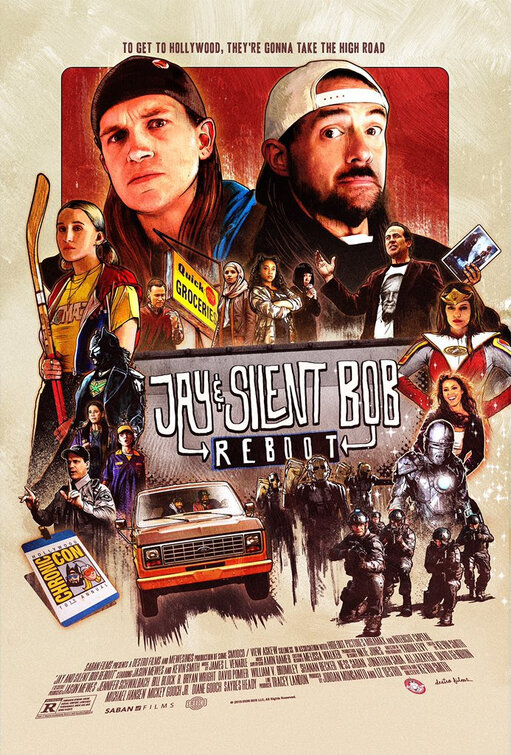
‘Jay and Silent Bob Reboot’ – The Duo is Back for Some High Times

Jay and Silent Bob Reboot poster

2001’s “Jay and Silent Bob Strike Back” was supposed to be the last installment of the View Askewniverse, but time has shown you cannot keep two stoners from New Jersey down. The duo would return in “Clerks II,” and now 13 years later following some serious drug problems and a near fatal heart attack, Jason Mewes and Kevin Smith have come back to play their iconic characters in “Jay and Silent Bob Reboot” which has the two up to the same shenanigans while finding new meaning in their lives. Like the average Kevin Smith film, it is imperfect but still a lot of fun. And unlike “Yoga Hosers,” you do not have to be stoned to enjoy it.

When “Reboot” begins, Jay and Silent Bob have been busted by the police for running an illegal marijuana operation in the old RST video store next to the Quick Stop. In court, they are represented by Brandon (Justin Long) who gets them acquitted upon convincing the judge (Craig Robinson) that the duo’s store was a temporary pop-up store designed to promote an upcoming movie. The case against them is dismissed which is a relief for them and me as I was not in the mood to watch a court movie. Things, however, take a sharp left turn when the same lawyer quickly switches sides and defends a representative of Saban Films which has optioned the comic book series “Bluntman and Chronic.” It turns out the two, when they were signing documents the lawyer said were necessary for representation purposes, inadvertently signed away their naming rights to Saban, and now they can no longer self-identify as Jay and Silent Bob ever again.

After meeting with Brodie Bruce (Jason Lee), Jay and Silent Bob discover Saban is planning a big budget reboot entitled “Bluntman v Chronic” which is being directed by… Well, you’ll see. Once again, our intrepid duo heads out to Hollywood in an effort to stop production in this reboot and reclaim their identities in the process.

Yes, the plot of “Reboot” is the same as “Strikes Back,” and even Smith has stated this new movie is “literally the same fucking movie all over again.” However, to dismiss this latest View Askew production as a lazy retread would be to miss the point. Smith is out to make fun of sequels, remakes and reboots, and he is not lost on the irony that “Reboot” is essentially all three of those things. What results is one of the most meta movies I have seen in some time as he threatens to be cleverer than he is, but it also results in a motion picture which kept me guessing as to what would happen next. Not all the jokes hit, but the ones which do had me laughing uncontrollably, and this includes one such moment which made me as light-headed as the “frosted” scene from “Zack and Miri Make a Porno.”

As you can expect, there are a myriad of cameos to be found throughout “Reboot” as well as a ton of easter eggs. One key cameo comes early when Shannon Elizabeth returns as Justice (a.k.a. Boo Boo Kitty Fuck), Jay’s love interest from “Strike Back.” It turns out Jay did get an answer to his question of “will you fuck me when you get out” as Justice introduces him to their love child, Millennium “Milly” Faulken (Harley Quinn Smith). But because Jay and Justice have been estranged for years to where she has lied to Milly about his whereabouts, she encourages Jay not to reveal to Milly he is her father because, well, you know. Still, Milly finds a way to join him and Silent Bob on their journey to Hollywood.

The moment where Jay discovers he is a dad is what makes this particular View Askew movie stand out as he is forced to confront a new responsibility no one is easily prepared for. It also allows for Jason Mewes to show a vulnerability here we have not seen from previously, and this makes for an especially heartfelt story. In real life, Mewes has become a dad himself, and this among other things is what has kept him from an early death. Seriously, there is real emotion to be found here in “Reboot” even for those who are not Kevin Smith fans in the slightest.

As for the other cameos, not all of them have been spoiled by the trailer, so I will go over the ones you already know about. Chris Hemsworth, in a movie filled with priceless “Thor” puns, plays himself and reminds us of his inspired comic performance in the “Ghostbusters” reboot. Ralph Garman of “The Ralph Report” can rest assured that his cameo as Ted Underhill lasts a lot longer than 17 seconds, but it could have lasted even longer so we too could get his character’s credit card number. Matt Damon’s cameo is so infinitely priceless to where I refuse to ruin it for anyone and, unlike Jimmy Kimmel, I am glad Smith made time for him. You also have Fred Armisen, Rosario Dawson and Kevin’s wife Jennifer Schwalbach making small but very memorable appearances, and be sure to take a look at the name of Craig Robinson’s character as it is like something out of a 1970’s exploitation movie.

But the best cameo here comes from Ben Affleck who returns as “Chasing Amy’s” Holden McNeil. Both Affleck and Smith had been estranged for some time, but even Affleck knew he had to be a part of this flick as Smith was responsible for giving him some of his first leading roles in movies. Plus, Affleck helps to give “Reboot” an even bigger heart as he talks about how children are like our own reboots, and this solidifies the evolution Smith had in mind for the various characters he has created over the years. While “Clerks II” dealt with the responsibilities of being an adult, “Reboot” looks at what becoming a parent does to your overall identity to where everything else in your life becomes secondary. Smith covered this before in “Jersey Girl,” a movie which I think is better than people typically give it credit for, but here it takes on a deeper meaning as both he and Mewes have danced with the Grim Reaper and have come out the other side with infinitely changed perspectives.

When it comes to the cinema of Kevin Smith, his movies are either for you or they are not. I have been a big fan of his since “Clerks” which contained one of my most favorite pieces of dialogue ever (“This job would be great if it weren’t for the fucking customers”), and it is a true joy to see him revisit his View Askew Universe. While he may not be as gifted as Martin Scorsese or Steven Spielberg, Smith still knows how to give us a fun time, and he does just that with “Jay and Silent Bob Reboot.” Even if you are not supposed to be here today, I would like to think this movie will find a way to cheer you up. And yes, be sure to stay through the end credits.

* * * ½ out of * * * *

‘3 From Hell’ Movie and Blu-ray Review

3D_RGB_3FromHell_BDCmboOcrd[4]

The following review was written by Ultimate Rabbit correspondent Tony Farinella.

After watching “3 From Hell,” I’m going to go out on a limb and say it is Rob Zombie’s best film with “The Devil’s Rejects” being right behind it.  This might be an unpopular opinion, and I might be in the minority on this, but this is one hell of a movie, pun intended.   Even though the late Sid Haig is hardly in the movie because of his health issues at the time, it is an incredible ride from start-to-finish.  There is never a dull moment in this movie.  This is the kind of balls-to-the-wall and in-your-face horror film which is missing from today’s cinemas.  It is a shame the film did not get a wider release as there is a lot to like here.

3 From Hell” picks up right where “The Devil’s Rejects” left off, and it shows the aftermath of the big finale.  Someway, somehow, Baby Firefly (Sheri Moon Zombie), Otis Driftwood (Bill Moseley) and Captain Spaulding (Sid Haig) have survived their shootout with the police.  However, they are in prison, which makes it quite difficult to unleash their unique brand of mayhem and chaos onto unsuspecting victims. Baby Firefly is still completely crazy and has little interest in trying to get out of prison.  She’s quite proud of what she has done behind bars and of how she has survived.  As a matter of fact, the three of them have quite a fan base now because of the news.

Otis Driftwood is able to escape out of prison thanks to the help of his half-brother Winslow Foxworth Coltrane (Richard Brake) who is new to this series of films.  However, he has worked with Rob Zombie in the past on “31” and “Halloween II.”  Even though he is no Captain Spaulding, he does a really good job of being a believable brother to Otis and a terrifying force.  Now that Otis and his brother are running around free, they need to find a way to reunite with Baby Firefly.  Without her, they are just not complete.  They write off Captain Spaulding as dying from lethal injection, which explains why he is not part of their team anymore.  Once the “3 From Hell” gang are back together again, things really get taken up a notch.  Sometimes their victims just happen to be in the wrong place at the wrong time.  The violence is unrelenting, brutal and completely raw, and this is a compliment to the highest degree in a horror film.

TFH_D3_01336.NEF

It is rare to see films like this made today, as I mentioned earlier.  This film is not politically correct, and it is not afraid to truly go for it without thinking twice or blinking. This is the unrated cut of the film, and it certainly holds nothing back with the violence or the nudity as well.  There is not a single moment in this film which is boring, lackluster or wasteful.  Rob Zombie takes a patient approach, but there is always something happening on screen that is capturing our attention as an audience.  At times, it plays like a horror western with some of the showdowns.  It’s also incredibly entertaining.

When “3 From Hell” was over, I had a huge smile on my face.  I realized I had witnessed something special and something which doesn’t find its way to your local theater with the proper marketing.  This is why it was given a special release through Fathom Events. A lot of people have complained about the film being a rehash of “The Devil’s Rejects,” but quite frankly I don’t see it.  With Rob Zombie, he doesn’t make films where things are black and white.  At times, innocent people die on screen. We find ourselves rooting for evil people who are doing evil things.  It is because they are entertaining, funny and totally unlike anything else in a horror movie.

Rob Zombie is a true horror fan, and it shows in the way the film was shot.  It had that grindhouse feel to it.  I loved the look of the film, and I especially loved the performances in the film.  At times, I felt like Sheri Moon Zombie was stealing the show with her antics on screen.  In other moments, I enjoyed the easy-going yet incredibly scary performance by Bill Moseley.  Richard Brake is just as off the wall as well with his performance.  If I had to pick one performance that really stood out, it would have to be Sheri Moon Zombie, though.  Granted, she is given a lot to work with on screen, but she’s more than up to the task of handling it all with relative ease. It’s hitting all the right notes.  I loved every single second of this flick.

* * * * out of * * * *

____________________________________________________________________________________________

Blu-Ray Info: “3 From Hell” is being released on a two-disc Blu-ray, DVD and Digital Combo Pack from Lionsgate Home Entertainment.  It comes with both the R-rated and unrated versions of the film, but the unrated version can only be viewed on the Blu-Ray. The film has a running time of 115 minutes.  For the rated version, it is rated R for strong sadistic violence, language throughout, sexual content and drug use.

Audio Info:  The English 7.1 Dolby TrueHD audio track is out of this world! It is exactly what I wanted out of this film.  It truly adds to the screams of terror when the violence is happening on screen.  It’s great during the scenes which feature some great songs as well. There are also subtitles in English and Spanish.

Video Info: The film looks outstanding on a 1080p High Definition 16×9 (1.85:1) presentation.  It is able to have an old-school grindhouse look to it, as I mentioned in my review, without sacrificing the picture quality which is sharp and top-notch.

Special Features:

Audio Commentary with Rob Zombie:  If you have ever heard an interview with Rob Zombie, you know what an intelligent and thoughtful filmmaker and individual he is.  He takes you through the entire filmmaking process and is never boring.  This is a commentary track which I highly recommend you listen to after watching the film on its own.

To Hell and Back: The Making of 3 From Hell (4-Part Documentary) (01:34:00):  This is almost as long as the film itself!  This is the kind of special feature I wish more filmmakers would add to Blu-rays. It shows on-set footage, behind-the-scenes interviews, and tons of knowledge on anything and everything you would ever want to know about this movie.  This is a top notch, A+ special feature.  I’m really glad they took the time to show us how this movie came together. Rob Zombie is as laid back as they come and very open to ideas from his actors.  Even though he is the writer/director, he only puts his foot down when it comes to notes from the studio trying to change his vision or tell him what to do on his films.

Should You Buy It?

HELL YES!!!  As soon as you have finished reading this review, you owe it to yourself to buy this movie as soon as possible.  This is my favorite horror movie of 2019, and it is one of the best horror movies I’ve seen in probably a decade.   Now don’t get me wrong: I love what Jordan Peele is doing with films like “Get Out” and “Us”.  However, this is, as director Kevin Smith called it, “Horror Heaven.”  If you like your horror films bloody, twisted, funny, unhinged, crazy and totally unfiltered, this is the movie for you.  The audio and the visuals are top notch as well as the special features.  Lionsgate did a tremendous job with this Blu-ray release, and I can’t recommend it enough!


‘Zombieland: Double Tap’ is Fun, But Also a Bit Stale

Zombieland Double Tap poster

For the record, I have seen the original “Zombieland” although it took being on cable one morning for me to watch it. In the midst of an endless sea of zombie movies and television shows, here was one which had a fresh take on the zombie apocalypse, and it proved to be endlessly entertaining throughout. While everything and everybody could have been easily upstaged by Bill Murray’s howlingly funny cameo where he is at his self-effacing best, it had a game cast of actors who reveled in the fun you could tell they were having during its making.

Now it is 10 years later, and we finally have the long-awaited sequel “Zombieland: Double Tap” (nice title). The cast now comes with at least one Oscar nomination under their belts, Reuben Fleischer is riding high after the commercial success of “Venom,” and screenwriters Rhett Reese and Paul Wernick have freed themselves from the “Deadpool” franchise long enough to pen this one. What results is definitely fun, but it also lacks the freshness of its predecessor, and everyone seems to be trying a little too hard to be funny and clever this time around. Plus, the sight of a zombie’s head getting bashed does not have the same visceral thrill it used to have.

When we catch up with our intrepid band of heroes, they are laying waste to the latest zombie horde as they make their way towards a government building which these days has had one too many unwelcome guests – The White House. Columbus (Jesse Eisenberg) has long since become a hardened survivor, and the many nights he spends with Wichita (Emma Stone) in the Lincoln Bedroom has him seriously thinking about marriage. As for Tallahassee (Woody Harrelson), he treats everyday in there like it is Christmas while Little Rock (Abigail Breslin) continually resents him for treating her like she is still a little girl. Things come to a head when Wichita and Little Rock suddenly become tired of life in the Oval Office and hit the road to find some new sights. After some hesitation, Columbus and Tallahassee do the same.

For a moment, I figured “Zombieland: Double Tap” would take place entirely in The White House and that the filmmakers would take great pleasure in ridiculing the terrible state of American politics. But since “Zombieland” took place largely on the west side of America, it only makes sense we find these characters traveling through various locales on the east coast which include, yes, Graceland. Like in any zombie movie, home is where you find it as no one can afford to stay in the same place for very long.

Seriously, these movies thrive on their inspired cast of actors. Woody Harrelson, who can play just about any role at this point in his career, looks to be having the time of his life as Tallahassee as we watch him channel Elvis Presley more often than not, and he makes his undying hatred of pacifism and minivans especially palpable. Eisenberg and Stone play off of each other wonderfully as they constantly try to prove who is more sarcastic than the other. As for Breslin, it has been fascinating to watch her grow up onscreen, and her yearning to look for other people her age in this apocalyptic world gives her character more room to grow than the others.

Still, there is a constant feeling of “been there, done that” which permeates these proceedings. Sometimes filmmakers can get away with doing the same thing one more time, but other times they fall victim to staying in their comfort zone to where things get stale very quickly. With “Zombieland: Double Tap,” it is an example of half and half as there is still much fun to be had, but what was once fresh now feels far past its expiration date. Plus, seeing these characters continually try to be cleverer than the other gets exasperating rather quickly.

One of the things this sequel really has going for it is new blood. Zoey Deutch, so fetching in “Everybody Wants Some,” is a scene-stealer as the infinitely dumb Madison. Sure, this character is a dumb blonde cliché, but Deutch is a hoot throughout as she makes Madison so adorably stupid to where I kept waiting for her to sing “Cause I’m a Blonde” at the drop of a hat. We watch a lot of movies like these waiting for dumb blondes to die a most horrible death, but Deutch gives us more than enough reason to see Madison live one more day and then die on another.

There is also the always excellent Rosario Dawson who shows up as Nevada, a fellow survivor who, like Tallahassee has quite the thing for Elvis. She and Harrelson have quite the chemistry together as they talk about their love for “the king,” and it is a shame she is not in the movie more. However, when she does reappear, it is at the perfect moment.

And there is no forgetting Luke Wilson and Thomas Middleditch who play… Well, just watch the movie to find out.

Fleischer does what he can to keep things rolling, and he gives us one great zombie attack sequence which lasts several minutes and looks like it was done in one shot. This sequel is never boring, but it still feels lacking in one way or another. Even when the main characters ban together to attack an amazingly large horde of zombies which threaten Babylon, an oasis of peace which is just asking to be laid waste to especially when you take into account it has a no guns policy, the climax is never as thrilling as it wants to be.

“Zombieland: Double Tap” is not a bad movie, but it is also not particularly memorable. Whether or not the fans of the original enjoy it, I do not think it will have the same staying power. Everybody here looks ever so happy to be reunited, and the fun is definitely on display, but that same amount of fun does not quite translate fully over to the audience. In the end, things could have been much worse, but this sequel is still a near-miss for me.

By the way, be sure to stay through the end credits as there is a couple of post-credit scenes which are funnier than anything else in this sequel. Trust me, it is worth waiting to go to the bathroom until after the lights come up.

* * ½ out of * * * *

‘The Cotton Club Encore’ Gives This Movie The Version it Deserves

thecottonclubencore-keyart

For years, Francis Ford Coppola’s 1984 film “The Cotton Club” was upstaged by its behind the scenes drama which included the cold-blooded murder of one of its financiers, Roy Radin. With Coppola teaming up again with producer Robert Evans and writer Mario Puzo, audiences must have been expecting another “Godfather” movie, but what they got was something quite different. Despite some good reviews, the movie proved to be a commercial failure, and far more time has spent documenting all of what went into its nightmarish making to where I am truly surprised Eleanor Coppola has never given us a documentary on it like she did with “Apocalypse Now.”

Now it is 35 years later, and Coppola has given us another version entitled “The Cotton Club Encore.” This version came about after he discovered an old Betamax video copy of his original cut which ran 25 minutes longer. From there, Coppola spent $500,000 of his own money to restore this film, and in the process he added 24 minutes and deleted 13 minutes to give us this new cut which just arrived in select theaters. For the record, I have not seen the original 1984 version, but after watching “The Cotton Club Encore,” I am certain I do not even need to bother as this cut is outstanding and absolutely exhilarating to take in. What seemed deeply flawed in the past now seems almost perfect.

In essence, “The Cotton Club” is about two men trying to navigate the hurdles life keeps throwing at them. One is cornet player Dixie Dwyer (played by Richard Gere) who arrives back in Harlem to see his family which includes his mother Tish (Gwen Verdon in an inspired piece of casting) and his brother Vincent (Nicolas Cage) who looks to be all too enthusiastic about becoming a mobster. After saving the life of gangland kingpin Dutch Schultz (James Remar), Dixie finds himself getting involved in the criminal element which, despite his better judgment, succeeds in elevating his career as a musician to a whole new level. In the process, however, he does make the mistake of falling in love with Dutch’s girlfriend, Vera Cicero (Diane Lane). Suffice to say, romances like these come with bloody endings rather than happy ones.

The other main man in this story is Delbert “Sandman” Williams (Gregory Hines) who, along with his brother Clayton “Clay” Williams (Maurice Hines, Gregory’s brother), get hired to perform at The Cotton Club, a jazz club located in Harlem which featured a roster of black (or African American if you will) performers who sang and danced their hearts out. While there, Delbert becomes infatuated with a singer named Lila Rose Oliver (Lonette McKee) to where he cannot wait to sweep her off her feet. But it doesn’t take long for the cracks to show in his personal and professional life as he gets constantly berated by club management which is intent on reminding him where his place is, and he later makes a decision which threatens to tear him and his brother apart forever.

The Cotton Club was a real club in New York which was open from 1923 to 1940, and while it did feature mostly black performers, no one of color could patronize it and the clientele was white. This irony ended up lasting all the way up this film’s making as the financiers, worried about the long running time, gave Coppola the following notes:

“Film’s too long. Too many black stories. Too much tap dancing. Too many musical numbers.”

Coppola by then was so burned out emotionally from the movie’s production that he acquiesced to the financiers and cut down many of the African-American related scenes to where the focus was more on the gangsters and the Gere/Lane love story. No wonder he sounds so weary when talking today about the changes he made and of how regretful he was about compromising his vision. It also serves as a sad statement of how things in show business did not change much as, even in the 1980’s, African-Americans were still getting the short end of the stick.

With “The Cotton Club Encore,” Coppola has restored much of the African-American storyline, and this is really where the movie is at its best. Seeing these actors and singers perform their hearts out is endlessly thrilling as is the director’s success in transporting us back to the bygone era of the 1930’s. Coppola really does take us back in time to where I felt like I lived through this era which brought with it great music, good and bad times, violence and, among other things, a stock market crash. Heaven forbid we ever go through anything like that crash again, huh?

One of the big treats of all though is watching Gregory Hines and his brother Maurice dance the night away. Both are extraordinary tap dancers, and the love they had for performing is on display throughout as they make their moves look like a piece of cake. Seeing Gregory here serves as a strong reminder of what an incredibly talented and gifted artist he was, and it is also especially bittersweet as he has long since left the land of the living. He was only 57 years old when he passed away after a battle with liver cancer, and he is still missed.

Indeed, this bittersweet feeling threatened to overwhelm me at times as “The Cotton Club Encore” features a number of actors who have since died like Bob Hoskins who portrays the ruthless club owner Owney Madden, and Fred Gwynne as his right-hand man, Frenchy Demange. The scene these two actors have together following a hostage situation is classic, and is another reminder of the talent we have lost over the years.

Another tremendous performance to be found in “The Cotton Club” comes from Lonette McKee, an actress I first became familiar with in “Brewster’s Millions.” With this new cut, Coppola has gone out of his way to restore her showstopping number of “Stormy Weather,” and watching her belt it out left me speechless. She doesn’t just sing the song, she lives through it, and it is an emotionally draining moment I still think about. It is one thing for a singer to hit all the right notes, and it is another to really perform it to where you are giving the most vulnerable performance imaginable, and McKee pulls this off beautifully.

The movie’s other main story of an illicit love affair had me worried for a bit as this tale has been told countless times on stage and screen to where we feel like we know how it will go. Regardless, it still proves to be enthralling in its own way. While it is easily upstaged by the African-American story, it is still fun to see Richard Gere and Diane Lane mix up as they prove to have a palpable chemistry which they would build on years later when they starred in Adrian Lyne’s “Unfaithful.” While it is a little weird to hear Gere’s Bronx accent at first, he quickly reminds us why he is such a magnetic leading man, and he proves to be quite the coronet player as well.

The only real problem I had with “The Cotton Club,” and this is probably the case with either version, is there are too many plot threads which meander, some of which fail to reach a fulfilling conclusion. Despite his efforts, Coppola is unable to manage these various threads to where everything fits into a cohesive whole. At times, it almost made me wish he cut more out of this version as things might have flowed better as a result. And yes, there is that fake head (you will know it when you see it) which proves to be as fake as the baby in “American Sniper.” Perhaps some CGI magic could have helped with it.

Still, when all is said and done, “The Cotton Club Encore” proves to be a stunning achievement as Coppola has finally given this film the version it truly deserves. While he may have come onto this project as a hired hand at first, it is clear to me he really fell in love with the subject matter and took joy in recreating a historical period which deserves far more than a passing glance.

It has been a big year for Coppola as he has announced plans to make his dream project “Megalopolis” a cinematic reality, and he also gave us another version of one of his classics with “Apocalypse Now: Final Cut.” With “The Cotton Club Encore,” he has righted the wrongs he made in the past, and he can now pat himself on the back instead of moan over the mistakes he made over 30 years ago. More importantly, this movie is no longer upstaged by its production stories and can now be appreciated on its own terms.

Relax Francis, you did great!

* * * * out of * * * *