‘Chappaquiddick’ Revisits a Tragedy No Kennedy Can Escape

Chappaquiddick movie poster

“They eat their wounded upstairs.”

Lieutenant Al Giardello tells Detective Frank Pembleton this on an episode of “Homicide: Life on the Street” to describe the politicians who have invited Pembleton to help them out on a delicate matter involving a congressman. So eager he is to impress his bosses, Pembleton suggests letting a police report get buried, covered up, and the Deputy Commissioner orders him to do so. But when this matter is made public to where a scandal erupts in the news, the Commissioner denies his own involvement and lets Pembleton take the fall. Pembleton has become one of the wounded as the higher ups in the department hang him out to dry, and we see what politicians will do to keep their political currency protected at all costs.

I kept thinking about this exchange while watching “Chappaquiddick” which takes us back to the year 1969 when Senator Ted Kennedy was involved in a car accident. While attempting to cross the Dike Bridge on Chappaquiddick Island in Massachusetts, his car went off the side and plunged into the water. Ted was able to free himself, but his passenger, Mary Jo Kopechne, remained trapped inside and eventually drowned. Ted failed to report this incident to the police until 10 hours after it happened, and we watch as his closest advisers look for ways to spin the story to their advantage as the scandal threatens to derail Ted’s political career and forever tarnish the image of the Kennedy family.

The car accident is presented in bits and pieces throughout because, as anyone who has been in an accident can tell you, no one remembers everything in a linear fashion. After the initial accident, the story jumps ahead to a soggy Ted Kennedy walking slowly back to the house where he, his advisers and secretaries were having a party. When his close friend Joe Gargan sees him shivering in the back of a car, Ted simply says, “I’m not going to be President.” From there, everyone goes into damage control mode as they try to get a hold of the narrative and manipulate it to where Ted will come out of this accident in one piece. But there is still a dead body in the center of this tragedy, and some in the inner circle are not about to let this fact go away.

It’s fascinating to watch the political spin machine at work in “Chappaquiddick” as this kind of press manipulation is a regular thing these days, but even back in 1969 the truth was not so easy to bend as the truth still found a way to the surface. Still, we feel the pressure of the press as Ted and company scramble to come up with an answer which will exonerate the Senator in the eyes of his constituents and America at large. There are scenes where his advisers come up with ridiculous scenarios to explain Ted’s actions, like getting a physician to explain how Ted suffered a concussion in the accident even though he isn’t given a chance to examine the senator. Then there’s the story about how Ted was put on sedatives because of his concussion, but a reporter points out how taking sedatives in this condition could easily kill him. And let’s not forget the neck brace fiasco which Ted didn’t even bother rehearsing. There was no Facebook or social media back then, but there was still enough attention paid to where Ted could not walk away from this tragedy unscathed.

At the center of “Chappaquiddick” is Jason Clarke who portrays Ted Kennedy. Many actors could have easily fallen victim to simply playing the late senator as the icon we all see him as and saddle themselves with an accent which makes them sound like Mayor Quimby from “The Simpsons.” Clarke never falls into any of those traps and instead makes Ted as human as anybody else, full of flaws and passions which at times get the best of him. It’s a wonderfully complex performance as Clarke shows how Ted worked to control how the news of this tragedy coming out while wrestling with a conscience that will not let him escape the guilt he feels. Just watch Clarke as he phones Mary’s parents to inform them of her death. It’s a heartbreaking moment, and not an easy one to pull off.

Special mention goes to Kate Mara who plays Mary Jo Kopechne. It’s a small role, but Mara makes the most of her time onscreen as she forces us to see Mary as much more than a mere historical footnote. We learn Mary was a devoted supporter of Bobby Kennedy and his values, and she desperately wants to believe Ted can deliver on the same promises Bobby made before he was killed. This makes her final onscreen moments where Kate is desperately keeping her head above water as she hopes for a miracle which never comes. Whether or not you knew of Mary Jo’s existence before this movie, Mara’s performance ensures we never forget her once we leave the theater.

Indeed, the entire cast of “Chappaquiddick” is well chosen as each actor inhabits their role with a lot of passion and energy which makes this more than the average biopic. Ed Helms and Jim Gaffigan get to break free of their comic roles here as Joe Gargan and Paul Markham, two of Ted Kennedy’s closest advisers who are desperate for him to get his story straight before he does even more damage to his image. Helms is especially worth singling out here as he makes Joe the conscience Ted desperately needs to pay attention to, and whether or not Ted does is not worth revealing here as you have to look into Helms’ eyes to see what the answer is.

One truly brilliant performance worth singling out here comes from Bruce Dern who gives an almost wordless performance as Joe Kennedy, the patriarch of this famous family. When we meet Joe, he has long since become hobbled by a stroke and aphasia, and this makes Dern’s work all the more challenging as he has to express things to the audience without the use of words. The final scene he has with Clarke is brutal as the frustrations and disappointments these two have with one another come to their breaking point.

It’s great to see Clancy Brown here as the no-nonsense Secretary of Defense Robert McNamara as he cuts through the bull to make sure the narrative runs as smoothly as possible for the incumbent senator. From the first moment he appears onscreen, the “Highlander” actor shows the audience he means business as McNamara moves quickly into damage control mode and freaks when the most thoughtless of mistakes are made by subordinates.

Olivia Thirlby also shows up here as Rachel Schiff, another loyal Kennedy secretary and close friend to Mary. It’s fascinating to watch Thirlby here as she takes Rachel from being totally devastated upon learning of her friend’s death to racing into damage control mode. Whatever you may think of her actions, Thirlby shows how devoted she is to the Kennedy family as she feels the country cannot suffer over one person’s mistake.

Also worth mentioning is Vince Tycer, a noted theater director in Connecticut, who plays David Burke, an individual known as a aide to powerful men. It’s fascinating to watch Tycer in “Chappaquiddick” as he hovers in the shadows next to Ted Kennedy and looks ready to defend the senator’s honor in any possible way. This is another character who could have been played in too broad a fashion, but Tycer plays David in a thoughtfully subtle way as this is a character who is more than willing to set aside his own thoughts and desires for something he considers to be the greater good.

“Chappaquiddick” was directed by John Curran who previously helmed such movies as “The Painted Veil” and “Tracks,” and he wrote the screenplay for Michael Winterbottom’s highly controversial “The Killer Inside Me.” Curran gives this film an underplayed feel as he wants us to see these characters not as historical figures forever defined by their public images, but as people like you and me. The more we see ourselves in these characters’ shoes, the more we get sucked into the story to where this becomes more than your average biopic or just another movie which is (sigh) “based on a true story.”

The only real problem I had with this movie was it felt a little too underdone to where an infusion of energy could have come in handy. I kind of wish Curran had livened up the proceedings at times, especially when it came to watching the walls close in on Ted. There is passion on display here, but that passion could have been stronger in retrospect.

Regardless, “Chappaquiddick” proves to be a fascinating look into the broad scope of political power and at the life of a man born into privilege who uses it to escape a harsh punishment with his career mostly intact. Ted did go on to become the “Lion of the Senate” as he fought long and hard for social justice and universal health care, but I left this movie wondering if his actions were taken to atone for his part in Mary Jo’s death. In the eyes of many Americans, he earned his forgiveness, but a closeup of Clarke’s eyes in this movie’s final moments suggests Ted never fully forgave himself. Did he truly earn a redemption in the years following this accident? We may never truly know, and this makes “Chappaquiddick” especially haunting.

* * * ½ out of * * * *

Exclusive Interview with Toby Regbo about ‘U Want Me 2 Kill Him?’

Toby Regbo in U Want Me 2 Kill Him

In “U Want Me 2 Kill Him?,” Toby Regbo gets one of his biggest and most memorable roles yet. The movie is based on a true story which was chronicled in Vanity Fair about a 16-year old schoolboy who gets arrested for attempted murder. His explanation was he was working under orders from an MI5 agent, but the truth of the matter ends up revealing something far more shocking.

Regbo plays John, a lonely boy who gets picked on at school and is later befriended by one of the most popular students there, Mark (Jamie Blackley). The friendship comes about because John’s sister Rachel (Jaime Winstone), whom Mark has developed an online relationship with, asked him to look out for John. But when Rachel is found murdered, both John and Mark in their devastation vow revenge against the person who took her life. What happens from there is not worth giving away, but it resulted in one of England’s most shocking crimes and showed us all how much of a threat the internet can be.

I got to speak with Regbo over the phone about his role back in 2013. During our conversation we talked about how his role reminded him of his years as a teenager, how much time he spends on the internet, the challenges of playing a character based on a real life person, and he even gave me an update on “Maleficent” which he was cast in.

U Want Me 2 Kill Him poster

Ben Kenber: Were you aware of the Vanity Fair article or the true-life story this film was based on before you got the script for it?

Toby Regbo: Not before I got the script. I read originally for Mark, the other character that Jamie Blackley ended up playing which is a good thing the roles ended up that way. But no, I didn’t know anything about it until I auditioned for it, and then once I got close to getting the part then I started looking further into it. I read the article and I also had some information that wasn’t in the article. I met the journalist who wrote the Vanity Fair Article (Judy Bachrach). In fact, she came to the set. But once you know the story, you want to know as much as possible about the case. It’s so mental that this happened.

BK: What appealed to you most about the role you ended up playing in the film?

TR: It’s hard to talk about the film without giving too much away.

BK: Yes, that’s true.

TR: I guess the interesting thing for me was trying to play the scenes in the movie without giving any tells to the ending. That was the key for me, trying to create something that was believable enough that you don’t see it coming I guess, at least for not a long way away.

BK: Yes, that must have been tricky because you read the script and wonder how you can keep from revealing everything. That must have been a challenge for everybody involved.

TR: We did a lot of rehearsals which is great. It’s the most rehearsal I’ve ever done before starting a film. Andrew Douglas, the director, and his wife Lenore sort of coached us (me and Jamie) through the movie. We did three or four weeks of rehearsals beforehand and working everything out. It was about just trying to keep them real, trying to find out exactly what motivated them. We did a whole bunch of work with sort of character objectives. We used this book called Ivana Chubbuck’s “The Power of the Actor” and we worked out what motivated our characters.

BK: Do you prefer to do a lot of rehearsal before you shoot a movie or does it depend on what movie you’re working on?

TR: It just depends on the whole vibe. I do like rehearsals, but at the same time the best stuff that ever happens is stuff that you don’t plan for. You can do things to death, but you just got to get out and do it for real. I’m doing this TV show and we’ve been shooting for like ten months now, and I’ve never shot that long before. It’s like a different process. You shoot like 8 pages a day, you get scripts like a couple of days beforehand, there’s not much preparation time and you just got to sort of go with it. It’s great training as an actor.

BK: I agree. The chemistry you have with Jamie Blackley onscreen is terrific and you two come across as very down to earth and really good friends. This makes the eventual unraveling of their friendship all the more painful to witness. How did you two develop that chemistry?

TR: It came to us naturally. Jamie is one of the easiest people to get along with that I ever met in my life. And also at the same time, when we started filming we both had fallen in love with girls at the same time, so we had that camaraderie on set. We were always talking about how long we should wait until we say I love you to a girl, so we both had that commonality. It worked out for Jamie, it worked out for me.

BK: Before you made this movie, did you spend a lot of time on the internet and in chat rooms?

TR: I’ve never been in a chat room before. There was a time where we used to go on MSN Hotmail a lot when I was like 14 which was a fucking nightmare. More than anything else, the social media revolution has helped kids talk shit about each other at an exponential rate. It’s been a lot of fun on there talking about who kissed who and what boy did what, and that was a great fucking waste of time for a couple of years. I’ve sort of grown away from it now. I thought I go and do a lot of other things than just waste all this time online.

BK: Were you able to do a lot of research on the person your character was based on? We find out at the end of the movie that a lot of information can’t be revealed due to certain laws in England.

TR: Yes, and I think that’s for the best. The character that I play, I based it on the script which was based on the Vanity Fair article. But I felt very distant from whoever this unknown boy, now a man, is. I don’t know the name, I don’t know who he is, I have no connection with him at all and I think that’s the way that it should be. On Demand on my TV earlier today I saw the trailer for the “Diana” movie. The story is about Diana and how the press ruined her life and how they like ended it. However you want to look at it, it was this terrible event that happened and now she’s dead, but they’ve made a fucking movie about it. I mean the hypocrisy of like saying oh look how terrible it is that the media ruined her life, and then they’ve made a movie about it. That doesn’t seem to make any sense. But I did feel a responsibility playing someone who is real. Although they did a very terrible thing, they shouldn’t have to have this film on their shoulders for the rest of their lives. It based on a true story, but there is this creative license in it.

BK: It’s interesting because with certain movies that are based on true stories, many actors feel the need to learn as much as they can about the real person they are playing to the point where they fall into the trap of impersonating them. I guess knowing less about the person your character was based on was probably more freeing for you because you weren’t shackled to that.

TR: Yeah, I mean I think for some actors they love that. They really want to get inside the heads of the real person, but I find it very, very strange to try sort of mesh this other person over the top of you especially when it comes to your voice and like doing an accent and that sort of thing. I think its dangerous territory where it can become an impersonation. I would always approach playing a real person with extreme trepidation, but in this case I felt like I was playing the character that was written on the page rather than this actual boy who is out there in the real world.

BK: I imagine you’re not far from the age of the character you play in this film. Did playing this role bring back any memories of being a teenager for you?

TR: I was 19 when we filmed it and I’m 22 now. Bringing back memories of a teenager would’ve only been one year. To be honest, being a teenager is fucking shit most of the time. Kids are really, really horrible, and I totally understand escapism that both of these boys are sort of trying to pursue through the power of the mundane inanity being a teenager growing up in the suburbs trying to have the “mad life” as Mark would put it.

BK: I see that you were cast in Disney’s “Maleficent” as the young Stefan. Can you tell us anything about that movie?

TR: Well I can tell you that I’m not in it (laughs). I worked two weeks on that and there was some studio nonsense. Basically they wanted the character that I was playing to be younger, much younger. We were doing this prologue to the film and they wanted 10 rather than 16, but they waited two weeks into filming before making that decision. I’m still glad that I got to be on that set. I’ve never done anything like that before, and I hope that it turns out well. It’s amazing what they are doing there, and I never been in something with such a big budget. Just the level of detail… There were these chests on the set, these like fairy chests or whatever, and you open them and they are like filled with all these intricate gilded swords and beautiful linens and stuff. The level of detail was amazing. I’m sad I’m not a part of it.

I want to thank Toby Regbo for taking the time to talk with me. “U Want Me 2 Kill Him?” is now available to own and rent on DVD, Blu-ray and Digital.

Exclusive Interview with Andrew Douglas about ‘U Want Me 2 Kill Him?’

U Want Me 2 Kill Him poster

U Want Me 2 Kill Him?” is yet another in a long line of movies “based on a true story.” But after watching it, you have to believe it’s true because no one could make a story like this up. Based on the Vanity Fair article by Judy Bachrach, it stars Jamie Blackley as Mark, a very popular high school student who ends up getting into a relationship with his online girlfriend Rachel. Mark ends up becoming so hopelessly in love with Rachel to where he’s willing to do anything to win her favor, and she soon has him befriending her lonely younger brother John (Toby Regbo) who gets picked on at school every day. As a result, Mark and John develop a strong friendship which soon leads them down some very dark paths that will have them doing things they never believed they were capable of. It all leads to one of the most shocking and baffling crimes in England’s history.

The movie’s director is Andrew Douglas who is best known for making the acclaimed documentary “Searching for the Wrong-Eyed Jesus” and for helming the 2005 remake of “The Amityville Horror.” I got to speak to him about “U Want Me 2 Kill Him?” which I felt served as a reminder of how threatening technology is in this day and age, and of how the emotions of a teenager are always simmering just beneath the surface. Douglas talked about the long road it took to get this movie financed and made, how familiar he was with the real-life story, and he also gave me an update of what’s happened to Mark and John since the movie’s release.

WARNING: THIS INTERVIEW DOES CONTAIN SPOILERS.

Ben Kenber: I was not at all aware of the true story this movie was based on. Were you aware of this story or the Vanity Fair article it was based on before you got the script?

Andrew Douglas: I’m not a big magazine reader anymore because of the internet, but for some reason I did look at that magazine and I did see the article. Ever since “The Amityville Horror” I’ve always got a weather eye out for projects. I didn’t know at the time what it could be or what it might be, but it just seemed such an extraordinary story. Being in America and finding a story from back home was also very appealing, and then it took a couple of years (to get it off the ground). It had a funky journey because uncharacteristically I tried to buy the rights to the story. It wasn’t something I’m used to, but I did have an agent and I reached out to try to buy the rights to that story thinking it was so extraordinary that I got to be able to do something with this. In the meantime, Bryan Singer of all people had also reached out and snagged the rights. So, a year went by or maybe six months, and a script came out based on that story which Bad Hat Harry, Bryan Singer’s company, had produced and it was pretty good and I took a meeting on it. It went into the air as what’s called an open directing assignment, so I managed to arrange a meeting on it. In the meeting I pitched a slightly different interpretation of the same material, and then another year went by during which the studio the project was with, Warner Independent Pictures, went down the tubes taking the script with it. So, all of a sudden that material was untouchable, so Bat Hat Harry got in touch with me and said, “Remember the take that you had on this story?” I said, “Yeah.” They said, “Well could you come in and re-pitch it to Bryan?” So, I did and they really liked it and they felt it was sufficiently different from where they’ve been in order to start again with the same thing. Over the next year I developed up the script and I found a young English writer who had a great voice for authentic youth, and I presented it to Bad Hat Harry and got my commercial company, Anonymous Content, involved a little bit as well to pony up some money, and all of a sudden, we had a film. Interestingly, right around the time I was shooting, there was also in London an opera based on the same article. I went to see it and it was kind of very operatic and it couldn’t be more different from the film, but it was very interesting to me that here’s a story that grabbed at least three different people in three different ways. The first script was quite documentary in the sense that they presented the kids from a kind of adult perspective, and really to me it was a story of how weird the world is. The opera was told from the police woman’s point of view, so to some extent the story was really about a police woman being puzzled by the internet and by the strange landscape of the internet. My take on it was here’s this weird world, here’s this odd landscape that we haven’t really explored in literature or in film yet, but I’m going to approach it from the point of view of one of the inhabitants of it. The idea was to see if I could find a way through the perplexing nature of what Mark does. What was interesting to me as a kind of challenge was we have these two ordinary boys, more or less ordinary boys, who live in an ordinary town, horribly ordinary, who go to a regular school. They are not project kids, they are not kids who are used to knives or used to violence. How do they make the journey that they made? That was really a kind of interesting challenge to me, and I felt as though it would be best served by really taking on the point of view of one of the kids. It could’ve been either of them funny enough, and John certainly makes an interesting journey as well. But I thought Mark was slightly the more difficult journey to explain; a regular kid who’s handsome and good at football and popular with the girls. What is missing in his life that he needs this thing so badly, that he needs to go as far as he goes? And I just thought that was both interesting in a conventional drama, but also interesting in the context of this new landscape of the internet.

BK: Yes, absolutely. These days people seem to be more open with one another on the internet than in real life when they are face-to-face.

AD: Yeah, I think that’s true, and also not necessarily honest as well of course. One of the things that internet provides then and now, even though we have cameras now which we didn’t have in the wild west of 2003, is the secret language of texting. So, I might be projecting on this, but there is still something very alluring, hopefully not with my kids, about what is called the dark room. Being able to go into a dark room where nobody knows you and nobody can really see you and you can be anything. Maybe it was two years ago that there was a floater piece about young gamers with their avatars. They had a real portrait of the gamers and then right next to them was their avatars, and it was so interesting and, in many ways, it was like a pageant. You get for example a disabled person or another person or the most extreme avatar who is everything that they weren’t, and it was very interesting and moving to see that article. I think to some extent this is what we do and this is what my film’s about. The film doesn’t judge them. Mark says early on to John, “I want a mad life like you have,” and John gives him one. He so does for six months there; he gets a very, very mad life. John on the other hand, he’s just sort of like a brother or somebody to look out for him, and you get that. So, I try not to judge the kids and say they’re weird or they’re bad. I just try and say that in a funny way both kids got what they needed and what they weren’t getting from home. And I thought the judge was very cool. I copied the dialogue straight from the court transcripts, so when the judge says that each boy is an extension of the other, that’s actually what the judge said. I thought that was like one of the coolest judgments. You’ve got to expect courts to be that smart, and I just thought that was really interesting because it was something that nobody had really seen before. It was a new crime so John was accused of organizing his own death, and Mark equally was accused of stabbing him. So, for the judge and for all the generations of the legal institution, it was very perplexing which could have been another take on the movie of course. This is material that has many different points of view on it. Somebody else could’ve taken it from the point of view of the trial and try to figure that out. You know how cool “The Social Network” was? It was all based around those court hearings. That could have been another way to go, but you just make your choices and I am pretty happy with how it came out. There are moments where it has to kind of stretch credibility. I had Mike Walden (the movie’s screenwriter) write the characters as realistically as I could bear, but still when you look back from the end of the film they’re melodramatic. They’re still not quite real and that was kind of intentional. The film is almost more fun watching it the second time. A film like “The Usual Suspects” or “Fight Club,” when you watch these kinds of films a second time you see all the tricks, and it’s very satisfying the see how the filmmakers flirted with showing you everything.

BK: This is definitely a movie that needs to be watched at least twice to see how the characters managed to accomplish all that they did. “U Want Me 2 Kill Him?” also reminded me of what it’s like being young and how the emotions of a teenager are just simmering below the surface to where they don’t know how to deal with certain things.

AD: Right, and the stakes for a kid dealing with those emotions are always so high. So, here’s this person online who he never met. He has a girlfriend of sorts, although that other girlfriend in the real world is just kind of messing him around, but here’s this girl he’s never met and he knows the stakes are so high somehow, and that kind of felt true. You’re absolutely right in what you just said. You have a feel as though one meeting and he loves somebody, and then they die and then you have to seek revenge. Teenage emotions, they run so big really.

BK: Yes, they do. It’s almost easy to believe that a young teenage boy could do what he did, and that’s scary too because when you’re that young and you feel the need to do something, you can get easily manipulated. The other thing I found fascinating, even though we know what happens at the end, is how the movie shows the power women can have over men.

AD: Yeah, it’s all about sex in a way. What John is so instinctively clever about is that every kind of invention is really about sex or power. So, to create Rachel or somebody you talk about, but also somebody who is also in danger and in jeopardy… I didn’t really invent that, I kind of refined it. I was very careful to stay pretty close to the instant messaging transcripts, so all those characters come right from the source. So, John was kind of preternaturally clever in understanding that Mark is going to fall for both the damsel in distress and the sex, and this is going to be too alluring for him. Each time he loses Mark’s attention, he has to up the stakes to invent something even bigger. So finally, he invents the spy woman, and again the relationship is very kind of sexual. It’s funny in that there are so many ideas there and a film can only tackle a few without getting too dense. You’re right, that’s so interesting.

BK: At the movie’s end it is said that only so much can be revealed about these two boys because of their age, and they were ordered to never contact each other ever again. Since the making of the movie, has there any other news about these two boys?

AD: No, and it’s so disappointing. When I was doing screenings in London, I was so hoping that in the audience was one of them. I was so hoping that one of them would come out. I always imagined it was going to be John. My interpretation of his character was that he was kind of very proud of what he did. I tried to capture that when he’s proud of that scar. And I felt as though Mark might be more humiliated by the whole thing and that he might well disappear and use the anonymity of the court much more than John. But I felt that John would continue being a con man which is why I do that thing at the end where he’s still conning. That felt as though the con man as a character… We know now as grown-ups that they use people and that they always have to romance us and exaggerate, so the con man as kind of archetype, it’s hard to break that. But sadly, I never found out about them, and I really wish I could. Remember that film “The Fighter” that Christian Bale was so good in as the messed-up boxer? At the end of the movie you get this real satisfaction that you see the real guy (that his character was based on). I’d love to have been able to do that because it just kind of completes the circle, and it also nails down that this extraordinary thing you just saw is real. I would’ve loved to have done that. I would’ve loved to have been able to show pictures of them now. It would’ve been very satisfying to do that but no, not a glimpse.

BK: This is not a story you could easily make up. It definitely feels like it came from real life.

AD: I know, it’s too extraordinary isn’t it? Sometimes during the filming, I was going, “Oh man I wish I could put ‘based on a true story’ several times through the movie because otherwise people are just going to think I’m crazy to expect people to believe this.” But since I made this film, there was a big event here in America with that Heisman Trophy winner with that Hawaiian name. It just shows you what people will believe like Christianity or something like Mormonism. People believe what they need to believe, I think, at every kind of level. It’s almost as if the internet is like a new country or a new landscape, and I’m a bit surprised that there aren’t more movies about it. One of the things that occurred to me is that I think maybe studios are scared of films where the danger is all going to happen on the computer. I know that was certainly true for myself when I was trying to get financing for the movie. They said, “Oh is it all going to be on computer?” That’s why I kind of invented that thing where often times they are talking, so it doesn’t feel as though it’s all written onscreen. I’m just a bit surprised there aren’t more films coming out (on this subject).

BK: Yeah, it’s been a while. If you look back over the years, it’s kind of been an ongoing theme here and there like with movies such as “WarGames” from the 1980’s.

AD: Oh yes Ben, you’re absolutely right. I had forgotten about that.

BK: It’s interesting to see how technology has evolved over time. Even back then it was a threat, but technology is even more of a threat today than ever before.

AD: Right, right. I think that there was one moment in the film when the police are interviewing Mark’s parents in his bedroom and his dad says he just sits on that thing and points at the computer, not understanding that the computer is a door. It is a door to a place that the dad knows nothing about. That wasn’t kind of forefront in my mind as a parent or anything. It wasn’t meant to be a cautionary tale. It was meant to be a roller coaster to be honest. It’s really true that parents don’t quite understand that this technology is a back door, so who knows what?

BK: How did you go about casting the actors in this movie? They are all really good and very natural.

AD: Yeah, they’re terrific. It was just a normal process really. It started by trying to get real people cast. I really like Shane Meadows’ films like “This is England” and he always tends to use real people. But I quickly found that the script and the ideas and the characters were actually too complicated for real people to kind of be able to layer it, and so I went back to more conventional casting. It took a while. It took a lot of backwards and forwards with like 40 or 50 kids. Jamie was a stretch because that boy had to shave every hour (laughs). He’s got a real heavy beard. While everybody else would be having lunch, we sent him off to shave again.

BK: Much of the movie looks like it was shot handheld.

AD: That was intentional. There was a limited budget, but also it felt that the film would be best served if it looked very realistic because the story is so unrealistic. I felt if I shot it as realistically as possible, not quite documentary but very handheld and very real, I thought as though that would create a tension within the story.

BK: I liked that because you watch this movie and it just washes over you. It does feel like you’re being invited into these kids’ private lives in a way you wouldn’t necessarily be invited otherwise. In some cases, people might view this story as being rather convoluted, but it is based on a true story and the realism of it aids the movie very well.

AD: Oh good, I’m glad to hear you say that.

BK: Well thank you for your time Andrew, it has been very interesting to talk with you and I thank you for your time.

AD: Not at all. I appreciate your liking this film. Independent films need help; they need champions so it’s really great that you’re supporting independent films. It’s also easy to just go for the big studio films, but then I think we lose something. I’m a big fan of all kinds of movies. Along with everybody else I’ll be there watching the Superman or the Spiderman and I’ll be there on the first day, but equally I just love independent cinema and I love the way it deals with often times more grown-up ideas. It’s all great.

BK: I agree. My hope is that independent cinema goes through another renaissance really soon.

AD: Oh, I know, absolutely because you see films like “12 Years a Slave” or even “American Hustle” and they are very independent in spirit and they do so well. So, it just feels as though we don’t just want to watch tent pole movies. It’s just not enough because that’s too simplistic and sometimes you feel as though all you are is a consumer. You’re just consuming a kind of product. And with big movies they have less and less dialogue because they travel more easily like a “Transformers” movie. There’s not any dialogue in them anymore because that way they can just export it all over the world, and you just feel like a sucker sometimes.

“U Want Me 2 Kill Him?” is now available to own and rent on DVD, Blu-ray and Digital.

‘The Imitation Game’ Presents Alan Turing to a New Generation

The Imitation Game poster

Movies “based on a true story” keep coming at us like Election Day fliers in the mail, but “The Imitation Game” is one of the few that actually deserves our full attention. It portrays the life and work of Alan Turing, one of Britain’s most extraordinary heroes, whose efforts and accomplishments remained unsung for far too long. At the same time, it is a movie about secrets; how we keep them, the importance of keeping them and of the damage they can do when uncovered by others. What starts off as a typical biopic becomes something much more as we watch how Turing and his crew of code breakers helped bring an end to World War II, and of how his life came to a tragic end through needless and unwarranted intolerance.

When it came to finding the right actor to portray Alan Turing, the filmmakers could not have found one better than Benedict Cumberbatch. While other actors would have made the mistake of portraying Turing as some kind of Dr. House clone, Cumberbatch turns him into a fascinatingly complex human being who is brilliant, socially awkward, and very vulnerable in a time where being vulnerable could be a huge liability.

For those who don’t know, Turing was a brilliant mathematician and cryptanalyst who worked at Bletchley Park, the top-secret Government Code and Cypher School during World War II, where he created a machine which succeeded in breaking Germany’s seemingly unbreakable Enigma machine. Cumberbatch makes it clear just how incredibly smart Turing is during his first meeting with naval commander Alastair Denniston (Charles Dance) as he turns a hopelessly bad job interview into an unforgettable demonstration of his deduction skills.

What I loved about Cumberbatch’s performance is how he makes Turing curt with people in a way which is arrogant but not necessarily mean. It’s no surprise his fellow co-workers have a tough time warming up to him as he is determined to do things his way and has little time for anybody who doesn’t think as fast as he does. But part of the fun is watching Cumberbatch take Turing from being an anti-social human being to one who is genuinely eager to involve the rest of his crew in breaking Enigma.

One of the colleagues who came to be a big help to Turing is Joan Clarke, a Cambridge mathematics graduate played by Keira Knightley. Her entrance in the movie is great as the other men consider her to be in town only to apply for secretarial work, but Knightley makes Clarke into a very confident character who is more than ready to prove her worth in a male dominated environment. She also becomes one of Turing’s best friends through thick and thin as she helps ease him into social gatherings and become one of the guys instead of such an isolated individual. Even as Turing’s life heads down the tubes, Clarke is still there for him as she understands him in a way few others do.

I figured “The Imitation Game” would climax with Turing’s machine breaking Enigma, and the sequence where Turing and the others succeed in doing so is intensely exciting. But in a sense, it marks the beginning of the end for this group as they come to discover how the secrets they have uncovered lead to other secrets being made and kept for the good of the people. There’s even a scene where Turing’s crew discovers when a cargo ship is going to be attacked, and they debate on whether or not they will stop it as doing so risks undoing all the work they have accomplished. I love it when dramatic movies provide characters with such difficult dilemmas to solve, and this film comes with some of the most agonizing.

Again, this is a movie about secrets, and it becomes fascinating to see how the keeping of these secrets comes to deeply affect each character. True identities are revealed and compromised, and while certain secrets are kept in the dark to give England an advantage in the war, others secrets come to destroy those who had the misfortune of living in a time where certain behaviors and orientations were criminalized. Turing is the one who suffers the most as his private life is revealed to the world which forces him to face an utterly cruel and unnecessary punishment.

“The Imitation Game” was directed by Norwegian filmmaker Morten Tyldum whose previous works include “Headhunters,” “Fallen Angels” and “Buddy,” and he also directed “Passengers” starring Jennifer Lawrence and Chris Pratt. Tyldum has done an excellent job in transporting us back to the days of World War II in a way which feels unique and not overly familiar. His emphasis is on the characters just as it should be, and he succeeds in making this not just another traditional biopic. He pays great respect to Turing throughout as this is a man who made a huge difference not just in World War II but also in the development of future technologies we have become far too dependent on these days.

Cumberbatch has long since proved how great an actor he is with his work on the London Stage and on “Sherlock,” and he was prominently featured in “The Hobbit: The Desolation of Smaug” and “Star Trek into Darkness.” In “The Imitation Game,” he takes us on quite the emotional ride as we see him triumph in what he does best and suffer horribly in a time where he doesn’t quite belong. He makes you feel Turing’s pain as it is reduced to a shell of what he once was, and the scene where he is unable to even start a crossword puzzle is devastating to witness.

But Cumberbatch isn’t the whole show here as he is surrounded by a wonderful group of actors who are every bit as good. Keira Knightley does some of her best work yet as Joan Clarke, the woman who comes to understand Turing the best. Matthew Goode, so unnerving a presence in “Stoker,” is the epitome of perfect casting as Hugh Alexander; the chess champion and man about town we would all like to be in our everyday lives. Mark Strong makes Major General Stewart Menzies a deeply enigmatic (no pun intended) character who knows far more than he ever lets on. And then there’s Rory Kinnear who portrays Detective Robert Nock, the man who investigates Turing and becomes very eager to keep his life from being ruined. Kinnear is very strong as he shows us the detective’s inner conflict in convicting a man who is truly responsible for saving many lives.

Turing ended up taking his own life at the young age of 43, and it is only in recent years that he has people have acknowledged the terrible treatment he received. In August 2009, John Graham-Cumming started a petition urging the British Government to apologize for Turing’s prosecution, and then Prime Minister Gordon Brown acknowledged and described Turing’s treatment as “appalling.” A few years later, Turing received a pardon from the Queen under the Royal Prerogative of Mercy, but many are still waiting for an apology over the way he was treated chemically. This man was responsible for helping to end the Second World War, and while he was alive he was treated with derision more than respect by many. Thanks to “The Imitation Game,” people will now see the kind of person Turing really was and why he deserves to be seen and celebrated as a hero. Believe it or not, his creation of his machine became the prototype for what we today call computers.

This is a terrific film.

* * * * out of * * * *

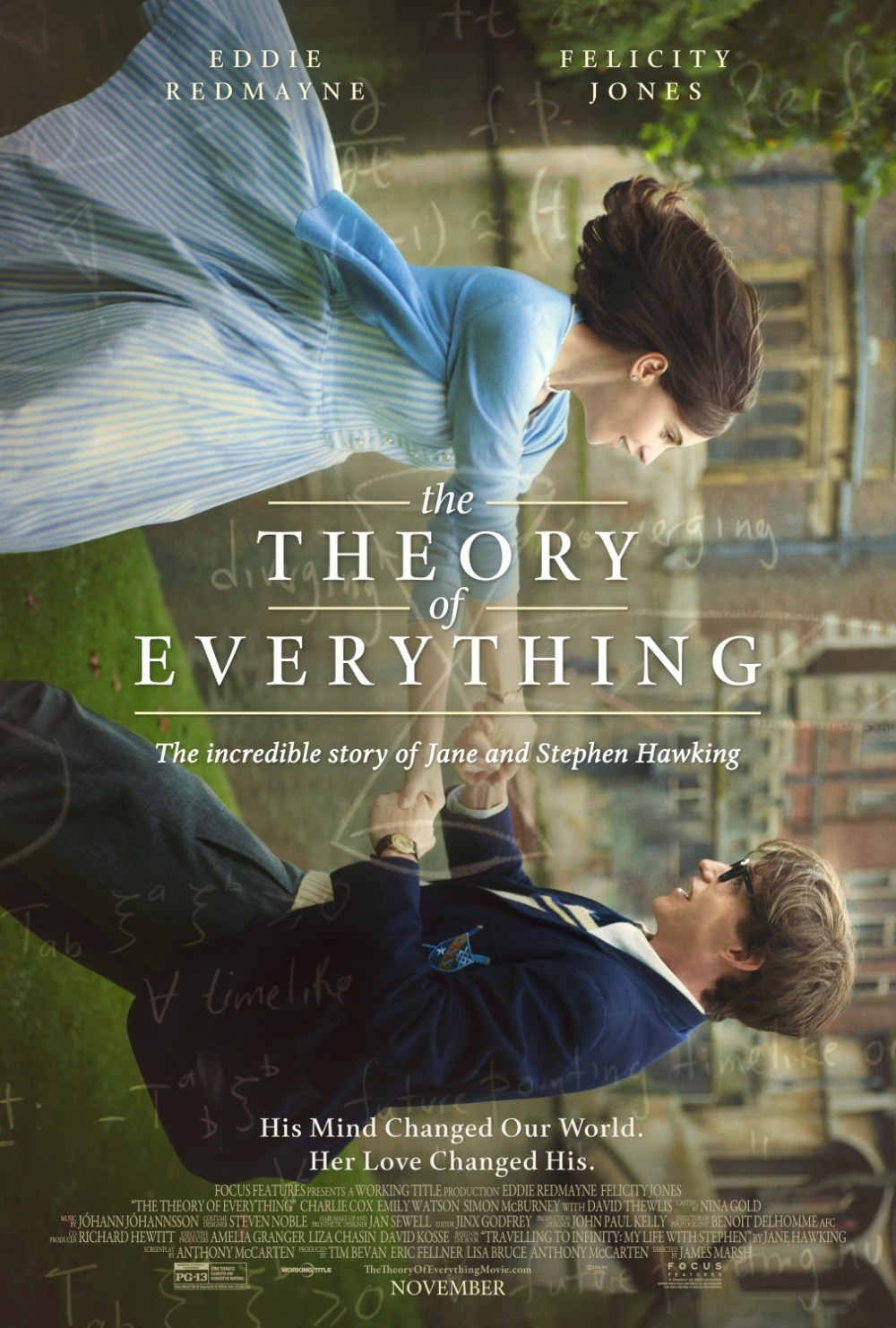
‘The Theory of Everything’ Gives Us the Stephen Hawking We Never Got to Know Until Now

The Theory of Everything movie poster

WRITER’S NOTE: This review was written back in 2014. I am posting it here out of respect for Stephen Hawking who just passed away in March 2018 at the age of 76. Once diagnosed with ALS, he was expected to live only a few years more, but he succeeded in living on despite what the disease did to his body, and he lived one hell of a life. RIP Stephen.

It is shocking to see Stephen Hawking, as played by Eddie Redmayne, riding around recklessly on his bicycle at the beginning of “The Theory of Everything.” We have long since gotten used to seeing him in his motorized wheelchair as ALS robbed him years ago of the ability to move around on his own, and we all know the sound of his computerized voice which has provided us with an insight to his brilliant mind and allowed him to provide lyrics to Pink Floyd songs. But this movie reminds us he was not always like this, and that there was someone in particular who saved his life in more ways than one.

“The Theory of Everything” is based on the memoir “Travelling to Infinity: My Life with Stephen” which was written by his first wife, Jane Wilde Hawking, and it focuses on their courtship which took place during their time as students at Cambridge University. Stephen looks like a perfectly dressed nerd who has the appearance of someone destined never to have any luck with women, and yet he still manages to catch the eye of the beautiful Jane (may we all be this lucky). At first it looks like an ill-suited coupling as Stephen is a student of physics while Jane’s main studies are in romantic languages. She believes in God, but Stephen’s love of science appears to imply he does not. We watch as they come to love and understand how the other thinks, and the way it is presented to us is both lovely and very believable.

But of course, we all know what will happen to Stephen eventually, and it is shown here in excruciating detail as he suddenly trips and falls down right on his head (ouch). Upon discovering he has ALS and told he has only a couple of years to live, Stephen finds himself shying away from everyone around him including fellow students, professors and even Jane as he desperately doesn’t want to be a pity case for anyone. But Jane has fallen deeply in love with Stephen, and she is not about to give up on him because there is too much to lose.

It’s hard not to think of movies like “A Beautiful Mind” while watching “The Theory of Everything” as both feature strong female characters determined to save their afflicted husbands from the diseases which appear all but fatal. For a time, it looks like this film will be no different in the way it portrays the strained relationship Stephen and Jane as they sacrifice so much to make things work between them. But as the movie goes on, it defies conventions and shows us a relationship which does suffer, but any impediments thrown into their path do nothing to tear apart the infinite respect they have for one another.

The eyes of the world are on Eddie Redmayne right now who as his performance here is utterly astonishing. I would love to ask about how he went about portraying Stephen’s bodily deterioration because he achieves doing so in a way which feels painfully real, and it’s amazing what he’s able to convey when Stephen is no longer able to communicate vocally (at least, until he gets that computerized voice). We always talk about how certain performances are more about imitation when it comes to playing characters based on real people, but Redmayne inhabits Stephen to such an amazing effect to where I found it impossible to label his performance as being one of mere imitation. Even as ALS continues to ravage his body, Redmayne makes the case for why Stephen remains such a respected individual to this very day as well as one who continues to fight the odds.

And let’s not forget the fantastic performance by Felicity Jones who portrays Jane Hawking as the lovely and strong-willed woman she is. While it may look like she has the easier role to play, Jones has an equally challenging role as she shows the unending struggles and sacrifices Jane went through to keep Stephen alive. It’s painful to watch Jane as she uses an alphabet sign to communicate with Stephen after his tracheotomy, and Jones makes you feel her pain as she wonders if she has suddenly taken too much away from him.

“The Theory of Everything” was directed by James Marsh who previously made “Man on Wire,” the Oscar-winning documentary about Philippe Petit’s tightrope walk between the two World Trade Center buildings in New York. Marsh does excellent work in keeping all his actors in check to where they never go for scene-hogging moments of an embarrassingly dramatic nature. Truthfully, it is the ordinary moments of these characters lives which are the most fascinating to watch, and Marsh succeeds in taking us back in time to a most romantic period in these couple’s lives.

The other great thing is how Marsh and screenwriter Anthony McCarten, who spent ten years trying to get this movie made, refused to let the audience look at Stephen Hawking as if he’s a complete invalid. Despite the damage ALS has done to his body, Stephen still managed to live a full life which has included two wives and three children, and it didn’t stop him from doing his work which eventually led to the publication of his novel “A Brief History of Time.” Heck, he even got to guest star opposite Data on “Star Trek: The Next Generation.” What more could someone ask for?

“The Theory of Everything,” is by no means a movie which falls victim to conventions or clichés. It presents us with a marvelous story about two people who come to love one another for their thoughts and minds, and of how their love helped them through various struggles which would have worn anyone else out in less than a year. It also contains some of the best performances of 2014 from Redmayne and Jones who are as brave as they are daring. Portraying real-life people onscreen is always a challenge, but they both took roles based on very well-known individuals and succeeded in making them their own.

Seriously, “The Theory of Everything” is one of the best movies of 2014 that I have seen and it is deserving of many of the accolades it has received.

* * * * out of * * * *

Exclusive Interview with Simon Curtis about ‘Goodbye Christopher Robin’

Goodbye Christopher Robin Simon Curtis

Filmmaker Simon Curtis gave us one of the best adaptations of the Charles Dickens’ novel “David Copperfield” back in 1999, he brought Marilyn Monroe back to life along with the help of Michelle Williams with “My Week with Marilyn,” and he directed Helen Mirren to one of her many great performances in “Woman in Gold.” Now he gives us his latest directorial effort, “Goodbye Christopher Robin,” which looks at the creation of Winnie-the-Pooh and the other characters who inhabit the 100 Acre Wood. But while it looks to be a simple biopic focusing on the creation of classic literature, it also proves to be an examination of the scars war leaves behind, the importance of having a regular childhood, and of the damages fame can cause before others can realize it.

I got to speak with Curtis while he was in Los Angeles recently, so please feel free to check out the interview below.

Goodbye Christopher Robin poster

Ben Kenber: From a distance, this movie looked like it would be a simple story of how A.A. Milne came up with Winnie-the-Pooh, but what I really liked though was how the story developed from the effects of fame to a childhood being stolen. Was this inherent in the screenplay (written by Frank Cottrell-Boyce and Simon Vaughan) when you first read it?

Simon Curtis: That’s a good comment. Yes is the answer. I loved the script from the get-go because you think it’s going to be exactly that, but it is about so many other things: family and creation and the impact of war. And yes, Christopher Robin was almost like the prototype child celebrity. And to be fair to the Milne family, it was such an unknown territory. They couldn’t have predicted that the stories would become so popular and the attention it would bring to the boy.

Ben Kenber: There’s no way they could have been prepared for it, and this is what makes A.A. Milne and his wife, Daphne, so incredibly complex. On one hand, you want to get mad at them for robbing Christopher of his childhood, but at the same time, they both come to realize the damage being done. But by the time they stop it, it is too late.

Simon Curtis: Yes, that’s right.

Ben Kenber: I found it very fascinating, and I liked how the movie deals with the PTSD flashbacks. If you’re in a theater with really good sound, you feel the impact of each bang and balloon pop.

Simon Curtis: Yeah, you do. I was trying to make the point that war doesn’t only impact on the men and the women who fight in the war, but their families and their descendants as well. So, the boy is a victim of World War I even though he wasn’t born until it ended.

Ben Kenber: When it comes to introducing the stuffed animals, I loved how Margot Robbie and Domhnall Gleeson introduced them. She had the voices, and he came up with Eeyore’s name. Was there anything about the stuffed animals which you wanted to include in the movie but were unable to?

Simon Curtis: I don’t think so. I love how it’s this almost accidental thing that they buy bear at Harrods or wherever it was, and suddenly it becomes this iconic thing. One of my favorite moments, in terms of when she first gives him the tiger and she says “happy” and then she hands it to him. Then the father says, “Well what should we call it?” “Tigger.” “Why?” “Because it’s more tiggerish” (laughs). It’s just lovely writing.

Ben Kenber: It is. The names all come by accident. It is not some pre-destined thing.

Simon Curtis: Absolutely. They were just little puppets, and that’s the great thing about art. There’s a surprising element to it.

Ben Kenber: A.A. Milne is very eager to say something about war and reality. The interesting thing is, in terms of the way the Pooh stories were written, he found a way of dealing with reality of writing readers with an escape from it.

Simon Curtis: Yes, good.

Ben Kenber: The young actor who plays Christopher Robin Milne, Alex Lawther, was excellent, and he is a very tough role to play here as you see him revel in seeing this stuff animals come to life, and yet he is thrust into a spotlight you couldn’t be less prepared to deal with. Was it hard casting this role?

Simon Curtis: It was lengthy. But I cast a nine-year-old boy would never acted before, do you know that was? Daniel Radcliffe (Curtis cast him in “David Copperfield”), and he had never acted before, so that gave me some confidence. But this boy Alex was a joy and a gift. He was fantastic.

Ben Kenber: Domhnall Gleeson brings a lot of depth to this role.

Simon Curtis: He does.

Ben Kenber: He has scenes where he says one thing, but his eyes have to say something else. How do direct an actor in scenes like those?

Simon Curtis: I don’t know is the answer. You just try to make every scene as good as possible and help the actor to do their best work, and Domhnall is one of those actors who thinks a great deal about it in advance. It brings a lot to the dad, and he was a real partner. The film improved because of his work in the scenes and elsewhere.

Ben Kenber: Margot Robbie has a very tricky part to play here because in some cases the audience may find her to be not for a likable, but she does come across as a very loving mother. It’s a British thing that they hold back. Some of my friends said Daphne is not very likable.

Simon Curtis: But that’s missing the point because that’s the way people were. Not everyone has to be likable in the world, and that’s the way people were mothers in those days. They had the baby, handed it over to a nanny, and waited for the wedding.

Ben Kenber: I always tell people it is not a question of whether a character is likable or not in a movie. It’s whether or not they are interesting.

Simon Curtis: Exactly.

Ben Kenber: Robbie’s performance is really good because she delves into the unlikable parts of her character, but you never doubt the love Daphne has for her son.

Simon Curtis: Yes, and she doesn’t shy away from it. She has such natural warmth herself as a woman, and that kind of balances it out on another level.

Ben Kenber: For many years, there has been a long battle between the Milne family and Walt Disney over the rights to the Winnie-the-Pooh stories. Was this something you considered including in this film?

Simon Curtis: No because that’s in the future, that story.

Ben Kenber: The movie’s ending could have been too sentimental with two characters hugging, but they don’t hug and I like that they didn’t because it would’ve seemed too manipulative.

Simon Curtis: Yeah, that’s England. Someone said astutely I thought how in England we are the world storytellers from Shakespeare to JK Rowling, but we can’t say I love you to our kids (laughs).

Ben Kenber: I loved the scene where A.A. Milne tells Christopher you will not write another word about Winnie-the-Pooh. The way the same was played was brilliant because it’s straight to the point.

Simon Curtis: I agree. That was Domhnall’s idea for him to be seated and looking up at Christopher who is standing. It was a really good idea. As a director I look like a genius, but it was totally the actor’s idea.

Ben Kenber: Do you give a lot of freedom to your actors?

Simon Curtis: Yeah. Plus, to be perfectly honest, there are so many little things, you can’t have them all solved in your head.

Ben Kenber: The stuffed animals we see in this movie are replicas of the original ones which are now part of a museum exhibit in New York. Did you have any issues with Disney over the rights to show these stuffed animals here?

Simon Curtis: I don’t think so in this case because they all predate Disney. They are not Disney. Winnie-the-Pooh doesn’t have his little red vest. We just wanted him to be this Victorian toy.

Ben Kenber: Were there any dramatic liberties you took with the factual material?

Simon Curtis: Well I think the fame comes much more quickly than a probably would’ve done, so it was that sort of thing.

Ben Kenber: The movie takes a real left turn when the books become incredibly popular, and the sun becomes an unwitting celebrity to where A.A. Milne begins to question the effect fame is having on Christopher.

Simon Curtis: I love that scene where he thinks he is speaking to his dad on the phone, and it is revealed to be a radio interview.

Ben Kenber: It is such a painful moment because you see in the dad’s eyes that he really shouldn’t be doing this.

Simon Curtis: That’s exactly right.

Ben Kenber: Kelly Macdonald’s character of the nanny, Olive, is wonderful as she serves as the Mary Poppins of this story.

Simon Curtis: She is certainly the emotional heart of it.

Ben Kenber: How did you come to cast Macdonald in this part?

Simon Curtis: Well she did a play with my wife about 10 years ago so I’ve always loved her work, and she just struck me as the perfect person at the perfect time.

Ben Kenber: I like how you portrayed England as still recovering from World War I.

Simon Curtis: Very much so, and I think it chimes in now because it feels like were living in wounded times now.

Ben Kenber: Was that something you planned?

Simon Curtis: It just happened in a way.

Ben Kenber: There are a number of things about A.A. Milne I didn’t know before watching this movie such as the fact he was a soldier and a playwright.

Simon Curtis: Yeah, I didn’t know he was a successful playwright.

Ben Kenber: At the beginning of the movie, A.A. Milne does not look the least bit prepared to be a parent. It’s almost like the movie “Kramer vs. Kramer.”

Simon Curtis: Yes, it is. We talked about that actually. There’s the first breakfast and then there’s the expert breakfast in “Kramer vs. Kramer.”

Ben Kenber: The arc of this movie goes from father and son being strangers to them coming together and then later becoming estranged from one another.

Simon Curtis: The thing that bonded them became the thing that tore them apart.

Ben Kenber: The segment where Chris for a sent off to school was handled very quickly. Was this a segment you ever wanted to expand on?

Simon Curtis: Not really because the last thing you want at that point in the film is to be slow.

Ben Kenber: “Goodbye Christopher Robin” has a running time of 107 minutes. I usually expect biopics like this one to go one for over two hours as filmmakers seem desperate to get every little about their subject’s life onto the silver screen. Did you ever feel this pressure when making this movie?

Simon Curtis: I don’t know really how to answer that. I was just doing the script.

Ben Kenber: This movie is dedicated to Steve Christian. Can you tell me more about him?

Simon Curtis: He was one of the producers who supported this script through years of development and who unfortunately passed away after he saw the first cut.

Ben Kenber: Well, it’s nice to know he did see a cut of the film.

Simon Curtis: Yes, it is nice.

Ben Kenber: The way I see this movie, I feel it is about the long journey to happiness. When father and son come together again, they realize to get to a point of happiness, they have to experience a lot of sadness and pain in order to better appreciate joy.

Simon Curtis: To me, the theme is pay attention to your loved ones while they are around because they won’t be around forever. And also, we punish ourselves over getting this or getting that done, and actually just being with your loved ones is the greatest gift of all. Somehow, that’s embedded in the film. I’m so glad when my kids were young because it was before these (cell)phones because I would’ve been totally on them the whole time.

Ben Kenber: In the movie’s postscript, it is revealed A.A. Milne did get to write his anti-war piece. Was this something you wanted to include in the movie as well?

Simon Curtis: Yeah. He didn’t intend to be known only as the writer of Winnie-the-Pooh. There’s a quote (by A.A. Milne) in the “Goodbye Christopher Robin” book introduction by Frank Cottrell-Boyce. Just read that.

Ben Kenber: “…little thinking

                     All my years of pen-and-inking

                    Would be almost lost among

                    Those four trifles for the young.”

Simon Curtis: Yeah. In fact, it’s not almost, it’s now completely. So that’s good, isn’t it?

I want to thank Simon Curtis for taking the time to talk with me. “Goodbye Christopher Robin” will arrive in movie theaters on October 13, 2017. Click here to check out my review of the film.

‘Only the Brave’ Celebrates the Lives of Those who Risk Everything to Keep Others Safe

Only the Brave movie poster

While watching “Only the Brave,” I kept thinking of what Mike Kellerman said in an episode of “Homicide: Life on the Street:” “Fire is a living thing. It eats, it breathes air, it can be killed. Something about that power draws people in.” This dialogue played in my head while Josh Brolin stares at a wildfire off in the distance, wondering which direction it will spread in. From this, we can tell he doesn’t just see fire as simply something to be put out, but as a force to be fought with on its own term. The term fight fire with fire takes on a special meaning here, and it is shown to be more than just the title of a Metallica song.

“Only the Brave” is, yes, based on a true story. In this case, it is about an elite crew of firefighters who came to be known as the Granite Mountain Hotshots and who risked their lives on a regular basis to stop wildfires in their tracks. In June 2013, 19 of their members died while fighting the Yarnell Hill Fire in Arizona, and it remains one of the deadliest incidents involving United States firefighters outside of the September 11th attacks. I figured the movie would be all about this fire and of who survived it and who didn’t. However, it is really about these group of men who come together to form a brotherhood of sorts as they come to depend on one another as their work is always very dangerous. In the process, we also see the bonds they have with their families and loved ones, and of the constant balance they have to work at between work and family life.

Brolin plays Eric Marsh, the leader of the Granite Mountain Hotshots who is eager to build a team of firefighters which will not simply serve as background performers while other elite firefighters push them to the side. You would think firefighters from different places would be quick to band together in the face of mother nature’s havoc, but each individual firefighting group is shown to be a competitive bunch as they want to claim the glory of being a hero before anyone else. After dealing with conflicts and money problems inherent in the realm of politics, Eric gets the funding he needs to begin training men who are infinitely eager to fight fire with fire.

Now a movie like this typically employs a number of stereotypical characters like the ladies’ man, the fearless leader, the trusted second-in-command the one who looks as if he is in the wrong place, and “Only the Brave” does traffic a bit in this area to where I thought this might become “Top Gun” but with firefighters instead of pilots. But thanks to an excellent cast which includes Miles Teller, James Badge Dale, Taylor Kitsch, Scott Haze, Alex Russell and Ben Hardy, we get to be intimately involved in the exploits of these firefighters to where we have to admire their selflessness in what they do.

An actor worth noting in particular is Teller who has given excellent performances in “Whiplash” and “The Spectacular Now.” Teller plays Brendan McDonough who, at the movie’s start, is a hopeless drug addict. From the character’s first appearance, I figured Brendan would be the one to start the Yarnell Hill Fire as he carelessly is shown smoking crystal meth to where he is barely conscious, and I kept waiting for him to drop a match in a field without even realizing it. Brendan comes to discover his ex-girlfriend is pregnant, and he reacts to this news flippantly as it only increases his capacity for self-destruction. But upon seeing his baby for the first time, he suddenly begins to turn his life around and looks to get employed on Eric’s firefighting team.

Teller’s performance is superb as he doesn’t make Brendan into the typical cinematic addict, but instead a person who goes from being lost in life to one who finds a purpose as he seeks to give his child the life his father never gave him. The interview scene he has with Brolin is superb as Teller never overdoes it as Brendan knows full well he can’t fool Eric since he sees right through his addiction. I kept waiting for Brendan to relapse as this is usually the case for addicts in a movie, but Teller makes his character’s hard-fought battle towards sobriety noble and believable. This is also the second movie he’s been in these past few years where he plays a man determined not to take painkillers even though they certainly would help (the other is “Bleed for This”).

Brolin is an ace at playing blue collar workers, and he never has to do much to convince us how believable he can be in portraying a firefighter. Through his expressions and actions, we quickly see this is someone who can tame the nastiest fires he and his team come into contact with. The “No Country for Old Men” actor shares a lot of great scenes with his male-costars, but his best moments come between him and the always terrific Jennifer Connelly who plays Eric’s wife, Amanda. Their relationship is a strong one, but it takes on an increasing strain when Amanda wants kids, something Eric is not quick to agree on. From this description, it sounds like the average marital conflict we see in every other movie, but Brolin and Connelly bring a lot of raw emotion to their roles to where they inhabit their characters more than anything else. This could have felt clunky, but the actors keep this from happening, and this is especially the case when Amanda reminds Eric what she goes through every day when he walks out the door to go to work.

“Only the Brave” was directed by Joseph Kosinski whose previous films were “Tron: Legacy” and “Oblivion.” This one takes place in the real world instead of in the realm of science fiction, and yet he still brings a strong visual flair to each scene as we watch the fires lay waste to the land with an unforgiving power, and we fear for the deer running through the fields even as a wildfire gets closer and closer. At the same time, he also puts much of his attention on these men as this movie is about the job they did, not the fire which killed many of them. Kosinski makes us share in the friendships they build with one another and of the joyous moments they spend with their families to where we feel we are a part of their lives. Nobody involved with this motion picture should need to convince anyone of the emotional investment they put into this material, and this makes its tragic climax all the more devastating to witness.

Even though I knew how things would end for this group of firefighters, it didn’t make it any easier to sit through. These men had the best training and were constantly being drilled on how to protect themselves in the event of being trapped in a fire, but like other natural disaster, a fire is indiscriminate in who and what it attacks as it seeks to breathe for as long as it can. What everyone is left with are a tremendous amount of grief and survivor’s guilt, both of which deserve a movie of their own to explore.

I walked out of “Only the Brave” in tears as the filmmakers paid special tribute to the men of the Granite Mountain Hotspots, those who lived and those who died. Even the best of preparations could not spare them from the destructive flames they perished in, but it still never took away from the bravery the showed us, and this movie gives them a well-deserved memorial to their selfless efforts. While we mourn the loss of life, we celebrate the lives these men led as they deserve much more than being just a footnote in history.

“Only the Brave” marks a big leap forward for Kosinski as he shows there is more to him than directing big science-fiction films with awesome music scores. It is also worth noting how the movie’s credits are shown at the beginning as opposed to at the end like in “Tron: Legacy” and “Oblivion.” Not only that, but the credits are presented in a surprisingly subtle fashion as Kosinski must have realized his talents could not and should not upstage the firefighters of the Granite Mountain Hotshots.

As I write this review, wildfires have been doing tremendous damage in Northern California near where my brother lives with his family. Seeing this film makes me think about what his family and others are enduring right now as the damage left in the fires’ wake is just awful. I also find myself thinking of those firefighters up north and wonder if they are getting the respect, not to mention the funding, they deserve. Whereas “Backdraft” felt more like a Hollywood take on the lives of firefighters, “Only the Brave” feels like the real deal, and it makes me want to go up to those who are working tirelessly to keep wildfires from spreading and shake their hands. This movie is proof of how much they deserve our respect.

* * * ½ out of * * * *

Save

‘Goodbye Christopher Robin’ Has More On Its Mind Than Winnie-the-Pooh

Goodbye Christopher Robin poster

Like many, I was raised on the stories of Winnie-the-Pooh and watched the various Disney movies which brought the “silly old bear’s” exploits to a whole new generation of fans. More importantly, I became a die-hard fan of the beloved donkey of these stories, Eeyore, as his depressed demeanor came to resemble my own for a time. The human boy at the center of these books, Christopher Robin, had a wonderful imaginary life which brought him to a place of love, happiness and adventure, so perhaps it’s not a surprise to learn the author of these books, A.A. Milne, did not always lead the happiest life. Yet in the process of trying to confront the horrors life inflicted on him, he found a wonderful way to escape from them, and millions of others joined him in this escape as well.

Goodbye Christopher Robin” offers the viewer a look into the complex relationship between A.A. Milne and his son Christopher Robin Milne whose collection of stuffed animals came to inspire the stories of Winnie-the-Pooh. I went into it thinking it would be a standard biopic which would recount how this honey-addicted bear and his various friends came into being, but I was stunned to see how the filmmakers covered more ground as the movie went on. Just when I thought the story was about to end, the movie takes another turn as it explores the effects of war, society, growing up, and fame have on both the youngest and oldest members of a family. It’s also a reminder of how no one, whether they have it good or bad, will ever get out of this life unscathed.

When we first meet A.A. Milne (played by Domhnall Gleeson), he is a World War I veteran and a noted playwright, and it doesn’t take long to see the damage war has done to him as he repeatedly suffers from flashbacks every time a loud sound goes off or a balloon pops near him. He and his wife, Daphne (Margot Robbie), have just become the parents of a baby boy, but it is shown to have been a difficult birth which almost killed Daphne. They name their son Christopher Robin Milne, and for a time there is a bit of a distance between father and son. Just watch as Gleeson picks up his baby for the first time. The audience I saw this movie with couldn’t help but laugh at what they saw.

Once the family moves to a house out in the woods, A.A. begins work on an anti-war book as he feels London is still suffering long after “the war to end all wars” was concluded. However, he suffers from writer’s block and finds himself in the same position William Shakespeare was in while he was trying to write “Romeo & Ethel The Pirate’s Daughter” in “Shakespeare in Love.” He is determined to write one kind of story, but he eventually comes to write a completely different one.

Seeing A.A. and Christopher come up with the characters for the Winnie-The-Pooh stories feels wonderfully organic as does their growing relationship. After Daphne disappears from the family for a time, father and son are forced to deal with one another in ways they didn’t anticipate. The porridge Milne makes for Christopher does not look the least big appetizing, but it serves as an ice breaker between the two as the distance between them decreases until they find themselves truly enjoying the imaginary world they have created for themselves.

From there, I figured “Goodbye Christopher Robin” was going to be a simple tale of father and son coming together in a wonderfully unique way, but then the focus shifts. We see the Winnie-The-Pooh books become a literary sensation to where the public cannot separate Christopher Robin Milne from the fictional character of Christopher Robin. As a result, this young boy is suddenly thrust into a spotlight no one can ever easily deal with, and the film almost turns into a horror flick as we know this will do irreparable damage to him. While some may consider him to be the luckiest boy alive, it becomes apparent his life is no longer his. Christopher should be allowed to have a childhood, but his parents don’t realize they have denied him this in time.

What surprised me about “Goodbye Christopher Robin” is how it is a biopic which cannot be boiled down to one sentence. This film is not just about the creation of a literary classic filled with characters who remain very popular to this day, but also one which deals with a multitude of themes, each of which is given a lot of meaning and depth. None of the real-life characters featured here are painted in an easily broad manner, and their evolution throughout was never less than fascinating to me.

Domhnall Gleeson has since created a name for himself outside of his father’s, Brendan Gleeson, success as an actor to where it is easy to separate the two of them. Domhnall has given terrific performances in “About Time” and “Star Wars: The Force Awakens,” and he does superb work here as a famous writer whose creations eventually take on a life of their own. At this movie’s start, he portrays A.A. Milne as a man traumatized by his experiences in war and slow to warm up to his role as a father, and he fully inhabits this man to where you can never catch him acting. Gleeson makes A.A. a wonderfully complex human being as he becomes more receptive to the world Christopher has created for himself, and he shows how this famous author quickly gets caught up in his book’s success to where he feels obligated to make his son a celebrity figure despite his growing concerns of what this will do to him. Although he eventually comes to see the damage he is doing, this realization comes too late, and he is left to pick up the pieces of a broken relationship which may never be fully repaired.

Robbie, who burst into our collective consciousness with her scene-stealing role in “The Wolf of Wall Street,” has an even trickier role to play here as Daphne de Sélincourt is shown to be both a loving mother and a very needful wife. You want to berate her for using her son to get a level of attention she might not otherwise receive, but there is no doubt as to the love she has for him. Daphne also provides the voices for Christopher’s stuffed animals to where A.A.’s cannot compete in the slightest, so her presence in Christopher’s life still has a tremendous amount of influence. Whatever you may think of Daphne, Robbie makes her into an individual who is undeniably flawed but still a loving mother.

One performance worth singling out above others in “Goodbye Christopher Robin” is Kelly Macdonald’s as Olive, Christopher’s beloved nanny. While Christopher’s parents get caught up in the fame these stories have brought about, Macdonald shows how Olive is thankfully objective to where she is never easily seduced by forces which have easily seduced many others away from a normal, ordinary life. She understands better than anyone how Christopher is being subjected to something very unhealthy for him, and she does her best to make his parents see how they need to see to remove them from the public eye.

And yes, Will Tilson makes a wonderful Christopher Robin Milne and shares a lot of great scenes with Gleeson.

As “Goodbye Christopher Robin” came to its conclusion, I came to realize how it was about the long and rough path towards happiness. We all want to be happy in our lives, but happiness is not as easy to come by as we are lead to believe when we were young. While some may complain about the exceptions made to historical fact, I loved how this film built up to an exhilarating point as Christopher comes to make peace with his dad to where he realizes what it means to be a happy person. The path to happiness is never a straight line or an easy road to travel, and the fact this biopic truly understands this fact is something I am very thankful for as its path still remains a torturous one for me after all these years.

Simon Curtis has directed a few biographical films previously (“My Week with Marilyn” and “Woman in Gold”), but he really outdoes himself here. In a time when biopics range from excellent (“Straight Outta Compton,” “Love & Mercy”) to incredibly disappointing (“I Saw the Light”), “Goodbye Christopher Robin” thankfully ends up on the positive side of the critical spectrum.

* * * * out of * * * *

Click here to read my exclusive interview with “Goodbye Christopher Robin” director Simon Curtis.

‘Fruitvale Station’ Puts a Human Face on a Tragic Shooting

Fruitvale Station movie poster

It’s a strange and cruel irony “Fruitvale Station” opened in theaters the same week George Zimmerman was found not guilty of shooting Trayvon Martin. Like Martin, Oscar Grant was a young African American male whose life was cut short under needlessly tragic circumstances. On the night of January 31, 2008, Oscar was traveling home with his girlfriend and their friends on BART (Bay Area Rapid Transit) when a fight broke out on the train which he gets caught up in. When the train arrives at the station of the movie’s title, Oscar was pulled off it by BART police officers, and one of them, either accidentally or intentionally (depending on who you ask) shot him. He died the following day, and his death brought about protests and a call for justice.

The cases of Martin and Grant appear to illustrate that, despite strides we have made in race relations, it’s still not safe to be a young black man in America. Now “Fruitvale Station” is not a movie out to offer a solution to this continuing problem, but it does put a human face on it. After watching it, Grant will no longer seem like a mere statistic to anyone.

The movie follows Oscar (Michael B. Jordan) on the last day of his life as he goes about his business while trying to survive in an unforgiving world. He still lives with his girlfriend Sophina (Melonie Diaz) and their daughter Tatiana (Ariana Neal) in a rundown part of the Bay Area, and this is despite the fact Sophina knows he cheated on her. But regardless his wayward ways, Oscar is clearly dedicated to taking care of them both and in doing what he can to give them a better life.

“Fruitvale Station” is the first feature film for director Ryan Coogler, and he made it because he wanted people to get to know Oscar as a human being instead of just another name in a newspaper. Having seen the film, I can honestly say he succeeded in doing so. Not once does Coogler try to sanctify Oscar or water him down for an easier movie going experience. Coogler presents Oscar warts and all, and while he is far from perfect, we come to respect him for what he’s trying to do with his life on this fateful day.

We see Oscar trying to get his supermarket job back even though his boss isn’t about to rehire him, and it’s the first time we see Oscar’s hair trigger temper come to life. His mission now and throughout this fateful day is to provide for his family. Of course, this may lead to him selling drugs to help pay the rent and put food on the table, the same thing which landed him in prison. While his desire to lead a good life is strong, the lure of the criminal life and the money it can generate for him keeps percolating below the surface.

Michael B. Jordan made a name for himself on television shows like “The Wire” and “Friday Night Lights,” and he also appeared in the surprise hit movie “Chronicle.” His performance in “Fruitvale Station” is nothing short of sensational, and it made him one of the great breakout stars of 2013. It’s exhilarating to watch him as he takes Oscar from the joys of being a father to his frightening lows when he begs his mother not to leave him all alone. It’s a shame Jordan didn’t get an Academy Award nomination for his performance, but then again 2013 was a year overflowing with great performances, many of which were bound to be left out.

Octavia Spencer gives another one of her great performances in this movie as well. As Wanda, she gives us a mother who tries to be strong for her wayward son, but who struggles with the reality she may need to keep her distance from him for his own good. This is not the typical clichéd mother character who goes through the usual motions of the parental ups and downs, but one who has stood up against the tides life has thrown at her and whose love for her son you never doubt for a second.

“Fruitvale Station” starts off with footage of the actual incident where Oscar was shot, but it cuts to black before we can see if the shooting was intentional or accidental. This gives the movie a certain tension as we know how things will end, but even as we get to that moment, there’s a still a part of us which wants this situation to have a different outcome. Even though the end of the movie is never in doubt, we desperately want him to survive the night and get home safe.

The other thing I really liked about this movie is how it showed us a part of the Bay Area many of us don’t get to see. I grew up in Northern California, and while much of it is not crime ridden, there are parts of it I dare not venture into. Like the brilliant documentary “Hoop Dreams,” it sheds a light on how African-Americans live and subsequently breaks a lot of the preconceptions many of us have about them.

There have been several other tragic incidents following what happened to Oscar Grant such as the death of Michael Brown in Ferguson, Missouri. It’s always depressing to see how history keeps repeating itself despite our best attempts to learn from it. What makes “Fruitvale Station” so remarkable is it’s not out to give us glib answers on how to end the violence, but it instead puts a human face on a man who didn’t deserve to die. We hear about these stories in the news far too often, and they are usually shown to us with an unnecessary amount of bias. Both Coogler and Jordan have done a great service as they force us to see Oscar Grant as a person with strengths and flaws, and this makes “Fruitvale Station” one of the very best movies of 2013.

* * * * out of * * * *


‘The Emerald Forest’ Makes the Term ‘Based on a True Story’ Mean Something

The Emerald Forest poster

The Emerald Forest” is kind of a spiritual sequel to “Deliverance” as both were directed by John Boorman. Each film deals with man’s tearing apart of nature for their own needs, and of how nature has its own set of rules which forces outsiders to survive by any means. They also take place in a wilderness where the rules of law and justice cease to exist as its inhabitants live defend what is theirs and are not exactly open to strangers. Also, they contain characters who have never been exposed to civilization as we know it. The subject of man versus nature makes for a fascinating subject, and it’s entertaining to see Boorman take it on again.

“The Emerald Forest” is “based on a true story” and was released back in 1985, back when that term actually meant something. Powers Boothe stars as Bill Markham, an engineer who has moved to Brazil with his family to complete the construction of a large hydro-electric dam. This of course necessitates large areas of the Amazon forest be cleared to make room for agriculture and living space. While on a picnic with his family, his son Tommy suddenly gets abducted by an indigenous Indian tribe. Bill ends up spending the next ten years looking for Tommy just as the dam he’s working on nears completion. He ends up finding Tommy alive, and Tommy has long since become fully integrated with the tribe known as the “Invisible People.” But will Tommy end up going home with his real dad, or will he stay with this tribe which he considers family?

I remember seeing commercials for this movie on television, and the fact it was “based on a true story” made it seem all the more frightening at the time. To be stolen from your family is a terrible fate and a horrible burden for any parent to endure, and it’s the last thing anyone should go through. The interesting aspect of “The Emerald Forest,” however, is how Tommy seems to enjoy being part of this tribe which has given his life a meaning it wouldn’t necessarily have in the real world. This makes the conflict between Bill and the tribe especially fascinating; he’s entitled to be angry at these people for kidnapping his son, but it’s not like his son has been treated badly by the tribe. Issues like this are usually black and white, but in this movie, they come to inhabit a morally gray area.

In the process of looking for his son, Bill comes across a rival tribe known as the “Fierce People” whose leader shows his admiration for the hunting skills he shows off with his machine gun, a weapon they are unfamiliar with. As a result, they give him a head start to run for his life before they hunt him down. He is fortunate enough to run into Tommy who has long since become a warrior like the Indian family which “adopted” him, and he takes his father to safety where the “Invisible People” can take care of his wounds.

The scenes showing the tribe and the rituals they perform are among the most fascinating scenes in “The Emerald Forest.” Boorman really makes us feel like we are observing something we would not be likely to see in person as we watch Tommy becoming a man. These are not just a bunch of actors trying to recreate what tribes of Indians did before and after white men stole their land, they look like the real deal. Plus, their description of Bill and those like him as “Termite People” as, like those pesky creatures, they destroy the land they come in contact with gets at the universal truth of life: Man’s attempt to create a new way of life ends up laying waste to our past.

Actually, the one actor who deserves the most credit here is the director’s son, Charley Boorman, who plays Tommy. Much of the movie’s success really hinged on his performance as a stranger to the world he has been abducted to. If you didn’t believe how sincere Tommy was to win the tribe’s respect, then “The Emerald Forest” would never have worked as a movie. But Charley is utterly believable and sucks you into his character’s reality without a second thought. It’s one of those performances where the actor becomes his character as opposed to just playing them.

Boothe was one of those actors who are impossible to cast as a wimp. I mean you could, but would you believe him in such a role? He’s always played tough guys who never go down without a fight, and here he plays a good guy who is no different. It’s hard to think of another actor who could have embodied Bill Markham better than him. Perhaps Sylvester Stallone or Arnold Schwarzenegger could have, but casting either of them would make this become a completely different movie.

Boothe not only has to show the intense dedication this father has in finding his son, but he also has to believably portray a man who is more of a match with the wilderness elements than any other stranger to this environment. He succeeds on both fronts as the tribe accepts him despite their differences with one another, something which isn’t easy. The actor also has to convincingly portray a man who has to go against what he does for a living to protect his son and his way of living. Looking at this makes you realize just how underrated, or perhaps largely underappreciated, an actor Boothe was while he was alive.

Boorman, along with cinematographer Philippe Rousselot, provides the viewer with beautiful scenery throughout. Much of it was filmed in Brazil, and we get to see sights which, all these years later, may not even exist anymore. Just as with “Deliverance,” Boorman wants to explore this part of life before it vanishes forever, and he was lucky to get any of it on film.

Like any movie “based on a true story,” much of “The Emerald Forest” has been fictionalized for dramatic considerations. This results in it having a shootout in which Boothe has to team up with the tribe which took his son so they can rescue their women who have been stolen into slavery. In some ways, it feels like a cop out for the movie to reach its conclusion, but it does have the added bonus of them dealing with another Indian tribe whose ignorance of guns has been exploited to their benefit. It seems to imply how any person who encounters the real world is more likely to corrupt themselves than advance their way of life. This ends up saving “The Emerald Forest” from turning into any other action movie.

John Boorman’s career as a director has taken him all over the critical map from classics like “Deliverance” and “Hope and Glory” to duds like “Zardoz” and “The Exorcist II: The Heretic.” “The Emerald Forest” stands in the middle of all his movies as it’s really good if not quite great. I’m glad I finally got the opportunity to see it even though it took me almost 30 years after its release to do so. It’s also nice to watch a movie “based on a true story” which actually feels like it is. These days, the term is meaningless as it has been used once too often, but back when this movie came out, it meant a lot.

* * * ½ out of * * * *