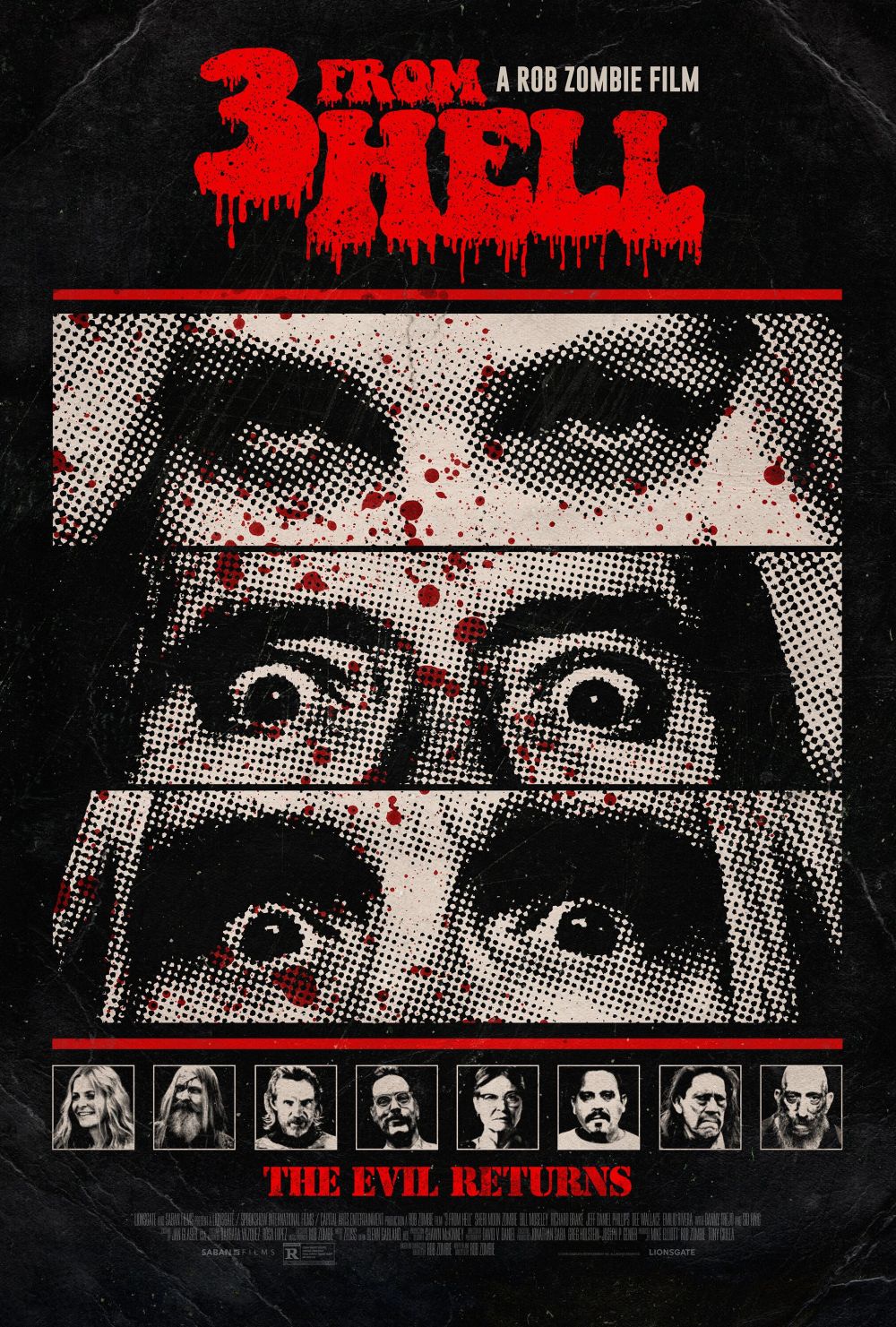
‘3 From Hell’ – Rob Zombie’s Vision of Madness and Mayhem Continues
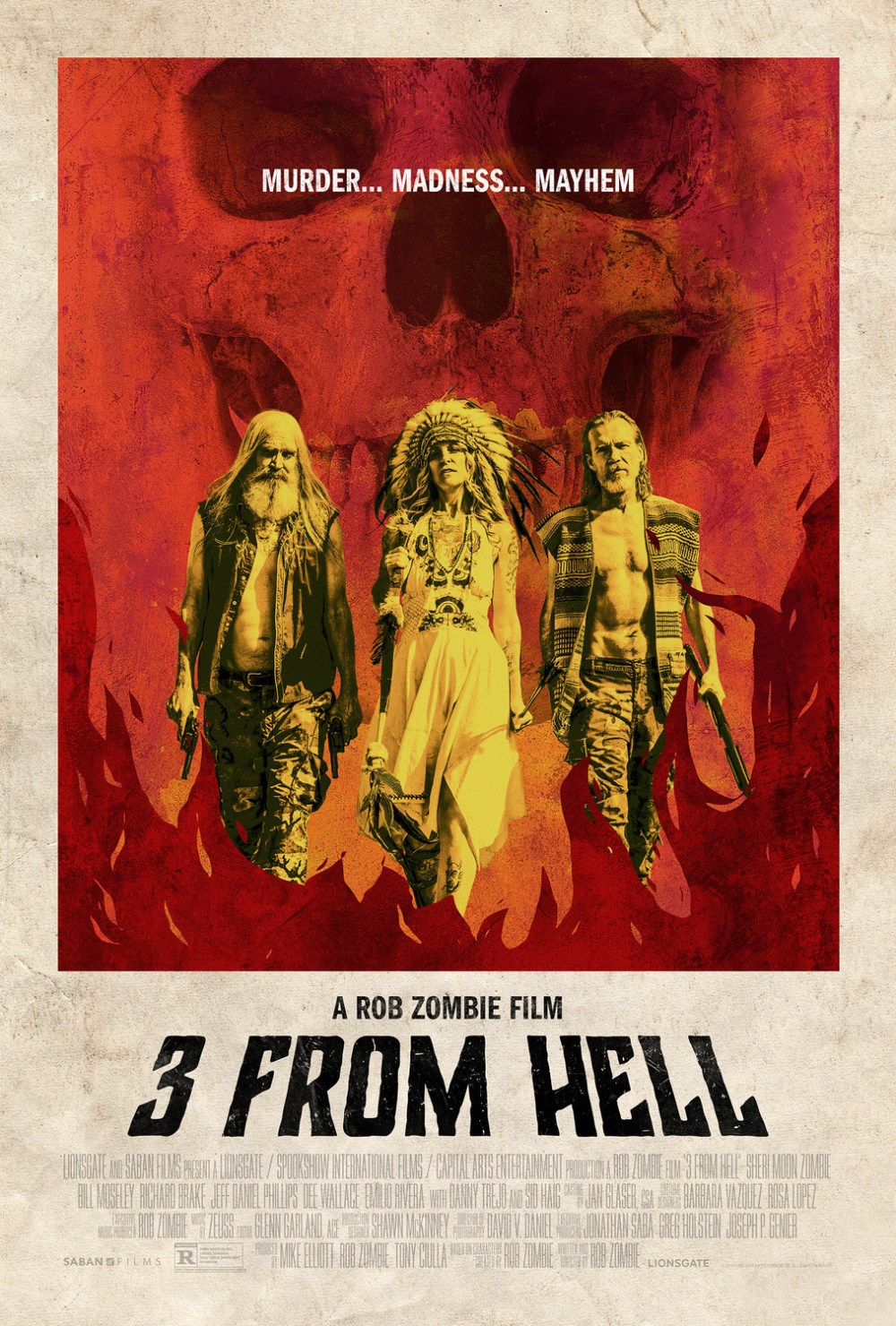
3 From Hell theatrical poster

I have no shame, nor should I, in admitting just how much I liked “The Devil’s Rejects.” While Rob Zombie’s first film, “House of a 1000 Corpses,” showed him to have a strong visual style and good taste in actors, it paled in comparison to the movies which inspired it. “The Devil’s Rejects,” however, showed him taking a number of cinematic influences and making them his own, and what transpired was a nasty grindhouse film which never pretended to be anything other than what it was. As a result, “3 From Hell,” was one of those 2019 movies I was most excited to see. How was it? Read on my fellow readers…

When we last saw Otis B. Driftwood (Bill Moseley), Baby Firefly (Sheri Moon Zombie) and Captain Spaulding (Sid Haig), they were going out in a blaze of glory as the police riddled them with an endless supply of bullets while Lynyrd Skynyrd’s “Free Bird” played over the soundtrack. They had reached the end of the line, or so we thought. As “3 From Hell” begins, a newscaster played by the great Austin Stoker informs us they somehow miraculously survived the lethal shootout by police, and they now have a lengthy trial to look forward which will determine their ultimate fate.

Now we can agree there is no way those crazy bastards could have survived such a shootout without at the very least wearing a bulletproof vest. Still, perhaps back in the late 1980’s, when “3 From Hell” takes place, medical science was advanced enough to where gunshot wounds could be treated more effectively. Then again, Otis, Baby and Captain Spaulding are known as the devil’s rejects, and I guess Satan still does not have enough room for them in hell any more than he does for business criminals. Street criminals on the other hand…

Anyway, the three killers are sentenced to either life in prison or death by lethal injection, but we all know they are not going to stay there. Thanks to Otis’ half-brother Winslow (Richard Brake), Otis and Baby escape their confines and head out on the road to inflict bloody mayhem on both the innocent and those who they believe “wronged” them. As you can expect, there is plenty of blood, gore and carnage on display as one bullet or stab wound is not nearly enough to take down a human being here.

One sad thing about “3 From Hell” is how briefly Sid Haig appears in it. This is because he was in ailing health when production started, and it was determined he would not able to participate as a result. Watching Haig here is heartbreaking as he is clearly not in the best shape, but Zombie still does right him and writes one hell of a monologue which Haig performs to brilliant effect as he yells out loudly, “I’m just a clown dancing to the sins of mankind.” Listening to Haig here reminded me of what Augustus Hill once said on an episode of “Oz:”

“So, what is it that separates you and me from the goldfish, the butterfly, the flat billed platypus? Our minds, huh? Our souls, huh? That fact that we can get HBO? Well maybe it’s that humans are the only species to put other animals in cages. Put its own kind in cages.”

Still, I have to say “The Devil’s Rejects” is a hard film to top, and “3 From Hell” proves this to be the case. This follow up does not have the same level of sadistic glee, nor does it have the kind of lethal antagonist which “Rejects” had in William Forsythe’s character of Sheriff John Quincey Wydell. When the Otis, Baby and Wilson are forced to deal with a Mexican gang, they also appear here by accident to where their threat does not register strongly enough with us.

But just when “3 From Hell” looks to be an unnecessary sequel, I did find myself admiring Zombie’s subversive ways as he plays around with how people see serial killers from the outside. We watch fans of the Firefly family as they are interviewed on television, and they seem them instead as folk heroes who they believe have been wrongfully convicted. While we may want to criticize these fans for worshipping the wrong people, Zombie is very clever at illustrating how we are deeply fascinated by certain people who have performed the most heinous and unforgivable acts on others. While we say we are not, there is that part of us which is even if we do not admit it. Just like Mercedes Ruehl said in “The Fisher King,” the devil is a lot more interesting.

There is even a scene where we are watching footage of Otis and some fellow prisoners (one of them played by Danny Trejo) being led to work in a field, and this same footage also shows Otis escaping and killing a prisoner in cold blood while the camera continues to roll. Now this is not something which should be shown on television, but stations still do this every so often, and we are drawn to this footage even if we know better than to watch it. With “3 From Hell” and its predecessors, Zombie makes us see how drawn we are to pure evil even as we openly despise it.

While Zombie was forced to shoot this sequel on digital instead of film, he along with cinematographer David Daniels and editor Glenn Garland succeed in making it look as grungy as your average grindhouse picture from the 1970’s to where I honestly thought this was shot on film (the end credits revealed otherwise). However, the CGI blood does leave little to be desired even if the filmmakers did what they could to make it look real.

In addition to a strong film score from Zeuss, Zombie provides us with another great soundtrack to put his grisly images to, and it includes such classic tunes as Slim Whitman’s “The Devil is Singing Our Song” and Suzi Quatro’s “The Wild One.” He even uses Iron Butterfly’s “In-A-Gadda-Da-Vida” in a key murder scene, and I admired him for daring to do so as this song has already been used to unforgettable effect in Michael Mann’s “Manhunter” and a classic episode of “The Simpsons.”

As expected, the actors revel in portraying their politically incorrect characters and do so without any shame. Moseley may very well have given his best performance as Otis in this sequel as he gives the character more dimension you might expect him to have. And while she looks to chew the scenery a bit too much at times, Sheri Moon is a blast to watch as she brings a surprising degree of vulnerability to Baby. As we see her being held in captivity, Sheri makes us see how prison life has had a harsh impact on Baby’s mental state, and it was never a particularly stable mental state to begin with.

I also have to give Richard Brake a lot of credit as he is stepping into an ensemble which has long since established its own rhythm. But as Winslow, he manages to fit in perfectly with Sheri Moon and Moseley, and he makes this character stand out in his own uniquely maniacal way. The scene where he grins ever so slightly as Otis pounds a man’s face in with the butt of his gun gives this film one of its most chilling moments, and it shows how fearless Brake is in portraying such an amoral human being.

I did my best to keep my expectation in check when I came into “3 From Hell” as “The Devil’s Rejects” was always going to be hard to top. The fact it is not the equal of its predecessor is not a surprise, but there is still much I admired here, and I have no problem saying I enjoyed what Zombie had to offer audiences this time out. No, it is not for everybody, and there are scenes of sheer brutality which will have certain audience members dashing for the exit. But for those who like especially intense horror films, I felt this one delivered.

Could there be a fourth film in this franchise? I suppose, but at some point the devil has to make room for these three as well as all the criminals on Wall Street who continue to get away with far too much.
* * * ½ out of * * * *

‘Ad Astra’ is an Enthralling Cinematic Experience

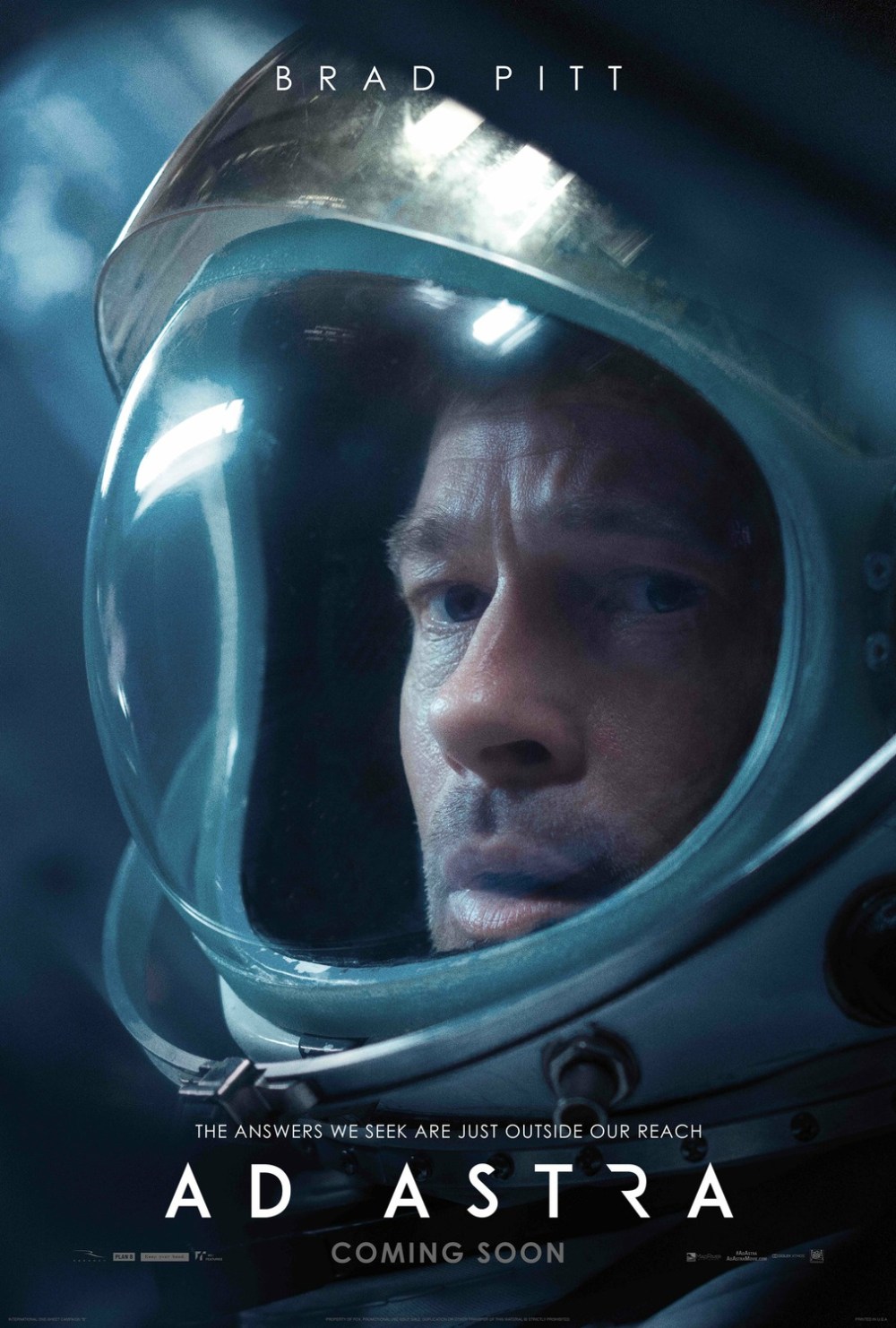
Ad Astra movie poster

The title of this movie is Latin for “to the stars,” and boy does co-writer and director James Gray ever take us there in “Ad Astra.” Like “Gravity,” “Interstellar” and “The Martian,” this is the rare science-fiction film which deals with the possibilities of space travel from a credible perspective, and it is a feast for the eyes throughout. While the human drama may be lacking, I could never ever take my eyes off the screen for a single second as this is a study in enthralling entertainment.

Brad Pitt, in his second great performance of 2019 (the other as Cliff Booth in “Once Upon a Time in Hollywood”), stars as Roy McBride, an astronaut who is able to keep his heart rate at a stable level even during the most strenuous of circumstances. In many ways he is the perfect astronaut, but his ambition to travel to the final frontier comes at a cost as he is emotionally distant from others around him, particularly his wife Eve (Liv Tyler, in a nearly wordless performance). When we see Eve dropping her keys on the counter before leaving the house, it is enough to tell us how good their relationship is going (which is to say, not at all).

Roy is also living in the shadow of his legendary father, Clifford McBride (Tommy Lee Jones), a pioneer of deep space travel who later disappeared into the far reaches of our solar system without a trace. But as Roy recovers from a catastrophic accident which sends him into a terrifying freefall he barely survives, he is told there is evidence his father may still be alive, and he embarks on a voyage to the outer edges of the galaxy to see if this is indeed true.

“Ad Astra” is said to take place in “the near future,” but considering all the flying spaceships we see here, this future is not all that near. One of the opening shots has Roy working near the top of what is called the International Space Needle, and it gives us an astounding moment of vertigo when we realize just how far this structure goes. This scene proved to be a quick reminder of when Felix Baumgartner made his record-breaking jump from a helium balloon above Earth’s stratosphere to the ground below, and it was both a terrifying and exhilarating moment which I watched as it happened. It is also the first of many spectacular images we are made to witness in this film.

Even though this story deals with technology of the future and space travel, the production design gives everything we see here an earthbound quality as spacesuits looked to have changed only so much throughout the years. It is quite fitting “Ad Astra” is being released in the same year we are celebrating the 50th anniversary of Apollo 11’s mission to the moon. The suit Neil Armstrong wore looks much like the one Pitt suits up in here, and along with the designs of the spacecrafts and controls designed to fly them, this makes everything we see here all the more believable to where nothing ever feels far-fetched.

Gray has crafted the story which he concocted along with Ethan Gross into a cross between “Apocalypse Now” and a Terrence Malick film. Like “Apocalypse Now,” this movie is not about the destination as much as it is about the journey. And like the average Malick cinematic experience, the move is paced in a slow and deliberate manner, and we get to hear Pitt provide a narration which encapsulates everything going on in his mind as his perfected astronaut ways are put to the test in ways he cannot see coming. This may put off some audience members who will find the film to be ponderous and a slog to sit through, and this is even though it barely runs over two hours. For myself, however, I felt this made the experience of watching “Ad Astra” all the more enthralling as we are sucked into a place the majority of us have only seen from a safe distance.

Yes, “Gravity” is still the ultimate outer space movie to where I had to admire Gray’s attempt to make “Ad Astra” in the wake of it as he could only hope to at best equal what Alfonso Cuaron pulled off. Like Cuaron, Gray not only captures the beauty of outer space, but also of its unforgiving nature. We are quickly reminded of how, in space, there is nothing to carry sound, no air pressure and no oxygen, and this adds an extra level of intensity to the proceedings as everyone here looks to be on a suicide mission.

But one thing I have to give Gray extra points for is how he portrays the psychological dangers of traveling through space. We all know how physically dangerous space travel can be, but many movies fail to illustrate how the mind can be almost irrevocably impaired the further we travel into what Captain Kirk called “the final frontier.” We watch Pitt as his character suffers through emotional turmoil which no mood stabilizer can offer him respite from, and it is emotionally draining to watch.

Pitt for the most part underplays his role here as his character starts off as emotionally withdrawn, but who eventually opens up to see what is most valuable in life. As Roy struggles to get closer and closer to where his father is believed to be, we see him getting increasingly desperate to find answers we know are being kept from him, and this forces him to make drastic decisions which will affect not only his sanity, but the lives of those around him. Like “Apocalypse Now,” “Ad Astra” is about a man on an obsessive journey, and many lives will be lost on the way to the final destination.

I also have to take my hat off to Tommy Lee Jones who, even though much of his performance comes across in video transmissions of a mission gone awry, shows Clifford’s transition from a loving father to an overly ambitious astronaut who is devalued the things in life he should have held most dear to his heart. When we see Jones in the film’s third act, he is just devastating to watch as he shows how Clifford knows all too well the damage he has left behind on Earth to where he is uncertain if he can live what he has done.

As serious as “Ad Astra” is, there are moments of levity and sardonic humor throughout as Roy’s arrival on the Moon shows it to have long since been taken over by corporate interests. There are fast food joints like Subway and delivery services like DHL on display, and it makes perfect sense how Roy could fly there only on Virgin Atlantic. Nothing is cheap in space either as a blanket and pillow pack costs $125. Gray’s vision of the future is meant to be one of hope, but I could not help but be reminded of a piece of dialogue from “Fight Club:”

“When deep space exploration ramps up, it’ll be the corporations that name everything, the IBM Stellar Sphere, the Microsoft Galaxy, Planet Starbucks.”

I was also amused to see how “Ad Astra” serves as a “Space Cowboys” reunion of sorts as, in addition to Jones, actors Donald Sutherland and Loren Dean also co-star here. I am almost tempted to call it a sequel to “Space Cowboys” as Jones plays astronauts in both films who end up far, far away from Earth. But while Clint Eastwood and company left him alone previously, now we have a new set of characters determined to find him.

Still, there is something which keeps me from calling “Ad Astra” a masterpiece, and it is a deficit in the human drama department. I am not about to say the human element is weak, but I came out of the theater feeling like it could have been stronger than it was. Perhaps there was a degree of predictability to this film which kept me from being completely enthralled by it. In some ways, it reminded me of “Tron Legacy” as both films deal with a son looking for his father who has long since lost himself in a realm which is not easily reached. As a result, I felt I knew where this story would end up heading, and this blunted the emotional impact to a certain extent.

It is always a bit frustrating when a film comes ever so close to being a masterpiece but does not quite reach that milestone. Regardless, it would be foolish to dismiss “Ad Astra” for its faults as it is still a visual spectacle which demands your attention in a theater with the biggest screen and best sound available. Along with ace cinematographer Hoyte van Hoytema and composer Max Richter, Gray has crafted a motion picture which makes you believe we can travel farther than we already have. At the same time, he also makes us see how the most valuable things we could ever find in our lives are not an infinite distance away, but in front of our very eyes.

* * * ½ out of * * * *


‘Midsommar’ is the WTF Movie of 2019

Midsommar movie poster

All the horror film fans I have met in the last few months have been saying the same thing: Ari Aster’s “Hereditary” is so fucked up, and they mean this as the highest compliment. Just the name of it is enough to make those who watched it open their eyes ever so wide sound like they are still gasping even months after sitting through it. It reminds me of when I saw Lars Von Trier’s “Breaking the Waves” with my parents, and we are still trying to recover from that cinematic experience twenty years later.

Well, as I write this, I have still not seen “Hereditary,” but I have just seen Aster’s follow up, “Midsommar,” and it was his director’s cut which I got to view. Even before it ended, I found it to be the WTF movie of 2019, and I do not think there will be another released before the end of the year which will equal it in terms of sheer unease. Now I have to watch “Hereditary” as I now wonder which one will seem more messed up than the other. After hearing people attempt to describe “Hereditary” to me before losing their breath, I feel like I have perfect understanding of why they reacted the way they did.

The first fifteen minutes of “Midsommar” is a short film of sorts as we are introduced to graduate students Dani (Florence Pugh) and Christian (Jack Reynor). They are romantically involved, but it does not take long at all to see the cracks in their relationship. Dani confesses to a friend how she is not sure Christian is opening up enough to her, and Christian’s friends keep convincing him to break up with her as he has wanted to for some time. However, when a terrible tragedy suddenly rocks Dani’s already fragile mental state which she treats with Ativan, Christian stays by her side out of a sense of obligation and to not leave out in a wilderness of pain and misery.

Cut to several months later, and Dani is still trying to recover. Christian, although begrudgingly so, invites her to come along with him and some fellow graduate students on a trip to Sweden. Their Swedish friend, Pelle (Vilhelm Blomgren), has invited them to his ancestral commune, the Harga, in Hälsingland, where they can attend a midsummer celebration. The big selling point of this trip is that the specific iteration of this celebration only occurs every ninety years, so it is essentially the equivalent of Haley’s Comet; you miss it now, you may never get another chance.

Aster makes no secret of how “Midsommar” was inspired by, among other films, “The Wicker Man,” and this is even if you have heard of that cult classic but have not seen it. Our main characters are introduced into a place far removed from modern living if not completely removed from technology (someone is always looking for a WIFI signal). Everyone is dressed in the same white clothes, they live off the land and make their own food and crops, and everything seems so beautiful and serene. Of course, looks are always deceiving and, in this story’s case, they are infinitely deceiving.

“Midsommar” has been described as a folk horror film, and Aster himself has called it a “break up movie.” What I admired was how he takes his time with the story to where he does not rush anything at all, and this makes the experience of viewing it all the more enthralling. Even when this loving commune later proves to be a pagan cult which is not always kind to outsiders, you, like the main characters, are not quick to find an escape even if there is a working car nearby. If this were being released by a studio other than A24, I imagine the executives would be asking Aster, “Can you get them to the commune any faster? How about by page 3?

Has this kind of film been made before? Yes, many times, but even as I thought I knew what would happen next, Aster lovingly teases us with our knowledge of the genre to where my expectations were gleefully subverted. While he doesn’t do anything new, he does make this kind of motion picture uniquely his own to where my eyes were pinned to the screen from start to finish.

Aster plays us like a piano throughout as he gives us certain moments which appear to imply what will happen to at least one or more of these characters to where we can only imagine what fate they will bring upon themselves. For instance, the girls in the commune play a game called “skin the fool.” Need I say more?

In addition, Aster has the good fortune of working with cinematographer Pawel Pogorzelski and composer Bobby Krlic, both of whom help make his vision all the more beautiful and deeply haunting. Pogorzelski makes everything here seem so inviting, and this is even after some commune members celebrate the end of life in a most painful way which, if it does not kill them, will involve some Gaspar Noe smashing of the “Irreversible” kind. As for Krlic, he creates a deeply atmosphere music score which sucks us right into the beauty and horror of all we witness. Even if we want to tear ourselves away, there is something which keeps us tightly locked in.

I am not really familiar with Florence Pugh’s work, but she does what many English actors have done before and will do again in the future, play an American character with an American accent. But more importantly, she captures Dani’s fragile mental state perfectly to where all the panic attacks we see her experiencing feel frightening in their authenticity. Trust me, anyone who has experienced any kind of panic attack will tell you this is the real deal, and Pugh inhabits this character fully and fearlessly.

A good deal of credit also goes to Jack Reynor as he boldly makes Christian into one of the most thoughtless boyfriends ever in cinematic history. Upon witnessing a ritual suicide, Christian first reacts in horror, then he decides he wants to do his graduate thesis on the commune despite one of his fellow classmates already planning to do so. Reynor also allows himself to be completely nude during and after one of the most deranged sex scenes ever filmed (trust me, you have to see it to believe it), and he did this after watching films like Wes Craven’s “The Last House on the Left” in which the female characters were made to disrobe, run around nude and be humiliated. The way Reynor saw it, the time had long since come where a male character suffered similar indignations. Well done Mr. Reynor, well done!

“Midsommar” is not your typical horror film in which you jump out of your seat every five minutes. Aster is instead more interested in getting under your skin, and just when you think he cannot get any deeper under it, he does. There was a lot of laughter at the screening I went to, but this should be expected. In reacting to what is shown onscreen, you cannot help but laugh as it is a good way to deal with the more deranged moments this film has to offer. Furthermore, I think Aster wanted us to laugh because even he saw just how fucked up this screenplay could get even as he wrote it. I myself have come to love wonderfully unnerving films as they offer me I kind of release the average studio movie never does, and I am glad we have A24 around to release something like this which freely goes against what is considered mainstream entertainment.

I am now eager to see where Aster will go from here as “Midsommar” as the work of someone who has seen hundreds of horror movies and has since taken what he learned and created one which is all his own. And yes, I will take the time to watch “Hereditary” as well. In a time when Hollywood is still all too frightened by originality, I am eager to see more movies like this made. For crying out loud, it has a Cinemascore rating of a C+. What more evidence do you need to show this is a daring and unique motion picture experience?

I’m just glad one of the characters found their smile again before the screen went to black. Seeing that was a major relief.

* * * ½ out of * * * *

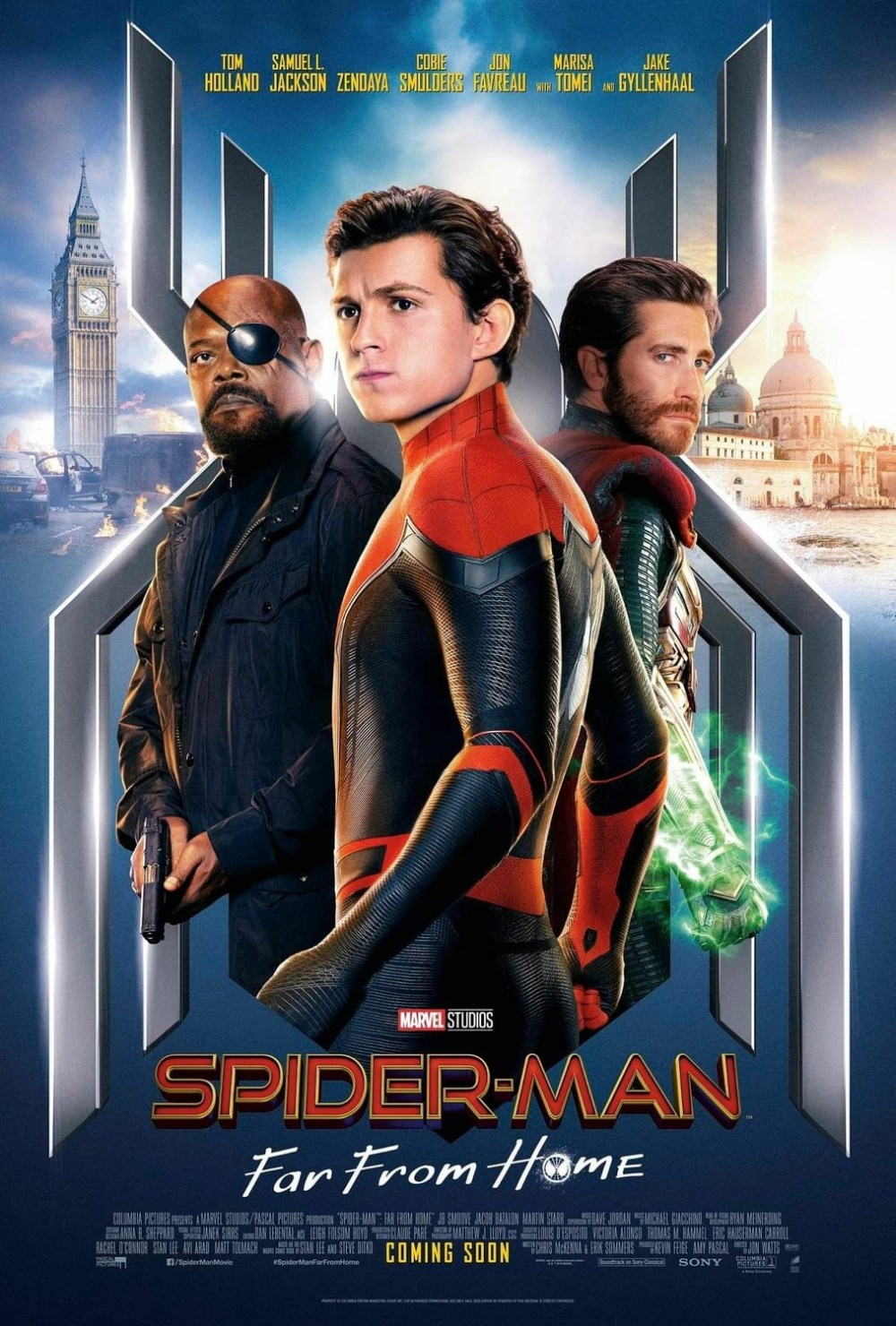
‘Spider-Man: Far from Home’ is a Fun Ride, and it May Be the Web Slinger’s Last in the MCU

Spider Man Far From Home Theatrical Poster

So, after a summer filled with an endless need to make ends meet, I finally got the chance to check out “Spider-Man: Far from Home.” Watching it at this point proves to be bittersweet as this may be the character’s last time in the Marvel Cinematic Universe since Disney and Sony are in a battle over profits. Spider-Man does whatever a spider can, but even a spider can fight only so much against greed and capitalism before he is undone or rebooted. It’s a crying shame because Peter Parker and his alter-ego were wonderfully reinvigorated thanks to Tom Holland who, ever since “Captain America: Civil War,” has proven to be the best Spider-Man yet. Here is hoping this will not be the last time we see Holland in this role as he keeps us invested in this teenager’s never-ending struggle between managing adolescence and being a superhero.

Eight months have passed since the events of “Avengers: Endgame” in which our heroes thwarted Thanos’ snap (everyone else calls it “the blip”) but did so at a great cost. Peter still mourns the death of Tony Stark as he tries to get back to being just a friendly neighborhood superhero, but Tony’s face is everywhere and it seems like everyone else expects Spider-Man to be the next Iron Man. It’s a lot to place on the shoulders of any one person, let alone those of a teenage boy eager to tell the girl he has a mad crush on how he truly feels about her.

A better title for this “Spider-Man” outing would have been “Spider-Man’s European Vacation” as Peter and his classmates which include his best friend Ned Leeds (Jacob Batalon) and love interest MJ (Zendaya), travel to Europe and some neighboring countries. Peter sees this as a much-needed opportunity to take a break from his Avenger duties and just be a kid, and Ned sees it as a chance for the two of them to be American bachelors in Europe because, or so he says, “Europeans love Americans.”

Of course, none of us can expect any Avenger to get much vacation time as the Water Elemental strikes with a vengeance in Venice, leaving our characters to run for their lives. Peter quickly springs into action, but he is aided by another superhero who goes by the name of Quentin Beck (Jake Gyllenhaal), but we all come to know him as Mysterio. Even though the two of them save the day, Nick Fury (the always reliably bad ass Samuel L. Jackson) shows up to tell him his help is needed. Peter protests how he is not ready to extend his duties beyond Queens, New York, but Fury bluntly reminds him, “Bitch, you’ve been to space!”

“Spider-Man: Far from Home” works best when it focuses more on the human element than on the spectacle. Spider-Man has always proven to be one of the most human of superheroes in movies and literature as his personal problems are no different from the ones we experienced at his age. Deep down, we all wanted to seem normal to our fellow classmates, and so does Peter. Still, hormones and awkwardness among other things needlessly but inevitably complicate our lives to where we are left with a lot of emotional scars which take forever to heal, if at all. Peter Parker is the MCU’s prime example of this, and it makes you admire him all the more as his juggling act is made all the more challenging throughout.

Jon Watts returns to the director’s chair after having done an excellent job with “Spider-Man: Homecoming,” and he infuses this installment with the same amount of fun and excitement. Along with screenwriters Chris McKenna and Erik Sommers, he makes Spider-Man’s predicament parallel with the insane times we live in as “alternative facts” and “fake news” have been given far more power than they ever deserved. Whether or not our heroes win the day, we are left to wonder if they will ever be able to fully control the narrative. As one character points out late in the film, “People need to believe, and nowadays they’ll believe anything.” As much as I hate to quote Rudy Giuliani in this or any other review, his ridiculous statement of how “truth is not truth” is played to great effect throughout this movie and its post credit scenes.

The thin line between reality and fiction is put to the test in an amazing sequence in which Spider-Man is thrust into a simulated world which alters his perception of reality in the same frightening way Jennifer Jason Leigh and Jude Law were in David Cronenberg’s “Existenz.” Just when Peter thinks he has a handle on things, so do we, and this proves to be our Achilles heel as reality is not at all what it used to be.

The climatic battle in “Spider-Man: Far from Home” ends up containing a bit too much in the way of CGI and suffers from overkill as a result. It is entertaining to sit through, but the overuse of visual effects ended up taking me out of the action more than I would have liked, and it makes this sequel pale in comparison to “Homecoming.” It always sucks when you watch a visual effect knowing it is a visual effect because there are many moments in this film which made me feel the exact opposite. Still, it failed to take away much of the enjoyment I had in watching these characters suffer through one of the best and worst field trips any of us could ever hope to have.

I also gotta say just how much I love this cast of actors. Aside from Holland, you have the great Martin Starr who is a deadpan delight as academic decathlon teacher Roger Harrington, “Iron Man” director Jon Favreau who gleefully returns as Harold “Happy” Hogan, Marisa Tomei who has long since proven to be the most alluring Aunt May of all, Cobie Smulders who remains an enticing and powerful presence as Maria Hill, and J.B. Smoove is a hoot to watch as science teacher Julius Dell. In addition, Tony Revolori returns as Peter’s classmate and YouTuber Eugene “Flash” Thompson as it allows us to see something many of us have wanted to see done to the most annoying YouTubers of all; get a swift kick in the balls.

It’s fascinating to watch Gyllenhaal here as he was almost cast as Spider-Man at one point. Seeing him making his first appearance in the MCU is a most welcome one as he has long since proven himself an actor to be reckoned with in movies like “Nightcrawler” and “Nocturnal Animals.” As Mysterio, he makes this character a complex one as he sympathizes with Peter’s plight while proving to be a bit of an enigma. When the truth of Mysterio is revealed to all, it made me respect Gyllenhaal’s performance all the more as it shows how he has to play not just with Peter’s mind, but the audience as well. Looks can be deceiving, and Gyllenhaal makes them especially deceiving here.

Like I said, watching “Spider-Man: Far from Home” proves to be very bittersweet as this may very well be the very last time we see this iconic character as part of the MCU. It’s a real shame as the first post credit scene we get foretells of a dark future for Peter Parker as his life is completely compromised through, among other things, doctored footage. Where can he go from here? It’s an infinitely interesting question.

Whatever happens from here, we will always have J. Jonah Jameson.

* * * out of * * * *


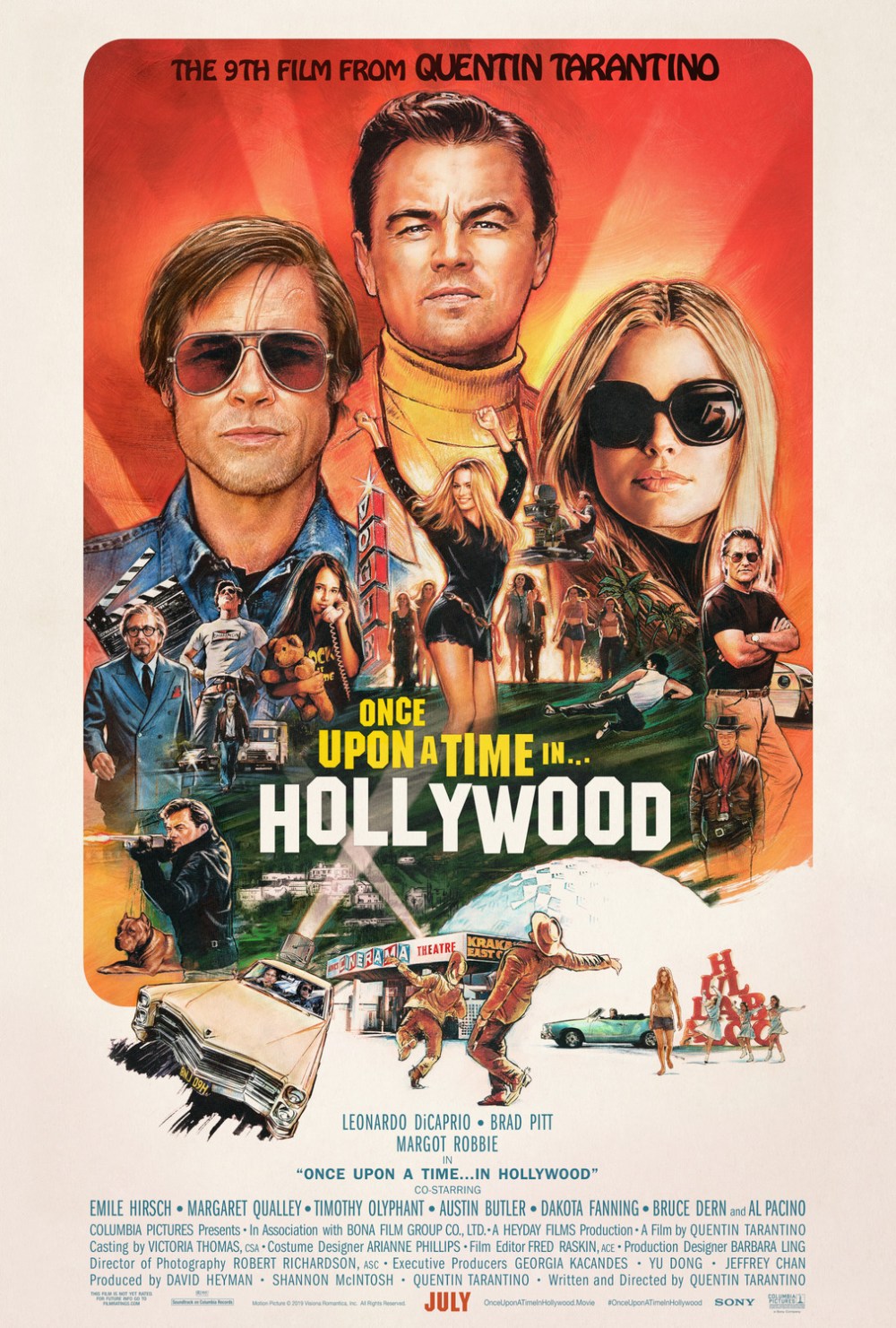
‘Once Upon a Time in… Hollywood’ – A Quentin Tarantino Fairy Tale

Once Upon a Time in Hollywood movie poster

Quentin Tarantino once said he did not have an “Age of Innocence” in him like Martin Scorsese did, but after watching his 9th film “Once Upon a Time in… Hollywood,” I think he may be mistaken. Yes, it does have an R-rating like and features some truly brutal moments of violence where faces are literally pounded in, but this is largely a loving tribute to the Hollywood of the 1960’s and of the actors and filmmakers which inhabited it. Considering Tarantino’s attention to detail and his fetish for any kind of artifact from this era, I have no doubt he would have loved to have been a filmmaker back then if he could.

Tarantino and his longtime cinematographer Robert Richardson transport us back to the Hollywood of 1969 where we meet Rick Dalton (Leonardo DiCaprio), an actor and former star of a “Wanted Dead or Alive”-like television series called “Bounty Law.” After having a conversation with his agent Marvin Schwarzs (Al Pacino, more restrained than usual), he comes to see how washed up his career has become as he is reduced to doing guest spots as the villain on various television shows. The only person he can talk to about his troubles is his best friend and stunt double Cliff Booth (Brad Pitt) who is always around to have a drink with and drive him around town as Rick has had one DUI too many.

“Once Upon a Time in… Hollywood” is kind of like a Robert Altman film in that it doesn’t have a straightforward plot. Instead, it acts as a day in the life story as we watch Rick Dalton try to move on with his acting career as an important decision hangs over him, whether or not to move to Italy where he can star in low budget spaghetti westerns. When the story isn’t focused on him, it focuses on Cliff who seems content to live in a trailer out in Van Nuys with his dog who is a bit annoyed at him for serving him the kind of dog food which slides out of its steel can as if it were pure slime.

The only thing Rick seems fairly excited about these days is the fact Roman Polanski and Sharon Tate now live next door to him in the Hollywood Hills. But looming in the background is Charlie Manson and his cult of followers who look at first to be harmless hippies, but they later reveal themselves to be devoted to him in a most unhealthy way. Those of us who are familiar with history, and who have a deep respect for historical facts, know Sharon Tate and others were murdered by Manson’s followers, and that this shocking act all but ended the era of love and peace irreparably. But as I watched this film, I began to wonder if Tarantino would stay true to history, or if he would play around with it as he did in “Inglourious Basterds.” Whatever the case, the presence of Manson and his cult cast an ominous shadow over the proceedings, so we know the end of this story will not be the least bit pretty.

Watching “Once Upon a Time in Hollywood” reminded me of how much I love it when a filmmaker sucks us right into another time and place to where we don’t doubt the accuracy and attention to detail. Cameron Crowe did this with “Almost Famous,” Paul Thomas Anderson did wonders with the 70’s and 80’s in “Boogie Nights,” and Tarantino does the same as he brings us right back to 1969 with wonderful abandon. All the famous landmarks of Hollywood are here including the Cinerama Dome, Musso & Frank Grill, El Coyote Restaurant and the classic movie theaters located in Westwood. New Beverly Cinema can be seen from a distance as it is shown having a premiere for an adult film, and this was back when it was a porno theater.

This attention to detail also includes the kind of beer these characters drank, the type of books they read, television antennas and cars. This was back in a time when people smoked an endless number of cigarettes, drove and sat in cars without having to wear seatbelts, and when love and peace was in the air even as wars were being waged overseas.

It is great fun to see DiCaprio in this kind of role after seeing him be so serious in “The Revenant,” a movie which earned him the Oscar he should have received for “The Wolf of Wall Street.” He’s a gas here as he makes Rick Dalton into a study of desperation as he struggles to maintain what’s left of his image and berate himself while alone in his trailer. The scene he has with a child actress played by the wonderful Julia Butters is a special highlight as she shows him the kind of innocence and love of acting he once had before life, alcohol and a corrupted world view clouded his perception.

As I have said in the past, I love it when Pitt gets down and dirty in a role, and he does just this as Cliff Booth. In addition to being Rick’s stunt double, he is also a Vietnam veteran, and the violence he inflicts on others who wrong him can be described at the very least as punishing. Pitt also proves to be as funny as DiCaprio from scene to scene, and he has a classic scene opposite Mike Moh who is pitch perfect as Bruce Lee in which I saw something I never thought I would see or believe, someone getting the best of Bruce Lee.

But one performance I really need to single out here is Margot Robbie’s as Sharon Tate. While at the Cannes Film Festival, someone asked Tarantino why he didn’t give Robbie the same amount of dialogue he gave DiCaprio and Pitt. I don’t remember who asked this question, but whoever it was, they completely missed the point. It’s not always dialogue which aids a performance. Sometimes it’s just a look or an attitude, and Robbie gives off a look or two which is more than enough to capture the essence of Sharon Tate as well as her beguiling innocence.

Tate has long been relegated to history as one of the Manson family’s murder victims, but she deserves to be known for much more. As Robbie sits in a Westwood movie theater watching a movie Tate co-starred in, we are reminded of a talent which was taken away from this world far too soon, and it makes me want to check out everything Tate ever appeared in. Robie does a fantastic job of reminding us how fun it is to see ourselves, let alone our name, on the silver screen as others look on, unaware of who is sitting next to them in the audience, and she is as radiant as Tate was in her far too brief lifetime.

There are so many familiar actors worth singling out here, but some of them you may not see coming and I am not about to spoil any surprises this film has to offer. I will say it’s always a delight to see Kurt Russell in anything and everything, and he is great as a stunt coordinator who is not quick to warm up to Cliff. Margaret Qualley is a memorable presence as Pussycat, a member of the Manson family who does warm up to Cliff. Bruce Dern, in a role originally meant for the late Burt Reynolds, is fun to watch as George Spahn, a man whose ranch was used for many westerns and which later got used by Charlie Manson and his demented followers. And it is quite bittersweet to see the late Luke Perry as it is the last feature film he will ever appear in.

Seriously, as rough and tumble as “Once Upon a Time in Hollywood” gets, it really is a love letter to a Hollywood which time will never forget. As Tarantino nears the end of his long filmmaking career (or so he says), he continues to give us one enthralling motion picture experience after another. Even if his works threaten to be undone by self-indulgence, I am glad people are thoughtful enough to give him the freedom to make what he wants to make. If Tarantino ever had it in him to give us a fairy tale, this would be it. Even as its main characters threaten to be forever swallowed up by bitterness and cynicism, there is a light of innocence which helps lead them to the next stage in their lives. And if this film is any indication, this is time in Hollywood which Tarantino wishes lasted longer than it did.

Now, as with any Tarantino film, I have to go out and buy the soundtrack and then watch it again. And one other thing, I almost didn’t recognize Timothy Olyphant. Did you? Oh yeah, and sauerkraut will never be the same.

* * * * out of * * * *

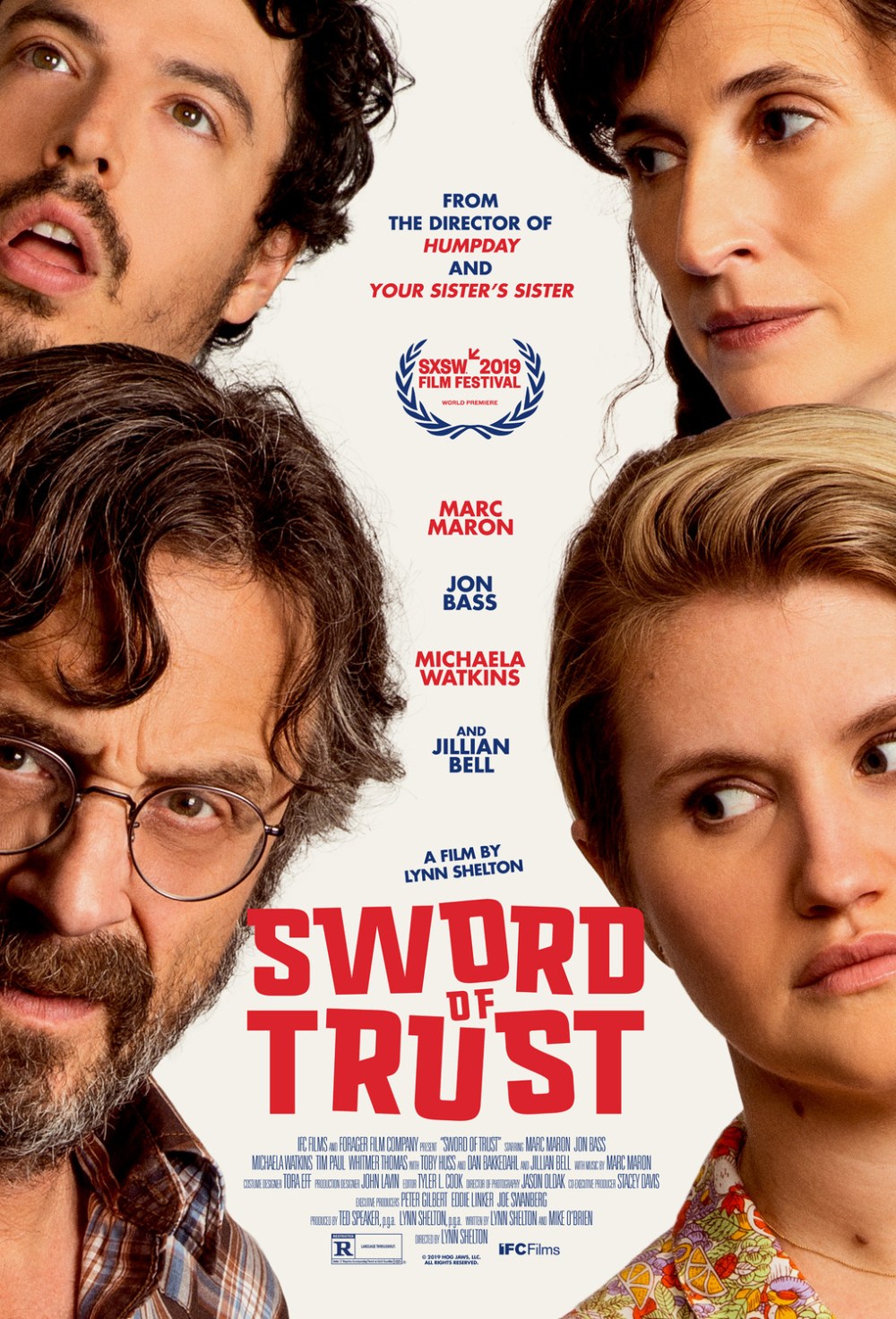
‘Sword of Trust’ Thrives On the Energy of its Cast

Sword of Trust movie poster

While driving over to a screening of “Sword of Trust.” I ended up in a fender bender which succeeded in ruining my mood for the rest of the day. As a result, I came into this movie wondering if I could look at it objectively as my mind kept going back to the unfortunate incident, and I was fuming at how I could not change what just happened. Well, it’s a good thing I waited a couple of days to write this review on it as my mind is clearer than it was previously. “Sword of Trust” at times feels like a half-realized film, but I did enjoy it and admired the intent of its filmmaker and cast to give us something character driven in a time when cinema is still infinitely dominated by superhero and comic book movies.

We meet Cynthia (Jillian Bell) and Mary (Michaela Watkins), a loving couple who arrive in Alabama to collect Cynthia’s inheritance from recently departed grandfather. They both think they will gain ownership of his home, but they discover it is wrapped up in reverse mortgages which means the bank owns it and is not about to give it up. Don’t you love that? Even if you read the fine print, you and your family members can ever so easily get screwed out of home ownership as greed remains king.

Anyway, Cynthia instead inherits a Civil War era sword, and it comes with a set of letters which prove that it was the South which actually won the Civil War. As a result, the two take the sword to the nearest pawn shop which is run by the cantankerous curmudgeon Mel (Marc Maron) who is quicker to cheat his customers out of the best deal possible for his own capitalistic gains. However, when his man-child employee Nathaniel (Jon Bass) stumbles across a You Tube video in which an overzealous conspiracy theorist appears more than willing to pay thousands of dollars for Civil War artifacts, these two men quickly become very interested in selling this sword to the highest bidder.

I enjoyed how the characters in “Sword of Trust” show themselves to be more capitalistic than they initially realize. Mel initially shuts down Cynthia’s and Mary’s attempt to sell him their sword, but when he shows a renewed interest in it, the two women are not about to be cheated out of any money. Unlike certain people, they refuse to believe Paramount Pictures has yet go profit on the Eddie Murphy comedy “Coming to America,” and they are not about to be swindled out of any substantial profit they are entitled to.

From there, the story moves in unpredictable directions as these four characters attempt to sell the sword to those conspiracy theorists, and I had no idea of where things were going to go which made this film especially entertaining. Considering the depressing rise in white supremacy in the United States of America, I started to believe “Sword of Trust” would descend into an abyss of racism, greed and selfishness. Does it? I refuse to say.

What I can tell you is “Sword of Trust” deals with characters who are more like us than we may initially realize. As they are driven to an undisclosed location in the back of a truck with no windows, they come to reveal things about themselves which no one is quick to another without some level of trust. This scene made me like this movie even more as these characters could have easily been passed off as types instead of individuals who slowly reveal share who they really are to complete strangers.

Directing this movie is Lynn Shelton who co-wrote the screenplay with Mike O’Brien, and she allowed her cast to improvise in a way which has us wondering how everything will turn out. “Sword of Trust” looks to be a cinematic experience we have seen far too many times beforehand, but it is filled with humanity and some strong laughs throughout. Even though it may very well get swept away by the latest summer blockbusters such as the live-action version of “The Lion King,” I think it is worth checking out for those who are looking for something a little different.

All the actors really commit to the material, and it is great fun to watch Watkins and Bell work off of one another throughout. It’s also fun to watch Bass fumble about as Nathaniel, a man-child who has made the mistake of believing in the wrong things to where his mind threatens to be permanently warped. Then again, his character does represent a growing portion of Americans who have somehow led themselves to believe the earth is flat (newsflash, it isn’t).

But the real star by far of “Sword of Trust” is Marc Maron. I have become a big fan of his after watching his IFC show “Maron” and listening weekly to his podcast “WTF.” Having seen and heard him in various formats, it is tempting to say he is simply playing a version of himself as Mel, but that isn’t really fair. Just watch as he tries to keep his guard up when his ex-girlfriend Deirdre (played by Shelton) visits his store; his inability to say something right away speaks volumes. Whether it is that scene or the one in the back of the truck, Maron has proven himself to be a strong actor as he is able to say many things without uttering a word, and it is an example of why he is having a career renaissance which has allowed him to star on the Netflix series “GLOW” and have a co-starring role in the upcoming film “The Joker.”

In addition, Maron also provides the music for this film, and his guitar helps to illustrate the complicated lives of each character and of the absurdity of their current predicament. Whether or not it will have you crying out “Boomer lives” while in the movie theater is another story.

“Sword of Trust” isn’t a great film, but it is an entertaining and absorbing one which I admired. Its resolution is a little pat, and some of the character twists feel a little too manipulative and fly in the face of easy logic, but I did admire what each cast member was able to bring to the material, and their performances alone make this worth a look.

It’s sad to see movies like this get such a short shelf life. Character driven motion pictures are not as prevalent in today’s cinematic landscape as they once were. I am always waiting for things to circle around back to where these kinds of movies will become more popular again, but it looks like we still have a long, long way to go to get there. Still, we have filmmakers like Lynn Shelton around who continue to buck the Hollywood trends, and this is better than nothing.

Now, back to my damaged car… Dammit.

* * * out of * * * *

“Sword of Trust” will be playing at the Nuart Theatre in Los Angeles, California thru July 25, 2019.


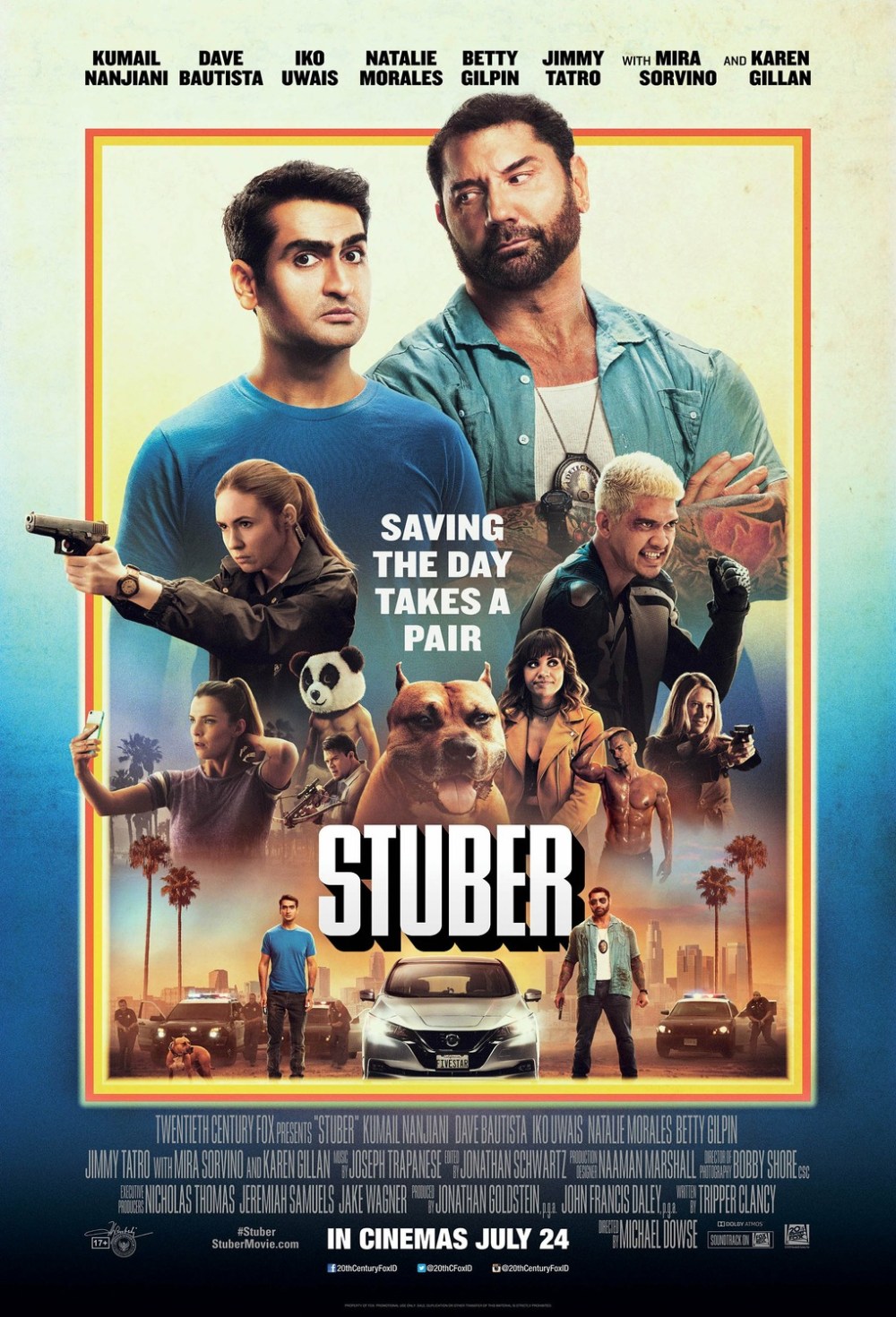
‘Stuber’ Has Its Moments, But Not Enough of Them

Stuber movie poster

Stuber” feels like an overdue return for me to action comedy genre. Seriously, it feels like I have been away from this particular genre for far too long. While there may have been many action comedies/buddy movies released in recent years, I cannot help but feel like the last one I bothered to watch was 2010’s “The Other Guys” with Mark Wahlberg and Will Ferrell. Watching “Stuber” brought to mind movies like that and also “Stakeout” in which Richard Dreyfuss and Emilio Estevez play Seattle detectives spying on Madeline Stowe, and it remains a classic I never get sick of watching. “Stuber,” however, doesn’t quite reach the greatness of “Stakeout” or “The Other Guys,” and watching it made me feel old as I begun to realize I have seen this type of movie so many times.

This movie starts off with a shockingly visceral action sequence as Los Angeles detective Victor Manning (Dave Bautista) relentlessly pursues ruthless drug trafficker Oka (“The Raid’s” Iko Uwais) inside a downtown hotel. This opening took me for a loop as the violence is not the least bit sugar coated as bullets inflect tremendous damage and the blood flows more freely than in the average comedy. Unfortunately, Oka escapes Victor’s grasp and mortally wounds his partner, Sarah (Karen Gillan), and this leads to a scene which has Victor more or less saying, “don’t you die on me!”

From there, the story moves to several months later where we meet Stu (Kumail Nanjiani) who, when he isn’t working his job at a corporate home improvement store, is out on the town as an Uber driver. Stu is also juggling his work life with his personal one as has deep feelings for his best friend Becca (Betty Gilpin) whom he is about to open a cycling exercise gym with. Then one day, while trying to maintain at least four-star rating on Uber so he can avoid deactivation, he gets a ride request from Victor who finds himself on the path of Oka yet again, and everyone’s life, career and Uber rating is on the line more than ever before.

The one thing which immediately stuck me about “Stuber” is how it reminded me of how the atmospheres of Uber and Lyft are completely different from one another. Whereas in “The Equalizer 2” where Denzel Washington got along with his passengers was only attacked by one but not because he was a Lyft driver, Stu invites trouble simply because Uber passengers are far too quick to give him a one-star rating for reasons which are not necessarily his fault. Seriously, Lyft has a better reputation than Uber, and this movie is a reminder of that.

“Stuber” is a movie aimed at entertaining its target audience and, as a result, employs an endless number of clichés which this genre is known for. Victor is a cop who is obsessed with bringing down the bad guy at any cost, and his endless pursuit has long since cost him the loving relationship he had with his daughter, Nicole (Natalie Morales). When these two men are forced into a situation brought about by circumstance, each wonders who is more manly than the other as they are forced to deal with issues which they have put off to the side for far too long.

On the upside, the pairing presented in “Stuber” is perfect as these two actors and their characters could not be further apart from one another if they tried. Bautista is a former wrestler who became an unforgettable presence in the Marvel Cinematic Universe when he played Drax in the “Guardians of the Galaxy” movies, and he has proven to be a memorable screen presence in “Blade Runner 2049,” “Spectre” and “The Man with the Iron Fists.” Nanjiani is a Pakistani-American stand-up comedian, actor, and podcast host who is best known for writing and staring in “The Big Sick,” a movie I should have already watched. This should be enough to inform you these two individuals are exact opposites from one another.

Bautista makes Vic Manning into the typically obsessed detective you are bound to find in a movie like this, and he makes this character an empathetic one as he tries to fix things with his daughter while bringing down an especially devious criminal. Nanjiani’s character is the more human of the two as he tries to survive a situation he has been unexpectedly thrust into while trying to be honest with Becca about his feelings for her. Together, these two actors make quite the pair as they race through Los Angeles in an electric car which is leased instead of owned.

Having said that, “Stuber” falls victim to playing far too often with clichés this genre has dealt with for far too long, and it gets to where we know the direction this story is heading in. Granted, I did not go into this movie expecting something original, but the filmmakers still had a chance to give us something both fresh and entertaining and they did not quite pull it off here.

The problem filmmakers have in making action comedies is balancing out the action with the comedy, and it is a balance which is harder to achieve than anyone initially thinks. “Stuber” was directed by Michael Dowse, a Canadian filmmaker who previously gave us the “FUBAR” movies which dealt with two lifelong friends and head bangers living out their lives, and also the sports comedy “Goon” which dealt with ice hockey. One of his movies I especially liked was “What If” which starred Daniel Radcliffe and Zoe Kazan in a romantic comedy that followed a well-established formula but still proved to be highly entertaining and absorbing nonetheless.

With “Stuber,” I couldn’t help but think Dowse would really freshen up the buddy comedy formula to great effect, but it only goes so far here. On one hand the action scenes are excellent and visceral, but on the other they seem too brutal for a movie which aims to keep us laughing hysterically. The shift from comedy to action is at times very jarring to where I wasn’t sure whether I should be laughing or clinging to the edge of my seat. And this movie doesn’t have the kind of action which could be seen as make believe. The bullets hit hard and leave a lot of damage, and the blood flows a lot more than it ever did in “Stakeout.”

When all is said and done, “Stuber” is not able to balance out the action and comedic elements with total success, and it is at times more violent than it needs to be. Also, I have seen this kind of movie so many times now to where it all feels routine, free of surprises and run of the mill despite a game cast that gives the material their all. Yes, it has its moments, and it is a reminder of why I would rather drive for Lyft instead of Uber, but for me this one is a near miss. I cannot say I didn’t enjoy it, but it is a movie which will not stay in the memory for very long after you depart the movie theater. Suffice to say, this is no “Stakeout” or “The Other Guys.”

Oh yeah, Mira Sorvino co-stars here as Vic’s boss, Captain Angie McHenry. It’s great to see her here. It’s great to see her in anything.

* * ½ out of * * * *


Rob Zombie Unleashes The First Trailer for ‘3 From Hell’

Of all the sequels coming out in 2019, I have to confess I am especially excited for “3 From Hell.” Writer and director Rob Zombie returns with his third film dealing with the murderous exploits of the Firefly family, exploits which began with 2003’s “House of 1000 Corpses” and continued on in 2005’s “The Devil’s Rejects.” This sequel has been in the making for some time now, and while we still have to wait a month or two before it comes out, we now have a new trailer which shows it to be as bloody and violent, if not more so, than its predecessors.

One thing I am especially intrigued about is how Zombie plans to explain how Captain Spaulding (Sid Haig), Otis (Bill Moseley) and Baby Firefly (Sheri Moon Zombie) survived the “Wild Bunch” shootout at the climax of “The Devil’s Rejects.” For all intents and purposes, they have looked to have willfully ended their existence in a hail of bullets which no one could easily survive. Still, a news reporter confirms they somehow survived but, as their mangled bodies are hauled into the emergency room, says their chances of survival are “less than a million to one.” But as John Carpenter once said, “evil never dies.”

Surprise! The three survive and are put on trial for their vicious crimes in a public spectacle to where they look to have become folk heroes just like Mickey and Mallory were in “Natural Born Killers.” We even hear supporters in the background yelling out “free the three” to where I wonder if Zombie is making some sort of comment about how many in America typically act against their own best interests. Regardless of how you may feel about horror and exploitation films, the best ones always have some social commentary hiding just beneath the surface.

Judging from the behind the stories I have read about “3 From Hell” thus far, I assumed this movie would be about the trial. But sure enough, Captain Spaulding, Otis and Baby appear to have freed themselves from their incarcerations and go on another killing spree, and the trailer never tries to sugar coat or hide away from the brutality Zombie has in store for genre movie fans. Just watch as Otis endlessly bashes a helpless victim while Winslow Foxworth Coltrane (“31’s” Richard Brake) looks on with a twisted and detached amusement.

Like “The Devil’s Rejects,” “3 From Hell” looks to have a very grungy look which more than suits the subject matter, and my hope is Zombie got to shoot this one on film instead of digital. I eagerly await its release and its soundtrack as the ones Zombie has provided for the previous films were fantastic, and I never get sick of listening to either of them. Surely, this latest installment will have one which is every bit as good, right?

Lionsgate and Saban Films have partnered with Fathom Events to present the unrated cut of “3 From Hell” in theaters on September 16, 17 and 18, 2019, and each screening will have unique bonus content:

  • September 16th – Rob Zombie will provide a special video introduction before the screening, and the first 50 people at each theater will receive an exclusive poster (while supplies last, I imagine).
  • September 17th – There will be a half hour behind-the-scenes featurette shown about the making of this particular sequel
  • September 18th – The unrated cut of “3 From Hell” will be presented as a double feature with “The Devil’s Rejects.”

Tickets for these screenings will be available on the Fathom Events website starting on July 19. Click here to find out more.

Please check out the trailer above.

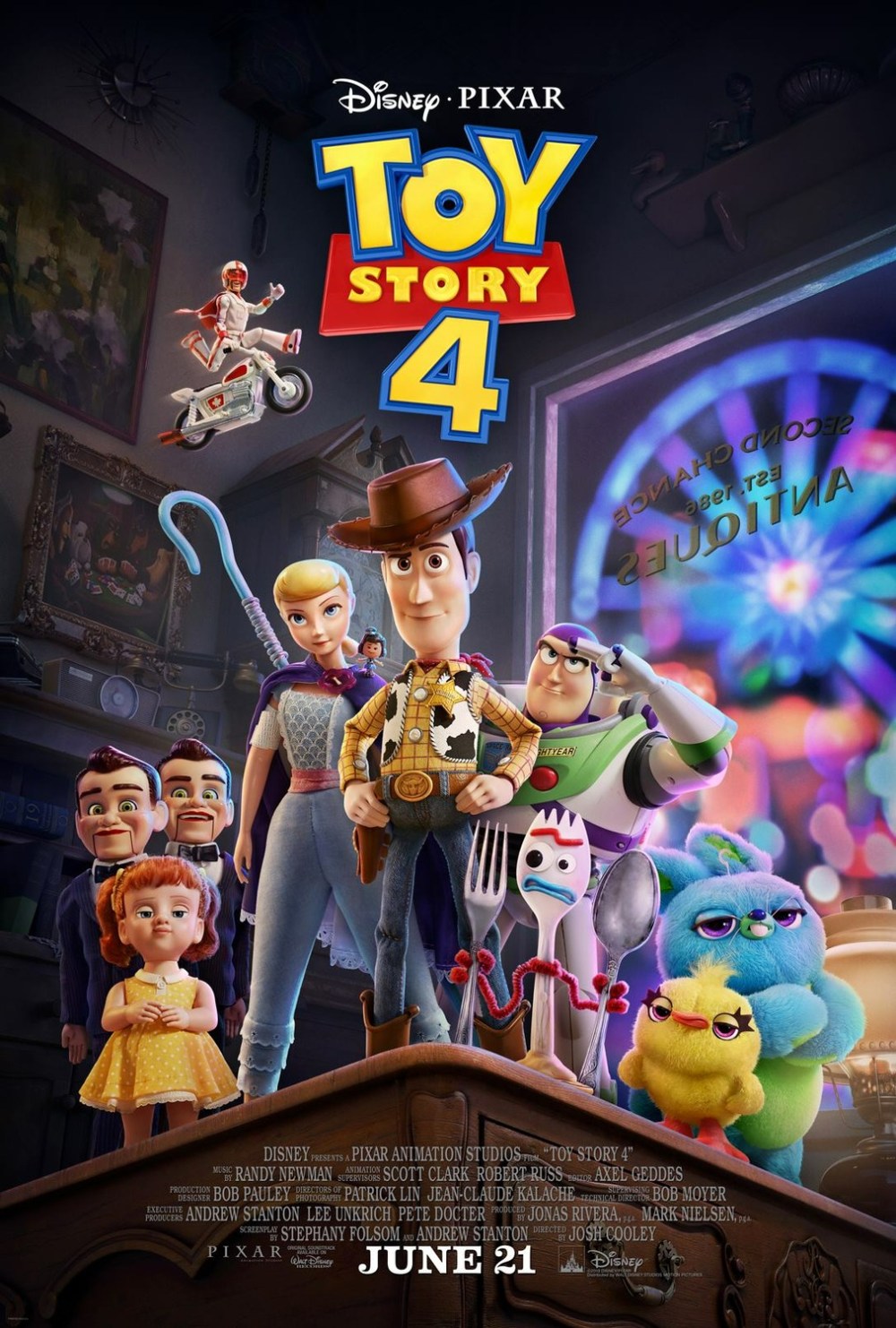
3 From Hell Teaser Poster

‘Toy Story 4’ is Yet Another Animated Masterpiece from Pixar

Toy Story 4 movie poster

Did the world really need another “Toy Story” movie, especially after the third one wrapped everything up with a beautiful ribbon? Well, it turns out we did. The news of a “Toy Story 4” sounded like a cash grab, and it’s not like Pixar is lacking in money or funds even after the box office failure of “The Good Dinosaur.” But to my surprise, the fourth movie in this ever so popular franchise quickly proves there is indeed another highly entertaining adventure involving the group of toys led by Woody and Buzz Lightyear.

Unlike other Pixar movies, “Toy Story 4” does not start off with an animated short, but this is because the opening sequence more or less serves as one. We go back several years before the previous sequel as we watch Woody (Tom Hanks) and the others work feverishly to save a remote-controlled car which is about to be washed away into the sewer. With the aid of Bo Peep (Annie Potts), Woody drags the car away from certain destruction, but then things take a sharp left turn when Molly, Andy’s sister, suddenly takes Bo Peep away from the window and donates her to a man eager to share this doll with his own daughter. Woody tries to rescue Bo Peep, but she assures him it is time for her to be someone else’s toy. Still, the deeply heartbreaking moment from “Toy Story 2” in which Jessie (Joan Cusack) is discarded by her owner to the tune of a Sarah McLachlan song immediately quickly comes to mind as this scene proves to be almost as painful.

Moving ahead years later, these toys are now in the care of Bonnie, and we catch up with her when she is about to make a big transition in her life: start going to school. Her kindergarten orientation marks the first time she is separated from her parents and her toys, and she is understandably crippled by separation anxiety like any other kid would be. Woody, having been neglected by Bonnie recently, sneaks himself into her backpack and throws some craft materials onto her table, and with them she creates a new toy out of a spork whom she names Forky (voiced by Tony Hale). This toy quickly becomes her most beloved, and Woody encourages the other toys to make Forky feel welcome in his new environment.

Forky, however, experiences an existential crisis as he feels he was never meant to be someone’s toy, but instead destined for the nearest trash can. Sporks are meant to be used once and then thrown away, but Woody desperately tries to make Forky see how important he is to Bonnie’s well-being. Still, it’s hard to think of another character in animation or family entertainment other than Oscar the Grouch who has had such a passionate love affair with a trash can, or any trash receptacle for that matter.

The “Toy Story” movies all have the same kind of story as the toys, for one reason or another, become separated from their owner and do whatever they can to return to them before it’s too late. Still, each one deals with very intriguing questions about what it means to be a toy and of the importance they play in anyone’s life. What I love about these questions is how deeply they involve the viewer to where you are as caught as the characters as they stress over the right move to make. Either that, or watching these movies really messes with my anxiety.

As always, Pixar provides us with brilliantly animated images, and “Toy Story 4” is full of them throughout. Our gang of toys ends up at a carnival while Bonnie and her parents are on a road trip, and Woody ends up in antique store which is filled with one easter egg after another. Some I recognized like the soda bottle cap from “Up,” but a second viewing is definitely required as there are many more I have yet to discover in this sequel. Just when I thought Pixar could not wow me anymore than they already had, they do.

The big news in this sequel is Woody ends up running into Bo Peep again for the first time in years. She appears to revel in being a free toy after her latest owner gave her away, and now she spends her days with her sheep. Billy, Goat and Gruff, traveling in a remote-controlled skunk in sequences I want to believe were inspired by similar ones in “Mad Max: Fury Road.” Woody reuniting with Bo Peep is a wonderful moment as those who have followed this franchise from the beginning know how affectionate these two toys were with one another, and we spend a good deal of this sequel’s running time wondering if these two can possibly stay together or suffer yet another sudden goodbye.

With any new “Toy Story” movie, there are always new characters to be found, and this was one has several. In the antique store, we meet a beautiful doll named Gabby Gabby (Christina Hendricks) who looks friendly enough at first, but who quickly reveals herself to be a bit devious as she attempts to obtain Woody’s voice box for her own uses. There is also Duke Caboom (Keanu Reeves), friendly Canadian daredevil who suffers from low self-esteem as his owner ditched him when he could not perform the same stunt he performed on a television commercial. Oh the pitfalls of advertising,

But when it comes to my favorite new toys, they are Ducky and Bunny, a pair who resent playing second fiddle to Buzz Lightyear in a carnival game. They are voiced by Keegan-Michael Key and Jordan Peele, the comedic duo we all know and love as Key & Peele, and it is great fun to see them reunited here. These two toys come to aid our heroes, and their methods prove to be hilariously unorthodox as they are quick to attack others in a way they mistakenly believe will be ever so effective.

When “Toy Story 4” comes to its conclusion, I found myself choked up even more than I was with the climax of “Toy Story 3.” With the previous sequel, we saw the end of one era, and with this one has us witnessing the end of another. It’s a deeply emotional finale to where it’s impossible not to feel like you are on the verge of crying as these toys have now been with us for over 20 years. They are like family, and they are now taking another big step into the unknown.

Could there be a “Toy Story 5?” Well, this sequel reminds us of how anything is possible. But if this is to be the final one, it certainly ends things on a tremendously high note. All the voice actors are excellent as they each find the depth in their characters to where not a single one is unforgettable. Josh Cooley makes a tremendous feature film directorial debut with this sequel, Stephany Folsom and Andrew Stanton have given it an excellent screenplay, and the great Randy Newman provides us yet again with another great score and songs this franchise has thrived upon.

2019 has not been a great year for sequels thus far, but along with “John Wick Chapter 3: Parabellum,” “Toy Story 4” proves you at the very least need Keanu Reeves to make your sequel the least bit successful in an overcrowded market. Seriously, you cannot deny this fact after what this summer has given us so far.

* * * * out of * * * *

‘Booksmart’ is an Instant High School Movie Classic

Booksmart movie poster

Looking back at my high school days, I wonder if I got into enough trouble as a kid. I was a good kid for the most part, a pretty good student, and was and still am a firm believer in karma. Still, a lot of my fellow classmates who constantly got into all kinds of mischief, some of which involved police involvement, seem to be doing much better in life than me. The other day, I read an article about how the kids who were really into heavy metal back in the 1980’s have since turned out to be well-adjusted adults. Perhaps if I had discovered Metallica in elementary school instead of high school, I would feel well-adjusted as well. Besides, neither Megadeath nor Motley Crue came even close.

I bring this up because these thoughts went through my head as I watched “Booksmart,” an American coming of age comedy which has at its center two females who have been best friends since childhood and are now one day away from graduating high school. They have been model students, paid far more attention to their studies than partying, and they have since been accepted to some of the best colleges America has to offer. But with one day of high school left, they begin to wonder if they haven’t fooled around enough in the past four years. What results is a film which has been described as a female “Superbad,” and it is one of the best coming-of-age films I have seen in some time.

It is made clear from the start how best friends Molly Davidson (Beanie Feldstein) and Amy Antsler (Kaitlyn Dever) have spent more time studying these past four years than they have getting wasted every other weekend. Molly is the student body president, but she is nowhere as popular as the vice-president, Nick Howland (Mason Gooding), who only went for the position because it involved planning parties. Amy came out as gay two years ago, and she is harboring a huge crush on fellow classmate Ryan (Victoria Ruesga) which could go unrequited. But while they have accomplished so much, these two young women are typically spurned by their fellow classmates as being too pretentious.

Molly ends up convincing Amy to go to Nick’s party, the biggest end-of-the-school party of all, after she makes a shocking discovery. While she and Amy have gotten into good schools, Molly discovers her fellow classmates who looked to have been partying their scholastic years away have also gotten accepted to prestigious institutions as well. How is this possible? Well, Molly isn’t sure, but she sees this party as their last chance to have the fun they somehow denied themselves during their time in high school.

Like many great movies, “Booksmart” isn’t so much about the destination as it is about the journey. Molly and Amy’s determination to get to Nick’s party is quickly thwarted by the fact they have no idea where it is. As a result, they are forced to endure detours to other parties they did not plan on going to, cell phones which are quickly drained of all their energy, and teachers who either have unexpected side jobs or have forever sworn off drinking certain smoothies from Jamba Juice.

“Booksmart” marks the feature directorial debut of Olivia Wilde, an actress as strikingly intelligent as she is fiercely beautiful. She has said “The Breakfast Club,” “Fast Times at Ridgemont High,” “Dazed and Confused” and “Clueless” served as inspirations for this film, and she has taken the best parts from each of them and created something which feels wonderfully unique. It has many laughs and heartbreaking moments which we can all relate to as, regardless of the advances in technology, our high school years were always emotional battlefields which left us with psychic scars which never fully heal.

Along with a cleverly crafted screenplay by Emily Halpern, Sarah Haskins, Susanna Fogel and Katie Silberman, Wilde takes the time to explore the various personalities high school has to offer, and of the cliques they have long since been consigned to. But as the story goes on, these same individuals get a chance to peel back the façade given to them by their classmates to where we see people trying to survive these rough and tumble years as rumors about their supposed behavior still spread like wildfires which can never be easily put out. It’s moments like these I always cherish in high school movies as no one is ever what they appear to be on the surface, and this is what I think “Booksmart” is truly about; looking past what you think you see to discover what is really there, and making us see we are all the same.

Both Davidson and Antsler are perfectly cast as Molly and Amy to where they make you believe they have been best friends forever. We root for them as they look to live their last night as high schoolers to the fullest, and we feel for them as they eventually realize they may never see each other again for the longest time after this year is over. And yes, the two have a tense confrontation when they reveal truths which should have been confronted ages ago, and Wilde sticks the knife in deeper by muting their conversation as the looks on their faces is enough to illustrate the painful truths and grudges which have now forced their way to the surface.

Another memorable performance comes from Billie Lourd as Gigi, a gleefully blissed-out individual who somehow shows up at every high school party Molly and Amy are at. She is a riot throughout and inhabits her character with such wonderful abandon to where I believe Silberman when she said extra scenes were written for Lourd as everyone was really impressed with her performance.

In addition, there are some nice cameos from Will Forte and Lisa Kudrow who play Amy’s parents and have prepared a dinner with food names which need to be heard to be fully appreciated. Jason Sudeikis has some choice moments as school principal Jordan Brown who shows up unexpectedly throughout the film. And Diana Silvers has some strong scenes as Hope, a seemingly mean school girl who eventually lets her poker face down.

Wilde also has wonderful collaborators in Dan the Automator who composed the energetic film score, and cinematographer Jason McCormack who gives the visuals a reality we can relate to as well as a fantastical quality when our heroines slip into their imaginations to where one dance sequence looks like it was shot by Benoît Debie.

“Booksmart” arrives in theaters one year after “Eighth Grade,” a film about the worst year in our lives. “Booksmart” isn’t quite as brutal as it takes place in a time when the divisions between teenagers begin to disappear as they are all about to advance to another, and more vulnerable, stage in their lives. Still, it proves to be as entertaining, thoughtful and at times as heartbreaking. While it may invite easy comparison with “Superbad,” it is by no means a gender reversed remake of it. I don’t know how many out there think it is, but it is worth pointing this out here.

In a time when summer blockbusters and superhero movies reign supreme at the box office, a movie like this can get buried too easily. Here’s hoping “Booksmart” gets the audience it deserves in one way or another. And after you have watched it, you will agree that panda bears will never, ever be the same.

* * * * out of * * * *