Halloween II (2009)

halloween-ii-2009-poster

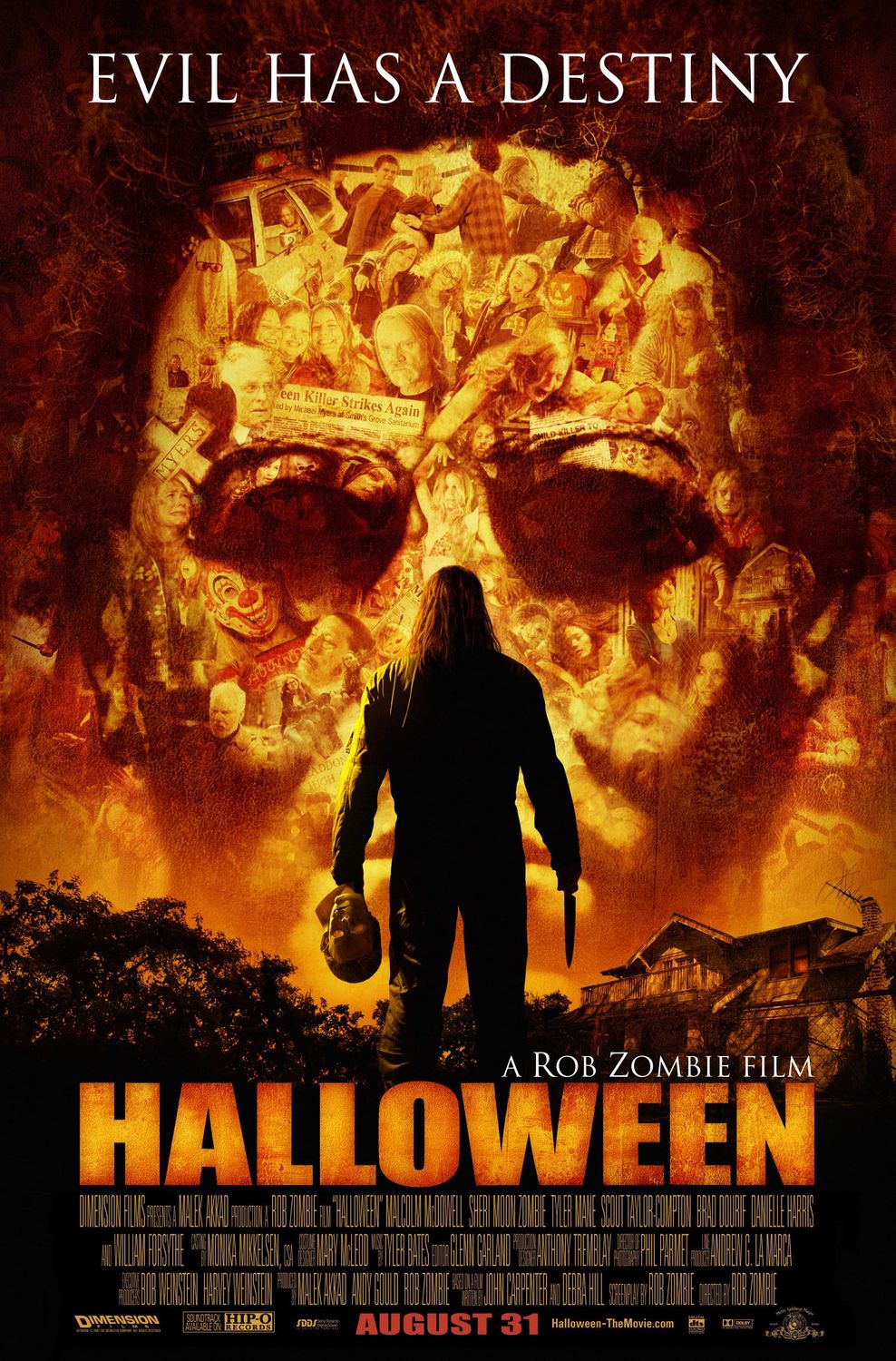
It’ll be interesting to see what people think of Rob Zombie’s “Halloween II.” With this sequel to his remake, he has not made your typical slasher flick even though it does contain some amazingly brutal and bloody moments. One crushing death plays like an homage to the fire extinguisher scene from Gaspar Noe’s “Irreversible.” I have also heard some complain because this sequel doesn’t even feel like a “Halloween” movie to them, but wasn’t that the whole point of this re-imagining? Do you really want the same old slasher formula we have long since gotten burned out on? Isn’t this why Zombie was brought on to do the remake? You know, to give this long running series a much-needed re-invigoration?

Zombie’s vision of Michael Myers may not be as scary as John Carpenter’s was, but I wasn’t expecting that to be the case. With Zombie’s take on the “Halloween” saga, what have here is more of a character study of how Michael became so infinitely evil, and this something we have seen much of in this never-ending franchise. “Halloween II” is definitely on a par with Zombie’s previous film, and everything comes around full circle to where there’s no doubt family is forever.

“Halloween II” starts moments after the previous film with Laurie Strode (Scout Taylor-Compton) walking down the street all bloodied up after shooting Michael dead at close range. However, it turns out Laurie didn’t kill him. The bullet must have bounced off his skull knocking him unconscious or something else along those lines. This seems to be a reasonable excuse to bring Michael back, and it is step from previous “Halloween” movies which managed to come up with ridiculous excuses to bring Michael back for another round with horny teenagers.

As Laurie is wheeled into the hospital crying hysterically, the first of many times she does so, shades of Rick Rosenthal’s “Halloween II” emerge, but this cannot be mistaken as a remake of sequel. Meanwhile, the drivers of the coroner van carrying Michael’s body end up smashing into a cow leaving them severely injured. This allows Michael to escape to live and see another October because, in the end, what is Halloween without Michael Myers?

Meanwhile, we see Laurie getting patched up in surgery, and the extent of her injuries is unsettling. The detail given to the doctors working on her is horrific very realistic, just the way Zombie wants it to appear. You look at Laurie’s mangled body, and you think to yourself it’s a miracle she lived through this dark, dark night.

“Halloween II” then moves to a year later as Laurie, still deeply traumatized by that horrific evening, struggles to go on with her life. She has since been adopted by Sheriff Lee Brackett (Brad Dourif) and lives with him and his daughter, Annie (Danielle Harris). While the previous movie was told through Michael’s eyes, this one is seen through Laurie Strode’s perspective, and she is no longer the person she once was.

One of the big differences with this sequel is the way it was filmed. Whereas Zombie’s “Halloween” was filmed in 35mm, he instead filmed “Halloween II” is in 16mm which gives everything a much harsher edge. This worked very effectively for him on what is still his best movie, “The Devil’s Rejects,” and it makes the killings in “Halloween II” feel all the more brutal. Michael doesn’t just slash his victims; he pounds them to a bloody pulp.

Tyler Mane once against gives us the most lethal and threatening Michael Myers ever unleashed on the big screen. Being as tall and hulking as Mane is, it’s a wonder why anyone would be foolish to take him on. Here’s another interesting thing about Michael in this one, he has a beard. That’s right, for the first time ever we get to see this iconic character with facial hair. This is ironic because Michael has proven to be very useful with knives to where I am convinced he can give himself the closest shave without ever having to use any shaving cream. Then again, Michael has more on his mind than facial hair.

Taylor-Compton’s Laurie Strode is not the chaste and resourceful character Jamie Lee Curtis gave us in the original, but she digs deep into this role and takes Laurie to places no ordinary person would dare go. You think she is at bottom when the movie starts, but she’s not anywhere near it. Taylor-Compton makes you care about Laurie as she comes to the realization of who she really is, and you want her to escape the abyss she is drowning in. You want to help her.

One especially good performance comes from Brad Dourif as he gets more screen time here. The sheriff he portrays here is not your typical clichéd stupid cop who makes all the wrong decision, but instead a caring adult and who is constantly looking out for Laurie and Annie. Dourif is great here in a way you would not usually expect an actor to be in a film like this, and he is one of the most underrated character actors working today.

That’s the great thing about Zombie’s “Halloween” movies; he is not out to give us the usual slasher flick. With these two films, he has taken the time to develop his characters to where they are not the usual pack of one-dimensional stereotypes the horror genre keeps relying on. While he still does employ the usual white trash characters who utter disgusting dialogue, it is clear he is moving beyond them now. This shows growth on his part which makes me look forward to his future work.

Zombie also conjures up some truly weird imagery throughout as we get a closer look into Michael’s deeply disturbed psyche. Sheri Moon Zombie returns as Michael’s mother, but this time she speaks to her murderous son from the grave and convinces him that if he kills Laurie, he can bring the whole family back together. Some may still criticize her acting abilities, but she is better than people tend to give her credit for.

Danielle Harris also returns as Annie Brackett, but Zombie doesn’t have her doing the same old things she did previously. Considering how Annie almost died, she is nowhere as foolish this time around (not completely anyway). Annie, along with her dad, is desperate to life Laurie out of her emotional abyss even as Laurie makes it incredible for them to even try to do so.

But of course, we cannot forget Malcolm McDowell who returns as Dr. Sam Loomis. This time around, the “Clockwork Orange” actor gives us a Sam Loomis who is a pure asshole getting high off the fame he obtains by exploiting his involvement with Michael and his family. Loomis is no longer the helpful psychiatrist he was before and is instead a profiteer off the misfortunes of others. His sudden change of heart towards the film’s climax may feel a little forced, but McDowell sells it to where we really feel his pain when he comes to accept the damage he has wrought on others.

The brilliant sound design in “Halloween II” also needs to be mentioned as well. Michael doesn’t just crash through windows and walls in this one. You feel him bashing his way through everything in his path, and it this movie a visceral thrill the other “Halloween” sequels could only dream of offering. Zombie is not out to give you a bunch of cheap scares, but is instead out to horrify you as much as possible as we suffer along with Laurie as Michael continues his endless pursuit of her.

Zombie also does a better job with suspense this time around, and it really boils in certain moments when our anticipation gets the best of us. We know Michael is going to strike, and we fear the bloody damage we know he will brutally inflict. I’m glad Zombie came back to do this sequel even though he originally wasn’t planning to. Having anyone else direct this follow up would have been a mistake.

John Carpenter’s “Halloween” was a one of a kind film which was never intended to start a horror franchise. Zombie is not trying to outdo Carpenter, but to merely make Michael Myers and all these characters his own. While “Halloween II” is not a masterpiece, he does stay true to his vision of this unstoppable monster and improves on his previous film quite a bit.

NOTE: The DVD and Blu-ray release of “Halloween II” contains the director’s cut of the movie. This version changes a few things and adds more scenes which focus on the characters more, and it’s even better than the theatrical version as it gives you an even clearer sense of what Zombie was trying to accomplish.
Theatrical Version: * * * out of * * * *

Director’s Cut: * * * ½ out of * * * *

Halloween (2007)

halloween-2007-poster

This one is a remake of one of the best horror films ever made. What could be the point of remaking it other than to make a quick buck? So many people have been milking this franchise dry for decades. Just when you thought Michael Myers was finished once and for all, he springs back with some utterly lame excuse for still being alive.

But what this “Halloween” remake has going for it is Rob Zombie who gave us “House of a 1000 Corpses” and the brilliant grindhouse flick “The Devil’s Rejects.” We all know just how much he loves John Carpenter’s original film, and we believed him when he said he would make this “Halloween” his own. If there was ever going to be a “Halloween” remake, who better to do it than Zombie?

This reimagining proved to be polarizing for “Halloween” fans in general. They either loved it, hated it or had a mixed reaction to it. One thing for sure, it is far more brutal than Carpenter’s film. Zombie does not try to hide from the ugliness of violence, and there is no campiness to be found here.

The first half is the freshest part as it deals with Michael Myers as a child and looks closely at what made him such a monster. This is where Zombie’s “Halloween” could have been disastrous as things tend to be scarier in a horror movie when the motives of the killer are barely described or explained. But what Zombie does is force us to look at Michael as a human being instead of an indestructible force of nature, and this makes his version all the more compelling.

Michael could not have come from a more dysfunctional family if he tried. His mother (Sheri Moon Zombie) is a stripper at a local bar, his step dad (William Forsythe) is an abusive prick who has nothing nice to say about anything or anybody, and his sister Judith (Hanna Hall) would rather make out with her boyfriend than take her little brother trick or treating. On top of that, he is constantly bullied at school and has this little hobby of killing animals which is typically a serious warning sign of someone about to embark more homicidal adventures.

Zombie succeeds in making you feel for Michael even as we condemn him for the violence he inflicts on others. We fear him but also empathize with him because we see the pathetic hell he has been put through.

The adult Michael is portrayed by Tyler Mane, a huge individual whom you never ever doubt will leave some serious damage in his path. I thought it was genius of Zombie to cast such a tall actor in this role. When he was at a Fangoria convention, Zombie said it made more sense to cast a very tall actor in this role as opposed to a regular height kind of guy. Michael has to be a formidable force of evil, and Mane gives us the best version of this character since Nick Castle played him in the original.

After spending a lot of time on Michael’s back story, Zombie moves us through the “Halloween” we grew up on as we get introduced to Laurie Strode and her friends from school. Many of the scenes from the original are repeated here which brings this movie down some as they remind us of just how great Carpenter’s film was. Zombie moves through those scenes at such a rapid pace to where the characters never seem as fully realized as they could have been. Laurie Strode is played by Scout Taylor-Compton, and she is one hell of a screamer! She may not be on the same par with Jamie Lee Curtis, but she does make the role her own and is fun to watch.

Playing Laurie’s babysitting friends are Kristina Klebe as Lynda and Danielle Harris as Annie Brackett. Harris is a Michael Myers veteran herself, having played the daughter of Laurie Strode in “Halloween 4” and ‘Halloween 5.” It is important to note she was not cast in this movie as a result of her previous work in the franchise, but because Zombie said he was truly blown away by her audition. She does deserve a lot of credit for playing such a believable teenager even though she was 30 when the cameras started rolling.

Zombie casted many of his friends like Sid Haig, Bill Moseley, Leslie Easterbrook, and Ken Foree as well. There are also cameos from B-movie actors like Dee Wallace Stone, Sybil Danning and Clint Howard. One of the best performances in “Halloween” comes from Sheri Moon Zombie herself. As the mother of Michael Meyers, she shows a lot of range here we haven’t seen before as her character proves to be the only who truly cares about Michael and what he is going through.

Another awesome actor featured here is Danny Trejo whose character encourages the young Michael to live inside his head so he won’t feel so boxed in when inside his prison cell. The way Trejo spoke those words must have come from a real place as he once served time in prison. His performance and scenes with Michael are haunting, and I would have loved to have seen more of him in this movie.

Overall, I liked Zombie’s ever so brutal vision of Michael Myers. It does not quite equal what Carpenter gave us, but it is certainly much better than several of the sequels which were inflicted on us. Zombie has created a movie which truly shocks and unsettles the viewer. Whereas you cannot help but snicker at the usual clichés in every other slasher movie, this one throttles you back into your seat. At the very least, it is the best remake of a John Carpenter movie yet. After the dismal remakes of “Assault on Precinct 13” and especially “The Fog,” this one fares much better in comparison.

* * * out of * * * *


No, I Haven’t Seen It Until Now: ‘Poltergeist’

poltergeist-movie-poster

I got the Blu-ray of “Poltergeist” around the time Circuit City was closing all their stores forever. I had seen bits and pieces of the movie before, but I had never watched it all the way through until a couple of years ago. What finally spurred me to watch it was having watched “Poltergeist III” on cable, and that sequel was a true abomination. I figured what came before that needless sequel had to be so much better. Getting past all the trivia surrounding “Poltergeist” and its so-called “curse,” it remains remarkably frightening for a PG-rated movie.

Actually, it’s quite fitting I watched “Poltergeist” during the period of the wildly successful “Paranormal Activity” movies since they all focus on the strange and bizarre happenings around suburban households. These days it seems like the “found footage” genre is the only way to make a horror movie set in the suburbs seem all the more frightening. But “Poltergeist” showed if you get the details just right, then you can find yourself relating to characters and their surroundings completely and without any question.

“Poltergeist” was directed by Tobe Hooper, but Steven Spielberg’s name is all over the movie as he came up with the story, co-wrote the screenplay and served as one of its producers. It’s hard to escape the influence he had over this production as, like “E.T. The Extra Terrestrial,” it takes place in the suburbs of America where many of us grew up.

We drop in at the home of the Freeling family which is located in the nice, clean California town of Cuesta Verde, and it’s the kind of neighborhood where the houses don’t look all that different from one another. The cars are parked out front because they aren’t parked in the garage for some odd reason, and the kids are riding their bikes all over the neighborhood.

Steven (Craig T. Nelson) is a successful realtor and his wife, Diane (JoBeth Williams), is a stay at home mom caring for their children Dana, Robbie and Carol Anne. One night, Carol Anne goes downstairs and sits in front of the television which is showing nothing but static. It’s an especially frightening image on the Blu-ray release as the flickering creates an eerie strobe light effect as if the house’s inhabitants are in the process of being brainwashed. Carol Anne begins talking to the television as if she’s having a conversation with someone invisible to everybody else. We can’t even hear what that someone is saying to her, but we believe Carol Anne is communicating with another and our imagination runs amuck at who that might be.

Following this, strange things begin to happen around the Freeling household like chairs moving by themselves and the furniture being rearranged in a heartbeat. One night while sitting in front of the television, a hand reaches out and pushes Carol Anne away which is followed by a force of energy penetrating the walls. Her parents wake up to see their daughter telling them, “They’re here…”

What makes “Poltergeist” so effective is how the filmmakers play on those childhood fears we all had. Whether it’s that creepy looking tree outside the bedroom window or the clown puppet which you fear will come alive and attack you in the night, we can all relate to what goes on here except, of course, for being sucked into another dimension. I remember always asking my mom to put my AT-AT toy, the Imperial walker from “The Empire Strikes Back”, on its side so it wouldn’t crawl over to me while I slept. I also kept having these dreams where this green school desk I had would end up rushing at my bed to attack me. Now imagine if these things happened in real life, and you will get a sense of what “Poltergeist” is all about.

There’s nothing too unique about the characters who live in Cuesta Verde, and this makes them all the more relatable. Seeing the kids’ room with those “Star Wars” posters and bed covers bring back a lot of memories. When these supernatural occurrences start happening and get increasingly worse, we can easily see it happening in our own homes. Then again, this might make our own households far more exciting than they usually are as living in the suburbs can be too low key for some.

“Poltergeist” is also perfectly cast with actors who inhabit their suburban characters with what seems like relative ease. Nelson and Williams still seem like the typical American parents we all know. Heather O’Rourke, Dominique Dunne and Oliver Robins are perfectly natural as their children, and they appear very comfortable in front of a camera. You also have Beatrice Straight as Dr. Lesh, a parapsychologist, and she gives this movie a strong dramatic weight.

There is also something to be said for Zelda Rubinstein’s performance as spiritual medium Tangina Barrons. While her high-pitched voiced might seem a little annoying, she makes her strange dialogue sound very believable as Tangina becomes the family’s last hope to save Carol Anne. It’s no wonder her presence in “Poltergeist” is so unforgettable, and not just for her immortal line, “This house is clean.”

Movies like “Poltergeist” usually have filmmakers getting too caught up in perfecting the special effects at the expense of everything else, but Hooper manages to balance everything out to create one of the most terrifying haunted house movies ever. As much as Spielberg’s name is all over this movie, I have to believe Hooper is the one who made this movie as scary as it is. While it may not be as unnerving as “The Texas Chainsaw Massacre” (and very few movies are), he really packs in a lot of scares for a PG-rated movie.

You could also say that “Poltergeist” is a serious dig at the cutthroat world of real estate as Steven makes the horrifying discovery of how certain sacred things which were not moved from their original location. People will do anything for the perfect property when there’s a ton of money involved, and if they can cut corners to make house building go faster they will. Heck, this almost sounds like a supernatural version of David Mamet’s “Glengarry Glen Ross.”

I can’t help but wonder if home insurance even covers supernatural occurrences like this. Would the Freeling’s insurance carrier find an excuse to deny them any financial compensation? Could you imagine the looks on their faces if their agent denied their claim for negligence as if it’s their fault for not reporting this to the authorities sooner? If I were on the receiving end of that, I would be pissed!

It says a lot about an 80’s movie like “Poltergeist” that it still holds up so well all these years later. Its portrayal of suburban America doesn’t look much different from what we see today. I guess the only real difference, aside from cell phones and iPads, are the number of bank foreclosures going on, and you certainly don’t see this happening here. While it may have been ruined a bit by sequels (and this movie really didn’t need any), it still is worth re-discovering and would make an interesting double feature with “Paranormal Activity.”

One other thing; is it just me or does that white spidery creature who blocks Williams from her children’s bedroom have the voice of MGM’s roaring lion?

* * * * out of * * * *


It Follows

it-follows-poster

To me, “It Follows” was to 2015 as “Honeymoon” was to 2014; an infinitely creepy horror movie deserving of the attention many low-budget movies don’t always get. It’s a mesmerizing and terrifying piece of work which invites comparison to some of John Carpenter’s best films, and it’s smart enough not to reveal every single detail of its story. Like the best Hitchcock classics, it strings you along to where you keep guessing as to what’s behind the cinematic madness all the way to the very last frame.

“It Follows” opens up on a teenage girl fleeing her home in terror, and we’re not sure why. The next day she is found murdered and her body is contorted in ways which make it look like a yoga exercise gone horribly wrong. From there we meet Jay Height (Maika Monroe) who swims alluringly in the family swimming pool, and it’s hard not to be sucked into her realm as a result. After making out with her boyfriend Hugh (Jake Weary), he renders Jay unconscious and takes her to an abandoned building where he says he has passed on a curse to her. As a result, an entity which can only be seen by those who have been cursed will follow them, and once they are dead it will go after the person who gave it to them.

It’s an ingenious concept for any horror movie as this is the kind of curse which doesn’t invite an easy explanation. We can’t be sure of what the curse is, and as a result our imagination runs wild with endless possibilities as to how it can appear to us. Now I know a lot of moviegoers are desperate to have everything explained to them, and they will probably have serious issues with “It Follows” as a result, but I loved how this is a film which keeps its secrets close to the vest as revealing any of them could make the whole endeavor fall apart irrevocably.

This is only the second film from writer/director David Robert Mitchell whose previous credit was “The Myth of the American Sleepover.” I liked how he just immerses us into the lives of these young characters to where he has the viewer in a trance. It’s certainly one of the most atmospheric horror films I have seen in a while, and even the cheap scares thrown in have a stronger impact here than they do in the average scary flick.

Mitchell has given us a horror film with real down-to-earth characters which is very commendable as this genre usually benefits from having the opposite kind. Horror movies these days are typically reduced to having one-dimensional characters to where you find yourself rooting endlessly for the masked villain to decapitate them in the worst way possible, but this is not the case here. As a result, the horror feels a lot more real as these characters fight to escape from a deadly force only they can see.

Mitchell also has a very strong cast to work with as well. Chief among them is Maika Monroe who plays the movie’s main protagonist, Jay Height. Monroe was terrific in the criminally underrated thriller “The Guest,” and she succeeds in giving us a strong female heroine who is vulnerable but not too vulnerable to let this evil spirit take her down. Strong performances also come from Keir Gilchrist as Paul, Jay’s friend who has a not-so-secret crush on her, Lili Sepe as Jay’s sister Kelly, Daniel Zovatto as Greg Hannigan, and Olivia Luccardi as Yara.

In addition, “It Follows” features a very cool and utterly visceral electronic score courtesy of Disasterpiece. I grew up on the electronic scores of John Carpenter and Alan Howarth, and I think it’s great this kind of film music is making a comeback in movies like this, “The Guest” and “Ex Machina.” Disasterpiece has created a memorable score which is at times lovely and thoughtful, and at other times highly unnerving as it goes out of its way to sound like it will overload your stereo speakers with no mercy.

Mitchell only had a budget of $2 million to make “It Follows” with, and he certainly made the most of it because the movie looks like it cost so much more. Also, he got to film it in Detroit, Michigan, a city which, despite its problems, has proven to have a very unique look other American cities do not possess. This is a wonderfully creepy, suspenseful and terrifying movie which stands out among many others in its genre, and it leaves the viewer with a lasting impression as the ending makes clear the terror is far from over. And I don’t just say this because RADiUS-TWC, the company that distributed it, is already thinking about a sequel.

It says a lot about a movie which manages to maintain a strong level of suspense and tension from start to finish, and “It Follows” is just the latest example of that kind of cinematic experience which, these days, no longer feels all that rare to us.

* * * * out of * * * *

Save

Honeymoon

honeymoon-movie-poster

Honeymoon” starts off with us viewing the pre-wedding video of Paul (Harry Treadaway) and Bea (Rose Leslie), and it’s the kind of video couples end up watching on their 10th anniversary. It also helps set up Paul and Bea as the perfect couple, and the chemistry between the actors is very strong to where we are eager to spend a lot of time with them.

For their honeymoon, these two lovebirds elect to spend it in a cabin on the lake. As is the case with horror movies, the weekend they pick to vacation at this cabin also happens to be when everybody else is out of town.

To be honest, the cabin they end up staying at is really beautiful. It’s not like those ratty old cabins we’ve seen in the “Evil Dead” movies, but instead the kind my parents always liked to take me and my bother to on family vacations. It has a docking station for a boat and all the amenities like a stove which any cabin requires. And, of course, it is located in an area of the United States which doesn’t get very good cell phone reception, if any.

Paul and Bea are having the time of their lives, but things take a strange turn when Bea suddenly goes missing and Paul finds her out in the woods naked and disoriented. She has no idea of how she got there, and Paul takes her back to the cabin. From there, Bea begins to act very strangely and Paul begins to wonder if she is the same person he just married. As her bizarre behavior escalates, strange things start happening like shafts of light invading the seemingly peaceful cabin, and scissors being used in ways almost as painful as what we witnessed in Lars Von Trier’s “Antichrist.”

I kept waiting for “Honeymoon” to fall apart. The suspense keeps building and building throughout, and I feared the movie would eventually mess things up by revealing too much. The fact it doesn’t is a testament to director Leigh Janiak who keeps ratcheting up the tension just when you think it’s on the verge of disintegrating. According to her IMDB page, Janiak has worked mostly as an assistant to various movie producers, and “Honeymoon” marks her directorial debut. I honestly find this to be a very impressive debut as she avoids a lot of rookie mistakes many filmmakers tend to make their first time out. She also doesn’t rely on a lot of blood and gore (although there is a bit of them here and there), and she instead lets the characters drive the movie while creating an atmosphere which makes you feel increasingly isolated from everything and everybody else.

I’m not familiar with Rose Leslie’s work as an actress, partly because I haven’t watched “Game of Thrones” which she has appeared on. On top of giving us a perfect American accent, she makes her character of Bea very down to earth to where we shudder as she endures things no human being should ever have to. She also has a very natural and appealing quality which makes us care even more about her horrific predicament. It’s a surprise to learn this is one of her very first movies as she shows a confidence in front of the camera which takes a long time to build up, and I look forward to seeing more from her in the future.

Treadaway, whom you might remember from the Showtime series “Penny Dreadful,” also turns in an equally strong performance as Paul. While a lot of actors in horror movies tend to emote more than act, you can tell Treadaway isn’t faking a single emotion we see him experiencing onscreen. He drags us almost forcefully into Paul’s mindset as he desperately tries to help the love of his life, and he makes you feel his desperation as it becomes increasingly evident time is running out for him to do so.

“Honeymoon” ends on an ambiguous note which may drive some audience members who want everything spelled out for them crazy, but it shows just how effective Janiak’s work as a director is. She keeps stringing us along and keeps us intrigued all the way through, and the movie’s final moment taps into our own dark and primal fears. There are no easy answers, only an inevitability the characters try to resist.

Everyone involved in “Honeymoon’s” production clearly had more on their mind than just giving you the same old thing. It deserves a much bigger audience than it has received so far. My hope is horror fans will check it out sooner rather than later.

* * * ½ out of * * * *

Keeping Up With The Joneses

keeping-up-with-the-joneses-poster

When a movie takes its title from a tagline used to promote “Indiana Jones and the Last Crusade,” I can’t help but walk into it with high expectations. Indeed, “Keeping Up with the Joneses” boasts a plot which quickly reminded me of “True Lies” and “Mr. and Mrs. Smith” in which government spies disguise themselves as ordinary suburban residents, and it has a cast of actors who you can always count on to give you a fun time. It’s even directed by the man who gave us “Superbad” and “Adventureland,” Greg Mottola. But while it does have some inspired moments, “Keeping Up with the Joneses” ends up feeling, to put it bluntly, half-assed.

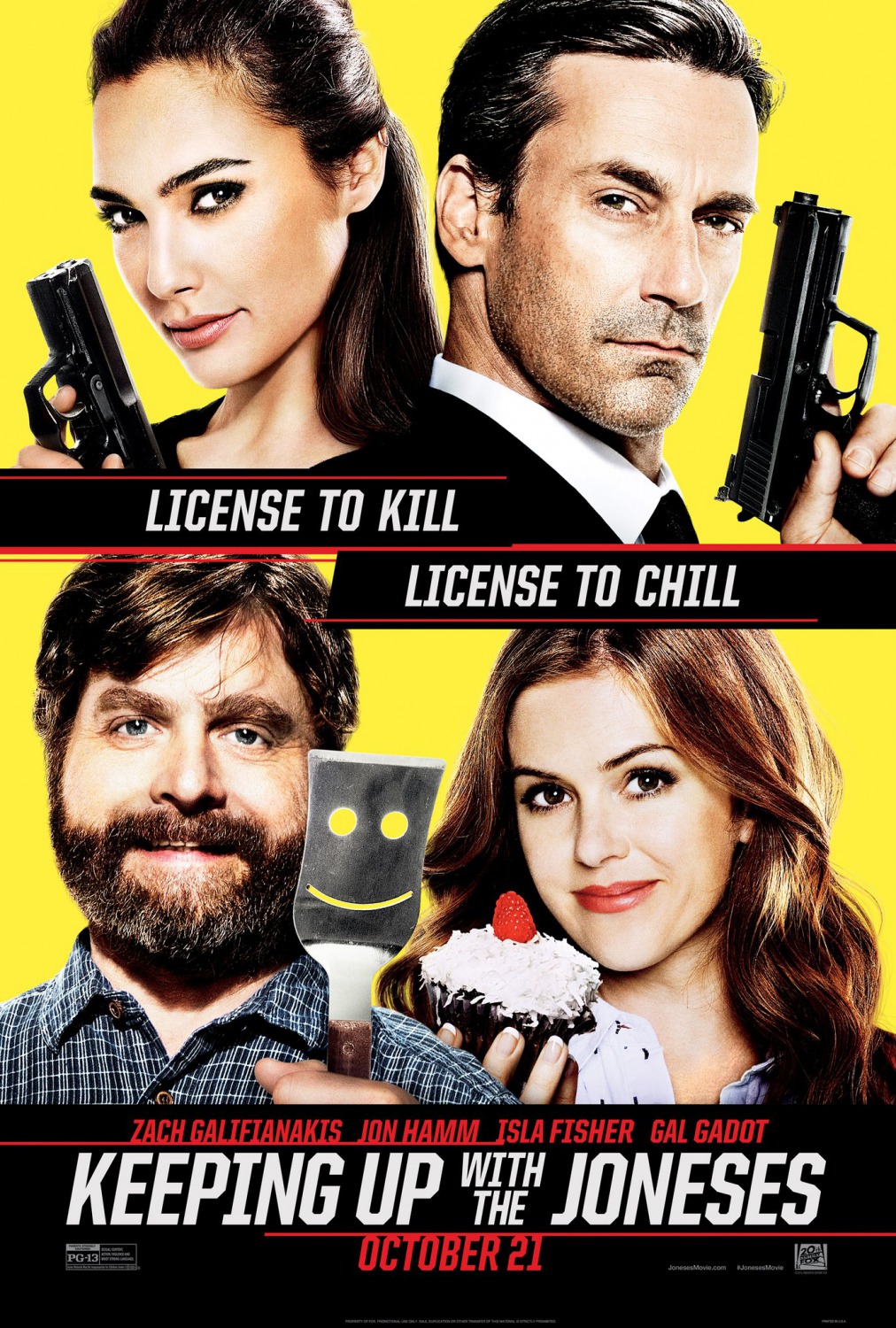
We meet Jeff Gaffney (Zach Galifianakis) who works at a corporate office as a human resources director. He is happily married to Karen (Isla Fisher), and they have two children who, as the movie starts, are heading off to summer camp for a few weeks. For the first time in years, the Gaffneys have the whole house to themselves which has them thinking of all kinds of mischief to get into, but any plans they have for getting naughty are interrupted when a new couple moves into the neighborhood.

Tim and Natalie Jones (Jon Hamm and Gal Gadot) are not your usual couple as they look as if they have traveled all over the world, and they look far too gorgeous to pass as ordinary people. As a result, the Gaffneys get overly suspicious and are eager to learn everything there is to know about them. It doesn’t take long, however, to realize they are spies, but whether they are foreign or domestic spies remains to be seen.

“Keeping Up with the Joneses” gets off to a strong start as we get a picturesque view of suburbia with the peaceful neighborhood these characters inhabit. As the camera pans around the different houses, one of them blows up into smithereens, and the explosion almost feels like something out of a Kathryn Bigelow movie. Next thing you know, the story moves back to two weeks before the explosion, so we already know this peaceful neighborhood won’t be very peaceful for much longer.

The great things about the movie is the cast. Galifianakis gets to play a different role this time around as Jeff Gaffney is not like the mentally unstable characters he became famous for playing like in “The Hangover.” Seeing him play a down to earth guy who is all about family and good times feels like a stretch for him, and it’s fun watching him opposite Hamm especially when they have lunch at an underground restaurant which is definitely not for vegans.

Hamm gets to play on his sexy guy image, and he is well matched with Gadot who looks very comfortable in the action comedy genre. Isla Fisher has been great fun to watch in any movie she appears in ever since her scene-stealing turn in “Wedding Crashers,” and she doesn’t disappoint here. There’s also a nice pair of performances from Matt Walsh and Maribeth Monroe as a pair of neighbors who might be getting a little to nosy in everyone’s affairs.

But as terrific as this cast is, they are not enough to save this movie which runs out of inspiration very quickly. It would have been more fun if the director and screenwriter kept us guessing as to whether the Joneses really were spies or not. Looking back, I kept thinking everyone missed out on various opportunities to make this movie cleverer than it is. This could have been an uproarious comedy had more effort been put into the script. After a while, we know how things are going to turn out for the four main characters here, and it just reminds us of other movies like it which were much, much better.

When the movie reaches its conclusion, it’s sunk by a predictability everyone could have avoided for the benefit of the audience. What we are left with is a premise which everyone could have and should have had a lot more fun with. The characters, despite the best efforts of the actors, could have been better developed to where they don’t feel like caricatures. The action scenes are fun, but you feel like they could have been more thrilling. Instead of accepting the movie for what it is, we keep thinking about the movie it could have been, and realizing this is depressing.

“Keeping Up with the Joneses” is one those films I analyze endlessly as I watch it because I am convinced I could have done a better job with the material. This premise could have been taken in a number of different directions and could have ended up being an insane amount of fun. But we get instead is a motion picture which have spent more time in the development phase because this one came out of the oven far too soon. It has its moments, but it could have had a lot more of them.

* * out of * * * *

Halloween 4: The Return of Michael Myers

halloween-4-poster

WARNING: THIS REVIEW CONTAINS SPOILERS. DON’T SAY YOU WEREN’T WARNED!

Halloween 4: The Return of Michael Myers” is actually one of the best films in this long running franchise, and it did more than just drop a bunch of bloody good killings on us with little regard to everything else which makes a movie strong. There was actually some thoughtful work put into the screenplay, the acting is better than you might expect it to be, and it does have some very scary moments the other sequels seriously lack.

The “Halloween” movies often defy the timeline of events they set up for themselves because logic doesn’t always apply to horror movies. Despite the huge explosion which ended “Halloween II,” Michael Myers and Dr. Loomis somehow managed to survive. It never seemed likely either of them would have come out of the burnt wreckage without turning into shish kabobs which were left on the barbecue for far too long, but this sequel shows you can’t keep a doctor or an evil monster down.

“Halloween 4” starts off with a couple of doctors assigned to transfer the seemingly comatose Michael back to Smith’s Grove where he should have stayed from the beginning. But of course, Michael wakes up and kills his naïve caretakers who think he is nothing more than just another prison transfer. These doctors also make the mistake of mentioning how Michael has one living relative left, his niece Jamie. Guess where she lives…

Going into a description of the plot is tiring, but you know what happens from there on out. “Halloween 4” is genuinely scary at points. The first appearance of Michael through the reflection of the mirror definitely had me standing up straight, and childhood terrors like the monster under the bed are exploited to strong effect. The movie does play around with the clichéd moments we often find in horror movies, but then it manages to pull the rug out from under you. You think you have a good idea of what is going to happen, but the filmmakers smartly play on your misplaced confidence to pull a fast one on you.

“Halloween 4” was directed by Dwight H. Little who later went on to direct one of Steven Seagal’s best movies, “Marked for Death.” Little deserves credit for not just doing everything according to formula. What he accomplishes here isn’t groundbreaking for the horror genre, but he pulls off something stronger than your average slasher flick. Instead of doing the usual opening with the pumpkin, he fills the screen with symbols of the October holiday which eventually leads us into the dead of winter. With that, he perfectly sets the mood and atmosphere for this particular sequel. He remains respectful of the original and does the right thing by keeping Michael hidden in the shadows like Carpenter did in the original. When that mask of his peeks out of the darkness, it becomes even more unnerving than watching him tilt his head.

The writer, Alan B. McElroy, managed to finish the script just mere hours before the 1980’s writer strike began. Listening to his audio commentary from the Anchor Bay release, McElroy makes it clear he came to this film as a fan of the original and was not about to throw the usual crapfest at us. He also gives us characters we actually come to care about and who don’t always do the stupid things we expect them to do in the average horror flick. You even find yourself caring about that hunk of a man Brady (Sasha Jenson) even after we find him cheating on his girlfriend with the movie’s obligatory big breasted lady (who also happens to be the sheriff’s daughter no less).

In retrospect, “Halloween 4” was one of the last slasher movies which featured actors who looked and felt down to earth. After this sequel, the genre was invaded by beautiful models with bodies very well taken care of or surgically enhanced. Whether or not they could act was another story, one which usually didn’t matter to the financiers.

This one is also not as bloody or gory as the other sequels came to be. Granted, there are a couple of nice bloody shots which illustrate how creative Michael is at killing people after coming out of a long coma. On top of sinking his thumb into a doctor’s skull, he also rips a big hole in a beer guzzling vigilante’s neck. Actually, this does bring up a weakness in the movie which involves a subplot with a bunch of middle aged guys who are regulars at a local bar. They almost seem tossed in as an afterthought, and their own hunt for Michael leads them to do the dumbest things.

Watching Danielle Harris here is a little weird as she has since grown up and gone on to play a completely different character in Rob Zombie’s “Halloween” movies. She plays Jamie, the daughter of Laurie Strode who was said to have been killed in a car accident along with her husband (Curtis would later return in “H2O”). You have to admire any young actor who does a horror movie at the age of 11 because it’s like we’re asking them to become emotionally scarred for life. On top of having a great set of lungs, Harris instantly wins our sympathy gives this movie one of its scariest images.

Ellie Cornell, who plays Rachel Carruthers, does Jamie Lee Curtis proud. We’re not talking an Oscar winning performance here, but she gives us the heroic female character we want to root for as she goes from being vulnerable to Sigourney (“Aliens”) Weaver tough.

And, of course, we have the only returning actor from the original “Halloween,” the late Donald Pleasence. Having miraculously survived the fiery explosion which should have killed him were a highly profitable box office possibility not taken into consideration, Dr. Loomis has become absolutely single minded in his pursuit to destroy Michael once and for all. Even if Pleasance was slumming by doing this movie, he still played this role to the hilt and gave this particular entry a legitimacy which eluded future installments. Heck, it probably would have been criminal to do a “Halloween” movie without Dr. Loomis at that point as he was an essential part of this franchise.

Actually, there is another “Halloween” veteran who returns to the fold here: Alan Howarth. Along with Carpenter he scored “Halloween II” and “Halloween III: Season of the Witch,” and they also provided great scores for “Prince of Darkness” and “Big Trouble in Little China.” Howarth goes solo on this one, but even without Carpenter he composes a memorable and atmospheric score, and his opening theme to “Halloween 4” is one of the best pieces of music in the franchise.

Stunt performer George Wilbur plays Michael here, and he does good work as the heavy-breathing killer. While no one can touch what Nick Castle did in the original, it’s nice to see a Michael who more mobile than Dick Warlock’s was in “Halloween II.” Wilbur gives Michael a formidable look which strikes terror in us even when this murderous character is not onscreen. The thought of Michael Myers in this one is just as scary as seeing these characters come face to face with him, or it as Dr. Loomis describes him:

“You’re talking about him as if he were a man. That part of him died years ago.”

DANGER! DANGER! SPOLIERS AHEAD!!!

Now let’s talk about Halloween 4’s” ending. Michael has been shot dozens and dozens of times in a scene which reminded me of the scene from “Predator” when Schwarzenegger and company blasted a forest to waste with their massive weaponry. Everyone is back home and safe, but then a scream erupts from upstairs. Loomis runs up to find Jamie has stabbed her stepmother with a pair of scissors and is covered in blood, looking much like young Michael did after murdering his sister. Like Pleasance, you find yourself screaming “NOOOOOO!!!!!!” Harris holding those scissors ranks as one of the series’ most chilling moments. Indeed, the corruption of innocence is a terror that can be all too real onscreen as well as off it.

Now this could have led the franchise in an inspired direction, but the producers wussied out and instead found a way (they always do) to bring Michael back from the dead yet again. Perhaps the late Moustapha Akkad felt the fans would never accept any killer other than Michael himself. It’s a shame because this brilliant plot twist could have made the series even more frightening than ever before, but the demands of the box office always dictate just how much you cannot change a winning formula.

Regardless, “Halloween 4: The Return of Michael Myers” still proves to be a strong entry in the undying franchise, and this is especially the case when you watch the two sequels which followed it.

* * * out of * * * *


The Whole Truth

the-whole-truth-poster

Watching “The Whole Truth,” I wondered if I had seen way too many courtroom dramas over the years to have the energy to appreciate this one. Then again, this movie does start off with a narration which had me laughing unintentionally, and its plot of a young man on trial for patricide felt like I was experiencing a severe case of déjà vu. How many episodes of “Law & Order” dealt with this kind of crime? Furthermore, how many of them proved to be more enthralling than this motion picture? Considering the talent involved in front of and behind the screen, “The Whole Truth” is a major disappointment.

Perhaps one of the main problems comes from an opening image which has a snake slithering on the ground as Keanu Reeves’ lawyer character of Richard Ramsay rides his motorcycle up the road. As soon as Richard goes by, the snake slithers right after him. From there, we have a good idea of the kind of people this movie will inhabit, and realizing this makes one realize there will be no real surprises in store for us.

Richard is a defense attorney, and he is defending young Mike Lassiter (Gabriel Basso) who is accused of murdering his father, Boone Lassiter (Jim Belushi). Things are not going well for these two as Mike refuses to speak about anything regarding his father’s death, and Richard tries to make him see they are on their way to a guilty verdict. All this time, Mike’s mother, Loretta (Rene Zellweger) sits in the courtroom looking on impassively. Did Mike really kill his father? Oh, come on, you already know the answer to this.

For those familiar with the novels of John Grisham and Scott Turow or the movies based on their works, the path “The Whole Truth” takes is one which has been traveled endlessly. We know something is up from the start, and it just makes us all the more impatient for the big reveal we know is coming. And while I’m no lawyer, I can see so many plot holes in this case which defy all reasonable logic. Mike himself makes a revelation on the stand which turns everything upside down, but the prosecuting attorney doesn’t even order a medical evaluation to verify it.

As for Reeves’ character, he seems much too close to the Lassiter family to represent them without bias. Then again, this probably doesn’t matter in the real world. It certainly didn’t matter when Johnnie Cochran represented O.J. Simpson in his murder trial, so why should it here? Still, with Richard so close to the family, it’s no surprise he is involved in this fiendish crime to where I just wanted him to admit the truth already.

The most dispiriting thing about “The Whole Truth” is it was directed by Courtney Hunt, the same person who gave us the terrific crime drama “Frozen River” back in 2008. That one starred Melissa Leo and the late Misty Upham as a pair of working-class women who smuggled illegal immigrants across the border into the United States. Hunt directed her actors to incredible performances, and she gave us a movie which felt alive and was never weighed down by clichés or illogical moments.

“The Whole Truth,” however, is the exact opposite as it is full of clichés and proves to be an insult to the intelligence even before the movie reaches its halfway point. The courtroom scenes are lifelessly staged, and the actors lack conviction in their performances. I expected Howard to bring something fresh to this material, and she even had a screenplay by Rafael Jackson to work from. But none of the energy and originality she brought to “Frozen River” can be found here. It’s been eight years since that film, and I can’t help but wonder why she chose this project as her follow up.

When it comes to Reeves as an actor, he either gives you the best or the worst he has to offer. His performance in “The Whole Truth” has him delivering courtroom speeches in an inauthentic manner which is depressing to watch, and his delivery of the voiceover narration is at times laughable. While he fares much better than he did in “Knock, Knock,” watching Reeves here makes me yearn for the “John Wick” sequel to come out sooner rather than later. Just from looking at the trailer for it, he looks far more alive in that sequel than he does here.

Then there’s Zellweger who makes Loretta far too enigmatic a character here. Furthermore, she looks very sick and emaciated here; very unhealthy. This all but takes away from the great performance she could have given but doesn’t. Loretta proves to be nothing more than another helpless wife and mother, and more could have been done to make this character complex and interesting. Instead, Zellweger is wasted in a role which gives her very little to work with. It’s great to see her back onscreen, but she deserves much better than this.

The only actor who gets off easy is Belushi as he succeeds in leaving his “According to Jim” persona in the dust by playing such an unlikable prick. His character of Boone is a jerk to put it mildly, but Belushi manages to make him more than that even with his limited screen time. Boone is like Aaron Paul’s character of Peter from “The 9th Life of Louis Drax” in that Boone initially comes across as a jerk, but we soon realize there is more going on with him than what’s on the surface. Belushi manages to convey this in a way the other actors are unable to, but it’s still not enough to life this movie out of the muck of mediocrity.

Popular culture has been and still is filled with court shows like “The People’s Court” and procedurals like “Law & Order: Special Victims Unit” to where we know exactly what to expect from the trials presented to us. It’s tempting to say “The Whole Truth” suffers from being stuck in a time where we have long since been burned out from this kind of entertainment, but it still feels like so much more could have been done with this material. What ends up unfolding before us feels stale, derivative and easily forgettable. My hope is Howard will have more luck on her next film because this one does not represent a step in the right direction for her.

Daniel Craig was actually set to play Reeves’ role, but he ended up dropping out before filming began. Perhaps he realized the screenplay for “The Whole Truth” wasn’t as good as he originally thought. Jack Nicholson once yelled “you can’t handle the truth” in “A Few Good Men,” and there’s no reason why audiences should have to handle “The Whole Truth.” Courtroom dramas are a dime a dozen, and this one doesn’t even try to stand out from the pack.

* ½ out of * * * *


Jack Reacher

jack-reacher-poster

I haven’t read “One Shot” or any of the other books written by Lee Child which feature the character Jack Reacher. At this point, however, I almost don’t need to as the casting of Tom Cruise as Reacher has brought to everyone’s attention how the character is 6’ 5” tall and weighs over 200 pounds. This description makes the role seem far more appropriate for Arnold Schwarzenegger, Sylvester Stallone, Dwayne Johnson or any other athlete turned actor who looks like they live at the gym. So, of course, everyone is snickering at Cruise the same way they did when he was cast as Lestat in “Interview with the Vampire,” but we all know how that turned out.

You know what? I don’t care if Cruise resembles the character or not because he proves to be the best thing “Jack Reacher” has to offer. While he is much smaller and nowhere as muscular as Child’s literary character, he still comes across as an intimidating force to everyone he comes in contact with. His charisma onscreen ends up giving you a reason to check out this movie even though it is surprisingly ho-hum and feels like a business as usual action picture.

Directing “Jack Reacher” is Christopher McQuarrie who won an Oscar for writing “The Usual Suspects” and previously worked with Cruise on “Valkyrie.” He gets things off to a suspenseful and tense start as we watch a sniper looking through his scope at random targets. It’s an unsettling way to start this movie off, and McQuarrie keeps us waiting with anxiety for the first bullet to be fired, and you know it will be fired. The sniper takes out five people and is later caught and interrogated by Detective Emerson (David Oyelowo), but instead of him giving the detective a confession he writes the following message down on a legal pad, “GET JACK REACHER”

Mr. Reacher arrives in town soon after, but not to help his sniper friend but instead bury him. Still, as in many action thrillers, things are not quite what they seem. Reacher has to contend with the sniper’s defense attorney Helen Rodin (Rosamund Pike), her dad who also happens to be District Attorney Alex Rodin (Richard Jenkins), a hired killer and a Russian named Zec Chelovek (Werner Herzog) who everyone refers to as “the Zec.”

Now I know it has been popular to hate Cruise these past few years with his off-camera antics getting more press than his movies, and part of me expected that I wouldn’t take him very seriously in this role. But he really does deliver here and gives a believable performance as a man you really don’t want to mess with. Even in those obligatory scenes where he’s about to beat up a bunch of guys at once, he’s riveting because his eyes tell us and his opponents they don’t stand much of a chance. It’s fun to see Cruise give Reacher an undeniably dangerous vibe, and even at his age he never feels out of place in this role.

It’s a kick to see Werner Herzog show up as “the Zec,” and he makes this villainous character especially depraved as he recounts the unthinkable of what he once had to do in order to survive. Herzog makes the almost unbelievable story he tells sound terrifyingly believable, and his voice continues to serve him well whether he’s narrating one of his documentaries or reading from the book “Go The F—k To Sleep.” It’s a shame he’s not in the movie more than he is.

I also liked seeing Robert Duvall, who starred opposite Cruise in “Days of Thunder,” show up as shooting range owner Martin Cash. These two share a great chemistry together no matter what movie they’re in, and it feels like it’s been forever since I’ve seen Duvall in anything. Like Herzog, I wish he had a bigger part here, but Duvall does make the scenes he’s in count for a lot. This is an actor who can take any throwaway role given to him and make it seem like it’s so much more than what’s on the page.

McQuarrie is a great writer, and not just for creating the screenplay to “The Usual Suspects.” I like how he gives us characters like Reacher and Helen Rodin whose descriptions cannot easily be boiled down into one sentence. And yes, the movie has some great dialogue in it just as it should.

Having said that, “Jack Reacher” comes up a little short for me because there’s not much to distinguish it from other movies of its ilk. Furthermore, it goes on for much longer than it should to where it drags in spots which had me getting a little restless. McQuarrie and Cruise are also unable to escape the clichés of the genre which would easily do in a weaker movie. Maybe it’s because the tone of this film is a little more downbeat than it should be. Both clearly had some fun with this character, but you come out of it wishing they had more fun with the story.

If you can get past the unspectacular aspects of “Jack Reacher,” you might still enjoy the movie for what it is. At the very least we have Cruise’s performance to enjoy as he makes every lethal blow he gives the bad guys hurt like hell. When the movie is finished, you do come out of it wanting to see Cruise take on this role again in the future. But if and when that does happen, let’s hope that potential sequel has a little more edge to it than this one.

* * ½ out of * * * *

Halloween II (1981)

halloween-ii-1981-poster

Sequels are usually beaten to a critical pulp, and it’s not hard to understand why. They are primarily made because the original made a ton of money, and heaven forbid that the money train stops there. It’s not enough to make a killing at the box office (no pun intended); you have to capitalize on what you made because greed still reigns supreme. Heck, these days studios are franchise crazy and are always on the lookout for the next one to start up. However, audiences these days are a lot more discerning and are quick to question why certain sequels were even made. They can tell when they are being scammed out of their hard-earned money, but the curiosity of what the sequel has to offer can be hard to ignore.

In a lot of ways, sequels are undone by the high expectations placed on them. Certain movies have no chance of living up to the brilliance of their predecessor, but maybe they can be enjoyable enough when you come to them with reduced expectations. Sometimes that can be enough.

Case in point is “Halloween II,” the sequel to, at the time, the highest grossing independent film ever made. “Halloween” was and still is one of the scariest movies ever made. The ending of the movie had Michael Myers disappearing from sight, and it was visual proof of how evil never dies. “Halloween II,” however, takes place at the exact moment the original ended with Michael still on the loose, and even while he moves a hell of a lot slower, he still proves to be a very deadly threat to everyone around him. Dr. Loomis (Donald Pleasance) continues to hunt for the man he tried to keep locked up, and Jaime Lee Curtis returns as Laurie Strode who is taken to Haddonfield Memorial Hospital to recover from the injuries she suffered a few hours earlier.

“Halloween II” was torn apart by the critics for being nowhere as good as the original, proclaiming it a rehash of what we saw before and for having nothing new to say about Michael Myers  or anyone else from the original. Even John Carpenter, who co-wrote the script for this one with the late Debra Hill but did not direct it, said he hated it, and the only thing which got him to finish writing this sequel was a six-pack of Budweiser. Even he realized he was making the same movie which is probably why he declined to direct it. The only really fresh aspect of this one is that we discover how Laurie Strode and Michael Myers have a closer bond than they realize, and it comes to explain why he made the long trip back to Haddonfield after waiting for years while staring out a window in total silence.

But despite its flaws, I still enjoyed “Halloween II” for what it was. Yes, it is a retread of the original, but what else are you gonna do with Michael Myers? Do you want him to win the Nobel Peace Prize? Get rehabilitated? Make peace with his sister after killing so many people? Don’t you remember? Evil never dies!

The one thing to note about “Halloween II” is how much bloodier and gorier it is than its predecessor. When this sequel came out, there had already been so many knock offs of “Halloween” with the psychotic and silent killer wearing a different kind of mask and using a different weapon which suits their murderous rages more than any other. “Friday The 13th” would not have existed without Carpenter’s original masterpiece.

At the very least, “Halloween II” tries to be more creative in the way Michael kills his victims as he proves to be  inventive with hypodermic needles, scalding hot water, and he even conducts a blood drive which doesn’t require anyone from the Red Cross to help out. If you run into Michael, you’re a donor whether you driver’s license says you are or not.

While “Halloween” only showed us so much of Michael and kept him hidden in the shadows for the most part, “Halloween II” pretty much shows everything. While it makes this sequel less effective than the original, I still got a kick out of it. Carpenter apparently came in to reshoot some scenes because he felt audiences would be demanding more blood and guts as horror movies have upped the ante in that arena since the original. Whether or not this was the right decision may be up for debate, but fans of Fangoria Magazine will not be complaining. The scene where Michael plunges Pamela Susan Shoop into scalding hot water is shocking and highly unnerving, and seeing a hypodermic needle get inserted into someone’s eye is very unsettling.

One thing this sequel has to its advantage is that is made by the same team which made the original. Director of photography Dean Cundey came back for it, and he gives “Halloween II” a dark and creepy look to where you want to keep an eye on what is hiding in those shadows across the hall. Michael could be anywhere, waiting for you to come out into the open.

At the very least, Carpenter and Hill do a good job of giving us characters who are as down to earth as those in the original. There’s a little scene where three of them are in a hospital lounge watching TV and talking about what just happened their previously quiet little town of Haddonfield. The young nurse claims she saw Michael, and one of the guys is a sexually frustrated prick who is more interested in having sex than the fact this force of evil is still on the loose.

The characters may come across as clichés after having seen the first one, but to me, they still felt real enough to where I wasn’t snickering at their actions. Among them is Jimmy, a paramedic played by Lance Guest, who ends up developing a protective crush on Laurie. After seeing Laurie being all shy in the first film, it was  nice to see her get something of a boyfriend in this one, and seeing him get hurt actually made me feel bad. If this were any other sequel to a slasher flick, I probably would have been cheering the killer on more than the victim.

There’s also the ever so serious nurse Mrs. Alves played by Gloria Gifford. She plays the boss you probably have been stuck with once or twice in your life, and one which you hope you never have again. Pamela Susan Shoop plays the well-meaning but always tardy Nurse Karen Bailey and, she is very good and appealing here and shows off the appropriate cleavage for a horror movie like this.

If there is a major weakness in “Halloween II,” it is the way Laurie Strode is written. She is not the same brave heroine we saw in the first movie. Here, she is drugged out after the doctor works on her injuries, and there is only so much she can do as a result. She is smart enough to run away when she feels Michael closing in, but she becomes utterly helpless instead of being inventive in the ways she protects herself. Regardless, I still liked Laurie Strode here, but it would have been better to see her kick more ass like she did the first time around. Perhaps she could have been much more vengeful towards Michael and much more eager to put an end to his rampage.

Donald Pleasance once again gives the demonic lines he is given a lot of depth to where they stay with you long after the movie has ended. His little speech on the festival of Sam Hain, the Lord of the Dead, and how we are all afraid of the darkness inside of ourselves is a great moment. The unconscious mind can be a very frightening place indeed.

I also have to say that when it comes Pleasance and Curtis, I have never really seen give a bad performance in any film they have ever been in. Put either of them into the worse movie ever made, and they will still be good.

But my most favorite thing about this “Halloween II” is the gothic score composed by Carpenter and Alan Howarth. It’s not any different from the score for the original, but I loved how it was done with synthesizers this time around. It feels all the more atmospherically consuming even after all these years, and I never get sick of listening to it. The piece of music where Michael  finally finds Laurie in the hospital and pursues her remains one of my favorite pieces of music in any movie ever.

Dick Warlock takes on the role of Michael this time around. I do agree that it would have been great if Nick Castle came back to play Michael again, but I imagine his own directing career must have been keeping him busy at that point. Warlock tries a little too hard to mimic Castle’s movements, but it is understandable why he moves so slowly in this one (he was shot six times). All the same, Michael still came across as a very threatening figure to me. Even if he moved so slowly, I was still terrified of him coming up on unsuspecting hospital employees, and it was excruciating to wait for that elevator door to open.

“Halloween II” might not be a great movie, but I still enjoyed it a lot. This sequel in many ways marked the last time where these characters seemed relatable as just about all the other sequels in this franchise as they came to feature infinitely stupid characters played by mediocre actors. Perhaps the passage of time has been kinder to this sequel than others as the series soon descended into mediocrity, but it didn’t decrease in quality as quickly as other slasher franchises have.

I have no shame in saying I really enjoyed this sequel. Then again, why should I have any shame about like it? Other critics can bash it all they want. But for me, “Halloween II” still delivers.

* * * ½ out of * * * *