Whiplash

whiplash-movie-poster

Yes, I have had teachers in the past who succeeded in shattering my ego to where it took me an incredibly long time to build my confidence back up to where it once was. I think it’s safe to say we all have had at least one vindictive instructor at one time or another who made our lives a living hell and robbed us of our morale to where the emotional scars we received never fully vanished. But the experience does leave us with an important question; did we improve as students under that teacher’s tutelage, or were they just determined to make us feel infinitely miserable to satisfy their own ego? I’d like to think I got something from the most brutally honest teachers I have studied with because it will, at the very least, keep me from spitting in their faces with a bitter vengeance.

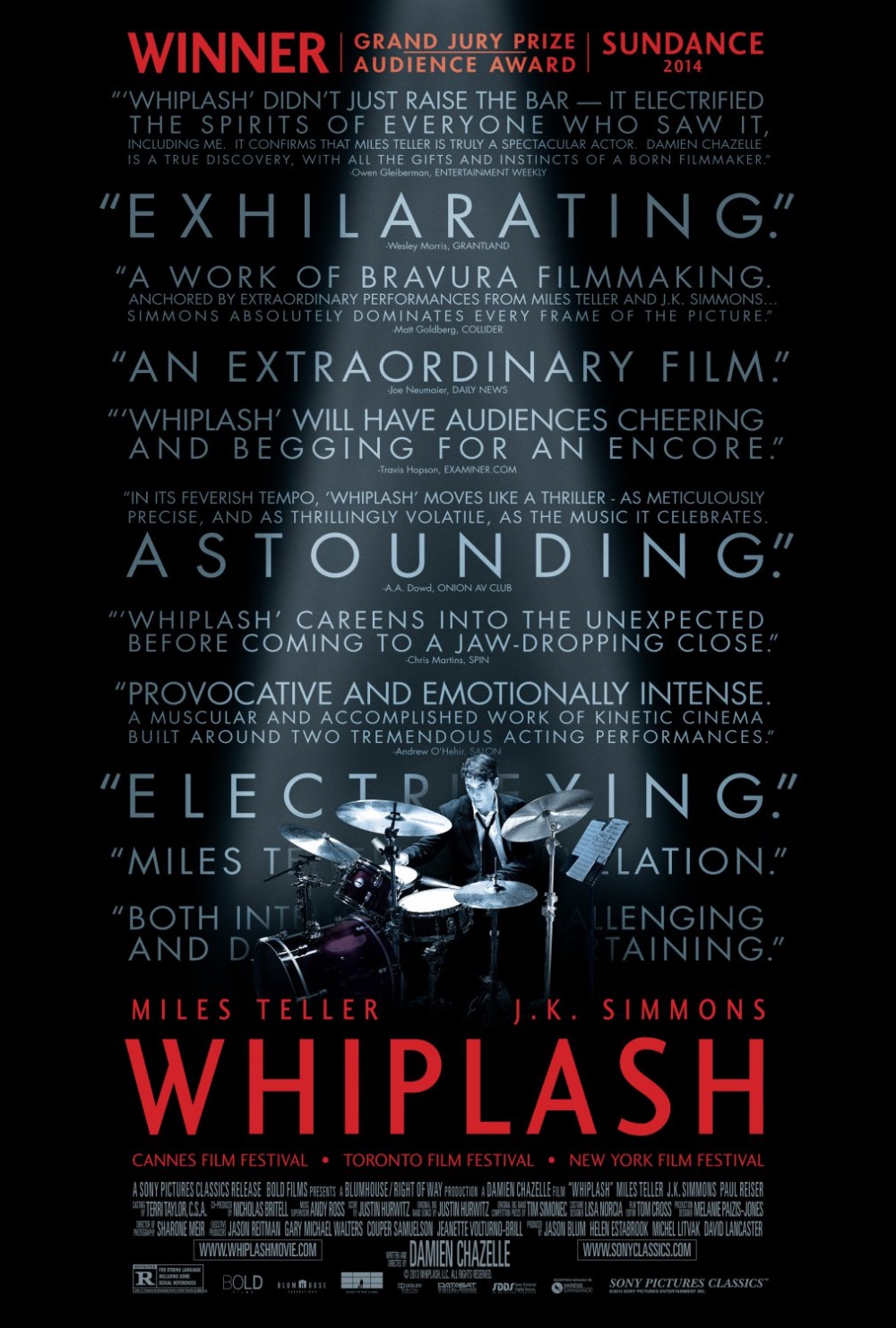
I think it’s likely you will be reminded of those teachers when you watch “Whiplash,” a perfectly titled movie which features the anti-Glenn Holland of music instructors, Terrence Fletcher. Played by J.K. Simmons in an utterly brilliant performance, Terrence is as talented a teacher as he is a terrifying one, and hopefully you have never had to deal with someone like him. But if you have, you have my deepest sympathies and I hope you have found a way to move past such a traumatizing experience.

Miles Teller stars as Andrew Neiman, a 19-year-old jazz drummer who is more than intent on becoming one of the greatest drummers who ever lived. Andrew studies at an elite music conservatory in New York and is working his way up through the ranks when Terrence comes upon him playing one day. Terrence says very little to Andrew and seems eager to see what the young man has to offer. But soon after, Terrence invites him to join his class which has the top jazz ensemble in the conservatory, and this gives Andrew’s ego a major boost to where he finds the courage to ask out Nicole (Melissa Benoist), the girl who works at the concession stand at his favorite movie theater.

Before the start of class, Terrence encourages Andrew to enjoy the process of playing and not to worry too much. But after class begins, Terrence quickly turns into a nasty SOB as he hurls insults as well as furniture at his students if they’re even the slightest bit out of tune. It takes almost no time for Andrew to incur his wrath, and Terrence shows no limit as to how far he will go in verbally abusing a student. He is determined to push Andrew beyond his limits and then some, and this leads to nights when the aspiring drummer becomes a water fountain of sweat and leaves with some nasty cuts on his hands to where band aids cannot stop the bleeding.

The effect Terrence has on Andrew is incredibly profound on him not just as a musician, but as a person as well. While he may be improving as a drummer, Andrew becomes an increasingly difficult person to get along with. At family gatherings, he comes to insult others who look down on his drumming aspirations, and he coldly dumps Nicole when he feels their relationship will get in the way of his mission to become the greatest drummer who ever lived. By the time “Whiplash” reaches its thunderous climax, you’ll be wondering who the victor of this tumultuous teacher/student relationship truly is. When you look at it closely, it could be either of them.

It doesn’t take much to see that “Whiplash” is a very personal story for Chazelle as he himself was a drummer in a high school music conservatory who lived in fear of his teacher and of screwing up a single note. Right from the start, he does an excellent job of setting up just how feared Terrence Fletcher is long before we see him viciously berating his students as if they have no reason to exist. Students stand rigidly at attention whenever he enters the room, fellow teachers don’t even hesitate to step out of his way when he bursts into their classrooms to find new musicians, and heaven forbid if you misplace your music or your drum sticks as you will suffer the man’s wrath in a way which makes you feel like you had it coming.

Now any actor can play a screaming jerk, but it takes a great one to make a jerk of a character into a fascinating and complex human being. This is what makes Simmons’ performance as Terrence Fletcher so damn good; he lets you know what he’s thinking without having to spell it out for the audience. Despite his brutally draconian ways, you can see he is searching for someone truly great and will do anything to get it. Seriously, he will do anything.

This all leads to the “good job” story Terrence tells Andrew, and I’m still thinking about what Terrence said long after the movie ended. On one hand, we cannot condone the way Terrence treats his students, but “Whiplash” has you wondering if being too nice to an aspiring student does them more harm than good. Sometimes brutal honesty is called for to get someone to learn, especially one who is determined to be the best at what they do. Still, there’s got to be a limit to how harshly you can treat a student before they suffer a horrific nervous breakdown.

Miles Teller’s star has been on the rise for a while now, and he’s turned in fantastic performances in the “Footloose” remake and “The Spectacular Now.” Teller was also in “21 & Over,” but the less said about that one the better. As Andrew Neiman, he gives one of the most exhausting performances any actor could have given in 2014, and there is absolutely no doubt he put his entire heart and soul into this character. Teller keeps pounding at those drums as if his life depended on it, and that really is his blood spattered all over the drum set (imagine how much money the studio saved on makeup and special effects). Teller shows a true fearlessness as he takes Andrew from being an easy-going guy to one who reaches his breaking point and then goes beyond it to where Terrence’s intimidating ways will not hold him at bay.

Writer/director Chazelle takes us on a journey which is as cathartic for him as it is for the rest of us, and “Whiplash” stirred up emotions in me I haven’t felt in a long time. It’s an amazing achievement especially when you take into account he had only 19 days to shoot this movie in. Few movies these days take you on such an emotionally pulverizing ride, and this is one of them.

* * * * out of * * * *

Please feel free to check out the interviews I did with Simmons, Teller and Chazelle on “Whiplash” on behalf of We Got This Covered down below.

The Fourth Noble Truth

the-fourth-noble-truth-movie-poster

Watching “The Fourth Noble Truth” quickly reminded me of how much I personally benefit from doing meditation, and of how I need to get back into the habit of doing it on a regular basis. It’s very beneficial as it allows your brain to have a rest from all the thoughts and concerns which constantly run through it, and it helped me during a time where I suffered deeply from anxiety and depression. Gary T. McDonald’s film explores meditation from a Buddhist perspective as two people come together while searching for true happiness, and the end result feels emotionally honest about a topic some would be loath to take seriously.

Before we get to the movie’s opening title, we are introduced to movie star Aaron Redmond (Harry Hamlin) who does a Jack Nicholson and bashes another person’s car with a golf club. This is all it takes for the audience to see that this guy has serious anger management issues, and the movie wastes little time in showing him driving out to the home of a Buddhist meditation teacher named Rachel (the lovely Kristen Kerr) as it is part of his sentence for being convicted of road rage.

The way Aaron sees it, he has everything a person could ever want, so how can he be the least bit unhappy? Rachel, however, is not impressed with his bad boy movie star persona and sets about teaching him each of the noble truths while guiding him through meditations. However, his constant flirtations end up getting the best of her, and they end up spending the night together. From there they are both forced to reassess their life choices or risk losing the love and happiness they strive for.

In case you are wondering what the four noble truths are, they express the basic orientation of Buddhism which says this worldly existence is fundamentally unsatisfactory, but there is a path to liberation from repeated worldly existence. The truths are as follows:

Life is full of psychic suffering, such as stress, angst, discontent, and unhappiness.

The cause of this suffering is desire. Not the fleeting kind, but a clinging or attachment for things like material possessions, people, and validation.

If you end these fixations, you will stop suffering.

You end suffering by walking the Eightfold Path, which is a way of life embodying these virtues:

Right Understanding

Right Intention

Right Speech

Right Action

Right Livelihood

Right Effort

Right Mindfulness

Right Concentration

The Buddha taught that developing the virtues of the fourth noble truth is the key to happiness. Of course, getting to the last truth is always the hard part.

I liked how Hamlin’s character evolves throughout the film. His skepticism over meditation is understandable as most people, including myself, come into it with a lot of doubt over if it will do them any good. Also, getting the handle of meditation takes some time because you are bound to start off feeling like you’re not doing it right. His character of Aaron refuses to take meditation seriously at first, and he is mostly interested in getting the judge in his case off his back more than anything else. But while he appears to be confident in being the man he is, we can see from the start he is one seriously unhappy dude.

Hamlin has been around for a long time, and my generation knows him best for his roles in “Clash of the Titans” (the original, not the remake) and the TV show “LA Law.” These days he is better known for his work on the shows “Mad Men,” “Glee,” and “Shameless.” At 63, he still has an effortless charisma about him which makes him perfect for this role of an over the hill celebrity who has yet to realize material possessions do not equal happiness.

I’m not familiar with Kristen Kerr’s work, but she left quite the impression on me as Rachel. When we first meet her, she appears to be a master in the ways of meditation and has reached a great place in her life where everything seems balanced. But as the movie goes on, she comes to see how uncertain she is of whether or not she has reached the fourth noble truth as she makes the biggest mistake a meditation teacher can make.

It should go without saying how nobody is perfect, but this threatens to do a disservice to Rachel as she quickly realizes the errors of her ways. Kerr makes Rachel a fascinating character as a result because we really root for her to hold onto her bearings and not give up on her pursuit to achieve happiness. It’s never an easy road as life is full of endless trials and tribulations, and we come out of this movie relieved Rachel has not lost her way. Kerr is a wonderfully appealing presence from start to finish, and she makes us believe in the benefits of meditation in a way few other actors could.

McDonald’s previous directorial credits include “The Sea Wolf” and the documentary “Rape/Crisis,” movies I have yet to see. He does a commendable job of taking this relationship story and makes it feel down to earth and not the least bit contrived. When Aaron and Rachel fall for one another, I thought the movie was going to shoot itself in the foot and lose all credibility, but their relationship serves to give “The Fourth Noble Truth” more complex issues to explore. What I admired most was how the movie explored meditation and the relationship issues these two characters experience to where it feels emotionally honest in a very satisfying way.

In some ways, “The Fourth Noble Truth” is somewhat undone by its understandably low budget, and I hate to say that because movies like these are forced to deal with whatever resources they can get a hold of. I could see this script being done as a play onstage, so it doesn’t feel as cinematic as a movie should. But despite its flaws, it serves as a nice introduction to what meditation can do for your own well-being. It’s not meant to be an instructional manual on meditation, but if it were then it wouldn’t be as effective.

“The Fourth Noble Truth” is coming in well below the radar amidst all the big blockbusters which threaten to occupy our local multiplexes at the expense of everything else. My hope is more people get exposed to it on the big screen long before it becomes available on DVD, Blu-ray and Digital.

* * * out of * * * *


Lincoln

lincoln-movie-poster

The one thing which always drove me nuts in history class as a kid was how the teachers and the books we read made the past seem so much better than our present. We were taught about how Presidents like George Washington and Abraham Lincoln were such great leaders who helped make America the country it is today, and in the process, they were turned into mythological characters to where we forgot they were human beings like the rest of us. Juxtaposing this with the politics of America back when Ronald Reagan was President, it looked like we could do nothing but complain about the state of the world. It made me wonder what we did as Americans which made us seem so ungrateful for what our forefathers brought about.

This is why I’m thankful for movies like Steven Spielberg’s “Lincoln” which helps to humanize those historical figures we learned about in class. In this case, the historical figure is Abraham Lincoln, the 16th President of the United States. The film focuses on the last four months of his Presidency when the Civil War was raging on and was insistent on getting the Thirteenth Amendment, which abolished slavery, passed in the House of Representatives. It presents this President, one of the greatest America has ever known, as a flesh and blood human being endowed with strengths and flaws which will make you admire him more than ever before.

Much of the accomplishment in making President Lincoln so vividly human here is the result of another unsurprisingly brilliant performance from the great Daniel Day Lewis. Known for his intense method acting and laser sharp focus in preparing for each role he does, he brings his own touches to a man so defined by his historical deeds, and he succeeds in making this character his own during the movie’s two and a half hour running time.

“Lincoln” also shows how the world of politics has always been a cutthroat place to be in. The Republican and Democratic parties were much different than from what they are today, but during the 1800’s getting certain amendments passed involved a lot of tricks which were not always highly regarded. Even Lincoln wasn’t above hiring three politicians, played by Tim Blake Nelson, John Hawkes and James Spader, to lobby members of the House to vote in favor of passing the Thirteenth Amendment. But what made this President’s actions especially courageous was how he wasn’t just thinking about solving the country’s problems but of the effects this particular amendment would have on generations to come.

“Lincoln” also delves into the President’s personal life which had been fractured by the loss of a child and was also unsteady due to the fiery personality of his wife Mary, played by Sally Field. Watching Field here reminds us of what a remarkable actress she remains after all these years. Field is such a live wire as she struggles to make her husband see the consequences of the actions he is about to take. The actress had signed on to play this role years ago, back when Liam Neeson was set to play Lincoln, and she had to fight to keep it. It’s a good thing Spielberg kept her around because she has always been a tremendous acting talent, and she enthralls us in every scene she appears in.

Like many of Spielberg’s best films, there isn’t a single weak performance to be found in “Lincoln” which boasts quite the cast. Joseph Gordon-Levitt, who had a heck of a year in 2012 with “The Dark Knight Rises,” “Looper” and “Premium Rush,” is excellent as Lincoln’s oldest son, Robert, who considers quitting school to join the army and fight for his country. David Strathairn is a wonderfully strong presence as Secretary of State William Seward, the great Hal Holbrook is unforgettable as the influential politician Francis Preston Blair, Gloria Reuben is very moving in her performance as former slave Elizabeth Keckley, and Jackie Earle Haley has some strong moments as the Confederate States Vice President Alexander H. Stephens.

But the one great performance which needs to be singled out in “Lincoln,” other than the ones given by Lewis or Field, is Tommy Lee Jones’ who portrays the Radical Republican Congressional leader Thaddeus Stevens. Jones is a powerhouse throughout as he empowers this fervent abolitionist with a passion as undeniable as it is undying, and seeing him reduce other congressional members to jelly is a thrill to witness. Jones is tremendous as we see him fight for what he feels is right regardless of how he goes about achieving it.

Spielberg employs his usual band of collaborators here like producer Kathleen Kennedy, director of photography Janusz Kamiński, editor Michael Kahn and composer John Williams to create a movie which captures the importance of Lincoln’s place in history while also making it intimate in a way we don’t expect it to be. He also benefits from having the great playwright Tony Kushner on board as the movie’s screenwriter. Kushner’s knowledge of history has never been in doubt ever since we witnessed his magnum opus of “Angels in America,” and word is he spent six years working on the script for “Lincoln.” His efforts do show as he gives us a riveting portrait of a divided nation on the verge of making a major change, and even back then America was resistant and deeply frightened to making certain changes regardless of whether or not it would benefit from them.

Granted, Lincoln’s life would probably be better explored in a miniseries as there is so much to explore, and this movie can explore only so much of it. Regardless, “Lincoln” is an invigorating portrait of a great American President who fought for the benefit of his country’s future. The sacrifices he made tragically cut his life short, but his legacy will never ever die as Spielberg’s film rightly proves.

* * * * out of * * * *

Black Sea

black-sea-poster

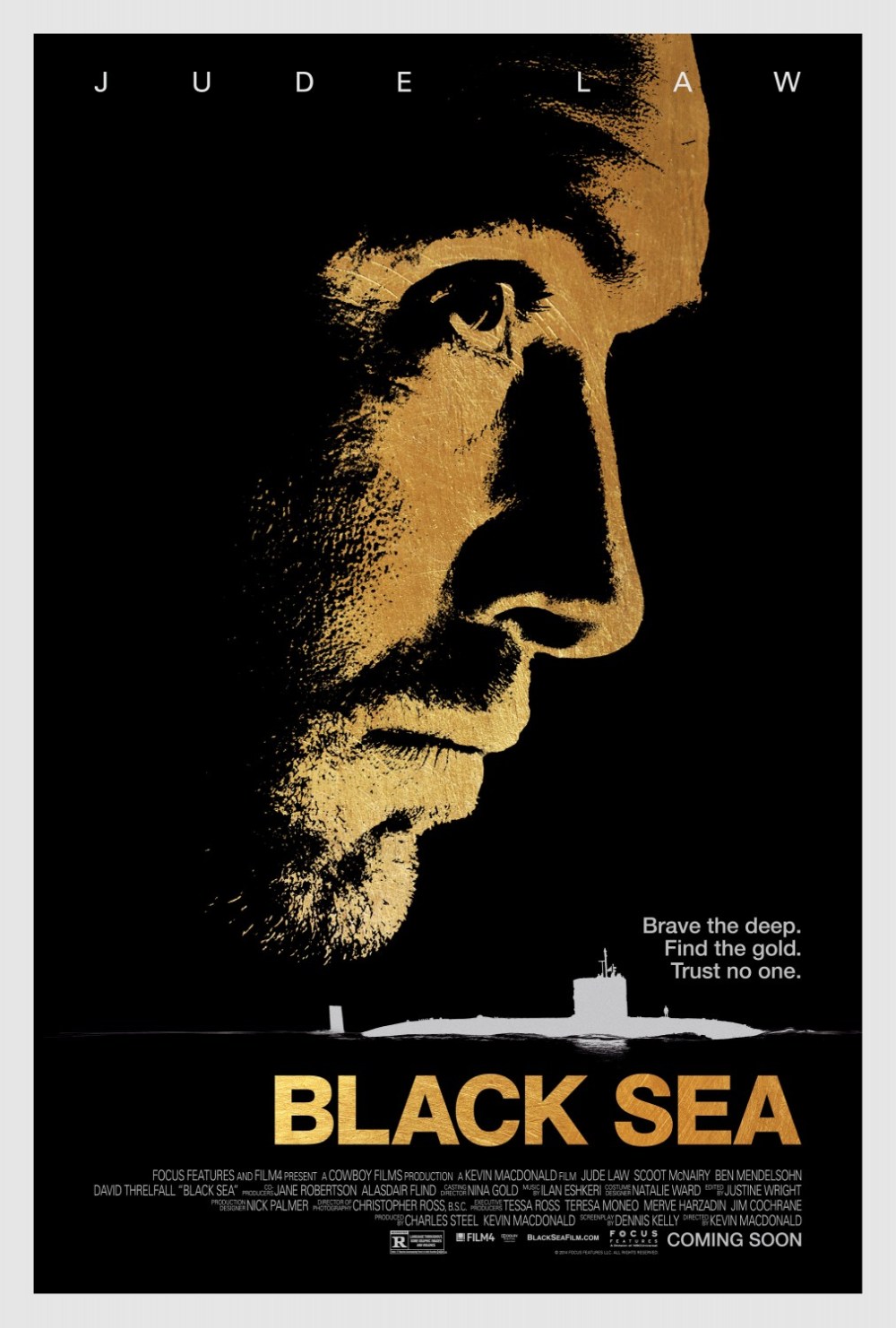
When it comes to submarine movies, I feel the genre peaked early on with Wolfgang Petersen’s “Das Boot” which proved to be as claustrophobic as movies get. Others have come close to equaling its visceral power, but there’s no topping it. I went into “Black Sea” knowing this would be the case, and that helped a lot because this movie proved to be a lot more intense and nail-biting than I expected it to be. It doesn’t break any new ground, but it is a gritty thriller which doesn’t let up.

Jude Law stars as submarine Captain Robinson who, as the movie starts, has been laid off from his salvage job which leaves him with few prospects for future employment. It turns out he’s not the only one as his friends and colleagues have been kicked out of their jobs as well, and it serves as an annoying reminder of how companies spend more time firing employees than they do hiring them.

But Robinson soon gets offered a job by a shadowy backer who tells him about a World War II submarine that has sunk to the bottom of the sea and which contains an enormous wealth of gold. Seeing how it offers him and his colleagues more than enough to quit any day job they can hope to get, he commandeers an old and fairly decrepit submarine from the Cold War days to get at the gold hidden miles below the surface. But in addition to avoiding detection from the Soviets as he travels below their radar, he has to contend with the fragile relations between the crew members as they come from different places and don’t have enough trust in each other to make this mission run smoothly.

What makes “Black Sea” an especially effective thriller is that the depths of the ocean prove to be every bit as threatening as the twisted psychology of the submarine’s passengers. Everyone on board has their own selfish motives, and those motives have to contend with the dangers they have to endure on a ship way past its prime. It doesn’t take long before you start to wonder what’s going to kill these men first; the crushing depths or their own paranoia.

“Black Sea” was directed by Kevin Macdonald, a filmmaker who has gone from making documentaries like “Touching the Void” and “Marley” to unforgettable dramas like “The Last King of Scotland” and 2013’s underrated “How I Live Now.” He doesn’t have much to work with in terms of originality, but he makes effective use of the claustrophobic setting to where our nerves are effectively fried throughout. Macdonald also gives equal attention to the human element as the characters drive the action more than you might think. Even though some of the characters’ decisions become rather silly towards the end, he makes you empathize with them to a certain extent. These days, who can’t relate to being laid off or jumping at the opportunity to make a fortune? People will do anything to survive these days.

It’s interesting to see Jude Law in a role like this where he portrays a hard scrabble worker who looks like he needs a good long shower on a regular basis. I’ve gotten so used to seeing him as this handsome man onscreen to where it threatened to make me forget what a great actor he is. While his Scottish brogue gets a little too thick at times, he fully inhabits his role of a man who is more in love with the sea than he is with his own family. Law is also surrounded by a terrific cast which includes Ben Mendelsohn (terrific in the criminally overlooked “Starred Up”), Scoot McNairy, David Threlfall and Konstantin Khabensky who each imbue their roles with a lot of grit and desperation. It helps to have actors this good in a movie which on the surface might seem run of the mill.

At this point, I don’t think it’s even possible to reinvent the submarine movie genre. Where else can you go with it after movies like “Das Boot,” “The Hunt for Red October” and “Beneath” to name a few? All you can hope for is that it can be done well and keep you on the edge of your seat, and “Black Sea” manages to do that more than you might expect. Sometimes that’s all you need a movie to do.

* * * out of * * * *

Race

race-movie-poster

2015 was a year where the biopic genre had a major resurgence with movies like “Straight Outta Compton” and “Love & Mercy.” Most biopics in recent years have been strictly by-the-numbers affairs which give us historical footnotes without going into much depth about the people they are about, but those two movies brought their subjects to life in a most wonderfully vivid way. “Race,” the biopic about gold medalist Jesse Owens which should have made years ago, will not rank among the best of the genre and starts off as a by-the-numbers affair, but it does get better as it goes along as we watch this iconic African American athlete get ready for the Olympics.

Instead of looking at Owens’ whole life, “Race” focuses on the years he went to college and began training with Coach Larry Snyder (Jason Sudeikis) who molds his running talent into something even better. Despite the adversity he and other African Americans face on the university campus, Owens soon becomes a star athlete and gets selected to compete in the Olympic Games. But these are the 1936 Olympics held in Berlin which was under the grip of Adolf Hitler’s Aryan supremacy. On top of dealing with racism in America, Owens also has to deal with a dictator who will not be quick to celebrate any victory he could possibly achieve.

“Race” gets off to a rocky start as it gives us snapshots of Owens’ life without much in the way of introspection. We briefly see the troubled relationship between him and his father in a wordless scene, but it’s never clear why these two aren’t getting along. To its credit, it doesn’t gloss over Owens’ affair which almost destroyed his relationship with his girlfriend and daughter, and it makes for some strong scenes as he desperately tries to win her back.

The movie, however, does get better when we watch Owens finding success, and there is a subplot involving Avery Brundage (Jeremy Irons) and Jeremiah Mahoney (William Hurt) who battle over whether or not America should even participate in these Olympic Games. We also get to see Carice van Houten as Leni Riefenstahl, the German filmmaker whose life could easily inspire a fascinating biopic on its own. Indeed, the politics behind these games help to make “Race” more riveting as it makes us see just how high the stakes were for everyone involved. Had it just focused on Owens, it would have been anti-climactic as we know how successful he would be at those Olympic Games.

“Race” was directed by Stephen Hopkins whose resume is all over the map as he has gone from making “A Nightmare on Elm Street 5: The Dream Child” and “Predator 2” to helming episodes of “24” and the acclaimed HBO movie “The Life and Death of Peter Sellers.” He does give the movie an amazing scene in which Owens enters the Berlin Stadium, and he puts us right into the man’s shoes as he works to tune out all the other voices yelling at him. Some biopics keep you at arm’s length away from their main subject, but this one makes you feel what it’s like to be Owens as Hopkins surrounds him with his camera to where we quickly come to understand what it’s like to be Owens at this moment. The weight of the world is on his shoulders, and he manages to not let this affect him as he makes his way to the starting line.

Playing Owens is Stephan James who played civil rights activist John Lewis in “Selma,” and he has been given the daunting task of humanizing such an iconic human being. But he succeeds as he gives us an Owens full of strengths and flaws like anyone else, and he never succumbs to portraying this gold medalist as some sort of superhuman. Had James done that, this movie could have easily fallen apart.

But the performance in “Race” I was most impressed with was Jason Sudeikis’ as Coach Larry Snyder. Sudeikis is best known for his time on “Saturday Night Live,” but the fact that he pulls off a first-rate dramatic performance here did not surprise me. Any actor or actress who can do comedy can certainly do drama as making people cry is a lot easier than making people laugh, but Sudeikis ends up giving this movie its most complex character. Snyder comes across as a hard ass when it comes to coaching his runners, but we come to see what fuels his commitment to them and of the things he was unable to accomplish as a runner himself. Sudeikis also has a great scene where he shows Owens and his team how successfully one can shout out opposing voices yelling at him in the background. He sells this scene for all it’s worth, and it makes me look forward to whatever this former “SNL” star decides to take on next.

“Race” is not going to go down as one of the best biopics ever made, but it is a compelling one all the same. While it does fall victim to reducing its subject’s life down to mere footnotes at the movie’s start, it does improve as we learn more about Owens and of the obstacles placed in his path when he decides to participate in the Olympic Games. In many ways, we should be thankful any biopic about Jesse Owens finally made it to the big screen as this movie should have been made years ago. Could it have been a better movie? Sure, but this one will do for now.

* * * out of * * * *


Eye In The Sky

eye-in-the-sky-poster

When it comes to drone warfare, it seems like such an easier way to fight an enemy without having to put “boots on the ground.” But like Snake Plissken said over and over in “Escape from L.A.,” the more things change, the more they stay the same. Just as in previous wars, there will always be much destruction and an inevitable number of civilian casualties. The question comes to this: is war worth it? Is it worth having all these civilian casualties while trying to take out the enemy? Now some might think these are easy questions to answer, but this is not the case at all, especially to those at the front line.

This is made clear in Gavin Hood’s intense thriller “Eye in the Sky.” It stars Helen Mirren as Colonel Katherine Powell who has been tracking a British citizen-turned-terrorist for six years and finally has her tracked down in Kenya. Thanks to local operative Jama Farah (“Captain Phillips’” Barkhad Abdi) and his nifty high-tech surveillance, she discovers this spy is quickly preparing along with others to carry out suicide attacks. As a result, what started as a mission of capture becomes a mission to kill terrorists, and Colonel Powell has drone pilot Steve Watts (Aaron Paul of “Breaking Bad”) target the safe house the terrorists are in and is prepared to take them out, but then a 9-year-old girl enters the kill zone to sell some loaves of bread, and she won’t leave until she sells them all. This quickly triggers an international dispute as the United States and British governments debate over whether or not to take action.

While most war movies enthrall viewers with bullets and bombs exploding constantly, “Eye in the Sky” leaves us in sweat-inducing suspense as we wonder if and when an explosion will go off at all. What’s great about Guy Hibbert’s screenplay is it never condescends to its characters or give us annoying ones who are out to make bone-headed decisions for their own benefit. Every reason each character gives for firing or not firing at the target makes perfect sense, and it adds to how difficult the question of attacking these terrorists with this little girl nearby is to answer. On one hand, stopping these terrorists will prevent the loss of many lives, but if the little girl is killed it will come back to aid the propaganda wars being fought against governments. Everyone is looking for a way to keep the blood off their hands, but no one gets off easy.

Watching this situation play out reminded me of a scene from “Blue Thunder.” This classic 1980’s movie is about a high-tech helicopter, and the characters see it do a demonstration of a strafing run where red dummies are terrorists and the white ones are civilians. In the course of shooting at the targets, all the red dummies are blown away as well as a few white ones. This leads the government official Fletcher to tell helicopter pilot Frank Murphy, “There’s one civilian dead for every ten terrorists. That’s an acceptable ratio.” To this Murphy replies, “Unless you’re one of the civilians.”

You almost want to laugh at the government officials who keep trying to contact their higher ups to get permission to obliterate the terrorists as it comes across as passing the buck. But whether or not there is an advantage to attacking or not attacking, there’s also how the rest of the population will interpret how their governments act. This is something governments can never fully control, and they are fully aware of the consequences of doing something and of doing nothing.

Gavin Hood has had a tough time in Hollywood ever since he won the Best Foreign Film Oscar for “Tsotsi.” His abduction thriller “Rendition” received a mixed reception, “X-Men Origins: Wolverine” proved to be a mess as it was undone by too much studio interference, and “Ender’s Game’s” chances of becoming a franchise of movies crashed as soon as it opened. But with “Eye in the Sky,” Hood is really in his element as he was once a soldier and has a clear understanding of the military’s responsibilities and the conflicts they endure. He’s also smart to not answer any of the questions the movie poses as he is not about to offer easy answers. Aside from the terrorists, there are no good or bad guys here, but instead, professionals trying to win a war against terrorism as well as the minds of the people.

Hood also shows how the drone pilots actually have it even harder than troops who see the action up close. They may be many miles away from their targets, but they can still see their targets up close and still have their finger on the trigger. At the movie’s press conference, Hood told reporters drone pilots have a higher rate of post-traumatic disorder than those troops who experienced armed combat up close. Having an actor like Aaron Paul playing the drone pilot gets this point across very well as we watch him suffer just as much as he did as Jesse Pinkman on “Breaking Bad.”

Mirren remains an impeccable actress, and she follows up her nasty turn as columnist Hedda Hopper in “Trumbo” with a much different character. Eager to stop another terrorist attack from happening, she undergoes tremendous stress while waiting for an answer from her commander. Mirren makes you feel her stress two-fold, and yet she never seems to break a sweat.

It’s also great to see Abdi here as he proves his Oscar-nominated performance in “Captain Phillips” was no fluke. His character is closest to the line of fire, and we watch as he does his best to do his work while under the prying eyes of fearsome soldiers. Abdi perfectly captures Jama’s desperation as he does what he can to save the little girl from a tragic fate, and he is riveting throughout.

The movie also contains the last onscreen performance from the late Alan Rickman who portrays Colonel Powell’s commanding officer, Lieutenant General Frank Benson. Rickman is as impeccable here as he has been in any other role he has played, and he will be deeply missed. He also has one of the movie’s most definitive lines which comes up towards the end, and he delivers it in a truly unforgettable way.

“Eye in the Sky” is one of those rare thrillers which thrills you just as much as it makes you think. The reality of drone warfare is hard to escape, and this is especially the case after watching this movie. As much as many of us want to leave life and death decisions up to others, Hood forces you to question what you would do in the same situation. You may not like the answers you come up with, but you can’t turn a blind eye to it forever.

By the way, in the case you were wondering, the Alan Parsons Project song of the same name is not featured in this movie. Bummer.

* * * ½ out of * * * *

Bad Santa 2

bad-santa-2-movie-poster

Bad Santa 2” is the kind of sequel I thought it would be; one which repeats the story of the original. Granted, many sequels are like this, and some get away with it like “Beverly Hills Cop II,” “The Hangover Part II” and John Carpenter’s “Escape from L.A.” Clearly, this is a movie made for fans of 2003 original which has long since become a holiday and cult classic, and this sequel does contain a number of gut-busting laughs as the world’s worst mall Santa Claus ever, Willie Soke, gets himself involved in another heist. But in its second half, “Bad Santa 2” loses much of the energy it built up and begins to run on fumes as scenes quickly remind us of the original and how great it was.

It’s been 13 years since “Bad Santa” was unleashed in theaters everywhere, and the holdup was the result of Miramax being sold among other things. Billy Bob Thornton was eager to get a sequel off the ground, but because of various rights issues, it seemed impossible to start production on one for years. While it is a relief to see this sequel finally arrive at your local cinema, it’s being released at a time where a major Presidential candidate bragged on audio about grabbing women by “the pussy.” As a result, it’s hard to watch “Bad Santa 2” without thinking about that, so the bad timing of its release is unfortunate.

So, what has Willie been up to for 13 years? Well, he’s still the same old cynical lout whose heart is smaller than the Grinch’s, and he still drinks himself silly at any given opportunity. Sue (Lauren Graham from the original) has long since left him as Willie is incapable of hanging onto any nurturing relationships, but he still gets regular visits from Thurman “the kid” Merman (Brett Kelly) who still acts like an 8-year-old even at the age of 21. Willie is prepared to put himself out of his misery, but he is much better at cracking safes than at attempting suicide. One thing’s for sure, he’s got one hell of a liver.

Despite having tried to kill Willie previously, Marcus Skidmore (Tony Cox) still manages to convince him to pull off another heist which will be their biggest yet. Marcus wants to rip off a Chicago charity which is said to have $2 million dollars, but Willie is against robbing a charity because, you know, they never have that much money. But Willie’s in for a big surprise as he discovers Marcus has brought on another partner for this caper, his mother Sunny (Kathy Bates). The fact Willie is quick to punch her right in the face as soon as he recognizes her should give you a good idea of just how dysfunctional the mother/son relationship is between these two.

Thornton hasn’t lost a step since first playing Willie back in 2003, and he still knows how to give a deplorable character like this one a complexity other actors couldn’t. The actor can still land a joke like the best can, and just when you think Willie can’t reach an even deeper bottom than he already has, he does. But as irredeemable as Willie seems, Thornton still gives us a reason to root for him even as he is about to sin again.

“Bad Santa 2,” however, scores a real casting coup with the addition of Kathy Bates who shows no fear in making Sunny every bit as cynical as Willie. She relishes playing an unrepentant biker chick who throws caution to the wind just as one would flick away a cigarette to the ground, and she’s the kind of actress who’s game for just about anything and everything.

It’s also great to see Tony Cox back as Marcus, and that’s even though the logistics of Marcus working again with Willie are beyond belief. Then again, you don’t bring logic into a sequel like this. While Lauren Graham is missed, it’s crazy fun to watch “Mad Men’s” Christina Hendricks let it loose as a reformed alcoholic who still feels the need to be bad when the opportunity presents itself. As for Brett Kelly, he still gives this sequel the heart it needs as man-child Thurman Merman. You would think Thurman would have long since outgrown his attachment to Santa, but again, this is not the kind of sequel you bring logic to.

But as “Bad Santa 2” heads into its second act, the laughs begin to die down as our familiarity with original sinks in to where what was once fresh now feels sadly stale. We are introduced to Regent Hastings (Ryan Hansen) who heads the charity and is Christina’s husband who cheats on her and indulges in a foot fetish which is best left to the imagination, and there’s also the security officer who is on the verge of uncovering Willie’s true identity. They eventually bring to mind the characters John Ritter and Bernie Mac played in “Bad Santa,” but these characters are nothing more than mere caricatures supplied for the audience to despise right from the start. The characters Ritter and Mac portrayed were not clichéd ones, and each actor inhabited them with a comic brilliance not easily duplicated. The both of them are very much missed this time around.

Directing “Bad Santa 2” is Mark Waters who gave us “The House of Yes,” the “Freaky Friday” remake and the infinitely enjoyable “Mean Girls” which made a star out of Lindsay Lohan and gave Tina Fey a life outside of SNL. With this sequel, he feels obligated to stay within the original’s formula as straying from it wouldn’t have worked. Waters succeeds in keeping the comic pace of the movie up, and he generates some big laughs which left me in hysterics. However, he can’t keep it from losing steam as we become more aware of where things are heading as this sequel heads to its inevitable climax which is not as inspired as it wants to be.

For me, “Bad Santa 2” is a near miss. Some sequels are mere replications of the original, and this drives most critics up the wall. I can be a bit forgiving as I’m willing to accept this to a certain extent if the sequel proves to be entertaining, but even I have my limits. “Bad Santa 2” succeeds in its first half, but its second half shows its filmmakers running out of steam long before they crossed the finish line. It’s a shame because the original is one of my favorite movies to watch during the holidays, but this one comes up short. It definitely has its devilishly inspired moments, but it could have used more of them.

* * ½ out of * * * *


Bad Santa

bad-santa-movie-poster

I don’t know about you, but I am SICK TO DEATH of holiday movies with families getting together and chaos ensuing. After a while, they all blend into one another and look no different from what we saw the year before. These are movies which shamelessly manipulate audiences into feeling joyful during the Christmas season, but this only works for so many people. Then there are other movies which preach against the commerciality and consumer frenzy which has come to overwhelm the Christmas season for years and years. But ironically, these same movies are released by studios infinitely eager to make a huge profit and potentially start a new franchise.

Yes, it is great to see films which really get to the true meaning of Christmas providing you have a couple extra dollars for them as well as for popcorn and drinks, let alone for the date you are lucky to bring along with you. So, like romantic comedies, I tend to avoid these “festive” cinematic experiences whenever they arrive at a theater near you.

This is why I love “Bad Santa.” It is free of the sentimentality and sugar coated characters which all but mar your typical holiday movie, and this is regardless of whether or not they are intended for the whole family. It is a crude and politically incorrect film, and it has a gleeful amount of fun at Mr. Claus’ expense. But don’t worry; Santa is too busy giving presents to all the children to have any time left to sit through it.

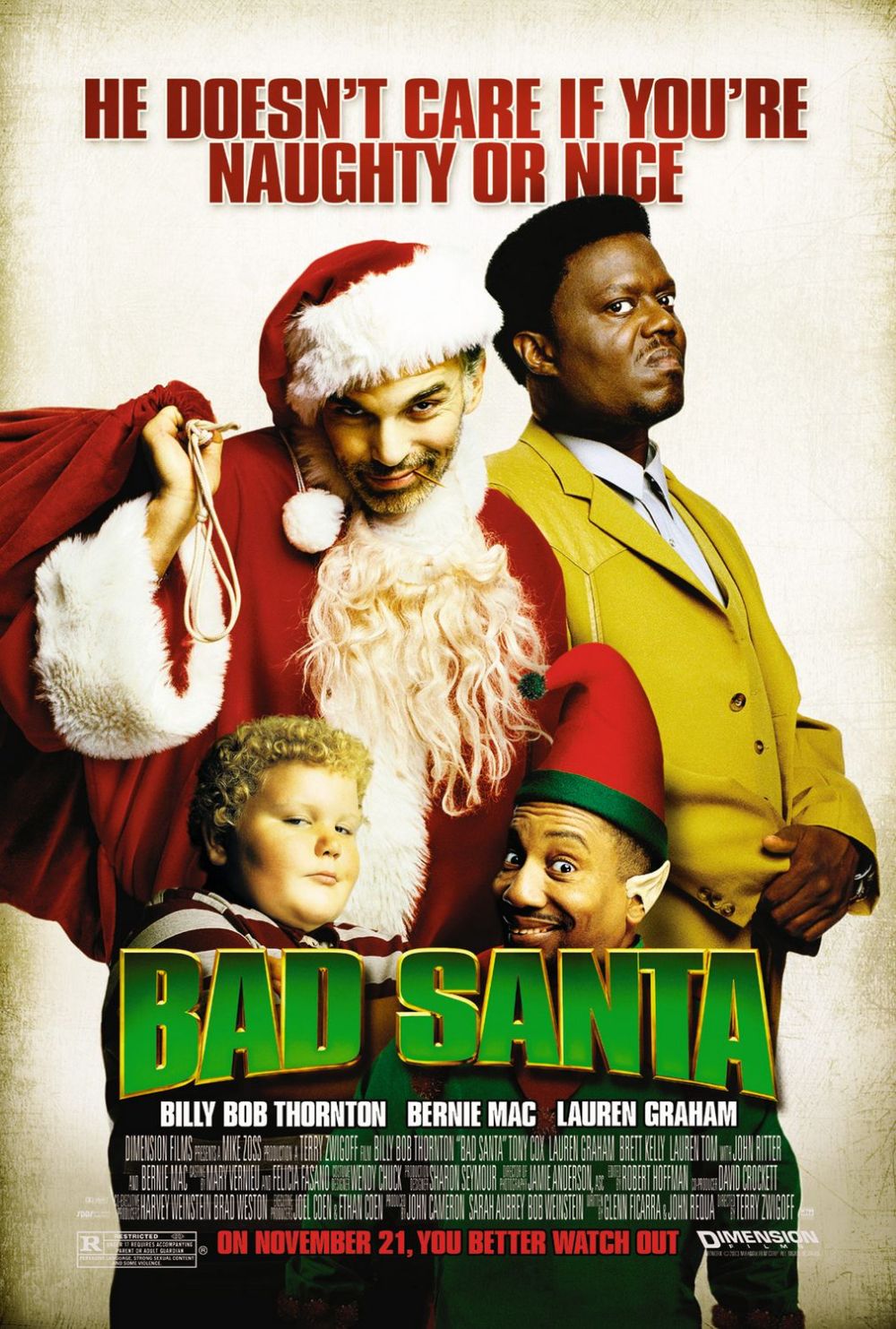
Billy Bob Thornton, one of the best character actors working, plays Willie Stokes, a department store Santa Claus who is anything but fat and jolly. You are more likely to see him drinking backstage, making out like the womanizer he is, and doing other things completely lacking in sensitivity. Seeing him talk with the kids makes you wonder how the hell he manages to keep a job anywhere. Willie cusses at them when they sneeze in his face, and he never lets them ask about the presents they want. I kept waiting for one kid to pee on him as this happens with every department store Santa, but it turns out he is the one doing the pissing. But as cruel and Scrooge-like as Willie is, there is one person he clearly despises more than the kids and their snooty parents, himself.

Eventually, the truth comes out. Along with his partner in crime, Marcus (Tony Cox), Willie robs each mall he works at. They wait until everyone has left, then they disable the security system and go on a shopping spree where they steal all the things they want but can’t afford. Willie’s specialty is opening safes which contain the majority of the store’s loot, and he is clearly a professional safe cracker when we first observe him at work. In addition, Marcus’ wife Lois (Lauren Tom, whose face is contorted into a permanent frown) is there to drive them away when their work is finished. Following this, they take the rest of the year off and live off of the money and valuables they have taken. Marcus goes back to living with his wife while Willie goes off to Miami to get endlessly drunk, and Willie somehow gets lucky with the ladies regardless of his infinitely inebriated state.

Then we catch up with these characters a year later when they are employed at another mall where they plan their next big heist. But of course, things do not go as planned.

Thornton is a hoot as Willie Stokes. While his character does many things which would get him fired from any and every other job available, he gives this endlessly crude character a heart covered with a big slab of cynicism. And amazingly enough, he also makes Willie somewhat empathetic. This comes about when he meets a young pudgy kid who you’d think would teach him the meaning of Christmas, but he is really just stalking Willie out of loneliness. It allows Willie to warm up a little, and seeing him make any sort of effort with this kid is remarkable considering how far from sobriety he is.

The kid’s name is Thurman Merman (Willie basically calls him “The Kid”), he is played by Brett Kelly. Kelly is not anything like those clean-cut kids in Disney movies, and I found this to be very refreshing. Thurman is a short, pudgy little unpopular guy who doesn’t have any friends and is an easy target for bullies in and out of the classroom. What I really dug about Kelly is how dryly comic he is. He never seems to be the least bit fazed by anything Willie does. Willie gives Thurman a ride home and then proceeds to steal from his dad’s safe and steals his car, and Thurman responds by waving at him and saying, “Bye Santa!”

Thurman lives alone in this big house with his senile grandmother who herself is barely dealing with reality as it is. With Willie, Thurman sees him as someone who could be the friend he doesn’t have. Once Willie catches a cop sniffing around his motel room, he ends up moving in with Thurman to stay out of law enforcement’s sight, and this also allows him to play with Thurman and make out with a local bartender in the hot tub while the grandmother watches television listlessly.

“Bad Santa” was directed by Terry Zwigoff whose previous films include “Ghost World,” “American Splendor” and one of the best documentaries of the 1990’s, “Crumb.” Zwigoff is interested in personalities who are far from normal and have been damaged by life. With “Crumb,” he took a close look at a man who dealt with abuse through his creation of comic books which kept him from going completely insane. With “Ghost World,” he followed a couple of girls who prided themselves on being outsiders at their high school. But in the process of becoming adults, their world is shattered by the onslaught of the corporate world which robs what was once original and special to them. Now with “Bad Santa,” Zwigoff deals with his most damaged character yet with Willie, and you wonder if he is worthy of any kind of redemption. As a result, he is more than well-suited to take on this story which was originally written by the Coen Brothers.

Zwigoff also has a blast digging away at the banal culture of American malls. While they were havens for us as teenagers, they eventually became tiresome places to visit as adults because all the stores and food courts became indistinguishable from one mall to the next. From the anal-retentive managers to the overconfident mall security officers to those annoying boy bands, the movie cuts down the sugar coating of the holidays which will be a relief to those who find it fake or something they don’t care much for anymore.

Tony Cox is hilarious as Marcus. You quickly realize Marcus works with Willie out of necessity, not friendship. Truth is, as great a safe man as Willie is, Marcus cannot stand the way he degrades himself and those around him. Lauren Tom plays Marcus’ wife, and I love how she maintains the same snarky expression as she constantly blows off mall employees who want to sell her stuff she plans to steal anyway. I also got a big kick out of Lauren Graham who plays Sue, a local bartender who starts up a relationship with Willie. Sue is not with Willie out of pity, but in large part because of a sexual fetish she has had for Santa Claus ever since she was young.

But the two actors who deserve special recognition for their great work in “Bad Santa,” and who are sadly no longer with us, are John Ritter and Bernie Mac. This actually turned out to be Ritter’s last live action role before his sudden death. As mall manager Bob Chipeska, Ritter reminds us of what a great comic talent he was as he becomes incensed with what Willie gets away with, and yet he is too much of a wimp to do anything to stop him. Instead, he turns to Gin Slagel, mall security chief, who is played by Mac. Even when he doesn’t say a word while eating an orange, Mac still has us laughing hysterically throughout. The diner scene Mac has with our main characters is brilliant in how he maintains a strong air of confidence, and I loved how he kept finding different ways of repeating the same number over and over again.

“Bad Santa” is the perfect holiday film for those who love infinitely black comedies like “The War of the Roses” or “Observe and Report.” It is a much-needed antidote to the manipulative schmaltz many get suckered into seeing, and it makes us root for a character you would never root for in real life. This is definitely one of Thornton’s best movies, and I consider a new holiday classic for those who have seen “A Christmas Carol” and “The Polar Express” one too many times.

Just remember, you have been warned…

* * * * out of * * * *

Recount

recount-poster

Memories of hanging chads and confusing ballots permeate our consciousness years after the heavily contested 2000 presidential election between Al Gore and George W. Bush. We saw this played out on the networks with all their furious coverage, but with “Recount” we get a look at what went on in the campaign offices while this election fight went on to get a picture of what they each felt was fair and just.

How you view “Recount” may depend on what side of the political spectrum you have placed yourself on. I’m not sure how accurate this movie is to the real events, but I imagine it is pretty close. Coming out of it, you may feel it values one candidate over the other. But in the end, “Recount” is not so much a movie about the fight to get candidates elected as it is about the fight for democracy. It is a fight for all the voters to be heard, and also a scary tale of how the fate of the Presidency can end up in the hands of a powerful few instead of America as a whole. Hopefully, this is something that we all collectively hope we never have to live through again.

“Recount” was directed by Jay Roach, best known as the director of the “Austin Powers” movies. Here, he directs a large cast of superlative actors who take the roles of many people we know well from the 2000 election and gives us a strong case of why many still thank Al Gore was robbed of the Presidency. Both Gore and Bush are basically supporting players here, and we only see them from the backs of their heads or in news footage of them during the campaign. The movie is more interested in what went on behind the scenes of the election and of the different fights made to get to the truth of who won the Florida electoral votes.

Even though we all know how this ended up and who got elected, the movie is still riveting in the same way “Apollo 13” was. The filmmakers are not so much interested in the general way things happened as they are in the specifics of the election. We see brilliantly shot examples of how chads in ballots could not be broken off as they were designed to. The opening shot of the movie shows how easily confused some Florida residents are when they are trying to vote, and yet it is not altogether clear how to vote for Gore so that you don’t accidentally vote for Pat Buchannan. The moment where one of Gore’s campaign workers rushes up to him before he is about to make his concession speech on the night of the election is scary as we all feel like we are running alongside him. Even after all these years, we have a strong emotional reaction to the thought of Gore conceding the election.

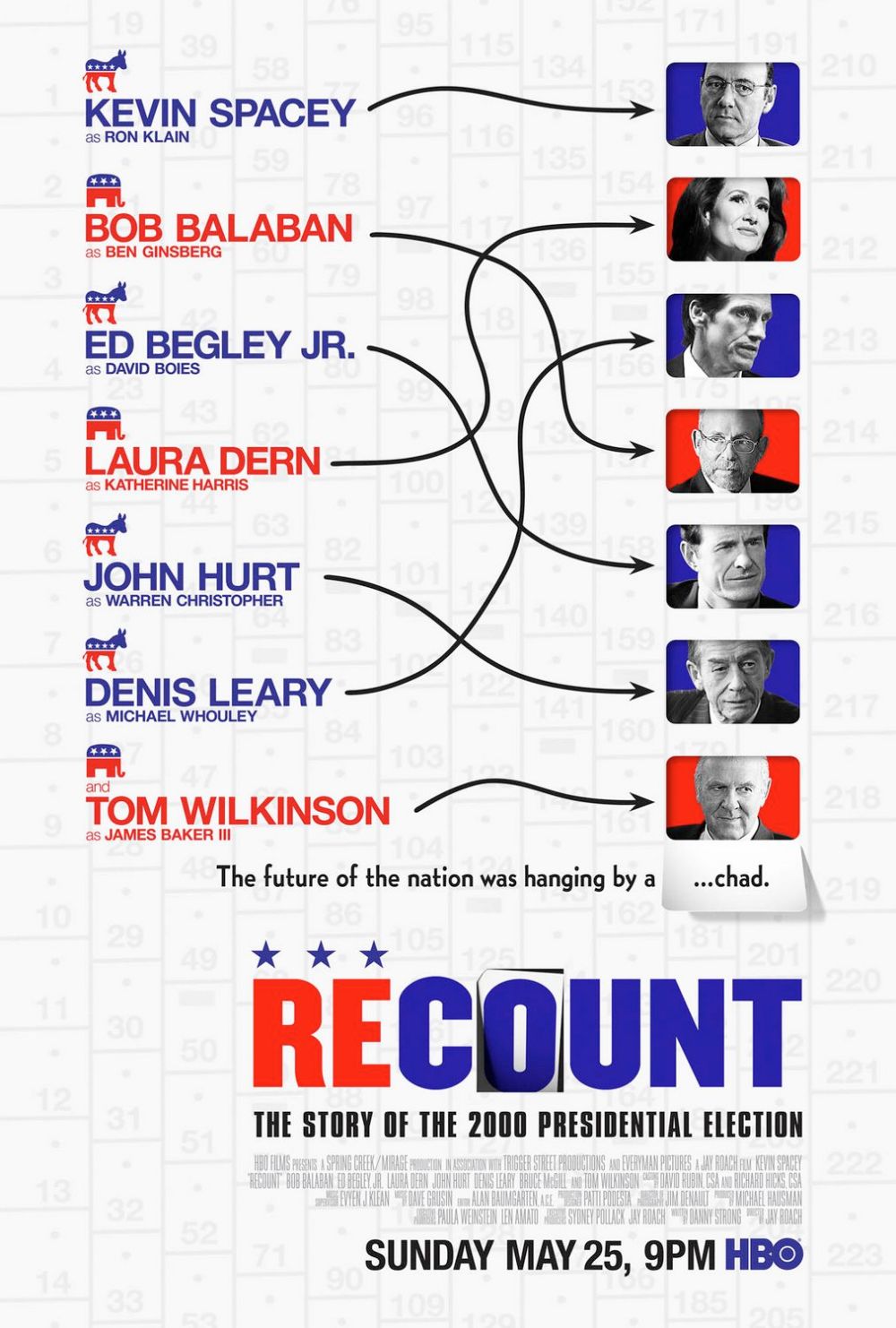
At the head of this star-studded cast is Kevin Spacey who gives one of his best performances as Ron Klain, Gore’s legal advisor on the campaign trail. The day before the election, it is presumed Gore is going to win, and Klain is offered a job in Gore’s new administration. Klain ends up turning it down as he feels it is not the way he wants to spend the next eight years of his life. But when it becomes clear there are clear inconsistencies in the voting in certain Florida counties, Klain goes right into action to make sure all the votes are recounted, as the margin of victory is only off by just over a thousand votes. Klain is aided by a large team of political strategists from Michael Whouley (Denis Leary) to Warren Christopher (John Hurt).

Spacey makes it clear from the start that Klain is an idealist more than anything else about the way the political system works. What he does throughout the movie is not motivated by his desire to see Gore become President, as he even admits he is not even sure he likes Gore, as it is by the desire to see all the votes counted and to not have any of them thrown out for different reasons like those rejected ones which contain the similar names of convicted felons. Because the election was so close, we can see in Spacey’s eyes how this election is much too important for anyone’s vote to be cast aside.

We also get great performances from actors like Ed Begley Jr. who plays David Boes who passionately fought for the recount to continue when testifying at the Supreme Court. Another great one comes from the always reliable Tom Wilkinson (“Michael Clayton”) who plays James Baker who fights on behalf of George W. Bush to turn the election his way. Wilkinson plays Baker as being idealistic in his own way, and he is almost as idealistic as Klain is for the democrats. Bruce McGill is also great here as Republican lobbyist Mac Stipanovich who is brought in to persuade Florida Secretary of State Katherine Harris to stop the recount.

Speaking of Katherine Harris, who by the way wanted nothing to do with “Recount,” she is played here in a brilliant performance by Laura Dern. With makeup, which brings up harsh memories of Faye Dunaway in “Mommie Dearest,” Dern gives us a Katherine Harris who is not dumb, but who is oblivious to what is going on around her. Harris says she is following the law, but never really questions those around her as to what their true motives are. Dern is one of the best actresses working today, and this movie is a good reminder of this fact.

The other thing to note about “Recount” is how the actors do a great job of inhabiting their roles as opposed to impersonating people we have become all too familiar with. The trap of playing real life people is many actors end up playing them from the outside in instead of the inside out. It takes a group of well-trained actors to play these roles, and who are not mere impressionists or mimics. Mimicry is a cool art, but it doesn’t work in a movie like this one.

Roach does a great job of putting us back in the year 2000, and he makes you a witness to all the events to where even though you know how this race ended, you still hope and pray for a different outcome. He also shows how each candidate has to be grateful for the dozens of people and hundreds of supporters who helped them get to where they ended up. The truth is we haven’t had many movies recently which have looked at the people who work so hard for the politicians they support, and these people need to be thanked for all they do. They can’t stay behind the scenes forever. They need to be seen for who they are.

In the end, “Recount” is not so much a movie about how Gore got screwed out of an election he won the popular vote on. It’s not even about if Gore lost the election. It is about how democracy was lost in the 2000 election, and of how many voices were rendered irrelevant for reasons which were not altogether justified. The final scene of the warehouse where all those uncounted votes is haunting, and it  feels like an outtake of the scene from “Raiders of The Lost Ark” where the Ark of the Covenant got stored in a factory holding hundreds of boxes which all look alike. The real victim of this election was all the voters were not heard, and this left a shadow over George W. Bush’s presidency which will never be erased.

It also serves as an important document of this moment in history which we can never forget. We need to remember what happened so it never happens again.

* * * * out of * * * *

The Ides of March

the-ides-of-march-poster

This movie’s title refers to the day Julius Caesar was assassinated by a group of senators who feared his role as a dictator would forever destroy their constitutional government. Some of these senators were close friends of his which make their actions all the more shocking. In the political arena, then and now, you would think those running for office would have their friends and loyal advisors to instill their trust in. But as history shows, the quest for power can tear friendships apart and corrupt the seemingly incorruptible. In William Shakespeare’s play of “Julius Caesar,” a soothsayer warns him before he is stabbed to death:

“Beware the Ides of March.”

George Clooney’s film is based on the play “Farragut North” by Beau Willimon, and it looks at how dangerous a political campaign can be for all those involved. They may not get stabbed in the back literally, but there is a lot of backstabbing to go around figuratively speaking. It all makes for an intense political thriller which never lets up.

Ryan Gosling stars as Stephen Meyers, a Junior Campaign Manager for Governor Mike Norris (Clooney) who is seeking the Democratic nomination for President of the United States. As the movie opens, Norris is campaigning in Ohio where a win there will all but guarantee him the nomination. Meyers is a strong believer in Norris and what he stands for, but his belief in him and the world of politics is in for a rude awakening. After a secret meeting with rival campaign manager Tom Duffy (Paul Giamatti), trust becomes a precious commodity in very short supply. Meyers also stumbles on an even bigger situation which could destroy the campaign to where it can never recover.

This is Clooney’s fourth movie as a director, and the abilities he shows behind the camera are never in doubt. “The Ides of March” doesn’t necessarily break any new ground in the political movie genre, but Clooney does great work in generating tension throughout as characters suddenly find themselves on a precipice which threatens to fall out beneath them with little warning. He also gets great performances from the entire cast as they face off against each other as if they are playing a game of chess. Everyone is holding their cards close to their chest, and only the eyes can give them away in showing where they are most vulnerable.

Gosling had a heck of a year in 2011 with this, “Crazy Stupid Love,” and “Drive.” As with the latter, he brings a smoldering intensity to his performance as he takes Meyers from a political idealist to one who sells out his values when things get rough. With one look, he can let us inside his thoughts without saying a single word.

Two of my favorite performances in “The Ides of March” come from two of the best character actors ever: Phillip Seymour Hoffman and Paul Giamatti. Playing campaign managers for their individual candidates, they brilliantly bring out the moral complexities of each person as their agendas become clear as the story continues to unfold. Both of them also make what could have been seen as convoluted actions or maneuvers completely believable as they try to get the upper hand in a fragile political environment. They essentially represent the cynical side of politics where idealism vanished a long time ago and the path Meyers may be forced to go down if he wants to continue working in this realm.

The fabulous Evan Rachel Wood is great as always as Molly Stearns, a campaign intern whose confidence collapses when her secret is realized. Seeing her go from a sexy seducer to the campaign’s most vulnerable employee is handled by her like a pro, and she makes us see Molly as a person while others view as a crippling concern which needed to be quickly and quietly removed. The cruelty of politics comes to hit her character the hardest.

And then there’s the equally fabulous Marisa Tomei who portrays New York Times reporter Ida Horowicz. She enjoys a friendly banter with Gosling from the start which draws us in on a more personal level. It’s there where Tomei traps not just Gosling, but the audience as well. She provides us with a friendly face, but she is later revealed to be a manipulative journalist who wields more power than you might expect a journalist to have. I have yet to see Tomei give a bad performance in anything she does.

What I really like about the screenplay of “The Ides of March” is it’s not about good guys and bad guys. It’s all about shades of gray and how the hope in politics can be easily and quickly worn down to a cinder of what it once was. Some of the actions in the movie almost feel like something out of the “Saw” movies as they almost seem illogical and impossible to put together, but it makes sense in regards to the political realm it takes place in. This would make a great double feature with Mike Nichols’ “Primary Colors” as both movies deal with the moral compromises made in getting your candidate elected. But while “Primary Colors” sees a light at the end of the tunnel, “The Ides of March” doesn’t let the viewer off as easy.

* * * ½ out of * * * *