Get Out

Get Out movie poster

You know the main characters of this movie are in trouble once they hit a deer. Of this, I speak from my own experience as my dad drove me to the airport one time and ran over a deer which walked into his traffic lane. It was not his fault as the deer came out of nowhere, and there wasn’t any time to hit the brakes to avoid an animal oblivious to the Volvo station wagon heading straight at him (or her). Nevertheless, a week later I got laid off from my job. Looking back, hitting the deer proved to be an omen of bad things to come, and losing my job was one of them.

I was reminded of this as I watched the opening minutes of “Get Out,” an insidiously clever horror movie with the occasional dose of humor thrown in. Chris Washington (Daniel Kaluuya) and Rose Armitage (Allison Williams) are driving up an empty stretch of road to meet her parents when they slam into a deer. There’s nothing they can do to help the animal, and the police officer who arrives at the scene asks for Chris’ license even though he wasn’t driving. Rose encourages the officer to let Chris be, and he eventually leaves the scene while advising her to fix her broken rearview mirror. But as the movie goes on, this turns out to be the least of their problems.

I should probably point out that Chris and Rose are an interracial couple, and Chris is concerned Rose’s parents have no idea her daughter is dating a black man. His nervousness is understandable, and it is elevated further when Rose’s parents, Dean (Bradley Whitford) and Missy Armitage (Catherine Keener) try to make him feel welcome by telling him they would have voted President Barack Obama for a third time if it were possible. Basically, the Armitages are well-meaning white folks who support the fight against racism, but they have yet to understand the damage, however unintentional, they are doing to African-Americans.

Things get even weirder when Chris meets two other black people who work for the Armitages, Georgina (Betty Gabriel) and Walter (Marcus Henderson). Both act very strangely and in a manner which threatens to redefine passive-aggressive, and the way they stare at Chris is unnerving as they look like snakes ready to strike at their pray without much notice. It doesn’t take long for Chris to realize something is terribly wrong, but his attempts to escape the Armitage household are not exactly successful.

There is a lot of racial tension burning right underneath the surface in “Get Out,” and this is on purpose. The movie plays on the stereotypes whites have of blacks and vice-versa. Everyone is trying to be polite, but you can sense what’s really going on by looking into the eyes of each character as they project darker intentions or sheer terror, and sometimes both. We are left in suspense as we constantly wonder what the Armitages truly have in store for the helpless Chris, and when their intentions are revealed, it makes a scary, and an oddly amusing, amount of sense.

“Get Out” marks the directorial debut of Jordan Peele, one-half of the famous comedy duo “Key & Peele,” who also wrote the screenplay. It’s a very strong debut as he takes satirical elements and places them into a story which ratchets up the intensity throughout and keeps it up to the end. But Peele doesn’t just give us a flat-out satire as he never set out to play everything just for laughs. He digs deep and touches at our own preconceptions of race in America and plays around with the unintentional ways we reveal ourselves to be more prejudice than we ever realized.

Daniel Kaluuya, whom you might remember from “Sicario” and “Kick-Ass 2,” is excellent as Chris, a young man caught up in a situation we hope he fully comprehends before it is too late. He also has good chemistry with Allison Williams to where you can’t doubt they are believable as a couple. “Get Out” also has the benefit of having two terrific actors playing Rose’s parents, Bradley Whitford and Catherine Keener. Both have a warm presence here which eventually turns into something more sinister before you even know it.

I especially have to single out Keener as she remains one of the most underrated actors working today, and the scene where she hypnotizes Chris is a huge reminder of that inescapable fact. She doesn’t have to do too much to get our attention, and as Missy, she seduces us to a place we didn’t plan on going to, and it’s a place where we fear we will never rise up from.

There’s also a terrific scene-stealing performance from Lil Rel Howery as Chris’ best friend, Rod Williams, a TSA agent who has seen it all. In any other movie, Rod would be the one to overact in the most annoying way possible, but Howery turns the character into a welcome form of comic-relief the movie needs to ease the at times unbearable tension, and he is hilarious.

In many ways, “Get Out” is a clever riff on movies of the past like “The Stepford Wives” which dealt with the unusual behavior of female residents in a little Connecticut town, and Peel takes risks with the material you wish other filmmakers would take on a more regular basis. What results is a motion picture which is not perfect, but still a very good one which will stay with and unsettle you in the way a good horror movie should. It also plays with the ways white people try to show how non-racist they are and yet fall into an inescapable pit of hypocrisy before they even know it.

And for the record, I’m a white guy and I would definitely have voted for Barrack Obama for a third term as President. Think what you will of that statement. I’m just going to leave it here.

* * * ½ out of * * * *


Mad Monster Gives ‘A Nightmare on Elm Street 3’ a Highly Entertaining Anniversary Screening

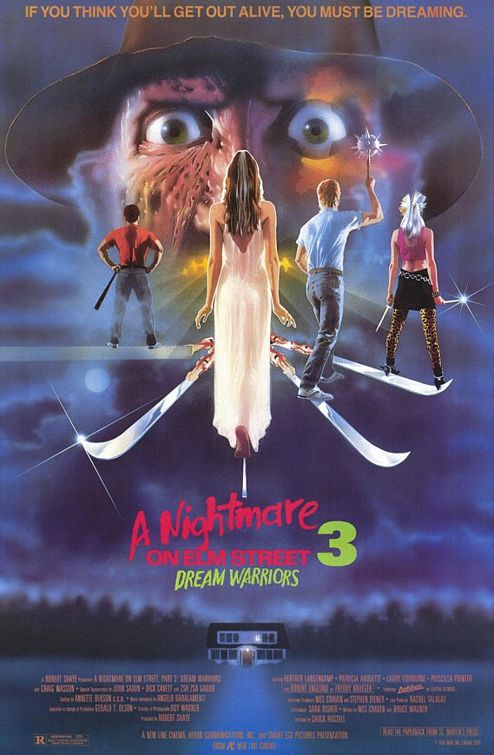
Dream Warriors Mad Monster Poster

On Monday, August 13, 2012, the Chinese Theatres in Hollywood presented a screening of “A Nightmare on Elm Street 3: Dream Warriors” in honor of its 25th anniversary. This event was put together by Mad Monster, a monthly genre print magazine made by and for the modern monster fan, and they ended up giving us quite a show. They had several giveaways of signed posters and tickets to horror conventions, a costume contest which had the audience cheering loudly for those best dressed, a musician doing an acoustic version of the Dokken theme song “Dream Warriors” and the evening culminated with the appearance of the sequel’s co-stars Rodney Eastman and Jennifer Rubin.

Eastman played Joey Peterson, the mute patient who refuses to speak or sleep after experiencing horrific nightmares. Rubin portrayed Taryn White, a former drug addict who also suffers from nightmares and is harassed by male orderlies at the hospital she is at. Both actors were asked if they were aware of the other “Nightmare” movies before they were cast in this one.

“I was 19 and I came of age during the era of the original slasher movies,” Eastman said. “I had almost given up on acting and this audition came to me out of the blue. I was excited to be a part of it, but it still felt like just another low-budget horror movie. It was not an iconic movie then like it is now.”

As for Rubin, she said, “I knew of the other two ‘Nightmare’ movies, but I did not see either of them before I auditioned for this one.”

Eastman and Rubin were then asked if anything happened during filming; like if any actors fell in love with one another or some other gossipy stuff. Both Eastman and Rubin had the same answer to that question, “No.”

When this sequel was released, it lifted the “Nightmare on Elm Street” franchise out of cult film status and into mainstream commercial success. Eastman and Rubin were asked if they were surprised by this sequel’s success.

“I had done the ‘Never Sleep Again’ documentary, and after that people were jumping out at me from the bushes,” Rubin said. “I had no idea it was for this film.”

“I was blissfully unaware of the world around me back then,” Eastman said. “It’s only in retrospect that I see the impact it has had. I wasn’t stopped in the streets and no one jumped out at me back then.”

Eastman got to reprise his role of Joey in “A Nightmare on Elm Street 4: The Dream Master,” and he was asked by an audience member which he preferred more; being in “Part 3,” or getting killed in his water bed in “Part 4.” Eastman made his answer crystal clear, “I prefer ‘Nightmare 3’ over the water bed death scene. Plus, Patricia Arquette was the hottest girl in that movie.” Then he remembered that Rubin was standing right next to him and quickly added, “I mean Arquette was the sexiest actress on set next to Jennifer here.” Of course, by then, the audience agreed it was a little late for Eastman to find forgiveness.

One audience member asked the two actors if they ever got to meet the members of Dokken. Eastman replied he, unfortunately, didn’t have the pleasure of meeting them, but Rubin ended up telling a funny story regarding the 80’s heavy metal band. “Their mail ended up coming to a house that I was house sitting at the time,” Rubin said. “So, I took the mail to their house, and it turns out there was nobody home.”

When asked what it was like working with Robert Englund, the actor who gave life to Freddy Krueger, Eastman said it was pretty incredible and went on to describe him as one of the smartest, most entertaining and brilliant conversationalists he has ever met. He also added that Englund was a wild man back in the 80’s. Rubin agreed with what Eastman on that, and she also had this to say about another important person in the “Nightmare on Elm Street” franchise, “Wes (Craven) was weird!”

All in all, this was an endlessly entertaining evening for fans of “A Nightmare on Elm Street 3: Dream Warriors.” Granted, the screening of the movie elicited many laughs which were not present when it came out in 1987, and it’s safe to say that certain parts of it have not aged very well. But none of that mattered because everyone came to have a great time at the movies, and that’s what they got.

Poster artwork by Christopher Ott.

A Nightmare on Elm Street 3: Dream Warriors

A Nightmare on Elm Street 3 Dream Warriors poster

“Sleep

Those little slices of Death

How I loathe them.”

-Edgar Allan Poe

As soon as you see the above quote which opens “A Nightmare on Elm Street 3: Dream Warriors,” you know Wes Craven is back on board in some capacity. After directing the original, one of the all-time great horror classics, he bailed out of the first sequel which he felt betrayed the logic of Freddy Krueger’s character and how he existed in the realm of dreams. This third entry ended up defining the look of the rest of the series until “Wes Craven’s New Nightmare” came along. This one brought forth a Freddy who, while still scary, was more of a stand-up comic with one-liners flying out from his charred face in rapid succession.

“A Nightmare on Elm Street 3” starts off with the character of Kristen Parker (Patricia Arquette, in her film debut) having the first of many nightmares. Freddy’s attack on her is made to look like she tried to commit suicide, and it gets her thrown into a psychiatric hospital with others suffering from serious mental health issues. Of course, when doctors try to give her a sedative to help her sleep, she naturally freaks out and grabs a knife to fight off those who don’t have a clue as to what she’s really up against. This is where she meets up with Nancy Thompson, played once again by Heather Langenkamp.

We learn Nancy has since gone to graduate school where she studied extensively about the nature of dreams. Here she gets assigned to this psychiatric ward where young teenagers are being stalked by the man with razors for fingers. They are being cared for by Dr. Neil Gordon (Craig Wasson) who has long since gained their trust, but he has yet to realize how he can really help them. Nancy sees right away it has everything to do with Freddy, and when she shares this information with the kids they stand at attention and are shocked to realize they have all been dreaming about the same person.

With a budget of around $5 million dollars, the special effects are more impressive than you would expect them to be. It’s always a gas to see what people can do with very little money. There’s one great effect where Freddy comes to life as a marionette, and he immediately returns the favor to its creator by pulling out the veins in his arms to use as strings. Ouch! The sets never reek of cheapness, and the imagination put into this movie is always on display as we see the dreams of the different characters and the forms they each take.

Bringing Craven back to help write the screenplay was a smart move, and he changes the formula to keep it from being just another single kid being chased by Freddy. Also, these kids fight back to stay alive and prepare themselves a lot quicker than the others did in the previous films. One of the screenwriters on “Dream Warriors” is Frank Darabont who later made one of the greatest movies ever, “The Shawshank Redemption.” There is a good amount of work done with the characters here to where they are not your usual one-dimensional horny teenagers which make up the average “Friday the 13th” movie.

The movie also digs deeper into Freddy’s past to make us see how he came to be. Before this film, we knew he was a child murderer who was brought to court but got off on a technicality, and he was later burned by the parents of the town. Dr. Neil Gordon is visited by a mysterious nun who informs him Freddy’s mother, Amanda, was accidentally locked in an insane asylum with the most mentally unstable people one could ever find, or hope to avoid, on the face of the earth. Amanda was raped over and over, and this led to the conception of Freddy who, as the nun puts it, is “the bastard son of a hundred maniacs!” This would make a great title for a movie.

Unlike other horror movies, you care about the characters and what happens to them. Most of these slasher movies have stock characters you hate and root for to die. In all fairness, it makes watching them more fun to watch in a theater, but here the characters, while dealing with obvious stereotypes, are interesting in their own way. Some are geekier than others (don’t get me started on the “Wizard Master”), but they are more real than your average teenagers dealing with ballistic hormones.

“Dream Warriors” is also proof of how wet dreams never end the way we want them to. One of the characters has an understandable crush on a nurse, and he ends up getting seduced by her. Some people get so lucky, but not this kid. What happens to him gives new meaning to the term “tongue-tied.”

Also in the cast is Laurence Fishburne who did this movie before “Boyz N the Hood.” He plays male nurse Max who is one of the more down to earth characters you could ever hope to find in a horror movie. The great John Saxon also returns as Nancy’s father, Lt. Donald Thompson. His character figures prominently in the film’s climax as they find that the only way to defeat Freddy is by burying his remains in consecrated grounds.

It’s hard to believe this was Patricia Arquette’s first film. She has since gone on to a successful career and appeared in great movies like “True Romance,” David Lynch’s “Lost Highway” and “Boyhood” which won her the Oscar for Best Supporting Actress. She creates one of the more sympathetic heroines in a horror movie who has a mother that, of course, does not understand what her daughter is actually going through. No one does initially, but if they did, there wouldn’t be a movie.

And, of course, we have Robert Englund returning as Freddy. In many ways, this was the last “Nightmare” movie where Freddy felt like a truly threatening presence. Just the thought of him was scary, and you didn’t need to show much of him to prove that. After this movie, he became more of a standup comedian than anything else. We had to wait until “Wes Craven’s New Nightmare” for him to come across as a viciously scary presence again. Still, Englund embodies this character in a way no one else could.

While Freddy ended up having an artistic downslide from here, “A Nightmare on Elm Street 3: Dream Warriors” is still one of the best movies in this long-running franchise, and it’s always fun to revisit this entry whenever it is showing on cable.

* * * ½ out of * * * *

Save

Oliver Robins Looks Back on ‘Poltergeist’ at New Beverly Cinema

oliver-robins-photo

On Thursday, August 16, 2012, Oliver Robins dropped by New Beverly Cinema to talk about the making of “Poltergeist.” Robins played Robbie Freeling, the boy who was terrified of that weird looking tree looming outside his bedroom window. These days Robins works as a filmmaker, but he explained how his time on the set of “Poltergeist” truly inspired him to make movies, and he helped debunk certain myths which continue to surround it years after its release.

Robins came up to the front of the audience after “Poltergeist” finished showing, and he talked about how he grew up at the New Beverly and discovered many movies which he might not have seen otherwise. He also remarked at how Steven Spielberg, who wrote and produced “Poltergeist,” gave him an 8mm camera as a present, and how the camera and the movie inspired him to become a filmmaker.

poltergeist-movie-poster

In talking about how he got cast, Robins said he had no real acting experience beforehand and that his only previous acting job was in a fertilizer commercial. The audition for “Poltergeist” was actually an open call which had hundreds of people coming down to be considered. Robins recalled having to wait for hours before he got inside to talk with the casting directors. When he did, they looked at him as being the true incarnation of Robbie as he talked about how he had lived in a haunted house while in New York.

Spielberg and director Tobe Hooper, however, were concerned because Robins couldn’t really scream, and they ended up getting a coach to help him learn how to. It got to where Robins was practicing his screams in his closet, and the neighbors began to wonder if there was any child abuse going on in his home. When he proved to the filmmakers he could indeed scream, Robins was informed he got the part.

When asked if a bond had formed between him and his fellow cast members, Robins told the audience “Poltergeist” was rushed into production and that there was no time for rehearsal. He did say, however, that JoBeth Williams, who played his mother Diane, really was a mother to him throughout the production.

One scene which really stands out is when Robbie’s father, Steven (played by Craig T. Nelson), teaches him how to count after lightning strikes to determine the distance between it and the sound of thunder. Robins remarked how Nelson was a comedy writer before he became an actor and that he made the set of “Poltergeist” very light-hearted as a result. Robins even remarked how working on the movie allowed him to stay up all night which he loved, and Nelson ended up telling him after one crazy night of filmmaking, “This is just another night in Simi Valley!”

Another famous scene from “Poltergeist” is when the tree comes through the window. Robins explained what ended up being 30 seconds of screen time where he got attacked by the tree ended up taking two weeks to film. Now this was back when digital effects were far from being a reality, so all the effects we see in the movie are real. Robins also pointed out there were several different trees being used for this sequence; one with roots, one where the branches reached out at him, and another which tried to eat him.

Robins described the tree sequence as being the most tedious and complex to film, and that he ended up spending much of the time being covered in molasses. He said being covered in that substance makes your body temperature drop precipitously and that he had to emote in his scenes in order create believability.

oliver-robins-in-poltergeist

Now there is an infamous story on IMDB of how when Robins gets attacked by the toy clown, he got choked for real and yet Hooper and Spielberg thought he was really acting. It was later said that when Robins face began turning purple, the filmmakers rushed over to remove the clown’s hands from around his neck. To this, Robins response was, “Maybe that did happen, but I can’t remember. Maybe I blocked it out of my conscious mind.”

When asked what it was like working with his sisters who were played by Heather O’Rourke and Dominique Dunne, Robins said it was great and that they both felt like real sisters to him. He also remarked at how Hooper and Spielberg were cool to him and other actors about wanting to change their dialogue. As a result, there proved to be a lot of ad-libbing on the set of “Poltergeist.”

There is also this ongoing story of how there were two directors on the set of “Poltergeist.” While Hooper’s name is listed as the film’s director, many believe Spielberg had the most influence. Robins, however, cleared up these rumors once and for all:

“There was only one director on set, and that was Tobe Hooper. Spielberg did write the story, but Hooper was the only one who directed me. It does feel like a Spielberg movie and he did work closely with Hooper on this project. In many ways it was a team effort, but Hooper was the true director of ‘Poltergeist.’”

Robins was also asked what it was like filming the scene between him and Beatrice Straight who plays Dr. Lesh where she tells him what she felt the true nature of ghosts were. He said Straight made him feel like he was really talking with someone who knows about ghosts, and this kept their performances from ever feeling forced.

It was great to hear Oliver Robins talk about the making of “Poltergeist” and to hear him dispel several myths about the 1982 movie. Since making that classic movie, Robins has retired from acting and went on to graduate from USC’s film school to where he has since become a very gifted filmmaker in his own right. His work in the Tobe Hooper-directed movie will continue to stand the test of time.


Save

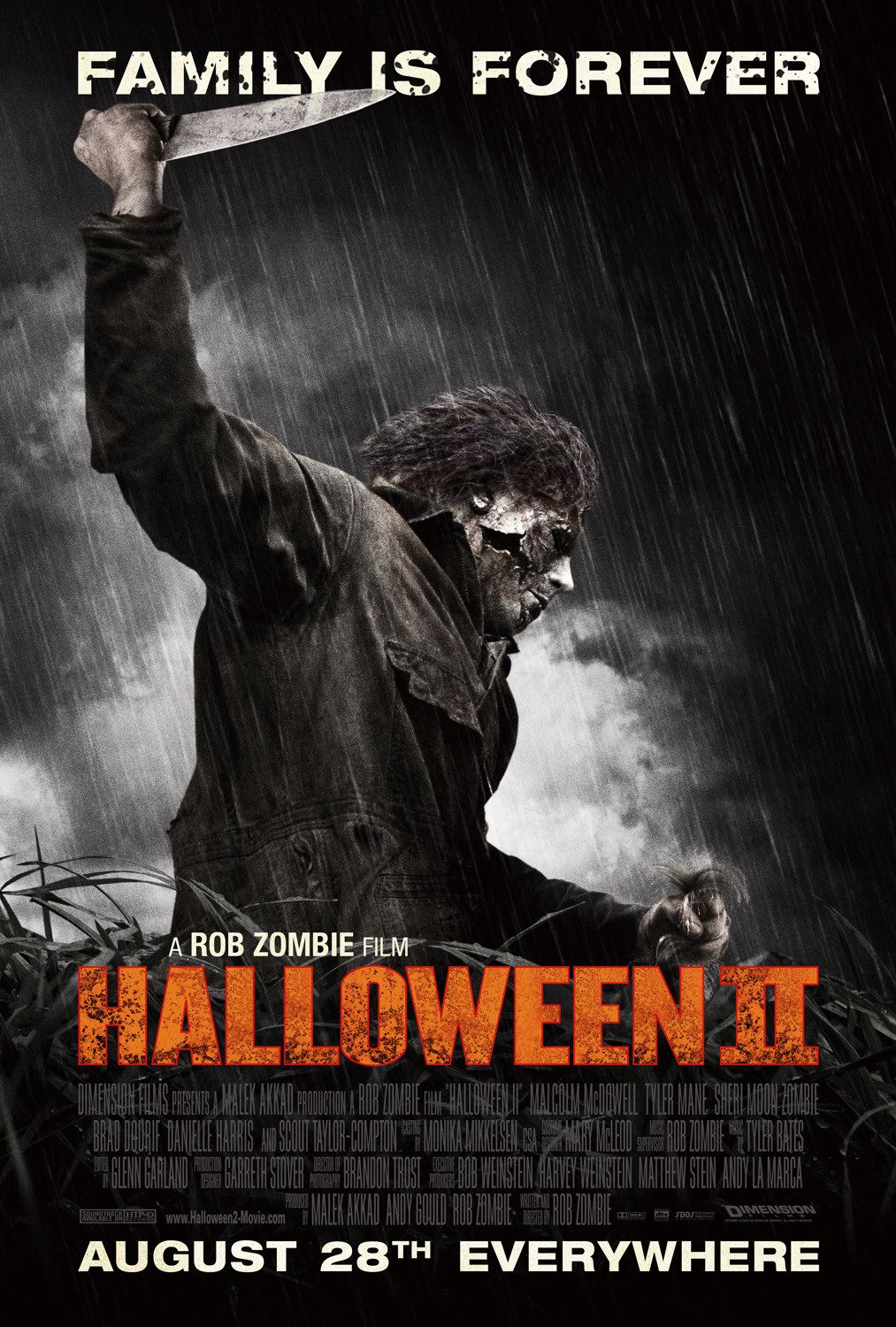
Halloween II (2009)

halloween-ii-2009-poster

It’ll be interesting to see what people think of Rob Zombie’s “Halloween II.” With this sequel to his remake, he has not made your typical slasher flick even though it does contain some amazingly brutal and bloody moments. One crushing death plays like an homage to the fire extinguisher scene from Gaspar Noe’s “Irreversible.” I have also heard some complain because this sequel doesn’t even feel like a “Halloween” movie to them, but wasn’t that the whole point of this re-imagining? Do you really want the same old slasher formula we have long since gotten burned out on? Isn’t this why Zombie was brought on to do the remake? You know, to give this long running series a much-needed re-invigoration?

Zombie’s vision of Michael Myers may not be as scary as John Carpenter’s was, but I wasn’t expecting that to be the case. With Zombie’s take on the “Halloween” saga, what have here is more of a character study of how Michael became so infinitely evil, and this something we have seen much of in this never-ending franchise. “Halloween II” is definitely on a par with Zombie’s previous film, and everything comes around full circle to where there’s no doubt family is forever.

“Halloween II” starts moments after the previous film with Laurie Strode (Scout Taylor-Compton) walking down the street all bloodied up after shooting Michael dead at close range. However, it turns out Laurie didn’t kill him. The bullet must have bounced off his skull knocking him unconscious or something else along those lines. This seems to be a reasonable excuse to bring Michael back, and it is step from previous “Halloween” movies which managed to come up with ridiculous excuses to bring Michael back for another round with horny teenagers.

As Laurie is wheeled into the hospital crying hysterically, the first of many times she does so, shades of Rick Rosenthal’s “Halloween II” emerge, but this cannot be mistaken as a remake of sequel. Meanwhile, the drivers of the coroner van carrying Michael’s body end up smashing into a cow leaving them severely injured. This allows Michael to escape to live and see another October because, in the end, what is Halloween without Michael Myers?

Meanwhile, we see Laurie getting patched up in surgery, and the extent of her injuries is unsettling. The detail given to the doctors working on her is horrific very realistic, just the way Zombie wants it to appear. You look at Laurie’s mangled body, and you think to yourself it’s a miracle she lived through this dark, dark night.

“Halloween II” then moves to a year later as Laurie, still deeply traumatized by that horrific evening, struggles to go on with her life. She has since been adopted by Sheriff Lee Brackett (Brad Dourif) and lives with him and his daughter, Annie (Danielle Harris). While the previous movie was told through Michael’s eyes, this one is seen through Laurie Strode’s perspective, and she is no longer the person she once was.

One of the big differences with this sequel is the way it was filmed. Whereas Zombie’s “Halloween” was filmed in 35mm, he instead filmed “Halloween II” is in 16mm which gives everything a much harsher edge. This worked very effectively for him on what is still his best movie, “The Devil’s Rejects,” and it makes the killings in “Halloween II” feel all the more brutal. Michael doesn’t just slash his victims; he pounds them to a bloody pulp.

Tyler Mane once against gives us the most lethal and threatening Michael Myers ever unleashed on the big screen. Being as tall and hulking as Mane is, it’s a wonder why anyone would be foolish to take him on. Here’s another interesting thing about Michael in this one, he has a beard. That’s right, for the first time ever we get to see this iconic character with facial hair. This is ironic because Michael has proven to be very useful with knives to where I am convinced he can give himself the closest shave without ever having to use any shaving cream. Then again, Michael has more on his mind than facial hair.

Taylor-Compton’s Laurie Strode is not the chaste and resourceful character Jamie Lee Curtis gave us in the original, but she digs deep into this role and takes Laurie to places no ordinary person would dare go. You think she is at bottom when the movie starts, but she’s not anywhere near it. Taylor-Compton makes you care about Laurie as she comes to the realization of who she really is, and you want her to escape the abyss she is drowning in. You want to help her.

One especially good performance comes from Brad Dourif as he gets more screen time here. The sheriff he portrays here is not your typical clichéd stupid cop who makes all the wrong decision, but instead a caring adult and who is constantly looking out for Laurie and Annie. Dourif is great here in a way you would not usually expect an actor to be in a film like this, and he is one of the most underrated character actors working today.

That’s the great thing about Zombie’s “Halloween” movies; he is not out to give us the usual slasher flick. With these two films, he has taken the time to develop his characters to where they are not the usual pack of one-dimensional stereotypes the horror genre keeps relying on. While he still does employ the usual white trash characters who utter disgusting dialogue, it is clear he is moving beyond them now. This shows growth on his part which makes me look forward to his future work.

Zombie also conjures up some truly weird imagery throughout as we get a closer look into Michael’s deeply disturbed psyche. Sheri Moon Zombie returns as Michael’s mother, but this time she speaks to her murderous son from the grave and convinces him that if he kills Laurie, he can bring the whole family back together. Some may still criticize her acting abilities, but she is better than people tend to give her credit for.

Danielle Harris also returns as Annie Brackett, but Zombie doesn’t have her doing the same old things she did previously. Considering how Annie almost died, she is nowhere as foolish this time around (not completely anyway). Annie, along with her dad, is desperate to life Laurie out of her emotional abyss even as Laurie makes it incredible for them to even try to do so.

But of course, we cannot forget Malcolm McDowell who returns as Dr. Sam Loomis. This time around, the “Clockwork Orange” actor gives us a Sam Loomis who is a pure asshole getting high off the fame he obtains by exploiting his involvement with Michael and his family. Loomis is no longer the helpful psychiatrist he was before and is instead a profiteer off the misfortunes of others. His sudden change of heart towards the film’s climax may feel a little forced, but McDowell sells it to where we really feel his pain when he comes to accept the damage he has wrought on others.

The brilliant sound design in “Halloween II” also needs to be mentioned as well. Michael doesn’t just crash through windows and walls in this one. You feel him bashing his way through everything in his path, and it this movie a visceral thrill the other “Halloween” sequels could only dream of offering. Zombie is not out to give you a bunch of cheap scares, but is instead out to horrify you as much as possible as we suffer along with Laurie as Michael continues his endless pursuit of her.

Zombie also does a better job with suspense this time around, and it really boils in certain moments when our anticipation gets the best of us. We know Michael is going to strike, and we fear the bloody damage we know he will brutally inflict. I’m glad Zombie came back to do this sequel even though he originally wasn’t planning to. Having anyone else direct this follow up would have been a mistake.

John Carpenter’s “Halloween” was a one of a kind film which was never intended to start a horror franchise. Zombie is not trying to outdo Carpenter, but to merely make Michael Myers and all these characters his own. While “Halloween II” is not a masterpiece, he does stay true to his vision of this unstoppable monster and improves on his previous film quite a bit.

NOTE: The DVD and Blu-ray release of “Halloween II” contains the director’s cut of the movie. This version changes a few things and adds more scenes which focus on the characters more, and it’s even better than the theatrical version as it gives you an even clearer sense of what Zombie was trying to accomplish.

Theatrical Version: * * * out of * * * *

Director’s Cut: * * * ½ out of * * * *

Halloween (2007)

halloween-2007-poster

This one is a remake of one of the best horror films ever made. What could be the point of remaking it other than to make a quick buck? So many people have been milking this franchise dry for decades. Just when you thought Michael Myers was finished once and for all, he springs back with some utterly lame excuse for still being alive.

But what this “Halloween” remake has going for it is Rob Zombie who gave us “House of a 1000 Corpses” and the brilliant grindhouse flick “The Devil’s Rejects.” We all know just how much he loves John Carpenter’s original film, and we believed him when he said he would make this “Halloween” his own. If there was ever going to be a “Halloween” remake, who better to do it than Zombie?

This reimagining proved to be polarizing for “Halloween” fans in general. They either loved it, hated it or had a mixed reaction to it. One thing for sure, it is far more brutal than Carpenter’s film. Zombie does not try to hide from the ugliness of violence, and there is no campiness to be found here.

The first half is the freshest part as it deals with Michael Myers as a child and looks closely at what made him such a monster. This is where Zombie’s “Halloween” could have been disastrous as things tend to be scarier in a horror movie when the motives of the killer are barely described or explained. But what Zombie does is force us to look at Michael as a human being instead of an indestructible force of nature, and this makes his version all the more compelling.

Michael could not have come from a more dysfunctional family if he tried. His mother (Sheri Moon Zombie) is a stripper at a local bar, his step dad (William Forsythe) is an abusive prick who has nothing nice to say about anything or anybody, and his sister Judith (Hanna Hall) would rather make out with her boyfriend than take her little brother trick or treating. On top of that, he is constantly bullied at school and has this little hobby of killing animals which is typically a serious warning sign of someone about to embark more homicidal adventures.

Zombie succeeds in making you feel for Michael even as we condemn him for the violence he inflicts on others. We fear him but also empathize with him because we see the pathetic hell he has been put through.

The adult Michael is portrayed by Tyler Mane, a huge individual whom you never ever doubt will leave some serious damage in his path. I thought it was genius of Zombie to cast such a tall actor in this role. When he was at a Fangoria convention, Zombie said it made more sense to cast a very tall actor in this role as opposed to a regular height kind of guy. Michael has to be a formidable force of evil, and Mane gives us the best version of this character since Nick Castle played him in the original.

After spending a lot of time on Michael’s back story, Zombie moves us through the “Halloween” we grew up on as we get introduced to Laurie Strode and her friends from school. Many of the scenes from the original are repeated here which brings this movie down some as they remind us of just how great Carpenter’s film was. Zombie moves through those scenes at such a rapid pace to where the characters never seem as fully realized as they could have been. Laurie Strode is played by Scout Taylor-Compton, and she is one hell of a screamer! She may not be on the same par with Jamie Lee Curtis, but she does make the role her own and is fun to watch.

Playing Laurie’s babysitting friends are Kristina Klebe as Lynda and Danielle Harris as Annie Brackett. Harris is a Michael Myers veteran herself, having played the daughter of Laurie Strode in “Halloween 4” and ‘Halloween 5.” It is important to note she was not cast in this movie as a result of her previous work in the franchise, but because Zombie said he was truly blown away by her audition. She does deserve a lot of credit for playing such a believable teenager even though she was 30 when the cameras started rolling.

Zombie casted many of his friends like Sid Haig, Bill Moseley, Leslie Easterbrook, and Ken Foree as well. There are also cameos from B-movie actors like Dee Wallace Stone, Sybil Danning and Clint Howard. One of the best performances in “Halloween” comes from Sheri Moon Zombie herself. As the mother of Michael Meyers, she shows a lot of range here we haven’t seen before as her character proves to be the only who truly cares about Michael and what he is going through.

Another awesome actor featured here is Danny Trejo whose character encourages the young Michael to live inside his head so he won’t feel so boxed in when inside his prison cell. The way Trejo spoke those words must have come from a real place as he once served time in prison. His performance and scenes with Michael are haunting, and I would have loved to have seen more of him in this movie.

Overall, I liked Zombie’s ever so brutal vision of Michael Myers. It does not quite equal what Carpenter gave us, but it is certainly much better than several of the sequels which were inflicted on us. Zombie has created a movie which truly shocks and unsettles the viewer. Whereas you cannot help but snicker at the usual clichés in every other slasher movie, this one throttles you back into your seat. At the very least, it is the best remake of a John Carpenter movie yet. After the dismal remakes of “Assault on Precinct 13” and especially “The Fog,” this one fares much better in comparison.

* * * out of * * * *


No, I Haven’t Seen It Until Now: ‘Poltergeist’

poltergeist-movie-poster

I got the Blu-ray of “Poltergeist” around the time Circuit City was closing all their stores forever. I had seen bits and pieces of the movie before, but I had never watched it all the way through until a couple of years ago. What finally spurred me to watch it was having watched “Poltergeist III” on cable, and that sequel was a true abomination. I figured what came before that needless sequel had to be so much better. Getting past all the trivia surrounding “Poltergeist” and its so-called “curse,” it remains remarkably frightening for a PG-rated movie.

Actually, it’s quite fitting I watched “Poltergeist” during the period of the wildly successful “Paranormal Activity” movies since they all focus on the strange and bizarre happenings around suburban households. These days it seems like the “found footage” genre is the only way to make a horror movie set in the suburbs seem all the more frightening. But “Poltergeist” showed if you get the details just right, then you can find yourself relating to characters and their surroundings completely and without any question.

“Poltergeist” was directed by Tobe Hooper, but Steven Spielberg’s name is all over the movie as he came up with the story, co-wrote the screenplay and served as one of its producers. It’s hard to escape the influence he had over this production as, like “E.T. The Extra Terrestrial,” it takes place in the suburbs of America where many of us grew up.

We drop in at the home of the Freeling family which is located in the nice, clean California town of Cuesta Verde, and it’s the kind of neighborhood where the houses don’t look all that different from one another. The cars are parked out front because they aren’t parked in the garage for some odd reason, and the kids are riding their bikes all over the neighborhood.

Steven (Craig T. Nelson) is a successful realtor and his wife, Diane (JoBeth Williams), is a stay at home mom caring for their children Dana, Robbie and Carol Anne. One night, Carol Anne goes downstairs and sits in front of the television which is showing nothing but static. It’s an especially frightening image on the Blu-ray release as the flickering creates an eerie strobe light effect as if the house’s inhabitants are in the process of being brainwashed. Carol Anne begins talking to the television as if she’s having a conversation with someone invisible to everybody else. We can’t even hear what that someone is saying to her, but we believe Carol Anne is communicating with another and our imagination runs amuck at who that might be.

Following this, strange things begin to happen around the Freeling household like chairs moving by themselves and the furniture being rearranged in a heartbeat. One night while sitting in front of the television, a hand reaches out and pushes Carol Anne away which is followed by a force of energy penetrating the walls. Her parents wake up to see their daughter telling them, “They’re here…”

What makes “Poltergeist” so effective is how the filmmakers play on those childhood fears we all had. Whether it’s that creepy looking tree outside the bedroom window or the clown puppet which you fear will come alive and attack you in the night, we can all relate to what goes on here except, of course, for being sucked into another dimension. I remember always asking my mom to put my AT-AT toy, the Imperial walker from “The Empire Strikes Back”, on its side so it wouldn’t crawl over to me while I slept. I also kept having these dreams where this green school desk I had would end up rushing at my bed to attack me. Now imagine if these things happened in real life, and you will get a sense of what “Poltergeist” is all about.

There’s nothing too unique about the characters who live in Cuesta Verde, and this makes them all the more relatable. Seeing the kids’ room with those “Star Wars” posters and bed covers bring back a lot of memories. When these supernatural occurrences start happening and get increasingly worse, we can easily see it happening in our own homes. Then again, this might make our own households far more exciting than they usually are as living in the suburbs can be too low key for some.

“Poltergeist” is also perfectly cast with actors who inhabit their suburban characters with what seems like relative ease. Nelson and Williams still seem like the typical American parents we all know. Heather O’Rourke, Dominique Dunne and Oliver Robins are perfectly natural as their children, and they appear very comfortable in front of a camera. You also have Beatrice Straight as Dr. Lesh, a parapsychologist, and she gives this movie a strong dramatic weight.

There is also something to be said for Zelda Rubinstein’s performance as spiritual medium Tangina Barrons. While her high-pitched voiced might seem a little annoying, she makes her strange dialogue sound very believable as Tangina becomes the family’s last hope to save Carol Anne. It’s no wonder her presence in “Poltergeist” is so unforgettable, and not just for her immortal line, “This house is clean.”

Movies like “Poltergeist” usually have filmmakers getting too caught up in perfecting the special effects at the expense of everything else, but Hooper manages to balance everything out to create one of the most terrifying haunted house movies ever. As much as Spielberg’s name is all over this movie, I have to believe Hooper is the one who made this movie as scary as it is. While it may not be as unnerving as “The Texas Chainsaw Massacre” (and very few movies are), he really packs in a lot of scares for a PG-rated movie.

You could also say that “Poltergeist” is a serious dig at the cutthroat world of real estate as Steven makes the horrifying discovery of how certain sacred things which were not moved from their original location. People will do anything for the perfect property when there’s a ton of money involved, and if they can cut corners to make house building go faster they will. Heck, this almost sounds like a supernatural version of David Mamet’s “Glengarry Glen Ross.”

I can’t help but wonder if home insurance even covers supernatural occurrences like this. Would the Freeling’s insurance carrier find an excuse to deny them any financial compensation? Could you imagine the looks on their faces if their agent denied their claim for negligence as if it’s their fault for not reporting this to the authorities sooner? If I were on the receiving end of that, I would be pissed!

It says a lot about an 80’s movie like “Poltergeist” that it still holds up so well all these years later. Its portrayal of suburban America doesn’t look much different from what we see today. I guess the only real difference, aside from cell phones and iPads, are the number of bank foreclosures going on, and you certainly don’t see this happening here. While it may have been ruined a bit by sequels (and this movie really didn’t need any), it still is worth re-discovering and would make an interesting double feature with “Paranormal Activity.”

One other thing; is it just me or does that white spidery creature who blocks Williams from her children’s bedroom have the voice of MGM’s roaring lion?

* * * * out of * * * *


It Follows

it-follows-poster

To me, “It Follows” was to 2015 as “Honeymoon” was to 2014; an infinitely creepy horror movie deserving of the attention many low-budget movies don’t always get. It’s a mesmerizing and terrifying piece of work which invites comparison to some of John Carpenter’s best films, and it’s smart enough not to reveal every single detail of its story. Like the best Hitchcock classics, it strings you along to where you keep guessing as to what’s behind the cinematic madness all the way to the very last frame.

“It Follows” opens up on a teenage girl fleeing her home in terror, and we’re not sure why. The next day she is found murdered and her body is contorted in ways which make it look like a yoga exercise gone horribly wrong. From there we meet Jay Height (Maika Monroe) who swims alluringly in the family swimming pool, and it’s hard not to be sucked into her realm as a result. After making out with her boyfriend Hugh (Jake Weary), he renders Jay unconscious and takes her to an abandoned building where he says he has passed on a curse to her. As a result, an entity which can only be seen by those who have been cursed will follow them, and once they are dead it will go after the person who gave it to them.

It’s an ingenious concept for any horror movie as this is the kind of curse which doesn’t invite an easy explanation. We can’t be sure of what the curse is, and as a result our imagination runs wild with endless possibilities as to how it can appear to us. Now I know a lot of moviegoers are desperate to have everything explained to them, and they will probably have serious issues with “It Follows” as a result, but I loved how this is a film which keeps its secrets close to the vest as revealing any of them could make the whole endeavor fall apart irrevocably.

This is only the second film from writer/director David Robert Mitchell whose previous credit was “The Myth of the American Sleepover.” I liked how he just immerses us into the lives of these young characters to where he has the viewer in a trance. It’s certainly one of the most atmospheric horror films I have seen in a while, and even the cheap scares thrown in have a stronger impact here than they do in the average scary flick.

Mitchell has given us a horror film with real down-to-earth characters which is very commendable as this genre usually benefits from having the opposite kind. Horror movies these days are typically reduced to having one-dimensional characters to where you find yourself rooting endlessly for the masked villain to decapitate them in the worst way possible, but this is not the case here. As a result, the horror feels a lot more real as these characters fight to escape from a deadly force only they can see.

Mitchell also has a very strong cast to work with as well. Chief among them is Maika Monroe who plays the movie’s main protagonist, Jay Height. Monroe was terrific in the criminally underrated thriller “The Guest,” and she succeeds in giving us a strong female heroine who is vulnerable but not too vulnerable to let this evil spirit take her down. Strong performances also come from Keir Gilchrist as Paul, Jay’s friend who has a not-so-secret crush on her, Lili Sepe as Jay’s sister Kelly, Daniel Zovatto as Greg Hannigan, and Olivia Luccardi as Yara.

In addition, “It Follows” features a very cool and utterly visceral electronic score courtesy of Disasterpiece. I grew up on the electronic scores of John Carpenter and Alan Howarth, and I think it’s great this kind of film music is making a comeback in movies like this, “The Guest” and “Ex Machina.” Disasterpiece has created a memorable score which is at times lovely and thoughtful, and at other times highly unnerving as it goes out of its way to sound like it will overload your stereo speakers with no mercy.

Mitchell only had a budget of $2 million to make “It Follows” with, and he certainly made the most of it because the movie looks like it cost so much more. Also, he got to film it in Detroit, Michigan, a city which, despite its problems, has proven to have a very unique look other American cities do not possess. This is a wonderfully creepy, suspenseful and terrifying movie which stands out among many others in its genre, and it leaves the viewer with a lasting impression as the ending makes clear the terror is far from over. And I don’t just say this because RADiUS-TWC, the company that distributed it, is already thinking about a sequel.

It says a lot about a movie which manages to maintain a strong level of suspense and tension from start to finish, and “It Follows” is just the latest example of that kind of cinematic experience which, these days, no longer feels all that rare to us.

* * * * out of * * * *

Save

Harry Treadaway Discusses Keeping the Suspense Strong in ‘Honeymoon’

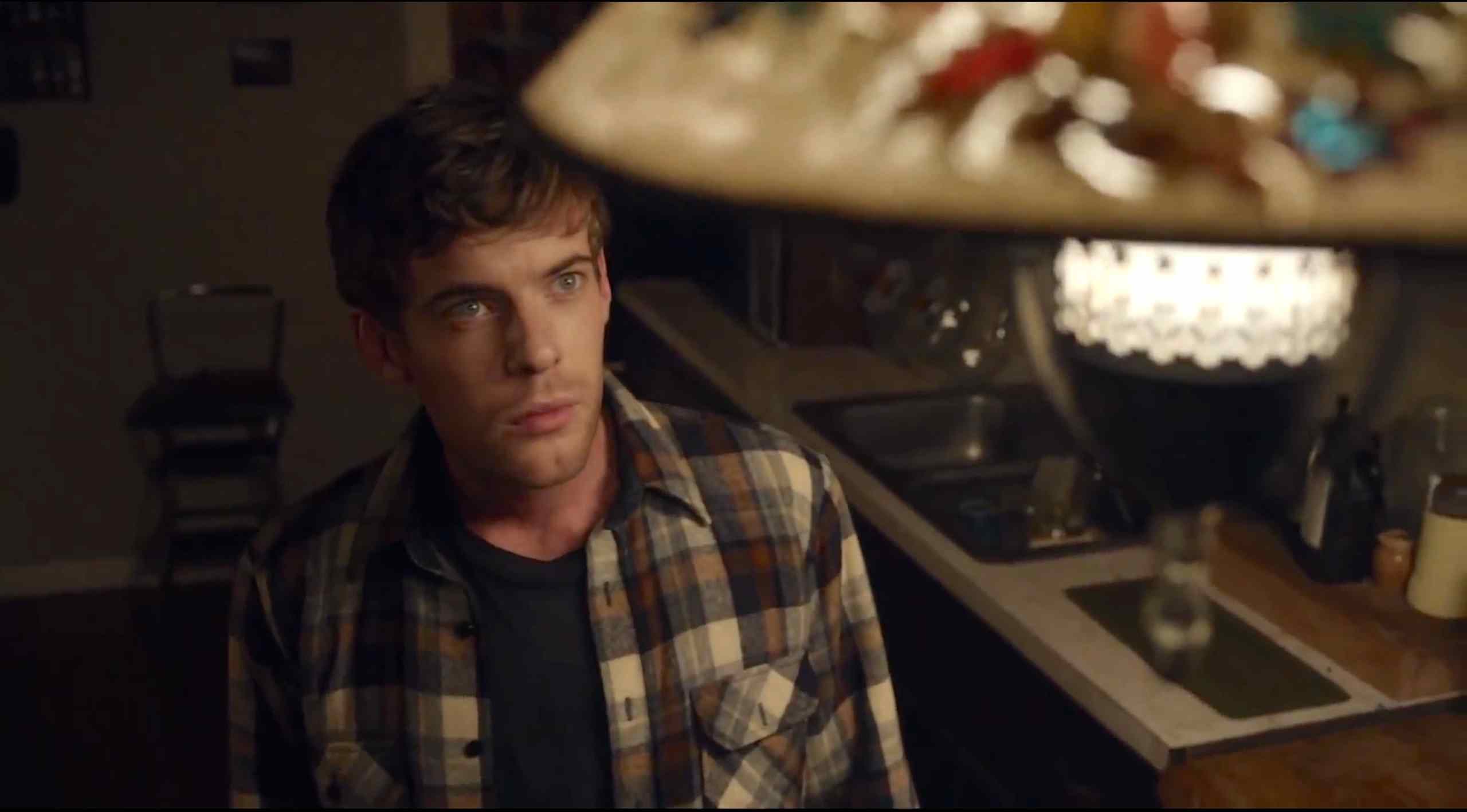
honeymoon-harry-treadaway-as-paul

Directed by Leigh Janiak, “Honeymoon” is a taut horror movie which stars Harry Treadaway and Rose Leslie as a newly married couple who spend their honeymoon in a secluded cabin by the lake where things soon become very chaotic. One night he wakes up to find that his wife is not in bed, and he eventually finds her sleepwalking in the woods. She doesn’t remember how she got there, but then strange things begin to happen as she suddenly forgets how to make coffee, burns the food while cooking it, and ends up swimming in the lake despite it being incredibly cold. The husband begins to wonder if this is the same person he just married, and the movie keeps you wondering the same exact thing all the way to the very end.

For me, “Honeymoon” was fascinating because a lot of horror and thriller movies these days have a hard time maintaining such a strong level of tension and suspense. The way I see it, pulling this feat off could not have been the least bit easy for either the director or the actors. I came out of it desperately wanting to know how they succeeded in keeping things tense throughout, and I got my chance at the press day for “Honeymoon” which was held at the Four Seasons Hotel in Los Angeles, California.

Treadaway has appeared in movies like “City of Ember,” “Fish Tank” and “The Lone Ranger,” and people these days probably know him best as Victor Frankenstein on the Showtime series “Penny Dreadful.” I asked him what it was like maintaining the suspense of “Honeymoon” as an actor, and his response showed how much thought he put into his role.

“I think it came from the great script. It came from the fact that it was set up with this foundation of reality and the horror came through,” Treadaway said. “The trickiest parts were the sort of middle ground almost because you kind of have to look at how you can tell that this is a happy relationship, and you kind of see where it’s got to be when it’s at its most horrific. But it’s won or lost probably in the way we see his first reaction to her going sleepwalking. If you buy that or not and if you buy the way that he’s reacting to her certain motor neuron skills slightly going weird or her forgetting certain elements of making coffee, you don’t just flip out straight away and go ‘you’ve lost your mind’ and you don’t ignore it. So, it’s how you work your way through that, and I think that was in the script and that was the fun part, playing with the elements.”

“Honeymoon” is now available to own and rent on DVD, Blu-ray and Digital. For horror fans, it’s a real treat.

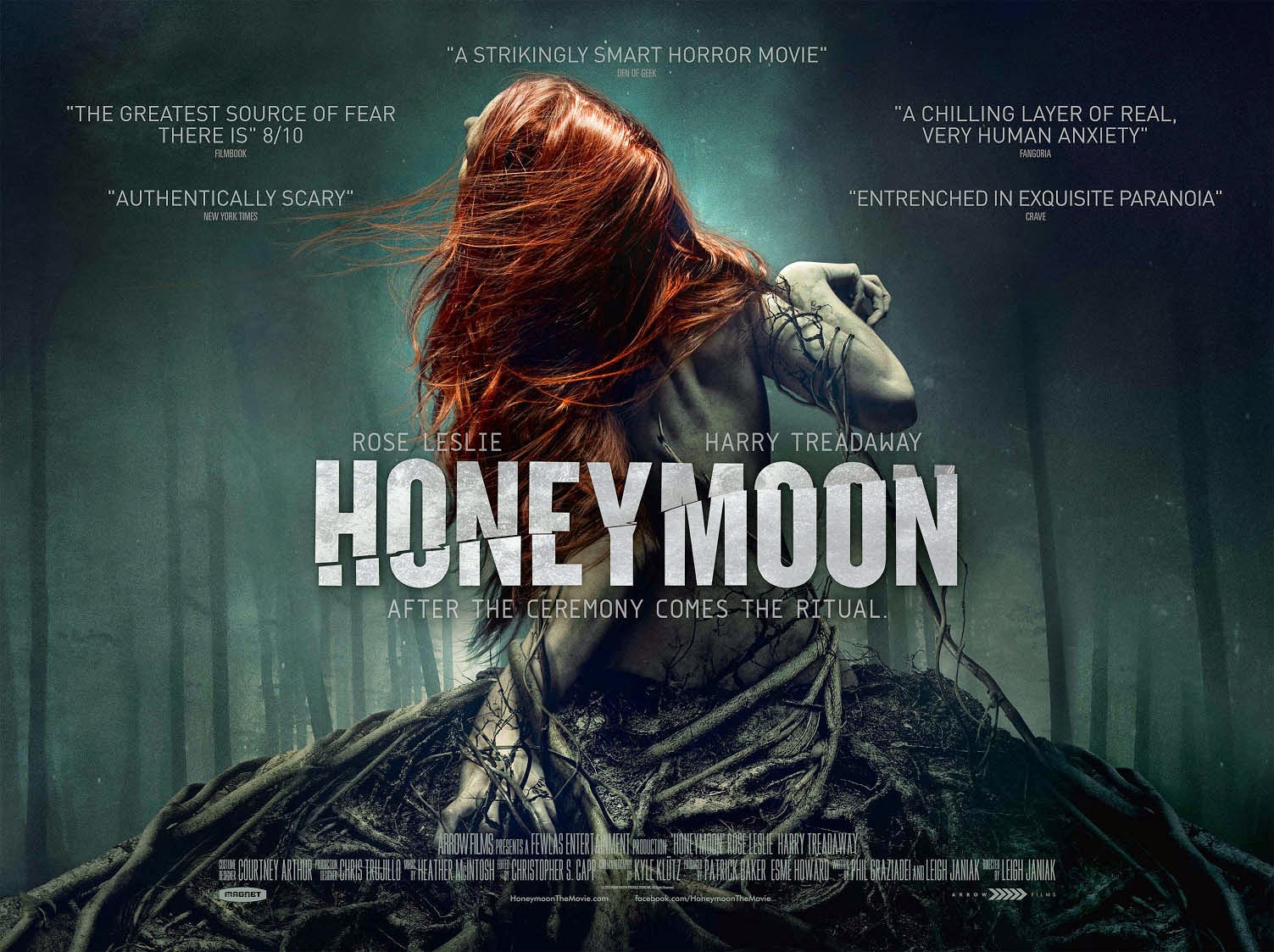
honeymoon-movie-poster

Save

Leigh Janiak on Her Directorial Debut, ‘Honeymoon’

honeymoon-leigh-janiak-photo

With the horror film “Honeymoon,” Leigh Janiak gives us one of the strongest directorial debuts I have seen in a while. It stars Harry Treadaway and Rose Leslie as Paul and Bea, a newlywed couple who spend their honeymoon at a beautiful cabin overlooking the river only to see their new beginning descend into chaos as sinister forces begin to tear them apart. For a first-time filmmaker, Janiak never takes a wrong step as she generates strong levels of suspense and horror and succeeds in maintaining them all the way to the movie’s infinitely creepy conclusion.

Janiak dropped by the Four Seasons Hotel in Los Angeles, California for the “Honeymoon” press day just before the movie was released. She studied creative writing and comparative religion at New York University, and then she later enrolled in a doctoral program at the University of Chicago which dealt with modern Jewish studies with an emphasis on violence and identity in post–World War II Hebrew literature. It was there her interest in movies skyrocketed after she met a group of student filmmakers known as Far Escape Films. As a result, she dropped out of her doctoral studies and moved to Los Angeles to pursue a career making movies.

Many wondered what horror movies inspired “Honeymoon” as well as which ones are her favorites. In regards to inspirations, her answer was a bit of a surprise.

“Well certainly ‘The Invasion of the Body Snatchers’ is the most kind of thematically influential on it,” Janiak said. “‘Rosemary’s Baby’ and ‘The Shining,’ those are kind of my favorite horror films generally. I like grounded horror where you really spend time with the characters and you get to this place of uncomfortableness.”

For myself, I was very interested in finding out how she maintained the suspense throughout “Honeymoon.” I kept waiting for the movie to make a wrong turn which would ruin everything which came before it, but that never happened. For a first time director, she really kept us on the edge of our seats throughout in a way I didn’t expect. I asked her how she managed to accomplish this feat.

“I think that the reason that works is because Harry and Rose’s characters are each transforming in different ways,” Janiak said. “So it was only challenging in so far as knowing that Rose would be on one page for her character internally and Harry is on a completely different one. We have to make them still interacting and keeping these things from one another so we recognize that as an audience we sense the unease. We sense things are going wrong with each of them even though we don’t know what and just making it feel like ‘okay enough. We know something secret is happening.’ It was just about balancing their transformations.”

After the interview ended, I asked Janiak which version of “Invasion of the Body Snatchers” she likes the best. There have been four different cinematic adaptations of Jack Finney’s novel “The Body Snatchers,” the most recent being the 2007 movie “The Invasion,” and she said she enjoyed the first two versions the most but the one with Kevin McCarthy, the 1956 version directed by Don Siegel, is her favorite

Here’s hoping that we get to see many more movies from Leigh Janiak in the near future. “Honeymoon” is now available to own and rent on DVD, Blu-ray and Digital.

honeymoon-movie-poster-2