‘Black Panther’ Gives Us One of the Best Superheroes Yet
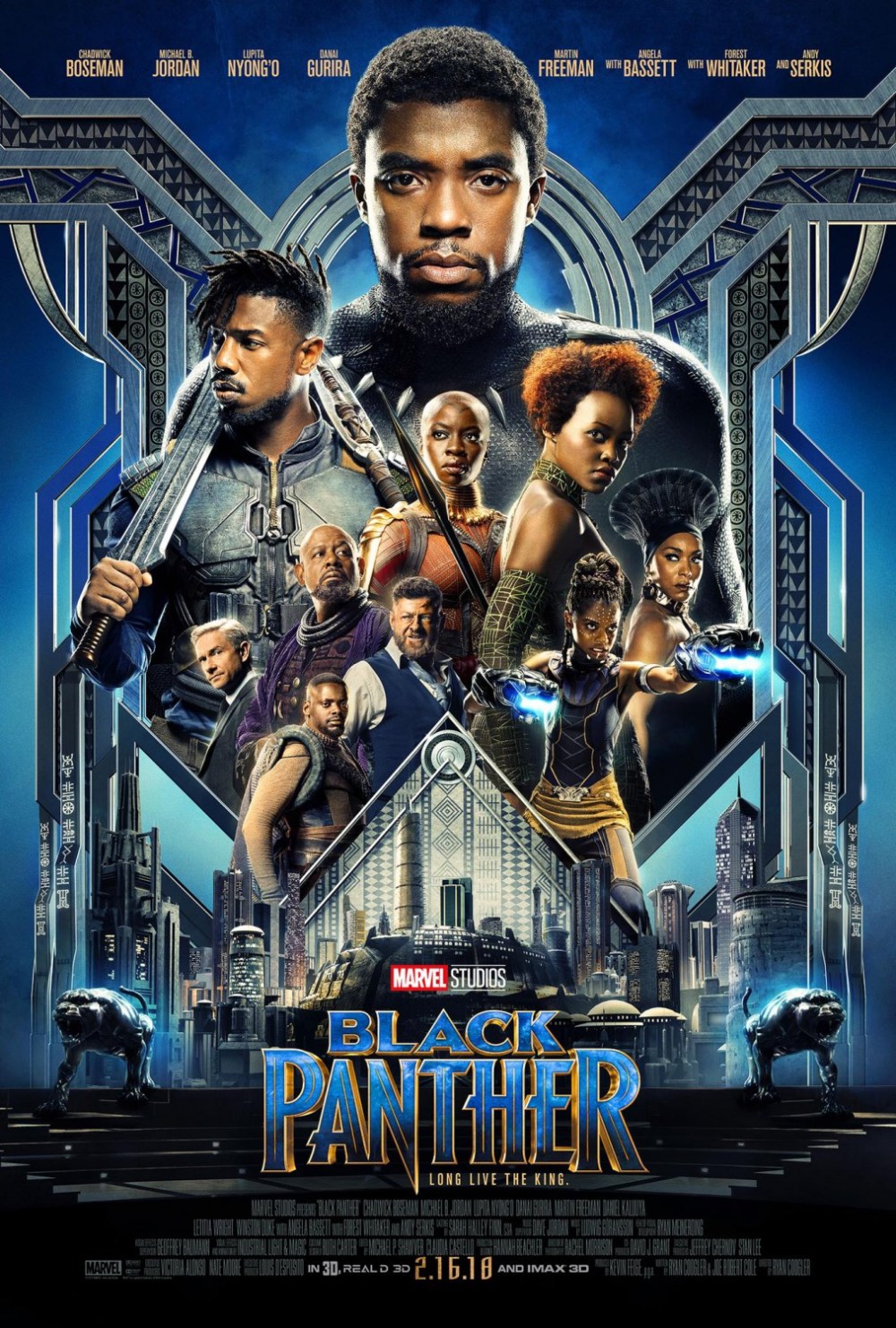
Black Panther poster

Complain all you want about the proliferation of superhero/comic book movies, the last year or so has given us some of the best. In 2017 we got “Logan” which saw Wolverine freed from his PG-13 shackles to where Hugh Jackman and James Mangold gave the “X-Men” character the sendoff he truly deserved. Then came “Wonder Woman” which not only filled our need for a female-led superhero movie, but also succeeded in putting the DC Extended Universe on the right track (of course, then “Justice League” arrived). And with “Thor: Ragnarok,” Marvel Studios allowed themselves to turn this particular franchise upside down and inside out, and what resulted was the most entertaining “Thor” movie yet.

Now it’s 2018 and we have “Black Panther.” You could say it provides audiences with the long overdue African-American-led superhero movie, but having watched it, this description is not entirely appropriate. T’Challa, the Black Panther of this movie, is a hero for everyone. Like Steve Rogers/Captain America, this is a character whose desire to do good in the world comes across with a powerful sincerity which no amount of cynicism can possibly take away. Along with confident direction, terrific performances and slam-bang action, “Black Panther” proves to be one of the best superhero/comic book movies ever made, a true high point in the Marvel Cinematic Universe, and one of the best movies of 2018.

As I write this review, “Black Panther” has been in general release for several weeks and has held the number one spot at the box office for as many times as James Cameron’s “Avatar” did. Clearly you have all seen it at least two or three times by now, so let’s not even bother with a plot description. Let’s just talk about what makes this particular Marvel Studios release so awesome.

Kudos to Ryan Coogler who has now graduated from low and medium-budgeted movies to full on Hollywood blockbusters with tremendous confidence. With “Fruitvale Station” he made us look at the life and tragic death of Oscar Grant in such a powerful way to where he can never be dismissed as a mere statistic. With “Creed” he brought a freshness and energy to the long running “Rocky” franchise which I never could have expected. Now with “Black Panther,” he has given us a movie which supersedes others of its genre to an outstanding degree as he combines the typical spectacle that comes with $200 million budget, and he combines it with a strong story filled with complex characters to where you cannot walk out of this one and say this was just an average motion picture.

Kudos to Chadwick Boseman for inhabiting T’Challa/Black Panther in a way to where there is no doubt he has the world’s best interests at heart, not just Wakanda’s. Through ferocity and feeling, Boseman makes T’Challa into a true hero for everyone and anyone. While this character has doubts about whether or not he is truly ready to be Wakanda’s king, something I have truly come to loathe about origin movies, Boseman never imbues him with the kind of hesitation which would easily destroy another. When the time comes to defend his people, he is most definitely up front and center.

Kudos to Michael B. Jordan for his performance as N’Jadaka / Erik “Killmonger” Stevens. N’Jadaka serves as the chief antagonist in “Black Panther,” but the character is not so much a villain as he is a victim. Jordan makes you see how N’Jadaka was wronged and of why his need for revenge is understandable if not condonable. This character was wronged and abandoned, so his bitterness at what was denied to him ends up feeling justified even when it poisons his soul. We root for N’Jadaka to fail, but we cannot help but feel empathy for him, and Jordan ends up creating a complex villain who can never be mistaken for some one-dimensional schmuck.

Kudos to every single actress in “Black Panther” as they give us badass Wakandans who refuse to run away from impending danger. Whether it’s Angela Bassett as Ramonda or Lupita Nyong’o as Nakia, they fill their characters with a strength and pride which can be wounded, but never easily broken. Special mention goes out to Danai Gurira who steals every scene she has as Okoye, a proud Wakandan who wears her pride on her face for all to see. If you threaten Okoye and she pulls a saber out on you, Gurira makes it clear you best start running in the other direction.

Kudos to Martin Freeman for making his character of CIA officer Everett K. Ross more than just mere comic relief. Even when we see him stumbling about in the midst of warriors who are prepared for conflict, Freeman allows Everett to evolve into a far more capable agent than he was at the movie’s beginning.

Kudos to Andy Serkis for his go for broke performance as gangster Ulysses Klaue. It’s a blast watching the “Planet of the Apes” actor smash through everything in his path. But even though he is not doing a motion capture performance here like he has done unforgettably in the past, he probably won’t snag an Oscar nomination for his work here anyway.

Kudos to Forest Whitaker for not just making Zuri a powerful religious and spiritual figure, but for also letting us see the cracks in the character’s façade when he reveals a burden he can never forgive himself for. Whether you see Zuri as “Black Panther’s” Yoda or Obi-Wan Kenobi, Whitaker lets us know right from the start no one could play Zuri better than he could.

Kudos to Daniel Kaluuya, currently riding high off of the tremendous success of “Get Out,” for making W’Kabi, T’Challa’s best friend, a vivid study of internal conflicts which are constantly pushed in different directions to where common sense can be thoughtlessly tossed aside.

Kudos to Winston Duke for making M’Baku into a ruthless warrior, but also one with a deep conscience. This character could have existed simply as a plot device for “Black Panther” to take advantage of when the going gets tough, but when T’Challa and his closest friends plead with M’Baku to join them in their battle of resistance, Duke makes the character’s eventual decision believable without ever seeming predictable or convoluted.

And kudos to all those filmmakers and artists behind the scenes who made Wakanda look so beautiful in “Black Panther.” Of all the places the Marvel Cinematic Universe has taken us to, this is the one I would like to visit the most. Wakanda forever? Damn straight!

Seriously, I cannot say enough great things about “Black Panther” as Coogler and company have made a film which was so well-thought out and put together. All the characters are complex and interesting, and what could have been just another superhero/comic book movie was elevated into something far more thrilling than I ever could have expected. But more importantly, “Black Panther” gives us a true superhero who everyone, and I mean everyone, can and should look up to. This, among other reasons, should explain why this movie has been such a box office behemoth since its release.

Even better, we won’t have to wait long to see this superhero again as he will appear in “Avengers: Infinity War” whose release is just around the corner.
* * * * out of * * * *

‘Justice League’ Doesn’t Leap Tall Buildings in a Single Bound

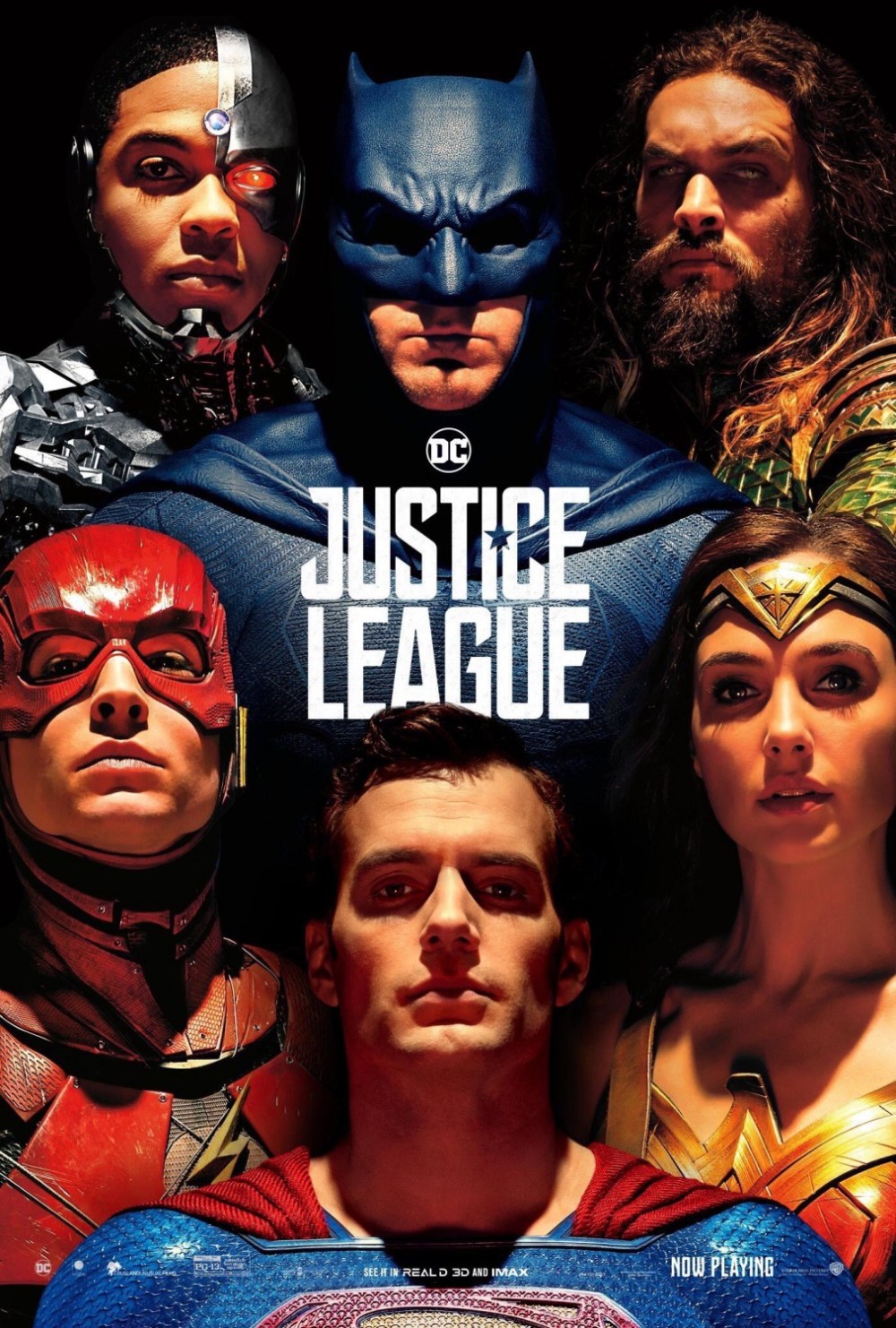
Justice League movie poster

You know how the Daytona 500 is the Super Bowl of NASCAR racing, but it’s also the first big race of the season instead of the last? That’s what “Justice League” is. It’s the penultimate motion picture of the DC Extended Universe, and yet it’s coming to us before Aquaman, Flash and Cyborg get their own solo films. With the Marvel Cinematic Universe, every character was in their own movie before “The Avengers” finally arrived on the silver screen. Granted, Hawkeye and Black Widow have yet to get their own movies, but enough groundwork was laid to where the time had come for “The Avengers” to become a reality. With “Justice League,” its long-awaited appearance feels a little premature.

Following the events of “Batman vs Superman: Dawn of Justice,” the world is still mourning the death of Superman (Henry Cavill), and all the other superheroes are trying to move on despite the large void the Man of Steel has left in his passing. Batman/Bruce Wayne (Ben Affleck) remains as dour as ever, but his faithful butler Alfred (Jeremy Irons) threatens to be even more dour to where they seem to be having a contest in that department. Wonder Woman/Diana Prince (Gal Gadot) leads a quiet life working in a museum, Victor Stone/Cyborg (Ray Fisher) spends the days hiding in his apartment because everyone thinks he is dead and he hates his father for saving him through the use of cybernetics, Arthur Curry/Aquaman (Jason Momoa) is busy drinking his life away when he’s not swimming in the ocean, and Barry Allen/Flash (Ezra Miller) spends his days trying to fit in with kids his age while moving at supersonic speed. These superheroes couldn’t be more mismatched, but they of course find themselves working together to stop a fearsome enemy bent on world domination.

This enemy is Steppenwolf (voiced by Ciaran Hinds), a supervillain determined to find three boxes of power known as the Mother Boxes and, in the process, escape the role of servitude he has been consigned to for far too long. Steppenwolf is, you know, the kind of villain bent on gaining the most power of anyone in the world, and we all know what happens to people like them; they are either defeated as we expect them to be, or they become President of the United States.

The movie gets off to a terrific start with Batman battling a common criminal on the streets of Gotham, but it turns out to be a ploy for the Caped Crusader to discover the identity of another evil foe who thrives on the fear of humans. Following this, “Justice League” becomes a labored adventure as Batman and Wonder Woman take their precious time finding all the other superheroes, some of which are hesitant to join the party even though they realize their planet is at great risk of being annihilated. Knowing those holdouts will eventually become a part of the league, this proves to be the film’s most agonizing point as too much time is spent gathering everyone together.

Ben Affleck still makes for a good Bruce Wayne/Batman, but I sense he is already tiring of the role. Gal Gadot left a powerful mark on movies this year as Wonder Woman, and she is every bit as thrilling a presence here. Of the new additions, Jason Momoa proves to be a solid choice as Aquaman, and watching him here makes me look forward to the character’s solo movie coming out next year. Ezra Miller steals every scene he is in as the Flash, and he brings a wonderful edginess to the role while also bringing the character down to earth in an especially unique way. While Miller’s character is thrilled to have these superpowers, he still yearns to fit in with everybody else, and he portrays this inner conflict very effectively.

The same can’t be said, however, for Ray Stone/Cyborg as the character has little more to do in “Justice League” other than brood, argue with his father, and try to tell everyone in hearing range of how his powers can in no way be mistaken as a gift. This is with all due respect to Ray Fisher who does what he can with an underwritten role, but I grew tiresome of his complaining, especially when we all know he’s going to be in this league eventually.

But honestly, the real heart and soul of “Justice League” belongs to Henry Cavill who returns as Clark Kent/Superman. Even I refused to believe the Man of Steel was all but finished off for good at the end of “Batman v Superman” as you can’t keep a good superhero down, and Superman remains one of the very best. Even better is the realization of how Cavill no longer has the shadow of Christopher Reeve hanging over him as he manages to bring the same dedication to this iconic character Reeve did years before, and seeing Superman fight for justice this time around brought a big smile to my face.

Indeed, “Justice League” gets better and better as it enters the third act in which our superheroes band together to defeat Steppenwolf. While I found myself not caring enough about these characters in the first half, I really rooted for their success as the movie went on because the actors looked excited to inhabit these unforgettable characters. There are times when the filmmakers succeed in arousing our childhood love for these superheroes, and this is when the movie works at its best.

Of course, I have to wonder which filmmaker deserves the most credit for “Justice League.” Zack Snyder is credited as director, but Joss Whedon came in during post-production, and it is tempting to believe Whedon, who struck gold with cinematic comic book gold with “The Avengers,” managed to tap into our childhood innocence in a way Snyder could not. With “Man of Steel” and “Batman v Superman,” Snyder focused more on the characters’ darkness which has enveloped their lives, and you can’t blame him for going in this direction as DC Comics tended to veer into darker territory. But they got so dark to where there wasn’t much in the way to be found, and it was said Snyder was going to go in a slighter lighter direction with “Justice League,” but we probably won’t know how much lighter he made it until we get his director’s cut, and the fans are already clamoring for one like crazy.

I also have to give credit to Danny Elfman for composing an excellent score here. Even he is eager to spark our childhood innocence as his score contains themes he created for Tim Burton’s “Batman” as well as John Williams’ theme for “Superman” which remains one of the best superhero movie scores ever composed. Those subtle little touches make a huge difference as they help to reawaken the past in a most welcome way.

Looking back, “Justice League” is enjoyable for the most part as it builds to a strong climax, but it still feels like this all-star superhero movie was brought to us earlier than it should have. The parts which were lacking keep me from giving this movie a solid recommendation. I still look forward to the solo movies like “Aquaman,” but in the end the filmmakers crammed too many characters into a story already overwhelmed by them, and what results is not completely satisfying in a way a film like this should be.

What I am left with is the wonderment over how the visual effects team managed to remove Cavill’s mustache digitally. Because of his commitment to starring in “Mission Impossible 6,” he couldn’t shave it off when “Justice League” went into reshoots. Then again, it would have been interesting to see this Superman with a mustache as it would have allowed Cavill to do something a little bit different with this iconic character. Of course, he would have to explain the unexpected presence of facial hair. How would he go about doing so?

“Well, something happened on the way to heaven…”

* * ½ out of * * * *

‘Thor’ Arrives with Thunderous Abandon

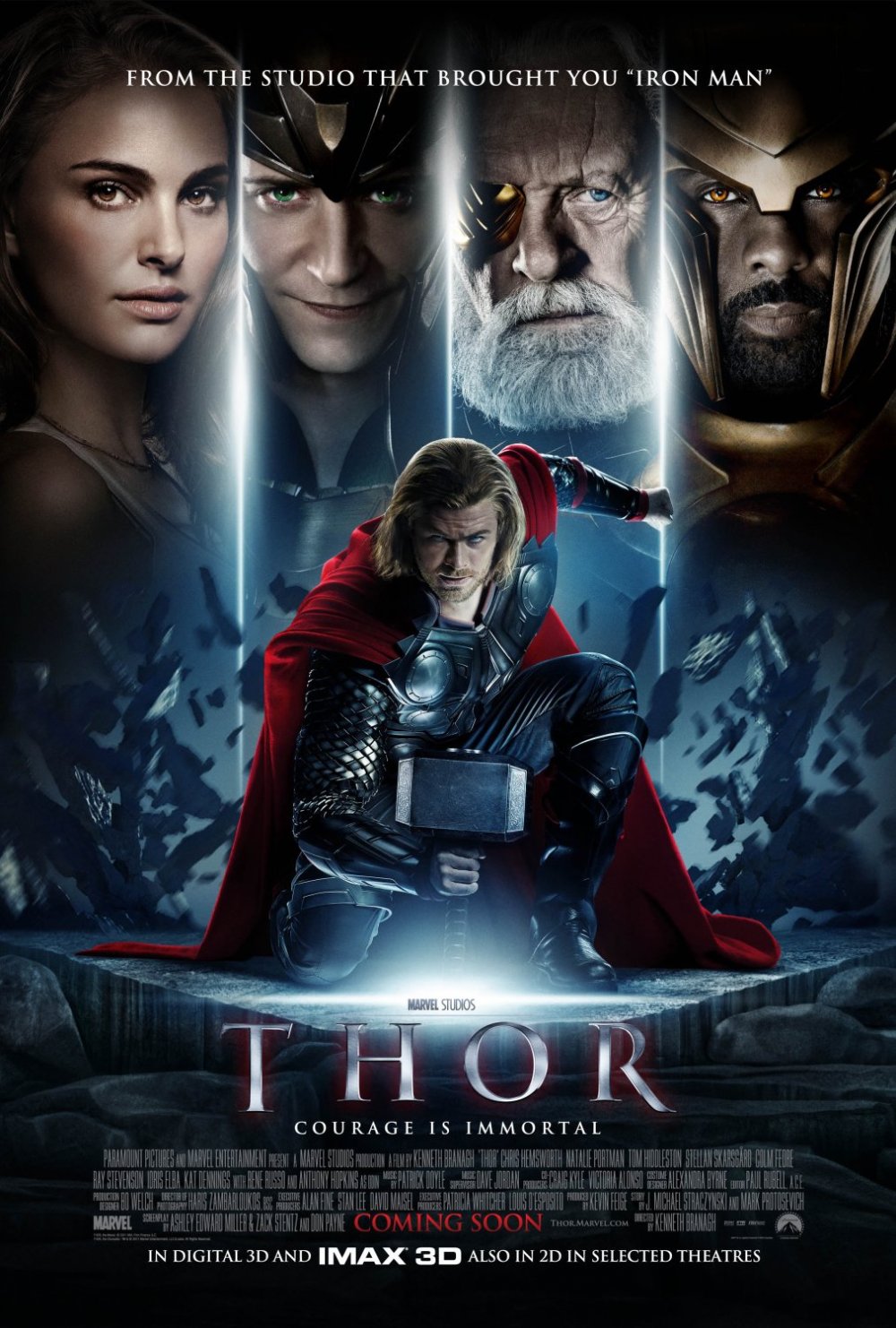
Thor movie poster

Thor” makes its presence known with thunderous abandon. Now like many comic books, this one is yet another I haven’t read, so I can’t say how true it stays to its origins. However, judging from the great Kenneth Branagh’s handling of the material, I imagine it’s very respectful to the character.

Heeding closely to classic Norse mythology, Thor is the god of thunder and heir to the throne of Asgard. But on the day of his ascension, the Frost Giants invade the planet’s deeper regions to retrieve the Casket of Ancient Winters, the source of their power. They are easily defeated, but their violation of the truce put together between them and Asgard seriously pisses Thor off. Against his father’s wishes, he and his fellow warriors journey to the Frost Giants home planet of Jotunheim to keep some frosty ass. Odin, however, intervenes and, infuriated with his son’s arrogance, strips him of his powers and banishes him to Earth. For a warrior like Thor, being banished to Earth does feel like a nasty insult.

First off, I really liked the way Branagh handled this material. In the wrong hands, this could have easily become high camp which would have been enjoyable for all the wrong reasons. But Branagh takes the characters and places they inhabit seriously, and he infuses them all with a strong humanity which comes to define them more than does their place in the universe. Even the villains are remarkably complex as their corruption results not so much from a need for power, but instead for a father’s love and approval. Of course, with Branagh directing, you can count on many Shakespearean references throughout, be it Iago from “Othello” or “King Lear,” and they prove to be a perfect fit for this movie.

I was also impressed with how well Branagh handled the visual elements of “Thor.” The last time he made a movie heavy with special effects was “Mary Shelly’s Frankenstein,” and he seemed a bit out of his league with that one. Perhaps we should not be impressed as this movie has a budget of at least $100 million, not counting advertisement costs, but the key thing here is the effects succeed in being an extension of the characters instead of just dwarfing them completely. Then again, that giant creature the Frost Giants unleash on Thor immediately had Liam Neeson screaming in my head, “RELEASE THE KRAKEN!!!”

As Thor, Chris Hemsworth, who played Captain Kirk’s father in J.J. Abrams’ “Star Trek,” owns the role right from the first moment he walks onscreen. Hemsworth clearly revels in portraying the great power Thor possesses, and he is a gentleman when the situation calls for it. Seeing him as a fish out of water on Earth also makes for some splendid moments which are slyly comic. I’m also glad to see Thor is not just another character who doesn’t want to be “the one,” conflicted about the things he is destined to do. With Hemsworth, you know from the get go he is fully aware he’s “the one” and owns this knowledge to where you feel his impatience in wanting to prove it to the universe. Instead of a whiny Anakin Skywalker, Hemsworth gives us a powerful warrior worth cheering for, and one who eventually learns from his mistakes.

As scientist Jane Foster, Natalie Portman’s casting in the role seems like a no brainer. We know from her off screen life that she is a remarkably intelligent human being, so she doesn’t have to prove to us how believable she can be as a scientist. She sparks instant chemistry with Hemsworth (damn those six pack abs!!!), and that shy smile of hers kills me every single time.

Then there’s the great Sir Anthony Hopkins whose portrayal of Asgard’s king and father to Thor, Odin, is nothing short of gallant. This is especially the case with the opening narration which he recites with such depth to where he makes all other actors who’ve done it before him sound like they were sleepwalking their way through it. While many may think this is one of those roles Hopkins did for an easy paycheck, it’s really one of the best performances he’s given in a while.

Tom Hiddleston plays Loki, Thor’s brother and the movie’s main villain. What I liked about Hiddleston is how he does so much more than give us the usual one-dimensional bad guy. Just like Joaquin Phoenix’s character from “Gladiator,” Loki feels slighted by his father as he prefers another man over him, and he becomes desperately eager to prove himself in any way he can. But of course, he ends up doing it in the worst way possible. Hiddleston makes Loki into a character who is more spiteful than hateful, and this makes his eventual fate seem all the more tragic in retrospect.

There are other strong performances throughout this blockbuster affair to enjoy as well. Rene Russo, where have you been? Idris Elba makes a memorable Heimdall, and it never seems like a small part with him playing it. Kat Dennings steals a few scenes as Darcy Lewis, Jane’s co-worker whose science is more political than astronomical. And Stellan Skarsgård remains a dependable actor as always playing scientist Erik Selvig, a character who ends up playing an important role in “The Avengers.”

Having said all this, “Thor” did feel like it could have been a little more exciting. It doesn’t quite have the same invigorating sweep as some of Branagh’s Shakespeare adaptations like “Hamlet” or “Henry V,” and it takes longer to get to the action than it should. It’s not quite as entertaining as “Iron Man,” but I would definitely rank it above “The Incredible Hulk.”

Regardless, there is still much to like about “Thor,” and Branagh has done the best job anyone could have in bringing this particular comic book hero to the big screen in such a respectful fashion. It also benefits from excellent casting, especially Hemsworth who looks like he came out of the womb looking like a warrior with a mighty hammer in his hand. This is one of the few times where “getting hammered” will sound more like a threat than an embarrassing state of drunkenness.

* * * out of * * * *

‘Captain America: The First Avenger’ Introduces Us to a Real American Hero

Captain America The First Avenger poster

Captain America: The First Avenger” succeeds where “The Green Lantern” utterly failed. It gives us a superhero, one from the Marvel Comics universe, who is distinct from those of his ilk, and he is one we quickly come to care about and root for. Steve Rogers isn’t just some cocky kid from Brooklyn with an overinflated ego. He’s a sickly young man who desperately wants to fight for his country, but who has been rejected by the military countless times. But what he lacks in health and strength he makes up for in spirit. Steve wants to fight for his country not because Uncle Sam wants him to, but because, and he said it himself, he never backs down from a fight.

I liked how this movie didn’t shy from its American roots the way “G.I. Joe: The Rise of Cobra” did. While that movie tried to make you forget the slogan “a real American hero,” “Captain America: The First Avenger” doesn’t do the same. At the same time, it doesn’t beat you over the head with blind American patriotism. It has its share of American pride, but it’s really about the spirit of this unlikely soldier which keeps him sane after he is transformed into a super soldier. The outside may be different, but the inside of this man remains the same to where he sounds like a relation to Robocop.

Playing Steve Rogers/Captain America is Chris Evans who you may remember him from those dopey “Fantastic Four” movies. As for myself, I remember him best for doing a skateboard grind down an icy railing which led to his ultimate demise in “Scott Pilgrim vs. The World.” Evans is perfectly cast and does great work in keeping his character from becoming just another clichéd war hero. His heart shines throughout the entire movie, and he never allows Rogers to become laughable or indulge in behavior which would seem cringe inducing.

Once Steve is turned into Captain America, you root for him to go into battle and defeat the Nazis. But seeing him become a pawn for the United States Government in hawking War Bonds is depressing even when his irrepressible spirit and love for country shines through. We understand his desire to prove himself, and our spirits rise along with his.

Of course, with every superhero movie we get a vicious villain. In this case, this would be Johann Schmidt, Adolf Hitler’s right hand man who is later revealed to be Red Skull. This particular Skull has his own plans for world domination through his organization of HYDRA, and he gets his followers to raise both hands instead of just the one for Hitler. With a stolen tesseract, HYDRA can eliminate their foes faster than those phasers that vaporized all the red shirts on “Star Trek.”

Hugo Weaving portrays Johann Schmidt/Red Skull, and he gives “Captain America” the formidable villain it needs. Still, after being in all “The Matrix” and the “Lord of the Rings” movies, I kept waiting for him to say, “Welcome to Rivendell Mr. Anderson!”

“Captain America: The First Avenger” also has the other requisite characters like the Army drill sergeant and the beautiful woman who dares the most macho men to treat her as just a woman instead of the tough as nails soldier she is. It’s not hard to guess who gets their ass kicked here when other men foolishly hit on her. Still, director Joe Johnston succeeds in getting the best actors available to inhabit these roles and give them life beyond the mere superhero movie stereotypes they could have been.

Tommy Lee Jones is highly entertaining as Col. Chester Phillips, a gruff, no nonsense military leader who expects nothing but the best from his soldiers. Jones, however, gives Phillips a wry sense of humor much like the one Sam Gerard had in “The Fugitive.” Watching him being subtly dismissive of others and later coming around to see Steve Rogers is the man is a hoot, and he never ends up screaming all over the place like R. Lee Emery did in “Full Metal Jacket.”

Then there’s Hayley Atwell who plays Peggy Carter, the female officer who eventually becomes Steve Rogers’ love interest. I really liked how Peggy was drawn out to where she doesn’t just exist for the sake of the movie’s superhero. Atwell sells us completely on her tough demeanor to where it cannot and should not be mistaken as an act, and she travels across the screen with an assured confidence which no one should ever doubt. If they do doubt her, it will say much more about her.

Johnston got the job of directing “Captain America: The First Avenger” based on the period movies he made such as “The Rocketeer” and “October Sky.” There’s a lot of attention paid to detail here (the story takes place 1942 to be exact), but it isn’t held prisoner by it. Heck, many of the tools HYDRA ends up using seem far removed from the 40’s, and they look like they came out of a sci-fi movie made in the 1970’s or 80’s. While Johnston hasn’t made a great movie here, he still has given us an undeniably entertaining one, and it didn’t even need another terrific film score by Alan Silvestri to prove this.

When it comes to the 2011 summer movie season, “Captain America: The First Avenger” isn’t better than “Thor” which for me had far more interesting characters, but it easily outdoes “The Green Lantern” which is one of that year’s biggest disappointments. Thanks to Evans’ performance, Captain America finally gets the cinematic respect this character has long since been denied.

* * * out of * * * *

‘X-Men: First Class’ Represents What a Prequel Should Be Like

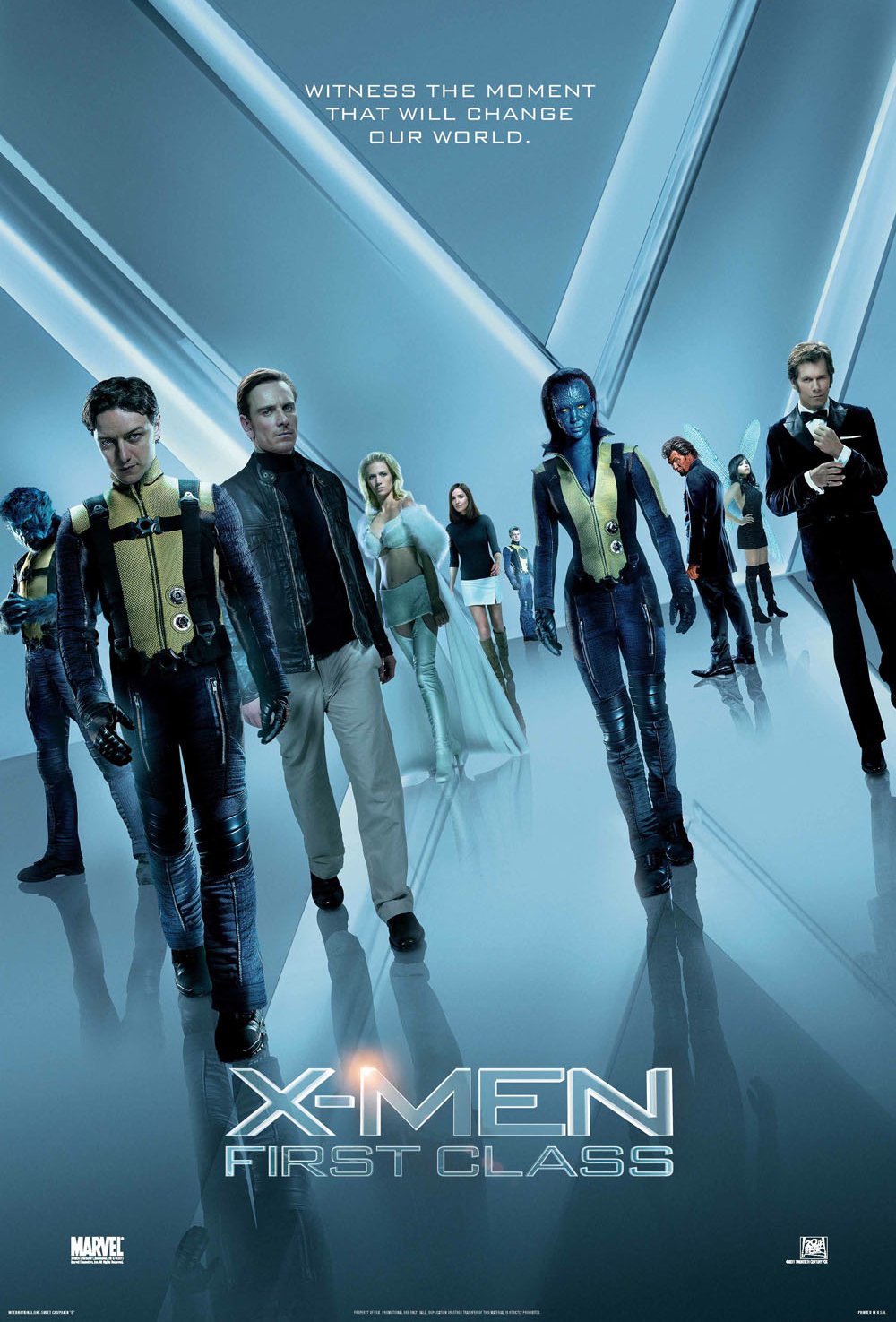
X Men First Class poster

X-Men: First Class” is a huge improvement over the previous entry, “X-Men Origins: Wolverine,” and it’s also the best film in the series since “X-Men 2.” It’s breezy fun, the special effects are terrific, and the emphasis on character this time around makes for a more involving prequel. With Wolverine shoved to the side, this fifth movie and the second prequel in the long running franchise, many other characters get their chance to shine.

The primary focus of “First Class” is on Charles Xavier/Professor X (James McAvoy) and Erik Lehnsherr / Magneto (Michael Fassbender) as we see the significant events which shaped and brought them together. But while Charles’ upbringing was a privileged one, Erik’s was unbearably tragic as he and his parents were imprisoned in a World War II concentration camp. Erik’s ability to control magnetism becomes evident early on, and this talent soon gets exploited by scientist Sebastian Shaw (Kevin Bacon) who commits an atrocious act in front of him. From there on, the driving force in Erik’s life is one of bloody revenge.

Prequels are tricky because we are naturally inclined to be against other actors taking over roles previously portrayed by Sir Patrick Stewart and Sir Ian McKellen. Then there’s that cynical feeling of studios taking this route just to save money. It was deemed after “X-Men: The Last Stand” that a fourth movie with the same cast would have been far too expensive to make. Of course, with a reported budget of $160 million, “X-Men: First Class” doesn’t sound like much of a bargain. Moreover, does anyone remember “Dumb and Dumberer: When Harry Met Lloyd?” Did you think audiences were going to be fooled by a Jim Carrey-less prequel? Anyone remember “The Flintstones in Viva Rock Vegas?” Heck, does anyone remember the first “Flintstones” movie? I remember seeing it, but the plot details escaped me once I walked out of the theater.

But what’s great about “X-Men: First Class” is the cast doesn’t need to worry about living up to the actors who inhabited the same roles before them. They get to approach these classic characters in a different light, and this frees them up from any restrictions which could have been imposed on them. Characters like Mystique and Dr. Hank McCoy are given more depth and complexity than ever before, and many surprises are in store for the audience as the script invests a lot of emotion in these characters including those bad mutants we rooted against in the past.

James McAvoy is excellent as the young Charles Xavier, and he looks like he had lots of fun making this prequel. Whereas Patrick Stewart’s Professor X was wise and mature, McAvoy’s is just getting started in his career and comes across as quite the ladies’ man. I also admired that while Charles is incredibly intelligent, we find his ego getting the best of him. So sure of all the things he is knowledgeable of, McAvoy does great work in making Xavier well-intentioned but not as open to mutants being themselves in the real world.

Erik Lehnsherr/Magneto remains one of the most fascinating characters in the “X-Men” universe. While he’s been the series’ chief villain and a megalomaniac, Magneto is simultaneously an anti-hero and has even been seen as a hero in the comic books. It’s hard not to feel sympathy for him considering the horrors he was exposed to in his youth, and it makes his future actions understandable, if not excusable. No wonder actors have so much fun in this role; you never know for sure the direction Magneto will end up taking. All you can say is, whatever he ends up doing, it will be to his benefit more than anyone else’s.

With movies like “Fish Tank” and “Inglourious Basterds” under his belt, Michael Fassbender is the perfect choice to play the young Erik Lehnsherr before and after he becomes Magneto. Fassbender has given performances deep with complexity and feeling; looking like the good guy at one point and then later turning into one seriously twisted individual. As Erik, he is great at showing the different layers to this character who is forever caught in a horrific moment he can’t get out of.

But one character who really gets expanded in “X-Men: First Class” is Raven whose shape-shifting abilities earn her the nickname of Mystique. Rebecca Romijn played Raven in the first three movies as a villain, and her character never got much in the way of psychological depth. Jennifer Lawrence, however, gets more to work with as we come to meet Raven at the time her allegiance to her “brother” Xavier begins to wane.

In Lawrence’s hands, she makes Raven/Mystique a strong female role model, one who is determined to be open about who she is and not be ashamed of it. While hiding herself in human form, as she is encouraged to do so by Charles Xavier, Raven’s frustration at appearing in public as someone other than herself is beginning to take its toll. Lawrence is riding high on some incredibly strong performances, and she continues to show how far her acting chops can stretch.

With Bryan Singer returning to this franchise as a producer, I’m sure he had a good hand in getting this particular entry focused more on character development. Each character is shown to be suffering through conflicted emotions as to what path the mutant race should follow, making them no different from the humans who deal with many of the same issues. Mutants are seen as the next stage in human evolution, but the haunting question of whether this will be to humanity’s best interests or detriment always hangs in the air.

But the person who deserves the most credit for “First Class” is its director, Matthew Vaughn. Coming off of the gleefully rebellious “Kick Ass,” one of 2010’s best movies, he manages to bring a lot of inventive energy to a franchise in desperate need of it. Vaughn also makes the special effects benefit the actors instead of just overwhelming them. What made the first few “X-Men” movies so special was the amount of emotion they generated, and the same thing is definitely the case here. It’s our connection with these characters which makes the action set pieces all the more exciting.

If there are any problems with “X-Men: First Class,” they come in the last half as the filmmakers become overly concerned about bringing the characters in line to where they are at in the first “X-Men” film. This was also a big problem with “X-Men Origins: Wolverine” even though that prequel was much more convoluted. It would have been nicer to see the friendship between Charles and Erik get expanded instead of just ending this one with them taking opposite sides. Then again, perhaps it still could be expanded on in future installments.

Kevin Bacon, always a terrific actor, is perfectly detestable as the movie’s most irredeemable villain. At the same time, I wished the writers had expanded on his character more. Compared to the others, Sebastian Shaw threatens to be a little too one-dimensional in his actions. If Sebastian had more complexity to him, it would have made the transition of power between him and Erik all the more believable and compelling.

Other strong performances come from Rose Byrne as Dr. Moira MacTaggert and Nicholas Hout as the highly intelligent yet shy Dr. Hank McCoy. On the other hand, while January Jones is amazingly beautiful as Emma Frost/White Queen, her one-note delivery of dialogue is one of this film’s major detriments.

“X-Men: First Class” is a prequel done in the same spirit of J.J. Abrams’ “Star Trek,” and it’s proof you don’t need Wolverine present to make a good “X-Men” movie. This is a reboot which works to everyone’s advantage, and I am eager to see what comes next.

By the way, don’t bother staying through the end credits. There’s no post-credits sequence, so take care of that urine ache ASAP.

* * * ½ out of * * * *

‘The Amazing Spider-Man 2’ Has Way Too Much Going On

The Amazing Spiderman 2 poster

I figured after “Spider-Man 3,” movie studios and filmmakers would think twice before putting three villains in a film, but lo and behold they have done it again with “The Amazing Spider-Man 2,” a sequel to the surprisingly successful reboot which wasn’t necessarily needed so soon. Director Marc Webb is forced to deal with a story that doesn’t have much of a focus and contains too many characters for it to deal with. What results is a incredibly underwhelming superhero movie which plays more like a two-hour plus trailer for other movies, and while this is the fifth “Spider-Man” film in just over a decade, my disappointment with this one has little to do with franchise fatigue.

Not much time has passed since the events of “The Amazing Spider-Man,” and we find ourselves catching up with Peter Parker/Spider-Man (Andrew Garfield) and Gwen Stacy (Emma Stone) as they are graduating from high school. Of course, Peter is delayed a bit as his alter ego of Spider-Man has to fight crime when Russian mobster Aleksei Sytsevich, who will later be revealed as Rhino, tries to drive out of New York City with a case full of plutonium vials. Paul Giamatti plays Aleksei and he clearly is having a blast playing such an over the top character, but he’s barely in the movie. We see him at the very beginning and at the end, but nowhere in between.

This brings me to one of my major gripes with superhero movies today. Studios are so insanely desperate in starting the next big franchise to where they already have at least two sequels planned before their big tent pole movie is even released, and it has gotten to where everyone has forgotten how to make a self-contained movie. Rhino is basically here to act as a bridge to the future spinoff “The Sinister Six,” and it ends up taking away from a movie which already has way too much on its plate.

Then we get to meet Max Dillon, an electrical engineer who is invisible to everybody and has no real friends. But after a freak accident lands him in a tank full of genetically modified electric eels, he quickly mutates into an electric generator of a monster who calls himself Electro. Jamie Foxx plays this character who is considered one of the greatest villains in comic book history, and his performance in a way reminded me of Jim Carrey’s in “Batman Forever” where he played Edward Nygma/The Riddler. Both characters come to idolize the heroes which dominate their lonely lives, but when they feel betrayed by those same heroes, the affection they have toward them is revealed to be a deep-seated resentment that soon evolves into sheer anger.

Foxx is a terrific actor and this role could have given him a number of great avenues to explore, but once again this movie has too much to deal with which results in Max Dillon/Electro not getting enough screen time. In fact, Electro ends up disappearing for a good portion of the movie to where you wonder if he’s disappeared for good. When he does come back onscreen, he’s reduced to spewing out a lot of lame one-liners I kept thing were rejected from “Batman & Robin.” Electro could have been one of the most memorable villains to appear in movies this year, but instead he turns out to be one of the lamest.

Next, we come to villain number three which is Harry Osborn/Green Goblin who has just inherited his late father’s business, Oscorp Industries. Played by James Franco in Sam Raimi’s “Spider-Man” movies, he is portrayed here by Dane DeHaan who has made quite the name for himself after his acting triumphs in “Chronicle” and “Kill Your Darlings.” DeHaan does excellent work as Harry in portraying his manipulative control over his newly acquired board of directors, and he makes us feel his desperation to escape the same fate which befell his father. But when DeHaan becomes the Green Goblin, he goes from giving one of the best performances in “The Amazing Spider-Man 2” to one of the worst as his acting is reduced to hissing a lot at people. Don’t even get me started on his makeup because it made me miss that cheap looking mask Willem Dafoe was forced to wear in the first “Spider-Man” movie.

So, is there anything which works in “The Amazing Spider-Man 2?” Well yes, the scenes between Andrew Garfield and Emma Stone which continue to be the best parts of this rebooted franchise. Whenever they are together onscreen, the movie comes to life in a way that doesn’t require a single special effect. Like Tobey Maguire before him, Garfield understands what makes Spider-Man such a relatable superhero as, aside from his amazing superpowers, he is a really down to earth guy who has problems like everybody else. As for Stone, she makes Gwen Stacy a wonderfully intelligent human being and the appealing girlfriend many of us hope to have.

Seeing them together also reminded me how Webb directed one of the best romantic movies of recent years, “(500) Days of Summer.” While his handling of this superhero franchise has become shoddy, he really does know how to direct actors to where their intimacy feels ever so genuine. I hope he goes back to directing character dramas very soon.

Actually, when it comes to the failure of “The Amazing Spider-Man 2,” I find myself blaming Sony and Columbia Pictures more than I blame Webb. In trying to make a hugely entertaining movie, everyone involved got so caught up in setting the stage for future sequels and spinoffs to where this feels like a coming attraction for something far more entertaining. Yes, there are some fantastic special effects on display here which look great in either 2D or 3D, but even they can’t lift this movie out of the muck. There’s never a shortage of fights, explosions and chases, and maybe that’s the problem. While Webb is looking to unlock his inner Michael Bay here, this sequel ends up getting robbed of much of its soul.

I really hate it when history repeats itself, be it in the real world or at the movies. Maybe you can get away with two villains in a movie, but you should not have three. “Spider-Man 3” and “Iron Man 2” should have taught us all this, but some people just don’t listen. Seriously, haven’t we learned anything? Are we destined to keep repeating the same mistakes over and over again?

* * out of * * * *

‘The Amazing Spider-Man’ is a Better than Expected Reboot

The Amazing Spiderman poster

When “The Amazing Spider-Man” was finally released in movie theaters everywhere, we finally got to answer the question nagging at us: isn’t it far too soon for a franchise reboot or remake or whatever the hell you want to call this? Well, the answer ends up going both ways here as Marc Webb’s film does tread familiar ground, but it gets better as it goes on. This time, our friendly neighborhood Spider-Man has a lot more edge to him and is a little more complex than he was in the Sam Raimi-directed movies.

This version starts off with a very young Peter Parker being left in the company of his Uncle Ben (Martin Sheen) and Aunt May (Sally Field) by his parents, Richard and Mary Parker (Campbell Scott and Embeth Davidtz), who are forced to leave town under mysterious circumstances. Forward several years later, and Peter is now a sullen teenager played by Andrew Garfield, one of several actors who should have gotten an Oscar nomination for “The Social Network.”

Like before, Peter is a social outcast who is not exactly the most popular person on the high school campus. But unlike Tobey Maguire’s interpretation, Peter here is sullener this time around; sensitive and shy while dealing with anger at the life he has been dealt which is anything but normal. In essence, he is more of a real-life teenager than he was in previous incarnations; confused about his place in life and unsure of himself. “The Amazing Spider-Man” hence becomes the story of a young man on a journey to find himself, and this helps ground the superhero in a reality we all know and understand.

The first part of “The Amazing Spider-Man” made me a bit impatient as it travels through all the things leading up to Peter adopting his alter-ego. Sam Raimi’s first “Spider-Man” movie may have come out ten years ago, but its images are still fresh in our minds. I’m not just talking about Kirsten Dunst kissing Maguire while he hangs upside down. Still, Webb and company do their best to make the material their own. The moments where Garfield develops his power to swing from place to place is exhilarating to watch, and whereas Raimi’s “Spider-Man” movies were like a comic book brought to life, Webb deals with Peter Parker in a more realistic fashion.

Speaking of Garfield, he has repeatedly said how happy he was to get this role, and the thrill he gets from playing this iconic comic book character is clearly on display. Throughout “The Amazing Spider-Man,” the actor looks to be having the time of his life, and he certainly has earned the right to enjoy himself based on his excellent performance here as he makes this role his own. I also really liked was how he wasn’t afraid to make Parker unlikable at times. Clearly this is a young man with issues, having lost his parents in a way no child should, and the actor makes Parker’s confusion over what is expected of him all the more palpable.

Matching Garfield scene for scene is the wonderful Emma Stone who plays his highly intelligent love interest, Gwen Stacy. Stone shares a strong chemistry with Garfield, and she gives the role a feisty kick which makes her so much fun to watch. She also infuses her Gwen with a strong humanity which keeps her from being just another love interest, and her performance goes way beyond what we could have expected.

Rhys Ifans portrays Dr. Curt Connors, once a friend of Parker’s father, who is developing ways to regrow limbs and human tissue. But something ends up going terribly wrong, as it always does, with an experiment, and he is soon turned into The Lizard. The dilemmas this character faces are not too different from what Norman Osborn/Green Goblin character dealt with, but Ifans makes the character a fascinatingly complex one as his intent to test his experimental serum on himself is not about proving oneself to a whole bunch of doubters as it is about taking responsibility for one’s creation when others are more interested in results and profit.

While I miss seeing the late Cliff Robertson and Rosemary Harris as Uncle Ben and Aunt May, both Martin Sheen and Sally Field fill the roles wonderfully. I also really liked Denis Leary as Gwen Stacy’s father, NYPD Captain George Stacy, who gets into an argument with Peter as to why he considers Spider-Man a vigilante. After watching him on “Rescue Me” and as an endlessly cynical standup comedian all these years, Leary once again reminds us of just how effective an actor he can be in playing an upstanding citizen and a strong family man.

Previously, Webb was best known for directing music videos, and the only other movie he made was “(500) Days of Summer.” You can’t help but wonder what the studio executives were thinking when they hired him after he made a $7.5 million indie movie to helm a summer blockbuster with a reported budget of over $220 million. Maybe all the other big name directors were busy or something. Then again, when you look at both “(500) Days of Summer” and “The Amazing Spider-Man,” they have strong similarities. Both feature main characters in the process of figuring themselves out while moving on to the next stage of their lives, and they also have them romancing a female who is as intelligent as she is attractive. Each movie succeeds in giving us relationships which were not the usual dopey romantic kind, and they are all the better as a result.

With “(500) Days of Summer,” Webb also showed a keen understanding of how important it is for the audience to be emotionally involved with the characters in a movie. This ended up making him an ideal choice to direct “The Amazing Spider-Man” as we need to care about these characters in order for the movie’s story and its special effects to work effectively. Webb succeeds in getting us emotionally involved in what goes on, and it makes this reboot stand out from the typical summer blockbuster which invades our local movie theaters more often than not.

Another thing I have to point out is the film score by James Horner. Danny Elfman had done such a brilliant job defining the sound of Spider-Man in Raimi’s movies, and this gave Horner a hard act to follow. But Horner succeeds in giving us music which is as adventurous and invigorating to listen to as Elfman’s was. Of course, this doesn’t keep him from stealing from himself as there is a musical cue from “Star Trek II” in here, and it is instantly recognizable to those who have listened to that soundtrack over and over again.

It would have been nice if Raimi and Maguire got to make a “Spider-Man 4,” if for no other reason than to make up for the huge disappointment that was “Spider-Man 3.” But in retrospect they must have seen the writing was on the wall as there was nowhere else for them to take the character. While a reboot still feels way too soon for this franchise, “The Amazing Spider-Man” is a very entertaining movie which looks to get this series back on track. Now that we got the origin story out of the way once again, we can get to an even more exciting chapter in Peter Parker and Gwen Stacy’s lives.

* * * out of * * * *

‘Spider-Man 3’ is a Major Disappointment

Spiderman 3 poster

After the brilliance of “Spider-Man 2” one of the best comic book movies ever made, “Spider-Man 3” proves to be an astonishing disappointment. Even though this sequel has the same actors and directors as its predecessors, they are faced with a screenplay with too many characters, too many subplots which don’t reach a satisfying conclusion, villains who are not very satisfying, and some character choices which feel out of place in a movie like this.

I already had a problem with “Spider-Man 3” before I went in as there were too many villains for one motion picture. It would have been better for it to have just one villain for Spider-Man to face because it allows the filmmakers to give more attention to the characters to where they can become unforgettable. You can get away with two villains sometimes, but you are better off with one as this movie shows.

This ended up being the last “Spider-Man” movie Sam Raimi directed, and my original thought was he knew this would be the case, so he ended up putting in everything but the kitchen sink. In retrospect, I think the studio forced him to add characters who were big comic book fan favorites, and Raimi obliged even though there was little chance of those characters getting enough screen time. In the process of pleasing the fans, “Spider-Man 3” succeeded in alienating them by throwing things at us the filmmakers assumed we would like.

Spider-Man’s first nemesis is the New Goblin, same as the Old Goblin. We all know the New Goblin is actually Harry Osborn, played once again by James Franco, and he ends up giving his best performance in all of the “Spider-Man” movies here. Franco revels in going all over the place as he seethes at Peter Parker whom he is still convinced killed his father. In the process of trying to kill Peter, Harry gets amnesia and forgets about what Peter supposedly did. But this doesn’t keep Harry from messing with Peter’s life or stealing away those closest to him.

Then comes Spidey’s next darn nemesis, Sandman/Flint Marko played by Thomas Haden Church who was on a roll after his Oscar nominated performance in “Sideways.” This is an interesting villain as you can clearly see what drives him: his love for his sick little girl. While Church does what he can with an underwritten part which has him disappearing from the screen for far too long, he is nowhere as compelling as Alfred Molina was as Doc Ock was in “Spider-Man 2.” Flint never gets the chance to revel in his new-found powers, and he doesn’t feel as threatening as a result.

After that, we get yet another antagonist in the form of Eddie Brock who later turns into one of the most famous comic book villains ever, Venom. Now while I can see how Venom is such an immensely popular character in the “Spider-Man” universe, his appearance in “Spider-Man 3” feels like an afterthought. Furthermore, he is portrayed by Topher Grace who, while having given terrific performances in movies like “Traffic,” is completely miscast. Eddie Brock/Venom feels too broad as he is portrayed here, and we don’t get to invest emotionally in this character as much as we would like to.

Tobey Maguire has long since proven to be one of the best Spider-Man’s we have ever seen on the big screen, and the best acting he does here is with his eyes and face. He can get you right in the heart with just one look, and he never gives you a false emotion in any scene. This is especially the case in a pivotal moment between him and Mary Jane Watson which is truly heartbreaking to watch.

“Spider-Man 3” also sees the famous web-slinger exploring his dark side when an alien symbiote lands down on earth in his vicinity and infects him and changes his behavior. But things soon degenerate as Maguire is forced to play Peter as if he is some sort of emo dude to where he is suddenly struck with the urge to dance in public for no particularly special reason. Some of these scenes are amusing to watch, but they belong in a different film.

It also sucks to see the female characters underused here. Kirsten Dunst is back as Mary Jane Watson, and it’s great to see her again as she has been fantastic in this series. But in “Spider-Man 3” she doesn’t have much to do here other than end up in a perilous state and hanging on for dear life. You’d think at this point Mary Jane would realize she’s better off without Peter as her life remains in constant danger while they are together. How many times do you think you could take fighting for your life when your boyfriend is Spider-Man? Well, if you’re Jack Bauer, I guess you could do it quite a bit. This is regardless of the fact Mary Jane Watson is not Jack Bauer’s girlfriend, but anyway…

Bryce Dallas Howard co-stars as Gwen Stacy, a huge fan favorite of the Spider-Man series, but she gets even less to do than Dunst. I think Gwen ended up here because Marvel and Columbia Pictures insisted on her inclusion as they figured the fans were ever so eager to see this character in any “Spider-Man” movie at that point. Howard is a fantastic actress and makes for a very good Gwen Stacy, but this character has little purpose for being in “Spider-Man 3” other than to please the most die-hard fans.

There are other welcome returns in “Spider-Man 3” like Rosemary Harris who plays Aunt May, the Yoda of Peter Parker’s life who gives him the wisdom he needs to hear. J.K. Simmons remains the consummate scene stealer as J. Jonah Jameson, and he had me in hysterics from his first scene where his secretary reminds him to watch out for his high blood pressure. And yes, Bruce Campbell does his usual “Spider-Man” cameo, this time as a waiter desperate to help Peter and Mary Jane have the most wonderful of times at a restaurant. It’s always good to see Campbell in a movie no matter what kind of role he plays.

The climax has the Sandman teaming up with Venom to take down Spider-Man, and while it is an emotionally charged climax, we still come out of this movie very disappointed as it feels like there are so many missed opportunities. Once again, each of these villains are very underdeveloped to where the stakes don’t feel high, and everything ends up feeling far less exciting. Plus, we have seen Mary Jane in danger far too many times to where everything going on begins to feel boring and redundant. I ended up going on a bathroom break during the movie, something I usually never do, but I’m positive I didn’t miss much.

For what it’s worth, I liked how Raimi deals with the futility of revenge and how it destroys the soul, and he also shows how it is better to forgive. This is something I need to remind myself of more often. It makes for a strong moment between Peter and the Sandman as well as with Harry. It’s these moments where you feel the strength and pain of the characters ever so purely, and this movie could have used many more moments like these.

I couldn’t help but come out of “Spider-Man 3” feeling completely let down. “Spider-Man 2” was so good to where I couldn’t help but come into this one with high expectations. The fact everyone involved screwed this motion picture up feels utterly baffling considering what came before, and the disappointment this sequel generates really stings. I’d like to think that “Spider-Man 3” stands as an example of how not to make a comic book movie, but after watching “The Amazing Spider-Man 2,” it is still a lesson everyone needs to learn.

* * out of * * * *

‘Spider-Man: Homecoming’ Gives the Web-Slinger a New Lease on Life

Spiderman Homecoming poster

The thought of another “Spider-Man” reboot had me rolling my eyes as this comic book character has already gotten through one too many versions already. But after watching Tom Holland portray him in “Captain America: Civil War,” I found myself getting excited about where the character could go from there. So, it’s my relief and delight to tell you all that “Spider-Man: Homecoming” proved to be a really good movie which successfully breathes new life into a franchise suffering from misdirection and too many chefs in the kitchen. With Holland, we also get the best incarnation of Spider-Man/Peter Parker yet as he gives the role a spirited turn full of youthful energy and boundless enthusiasm.

Director Jon Watts and the screenwriters, too many to name here, wisely avoid regurgitating Peter Parker’s origin story the way “The Amazing Spider-Man” did, and they instead hit the ground running. Peter has received a new Spidey suit courtesy of Tony Stark (the always welcome Robert Downey Jr.), but he is not quick to welcome Peter into the Avengers fold. Instead, Peter has to spend his days at high school like any other teenager and with his equally intelligent best friend Ned (Jacob Batalon). But when a new villain who even the Avengers don’t see coming called the Vulture starts wreaking havoc in Queens, New York, Peter finds himself too impatient to just sit on the sidelines and let him get away with his felonious deeds.

Holland really hits it out of the park here, and his boundless enthusiasm is set up perfectly through a home movie Peter Parker makes which encapsulates his time with the Avengers and battling Captain America. While the character remains the conflicted superhero who has trouble balancing out his school life with his crime stopping job, Holland makes the role his own and brings such an infectious spirit which makes the proceedings endlessly entertaining. Whereas Tobey Maguire and Andrew Garfield made Spider-Man too emo for his own good, Holland doesn’t go the same route, and his interpretation is much closer to the character we grew up reading in the comic books. I was frightened he might become too enthusiastic for Spider-Man’s own good, but his performance never becomes ingratiating and he also shows us a vulnerability which feels genuine and not easily achieved.

Of course, comic book movies need a good villain, and “Spider-Man: Homecoming” has one and, thank goodness, only one. The Vulture is an interesting choice as the person who inhabits him, Adrian Toomes, is as regular a guy as Peter Parker is a regular kid. Adrian is not so much a bad guy as he is a man who feels betrayed and left behind by those who have it all. His belief is that those in power couldn’t care less about the little man or anything he could possibly contribute to society, so he does many villainous things for his own benefit. But unlike many James Bond villains, he is not out for world domination. He just wants to provide for his family like any parent does.

It is a great pleasure to see Michael Keaton return to the world of comic book movies, and he arrives here just as “Batman Returns” celebrates its 25th anniversary. As Adrian Toomes/The Vulture, Keaton renders him into someone all too human even as he lays waste to Queens, New York and anyone foolish enough to get in his way. Even as the character sinks deeper and deeper into the criminal life, Keaton gives Vulture a humanity, albeit a corrupted one, which makes him seem more threatening and morally complex.

The rest of the cast is excellent, and it’s great to see Jon Favreau here as Happy Hogan gets more screen time here than he has in previous Marvel movies. One of the last scenes he shares with Holland is especially good as Hogan comes to see just how much attention he really should have paid to Peter. Downey Jr. continues to bring a sharp attitude to Tony Stark/Iron Man, but he also allows the character to evolve as Tony finds himself becoming a father figure to Peter, albeit a reluctant one. Even Chris Evans shows up in a cameo as Steve Rogers/Captain America, and he steals every scene he is in.

There has been a lot of talk of how Marisa Tomei was too young to play May Parker in “Spider-Man: Homecoming,” but that’s ridiculous. If May Parker is the sister to Peter’s mother, she wouldn’t be as old as Rosemary Harris now, would she? Either way, she brings a wonderful sass to this role, and she remains an enormously gifted actress after all these years. All the same, I wished we got to see more of her here as she has a wonderful chemistry in her scenes with Holland. I kept waiting for Tomei to be the Yoda to Holland just as Harris was to Tobey Maguire, but I guess we will see this come about in the inevitable sequel.

Watts previously directed “Cop Car” which was about two young kids who steal a police car from a corrupt sheriff. Essentially, that movie was about kids getting into the kind of trouble they would be smart to avoid, and “Spider-Man: Homecoming” has the same thing going on. Peter eventually comes to see he is in over his head to where Tony has to take away his Spidey suit. This sets up the third part of the movie where Peter has to see there is more to being a superhero than having a really cool suit. With great power does come great responsibilities, but this Spider-Man comes to see how great power needs to come from within as it cannot simply be co-dependent on nifty gadgets.

Some of the action scenes are a little too frenetic to where it’s hard to tell what is going on, and I was hoping for a little more in the way of emotional gravitas which highlighted Raimi’s first two “Spider-Man” movies. Still, it is a surprise to see how wonderfully inventive “Spider-Man: Homecoming” is as it gives us what appears to be a formulaic story, and yet it keeps giving us one surprise after another, all of which are too clever to spoil here. Just when you think you know how things will play out, the script veers in another direction you don’t see coming, and it makes the movie more interesting as the conflicts become increasingly intense.

I came into “Spider-Man: Homecoming” believing it could never top “Spider-Man 2” which has earned its place among the best comic book/superhero movies of all time. This one doesn’t, but it lands at number two among the “Spider-Man” movies as it is endlessly entertaining and wonderfully cast. My hat is off to the filmmakers for breathing new life into this franchise during a summer where so many others are suffering from fatigue, and I am infinitely eager to see where Spider-Man will go from here. For now, Columbia Pictures appears to have learned from the mistakes made with “Spider-Man 3” and “The Amazing Spider-Man 2” as this iteration is neither an overstuffed bird or a 2-hour long trailer for movies which never materialized. Here’s hoping the filmmakers keep from making those same mistakes in future installments.

And yes, there are two post-credit sequences, and both are worth sitting through the end credits to get to. The second one is priceless and brilliant. Trust me, you’ll see.

* * * ½ out of * * * *


‘Batman Begins’ Revisited

Batman Begins poster

Before “The Dark Knight Rises” was released, I took the time to revisit director Christopher Nolan’s first stab at the Batman. I remember seeing “Batman Begins” at Grauman’s Chinese Theater when it first came out and thought it was very good, but I don’t remember thinking it was a masterpiece the way I thought “The Dark Knight” was. But now having watched it again, I have a better appreciation of “Batman Begins” and agree it has earned its place among the best comic book movies ever made.

The real difference here is, unlike the Tim Burton and Joel Schumacher “Batman” movies, Bruce Wayne and his alter ego are not upstaged by the villains. In fact, Bruce Wayne is a much bigger character this time around and also far more complex. This is a credit to both the screenwriters (Nolan co-wrote the screenplay with David S. Goyer) and actor Christian Bale who more than makes this iconic role his own.

We first see Bruce as an 8-year-old (played by Gus Lewis) running around his parents’ garden when he accidentally falls down into a well. It is there he is met by dozens of angry bats, giving him a serious phobia of the creatures. From there, the movie establishes its main theme of fear and how Bruce works to overcome it as well the fears he has about himself.

Now a lot of times when we get a backstory to a character, it ends up taking away their mystery by telling us more than we need to know. Burton’s “Batman” and “Batman Returns” never fully explored how Bruce became this crime fighter, and this proved to be a positive and a negative. While it made Michael Keaton’s portrayal more intriguing, it also made his Bruce Wayne/Batman a lot less complex. But a good portion of “Batman Begins” is dedicated to discovering how Bruce developed his fighting skills, and we get to see different sides of him throughout.

Tortured by the memory of his parents being shot to death in front of him, Bruce yearns for justice. His journey for it takes him from the criminal underworld in South Asia to the temple of the League of Shadows led by Ra’s al Ghul (Ken Watanabe). With the help of Henri Ducard (Liam Neeson), Bruce is trained as a ninja and vows to fight the crime and corruption which is engulfing his hometown of Gotham.

When it comes to origin stories, I get seriously impatient with them as they take too much time to set up a character, and they can simply feel like a commercial for the sequel we know will eventually follow. I have had that issue with many comic book movies like “Blade” to where I feel the movie is nothing more than a setup for a potential franchise. But I never felt this way with “Batman Begins” and was utterly enthralled by Bruce Wayne’s transformation from a man obsessed with vengeance to one determined to not become as bad as the criminals threatening Gotham. Seeing Bruce become this instrument of justice makes him a compelling character you want to keep on watching.

In the past, the “Batman” movies have been dominated by their villains. In “Batman Begins,” the villains come in different shapes and sizes. There’s mob boss Carmine Falcone (Tom Wilkinson), corrupt police detective Arnold Flass (Mark Boone Junior), the greedy CEO William Earle (Rutger Hauer), and the twisted psychopharmacologist Dr. Jonathan Crane (Cillian Murphy) who becomes better known by his alter ego of The Scarecrow. Of all these villains, The Scarecrow proves to be Batman’s most vicious threat here as his fear-inducing toxins devour the human mind into an almost permanent state of psychosis. Murphy, best known for his performance in “28 Days Later,” casts a spell on the viewer as he lets you look deep into his bright blue eyes to where you wonder how nasty the monster inside of him truly is.

Actually, the great thing about “Batman Begins” is how the good guys prove to be far more interesting than the villains. Until this movie came along, who would have ever thought this would be the case in a “Batman” movie?

Bale came to own the role of Bruce Wayne/Batman in a way only Keaton did before him. After Keaton left the franchise, the role basically became interchangeable to where it didn’t matter who played him. But Bale is lucky as he gets to play all the different parts of Bruce here; the vengeful son, the arrogant playboy, and the injustice-fighting warrior who likes to dress as a bat. Bale brilliantly captures each facet of Bruce to where you wish the character was this charismatic in the previous films.

Then there’s Gary Oldman, an actor who has given us some of the most intense and scariest villains in cinematic history, playing the role of Sgt. James Gordon. It would seem almost unthinkable for Oldman to play a good cop, but then again this may show how our respect for him as an actor may not have been as high as we thought. Some of the best actors can go from playing good guys/gals to bad ones with relative ease, and Oldman proves here he can do just this by making Gordon genuine in his intentions and a real cool dude overall.

As Henri Ducard, Neeson does kind of a variation of his Jedi master role from “Star Wars: The Phantom Menace,” and I think we all came out of “Batman Begins” wishing that Qui-Gon Jinn was as cool as Ducard. A man with fighting skills and the confidence to match them, Neeson is perfect in the role as his character trains Bruce without restraint and who ends up going in a different direction than we expect him to.

Katie Holmes plays Rachel Dawes, a character not in the original comic book series. When “Batman Begins” was first released, Holmes was in the midst of her whirlwind romance with Tom Cruise, and the way their relationship was perceived ending up spilling over to how people saw her in this movie. The general feeling at the time was that Holmes was miscast in the role, and many thought she was too young to be playing an assistant district attorney. Looking back though, Holmes was much better than we gave her credit for at the time. Either that, or her brilliantly staged divorce from Cruise gave me a new respect for her I didn’t have previously. Whatever the case, she gives her character a strong intelligence and a beautiful empathy that shines in various scenes, and that’s especially the case in her last scene with Bale.

As for Sir Michael Caine and Morgan Freeman, they are two veteran character actors you can never go wrong with. Caine gives Alfred a tremendous humanity in overseeing not just Bruce but the legacy his parents left behind. And Freeman makes Lucius a really fun character to be around as well as one who deserves the upper hand he eventually gets. Other great performances come from Tom Wilkinson, Linus Roache, and Rutger Hauer.

Watching “Batman Begins” again, I am amazed with what Nolan got away with. Each “Batman” movie he has done has him dealing with a large number of characters to where he should have too many to deal with. But here, each character plays a big part in the overall story, and none of them feel extraneous to it. There was a lot of thought put into this reimagining of the caped crusader, and it paid off big time.

Nolan’s other masterstroke in making “Batman Begins” stand out from its predecessors was in giving it a contemporary realism and humanity. Gone were the gothic qualities of Burton’s movies and the overly campy qualities which waylaid the Schumacher films, and in their place we got a Bruce Wayne we could actually relate to. No longer was this a character we watched from a distance, but one we could get up close and personal with. Bruce, after all, is not an alien from another planet, but a flesh and blood human being with a lot of wealth and emotional problems he needs to overcome. He was never designed to be your average superhero.

“Batman Begins,” when looked at on closer inspection, gave this DC Comics character the respect which eluded him on a cinematic level for far too long. Sure, the Burton movies were great in bringing the character back to the darker realm he originally inhabited, but Nolan was the first director to devote more attention to him as a character over the villains surrounding him. His achievement here has made him one of the best filmmakers working today, and this movie marked the start of one of the greatest movie trilogies ever.

Bring on the Bat!

* * * * out of * * * *