‘Logan Lucky’ Rescues Steven Soderbergh From His Unintended Retirement

Logan Lucky movie poster

I never really believed Steven Soderbergh was all that serious about retiring from filmmaking. Since calling it quits after “Behind the Candelabra,” he directed the Cinemax television series “The Knick,” helped Spike Jonze edit his Oscar-winning film “Her,” executive produced the television series version of “The Girlfriend Experience,” and he has even gone out of his way to recut famous movies like “Raiders of the Ark” and “Heaven’s Gate” (the latter which has been referred to as “The Butcher’s Cut”). This man has had filmmaking in his blood probably since birth, and you can’t keep a good filmmaker like him down.

Soderbergh is finally back in the world of motion pictures with “Logan Lucky,” and it’s another heist movie but one with a cast of characters nowhere as smart or as gloriously debonair as those from the “Ocean’s Eleven” movies. In fact, during a newscast we hear someone describe this gang of thieves as “Ocean’s 7-Eleven,” and this description feels more than appropriate given what we have seen.

Jimmy Logan (Channing Tatum) is a hard-working construction worker at Charlotte Motor Speedway, but this soon doesn’t matter as his boss is forced to terminate his employment after he is seen limping around the workplace due to an injury which ended his ever so promising football career. Jimmy is told his limp represents a “pre-existing condition,” a term which these days should be seen as the equivalent of a four-letter word. On top of this, his ex-wife Bobbie Jo (Katie Holmes) informs him she and her husband will soon be moving to Lynchburg, Tennessee which will make visiting his daughter, Sadie (Farrah Mackenzie), all the more difficult.

So, what’s an unemployed father with few prospects to do? Well, rob the race track of course. For this, he turns to his brother, the one-armed war veteran and bartender Clyde (Adam Driver), to pull off this challenging heist (is there any other kind?) without a hitch. Together they assemble a team which includes convicted safecracker and explosives expert Joe Bang (Daniel Craig), their sister Mellie (Riley Keough) who figures prominently in Sadie’s beauty pageant contest and can drive a Ford Mustang better than Bobbie Jo’s car salesman husband Moody (David Denman), and a pair of brothers, Sam (Brian Gleeson) and Fish (Jack Quaid) who are willing to participate in criminal activities as long as it doesn’t interfere with their religious beliefs.

Is “Logan Lucky” among Soderbergh’s best movies? No, but it does provide the audience with a fun time, and you can sense the director’s giddiness as he tackles the screenplay written by Rebecca Blunt with an unrestrained relish. This is familiar territory for the Oscar-winning director, but we can easily sense how inspired he felt while making this feature. There have been many heist movies and there will be many more after this one, but Soderbergh makes this one breathe as it has a lively setting and characters who could have been mere southern clichés but who are instead brought to wonderful life thanks to the actors portraying them. Soderbergh is also well-served by his frequent collaborators which include composer David Holmes, cinematographer Peter Andrews and editor Mary Ann Bernard (pay special attention to those last two names) as they help realize his vision in a way few others could.

This is one of those movies which features a big-name cast, and watching it reveals even more big names than what you may have noticed when looking at the poster. One actor I got a huge kick out of seeing here was Daniel Craig as Joe Bang represents a much-needed change of pace for the actor best known as James Bond (by the way, I’m thrilled to hear he will be playing 007 for a fifth time). Adapting an Appalachian accent which could not have been easy to pull off, Craig is an utter delight playing someone who is not the least big refined or tasteful in the clothes he chooses, or is forced, to wear. Also, seeing him deal with an explosive device he made out of household substances is especially hilarious as he has us in suspense until he doesn’t.

Adam Driver, who is quickly proving to be one of the most talented actors of his generation, is a deadpan delight as Clyde Logan as his face remains an impenetrable one incapable of showing emotions. In fact, I think he is as deadpan here as Steven Wright is in his comedy routines, and that’s saying a lot. Despite the seeming lack of emotions, Driver makes Clyde a fascinating character whose loss of an arms says more about him than he could ever say about himself.

There are many other actors worth mentioning here, but I would rather not as it might spoil the surprises you will find in this movie. I do, however, have to mention Dwight Yoakam who plays Warden Burns as this role represents something of a departure from the typical bad guys he has been known to play. Yoakam is hilarious in scenes where he tries to control a prison riot by explaining to the inmates how “Games of Thrones” show no longer follows the books it is based on. It also took me far too long to recognize Seth MacFarlane as the pretentious British businessman Max Chilblain or Sebastian Stan as NASCAR race driver Dayton White. Then again, this should testify as to what they both can get away with as actors.

“Logan Lucky” goes on a little longer than it should as various loose ends take an extensive amount of time to tie up for us to have a satisfying conclusion, but it is still a wonderfully inventive movie which represents a welcome return for a filmmaker we never wanted to see retire. While it doesn’t match up to Soderbergh’s greatest masterpieces, it does show how his enthusiasm for filmmaking is still strong even after it appeared to be burned out forever. This movie also gives me an increased appreciation for the word cauliflower as well as the music of John Denver. You may ask why, but to discover why, you have to watch this movie.

* * * out of * * * *

Ultimate Rabbit Exclusive Interview: Bryan Fogel Talks about ‘Icarus’

Bryan Fogel Icarus photo

Actor, writer and filmmaker Bryan Fogel first came to the world’s attention with “Jewtopia,” a play he co-wrote and starred in which went on to become one of the longest running shows in off-Broadway and Los Angeles history as it was seen by over a million viewers. Now he is set to reach an even larger audience with his documentary “Icarus” which will debut on Netflix on August 4.

Icarus documentary poster

“Icarus” follows Fogel as he went on a mission to investigate doping in sports. Like Morgan Spurlock in “Super Size Me,” he becomes the main experiment of his own documentary as he dopes himself with performance enhancing drugs to observe the changes they have on his body, and to see if he can avoid detection from anti-doping officials. By doing so, he aims to prove the current process of testing athletes for performance enhancing drugs does not work in the slightest.

During this process, Fogel comes to meet Dr. Grigory Rodchenkov, a pillar of Russia’s “anti-doping” program who aids the filmmaker in avoiding doping detection through various processes which include being injected with various substances as well as collecting daily urine samples which will be smuggled from one country to another. But as Fogel becomes closer with Rodchenkov, he soon discovers the Russian is at the center of his country’s state-sponsored Olympic doping program. From there, “Icarus” goes in a different direction as it delves deep into Russia’s program and discovers the illegal activities go all the way up to the country’s highest chain of command which includes Vladimir Putin. The deeper this documentary goes, the more aware we become of how truth can be an easy casualty as others die under mysterious circumstances.

I had the opportunity to speak with Fogel about “Icarus” while he was in Los Angeles to promote it. He spoke about the documentary’s evolution from being a simple exploration into sports anti-doping programs to becoming a geopolitical thriller where witnesses are forced to go into hiding. Also, he spoke of how Lance Armstrong’s admission of using performance enhancing drugs was merely a needle in the haystack as many athletes were utilizing the same chemicals and threw him under the bus to save their own careers.

Check out the interview below.

‘The Emoji Movie,’ Like its Main Character, is Simply Meh

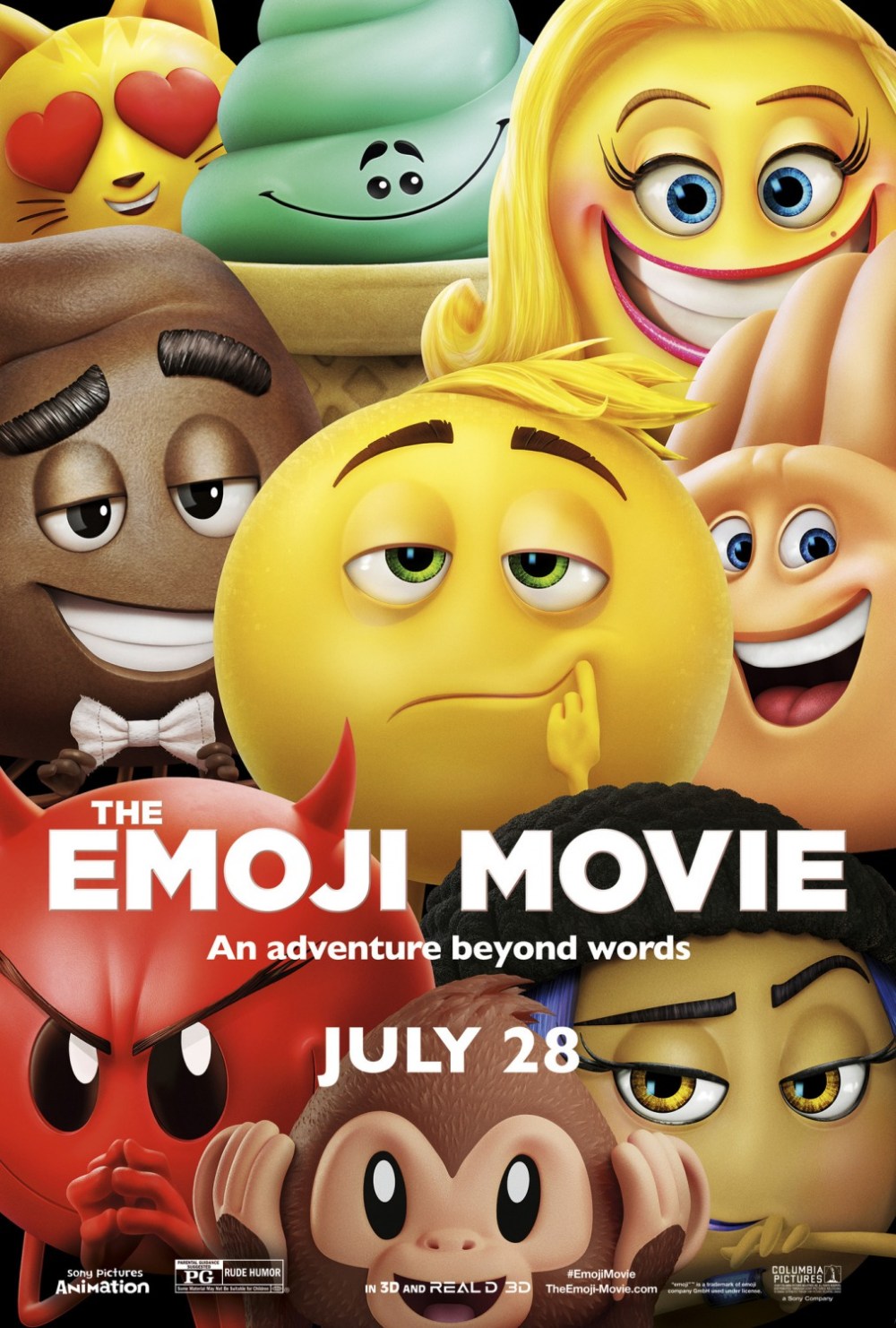
The Emoji Movie poster

This never seemed like a good idea for a movie. Sure, there was “Toy Story” which brought those toys we grew up playing with to wonderful life, and we had “The Lego Movie” which featured those building blocks in a story which had profound things to say about the power of our imagination. But emojis? Seriously, where can you go with those things? They are just faces with one single emotion to exhibit. How can you possibly make a movie out of them?

Going into “The Emoji Movie,” I was reminded of an episode of “Hollywood Babble-On” in which Ralph Garman and Kevin Smith ranted about the news of this movie being made following a bidding war between three studios.

“To go into a room and say, ‘Guys, I got the idea. You know the fucking face at the end of your text with the fucking tongue out and one eyebrow is up and shit? You know that shit? Here’s my idea. Hey, bring out my Power Point presentation. See that fucking round yellow face? That’s going to be my new movie!’ WHO FUCKING THINKS LIKE THAT?!”

“We could go pitch ‘Hieroglyphics: The Movie!’”

“But ‘The Emoji Movie?’ A movie about the emojis? What’s it going to be, the fucking family of emojis going on vacation together and, oh no, Tongue-Out is upset because Cross-Eyes is pissed off that Thumbs-Up is hogging the backseat? WHAT THE FUCK?! Seven figures they paid for this idea! Seven figures!”

Actually, what Garman thought the story would be could have been more interesting than this. ‘The Emoji Movie,” like its main character, proves to be a meh affair with jokes which fall flat more often than not, a voice cast which cannot lift the material up beyond its banal confines, and ideas which were dated by the time this movie went into pre-production. The fact it is coming out at a time when GIFS are proving to be very popular doesn’t help either.

For the most part, “The Emoji Movie” takes place within the cell phone belonging to Alex (Jake T. Austin), a human teenager who lives and sleeps with his phone like every teenager does to where kids colliding with each other because they can’t take their eyes off their devices is to be expected. Fortunately, there are no scenes of teenagers texting while driving which is a relief. Imagine how traumatic it would be for children to watch them getting into a car crash because the characters were texting each other about the latest school gossip.

Anyway, inside Alex’s phone live the emojis who are always around to help provide him with text responses which need no description with words, and among them is Gene (T.J. Miller), a meh emoji, who is super-excited about going to his first day at the office. Gene just wants to be a normal emoji like everybody else, but we soon discover he is capable of exhibiting multiple expressions and ends up having a panic attack which shows him to be anything but meh. Smiler (Maya Rudolph), whose infinite smile cannot hide her vindictive nature, orders Gene to be deleted from the phone. Of course, Gene manages to escape her cheerful façade and goes on a mission to become a normal emoji like all the others.

Director Tony Leondis was interested in exploring life inside a phone, and he also explored the plight of being different in a world which unrealistically expects everyone to be the same. The latter part is noble as we need movies which remind us all of how we should not exclude those who are different (you listening Donald Trump?) as this world is hard enough without people ostracizing others who are not seen as the norm. Even in this day and age, we need these stories as life seems to mostly be about conforming to societal norms, and not everything can or should be the same.

Regardless, this movie never has enough to work with. The problem with emojis is they, as characters, are far too simplistic. You cannot do much with them as their role in life or, in this case, Alex’s phone has been decided from the get go to where, even if they tried to do something, there’s no real reason to expect anything different from they are already programmed to do.

The plot of “The Emoji Movie” also suffers as it is the same kind of story where the underdog goes on a journey which will eventually lead him to becoming the hero, at which point everyone will accept him for who he is. It sucks a lot of times when you know the outcome long in advance, and it really tears away at the inspired movie this one could have been.

Leondis was clearly inspired by the “Toy Story” movies as well as “The Lego Movie,” but those movies managed to surprise us not just with their splendid animation, but with their stories which took audiences on rides they weren’t really expecting to go on. “The Emoji Movie,” however, isn’t much more than your typical outsider movie, and this is a shame as so much more could have been done here. This could have been an insanely inspired movie, but instead it travels down a road many of us have already traveled one too many times. Kids may get a kick out of it, but adults will be left wondering why this one couldn’t be as good as anything Pixar puts out.

Many shots are taken at various mobile apps like YouTube, Instagram, and even Candy Crush, a game for which I still get countless invitations to play (FYI, I’m not interested). Even Pikotaro’s “Pen-Pineapple-Apple-Pen” video makes a brief appearance, reminding us it was 2016’s most viewed video on YouTube. However, Leondis and his screenwriters, Eric Siegel and Mike White, don’t mine this material enough for all the satirical value it holds. Moments like the reveal of Candy Crush generate a chuckle, but nothing in the way of real laughs.

It’s a real shame because the voice cast is nothing short of terrific. T.J. Miller of “Silicon Valley” fame makes Gene an emoji we want to follow along with, and Anna Faris lends her everlasting charm to the codebreaker emoji Jailbreak. Maya Rudolph makes Smiler a wonderfully devious presence as her infinitely cheerful demeanor and pearly white teeth reveal her to be anything but truly happy. James Corden brings the same giddy energy he brings to his late-night CBS show to the role of Hi-5, and he steals just about every scene he has. I also have to say the casting of Steven Wright as Gene’s father, Mel Meh, was priceless.

Sir Patrick Stewart, however, is wasted in a role I expected to be the real scene stealer here, the poop emoji. Stewart has some choice moments which had me chuckling a bit, but he disappears from this movie too often to where I wondered why the filmmakers bothered to cast him. And the scene where poop is in the cube shouting “red alert!” makes me pine for another “Star Trek: The Next Generation” movie which will probably never happen. Regardless of how you felt about “Star Trek: Nemesis,” the “Next Generation” crew still deserves a better curtain call.

There was an animated movie which came out earlier this summer called “Captain Underpants: The Epic First Movie” which I wasn’t expecting much from when I walked into the theater. I came out of the movie pleasantly surprised as it proved to be very entertaining, full of imagination, and wonderfully subversive. I was hoping “The Emoji Movie” would surprise me in the same way, but the cards were stacked against this one right from the start. Emojis only have one function, to show a specific emotion. While Gene can show off many different emotions, it doesn’t change this fact. What we are left with is a thin story with jokes which are as funny as the hopelessly corny ones at all those Disneyland park shows, and animation which, while not at all bad, never comes across as the least bit wondrous. And yes, there is a post-credit sequence, but don’t bother waiting for it. All it does is show the fate of a certain character, and the moment is over in a flash.

“The Emoji Movie” does have a short-animated film preceding it called “Puppy!” which is based on the “Hotel Transylvania” franchise. It has Dennis getting a puppy, albeit one which is almost as big as King Kong. This short might pale in comparison to the ones Pixar makes, but it is very funny and playful and everything “The Emoji Movie” could have been.

Perhaps Garman was right. It would have been better to do an emoji road movie. Leondis would have had more luck with this genre than “The Diary of a Wimpy Kid: The Long Haul” did.

* * out of * * * *

‘Dunkirk’ is Yet Another Brilliant Masterpiece from Christopher Nolan

Dunkirk movie poster

Dunkirk” is the first Christopher Nolan film since “Insomnia” where you see the movie’s title on the screen at the beginning instead of at the end. This surprised me as Nolan always seems determined to suck you right into the movie instead of having you think about its title until the screen fades to black. When it comes to “Dunkirk,” however, I imagine he wanted audiences to have this title firmly implanted in their brains as this particular World War II story is one of character and bravery in the face of such agonizing defeat.

The title refers to the beaches and harbor of Dunkirk, France where thousands of allied soldiers were trapped like sitting ducks as the German army closed in on them during the Battle of France. Now World War II has been a historical event which filmmakers have visited as often as they have the Vietnam War, but “Dunkirk” has a different angle than other films of its genre. There are no American troops to be found here, we never see Germans but feel them closing in on the allies throughout, and the allies are at a complete loss in terms of being able to fight back. What happened at Dunkirk was not at all about victory, but about survival, and sometimes surviving a war is all a solider needs to do.

Nolan, who also wrote “Dunkirk’s” screenplay, tells the movie from three different perspectives: the land, the sea, and the air. On land, we meet British Army Private Tommy (Fionn Whitehead) who barely escapes a German ambush and arrives at the beach of Dunkirk where he befriends Gibson (Aneurin Barnard), another young soldier with whom he desperately tries to escape Dunkirk with on any boat that will take them. On the sea, Mr. Dawson (Mark Rylance) sails his boat out to Dunkirk in an effort to bring stranded soldiers back home, and he is joined by his son Peter (Tom Glynn-Carney) and Peter’s friend George (Barry Keoghan) who is curious to see the war up close. And in the air, Royal Air Force Pilot Farrier (Tom Hardy) and two other Spitfire pilots battle enemy fighters in the sky who are determined to destroy any boat going away from Dunkirk. Everyone is busy as can be as they fight to keep their fellow allies out of harm’s way, and this is even though the situation is growing increasingly dire.

What’s fascinating is how Nolan ends up using very little dialogue throughout a good portion of the film. These characters are too shell-shocked to speak in full sentences after all they have been through, and Tommy and Gibson end up connecting in a way not only wordless but also totally believable. As “Dunkirk” goes on, more dialogue is featured, but Nolan has already managed to set up the atmosphere to where no one needs to say much because their faces and eyes say so much more than words ever could.

Watching all the soldiers on the beach, waiting for a boat, any boat, to take them, I was reminded of Tom Sizemore’s dialogue from “Saving Private Ryan” when he said, “I want plenty of feet between men. Five men is a juicy opportunity. One man is a waste of ammo.” These soldiers are stuck together in bunches, desperate to escape Dunkirk at the earliest opportunity. I felt horrible for them as they all just sitting ducks for German bombers who can pick them off ever so easily. All these soldiers can do, other than shoot back, is to play dead in the sand, but even this may not be enough to save them.

Much of the movie is focused on the endless ordeals of Tommy, Gibson, and another young soldier named Alex (Harry Styles) as they get on different boats to escape from Dunkirk. However, their successes are often thwarted by attacks which sink the ships they are on, and they soon find themselves in even worse situations. Like Adrien Brody in “The Pianist,” these characters are caught up in unthinkable circumstances and are just trying to survive by any means. Many will consider them cowards for trying to flee, but considering the dire situation they are trapped in, it’s hard to hold much of a grudge against them.

With Mr. Dawson and his two young companions sailing out to sea, we see the need these men have to help those in harm’s way. While Dawson is supposed to give his ship over to ship over to the Navy as they are commandeering private boats to help in the Dunkirk evacuation, he simply sails off as he feels it is his duty to rescue as many soldiers as he can since it was his generation who decided to send young men out into the battlefield. As for the two boys, both want to do something noteworthy in this war instead of just staying on the sidelines. In wartime, it doesn’t matter if you are a soldier or not because everyone is involved in one way or another.

For me, the moments in the air were among the most fascinating, and not just because of Hoyte van Hoytema’s beautiful cinematography. Once those pilots and their planes came up on the screen, I figured it would all play into the clichés of war movies or be something like “Top Gun” with characters infinitely eager to be seen as heroes and taking giddy pleasure in shooting the enemy down. But this is not the case in “Dunkirk” as these pilots are simply men doing their job without any fanfare, and they are well aware of the risks and of what could happen if the enemy wins. Farrier, in particular, has even a bigger risk to consider as his fuel gauge is cracked to where he can’t tell how much fuel he has left. He should turn back, but with the allies having little to defend themselves with, his concern for their well-being overrules any thoughts he has for his own safety.

With these three divergent plot points, Nolan has the Dunkirk evacuation surrounded brilliantly. This is not a story about victory in the slightest, but instead one of character and of what people will do in a most precarious situation. Some stand around as others suffer helplessly because they can’t save them, others are desperate to escape by any means as the miracle they pray for doesn’t look to be delivered to them any time soon, and there are those who sail out to the most dangerous place not because they want to, but because they have to. Like I said, “Dunkirk” is a movie about the character of a person and how that character is tested in wartime.

Nolan also ratchets up the intensity throughout as the situation these characters are in becomes increasingly dire as the Germans close in on them. This is especially the case when Tommy, Alex and Gibson join a group of Scottish soldiers who have discovered an abandoned boat in the intertidal zone which they plan to use for their escape when the tide rises. The Germans, however, have already begin using it for target practice, and the holes they put in the boat soon have water coming through them. To stay on the sinking ship is suicide as they will certainly drown, but to go out into the open is no different as they will be shot once they are out in the open. But Nolan squeezes even more intensity out of this scene as it is suddenly revealed one of the soldiers on board might be a German spy, and it becomes a question of not who will survive, but who will die first.

There’s not a weak performance to be found here as every single actor in “Dunkirk” brings their A game to the table. Mark Rylance remains an impeccable actor, and he makes Mr. Dawson into a man determined to do his national duty not just out of necessity, but out of guilt as well. I’m not familiar with Fionn Whitehead, but his work here is exemplary as he doesn’t have much dialogue and instead has to spend most of his performance showing the turmoil Tommy endures through his eyes and actions. Cillian Murphy also gives a strong supporting turn as a soldier who has seen the worst war has to offer, and it becomes clear he will never again be the man he once was. Harry Styles, whom many thought would stand out like a sore thumb, fits perfectly into this ensemble of actors without ever overshadowing them. Even the great Kenneth Branagh shows up as Commander Bolton who oversees the evacuation of soldiers, and the moment where his eyes water up at the sight of those private boats sailing towards the soldiers is a moment of beauty as I wanted to cry with him. To quote the movie’s tagline, these soldiers couldn’t get home, so home came for them.

But one performance I want to point out in particular is Tom Hardy’s as Farrier. Watching the actor here reminded me of his work in “Locke” as, like the character in that movie, Farrier spends the majority of the time in a moving vehicle with only his fellow pilots and his own sense of duty to keep him company. Not once does Hardy try to portray Farrier as some hotshot pilot like Maverick in “Top Gun” or Captain Steve Hiller in “Independence Day,” but instead as a soldier like any other. Even with his face covered by an oxygen mask, Hardy deftly shows the stoicism and determination of his character as he continues to battle his foes in the sky even as his gasoline supply continues to dwindle, and he makes Farrier into the hero this movie very much deserves.

Another big character in “Dunkirk” is the music of Nolan’s frequent collaborator, Hans Zimmer. The German film composer has given us some of the most thrilling music scores of the past couple of decades, and his music here helps to make an intense motion picture experience even more intense than it already is. It essentially acts as a ticking clock, reminding the audience of how time is running out for the allied soldiers as the German forces get closer and closer to their location. Even in its more hopeful moments, Zimmer provides ominous sounds reminding us how the danger is always around the corner, ready to strike without much warning. When Zimmer’s music breaks into a cue scoring the arrival of boats to take the soldiers home, I could help but let out a sigh of relief as he finally had a reason to slow things down a bit and revel in the heroics of those who came to rescue the stranded men.

Does “Dunkirk” stand as one of the greatest war movies, let alone World War II movies, ever made? You bet. Nolan continues to give us one brilliant cinematic masterpiece after another, and whether or not you think this film is his best, it is certainly the most important he has made to date. The story of the Dunkirk evacuation is one the British people were raised on, and the world needs to be reminded again of how important a story this is. On one hand it is a story about military defeat, but it is also about a nation’s character and of how citizens stood up in the face of disaster to help those trapped. All the characters featured here endure different fates, but what they endure says more about them than words ever can. And the movie also reminds us sometimes all you need to do in a war is survive. You may come out of a war not feeling like the hero everyone makes you out to be, but surviving really is more than enough. At the very least, it gives you a reason to carry the story on to the next generation so the sacrifices made by so many will never be lost in the backroom of history.

* * * * out of * * * *

‘Spider-Man: Homecoming’ Gives the Web-Slinger a New Lease on Life

Spiderman Homecoming poster

The thought of another “Spider-Man” reboot had me rolling my eyes as this comic book character has already gotten through one too many versions already. But after watching Tom Holland portray him in “Captain America: Civil War,” I found myself getting excited about where the character could go from there. So, it’s my relief and delight to tell you all that “Spider-Man: Homecoming” proved to be a really good movie which successfully breathes new life into a franchise suffering from misdirection and too many chefs in the kitchen. With Holland, we also get the best incarnation of Spider-Man/Peter Parker yet as he gives the role a spirited turn full of youthful energy and boundless enthusiasm.

Director Jon Watts and the screenwriters, too many to name here, wisely avoid regurgitating Peter Parker’s origin story the way “The Amazing Spider-Man” did, and they instead hit the ground running. Peter has received a new Spidey suit courtesy of Tony Stark (the always welcome Robert Downey Jr.), but he is not quick to welcome Peter into the Avengers fold. Instead, Peter has to spend his days at high school like any other teenager and with his equally intelligent best friend Ned (Jacob Batalon). But when a new villain who even the Avengers don’t see coming called the Vulture starts wreaking havoc in Queens, New York, Peter finds himself too impatient to just sit on the sidelines and let him get away with his felonious deeds.

Holland really hits it out of the park here, and his boundless enthusiasm is set up perfectly through a home movie Peter Parker makes which encapsulates his time with the Avengers and battling Captain America. While the character remains the conflicted superhero who has trouble balancing out his school life with his crime stopping job, Holland makes the role his own and brings such an infectious spirit which makes the proceedings endlessly entertaining. Whereas Tobey Maguire and Andrew Garfield made Spider-Man too emo for his own good, Holland doesn’t go the same route, and his interpretation is much closer to the character we grew up reading in the comic books. I was frightened he might become too enthusiastic for Spider-Man’s own good, but his performance never becomes ingratiating and he also shows us a vulnerability which feels genuine and not easily achieved.

Of course, comic book movies need a good villain, and “Spider-Man: Homecoming” has one and, thank goodness, only one. The Vulture is an interesting choice as the person who inhabits him, Adrian Toomes, is as regular a guy as Peter Parker is a regular kid. Adrian is not so much a bad guy as he is a man who feels betrayed and left behind by those who have it all. His belief is that those in power couldn’t care less about the little man or anything he could possibly contribute to society, so he does many villainous things for his own benefit. But unlike many James Bond villains, he is not out for world domination. He just wants to provide for his family like any parent does.

It is a great pleasure to see Michael Keaton return to the world of comic book movies, and he arrives here just as “Batman Returns” celebrates its 25th anniversary. As Adrian Toomes/The Vulture, Keaton renders him into someone all too human even as he lays waste to Queens, New York and anyone foolish enough to get in his way. Even as the character sinks deeper and deeper into the criminal life, Keaton gives Vulture a humanity, albeit a corrupted one, which makes him seem more threatening and morally complex.

The rest of the cast is excellent, and it’s great to see Jon Favreau here as Happy Hogan gets more screen time here than he has in previous Marvel movies. One of the last scenes he shares with Holland is especially good as Hogan comes to see just how much attention he really should have paid to Peter. Downey Jr. continues to bring a sharp attitude to Tony Stark/Iron Man, but he also allows the character to evolve as Tony finds himself becoming a father figure to Peter, albeit a reluctant one. Even Chris Evans shows up in a cameo as Steve Rogers/Captain America, and he steals every scene he is in.

There has been a lot of talk of how Marisa Tomei was too young to play May Parker in “Spider-Man: Homecoming,” but that’s ridiculous. If May Parker is the sister to Peter’s mother, she wouldn’t be as old as Rosemary Harris now, would she? Either way, she brings a wonderful sass to this role, and she remains an enormously gifted actress after all these years. All the same, I wished we got to see more of her here as she has a wonderful chemistry in her scenes with Holland. I kept waiting for Tomei to be the Yoda to Holland just as Harris was to Tobey Maguire, but I guess we will see this come about in the inevitable sequel.

Watts previously directed “Cop Car” which was about two young kids who steal a police car from a corrupt sheriff. Essentially, that movie was about kids getting into the kind of trouble they would be smart to avoid, and “Spider-Man: Homecoming” has the same thing going on. Peter eventually comes to see he is in over his head to where Tony has to take away his Spidey suit. This sets up the third part of the movie where Peter has to see there is more to being a superhero than having a really cool suit. With great power does come great responsibilities, but this Spider-Man comes to see how great power needs to come from within as it cannot simply be co-dependent on nifty gadgets.

Some of the action scenes are a little too frenetic to where it’s hard to tell what is going on, and I was hoping for a little more in the way of emotional gravitas which highlighted Raimi’s first two “Spider-Man” movies. Still, it is a surprise to see how wonderfully inventive “Spider-Man: Homecoming” is as it gives us what appears to be a formulaic story, and yet it keeps giving us one surprise after another, all of which are too clever to spoil here. Just when you think you know how things will play out, the script veers in another direction you don’t see coming, and it makes the movie more interesting as the conflicts become increasingly intense.

I came into “Spider-Man: Homecoming” believing it could never top “Spider-Man 2” which has earned its place among the best comic book/superhero movies of all time. This one doesn’t, but it lands at number two among the “Spider-Man” movies as it is endlessly entertaining and wonderfully cast. My hat is off to the filmmakers for breathing new life into this franchise during a summer where so many others are suffering from fatigue, and I am infinitely eager to see where Spider-Man will go from here. For now, Columbia Pictures appears to have learned from the mistakes made with “Spider-Man 3” and “The Amazing Spider-Man 2” as this iteration is neither an overstuffed bird or a 2-hour long trailer for movies which never materialized. Here’s hoping the filmmakers keep from making those same mistakes in future installments.

And yes, there are two post-credit sequences, and both are worth sitting through the end credits to get to. The second one is priceless and brilliant. Trust me, you’ll see.

* * * ½ out of * * * *


‘The Little Hours’ Cast and Director Talk About Making This Satirical Comedy

The Little Hours poster

From its trailer, I figured “The Little Hours” would be a spoof of all the religious movies we grew up watching. But actually, it is a straightforward comedy which instead looks to satirize a culture we assumed was wholly religious, but was actually a lot looser and fun than history books ever made it out to be.

Based on the first tale of the third day from “The Decameron,” it stars Dave Franco as Massetto, a young servant who flees from his master after he is found out to be having an affair with his wife. Massetto is taken under the wing of Father Tommasso (John C. Reilly) who agrees to hide him and pass him off to the residents as a deaf-mute to avoid detection. But among the residents are a trio of medieval nuns, Alessandra (Alison Brie), Fernanda (Aubrey Plaza) and Ginevra (Kate Micucci), who think nothing of berating a pleasant laborer, chafing at their given duties, and also spying on one another. When they become aware of Massetto, a wealth of sexual repression becomes awakened along with a dose of substance abuse and wicked revelry, and he wonders how long he can keep this act up before giving in to temptation.

The Little Hours Jeff Baena

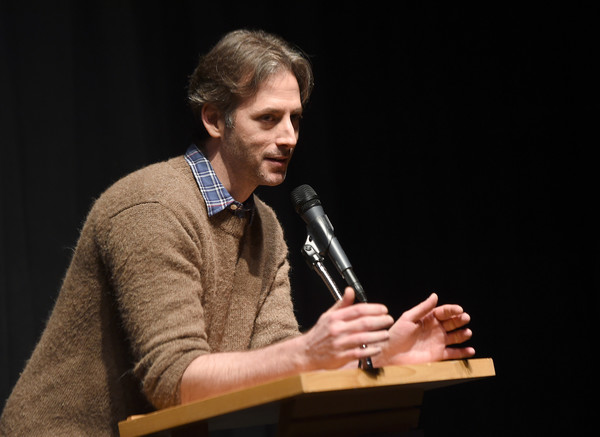
“The Little Hours” was written and directed by Jeff Baena whose previous credits were “Life after Beth” and “Joshy,” and he was joined at the movie’s Los Angeles press day by actors Dave Franco, Aubrey Plaza, Alison Brie and Molly Shannon. Baena explained how, while he was studying filmmaking at NYU, he also earned enough credits to get a minor in Medieval and Renaissance Studies. This is where he learned about “The Decameron,” a collection of short stories written by Giovanni Boccaccio in the 14th century. The stories dealt with life lessons and love, and I asked Baena why he chose to make a movie out of one particular story from it.

Jeff Baena: I wasn’t expecting something as funny and bawdy coming from a source material that is almost 700 years old. So, when I read it, it just read to me as something so human and just highlighted how similar we are to these people even though obviously the context is completely different. I was just drawn to how amazingly easy it is to connect to this thing and find our commonalities and also highlighting differences and showing how much we’ve changed despite that. All that stuff was really interesting to me.

I was also interested in learning from Baena about how he conceived this movie. Like I said, I thought this would be a religious spoof after watching the trailer, but “The Little Hours” proves to be much more than that. I was curious to see how this story evolved for him as he went about turning it into a movie.

Jeff Baena: I just wanted to achieve something similar to what “The Decameron” does itself which is funny. It’s a humanist book, so more than anything I just wanted to get the tone of that silliness but also the historicity which is a sort of strange balance, and then highlight all these actors who I love being in this world and then finding a way to make it adjustable for people to digest.

The Little Hours Dave and Aubrey

“The Little Hours” takes place in the year 1347 and was shot in Tuscany, Italy. As a result, it was tempting to believe the actors did a lot of research in preparation for filming. But in talking with Franco, he explained why this didn’t end up being your average period film.

Dave Franco: I kept asking Jeff what kind of research I could do and what research I should be doing, and he told me not to overthink it. He said it is not about knowing about the time period or how they talked or what activities they were doing there anything like that. It was more about the human connection. Even though the movie is set in the 14th century, it’s just about the relationships and we want you to talk in your own natural cadence. We don’t want you having to talk flowerily language. So yeah, it was just about connecting to one another.

The Little Hours Nuns

Both Alison Brie and Aubrey Plaza play nuns who are not at the convent for religious reasons as much as they are for some form of persecution. Many have asked the actresses what it was like wearing the nun costumes, and they replied they were heavy and itchy. But being an actor myself, I was more interested in how these costumes influenced their performances and if it changed the way they thought about their characters. Actors spend a lot of time preparing a role, and the costume is like the finishing touch or the missing puzzle piece which completes everything.

Aubrey Plaza: Yeah. Nun habits can feel really depressing. They are like really weighing you down literally, and only having just your face exposed is really hard. So, I think psychologically it helped get us all into character because we were totally de-sexualized, we couldn’t use our bodies, and we just felt after 10 hours of that we were all kind of like, “Can we get this fucking thing off?” Because it’s a drag.

Alison Brie: I feel like it made the character. The costume, the habit, is very oppressive and I found myself to be very depressed while wearing it, and my character’s in that same mental state a lot of the movie. So, it definitely helped and it did sort of change the way I went about performing in the movie because I’m a very physical person, and I think that that is one of my biggest tools that I use often. It’s like the tool I always reach for first in the bag. So, to have that kind of physicality taken away from you and also any sexuality robbed from you and to have just this small part of your face exposed, it was an interesting challenge in minimalism and in conveying ideas with as little movement as possible sometimes.

The Little Hours Molly Shannon poster

Then there was Molly Shannon who plays Sister Marea, easily the nicest and kindest character to be found in “The Little Hours.” When it comes to Shannon, we all know her best from “Saturday Night Live,” where she created Mary Katherine Gallagher, the awkward and unpopular Catholic schoolgirl prone to severe mood swings. Last year, I got to attend a special screening of “Superstar” which starred Shannon as MKG, and she spoke of how she went to Catholic school as a child and the experiences she had which to came to inform the creation of that character. I asked Shannon if MKG or her Catholic school experiences came to inform her performance as Sister Marea in “The Little Hours.”

Molly Shannon: That’s interesting. No, I wouldn’t say so much Mary Katherine Gallagher, but we did have a nun when I was in grade school named Sister Rosemary and she seemed really unhappy to me. She was fascinating because she seemed kind of miserable. She was young and she had a beautiful face. She was my first-grade teacher and she would take the hall pass and go, “Do you want to smell it?” Meaning like she wanted to hit you with it. I used to go pray at her convent after school to get extra credit, and I would just kind of study her and I was like wow, this is so weird. This young girl lives in this clean house. And then she left the convent and was seen on this golf course with a miniskirt like whooping it up with one of my schoolmates’ fathers and I was like, “Yay, she’s free! She got out!” I think about her in that little golf cart and I’m like, “Wow!” I could see she wanted to escape. She seemed unhappy. I think I always liked to study characters. I would study people. So, I think maybe I thought more of her.

While “The Little Hours” might seem crude on the surface, it is truly one of this year’s more original and subversively wicked comedies. It also shows how the 14th century was nowhere as stolid as we all have been led to believe, and it serves as a highly entertaining showcase for Baena and his super-talented cast. It opens in theaters on June 30, so be sure to check it out!

Stills, posters and trailers courtesy of Gunpowder & Sky

Jeff Baena photo courtesy of Getty Images


‘War for the Planet of the Apes’ Caps Off a Truly Great Trilogy

War for the Planet of the Apes poster

The summer 2017 movie season hasn’t necessarily been a bad one, but so far it has been overrun by franchise fatigue. Did we really need another “Transformers” sequel? Was the wait for the latest “Pirates of the Caribbean” really worth it? Can’t Pixar do more than just give us another sequel to “Cars?” Some franchises have seriously overstayed their welcome to where it feels like we need to take a LONG break from sequels of any kind, except of course for the next ones coming from the Marvel Cinematic Universe.

But now we have “War for the Planet of the Apes,” the third in the rebooted “Apes” franchise which is not only the best one to date, but also one of the best movies of 2017. Unlike other sequels which essentially repeat the same story to nauseating effect, “War” is not out to give us a replica of everything which happened before. From the start, we see how far the apes have evolved, and we also see the humans going through a state of de-evolution as well. In this war, it won’t matter who wins because nothing will ever be the same for anybody.

Taking place two years after the events of “Dawn of the Planet of the Apes,” “War” finds the conflict between the apes and the humans getting bloodier and bloodier. Both sides have taken heavy casualties, and the humans have resorted to recruiting apes to betray their own in a desperate effort to gain the upper hand in an escalating conflict. Caesar (Andy Serkis) has now reached a mythic status on the planet as a strong leader, and he now speaks as well as any human. When the movie starts, he has just survived another battle which leaves many dead in its wake, but instead of killing the remaining human soldiers, he sends them back to their base with a message to their leader, leave us alone. At this point, Caesar merely wants to protect his fellow apes and everything which is rightfully theirs.

But after being reunited with his loving family, Caesar suffers an unimaginable tragedy perpetrated by a military unit led by the ruthless Colonel McCullough (Woody Harrelson), and he heads out on a mission of revenge which, to quote a Klingon proverb, will be best served cold. Joined by several of his closest friends which include the wise and benevolent Maurice (Karin Konoval), Caesar comes not just to understand the world around him, but also about himself and of how he may be the maker of his own fate.

Whereas “Rise” dealt with evolution and how humans may not be a superior race of beings, and “Dawn” observed how humans and apes can be their own worst enemies, “War” focuses on the themes of vengeance and hate and what they do to the soul. Caesar’s quest for revenge is completely understandable, but his friends worry about what his hate for the Colonel is doing to his inner self. Caesar finds his strength from within and is as wise as he is strong, but we can see his soul is being corrupted on this mission as he is determined to exterminate his enemy with extreme prejudice.

The cost of revenge is a common theme in many stories, but “War” treats it with a great deal of intelligence. Caesar is constantly haunted by visions of Koba (Toby Kebbell) whose treacherous actions led Caesar to drop him to his death in “Dawn.” Maurice, the Obi-Wan Kenobi of these “Apes” movies, reminds Caesar of how Koba never got past his hate for humans to see the need for peace. But while Caesar convinces himself his motives are far purer than Koba’s, he comes to realize he is no different from Koba as his need to exact revenge takes precedence over everything else which holds great meaning in his life. The question is, can Caesar pull out of this moral nosedive before it’s late, or will he sink into an abyss of hatred which will rob him of all he stands for?

Not enough can be said about Andy Serkis’ performance as Caesar, and his work should have netted him at least one Oscar by now. We have seen Caesar go from being a frightened young ape into a hardened warrior, and Serkis has made every emotional beat count for something deep and true. While the visual effects help to illustrate how he has paid a price for the war being fought, it is Serkis who gives these effects soul and meaning as he plumbs the depths of Caesar to give us a character who is wonderfully complex and haunted by past deeds which cannot be simply washed away.

Woody Harrelson once again reminds us how he can play just about any role given to him these days with his portrayal of Colonel McCullough. His performance draws a bit from Marlon Brando’s in “Apocalypse Now” as, like Colonel Kurtz, McCullough has become a rogue soldier as his need to wipe out the apes and save the humans comes from a place of pain and delusion instead of from a higher military authority. Part of me expected to McCullough to be the usual military antagonist movies of this kind typically employ, but Harrelson gives this character much more dimension than you might be anticipating, and he matches Serkis scene for scene as their characters come to discover how alike they really are.

In addition, Serkis and Harrelson get strong support from Karin Konoval who makes Maurice far wiser than CGI can ever convey, Steve Zahn whose character of “Bad Ape” is kind of the equivalent to “Harry Potter’s” Dobby, and Amiah Miller is a scene-stealer as the mute war orphan who comes to be known as Nova.

Matt Reeves, who directed “Dawn,” returns to helm “War” and tops what he gave us before. The third movie in a franchise usually falls back on a well-trod formula, but he instead advances the plight of the apes to another level which furthers their evolution, and of the humans’ furious attempts to eradicate them which reveals their failings and a tremendous lack of understanding about where we all came from. And while the visual effects are tremendous in how they make the apes look ever so real, they are not the point. Reeves’ focus is more on character and performance more than ever before, and it is those things which make “War” especially epic. A lot of summer blockbusters are geared towards wowing us with special effects to where the human element is lost, but Reeves and company have the special effects serving the movie and its characters in a wonderfully effective way. On top of all this, “War” is well-served by one of Michael Giacchino’s best film scores to date.

The “Apes” reboot trilogy now joins the company of great cinematic trilogies such as Episodes IV, V and VI of “Star Wars,” the Jason Bourne trilogy, and “The Lord of the Rings” among others. It’s so pleasing to see filmmakers give us the kind of summer blockbuster many don’t always expect to see, one filled with great performances and intelligence as well as characters who are very interesting and whom you want to root for. Many blockbusters are the equivalent of a fast food meal which you may have enjoyed eating but which does not leave much of an aftertaste, but this is epic filmmaking which you can’t help but be emotionally drawn into. In a summer movie season which has been lacking to say the least, “War for the Planet of the Apes” is a real winner.

I also have to say “War” kept reminded of a Talking Heads song called “(Nothing But) Flowers.” As apes and humans traverse a landscape dominated by trees, rocks and lakes to where you can’t remember the last time you saw a building, the following lyric kept playing in my head:

“If this is paradise, I wish I had a lawnmower.”

* * * * out of * * * *

Sofia Coppola’s ‘The Beguiled’ is Wonderfully Unnerving

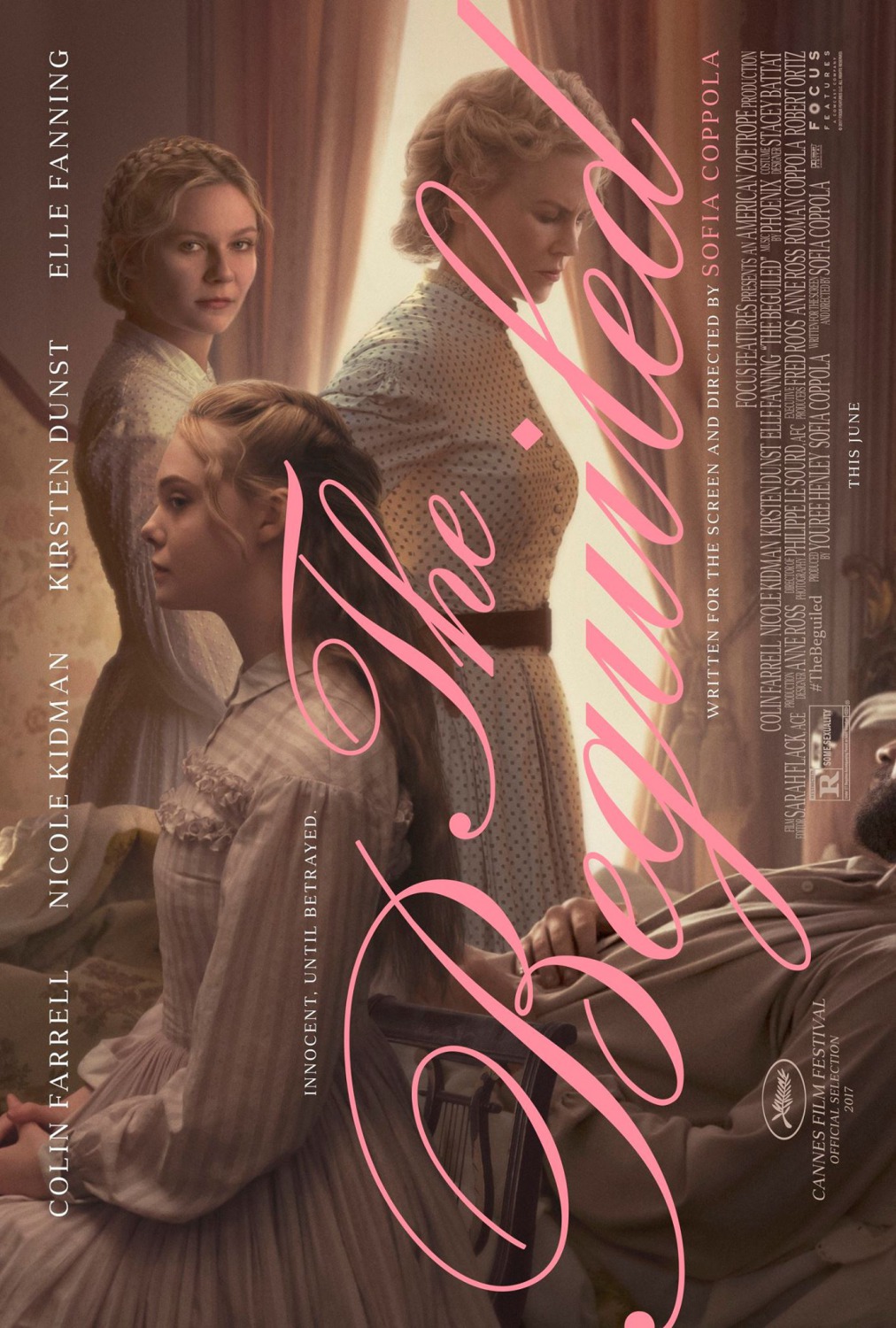
The Beguiled 2017 poster

Sofia Coppola’s “The Beguiled” is a movie I would describe as being wonderfully unnerving. Coppola takes her precious time setting up the story to where, when the situation worsens, we are left wondering how the characters can resolve it without anyone getting hurt. In the process, as the situation everyone is involved becomes increasingly chaotic, I couldn’t help but laugh. In a drama, this can be bad as a serious story which becomes laughable means the filmmakers failed in some way, but the laughs here serve as a release because the intensity of the story reaches a fever pitch to where we are unsure of how else to react. Plus, these are the kind of laughs which stick in your throat, and this means you would not laugh at what is going on here were this any other situation.

The word beguiled means being captivated, charmed, delighted, enthralled or entranced, and we see all of this on display right from the start. The movie is based on the novel “A Painted Devil” by Thomas P. Cullinan which in turn was made into a movie in 1971 directed by Don Siegel and starring Clint Eastwood and Geraldine Page. But while Hollywood has been remake happy for far too long, we know Coppola is going to take this material and make it her own. Plus, unlike other remakes, this one does not serve as a setup for a franchise desperate to match Marvel’s Cinematic Universe.

“The Beguiled” takes us back to the year 1864, three years into the Civil War, in Virginia. While picking mushrooms in the woods, a young girl comes across a wounded soldier, John McBurney (Colin Farrell), and takes him back to the boarding school she is staying at. It is a Southern girls’ boarding school which still has a few students hanging around even as many others have since gone back home, and they live a secluded lifestyle which keeps them from the front lines. Regardless, we can all hear the gunshots and explosions going off in the distance which remind us that while the danger might be far away, it could always spill over to their location at any given moment.

As John recuperates from his injuries, he gets to know the girls at the school much better. They include the headmaster Martha Farnsworth (Nicole Kidman), the rather quiet Edwina Dabney (Kirsten Dunst), and the teasingly playful Alicia (Elle Fanning). Time goes on, and John begins to slowly insinuate himself into the girls’ lives as he senses their needs and desires, some of which have long since been repressed. Sexual tension is definitely in the air as the ladies look longingly at John, and Edwina in particular is looking for a way to escape the secluded existence she has been trapped in, but we can all sense from the start that things will not culminate in a satisfactory solution for anyone.

What is brilliant about Coppola’s direction is how she hints at the longings of each character just from a look in their eyes. Furthermore, she is not quick to pass judgment on any of the characters to where we are left to make up our own opinions about them and their actions. Of course, how we view them ends up saying more about ourselves than it does about anyone else. Whereas Siegel’s take on “The Beguiled” may have been quick to cast John McBurney as a villain, Coppola’s version leaves you to decide this for yourself as Farrell gives us a man who is thankful for the help he has received and also unable to keep his libido in check (that’s what I think anyway).

“The Beguiled” reunites Coppola with actresses she has worked with previously. Dunst starred in her films “The Virgin Suicides” and “Marie Antoinette,” and Fanning co-starred in “Somewhere” when she was just 11 years old. Here, they both get to act against type in a way which makes us appreciate their talents in a way we should have already. Dunst, who has played extroverts in a beautifully gleeful way, gives us a repressed and longing performance as Edwina, and it makes us question whether the perspiration on her face is the result of humidity or her strong desires she can only hide for so long. As for Fanning, she gets to portray a young woman entering her sexually aware phase in life, and she clearly relishes in playing someone ever so eager to explore her sexuality with a man, any man.

Coppola also gets to work with Kidman who plays someone religiously stern, but even John can see the longing in heart for something different. Kidman has always been a brilliant actress, and she has not lost any of her power as this movie shows. In her scenes with Farrell, she exhibits a desire she never has to spell out for the audience, and the scene where they are face to face is a wonderfully tense scene as you wonder if they will or they won’t. And as the movie reaches its unnerving climax, it is a gas to see her the devilish look on her face as she calculates how to best deal with the school’s unwanted guest.

After all these years, Farrell remains an infinitely charismatic actor, and he seduces not just the ladies in the movie but the audience as well with what seems like relative ease. While the rest of us men struggle to attract the opposite sex, he succeeds in doing so in a way we can’t help but be infinitely resentful of. Farrell insinuates his character of John McBurney into a situation he thinks he can control, but this is a movie told from a female perspective, and it makes his predicament all the more entertaining as he attempts to gain a hold on a living situation which is far beyond his grasp.

Along with cinematographer Philippe Le Sourd and the fact she shot this on 35mm film, Coppola gives “The Beguiled” a smoky and beautiful look few other filmmakers could have pulled off. The ladies in their costumes look those women from Peter Weir’s “Picnic at Hanging Rock” to where the attention to detail meshes perfectly with a dreamlike quality. The soundtrack is mostly insects and birds making noises in the humid wilderness, but it is eventually punctuated by the subtle but powerful hum of the music by Phoenix which more than hints at the tension, sexual or otherwise, which is bubbling just below the surface.

There should be no doubt by now that Sofia Coppola is a born director, and I am not just saying this because her father gave us “The Godfather” trilogy (and yes, I like the third one). She has a signature style all her own, and she pays sharp attention to both the visuals and her cast with equal measure. Taking this into account, it should be no surprise she picked up the Best Director Award at this year’s Cannes Film Festival.

In a summer which seems beleaguered by franchise fatigue, “The Beguiled” is a nice and unnerving surprise as the suspense builds to where characters, who at once seemed a peaceful bunch, seize on their animalistic nature for the sake of survival.

* * * * out of * * * *

NOTE: “The Beguiled” has been the subject of controversy recently as Coppola decided to exclude the character of Hallie, a black slave, who was featured in the 1971 movie. As a result, she has been accused of whitewashing the story and of downplaying the role slaves had in the Civil War. Coppola has explained she did not want to present slavery in a lighthearted way and was concerned she would not be able to give the subject the attention it deserved. This seems like a sane response as it shows her sensitivity to the issue of slavery, and it would be hard to see how she could balance that out with the story of the women in a successful way here. I don’t think she is whitewashing this story in the slightest. Besides, with all the unrest in the world of American politics right now, Coppola is the last person we should be accusing of whitewashing anything.

Exclusive Interview with Sean Combs on ‘Can’t Stop Won’t Stop: A Bad Boy Story’

Sean Combs, a.k.a. Puff Daddy, is many things in life: a rapper, mogul, actor and businessman whose strong work ethic came about when he was a young boy. Following his time as an intern at Uptown Records, he came to form his own label, Bad Boys, which became a highly influential foundation for hip-hop and developed the careers of many artists including the late Notorious B.I.G. Combs’ image in the media, however, has been constantly pigeonholed into something which is not altogether true, and with the documentary “Can’t Stop Won’t Stop: A Bad Boy Story,” he looks to correct this so the world at large can see him for who he really is.

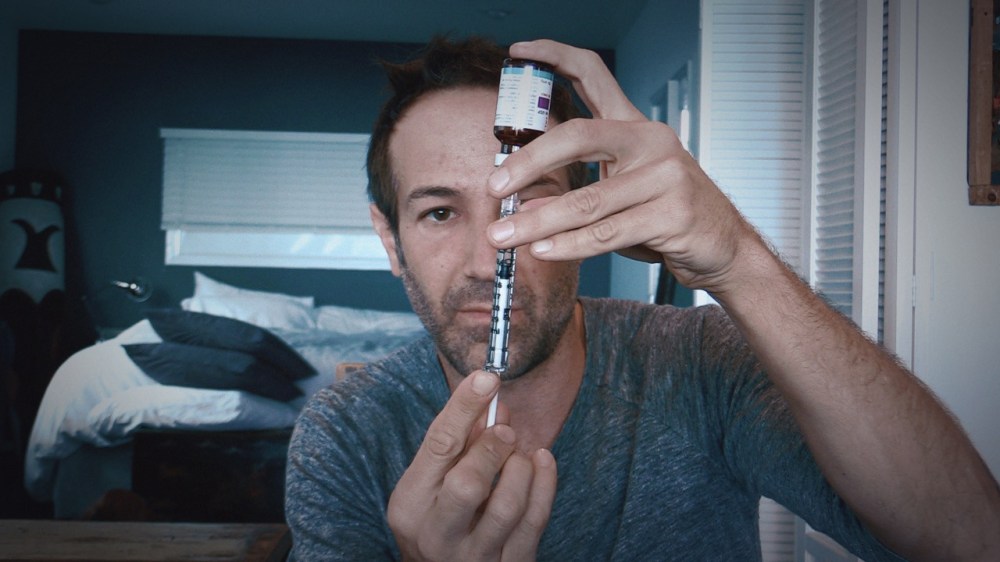
Directed by Daniel Kaufman, “Can’t Stop Won’t Stop” shows Combs at his most open and vulnerable as we learn how he became a millionaire at the young age of 19 and learned to navigate the real of corporate business. We come to see how the Bad Boy family he helped bring about filled his need for a family as he felt he never really had one before, and discusses how his world was forever shattered when the Notorious B.I.G. was murdered. We also see Combs get a Vitamin B12 shot right in the butt, and if this doesn’t show open he is willing to be on camera, then I am not sure what will.

“Can’t Stop Won’t Stop” also documents the Bad Boy artists reuniting for a 20th anniversary concert at the Barclay Center in New York which was put together in a mere three weeks, an insanely short schedule for any show to be assembled in. Among the artists, some of whom have not performed live for years, include Lil’ Kim, Mase, Faith Evans and Mario Williams among others.

I was lucky enough to speak with Combs while he was in Los Angeles, and we talked about how challenging it was for him to let go of the control he has over his image for this documentary. In addition, he also discussed the fun he had in sending up his own image in “Get Him to the Greek” and, in echoing what Nina Simone once said about being free means having no fear, admits to the place he finds himself being the most fearless in.

Please check out the interview above. “Can’t Stop Won’t Stop: A Bad Boy Story” opens in Los Angeles and New York on June 23, and it will be shown exclusively on Apple Music starting on June 25.

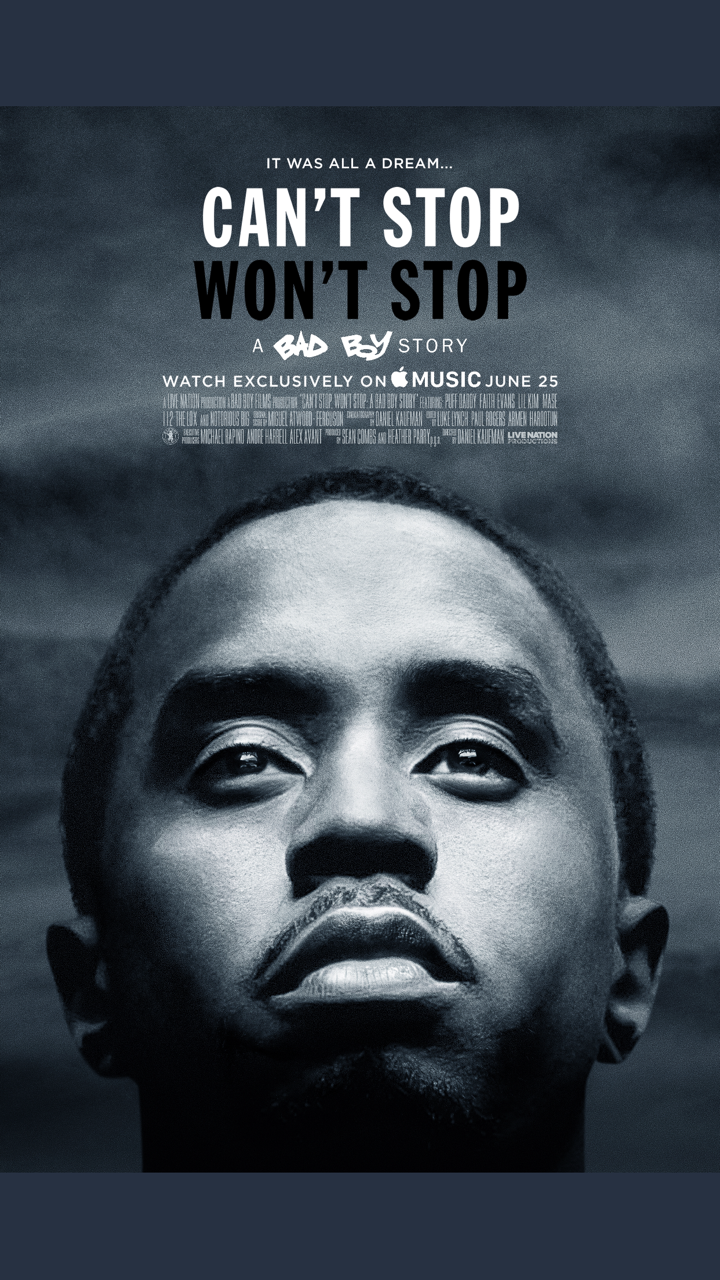
Can't Stop Won't Stop documentary poster

‘It Comes at Night’ is Not Your Average Psychological Horror Movie

It Comes at Night movie poster

It Comes at Night” cannot and should not be mistaken for your average psychological horror movie. Whereas the average genre film aims to delineate who the good guys and the bad guys are, no such distinction is made here as writer and director Trey Edward Shults has rendered the characters to be all too human. We understand their wants, needs and motivations very well, and this makes the movie even more unsettling than it already is.

We are introduced to Paul (Joel Edgerton), his wife Sarah (Carmen Ejogo) and their teenage son Travis (Kelvin Harrison Jr.) as they lay Sarah’s father, Bud (David Pendleton), to rest in a most uncomfortable way. We soon learn the family has secluded themselves in their country home as some highly contagious disease has since laid waste to the world. Along with their dog, Stanley, the family keeps themselves out of danger by staying locked up at night when the danger which threatens humanity is at its most powerful point.

But their bubble is suddenly threatened when a stranger named Will (Christopher Abbott) breaks into their home, believing it to be unoccupied and in desperate need of supplies for himself and his family. After tying Will to a tree overnight to confirm he is not infected by the disease, Paul decides he is worth helping and succeeds in bringing Will’s wife, Kim (Riley Keough), and their son, Andrew (Griffin Robert Faulkner), to safety to where they are all leaving under the same roof. But even as they come to settle down comfortably with one another, the inevitable conflicts arise which will force them into a game of survival no one can back away from peacefully.

Shults made an unforgettable directorial debut with “Krisha” which was one of my favorite movies of 2016. While “Krisha” was an emotionally pulverizing motion picture, “It Comes at Night” is one which mercilessly plays with your head as it taps into your fears of the things you can’t see or understand. Paul, Sarah and Travis rarely stray far from their country home as just about everything outside of seems all too threatening to confront. Whether or not you think Shults gives the “it” of the movie’s title a clear definition, it won’t matter. The it could be anything. It could be a supernatural force, an incurable disease, or perhaps it is the realization of the violent deeds we are capable of committing when pushed to our breaking point.

“In order to appease the gods, the Druid priests held fire rituals. Prisoners of war, criminals, the insane, animals… were… burned alive in baskets. By observing the way they died, the Druids believed they could see omens of the future. Two thousand years later, we’ve come no further. Samhain isn’t evil spirits. It isn’t goblins, ghosts or witches. It’s the unconscious mind. We’re all afraid of the dark inside ourselves.”

                                                                                                                           -Donald Pleasance

                                                                                                                            “Halloween II

I put the above quote from “Halloween II” up above because those words were playing in my head while watching “It Comes at Night.” Looking at these characters, you can tell they were once decent people who wanted nothing more than to raise their families and live in peace, but the state of the world has forced them to defend what is theirs in a way they never thought they would resort to. This is especially the case with Paul who has long since become handy with a shotgun and disposing of corpses. But Edgerton, who is excellent as Paul, eventually shows the character at his most vulnerable state as he comes to see not just the person he has become, but the person he always was.

Shults shows the fears of all these characters reaching their peak at nighttime when fear and paranoia combine to create a more hostile environment than the one outside their front door. Speaking of the front door, it is painted a dark red as horror movies always feature a red door or two, and Paul makes it clear to everyone how the door must always stay locked at night, always. As Roger Corman once said, one of the scariest images in any movie is the closed door. So, when the door moves suddenly is ajar, Shults has us right in his grasp to where we are sitting straight up in our chairs.

In addition to Edgerton, Carmen Ejogo and Kelvin Harrison Jr. provide strong support as Paul’s wife, Sarah, and their son Travis. Together, they portray a family much like any other, struggling to survive in an increasingly insane world. Christopher Abbott, so good in “James White,” inhabits the character of Will with both a tense desperation and an easy-going attitude as he settles in with Paul and his family. This is an actor incapable of faking an emotion, and his performance in “It Comes at Night” is the latest example. Riley Keough is also excellent as Will’s wife, Kim, as she makes her an enigmatic presence to where you don’t know whether to hug her or keep your distance from her.

In making everything seem so down to earth, “It Comes at Night” does suffer as things become more underplayed than they should have been. There were times where I wished Shults had injected more energy into the story as things begin to feel way too subtle. Still, when the movie works, it really works as the tension builds to a fierce climax where I could not find myself rooting for one person over the other. Shults is also assisted by his “Krisha” collaborators Drew Daniels whose cinematography makes the darkness these characters live in all the more threatening and claustrophobic, and by composer Brian McOmber who provides another unsettling score which builds up an already intense motion picture into something feverishly intense.

The ending of “It Comes at Night” proves to be both infuriating and utterly haunting as we are left to wonder what will become of whoever is left. It feels like the movie ended sooner than it should have, but perhaps it would have been unfair to ask Shults to give us something more definitive. Still, it’s nice to see something like this occupying the local movie houses alongside the summer blockbusters as it gives us a lot to ponder once the lights come up.

As for myself, the post-apocalyptic setting of this movie is almost secondary to the one thing which should matter the most to these characters – trust. Whether we are living in the best of times or the worst of times, trust is the one thing we need more than anything else to survive one hard working day after another. Without trust, how can we survive in a crazy world? “It Comes at Night” confronts the issue of trust head-on, and it is devastating to see it break down amongst characters who might otherwise have no problem living under the same roof.

* * * ½ out of * * * *