‘The Imitation Game’ Presents Alan Turing to a New Generation

The Imitation Game poster

Movies “based on a true story” keep coming at us like Election Day fliers in the mail, but “The Imitation Game” is one of the few that actually deserves our full attention. It portrays the life and work of Alan Turing, one of Britain’s most extraordinary heroes, whose efforts and accomplishments remained unsung for far too long. At the same time, it is a movie about secrets; how we keep them, the importance of keeping them and of the damage they can do when uncovered by others. What starts off as a typical biopic becomes something much more as we watch how Turing and his crew of code breakers helped bring an end to World War II, and of how his life came to a tragic end through needless and unwarranted intolerance.

When it came to finding the right actor to portray Alan Turing, the filmmakers could not have found one better than Benedict Cumberbatch. While other actors would have made the mistake of portraying Turing as some kind of Dr. House clone, Cumberbatch turns him into a fascinatingly complex human being who is brilliant, socially awkward, and very vulnerable in a time where being vulnerable could be a huge liability.

For those who don’t know, Turing was a brilliant mathematician and cryptanalyst who worked at Bletchley Park, the top-secret Government Code and Cypher School during World War II, where he created a machine which succeeded in breaking Germany’s seemingly unbreakable Enigma machine. Cumberbatch makes it clear just how incredibly smart Turing is during his first meeting with naval commander Alastair Denniston (Charles Dance) as he turns a hopelessly bad job interview into an unforgettable demonstration of his deduction skills.

What I loved about Cumberbatch’s performance is how he makes Turing curt with people in a way which is arrogant but not necessarily mean. It’s no surprise his fellow co-workers have a tough time warming up to him as he is determined to do things his way and has little time for anybody who doesn’t think as fast as he does. But part of the fun is watching Cumberbatch take Turing from being an anti-social human being to one who is genuinely eager to involve the rest of his crew in breaking Enigma.

One of the colleagues who came to be a big help to Turing is Joan Clarke, a Cambridge mathematics graduate played by Keira Knightley. Her entrance in the movie is great as the other men consider her to be in town only to apply for secretarial work, but Knightley makes Clarke into a very confident character who is more than ready to prove her worth in a male dominated environment. She also becomes one of Turing’s best friends through thick and thin as she helps ease him into social gatherings and become one of the guys instead of such an isolated individual. Even as Turing’s life heads down the tubes, Clarke is still there for him as she understands him in a way few others do.

I figured “The Imitation Game” would climax with Turing’s machine breaking Enigma, and the sequence where Turing and the others succeed in doing so is intensely exciting. But in a sense, it marks the beginning of the end for this group as they come to discover how the secrets they have uncovered lead to other secrets being made and kept for the good of the people. There’s even a scene where Turing’s crew discovers when a cargo ship is going to be attacked, and they debate on whether or not they will stop it as doing so risks undoing all the work they have accomplished. I love it when dramatic movies provide characters with such difficult dilemmas to solve, and this film comes with some of the most agonizing.

Again, this is a movie about secrets, and it becomes fascinating to see how the keeping of these secrets comes to deeply affect each character. True identities are revealed and compromised, and while certain secrets are kept in the dark to give England an advantage in the war, others secrets come to destroy those who had the misfortune of living in a time where certain behaviors and orientations were criminalized. Turing is the one who suffers the most as his private life is revealed to the world which forces him to face an utterly cruel and unnecessary punishment.

“The Imitation Game” was directed by Norwegian filmmaker Morten Tyldum whose previous works include “Headhunters,” “Fallen Angels” and “Buddy,” and he also directed “Passengers” starring Jennifer Lawrence and Chris Pratt. Tyldum has done an excellent job in transporting us back to the days of World War II in a way which feels unique and not overly familiar. His emphasis is on the characters just as it should be, and he succeeds in making this not just another traditional biopic. He pays great respect to Turing throughout as this is a man who made a huge difference not just in World War II but also in the development of future technologies we have become far too dependent on these days.

Cumberbatch has long since proved how great an actor he is with his work on the London Stage and on “Sherlock,” and he was prominently featured in “The Hobbit: The Desolation of Smaug” and “Star Trek into Darkness.” In “The Imitation Game,” he takes us on quite the emotional ride as we see him triumph in what he does best and suffer horribly in a time where he doesn’t quite belong. He makes you feel Turing’s pain as it is reduced to a shell of what he once was, and the scene where he is unable to even start a crossword puzzle is devastating to witness.

But Cumberbatch isn’t the whole show here as he is surrounded by a wonderful group of actors who are every bit as good. Keira Knightley does some of her best work yet as Joan Clarke, the woman who comes to understand Turing the best. Matthew Goode, so unnerving a presence in “Stoker,” is the epitome of perfect casting as Hugh Alexander; the chess champion and man about town we would all like to be in our everyday lives. Mark Strong makes Major General Stewart Menzies a deeply enigmatic (no pun intended) character who knows far more than he ever lets on. And then there’s Rory Kinnear who portrays Detective Robert Nock, the man who investigates Turing and becomes very eager to keep his life from being ruined. Kinnear is very strong as he shows us the detective’s inner conflict in convicting a man who is truly responsible for saving many lives.

Turing ended up taking his own life at the young age of 43, and it is only in recent years that he has people have acknowledged the terrible treatment he received. In August 2009, John Graham-Cumming started a petition urging the British Government to apologize for Turing’s prosecution, and then Prime Minister Gordon Brown acknowledged and described Turing’s treatment as “appalling.” A few years later, Turing received a pardon from the Queen under the Royal Prerogative of Mercy, but many are still waiting for an apology over the way he was treated chemically. This man was responsible for helping to end the Second World War, and while he was alive he was treated with derision more than respect by many. Thanks to “The Imitation Game,” people will now see the kind of person Turing really was and why he deserves to be seen and celebrated as a hero. Believe it or not, his creation of his machine became the prototype for what we today call computers.

This is a terrific film.

* * * * out of * * * *

‘Inverse’ is an Infinitely Thoughtful and Riveting Sci-Fi Movie

Inverse movie poster

When it comes to mind-bending science fiction movies, I have gotten into the habit of trying to stay ahead of the filmmakers to see if I can guess where the story is heading and how it’s going to end. “The Sixth Sense” among other movies got me good, but now I want to beat directors at their own game. I don’t know, maybe I’m just sick of people playing with my head. But with Matt Duggan’s “Inverse,” it really helps not to second guess the filmmaker or attempt to stay ahead of him. Just when you think you know where this movie is heading, it becomes something else and goes out of its way to defy your expectations. What I thought was going to be something along the lines of “Starman” or maybe even “The Terminator” proved to be quite different, and it was in my best interest to just watch it and take everything in.

“Inverse” opens on a small picturesque house in a suburban neighborhood where we see a naked man (played by Josh Wingate) emerging from a swimming pool with no idea of who he is. Once he steps inside the house, he finds pictures of himself and discovers his name is Max, a man who actually died some time ago. His appearance causes quite a shock for his wife and other relatives who come into contact with him, but he can’t seem to remember who they are. Then Max is met by a man named Batter (Morlan Higgins) who informs him he is actually from a parallel universe and has been travelling back and forth between universes to where his brain has been almost completely fried. As Max begins to realize who he really is, he comes face to face with people who want to learn all they can about the universe he is from, and this ends up putting him in grave danger.

Like I said, “Inverse” is not a movie you want to try to get ahead of. Duggan unveils the different layers of the movie’s story to where it truly helps to pay close attention. It invites repeat viewings so you can get deeper into the story and discover new things. The first time you watch it will give you a visceral feeling as Duggan puts you right into Max’s shoes as he desperately tries to discover why he’s here, and you feel his insatiable need to get to the truth before he reaches an unfortunate end.

The other thing which intrigued me about “Inverse” is it’s not your typical good guy/bad guy story. There are no heroes to be found here as everyone has a price to pay for the actions they end up committing. Not even Max is safe as he comes to discover the damage he has incurred during his various travels, and there is really only one person here who hasn’t done anything wrong, and yet this person still gets harmed inadvertently. I leave it to you, the viewer, to figure out who this character is.

“Inverse” meditates on what it might be like to live in a universe where the level of intelligence is much higher than our own. It would certainly be nice to use more than 20% of our brains, so the appeal of certain characters wanting to discover the secrets of this other universe is very understandable. The movie also shows how the quest for higher intelligence can be an obsessive one, and it gets to where we realize there is only so much we should be allowed to discover as it may lead to our undoing.

The cast is all around excellent, and hopefully we will get to see more from them in the future. Wingate carries the weight of this movie on his shoulders as we stay with him from the first scene to the last. It’s almost exhausting to watch him here as he is forced to exhibit a wide range of emotions, and he succeeds in making you feel all of them.

There’s also a great supporting performance from Morlan Higgins as Batter, a character who serves as Max’s conscience throughout the film. We watch as Batter explains to Max how he got to where he is now, and in the process of trying to do the right thing, Batter ends up imprisoning himself into a mental cage which offers no easy escape. Higgins is actually one of the most well-known actors on the Los Angeles theatre scene, and he proves to be the kind who inhabits a character more than he plays one. You never catch him acting, and this is one of the joys of watching his performance here.

In addition, you have strong turns from John Burish as Tommy, Max’s brother, who is put in a difficult situation of putting a close family member in harm’s way in order to get at the truth of what’s going on. There’s also Alanna Priere and Michele Lawrence who play the women in Max’s life who are not all they appear to be. To say more about their characters would be giving too much away, so I’ll leave you to see how they fit into this story.

But the best performance in “Inverse” belongs to Chris Pauley who ends up playing two roles here. The most notable role of the two is Bert, a man who knows who Max really is and where he’s from. Pauley is utterly riveting every moment he appears onscreen as he interrogates Max through various methods, one of which includes him rocking out to some techno music for no easily discernable reason. You never know what Pauley is going to do next, and you can’t take your eyes off him for a single second.

“Inverse” was made on a very low budget, and Duggan makes the most of it. In the end, this is a sci-fi movie which thrives more on ideas than on spectacle. Even if the pace drags a little, Duggan holds your attention throughout as the effects of Max’s actions become all the clearer toward the movie’s conclusion. Credit should also be given to the movie’s producers, Stephanie Bell and Trevor Boelter, for seeing it all the way to its completion. Like a lot of low budget movies, this one had a very long journey to the silver screen, and it proves to be worth the wait.

Rumor has it Duggan wants to make a trilogy of movies starting with “Inverse,” and it would be very interesting to see where Max’s adventures will go from here. This is a movie which is coming way, way, way beneath the radar, and it deserves a big audience. Here’s hoping we eventually see a sequel to it.

* * * ½ out of * * * *

“Inverse” is now available to stream on Amazon Prime. If you are already a member, you can stream it for free.

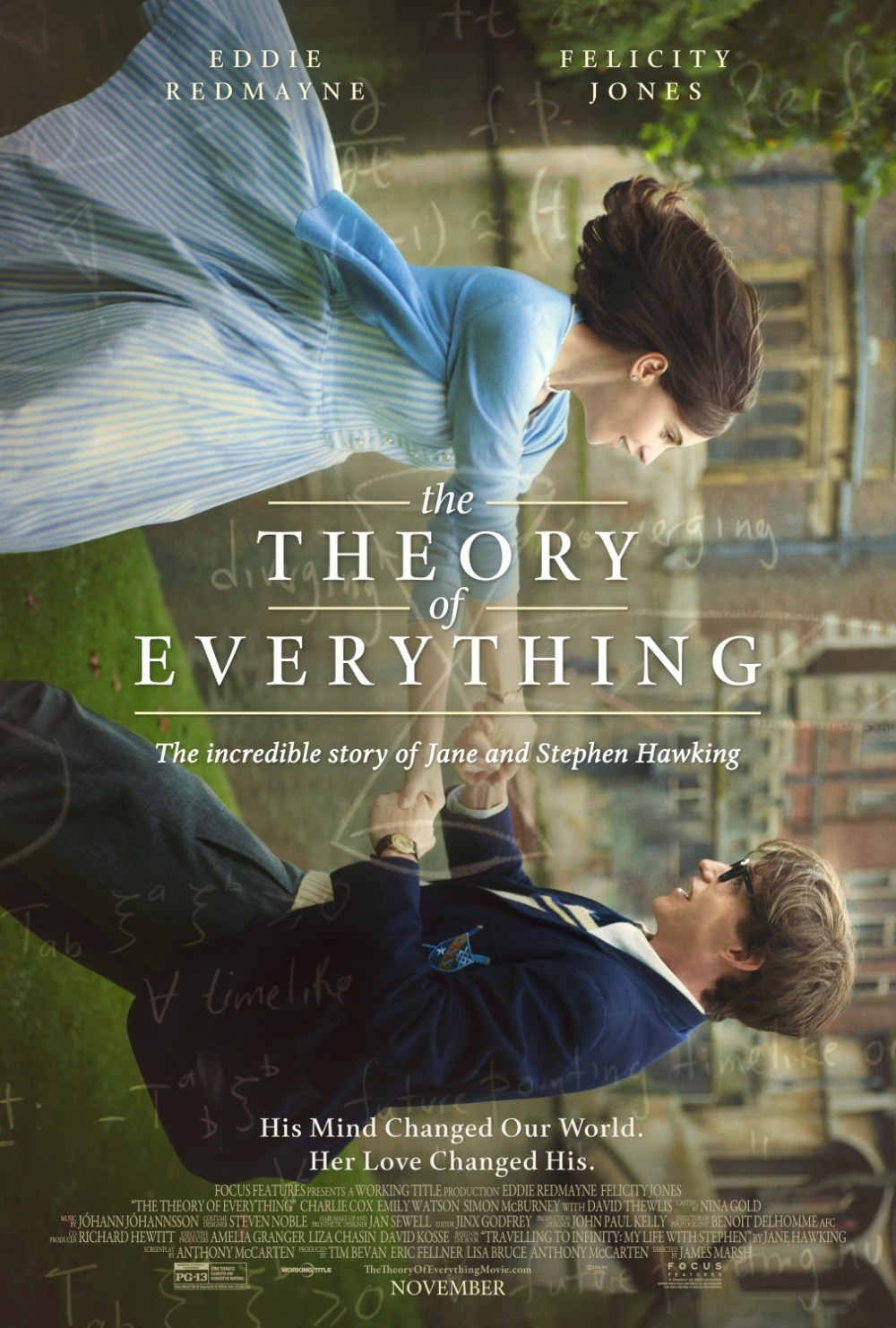
‘The Theory of Everything’ Gives Us the Stephen Hawking We Never Got to Know Until Now

The Theory of Everything movie poster

WRITER’S NOTE: This review was written back in 2014. I am posting it here out of respect for Stephen Hawking who just passed away in March 2018 at the age of 76. Once diagnosed with ALS, he was expected to live only a few years more, but he succeeded in living on despite what the disease did to his body, and he lived one hell of a life. RIP Stephen.

It is shocking to see Stephen Hawking, as played by Eddie Redmayne, riding around recklessly on his bicycle at the beginning of “The Theory of Everything.” We have long since gotten used to seeing him in his motorized wheelchair as ALS robbed him years ago of the ability to move around on his own, and we all know the sound of his computerized voice which has provided us with an insight to his brilliant mind and allowed him to provide lyrics to Pink Floyd songs. But this movie reminds us he was not always like this, and that there was someone in particular who saved his life in more ways than one.

“The Theory of Everything” is based on the memoir “Travelling to Infinity: My Life with Stephen” which was written by his first wife, Jane Wilde Hawking, and it focuses on their courtship which took place during their time as students at Cambridge University. Stephen looks like a perfectly dressed nerd who has the appearance of someone destined never to have any luck with women, and yet he still manages to catch the eye of the beautiful Jane (may we all be this lucky). At first it looks like an ill-suited coupling as Stephen is a student of physics while Jane’s main studies are in romantic languages. She believes in God, but Stephen’s love of science appears to imply he does not. We watch as they come to love and understand how the other thinks, and the way it is presented to us is both lovely and very believable.

But of course, we all know what will happen to Stephen eventually, and it is shown here in excruciating detail as he suddenly trips and falls down right on his head (ouch). Upon discovering he has ALS and told he has only a couple of years to live, Stephen finds himself shying away from everyone around him including fellow students, professors and even Jane as he desperately doesn’t want to be a pity case for anyone. But Jane has fallen deeply in love with Stephen, and she is not about to give up on him because there is too much to lose.

It’s hard not to think of movies like “A Beautiful Mind” while watching “The Theory of Everything” as both feature strong female characters determined to save their afflicted husbands from the diseases which appear all but fatal. For a time, it looks like this film will be no different in the way it portrays the strained relationship Stephen and Jane as they sacrifice so much to make things work between them. But as the movie goes on, it defies conventions and shows us a relationship which does suffer, but any impediments thrown into their path do nothing to tear apart the infinite respect they have for one another.

The eyes of the world are on Eddie Redmayne right now who as his performance here is utterly astonishing. I would love to ask about how he went about portraying Stephen’s bodily deterioration because he achieves doing so in a way which feels painfully real, and it’s amazing what he’s able to convey when Stephen is no longer able to communicate vocally (at least, until he gets that computerized voice). We always talk about how certain performances are more about imitation when it comes to playing characters based on real people, but Redmayne inhabits Stephen to such an amazing effect to where I found it impossible to label his performance as being one of mere imitation. Even as ALS continues to ravage his body, Redmayne makes the case for why Stephen remains such a respected individual to this very day as well as one who continues to fight the odds.

And let’s not forget the fantastic performance by Felicity Jones who portrays Jane Hawking as the lovely and strong-willed woman she is. While it may look like she has the easier role to play, Jones has an equally challenging role as she shows the unending struggles and sacrifices Jane went through to keep Stephen alive. It’s painful to watch Jane as she uses an alphabet sign to communicate with Stephen after his tracheotomy, and Jones makes you feel her pain as she wonders if she has suddenly taken too much away from him.

“The Theory of Everything” was directed by James Marsh who previously made “Man on Wire,” the Oscar-winning documentary about Philippe Petit’s tightrope walk between the two World Trade Center buildings in New York. Marsh does excellent work in keeping all his actors in check to where they never go for scene-hogging moments of an embarrassingly dramatic nature. Truthfully, it is the ordinary moments of these characters lives which are the most fascinating to watch, and Marsh succeeds in taking us back in time to a most romantic period in these couple’s lives.

The other great thing is how Marsh and screenwriter Anthony McCarten, who spent ten years trying to get this movie made, refused to let the audience look at Stephen Hawking as if he’s a complete invalid. Despite the damage ALS has done to his body, Stephen still managed to live a full life which has included two wives and three children, and it didn’t stop him from doing his work which eventually led to the publication of his novel “A Brief History of Time.” Heck, he even got to guest star opposite Data on “Star Trek: The Next Generation.” What more could someone ask for?

“The Theory of Everything,” is by no means a movie which falls victim to conventions or clichés. It presents us with a marvelous story about two people who come to love one another for their thoughts and minds, and of how their love helped them through various struggles which would have worn anyone else out in less than a year. It also contains some of the best performances of 2014 from Redmayne and Jones who are as brave as they are daring. Portraying real-life people onscreen is always a challenge, but they both took roles based on very well-known individuals and succeeded in making them their own.

Seriously, “The Theory of Everything” is one of the best movies of 2014 that I have seen and it is deserving of many of the accolades it has received.

* * * * out of * * * *

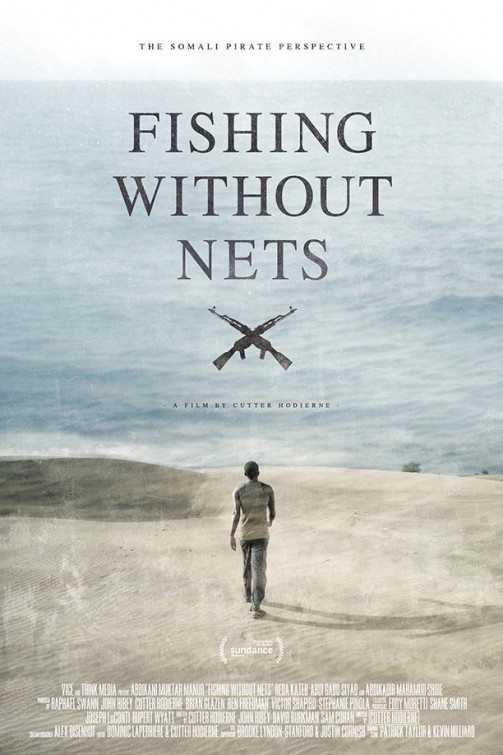
If You Liked ‘Captain Phillips,’ Then Check Out ‘Fishing Without Nets’

Fishing Without Nets movie poster

Fishing Without Nets” is the third movie in recent years to deal with Somali Pirates hijacking a ship at sea, and it comes on the heels of “Captain Phillips” and “A Hijacking.” The scenario may be the same, but the perspective is different this time around. While “Captain Phillips” and “A Hijacking” observed the pirates from a certain distance, “Fishing Without Nets” is told from their point of view. While no one is in a position to condone their actions, director Cutter Hodierne gives us an empathetic view of their struggles which have led them to take such drastic actions to ensure their own survival.

The movie opens on Abdi (Abdikani Muktar), a Somali fisherman, loving husband and father, walking through the village he lives in. The place is an utter mess and you get the sense it has been a mess for quite some time to where it doesn’t appear to offer much in the way of opportunities. Abdi has no interest in joining the pirates on their hijacking missions as he prefers to make an honest living through fishing, but he becomes increasingly desperate as his last few times out at sea resulted in no fish being caught. In the process of trying to get his wife and son out of Somalia to a better place, he discovers he needs a whole lot more money to make that happen, so he relents and joins the pirates on their latest hijacking mission with the promise of a huge reward. But once the pirates take over an oil tanker, Abdi finds himself wanting to escape the situation even before it descends into paranoia and chaos.

Watching “Fishing Without Nets” reminded me of movies like “Frozen River,” “Maria Full of Grace” and “Alive” which feature characters resorting to life-threatening methods as the bottom constantly threatens to fall out from beneath them. “Frozen River” in particular was about a mother (played by Melissa Leo) whose husband ran out on her with their life savings, and she is barely making ends meet at a minimum wage job. As a result, she resorts to smuggling illegal immigrants across the Canadian border into the United States which nets her enough money to keep her big screen TV from getting repossessed as well as for the down payment on her family’s new home. In any other instance she would not resort to this law-breaking activity, but when a mother’s livelihood and her family’s are at stake, you know she will do anything to keep them safe.

This is certainly the case for Abdi when he resorts to piracy to keep his family safe, and he even says at one point, “a man is not a man until he can feed his family.” When it comes down to it, “Fishing Without Nets” is about the will to survive, and this remains a universal story all around the world. When pushed to extremes, you can bet no one is going to just lie down, give up and die. No, they are going to fight for their loved ones even if it means breaking the law, so you cannot help but be empathetic to Abdi’s choices even as they put his life in serious danger.

Hodierne went out of his way to cast non-actors for this movie instead of putting known names in it, and this helps to give “Fishing Without Nets” a truly authentic feel which puts you right into the action. While some of the situations are familiar from “Captain Phillips” and “A Hijacking,” he makes this film stand out with its unique point of view, and he generates some serious tension when infighting breaks out among the pirates. Scenes where a gun is pointed at a character’s head are a dime a dozen in movies, but here those same scenes have an intensity which really shakes you up.

Also, Hodierne and his director of photography, Alex Disenhof, capture some amazingly beautiful shots on the ocean which help illustrate just how isolated all these characters are out there. The last shot pulls away from a boat drifting in the ocean, and it’s truly one of the most memorable moments of any film I saw in 2014. Considering how small of a budget Hodierne had to work with, this makes what he accomplished all the more impressive.

“Fishing Without Nets” may not be on the same level as “Captain Phillips” or “A Hijacking,” but it is an action packed and intense movie which would make for a perfect triple feature with those two. After it was over, I could see why the Sundance Film Festival decided to give Hodierne a directing award because it is a truly impressive debut which invites you into a world that is not the least bit safe to be in. Furthermore, it also allows us to understand why Somalis have been resorting to such methods in order to survive, but then again, anyone else might be forced to do the same when it comes to surviving in an endlessly harsh and cruel world. It doesn’t make it right, but it’s a truth which hopefully none of us will ever have to face like these men do.

* * * ½ out of * * * *

Exclusive Interview with Cutter Hodierne about ‘Fishing Without Nets’

Cutter Hodierne photo

2013 brought us two movies about Somali pirates hijacking ships at sea: “Captain Phillips” and “A Hijacking.” Both were more focused on the hostages and their ordeal while the pirates themselves were observed from a relative distance. Then in 2014, we got Cutter Hodierne’s “Fishing Without Nets” which is another movie about Somali pirates, but this one is told from their point of view. It follows fisherman and father Abdi (Abdikani Muktar) who, in desperation and for his family’s safety, joins up with a group of pirates to hijack an oil tanker with the promise of a lot of money. But as soon as the hijacking begins, Abdi tries to remove himself from the situation as it descends into increasing chaos and paranoia.

I got to speak with Cutter about “Fishing Without Nets” which originally started out as a short film which received the Grand Jury Prize in Short Filmmaking at the 2012 Sundance Film Festival. This led to Vice Films financing the feature length version which picked up the Dramatic Directing Award at Sundance. The movie takes place in Somalia but was shot in Kenya, and Cutter discussed the challenges he faced as well as the discoveries he made during its filming.

Fishing Without Nets movie poster

Ben Kenber: “Fishing Without Nets” started out as a short film. How would you say it evolved from a short to a feature length movie?

Cutter Hodierne: Well, the hope always was to make a feature, and so the short was kind of made in support of that idea. So we wanted to make the short as a way of sort of researching and developing a concept for a feature, and in the process of making a short film we always hope to use it as a tool to raise the money to make a feature film.

BK: That seems to be more of the case these days. You and the makers of “Whiplash” really had a lot of success with that.

CH: Yeah, I think it’s a really natural model if you can end up pulling off the short film because you kind of work out a lot of things with your concept early on that you test things out, and then if you do a good job you can also have a really powerful tool to get the attention to make a feature as well. I think it’s good in every direction.

BK: I have always heard that filming on water is always very challenging. What were the biggest challenges that you had in filming this movie on the ocean?

CH: Shooting on the ocean is a really, really difficult thing. The ground that you’re walking on, it’s not ground but the surface underneath you is undulating all the time, and for the weather to just kind of change out of nowhere suddenly… You’re kind of at the mercy of all those things. It’s really difficult, and if you get seasick at all that kind of gets in the way. The ocean would just turn in a moment and you would have to cancel the entire day’s shoot. It’s really tricky. It’s kind of like outer space. The ocean is not so far from the idea of being in space. You’re way out in the middle of nowhere and it’s endless in every direction and it’s really tricky.

BK: You also went out of your way to use non-actors for this movie. What made you decide to go in that direction?

CH: I think that it was just kind of the only way. The way to do this movie in an authentic way involved non-actors. It was probably also our only option when we were making a short film. I don’t think this movie, our version of it, would have made sense with anybody really recognizable because it would take something away from the story, and I think you get such a great sense of reality from having people you are not accustomed to seeing and who also just inhabit the role in a really natural way. I don’t think there’s any other way to go about it.

BK: I also heard that you set up scenes for them but that you let them come up with their own dialogue. What discoveries did you make along the way with the process?

CH: Well, I discovered that Somalis talk a lot (laughs). You give a couple of these guys a license to talk and make their own lines, so they will go and talk and talk and talk and talk. So what I really learned was that the most important thing that they all needed to have, if they are going to give themselves their own lines, is knowing where the scene needs to end. They have their own lines but they have a very, very structured scene they were playing within. They knew kind of the beginning, middle and end of the scene and I think what we learned as we went along with the cast and myself and the translator was having an ending to the scene was really crucial. Having a defined place where the dialogue would end was really important. I wouldn’t understand the words but I would understand roughly kind of where we were in a scene even though I can understand the language. It’s amazing what you end up starting to recognize in that setting.

BK: You did a lot of research why you were in Kenya where the movie was shot. What surprised you most about your time over there?

CH: What surprised me most? Everything was always surprising (laughs), but I always felt like I was learning something new about how to operate over there. There’s something around the corner that I wasn’t going to be prepared for, and I think what surprised me the most was probably that I never really completely got the hang of it despite how much time I had spent there. You really feel foreign there even when you know your way around and you think you can talk the talk and this is that. Something will happen that will just remind you that you’re not completely at home no matter how immersed you feel. That was probably the most surprising thing. I was always learning something new.

BK: Other movies that have featured Somali pirates, we don’t always get to know them as individuals but in this movie, we do. Their mission in getting a hefty ransom is doomed once the infighting gets more heated, and at its heart this is a movie about survival. Was that what you were trying to get across as a director that people will do anything to survive?

CH: Yeah, absolutely. This is definitely a story of someone’s hope and quest for survival. Even with the new stuff I’m working on now I sort of realize that’s something I’m definitely interested in; how survival as a mentality informs so many other new things that we do in a more complex society today. Just the desire to survive is like a driving force in a lot of things we do, but in this case with Abdikani (Muktar, who plays Khadir) in the story, this was absolutely a show of when desperate times call for extremely desperate measures. The extreme that is piracy is a really clear show of how extreme the situation in Somalia is; that where you end up in desperation is with four or five guys in a speedboat in the middle of the ocean attempting to capture a ship that is 10 times as big or more, and everyone’s life is at risk trying to climb aboard the ship. The situation is so preposterous that to me the question always begged is, what is the preposterous situation that would lead somebody to that point? It’s a really extreme reaction so we wanted to tell the real extreme cause.

BK: One movie “Fishing Without Nets” reminded me of was “Frozen River” which starred Melissa Leo as a mother who resorts to smuggling illegal immigrants across the Canadian border into the United States. She wouldn’t be doing this kind of work otherwise, but her main priority is her kids and that overrides everything else. Looking at that, the story of survival is a very universal one and not specific to one culture.

CH: Yeah, and I also wanted this movie to have a little bit of a feeling like you’re in an action adventure film that is just completely inverted. You’re not accustomed to seeing all these action adventure film elements playing out in a setting that you would normally not be in. I wanted to work in a specific genre, so I think that’s about as an exciting thing to do with it as well.

BK: The opening scenes of the movie show the characters living in this decimated area that doesn’t offer them a lot in the way of opportunities terms of making an honest living or raise a family in. Did you see a lot of that in Kenya?

CH: Yeah definitely, and even in Somalia it’s really much worse. I think everybody like walks through a slum for the first time in their life and are kind of like, “Holy shit this is real. This isn’t just something in pictures.” It’s pretty affecting. It’s hard not to be moved by something like that and I think we really wanted to show, what if you woke up and this is what it looked like every day and this is your situation every day? How far will you get pushed before this doesn’t seem like a good option to go out and try to get rich? Yeah it was definitely intentional to show where he (Abdi) lived and where he came from.

I want to thank Cutter Hodierne for taking the time to talk with me. “Fishing Without Nets” is now available to own and rent on DVD, Blu-ray and Digital.

‘Jack Ryan: Shadow Recruit’ Forgets What Makes Tom Clancy’s Hero Stand Out

Jack Ryan Shadow Recruit movie poster

While watching “Jack Ryan: Shadow Recruit,” it didn’t take long to realize like the CIA analyst hero of the late Tom Clancy’s novels has been rebooted one too many times. After being portrayed by Alec Baldwin and Harrison Ford, Jack Ryan got his clock turned backwards when Ben Affleck played him in “The Sum of All Fears.” I have no problem admitting I liked that film, but casting a younger actor as Ryan ended up screwing with the franchise’s equilibrium. Things were going smoothly beforehand, so why throw a younger actor, any young actor, into this role and take the audience back in time? Why not bring Baldwin back? When is all said and done, Baldwin is still the best actor to inhabit this character.

Well, now we have Pine taking over the role of the brilliant Jack Ryan, and this time the franchise goes right back to the beginning of Ryan’s career. What results is by no means a bad movie as it is well made, features a number of strong performances and some exciting action scenes. Regardless, there’s a feeling of emptiness at this film’s core. The problem it’s not much different from the many spy movies I have seen over the years and, as a result, feels largely forgettable.

For those who remember Fred Dalton Thompson’s character of Rear Admiral Joshua Painter from “The Hunt for Red October,” he gave a speech in which he talked about how Ryan was severely injured in a helicopter crash back in the 70’s and spent the following year learning to walk again. This is the Ryan we meet here when this film begins as he is compelled to enlist in the military after the events of September 11, 2001. From there, we watch him recovering from a helicopter crash, and he recuperates over time with the help of Dr. Cathy Muller (Keira Knightley), the woman we know will eventually become his wife.

During his lengthy recovery, Ryan is paid a visit by CIA official Thomas Harper (Kevin Costner) who recruits him to work for the agency. We then move forward ten years later to when Ryan is working on Wall Street as a compliance officer at a stock brokerage, but this job is of course a cover for his real work as a covert CIA analyst as he keeps an eye out for financial transactions which are suspect and may indicate terrorist activity. Upon discovering trillions of dollars held by Russian organizations have gone missing, the trail of criminality leads him to Russian tycoon Viktor Cherevin (Kenneth Branagh). Ryan travels to Russia and, from there, things go bang, bang, bang like you would expect.

I think one of the big mistakes made with “Jack Ryan: Shadow Recruit” was that the filmmakers decided not to base it on any of Clancy’s novels. I know Clancy was always highly critical of the way Hollywood treated his books and I’m pretty sure he would have had many things to say about this installment had he lived to see it. At the same time, his stories were always intricate and fascinating, and the screenplay here by Adam Cozad and David Koepp is both confusing and hard in comparison. As a result, it feels a surprisingly lightweight compared to the complex stories Clancy came up with.

In addition to playing Jack Ryan’s chief nemesis, Branagh also directed the movie and has come to show a real panache for filming exciting action scenes. There’s also a crazy car chase near the end which really did have me on the edge of my seat, and he has come a long way from directing big budget movies like “Mary Shelly’s Frankenstein” and “Thor.” Granted, you can’t go into this expecting something on the level of his Shakespeare cinematic adaptations, but he does provide the audience with a fun time. The problem is the story of “Jack Ryan: Shadow Recruit” is very routine, and it was hard to get excited about what unfolded once I made this realization.

In all fairness, Pine does make for a good Jack Ryan in the way the character was written here. As tired as I am of movie studios making all these origin movies, Pine brings the same kind of energy to this role as he did to “Star Trek” as James Kirk. While this Ryan is not as interesting here as he was in the previous films, Pine does the best that he can with a somewhat underwritten part.

One performance in particular I want to point out is Costner’s as Thomas Harper. It’s fascinating to watch him here after having seen him as the heroic young soldier in movies like “No Way Out,” and he is aging nicely into the role of the elder statesmen who imparts his wisdom and advice to newbies. Part of the fun in watching Costner here is how mysterious he makes Harper. Ryan is not sure he can trust him fully, and Costner’s constant poker face throws not only him off, but the audience as well.

But despite all the good things about “Jack Ryan: Shadow Recruit,” the whole package feels far too ordinary for it to work effectively. We’ve seen this kind of story before, and not much was done to elevate it above the usual fare this genre has to offer. In the process of trying to make Jack Ryan young again in the hopes of jump starting this long-running franchise, they have robbed the character of what made him unique. In this film, he’s like any other young CIA recruit who has yet to understand what he’s getting himself into, and I have seen this scenario played out far too many times before.

For me, Jack Ryan was always the accidental action hero. He has a brilliant mind and always gets to the truth of the matter because he takes the time to study the individual at the center of the story. Like John McClane, he’s not out to be the hero and is always looking to avoid life threatening situations, but he eventually steps up to the plate because no one else can, and no else knows what he knows. If they ever do make another Jack Ryan, they need to make him the analyst he’s always been and not just start from scratch with an origin story. We know all about Ryan’s past, now let’s deal with his present and future. Is this too much to ask?

* * ½ out of * * * *


‘Paranormal Activity: The Marked Ones’ Sees the Franchise Making a Comeback

Paranormal Activity The Marked Ones poster

Paranormal Activity: The Marked Ones” proves to be much, much better than “Paranormal Activity 4,” and it succeeds in reinvigorating a franchise which was starting to look like it was running on fumes. In terms of story, it’s not very different from the previous films and you do have a good idea of where the story is heading, but Christopher B. Landon who wrote the screenplays for “Paranormal Activity 2, 3 and 4” and directed this one is very deft at positioning the scares to where they come at you before you know it. Thanks to a terrific cast and a good dose of humor, it proves to be one of the best entries in the long running franchise.

“Paranormal Activity: The Marked Ones” is not a direct sequel to “Paranormal Activity 4,” but instead a spin-off which features a family not white-bred like all the others featured in the franchise. When the film begins, we are introduced to Jessie (Andrew Jacobs), a young Latino who has just graduated from high school along with his best friend Hector (Jorge Diaz). Soon afterwards, we see the whole family partying at their apartment complex and having a grand old time as they bid farewell to the hell that is high school.

But then they learn their downstairs neighbor has died under suspicious circumstances. With nothing better to do, Jessie and Hector break into the apartment to figure out what happened. What they discover are a bunch of items used in black magic rituals as well as all those videotapes which formed the basis of “Paranormal Activity 3.” The next day, Jessie wakes up to discover what looks like a huge bite mark on his arm, and it’s a sign that his troubles are only about to begin.

The idea to focus on a Latino family for this “Paranormal Activity” was a smart one as it gives this entry a fresh feel we really take notice of. The family presented here is a great one, and while Landon is really just out to give us a fun and scary time, he is also smart in giving us a group of Latinos not dominated by stereotypes. Some might complain the film does traffic in stereotypical behavior, but I disagree. While many have a view of inner city neighborhoods as being violent hellholes, few seem to realize how close knit the families who live in them are, and many of them are not involved in a life of crime.

Part of me was hoping the filmmakers would dare to film the whole movie in Spanish with subtitles, but since this is a “found footage” movie, they are apparently not allowed to do so. Still, this was a small complaint in the large scheme of things.

Another one of the main differences between “Paranormal Activity: The Marked Ones” and the previous films is the amount of humor in it. This is not to say the other films lacked humor, but I was surprised at how much I found myself laughing with this particular entry. A lot of this is thanks to Diaz who comes close to stealing the movie as Hector. Watching him get all super excited at the things happening to and around his friend Jessie are a gas to watch, and he ends up becoming the real star of this movie as a result.

I also have to say that the ending of “Paranormal Activity: The Marked Ones” is one I did not see coming. It ends up turning the whole franchise on its head as you wonder what realm these “Paranormal Activity” movies truly exist in. After watching this spin-off, it’s clear the series is not simply relegated to the found footage genre.

Landon, who finally gets to direct a “Paranormal Activity” movie after having written many of them, knows we have become familiar with where to expect the scares to happen. To his credit, he plays on what we expect to see and provides us with some jump out of your seat moments we don’t quite see coming. Whether or not you think this particular entry is or is not as scary as the first three, it definitely has its moments if you patiently wait for them.

I got to see “Paranormal Activity: The Marked Ones” with a preview audience, and their reaction was contagious as was their enthusiasm. Many movie franchises, regardless of the genre, live and die in regards to how audiences react to them, and this one shows there is still life left in it. Just when you think this series has reached its peak, this entry makes you excited for what will happen next, and I am ever so curious to see which direction this one will take from here. That’s a very good thing as this series works best on what fans are not expecting.

For me, I’m still waiting for the “Paranormal Activity” movie where the executives of Paramount Pictures become victims of similar hauntings as a result of profiting off the tragedies which have befallen the families featured in these films. If they want people to keep believing these found footage movies are real, then they should seriously consider this because the franchise appears to be heading in this particular direction.

* * * out of * * * *

Check out the interview I did with the stars of “Paranormal Activity: The Marked Ones” which I did for the website We Got This Covered down below:

‘Left Behind’ is as Cinematically Atrocious as Movies Get

Left Behind movie poster

The 2014 version of “Left Behind” received quite the critical smackdown upon its release, and this made me all the more interested in seeing it. How many times do you get the opportunity to say you were one of the handful people who got to see such a god-awful motion picture on the big screen which notoriously flopped at the box office during its incredibly short time in theaters? There were a few people who proudly wore t-shirts signifying they saw “Gigli” while it was in theaters, and some wear it like a badge of honor.

“Left Behind” looks like one of those so bad it’s good movies, but even on that level it is a complete failure. This cinematic version of the best-selling novel by Tim LaHaye and Jerry B. Jenkins is every bit as hideous as its reputation suggests. The acting is amazingly bland and lifeless, the dialogue is unforgivingly bad, and the direction is beyond incompetent. Upon coming out of this movie, one has to wonder if its best sequences were all left behind on the cutting room floor on purpose or by accident.

The movie opens on Chloe Steele (Cassi Thomson) arriving home from college to surprise her father, airline pilot Rayford Steele (Nicolas Cage), for his birthday. Rayford, however, is already set to pilot a flight to London and cannot make it. Also, his marriage to his wife Irene (Lea Thompson) is on the fritz as she has since become a devout Christian, something which drives him and Chloe up the wall. He also has his eye on an infinitely beautiful flight attendant to the point where he doesn’t hesitate to leave his wedding ring in the glove compartment of his car.

Anyway, the family members go their separate ways to do their thing, but then people suddenly vanish into thin air without any explanation, and the world quickly descends into utter chaos. Their clothes and belongings are left behind, but their bodies have apparently disappeared and don’t look to reappear anytime soon. It turns out the end of the world is much nearer than the non-believers ever bothered to realize, and those who believe in Jesus are now under his, or her, protection. As for those back on Earth, they are forced to prepare for the rapture which is certain to kill them off at some point in the not too distant future.

“Left Behind” is actually a remake of the 2000 film that starred Kirk Cameron and which received largely negative reviews upon its release. In a time where every other movie is being remade, this looked like the rare remake which could have easily improved upon the original, but no such luck. For all we know, this remake is even worse than its predecessor, and sitting through it is like pouring salt on an already gaping wound.

Where do we start with a cinematic monstrosity like this? Well, let’s take into account how the story lacks much in the way of drama. Those characters who didn’t go up to heaven are basically condemned to a hellish existence, so where’s the drama? As for what’s going on up in the sky, the characters stuck in the airplane are forced to act stupidly and utter dialogue so silly and inane to where it makes the screenplays of the “Star Wars” prequels sound like they were written by Aaron Sorkin.

The saddest thing about “Left Behind” is watching Nicolas Cage give one of the worst performances of his long career. Granted, Cage has done more bad movies than good ones these past few years, but even he can sometimes elevate a terrible motion picture into something which is, at the very least, entertaining. But here he looks like he is about to fall into a coma like Ben Carson threatens to during his campaign for President as he appears bereft of passion and meaning. What made Cage decide to do this movie anyway? He can underplay a role to great effect in movies like “Joe,” but here he only succeeds in making a terrible movie all the more infinitely pathetic.

The director of this misbegotten disaster is Vic Armstrong who is said to be the world’s most prolific stunt double in movies. He doubled for Harrison Ford in the first three “Indiana Jones” movies, Timothy Dalton in “Flash Gordon” and George Lazenby in “On Her Majesty’s Secret Service.” Whatever lessons he gleaned from the directors he worked with on those projects did not translate to “Left Behind.” He should be forgiven for the lousy special effects he had a budget of only $16 million which, for a movie like this, is not nearly enough to, but my sympathy doesn’t extend much further than that. His direction is so amateurish to where I wondered how he got the directing job at all.

There is only so much time one can waste on a movie like “Left Behind” because there are hundreds upon hundreds of other movies out there so much better than this one. It ends on a note of seeming uncertainty as the apocalypse has only begun, but Cage stares at it so blankly as if to say he won’t be around for the sequel, assuming there will ever be one. It’s depressing to see a number of careers hit rock bottom here, but this is what happens here as movies don’t get much worse than this one. Sitting through a Dinesh D’Souza “documentary” is hard enough, but this one is a real endurance test.

For what it’s worth, it is nice to see Lea Thompson here as she always proves to be a very appealing presence in each movie or television show she appears in. What a shame it is that she disappears from this movie far too soon.

½* out of * * * *

Darren Aronofsky’s ‘Noah’ is His Biggest and Most Flawed Film So Far

Noah movie poster

Darren Aronofsky’s “Noah” is a movie I have conflicted feelings about. On one hand it is a deeply flawed effort with moments which belong in another movie, but on the other hand it brings up questions inspired by the actions of the characters which I found endlessly fascinating, and those same questions stayed with me long after the movie ended. With “Noah,” Aronofsky has been handed the biggest budget he has ever had to make a movie with, but what amazes me is how much of his vision ended up on the silver screen. You’d think Paramount Pictures would have the last say on final cut, but Aronofsky has managed to graduate to the big leagues without losing his unique voice as a filmmaker.

The movie gets off to a shaky start as we watch a young Noah being initiated into manhood by his father with what looks like a magical snakeskin, but then his father is brutally murdered in front of him by Tubal-Cain and Noah runs like hell to get away from him and his followers. For a moment, I thought this would turn into a revenge movie with Noah going after Tubal-Cain to where the ark becomes a secondary story. Fortunately, this was not the case.

The story then leaps forward many years later when Noah (now played by Russell Crowe) is a husband to Naameh (Jennifer Connelly) and a father of three boys: Shem, Ham and Japheth. However, it’s not long until Noah begins having frightening dreams about a great flood swallowing up every living and breathing thing on earth. Eventually, he comes to discover he has been giving a mission: to build an enormous ark and fill it up with animals so that when the great flood comes to wipe out the evilness of humanity, the animals will survive to restart civilization anew.

One of the big stumbling blocks of “Noah” comes when we are introduced to fallen angels known as the “Watchers.” They are these enormous stone creatures who tower over all humans, and they kept reminding me of those tree creatures from “The Lord of the Rings: The Two Towers.” Furthermore, the “Watchers” almost took me out of the movie completely and had me thinking about those stone creatures William Shatner wanted to put in “Star Trek V: The Final Frontier.” While watching “Noah,” I kept thinking about what Shatner must have been thinking when he Aronofsky’s film. Shatner was probably thinking, “Damn you Aronofsky! My film had biblical themes in it too! Why didn’t I get to put any stone creatures in my movie?”

When all those animals start making their way to the almost completed ark, you can tell they were all created using CGI effects. Then again, I can’t blame Aronofsky for going this route as directing real life animals must feel next to impossible especially in a movie like this. Plus, if he did get access to real animals, how would he have dealt with all those animal droppings the crew would have spent hours trying to clean up? Imagine the smell that would have created. Yuck!

As “Noah” continued on, the things which bothered me began to make sense, and the film really hit its stride just before the ark sets sail in the flood. I figured the movie would end there, but it goes on to look at how Noah and his family deal with issues like survivor’s guilt and questioning the motivations of “the creator” (the word God is never mentioned). Aronofsky does terrific work in giving all these characters complexities which render them far more fascinating, and the challenges they face come to define who they are. This is not a good guy vs. bad guy story as all the characters inhabit a morally grey area, and it gets to where we’re not sure who to root for.

Since his Oscar winning turn in “Gladiator,” Russell Crowe’s career has been all over the place as he has given terrific performances in “Cinderella Man” and “American Gangster” and suffered through cinematic misfires like “A Good Year” and “The Man with the Iron Fists.” As Noah, Crowe does some of the best work he’s done in a while as he humanizes a character made famous through biblical tales. When Noah threatens a course of action which may very well to his family apart, Crowe still makes us feel for him as he struggles to remain true to what is asked of him.

Jennifer Connelly also gives one of her best performances as Noah’s wife, Naameh, and no, she does not play Joan of Arc (Keanu Reeves got that wrong in “Bill & Ted’s Excellent Adventure”). As Naameh, she plays a character similar to the one she played in “A Beautiful Mind;” a woman very much in love with her husband and yet deeply afraid of what he is capable of doing. Connelly is no stranger to the Aronofsky universe, having given such an earth shattering performance in “Requiem for a Dream,” and she is not afraid to go to emotional extremes. Watching her trying to reach her husband, Connelly sucks you vividly into the fearful state she has been thrust into, and she makes us share in her desperation to protect what is left of humanity.

“Noah” is also well served by a strong supporting cast which includes Ray Winstone, Douglas Booth, Logan Lerman and Emma Watson who shows there is more to her than playing Hermione in the “Harry Potter” movies. In addition, Aronofsky brings along his dedicated team of collaborators such as editor Andrew Weisblum, cinematographer Matthew Libatique and composer Clint Mansell. Speaking of Mansell, he gives us yet another great film score with “Noah.” While it might not be on a par with his work on “Requiem for a Dream,” he gives the movie a great emotional power, and he continues to be one of the more unique film composers working i today.

So again, “Noah” has some glaring flaws I could have done without, but its strengths eventually outweigh its weaknesses to where the movie had a strong impact on me. I’m not sure I will ever forget hearing all those screams from people begging to be rescued while Noah and his family sail away in the ark, and Aronofsky is fearless in questioning the audience as to what they would have done were they in his position. This movie also shows how even biblical characters have dysfunctional families to deal with, so we have no business being surprised when we have to deal with the same thing in life.

When all is said and done, I’m glad that Aronofsky managed to get his vision of “Noah” to the big screen without too much studio interference. All the same, I hope he thinks twice about putting giant stone creatures in his next film.

* * * out of * * * *


Ben and Josh Safdie Discuss the Making of ‘Heaven Knows What’

Heaven Knows What movie poster

Heaven Knows What” is a movie which takes us into a landscape alien to many of us: the world of a drug addict. Arielle Holmes stars in a riveting performance as Harley, a homeless addict on the streets of New York who has two passionate yet volatile loves in her life: her boyfriend Ilya and heroin. We watch as they struggle to survive one day after another on the mean streets of New York, struggling with addiction and each other as Harley attempts to prove her love to Ilya in the most passionate and dangerous way possible.

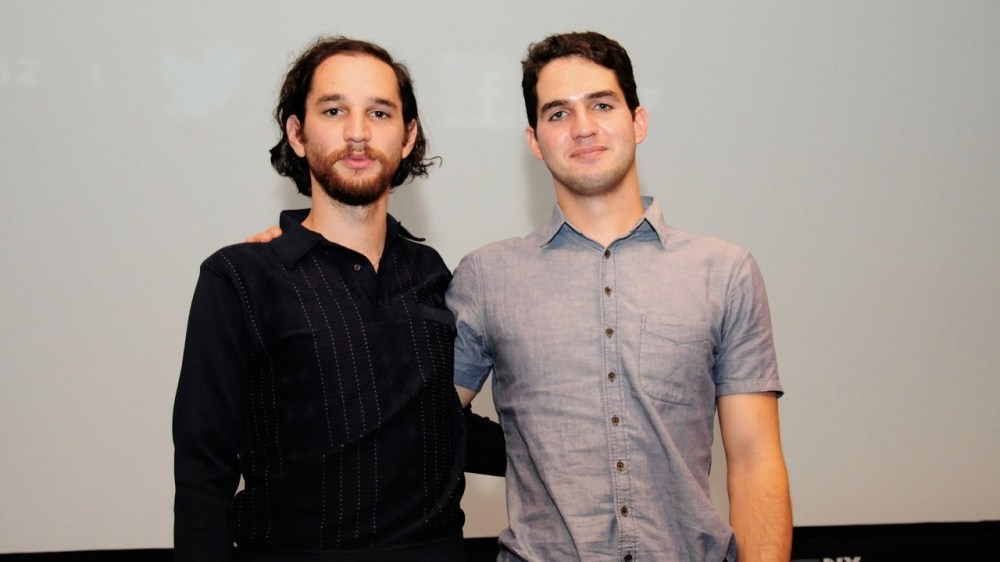
The movie was directed by brother filmmakers Josh and Ben Safdie whose previous credits include the comedy drama “Daddy Longlegs,” the documentary “Lenny Cooke,” and the crime-drama “Good Time” starring Robert Pattinson. I got to speak with them while they were in Los Angeles, and they described the various elements behind this movie’s making in great detail.

“Heaven Knows What” is based on the memoir “Mad Love in New York City” written by Holmes. I was eager to read it after watching the movie, but it hasn’t been published yet. Josh explained why.

Ben and Josh Safdie photo

Josh Safdie: She has a few publishers who want to do it, but she’s like rethinking about how she wants to release it now that she’s done these two other movies and is now in the responsible world.

Ben Safdie: There’s a beautiful rawness to it. If you were to read the pages, it really feels like you were right there sitting next to her all the time and it’s beautiful. That kind of immediacy is also what really attracted me to it because first you hear about, oh, homeless person addicted to drugs. We’ve heard that story a million times. How do you tell that story in a new and different way? Her voice was that new way.

I came into this movie not knowing anything about its backstory, and I honestly thought Holmes was a highly trained actress as her performance is brilliant and mesmerizing. This, however, is not the case as she is not all that far removed from the addict we see on screen. She was a homeless addict for years but has managed to get herself cleaned up, and her performance in “Heaven Knows What” has earned her attention from many who want to make her a star. Both Josh and Ben described what it was like working with her.

JS: Her performance is incredible. You have to remember when you live on the street you’re performing on an everyday level. Whether you’re hustling this person or trying to get this thing out of that person, it’s a performance and a performative life. She was also moonlighting as a dominatrix where she literally was performing as a different character.

BS: One of the most difficult performances you can give is as yourself because you need to be able to understand what makes you tick and then be able to put that out there without any inhibition. And then that’s how you build other performances because if you can get at your core in its ugliest form, or whatever its form, you can build from there.

JS: Acting is just painting your personality a different color. I really was amazed. When I watch the movie now, as I get more and more distance from it just in terms of just having filmed it with a sense of making it, I watch Ari’s performance and I’m really in shock about it. It would take like six or seven takes to get the performative level because it would often start out with her enthusiasm level and how enthused she was to do the scene. Sometimes she was really in it and she would give us this incredible performance. Other times it would take 12 takes to get it out of her. It’s really a beautiful performance from her. And the guy, Caleb (Landry Jones, who plays Ilya), is an actor in Hollywood movies. That’s like the craziest performance because people don’t even realize that it’s a performance and they learn his real story that he is a Texan and that he was in “X-Men: First Class,” he was in “Contraband,” he was in “Antiviral,” he lives in Los Angeles. This is not him at all. Maybe there are traces of him in Ilia, but no, that’s not him.

What’s fascinating about “Heaven Knows What” is how it combines fiction with a raw cinema verite. It’s essentially a fictionalized version of true events, and yet it feels like we’re watching real life unfold right before our eyes. I asked the directors what it was like balancing out the fictional elements with the real-life ones while making this movie.

BS: I think it was about putting them in a blender and not knowing where that line was because that was the only way to make it successful. We made a documentary before this, and that was a documentary. That was a real person and we were trying to tell his real story, but in order to tell his story most effectively we had to use techniques from fiction filmmaking, reenactment and changing the timeline. We were fictionalizing reality there to get the point across. So here we are making a fiction film with a kind of documentary base, and again we had to employ the same kind of tools. You have to make things up to really get at the true emotional core of things. (Werner) Herzog says it’s like the ecstatic truth once you get there.

The movie also features a brilliant electronic score which serves to illustrate just how alien the world drug addicts inhabit is to the rest of us. Along with movies like “The Guest,” “It Follows” and “Ex Machina,” electronic film scores are making a big comeback. Josh and Ben talked about the movie’s composers and why they chose that kind of music.

JS: There’s a bunch of things that are happening in music in the movie. For the most part, we feature the work of Isao Tomita and his renditions of Debussy. We really wanted to have a romantic score, but this movie is like a time squared, nighttime vibe. It’s like electrified and it’s kind of seedy, and it’s an alien landscape almost. We like to say the movie takes place on Mars which is where an addict’s brain goes in a weird way. Debussy music is some of the most romantic music ever composed, but when it’s done through this Japanese mind from the 70’s it’s different. It’s reinterpreted. It’s no longer really romantic but it has its core in romanticism.

BS: There’s other music that we use throughout the movie. There’s some original music by Paul Grimstad in the hospital sequence, and then there’s Ariel Pink who’s a Los Angeles guy who wrote a song for the movie called “I Need a Minute.” It’s electrified as well, and he wanted it to be a love song to the locked bathroom, being able to lock your own bathroom and needing another minute while people are banging on the door.

Watching “Heaven Knows What” brings to mind movies like “Kids” and “Requiem for a Dream” which dealt with lifestyles which were unnerving and at times horrifying to witness. We want to look away and these films dare us to, but in the end we can’t avoid the reality of what people do to each other and themselves.

“Heaven Knows What” is now available to own and rent on DVD, Blu-ray and Digital.