‘Paranormal Activity 4’ Sees the Franchise Running Out of Clever Ideas

Paranormal Activity 4 movie poster

With “Paranormal Activity 4,” the law of diminishing returns has finally caught up with this found footage franchise. Granted, all the films have revolved around the same old story of people taping themselves and their homes while they sleep so they can see what goes bump in the night, but this same old story has now become all too familiar for me. This sequel does have its moments, appealing characters and some clever twists, but the scares are a hell of a lot easier to spot this time around.

Whereas “Paranormal Activity 2 & 3” revolved around the events of the original film or came before them, “Paranormal Activity 4” marks the franchise’s first real sequel. Moving us forward to the year 2011, 5 years after the events in Parts 1 and 2, the story takes place in a small neighborhood in Nevada where the very pretty Alex (Kathryn Newton) lives with her parents, who are having marital difficulties, and her younger brother Wyatt (Aiden Lovekamp). Alex appears to be pretty happy for a teenager, and she has a cool boyfriend in Ben (Matt Shively) with whom she confides in every night via webcam.

But, of course, things are destined to get weird as they always do in a “Paranormal Activity” movie, and the weirdness begins with the appearance of a young boy named Robbie (Brady Allen) who appears one night in Alex’s tree house. Robbie is the son of their neighbor who lives across the street, and his mother has just been hospitalized for some unknown reason. As a result, he is sent to stay over with Alex’s family until she recuperates. After that, it doesn’t take long for those ominous sounds and loud thumping noises to start haunting this suburban household.

With each “Paranormal Activity” movie, the filmmakers have managed to use different forms of technology to tell the story like video cameras and surveillance equipment. In this fourth movie, they use several: laptop computer cameras, Kinect, a MacBook, smart phones and a Canon XA10. The Kinect proves to be especially interesting as it uses some kind of scanning system which puts out these green lights to map the game player’s physical environment. Those same green lights end up capturing sights not easily visible to the human eye. There’s also the automated voice which keeps saying “FRONT DOOR OPEN.” When you hear that, you know things are going to get bad.

I really liked the way the younger characters were drawn out here. Kathryn Newton is especially appealing as her character of Alex shows a maturity her mother and father seriously lack. I also enjoyed Matt Shively’s performance as Ben, and not just because he shares the same first name as me. The boyfriends in these “Paranormal Activity” movies threaten to be seriously annoying at times, but Ben has just the right amount of cool to keep him interesting. Furthermore, Alex and Ben are wearing Beastie Boys and Metallica t-shirts, so you have to applaud their taste in music!

As for Alex’s parents, I spent most of this movie wanting to smack them in their faces. They are made out to be like some generic bickering couple, and they keep making foolish assumptions and decisions to where you just want to yell at them. When that chandelier comes crashing down in front of Alex (and I know I’m not spoiling anything because we’ve all seen this in the trailers), you’d think they would be a little more suspicious about this strange kid they let stay in their house. It’s like some demonic force has to come out of the ground and throw fireballs at this couple before they finally get the picture. This is nothing against Alexondra Lee and the late Stephen Dunham (who passed away from a heart attack in September 2012) as they do their best with the material they’re given, but the “Paranormal Activity” movies have succeeded in giving us characters who feel real, and these two feel like cardboard cutouts from other horror flicks.

Directors Henry Joost and Ariel Schulman, who directed “Paranormal Activity 3,” return to helm this fourth entry. You can feel them struggling to keep the material fresh here, but the series is now becoming more formulaic than ever before, and things become frustratingly predictable as a result. They also rely on cheap scares too much this time around. This was a problem in the previous film as well, but here they just go overboard to a very annoying extent.

“Paranormal Activity 4” does get better as it goes along as things become more eerie, leading to a climax which feels predestined but still makes you jump out of your seat. There is a lot of mystery still left in this series as the whereabouts of Katie and Hunter remain hard to pin down, and this entry is not about to answer all the questions we have. As for the next “Paranormal Activity” movie, stay through the end credits and you will get a glimpse of what it may be.

But as of now, this franchise is running on fumes. The fact these “Paranormal Activity” movies have lasted this long is a testament to our collective fears of those weird sounds we hear late at night when all our electronic distractions have been turned off. However, “Paranormal Activity 4” proves to be a lot less viscerally frightening than its predecessors as we’ve become all too familiar with how these movies work. For the next one, Blumhouse Productions and Paramount Pictures really need to shake things up, and I don’t mean in the way they handle the “demand to see it first” crap. I can’t believe people are still buying that malarkey.

* * ½ out of * * * *

‘The Grey’ Has Liam Neeson Battling More Than Wolves

The Grey movie poster

I was stunned at just how powerful “The Grey” was. Not that I was expecting it to be bad, but I was unprepared for how deep it was on an emotional level. On the surface, it looks like your average action movie crossed with an animal attack movie as the antagonists being a pack of bloodthirsty wolves. But as “The Grey” goes on, it becomes less about the wolves and more about man’s inner struggle. The wolves are really just serve as a metaphor for the beast inside of us which threatens to tear us apart.

Liam Neeson stars as John Ottway, a man who works at an oil drilling platform out in Alaska. John, however, is not an oil worker, but instead a hunter who shoots the wolves which threaten the workers. He also keeps having visions of his wife, Ana, (Anne Openshaw) and of them cuddling in bed together, and it is not clear whether she died or if she left him before he came out to one of the coldest places on Earth. What we do know is John is pretty despondent about his current situation, and he’s not sure if he wants to go on living.

All of this contemplation comes to a sudden halt when the plane he and the workers are traveling back home on suffers a serious malfunction and crashes in the most frigid and coldest place in all of Alaska. Director Joe Carnahan directs this crash sequence for maximum effect, and he keeps you inside the plane at all times which makes it all the more terrifying to watch. Robert Zemeckis’ “Flight” may have contained the most harrowing plane crash of any 2012 movie, but the one in “The Grey” is just as unnerving to witness.

John and the survivors gather supplies and make a fire in the hopes they will be rescued, but they are soon met by a foe deadlier than the subzero temperatures: wolves. They come at the men in packs and rip them apart mercilessly, and those left over are forced to escape the crash site and make their way towards the trees in the hopes of losing the wolves and making it back to civilization in one piece. It doesn’t take long to see how John being with them is a good thing as he knows how wolves think and act, and he understands that these animals feed off of our fear of them. John informs the men it doesn’t matter if they have harmed the wolves or not because they are in their territory and not the least bit welcome in it.

Carnahan, ever since his directorial debut with “Blood, Guts, Bullets and Octane,” has been a kick ass director who fills his films with an energy both kinetic and rough. His movies are never filled with pretty boys and girls, but with working class people who have been through a rough and tumble life which has given them only so much comfort. As a result, these characters feel relatable and are inhabited by a strong group of actors who are not afraid to look less than glamorous as them.

Along with his director of photography Masanobu Takayanagi, Carnahan captures the brutally cold landscape of Alaska in a way which makes you want to wear layers of clothing and a parka even if you’re watching “The Grey” from the comfort of your own home. It should also be noted that the snowstorms seen here are not CGI creations, and the cast and crew did in fact shoot this movie out in British Columbia where the temperatures got as low as -40 degrees Celsius. Give them all points for sheer bravery!

Now I know a lot of animal lovers out there who are boycotting “The Grey” for all it’s worth due to its presentation of wolves being these ferociously evil monsters, but I doubt this movie is meant to be an accurate depiction of these animals. It’s not like you’re going into it expecting a National Geographic special, but if you are, why? The wolves and how they tear away at human flesh is clearly exaggerated for effect, and they are presented as bloodthirsty killers which I doubt they are in real life.

But the more you get into “The Grey,” the more you realize it’s really not about man versus wolf but about man’s conflict with himself. As these men make their way through unforgiving blizzards and up to a higher elevation which their bodies are not prepared to handle, they discuss the existence of God and if there was ever one to begin with. This movie is not out to offer any definitive answer to this question, but examination of this issue creates a moral conundrum for the characters which is fascinating to watch, and it brings the movie to a whole other level I didn’t expect it to go to.

It also helps that Carnahan has a great supporting cast of actors like James Badge Dale, Dermot Mulroney, Frank Grillo, Dallas Roberts, Nonso Anozie and Joe Anderson to work with as they all do a great job of bringing these characters to life. I especially have to single out Grillo who plays the arrogant hard ass Diaz. This character is the kind you want to see die painfully in a movie like this as he is like Hudson from “Aliens,” and excruciating pain in the ass, but Grillo makes Diaz into much more than that, and his character’s fate is a very sobering one to witness.

You have got to hand it to Neeson though as he brings a tremendous gravity to each film he’s in. Neeson has always been a riveting actor to watch, and he sells you on the knowledge his character has of wolves in a way few others can. If it were anyone else in this role, things might not seem as believable, but Neeson is the kind of guy who looks like he’s been through a lot in life (and he has), and you need an actor like him in a movie like this.

“The Grey” also has an emotionally powerful film score by Marc Streitenfeld. He has been Ridley Scott’s composer of choice for several of his movies, and yet he somehow got some time off to compose something for Carnahan. I even detected strands of Henryk Górecki’s Symphony No. 3 in Streitenfeld’s score, and that is a piece of music as beautiful as it is sad (Peter Weir used it to great effect in “Fearless”). I had no idea Streitenfeld was going to come up with music this moving, and this says a lot about his talent.

“The Grey” doesn’t reinvent cinema as we know it, but it does take familiar elements and creates a movie going experience I didn’t expect to be taken on. While many may be bummed out by the film’s ending, I feel it is a perfect one for a movie like this. This is not a story which requires a heavy-duty action sequence to conclude it, and it’s really better for it as a result (be sure to stay through the end credits though). Those involved in its making were not out to give us a simple action movie, but instead a character driven one, and we should give them our thanks for taking it in this particular direction. Any other filmmaker would have been content to give us something which seemed like business as usual, but Carnahan was not out to do that. Thanks goodness for that.

* * * ½ out of * * * *

‘The Dark Knight Rises’ Caps Off a Perfect Batman Trilogy

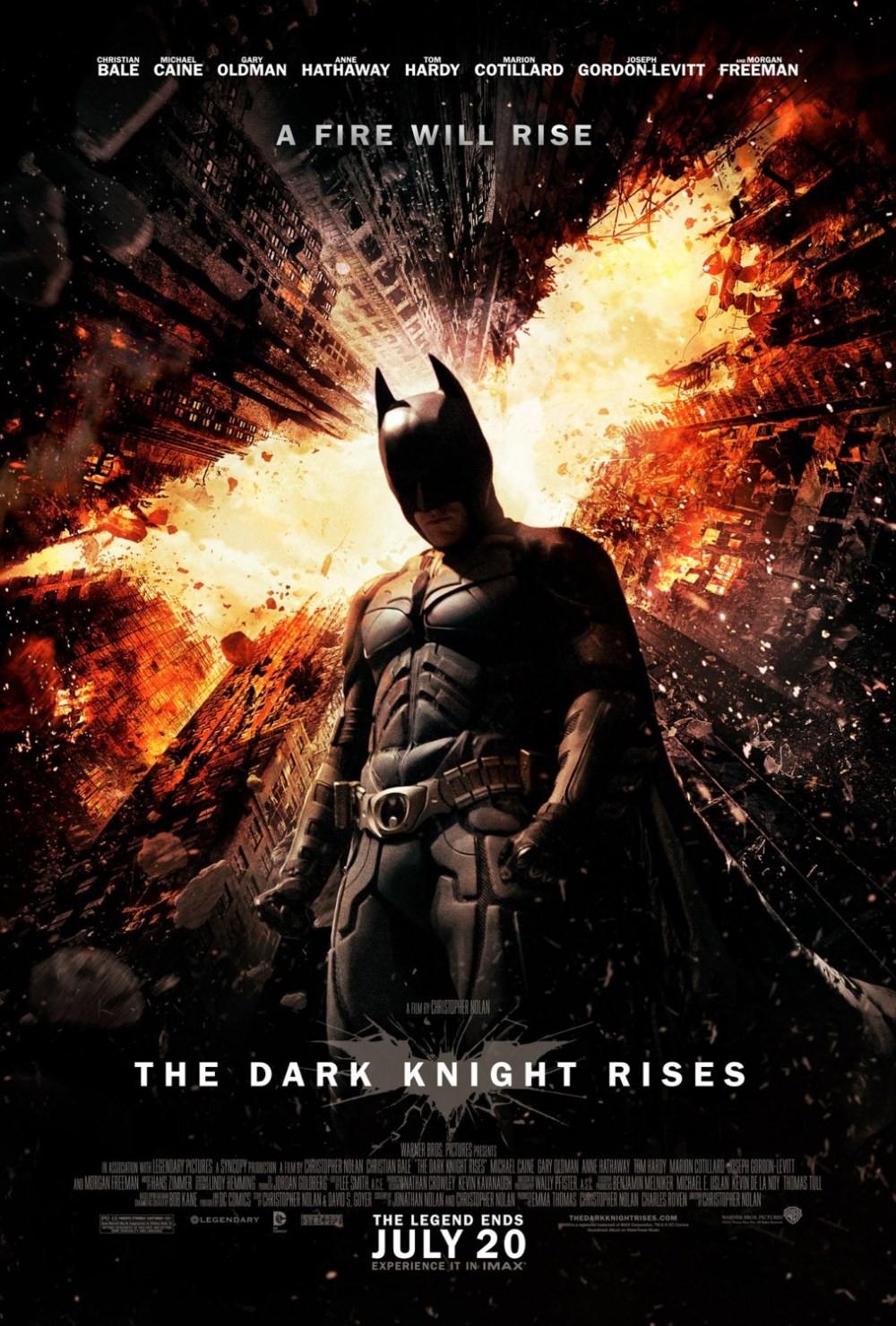
The Dark Knight Rises poster

With “The Dark Knight Rises,” filmmaker Christopher Nolan has completed one of the greatest trilogies in cinematic history. It is a thrilling spectacle with tremendous emotional power, and I came out of it not just fulfilled, but quite shaken. Regardless of whatever plot holes this movie may have, or if it has one too many characters to deal with, it is still as brilliant as its predecessors.

Now I’ll give you more or less a brief outline of “The Dark Knight Rises” without giving away major plot points. I know you all have been seriously pissed about reviewers ruining this movie for you like Homer Simpson ruined “The Empire Strikes Back” for a crowd waiting to see it outside a Springfield movie theater on “The Simpsons,” and I wouldn’t dare to do the same thing here.

Eight years have passed since Batman/Bruce Wayne (Christian Bale) took the fall for Harvey Dent’s death in order to hide the murders he committed and let him remain a hero in the eyes of Gotham’s citizens. Since then, Gotham has entered a time of peace and prosperity, all of which is based on a lie. Enter Bane (Tom Hardy), a brutal and methodical terrorist who plans to reduce Gotham to ashes slowly but surely. This brings Batman out of hiding, but he also has to deal with cat burglar Selina Kyle (Anne Hathaway) who catches him off guard, a beautiful corporate executive named Miranda Tate (Marion Cotillard), and the idealistic young cop John Blake (Joseph Gordon-Levitt) whose “hot head” ways make him much smarter than his fellow officers. So that’s it for the movie’s story.

Actually, to go into full detail over the plot of “The Dark Knight Rises” would take forever as it goes in various directions to where seeing it once is not enough to take everything in. Nolan has said part of his inspiration for this film was Charles Dickens’ “A Tale of Two Cities” which is known for this famous quote:

“It was the best of times; it was the worst of times.”

Now while this quote is never spoken in “The Dark Knight Rises,” it never needs to be. Nolan is fascinated with how the lie over Dent’s death has helped Gotham while at the same time turned it into a prison state where freedoms are eroded. It also parallels current events in the real world by taking into account the continuing gap between the rich and the poor and how people will go out of their way to manipulate the collective anger regarding it. This movie is a huge action spectacle, but it has a lot of things to say about the world we live in today which makes it all the more powerful.

Many have been calling this the “darkest” Batman movie of them all, as if the two which came before it were a sunny paradise in the realm of “Batman & Robin” (they most certainly were not). But while “The Dark Knight Rises” is indeed a dark vision of a city under siege, it also has a strong ray of hope emanating from it. Bruce Wayne has always wanted to hold Batman up as a symbol to inspire people, and you revel in seeing the impact he has on the characters around him.

People have also been saying Nolan has put far too many characters into this movie. Newsflash, Nolan has done this with each of his “Batman” movies, but what truly amazes me is how he has gotten away with doing so each time. Every single character in “The Dark Knight Rises,” from Matthew Modine’s bone-headed Deputy Commissioner Peter Foley to Ben Mendelsohn’s greedy businessman John Daggett, informs the movie’s main characters and overall themes throughout. Not a single one of them feels extraneous to the plot as each illustrates examples of justice and personal responsibility, and of how easily misconstrued they can end up being.

Christian Bale completes his tour of duty as Batman with a deeply felt performance. In many ways, “The Dark Knight Rises” is more about the rise of Bruce Wayne than anything else as he is forced to deal with who he is than what his alter ego can do. While Spider-Man and Superman are endowed with super powers, this movie renders him all the more vulnerably human as he starts off walking with a cane and dealing with injuries not easily healed. It’s those human flaws, however, which make Bale’s portrayal of Bruce Wayne all the more powerful and enthralling.

With Bane, Nolan has fashioned a villain far different from Heath Ledger’s Joker which was a smart move. While the Joker was far more desirous of watching the world burn, Bane simply wants it to suffer right down to its dying breath. With Tom Hardy, Nolan has found the perfect actor to portray Bane as he brings to life the character’s twisted code of ethics and his utter brutality which allows him to batter his helpless opponents with sheer efficiency. Thanks to Hardy, Bane proves to be Batman’s most formidable foe yet.

As for Anne Hathaway, she is excellent as the character known as Catwoman but who is never actually called Catwoman in “The Dark Knight Rises.” Her portrayal of Selina Kyle never invites easy comparison with the actresses who played her in the past as her version exists in the world of realism created by Nolan. Hathaway succeeds in giving this movie the feeling of exuberance and fun it needs from time to time, and she more than holds her own against Bale and Hardy. But then again, this should be no surprise to those who remember her Oscar nominated performance in “Rachel Getting Married.”

And, of course, you have the usual cast of supporting characters played by Sir Michael Caine, Morgan Freeman, and Gary Oldman. All of them are fantastic as always, and they give this movie the emotional heft it calls for throughout. We also get a great bunch of franchise newcomers like Joseph Gordon-Levitt who is sensational as the intelligent John Blake, and Marion Cotillard who radiates both beauty and mystery as Miranda Tate.

Technically, “The Dark Knight Rises” looks flawless with cinematographer Wally Pfister capturing the dark corruption consuming the citizens of Gotham which they are forced and inspired to rise out of. And with Hans Zimmer, minus James Newton Howard this time around, we get another rousing and thrilling music score which keeps our adrenaline pumping along with movie’s thrilling action set pieces.

Yes, the movie has some plot holes which I’m sure you will discover for yourself. None of them, however, were enough to derail my enjoyment of this awesome spectacle Nolan and company have put together. I’m not sure where I would rate this in the series, but while it doesn’t best “The Dark Knight,” it still comes very close to doing so and continues Nolan’s reign one of the best movie directors working today. I don’t think I am overreacting in the least when I declare “The Dark Knight Rises” to be a brilliant motion picture.

Oh yes, some will say that the movie’s final scenes seem to spell out a potential new direction for this franchise to take as if it were a set up for a sequel. I’d like to think it speaks to the influence Batman hoped to have on the citizens of Gotham, to inspire them to do good. Thanks to Nolan, Batman is a hero we can appreciate and applaud.

* * * * out of * * * * 

‘The Amazing Spider-Man’ is a Better than Expected Reboot

The Amazing Spiderman poster

When “The Amazing Spider-Man” was finally released in movie theaters everywhere, we finally got to answer the question nagging at us: isn’t it far too soon for a franchise reboot or remake or whatever the hell you want to call this? Well, the answer ends up going both ways here as Marc Webb’s film does tread familiar ground, but it gets better as it goes on. This time, our friendly neighborhood Spider-Man has a lot more edge to him and is a little more complex than he was in the Sam Raimi-directed movies.

This version starts off with a very young Peter Parker being left in the company of his Uncle Ben (Martin Sheen) and Aunt May (Sally Field) by his parents, Richard and Mary Parker (Campbell Scott and Embeth Davidtz), who are forced to leave town under mysterious circumstances. Forward several years later, and Peter is now a sullen teenager played by Andrew Garfield, one of several actors who should have gotten an Oscar nomination for “The Social Network.”

Like before, Peter is a social outcast who is not exactly the most popular person on the high school campus. But unlike Tobey Maguire’s interpretation, Peter here is sullener this time around; sensitive and shy while dealing with anger at the life he has been dealt which is anything but normal. In essence, he is more of a real-life teenager than he was in previous incarnations; confused about his place in life and unsure of himself. “The Amazing Spider-Man” hence becomes the story of a young man on a journey to find himself, and this helps ground the superhero in a reality we all know and understand.

The first part of “The Amazing Spider-Man” made me a bit impatient as it travels through all the things leading up to Peter adopting his alter-ego. Sam Raimi’s first “Spider-Man” movie may have come out ten years ago, but its images are still fresh in our minds. I’m not just talking about Kirsten Dunst kissing Maguire while he hangs upside down. Still, Webb and company do their best to make the material their own. The moments where Garfield develops his power to swing from place to place is exhilarating to watch, and whereas Raimi’s “Spider-Man” movies were like a comic book brought to life, Webb deals with Peter Parker in a more realistic fashion.

Speaking of Garfield, he has repeatedly said how happy he was to get this role, and the thrill he gets from playing this iconic comic book character is clearly on display. Throughout “The Amazing Spider-Man,” the actor looks to be having the time of his life, and he certainly has earned the right to enjoy himself based on his excellent performance here as he makes this role his own. I also really liked was how he wasn’t afraid to make Parker unlikable at times. Clearly this is a young man with issues, having lost his parents in a way no child should, and the actor makes Parker’s confusion over what is expected of him all the more palpable.

Matching Garfield scene for scene is the wonderful Emma Stone who plays his highly intelligent love interest, Gwen Stacy. Stone shares a strong chemistry with Garfield, and she gives the role a feisty kick which makes her so much fun to watch. She also infuses her Gwen with a strong humanity which keeps her from being just another love interest, and her performance goes way beyond what we could have expected.

Rhys Ifans portrays Dr. Curt Connors, once a friend of Parker’s father, who is developing ways to regrow limbs and human tissue. But something ends up going terribly wrong, as it always does, with an experiment, and he is soon turned into The Lizard. The dilemmas this character faces are not too different from what Norman Osborn/Green Goblin character dealt with, but Ifans makes the character a fascinatingly complex one as his intent to test his experimental serum on himself is not about proving oneself to a whole bunch of doubters as it is about taking responsibility for one’s creation when others are more interested in results and profit.

While I miss seeing the late Cliff Robertson and Rosemary Harris as Uncle Ben and Aunt May, both Martin Sheen and Sally Field fill the roles wonderfully. I also really liked Denis Leary as Gwen Stacy’s father, NYPD Captain George Stacy, who gets into an argument with Peter as to why he considers Spider-Man a vigilante. After watching him on “Rescue Me” and as an endlessly cynical standup comedian all these years, Leary once again reminds us of just how effective an actor he can be in playing an upstanding citizen and a strong family man.

Previously, Webb was best known for directing music videos, and the only other movie he made was “(500) Days of Summer.” You can’t help but wonder what the studio executives were thinking when they hired him after he made a $7.5 million indie movie to helm a summer blockbuster with a reported budget of over $220 million. Maybe all the other big name directors were busy or something. Then again, when you look at both “(500) Days of Summer” and “The Amazing Spider-Man,” they have strong similarities. Both feature main characters in the process of figuring themselves out while moving on to the next stage of their lives, and they also have them romancing a female who is as intelligent as she is attractive. Each movie succeeds in giving us relationships which were not the usual dopey romantic kind, and they are all the better as a result.

With “(500) Days of Summer,” Webb also showed a keen understanding of how important it is for the audience to be emotionally involved with the characters in a movie. This ended up making him an ideal choice to direct “The Amazing Spider-Man” as we need to care about these characters in order for the movie’s story and its special effects to work effectively. Webb succeeds in getting us emotionally involved in what goes on, and it makes this reboot stand out from the typical summer blockbuster which invades our local movie theaters more often than not.

Another thing I have to point out is the film score by James Horner. Danny Elfman had done such a brilliant job defining the sound of Spider-Man in Raimi’s movies, and this gave Horner a hard act to follow. But Horner succeeds in giving us music which is as adventurous and invigorating to listen to as Elfman’s was. Of course, this doesn’t keep him from stealing from himself as there is a musical cue from “Star Trek II” in here, and it is instantly recognizable to those who have listened to that soundtrack over and over again.

It would have been nice if Raimi and Maguire got to make a “Spider-Man 4,” if for no other reason than to make up for the huge disappointment that was “Spider-Man 3.” But in retrospect they must have seen the writing was on the wall as there was nowhere else for them to take the character. While a reboot still feels way too soon for this franchise, “The Amazing Spider-Man” is a very entertaining movie which looks to get this series back on track. Now that we got the origin story out of the way once again, we can get to an even more exciting chapter in Peter Parker and Gwen Stacy’s lives.

* * * out of * * * *

‘Prometheus’ is Great and I Don’t Care What You Say

Prometheus movie poster

How sweet it is to have Ridley Scott return to sci-fi genre 30 years after giving us “Blade Runner.” His “Prometheus” is a stunning movie to watch and once again reminds us of what a stylistic perfectionist he is. While it is said to be a prequel to “Alien,” it is really separate from the 1979 classic as it deals with a different set of themes and ideas. While the original “Alien” dealt with corporate greed in trying to use the creature as a weapon, “Prometheus” is far more fascinated with the origins of humanity.

Noomi Rapace, Lisbeth Salander in the Swedish version of “The Girl with The Dragon Tattoo,” stars as Elizabeth Shaw, an archaeologist who, along with her boyfriend Charlie (Logan Marshall-Green), discovers a star map in several unconnected ancient cultures on Earth. They come to interpret the map as an invitation from those who created humanity to discover the origins of life on a distant planet. A few years later they are on board the spaceship Prometheus which takes them and several engineers to that location.

When they land on the planet LV-223, not LV-426 from the first two “Alien” movies, they discover a species which appears to be extinct along with a monolithic statue of a humanoid head. In the structure they explore, they also find a large number of metal cylinders which soon start leaking black fluid. Soon after, everything goes wrong and the characters discover how their need to learn about humanity’s creators was a very big mistake.

The smartest thing Scott did with this particular prequel was to not make it the kind which ties up all the loose ends to the original movie that comes after it. This has been a big problem with prequels like “The Thing” and “X-Men Origins: Wolverine” as they get so concerned about getting the details right to where any suspense or drama gets completely drained, making for a far less effective movie going experience. “Prometheus,” however, takes place several decades before “Alien,” so the filmmakers don’t have to worry about this too much.

“Prometheus” uses the element of mystery to great effect as several characters appear to have ulterior motives they work to hide from others. Charlize Theron is especially effective as Weyland Corporation employee Meredith Vickers. Hiding discreetly in the shadows and coming off with a tough as nails attitude, she clearly has her own agenda as you would expect any member of this or any other, corporation to have.

The movie’s most fascinating character, as well as its most enigmatic, is David, an android designed to be indistinguishable from humans played by Michael Fassbender. We first see him looking over the ship while the rest of the crew is in hypersleep, and he models his behavior on Peter O’Toole’s performance from “Lawrence of Arabia.”

David is like Data from “Star Trek: The Next Generation” in that he is more human than the humans he works with. But the words of the Borg Queen from “Star Trek: First Contact” of how Data is “an imperfect being created by an imperfect being” kept echoing in my head as we see David gaining an ego to where he is fully aware of how superior he is to humans. With this ego comes a wealth of insecurities like envy and jealousy which wipe away the façade his infinitely polite behavior hides.

Idris Elba co-stars as the captain of Prometheus, Janek, who serves as the movie’s most realistic character. Sci-fi movies need a down to earth character like this because in the midst of all the technical mumbo jumbo, someone has to come out and say, “What the hell is going on?” Elba, so good on the BBC series “Luther,” is a strong addition to this cast even though I found his American accent a little weird at times. Couldn’t he have made Janek British like him? Anyway, he gives what may be seen as this movie’s most underrated performance.

But while much of the acting praise may go to Fassbender, I have to single out Rapace who gives a very strong performance as Elizabeth Shaw. Just watch her in the scene where another character yells right in her face that he wants to go back to the ship. Rapace doesn’t budge or blink at this raw anger, and she is as riveting in this movie as she is in that one scene.

Rapace also has the movie’s most unnerving scene as, upon finding that she has a “foreign organism” inside her body, gets into a robotic surgery device to have it removed. It’s a brilliantly icky scene which shakes up the audience in the same way watching Anthony Hopkins cut off a piece of Ray Liotta’s brain in “Hannibal” did. Rapace sells the scene completely and has you pinned in your seat as she goes through the kind of surgical procedure we’d rather be sedated through. On top of this, she does a practically flawless British accent which is more than I can say for many actors in American movies.

Among the other excellent performances comes from Sean Harris who plays the unhinged geologist Fitfield who never lets his mohawk hairdo upstage him, Guy Pearce who is almost unrecognizable under pounds of makeup as the CEO with a god complex Peter Weyland, Logan Marshall-Green as archeologist Charlie Holloway who goes to extremes in his work for better and for worse, and Rafe Spall as the all too friendly botanist Milburn.

“Prometheus” asks a lot of profound questions about who created us and why those same beings chose to abandon planet Earth. It deliberately doesn’t answer all of those questions, but while many consider this one of the movie’s biggest problems, I think it’s one of its many strengths. To answer all those questions would have weakened this movie tremendously and, as I said earlier, the element of mystery plays a strong part in its overall success.

There’s no real satisfying way to answer all the questions “Prometheus” presents as we have enough trouble answering them on our own. I think the movie’s main focus is on the struggle of faith as Rapace’s character thrives on it, and she spends the story seeing it severely tested. The lack of answers ends up reinforcing the faith she has in those who created human beings, and this keeps her faith from being killed off completely.

Scott gives us a visually sumptuous motion picture with extraordinary visuals and special effects which feel wonderfully unique to everything else out there. With cinematographer Dariusz Wolski, frequent music composer Marc Streitenfeld, editor Pietro Scalia, and writers Jon Spaihts and Damon Lindelof, Scott gives this movie the look and feel the only he can pull off, and it all makes his eagerly awaited return to the sci-fi genre he so brilliantly transcended with “Alien” and “Blade Runner” all the more welcome.

While “Alien” was a masterful combination of the sci-fi and horror genres, “Prometheus” is more sci-fi than horror. “Prometheus” has its thrilling moments, but Scott is not out to scare the shit out of us the way he did back in 1979. He is more cerebral with this film, and it makes you eager to see a sequel to it sooner rather than later. I don’t care what anybody says, “Prometheus” was very much worth the wait and, despite whatever flaws it may have, it had me enthralled from beginning to end.

Actually, one thing you could say about the movie is how it may give ammunition to creationists who claim human life came about through the efforts of a supernatural being. Then again, the very last scene of “Prometheus,” before the end credits roll, features a somewhat familiar-looking creature making an appearance you can’t quite see coming. With that, you can safely say the filmmakers do firmly believe in the theory of evolution.

* * * * out of * * * *

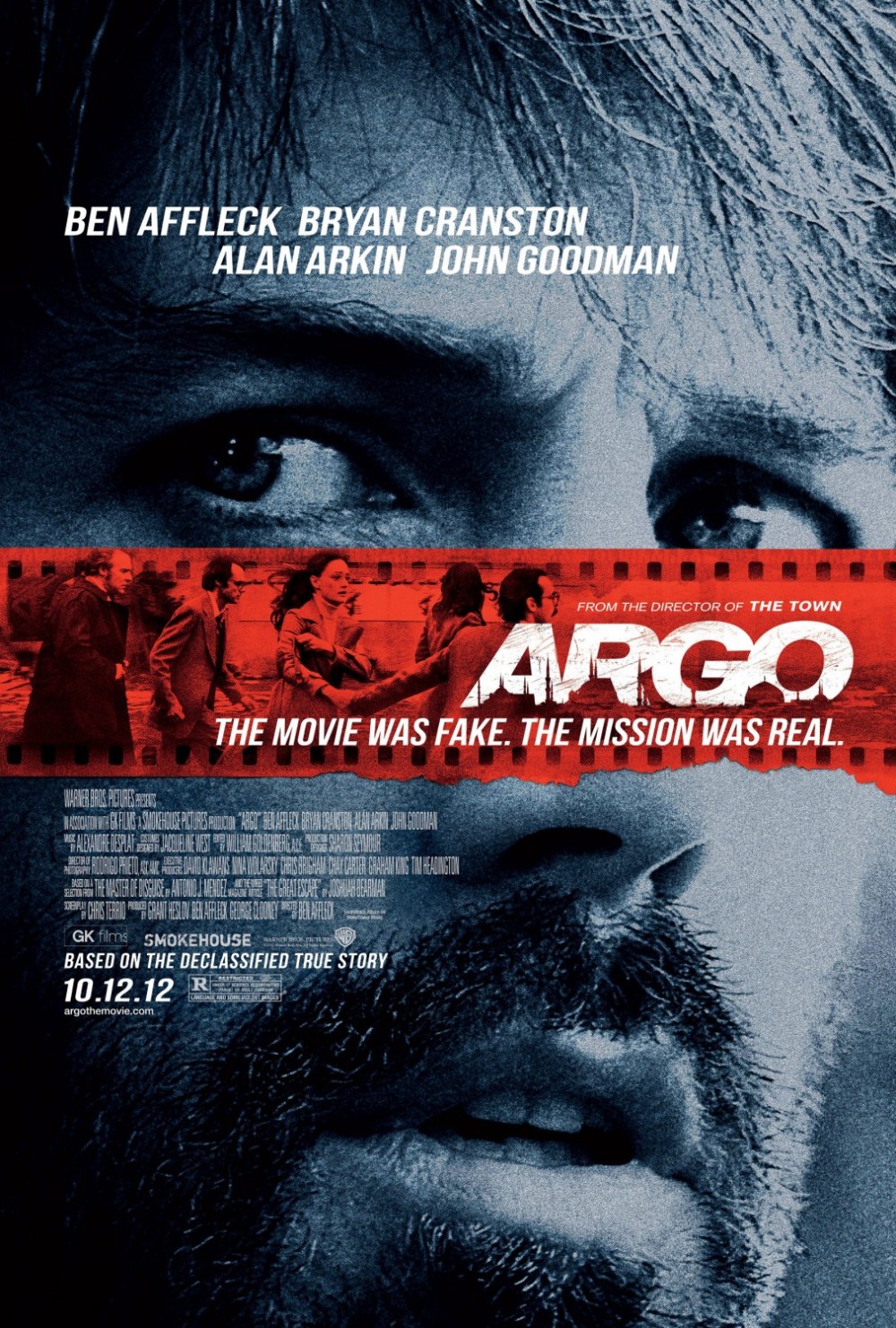
Argo

Argo movie poster

After the one-two punch of “Gone Baby Gone” and “The Town,” Ben Affleck should not have to prove what a great movie director he is. But for those who, for some utterly bizarre reason, still believe they need further evidence to support this conclusion, I give you “Argo.” His third movie as a director tells the story of how CIA specialist Tony Mendez went about trying to extract six U.S. diplomats out of Iran during the 1979 hostage crisis. It proves to be a very intense experience watching this movie, and I also got a huge kick over how it skewers Hollywood and the business of making movies as well.

I loved how Affleck really went out of his way to make “Argo” look like a 70’s movie. He even included the old Warner Brothers logo (referred to as the “Big W” logo) which preceded the studio’s movies from 1972 to 1984. I’ve really missed this logo for the longest time.

Anyway, when Iranian revolutionaries ended up storming the U.S. embassy in Tehran, six diplomats manage to evade capture and find refuge in the home of Canadian ambassador Ken Taylor (Victor Garber). Meanwhile, back in the United States, the State Department has learned of the escapees and their predicament, and they start looking for ways to get them out of Iran. It is Mendez who comes up with the idea, after watching “Battle for the Planet of the Apes” on television, to create a cover story of how the six are actually filmmakers from Canada who are scouting locations for a fake sci-fi movie called Argo. This looks to be one of those “so bad it’s good” kind of movies, and it would have been fun to watch for all the wrong reasons had it ever been made.

The scenes where Mendez goes to Hollywood are among my favorites in “Argo” as he works with movie business veterans who are keenly aware that lying to others is part of their job description. John Goodman and Alan Arkin are priceless as make-up artist John Chambers and film producer Lester Siegel, and they are given great pieces of dialogue to speak throughout. The lines Arkin is given are especially biting:

“You’re worried about the Ayatollah? Try the WGA!”

The tension is then ratcheted up tremendously when Mendez heads over to Iran to prep those six diplomats on how to get out of the country alive. You feel their collective anxiety as they become fully aware of how one little slip up will get them quickly executed in public view, and you are with them every step of the way as the walls continue to close in on them. Emotionally speaking, “Argo” is the first movie I have found myself crying after in a long time, and the tears I cried were from sheer relief.

“Argo” is based on a true story and, while this remains a serious pet peeve of mine, this is one which needed to be told. It wasn’t until 1997 that this rescue operation was declassified for all the world to know about, and it speaks a lot about how two countries can come together in a tough situation (in this case, the U.S. and Canada). Yes, portions of the story were fictionalized for dramatic purposes, but that’s always the case so just get over it.

Affleck casts a lot of great acting veterans in “Argo,” and kudos to him for doing so. I’ve already mentioned Goodman and Arkin, but you will also find Bryan Cranston, Kyle Chandler and Philip Baker Hall doing terrific work here as well. As for the diplomats, they are played by such actors as Clea DuVall and Tate Donovan among others, and they all are uniformly excellent.

In addition to directing this movie, Affleck also stars as Mendez and gives a particularly understated performance. I know we all love to pick on him as an actor, but he’s a better one than we give him credit for. Not once does Affleck try to steal the show from the actors around him, and his work is commendable as acting and directing a movie at the same time can be a real pain in the ass.

“Argo” has more than earned its place among the best movies of 2012, and it makes clear that Affleck’s success as a director is no fluke. This is a guy who has seen the heights of success and the utter embarrassment of failure, and he has come out the other side of it all proving he is a great talent whether he’s in front of or behind the camera.

Be sure to stay through the end credits as well as there is information you will need to hear about this true story.

* * * * out of * * * *

Arbitrage

arbitrage-movie-poster

Definition of Arbitrage:

  1. The nearly simultaneous purchase and sale of securities or foreign exchange in different markets in order to profit from price discrepancies.
  2. The purchase of the stock of a takeover target especially with a view to selling it profitably to the raider.

Arbitrage” looks like the average thriller better suited to the usual made for TV movie on network television or the Lifetime Channel. However, it turns out to be a brilliant thriller which takes a seemingly simple story and spins it into a complex one filled with characters that seem easy to figure out but prove to be anything but. Just when you think this will be a film about what’s right and wrong, it becomes one in which everyone finds their moral values permanently compromised no matter how good their intentions are.

Richard Gere stars as Robert Miller, a hedge-fund magnate whose every inch of his being oozes success like it’s supposed to. Robert looks to have all the money he ever needs, a loving family, a loyal wife, grandkids and the whole nine yards. We soon find, however, that he is deeply immersed in fraudulent practices which could tear his whole empire down if exposed. Robert’s only salvation is to sell off his trading empire to a major bank before his wall street crimes are revealed so he may pay off all his debts for good.

But things get seriously complicated for Robert when he is driving to upstate New York with his mistress Julie (Laetitia Casta) and their car flips over on the road. The crash ends up killing Julie and leaves Robert in a serious predicament as he cannot report what happened to the police. If he does, it will seriously delay the sale of his company which could put him and his family on the brink of financial disaster. The walls continue to close in when NYPD Detective Michael Bryer (Tim Roth) is assigned to the case and finds circumstantial evidence implicating Robert in Julie’s death. The question is, how much longer he can keep up this moral duplicity before it undoes him permanently?

“Arbitrage” marks the directorial debut of writer Nicholas Jarecki whose work deals with larger than life characters and morally ambiguous themes of industry, power, and corruption. What I loved about his direction here was how naturalistic everything seemed, be it the acting or the setting. No one in the cast overdoes their performance which makes for a more invigorating cinematic experience than we typically get.

Jarecki also gives us some brilliantly conceived characters who appear to represent right and wrong very clearly, but as the story goes on, we find they are not immune to moral compromises. Even the police detective who represents working class Americans sick of being screwed over by the rich proves he is not above bending the rules to get a conviction. All this time, Julie becomes less of a human being and more of a bargaining chip for everybody involved.

I was listening to an interview with Gere and NPR’s Audie Cornish who remarked how she’s always rooting for the actor no matter what character he plays. Whether he’s playing a slick defense attorney who lives for self-promotion in “Primal Fear” or as a seriously corrupt cop in “Internal Affairs,” Gere comes across as strangely likable even when his characters are jerks to say the least. His role as Robert Miller is further proof of how brilliantly he portrays the kind of people we love to hate in these endlessly difficult economic times.

Robert is at his heart a slick manipulator and a liar; he deceives his children, cheats on his wife, is knowingly committing fraud, and is not about to accept any responsibility for his mistress’ death. Throughout “Arbitrage’s” running time, Gere is riveting as he tries to stay one step ahead of the law, and we find ourselves rooting for him to do so. We should despise this man and his morally duplicitous ways, but you have to admit Robert is a very smart guy who has managed to stay afloat despite some bad decisions.

Although his New York accent sounds a little weird, Tim Roth is also excellent as NYPD detective who becomes bent on taking Robert down. His character of Michael Bryer is on the side of law and justice, but he proves to be as ruthless as Robert while he pursues witnesses relentlessly, and he has no problem threatening their livelihoods in order to get a conviction.

Nate Parker plays Jimmy Grant; a family friend of Robert’s who helps him out of and then finds himself in the middle of his problems. Jimmy is a familiar character in that he is caught between doing the right thing and keeping his mouth shut and we see so many of them in movies. But Parker does great work in conveying Jimmy’s inner turmoil to where this character seems like anything but a cliché, and he makes you feel what it’s like to walk in his shoes.

Brit Marling is wonderful as Robert’s daughter and heir-apparent Brooke, and seeing her transition from loyal daughter to one whose trust is forever shattered is heartbreaking. Her scene with Gere will remind those of us who have been put into impossible situations we cannot easily extricate ourselves from, and the look on her face is one which never goes away.

But it’s Susan Sarandon who almost steals the show as Robert’s wife Ellen, and she reminds us what a powerhouse of an actress she can be. Sarandon portrays Ellen as loyal almost to a fault, but she reveals vulnerabilities throughout which indicate she knows more about what’s going on than Robert realizes. Sarandon’s final confrontation with Gere is a knockout as she comes up with an extra strategy which is as brilliant as the one Katie Holmes pulled on Tom Cruise.

In addition, there’s also a wealth of beautiful cinematography by Yorick Le Saux and a music score by Cliff Martinez which fits this material like a glove.

I was stunned at how much I liked “Arbitrage,” and it really is one of the best movies I saw in 2012. It’s the kind of film you can’t quite prepare yourself for how good it will be because it came cloaked in trailers and advertisements which make it look ho-hum. Jarecki, however, gives us a film which is anything but average, and I thank him for that.

* * * * out of * * * *

Lincoln

lincoln-movie-poster

The one thing which always drove me nuts in history class as a kid was how the teachers and the books we read made the past seem so much better than our present. We were taught about how Presidents like George Washington and Abraham Lincoln were such great leaders who helped make America the country it is today, and in the process, they were turned into mythological characters to where we forgot they were human beings like the rest of us. Juxtaposing this with the politics of America back when Ronald Reagan was President, it looked like we could do nothing but complain about the state of the world. It made me wonder what we did as Americans which made us seem so ungrateful for what our forefathers brought about.

This is why I’m thankful for movies like Steven Spielberg’s “Lincoln” which helps to humanize those historical figures we learned about in class. In this case, the historical figure is Abraham Lincoln, the 16th President of the United States. The film focuses on the last four months of his Presidency when the Civil War was raging on and was insistent on getting the Thirteenth Amendment, which abolished slavery, passed in the House of Representatives. It presents this President, one of the greatest America has ever known, as a flesh and blood human being endowed with strengths and flaws which will make you admire him more than ever before.

Much of the accomplishment in making President Lincoln so vividly human here is the result of another unsurprisingly brilliant performance from the great Daniel Day Lewis. Known for his intense method acting and laser sharp focus in preparing for each role he does, he brings his own touches to a man so defined by his historical deeds, and he succeeds in making this character his own during the movie’s two and a half hour running time.

“Lincoln” also shows how the world of politics has always been a cutthroat place to be in. The Republican and Democratic parties were much different than from what they are today, but during the 1800’s getting certain amendments passed involved a lot of tricks which were not always highly regarded. Even Lincoln wasn’t above hiring three politicians, played by Tim Blake Nelson, John Hawkes and James Spader, to lobby members of the House to vote in favor of passing the Thirteenth Amendment. But what made this President’s actions especially courageous was how he wasn’t just thinking about solving the country’s problems but of the effects this particular amendment would have on generations to come.

“Lincoln” also delves into the President’s personal life which had been fractured by the loss of a child and was also unsteady due to the fiery personality of his wife Mary, played by Sally Field. Watching Field here reminds us of what a remarkable actress she remains after all these years. Field is such a live wire as she struggles to make her husband see the consequences of the actions he is about to take. The actress had signed on to play this role years ago, back when Liam Neeson was set to play Lincoln, and she had to fight to keep it. It’s a good thing Spielberg kept her around because she has always been a tremendous acting talent, and she enthralls us in every scene she appears in.

Like many of Spielberg’s best films, there isn’t a single weak performance to be found in “Lincoln” which boasts quite the cast. Joseph Gordon-Levitt, who had a heck of a year in 2012 with “The Dark Knight Rises,” “Looper” and “Premium Rush,” is excellent as Lincoln’s oldest son, Robert, who considers quitting school to join the army and fight for his country. David Strathairn is a wonderfully strong presence as Secretary of State William Seward, the great Hal Holbrook is unforgettable as the influential politician Francis Preston Blair, Gloria Reuben is very moving in her performance as former slave Elizabeth Keckley, and Jackie Earle Haley has some strong moments as the Confederate States Vice President Alexander H. Stephens.

But the one great performance which needs to be singled out in “Lincoln,” other than the ones given by Lewis or Field, is Tommy Lee Jones’ who portrays the Radical Republican Congressional leader Thaddeus Stevens. Jones is a powerhouse throughout as he empowers this fervent abolitionist with a passion as undeniable as it is undying, and seeing him reduce other congressional members to jelly is a thrill to witness. Jones is tremendous as we see him fight for what he feels is right regardless of how he goes about achieving it.

Spielberg employs his usual band of collaborators here like producer Kathleen Kennedy, director of photography Janusz Kamiński, editor Michael Kahn and composer John Williams to create a movie which captures the importance of Lincoln’s place in history while also making it intimate in a way we don’t expect it to be. He also benefits from having the great playwright Tony Kushner on board as the movie’s screenwriter. Kushner’s knowledge of history has never been in doubt ever since we witnessed his magnum opus of “Angels in America,” and word is he spent six years working on the script for “Lincoln.” His efforts do show as he gives us a riveting portrait of a divided nation on the verge of making a major change, and even back then America was resistant and deeply frightened to making certain changes regardless of whether or not it would benefit from them.

Granted, Lincoln’s life would probably be better explored in a miniseries as there is so much to explore, and this movie can explore only so much of it. Regardless, “Lincoln” is an invigorating portrait of a great American President who fought for the benefit of his country’s future. The sacrifices he made tragically cut his life short, but his legacy will never ever die as Spielberg’s film rightly proves.

* * * * out of * * * *