‘Tinker Tailor Soldier Spy’ Has Gary Oldman Giving One of His Best Performances
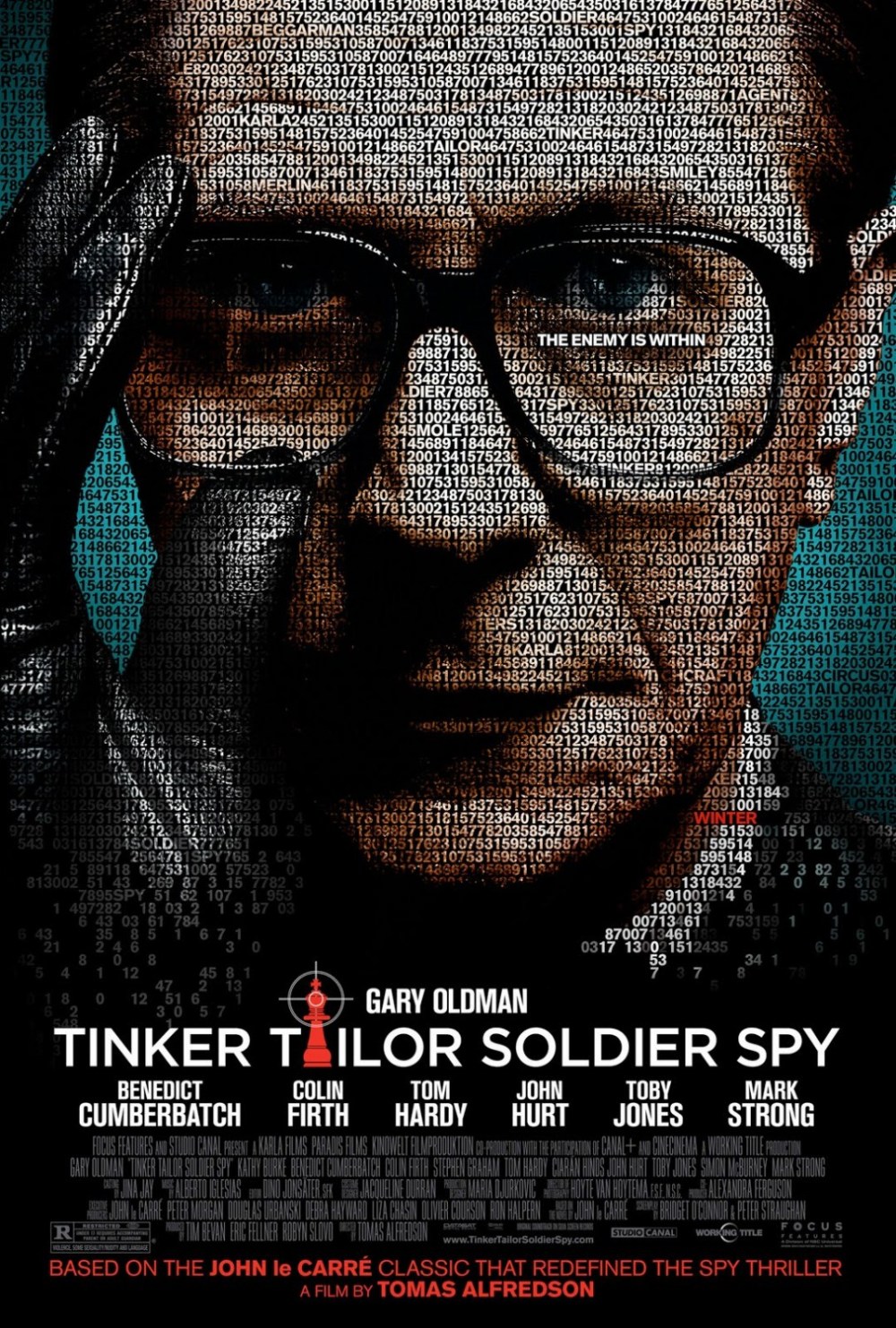
Tinker Tailor Soldier Spy movie poster

It’s interesting how the spy world in John le Carré’s novels differs sharply from the one in Ian Fleming’s. Whereas James Bond was a dashing playboy of a spy and the good and bad guys were easy to tell apart, the spies in Carré’s world exist in a morally gray area, and their lives prove to be anything but glamorous. No one is innocent, and everyone has something to hide from others or perhaps even themselves. Here, there are no gunfights or explosions but instead conflicts both internal and external. Even the people we look up to in Carré’s novels are deeply flawed, and you can quickly see why no one can truly trust one another.

No book in Carré’s vast library of work exemplifies this more than “Tinker Tailor Soldier Spy” which features his most famous fictional character, George Smiley. Originally turned into a brilliant BBC miniseries back in 1979 with Sir Alec Guinness as Smiley, it has now been made into a motion picture with Gary Oldman in the lead role. Whereas the miniseries had more time to develop the story and characters, this movie does an excellent job of doing the same in a shorter span of time. Granted, much has been left out from the novel, but those unfamiliar with the miniseries are unlikely to notice.

The movie hovers around the goings on in The Circus, the codename for British Intelligence. After one operation goes wrong and an agent is killed, the head of Intelligence, Control (John Hurt), is forced to resign along with his right-hand man, Smiley. Smiley, however, is brought back into service when it becomes apparent there is a mole in British Intelligence. Moreover, it’s a mole which has been in The Circus for a long time, and he is a senior member with access to all sorts of secret information. Smiley, in his own way, seeks out the mole before the British become completely compromised in world affairs, and what results is a game of chess more than a battle of wits.

Casting Oldman as George Smiley at first seems like a surprising choice. Oldman made his film debut as Sid Vicious in “Sid & Nancy,” and his performance as the doomed punk rocker reminds us of how over the top he can be as an actor, and I always looked forward to seeing him play the villain in movies like “The Professional” and “Air Force One.” We revel in his emotionally unhinged performances which have made him stand out prominently among other actors of his ilk, and he has rarely, if ever, let us down.

As Smiley, however, Oldman is forced to dial back on the manic energy he became famous for. George Smiley is a character who never loses his cool and conveys so much even through the simplest of gestures. With even an ever so slight movement, we can see Smiley’s thought process at work and are never in doubt of how powerful a character he is. Each movement Oldman takes as Smiley is one which has been deliberately thought out, and even he knows he doesn’t have to bounce off the wall as this famous spy because this one goes into the room knowing all he needs to know.

In recent years, Oldman has gotten to stretch a bit with roles like Sirius Black in the “Harry Potter” movie franchise. While Black is first seen as a bad guy, it turns out he is a good one who cares deeply about Harry’s well-being. Then there is his role as James Gordon in Christopher Nolan’s “Batman” movies where he makes the good guy seem very cool without being such a square. What makes George Smiley an especially interesting character is he is neither a good or bad guy, but instead someone who is forced to navigate the dirty waters which he cannot help but get submerged in from time to time.

This is one of those roles which drive most actors crazy because it can become ever so easy to become utterly self-conscious about every single scene they are in. Being an actor myself, I often wonder if I am doing enough or perhaps too much in one performance to the next. While acting on the stage makes this easier to answer, acting in a movie or television is not only different but far more intimate. In the latter, you have to be more natural to where the camera never catches you emoting, and this can be difficult to say the least. But it’s those subtleties which can provide amazing results with the right director watching over you.

“Tinker Tailor Soldier Spy” also has a cast of brilliant British actors like John Hurt, Colin Firth, and Toby Jones, all of whom do their best in playing characters who have long since accepted the fact that they are morally compromised. You also have Tom Hardy, who succeeded in doing so much with just his eyes as Bane in “The Dark Knight Rises,” as a British agent who is only beginning to become morally compromised. None of these intelligence officers are easy to decipher on the surface, and a lot of this is thanks to their excellent performances.

Directing this adaptation is Tomas Alfredson who directed the great film “Let the Right One In.” Alfredson handles the intricacies of a story which could easily have become convoluted in terrific fashion, and he keeps us enthralled throughout. Even if we can’t follow the story, he succeeds in keeping us on the edge of our seat all the way to the end. Furthermore, he generates an intense and exciting climax without the use of gunplay or explosions, and there is something to be said about that.

Describing all which goes on in “Tinker Tailor Soldier Spy” is not easy, but it is not an impossible story to follow. Watching this movie for a second time will help give you a chance to examine the subplots more closely. While the spy world of Carré may seem nowhere as exciting as the one Fleming created for 007, it deals with the real world more directly as the line between right and wrong is forever blurred. What’s fascinating is how these people survive in it even as they continue losing pieces of themselves in a world and time which is prepared to beat them down on a regular basis. Everyone involved deserves a lot of credit for making what might seem ordinary and unglamorous seem so relentlessly thrilling.

* * * * out of * * * *
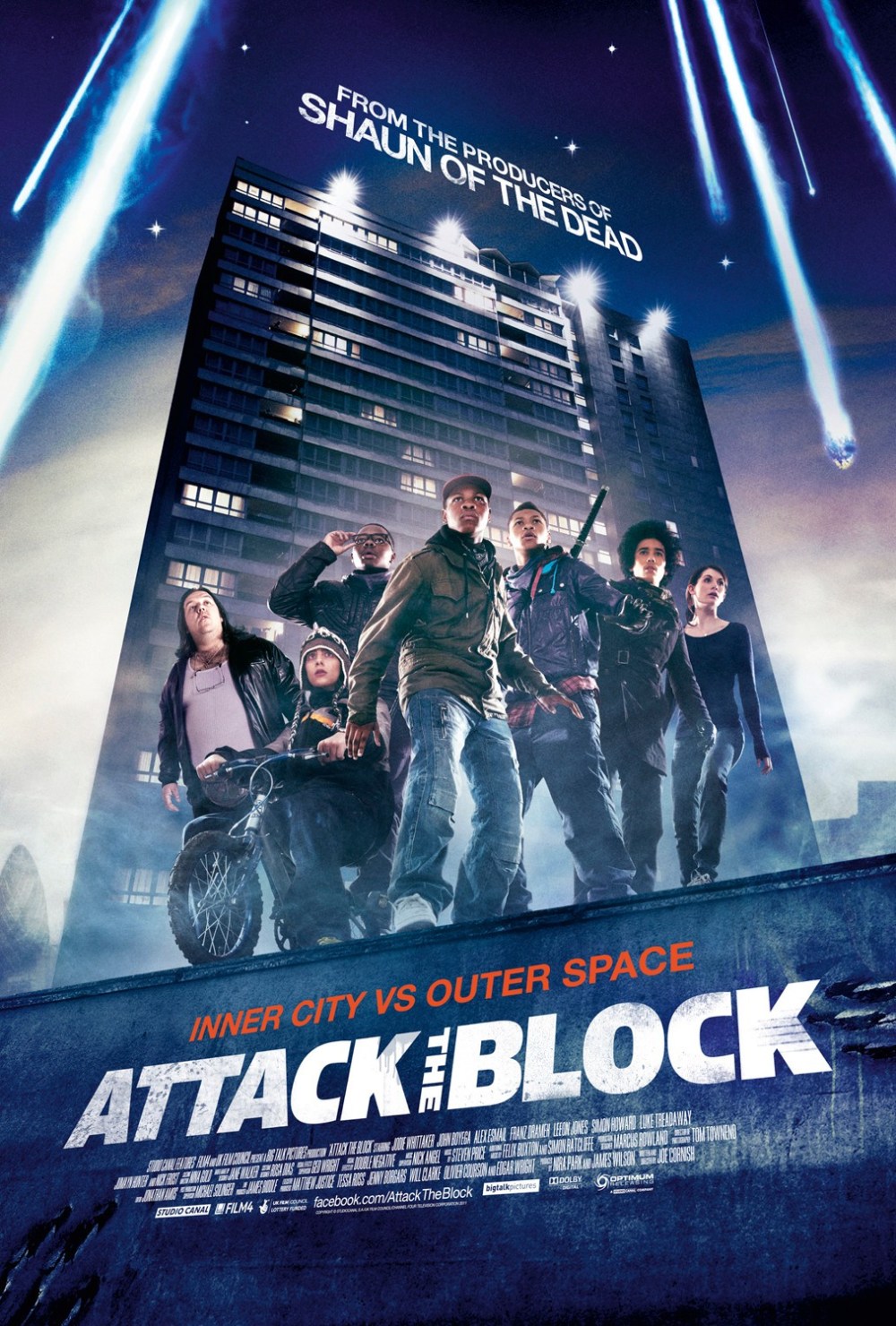
 

‘Attack the Block’ Features John Boyega in a Terrific Debut Performance

Attack the Block movie poster

Attack the Block” is a highly entertaining combination of action and sci-fi genres which deals with humans defending themselves against a swarm of unfriendly extra-terrestrials. It follows a street gang of young kids who, in the process of robbing a female nurse, get greeted by an alien who lands with a loud thud on someone’s car (here’s hoping they have auto insurance). It marks the beginning of an attack by an alien race which immediately tears apart anything in its path, and it’s up this gang of delinquents to save the day.

The majority of “Attack the Block” takes place in a council estate, a location which houses the financially challenged of England’s residents, and it is generally overrun by a nasty criminal element. This setting has been used to great effect in “Fish Tank” and “Harry Brown,” movies which effectively showed how isolating it can be to live there. The characters presented feel very true to life, and it makes what could be seen by many as another B-movie far more effective as a result.

Leading this street gang is Moses (John Boyega), a 15-year-old who is older than his age would suggest. Moses and his mates spend their time robbing those walking through the terrace they live in. But when the aliens enter into their territory, they find antagonists that are completely unwilling to give up their valuables (assuming they have any), and the threat they pose to this gang make their struggles in daily life a cakewalk in comparison.

“Attack the Block” was directed by Joe Cornish, an English comedian, television and radio presenter, director, writer and actor. This marks his directorial debut as he has previously helmed several behind the scenes documentaries like “The Fuzzball Rally” featured on the “Hot Fuzz” DVD and Blu-ray. Cornish’s work here is very assured, and he does an excellent job of combining elements of horror and comedy to great effect, something never easy to pull off. He also generates highly suspenseful moments which really get the audience on edge, and they make for a surprisingly unpredictable motion picture.

Of all the performances, the most impressive comes from John Boyega as Moses. This is his film debut, but he looks and acts like he’s been acting for ages as his eyes reveal a battle over how far he will go and of all the bad things he has seen in life. As the fight against the aliens goes on, it offers his character a chance for redemption and to be a hero, and Boyega makes Moses earn those honors long before the film’s conclusion.

Also impressive is Jodie Whittaker as Sam, a hospital nurse faced with an impossible situation where she has to work with the same gang of kids who mugged her in order to survive. Whittaker convincingly takes her character from being a frightened woman to one who holds her own alongside these kids, and she is not your typical horror victim screaming her way throughout the entire movie.

It’s also great to see Nick Frost here as the drug dealer, Ron. Frost brings an ever so dry humor to the proceedings, and all the other actors work off of him to great effect. In each movie he does, Frost is brilliant at sneaking the occasional joke in when you least expect it, and you can always count on him to leaving on the floor laughing.

“Attack the Block” was made for only $13 million, and the visual effects the filmmakers came up with are very impressive considering the budget. Having less money forces directors to be more creative, and Cornish succeeded in making this film look like it cost a lot more. The aliens themselves are minimal in their design, but they feel far more threatening than the ones you might remember from “Cowboys & Aliens.” Their pitch-black fur is highlighted by neon-like eyes and teeth, and their horrendously loud shriek is certain to make audiences jump out of their seats more often than not.

The action is also highlighted by a super cool electronic score by Basement Jaxx which really puts you in the right frame of mind. I definitely recommend buying the soundtrack once you have watched this movie. I myself didn’t even hesitate in purchasing a copy. That’s how much I like this kind of film music.

The summer 2011 movie season was mostly disappointing due to a lack of creativity and inspiration as many of the blockbusters were cynically made by studios with the intention of making money while giving audiences what they thought they wanted. Watching “Attack the Block” though is a great reminder of how much fun it can be to go to the movies, and it was one of the best action movies to come out that year. This is a must see.

* * * ½ out of * * * *

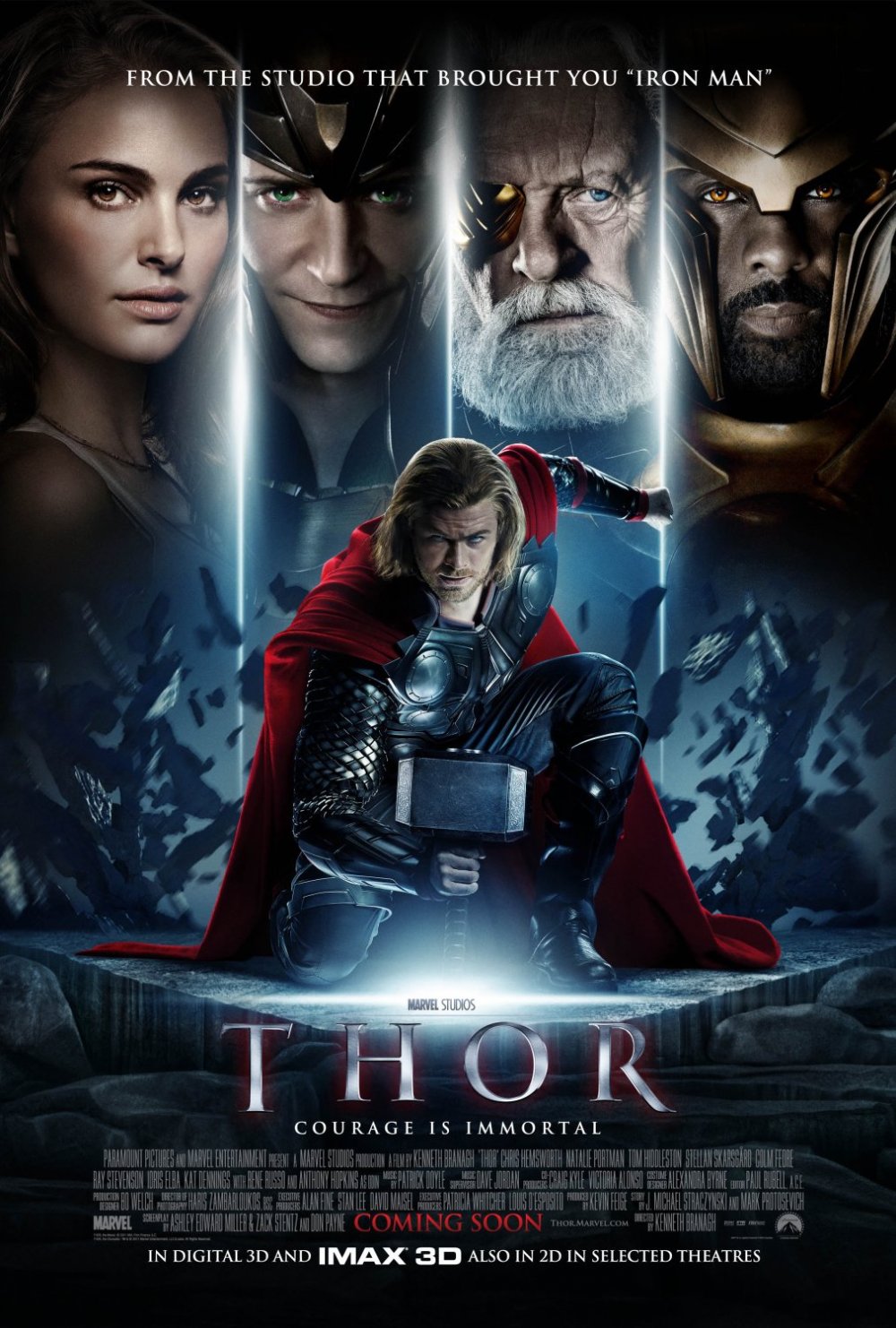
‘Thor’ Arrives with Thunderous Abandon

Thor movie poster

Thor” makes its presence known with thunderous abandon. Now like many comic books, this one is yet another I haven’t read, so I can’t say how true it stays to its origins. However, judging from the great Kenneth Branagh’s handling of the material, I imagine it’s very respectful to the character.

Heeding closely to classic Norse mythology, Thor is the god of thunder and heir to the throne of Asgard. But on the day of his ascension, the Frost Giants invade the planet’s deeper regions to retrieve the Casket of Ancient Winters, the source of their power. They are easily defeated, but their violation of the truce put together between them and Asgard seriously pisses Thor off. Against his father’s wishes, he and his fellow warriors journey to the Frost Giants home planet of Jotunheim to keep some frosty ass. Odin, however, intervenes and, infuriated with his son’s arrogance, strips him of his powers and banishes him to Earth. For a warrior like Thor, being banished to Earth does feel like a nasty insult.

First off, I really liked the way Branagh handled this material. In the wrong hands, this could have easily become high camp which would have been enjoyable for all the wrong reasons. But Branagh takes the characters and places they inhabit seriously, and he infuses them all with a strong humanity which comes to define them more than does their place in the universe. Even the villains are remarkably complex as their corruption results not so much from a need for power, but instead for a father’s love and approval. Of course, with Branagh directing, you can count on many Shakespearean references throughout, be it Iago from “Othello” or “King Lear,” and they prove to be a perfect fit for this movie.

I was also impressed with how well Branagh handled the visual elements of “Thor.” The last time he made a movie heavy with special effects was “Mary Shelly’s Frankenstein,” and he seemed a bit out of his league with that one. Perhaps we should not be impressed as this movie has a budget of at least $100 million, not counting advertisement costs, but the key thing here is the effects succeed in being an extension of the characters instead of just dwarfing them completely. Then again, that giant creature the Frost Giants unleash on Thor immediately had Liam Neeson screaming in my head, “RELEASE THE KRAKEN!!!”

As Thor, Chris Hemsworth, who played Captain Kirk’s father in J.J. Abrams’ “Star Trek,” owns the role right from the first moment he walks onscreen. Hemsworth clearly revels in portraying the great power Thor possesses, and he is a gentleman when the situation calls for it. Seeing him as a fish out of water on Earth also makes for some splendid moments which are slyly comic. I’m also glad to see Thor is not just another character who doesn’t want to be “the one,” conflicted about the things he is destined to do. With Hemsworth, you know from the get go he is fully aware he’s “the one” and owns this knowledge to where you feel his impatience in wanting to prove it to the universe. Instead of a whiny Anakin Skywalker, Hemsworth gives us a powerful warrior worth cheering for, and one who eventually learns from his mistakes.

As scientist Jane Foster, Natalie Portman’s casting in the role seems like a no brainer. We know from her off screen life that she is a remarkably intelligent human being, so she doesn’t have to prove to us how believable she can be as a scientist. She sparks instant chemistry with Hemsworth (damn those six pack abs!!!), and that shy smile of hers kills me every single time.

Then there’s the great Sir Anthony Hopkins whose portrayal of Asgard’s king and father to Thor, Odin, is nothing short of gallant. This is especially the case with the opening narration which he recites with such depth to where he makes all other actors who’ve done it before him sound like they were sleepwalking their way through it. While many may think this is one of those roles Hopkins did for an easy paycheck, it’s really one of the best performances he’s given in a while.

Tom Hiddleston plays Loki, Thor’s brother and the movie’s main villain. What I liked about Hiddleston is how he does so much more than give us the usual one-dimensional bad guy. Just like Joaquin Phoenix’s character from “Gladiator,” Loki feels slighted by his father as he prefers another man over him, and he becomes desperately eager to prove himself in any way he can. But of course, he ends up doing it in the worst way possible. Hiddleston makes Loki into a character who is more spiteful than hateful, and this makes his eventual fate seem all the more tragic in retrospect.

There are other strong performances throughout this blockbuster affair to enjoy as well. Rene Russo, where have you been? Idris Elba makes a memorable Heimdall, and it never seems like a small part with him playing it. Kat Dennings steals a few scenes as Darcy Lewis, Jane’s co-worker whose science is more political than astronomical. And Stellan Skarsgård remains a dependable actor as always playing scientist Erik Selvig, a character who ends up playing an important role in “The Avengers.”

Having said all this, “Thor” did feel like it could have been a little more exciting. It doesn’t quite have the same invigorating sweep as some of Branagh’s Shakespeare adaptations like “Hamlet” or “Henry V,” and it takes longer to get to the action than it should. It’s not quite as entertaining as “Iron Man,” but I would definitely rank it above “The Incredible Hulk.”

Regardless, there is still much to like about “Thor,” and Branagh has done the best job anyone could have in bringing this particular comic book hero to the big screen in such a respectful fashion. It also benefits from excellent casting, especially Hemsworth who looks like he came out of the womb looking like a warrior with a mighty hammer in his hand. This is one of the few times where “getting hammered” will sound more like a threat than an embarrassing state of drunkenness.

* * * out of * * * *

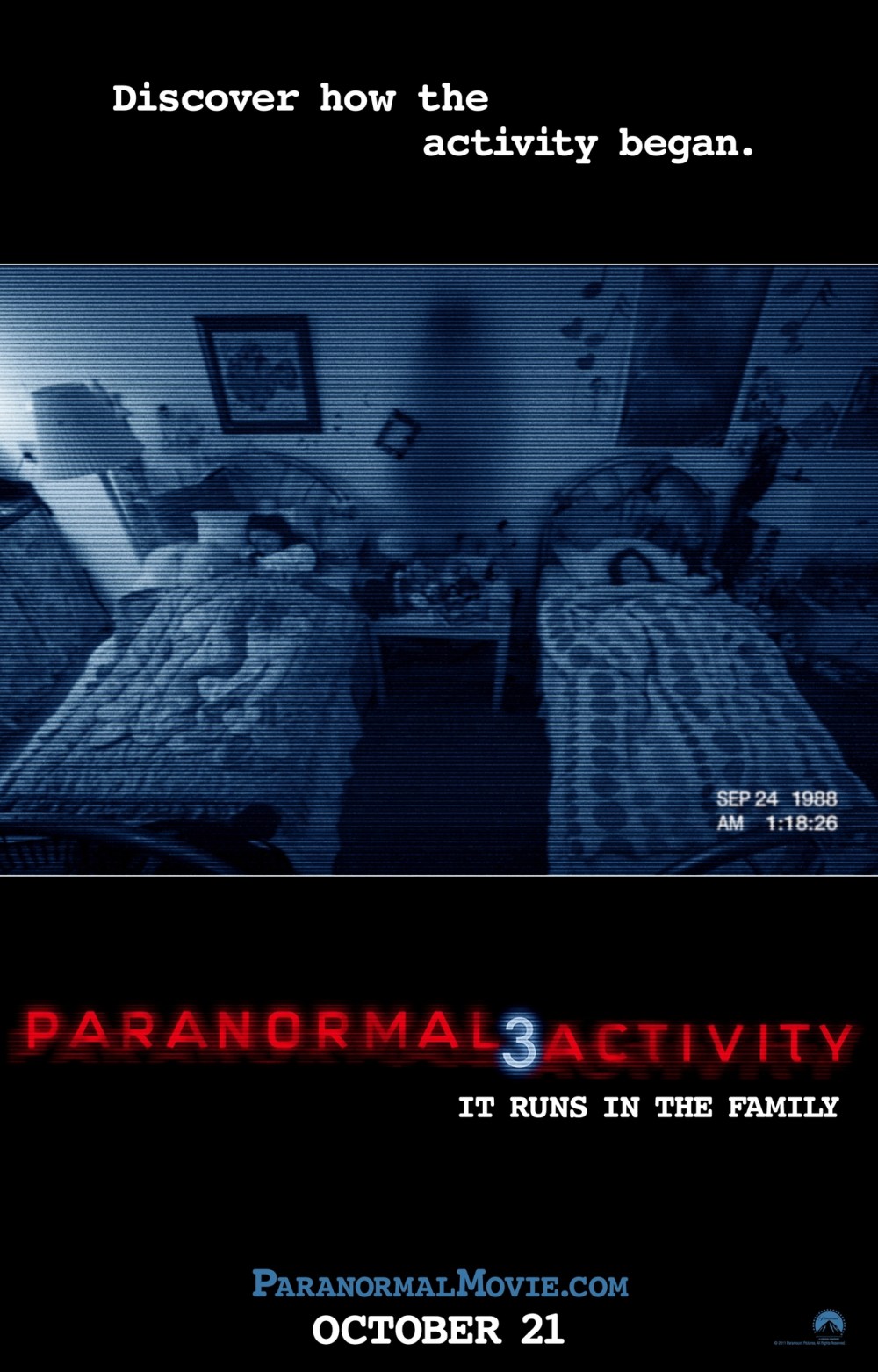
‘Paranormal Activity 3’ Avoids the Curse of the Prequel

Paranormal Activity 3 movie poster

In a lot of ways, “Paranormal Activity 3” shouldn’t work. It’s the third movie in an astonishingly popular series which eventually replaced “Saw” as the official franchise for the month of October each year. The third in a trilogy is also when the series starts running out of creative juices and becomes bound by an increasingly worn out formula. Maybe it’s time to move on to the next big thing in horror, right? Not quite.

Despite the inescapable feeling of déjà vu, “Paranormal Activity 3” still has the power to scare and unnerve viewers, and I knew exactly what I was doing when I watched it at night. This one comes from the makers of “Catfish,” and they follow the familiar found footage setup to where nothing may be new, but they still generate a number of jump-out-of-your-seat moments which will freak out even the most jaded of moviegoers.

Whereas “Paranormal Activity 2” was a prequel and a sequel, this third movie is a flat-out prequel which takes place 18 years before the events of the original. Sisters Katie and Kristi, played by Katie Featherston and Sprague Grayden in the previous films, are seen here as children who live with their mother Julie (Lauren Bittner) and stepdad Dennis (Christopher Nicholas Smith). Things get weird, however, when Kristi gets an invisible friend named Toby, and strange occurrences develop in their home with increasing volatility.

Since this prequel takes place in 1988, the filmmakers get to work technology now seen as prehistoric as this was a time of video cameras and VHS tapes. Part of it serves as a needless reminder of how Betamax got its ass kicked years ago. While the technology is limited compared to what the characters had at their disposal in the previous films, this forces everyone here to get creative with what they have.

Once again, the man of the house (and it’s always the man) sets up a barrage of video cameras in various rooms to figure out what craziness is going on in order to put a stop to it. The only disadvantage is VHS tapes only allow for 6 hours of recording at the most. But somehow the spirits do make their appearance before the tape runs out which is rather convenient for everyone involved.

The one new thing in “Paranormal Activity 3” is how Dennis comes up with the idea of attaching one video camera to the base of a fan. As the camera veers from side to side, we have another reason to be tense about what we’re watching. Will there be something on the other side about to jump out at us? This quickly becomes a clever device which distinguishes this film from its predecessors.

“Paranormal Activity 3” does, however, get off to a shaky start. There were a bunch of cheap scares which, whether they worked or not, had me worrying this prequel would be overrun with them. While they provided the audience with a several good jolts, it made me wonder if the series was beginning to descend into self-parody. Once this happens, the series might as well end. Fortunately, things straighten out as the happenings inside the house become increasingly unrelenting in their viciousness.

There are many moments which had my hair standing on end. We see furniture moving around by itself, a character running into something not visible, and someone’s hair getting grabbed. “Paranormal Activity 3” may seem like business as usual, but this business is still producing terrifying moments just as things are beginning to look old. Like the previous entries, I’m not entirely sure how the filmmakers pulled off certain special effects (the one at the very end is very painful to witness), and I don’t want to know for fear of breaking the illusion.

I recently watched “The Thing” which was a prequel to John Carpenter’s 1982 film. It reminded me of the problems with prequels in general as you know from the start who is going to live and die, and the suspense gets diluted as a result. The advantage “Paranormal Activity 3” has is, while we know the little girls will survive and live on in future installments, we aren’t sure what the fate of the adults will be. Katie and Kristi only reveal so much about what happened to them as children in the second film, so we are left to guess if any adults hanging around these kids will ever live to see tomorrow. Had the girls revealed the exact chronology of events, this prequel would have been screwed from the get go.

Many critics have voiced that they have had their fill of the “Paranormal Activity” films it, but the formula behind them still works very well and has me pinned to my seat. That invisible spirit can still scare the crap out of me, and it made me look forward to “Paranormal Activity 4.” Granted, Paramount Pictures and Oren Peli can only keep this franchise going for so long, but they have made it this far without losing any of the power which made the original so damn scary. Here’s hoping the filmmakers don’t trip over themselves in the future. We all know what happened to “Blair Witch 2: Book of Shadows.”

By the way, you’ll never look at a Bloody Mary (the drink I mean) the same way after this prequel is over. Watch the movie and you’ll see what I mean.

* * * out of * * * *

‘Captain America: The First Avenger’ Introduces Us to a Real American Hero

Captain America The First Avenger poster

Captain America: The First Avenger” succeeds where “The Green Lantern” utterly failed. It gives us a superhero, one from the Marvel Comics universe, who is distinct from those of his ilk, and he is one we quickly come to care about and root for. Steve Rogers isn’t just some cocky kid from Brooklyn with an overinflated ego. He’s a sickly young man who desperately wants to fight for his country, but who has been rejected by the military countless times. But what he lacks in health and strength he makes up for in spirit. Steve wants to fight for his country not because Uncle Sam wants him to, but because, and he said it himself, he never backs down from a fight.

I liked how this movie didn’t shy from its American roots the way “G.I. Joe: The Rise of Cobra” did. While that movie tried to make you forget the slogan “a real American hero,” “Captain America: The First Avenger” doesn’t do the same. At the same time, it doesn’t beat you over the head with blind American patriotism. It has its share of American pride, but it’s really about the spirit of this unlikely soldier which keeps him sane after he is transformed into a super soldier. The outside may be different, but the inside of this man remains the same to where he sounds like a relation to Robocop.

Playing Steve Rogers/Captain America is Chris Evans who you may remember him from those dopey “Fantastic Four” movies. As for myself, I remember him best for doing a skateboard grind down an icy railing which led to his ultimate demise in “Scott Pilgrim vs. The World.” Evans is perfectly cast and does great work in keeping his character from becoming just another clichéd war hero. His heart shines throughout the entire movie, and he never allows Rogers to become laughable or indulge in behavior which would seem cringe inducing.

Once Steve is turned into Captain America, you root for him to go into battle and defeat the Nazis. But seeing him become a pawn for the United States Government in hawking War Bonds is depressing even when his irrepressible spirit and love for country shines through. We understand his desire to prove himself, and our spirits rise along with his.

Of course, with every superhero movie we get a vicious villain. In this case, this would be Johann Schmidt, Adolf Hitler’s right hand man who is later revealed to be Red Skull. This particular Skull has his own plans for world domination through his organization of HYDRA, and he gets his followers to raise both hands instead of just the one for Hitler. With a stolen tesseract, HYDRA can eliminate their foes faster than those phasers that vaporized all the red shirts on “Star Trek.”

Hugo Weaving portrays Johann Schmidt/Red Skull, and he gives “Captain America” the formidable villain it needs. Still, after being in all “The Matrix” and the “Lord of the Rings” movies, I kept waiting for him to say, “Welcome to Rivendell Mr. Anderson!”

“Captain America: The First Avenger” also has the other requisite characters like the Army drill sergeant and the beautiful woman who dares the most macho men to treat her as just a woman instead of the tough as nails soldier she is. It’s not hard to guess who gets their ass kicked here when other men foolishly hit on her. Still, director Joe Johnston succeeds in getting the best actors available to inhabit these roles and give them life beyond the mere superhero movie stereotypes they could have been.

Tommy Lee Jones is highly entertaining as Col. Chester Phillips, a gruff, no nonsense military leader who expects nothing but the best from his soldiers. Jones, however, gives Phillips a wry sense of humor much like the one Sam Gerard had in “The Fugitive.” Watching him being subtly dismissive of others and later coming around to see Steve Rogers is the man is a hoot, and he never ends up screaming all over the place like R. Lee Emery did in “Full Metal Jacket.”

Then there’s Hayley Atwell who plays Peggy Carter, the female officer who eventually becomes Steve Rogers’ love interest. I really liked how Peggy was drawn out to where she doesn’t just exist for the sake of the movie’s superhero. Atwell sells us completely on her tough demeanor to where it cannot and should not be mistaken as an act, and she travels across the screen with an assured confidence which no one should ever doubt. If they do doubt her, it will say much more about her.

Johnston got the job of directing “Captain America: The First Avenger” based on the period movies he made such as “The Rocketeer” and “October Sky.” There’s a lot of attention paid to detail here (the story takes place 1942 to be exact), but it isn’t held prisoner by it. Heck, many of the tools HYDRA ends up using seem far removed from the 40’s, and they look like they came out of a sci-fi movie made in the 1970’s or 80’s. While Johnston hasn’t made a great movie here, he still has given us an undeniably entertaining one, and it didn’t even need another terrific film score by Alan Silvestri to prove this.

When it comes to the 2011 summer movie season, “Captain America: The First Avenger” isn’t better than “Thor” which for me had far more interesting characters, but it easily outdoes “The Green Lantern” which is one of that year’s biggest disappointments. Thanks to Evans’ performance, Captain America finally gets the cinematic respect this character has long since been denied.

* * * out of * * * *

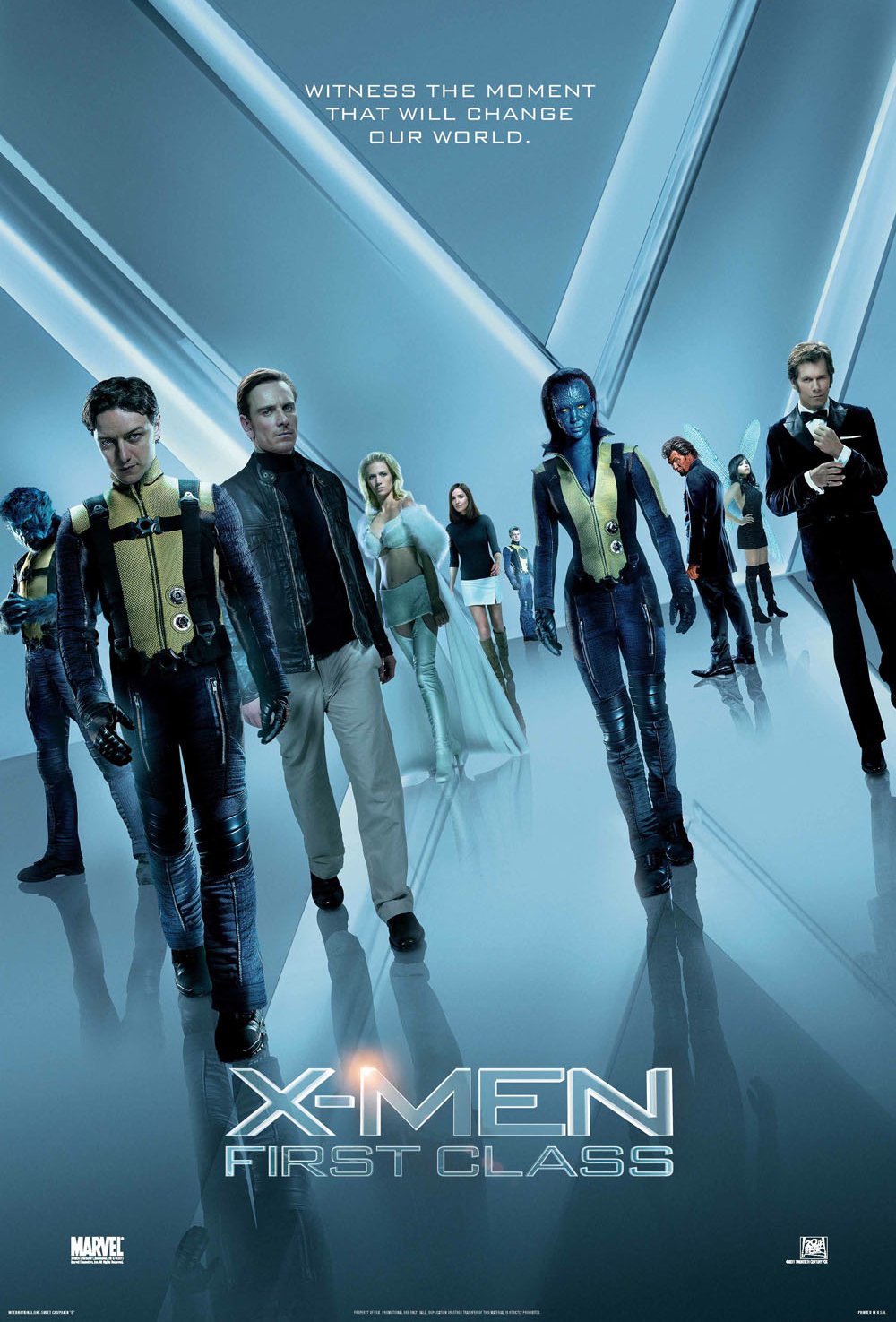
‘X-Men: First Class’ Represents What a Prequel Should Be Like

X Men First Class poster

X-Men: First Class” is a huge improvement over the previous entry, “X-Men Origins: Wolverine,” and it’s also the best film in the series since “X-Men 2.” It’s breezy fun, the special effects are terrific, and the emphasis on character this time around makes for a more involving prequel. With Wolverine shoved to the side, this fifth movie and the second prequel in the long running franchise, many other characters get their chance to shine.

The primary focus of “First Class” is on Charles Xavier/Professor X (James McAvoy) and Erik Lehnsherr / Magneto (Michael Fassbender) as we see the significant events which shaped and brought them together. But while Charles’ upbringing was a privileged one, Erik’s was unbearably tragic as he and his parents were imprisoned in a World War II concentration camp. Erik’s ability to control magnetism becomes evident early on, and this talent soon gets exploited by scientist Sebastian Shaw (Kevin Bacon) who commits an atrocious act in front of him. From there on, the driving force in Erik’s life is one of bloody revenge.

Prequels are tricky because we are naturally inclined to be against other actors taking over roles previously portrayed by Sir Patrick Stewart and Sir Ian McKellen. Then there’s that cynical feeling of studios taking this route just to save money. It was deemed after “X-Men: The Last Stand” that a fourth movie with the same cast would have been far too expensive to make. Of course, with a reported budget of $160 million, “X-Men: First Class” doesn’t sound like much of a bargain. Moreover, does anyone remember “Dumb and Dumberer: When Harry Met Lloyd?” Did you think audiences were going to be fooled by a Jim Carrey-less prequel? Anyone remember “The Flintstones in Viva Rock Vegas?” Heck, does anyone remember the first “Flintstones” movie? I remember seeing it, but the plot details escaped me once I walked out of the theater.

But what’s great about “X-Men: First Class” is the cast doesn’t need to worry about living up to the actors who inhabited the same roles before them. They get to approach these classic characters in a different light, and this frees them up from any restrictions which could have been imposed on them. Characters like Mystique and Dr. Hank McCoy are given more depth and complexity than ever before, and many surprises are in store for the audience as the script invests a lot of emotion in these characters including those bad mutants we rooted against in the past.

James McAvoy is excellent as the young Charles Xavier, and he looks like he had lots of fun making this prequel. Whereas Patrick Stewart’s Professor X was wise and mature, McAvoy’s is just getting started in his career and comes across as quite the ladies’ man. I also admired that while Charles is incredibly intelligent, we find his ego getting the best of him. So sure of all the things he is knowledgeable of, McAvoy does great work in making Xavier well-intentioned but not as open to mutants being themselves in the real world.

Erik Lehnsherr/Magneto remains one of the most fascinating characters in the “X-Men” universe. While he’s been the series’ chief villain and a megalomaniac, Magneto is simultaneously an anti-hero and has even been seen as a hero in the comic books. It’s hard not to feel sympathy for him considering the horrors he was exposed to in his youth, and it makes his future actions understandable, if not excusable. No wonder actors have so much fun in this role; you never know for sure the direction Magneto will end up taking. All you can say is, whatever he ends up doing, it will be to his benefit more than anyone else’s.

With movies like “Fish Tank” and “Inglourious Basterds” under his belt, Michael Fassbender is the perfect choice to play the young Erik Lehnsherr before and after he becomes Magneto. Fassbender has given performances deep with complexity and feeling; looking like the good guy at one point and then later turning into one seriously twisted individual. As Erik, he is great at showing the different layers to this character who is forever caught in a horrific moment he can’t get out of.

But one character who really gets expanded in “X-Men: First Class” is Raven whose shape-shifting abilities earn her the nickname of Mystique. Rebecca Romijn played Raven in the first three movies as a villain, and her character never got much in the way of psychological depth. Jennifer Lawrence, however, gets more to work with as we come to meet Raven at the time her allegiance to her “brother” Xavier begins to wane.

In Lawrence’s hands, she makes Raven/Mystique a strong female role model, one who is determined to be open about who she is and not be ashamed of it. While hiding herself in human form, as she is encouraged to do so by Charles Xavier, Raven’s frustration at appearing in public as someone other than herself is beginning to take its toll. Lawrence is riding high on some incredibly strong performances, and she continues to show how far her acting chops can stretch.

With Bryan Singer returning to this franchise as a producer, I’m sure he had a good hand in getting this particular entry focused more on character development. Each character is shown to be suffering through conflicted emotions as to what path the mutant race should follow, making them no different from the humans who deal with many of the same issues. Mutants are seen as the next stage in human evolution, but the haunting question of whether this will be to humanity’s best interests or detriment always hangs in the air.

But the person who deserves the most credit for “First Class” is its director, Matthew Vaughn. Coming off of the gleefully rebellious “Kick Ass,” one of 2010’s best movies, he manages to bring a lot of inventive energy to a franchise in desperate need of it. Vaughn also makes the special effects benefit the actors instead of just overwhelming them. What made the first few “X-Men” movies so special was the amount of emotion they generated, and the same thing is definitely the case here. It’s our connection with these characters which makes the action set pieces all the more exciting.

If there are any problems with “X-Men: First Class,” they come in the last half as the filmmakers become overly concerned about bringing the characters in line to where they are at in the first “X-Men” film. This was also a big problem with “X-Men Origins: Wolverine” even though that prequel was much more convoluted. It would have been nicer to see the friendship between Charles and Erik get expanded instead of just ending this one with them taking opposite sides. Then again, perhaps it still could be expanded on in future installments.

Kevin Bacon, always a terrific actor, is perfectly detestable as the movie’s most irredeemable villain. At the same time, I wished the writers had expanded on his character more. Compared to the others, Sebastian Shaw threatens to be a little too one-dimensional in his actions. If Sebastian had more complexity to him, it would have made the transition of power between him and Erik all the more believable and compelling.

Other strong performances come from Rose Byrne as Dr. Moira MacTaggert and Nicholas Hout as the highly intelligent yet shy Dr. Hank McCoy. On the other hand, while January Jones is amazingly beautiful as Emma Frost/White Queen, her one-note delivery of dialogue is one of this film’s major detriments.

“X-Men: First Class” is a prequel done in the same spirit of J.J. Abrams’ “Star Trek,” and it’s proof you don’t need Wolverine present to make a good “X-Men” movie. This is a reboot which works to everyone’s advantage, and I am eager to see what comes next.

By the way, don’t bother staying through the end credits. There’s no post-credits sequence, so take care of that urine ache ASAP.

* * * ½ out of * * * *

‘The Thing’ Prequel Should Have Been a Sequel

The Thing 2011 poster

It says a lot about John Carpenter’s “The Thing” that it could generate a prequel almost 20 years after its release. A critical and commercial failure back in 1982, it has since been justly reappraised as a true horror classic and remains Carpenter’s masterpiece. It proved even more terrifying than “Halloween,” and it also holds a special place on my list of my top ten favorite movies of all time. These days, it is even more frightening as the scenario it presents feels all too possible.

Now we have Matthijs van Heijningen Jr.’s “The Thing,” a prequel to Carpenter’s movie which explores the events leading up to it. Remember the Norwegian camp Kurt Russell and Richard Dysart visited which had been completely burned down? Now we get to see how it got laid waste by both the thing and the humans. But therein lies the problem; knowing the events precede those of the 1982 movie and who survives, much of the potential suspense and tension gets drowned out almost immediately.

Frankly, I would much rather see a sequel to Carpenter’s “The Thing” instead of this. His film was very effective because we never had a clear idea of who to trust. But in Heijningen’s film, we know the characters on display will eventually bite the dust, and it becomes a question of when these characters turn into the thing. After a while, it becomes more shocking when a character dies but doesn’t turn into a gooey alien. What spoils it even more is we know of at least one character who will survive what happens very early on, and all we can do is wait impatiently for him to get on the helicopter with his rifle and take shots at the wolf.

Heijningen is respectful of Carpenter’s movie and pays homage to it throughout, but I kept wondering if this was a remake instead of a prequel. Various scenes are clear imitations of the 1982 movie’s most classic moments, and I wish he had worked harder at distinguishing the prequel from it instead of just presenting us with something way too similar. He does wring some suspense and strong tension at different points, and his unique take on the blood test scene is very clever, but he is unable to sustain the tension which made Carpenter’s movie so utterly terrifying.

The special effects are very good, but they pale in comparison to the genius of Rob Bottin. Audiences are always quick to tell when CGI effects are overused. As for the performances, they are generally good even though the characters could have come out of any monster movie.

The best performance comes from Mary Elizabeth Winstead as paleontologist Kate Lloyd. Such a terrific presence in “Scott Pilgrim vs. The World” and “Live Free or Die Hard,” she holds our attention throughout and is one of the best reasons to see this prequel. While Lloyd is predictably inspired by Ellen Ripley from “Aliens,” Winstead makes the character her own and more than just another tough chick which movies like these typically rely on.

“The Thing” prequel is not terrible, but it will be of interest more to those who haven’t seen the 1982 film which itself was a remake and made back in a time when remakes were rare and actually worth watching. This particular version of John W. Campbell’s “Who Goes There?” feels like a lost opportunity, and it gets caught in the prequel trap of busily matching everything up to the film it leads into. It really sucks when you can see a movie’s ending long in advance. I did however admire the ambiguous ending shown before the end credits as it leaves you wondering if the alien really infected one of the last characters standing. Not knowing is always more unnerving than knowing, and at least the director got this right.

* * ½ out of * * * *

‘Cars 2’ Outpaces its Predecessor

Cars 2 movie poster

I’m a little befuddled at the critical notices being hurled at “Cars 2.” It’s the first Pixar movie to ever get a rotten score on Rotten Tomatoes. Granted, neither this sequel nor its predecessor represent Pixar at its best or most adventurous, but even the least of their movies are infinitely better than most of what Hollywood puts out. “Cars” was essentially an animated “Doc Hollywood,” but as predictable as the story was, it was still wonderfully entertaining and had many memorable characters. Its being made was also worth it just to hear my niece say “ka-chow!” on a regular basis.

But “Cars 2” is easily more fun because the story is not as formulaic as its predecessor’s, and it takes the characters in a refreshingly different direction. This one has Lightning McQueen (Owen Wilson) going with his best friend Mater (Larry The Cable Guy) to the World Grand Prix to race against the arrogant Italian Formula One car named Francesco Bernoulli (John Turturro). During this time, Mater is suspected of being a spy by British Intelligence officers Finn McMissile (Michael Caine) and Holley Shiftwell (Emily Mortimer), the latter whom he takes a strong liking to. What starts off as another racing movie turns into an espionage adventure which circles the globe in an amazingly animated style.

Make no secret, “Cars 2” truly belongs to Mater more than anyone else. I’ve never been a huge fan of Larry The Cable Guy or his kind of humor, but he’s great fun here. Mater is not the brightest car in the world, but his heart shines through everything he does even as it continually gets the best of him. Most of the movie’s funniest scenes come from him dealing with customs unlike those in his home country, and his mistaking wasabi for ice cream is funnier than anything I saw in “Bad Teacher.”

Pixar continues to outdo itself in the field of animation, and the visuals they come up with are brilliant. I’ll go even further and say there were times I stared at the screen and wondered if certain things being shown were actually real instead of animated. Seriously, the resemblance between what’s real and what’s not disappeared for me at certain points,

Directing “Cars 2” is John Lassiter, and this marks the first full length Pixar film he’s directed since the original. His love of all things cars is as evident here as it was in the first film, and he also has race car drivers and announcers like Jeff Gordon, Lewis Hamilton, Darrell Waltrip, Brent Musburger, and David Hobbs voicing characters. You don’t even have to look at, or listen, hard to discover which characters they are voicing as character names are not particularly subtle. For example, we have Jeff Gorvette, Darrell Cartrip, Brent Mustangburger, David Hobbscap, and the subtlest of all, Lewis Hamilton.

I loved the addition of Michael Caine to this sequel as he makes Finn McMissile a cross between James Bond and the character he played in “Get Carter.” Years after playing Jack Carter in the 1971 classic, Caine remains as cool as ever, and not just because his car has an endless number of gadgets Bond could only wishes he had in the real world. His cockney accent is welcome in any movie he does, and this is certainly the case here.

Other additions in this automotive universe include Emily Mortimer who makes Holley Shiftwell tough and sensitive in believable fashion. Mortimer is such a sweet presence in movies like this and “Lars and the Real Girl,” and I always look forward to seeing and hearing her in any movie she does. It’s also great to have Cheech Marin, Jenifer Lewis, Tony Shalhoub, Joe Mantegna, and Bruce Campbell among others on board, and listening to them made me believe they had a blast working on “Cars 2.”

If I had any issues with “Cars 2,” it’s in regards to the character of Fillmore. This really has to do with the fact George Carlin voiced him in the original, and he has since passed on, and that Fillmore has little to do other than to say, “Wow man!” Out of respect for the late Carlin, who I still miss, I wished they had retired the character. This is nothing against Lloyd Sherr who has the unenviable task of replacing one of the great comedians ever as Fillmore, but this is one Pixar character which should have been put to rest. They retired Paul Newman’s character of Doc Hudson as he has also passed into the great beyond, and no one could have replaced him. I mean, I can understand why Pixar kept Slinky Dog on board for “Toy Story 3” even though Jim Varney died long before filming started, but Slinky had more to do in that sequel than Fillmore does here.

“Cars 2” does not equal Pixar’s artistic highs of “Up,” “Ratatouille,” or “Wall-E,” but so what? All that matters is it’s fun, and it easily outdoes the original. While its messages like the importance of being true to yourself may seem cheesy from a distance, they are handled here with a lot of heart and genuine emotion. Whatever you thought of the first one, you have to admit that you cared about the characters, and you will care for them even more in this sequel.

You can waste your money on “Green Lantern,” or you can take the family out to this one. The kids will be restless and noisy whether we like it or not, but I’m used to that by now. I saw “Cars” at the El Capitan Theatre in Hollywood, and parents were incapable of shutting their children up there. That I did not make the same mistake with this sequel is largely why it’s getting a particularly high rating.

* * * ½ out of * * * *

Pirates of the Caribbean: On Stranger Tides

Pirates of the Caribbean On Stranger Tides poster

I am happy to say “Pirates of The Caribbean: On Stranger Tides” is a big improvement over the previous entry, “At World’s End.” Whereas the latter had an incomprehensible story I gave up on following, “On Stranger Tides” has a plot which is a little more straightforward and easier to follow. Stars Orlando Bloom, Keira Knightley, and director Gore Verbinski have done left the building, and in their place are “Chicago” director Rob Marshall, Ian McShane and the alluring Penelope Cruz. With some of the dead weight removed and new elements thrown in, this showed promise. And of course, we have Johnny Depp back as Captain Jack Sparrow, whom without there would be no “Pirates” franchise.

This one has Jack sailing to the Fountain of Youth, and we’re not talking Beverly Hills. Along with him on the voyage is his former lover Angelica (Penelope Cruz) who proves to be every bit as trustworthy as Jack, which is to say not at all. Also onboard is legendary pirate Blackbeard (Ian McShane) whose giant sword wields a vicious power even with a simple wave of it. And just when you thought he was out of the way, Captain Hector Barbossa (Geoffrey Rush) is back as well, leaving Sparrow with the usual number of antagonists working against him, and there’s always plenty to go around considering Sparrow’s checkered history.

You would think by now this franchise would have bought the farm as it seems the only reason for it to continue is money. But even in this sequel, Depp still looks to be having a blast as this rock star of a pirate. Never easily upstaged, except by Keith Richards who has one of the movie’s best lines, he finds much to play around with and hasn’t lost a beat since the beginning. It could have been a movie where he could have just taken the money and run, but if he’s still having fun then so am I.

Personally, I’m glad Bloom and Knightley are gone as their romance ran its course, and to have them bitching and moaning at each other yet again would have been tiresome from the start. Instead we have Penelope Cruz who remains an actress as fantastic as she is beautiful. She more than holds her own opposite Depp as Angelica as her character threatens to be even more devious than Jack. Seeing these two play off each other kept me guessing as to who was the more honest of the two, and if they ever reached a point where they start believing their own lies.

I’m also glad to see Geoffrey Rush back as well and fresh off the Best Picture winner “The King’s Speech.” His character of Barbossa has had an interesting journey throughout these films as he’s been an antagonist and then a protagonist. By the time you reach him in “On Stranger Tides,” you’re not quite sure what to make of him which is part of the fun. Like Depp, Rush still has a joyous time playing this enigmatic character, and his gleeful delivery of dialogue is highly entertaining.

Ian McShane was an inspired choice to play Blackbeard, but in some ways his performance is a bit of a letdown. He’s very good, but after watching him portray one of the most cold-blooded bad guys ever in “Sexy Beast,” I expected a lot more menace from him which would have made “On Stranger Tides”’ all the more enthralling to watch. Still, he’s a great actor and could have done much worse.

The one character, however, I could have done without is the stubborn missionary Philip Swift. He’s a bland character who serves no real purpose in a movie which already has more then enough characters to juggle. This is no fault of the actor playing him as Sam Claflin does his best with an underwritten role, but it felt like the screenwriters were making up for the loss of Bloom and Knightley, and they really didn’t need to.

I do have to admit I really dug the mermaids and their natural beauty as much as I did the filmmakers’ take on them. Whereas they are as lovely as we remember them from stories and fairy tales, these mermaids here pack a vicious set of jaws and would sooner devour you than kiss you. There is some nudity here but no breasts (it’s a Disney movie folks), and you will find them unusual than the mermaids you grew up reading about. I guess you could say this is Disney’s subtle take on “Fatal Attraction.”

With Rob Marshall taking over directing duties on this one, I really admire how he streamlined this venture. Even though the movie stumbles a bit in the mid-section, Marshall keeps things moving at a swift pace and none of it gets overwhelming. “At World’s End” was so over bloated to where I wouldn’t be able to describe the plot or remember the name of the character Chow Yun Fat played to you. But here you have a good idea of who everyone is, and even if there are things which don’t make complete sense, it doesn’t matter too much.

In the end, all I really wanted out of “Pirates of The Caribbean: On Stranger Tides”’ was a good time. It’s not a movie I ask too much from, and I liked how Disney learned from the franchise’s previous mistakes. While the wonderfully entertaining “Curse of The Black Pearl” set the bar high, this one reaches up far enough towards it. Along with another thunderous Hans Zimmer score, I was pleased with this fourth “’Pirates” film, and I am open to seeing a part five, and you know there will be one at some point in the future.

* * * out of * * * *

‘Red State’ is the Best and Most Unlikely Film from Kevin Smith

Red State movie poster

Red State” is to Kevin Smith as “Unforgiven” was to Clint Eastwood; a game changer in the way we perceive him as an artist. Any shred of Jay and Silent Bob is completely absent here as he probes the horror of an ultra-fundamentalist church whose fear of God prompts a siege of destruction which tests its members as well as those ordered to bring them down. Nothing Smith has done previously will prepare you for what he comes up with in “Red State.” We know he’s been looking to do something other than “Clerks” or those formulaic comedies he has spent far too long apologizing for. With this one, his creativity and passion for moviemaking are completely reinvigorated.

The movie starts off innocently enough with one of Smith’s favorite subjects: young men talking about sex. Three teens named Travis, Jared, and Billy Ray drive out to a remote area and meet up with a woman named Sarah (Melissa Leo) who has promised to make out with each of them. But after a couple of beers, they pass out and wake up to find themselves prisoners of the Five Points Church, a fundamentalist cult led by God-fearing pastor Abin Cooper (Michael Parks) who seeks to punish those who have morally corrupted America whether they be homosexuals or adulterers among other sinners. But when things get out of hand, as they always do, the church is forced to make a last stand as the police and FBI intervene in a showdown destined to have a bad ending.

The Five Points Church is Smith’s not so subtle representation of that church which is known for protesting funerals of homosexuals and dead soldiers. You probably know the church he’s referring to. For those of you who don’t, you can just figure it out on your own. While we see them for the fascist hate mongers they are, you have to wonder what draws anyone to a church with such unrealistic and obscene views. Some are just looking for an answer, and any answer after a while will do to give their life meaning. Whether or not you believe in the beliefs of the Five Points Church or that church is beside the point; what should concern you is there are people out there who do believe in the ridiculously hateful things they have been taught, and they will do anything to defend those values at any cost.

The leader of that church can only dream of being as charismatic as Abin Cooper. Michael Parks performance is nothing short of brilliant as he makes you believe that people can fall under the spell of a religious pervert. Parks was introduced to a whole new generation of fans when he played Texas Ranger Earl McGraw in “From Dusk till Dawn,” “Kill Bill Vol. 1,” and “Grindhouse.” After watching him in “Red State,” you come out wondering why he is not a bigger star. Parks doesn’t just give us a mere impersonation of some maniac preacher. Instead, he gives us an infinitely charismatic portrayal of a deeply religious man who is as seductive as he is dangerous.

With the actors, Smith just lets them loose to do their own thing, and the results are enthralling. Melissa Leo, who deservedly won an Oscar for her performance in “The Fighter,” gives it her all as Cooper’s daughter Sarah. Her emotional conviction in this role is proof of how far Cooper’s influence as a preacher goes, and Leo remains one of the best actresses working today.

Another big standout is John Goodman who plays ATF Special Agent Keenan. Goodman has always been a great actor, but you get the sense after so many years that most people don’t recognize him as such. His work in “Barton Fink” and “The Big Lebowski” should be more than enough to convince you of his greatness. Anyway, he gives some of the film’s best speeches as his character is forced into a situation which goes against his moral values, but it is a situation he cannot simply override. Goodman inhabits this character perfectly, giving him the emotional turmoil and confusion etched all over his face.

Other great performances come from Kerry Bishé as Sarah’s daughter, Cheyenne, and she is ever so intense in her desperation to save the women and children whom she feels will fall victim to the government’s actions for the wrong reasons. Kevin Pollak provides memorable support as Keenan’s right-hand man, Special Agent Brooks. You also have to give credit to the three young actors playing the teens: Michael Angarano, Kyle Gallner, and Nicholas Braun. The roles they are given appear one-dimensional, but they bring more to the material than what is on the page, and they give you a reason to care about what happens to them.

Smith’s movies in the past have dealt with conversations about pop culture, but there’s none of this in “Red State.” He instead exploits certain movie conventions which have us believing we’ve figured the whole story out, and then he pulls out the rug from under us. The violence is truly shocking as characters meet their fates in a way we don’t see coming. This is not your typical good guys versus bad guys story as everyone here is morally flawed in one way or another. The events of David Koresh’s demise in Waco, Texas hang heavily over the proceedings, and no one looks to come out of this a hero.

This movie could have been a simple look at the damage caused by religious perversion, but there are different levels at work here. We see how the church, the government, and the local police react to the violent situation they are all immersed in. Look closely at the end credits; the cast is divided by religion, police, and politics. It becomes about containment by any means necessary. So, when all is said and done, no one’s coming out of this battle in one piece.

Working with his longtime director of photography Dave Klein, Smith finds a unique look for this movie thanks to the RED digital camera. Both are able to get shots which give the material a visceral feel you wouldn’t expect from the director of “Jersey Girl.” The flexibility they find with this device feels inspirational as it allows them to do things they couldn’t do previously.

Smith still seems determined to retire from making movies, and that’s a shame. “Red State” represents a new chapter in his long career which has me begging him to keep on going. It’s not a horror movie in the usual sense of things jumping out at you to give you an easy scare. Instead, it shows horror we find in everyday life. Who knew he would capture it to such powerful effect? In a time when the voices of independent movies appear to be gasping their last breath, Smith shows himself to be the last man standing and gives us a reason why we can’t let movies like his simply fade away.

* * * * out of * * * *