‘Hanna’ Features One of Saoirse Ronan’s Best Performances

Hanna movie poster

Joe Wright’s “Hanna” on the surface looks a bit like “Kick Ass” as, like that movie, it follows the exploits of a young girl who has been trained to be an elite assassin so she can avenge her mother’s murder. But “Hanna,” however, is more down to earth in how it treats its characters and the events which envelop them. Does this make it better than “Kick Ass?” No, just different.

On top of it being an action thriller with a bit of Luc Besson sleekness in its design, “Hanna” is also a fish out of water story as the title character discovers the real world in a way previously denied to her. Hanna has spent her entire life in the woods, living in a snow-covered cabin where her dad, Erik Heller (Eric Bana), has kept her safe. But now she is heading into a world completely unfamiliar to her. Hanna’s mission of assassination is also a journey of discovery, and this movie ends up coming with more surprises than I ever could have expected.

Playing Hanna is Saoirse Ronan who has gone from her Oscar-nominated turn in “Atonement” to an excellent career which includes unforgettable performances in films like “Brooklyn,” “Lady Bird” and “Mary Queen of Scots.” On paper, Hanna seems like a completely unrealistic character who could in no way exist in real life. But the beauty of Ronan’s performance is how she makes Hanna seem as real as any 16-year old girl even as the character leads a double life the average teenager does not. Seeing her come into contact with a civilization she has been sheltered from provides her with evidence of how not everything involves guns, bullets and violence. Of course, seeing her get her first kiss is frightening because she can flip back to assassin mode in a heartbeat if she gets the wrong impression.

Most of Hanna’s adventures come as a result of her befriending a British family on a road trip whose daughter Sophie (Jessica Barden) introduces her to teenage rebellion and some rather tacky fashion statements. Sophie’s parents, Sebastian (Jason Fleming) and Rachel (“The Ghost Writer’s” Olivia Williams), come to admire Hanna and help her as she moves on to a safer haven from the government forces who look to eliminate her.

Wright comes up with several invigorating action sequences which made me feel like I was watching a Jason Bourne movie. There’s not much in the way of shaky camerawork, but you can feel the bullets flying in the air as well as the punches and kicks which land on her opponents, crushing them as if she were simply swatting flies. This is the kind of action film I like to watch as it makes you feel things instead of letting you just sit back like you’re some passive observer.

In addition, Wright gets some amazing unbroken shots as we watch characters make their way through crowds of people while being followed by their cold-hearted adversaries. It makes me want to say “eat your heart out Brian DePalma” as the choreography involved in filming an unbroken sequence like this is anything but easy.

There are other great performances to be found in “Hanna” as well. One in particular is from Eric Bana who plays Hanna’s father Erik Heller. His character is also a spy on the run whose relationship with Hanna is far more complicated than at first glance. Watching Bana here reminded me of just how much he throws himself physically and emotionally into his characters. It’s exhausting watching him here as we get reminded of his strong work in “Black Hawk Down” as well as his comedic roles like the one he had in “Funny People.”

Then there’s the infinitely brilliant Cate Blanchett who never seems to suck in anything she does. While listening to her southern accent feels a bit odd at first, she is still sharp as ever as corrupt CIA agent Marissa Wiegler. Throughout Marissa is as obsessive in eliminating Hanna and Erik as she is in cleaning her teeth. Heck, watching her brushing even while her gums bleed profusely reminded me of just how long it’s been since I’ve gone to the dentist. Blanchett also has a brilliant moment where she pays a visit to a key witness, but her face suddenly shows a wealth of pain which is mysterious in its origin. I don’t know how she did it, but it’s the one shot in “Hanna” which stays with me the most as her ruthless character succumbs to a moment of inescapable vulnerability.

On top of it all, you get a brilliantly propulsive electronic film score from The Chemical Brothers. I immediately downloaded it off of iTunes as soon as I got back to my apartment. It’s actually the first time they have ever composed for a movie. Learning this made me want to say, “duh, what about ‘Fight Club?’” But wait, it was The Dust Brothers who composed the score for that 1999 classic. I guess techno music is more of a family affair than I realized. Either that or all these brothers look alike.

“Hanna” is not without its faults. The pace of the movie tends to slag in between the action scenes which, while offering us beautiful moments for the title character, drag the proceedings down more than they should. Also, it ends without resolving the fate of several characters, leaving us wondering what happened to them and if they came out of this story alive and in one piece. As a result, the ending feels a bit too abrupt.

Still, “Hanna” is a remarkably involving action thriller which doesn’t lay out everything for you right at the start. The story continues to unfold throughout, revealing each of its secrets along the way. What brings it altogether is the fantastic performance of Saoirse Ronan who at a young age showed a professionalism and sharp focus on character equal to many acting veterans. Seeing her portray someone as innocent as she is very deadly made it one of the most unforgettable performances I had seen in any movie from 2011.

* * * ½ out of * * * *

‘Religulous’ Shows No Shame in Questioning Religion and Blind Faith

Religulous movie poster

I came into this documentary with much excitement as religion is such a fun and easy target to lampoon regardless of what your thoughts are on it. “Religulous” was directed by Larry Charles who directed one of the funniest mockumentaries ever with “Borat,” and it has Bill Maher interviewing people of different faiths. Apparently, the people interviewed were not aware Maher was going to be interviewing them until Maher showed up. This is made clear by certain moments where publicists come up to the film crew saying rather tensely that they do not want Maher talking to their clients because of what they believe he represents. Would that be logic and reason? The fact these same people still chose to be interviewed by Maher does show a lot of guts on their part as he lets them have their say even as he interrupts them when things don’t make sense to him (and this happens more than you might think).

“Religulous” starts with Maher talking with his sister and mother about why they all stopped going to church. He explains how he was brought up by a mother who was Jewish and a father who was Catholic, and of how he loved playing with his toy gun and holster which he refused to take off even when he went to church. We also get to see clips from when he was starting as a standup comic and talked about what the first circumcision must have looked like to the one it was being suggested to. Maher’s distrust and comments on religion still go on to this very day, and they are not just meant to be funny, but also to make you think about why people allow themselves to believe certain things which defy easy logic.

One thing which kept coming up is how many preachers go out of their way to purchase expensive clothes and live more luxuriously than Jesus ever did. Jesus wore robes and lived in a hut or some other dwelling, and we can all agree he did not care for making money in his father’s temple. Here, Maher interviews them while they are showing off their tailor-made suits, the kind you would never find at your average discount store, and they also wear gold rings because they feel God would want them to dress extravagantly. Maher intersperses these interviews with these same preachers hawking their own DVD’s among other items they have to offer, and it immediately reminded of L. Ron Hubbard’s response to someone who asked him why he was so keen to create his own religion:

“That’s where the money is.”

“Religulous” also opened me up to what Mormons really believe. I always thought they were the nicest people, and I did have a huge crush on one while I was in school, but I never had the slightest idea they held the belief that God is actually from another planet (I can’t remember the name of it). We watch as Maher gets kicked off of the lawn outside the Mormon Tabernacle Church, but he does get to speak with two men who have since left the church and dispute what the Mormons are taught to believe in. Every religion seems to have its own interpretation of God, and I can’t help but wonder if a consensus can ever be reached on this subject.

One of the real pivotal moments comes when Maher interviews a “reformed” homosexual (talk about a contradiction). The fact that pseudoscience facilities which practice conversion therapy exist where people are send to be “cured” of their homosexuality, will always baffle me. Furthermore, this man Maher interviews is married to a woman who claims she was “cured” of being a lesbian. This all struck me as being completely odd and inappropriate as I was always under the belief God loves us all no matter who we are. That people allow themselves to be brainwashed into what others want them to be is frightening, and practices still continue even when people should know better. Seeing Maher hug the “reformed homosexual,” I kept waiting for the “Real Time” host to do something rather provocative, but even he has the good sense not to pinch the guy’s butt.

Clearly, “Religulous” is bound to upset many religious people as Maher shows no shame in picking apart faiths of any and every kind. I personally do not see, nor do I want to see, religion as being evil, but this will not step many from believing both Maher and Charles have made something both biased and hateful. Granted, there are many Bill talks to who will ever be quick to share his problems with religion, and we even see this here from one point to the next. But “Religulous” does indeed have a strong point of view as it never hesitates to call out those religious beliefs which prove to be both misleading and very dangerous. Maher also takes the time to find similarities between Muslims and Christians as each religion has their followers believing they are the chosen people and of how the world is coming to an end and that they will be the only ones left standing.

“Religulous” ends on an ominous note as Maher discusses how religions constantly talk about the end of the world and of how we should be wary of blind faith (amen to that). Religion is supposed to be about love, and yet there is a lot of hate and fear involved in many faiths. Hearing and seeing all of this takes me back to that scene in “A Bronx Tale” where the young kid asks a known gangster:

“Is it better to be loved or feared?”

His reply:

“I would rather be feared, because fear lasts longer than love.”

Maher remains one of the smartest, not to mention one of the most provocative, and “Religulous” is further proof of this as it shows he has balls of steel. He shows no fear as he questions the religion of those who may very well kill him for defying what they hold most holy. In the end, he makes a compelling argument of how religion can be dangerous and easily corrupted, and he also gets a lot of huge laughs out of the subject.

Like I said, there are moments where Charles puts in clips from religious shows, and there is one with a man talking in a language which makes him feel so good and yet has him sounding like a baby struggling to say their first words. It’s as gut busting hilarious as it is frightening. Whatever you may feel about religion, and everyone is entitled to their own opinion about it, “Religulous” will make you see the dangers of believing certain things and of the immense dangers of blind faith.

We all keep wondering when and if we will be saved from the horrors which keep engulfing this world we all live in. Maher meets a man who plays Jesus at a religious amusement park and asks him:

“Why doesn’t he (Jesus) obliterate the devil and therefore get rid of evil in the world?”

“He will.”

“He will?”

“That’s right.”

“What’s he waiting for?”

Yeah, what is he waiting for? And how do we know he is not actually a she?

Seriously, this documentary could make a great double feature with Lars Von Trier’s “Antichrist.”

* * * ½ out of * * * *

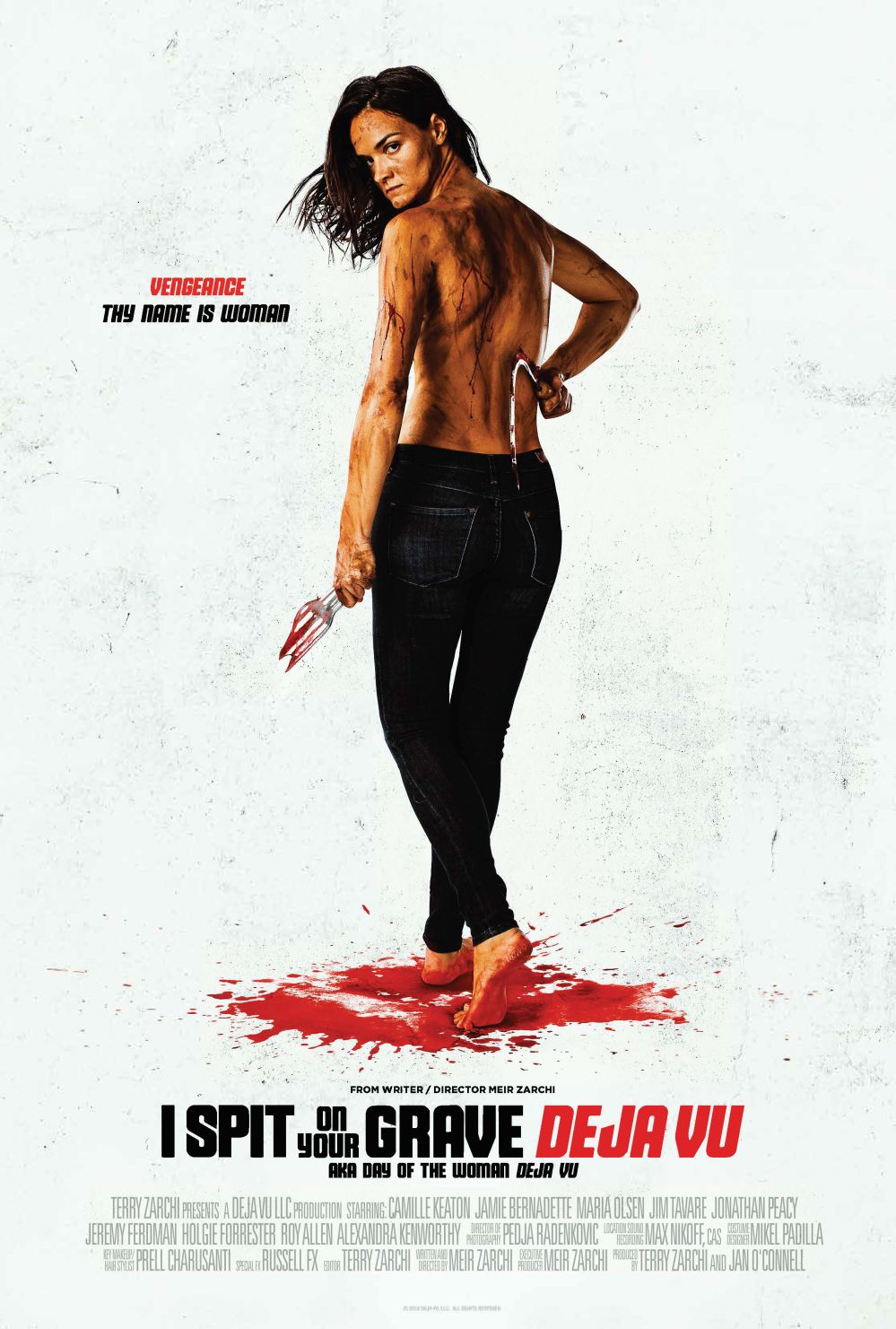
‘I Spit on Your Grave: Deja Vu’ Has Its World Premiere in Beverly Hills

i-spit-on-your-grave-deja-vu-ISOYGDV_3WOMEN8X11_rgb

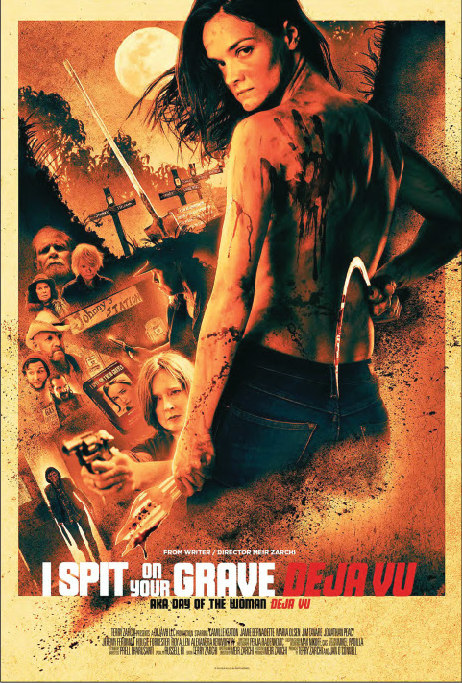
A sequel 40 years in the making, “I Spit on Your Grave: Déjà vu,” had its world premiere on April 18, 2019 at the Laemmle Music Hall Theater in Beverly Hills, California. Among those in attendance were its director Meir Zarchi who also wrote and directed the 1978 original, his son Terry Zarchi, Camille Keaton who returns as Jennifer Hills, and Jamie Bernadette who plays Jennifer’s daughter, Christy Hills. The sequel sees Jennifer and Christy getting abducted by the infinitely vengeful Becky (Maria Olsen) who looks to make Jennifer pay for what she did to her husband years ago. For those who have seen the original, you can expect blood, gore, acts of revenge which know no bounds, and the intensely painful separation of certain body parts which no one is ever quick to part with.

Following the screening, there was a Q&A with the cast and filmmakers who were also watching this sequel on the big screen for the very first time. It was an exciting evening for everyone as this sequel was actually finished back in 2015, and it is only now being released. When Keaton was asked what made her return to this iconic role, she made it clear how she wanted Zarchi to make a sequel for many years.

“I had been trying to get him to make a sequel to this movie for about 30, 35 years at least,” Keaton said. “One day I get a call, and lo and behold (Meir Zarchi told me) we’re gonna make a sequel. So I said, what? I was surprised and was happy we were going to do this, and it was great to work with him again.”

Jamie Bernadette was asked how she came to be cast in “Déjà vu,” and her response showed how thoughtful she is as a working actress.

“I saw the casting notice and I had seen the original 1978 film and thought it was brilliant,” Jamie said. “The casting notice said Christy Hills was a supermodel and gorgeous, and I thought no, I’m not going to submit. I’ll never get this. And then I sat and stared at that notice and said you know what, what the heck. So, I just pushed a button, and then I got asked for a tape. So I sent in a tape and I thought well, I won’t get a callback but we’ll just do this for kicks. Sent in a tape and I got called back in and I thought, you know what, if I meet Meir Zarchi, I’m happy. So, I walked into that callback room and Meir was sitting there with Terry (Zarchi), our producer. I did the scenes and I was in there for like 40 minutes. It was a long audition, and then Terry caught me on my way to the elevator and said can I take my picture with you because Terry told me later that he just knew before I spoke…”

“(It was) the eyes, the eyes,” Terry Zarchi said. “There was a look that she gives… She gave that look in the audition before she uttered a word. I said wow, that spoke so many words without her saying a word. I can’t wait to hear her, and then a second later three words came out of her. I really hoped Meir likes her enough to (cast her), because he has the ultimate decision on who is going to be cast, but I knew.”

Terry’s relationship with the “I Spit on Your Grave” movies began when he was just nine years old and back when the 1978 original was referred to as “Day of the Woman.”

“I had a hippie guy come up to me while I was on the set and asked me hey, do you want to be in the movie,” Terry said. “I was like no, I really don’t. I was a shy kid, and they talked me into it by saying that my father would offer me $10 if I did the film. I decided to do the film.”

Meir Zarchi himself eventually made it to the front of the audience, and he answered the question which was all on our minds before anyone could ask it.

“Somebody asked me why did it take 40 years to make this sequel,” said Meir. “So I said because I was waiting (he points to Jamie) for this girl. She wasn’t born yet.”

An audience member asked the cast what they did to prepare for their roles and of what they did to get into the psychotic mindset. Jamie was very open about the research she did.

“I spent months watching horrific videos about rape and murder, and I had a lot of nightmares during those months,” Jamie said. “I watched the original film over and over. It was a lot of research into gang rape and things like that, so it was a dark time. I also lost a lot of weight for the role because I am playing an anorexic model. Every day was emotional.”

This evening also allowed Meir to share a moment with Camille whom he married after the making of “I Spit on Your Grave.” Unfortunately, their union did not last long as they divorced in 1982 after three years of marriage. Still, they appeared to have a great respect for one another, and it should be noted how Camille flew all the way over from Florida just for this screening (“I wouldn’t have missed it for the world,” she said).

“Tell us, what do you think about seeing yourself on the big screen after 40 years for this time,” Meir asked Camille.

“I felt the same way I felt about it when I saw myself the first time,” Camille replied.

“That’s a lie, that’s a beautiful lie” Meir said. “You know we were married once. No wonder she divorced me. What did I do? What did I do wrong?”

“I don’t think you did anything wrong,” Camille replied.

Regardless, they both shared a kiss which had the audience applauding.

2018 had Jamie Lee Curtis resurrecting Laurie Strode to tremendous effect in “Halloween,” and now Camille Keaton gets to do the same with Jennifer Hills while at the same time passing on the torch of vengeful female to Jamie Bernadette. As for Meir Zarchi, he isn’t terribly concerned whether or not you like or hate “I Spit on Your Grave: Déjà vu.” He does, however, want to make certain you were not bored while watching it. Suffice to say, the audience responded loudly that they were not.

I Spit on Your Grave: Déjà vu” is set to be released on DVD and Blu-ray April 23, 2019.

The video below is from the Q&A following “Deja Vu’s” screening. My apologies for the the shakiness and visual quality as I shot this on my cell phone. Still, it was fun to hear how the cast and crew came to work on this long-awaited sequel.

All-Time Favorite Trailers: ‘Star Wars Episode I – The Phantom Menace’

With the unveiling of the first trailer for “Star Wars: The Rise of Skywalker,” many generations were once again reminded of how thrilling it is to get our first glimpse at the latest episode which will take us to a galaxy far, far away. Seeing the fans cheer the trailer on at the recent Star Wars Celebration in Chicago, Illinois also took me back to the times when I got to witness any of the them on the silver screen with a large and incredibly enthusiastic audience as there are few cinematic experiences people are as passionate as a “Star Wars” movie.

After watching “The Rise of Skywalker” trailer, I found myself going back to the year 1998 when I was at the enormous movie theater located in the Irvine Spectrum Center to watch “Star Trek: Insurrection.” This was in the winter before “Star Wars Episode I: The Phantom Menace” was set to be released. I remember hearing about the development of the prequel movies when I was in junior high school when time moved by way too slowly. Those movies could not come soon enough, and it would feel like an eternity before they finally arrived on the silver screen.

Never will I forget this particular evening as I watched the lights go down in the theater and the trailers began to appear. We thought we were getting “The Phantom Menace” trailer right at the start, but it turned out to be a teaser for “Austin Powers: The Spy Who Shagged Me,” another all-time great movie trailer. But as soon as the Lucasfilm Ltd. Logo appear on the silver screen, the audience members began to applaud and cheer loudly as this was the one thing they were eager to see more than anything else.

Knowing this was particular “Star Wars” movie was the first new one since “Return of the Jedi,” which was came out almost 16 years before, and understanding how it marked George Lucas’ return to the director’s chair since “A New Hopes” (22 years to be exact), there was no way you could not be the least bit excited about this particular motion picture. We keep hearing about this movie or that one is the most anticipated movie in history, but this saying could not be truer when it came to “The Phantom Menace.”

This trailer hits all the right notes. John Williams’ famous themes never sounded as good as they did here, and the visual effects looked simply amazing. Seeing Yoda back in action earned an extra few cheers as few characters have given us such endless wisdom as he has. Plus, you had Samuel L. Jackson as a Jedi master, so you now there will be at least one bad ass motherfucker in this PG-rated movie. Plus, that Sith lord Darth Maul looked especially evil even by Darth Vader standards, so there was something else to look forward to. And when the trailer climaxed with Williams’ music, the crowd cheered louder than I have ever heard anyone cheer at a trailer before. It goes without saying that everyone was all set to see this sucker on opening night and perhaps even sleep outside the local movie theater so they could be the first ones inside.

Forget about what you thought about the finished film (that’s for a separate article). There was no cinematic experience you could have been more hyped about back in the 1990’s than “Star Wars Episode I: The Phantom Menace.” I love this trailer because it reminded me of the many things I love about these movies, and of how important it was to see it before people spoiled it just as Homer Simpson spoiled “The Empire Strikes Back” for those waiting in line for it. Even today, 20 years later, this is still a thrilling trailer to sit through.

Star Wars Phantom Menace teaser poster

Star Wars Phantom Menace movie poster

The First Trailer for ‘Star Wars: Episode IX,’ Arrived It Has

The first trailer for “Star Wars: Episode IX,” arrived it has. And with our first look at this eagerly anticipated conclusion to the latest “Star Wars” trilogy, it comes to us with the following title we were ever so eager to learn of: “The Rise of Skywalker.” This is an interesting title to be sure as Luke Skywalker (Mark Hamill) left the realm of the living in “The Last Jedi,” but thanks to the Force, you can’t keep a good Jedi down.

Luke is not seen in this teaser trailer, but his voice is heard and his presence is felt throughout as he tells the Force sensitive Rey (Daisy Ridley, looking more intense than ever before) of how a thousand generations of Jedi have been passed on to her, but that this is a fight only she can take on. Still, he says how the Jedi will always be with her, and that no one is ever gone. Oh, the magic and possibilities science-fiction stories bring with them! Luke is right, no one is ever really gone, and it makes me believe a number of surprises are in store for us next Christmas.

“Star Wars: The Rise of Skywalker” marks the return of J.J. Abrams to the director’s chair after reinvigorating the franchise to tremendous effect with “The Force Awakens,” and this trailer makes it look and feel like an Abrams film alright. It does what any good teaser trailer does which is wet our appetites, and we will all be dissecting it endlessly long before the next trailer comes along.

There are many sights I delighted in seeing such as Ridley’s infinitely committed portrayal of Rey, and the actress has long since been proven to be one of this franchise’s best additions. Another major delight was seeing the original Lando Calrissian, Billy Dee Williams, back in the pilot’s chair of the Millennium Falcon alongside Chewbacca as he rediscovers the joy he has in flying it just like he did when he escaped from the fiery corridors of the Death Star in “Return of the Jedi.” And judging from the way he handles the controls, it is clear Lando is not drinking a six-pack of Colt 45 while behind the wheel.

Adam Driver is back as Kylo Ren, and I was surprised to see a glimpse of him putting his mask back together. I wonder why he would bother doing so after smashing to pieces. We only get brief moments of John Boyega and Oscar Isaac, but it is enough to put a smile on my face to see these two charismatic actors back as Finn and Poe Dameron. Even the late Carrie Fisher returns as Leia, albeit in footage taken from the previous two movies. As always, Fisher has the last laugh.

The title “The Rise of Skywalker” left me wondering what it means just as “The Last Jedi” did. How will Skywalker rise, and is the bloodline really at an end? Lucasfilm has been smart to keep us in the dark about this episode’s story, and the titles they have given these three films only peak our interest as they tell us only so much. As history has shown, there has always been one more Skywalker than we were originally led to believe. You remember what Yoda said to Obi-Wan Kenobi in “The Empire Strikes Back,” right?

“No, there is another…”

And plus, there is that laugh at the trailer’s end. Could it be Darth Sidious making a comeback?

Yes, I am super excited for “Star Wars: The Rise of Skywalker,” and I am doing my best to keep my expectations in check. Heaven forbid the hype overwhelms the final cut. At the very least, it looks to be much better than the disappointiment that was “Solo.” With Abrams back, we should be in for a fantastic voyage throughout a galaxy far, far away. It also marks John Williams’ last time composing a “Star Wars” film score, so it is a goodbye in more ways than one.

I know Christmas 2019 will be here before I know it, but I’m not sure I can wait that long.

Star Wars The Rise of Skywalker teaser poster

30 Years Later, ‘When Harry Met Sally’ is Still a Wonderful Delight

When Harry Met Sally movie poster

In today’s episode of “man, do I feel old,” we revisit “When Harry Met Sally” which has now reached its 30th anniversary. Yes, this romantic comedy is that old, but in many ways, it hasn’t aged a day. The life challenges its main characters face are no different from what men and women face today, and the only thing missing is an overabundance of cell phones.

“When Harry Met Sally” is an especially unusual love story in regards to how it starts and progresses throughout. We first meet Harry Burns (Billy Crystal) and Sally Albright right after they graduate from college. They end up taking a long car ride from Chicago to New York where the real world awaits them whether they are ready for it or not, and from the outset they cannot stand each other to save their lives. Harry is convinced men and women can never be friends because, as he puts it, “the sex part always gets in the way.” Sally tries to rebuff Harry’s advances and sexist comments by attempting to be more open-minded, but this motivates Harry even more determined to prove his point. When they finally reach New York, they part ways and go their separate paths, thinking they will never see each other again. But we know this will not be the case.

Five years later, we catch up with Harry and Sally as they bump into each other on a flight going to Chicago for business purposes. Things have definitely changed for the two as Sally is involved in a serious relationship with a lawyer named Joe, and Harry is now engaged to be married. The relationship between these two has not changed much, and Sally is still turned off by Harry’s cavalier attitude towards the opposite sex, even when it seems like he really has found true love. They finally part ways at the airport, thinking they won’t bump into each other ever again…

This brings me to the point the movie’s screenwriter, Nora Ephron, made about these two characters; they keep meeting up with each other at the wrong times in their lives. The first time when they were on the road and leaving college was the wrong time, and bumping into each other at the airport was also the wrong time. But the third time, which comprises the bulk of the movie, is definitely the most wrong time at all. Sally has recently broken up with Joe and declares to all who listen that she is “over him,” and Harry is going through a painful breakup which he did not see coming. These two at this point have no business being in any relationship as they are in a mourning period, but this time a strong friendship blossoms between the two as they go from fighting to challenging each other to see if men and women can really remain friends even after the sex part gets in the way.

“When Harry Met Sally” was made back in Rob Reiner’s golden age in which he gave us such cinematic gems as “This is Spinal Tap,” “The Princess Bride,” “Stand by Me” and “The Sure Thing.” His direction here is flawless as he brings us right up close and into the two lives of people who couldn’t be more different from one another. Their progression throughout the movie is very believable and feels almost effortless thanks to the truly inspired performances of Billy Crystal and Meg Ryan, and the screenplay by Nora Ephron is far and away one of her best. Even when it looks like the movie might get a little too broad for its own good, Reiner manages to keep everything together and mines the material for all the humor and heart it has to offer. He also populates the movies with short vignettes of absolutely true stories involving how people found love in the most unexpected ways, and I came out of it believing how love is possible even for those who foolishly believe they are unlovable.

Billy Crystal typically comes across as just Billy Crystal in many of the movies he stars in, but he can be a very good actor when he is given the right role. His performance as Harry starts off in a seemingly broad manner, but he goes from being a confident man in love to a man whose pride looks to be broken forever in a way which he conveys perfectly. The pain in his face when he sees his ex-wife with another man while he and Sally are doing karaoke at the Sharper Image store really hit me hard, and his acting is strong as he makes Harry’s anger raw to where anyone is a target for his upset feelings. This character remains one of Crystal’s best roles to date.

Meg Ryan became a star with this movie and rightly so. No one else could have played the role of Sally Albright better than her, and she is utterly lovable even when she gives the waiter instructions of how she wants her food which would make any food server go insane. You also have to give her almost all the credit for the diner scene, which became one of the all-time great comedy moments in film history as she was the one who came up with faking an orgasm. Ryan shows a lot of range in the movie as she takes Sally from being serious to giddy to heartbroken at a moment’s notice. Granted, this movie pretty much got her stuck in romantic comedies for a long period than she wanted, but that’s because we came to love her so much.

But let’s not forget the great supporting cast here who prove to be every bit as good. The late Carrie Fisher reminded us there was more to her than “Star Wars” and writing screenplays as she steals one scene after another as Sally’s best friend, Marie. Carrie’s character has a thing for married men which never seems to deter her from pursuing them. Then you have the late Bruno Kirby (he is still missed) who plays Harry’s best friend, Jess. When Jess and Marie get together, it is a comedy high point as they ditch their friends for a night alone. Things never do go as planned, do they?

What makes “When Harry Met Sally” so enjoyable is how examines the question of if men and women can truly be friends, and in the answers it comes up with. This is one of those romantic comedies which is meant for both men and women, and remains a gem in a genre I typically want nothing to do with. It broke through the perception we had of these kinds of movies at the time, and of how the audience for them was bigger than we bothered to realize. It also stands as a testament to how unrequited love can be requited and in a way which is absolutely believable. We should all be so lucky.

Thirty years after its release, “When Harry Met Sally” more than deserves its place as one of the best romantic comedies ever made. It’s still a great movie after all these years, and one that is impossible to forget. And by that, I don’t just mean the diner scene. Few romantic comedies these days can match its laughter and sincerity, and I’m not sure we see one like this again for a long time. Of course, filmmakers out there are more than welcome to prove me wrong.

* * * * out of * * * *

‘The Wind’ is a Menacing Horror Western Which Gets Under Your Skin

The Wind movie poster

Weather can be a formidable character in movies, especially those in the horror genre. We have “The Fog” (John Carpenter’s original, not the dreadful remake), “The Mist” (talk about an infinitely devastating climax), “The Wave” which proved to be the best disaster flick I have seen in a long time, and there’s even “The Day After Tomorrow” which dealt with climate change although in a highly unrealistic way.

Now we have “The Wind,” a horror western which takes us back to the untamed Western frontier of the 1800’s. The wind here has a supernatural force inhabiting it almost in the same way those ghosts inhabited “The Fog,” and you are left wondering how anyone can rise above such a common weather element especially when it is always around. In the process, we are sucked right into a horror movie which fearlessly turns a number of tropes on its head especially when it comes to female characters.

Lizzy Macklin (Caitlin Gerard) is forced to fend for herself in the lonely wilderness when her husband, Isaac Macklin (Ashley Zukerman), is forced to leave her and travel into the nearest town with their friend Gideon Harper (Dylan McTee) for reasons which will quickly become clear. From there, she is stuck in the loneliest of places and in a house which looks like something out of Clint Eastwood’s “Unforgiven.” The old west Lizzy resides in is not the least bit glamourous, but we quickly realize she is resilient and strong even after she is chased back into her house by a pair of ravenous coyotes.

The wind of the movie’s title first presents itself as a natural element, but it quickly becomes very ominous as it has hands reaching out at its victims who have little hope of escape. But after a while, one begins to wonder if Lizzy is really being attacked by a supernatural force, or if she is instead descending deeper and deeper into madness. Either way, you are in for an unsettling ride which won’t let you go.

The first thing I should single out is Caitlin Gerard’s performance. Right from the start, she holds our attention as she makes Lizzy into a formidable character who doesn’t necessarily need a man to see her through dangers of any kind. Furthermore, she has many scenes in which she doesn’t utter a word of dialogue and has to get things across with her face and body. It’s a lot to ask of an actor to communicate with just their face as they could easily fall into the trap of emoting to where they overdo it and turn in a performance which is inescapably laughable. Gerard, however, never falls into this trap as she almost succeeds in turning this movie into a one-woman show. Throughout, she succeeds in conveying so much while saying so little, and she completely sucked me into Lizzy’s horrifying predicament which could have easily done in a weaker character.

Co-starring alongside Gerard is Julia Goldani Telles who plays Emma Harper, Isaac’s pregnant wife who befriends Lizzy. Emma is pleasant at first, but she soon complains of how something is out to get her, and she becomes possessed by a force which does everything except turn her head 360 degrees. Telles also could have fallen into the same trap, but she makes Emma’s possession fierce and believable to where her transition from sane to insane is all the more terrifying.

From a distance, “The Wind” looks like a movie which will employ the usual variety of horror tropes such as the last woman standing, heroic and moronic male characters and a murderous villain looking for a long-running franchise which will eventually see a reboot. However, this horror western feels unique to many of its ilk, and it is great to see such strong female characters inhabiting it. Honestly, it feels like it has been a long time since I have seen a horror movie with female characters like these as they easily dominate the male characters without any doubt.

Director Emma Tammi makes her narrative feature debut here after having made several documentaries including “Fair Chase.” It is a very assured debut as she balances out all the cinematic elements in equal fashion. In addition to getting excellent performances from the cast, there is also beautiful cinematography from Lyn Moncrief and a terrific film score composed by Ben Lovett which sounds like something out of my childhood nightmares. The fact Tammi had only 30 days to film “The Wind” makes her work here all the more impressive.

If “The Wind” does run into any problems, it is in regards to its non-linear story which gives the movie a lot of power, but also generates some confusion. The screenplay by Teresa Sutherland is strong, but the more it shifts from one place in time to another, the more I lost track of where the characters were in the story. Granted, a lot of my confusion was rectified before the movie’s climax, but being thrown off like that did take away from my viewing experience.

I also have to say that the ending was a bit of a letdown. As much as I enjoy ambiguous conclusions, this was one I wanted spelled out for me. I usually hate it when filmmakers try to spell things out for audiences, but this time it would have helped as “The Wind” felt somewhat incomplete when the screen went to black.

Regardless, I very much taken in by “The Wind” and found it to be a highly unnerving horror film. It’s coming in under the radar and is easily being smothered by bigger movies, but I hope fans of the genre will give it a look. In the meantime, I will be waiting for the next weather disaster movie, “The Smog.” That one will be worth it just to hear its characters have the following exchange:

“You don’t understand! The smog is here and it’s trying to kill us!”

“Ahh, I see you are new to Los Angeles…”

* * * ½ out of * * * *

‘Hellboy II: The Golden Army’ Has Del Toro and Perlman Up To Their Old Tricks

Hellboy II The Golden Army movie poster

WRITER’S NOTE: This review was written back in 2008.

Darn it, I was not able to get around to seeing the original “Hellboy” before checking out its sequel, so I hope I am not missing much. When all is said and done, however, I was able to follow along with “Hellboy II: The Golden Army” and its characters with little, if any, confusion. I would like to know how the fish character, Abraham, breathes outside of the water, but I guess I’ll have to watch the original to find this out. With this sequel, we do get some back story of how the title character came to be, so the uninitiated shouldn’t feel too alienated from what is going on here.

Hellboy II,” like its predecessor, comes to us from the infinitely inspired cinematic mind of Guillermo Del Toro whose work here proves to be endlessly imaginative on a visual level. In the last few years, he has proven to be one of the most original and creative directors working in movies, and his 2006 film “Pan’s Labyrinth” was one of the very best of that year. While this sequel doesn’t reach the creative brilliance of that movie, it doesn’t matter much because this time around Del Toro is just out to give us a fun time. “Hellboy II” is definitely a lot of fun, and there is plenty of creativity on display here which you don’t see from your average movie studio looking to cut down overall budgets wherever and whenever they can.

Hellboy himself is played by Ron Perlman, and there is no one else who could have inhabited this demonic superhero anywhere as effectively. Seriously, I can’t think of one. Perlman previously worked with Del Toro in “Blade II” which was another great sequel, and he is also best known for his roles in “The City of Lost Children” and the television series “Beauty and the Beast.” His imposing height and rough demeanor fit perfectly with this comic book character who has a lot of Casper the friendly ghost inside of him as he wants to get along with people instead of them fearing and hating him. Hellboy is kind of like Snake Plissken from “Escape From New York,” except he does care about more than himself than just staying alive.

The prologue lets those who haven’t seen the original know how Hellboy was actually created by the Nazis, but he was soon rescued by the Army and raised to be one of the good guys instead of becoming a villain. On Christmas Eve, he is told a bedtime story by his surrogate father, Professor Trevor ‘Broom’ Bruttenholm (John Hurt). This allows Del Toro to set up the story of the Golden Army and of how they waged a war against humanity to rule the earth. The truce between the mythical world and humanity, however, is about to be broken as Prince Nuada (Luke Goss) seeks to restore the rule back to the mythical world.

The world of “Hellboy” is much like the one we saw in the “X-Men” movies as it deals with characters rejected by society for being different. Hellboy, while being hurt by the rejection of the humans, seems to have a strong sense of humor about the whole situation. While doing his duty against his and the world’s enemies, he always finds the time to drink a couple 6-packs of imported beer and take care of an unusually high number of cats (how does he keep track of them all?). The other characters around him are just as alienated from humanity, and this is mainly because the majority of them look anything but human. One of the other main characters, Abe Sapien (played by Doug Jones), is a fishlike character who has to wear a special breathing apparatus filled with water wherever he goes. One of the other ingeniously created characters in this movie is Johann Krauss, an ectoplasmic being who lives in a containment suit. While the characters of the “X-Men” movies may stand a chance of having seemingly normal lives, the ones in the “Hellboy” franchise don’t look to be as lucky.

I enjoyed some of the music choices Del Toro made here, and I’m not just talking about Danny Elfman’s score which is the same kind of score he gives to Tim Burton movies. There is one point where the song “Beautiful Freak” by the Eels (one of my favorite alternative bands) is used to help illustrate the strong relationship Hellboy and his girlfriend Liz (Selma Blair) have. No one can love Hellboy the way Liz does, and it certainly not a perfect love to put it mildly. There is also a funny and strangely touching moment between Hellboy and Abe where they start singing to a Barry Manilow song as they seek to find the elusive magic of love.

Selma Blair proves to be terrific as Liz, and she gives her character a don’t mess with me attitude as well as a vulnerability which makes us care about her all the more. You never doubt that she is ready and willing to risk her life and even the fate of humanity to save Hellboy for reasons which are made abundantly clear at this sequel’s start.

I also really admired the character of the Johann Krauss and of how he was created. There is also a hilarious fight scene between him and Hellboy where he ends up fighting the hornless devil boy in the least expected way possible. That scene was one of my favorites, and it also helps that Johann is voiced by Seth MacFarlane, the creator of “Family Guy.”

There’s nothing truly original about the story of “Hellboy II: The Golden Army,” but Del Toro still manages to make it feel original in a way only he can pull off. Right now, he is one of the few directors I can think of who has a really unique filmmaking style. Even if this sequel doesn’t prove to be one of his best works, it still has a wonderful level of creativity missing from many mainstream films.

In the end, “Hellboy II” proves to be a fun ride, and it does make me want to catch the original at some point in my lifetime. Better yet, I should also check out “The Devil’s Backbone,” “Cronos” and “Mimic.” I have a lot of catching up to do.

* * * out of * * * *

Exclusive Interview with Caitlin Gerard and Emma Tammi on ‘The Wind’

There’s a movie coming out this weekend which is coming in under the radar which is worth your time. Once you have gotten through “Shazam” and the “Pet Sematary” remake, be sure to check out “The Wind,” a horror western which turns many of the clichés of scary movies on their heads. It also features some of the strongest female characters you could hope to see in a horror film in this day and age, and they are not your typical last girls or scream queens.

We are introduced to Lizzy Macklin (Caitlin Gerard), a plains-woman living in the untamed western frontier of the 1800’s who is forced to fend for herself when her husband, Isaac (Ashley Zukerman), leaves her alone to the needs of a close friend. From there, we watch Lizzy dealing with the elements which include a pair of fierce coyotes and a sheep that won’t stay dead. But when the wind of the movie’s title comes around, she is driven to near madness as forces beyond her control mess with her head, and she is forced to hold on to what is left of her sanity to live another day above ground.

I had the great opportunity to talk with “The Wind’s” director Emma Tammi and actress Caitlin Gerard recently. Tammi is known for her documentaries “Election Day” and “Fair Chase,” and “The Wind” marks her directorial debut of a narrative feature. Gerard portrayed Imogen Rainier in “Insidious: The Last Key,” and she is known for her work on the television series “When We Rise” and “American Crime.”

I want to thank Gerard and Tammi for taking the time to talk with me about “The Wind,” and I would also like to thank Rama Tampubolon of Rama’s Screen for being my cameraman on this interview. His help and tripod were very much appreciated.

Please check out the interview above, and be sure to check out “The Wind” when it arrives in theaters and VOD on April 5, 2019.

The Wind movie poster

‘Gran Torino’ is a Movie Only Clint Eastwood Could Pull Off

Gran Torino movie poster

At its core, “Gran Torino” is a familiar story as it deals with a man in contact with people he does not fully understand but comes to respect and even love by the movie’s end. But it brings out the brilliance of Clint Eastwood the director as his handling of the material makes it anything but familiar. Many of his best movies have a very down to earth feeling which brings you closer to the story and the characters involved in it, and he doesn’t rely on casting picture-perfect actors who would unintentionally suck away all the reality inherent in the screenplay. Eastwood gives us a close-knit Hmong family that is anything but average, and he gets deep into their culture and the traditions they keep. It’s a great family that breaks through whatever stereotypes we have of them, and seeing him hang around them gives the movie some of its best moments.

Eastwood portrays Walt Kowalski, a recently widowed Korean War veteran who is as cantankerous a man as they come. He is alienated from his family who are becoming increasingly eager to put him into a retirement home, and his granddaughter is keen for him to donate his prized 1972 Ford Gran Torino to her when he dies. His neighborhood of Highland Park in Detroit, Michigan used to be filled with working class white families, but now it is dominated poor Asian families and gangs whose violence seems never ending. Like many, Walt is resistant to change, but change is inevitable and something he cannot possibly stop.

The Hmong Vang Lor family lives next door to Walt, and neither are keen to know one another. This is especially the case after the teenage Thao Vang Lor (Bee Vang) attempts to steal Walt’s Gran Torino after being pressured by the local gang to do so. Upon failing to steal it, the gang beats up on Thao until Walt confronts them with his rifle, and they run off. From there, Walt earns the family’s respect and is determined to thank him endlessly for what he has done.

The fact the Vang Lor family lets Walt hang out with them is astonishing when you take into account the vile crap which comes out of his mouth. As an actor, Eastwood never tries to hide from the ugly racist Walt is, and the name calling he does makes it seem insane that any family member would keep him around for five minutes. Watching “Gran Torino,” I tried to think of another actor other than Eastwood who could play such a politically incorrect character and still make you sympathize with and follow him wherever he goes. Eastwood gives Walt Kowalski a toughness and a vulnerability which is not so easy to pull off. To say this is a part which Eastwood could just walk through would be an insult to what he accomplishes here.

In the youth obsessed place that is Hollywood, it’s nice to see an actor of Eastwood’s age show us how it is really done. A part like his in “Gran Torino” cannot be played by some Clearasil clean face actor that adorns many of the shows on the CW network, but by one whose face and body is etched with the marks of a life lived long and hard. One of my favorite scenes has Clint driving up to a trio of African-American men who are messing with Sue (Ahney Her), Thao’s older sister, and her white boyfriend. Eastwood comes in and breaks up the party, going out of his way to insult everyone around him. He calls Sue’s boyfriend a pussy and busts his chops for trying to pretend he’s black (this got one of the biggest laughs in the theater the night I saw it in). He then delivers a line which would have sounded ridiculous coming out of any other actor’s mouth:

“Ever notice how you come across somebody once in a while you shouldn’t have messed with? That’s me.”

Watching this, I felt more than convinced only Eastwood could sell a line like that. I like to believe I could, but a lot of people who know me seem to have a huge misunderstanding of the kind of guy I am.

The more I think of Eastwood’s role in “Gran Torino,” the more multi-dimensional it is, and he nails every part of it perfectly. We see the pain in his face of memories from long past which still haunt him, of the despair he experiences when members of the Vang Lor suffer the worst kind of abuse, and we can clearly see the regret in his face that he was not closer to his children throughout their lives. Even though Walt can seem like a hateful person, Eastwood gives him a strong humanity which comes across from start to finish.

By casting unknown actors as the members of the Vang Lor family, Eastwood the director gives this movie an even stronger authenticity to where you feel like you have known these people forever. One of my favorite performances in the movie was by Ahney Her who plays Sue Lor. She is a real kick to watch throughout as she comes through Walt’s casual insults unphased and even convincingly manages to get him to attend the family barbecue. It takes her a bit, but she manages to draw him in when she mentions there is beer. Her gives us a jaded teenager with a good sense of humor who is no pushover. She’s the kind of girl we knew from high school regardless of race, and Her steals every scene she is in.

As dark as “Gran Torino” seems, the movie has a quirky sense of humor which makes it all the more enjoyable. Another great moment is when Walt teaches Thao how to talk like a man to get what he wants. The scene in the local barbershop of Walt getting Thao to do this is a hilarious moment in how he gets the teenager to talk, and he playfully messes with Thao’s head to get him to realize a few things. This leads to one of the movie’s most gut busting moments when Walt helps Thao get a construction job and lets Thao do all the talking. I almost passed out because I was laughing so hard.

The last half turns bleak as the Vang Lor family deals with devastating events which threaten not only them, but Walt as well. It almost seems like the movie will have a “Death Wish” kind of ending, but Eastwood is much too smart to let things become unforgivably manipulative or sentimental. You may think you know where things are heading, and while you may be right, the terrific screenplay by Dave Johannson and Nick Schenk keeps you on the edge of your seat and has you guessing what will happen all the way to the end. It’s very clear “Gran Torino” is a redemption piece, but the way Walt achieves his redemption is both unexpected and shocking.

“Gran Torino” is the kind of movie which I think really brings out the best in Eastwood as an actor and a director. I am convinced that if this script landed in the hands of another director, it would have ended up being your average anti-racism parable with loads of clichéd characters and predictable situations. But with Eastwood in the director’s chair, he gives the movie a genuine humanity, and he lets the characters propel the plot of the movie. He also gives what we see a strong sense of reality which draws you into the story right away, and a freshness which almost makes you forget you have seen this kind of movie before. I really enjoyed “Gran Torino” a lot more than I thought I would. I figured it would be a decent movie at best, but Eastwood continues to challenge himself and his audience with each project he does. I also have to say that I’m really glad I didn’t have to sit through another ending like the one he gave us in “Million Dollar Baby.” I don’t think I could handle such an ending again.

* * * ½ out of * * * *