The fact that Clint Eastwood is still directing films at his age is nothing short of amazing. When he is acting and directing them, it is even more impressive. “The Mule” marks the first time he has directed and acted at the same time since 2008’s “Gran Torino,” so it’s been a while. He does not disappoint as the usual Eastwood touches are here. He is a simple yet powerful filmmaker and actor. He is not going to do a lot with the camera, but he trusts his actors, the writer, and he gives everyone them the space they need to tell the story. It is what he has always done as a director. He’s not a flashy filmmaker and he doesn’t need to be since he knows what works.
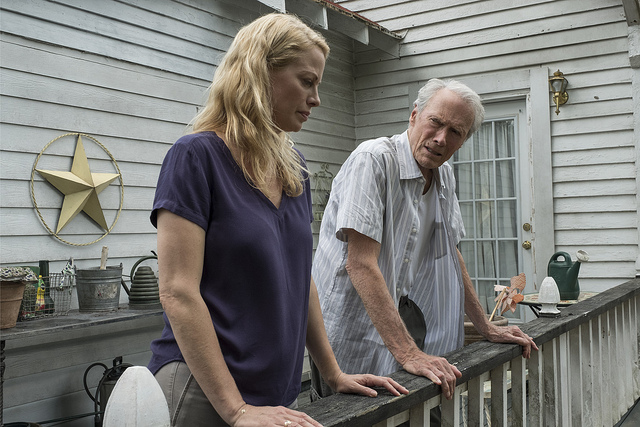
Eastwood stars as Earl Stone, a 90-year old horticulturist from Peoria, Illinois who is seeing the world changing rapidly thanks to the Internet. The film starts out in 2005 and he is winning awards at conventions and making friends left and right. However, he has forgotten about his family in the process. He is not on good terms with them and they feel neglected. Early on in the film, they show him missing out on his daughter’s wedding. His real-life daughter (Alison Eastwood) is in the film, which is a nice touch.
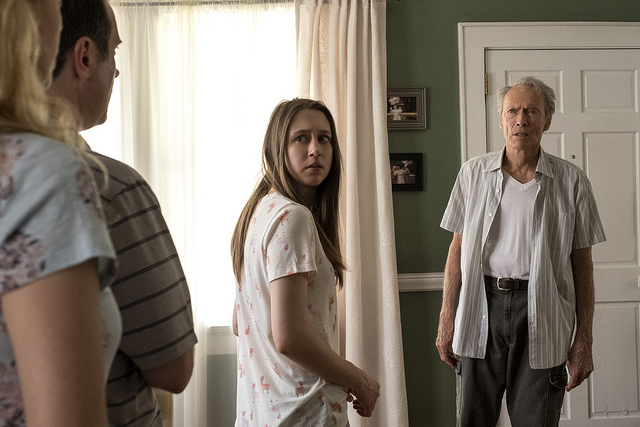
With the internet growing, Earl has now fallen on hard times. When he shows up to visit his granddaughter at a brunch for her upcoming wedding, he notices his family has not forgiven him for putting work over family. He wants to make it up to them by pitching in for Ginny’s (Taissa Farmiga) upcoming wedding. Someone approaches him at the brunch and informs him that all he has to do is drive and he can make a lot of money. Driving is something he is very good at as he has driven in forty-one states and has never been pulled over or ever had a ticket.
Little does Earl know he will be driving for the cartel and carrying around some cocaine. Since he is such a good driver, and 90-years old, it seems like the perfect way for him to make some easy money and get back in the good graces of his family. At first, he only takes on one job and believes it will be enough to hold him over. Before long, he is their top driver and highly thought of by the cartel. However, two DEA agents played by Bradley Cooper and Michael Peña are trying to take down the cartel, and Earl may go down with them as well.
There is nothing here which is incredibly moving, profound, or earth shattering. The jokes about cell phone usage are a little overdone. It is still very entertaining, however, and a very easy movie to watch. The film also features stellar performances from Laurence Fishburne, Dianne Wiest as Earl’s ex-wife, Richard Herd, Andy Garcia, and Clifton Collins Jr. Eastwood is the one leading the charge here, and he always plays it with his usual Eastwood calm, cool, and collected persona even when things get a little hairy. He makes a decision and he sticks with it.
At 116 minutes, “The Mule” breezes by with humor, suspense, and tension. At this rate, we don’t know how many more times Eastwood will be in front of the camera, and he is a Hollywood icon, so it’s always a treat. I don’t see any upcoming films for him as a director/actor, and he is someone who should be cherished. He still has it and will never lose it. I hope he lives forever and keeps making movies. This is the kind of movie where you sit back, relax, and enjoy the ride Eastwood and company take you on for almost two hours. It’s not great, but it’s still quite good.
Blu-Ray Info: “The Mule” is released on a two-disc Blu-Ray, DVD, and Digital Combo Pack from Warner Brothers Home Entertainment. It has a running time of 116 minutes and is rated R for language throughout and brief sexuality/nudity.
Audio Info: The audio is presented in DTS-HD Master Audio: English 5.1, English Descriptive Audio 5.1, Dolby Digital: French 5.1 (Dubbed in Quebec), and Spanish 5.1. Subtitles are included in English, Spanish, and French.
Video Info: The film comes to you in 1080p High Definition 16×9 2.4:1.
Special Features:
The Making of The Mule: Nobody Runs Forever (10:59): Clint Eastwood talks about how it was different from other projects he had done in the past. It was inspired by true events as well. The screenwriter of “Gran Torino” wrote this film, which makes total sense. Eastwood gives great details about how he approached the character. Many of the main cast members chime in with their thoughts on the film and working with Eastwood. They also go into detail on how Eastwood was big on getting all of the little things right in this movie.
Toby Keith “Don’t Let the Old Man In” Music Video (02:54)
So, the time had come again. The day of the Los Angeles Marathon had arrived, an event which brings the city of angels together in a way which is beautiful. Strangers cheer you on no matter who you are, and volunteers of all kinds are on hand to give you all the water, Gatorade, oranges, bananas and, yes, beer you could ever possibly want as you pound the pavement for 26.2 miles. We’ve trained for this endurance event for months, and now all we can do is hope it pays off as we pound the pavement for what those who do not run openly think is an insane distance to travel on foot. Of course, many of those same people keep telling me they cannot even run a mile, so their bewilderment at such an event is understandable.
This is the ninth year in a row I have participated in the LA Marathon, but things were different this time around. After running the full 26.2 miles for the past eight years, I decided the time had come to run the half marathon instead as it was harder to find time to train, and I was unable to complete certain runs either because my knees were hurting more than usual, or because I stupidly lost my cell phone and had to go searching for it. Seriously, hell hath no fury like a human being who has lost their cell phone.
In a time where I find myself oversleeping for far too often, I actually woke up about a half hour or so before the alarm on my cell phone was set to go off (4:45 a.m. to be exact). Since I was running the half marathon, I didn’t need to be in Santa Monica until about 6:00 a.m., so I took it easy as I got my running gear on and made sure to apply generous amounts of Body Glide and suntan lotion to my far too pale body. As I drove out to Santa Monica, I played music from the “American Flyers” soundtrack to pump myself up. I usually go with that or Queen’s extended version of “One Vision” as the key is to get myself all psyched up for a day in which I travel all parts of Los Angeles while saving gas money in the process. And, as I always like to tell people, I have to get back to my car somehow, and taking an Uber or a Lyft is out of the question. It’s not like any of the drivers can deal with all those road closures in a sane fashion anyway.
I drove over expecting traffic to be backed up to a crawl but I was astonished to see things weren’t that bad as getting into Santa Monica proved to be a piece of cake. Since the full marathoners had long since arrived, parked and made their way via bus to Dodger Stadium, the half marathoners were the only ones left. I parked in a lot off of Ocean Avenue, the cheap seats of LA Marathon parking, and made my way over to where the buses were waiting. Of course, unlike when parking at the Civic Center off of Main Street, the path to the buses was not a straight line like it once was. I realized this when I found myself approaching the Santa Monica Pier and began wondering where the hell I was.
As I made my way up, people were already gathering around as the last touches were being put on the finish line, and I was already getting congratulations from strangers for participating. I was in a hurry so I didn’t have time to tell anyone I had not actually started the marathon yet. Still, no one questioned why a guy like me who is carrying a little more luggage on his belly than he cared to admit could have finished running the LA Marathon so quickly. As much as I would like to believe I am faster than speeding bullet, there is a wealth of evidence to suggest otherwise.
My biggest fear was of getting on the wrong bus and ending up at Dodger Stadium. I was told there would be buses which would take us to Beverly Hills where the half-marathon starting point was, and that they would be leaving between 6:30 and 7:30 a.m. I had to double check with the traffic cop on duty to make sure I wasn’t about to make the dumbest mistake possible. It would have been catastrophic had I gone on one heading to Dodger Stadium as I could easily see myself going into full on self-flagellation mode. Heaven forbid I take it easy on myself, huh?
Anyway, I did get on the right bus which led me to the corner of Fairfax and Orange Grove. As I arrived, I had the good fortune to run into several of my fellow Pablove runners who were all set to run 13.1 miles from Beverly Hills to Santa Monica. To my surprise, there were more Pablove runners taking on the half-marathon than I originally realized. Like me, they decided to do the half as they were unable to devote the time they needed to training. But on the upside, we got to avoid running up those steep hills in Downtown Los Angeles as well as having to endure all those religious people who keep yelling into their bullhorns about how we have to give ourselves to Jesus. Methinks those people take the word of the Bible far too literally.
The day turned out to be warmer than I expected. This was a surprise after experiencing the coldest winter Southern California has had in lord only knows how long. For a while, I figured we might be greeted by cold weather this marathon hasn’t seen since 2012. But no, it was warmer than many would have preferred. Still, it wasn’t a scorcher like it was a few years ago.
At Dodger Stadium, the runners have to count the number of times Randy Newman’s “I Love LA” is played before they cross the starting line. From where we were, we were not subjected to that undying anthem. Instead, we got a school band performing “The Star-Spangled Banner” for us which we proudly stood for. But yeah, in retrospect I should have kneeled.
We had to wait a bit to start as the elite marathon runners, those who are Kenyan or anyone else determined to finish it in 2 or 3 hours, passed by. Once they came and went, we were led out in waves onto Sunset Boulevard. I decided to run this marathon at a 2:2 pace which means I ran for two minutes and then walked for another two. It didn’t take long for me to lose my fellow Pablove runners as they took off with no signs of stopping for any walk break, and once again I was “all by myself.” But was I? After all, thousands upon thousands of people were participating in this event, so I had little reason to ever feel lonely.
It is an exhilarating thing to run this particular marathon as it brings the citizens of Los Angeles together in a way I want them to be brought together on a daily basis. I don’t know the religions of everyone who volunteered, but they were definitely on display whether or not it called for its most loyal followers to wear a turban . I have to tell you, the endless supply of bananas came in handy as they gave me the extra burst of energy I desperately needed. In retrospect, however, I should have taken more of those orange slices as the juice was much needed on a day where Southern California returned to its unseasonably warm temperatures after going through one of its coldest winters ever.
Another joy I have in running this particular marathon is in seeing the signs spectators feel free to put on display. Among them was one which stated how we run better than the government, but then again, who doesn’t these days. One of my favorites came from someone eager to address the current controversy involving celebrities helping their kids cheat their way into top-rated universities.
Not once did I ever feel the need to take one or two extra strength Tylenol caplets. If I ran 26.2 miles, I would have taken at least one by the time I reached mile 13. My feet can only get abused so much before they start to complain as if to say, “why have you forsaken us?” Trust me, I have run this marathon before without taking any pain relievers, and I came out of it wondering why I could be so cruel to myself.
The sun did shine a lot brighter than I thought it would, but there was a cool breeze blowing in our direction as we approached Ocean Avenue. Of course, we had to suffer through San Vicente Boulevard before we got there, and this street feels never ending. It’s like a dolly zoom in a movie in that you are making progress, but the visual ahead suddenly looks a lot further away than you thought. Remember the moment in “Jaws” where Chief Brody slowly realizes that kid on the yellow raft is being attacked by a shark? That’s what I’m talking about.
I came into this year’s LA Marathon a bit depressed as I fell backwards in terms of training and ended up realizing I would be better off running the half. I had to accept the fact that my body is not the well-oiled machine it once was, and this involved acknowledging to myself of how I am not as young as I look. Regardless, this day was still a triumphant one, and I felt a sense of pride as I crossed the finish line while holding nine fingers up in the air to indicate how many times I have participated in this particular endurance event.
We still had to keep walking upon crossing the finish line as to suddenly stop would not be in our best interest. We were greeted with medals, and the LA Marathon always has the best ones, as well as servings of bananas, bagels (no cream cheese, damn it), water and Muscle Milk (which was not cold enough). Coach Kerry, who ran the half marathon with us, said he tried to wait for us, but security kept moving the runners along so they could make room for all the runners who had yet to finish.
So I walked slowly back to my car, put on deodorant, changed my shirt, got in and drove home. Although I only ran 13.1 miles, I was still wiped out and discovered a significant of sunburn on my back. I did put suntan lotion on, but my arms can only reach so far to cover everything.
As I walked home after parking my car, strangers noticed what was around my neck and were quick to say congratulations. Like I said, this event is the kind of thing which brings the citizens of this crazy city together in a beautiful way.
There are certain visuals from this marathon I will keep with me always. Among them is watching a physically disabled man slowly making his way to the finish line with a walker while still being in a lot of time. I also saw a young female runner being loaded onto a medical vehicle even as she screamed over the pain from her leg. I hope she’s doing better now.
I want to thank Coaches Kerry, Joaquin and Lourdes for all their help this past season and to congratulate my fellow Pablove runners for crossing the finish line. It has been an honor running in support of The Pablove Foundation which continues its fight against childhood cancer. These group of runners succeeded in raising over $50,000 for the organization, $1,000 of which was raised by me. Last I checked, my fundraising page is still up and running, so please feel free to make a tax-deductible donation to a great non-profit.
WRITER’S NOTE: This review was written back in 2010.
Gaspar Noe’s “Enter the Void,” his first feature length film since the highly controversial “Irreversible,” is one of the craziest and hypnotic cinematic experiences I have ever sat through. A hallucinogenic kaleidoscope of colors, some of which looked like they were taken from Dario Argento’s “Suspiria,” it’s a surreal out of body experience and the kind you do not see today in American cinema today. In a time of soulless remakes and films which shamelessly manipulate our emotions, this is a one of kind motion picture as it breaks boundaries to create something unlike anything we have seen before. Like Noe’s previous films, it is destined to have sharply polarized reactions. Some will admire it, and others will find it excruciating to sit through. As for myself, I was mesmerized from beginning to end, thankful I got to take in something not bound by your typical Hollywood formula.
Straight after the IFC Films logo appears, Noe propels us into this visionary experience by beginning with the end credits, just as he did with “Irreversible,” racing through them at warp speed. Watching this, I was reminded of what Homer Simpson said during the end credits of “The Simpsons Movie:”
“A lot of people worked hard on this film, and all they ask is for you to memorize their names!”
Then the movie goes from there into the opening titles which themselves are exhilaratingly creative and makes you feel like you’re at a rave party in Tokyo. Crazy visuals done to the song “Freak” by LFO, they alone were worth the price of admission and got applause from the audience I saw it with at the Lamelle Sunset 5 in Los Angeles.
The word “enter” gets blasted onto the screen, and we then make it to the seamier side of Tokyo as seen through the eyes of the main character, Oscar (Nathaniel Brown). Just like in the opening sequence of Kathryn Bigelow’s “Strange Days,” we see everything from his perspective as he talks with his sister Linda (Paz de la Huerta) who lives with him in a small apartment, and as he smokes some Dimethyltryptamine (DMT) which provides him with the ultimate high, filled with amazingly beautiful colors. During this time, we see Oscar is reading a book his friend Alex (Cyril Roy) gave him called the “Tibetan Book of the Dead.” Alex describes the book as one person’s experience after death, and of how it eventually leads to rebirth. From there, you get a good idea of where “Enter the Void” is going as Oscar later gets shot dead by police while attempting to flush his drugs down the toilet.
At this point, “Enter the Void” becomes a literal out of body experience as Oscar dies and his soul, no longer caged in its human form, rises from his lifeless body. From there, he floats through the darker sections of Tokyo as he watches over his sister as she moves on with life, devastated she can no longer spend it with her dear brother. Throughout, Noe goes back and forth in time as we come to see the connection Oscar and Linda developed in their youth, and how their promise of always being together is strong even as tragedy threatens to tear them apart.
Many will probably see “Enter the Void” as being a pro-drug movie, but I will leave this up to you, the viewer to decide. This is a movie meant for an adult crowd anyway, not for pre-teens. With drug trips, or so I am told, you are lifted high into a state of euphoria which seems untouchable in our everyday lives, but you are also brought down to emotionally shattering lows you will be desperate to look away from, but you won’t be able to tear your eyes away from what you will soon wish you’d forget. Your mind may be freed up in this state, but don’t ever expect to have any control.
Look, I’m not saying drugs are right, but if we’re not taking something illegal and very dangerous, then we are probably relying on something pharmaceutical. Anyway, this is not a movie to get all political about.
When the movie veers into Oscar’s youth, we get to see the close relationship he and his sister have with their ever-loving parents, and the times we see them together are very sweet and captured with a strong sense of innocence. But this later turns out to be a setup for when the parents are killed in horrific fashion after a truck going in the wrong direction smashes into their car, killing them instantly. It’s impossible not to feel the shattered emotions of the children as their lives are irrevocably altered in ways which rob them of a childhood they deserved to have.
Noe does manage to counter many of the disturbing moments of the movie with scenes of innocence and sweetness, and this is an aspect of his filmmaking people don’t often give him credit for. In the midst of shocking scenes filmed in all their psychologically damaging glory, he does capture intimate moments between which I rarely seen in movies being released these days. This was even the case in “Irreversible” when we watched Vincent Cassel and Monica Bellucci frolicking with one another in their apartment, and the fact the two were married in real life at the time makes those scenes feel more emotionally honest as a result.
As with your typical Noe motion picture, “Enter the Void” is not the kind which can be easily recommended to those interested in mainstream fare. In fact, is as far from mainstream cinema as you can get these days, and those who are easily offended would do their best to keep a marathon-like distance away from it. There’s even a scene where we watch helplessly as Linda gets an abortion, and although I was afraid it would be a much harder to sit through than it was, it is bound shake up a lot of the audience members’ emotions.
The acting for the most part is good. Special praise goes to Paz de la Huerta whose character of Linda has to go through the film’s most viscerally emotional moments, and she portrays them without a hint of simply playing the emotion. I also liked Cyril Roy as Oscar’s mentor Alex and found him to be an enjoyable presence even in the film’s more damning moments of despair. But let’s be honest here, this is a director’s movie more than anything else, and it is easy to believe this was Noe’s dream project for years. It’s a movie for visual and sound designers to go nuts on, and they must have had a blast trying to bring the director’s own psychedelic visions to the silver screen.
At two and a half hours long, “Enter The Void” does get a bit tedious at times. When the movie ended and the lights came up, I heard one guy say, “So at what point did you fall asleep? For some, this movie will be a lot longer than it should. The only time I got a bit restless was during the hotel orgy scene which overstays its welcome after not too long. Noe uses this scene to make clear the difference of having sex and making love, but he spends far too much energy filming this moment instead of just cutting down to its bare essence. I started to feel like Sean Young at the DGA awards when she told “The Diving Bell and the Butterfly” director Julian Schnabel to “get on with it.”
In spite of this, I was completely mesmerized by “Enter the Void” from start to finish as it took me on a cinematic journey far different than most I have sat through this past year. It will surely go down as one of the definitive love-it or hate-it movies of 2010, but I have no problem sticking up for what Noe has accomplished even if it became a bit overindulgent.
Personally, I’m glad we have directors like Gaspar Noe around because it feels like cinema worldwide is lacking filmmakers who take risks and challenge the conventional structure of your typical corporate product posing as a movie. We need more directors like him now because it has become increasingly understandable as to why many no longer go out to the movies like they once used to.
I will never forget when I first watched Terry Gilliam’s cinematic adaptation of “Fear & Loathing in Las Vegas.” Seeing the main characters played by Johnny Depp and Benicio Del Toro descend into a drug-fueled inferno proved to be one of the most insane and chaotic cinematic experiences I’ve ever had to where I felt like a hammer was constantly bashing at my head. I was in college at the time, and I described it to my friends as being one long acid-trip nightmare. One friend, her name Wendy, looked at me and said, “Oh yeah, like you would know!” This led to another person, Matthew, across the table laughing and responding, “Hey Wendy, he’s right.”
Seriously, you don’t need to have any experience with drugs of any kind to call “Fear & Loathing in Las Vegas” an acid-trip nightmare, and the same goes for “Climax,” the latest cinematic opus from Gaspar Noe. Like the majority of his films, it proves to be exhilarating, hypnotic and gloriously out of control as we watch a group of dancers try to get a hold of their sanity after they discover the sangria they have been drinking has been spiked with LSD. Whether or not you have had any experience with this drug, you will agree the trip these characters go on is not the least bit pleasant.
“Climax” takes us back to the winter of 1996 and opens with a series of audition tapes featuring dancers who are being considered for a French dance troupe being created by Selva (Sofia Boutella) and DJ Daddy (Kiddy Smile). Each dancer makes clear how intense their passion is for this particular artform and what they will do to make a career out of it. What’s interesting about this opening we are watching them on an old-style tube television which is surrounded by VHS tapes and books, all of which have influenced Noe’s filmmaking and personal beliefs. This includes such cinematic escapades like “Suspiria,” “Salo,” “Hara-Kiri” and “Possession,” and among the books are one by Romanian philosopher Emil Cioran, famous for his ultra-negative views on life and humanity, “Junkie” by William S. Burroughs, “LSD Psychotherapy” by Stanislav Grof, and “Wir Kinder vom Bahnhof Zoo” (“We Children of Bahnhof Zoo”) by Christiane F. Seeing these materials around the TV set should make it clear that Noe is not about to play it safe for anybody.
Following this comes one of the most exhilarating dance sequences I have in a movie in a long time as we watch a five-minute-long scene in which characters perform with utter abandon as they contort their bodies in ways which amazed me to no end. As the camera swoops over the performers, we are sucked into their dance space to where I wanted to feel the passion they felt. Seeing this reminded me of when I first watched the music video to Madonna’s “Lucky Star” on MTV, back when they actually showed music videos, and of how I wanted to experience the same level of joy she was having.
Noe is up to his old tricks again as he starts “Climax” with the end credits first and then give us the opening credits about 45 minutes later. As for the title, it appears exactly where it should. It does take a while for things to get crazy as Noe takes his time introducing us to these dancers as they discuss the sexual conquests and/or the future they hope to have sooner rather than later. As this goes on, the techno music plays non-stop, and once you notice it slowing down all of a sudden, you know this shit is about to get real.
Once the characters begin to realize they are under the influence of a psychedelic substance they were not planning on ingesting before their performance, the movie becomes a slow descent into chaos, and I could not take my eyes off the screen for one second. Even as the events became more and more horrifically chaotic, I was sucked into the madness everyone was trapped in, and I had no idea of where the story was going. This kind of unpredictability is very rare in movies today.
It’s especially impressive to learn that “Climax” was shot in just 15 days and with a script only five pages long. Learning of this made me believe this film could have been an enormous mess were it in the hands of another filmmaker, but Noe gives this sheer chaos a structure even as the performers let themselves run wild with the material. Some will complain this movie has no real story or plot, but I am certain anyone who has taken LSD can assure us how most psychedelic trips do not come with a three-act structure.
Once again, Noe employs his and Harmony Korine’s favorite cinematographer, Benoît Debie, who gives us such striking and absorbing colors throughout. Whether the lighting is dark green or blindingly red, Debie captures the insane madness in all its visual beauty, and when the white of the snow appears it feels like such a relief. This makes me look forward to Korine’s upcoming movie “The Beach Bum” all the more as Debie is the cinematographer on it too.
Noe has gone on record in saying the production of “Climax” was the most peaceful he ever had as a director, and this is regardless of the movie’s content. Apparently, there were no arguments on set, and no drugs or alcohol were used by anyone during filming. The latter is worth pointing out as the cast does an excellent job of looking like they are being ravaged by a narcotic they didn’t plan on taking. They could have easily looked ridiculous to where the movie could have been laughable, but everyone looks to be on their game here.
The cast is made of both professional and non-professional actors, and the one who stands out the most is Sofia Boutella. The French-Algerian actress has long since made a name for herself with such memorable performances in “Kingsman: The Secret Service,” “Star Trek Beyond” and “Atomic Blonde,” and watching her here is mesmerizing as she takes her character of Selva from a place of sanity to the polar opposite of it. She could have easily fallen into the trap of emoting here, but she never does as she makes Selva’s helpless predicament all the more frightening as this trip she is forced to take offers no easy escape for her or anyone else.
“Climax” may not reach the nightmarish heights of “Requiem for a Dream,” but it stands out as one of Noe’s strongest efforts. It doesn’t reach of what I feel is his masterpiece, “Enter the Void,” but it is stronger than his last movie, “Love 3D” which many were quick to dismiss as just another porno flick (I disagree). I for one am glad such daring filmmakers are still working in a time where superhero movies continue to dominate everything in the cinematic landscape. We need at least one filmmaker to break the rules, and Noe is no doubt one of them.
Again, I don’t think you need any experience with psychedelic substances to realize “Climax” is one long acid-trip nightmare. While the late Steve Jobs found an amazing level of creativity after experimenting with LSD, I don’t think the characters here will be anywhere as lucky, assuming they survive.
So, it has been a few weeks since I last wrote about my training for the 2019 Los Angeles Marathon. The last time I did, it was in regards to my 20-mile run which had me suffering an emotional breakdown. In addition, my knees have been hurting more than ever before. I am not in excruciating pain mind you, it’s just that after running the LA Marathon eight years in a row, my body is really feeling the mileage.
After giving much thought to it, I have decided to run the half marathon on March 24, 2019 instead of the full. After suffering several setbacks, it seemed like the smart thing to do. Still, I feel a bit depressed about making this change as it marks the first time in years I will not be running the full LA Marathon. As a result, my enthusiasm for this yearly event, the kind which brings Los Angeles together in a beautiful way, has been dimmed significantly.
But maybe the diming of my enthusiasm is the result of realizing where I am in life. In short, I’m not a young guy anymore. As much as I try to convince myself I am still demographically desirable, I have to face some inescapable facts: I am not as fast as I used to be, my body is failing me more than I care to admit, I am trailing behind everyone to where I cannot catch up with even their vapor trails, and those pounds I aim to shed off my body refuse to be shed. As much as I refuse to act my age (and who does anyway?), my body is changing, or devolving to put it midly.
I remember watching “City Slickers” on the silver screen back in 1991, and this piece of dialogue from Billy Crystal has always stayed with me:
“Have you ever had that feeling that this is the best I’m ever gonna do, this is the best I’m ever gonna feel… and it ain’t that great?”
I was still a teenager when “City Slickers” was released, and I kept thinking to myself, thank god I won’t have to worry about that for a long time. Well, a couple of decades have passed by, and there are things I need to accept as reality: lines are slowly showing up on my face, I’m getting hair where there shouldn’t be hair, and my knees are started to feel like they will collapse without much notice. I was told when I turned 18 how it was all downhill from there, but now I feel like I am going downhill faster than before, and the brakes to slow me down are a lot wobblier than they should be.
For the record, I am still keeping up with marathon training and have been attending each Saturday run the Pablove runners are expected to be at. It has been the rainiest and coldest winter Southern California in years, but neither rain nor the treacherous road that is Forest Lawn Drive can keep us from getting ready for the big day. We even broke our routine up one week and trained at the Rose Bowl in Pasadena, and running a couple of loops outside of it was refreshing.
The major upside of the last few runs was, for once, I got to run with others instead of just by myself. It’s nice to have the company as it sure helps motivate me in a way I cannot do on my own. I particularly want to thank Esther and Glendale, both whom are also running the half-marathon, for allowing me to keep up with them. And yes, it allowed me and Glendale to have a discussion about “I Spit on Your Grave” and its upcoming sequel, “I Spit on Your Grave: Déjà Vu.” The two of us are tickled to death over a direct sequel being made to this controversial cult classic all these years later, especially when you consider just how awful the first film was. Esther hasn’t seen or even heard of it, and she should consider herself lucky.
Running with these two reminded me of what kept bringing me back to LA Marathon training for several years now: the people. It’s fun running with people and talking about what the past week was like. Usually I end up running by myself to where my motivation to run more than walk is not as strong as it should be. It’s like I am Charlie Brown and lost in my own thoughts to where I inadvertently trick myself into believing I am going to win the decathlon, and we all remember how “You’re the Greatest, Charlie Brown” ended.
And again, there’s the issue with my knees. How much cartilage do they have left to work with? They ache more than usual, and I am not sure what to do about that. I keep thinking they will buckle on me when I least expect it, and I am trying to remain conscious of my running form from start to finish. George Harrison once sang about his guitar gently weeping, but my knees are not exactly weeping gently.
Also, I have been getting fatigued a lot. I spend a lot of mornings sleeping in even when I know I need to work. Maybe I was a bear in a previous life. A least they have an excuse to sleep for a long time; they hibernate. It makes me long for all the testosterone which starting leaving my body at 40. Testosterone, testosterone, my kingdom for some testosterone! Maybe I should get a bottle of Nugenix and see if it makes a difference. Frank Thomas did say “she’ll like the difference too,” so shouldn’t that be considered a solid endorsement?
Despite the setbacks, I still soldier on. Why? Well, these Saturday morning runs help give me a schedule which self-employment does not always invite (but probably should). It’s a great way for me to keep in shape even as the boundless energy I once had as a youth continues to disappear. And yes, I am doing this for a noble non-profit, The Pablove Foundation, which continues its fight against the insidious disease called pediatric cancer. No one should ever die young. No one.
We need to put more of a face on this disease. The Pablove Foundation has certainly done this, but we as runners don’t always know who we are doing this for on a personal level. Well, at least I don’t. It would serve as a strong reminder of the importance of what we do.
I hope my former marathon coach, JC Fernandez, doesn’t mind, but I wanted to share something he sent me recently:
“I neglected another important thing that I hope you have already taken to heart: YOU ARE A HERO. It can be difficult to consider when you’re focused solely on surviving the next mile of a course, but you have inspired people. People saw you run and thought, ‘Maybe I can do that.’ Furthermore, the people you’ve supported all these years are not grateful to you because of your pace. I’ve said often enough through the years that what we do is not abstract. And somewhere there is a person who at the very least struggles a bit less because of you but at the most remains alive because of you. Do not ever forget that, even if you decide to hang your cape up forever.”
JC certainly has a great point, and he and I learned from the best: Scott Boliver.
FUNDRAISING UPDATE: To date, I have raised $1,062 for The Pablove Foundation. I want to thank all of you who have supported me so far on this voyage to another LA Marathon. My fundraising goal is still $1,500, and there is still plenty of time to make a donation.
As much as I despise the controversial 1978 exploitation classic “I Spit on Your Grave,” I cannot help but be intrigued by its upcoming sequel. 40 years after Jennifer Hill (Camille Keaton) was brutally assaulted, left for dead and eventually reaped bloody revenge on her assailants, she rises again for another “Day of the Woman” in the eagerly anticipated sequel “I Spit on Your Grave: Déjà Vu.” Keaton returns to her iconic role along with Meir Zarchi who also wrote and directed the original, and one has to wonder how much more brutality Jennifer can possibly endure even after suffering unimaginable horrors decades before.
The trailer starts off with images from “I Spit on Your Grave” which last long enough to remind us how brutal and uncomfortable the first film was, and the moment where Jennifer has one of her attackers relaxing comfortably in the bathtub as she gently lifts up a knife she has hidden away still has men crossing their legs automatically. Whatever your thoughts were on the original, its lasting impact in the realm of revenge and exploitation films cannot be denied. It inspired a remake which was followed up by several sequels, but this follow up ignores them and focuses on the aftermath of what came before.
40 years later, we see Jennifer having a nice lunch with her daughter, Christy (Jamie Bernadette), but while walking back to their cars, they are greeted by a rabid fan gets Jennifer’s attention and asks her to sign a copy of her book. That this guy has a face which makes him look like a disciple of Charles Manson, and this is the first sign of things about to go very bad. Also, he is coming up to these ladies in a white van which, aside from the passenger and driver side, has no windows to see what’s in the back. This makes it all the easier for the fan and his driver to abduct Jennifer and Christy and throw them inside while no one else is looking.
From there, we know history will repeat itself in an intensely bloody fashion as Jennifer and Christy are greeted by an especially deranged matriarch named Becky (Maria Olsen), wife of the man Jennifer castrated in the bathtub. Becky promises both Jennifer and Christy a slow ride to hell as she seeks to avenge the men Jennifer killed, but neither of them are about to go quietly into that gentle night. This is especially the case with Christy who, at one point in the trailer, says she has her mother’s genes but none of her forgiveness.
Okay, this does not look like a great movie to say the least, but I am interested in checking it out in part to see if Zarchi’s filmmaking skills have improved in the slightest since 1978. Furthermore, even if you hated the original, you had to admire Keaton’s bravery as her character endured an infinitely appalling attack I would never wish on my worst enemy, and this sequel would not be worth the effort had she not agreed to reprise her role here.
Aside from Keaton, there are two actresses who stand out prominently in this trailer. One is Maria Olsen who looks to give a scenery-chewing performance as the embittered widow aiming to give Jennifer a taste of her own gory medicine. Granted, some of her acting looks like it just might be featured on the “Exquisite Acting” segment of Hollywood Babble-On, but she may very well give this sequel the hateful antagonist it deserves.
The other is Jamie Bernadette who plays Christy Hills. We see Christy wreaking bloody havoc on her captors to where she has bloodstains on her face much like her mother had years before. Bernadette has previously appeared in such movies as “Mortdecai” opposite Johnny Depp, and “The Darkness” which starred Kevin Bacon. If she hasn’t snuck into your consciousness yet, she will after this sequel is unleashed.
As for the male characters, they look to have the same luck as those crew members of the Starship Enterprise who are forced to wear red shirts on the average episode of “Star Trek.”
Again, this is unlikely to be a great cinematic experience, and the trailer cannot hide the signs of the limited budget the filmmakers had to work with. Filming on this sequel was completed back in 2015, and it is only now getting a release. Still, in a time where alternate timelines are more popular than ever, whether its J.J. Abrams’ “Star Trek” or the latest “Halloween” movie we’re talking about, this direct sequel to “I Spit on Your Grave” is something horror and exploitation movie fans cannot ignore.
“I Spit on Your Grave: Déjà vu” is set to be released on DVD and Blu-ray April 23, 2019. If Roger Ebert were still alive, I have no doubt he would be thrilled at how this sequel is not being shown on the silver screen (or at least, not yet).
The following is a sponsored post which was written by Maxim Pratsyuk, a writer currently living in Ukraine.
There is a special category of films which, regardless of the plot, are loved and watched by many people around the world. This is Indian cinema. The plots of Indian films, like most other ones, tell about relationships between two people. The blessed theme of love comes to the fore. Directors can add intrigue and come up with an incredible life story of the characters. Despite the fact that most Indian films are related to melodramas, there is always a place for humor in them. Immediate and harmless, it harmoniously fits into any plot. The main feature of Indian love films is the heat of passion. And the ending is always life-affirming – love conquers all. If you meet a girl on an international dating site, then why not invite her on a date and watch something from Indian cinematography?
A silent prisoner in a Pakistani prison has not uttered a word since his imprisonment. A girl named Samia, who is an activist for the protection of human rights, is going to find out the real reason for his silence. And she succeeds. This superbly filmed, beautiful and touching love story will surely please even those who are absolutely indifferent to Indian cinema. It deserves the first place in the rating.
The sexiest Indian actress Zeenat Aman plays a girl named Rupa, half of whose face is disfigured by a terrible burn, received in childhood. Rupa loves a man who also loves her, but he doesn’t know about her terrible secret since she covers the disfigured part of her face when she is with him.
The main character of the film Nain, having lost her father, wallowed in family problems. But having met cheerful and kind Haman, her life begins to improve. And all can be good, but suddenly there a love triangle forms in which everyone must make a sacrifice. Among the everyday routine, we often forget about the main things – we forget to appreciate each passing day, smile, and enjoy the world around us. The film reminds us of this because no one knows whether tomorrow will come or not.
The mentally ill villain Ravana kidnaps Rajini, the wife of a policeman and he is going to save her. As long as Rajini is held captive by Ravana, their relationship grows into an “abductor-prisoner” relationship. Rajini gradually learns who is hiding behind the guise of the villain and realizes that their relationship will continue even after death.
Three friends study at the men’s college in the city where they live. The rector of the college strictly forbids the young men to leave the territory and especially attend the nearby female gymnasium. But how can a ban deprive young people of the opportunity to love and date? A touching plot, wonderful music and, of course, a brilliant cast – everything is perfectly matched in this film.
The film was shot based on the tale of the Russian writer F.M. Dostoevsky – “White Nights”. The plot of Dostoevsky’s story in the film was almost unchanged. But the action was transferred from Russia to India. Sonam Kapoor played an Indian girl Sakina, who needed to make a choice between two men – the one who wasn’t around but whom she loved and waited a whole year and the one who was nearby and loved her.
The Indian army sapper Samar Anand is not afraid of death. He never even puts on a protective suit. Once Samar saves the life of a journalist Akira and at the same time loses his diary. From him, Akira learns the story of his love for the girl Mira because of whom Samar defied God ten years ago.
The protagonist of the film Raj is a simple guy who works as a regular truck driver. His loved girl Priya is smart and self-confident. Will love be able to remove this class abyss between them? Or is their relationship destined to end? Fans of this genre will surely like this film about mutual support and forgiveness, love, and empathy.
A young girl Taani lives with her husband. But their views and interests in life are completely different. Taani loves dancing and is preparing for the next dance competition. One day she meets a guy for whom her feelings begin awakening. Beautiful actors and fiery dances will not leave you indifferent. If you want to please a girl on a date, then you definitely have to pay attention to this film.
The twin sisters were separated by the will of their early childhood. Each of them lives differently. Geeta became a dancer with tramps, and her sister Seeta has a rich family. Each of them dreams of happiness and love, which they lack so much. This film is a real classic of Indian cinema. Songs, dances and melee battles – there is everything that Indian cinema embodies. Your loved one will be definitely touched by this romantic movie.
When “Rocky Balboa” was released in 2006, many wondered how a sixth “Rocky” film would perform when the last one prior to that was released in 1990. Sylvester Stallone himself was not all too pleased with how “Rocky V” ended, and he wanted to do right by Rocky Balboa. Needless to say, he did so as he was the writer and the director behind it. Because of the good will he had built up from the sixth installment, fans were excited for “Creed,” which was released in 2015 and directed by Ryan Coogler.
Coogler was coming off the success of “Fruitvale Station,” and it was set to star Michael B. Jordan, also from the aforementioned film. It was in good hands, as they were wise to hand the franchise over to Jordan while still keeping Stallone around. The film was organic, funny, entertaining, and powerful at the same time. When it was time for “Creed II,” they handed it over to Steven Caple Jr. I’m happy to report he did a terrific job with “Creed II,” and the writers also had a fresh idea to bring to the table: bring back Ivan Drago (Dolph Lundgren) and introduce his son Viktor (Florian Munteanu). After all, everyone remembers how things ended up in “Rocky IV” between Drago and Apollo Creed.
When the film gets started, everything seems to be going well for Adonis Creed. He wins the World Heavyweight Championship, proposes to his girlfriend, Bianca (Tessa Thompson), and he also has a baby on the way. His world, however, gets turned upside down when Viktor Drago, son of Ivan Drago, challenges him. This is the same Ivan Drago who killed his father back in 1985. Rocky tries to tell him to stay away from the fight and that he is fighting for the wrong reasons.
Adonis’ pride, however gets in the way and he ends up taking on the fight, regardless, and without Rocky his corner. His life only becomes more complicated and painful from that point forward. Now, he needs to figure out what to do in order to get his career, his health, and his life back on track. It won’t be easy for Adonis, but everything in his life has always been a fight. Rocky just wants him to figure out what he’s fighting for and also realize he has other people counting on him as well.
There is a lot to like about “Creed II.” I’m not going to say if it is better or worse than 2015’s “Creed.” It is just as good. It is just different, and it is dealing with different themes and different messages. Jordan gives a knockout (I know, easy pun) performance here. All of his emotions are in his face, and it’s a performance with a lot of nuance and complexity attached to it. As an audience member, you understand what he’s doing and why, even if you don’t always agree with him.
His relationship with Tessa Thompson’s Bianca also brings a big heart to the film. These two have tremendous chemistry together and it is a joy to watch them on screen. Stallone has said he is walking away from the franchise after this movie, and it seems like the right move. Make no mistake about it, Stallone’s the backbone of this franchise and he makes the most of every scene he’s in even though he doesn’t get a lot of screen time. He does a lot with a little. I imagine this was intentionally done, as he was one of the writers on the project.
The film deals with the complexity of a father/son relationship and how men are trying to carve out their own image and legacy. There is a lot of meat in this script, as Adonis is becoming a father himself. Phylicia Rashad is back here once again, and she brings such fierce intensity and knowledge to her role as Mary Anne Creed. There is not a bad performance in the film. It’s heartwarming, intense, and very, very entertaining.
With that said, it is not a perfect film. I would argue it is about twenty minutes too long. As with most boxing movies, the boxing itself and the training montages are not all that interesting compared to the relationships in the film. What transpires throughout the film will not surprise anyone, but when it’s done with such warmth and commitment from the actors, it helps elevate the material into something really, really special. While I don’t think we need a “Creed III,” I can’t say I would necessarily mind one if the right people are involved in the project.
Blu-Ray Info: “Creed II” is released on a two-disc Blu-ray combo pack, which also includes a digital copy, from Warner Brothers Home Entertainment. The film is rated PG-13 for sports action violence, language, and a scene of sensuality. It has a running time of 130 minutes. It is presented in 1080p High Definition with an aspect ratio of 16×9, 2.4:1. The audio formats are Dolby Atmos-TrueHD: English, DTS MA: English 5.1, English Descriptive Audio 5.1, Dolby Digital: Français 5.1, and Español 5.1. Subtitles are included in English, French, and Spanish.
Special Features:
Fathers and Sons (07:16): This special feature talks about how “Creed II” touches on the father/son dynamic and what a big role it plays in the film and also in life. Interviews with the cast and crew are featured as well as some famous boxers including Sugar Ray Leonard. They even talk about the Shakespearean aspects of the story.
Casting Viktor Drago (05:43): This special feature is all about the casting of Florian Munteanu who comes from a boxing background. Stallone wanted him in the film and saw something special in him. Munteanu talks about how grateful he is to be in the film as he is familiar with all of the “Rocky” films. He trained for seven months and really committed to the role, which impressed his fellow actors and the director as well.
The Women of “Creed II” (05:51): Sugar Ray Leonard appears once again, and he gives credit to the women that are alongside the boxers through all of the training and the punishment in the ring. Director Steven Caple Jr. didn’t just want Tessa Thompson and Phylicia Rashad to be in the background of the film. He wanted them to get their due. It’s a big reason why the film is as effective as it is because each and every character serves a significant purpose.
The “Rocky” Legacy (15:01): This is hosted by Dolph Lundgren, and it discusses the impact the “Rocky” franchise has had not only on boxing movies, but also on the sport itself. They also tie it together with “Rocky IV” and “Creed II.” The cast and crew of “Creed II” talk about the music, the boxing scenes, and why the franchise has lasted as long as it has going all the way back to 1976.
Deleted Scenes (09:46): One notable deleted scene worth mentioning is one where Rocky performs a eulogy for Spider Rico, the first fighter he ever fought in the “Rocky” films. It’s a powerful scene and one which should have been in the film despite my issues with its length. The other three deleted scenes include Rocky training young kids to box, Adonis and Bianca talking about his legacy, and the aftermath of the fight between Adonis and Viktor.
For many of us, the events of the Apollo 11 have long since been relegated to the annals of history. Back in July 1969, astronauts Neil Armstrong, Buzz Aldrin and Michael Collins were propelled into outer space to fulfill President John F. Kennedy’s 1961 national goal of landing a man on the Moon and then returning him safely back to Earth before the end of the decade. Those who were alive back then cannot and will not forget this incredible event, but many who were born after it occurred observe it as a mere footnote in history which has long since passed them by.
This historic event was revisited recently in Damien Chazelle’s film “First Man,” but now we have the documentary “Apollo 11” which takes audiences right back to 1969 when the mission took place. Described as a “cinematic event 50 years in the making,” it has been crafted from a newly discovered treasure trove of 65mm footage and 11,000 hours on uncatalogued audio recordings. The end result is a motion picture which makes you feel as though you are watching America’s first flight to the Moon as if it just happened yesterday, and it is a movie which demands to be seen on the biggest screen near you.
“Apollo 11” was directed by Todd Douglas Miller whose previous films include “Dinosaur 13” which observed the discovery of the largest Tyrannosaurus Rex fossil ever found, and “Gahanna Bill” which chronicles the life of Bill Withrow; a middle-aged, mentally handicapped man. I spoke with Miller about the making of “Apollo 11,” and he discussed why no narration or interviews were included in the documentary, the process of restoring much of the footage, and of how the discovered audio proved to be as informative as the visuals on display.
Ben Kenber: I love how the documentary opens with the image of the rocket and the capsule being slowly moved out to the launching area. It’s a fascinating way to start as we are reminded of the immense size of the rocket and also, more importantly, what humanity is capable of creating. What made you start the documentary with this image?
Todd Douglas Miller: One of the first images that we saw when we were doing some test scanning of the original film reel was the rocket being taken out on the crawler to pad 39A. It was actually upside down because the reel was wound backwards. So, we are looking at it and the way it comes off the scanner you only see an image every three or four seconds. And then we go, wait a minute, we know this is large-format but this is actually taken from a helicopter too, so we immediately put it up on the big screen in the theater and our jaws were just on the floor. I knew that I wanted to start this film to put the audience right in the moment, and I just felt like what better moment to see this giant 300+ feet tall Saturn V rocket and this amazing machine which was created to move it. It was really a no-brainer to start the movie there.
BK: I agree. Also, the resolution of the images you have to work with here is just breathtaking.
TDM: Yeah. Originally, we had set out to just rescan all the 16 and the 35mm film which we ultimately did. But when we dealt with those materials, some of them had been used over the decades, a shot here in a shot there, so there was a fair amount of clean and prep before we actually scanned them. With the 65mm, it was just so pristine, we really treated it with kid gloves in the color correction and the conform of it. It was just something that the technicians who were working with it on the scanners, they had just never seen anything like that: the condition and the way it moves through the machinery. Important to note too, the scanner that was developed for this was a prototype scanner. There is only one in existence created for just this project, but it actually moved the film through a series of air pressures. There was never anything physically touching the film itself. It’s a real testament to the guys who developed the technology created to handle it.
BK: In addition to all the footage which was discovered, there was a wealth of audio recordings recovered as well. Which give you more information and more help in making this documentary, the video or the audio?
TDM: That’s a great question. I would say if I had to pick because I am a visual guy, seeing the large-format film obviously informs some of the edit decisions as far as the eye candy shots go. But certainly, from a story perspective and how I want the shape the narrative of the mission, there was no better resource then the audio. We knew about all the air to ground audio and all the onboard audio that existed. When Neil Armstrong, Buzz Aldrin and Michael Collins were in the command module while they were on, let’s say, the dark side of the moon and they weren’t in communication with the earth, they flipped on a recorder so we have recordings that were taken on board, and there were also on-board recordings from the lunar landing and some other key moments during the mission. But we didn’t know of and what landed in our lap was 18,000 hours of Mission Control audio that was recorded at Mission Control on 30 tracks of audio in the front room, an additional 30 tracks of audio in the back room, and 11,000 hours of the 18,000 hours was statistically Apollo 11. It was a real mishmash. It has been digitized by a team down at the University of Texas in Dallas. It was going through NASA exports control. We got it fairly early so we could rifle through it and kind of help with the effort to transcribe everything and see if there was anything questionable in there or anything we can utilize in the film. It turned out it became our main resource for shaping the structure of this story that we wanted to focus on this because there were things in there that had never been heard before, or there were lines in there that might have not ended up on the air to ground transmissions that were cleaner than this 30-track audio recording.
BK: This documentary has no narration, but it really doesn’t need it because you can tell everything that is going on. Was it always your intention to not include any narration in this documentary, or was it something which came up during the editing process?
TDM: Yeah. One thing that you discover when you listen to all the mission audio, NASA broadcast what is basically the flight directors’ loop. So, if you hear any of the four flight directors (Gene Krantz, Clifford E. Charlesworth, Gerald D. Griffin and Glynn Lunney) talking with the other guys and also the flight capsule communicator in direct communication with the capsule, that gets broadcast. But a lot of times it’s just a lot of technical jargon and numbers. They are inputting data into their local computer, the command module and the lunar module. So, what’s great for the average viewer or for a filmmaker was there was also four public affairs officers stationed in Mission Control that were of functioning as narration for the general audience that was listening via TV or the radio and would kind of dumb it down for people like me. You could get kind of a blow-by-blow, it’s almost like watching a live sportscast, of exactly what’s going on. From a filmmaking perspective it was really great that they so happened to have the voices of airline pilots. They were just this really calming influence and it certainly translated very well into utilizing them in the guise of the film.
BK: I was also really fascinated with how fast the spacecraft goes. It’s frightening when you realize what the velocity is. The scene where the astronauts land on the moon is almost terrifying because they are descending so fast and I found myself wanting to yell at the screen, hit the brakes!
TDM: (Laughs) Yeah, it was really fun to deal with all that telemetry and hours and hours spent with the consultants trying to figure out different angles and the velocities and approximate altitudes for different things. It really puts in perspective the technical accomplishments in this year expertise that these astronauts had to fly these machines and land them safely. It’s really incredible.
BK: “Apollo 11” deals with some very iconic moments, and yet it all feels like we are watching this event for the first time.
TDM: Thanks for saying that. That was definitely the intent. We joked that from the beginning we wanted this to feel like “Dunkirk” in space. It’s an analogy in that if you think about just being dropped into a situation, even though you know how it ends, that it’s definitely going to take you for a ride just by the sheer imagery involved. Some of the imagery that was captured, whether it was Buzz Aldrin operating the 16mm camera during the landing or Michael Collins during the lunar liftoff when the lunar module was coming off the surface of the moon towards the command module to dock, those two scenes we wanted them to be unbroken shots because they are two of the most iconic things ever captured on celluloid as far as I’m concerned. I think that too often it gets kind of missed on people how special that imagery really is when you just see it in bits and pieces or sped up, or it has too much flash to it. To see it as it was, it had an emotional impact on me for sure.
BK: The film score by Matt Morton helps to heighten the more dangerous aspects of the mission. Every once in a while, we are reminded of how dangerous space travel can be just as were while watching Alfonso Cuarón’s “Gravity.” What was it like working with Matt on the score?
TDM: Well I have known Matt since we were kids, and he’s my oldest collaborator. Typically, the way we work is we do post scores so I’ll temp in music to a team and then give it to him, and we talked about it and then he goes off and does his magic. With this, he told me very early on even when we were in the research phase of the film that he wanted to do a period score with modern composition and I said, what does that mean? (Laughs) He said I actually want to go out and only use instruments that were made pre-1969, one of which is a Moog synthesizer. Moog at the time was reissuing their 1968 synthesizer. They only made 25 of them and he got, I don’t know, number 13 or 14. I was scared at first but I didn’t tell them. I trust him but he didn’t know how to play one, and it’s a monster thing. It takes up an entire wall. It’s huge. He would go off and give me these hours and hours of these Moog compositions, so we ended up pre-scoring most of the film that way and it was just an absolutely wonderful way to work. It is one in which we, moving forward, want to do more of. It’s really just a testament to Matt and his skills as a composer and his versatility too. I’m just lucky that I get to work with him. I think his skill set as a composer is really in the spotlight and this one, and I’m just really proud of the work he did.
BK: “Apollo 11” is dedicated to Al and Theo. Can you tell me about those two people?
TDM: Al was Al Reinert, and he was a filmmaker. He made of film in the 80’s called “For All Mankind.” We became friends. I reached out to him when we did a short film which was really a primer for this film called “Last Steps” about Apollo 17. We just really hit it off, and he was working on a space themed film. We were doing some resource sharing and I was really looking forward to sharing this with him. Unfortunately, he passed away not too long ago before he could see the film. It’s one of the things I regret most, not showing him an early cut. Al was also the screenwriter on “Apollo 13,” and his films had at impact on me as a filmmaker. But I’m also lucky enough to call him a friend and develop a personal relationship with him towards the end of his life. Theo is Theo Kamecke, and he also passed away during the making of our film. Theo was the director of a film that’s become a cult classic among space fans called “Moonwalk One,” and a lot of the imagery that’s in our film “Apollo 11” was created for “Moonwalk One.” He was known as a really good editor too, and he actually worked on an Academy Award-winning short film called “To Be Alive!” which was produced by the Francis Thompson Company which ended up producing “Moonwalk One.” There was going to be a contingent of myself, National Archives and Maps and some of the team were going to show him some of things we discovered, and unfortunately he passed away a few weeks before this happened. So, we dedicated the film to those two filmmakers.
BK: You are known for another documentary you made previously called “Dinosaur 13.” I was curious, between that and “Apollo 11,” which was the tougher documentary to make?
TDM: That’s an interesting question. I think in terms of sheer scope, this was more difficult. We knew from the very beginning the immense responsibility we had. The fact we were transporting priceless materials up the I-95 corridor from (Washington) D.C. to New York led to a lot of sleepless and restless nights. We shot a lot on “Dinosaur 13,” but the narrative kind of set itself, and we were purely focused on just the film. With this, it wasn’t just the film. It was also the preservation and curation of all these materials that we were generating, and also the ones we were utilizing. We just felt a real pressure to get it right, so I would have to vote for this one.
BK: I imagine it’s a lot more challenging to get the details right something like this especially when you have this treasure trove of material which was left unseen for far too long.
TDM: Yeah, and I am so proud of all the work that everybody did on this, and I am proud of the work everybody did on “Dinosaur 13.” That was definitely a big project to pull that all together. We used a lot of archival material on that as well and filmed as much as we did. With “Apollo 11,” we didn’t shoot it ourselves. We had the responsibility to honor a lot of these filmmakers who are now deceased.
“Apollo 11” opens exclusively in IMAX on March 1st for one week only, and it will open in theaters everywhere on March 8th. If you can, see it in IMAX. It is an extraordinary cinematic experience.
2018 was not a great year for cinema, but the films that were good were really good. The year started out strong, it died out in the middle, and finished good but not good enough.
Honorable Mentions for Really Good Movies:
“Game Night,” “Blockers,” “Assassination Nation,” “Paterno,” “Halloween,” “Never Goin’ Back,” “Creed 2,” “Widows,” “The Hate U Give,” “Three Identical Strangers,” “The Wife,” “What They Had,” “All the Money in the World,” “Sorry to Bother You,” “Fahrenheit 11/9” and “Upgrade.”
10) “Love, Simon”
This flick came out in March, and it is truly a film which needed to be made. It was directed incredibly well by Greg Berlanti. Here is the thing about films which deal with someone being gay and not being sure how to tell their friends and family: these are stories that help others feel more comfortable about coming out. This film was funny, touching and incredibly moving. The lead, Nick Robinson, shows the audience all of Simon’s conflicting emotions from coming out to his parents, played by Josh Duhamel and Jennifer Garner, as well as his group of friends. Katherine Langford from “13 Reasons Why” is terrific as his best friend, and Tony Hale is also great as the vice principal of the school. The film deals with the subject in a sensitive but profound way. At the end of the day, it is a love story filled with a big heart and a lot of humor. If you missed it back in March 2018, now is the time to see it.
As someone who tries to attend the cinema as often as possible, I know how hard it is to get an audience to keep quiet. While watching this movie in a packed theater, it was total and complete silence. It was a truly surreal and great moviegoing experience. This was an April release and it did well at the box office and with critics. It stars John Krasinski and Emily Blunt as a family that must survive during a time where, if there is any noise, monsters will appear and attack and kill you. Krasinski is also behind the camera on this one, and he shows some real talent as a filmmaker. When the stakes are so high and no one can talk or make any noise, the tension is unnerving and unsettling in the best possible way. The film also features two great performances from the two children: Millicent Simmonds (hearing impaired in real life) and Noah Jupe. It was great casting to find a young actress who was really deaf as it lends to the film’s authenticity.
8) “Won’t You Be My Neighbor?”
How in the world did this film get overlooked at the Oscars? How did it not even get a nomination? This is something which will puzzle and bother me for quite a while. This is a tremendous documentary and a great film. Everyone remembers Mr. Rogers, and this film shows the impact he had on children and the world. It also dives into other aspects of his life and leaves no stone unturned. It is the kind of movie which makes you feel good, and we need more movies like it during these trying times. Mr. Rogers was a special person, and this is a special film. As the tagline on the poster says, “A Little Kindness Goes A Long Way.” It will take you back to when you were a kid and grew up watching and responding to him. He was never afraid to tackle tough subjects in a profound and thoughtful way, and his impact will forever be felt.
Spike Lee’s “BlacKkKlansman” is a mind-blowing film which shows how Detective Ron Stallworth (John David Washington) was able to be part of the Ku Klux Klan as a black man with the help of Flip Zimmerman (Adam Driver), his partner. Stallworth does all of the voice work over the phone to convince David Duke (Topher Grace) he’s really white while Flip shows up to various meetings. The usual Spike Lee humor is infused in the script as well, and it works because he is still taking the subject matter seriously. Racism is still very much alive today, as they show this in the end credits, but Lee makes an entertaining true story come to life here. Washington keeps proving he is an actor and not just Denzel’s son. This is tough material, no question about it, but Lee has never been afraid to go there. You have to go there in order for real change to occur.
Bo Burnham’s directorial debut took the world by storm in the summer of 2018. My wife and I went out of our way to see it. We have always been big supporters of independent cinema, and we were glad to see it and more than happy to make the drive. Burnham is very much in touch with social media, and even though he is not a girl in eighth grade, he taps into what it feels like to be in that mindset and how terrifying it can feel. It feels like the end of the world and all of this pressure is mounting on you. Elsie Fisher is the star of the show, and she’s so likable, funny and interesting, even though she does not see it. In interviews, Burnham talked about how she was a shy girl trying to be confident in auditions, and this is exactly what he was looking for as everyone else was a confident girl trying to act shy. The best scenes in the film are the ones with her and her father, played by Josh Hamilton. It is a great movie which more people need to discover now that it’s out on Blu-ray.
The LGBTQ community got another great film in “Boy Erased.” This was a November release which sadly did not perform well at the box office. It was written and directed by Joel Edgerton and adapted from the novel by Garrard Conley. The film deals with something called conversation therapy. Those who perform this therapy believe they can turn someone who is homosexual into a straight man or woman. Edgerton also plays the leader of this program, and he has some unusual methods to say the least. Lucas Hedges tells the story of Garrard Conley, although his character’s name in the film is Jared Eamons. His parents are played by Nicole Kidman and Russell Crowe, and this is shockingly their first time working together. Things are complicated because Jared’s father is a pastor, and his father believes this is the best way to handle this situation. The mother is not really on board with it, but she is sticking by her husband even though you sense her regret. It is a haunting, scary and emotional film which deserves to be seen. People are unaware places like these still exist in so many states. The only way they will not exist is if people pay attention and do something. It is an eye-opening film which was criminally overlooked by moviegoers. Just because a film deals with tough subject matter, it does not mean audiences should not view it. Film can educate and inform us.
4) “First Reformed”
Paul Schrader’s “First Reformed” is yet another great movie which audiences decided to turn away from at the box office. I understand people enjoy their Marvel movies and their popcorn entertainment, but there are films which can create discussion. That, to me, is the power of cinema. The always terrific Ethan Hawke is a pastor named Toller at the First Reformed church. One day, Mary (Amanda Seyfried) comes to his church and asks him to help out her husband Michael (Philip Ettinger) who is worried about the state of the world, the planet and what we are doing to it. Her husband wants to do something about it, has been arrested and he feels people are turning a blind eye to these major issues going on in the world. Toller starts to believe in a lot of what he is being told by Michael and even questions his own faith and his church. He has health problems and is not happy with how things are being run over at Abundant Life, which is part of First Reformed, by Jeffers (Cedric Kyles, a.k.a. Cedric the Entertainer ). He is journaling everything and trying to process his feelings. Toller also has some issues from his past which he has never gotten over as well. This is an impactful movie which left me speechless. It is a must-see.
Another overlooked critical darling is “Blindspotting” which was written by long-time friends Daveed Diggs and Rafael Casal. Diggs plays Collin, a black man on parole trying to finish it out without any incidents. This is incredibly difficult due to his friendship with Miles (Casal), a white-man living in Oakland who is always trying to act tough and intimidate people to get respect. Collin is just trying to keep to himself and do his job so he can be free from probation, but he’s finding this hard to do when he sees a young black man killed by a police officer. He wants to say something, but he is worried about how it will impact his parole. “Blindspotting” is a term where people look at something and they only see one thing and are missing another piece of the picture. The chemistry between Diggs and Casal is totally natural, as to be expected, and they have a lot of humorous moments together. That is the beauty of “Blindspotting,” and there are similar films talking about these things happening in the world right now. You can show the ugly side and bring it to people’s attention, but you can also have some humor in there as well. It does not have to be all gloom and doom. There is a lot of terrific music in the film and a lot of it is free style rapping which pertains to the plot. As Collin says, “You monsters got me feeling like a monster in my own town.”
2) “Green Book”
This is more than your average road trip buddy movie between two unlikely friends. Mahershala Ali plays Dr. Don Shirley, a famous pianist who needs a driver to take him through the south. Tony Lip, played by Viggo Mortensen, needs some money and ends up taking the job as his driver. Tony is not necessarily racist, but he does offer fried chicken to Don Shirley, as I imagine he is more ignorant than anything else. Tony sees how white men are treating Mr. Shirley and is not happy about it. He forms a kinship with him, especially after Shirley helps Tony write love letters to his wife, played by Linda Cardellini. It is based on a true story, and the two leads knock it out of the park. I have to give a slight edge to Mortensen’s performance, but that is only because he has the juicer lines and more material to work with compared to Ali. Make no mistake about it, though, Ali is superb in this movie and he knows when to pick his scenes to knock it out of the park. This is a moving picture which deals with race in a thoughtful and heartfelt way, and it doesn’t shy away from the tough stuff either.
1) “A Star is Born”
If you are surprised by this selection, you have not heard me rave about this movie since I first watched it with my wife on opening night back in October. Bradley Cooper is a great director and he should have been given a nomination for Best Director. I hope Lady Gaga wins Best Actress over Glenn Close. This movie is about mental illness, fame, believing in yourself, putting yourself out there and so much more. Cooper is believable as a singer and Lady Gaga is believable as an actress. The two have chemistry for days. It’s a heartbreaking film which truly earns every tear from the audience. The music is catchy, and it has a great soundtrack as well. This is why I go to the movies and, as I said in my review, no film has affected me as much as since 2004’s “Million Dollar Baby.” This is the best film of 2018, hands down. If you don’t cry during it, you are made of stone.