Underseen Movie: ‘The A-Team’ – A Ralph Report Video Vault Selection

The movie version of the 1980s television show “The A-Team” is one of those examples of how, as U2 put it in their song “Numb,” too much is not enough. The plot is razor thin, and the stunts defy all things we see as logically possible. And you know what? I didn’t care because I HAD SUCH A BLAST WATCHING IT!!! Many reviewers have been bemoaning how it was not what it could have been. I, on the other hand, prefer to see it for what it is, a highly entertaining film and the kind we usually expect to watch during the summer season.

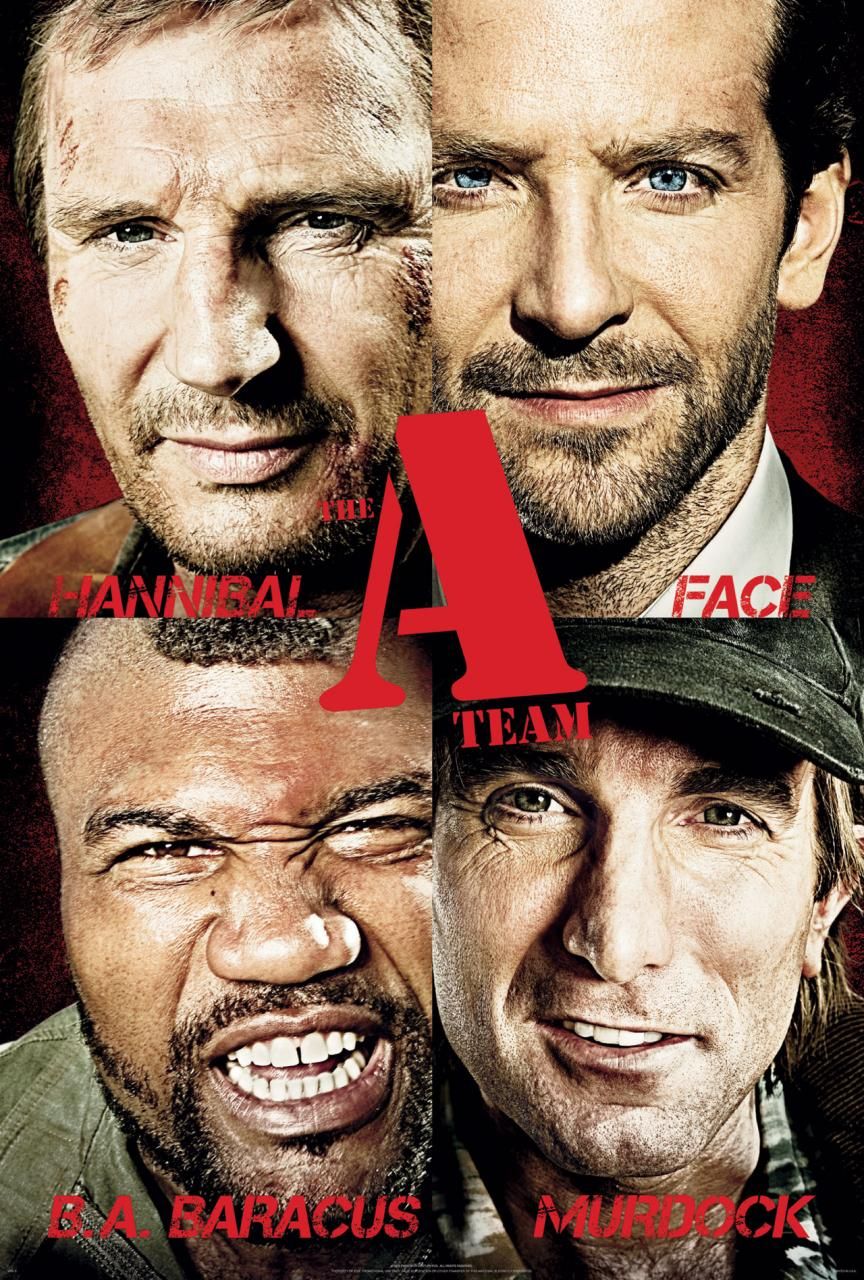
After a prologue that shows how this team of Army rangers came together, we get thrust right into the action as we catch up with Hannibal, Faceman, B.A. Baracus, and the consistently insane Murdock as they are about to wrap up their tour of duty in Iraq. But before they can leave, they are given another mission to retrieve U.S. treasury plates that insurgents intend on using to make counterfeit money; the same kind of plates we would love to have in our possession as they would allow us to quit our day jobs. Without going into much detail, the plan goes awry, and they get set up to take the fall for something they are completely innocent of. The rest of the movie has them going on a mission to get the plates back and clear their names.

The director behind this unrestricted mayhem is Joe Carnahan. This is the same filmmaker who began his career with the $7,500 budgeted “Blood, Guts, Bullets and Octane” and later directed one of the best crime thrillers with “Narc.” Not once does he allow us to take the characters or what they are doing at all seriously, and it is clear from the get-go how he wants us to take joy in the utter insanity of everything going on. For those who think this movie could have been more serious and reality-based, you came into it with the wrong expectations.

Just look at the insane things these guys do here. They parachute out of a plane in a tank, and they are forced to steer it by firing the turret. There are other moments that defy simple description, and you just have to watch it without wondering too much over how they pulled this insanity off without a hitch. These are characters who prepare for their missions by doing the impossible, or so it would seem. While Carnahan at times gets caught up in the current trend of action film editing which features quick shots that leaves us a little confused as to what we are watching, he keeps us entertained throughout and even allows us to breathe when we need to. Not every filmmaker allows us to pause for a moment, so this is worth pointing out.

Seeing Liam Neeson here as John “Hannibal” Smith was great fun as it allows him to let loose in a way he doesn’t often. Typically, we see him as a mentor in movies like “Star Wars: The Phantom Menace” and “Batman Begins,” but as Hannibal, he doesn’t have to be his old serious self. Once you see him pop a cigar into his mouth and light it up, you can see why Neeson was eager to join this project. The “Taken” actor wanted to have fun and lighten up for a change.

Bradley Cooper plays Templeton “Faceman” Peck, the Casanova of the group who, despite his womanizing ways, still has eyes for Charisa Sosa (Jessica Biel). Cooper has come a long way from beating the crap out of Vince Vaughn in “Wedding Crashers,” and he manages to convince us of his various intentions and has us believing this despite all the craziness he keeps getting caught up in.

The part of B.A. “Bad Attitude” Baracus is played by Quinton “Rampage” Jackson, former UFC Light-Heavyweight champion. I kept thinking that his nickname of “Rampage” won him the part. Taking on a part made famous by Mr. T could not have been an enviable position to be in, but Jackson pulls it off. Is this role a stretch for him? It doesn’t matter because he has us believing in Baracus, and that’s even when this character says he has become a pacifist. We all know that can’t last, and Jackson does surprisingly good work here and without the use of gold chains. Not one is he ever a fool we have to pity.

But the real scene stealer of “The A-Team” is Sharlto Copley who takes on the role of H.M. “Howling Mad” Murdock. It is only when he slips back into his South African accent that you remember he was in one of the very best movies of 2009, “District 9.” Having said that, he actually pulls off a compelling southern accent here, showing us he is a far more talented actor than we first realized. Watching him go utterly nuts, be it jump-starting a car with a defibrillator or singing a Dead or Alive song while hanging onto a rotor blade of a helicopter had me in stitches.

Jessica Biel is on board as Faceman’s eternal love interest Charisa Sosa, and she makes for a convincing badass female soldier here. It’s in some ways the same kind of role she played in “Blade Trinity,” and it is nice to see her doing it again in an infinitely better movie.

For those of you wondering if the show’s famous theme song is at all featured, it is. While some say it is not in this movie enough, they should be happy it was included. The score was composed by Alan Silvestri, famous for writing the music for such classic movies like “Back to The Future” and “The Abyss.” Listening to his work here, it is great he still has it in him to create such rousing action scores to keep our adrenaline up and running.

“The A-Team” also proves what I have been saying about how the US military is treated in movies today; they are not anti-troop in the slightest, they are anti-mercenary. Whether it is “Rambo” or “The Hurt Locker” or “Green Zone” we are dealing with, troops are shown to be a dedicated bunch to their country. The main villains are mercenaries who don’t even try to hide the fact they make more in one day than an American soldier makes in a year. Now tell me, who do you think is more patriotic?

You could complain about how absurd this movie version of “The A-Team” is, but Carnahan plays on what made the show so appealing back in the 1980s, and he pays homage to it without making a simple carbon copy of what many of us grew up on. Every once in a while, we need a movie that is brainless fun and does not require us to overthink everything going on. “The A-Team” succeeds on this front, and I enjoyed it much more than I thought it would.

Oh, by the way, be sure to stay through the end credits. You’ll see why. Like the average Marvel movie, it has some surprises up its sleeve.

Like Eddie Pence of “The Ralph Report,” I very much appreciated this cinematic adaptation of this 1980s television classic. What a shame it is that this movie never got a sequel.

* * * ½ out of * * * *

Underseen Movie: ‘The Men Who Stare at Goats’ – A Highly Unusual War Movie

WRITER’S NOTE: This review was written in 2009.

“More of this is true than you would believe.”

You know something? It’s really nice to see a movie use a phrase other than “based on a true story” or “inspired by true events.” Those descriptions have all but lost their meaning because even if what we are seeing actually did happen, it has all been watered down into a formulaic feel-good movie we have seen over and over again to where we want to gag. Even worse, we keep getting suckered into seeing them even when we should know better. Either that, or there’s nothing better to watch. But this year has proven to be great as filmmakers have worked hard to subvert those worthless phrases with movies like “The Informant.” That Steven Soderbergh film made it very clear how it was based on actual events but that certain parts had been fictionalized, and it ended by saying:

“So there!”

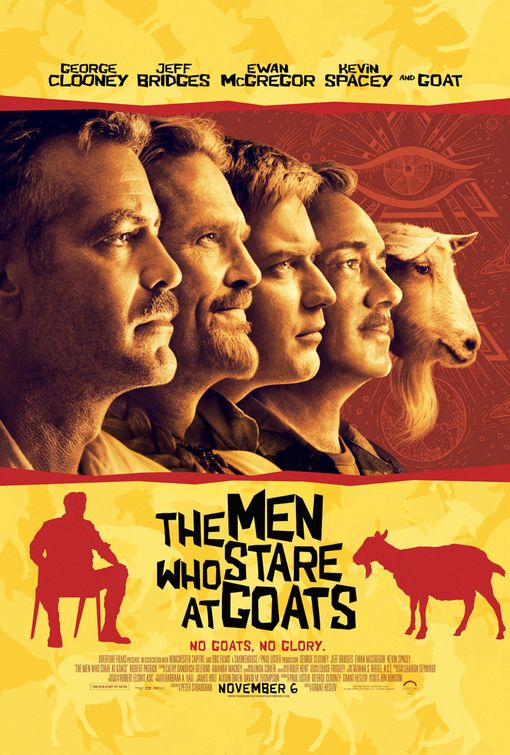
Now we have “The Men Who Stare at Goats” which opens with the sentence at the top of this review. The story behind this one is so bizarre to where it’s almost impossible to believe any of what we are watching could ever have happened. All the same, it appears a good portion of these happenings did take place, and it makes for what is truly one of the more unique war movies I have seen in a while. The film is based on a non-fiction book by Jon Ronson which looked at how US military forces used psychic powers against their enemies. They look at New Age concepts as well as paranormal activities to achieve these goals, and of how they worked to use these methods to their advantage. The movie takes place during the Iraq war, but not to worry, the filmmakers is not trying to shove any politics down your throat (not consciously anyway).

Ronson serves as the inspiration for Bob Wilton, an investigative journalist played by Ewan McGregor. Bob’s wife has just left him for his editor and, of course, he is depressed and decides he needs to do something more important with his life in the hopes he can win her back. As a result, he travels to Kuwait to do firsthand reporting of the Iraq War, with hopes of finding someone who can get him across the border. Bob ends up having a chance meeting with a Special Forces operator named Lyn Cassady (George Clooney) who was in the military, but now runs a dance studio. Lyn reveals to Bob he was part of an American unit that was trained to be psychic spies or, as he eventually calls them, “Jedi warriors.” From there, Bob learns everything about this special unit which sounds like something out of a science fiction novel.

I love the irony of all the talk about “Jedi warriors” here, especially since McGregor played one in the “Star Wars” prequels.

Anyway, “The Men Who Stare at Goats” is really a cross between a war movie and a road movie as Lyn and Bob traverse the sandy dunes of the Middle East to where not everything is as it appears. This film is also a mix of comedy and drama the same way “Three Kings,” another war movie which starred Clooney, was. While the tone is largely uneven, especially towards the end, this was definitely an inspired film which kept me entertained throughout and proved to be quite unpredictable.

McGregor is playing the main character here, but let’s face it, Clooney steals the show right out from under his feet. His performance as Lyn Cassady is truly one of his most surprising and inspired. Despite how ridiculous Lyn may seem, Clooney plays him straight and never appears to be self-conscious. Seeing Clooney trying to burst clouds with his mind, and trying to reach into his enemy’s mind by staring right at them has the actor going through emotions ranging from serious to funny to downright tragic. Having gone from playing dramatic roles in movies like “Syriana” to “Michael Clayton,” Clooney once again shows he is really good at comedy and never has to strive hard for a laugh.

I don’t want to take away from McGregor though, who pulls off a convincing American accent. In many ways, his role is more of a reactionary one as he is subjected to conditions one is never fully prepared for. Bob is bewildered at what Lyn is telling him, and yet he still wants to journey further and further into Lyn’s head. I also have to give McGregor a lot of credit because he could have made it look like he was consciously aware of all those “Star Wars” references, but he never did.

But one of the great delights is watching Jeff Bridges channel his inner-dude-ness from “The Big Lebowski” into his role of Bill Django, a military leader who, after being wounded in Vietnam, has a New Age vision of combat he wants to develop. This leads him to study concepts which he incorporates into a special unit called the New Earth Army. Bill becomes a teacher of using non-lethal techniques to gain advantage over the enemy, and his training techniques are unorthodox to say the least. Bridges plays the character broadly, but not too broadly. As funny as Bridges is, he infuses Django with a disappointment which threatens to render him useless to those around him, and with a deep sense of fear and tragedy as his techniques are misused or taken advantage of by those who seek to profit from them.

Having been in London doing tons of theater, it seemed like it would require a herculean effort to bring Kevin Spacey back to the big screen. Seeing him here is a kick as he plays the real antagonist of the film, Larry Hooper. Larry is basically the Darth Vader to Bill’s Obi Wan Kenobi and Lyn’s Luke Skywalker as he takes the non-lethal methods of the New Earth Army and ends up using them for more lethal purposes. Larry ends up doing this not so much out of greed as he does resentment since Django does not consider him in the same light as Lyn. His actions bring about the downfall of the New Earth Army, and he turns all these abilities they developed into something far more insidious. From there, you will see why the movie and the book it is based on has the title it does.

Spacey has great fun as he channels the inner smugness which has enveloped Larry over time. While his role is a little more serious than the others, he still has great moments of comedy which remind us of what a talented actor he is as he balances out the serious and comedic aspects of Larry without tilting too much in one direction.

“The Men Who Stare at Goats” was directed by Grant Heslov, Clooney’s business partner on many films. He has his work cut out for him here as he must find a balance between the humorous and dramatic aspects of the story. Granted, Heslov doesn’t always succeed but he creates a most unusual war movie, and it is all the more entertaining as a result. Even more telling is the way he portrays the Iraqi people in certain scenes. They are not shown as gun toting terrorists, and he captures the look of their helplessness in having to deal with a military occupation they did not ask for.

Like I said, there’s no serious politicizing of the Iraq war in this movie, so don’t feel like you are walking into some sort of trap. Like “The Hurt Locker,” it merely focuses on what those Americans in Iraq were doing in the midst of the chaos, albeit in a more comical way. “The Men Who Stare at Goats” seems almost far too bizarre to be real, but a part of you just might want it to be real. One thing’s for sure, you will never look at “Barney and Friends” in the same way ever again, assuming you ever watched it in the first place (c’mon! Don’t deny it!).

* * * ½ out of * * * *

Underseen Movie: ‘Premium Rush’ Lives Up to Its Name

WRITER’S NOTE: This review was written back in 2012.

David Koepp’s “Premium Rush” is the best cycling movie in some time. Come to think of it, when was the last time a cycling movie was made and released? I keep thinking it was Hal Needham’s “Rad,” but that came out in 1986. There’s also no topping the classic “Breaking Away,” the cycling movie many aspire to be like. There was also “American Flyers” which was released in 1985 and was written by Steve Tesich, the same one who wrote the screenplay for “Breaking Away.” But when it comes to “American Flyers,” I think its fantastic music score easily upstaged the film itself.

Anyway, none of that matters because “Premium Rush” delivers the goods like any cycling film should, and it does so with terrific acting, sharp writing and what looks like the real thing with a wonderfully severe lack of CGI as we watch these daredevil bike messengers throttle their way through the insanely busy streets of New York City.

Joseph Gordon-Levitt stars as Wilee, one of the very best bicycle messengers in New York who gets things to where they need to be and on schedule. Of course, this requires him to travel at breakneck speeds through busy traffic where a car can break down at the most inconvenient time, and he also has to deal with various members of the NYPD who have it in for him and others in his line of work. One other thing, Wilee’s bike of choice has only one gear, and he’s taken the brakes off of so that nothing will slow him down. Seriously, that is how he rolls.

Taking this into account, I wonder if Wilee has a death wish or if he’s just an adrenaline junkie. What we do learn about him is that he came close to becoming a lawyer, but the idea of sitting behind a desk in some office did not appeal to him in the slightest. Of course, it probably wouldn’t appeal to anyone who has seen “Office Space.”

His ex-girlfriend, Vanessa (Dania Ramirez), however, entertains thoughts of working in an office as she doesn’t want to be a bike messenger forever, and that’s even though she says it beats waiting tables. There’s also Tito (Anthony Chisholm) who doesn’t let his advanced age make him any less useful in this line of work (nor should it by the way), and Manny (Wolé Parks) who competes with Wilee not just on a bike but for Vanessa as well.

On this one particular day in which this movie takes place, Wilee is delivering a package that has caught the attention of NYPD cop Bobby Monday (Michael Shannon). Now Bobby wants what Wilee has, but while Wilee is not always one to obey the rules of the road, he does follow the strict guidelines of his job which states messengers will not hand over the package they are delivering to anyone other than who it is meant for. As a result, Bobby begins chasing Wilee down as we find out that this NYPD cop, like any other stupid gambling addict, has a ridiculously high debt to pay off.

The film’s director, David Koepp, is best known as a screenwriter, having written such exciting movies like “Jurassic Park,” “Spider-Man” and “Panic Room.” Along with co-writer John Kamps, Koepp has great fun telling the story of “Premium Rush” in a non-linear fashion. The story goes back and forth in time as the characters’ actions are made very understandable and given more depth throughout. This way of storytelling may alienate certain audience members, but I liked it as it plays around with our perceptions of what we believe to be true. Just when you think you know what’s going on to happen, something comes along which obliterates your predictions.

As a director, Koepp has had varying degrees of success with movies like “The Trigger Effect,” “Stir of Echoes” and “Secret Window,” but here he manages to keep the action exciting and never lets it drag for a second. It also helps that the cycling we see here is done for real, and it makes me wonder how it was choreographed and who these stunt people are. Clearly, they dared to pedal fast while cars come at them in various directions, and even the best cyclists have to be scared in these situations.

Now people may debate about whether or not “Premium Rush” might serve as a recruitment gig for bike messengers, but it also shows how painful it can be when you crash into something, and odds are you will. There’s also a scene during the end credits which shows Levitt’s arm all bloody after he hit the back window of a taxi cab, and that makes up for the lack of a disclaimer.

Levitt has had great success in the last few years with “(500) Days of Summer,” “Inception” and “The Dark Knight Rises,” and he is fantastic here as a character named after that coyote who chased the Road Runner endlessly. This role could have been given to some actor who would have annoyed us with their overwhelming ego, but Levitt makes this character likable despite his insane bike-riding habits.

You also have ace character actor Michael Shannon on board as an undeniably dirty cop. It doesn’t matter what movie he’s in because Shannon never disappoints in giving us a great performance. As Bobby Monday, he makes what could have been a mere one-dimensional villain all the more colorful and threatening. We have seen corrupt cops like this one in so many different movies, but Shannon makes him seem more intriguing than what must have originally appeared on the written page.

The rest of the cast includes Dania Ramirez (whom you may remember as AJ’s girlfriend on “The Sopranos”) to the always entertaining Aasif Mandvi, and they succeed in making this movie all the more entertaining to watch. The action is also given an exciting and propulsive score by David Sardy and a beautifully sunny look by cinematographer Mitchell Amundsen. Heck, watching this movie makes you very sweaty even if you are viewing it in a theater or in the comfort of your air-conditioned home.

“Premium Rush” is nothing spectacular, but it is fun to watch. It’s a shame it did not do better business at the box office, but Columbia Pictures did kind of screw up its release. Watching it reminds those of us who do not ride bikes anymore how much fun and very dangerous cycling can be. If nothing else, it does make wearing a helmet while riding a bike far more appealing than it ever has been in the past.

* * * out of * * * *

‘Where The Crawdads Sing’ Doesn’t Dig Deep Enough into the Marsh

After watching “Where the Crawdads Sing,” I immediately went out and purchased a copy of Delia Owens’ novel upon which it is based. Judging from the opening narration in which the main character of Catherine “Kya” Clark tells the audience how “marsh is not swamp” but instead is “a space of light where grass grows in water, and water flows into the sky,” this cinematic adaptation looked to defy all the perceptions we typically have of such places on Earth. This is further emphasized by her describing how swamp exists within the marsh and is “quiet because decomposition is cellular work,” and how it “knows all about death, and doesn’t necessarily define it as tragedy, certainly not a sin.” This dialogue comes straight from Owens’ prose, and it stayed with me throughout the film’s 126-minute running time.

This cinematic adaptation of “Where the Crawdads Sing” comes to us from Reese Witherspoon who has gushed endlessly about how much she loves the novel, and she produced this film alongside Lauren Neustadter. The screenplay was written by Lucy Alibar who co-wrote “Beasts of the Southern Wild,” and it was directed by Olivia Newman who is best known for her Netflix film “First Match.” Clearly, there is a lot of talent in front of and behind the camera here, and the appreciation everyone has for the source material cannot be doubted. Still, while this film held my attention throughout, I Pate’s came out of it thinking, couldn’t the filmmakers have dug into the material even deeper?

We first meet Kya as a young girl who lives with her family in the North Carolina marsh, and it is fun to watch her being embraced by her loving mother. But then we see her dad (played by Garret Dillahunt) is an abusive bastard who treats every member of his family like crap. From there, Kya’s mother and siblings leave their home one by one to where it is just her and dad, and she learns to survive his drunken wrath in more ways than one. But soon he disappears, and Kya is forced to fend for herself and survive on her own to where she copes with loneliness in a way few others do.

Indeed, seeing Kya grow up in the marsh to where we can believe she can more than survive on her own provides this film with its most interesting moments, but it is all surrounded by a courtroom drama which makes the proceedings feel utterly routine and ordinary. As the story begins, the police come upon the body of Chase Andrews (played by Harris Dickinson), a high school quarterback who had been in a relationship with Kya which ended on a bitter and violent note. People in town are quick to label Kya as the key suspect as they have always viewed her as an outsider to where they fear her for all the wrong reasons. It is not long before Kya is arrested and charged with his murder.

Part of my problem with this film is that it treats many of the characters as caricatures instead of fleshed out human beings. More often than not, the filmmakers only touch on the surface of these individuals instead of transcending their nature to present something more unique. While certain characters are given special attention, others are painted in broad strokes to where they could have come out of so many other motion pictures. The period detail is spot on as the film immerses us in the times and tribulations of the 1960’s, but it still feels like we are just watching events unfold instead of living them through Kya and everyone else.

One actor who elevates his material here is the great David Strathairn who co-stars as Kya’s defense attorney, Tom Milton. While the prosecuting attorney looks and acts like a Jake Brigance wannabe, Strathairn transcends his character’s mannerisms and background to give us a performance which feels alive and lived in. Not once does he ever give us a moment which feels false as his character comes out of retirement to defend Kya in her murder trial. At the start, he asks Kya to her that he cannot help her until het gets to know her better. His character becomes key from there to the story as, like him, we want everyone to see Kya as an individual instead of some odd human being who exists in the shadows where few others dare to travel to.

Speaking of Kya, the actress who plays her is Daisy Edgar-Jones, and her performance for me was worth the price of admission. She more than inhabits Kya to where the character never comes across as some female version of Tarzan, but instead one who merely exists in the marsh as it is the only home she has ever known and feels comfortable in. Jones also renders many scenes she appears in with heartbreaking honesty as we watch her discover love for the first time, and later heartbreak which is always devastating, especially for the young.

It is also worth singling out Jojo Regina who plays the younger Kya as she embodies the character at a fragile point in her life. She shows us how lost the young Kya is when she first goes to school and discovers how cruel children can be to someone different from them. More importantly, Regina sets the stage for Kya becoming wholly independent as she digs in the marsh for mussels to sell to the local general store. Watching her, I believe Regina gave Jones so much great stuff to work with.

I also enjoyed the performances of both Sterling Macer Jr. and Michael Hyatt as Jumpin and Mabel, the kindly African-American couple who own and run the local general store where boats get their gas. They respect and care they have for Kya is strong and shows through their eyes and actions. Plus, Mabel has one of the movie’s best lines as she rightly points out that the Bible says nothing about being careful.

But as for the rest of “Where the Crawdads Sing,” it all feels inescapably routine. Sure, the cinematography by Polly Morgan is gorgeous, the music score by Mychael Danna fits the material perfectly, and it is clear everyone here has great love for the source material. But in the process of being slavish to the novel, they don’t do enough bring everything it to life. I cannot help but believe this adaptation could have been given much more depth as this movie could have stood out in the same way Michael Apted’s “Nell,” which starred Jodie Foster as a similar individual raised away from civilization. While the novel may have given many a unique experience, this movie fails to do the same as it becomes like many we have seen time and time again.

I think it would have been best to focus much more on the trifecta of Kya, her first boyfriend Tate (Taylor John Smith), and her second boyfriend Chase. Where Kya is a child of the wilderness and the marsh, Tate has one foot in the civilized world and another in the wilderness, and Chase himself is a product of the civilized world which has given him a lot of bad ideas about social status and women. These relationships are dealt with, but in a rather shallow way with some acting which is too theatrical for motion pictures.

Heck, I would have liked to have seen more of Dillahunt as Pa as, from what I have read of the novel thus far, there is more to him than being just a drunken bully. Perhaps we could have been given more depth into this character as a result to where we could understand why he acts the way he does even as we rightly despise his actions. Still, the movie decides to keep him at arms’ length. Granted, the main focus is, and absolutely should be, on Kya, but perhaps knowing more about the key people in her life would have made her coming of age adventures all the more enthralling.

If you are a fan of the novel, I think you will have to see how the movie “Where the Crawdads Sings” compares to it. There is a lot to like about it, and again, Jones is simply wonderful in the lead role. But considering how beloved this novel is, I imagine many will come out of it feeling like more could have been done with the material.

For what it’s worth, both the movie and the novel serve as a reminder of how the civilized and uncivilized worlds don’t go by the same laws as survival takes on different forms in each. And remember, unlike animals, human beings are the only species to put their own in cages, behind bars.

* * ½ out of * * * *

‘Adventureland’ – A Ralph Report Video Vault Selection

WRITER’S NOTE: This review was written back in 2010. I applaud Eddie Pence for featuring this as a Video Vault selection on “The Ralph Report.”

It’s always those low paying jobs you had as a teenager during the summer months which helped mold you into the person you are today. It sucks how it takes you another decade or so to realize this upon closer reflection. Being there at the cash register, ringing up orders for customers in the real world, this all shows you things people they don’t teach you in high school or college. So yes, even those cumbersome jobs I had such as cutting the guts out of fish, teaching little kids how NOT to fish (and they still didn’t listen to me), shoveling popcorn constantly to where I came home reeking of it, and selling overpriced drinks at the movie theater (because that’s where they get their profit from folks) made me wise up to things which would eventually benefit me later in life. It also taught me how to take control and responsibility for my life. Still, it would have been nice if they paid me more an hour. Minimum wage was around four dollars back then. I wouldn’t be able to live on that today.

Adventureland” follows the exploits of James Brennan who is forced to take a summer job upon graduating from Oberlin College. His dad just got laid off to where neither of his parents will be able to support him financially either for the summer vacation in Europe he was hoping to take, or for his first year at Columbia College where he was planning to study journalism. Despite gloating over the great vacation he cannot go on now, James applies for different jobs around his hometown, but even his impressive transcript from Oberlin can’t land him a decent paying job. Adventureland Park, however, is hiring just about anyone with a pulse who fills out an application. Heck, I bet they even hire people they call the cops on! James tries to get a ride operator position, but managers Bobby and Paulette (played by Bill Hader and Kristen Wiig) are convinced he is more of a games person, so he unenthusiastically takes on the job only out of a financial need.

This is one of those movies which unfortunately got lost in the shuffle due in part to Miramax’s promoting it in the wrong way. The posters kept screaming out how it was from the director of “Superbad,” Greg Mottola. But despite the fact both movies have the same director, they are very different from one another. While “Superbad” was a broadly comic farce (one of the most gut-bustlingly hilarious ones from this past decade might I add), “Adventureland” is more of a serio-comic story and one of the more realistic coming of age movies I have seen in a while. Don’t get me wrong, there are some very funny moments to be found here, but you really can’t walk into this movie expecting another “Superbad.” If you do, you will be disappointed for all the wrong reasons.

The Adventureland Park itself is like one of those travelling carnivals you see come into town once or twice a year. You know, the ones with those rides which are in a constant state of disrepair which no cleverness can ever hide. The games they have like the ring toss and dart throwing are all designed to be unwinnable. This doesn’t stop people from still paying to play them though, hence the profit. Plus, like all amusement parks, they play the same damn songs over and over to where the employees are driven to insanity. I remember working at a park like this once, and I endured the same exact daily irritations. Where James and his colleagues have to listen to Falco’s “Rock Me Amadeus” every other five minutes, we kept getting subjected to Tom Petty & The Heartbreakers… Well actually, I do like Tom Petty, but I just realized I don’t listen to him as much as I used to.

I love how “Adventureland” gets all the specific details down to where it resembles just about any job I could have had as a youth. I actually worked at Disneyland for a couple of years myself, and while Adventureland is a pale imitation of it, many of the same rules I lived under were reflected by the park employees here. What this park has over that corporate monolith, however, is that the rules are much looser, and the working environment is nowhere as stressful.

Jesse Eisenberg plays James Brennan, and right now he is going through that Michael Cera phase of playing the young adult who is not always of sure of what he is supposed to say, think or do most of the time. He is best known for starring in “Zombieland” opposite Woody Harrelson or from “The Squid & The Whale” where he held his own opposite the great Jeff Daniels. Eisenberg is perfect as James in how he finds things to savor at Adventureland even though he would rather be vacationing in Europe. He never overplays or underplays the part to where he becomes ingratiating to watch. Somehow, this actor finds the perfect note to play James to where we like this guy and want to follow him on his post-graduate summer from start to finish.

The other big star here is Kristen Stewart who we all know of course from those darn “Twilight” movies. I haven’t seen any of them but, from what I have been told, I haven’t missed much. My friends keep telling me Stewart cannot act and how she looks all vacant whenever she is onscreen. Well, they didn’t check her out in “Adventureland” because her talent really shines through. Her character of Emily Lewin is the most complex here as she is dealing with a lot of problems which make her yearn for an escape out of town. Emily’s dad is actually a rich lawyer whom she resents for remarrying so soon to a woman she cannot stand. She really doesn’t need to work a part time job, but she does so just to get out of the house. Her methods of escape end up getting her into a relationship with Mike Connell (Ryan Reynolds), a married man who also works at the park.

Stewart does great work in portraying a character who yearns to be with someone who really sees her for who she is, but ends up running away from that particular someone when she becomes seriously afraid of messing everything up. You care about Emily because we can all relate to being confused about our place in life and of wanting to escape an environment which feels too confining. As a teenager, you can really feel like a prisoner in your hometown, especially if you don’t have a driver’s license. There are only so many places you can go to, and there is a strong need to break the boundaries holding you back. Stewart and the rest of the cast really show this throughout.

Another actor I want to give a lot of credit to is Martin Starr who plays Joel, the sarcastic co-worker who shows James around the park and makes him see how everything works. Starr has an amazingly dry sense of humor which has served him very well ever since appeared on the depressingly short-lived show “Freaks & Geeks.” This role is perfect for him as he embodies the antisocial misfit we remember from school, and who proves to be far more interesting than the jocks who were the stars on campus. Starr also gives his role an unexpected depth as we see him getting involved with a girl who ends up thoughtlessly rejecting not for who he is, but of what she and her family sees him as. It’s one of the film’s most honestly painful moments which rings true in ways too real to discuss openly.

And, of course, I can never get enough of Bill Hader and Kristen Wiig, some of the funniest people working today on “Saturday Night Live.” They are great together as the managers of this barely average amusement park and provide some of the biggest laughs as they take care of business as professionally as they can. Just make sure not to litter around Hader’s character because this will set his fuse off almost immediately,

With “Adventureland,” Mottola really captures how those jobs we worked for little money growing up toughened us up and helped in our evolution. I think it will be seen in the future as one of the most vastly underrated coming of age movies ever. It deals with the painful truths of growing up, and of experiences we had which molded the way we think and acted from there. Hopefully it will find the audience it deserves on cable and physical media. And for those of you who still think Kristen Stewart cannot act, get a clue, please.

* * * ½ out of * * * *

‘Lost Highway’ – One of My Favorite David Lynch Films

I remember when I first watched David Lynch’s film “Lost Highway” back in 1997. I saw it at a small theater in Newport Beach where the screen ratio was off by a bit, and the opening credits did not fit onto the silver screen as a result. I left the theater feeling a bit cold as I was not sure what to make of What I saw, and the ending seemed so absurdly abrupt to where I wonder if Lynch and co-writer Barry Gifford had simply run out of ideas and went down a rabbit hole they could not dig themselves out of. The way I saw it, this film was easily upstaged by its soundtrack which proved to be one of my favorites from the 1990’s with its music by Angelo Badalamenti, Nine Inch Nails. Barry Adamson, Smashing Pumpkins and Marilyn Manson.

A few days later, however, I found myself thinking about “Lost Highway” a lot to where I could not put it out of my head. I could not figure out why initially, but then I found the answer in a review of the movie I read in Video Watchdog. I cannot remember the critic’s name, but they wrote it’s not about how the film affects you while you watch it, but how it affects you after you have watched it. I could not agree with this more, and it made me watch “Lost Highway” again, but this time in a THX approved theater with better sights and sound.

I have since revisited “Lost Highway” again and again over the years, and I revisited it yet again at the Nuart Theatre which presented this Lynch cult classic in a 4K restoration personally supervised by the director. While it may not seem as brilliant as “Blue Velvet” or “Mulholland Drive,” it remains one of my favorite films of Lynch’s as it presents us with a puzzle of a story which might be easier to solve than at first glance.

We are introduced to the married couple of saxophonist Fred Madison (Bill Pullman) and his wife, Renee who live in the Hollywood Hills. Their marriage looks to be a cold one, lacking in passion. When it comes down it, Fred is far more able to get orgasms out of his saxophone solos than with Renee, and he becomes suspicious that she might be seeing someone behind his back.

Things get more unsettling for them when they discover someone has been leaving videotapes for them on their doorstep. The first one features a view of the outside of their house, but the second goes even further as it shows footage of them asleep in their bed. They call the police, but they are of little help in finding out who filmed them. Next thing you know, Fred finds and views another videotape which shows him hovering over Renee’s dismembered body, and from there he finds himself on death row for her murder.

Lynch has described “Lost Highway” as being a “psychogenic fugue,” a rare psychiatric phenomenon characterized by reversible amnesia for one’s identity. Others have compared the film to a Möbius strip, a non-orientable strip which one cannot consistently distinguish clockwise and counterclockwise turns. Both of these make sense as the beginning may very well be the end, and the end may very well be the beginning.

This is even further enhanced by Lynch saying he was partially inspired by the O.J. Simpson murder trial which came to dominate the early 1990’s. Indeed, I can see this inspiration all throughout “Lost Highway” as Simpson has not, nor will he ever, admit to committing any murders. For all we know, Simpson may still not know what he did as he has long since blacked it out of his mind. The same goes with Fred Madison as he cannot believe it when a certain video implies he murdered his wife in a most horrible way, but this doesn’t stop a jury of his peers from finding him guilty and putting him on death row.

There is a scene where the police visit Fred and Renee at their home after they received the second video, and Renee talks about how Fred hates video cameras and doesn’t want them in the house. His explanation is as follows:

“I like to remember things my own way. How I remembered them. Not necessarily the way they happened.”

I have come to refer to this dialogue as the Dinesh D’Souza line as he continues to sell anyone and everyone on a narrative which just isn’t the least bit true. But regardless of how you view this film, one thing should remain clear: videotapes do not lie. Just look at what Detective Mike Kellerman (played by Reed Diamond) said in one episode of “Homicide – Life on the Street:”

“Videotape, it’s the perfect witness. It can’t change its testimony, and it can’t forget what somebody looks like.”

Indeed, “Lost Highway” is all about Fred Madison trying to escape the truth of what he did or, perhaps, what everyone thinks he did. As a result, he goes through a rather grotesque transformation which ends up turning him into a young auto mechanic named Pete Dayton (played by Balthazar Getty), and he gets released from prison. But as he now experiences life as a free man, he comes to meet the gangster Mr. Eddy’s mistress, Alice Wakefield. The only thing is, she looks a lot like Fred’s late wife, Renee. Of course, a lot of that has to do with the fact Patricia Arquette is playing Alice as well as Renee.

“Lost Highway” has long since become one of my favorite David Lynch films, and while “Blue Velvet” and “Mulholland Drive” are regarded more highly, this one is so much fun to view again and again. The whole thing is a complex puzzle, and I am convinced I can still solve its mysteries in ways I cannot with Lynch’s other works. I am not even going to try and make sense of “Inland Empire.”

With Pullman’s character of Fred, he is trying to stay ahead many steps of his darkest memories and actions, assuming they are true. But the deeper he digs into his psyche to escape an especially harsh reality, the more memories and familiar faces keep coming up. I like how Pullman plays Fred as a suspicious man who finds himself caught up in a situation he does not understand but which leaves him with the worst headaches imaginable.

Patricia Arquette is a marvel here as both Renee and Alice as she opens herself up, literally and figuratively speaking. It’s great to watch her go from portraying a scared wife to a dominant seductress who holds Pete very tightly within her grasp. Seriously, watching this Oscar winning actress here should serve as reminder of just how much stronger women are than men, especially when men are led by certain parts of their bodies other than their brains.

Who could have known this would have been Robert Blake’s last performance ever in a motion picture before the whole… Well, you know. Still, his work here as the Mystery Man is wonderfully chilling as he clearly took joy in crafting a character unlike any he played previously. When he glares at you, there is no escape, and seeing him without eyebrows makes his presence all the more unnerving. It’s an original performance which people never give enough credit to.

There are many moments from “Lost Highway” which will forever stay with me like when Fred Madison walks into the darkness of his home and re-emerges as someone much different, Robert Loggia who, as Mr. Eddy, unleashes his rage at an ignorant motorist for tailgating him, seeing Alice and Pete have sex in front of a car’s headlights, and the final scene where a character transforms in a hideously angry fashion. All of them are aided by the haunting musical soundscapes created by Angelo Badalamenti and Trent Reznor, the cinematography of Peter Deming, and the strange appearances pf both Richard Pryor and Gary Busey which had me wondering if Lynch was using dream logic in the same way Darren Aronofsky did in “Mother.”

“Lost Highway” provided me with one of the most unique experiences I have ever had. It left me at odds upon the beginning of its end credits, but it stayed with me from there on out, and I constantly find myself returning to it and its awesome soundtrack. This truly is an art picture as it can be interpreted in many ways, and I know I will come back to it again before I know it. Just remember one thing, Dick Laurent is dead.

* * * * out of * * * *

‘Edge of Tomorrow’ Movie and 4K/Blu-ray Review

The following review was written by Ultimate Rabbit correspondent, Tony Farinella.

Edge of Tomorrow” is a film that, on paper, had all the ingredients for a film I would enjoy.  Tom Cruise has always been an actor who has never been afraid to really throw himself into a project.  He takes his work seriously, and it shows with the films he releases.  He has great quality control.  Emily Blunt is one of the best-working actresses in Hollywood with a ton of range and depth.  When you throw in director, Doug Liman (known for action films such as the “The Bourne Identity” and “Mr. and Mrs. Smith”), it seemed like a recipe for a fun action film featuring some impressive action sequences and top-notch performances by its leads. However, the film forgot one of the most important ingredients of any truly successful action film: a great story.  It uses the Groundhog Day gimmick of repeating the same day over and over again.

A group of aliens, which are known as “Mimics,” are coming to destroy Earth.  They are fast, smart, and incredibly difficult to defeat. U.S. Army Major William Cage (Tom Cruise) is thrown into the fire by General Brigham (Brendan Gleeson) to help what is essentially a suicide mission against these Mimics. William Cage makes sure to tell him he has no combat experience, and he is not fit for any type of action. Brigham, however, is only looking out for himself, and he is looking to make Cage the fall guy. When he’s arrested and sent to Heathrow Airport, Cage soon discovers he is in way over his head. He’s part of a ragtag group of misfits known as the J-Squad.

Cage is killed instantly and starts to have the same day over and over again.  If this sounds familiar, it is because this formula has been used countless times in other films, most recently with the “Happy Death Day” franchise. During one of his multiple trips to France, he ends up meeting Sergeant Rita Vrataski (Emily Blunt).  It doesn’t take long for them to connect, and she reveals to Cage she also once had the same power he now possesses, where she had to repeat the same day over and over again.  She has since lost it.  If the two of them can team up, maybe together they can figure out a way to save the world from the Mimics.

“Edge of Tomorrow” is a very complicated film to follow at times. All of this talk about Mimics, alphas, betas, superorganisms and loops starts to become quite tedious after a while.  This should have just been a fun, easy-to-follow film with some action and laughs thrown in the mix.  There is plenty of action, in fact, there is too much of it.  At times, it really took me out of the film. A little bit of character development and a little time to stop and smell the roses would have been appreciated. Any great action film takes the time to really let us get to know about our main characters. We know absolutely nothing about them. Cruise and Blunt are entertaining when paired together, but it doesn’t take long for the film to resort to wall-to-wall action right away.

Between the convoluted story, the non-stop action and lack of character development, I found it hard to really get into “Edge of Tomorrow.” I can’t deny the special effects are impressive and the Mimics look really good, but I didn’t sign up for either of them though, I realize I’m in the minority on this 2014 film, which made quite an impression with a majority of critics. I truly wanted to like this film, and I was prepared to sit back and shut my brain off and enjoy myself for two hours. I just couldn’t suspend my disbelief for that long because the film was throwing too much at me with little rhyme or reason.  It didn’t take the time to explain things or to make us care about what was happening on screen.

* * out of * * * *

4K Info: “Edge of Tomorrow” is released on a two-disc 4K Combo Pack from Warner Brothers Home Entertainment. It comes with the 4K, Blu-ray, and a digital copy of the film.  It has a running time of 113 minutes and is rated PG-13 for intense sequences of sci-fi action and violence, language, and brief suggestive material.

Audio Info: The audio formats for this film are Dolby Atmos-TrueHD: English, DTS-HD MA: French, Dolby Digital: English Descriptive Audio, French, and Spanish. The film has subtitles in English, French, and Spanish. I’m always a huge fan of Dolby Atmos audio, and it really stands out in a film like this.

Video Info: The 4K is released on 2160p Ultra High Definition. The High Dynamic Range really makes the film look moody, dark, and shadowy. It’s an impressive looking 4K. The Blu-Ray is in 1080p High Definition.

Special Features:

Operation Downfall – Adrenaline Cut

Storming the Beach

Weapons of the Future

Creatures Not of This World

On The Edge with Doug Liman

Deleted Scenes

Should You Buy It?

Sadly, I can’t recommend you go out and purchase “Edge of Tomorrow.”  However, if you are a fan of the 2014 film, I would encourage you to upgrade from the Blu-ray to the 4K.  There is a noticeable difference between the two formats in terms of picture quality and audio.  It had been eight years since I watched the film, and I didn’t think much of it back then.  I thought maybe a second viewing would give me a new appreciation for the film.  I’m sad to report that is not the case.  It’s still not a film I enjoy or can recommend you pick up unless you own the Blu-ray and want the 4K experience.  I like all of the participants in the film, but the storyline has been done before and done better. The actors are really hampered by the exhausting script. It’s too much movie and there is no brain behind it.  The characters are also written without a lot of thought behind them. The film is simply eye candy with its special effects.

**Disclaimer** I received a copy of this film from Warner Brothers to review for free.  The opinions and statements in the review are mine and mine alone.

‘The Great Gatsby’ – Even Baz Luhrmann Can’t Bring Fitzgerald’s Classic Novel to Life

I once had a teacher in college who told me filmmakers keep making the same movie over again and again without even realizing it, and Baz Luhrmann is a prime example of this. His “Romeo & Juliet” and “Moulin Rouge” dealt with characters looking back at a past they can never return to and of love affairs which ended tragically. His adaptation of F. Scott Fitzgerald’s classic novel “The Great Gatsby” is not any different from those two films, and it is filled with extravagant scenes that dazzle us with amazing choreography and beautiful images. But while it is a beautiful movie to look at, this film lacks the heart and soul I usually expect Luhrmann’s works to have in an infinite degree.

This “Gatsby” adaptation starts with Nick Carraway (Tobey Maguire), a writer and bond broker, telling us about his time in New York during the 1920s (better known in the history books as the “Roaring 20s”). Right there I knew the movie was in trouble as Luhrmann started “Moulin Rouge” off with Ewan McGregor reflecting on an exhilarating past and a great love which has long since passed him by, and Maguire is a very similar character in that respect. From there, it is clear that this movie will not have a happy ending, and the characters we see enjoying themselves will soon experience a suffering which will be endless. We’re not even five minutes into this cinematic adaptation, and already I can tell this will be familiar territory for Luhrmann, way too familiar.

The 1920s were a time of great wealth and endless partying which came to a crashing halt the following decade when the stock market crashed and Americans found themselves out of a job (sound familiar?). Carraway finds himself caught up in all the hoopla which came with those times, and it’s at an especially over the top party where he meets Jay Gatsby (Leonardo DiCaprio), a man as rich as he is mysterious. From there they become inseparable friends as Gatsby shows Carraway around town and introduces him to the most influential people one could ever hope to meet. But it’s when Gatsby takes a strong interest in Carraway’s cousin, Daisy (Carey Mulligan), that things start changing and not for the better. It turns out Gatsby knew Daisy in the past, and now Gatsby will do everything in his power to win Daisy back from her suspicious husband, polo player Tom Buchanan (Joel Edgerton).

“The Great Gatsby” has the same problem Luhrmann’s “Romeo & Juliet” had during its first half; it thrust a lot of style and flash cuts at us at an alarming rate to where I was desperate for things to slow down so I could breathe and actually everything in on a deeper level. Now Luhrmann did slow things down in “Romeo & Juliet” to where we connected emotionally with the story and its characters, and he successfully reinvigorated one of William Shakespeare’s most overdone plays to where it felt fresh and exciting again. But this time he gets so caught up in the spectacle he is putting up for us all to see to where it became impossible for me to connect with anything or anybody here. The sensory overload I got in his previous films was exhilarating, but here everything feels so exhausting and artificial to where it doesn’t matter if you watch this film in 2D or 3D (I watched it in 2D because I refused to spend the extra money). The characters may be starving for emotion, but it’s the audience that needs it even more.

Whether or not you have read Fitzgerald’s classic novel, it’s easy to see the direction this movie was going to take. As a result, I found myself getting very bored and impatient as I knew Gatsby would eventually stumble over his own ambitions, and I just wanted see him get his ass kicked sooner rather than later. Heck, I even got up and went to the bathroom at one point, and that should you give you an idea of how frustrating this movie was for me. I was able to sit through “Star Trek V: The Final Frontier” despite needing to pee really bad, but this one I could not hold it in. Yes, that’s too much information for you readers, but anyway…

On the upside, the actors acquit themselves very nicely. You can’t really go wrong with DiCaprio, and he does make quite the dashing Gatsby, but there should be a drinking game based on how many times he calls people “old sport” throughout, and I seriously got sick of him saying that. His good friend Tobey Maguire has his back as Nick Carraway, and he does a lovely job of reading Fitzgerald’s words to where I’d like to hear him do a reading of the novel as he brings us a lot closer to the author’s dialogue than Luhrmann does.

Carey Mulligan, however, is seriously miscast as Daisy Buchanan. She still gets to do her whole woefully vulnerable lady act which she played to perfection in “An Education,” but Mulligan is not able to nail the other complexities this role has to offer. Yes, she is a lovely presence to watch in this or in any other movie, but this is not enough to save her performance here.

Clearly a tremendous amount of effort was put forth by the cast and crew on “The Great Gatsby,” but it doesn’t change the fact that the movie is a profound disappointment. Fitzgerald’s novel has been adapted several times with limited success, and many say it is an exceedingly hard book to translate to the silver screen. Luhrmann looked like he was the man who could do it justice, but he doesn’t come close. What a shame. We can always count on him to give us spectacle as well as substance, but this movie is all spectacle and not enough substance.

* ½ out of * * * *

Julian Fellowes’ ‘Romeo & Juliet’ is Seriously Lacking in Passion

William Shakespeare’s “Romeo and Juliet” is a play which has been done to death. Keeping track of all the adaptations is aggravating, but on top of that, there are other plays or musicals which were, at the very least, inspired by this classic tragedy (“West Side Story” is the most obvious example). Since Shakespeare’s time, “Romeo and Juliet” has been done in many different styles and taken place in various time periods. It seems the only way to do a production of it these days is to break free of the way it was done during Shakespeare’s time. Baz Luhrmann’s modern take on “Romeo and Juliet” was absolutely entrancing in how it made us feel like we were watching the doomed story of two young lovers for the first time, and Leonardo DiCaprio and Claire Danes never had a shortage of chemistry between them.

Taking all of that into account, that makes this “Romeo and Juliet,” directed by Carlo Carlei and adapted to the screen by Julian Fellowes, come across as a renegade version for they have instead brought Shakespeare’s work back to its traditional and romantic version. It is filled with medieval costumes, balcony scenes and duels, and the filmmakers even got the opportunity to shoot it at the story’s original location of Verona, Italy. But for all the effort put into this umpteenth film adaptation of this famous tragedy, the whole endeavor feels like it is severely lacking in passion.

Perhaps the main problem is the lack of chemistry between the two leads, Douglas Booth and Hailee Steinfeld, who play Romeo and Juliet. When they first meet at the dance, their attraction to one another is not all that palpable and feels rather forced. While both actors do their best to connect with one another, their relationship never felt believable enough for me to really care about what happens to them. In fact, towards the end, I started to get impatient and kept waiting for Romeo to do himself in already.

Steinfeld is a wonderful actress, having deservedly received an Oscar nomination for her performance in “True Grit” (though she should have been for Best Actress, not Best Supporting Actress). As Juliet, she does well and has quite a radiant smile which lights up the screen. At the same time, she seems miscast in this role when paired with Booth. While Steinfeld is around the same age as Juliet, she seems too young to be taking on this famous role now. It’s a shame to say this because she isn’t bad, but I came out of this movie thinking an actress a few years older might have fit this role more realistically.

As for Booth, it takes too long for him to come to life as Romeo. When we first see him, he doesn’t seem all that crazy about Rosalind even after we see him making a bust of her likeness. When it comes to the classic balcony scene, the attraction between him and Juliet feels awkward as they still don’t seem as madly in love as they are supposed to be. Booth’s performance does get stronger as the movie goes on, but he never digs deep enough into the character to where it seems like he is only touching the surface of Romeo’s dilemmas.

Carlei, whose work as a director I am not familiar with, does capture the beauty of Verona, Italy to where it made me want to get on a plane and visit it. His handling of the conflict between the Capulets and the Montagues, however, is not clearly defined, and we never quite get a full idea of what made them hate each other in the first place. This is the original gang story for crying out loud! As for the battle scenes, they feel a bit too staged and could have been far more exciting.

Fellowes is best known for creating the popular show “Downton Abbey,” and he seems a natural to adapt any Shakespeare play let alone “Romeo and Juliet.” He preserves the dialogue for the most part, and it’s clear he has a deep love and understanding for the Bard’s words. At the same time, this film has been severely affected by a misleading advertisement which stated it would not be using Shakespeare’s traditional dialogue but would still follow the play’s plot. But having been exposed to this play many times myself, I could not tell the difference between what Shakespeare wrote and what Fellowes came up with. Go figure.

It is a real shame because this “Romeo & Juliet” has a number of great supporting performances which almost make it worth watching. Ed Westwick makes a fierce antagonist out of Tybalt, his eyes filled with rage over a betrayal he can never forgive. Lesley Manville, best known for work with Mike Leigh, is priceless as the Nurse and succeeds in taking this character from her ecstatic highs to her tragic lows. Manville never misses a beat every time she appears onscreen.

There’s also Damian Lewis as Lord Capulet, and he gives the character of Juliet’s father a twisted feel which really makes his performance stand out. Kodi-Smit McPhee is very strong as Romeo’s good friend Benvolio, Natascha McElhone gives us a sympathetic Lady Capulet, and Stellan Skarsgård is a welcome presence as the Prince.

But it should be no surprise to see Paul Giamatti stealing the show as Friar Laurence, as it’s truly one of the best interpretations of this role I have ever seen. Friar Laurence is the moral center of “Romeo & Juliet,” and he sees the union between the two lovers as a way of bringing peace between the Capulets and the Montagues. I could tell just how much Giamatti put his heart and soul into this role, and I wept with him when his well-intentioned plans fall apart so tragically.

Still, despite all the great performances, this “Romeo & Juliet” never really comes to life in the way a truly great Shakespearean production does. The language in his plays is so rich, and it can be so intoxicating to take in when done right. This is how I felt after watching Kenneth Branagh’s cinematic adaptations of Shakespeare’s work, but Carlei is not as successful in making this famous playwright’s words come alive, and he is working from a script by Fellowes for crying out loud!

Every generation definitely deserves their own version of “Romeo and Juliet,” but this one is not going to do it. They will be better off with Baz Luhrmann’s version which ended up breaking my heart as it made me wonder if things might take a different turn from what we remember. Or perhaps it was just that big crush I had on Clare Danes which made Baz Luhrmann’s movie affect me so much. Oh well…

* * out of * * * *

‘Top Gun: Maverick’ Was Well Worth the Wait

Movies take a long time to make and bring to the silver screen, but this one took forever to debut thanks to the pandemic and a superstar’s strong desire to ensure it DID NOT debut on streaming. This is also a sequel which comes to us 36 years after the original, and that one was a classic 1980’s flick. Can you make a sequel to an 80’s classic in another decade where things have changed ever so much? I mean, Paul Hogan tried to do this with “Crocodile Dundee in Los Angeles,” and it proved to be one of the most needless sequels in cinematic history.

Well, when it comes to “Top Gun: Maverick,” this is a sequel which proves to be well worth the wait. While it does pay some homage to its predecessor, especially in its opening moments where the music of Harold Faltermeyer and Kenny Loggins blast through the speakers and generate a wealth of nostalgia, this sequel is the rare one which largely stands on its own and proves to be even better than the original. Now that is saying a lot as “Top Gun” forever holds a special place in my heart for being one of the most iconic 80’s films whose VHS tape gave our home speakers quite the workout and proved to be one of the few from this glorious decade which I did not walk out of crying uncontrollably. Believe me when I say this is saying a lot.

We catch up with Pete “Maverick” Mitchell all these years later as he continues to avoid promotion in order to keep flying. He works as a test pilot who is determined to lay waste to any of Chuck Yeager’s all-time records. The problem is, pilots like him are in the process of being phased out to make room for drones. As Rear Admiral Chester “Hammer” Cain (the great Ed Harris) points out, Pete is on his way to becoming a relic. Of course, the Admiral tells Pete this at the same time he is forced to point out his talents are needed back at Top Gun to train a new generation of pilots for an important mission.

While his fellow aviators have advanced in rank, Pete has remained a captain and continues to piss off admirals and other superior officers in ways both intentional and unintentional. When the original “Top Gun” ended, Maverick was about to become a instructor, but here we learn he only lasted two months as one before ditching those duties. I have to say I was annoyed upon learning this as dropping out after such a short period of time seems rather petty of Maverick, but it also once illustrates what a rebel he is among his fellow aviators.

Upon his arrival at Naval Air Station North Island (a.k.a. NAS North Island), Maverick comes to meet a new generation of aviators which include Lt. Natasha “Phoenix” Trace (Monica Barbaro), the lone female pilot of the bunch, and Jake “Hangman” Seresin (Glen Powell) whose ego knows no bounds even when you want it to. But the two individuals who will factor most strongly into Maverick’s life here are Penny Benjamin (Jennifer Connelly), and admiral’s daughter whom he once did a high-speed flyby years ago and now owns a bar, and Bradley “Rooster” Bradshaw (Miles Teller) who just happens to be the son of his best friend, the still missed Goose (Anthony Edwards). Suffice to say, some here have not quite gotten over the past, and dealing with the present may prove to be even more challenging.

One of the things I have to address about “Top Gun: Maverick” is the fact Kelly McGillis did not return to portray Charlotte “Charlie” Blackwood. Many consider this the latest case of ageism in Hollywood, but while I do not want to lay any shade to that, there are also several other actors who are absent in this sequel: Tom Skerritt, Rick Rossovich, Meg Ryan, Michael Ironside, and James Tolkan to name a few. When it comes to the filmmakers/ response to this, they said they did not want to spend a lot of time looking backwards, and to this I applaud them endlessly.

The problem with a lot of sequels, especially ones which come 10 or more years after their predecessor, is how much they reflect on what happened previously. Sequels are clearly made to cash in on the original’s massive success, and it gets to where filmmakers are a bit too fearful to tinker with an established formula. I was reminded of this while I was watching “Blues Brothers 2000,” a sequel I was honestly excited to see come fruition. But as I watched this movie unfold before me, the following dialogue started playing in mind:

“Hey, remember when we did this years ago?”

“Yeah.”

“Remember when they did that?”

“Yeah.”

“Hey, remember this bar owner from the original?”

“Yeah.”

“He was funny when he said what he said, you know?”

“Yeah, he was.”

“Seriously, do you want to turn this sequel off and just watch the original?”

“Oh yeah, way ahead of you!”

We love what came before, but not everything can be the same. Granted, “Tom Gun: Maverick” does not reinvent the formula or the genre it is a part of, but it does give us something new and fresh which makes everything we see here all the more thrilling. This is not a simple regurgitation of what we previously witnessed, but instead a look at the present and the challenges it presents for the characters here. While certain notes from the original are played on here, this sequel is not necessarily business as usual.

More importantly, this is one of those sequels which are better than the original. As incredibly entertaining as “Top Gun” was, it did suffer from cliches and a romantic subplot which the movie really could have done without. “Top Gun: Maverick” improves upon its predecessor in many ways as, even if repeats familiar beats, brings a lot more depth to the proceedings and more heart to where, even when things seem emotionally manipulative, I got so swept up in the action. I cheered as loudly as the next audience member during the climatic sequences, and this made me feel like I was back in Thousand Oaks watching “Return of the Jedi” for the first time. The audience got so involved in the action, and it filled my spirits in a way few cinematic experiences could have back then. Believe it or not, the same goes for this long-awaited sequel.

The late Tony Scott, who directed the original “Top Gun” and to whom this sequel is dedicated, gave us some amazing aerial dogfights years before. “Top Gun: Maverick” was directed by Joseph Kosinski who previously worked with Cruise on “Oblivion” and was also behind the camera for “Tron: Legacy” and “Only the Brave.” Like Cruise, he was clearly determined to not fake a single scene from start to finish. The g-forces you see the actors experience is no joke, and it made me wonder what was going through their heads as their faces were being smushed in beyond their control. And seeing those fighter jets fly through treacherous terrains at such high speeds was infinitely thrilling.

Kosinski has proven to be a strong director with a great visual style, and “Top Gun: Maverick” is his best film yet.

As for Cruise, there is no doubt about his dedication to authenticity. While, to quote a lyric from Aerosmith’s “Dream On,” all those lines on his face (or his forehead to be more specific) are getting clearer, he is not about to let age get in the way of what he wants to accomplish in a motion picture. When it comes to his star-making role, he slips back into it ever so easily, and he is not just portraying Maverick in the same way he portrays Ethan Hunt.

I also got to praise the rest of this cast as they more than rise to the occasion here. Miles Teller has long since proven to be a truly talented actor, and I love watching him hold his own opposite Cruise from scene to scene. Jennifer Connelly remains an infinitely talented presence as she gives Penny Benjamin a reason to stand head-to-head with a man who once flew by her at very high speed. Glen Powell tricks you into believing his character’s strong ego will be forever crushed, but it makes sense as to why it never does. And then there is Val Kilmer who returns briefly as Tom “Iceman” Kazansky, and his presence reminds us of how powerful a presence this actor can be even if cancer has forever robbed him of his wonderful voice.

It would have been a joke if Cruise did a “Top Gun” sequel back in the 1990’s or at the cusp of the new millennium. He would have needed such a sequel back then as “Cocktail” would have. His career was flying high without a need to revisit his past, but when it became time to do so, he was not about to serve us the same old shit.

“Top Gun: Maverick” for me is the epitome of a summer blockbuster as it makes you feel like a part of the action, and you find yourself cheering with the audience in a way you normally do not. While it not be a cinematic masterpiece, it does its job with sincerity and boundless enthusiasm, and like many, I cannot wait to see it again. Yes, this sequel was made to be seen on the silver screen, so please do so before it does make its debut on streaming.

I cannot wait to see it again.

* * * * out of * * * *