‘Jack Ryan: Shadow Recruit’ Forgets What Makes Tom Clancy’s Hero Stand Out

Jack Ryan Shadow Recruit movie poster

While watching “Jack Ryan: Shadow Recruit,” it didn’t take long to realize like the CIA analyst hero of the late Tom Clancy’s novels has been rebooted one too many times. After being portrayed by Alec Baldwin and Harrison Ford, Jack Ryan got his clock turned backwards when Ben Affleck played him in “The Sum of All Fears.” I have no problem admitting I liked that film, but casting a younger actor as Ryan ended up screwing with the franchise’s equilibrium. Things were going smoothly beforehand, so why throw a younger actor, any young actor, into this role and take the audience back in time? Why not bring Baldwin back? When is all said and done, Baldwin is still the best actor to inhabit this character.

Well, now we have Pine taking over the role of the brilliant Jack Ryan, and this time the franchise goes right back to the beginning of Ryan’s career. What results is by no means a bad movie as it is well made, features a number of strong performances and some exciting action scenes. Regardless, there’s a feeling of emptiness at this film’s core. The problem it’s not much different from the many spy movies I have seen over the years and, as a result, feels largely forgettable.

For those who remember Fred Dalton Thompson’s character of Rear Admiral Joshua Painter from “The Hunt for Red October,” he gave a speech in which he talked about how Ryan was severely injured in a helicopter crash back in the 70’s and spent the following year learning to walk again. This is the Ryan we meet here when this film begins as he is compelled to enlist in the military after the events of September 11, 2001. From there, we watch him recovering from a helicopter crash, and he recuperates over time with the help of Dr. Cathy Muller (Keira Knightley), the woman we know will eventually become his wife.

During his lengthy recovery, Ryan is paid a visit by CIA official Thomas Harper (Kevin Costner) who recruits him to work for the agency. We then move forward ten years later to when Ryan is working on Wall Street as a compliance officer at a stock brokerage, but this job is of course a cover for his real work as a covert CIA analyst as he keeps an eye out for financial transactions which are suspect and may indicate terrorist activity. Upon discovering trillions of dollars held by Russian organizations have gone missing, the trail of criminality leads him to Russian tycoon Viktor Cherevin (Kenneth Branagh). Ryan travels to Russia and, from there, things go bang, bang, bang like you would expect.

I think one of the big mistakes made with “Jack Ryan: Shadow Recruit” was that the filmmakers decided not to base it on any of Clancy’s novels. I know Clancy was always highly critical of the way Hollywood treated his books and I’m pretty sure he would have had many things to say about this installment had he lived to see it. At the same time, his stories were always intricate and fascinating, and the screenplay here by Adam Cozad and David Koepp is both confusing and hard in comparison. As a result, it feels a surprisingly lightweight compared to the complex stories Clancy came up with.

In addition to playing Jack Ryan’s chief nemesis, Branagh also directed the movie and has come to show a real panache for filming exciting action scenes. There’s also a crazy car chase near the end which really did have me on the edge of my seat, and he has come a long way from directing big budget movies like “Mary Shelly’s Frankenstein” and “Thor.” Granted, you can’t go into this expecting something on the level of his Shakespeare cinematic adaptations, but he does provide the audience with a fun time. The problem is the story of “Jack Ryan: Shadow Recruit” is very routine, and it was hard to get excited about what unfolded once I made this realization.

In all fairness, Pine does make for a good Jack Ryan in the way the character was written here. As tired as I am of movie studios making all these origin movies, Pine brings the same kind of energy to this role as he did to “Star Trek” as James Kirk. While this Ryan is not as interesting here as he was in the previous films, Pine does the best that he can with a somewhat underwritten part.

One performance in particular I want to point out is Costner’s as Thomas Harper. It’s fascinating to watch him here after having seen him as the heroic young soldier in movies like “No Way Out,” and he is aging nicely into the role of the elder statesmen who imparts his wisdom and advice to newbies. Part of the fun in watching Costner here is how mysterious he makes Harper. Ryan is not sure he can trust him fully, and Costner’s constant poker face throws not only him off, but the audience as well.

But despite all the good things about “Jack Ryan: Shadow Recruit,” the whole package feels far too ordinary for it to work effectively. We’ve seen this kind of story before, and not much was done to elevate it above the usual fare this genre has to offer. In the process of trying to make Jack Ryan young again in the hopes of jump starting this long-running franchise, they have robbed the character of what made him unique. In this film, he’s like any other young CIA recruit who has yet to understand what he’s getting himself into, and I have seen this scenario played out far too many times before.

For me, Jack Ryan was always the accidental action hero. He has a brilliant mind and always gets to the truth of the matter because he takes the time to study the individual at the center of the story. Like John McClane, he’s not out to be the hero and is always looking to avoid life threatening situations, but he eventually steps up to the plate because no one else can, and no else knows what he knows. If they ever do make another Jack Ryan, they need to make him the analyst he’s always been and not just start from scratch with an origin story. We know all about Ryan’s past, now let’s deal with his present and future. Is this too much to ask?

* * ½ out of * * * *


Kenneth Branagh’s ‘Murder on the Orient Express’ is Wonderfully Old-Fashioned

Murder on the Orient Express 2017 movie poster

Kenneth Branagh’s adaptation of “Murder on the Orient Express” marks a return of sorts for the actor and director. His last few movies as a director, “Thor,” “Jack Ryan: Shadow Recruit” and “Cinderella,” had him embracing all the cinematic tools available to him to where his unique talents threatened to be squashed as he began to look like any other filmmaker making blockbuster motion pictures. But with this latest adaptation of Agatha Christie’s classic mystery novel, we see him returning to his theatre roots as he directs an all-star cast to excellent performances while simultaneously playing the lead role of Belgian detective Hercule Poirot. The late Leonard Nimoy said he never directed another “Star Trek” movie after “The Voyage Home” because acting and directing at the same time was just too much work. Branagh, however, makes it all look like a walk in the park, and after all these years I am astonished that he can make it look so easy.

Branagh is fantastic as Hercule, and he makes this classic character into a man of many splendors. We first see him being very picky about being served two hard-boiled eggs, both of which need to be the same size for him to eat. This scene almost makes him looks like a food snob, but then we see him solve a crime at the Wailing Wall in Jerusalem. Hercule brings up three holy men to the front of the crowd, and immediately we think one of them is guilty, and that, once the guilty man is revealed, people will find their prejudices to be justified. But instead, Hercule implicates another man with the crime, and it shows how he sees sins as being universal and not relegated to a particular group or ethnicity. From there, we know this man will not be bound by prejudice when it comes to solving a crime.

Hercule just wants to take a holiday aboard the Orient Express, and we see him take great joy in observing perfectly baked foods as well in reading Charles Dickens’ “A Tale of Two Cities” which he laughs at constantly. But detectives like him can only stay on vacation for so long as the scent of crime is never far from him. And, as the movie’s title implies, a murder is committed which only he can solve with his unique set of skills. This will not be an easy case, but Hercule is quick to tell us, “If it were easy, I would not be famous.”

“Murder on the Orient Express” has been adapted several times, the most famous adaptation being Sidney Lumet’s 1974 film which, like this one, features an all-star cast. I have not seen any of the previous versions nor have I read Christie’s novel, so I am coming into this one a fresh newbie. From the start, I expected Branagh’s film to be an old-fashioned whodunit, but as it went on, I was surprised to see the story deal with themes Shakespeare wrote about time and time again. It becomes less about who the murderer is and more about the sins we allow ourselves to live with and of the different kinds of punishment we are forced to endure. Once the murderer is revealed, the story doesn’t stop there.

Branagh brings together a terrific group of actors who sink their teeth into roles which, on the surface, might seem underwritten and one-dimensional, but each actor does excellent work in creating an inner life for their characters to where their eyes tell us more than their mouths do. Even as they work on perfecting their poker faces, something which Hercule has them all beat at, their eyes betray a truth which can no longer stay buried.

Johnny Depp shows up as Edward Ratchett, an unsavory individual who becomes the victim of the story. Seeing Depp getting killed off early on in a movie is guaranteed to please many audience members who have had their fill of him, and I don’t just mean Amber Heard. I’m just glad Branagh cast him in this role instead of as Hercule. Depp would have just resurrected his Guy LaPointe character from “Tusk” and “Yoga Hosers” if he played Hercule, or perhaps he would have given us another variation on Charlie Mortdecai as, like Hercule, that character sports a truly extravagant mustache. All the same, Depp is wonderful in the role and makes Ratchett into a despicable character whose nasty fate deserves a thorough investigation.

I loved watching Penelope Cruz as Pilar Estravados as her demeanor presents the character as one with dark intentions as well as someone who has suffered far too much pain and tragedy in life. It took me a bit to recognize Josh Gad who plays Ratchett’s right-hand man, Hector MacQueen, and he is excellent as a man who has compromised his values once too often. Daisy Ridley, whom we cannot wait to see again as Rey in the next “Star Wars” movie, matches Branagh scene for scene as Mary Debenham, a lady who refuses to be investigated by Hercule for a protracted amount of time, but even her poker face falls apart before she realizes it. And you can always depend on Derek Jacobi, Dame Judi Dench and Willem Dafoe to turn in excellent performances as they rarely, if ever, have let us down.

But one performance I want to single out in particular is Michelle Pfeiffer’s who portrays Caroline Hubbard. 2017 has been a big year for Pfeiffer as she has emerged from what seems like an infinitely long hiatus and has given unforgettable and scene-stealing performances in Darren Aronofsky’s “mother!” and Barry Levinson’s “The Wizard of Lies.” The same goes with her performance here as she takes the stereotypical divorced socialite and renders her into a complex figure of tragedy whose armor is harder for Hercule to break through. Pfeiffer has always been a fantastic actress, and her performance as Caroline reminded me of this and of how long her career has lasted. She has a show-stopping moment towards the movie’s end (you’ll know it when you see it), and it is further proof of how she has never been just another pretty face in Hollywood.

Branagh has directed “Murder on the Orient Express” as a theatre piece, and it is clear to me how much attention he has given the actors here. Having said that, he also gives this adaption a beautifully cinematic look. Along with his collaborators, director of photography Haris Zambarloukos and composer Patrick Doyle, he makes this film feel wonderfully old-fashioned, and it seems like forever since I have watched a movie which evokes this feeling. It should also be noted how he shot this movie on 65mm film which suits the material perfectly, and seeing those cigarette burns appear on the screen was a very welcome sight for me.

Of course, not everything about “Murder on the Orient Express” is perfect. The movie does drag a bit towards the end, and the story is at times a bit hard to follow. It also pales in comparison to another mystery movie Branagh directed back in the 1990’s, “Dead Again.” Still, it proves to be a wonderfully entertaining motion picture which reminded me of his best work even while not quite equaling it. The ending draws our attention to another Agatha Christie classic novel which implies, if this movie does well, we could be seeing the beginning of a franchise. I do hope this happens as Branagh has put together a wonderfully entertaining motion picture which begs for a continuation. Whether he can come up with a follow up remains to be seen as the world of movies remains dominated by endless superhero/comic book franchises.

I also have to say the mustache Branagh sports in this movie is very impressive. Lord knows how long it took for him to grow and keep so pointy. Many other actors would have been easily upstaged by such a mustache, but not Branagh.

* * * ½ out of * * * *

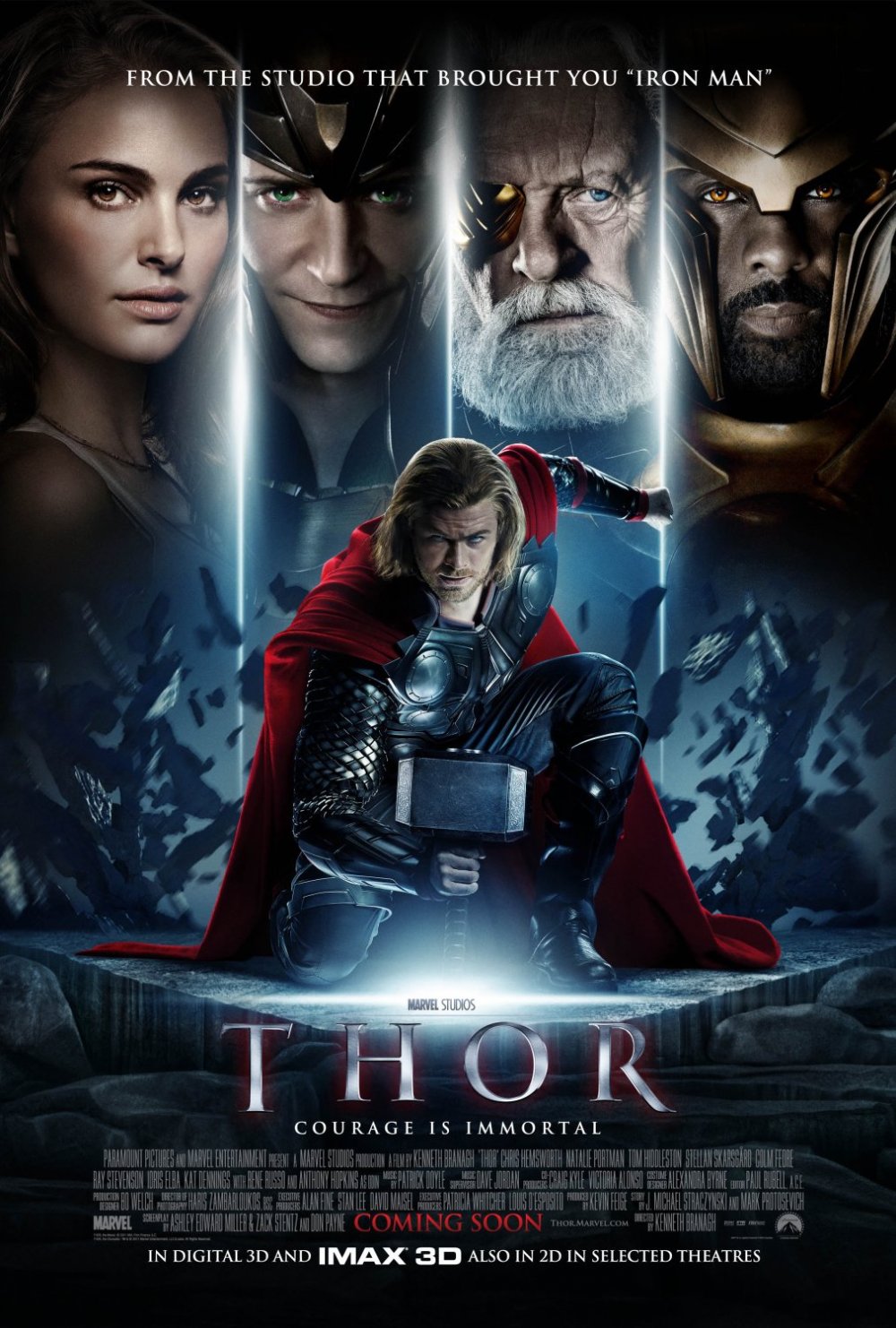
‘Thor’ Arrives with Thunderous Abandon

Thor movie poster

Thor” makes its presence known with thunderous abandon. Now like many comic books, this one is yet another I haven’t read, so I can’t say how true it stays to its origins. However, judging from the great Kenneth Branagh’s handling of the material, I imagine it’s very respectful to the character.

Heeding closely to classic Norse mythology, Thor is the god of thunder and heir to the throne of Asgard. But on the day of his ascension, the Frost Giants invade the planet’s deeper regions to retrieve the Casket of Ancient Winters, the source of their power. They are easily defeated, but their violation of the truce put together between them and Asgard seriously pisses Thor off. Against his father’s wishes, he and his fellow warriors journey to the Frost Giants home planet of Jotunheim to keep some frosty ass. Odin, however, intervenes and, infuriated with his son’s arrogance, strips him of his powers and banishes him to Earth. For a warrior like Thor, being banished to Earth does feel like a nasty insult.

First off, I really liked the way Branagh handled this material. In the wrong hands, this could have easily become high camp which would have been enjoyable for all the wrong reasons. But Branagh takes the characters and places they inhabit seriously, and he infuses them all with a strong humanity which comes to define them more than does their place in the universe. Even the villains are remarkably complex as their corruption results not so much from a need for power, but instead for a father’s love and approval. Of course, with Branagh directing, you can count on many Shakespearean references throughout, be it Iago from “Othello” or “King Lear,” and they prove to be a perfect fit for this movie.

I was also impressed with how well Branagh handled the visual elements of “Thor.” The last time he made a movie heavy with special effects was “Mary Shelly’s Frankenstein,” and he seemed a bit out of his league with that one. Perhaps we should not be impressed as this movie has a budget of at least $100 million, not counting advertisement costs, but the key thing here is the effects succeed in being an extension of the characters instead of just dwarfing them completely. Then again, that giant creature the Frost Giants unleash on Thor immediately had Liam Neeson screaming in my head, “RELEASE THE KRAKEN!!!”

As Thor, Chris Hemsworth, who played Captain Kirk’s father in J.J. Abrams’ “Star Trek,” owns the role right from the first moment he walks onscreen. Hemsworth clearly revels in portraying the great power Thor possesses, and he is a gentleman when the situation calls for it. Seeing him as a fish out of water on Earth also makes for some splendid moments which are slyly comic. I’m also glad to see Thor is not just another character who doesn’t want to be “the one,” conflicted about the things he is destined to do. With Hemsworth, you know from the get go he is fully aware he’s “the one” and owns this knowledge to where you feel his impatience in wanting to prove it to the universe. Instead of a whiny Anakin Skywalker, Hemsworth gives us a powerful warrior worth cheering for, and one who eventually learns from his mistakes.

As scientist Jane Foster, Natalie Portman’s casting in the role seems like a no brainer. We know from her off screen life that she is a remarkably intelligent human being, so she doesn’t have to prove to us how believable she can be as a scientist. She sparks instant chemistry with Hemsworth (damn those six pack abs!!!), and that shy smile of hers kills me every single time.

Then there’s the great Sir Anthony Hopkins whose portrayal of Asgard’s king and father to Thor, Odin, is nothing short of gallant. This is especially the case with the opening narration which he recites with such depth to where he makes all other actors who’ve done it before him sound like they were sleepwalking their way through it. While many may think this is one of those roles Hopkins did for an easy paycheck, it’s really one of the best performances he’s given in a while.

Tom Hiddleston plays Loki, Thor’s brother and the movie’s main villain. What I liked about Hiddleston is how he does so much more than give us the usual one-dimensional bad guy. Just like Joaquin Phoenix’s character from “Gladiator,” Loki feels slighted by his father as he prefers another man over him, and he becomes desperately eager to prove himself in any way he can. But of course, he ends up doing it in the worst way possible. Hiddleston makes Loki into a character who is more spiteful than hateful, and this makes his eventual fate seem all the more tragic in retrospect.

There are other strong performances throughout this blockbuster affair to enjoy as well. Rene Russo, where have you been? Idris Elba makes a memorable Heimdall, and it never seems like a small part with him playing it. Kat Dennings steals a few scenes as Darcy Lewis, Jane’s co-worker whose science is more political than astronomical. And Stellan Skarsgård remains a dependable actor as always playing scientist Erik Selvig, a character who ends up playing an important role in “The Avengers.”

Having said all this, “Thor” did feel like it could have been a little more exciting. It doesn’t quite have the same invigorating sweep as some of Branagh’s Shakespeare adaptations like “Hamlet” or “Henry V,” and it takes longer to get to the action than it should. It’s not quite as entertaining as “Iron Man,” but I would definitely rank it above “The Incredible Hulk.”

Regardless, there is still much to like about “Thor,” and Branagh has done the best job anyone could have in bringing this particular comic book hero to the big screen in such a respectful fashion. It also benefits from excellent casting, especially Hemsworth who looks like he came out of the womb looking like a warrior with a mighty hammer in his hand. This is one of the few times where “getting hammered” will sound more like a threat than an embarrassing state of drunkenness.

* * * out of * * * *

‘The Ghost Writer’ Shows Roman Polanski Has Not Lost His Touch as a Filmmaker

The Ghost Writer movie poster

The act of ghost writing a book for a celebrity, be it a memoir or perhaps a children’s book, seems like a cheat. Granted, there are a lot of celebrities out there who do in fact write their own books, sometimes with the help of another, and good for them. But you can’t convince me O.J. Simpson wrote that book which contained his supposed confession of the double murder he committed back in 1994 that claimed his ex-wife Nicole and Ron Goldman. By now, we should know Simpson is going to be the last one to admit to any wrongdoing, and the idea behind it was pathetic to say the least. Still, there was a nice sum of money involved in this particular ghost-written book, and Simpson was struggling financially.

What really has me wondering about this whole process itself is who the ghost writer is, and of how they about seeing their work being credited to another who didn’t write it. On one hand, you avoid a lot of the hoopla and screaming fans who worship the work to an unhealthy extent, but the benefits you get out of it are depressingly minimal it seems. You are basically an anonymous person in a sea of people who get far more attention than they deserve, and this makes you easily expendable as a result.

Now I’m not mistaking “The Ghost Writer” as the definitive example of what a writer like this goes through, but the feeling of replacing someone or fearing you will be easily replaced cannot leave one in a state of supreme confidence. But what the movie version of Robert Harris’ book shows is how it can make for a really good mystery thriller.

“The Ghost Writer” is the film Roman Polanski made while he was “wanted and desired,” and it’s the same one he managed to finish post-production on while under house arrest. The writer of the movie’s title is played by Ewan McGregor, and to add to some vivid illustration to the title, we never learn his character’s real name throughout the entire running time.  Anyway, he gets a very lucrative job offer from a publishing firm CEO, played by James Belushi of all people, to ghost write the memoirs of the former British Prime Minister Adam Lang (Pierce Brosnan). It turns out that McGregor’s predecessor on this project died in an apparent suicide, and his body was found washed up on the beach.

Once hired, McGregor is taking to Lang’s oceanfront house on Martha’s Vineyard, an island off the coast of New England. Of course, this was actually filmed in Germany as Polanski could not step on American soil without getting arrested. Upon looking over the manuscript from the deceased writer, and in his talks with Lang, McGregor comes to discover this ex-Prime Minister may have been involved in handing over suspected terrorists in Britain to the CIA for torture. The closer he gets to the truth, the more he fears he will end up like his predecessor.

After all these years, Polanski still knows how to make an excellent thriller, and he manages to maintain a strong level of suspense and intensity over the movie’s two hour plus running time. Throughout “The Ghost Writer” he is extra careful not to reveal too much of what’s going on, and it leaves us guessing as to what the truth really is. Like McGregor, we are left to sift through the clues left behind and figure out how they all add up.

McGregor doesn’t play any writer here, but instead one eager to get at the truth which is just within their grasp, and that’s even if they know they will not like what they see. McGregor gives a really strong performance here as the ghost writer, and Polanski succeeds in putting us in his shoes to where we feel as lost as him as he gets deeper into uncovering long kept secrets. During a chase scene, we are in the actor’s mindset, and even we can’t figure where to go or who to trust.

Also great in “The Ghost Writer” is Brosnan who plays an ex-Prime Minister who bares a not so subtle resemblance to Tony Blair. This gives the former James Bond actor the continued opportunity to shed his 007 image as Adam Lang in a way he must have been eager to do. Behind this image, we see on the television screen a man stuck in a moral contradiction he will never be able to escape. Flanked by his wife, a team of advisors, and besieged by a plethora of angry protestors out for his blood, Brosnan gives us a character you almost have to admire in how he manages to keep many things to himself despite an unrelenting pressure to reveal stuff he’d rather not reveal.

Olivia Williams is also terrific as Lang’s wife, Ruth, and she herself is a complex study in emotions. In the face of her advisors, Ruth has a tough façade which screams out “don’t bullshit me” whenever possible. But when Ruth is alone with the ghost writer, she lets this mask down to reveal someone who feels hopelessly trapped in a situation she has no real control over. She was probably promised something much different in life, something more positive, but she now looks back on it all as one big lie. Taking her character through different levels of emotion is fascinating to watch, and Williams holds our attention completely whenever she is onscreen.

I also loved seeing Kim Cattrall here as well, and her British accent was absolutely flawless. As Amelia, Lang’s personal assistant and mistress, she manages to keep the coolest face despite escalating controversies which threaten to define this ex-Prime Minister as a deceptive war criminal. Her strictness of directions can be seen through her sexy smile, and she holds her own against Lang’s wife with aplomb. There is an innate sexiness to Cattrall’s performance in how she goes about her days not losing a beat, and it is enthralling to see what she pulls off here.

There are also a number of familiar faces to be found in “The Ghost Writer.” You also have Timothy Hutton who plays Lang’s American lawyer Sidney Kroll, Tom Wilkinson who portrays Harvard law professor Paul Emmett, and even Eli Wallach shows up in a memorable cameo. In some cases, their appearances could have really taken us out of the movie, but none of them are able to hide the fact the real star of “The Ghost Writer” is Polanski.

Ironically, Polanski is in a good position with “The Ghost Writer” as the shadow of his most famous movies like “Chinatown” and “Rosemary’s Baby” are not hanging over this one. Throughout the years, he was trapped by his earlier work which he received so much critical acclaim for, and it affected his later movies like “Bitter Moon” and “The Ninth Gate” to name a few. But every so often he gives us a motion picture to remind us of how he has never lost his unique talent for filmmaking.

We see so many directors drop the ball in terms of maintaining suspense, but Polanski has not lost a beat, and this film sees him hitting his stride again. Many will say “The Ghost Writer” is the kind of movie which doesn’t get made anymore, but Polanski calls Hollywood’s bluff on that to where this is one which cannot be missed.

* * * ½ out of * * * *

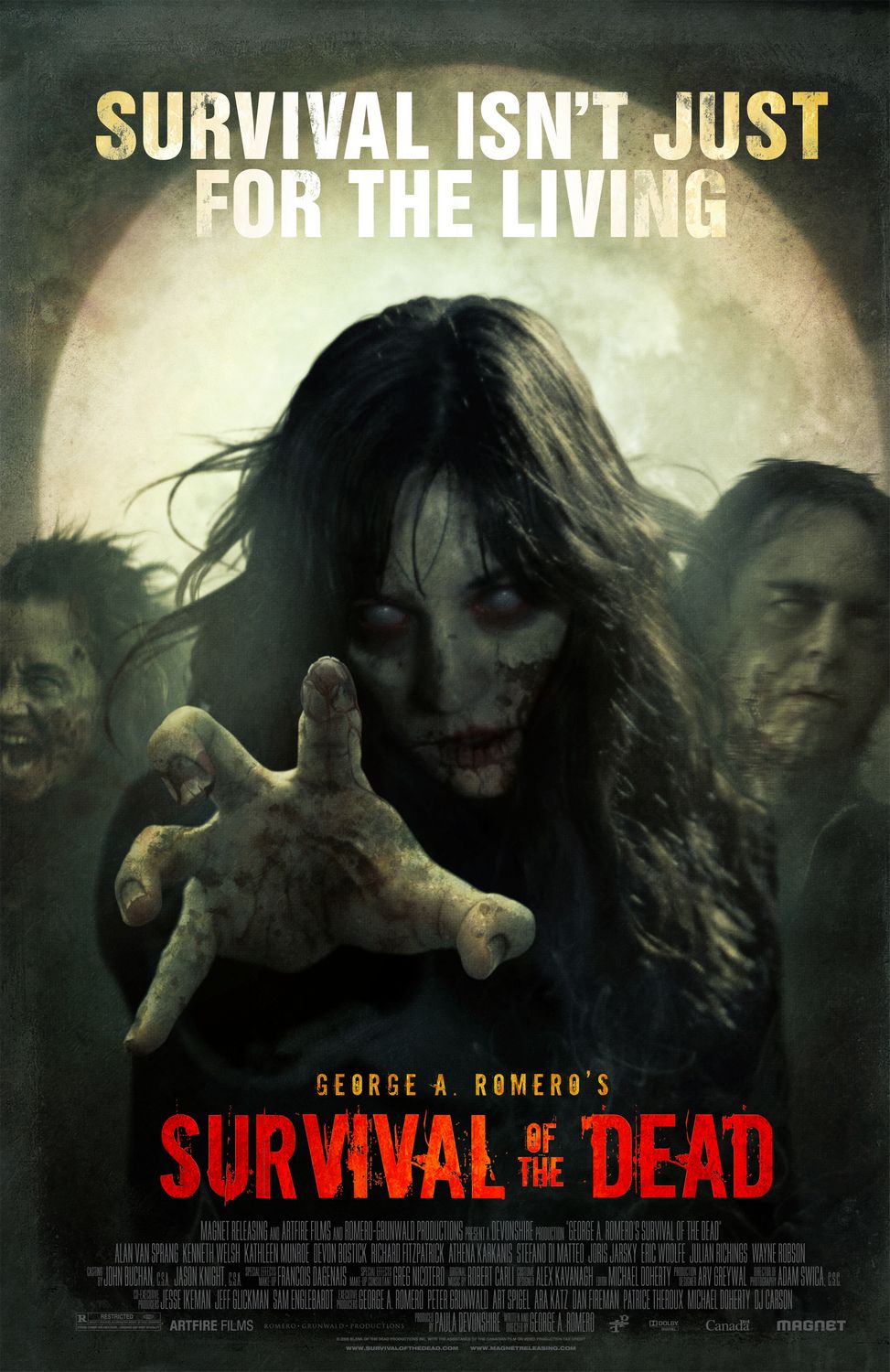
‘Survival of The Dead’ Finds Zombies Running Afoul of Family Rivalries

Survival of the Dead movie poster

“We’re not gonna make it, humans I mean.”

 “It is in your nature to destroy yourselves

                                                                  -Edward Furlong & Arnold Schwarzenegger from “T2”

There was a 20-year gap between George Romero’s “Day of The Dead” and “Land of The Dead.” Some parents now have kids who are slightly older than the number of years Romero sought financing to make zombie movies on his own terms. But since “Land of The Dead,” Romero has been pumping out one living dead movie every other year. Talk about strong productivity. His latest flesh-eating opus is “Survival of The Dead” which looks at the rivalry between two families on an isolated island, struggling to maintain power as the zombies continue to outnumber them and reject their vegan ways.

Actually, we first get introduced to a group of mercenary National Guardsmen who appeared briefly in “Diary of The Dead” when they stole supplies from the protagonists as they traveled the deserted highway in their old Winnebago. These soldiers are lead by Sarge “Nicotine” Crockett (Alan van Sprang), and they are now on their own, struggling to survive in a god forsaken world. As a result, “Survival of The Dead” is the closest thing to a direct sequel this series has ever had.

These days, Romero is not trying to scare with these movies, and he even “Night of The Living Dead” was the only true horror movie of the bunch. These zombie movies act as a conduit for his social commentary which is both humorous and yet very bleak. In Romero’s point of view, it is only a matter of time before these “deadheads,” as one young boy calls them, devours what’s left of humanity. What can be said about us in the meantime?

Whereas “Diary of The Dead” was a clear take on the You Tube/social networking generation of today, the meaning behind “Survival of The Dead” is not as clear. It took me some time after watching the movie to get an idea of what Romero was attempting to accomplish. Apparently, this one was inspired by a 1958 western called “The Big Country” which follows a new man in town who gets caught up in a feud between two rival families over a valuable piece of land. The same thing happens here between the O’Flynns and the Muldoons, but their rivalry is amped up by the fact that many of the people they know and loved have died and come back to life as drooling flesh eaters.

The O’Flynns believe the zombies are dead and will never return to normal, and therefore must be destroyed. The Muldoons, however, believe they should be kept alive in the hope a cure can be found for them. Romero sees their sharp differences as symbolic of the state of our world today as we can’t agree without being disagreeable, and the lack of civility reigns over the ability for us to listen to one another.

With the Muldoons, things get a little confusing at times because they are not above shooting zombies dead if necessary, so their protection of these same beings threatens to make them utterly hypocritical. Then again, their hypocrisy may be the point. “Survival” goes along with one of the plot threads of “Land of The Dead” as it shows how zombies have evolved somewhat to where humans can now teach them things. What the Muldoons hope to do is teach these lumbering bodies to consume something other than human flesh. Whether or not they succeed is for you to find out.

When the National Guardsmen arrive on the island, they are caught in the middle of this conflict and provide a more objective point of view. All they want to do now is survive. They can take an island and make it their own, but they won’t hesitate to abandon it when it becomes overrun by unwelcome guests. They are also not about to get caught up in some family duel when they run a high risk of turning into the thing they blow away at close range.

Politically speaking, we are so seriously divided these days, and we believe the side we are on is right without any question. We just think the other side is full of horse dung and incapable of looking at the world objectively. In the meantime, the world is falling apart all around us, and we appear to be unable to pull together as a whole when a crisis hits. I’m sure we can all see by now it’s not the zombies who are going to do us in, but ourselves instead. That’s the way it has been from the start.

The budget for “Survival of The Dead” was around $4 million dollars; not a lot, but enough to give Romero total creative control over his content. I have to give him a lot of credit because he gives this movie a look which makes it look like it cost much more. I don’t know if this is because the scope he is shooting in is bigger than on his previous movies, but it looks more like it cost at least $20 million to make.

Plum Island almost seems like the land time forgot. Whereas on the mainland people are utterly consumed by technology and have made themselves a slave to it, these families live like they are still stuck in the Old West. You never see anyone other than the National Guardsmen with a laptop computer or an iPhone. They simply ride on their horses or in their cars, and they appear happy to be isolated from the rest of the world. Feminism also seems to not have been introduced yet to the island, and this is regardless of how Janet O’Flynn (Kathleen Munroe) is perfectly capable of taking care of herself without the help of a man. Leave it to Romero to always include strong female parts in his films.

Both families are Irish by the way. I’m not sure why Romero went this route, but perhaps it was to remind us how America is, and always has been, a land of immigrants. Their accents at times were a little too thick to where I couldn’t understand half of what they were saying, but as long as I got the gist of what was being said, I didn’t complain much.

There is a strong of familiarity which runs throughout “Survival of The Dead” in the themes and characters Romero employs throughout. Sarge “Nicotine” Crockett is close to being a doppelganger of Captain Rhodes from “Day of The Dead.” Janet O’Flynn is your basic strong willed female character who is in every “Living Dead” movie. And, of course, the movie ends the same way the others do with the zombies having more than enough room for leftovers. So really, there’s not a lot new here, but once you get past that, the movie is still fun.

The cast is the usual batch of no-name actors Romero prefers to use. I liked Kathleen Munroe and thought her to be very lovely, and I also liked Alan van Spring as the no-nonsense sergeant who manages to hold it together throughout. Kenneth Welsh also has a very strong presence here as Patrick O’Flynn, the patriarch of his family who gets thrown out but ends up coming back with the guardsmen for revenge. Athena Karkanis also makes a badass soldier out of Tomboy in the same way Jeanette Goldstein made an undoubtedly tough marine out of Vasquez in James Cameron’s “Aliens.” All in all, the cast does very good work here.

Many of you probably are wondering how gross the effects are in “Survival of The Dead.” Well, let’s just say the Fangoria fans will not be disappointed. One character makes creative use of a fire extinguisher to dispatch one flesh eating bastard. All the other characters have their own creative kills as they are equipped with the full knowledge that zombies need to be shot in the head to be killed. They are no longer terrified of the living dead as much as they are hopelessly annoyed by them, and the living dead exist more as a nuisance to them instead of a threat.

“Survival of The Dead” is not as good as “Diary,” and the themes and meanings behind this sequel are not easy to decipher at first. I’m not even going to bother comparing it to the original trilogy because it’s just going to take away from Romero was trying to accomplish here. I still enjoyed “Survival” for what it was, and there is something really inspiring about how Romero still makes these zombie movies after so many years. It’s like you could never make him give up on the chance to make another one after the box office disappointment of “Day of The Dead.” There is a way to make a movie all your own. It’s just that there is not as much money involved.

The movie’s last image of two men facing off at each other with their guns is a strong one as it illustrates the folly of rivalry, especially when it’s over things which become increasingly insignificant in the wake of a zombie apocalypse. Romero still has a bleak worldview of humanity, but he still manages to give this film some biting humor which keeps us entertained. It seems like all we can do is just survive and make it to another day. In his movies, this seems to be the best victory anyone can hope for.

* * * out of * * * *

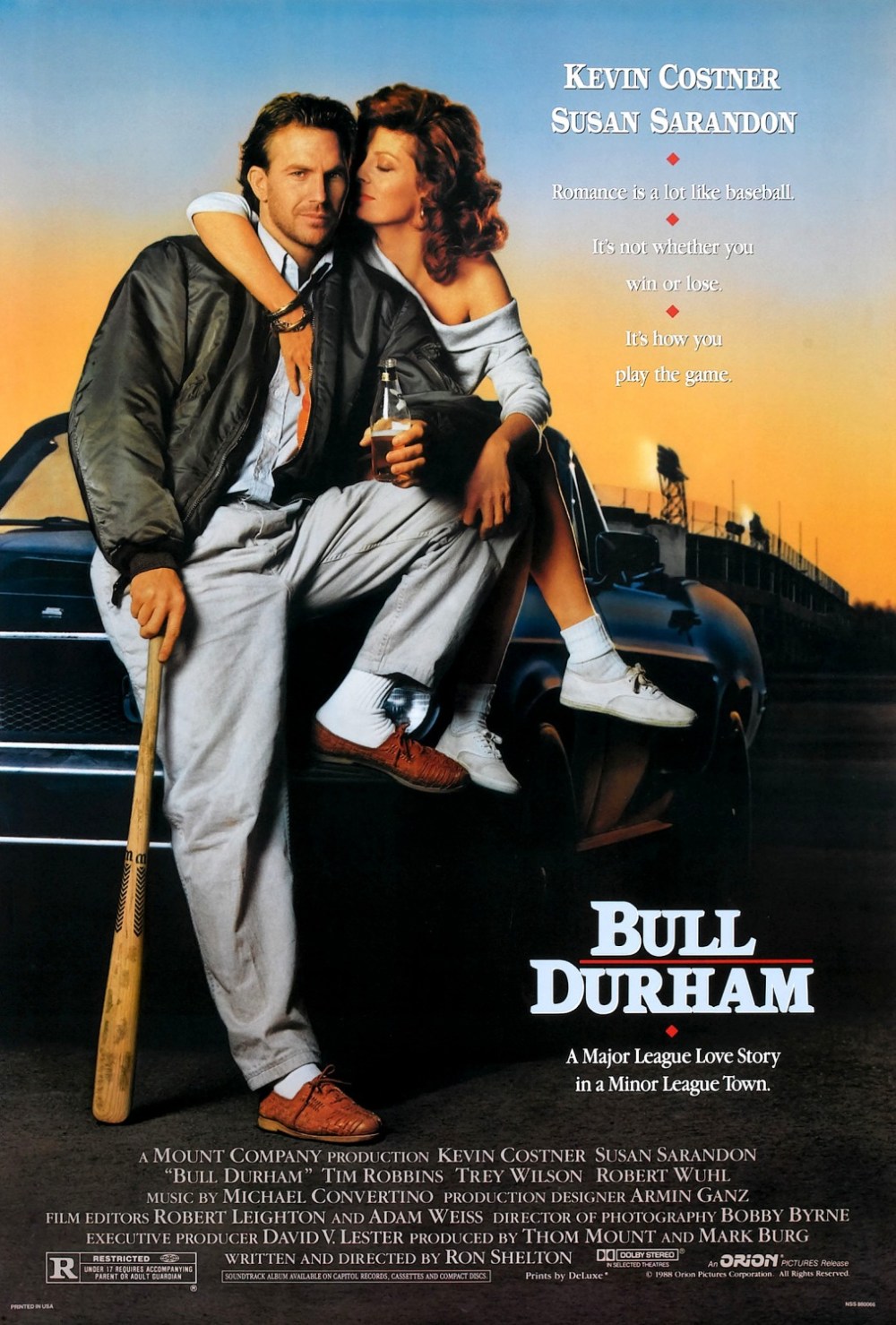
Why ‘Bull Durham’ Remains My Favorite Sports Movie

Bull Durham movie poster

This was one of the few R-rated movies my parents let me see long before I turned 17. Of course, I was already sneaking into R-rated movies before I reached that age. I’d buy a ticket to “Ghost” and instead walk into the theater showing “Marked for Death.” I guess my mom and dad decided, since I was watching all these movie review shows like “Siskel & Ebert” and “Sneak Previews,” and I had seen this movie’s trailer numerous times on the Movietime Channel (long before it turned into E! Entertainment Television), that the damage to my fragile little mind had already been done. Then again, it’s not like they were exposing my brother and I to “The Texas Chainsaw Massacre.” Had they done so, it would have scarred us for life!

When I first saw “Bull Durham” on VHS, I was already very used to the Hollywood sports movie formula where the hero suffers a crushing defeat and has to build themselves back up again to an audience-pleasing finish. When I was younger, I was far more comfortable knowing how a movie would end, and I wanted them all to end the same way. It feels like this with today’s generation of audiences as they thrive on repetition in stories and of the good guys beating the villains we are led to believe good will always triumph over evil. When you’re young, you have yet to learn that in reality the bad guys get away with a lot before anyone notices, especially if they have corporate and/or political connections.

“Bull Durham,” however, forever changed the way I looked at sports movies in general. It didn’t always have to be about training montages and the build up to the big game. Instead, it was about the reality of the game itself, and of the various personalities inhabiting it. Whether or not the characters get their big moment at the end, their victories and accomplishments were never about coming out on top or being the best. The real victory came from struggling through one important stage in your life, and surviving long enough to get to the next. Or, in other words, closing one chapter in your life and moving on to the future.

Most baseball movies focus on the major leagues, but what makes “Bull Durham” especially unique is it is about the minor leagues. Writer and director Ron Shelton based this film on his own experiences in the minors which he played in for several years, and he shows it to be a much looser environment and one which is far more fun and carefree. The baseball stadium may be smaller, but the connection between the players and the fans is more intimate and not engulfed in corporate greed or network contracts. Still, all these players see getting to the majors, which they refer to as “the show,” as their holy grail, the one thing they feel destined to get to at some point. The sad thing is, many of them will never make it there.

“Bull Durham” focuses on three characters throughout: Crash “the player to be named later” Davis played by Kevin Costner, Ebby Calvin “Nuke” LaLoosh played by Tim Robbins, and Annie Savoy played by Susan Sarandon. LaLoosh is the star pitcher of the Durham Bulls and is about to make his professional debut. When he does, he ends up, as Millie (the incredibly cute Jenny Robertson) says, pitching the same way he makes love, “All over the place.”

Hence, veteran catcher Crash is brought in to teach LaLoosh how he can control his pitching, and to get him prepped for the major leagues. During this time, the two of them will meet the high priestess of baseball, Annie Savoy. Her church is the one of baseball, and she hooks with one guy a season to help them with their playing and to expand their mind. This player also gets to share her bed with her, and considering just how amazingly hot Sarandon is in this role, it looks very foolish to even consider turning her down.

At the age of 14, I may not have understood all of what “Bull Durham” was about, but it was not a movie as disposable as a McDonald’s Happy Meal. Shelton offers us a closer look into the world of baseball than I could have expected to see back in 1988. The intimate details of the minor leagues make it very unique among other films of its genre. You also get to learn the importance of the relationship between the pitcher and the catcher, and of how one better not cross the other if he is looking to win.

Aside from the main players, the other team members are individualized to where you can tell one from the other. There’s the one player who swears by the bible and wants all his fellow teammates to follow in his righteous path. Then you have another who uses a necklace with a cross to bless his baseball bat, and who later needs a live rooster to take the curse off his glove. Crash Davis also shows an alternative way to get a rainout which results in one of the movie’s funniest moments.

Kevin Costner was perfectly cast as a veteran baseball player, and he also had the athletic ability to hit a ball right out of the park during filming. In “Bull Durham,” Costner gives us a man knowledgeable of the majors and the minors, and through his eyes he shows us the yearning he has to get back to “the show” as he was there once for 20 days, the greatest days of his life. You can only imagine how much he is working to get back there, but it seems more like a mirage that gets further and further away from him as time marches on.

Looking back at Tim Robbins’ performance, it is clearer to me now he had the toughest role to play in “Bull Durham.” Throughout, he has to take LaLoosh from being a wild and crazy guy on and off the baseball to someone more mature and ready to enter the majors. Robbins makes the transition look seamless, and it was the first indication of the brilliant actor we now see him as today. Seeing him again in “Bull Durham” after all these years is a kick because he is so loose and fancy free.

But seriously, the most memorable performance comes from Susan Sarandon as Annie Savoy. To say Sarandon is sizzling hot remains an understatement as she captivates the audience in the same way she reels in Robbins and Costner. With this character, Shelton gave us one of the most original female characters ever seen on the silver screen. Annie is a strong female, and Sarandon succeeds in making Annie this and more. It may almost sound ridiculous to have a character believing in the “church of baseball” when you look at it on the page, but once Sarandon utters those words which start off “Bull Durham,” you never doubt that she fully believes in it for a second. After all these years, it is still a travesty she didn’t receive an Oscar nomination for her performance.

But the real star of “Bull Durham” is Shelton, and he sees a lot of Crash Davis in himself. After this film came out, he became the go to guy for writing sports movies. You never get a “Rocky” like movie from him, and the characters he creates are rich, complex, and they always have such fantastic dialogue coming out of their mouths. This great talent of his led him on to make “White Man Can’t Jump” where Woody Harrelson and Wesley Snipes were as brilliant at hustling on the basketball courts as they were at verbal sparring with each other and their opponents, “Tin Cup” which left me thinking Costner and him should make as many movies together as possible, and “Cobb” with Tommy Lee Jones which may very well be the definitive anti-sports biopic of all time.

Incidentally, the commentary track he did for the DVD remains one of my all-time favorites. Throughout the movie, he strips away the mythology of other baseball movies to give us an idea of what the game is really like. I also loved how he talked about the fight to get Robbins cast even though the studio didn’t view him as a big enough star. The way they saw it, the audience would never believe Sarandon would ever fall for a guy like him. This led Shelton to bring up how he is godfather to one of their sons.

Shelton also pays great respect to the other actors like the late Trey Wilson who is so good here as the coach, and to Robert Wuhl whom he cast despite him giving the worst audition of any actor he had ever seen. He also lays bare how much he loves making movies and how much he hates the business.

Shelton may have never made it to the majors, but his experiences allowed him to give us “Bull Durham,” one of the funniest and most irresistibly sexy films of all time. I still see it as my all time favorite sports movie, and I don’t care how much more acclaim “Rocky” and “Raging Bull” have over it/ Besides, where else will you find a movie about minor league baseball? Oh yeah, there’s “Major League: Back to The Minors,” but who’s in a hurry to see that?

* * * * out of * * * *


‘Paranormal Activity: The Ghost Dimension’ Ends This Series with a Whimper Instead of a Bang

Paranormal Activity The Ghost Dimension poster

With “Paranormal Activity: The Ghost Dimension,” we have finally reached the end of this long running horror franchise. At least, this is what Paramount Pictures is saying. They said the same thing after “Friday the 13th Part IV: The Final Chapter” and looked what happened there. When asked to explain the end of his movie “Halloween,” John Carpenter said it shows how evil never dies. This is a perfect explanation, and it helps explain why Michael Meyers keeps coming back to Haddonfield, why Freddy Krueger continues to haunt the dreams of teenagers, why Jason Voorhees continues to hack up camp counselors, and why Pinhead continues to lure the infinitely curious to that crazy box of his. Could the ever-malevolent demon known as Toby finally be stopped once and for all?

Well, let’s hope so because “The Ghost Dimension” confirms the “Paranormal Activity” franchise has finally run out of gas to where I wished the filmmakers ended it after “The Marked Ones.” This sequel returns the series to another tale of a white suburban family terrorized by Toby, and the family keeps looking into the things which go bump in the night even as the story get progressively worse. On the upside, this sequel does attempt to answer all the questions we have about this series and doesn’t just tease us endlessly the way “Paranormal Activity 4” did, but nothing is as scary as it once was.

This movie opens with a quick throwback to the literally back-breaking finale of “Paranormal Activity 3” where young Katie and Kristi are gathered up by their grandma Lois and taken to a room where a man tells them they are a critical part of Toby’s plan. We then move forward to 2013 where we meet the Fleeges, a family comprised of Ryan (Chris J. Murray), his wife Emily (Brit Shaw), and their young daughter Leila (Ivy George). They are later joined by Ryan’s brother Mike (Dan Gill) who just broke up with his girlfriend, and also Skylar (Olivia Taylor Dudley) who is a nanny or a yoga instructor or something along those lines.

Each “Paranormal Activity” movie has a twist on the technology used to exploit the presence of the demonic Toby, and this one is no exception. Ryan and Mike end up coming across this giant video camera (and yes, they used to be that big) which actually allows them to see the spiritual forces hovering around the home which take the form of an oil slick that moves around ominously. Pretty soon, young Leila is talking to Toby because impressionable kids are easily for demons to influence, and the family comes to discover they are living in the same house that grandma Lois lived in years ago. Yes, there are no such things as coincidences in a “Paranormal Activity” movie.

Let me start with “The Ghost Dimension’s” biggest problem, it feels like a movie. The previous installments, even “Paranormal Activity 4,” never made me feel like I was watching a movie. Instead, they felt like documents of real people being haunted by forces they can’t control and which encroach mercilessly on their safety. They felt real, but here everything feels highly scripted as the actors are forced to utter a lot of exposition in an effort to explain to the audience what Toby’s big plan is. As a result, everything feels contrived, and the movie comes across as just another exercise in found footage terror.

Furthermore, the characters are frustratingly one-dimensional and incredibly idiotic to put it mildly. A lot of opportunities to make them relatable or the least but likable are blown by the screenwriters as I never came to care much about them. After a while, I became more eager to see them become devilish entertainment for Toby. I do have to say, however, that Ivy George does very good work here as Leila, and she provides “The Ghost Dimension” with some of its most haunting moments as her face becomes a mask of possession which makes her intensely unpredictable.

The real big news about “The Ghost Dimension” is it’s the first “Paranormal Activity” movie to be shown in 3D. Now I’ve seen 3D used to great effect in Ridley Scott’s “The Martian” and Gaspar Noe’s “Love,” but watching it here only reminded me of how “The Ghost Dimension” feels more like a movie and less like an experience. In the end, the extra dimension feels like a stunt which adds nothing to the proceedings.

Also, in its attempts to answer many of the questions we have about Toby, it makes this horrifically violent demon look no different from so many others in cinematic history. Just as it was with the first two “Alien” movies, the thought of the monster is far scarier than the sight of it, and seeing Toby in his demonic form just takes away from what’s frightening about him. And the explanation of Toby’s “plan” feels like something out of a dozen other horror movies.

The original “Paranormal Activity” was supposed to be a stand-alone movie. It was supposed to end with Katie dying, but Paramount Pictures decided to change this ending and made Katie look like she was invaded by some evil force. The movie’s amazing success ensured sequels would be made whether we liked it or not, but the first two actually added to the original’s ending and built up a mythology which left audiences endlessly intrigued. But watching “The Ghost Dimension” makes me realize there was no way anyone could have concluded this mythology in a satisfactory manner. The revelation of Toby’s big plan sounds like something out of a dozen other horror movies, and it made me wish I knew a lot less about him.

“Paranormal Activity: The Ghost Dimension” does leave the door open for another sequel as the demonic force takes on a new form, but this really should be the last one for a while at the very least. It’s sad to see this franchise end on a banal note as things began feeling fresh again after “The Marked Ones,” but many horror franchises tend to overstay their welcome, and “Paranormal Activity” is just the latest example. We need to face the facts; the thrill is gone.

* ½ out of * * * *

Please check out the following reviews:

Paranormal Activity

Paranormal Activity 2

Paranormal Activity 3

Paranormal Activity 4

Paranormal Activity: The Marked Ones


‘Paranormal Activity: The Marked Ones’ Sees the Franchise Making a Comeback

Paranormal Activity The Marked Ones poster

Paranormal Activity: The Marked Ones” proves to be much, much better than “Paranormal Activity 4,” and it succeeds in reinvigorating a franchise which was starting to look like it was running on fumes. In terms of story, it’s not very different from the previous films and you do have a good idea of where the story is heading, but Christopher B. Landon who wrote the screenplays for “Paranormal Activity 2, 3 and 4” and directed this one is very deft at positioning the scares to where they come at you before you know it. Thanks to a terrific cast and a good dose of humor, it proves to be one of the best entries in the long running franchise.

“Paranormal Activity: The Marked Ones” is not a direct sequel to “Paranormal Activity 4,” but instead a spin-off which features a family not white-bred like all the others featured in the franchise. When the film begins, we are introduced to Jessie (Andrew Jacobs), a young Latino who has just graduated from high school along with his best friend Hector (Jorge Diaz). Soon afterwards, we see the whole family partying at their apartment complex and having a grand old time as they bid farewell to the hell that is high school.

But then they learn their downstairs neighbor has died under suspicious circumstances. With nothing better to do, Jessie and Hector break into the apartment to figure out what happened. What they discover are a bunch of items used in black magic rituals as well as all those videotapes which formed the basis of “Paranormal Activity 3.” The next day, Jessie wakes up to discover what looks like a huge bite mark on his arm, and it’s a sign that his troubles are only about to begin.

The idea to focus on a Latino family for this “Paranormal Activity” was a smart one as it gives this entry a fresh feel we really take notice of. The family presented here is a great one, and while Landon is really just out to give us a fun and scary time, he is also smart in giving us a group of Latinos not dominated by stereotypes. Some might complain the film does traffic in stereotypical behavior, but I disagree. While many have a view of inner city neighborhoods as being violent hellholes, few seem to realize how close knit the families who live in them are, and many of them are not involved in a life of crime.

Part of me was hoping the filmmakers would dare to film the whole movie in Spanish with subtitles, but since this is a “found footage” movie, they are apparently not allowed to do so. Still, this was a small complaint in the large scheme of things.

Another one of the main differences between “Paranormal Activity: The Marked Ones” and the previous films is the amount of humor in it. This is not to say the other films lacked humor, but I was surprised at how much I found myself laughing with this particular entry. A lot of this is thanks to Diaz who comes close to stealing the movie as Hector. Watching him get all super excited at the things happening to and around his friend Jessie are a gas to watch, and he ends up becoming the real star of this movie as a result.

I also have to say that the ending of “Paranormal Activity: The Marked Ones” is one I did not see coming. It ends up turning the whole franchise on its head as you wonder what realm these “Paranormal Activity” movies truly exist in. After watching this spin-off, it’s clear the series is not simply relegated to the found footage genre.

Landon, who finally gets to direct a “Paranormal Activity” movie after having written many of them, knows we have become familiar with where to expect the scares to happen. To his credit, he plays on what we expect to see and provides us with some jump out of your seat moments we don’t quite see coming. Whether or not you think this particular entry is or is not as scary as the first three, it definitely has its moments if you patiently wait for them.

I got to see “Paranormal Activity: The Marked Ones” with a preview audience, and their reaction was contagious as was their enthusiasm. Many movie franchises, regardless of the genre, live and die in regards to how audiences react to them, and this one shows there is still life left in it. Just when you think this series has reached its peak, this entry makes you excited for what will happen next, and I am ever so curious to see which direction this one will take from here. That’s a very good thing as this series works best on what fans are not expecting.

For me, I’m still waiting for the “Paranormal Activity” movie where the executives of Paramount Pictures become victims of similar hauntings as a result of profiting off the tragedies which have befallen the families featured in these films. If they want people to keep believing these found footage movies are real, then they should seriously consider this because the franchise appears to be heading in this particular direction.

* * * out of * * * *

Check out the interview I did with the stars of “Paranormal Activity: The Marked Ones” which I did for the website We Got This Covered down below:

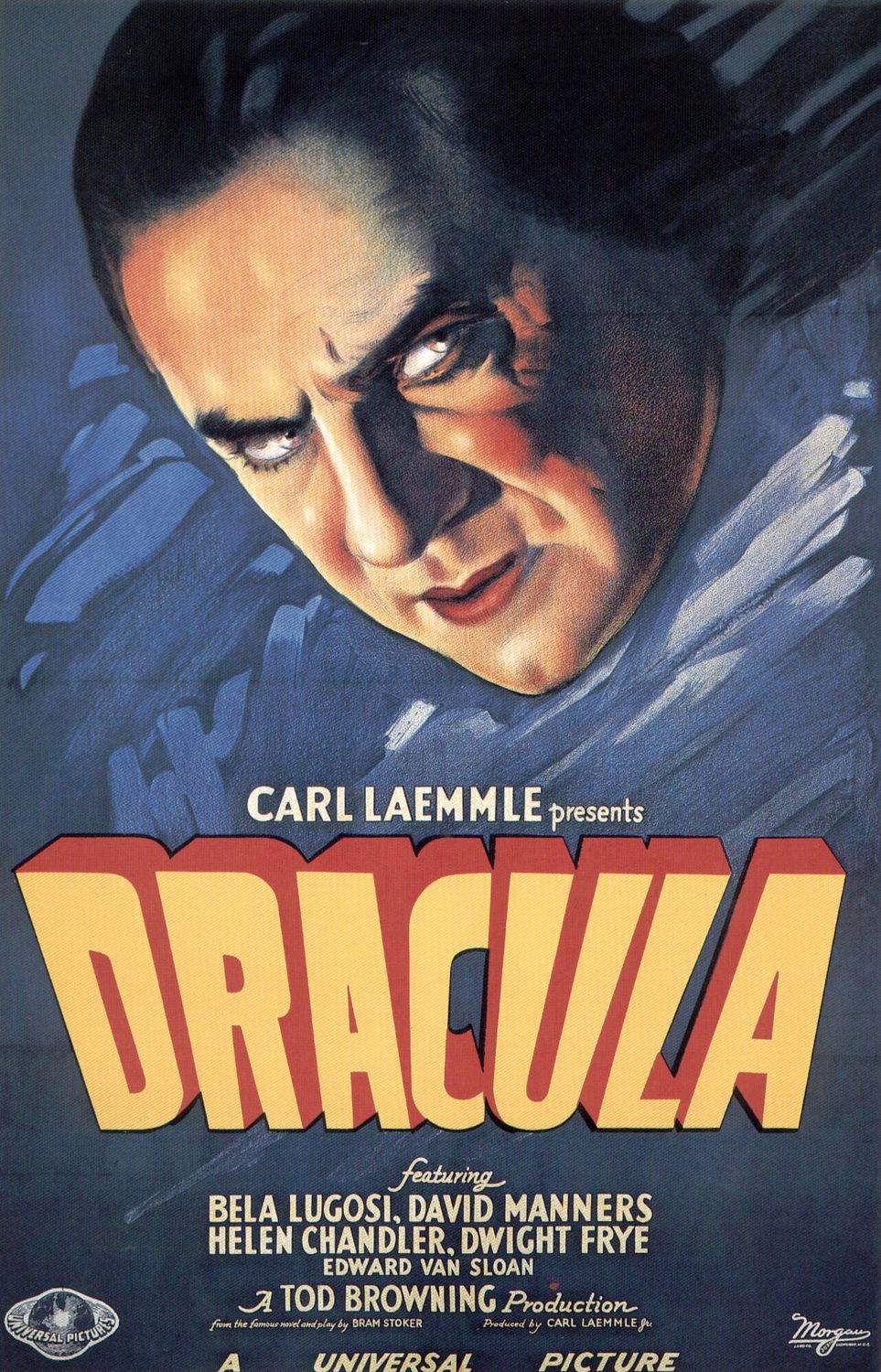
No, I Haven’t Seen It Until Now: ‘Dracula’ (1931)

Dracula 1931 poster

While at a party celebrating the DVD, Blu-ray and Digital release of “Ouija,” I was one of several people who won the DVD box set of “Universal Classic Monsters,” a complete 30-film collection of all the movies from Universal Pictures’ Monster Universe which played in theaters from 1931 to 1956. These movies included such iconic characters as Frankenstein, The Wolf Man, The Mummy, The Invisible Man, Phantom of the Opera, and Creature from the Black Lagoon. With the occasion of Halloween rapidly approaching, I decided to sit down and watch the 1931 English-language version of “Dracula.” While I am familiar about Count Dracula and how he says “I want to suck your blood” on what seems like a regular basis, this marks the first time I have taken the time to sit down and watch this particular movie.

Having grown in a time of horror movies like “Jaws,” Halloween,” “Friday the 13th,” and “A Nightmare on Elm Street,” I wondered how this would affect my enjoyment of this horror classic which was first released back in 1931. Watching “Dracula” today made me wonder if I would react to it in disdain, and I came out of it wondering how I would have reacted to it were I alive and watched it when it first came out. Nevertheless, I can see why this version of “Dracula” remains such an unforgettable cinematic classic. While certain aspects of its production seem cheap by today’s standards (we all know it took a fishing pole to make the bat fly), time has been kinder to this version than I expected.

“Dracula” begins with a group of people riding in a stagecoach to a local village, and among them is Renfield (Dwight Frye), a solicitor on his way to Transylvania to visit Count Dracula for business purposes. The mention of Dracula’s name, however, has everyone reacting with wide-eyed expressions (and we are talking really wide) as his reputation for sucking blood is never in doubt, and the townspeople beg Renfield to reconsider going to his residence. But unlike some stupid kid in an 80’s horror flick eager to tempt fate because he thinks he is invincible, Renfield has actual business to do with Dracula, so it’s understandable how the man will not be deterred from meeting with the man everyone rightfully believes is a vampire. Of course, by the time Renfield discovers this, it is too late.

The first thing I want to talk about in regards to this particular version of “Dracula” is the man who plays Bram Stoker’s iconic character, Bela Lugosi. Before watching this movie, I was more familiar with what happened to Lugosi’s career after he played Dracula than what came before it. A victim of typecasting, he would later descend into oblivion to where he appeared in Ed Wood’s infamous films, “Plan 9 From Outer Space” being the most memorable, and people in Hollywood had long since assumed he had died. Lugosi would be memorialized years later by the late Martin Landau who played him in Tim Burton’s delightful and thoughtful biopic “Ed Wood.”

But seeing him here made me realized just how perfectly cast Lugosi was why he remained forever typecast as a result. From his first appearance, Lugosi is an insidiously frightening presence as all he has to do is stare in the distance to give you an idea of how threatening he can be if you dare cross him. When he claims his first onscreen victim, he simply waves his arm to let his three undead wives know this one is his to turn. When it comes to movies, this is an example of showing power as the character doesn’t need words to show how commanding they are.

Lugosi is wonderfully mesmerizing throughout “Dracula” as he just needs to give off a look with his eyes to let you know what is going on in his obsessive mind. Every physical step he takes is tinged with a sheer menace, and the actor also benefits from the wonderful cinematography by Karl Freund, whom many consider an uncredited director on this film. When he tells a character to “come here,” the power in his voice more than suggests you should take his order very, very seriously as he doesn’t need any additional dialogue from David Mamet or Aaron Sorkin.

It should be noted how when this film was made, Hollywood had just emerged from the era of silent movies.  As a result, the acting is more emotive than the kind we often see in movies today. The transition from silent films to talkies was not without its bumps, so the actors we see here are still used to a process of trying to get things across to an audience by acting out emotions instead of inhabiting their characters. Still, I did get a kick out of Dwight Frye’s performance as Renfield as he is clearly having a blast playing an infinitely possessed human being whose suffering, caused by a vampire’s bite, comes close to equaling Nicolas Cage’s present-day theatrics.

“Dracula” was directed by Tod Browning, a filmmaker who these days is better known for his 1932 cult classic, “Freaks,” one of the movies which is impossible to erase from the mind once you have seen it. I really liked how he used silence to the film’s advantage instead of giving us a music score. The tension is still taut as he follows Dracula’s every step, and this is a vampire who moves ever so gracefully because he doesn’t have to move quickly for anybody.

There was a score composed for the film by Philip Glass in 1998 and performed by Kronos Quartet, and you can tell it’s a Philip Glass score right from the start. It suits “Dracula” well, but I enjoyed the film more without it.

If there is anything disappointing for me about “Dracula,” it was the ending. Now this is largely the result of me being spoiled by countless slasher movies from the 80’s, but I think things could have been handled in a far more spectacular fashion than just driving a stake into a character’s heart and the happy couple running off together. It seems such like am abrupt ending to a classic motion picture, but then again, I am watching it close to a hundred years after its release.

There are many other versions of “Dracula” I need to watch now as I am eager to see how this character has evolved cinematically from one generation to the next. Browning’s 1931 version is a good one to start with, and lord knows there are also many other classic horror movies I need to watch. In order to better understand and appreciate the present, we at times have to go back to the past to discover how things got started.

* * * ½ out of * * * *

‘Paranormal Activity 4’ Sees the Franchise Running Out of Clever Ideas

Paranormal Activity 4 movie poster

With “Paranormal Activity 4,” the law of diminishing returns has finally caught up with this found footage franchise. Granted, all the films have revolved around the same old story of people taping themselves and their homes while they sleep so they can see what goes bump in the night, but this same old story has now become all too familiar for me. This sequel does have its moments, appealing characters and some clever twists, but the scares are a hell of a lot easier to spot this time around.

Whereas “Paranormal Activity 2 & 3” revolved around the events of the original film or came before them, “Paranormal Activity 4” marks the franchise’s first real sequel. Moving us forward to the year 2011, 5 years after the events in Parts 1 and 2, the story takes place in a small neighborhood in Nevada where the very pretty Alex (Kathryn Newton) lives with her parents, who are having marital difficulties, and her younger brother Wyatt (Aiden Lovekamp). Alex appears to be pretty happy for a teenager, and she has a cool boyfriend in Ben (Matt Shively) with whom she confides in every night via webcam.

But, of course, things are destined to get weird as they always do in a “Paranormal Activity” movie, and the weirdness begins with the appearance of a young boy named Robbie (Brady Allen) who appears one night in Alex’s tree house. Robbie is the son of their neighbor who lives across the street, and his mother has just been hospitalized for some unknown reason. As a result, he is sent to stay over with Alex’s family until she recuperates. After that, it doesn’t take long for those ominous sounds and loud thumping noises to start haunting this suburban household.

With each “Paranormal Activity” movie, the filmmakers have managed to use different forms of technology to tell the story like video cameras and surveillance equipment. In this fourth movie, they use several: laptop computer cameras, Kinect, a MacBook, smart phones and a Canon XA10. The Kinect proves to be especially interesting as it uses some kind of scanning system which puts out these green lights to map the game player’s physical environment. Those same green lights end up capturing sights not easily visible to the human eye. There’s also the automated voice which keeps saying “FRONT DOOR OPEN.” When you hear that, you know things are going to get bad.

I really liked the way the younger characters were drawn out here. Kathryn Newton is especially appealing as her character of Alex shows a maturity her mother and father seriously lack. I also enjoyed Matt Shively’s performance as Ben, and not just because he shares the same first name as me. The boyfriends in these “Paranormal Activity” movies threaten to be seriously annoying at times, but Ben has just the right amount of cool to keep him interesting. Furthermore, Alex and Ben are wearing Beastie Boys and Metallica t-shirts, so you have to applaud their taste in music!

As for Alex’s parents, I spent most of this movie wanting to smack them in their faces. They are made out to be like some generic bickering couple, and they keep making foolish assumptions and decisions to where you just want to yell at them. When that chandelier comes crashing down in front of Alex (and I know I’m not spoiling anything because we’ve all seen this in the trailers), you’d think they would be a little more suspicious about this strange kid they let stay in their house. It’s like some demonic force has to come out of the ground and throw fireballs at this couple before they finally get the picture. This is nothing against Alexondra Lee and the late Stephen Dunham (who passed away from a heart attack in September 2012) as they do their best with the material they’re given, but the “Paranormal Activity” movies have succeeded in giving us characters who feel real, and these two feel like cardboard cutouts from other horror flicks.

Directors Henry Joost and Ariel Schulman, who directed “Paranormal Activity 3,” return to helm this fourth entry. You can feel them struggling to keep the material fresh here, but the series is now becoming more formulaic than ever before, and things become frustratingly predictable as a result. They also rely on cheap scares too much this time around. This was a problem in the previous film as well, but here they just go overboard to a very annoying extent.

“Paranormal Activity 4” does get better as it goes along as things become more eerie, leading to a climax which feels predestined but still makes you jump out of your seat. There is a lot of mystery still left in this series as the whereabouts of Katie and Hunter remain hard to pin down, and this entry is not about to answer all the questions we have. As for the next “Paranormal Activity” movie, stay through the end credits and you will get a glimpse of what it may be.

But as of now, this franchise is running on fumes. The fact these “Paranormal Activity” movies have lasted this long is a testament to our collective fears of those weird sounds we hear late at night when all our electronic distractions have been turned off. However, “Paranormal Activity 4” proves to be a lot less viscerally frightening than its predecessors as we’ve become all too familiar with how these movies work. For the next one, Blumhouse Productions and Paramount Pictures really need to shake things up, and I don’t mean in the way they handle the “demand to see it first” crap. I can’t believe people are still buying that malarkey.

* * ½ out of * * * *