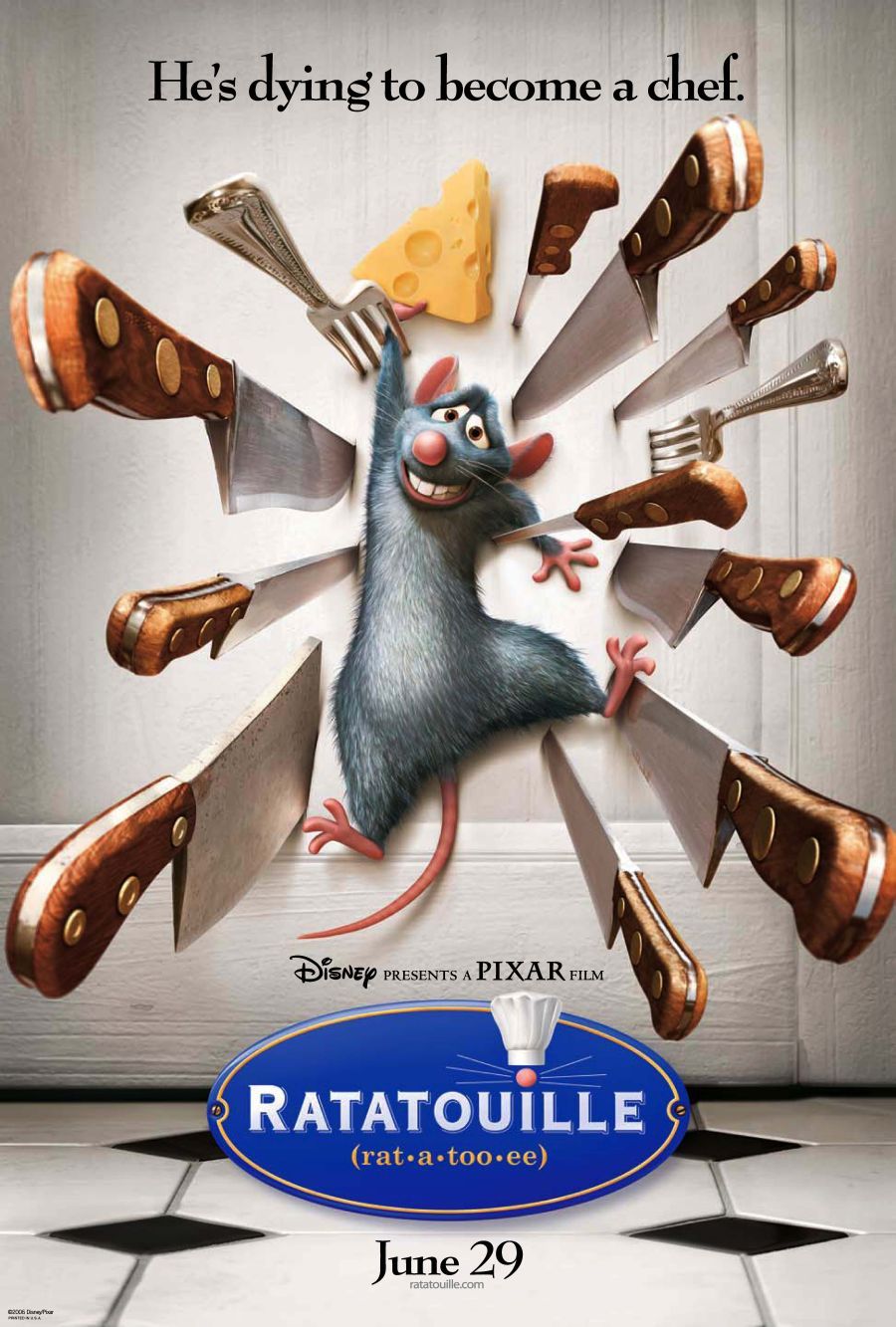
“Ratatouille” was written and directed by Brad Bird who also directed another Pixar movie, “The Incredibles,” which was one of the few movies made which actually lived up to its name. With this “Ratatouille,” we follow the story of Remy, a rat who ends up getting separated from his family and is washed away to where he ends up in Paris. The moment where he arrives and sees Paris is a truly brilliant scene of amazing imagery, and Pixar continues to outdo themselves in terms of this. The look of Paris is astonishing, and it had me wondering how the hell they managed to put this together. The wonder of movies still exists after all these years of cynical blockbusters, and I am ever so thankful for that!
Anyway, Remy ends up sneaking into a restaurant named after a famous cook, Auguste Gusteau (voiced by Brad Garrett), who has written a book entitled “Anybody Can Cook.” From there, he befriends a new employee named Linguini (voiced by Lou Ramano) who cannot cook to save his life. Through Linguini, Remy creates a system where he can make him cook the way he wants by pulling at his hair like he is a marionette while remaining hidden inside his hat.
Along the way, he infuriates the head chef of the restaurant who is busy selling off Gusteau’s name and likeness through frozen burritos which offers him the promise of becoming very wealthy. Linguini also meets Colette, the only female chef in the restaurant who makes it clear she is here to stay. All the other rats help Remy in a way which, if the restaurant patrons realized, would have had them running out of there at a relentless pace.
“Ratatouille” is filled with wonderful vocal characterizations which did not immediately have me thinking about the people who did them. At the time this movie was release, I was not familiar with either Patton Oswalt or Lou Romano who voiced Remy and Linguini. Both are very memorable characters who stand out among many others in animated movies. Remy himself is a genius creation who just might make you think twice about rat traps and poison. I am very tempted to go out right now and get a stuffed animal version of the character, and this is in large part thanks to Oswalt’s very enthusiastic performance.
For a while, I thought that Remy’s father Django was voiced by Jason Alexander. However, it turns out Brian Dennehy voiced this character, and he is wonderful in giving Django different layers and realizations to work with. The biggest surprise for me though was learning who voiced Colette Tatou, the restaurant’s only female chef – Janeane Garofalo. I didn’t even recognize Garofalo’s voice and thought it was Elizabeth Pena doing it with a very realistic French accent! Collette does look a bit like the character Pena voiced in “The Incredibles.” All the same, Garofalo does terrific work here, and it is so nice to see her doing something other than joking about her period.
The one voice I did recognize was Peter O’Toole’s who plays perhaps the harshest restaurant critic ever to walk the face of the earth, Anton Ego (a very symbolic name actually). His character becomes quite pivotal to the movie’s climax as the restaurant is forced to come up with a spectacular dish which will keep Mr. Ego from savaging the restaurant and its staff in a review.
Pixar continues their winning streak of great movies. Even if you were disappointed by “Cars” which really wasn’t bad, it was proof how even their weakest movies put so many other Hollywood movies to shame. They are to me what the Jim Henson’s Muppets were to me when I was a kid, creators of projects which appealed simultaneously to children and adults.
“Tomorrowland” is to Brad Bird as “Interstellar” was to Christopher Nolan, an opportunity for a well-regarded filmmaker to wear their heart on their sleeve and give us a motion picture which aims to inspire and lift us up from the cynical worldview we have grown accustomed to for far too long. But whereas Nolan found success with “Interstellar,” Bird comes up short with “Tomorrowland” as his love letter to all the dreamers out there becomes undone by a thin plot lacking in narrative drive.
Britt Robertson stars as Casey Newton, a highly optimistic and tech savvy teenager who lives in Cape Canaveral, Florida and gets into trouble while trying to save a launch pad from being demolished. In the process, she comes into contact with a “T” pin which takes her to a futuristic place where imagination is infinite and possibilities for a better world are endless. When the pin suddenly loses the power to take her to that place, she seeks out Frank Walker (George Clooney), an inventor who showed a lot of promise while living in Tomorrowland but was later banished from there when his work started to frighten people off. Together, they find their way back to this wondrous place and work to save it before it is forever destroyed.
Now I love how Bird has made a movie which encourages all the dreamers out there to keep on dreaming. Despite how dark the world can seem at times, his encouragement to those who want to use their imagination to make it a better place is commendable. Many will snicker at this optimism, but their snickering will end up saying more about them than it will Bird.
Having said that, “Tomorrowland” isn’t entirely sure of what it wants to say or how to say it, and it takes forever for the movie to get to where it needs to go. By the time we do make it back to the futuristic place, the movie has devolved into a typical good versus evil plot which robs it of any uniqueness it could ever hope to have. In this kind of movie, we know good will triumph over evil, so the stakes never feel very high as a result.
It’s a real shame because Bird gets things off to a fantastic start with the movie’s prologue which introduces us to Frank Waller when he was a young boy who gets invited into the magical world of Tomorrowland, and our imaginations are quickly aroused by what we see. Watching Frank discover a place that exceeded his wildest dreams had me thinking about when I was a child and where my imagination often took me, and it was a time where anything seemed possible. Now while we find ourselves trading fantasy for reality as we get older, I like to think I have not lost any childlike innocence after all these years and watching this part of “Tomorrowland” made me realize I have not.
But after the prologue is over, “Tomorrowland quickly becomes a film unsure of what tone it wants to set, and it devolves into a typical story of an optimistic teenager trying to get a broken-down adult to reignite their potential before everything goes to hell. Furthermore, we are introduced to a number of evil robots who aim to take Casey out with extreme prejudice, but it feels like they belong in a different movie. In the process of trying to balance out the darker elements with the lighter ones, “Tomorrowland” becomes a total mess.
I felt sorry for Clooney as he is forced to play a character who has long since become embittered about the sour lemons life has handed him. As a result, he gives one of his weakest performances to date as he is forced to take Frank Walker from a state of disbelief to one of true belief in a very unbelievable way. Clooney remains one of the most dependable actors working in movies, and if he can’t make a character like this work on the big screen then no one can.
“Tomorrowland” also has a scene with Clooney and other actors travelling to another dimension in a rocket, and this is bound to bring back bad memories “Batman & Robin” which had the Oscar-winning actor in a similar situation. I guess some bad movie memories can never be permanently erased.
Robertson makes for an appealing heroine as Casey, and she is one of the reasons why “Tomorrowland” works to a certain extent. Even as the movie suffers through its various flaws, she keeps us engaged as we root for her character to triumph over those who are far too quick to crush the wonder she has about life. Without her, this movie could have been worse.
When we do get to the end of “Tomorrowland,” the whole venture ends up feeling incomplete as the writers appear to be uncertain as to how to tie everything up. You could say the ending gives hope to all the dreamers out there, but it frustrates more than anything else as “Tomorrowland” feels like it ended sooner than it should have. Judging from this movie’s opening box office weekend, the odds of it getting a sequel are pretty bad.
It really sucks to give a movie like this a bad review. “Tomorrowland” has its heart in the right place and has some wonderful images, but its story seems stuck in stasis and lacks the imagination to really inspire us. Bird remains a gifted filmmaker and has directed a number of highly entertaining movies like “The Iron Giant,” “The Incredibles,” “Ratatouille” and “Mission Impossible: Ghost Protocol.” “Tomorrowland” marks his first directorial misfire, but I have no doubt he will be back on top before we know it. It’s just a shame he made a movie about wide-eyed optimism which was constructed in a half-hearted way.
I would also like to add this movie’s commercial failure made Disney cancel a third “Tron” movie. Blasphemy!
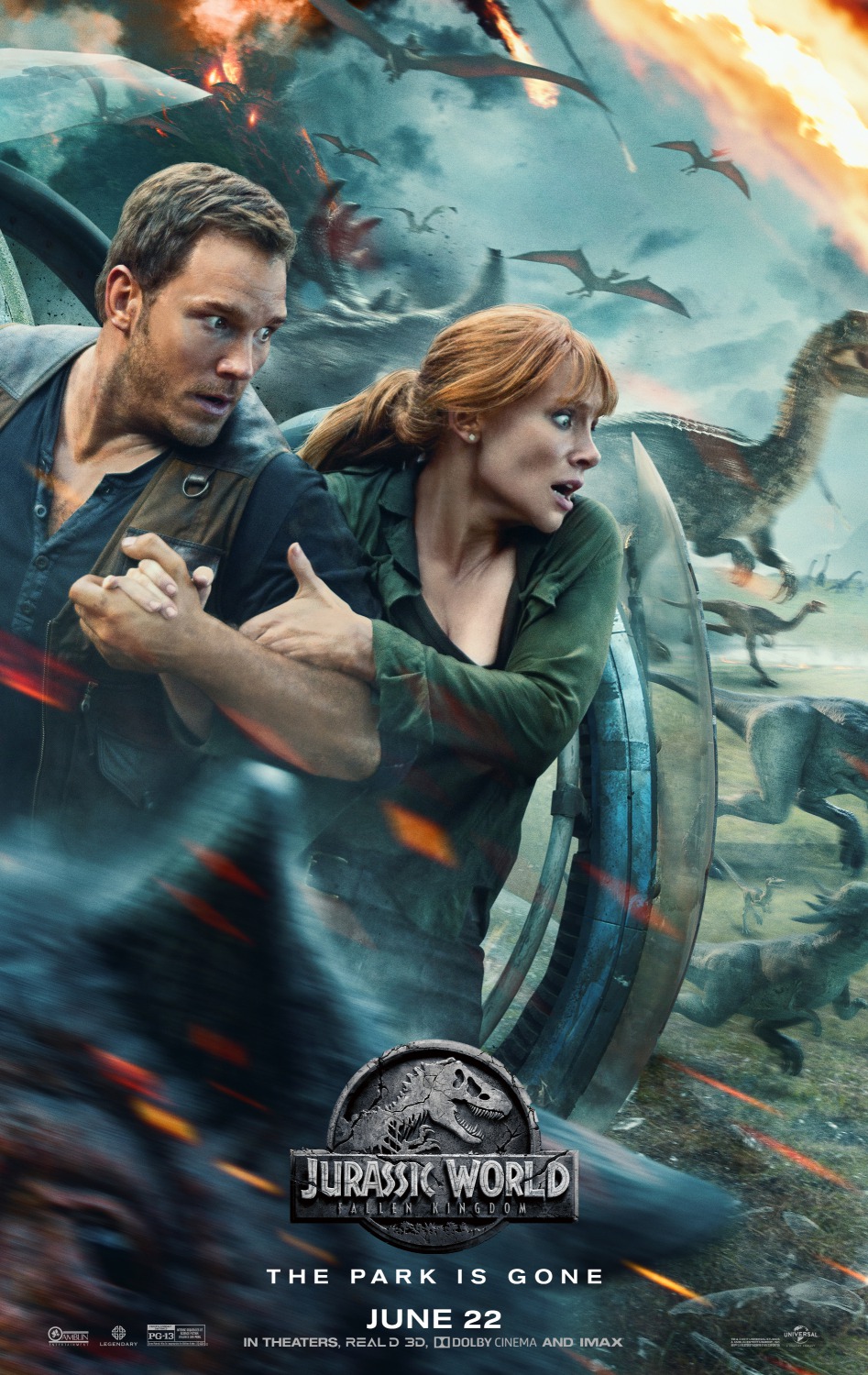
Remember the scene in “The Lost World: Jurassic Park” where John Hammond told Ian Malcolm they were not going to make the same mistakes, and Malcolm quickly replied they were going to be making new ones? Well, “Jurassic World: Fallen Kingdom” doesn’t make new mistakes and instead repeats the old ones as the humans once again try to save the once extinct species in way we have all seen before. Yes, the visual effects are fantastic, but everything else feels astonishingly banal as nothing new is brought to the franchise. As for the storyline, it simply shows history repeating itself, something we see happen in the real world more often than not.
Three years have passed since the events of “Jurassic World,” and the theme park has been left in ruins. Now an active volcano threatens to destroy what’s left of the dinosaurs, and those in the government debate whether it is worth the trouble to save the species from becoming extinct again. Ian Malcolm (Jeff Goldblum) argues it would be best for the volcano to destroy the dinosaurs as he sees this as nature’s way of correcting the mistake Hammond made in cloning them years ago. Meanwhile, Claire Dearing (Bryce Dallas Howard) has formed the Dinosaur Protection Group in an effort to save them. When the U.S. senators do not come through for her, she finds a savior in Sir Benjamin Lockwood (James Cromwell), Hammond’s partner in developing the technology to clone dinosaurs, who is intent on moving the dinosaurs to an island where they will have zero interaction with humans. Of course, this also means she will have to acquire the services of her ex-boyfriend, Owen Grady (Chris Pratt), in the effort to rescue them.
Okay, the “Jurassic” movies have never been heavy on complex characters as the attention is focused mostly on the dinosaurs. The reasoning is understandable, but I have grown weary of letting the filmmakers get away with weak characterizations which are always upstaged by the special effects. Howard and Pratt are fun to watch in anything the appear in, but their talents are wasted as their characters are relegated to the romantic will-they-or-won’t-they scenario which will all know will end with them kissing passionately as they can only fight their intense feelings of love for so long.
The screenplay by Colin Trevorrow and Derek Connolly proves to be “Fallen Kingdom’s” biggest stumbling block as it takes the story of “The Lost World” and follows it to the letter to where the twists and turns the story takes are not the least bit surprising. As I’m sure you have derived from the trailers, the plans to move the dinosaurs to another island are thwarted by a team of mercenaries led by Ken Wheatley (Ted Levine) and Lockwood’s slimy right-hand man Eli Mills (Rafe Spall) who looks to sell the dinosaurs to the highest bidders. You would think after all these movies humans would realize they can never fully control what they have created, but when dollar signs are involved, common sense and morality always take a backseat to greed.
Actually, some characters here had interesting potential which the filmmakers really could have built on. Eli Mills, thanks in large part to Rafe Spall, wins the audience over as he does Claire when he tells her of the plan to save the dinosaurs, but he is later revealed to be a slimy bastard as he looks to profit off them instead. Spall has described Eli as being a victim of high ambitions and of allowing himself to believe he is doing the right thing. He has been entrusted with securing the financial future of the Lockwood estate, and he feels this is the only way he can do it. Still, the character eventually becomes a one-dimensional baddie whom the audience is made to hate, and it got to where I kept waiting for him to say, “Hey look at me! I’m dino-meat!”
The same goes with Gunnar Eversol who is played by Toby Jones. Gunnar is the auctioneer who sells off the dinosaurs, and Jones has compared him to a rogue arms dealer who is morally neutral about the work he is doing. This could have made for an especially fascinating character, but alas, Jones is given only so much to do here as Gunnar is designed to be an appetizer for the “Jurassic” franchise’s newest dinosaur, the Indoraptor. Considering how morally neutral Gunnar is, it would have made more sense for him to take his fate as though he saw it coming instead of screaming like he doesn’t deserve it.
B.D. Wong returns again as Dr. Henry Wu, the chief geneticist of the Jurassic theme parks. Wong plays Henry as a man whose love for science is as big as his own ego, and he is a welcome presence in this deeply flawed sequel. But like the other characters, Henry is given short-shrift to where he just ends up acting like a one-dimensional jerk.
There are some new characters added to the mix such as Dr. Zia Rodriguez, a Marine veteran and a paleo veterinarian, played by Daniella Pineda. Pineda makes Zia into a quirky presence throughout, but the character feels half-realized never fully human. As for Justice Smith, his character of hacker and systems analyst Franklin Webb is this sequel’s most annoying as runs all over the place screaming as if we couldn’t already tell how unprepared he is to be around dinosaurs. I kept wanting to slap Franklin in the face and tell him to grow a pair as his whining made this sequel even more frustrating than it already was.
It is great to see Jeff Goldblum back as Ian Malcolm, one of the most popular and fascinating characters in the “Jurassic” franchise, but his appearance here is a mere cameo as he serves to bookend “Fallen Kingdom.” This is a real shame as the speeches he gives offers us a glimpse at what this sequel could have been: a look at humankind’s abuse of various powers, and at the possibility of if and how humanity and dinosaurs can co-exist. As he makes clear how Jurassic World is no longer the name of a theme park, but of the times humanity now lives in, we are reminded of the opportunities this sequel lost out on exploring.
And yes, there is the little child character named Maisie Lockwood played by Isabella Sermon who constantly sees through the deceptions of the adults and manages to outwit the dinosaurs chasing her. Of course, seeing her being smarter than the adults quickly becomes exasperating, and that’s even though this kind of character serves to remind adults of why they need to listen to children more often. Remember the child from Terry Gilliam’s “Time Bandits” who told his parents “don’t touch it, it’s evil” and they did anyway? Well, you get the picture.
I couldn’t help but walk into “Jurassic World: Fallen Kingdom” with high expectations as it was directed by J.A. Bayona, the Spanish film director who gave us “The Orphanage,” “The Impossible” and “A Monster Calls.” “The Impossible” had an especially profound impact on me as he depicted the devastation of 2004 Indian Ocean tsunami in a way to where I felt I experienced and survived it along with the characters. I guess I was hoping he would bring that same cinematic power to this long-running franchise, but his efforts do little to improve this sequel’s poor story and screenplay.
For what it’s worth, Bayona does give us some memorable moments. The scene where the characters observe one of the vegan dinosaurs crying out to be rescued as the volcano lays waste to Isla Nublar is truly heartbreaking, and the moment where the Indoraptor stalks the helpless Maisie in a sequence which evokes “Nosferatu” as the dinosaur stretches his creepy claws out is wonderfully chilling. I also loved how Bayona started this movie off in near silence as it opens in an underwater environment. It is times like this where I am reminded of how silence is golden, and I was hoping he would use it to his advantage. But as many sequels go, this one is noisy as hell and is at times undone by Michael Giacchino’s overambitious score.
“Jurassic World: Fallen Kingdom” is not this franchise’s worst installment (“Jurassic Park III” still holds that honor), but it is pretty close. “Jurassic World” managed to do the impossible which was bring back much of the awe and wonder from Spielberg’s 1993 classic, but this one finds those things sorely missing to where I wondered if there was ever enough of a reason to make another sequel other than money. What we get here is the same old thing, and the results are depressing as its storyline points out how humans will keep making the same mistakes over and over again as they refuse to learn from history. It left me wondering who would be better off here, the humans or the dinosaurs. As I left the theater, I kept thinking about what Ellen Ripley said in “Aliens:”
“You know, Burke, I don’t know which species is worse. You don’t see them fucking each other over for a goddamn percentage.”
Ripley had a really good point there, and this line was also proof of how James Cameron could come up with good dialogue when he put his mind to it.
I still vividly remember when “Jurassic Park” came out in 1993. I was in high school back then, and many of my friends got to see it before I did. Their reactions always stayed with me as they described how thrilling a movie it was. One guy kept holding his arm intensely and kept saying, “It steamed the glass!” I would later find out what he meant when I saw the movie a few days later, and it was quite the thrill ride as well as groundbreaking in terms of special effects. Steven Spielberg delivered us the kind of blockbuster he had been delivering to us since he made “Jaws” all those years ago, one which is thrilling and fills you with wonder and awe.
It was later followed by “The Lost World: Jurassic Park” which was more of the same but fun if you could get past the fact that Spielberg pretty much directed in on auto pilot. As for “Jurassic Park III,” a better title for it was “300 special effects in search of a screenplay.” Now we have “Jurassic World,” the latest sequel in this franchise which arrives over a decade after the previous installment. While there’s little chance in recapturing the wonder of the original, this sequel still proves to be a fun time at the movies.
Intended as a direct sequel to “Jurassic Park,” “Jurassic World “shows us how the island of Isla Nublar has long since become an infinitely popular theme park. John Hammond’s dream is now a reality, and guests are treated to a variety of shows and rides which depict these once extinct creatures in all their incredible glory. But now tourists have long since gotten used to dinosaurs being brought back from extinction, and now they want something more intense and scary. As a character notes, the park’s attendance level spikes when a new dinosaur is unveiled, and this makes the park operators create one which ends up scaring not just the children but their parents as well. And just as before, the results prove to be disastrous as the road to hell is always paved with good intentions and a misguided quest for profit.
What I liked most about “Jurassic World” is how its screenplay acknowledges how tired and worn out people are by watching dinosaurs in this day and age. This is exactly how I felt after watching “Jurassic Park III” as what was once thrilling and magic had since become depressingly routine. As a result, the script has a subversive feel as it ponders our need for the same level excitement we had in the past, and of how desperate we are to relive or top it. Now on one hand this sequel has a lot of things going for it as the filmmakers explore the desires of both the public and the corporate world which continues to be blinded by dollar signs at the expense of everything else. This wouldn’t be a theme park without a Starbucks or a Jimmy Buffet Margaritaville Restaurant in it, and both are on display here. Heck, even Buffet makes a cameo carrying a couple of margaritas, but when the dinosaurs start wreaking havoc, it’s clear he won’t have time to look for his lost shaker of salt.
On the other hand, the movie has its characters making incredibly dumb decisions which will have audience members scratching their heads in disbelief. Then again, this wouldn’t be much of a movie if everyone used their common sense on a regular basis. Those of you who have watched “Jurassic Park” over a thousand times will be instantly reminded of famous dialogue like when Ian Malcolm talked about how scientists were so preoccupied with whether or not they could create dinosaurs to where they never stopped to think if they should. Then there’s Ellie Sattler who made it clear to Hammond he will never have control because that’s the illusion he was trying to avoid.
Then again, the one line which stands out most is when Hammond said how he “spared no expense.” When we get our first glimpse of what has become of Isla Nublar, we are reminded of what Hammond said as it has accommodations your local Motel 6 can only dream of offering guests. They may leave the light on for you, but they can’t give you amazing vistas or prehistoric creatures to look at.
Actually, one of the best moments in “Jurassic World” comes from B.D. Wong who reprises his role of Dr. Henry Wu from the first movie. When asked why he and the other scientists created the new dinosaur, Indominus Rex, Henry responds, “Monster is a relative term. To a canary, a cat is a monster. We’re just used to being the cat.”
In terms of the human element, “Jurassic World” does suffer a bit. Then again, these movies have never been about complex characters as much as they have been about dinosaurs. Still, one of the best things about this long-awaited sequel is Chris Pratt who lends his “Guardians of the Galaxy” charisma to his role as Owen Grady, a former military officer and velociraptor trainer. Pratt adds the heroic element this movie demands, and his comedic skills are put to good use.
Another terrific performance comes from Bryce Dallas Howard as the park’s operations manager, Claire Dearing. It’s great to watch Howard take Claire from being a work obsessed park employee to a badass heroine who ventures out into the danger zone to save her two nephews before they become the dinosaurs’ main course.
It’s also a kick to see Vincent D’Onofrio here as the antagonist Vic Hoskins, head of security operations for InGen. The actor manages to take what could have been a simple one-dimensional villain and makes him a lot more interesting. You can see in his eyes how he has a secret plan for the dinosaurs which has yet to be revealed to our heroes. Of course, we all know how D’Onofrio’s character is going to die, and it is not pretty.
Spielberg once again stayed in the executive producer’s chair for this sequel, and the director is Colin Trevorrow who is a very lucky filmmaker as he went from directing a movie with a budget of $750,000 (“Safety Not Guaranteed”) to this $150 million summer blockbuster. While he is not able to fully recapture the wonder of “Jurassic Park,” he makes “Jurassic World” a solid piece of summer entertainment which brings out the kid in you. Trevorrow also creates moments which will have the audience cheering loudly, showing he is more than capable of giving us the kind of crowd pleasing movie we expect in the summertime.
“Jurassic World,” like “Mad Max: Fury Road,” was stuck in development hell for years before it finally came to fruition. For the most part it was worth the wait as it comes with a stronger story and screenplay than the last two “Jurassic” movies could ever hope to have. There’s plenty of great dinosaur fights, tourists getting terrified, and there are characters here worth rooting for. All in all, it does what a summer movie should do which is entertain you from beginning to end.
Of course, when you look more closely at the story, it illustrates how history keeps repeating itself when dollar signs get in the way. Once again humans deluded themselves into thinking they could control dinosaurs, and nature finds a way to prove them wrong. With “Jurassic World: Fallen Kingdom” about to be released, I imagine we will watch humans again trying to tame these prehistoric creatures, and their efforts will prove to be largely futile. Oh well, hopefully we’ll get another entertaining sequel in the process.
I was beginning to think Pixar had made one too many sequels to their biggest hits, but now we have “Incredibles 2” which brings writer and director Brad Bird back into the Pixar fold as he continues the fantastic adventures of Bob and Helen Parr who try to balance out their crime-fighting ways with raising three kids, each who has their own unique super powers they are ever so eager to use. It is no surprise how this sequel is not as fresh or as inventive as its predecessor, but I am thrilled to say “Incredibles 2” proves to be just as much fun as the original, and it is a blast from start to finish.
It has been 14 years since “The Incredibles” was unleashed on us, but “Incredibles 2” begins just mere seconds after it ended with the Parr family doing battle with the Underminer who lays waste to their town while robbing the Metroville bank. They manage to thwart the Underminer’s dastardly plans, but in the process they leave a tremendous amount of damage in their path. Despite their goodwill in preventing many citizens from getting hurt, the police do not even try to contain their fury at these supers to where they flat out tell them it would have been better to let the bad guy get away as the bank are insured. Hmm, it kind of makes you think how the story might just reflect the state of our society today…
While attempting to do the right thing, the Parrs forgot that, in spite of their victories, supers are still illegal and have long since been forced to adhere to their secret identities. With this latest incident, the family has been forced to say at a motel as their home was destroyed, and they are informed by government agent and friend Rick Dicker (Jonathan Banks) that the “Super Relocation” program is being shut down permanently. Bob and Helen now have two weeks to figure out what they can do to support their family before they find themselves homeless and out on the street.
Their savior comes in the form of Winston Deavor (Bob Odenkirk), a telecommunications tycoon who has been a big fan of superheroes since he was a child. Winston is intent on changing the public’s perception of supers with the help of his tech savvy sister Evelyn Deavor (Catherine Keener), and he chooses Helen to revive her superhero alter-ego of Elastigirl to make this happen. However, this leaves Bob, better known as Mr. Incredible, at a loss as he feels he should be the one to start things off, but Winston feels Elastigirl is a better choice as she does not leave the same path of destruction Mr. Incredible does on a regular basis. This ended up reminding me of what Al Powell told John McClane in “Die Hard 2” after McClane said he had a feeling about something:
“Ouch! When you get those feelings insurance companies start to go bankrupt!”
Seeing Helen/Elastigirl take center stage as the main superhero in “Incredibles 2” is a wonderful twist on the original when Bob/Mr. Incredible did his superhero thing while Helen stayed at home to look after the kids. With “Wonder Woman” having been a critical and commercial smash hit, lord knows we have been long overdue for female superheroes to take charge as this genre can no longer be considered a male dominated club. Holly Hunter returns to her role with great relish as she makes Helen/Elastigirl into a wonderfully realized human being who runs the gamut of emotions throughout, and the action sequences she is featured in puts those in so many live action movies rendered in this past year to utter shame.
It’s also great to have Craig T. Nelson back voicing Bob/Mr. Incredible, and hearing him here reminded me of the welcome presence he gave us in movies like “Poltergeist,” “All the Right Moves” and on the television series “Parenthood.” He does great work in making Bob’s heroic efforts in caring for his children by himself all the more palpable as he experiences sleep exhaustion any parent can relate to. Whether its desperately trying to understand how Dash’s teachers want him to do math in a completely different way from what he as taught or dealing with Violet’s descent into adolescence, Bob has more to deal with than any parent could ever expect, and having to handle so many real-life obstacles on your own has to be admired more than criticized.
This is Brad Bird’s first movie since “Tomorrowland” which proved to be a critical and commercial disappointment. After his phenomenal success with “The Incredibles,” “Ratatouille” and “Mission: Impossible – Ghost Protocol,” “Tomorrowland” was greeted with a lot of criticism to where it seemed like Bird lost his mojo, but every director has their failures, and we are always eager to see them make a comeback. With “Incredibles 2,” Bird shows us how quickly a filmmaker can recover from a cinematic failure as he raises the bar for the other movies to be released in the summer of 2018. When “The Incredibles” was released, the superhero genre was not at the same level of popularity it is at now, and this created challenges for any sequel destined to follow it. But Bird more than rose to the occasion as he has given us a sequel which is gloriously entertaining and full of heart.
I also have to say Jack Jack steals every scene he’s in here. Whereas we saw some of what Jack Jack was capable of in the first movie, his parents are only now discovering he has many superpowers. This makes Bob’s role as a parent more challenging as Jack Jack won’t stay still, refuses to fall asleep, and turns himself into an angry beast at the most inconvenient of moments. Even Lucius Best/Frozone (Samuel L. Jackson) cannot maintain his cool self once he sees how this baby boy can make himself invisible and not easily detectable.
And yes, Bird reprises his brilliant character of Edna Mode, fashion designer to the supers who, in her first appearance, reveals herself to be infinitely perturbed to learn Elastigirl is wearing a suit not designed by her. Still, she becomes Bob’s savior when upon agreeing to babysit Jack Jack so he can for once get a decent night’s sleep. The bond she forms with this baby boy is a hilarious sight to take in as he is quick to mimic Edna’s every move, and it makes her appearance all the more delightful to take in.
I got to see “Incredibles 2” with a nearly sold out audience, and it reminded me of how much fun it is to watch a movie with so many enthusiastic people. You could complain at length about how this sequel doesn’t have the freshness of the original, but it would just take away from the fun it contains. I had a great deal of fun watching this long-awaited motion picture, and the rest of the audience clearly felt the same all the way through the end credits. Pixar still succeeds in making movies for audiences young and old, and I eagerly await an “Incredibles 3.” Of course, it would be nice to see it come out in less than 14 years.
“World’s Greatest Dad,” which was written and directed by comedian Bobcat Goldthwait, was one of those small movies from 2009 which got released under the radar. It does star the late Robin Williams, but it never got the same level of marketing some of his others got that year, namely “Night at the Museum: Battle of the Smithsonian” and the god awful “Old Dogs.” But those who have a deep love for twisted humor should enjoy this one, and it features one Williams’ last great performances before he prematurely left the land of the living.
Along with Jody Hill’s “Observe and Report,” 2009 was quite a year for black comedies which managed to mine comedy out of the most sensitive of subjects. Williams plays Lance Clayton, a failed writer and poetry teacher who is the antithesis to Mr. Keating from “Dead Poet’s Society.” The class he teaches is not at all popular, and he is unable to inspire his students or make them seize the day. Lance dreams of publishing one of his novels and of becoming rich and successful, but this success has eluded him throughout his life. Of course, once you look at the kind of novels he writes, it becomes sadly understandable why he has received a truckload of rejection letters.
Lance is also a single father to his son Kyle, a kid who many would go out of their way to nickname the antichrist. Has there ever been a ruder, endlessly selfish, thoughtless, or verbally abusive son in the history of cinema? I’m sure there are, but none come to mind at the moment. Kyle makes Rhoda Penmark from “The Bad Seed” look like Teddy Ruxpin, and he’s what Macaulay Culkin’s character from “The Good Son” would have been like if the filmmakers weren’t subjected to the iron grip of Kit Culkin. Maybe these are extreme comparisons, but they seem to fit.
Then one day, Lance comes home to find his son Kyle dead in front of his computer after accidently strangling himself during the act of autoerotic asphyxiation. Knowing the way he died, once revealed to the public, will be humiliating for him and forever put a stain (no pun intended) on his son’s memory, Lance makes Kyle’s death look like a suicide and even writes a suicide which ends up having more emotional depth than anything which could possibly have come out of Kyle’s shallow little mind. Once the note is made public on a police website, everyone at school starts seeing Kyle in a different, albeit completely false, light, and Lance soon gets the fame and adoration he always dreamed of having, and this leads him to pen a fake memoir in his son’s name.
From this description, “World’s Greatest Dad” looks to travel down the same satirical roads as “Heathers” in how it depicts the absurd effect a person’s death can have on us, especially when it involves someone we hardly knew or truly despised. But as familiar as these roads are, the timing worked to this movie’s advantage as it was released not long after the death of Michael Jackson. With his sudden passing, all the crimes he was accused to have committed, but was never convicted of, quickly seemed to disappear as if they were all a fiction, and all we could think about was the great music and dance moves he left us. With Kyle, his sins seem to be miraculously absolved upon his death, and people look to his spirit as if he was some kind of cult hero. It’s all further proof of how we have tremendous respect for the dead, but none for the living, and this saying is amped up to such a crazy degree by Goldthwait.
But Goldthwait also has an even bigger target than our adulation for the not so dearly departed, and that’s the hollow pursuit of fame. We all know this filmmaker best from his days as a comedian, and his off-kilter voice had us laughing endlessly time after time. Seeing his work as a filmmaker should make you realize there is more to him than his talent for burning up furniture on “The Tonight Show.” Being as famous as he is, Goldthwait understands how fame can bring you in touch more with people who don’t have your best interests at heart as well as others who never have cared about you in the first place. It becomes easier to see why having all this adoration can make you feel even more than you ever have before.
Kyle’s death ends up turning just about everyone at school into an utter hypocrite. Many who would rather have beaten the leaving crap out of him suddenly come forth to say they were actually friends of his. Even the principal and school psychologist try to use Lance’s new-found fame to advance their career goals. Heck, a Goth chick becomes a Bruce Hornsby fan after Lance tells her Kyle was as well. Of course, we have already previously seen how Kyle hated Bruce Hornsby as much as Lance loved to listen to him, and the level of absurdity reaches epic heights once Lance publishes his son’s fake memoir, and the book deal which has long eluded him suddenly becomes a reality.
Williams’ performance in “World’s Greatest Dad” showed how great and subtle he was to where it wasn’t always necessary for him to act crazy 24/7. Aside from his concert tours, seeing him going all nuts in a movie eventually wore out its welcome, and at times it felt like he was desperate to make us laugh. But as Lance Clayton, Williams never overdoes anything, and he makes the character sympathetic even when we know what he is doing is very wrong.
Williams also captures the lonely life of an unpublished writer whose existence is filled to rim with endless rejection. Seeing another teacher getting an article published in the New Yorker, and on his very first try by the way, brings about a resentment in him he can’t quite hide. The “Good Will Hunting” actor captures Lance’s pain perfectly, and he grounds this character in a reality which grows increasingly bizarre as the movie goes on to where he never has to a single scene just for laughs.
But one actor who truly deserves a lot of credit is Daryl Sabara who plays Kyle. Perhaps best known for his work in “Spy Kids,” Sabara doesn’t even try to find any redeeming qualities in this astonishingly vulgar character because it feels like there are none to find. Building on the school bully he played in Rob Zombie’s “Halloween,” he fearlessly makes Kyle one of the most despicable teenage characters I have ever seen in motion pictures, and he even makes Danny Lawrence from “The Karate Kid” look like a real pushover. Sabara’s work here is fearless, and you have to give him big props for how far he was willing to go.
I also really liked the lovely Alexie Gilmore as Claire, the younger teacher who is more or less dating Lance while having eyes for another teacher, Mike (Henry Simmons from “NYPD Blue”). Her adorable personality and warm smiles make you almost completely forget how incredibly self-serving she is. Perhaps Claire doesn’t even know how selfish she is as she remains very coy about her relationship with Lance, but we cannot look past how selfish she is in her own desires. Despite all this, Gilmore still makes you root for her to be with Lance even after we realize this relationship is not in Lance’s best interest.
Many have complained about how “World’s Greatest Dad” ends with a number of issues unresolved, and this is true. Things are tied up a little too neatly, and you get the impression Goldthwait could have made this black comedy even blacker than it already is. Still, he shows a lot of guts taking on such touchy subject matter which other filmmakers would never dare deal with. As dark a comedy as this may seem, he also makes it a very moving one. Once you get past what you see on the surface, there’s actually quite a bit to take in. With this film, Goldthwait makes us understand how being alone can be nowhere as bad as being surrounded by people who make you feel lonelier than ever. Remember when Travis Bickle talked about being “God’s lonely man?” Well, I was reminded of that here.
Goldthwait previously directed several films before this one including “Shakes the Clown” and “Sleeping Dogs Lie,” and he would later give us an even darker and more biting black comedy with “God Bless America.” But aside from working in comedy, he also directed the found-footage horror movie “Willow Creek,” and he gave us one of the most unforgettable documentaries of recent years with “Call Me Lucky” about the late comedian Barry Crimmins. Like “World’s Greatest Dad,” they deserve a bigger audience than they have received to date, and they demonstrate how talented Goldthwait is behind the camera as well as in front of it.
Williams and Goldthwait were great friends off screen, and their appreciation for one another really showed here. “World’s Greatest Dad” may seem like an unusual movie to view on the very important occasion of Father’s Day, but you can only watch Gregory Pick in “To Kill a Mockingbird” so many times. Lance Clayton may not be the greatest dad as the title infers, but you never doubt the love he lies about him to the world to achieve fame and cover up what an infinite little prick he was in his short life. For those in the mood for a thoughtful black comedy, this one delivers.
Besides, is there any other movie out there featuring two teenage girls getting in a catfight over a Bruce Hornsby CD?
The original “Super Fly” directed by Gordon Parks Jr. was a notable blaxploitation classic as it provided many advancements for African-Americans in show business. Many accused it of glamourizing the drug business and of drug dealing in general, but others saw its glorification of drug dealers as a critique of the civil rights movement’s failure to provide better opportunities for black America. Either way, it gave a lot for audiences to talk about, and it provided us with one of the greatest soundtracks of all time courtesy of Curtis Mayfield.
Now it is 2018, and we have the remake of the 1972 movie which the filmmakers have entitled “Superfly” because, you know, why separate the two words? While it made more sense to separate the words “super” and “fly” decades ago, the rules of grammar continue to change for no special reason. But while the original movie still resonates with audiences more than 45 years after its release, I walked out of this remake constantly saying to myself, what was the point? Updating a classic of any kind is one thing, but this “Superfly” has little reason to exist as it offers us the same old tale of a gangster who is looking to go straight after spending too much time in a life of crime, and it offers nothing new or fresh to this story. While it is never boring, this movie will not have the same staying power of its predecessor.
The story remains the same, but this time the action has been moved from New York to Atlanta, Georgia (or ATL as the locals like to call it). Playing Youngblood Priest is Trevor Jackson, a 21-year-old actor, singer and dancer whose taste in clothes and cars is almost upstaged by his silky head of hair. Priest has it all, and this includes a luxurious house which has a beautiful view of downtown Atlanta, a pair of loving and tough-minded girlfriends in Georgia (Lex Scott Davis) and Cynthia (Andrea Londo), and he drives around town in a super-expensive Lexus car which, unlike Ron O’Neal’s 1971 Cadillac Eldorado, needs no customization. One look at it is enough to give you an idea of how well-off Priest is to where putting a spoiler on his Lexus would just look stupid.
Yes, Priest is a career criminal who is now more serious than ever about leaving the Atlanta drug scene, but no one is about to make things easy for his departure, and this is especially the case when one particular drug deal goes horribly awry. From there, those who have seen the original “Super Fly” will not be surprised at the turns the story takes, and those who have not watched it will marvel at how convoluted things become as the remake heads to its largely unsurprising climax.
The first thing I got to say about “Superfly” is when it comes to Jackson, I cannot help but feel he is too young to play Priest. Jackson is not bad as he exhibits a natural charisma and does have the necessary aura of coolness Priest requires, but he never struck me as a gangster who has led a rough and tumble life. Instead, he looks more like someone who just entered the life to where he has yet to show off any of the scars which come with it. Alex Tse’s screenplay does make mention of how Priest started out hustling at the tender age of 11, but even with this realization, Jackson still looks like an intern who just entered this life.
The other big problem is Jackson is constantly upstaged by his fellow actors, several of whomwould have been more believable as Priest. Chief among them is Michael K. Williams, best known for playing Omar on “The Wire,” who plays Scatter, Priest’s chief drug supplier and martial arts teacher. The scene in which they spar with one another is one of “Superfly’s” best moments as their physical moves match up with their mental ones to where you can see them working out scenarios in their heads about surviving into the future. Williams has the look of someone who has worked in the Atlanta drug trade for many years, and he makes Scatter look like someone with more of a reason to retire from this life than Priest does. I think Williams would have been a better fit for the role of Priest, but I guess considerations in regards to demographics were taken into consideration here above all else.
Jason Mitchell, who was fantastic as Easy-E in “Straight Outta Compton,” steals one scene after another as Priest’s right-hand man, Eddie. He keeps you guessing as to what Eddie’s next move will be to where you constantly wonder where his loyalties lie. While Eddie seems eternally dedicated to Priest, Mitchell constantly gives you the sense he may bolt to the other side as being a supporting player in this trade can be infinitely frustrating at times, and his high energy performance is one of “Superfly’s” great delights.
Lex Scott Davis makes Georgia into a formidable girlfriend for Priest to where he needs her more than she needs him. Andrea Londo provides “Superfly” with its most alluring presence as Cynthia, Priest’s other girlfriend. From start to finish, Londo inhabits Cynthia to where she cannot be mistaken for anything other than a fierce self-provider who is more than prepared to fight to the death for her loved ones. Outkast’s Big Boi shows up as Mayor Atkins, a man whose political influence knows no bounds until Priest puts some directly in his path. And I have to single out Jennifer Morrison for her wonderfully wicked performance as the infinitely corrupt Detective Mason. She doesn’t hesitate to show far off to the dark side Mason is as she makes clear how quick she is to bend the rule of the law to her hardened heart’s content, and I could never take my eyes off her whenever she appeared onscreen.
Directing “Superfly” is Julien Christian Lutz, better known by the name of Director X. Whether or not this name is meant to define some sort of political belief I will leave for him to explain. X is best known for making music videos with Drake, Kendrick Lamar and Rhianna among others, and his trademark involves tweaking the letterbox format to where he plays with our expectations with glee. He crafts a strong opening sequence in which we follow Priest into a nightclub whose membership is clearly restricted to a select few, and it reminded me of the scene in Martin Scorsese’s “Goodfellas” when Henry Hill and Karen entered the Copacabana nightclub through the back way. As we follow Priest into this particular nightclub, X makes it feel like an invitation into a side of life many of us never get to experience. After this sequence, everything ends up feeling inescapably routine.
There have been many gangster movies like “Scarface,” “Carlito’s Way,” “Sugar Hill” and “Light Sleeper” which depict their lives in a way which is endlessly fascinating even as the characters are looking to escape the life they were not necessarily aiming to enter. “Superfly,” however, feels stale in comparison as it offers nothing new or unique to the genre. As the movie went on, I kept wondering what the point was of remaking this blaxploitation classic. Many have said how the original glamourized crime and drug dealing, but this remake seems to do this to a shameless extent as the characters sport not only designer clothes, but designer guns which more lethal than the kind we usually see in movies. Whereas O’Neal’s Priest was moving through life the only way he knew how, Jackson’s Priest looks to live the life of the richest 1% in America as drug dealing provides what seems like an unrealistic route to it.
I cannot say I didn’t enjoy parts of “Superfly” as it is never the least bit boring, but this kind of movie has been played out too many times to where this remake serves no real purpose. After all these years, the most memorable thing to come out of the 1972 blaxploitation classic will be Curtis Mayfield’s soundtrack, and even the filmmakers behind the remake could not escape this fact as one of his songs is featured here. If there was a reason to update this story for the year 2018, this is never made apparent here. Besides, there is bigger gangster for Priest to deal with in this day and age, and his name is Donald Trump.
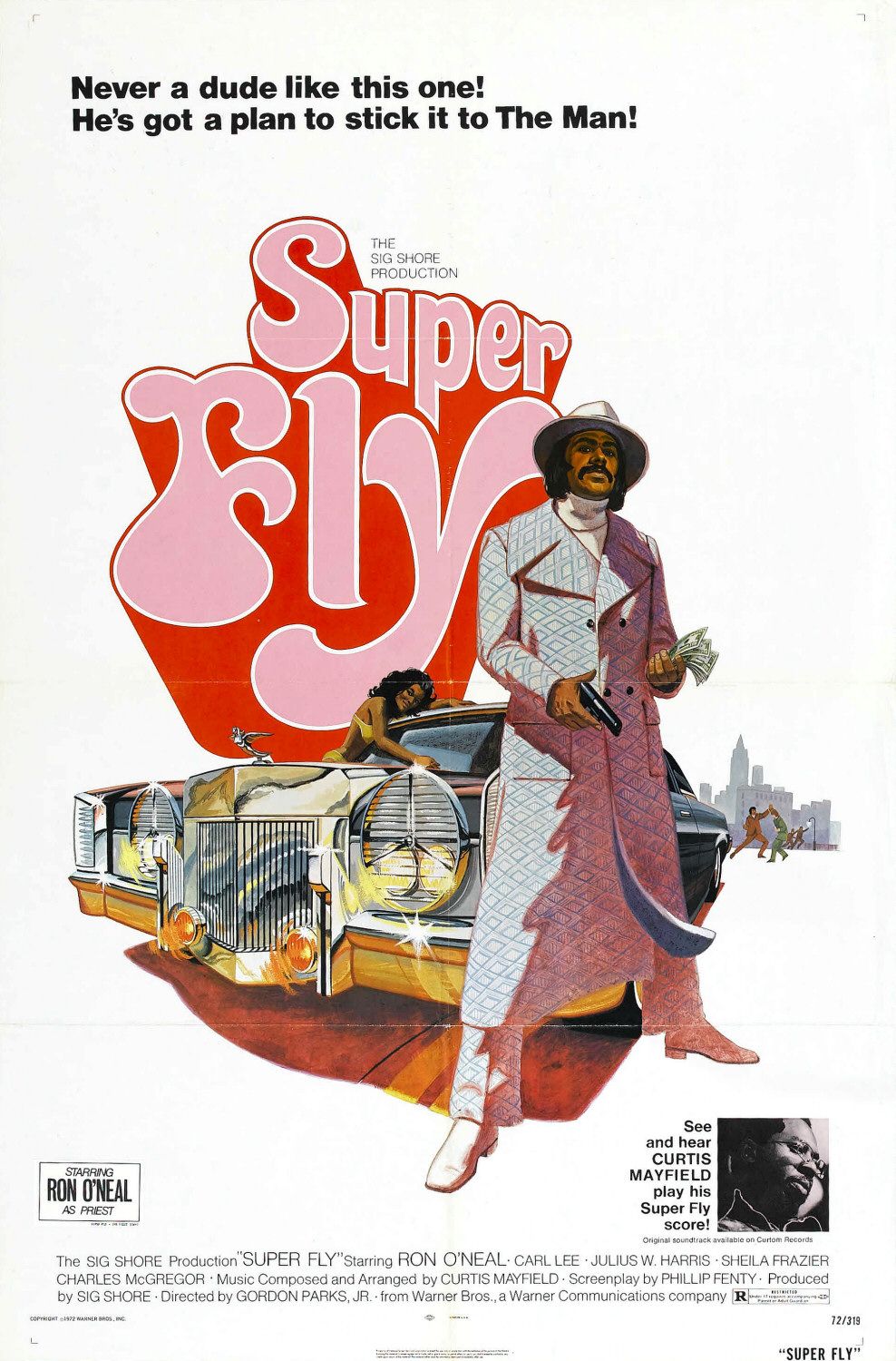
With the remake about to be released, it was time to check out “Super Fly,” the 1972 blaxploitation crime drama which is considered one of the biggest classics of the genre. I have been aware of this film’s existence for years, and the photo on its VHS cover of Ron O’Neal holding a gun and looking ever so cool in his white suit and pants has been burned into my memory for decades. But like many movies I perused at local video stores, all of which have since vanished, I never got around to watching it until now.
While I certainly understand why “Super Fly” is long considered a classic blaxploitation film, it is not necessarily a great movie. On one hand the signs of its low budget are very much on display throughout to where I was reminded of what John Carpenter once said about the rule of making independent movies: “Shoot as little film as possible and make it as long as you can.” But on the other, it presents us with a New York time which no longer exists in modern day America, and the gritty realism of the city streets is on display throughout to where the movie’s existence is especially important as you can only fake this kind of realism in today’s cinematic world.
Ron O’Neal plays Youngblood Priest, an African-American drug dealer who enjoys a luxurious lifestyle in Harlem, New York. He got the name Priest because of the cross he wears around his neck. While this cross may or may not reflect his belief in God or any religious deity, a closer inspection reveals that the tip of the cross is fashioned in the shape of a spoon, and this allows him to do lines of cocaine whenever he needs a hit. In addition to his high-class apartment, the kind which would fetch at least a million in today’s New York real estate market, he also has a dedicated girlfriend in Georgia (Sheila Frazier), a white girl mistress named Cynthia (Polly Niles), the best set of clothes any man would be lucky to own and wear at the time, and he drives around town in a 1971 customized Cadillac Eldorado. Looking at Priest is to be convinced this is a man who has a lot of power and confidence you would be foolish to question, and this is something he does not have to spell out to anyone in words.
But as successful as Priest is, he yearns for a life outside of the underground drug business. This, of course, leads to him to plan one last “big score” which he believes will allow him to retire and go straight, but those of us who have watched countless gangster movies know this last big score will be the one fraught with the most danger. It gets to where there I expected the one scene where Priest just shakes his head as if to say to himself, “I should have gotten out of the life sooner, and now it’s too late.” Still, Priest is much smarter than his friends and foes realize, and we watch as he plots his way to his biggest drug deal ever, and then attempt to stay one step of everyone else who wants to do him in.
It has been said that the screenplay for “Super Fly” was only 45 pages long, and this is why we get exposed to so many shots of people walking, driving and talking in restaurants. This is the kind of film editing you would never see today as everything needs to move at a fast pace. This ends up dragging the movie down a bit as certain moments play themselves out for much longer than is necessary. Still, it allows us to take a look back at the New York that was before it, for better or worse, was cleaned up to where much of the state if unaffordable to live in. This helps to make up for other scenes which are staged rather pathetically, especially one in which a character gets hit by a car.
O’Neal immediately comes across as the personification of cool from the first moment he appears onscreen. He was in his 30’s when starred in “Super Fly,” but his face has the look of a man who has seen a lot in life up to that point, and this makes his performance as Priest feel all the more powerful and authentic. I never got the feeling he was trying to glamourize Priest’s lifestyle, and he was not afraid to make this character a rough and unlikable dude at times. He simply portrays Priest as a man who makes his way through life the only way he knows how, and his methods as you can imagine are not always morally sound.
As for the rest of the cast, their performances range from okay to pretty good. Charles McGregor, who was released from prison before “Super Fly” began filming, has some good moments as Fat Freddie, and Carl Lee, who plays Eddie, has a strong scene in which he tells Priest if it wasn’t for him, he would have overdosed. This line of dialogue would later prove to be tragically ironic as Lee became a heroin addict, and he died of a drug overdose back in 1986.
When “Super Fly” was released, many African-Americans were said to have been displeased with the way the movie glamourized people like themselves as drug dealers and pimps, but it resonated deeply with others who saw the movie as an example of how to rise up in the American class system. Does this movie glamourize the lifestyles of drug dealers? Well, perhaps it does, but the scary truth is there is always an allure to a life like this as it affords us a wealth which constantly seems out of our reach. Still, it should be noted how we never really see Priest enjoying himself much in the movie. While he has many things a person would want in life, we see right from the start how he has long since tired of his role in society to where it is believable and understandable why he yearns to do something legitimate for a change.
For those who think “Super Fly” provides audiences with a rather ambiguous look at the world of drugs and drug dealing back in the 1970’s, you need to take the time to listen Curtis Mayfield’s soundtrack to it which, by the way, is one of the best of its kind ever. An exhilarating fusion of soul and funk music, Mayfield also provided lyrics which were very socially aware and took an even closer look at drugs and poverty in society. When you read the lyrics of the song “Freddie’s Dead,” you can see the evidence of this very clearly:
“Everybody’s misused him
Ripped him up and abused him
Another junkie plan
Pushing dope for the man
A terrible blow
But that’s how it goes
A Freddie’s on the corner now
If you want to be a junkie, wow
Remember Freddie’s dead
We’re all built up with progress
But sometimes I must confess
We can deal with rockets and dreams
But reality, what does it mean
Ain’t nothing said
‘Cause Freddie’s dead.”
Looking at this, it is no wonder the soundtrack ended up making more money than the movie itself, and the movie did make a huge profit.
So “Super Fly” may not be an example of great filmmaking, but it should be noted how its production succeeded in offering advances for African-Americans. The city of Harlem went out of its way to back the movie financially, and many black businesses helped with production costs. Furthermore, the majority of the crew were in fact African-American, something which was very rare at this time in cinema. Taking all this into account makes “Super Fly” all the more enjoyable as it was a movie made with passion and respect as the filmmakers sought to tell it like it is. Despite its glaring flaws, it is a very cool movie to experience, and I am glad I finally got the chance to check it out, especially before I went out to see the remake.
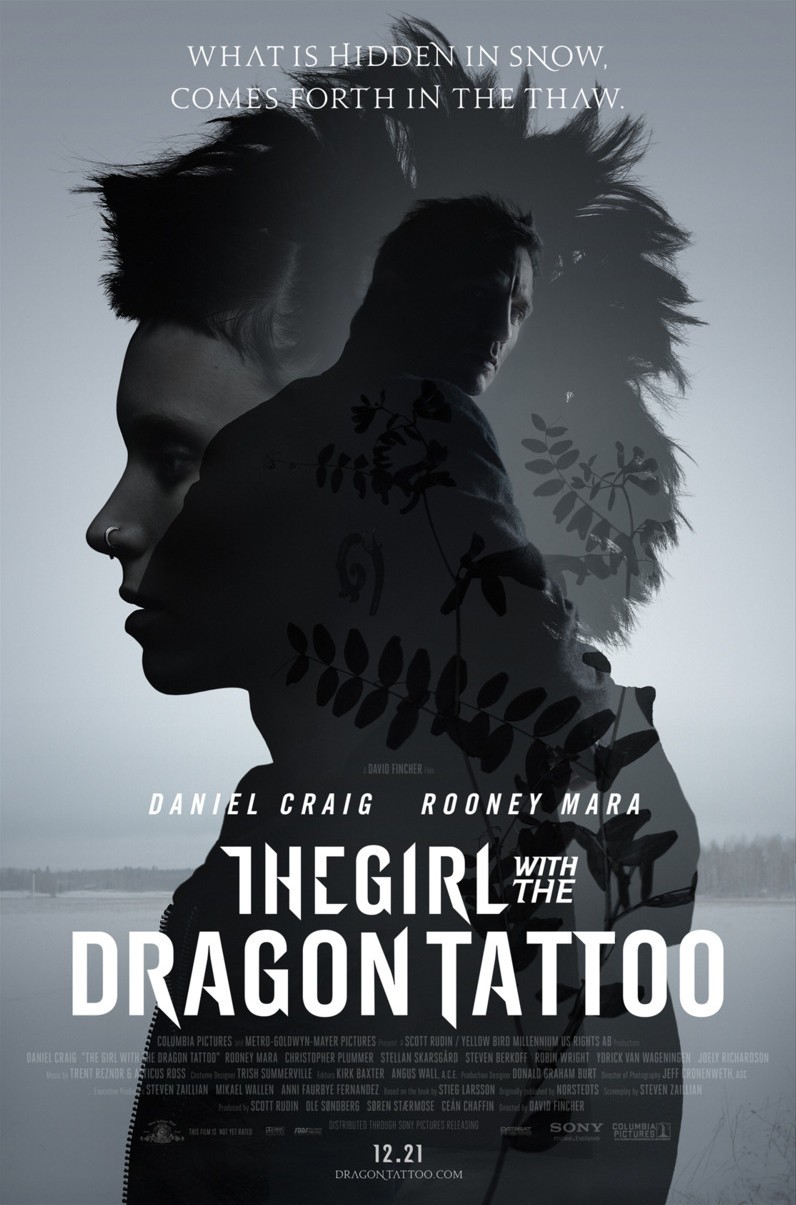
To call David Fincher’s “The Girl with The Dragon Tattoo” a remake of the excellent 2009 Swedish thriller wouldn’t be fair. Yes, it too is based on the runaway bestseller by the late Stieg Larsson, but Fincher has taken this material and, with the help of ace screenwriter Steve Zaillian, made it his own. His version proves to be one which is neither better nor worse than the original, but one which effectively stands on its own two feet to where any comparisons are not really necessary.
Daniel Craig takes on the role of Millennium Magazine writer Mikael Blomkvist who, at the movie’s start, has lost a libel case against the wealthy but corrupt businessman Hans-Erik Wennerström, a defeat which will seriously deplete his savings account. To escape the prying eyes of the press, he accepts an invitation from retired CEO Henrik Vanger (Christopher Plummer) to investigate the mysterious disappearance of his great-niece Harriet. Vanger believes she may have been murdered by a member of his family, one which proves to be far more dysfunctional than any you may know.
Fincher’s film takes its time in establishing the characters of Blomkvist and Salander, who is played here by Rooney Mara. In fact, they don’t meet face to face until an hour into the movie. While studio executives were probably begging to see these two come together a lot sooner, it gives these actors time to establish their characters to where we feel like we understand them and are eager to see each work with one another.
Stepping outside of the James Bond franchise, Craig is terrific in conveying Blomkvist’s single-mindedness in finding answers which need to be uncovered. This is not a heroic character taking out the bad guys with relative ease, but one who is dedicated to finding out the truth and soon comes to realize just how much danger he is in. But as frightened as he is, Blomkvist is in no position to just give up and go home.
As for Mara, her performance as Lisbeth Salander is nothing short of a revelation. She must have given one hell of an audition for Fincher because very little in her resume, certainly not the bland “Nightmare on Elm Street” remake, could have prepared us for how good she is here. That is, except for her performance as Max Zuckerberg’s girlfriend who dumps him without remorse at the beginning of “The Social Network.”
Having watched Noomi Rapace inhabit this character previously, it was hard to think of another actress who could be anywhere as good in playing Lisbeth Salander. Mara, however, is more than up for the challenge, and her commitment in portraying this understandably anti-social character is utterly complete. I kept trying to find traces of Mara in this film, but I came out of it feeling like I never saw her. Instead, I felt like was watching Lisbeth Salander and no one else. Now this is a performance worthy of awards consideration!
Not to take away from Rapace’s star-making performance, but Mara has the advantage here of dealing with this character’s complexities which were not as deeply explored in the 2009 film. While Mara puts up a tough exterior, she simultaneously allows you to see those cracks of vulnerability hiding just beneath the surface. You fear for Lisbeth even though you know she eventually will kick ass.
There are many other great performances to be found here, and the actors have the fortune of playing characters which are given more depth in this version. Plummer has had quite the year with this and “Beginners,” and he gives Henrik a biting sense of humor which has aided him in dealing with the emotionally sordid history of his family. Robin Wright pulls off a surprisingly confident Swedish accent as Blomkvist’s co-worker and lover Erika Berger. Steven Berkoff of “Beverly Hills Cop” and “A Clockwork Orange” fame is a strong presence as Henrik’s lawyer Dirch Frode, Stellan Skarsgård remains one of the most reliable actors in movies with his performance as Martin Vanger, and Joely Richardson is fantastic as Anita.
Director of Photography Jeff Cronenweth does a superb job of capturing the frozen landscapes of Sweden to where you get frigid just looking at the screen. The scene where Blomkvist desperately tries to warm up the cottage Vagner has provided for him pushes this point across than it would ever need to. I haven’t shivered this much since after I finished swimming the 2011 Los Angeles Marathon.
Fincher’s movie also has a mesmerizing score from Trent Reznor and Atticus Ross, both whom won the Best Original Score Oscar for their work on “The Social Network.” They give the story and its characters a sonic soundscape unlike the typical orchestral score, and it brilliantly captures the growing emotions which get stronger and stronger as the movie reaches its brutal climax.
Speaking of brutal, Fincher never sugarcoats this story or makes it easy to digest down to a PG-13 rating. In retrospect, I’m not sure there was a way he could as it deals with serial killers and features a vicious rape perpetrated on the main character. As with the majority of his movies, Fincher’s vision of the world is a dark one where the characters can be as cold as the snowy weather, but his vision also remains one of the most powerful in today’s cinematic world.
When it comes to comparing the 2009 and 2011 movies, this one has an upper hand in that it’s far more cinematic. The original Swedish film was actually a television miniseries which got shortened when released theatrically. That one remains a great thriller worth watching, but David Fincher’s version of “The Girl with The Dragon Tattoo” threatens to be more compelling as it builds on the original without taking away from it. I have yet to see him make a truly bad motion picture, and yes, that includes “Alien 3.”
“Ocean’s Thirteen” was one of the few threequels from 2007 which really delivered without any frustration, and I was relieved how it did not suffer from an overabundance of plot and characters. True, the story and twists in plot are a bit hard to follow at times, but this was also the case in the last two movies in this trilogy, so why should this one be any different? This is a movie which invites you to sit back and relax and to have some fun, and for me it delivered.
The gang is back with the exception of Julia Roberts who was in the previous two movies, and Catherine Zeta-Jones who appeared in the last one. It’s just as well because there really is not much they could do here. They would have been wasted in bit parts which would not have required much from their presence. As George Clooney and Brad Pitt point out at the beginning in regards to the characters Roberts and Jones played, “IT’S NOT THEIR FIGHT!”
This one starts off with their friend Reuben Tishkoff (Elliot Gould) in the hospital where he is recovering from a nasty heart attack. This was brought on when he got screwed out of a partnership by the devious Willie Bank (Al Pacino) who is legendary in Las Vegas for stabbing everyone who ever worked for them in the back without any remorse. None of Ocean’s gang is happy about this, and they quickly begin to plot their revenge against him. Their plan is to essentially bankrupt Willie on the opening night of his new casino, and whether or not they win is irrelevant as long as he loses big time.
Clooney and Pitt are as cool as ever in returning to Las Vegas, the scene of their insidiously clever crime from the first movie. They never miss a beat as their confidence remains unbreakable while they attempt to screw over Pacino’s character. Matt Damon is great as always as Linus, the guy who always wants to put more into the plan, and he remains convinced of how he can pull it off if those around him would just give him a chance. However, I could easily spot who his character’s father was from a mile away. Don Cheadle has some great scene stealing moments as Basher Tarr, especially when he tries to divert Pacino’s attention in one key scene.
Pacino has been ridiculed for some time now as he is constantly accused of giving the same bombastic performance over and over again. Ever since his Oscar winning turn in “Scent of a Woman,” people keep saying he overplays every role given to him, and while there is a lot of evidence to this fact, I don’t think it’s always the case (“Donnie Brasco” anybody?). He succeeds in underplaying his role here, and his usual bombast is not on display as much. He has a quiet menace in some scenes which really works, and Clooney plays off of it very effectively to where they both generate some good chuckles along the way.
It’s also great to see Ellen Barkin again and reuniting with her “Sea of Love” co-star Pacino as his chief assistant, Abigail Sponder. She still looks very hot, and it’s nice to see her acting again instead of hearing about all those divorce stories between her and her millionaire ex-husband. She is a lot of fun to watch here, and there is a great moment where she ends up getting seduced by Matt Damon’s character, and the way she plays her inevitable seduction is both hilarious and quite believable.
Carl Reiner and Elliott Gould return as well to the Ocean’s franchise, and their presence is very welcome. Hollywood is as always obsessed with youth, so it’s nice to see two older guys still being allowed to make their mark in a big Hollywood movie like this. And I don’t want to leave out Shaobo Qin who plays Yen. Qin gets more to do here than he has in the other Ocean’s movies, and his acrobatic skills come into focus when he has to make his way across a very unpredictable elevator system.
Andy Garcia is also back as Terry Benedict, and the Ocean crew is forced to partner with him in order to complete their revenge against Pacino’s character. How Garcia’s character gets done in is too good to spoil here, and it results in one of this sequel’s most inspired moments.
Steven Soderbergh, or Peter Andrews if you really want to call him that, keeps the coolness factor up and running, and he provides us with what this movie is supposed to give, a good time at the movies. With a movie like this, you can’t ask for much more. This must serve as a vacation for Soderbergh from all his more serious movies like “Traffic” and “The Good German,” and it is always great to see him jumping from one genre to another.
Whereas a lot of sequels have underwhelmed mostly because of constant overhyping, this one is smart enough not to fall victim to that. I was always surprised when I heard they were going to do a sequel to “Ocean’s Eleven,” and then another sequel after “Ocean’s Twelve.” Each one delivered for me, and this one does as well.