‘Hanna’ Features One of Saoirse Ronan’s Best Performances

Hanna movie poster

Joe Wright’s “Hanna” on the surface looks a bit like “Kick Ass” as, like that movie, it follows the exploits of a young girl who has been trained to be an elite assassin so she can avenge her mother’s murder. But “Hanna,” however, is more down to earth in how it treats its characters and the events which envelop them. Does this make it better than “Kick Ass?” No, just different.

On top of it being an action thriller with a bit of Luc Besson sleekness in its design, “Hanna” is also a fish out of water story as the title character discovers the real world in a way previously denied to her. Hanna has spent her entire life in the woods, living in a snow-covered cabin where her dad, Erik Heller (Eric Bana), has kept her safe. But now she is heading into a world completely unfamiliar to her. Hanna’s mission of assassination is also a journey of discovery, and this movie ends up coming with more surprises than I ever could have expected.

Playing Hanna is Saoirse Ronan who has gone from her Oscar-nominated turn in “Atonement” to an excellent career which includes unforgettable performances in films like “Brooklyn,” “Lady Bird” and “Mary Queen of Scots.” On paper, Hanna seems like a completely unrealistic character who could in no way exist in real life. But the beauty of Ronan’s performance is how she makes Hanna seem as real as any 16-year old girl even as the character leads a double life the average teenager does not. Seeing her come into contact with a civilization she has been sheltered from provides her with evidence of how not everything involves guns, bullets and violence. Of course, seeing her get her first kiss is frightening because she can flip back to assassin mode in a heartbeat if she gets the wrong impression.

Most of Hanna’s adventures come as a result of her befriending a British family on a road trip whose daughter Sophie (Jessica Barden) introduces her to teenage rebellion and some rather tacky fashion statements. Sophie’s parents, Sebastian (Jason Fleming) and Rachel (“The Ghost Writer’s” Olivia Williams), come to admire Hanna and help her as she moves on to a safer haven from the government forces who look to eliminate her.

Wright comes up with several invigorating action sequences which made me feel like I was watching a Jason Bourne movie. There’s not much in the way of shaky camerawork, but you can feel the bullets flying in the air as well as the punches and kicks which land on her opponents, crushing them as if she were simply swatting flies. This is the kind of action film I like to watch as it makes you feel things instead of letting you just sit back like you’re some passive observer.

In addition, Wright gets some amazing unbroken shots as we watch characters make their way through crowds of people while being followed by their cold-hearted adversaries. It makes me want to say “eat your heart out Brian DePalma” as the choreography involved in filming an unbroken sequence like this is anything but easy.

There are other great performances to be found in “Hanna” as well. One in particular is from Eric Bana who plays Hanna’s father Erik Heller. His character is also a spy on the run whose relationship with Hanna is far more complicated than at first glance. Watching Bana here reminded me of just how much he throws himself physically and emotionally into his characters. It’s exhausting watching him here as we get reminded of his strong work in “Black Hawk Down” as well as his comedic roles like the one he had in “Funny People.”

Then there’s the infinitely brilliant Cate Blanchett who never seems to suck in anything she does. While listening to her southern accent feels a bit odd at first, she is still sharp as ever as corrupt CIA agent Marissa Wiegler. Throughout Marissa is as obsessive in eliminating Hanna and Erik as she is in cleaning her teeth. Heck, watching her brushing even while her gums bleed profusely reminded me of just how long it’s been since I’ve gone to the dentist. Blanchett also has a brilliant moment where she pays a visit to a key witness, but her face suddenly shows a wealth of pain which is mysterious in its origin. I don’t know how she did it, but it’s the one shot in “Hanna” which stays with me the most as her ruthless character succumbs to a moment of inescapable vulnerability.

On top of it all, you get a brilliantly propulsive electronic film score from The Chemical Brothers. I immediately downloaded it off of iTunes as soon as I got back to my apartment. It’s actually the first time they have ever composed for a movie. Learning this made me want to say, “duh, what about ‘Fight Club?’” But wait, it was The Dust Brothers who composed the score for that 1999 classic. I guess techno music is more of a family affair than I realized. Either that or all these brothers look alike.

“Hanna” is not without its faults. The pace of the movie tends to slag in between the action scenes which, while offering us beautiful moments for the title character, drag the proceedings down more than they should. Also, it ends without resolving the fate of several characters, leaving us wondering what happened to them and if they came out of this story alive and in one piece. As a result, the ending feels a bit too abrupt.

Still, “Hanna” is a remarkably involving action thriller which doesn’t lay out everything for you right at the start. The story continues to unfold throughout, revealing each of its secrets along the way. What brings it altogether is the fantastic performance of Saoirse Ronan who at a young age showed a professionalism and sharp focus on character equal to many acting veterans. Seeing her portray someone as innocent as she is very deadly made it one of the most unforgettable performances I had seen in any movie from 2011.
* * * ½ out of * * * *

‘Religulous’ Shows No Shame in Questioning Religion and Blind Faith

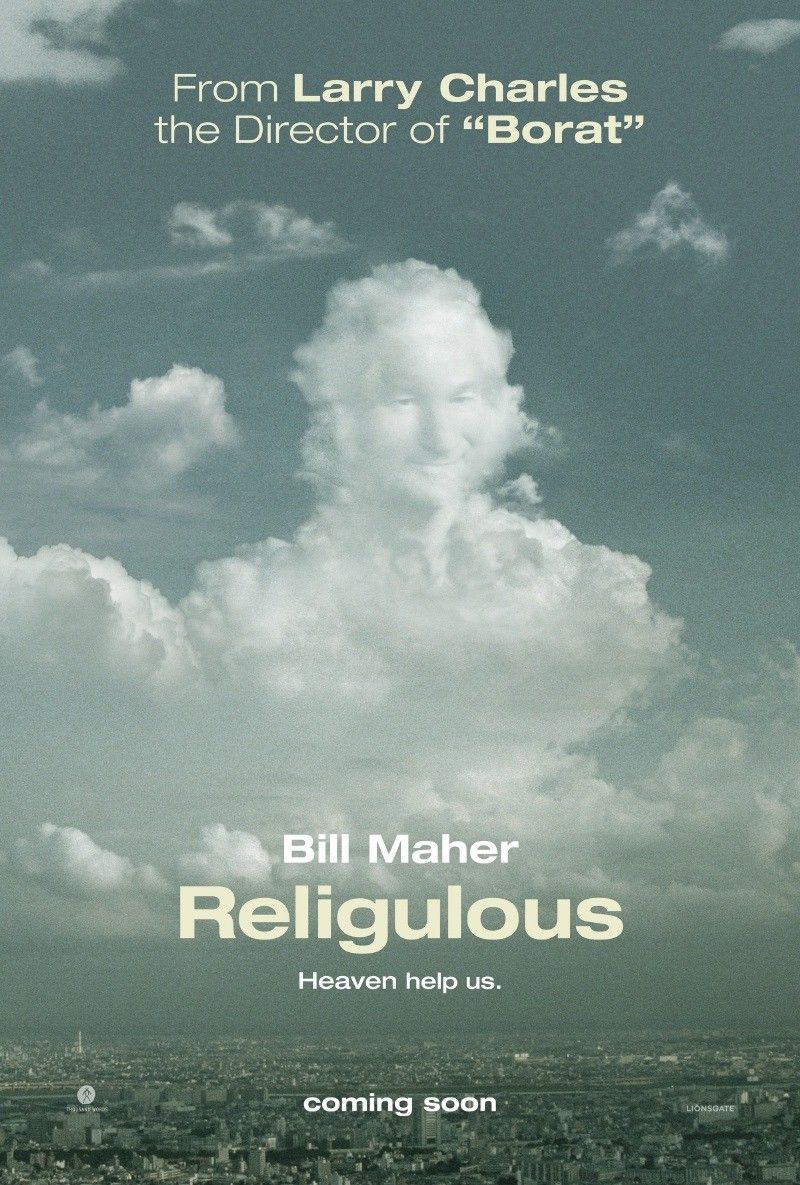
Religulous movie poster

I came into this documentary with much excitement as religion is such a fun and easy target to lampoon regardless of what your thoughts are on it. “Religulous” was directed by Larry Charles who directed one of the funniest mockumentaries ever with “Borat,” and it has Bill Maher interviewing people of different faiths. Apparently, the people interviewed were not aware Maher was going to be interviewing them until Maher showed up. This is made clear by certain moments where publicists come up to the film crew saying rather tensely that they do not want Maher talking to their clients because of what they believe he represents. Would that be logic and reason? The fact these same people still chose to be interviewed by Maher does show a lot of guts on their part as he lets them have their say even as he interrupts them when things don’t make sense to him (and this happens more than you might think).

“Religulous” starts with Maher talking with his sister and mother about why they all stopped going to church. He explains how he was brought up by a mother who was Jewish and a father who was Catholic, and of how he loved playing with his toy gun and holster which he refused to take off even when he went to church. We also get to see clips from when he was starting as a standup comic and talked about what the first circumcision must have looked like to the one it was being suggested to. Maher’s distrust and comments on religion still go on to this very day, and they are not just meant to be funny, but also to make you think about why people allow themselves to believe certain things which defy easy logic.

One thing which kept coming up is how many preachers go out of their way to purchase expensive clothes and live more luxuriously than Jesus ever did. Jesus wore robes and lived in a hut or some other dwelling, and we can all agree he did not care for making money in his father’s temple. Here, Maher interviews them while they are showing off their tailor-made suits, the kind you would never find at your average discount store, and they also wear gold rings because they feel God would want them to dress extravagantly. Maher intersperses these interviews with these same preachers hawking their own DVD’s among other items they have to offer, and it immediately reminded of L. Ron Hubbard’s response to someone who asked him why he was so keen to create his own religion:

“That’s where the money is.”

“Religulous” also opened me up to what Mormons really believe. I always thought they were the nicest people, and I did have a huge crush on one while I was in school, but I never had the slightest idea they held the belief that God is actually from another planet (I can’t remember the name of it). We watch as Maher gets kicked off of the lawn outside the Mormon Tabernacle Church, but he does get to speak with two men who have since left the church and dispute what the Mormons are taught to believe in. Every religion seems to have its own interpretation of God, and I can’t help but wonder if a consensus can ever be reached on this subject.

One of the real pivotal moments comes when Maher interviews a “reformed” homosexual (talk about a contradiction). The fact that pseudoscience facilities which practice conversion therapy exist where people are send to be “cured” of their homosexuality, will always baffle me. Furthermore, this man Maher interviews is married to a woman who claims she was “cured” of being a lesbian. This all struck me as being completely odd and inappropriate as I was always under the belief God loves us all no matter who we are. That people allow themselves to be brainwashed into what others want them to be is frightening, and practices still continue even when people should know better. Seeing Maher hug the “reformed homosexual,” I kept waiting for the “Real Time” host to do something rather provocative, but even he has the good sense not to pinch the guy’s butt.

Clearly, “Religulous” is bound to upset many religious people as Maher shows no shame in picking apart faiths of any and every kind. I personally do not see, nor do I want to see, religion as being evil, but this will not step many from believing both Maher and Charles have made something both biased and hateful. Granted, there are many Bill talks to who will ever be quick to share his problems with religion, and we even see this here from one point to the next. But “Religulous” does indeed have a strong point of view as it never hesitates to call out those religious beliefs which prove to be both misleading and very dangerous. Maher also takes the time to find similarities between Muslims and Christians as each religion has their followers believing they are the chosen people and of how the world is coming to an end and that they will be the only ones left standing.

“Religulous” ends on an ominous note as Maher discusses how religions constantly talk about the end of the world and of how we should be wary of blind faith (amen to that). Religion is supposed to be about love, and yet there is a lot of hate and fear involved in many faiths. Hearing and seeing all of this takes me back to that scene in “A Bronx Tale” where the young kid asks a known gangster:

“Is it better to be loved or feared?”

His reply:

“I would rather be feared, because fear lasts longer than love.”

Maher remains one of the smartest, not to mention one of the most provocative, and “Religulous” is further proof of this as it shows he has balls of steel. He shows no fear as he questions the religion of those who may very well kill him for defying what they hold most holy. In the end, he makes a compelling argument of how religion can be dangerous and easily corrupted, and he also gets a lot of huge laughs out of the subject.

Like I said, there are moments where Charles puts in clips from religious shows, and there is one with a man talking in a language which makes him feel so good and yet has him sounding like a baby struggling to say their first words. It’s as gut busting hilarious as it is frightening. Whatever you may feel about religion, and everyone is entitled to their own opinion about it, “Religulous” will make you see the dangers of believing certain things and of the immense dangers of blind faith.

We all keep wondering when and if we will be saved from the horrors which keep engulfing this world we all live in. Maher meets a man who plays Jesus at a religious amusement park and asks him:

“Why doesn’t he (Jesus) obliterate the devil and therefore get rid of evil in the world?”

“He will.”

“He will?”

“That’s right.”

“What’s he waiting for?”

Yeah, what is he waiting for? And how do we know he is not actually a she?

Seriously, this documentary could make a great double feature with Lars Von Trier’s “Antichrist.”

* * * ½ out of * * * *

30 Years Later, ‘When Harry Met Sally’ is Still a Wonderful Delight

When Harry Met Sally movie poster

In today’s episode of “man, do I feel old,” we revisit “When Harry Met Sally” which has now reached its 30th anniversary. Yes, this romantic comedy is that old, but in many ways, it hasn’t aged a day. The life challenges its main characters face are no different from what men and women face today, and the only thing missing is an overabundance of cell phones.

“When Harry Met Sally” is an especially unusual love story in regards to how it starts and progresses throughout. We first meet Harry Burns (Billy Crystal) and Sally Albright right after they graduate from college. They end up taking a long car ride from Chicago to New York where the real world awaits them whether they are ready for it or not, and from the outset they cannot stand each other to save their lives. Harry is convinced men and women can never be friends because, as he puts it, “the sex part always gets in the way.” Sally tries to rebuff Harry’s advances and sexist comments by attempting to be more open-minded, but this motivates Harry even more determined to prove his point. When they finally reach New York, they part ways and go their separate paths, thinking they will never see each other again. But we know this will not be the case.

Five years later, we catch up with Harry and Sally as they bump into each other on a flight going to Chicago for business purposes. Things have definitely changed for the two as Sally is involved in a serious relationship with a lawyer named Joe, and Harry is now engaged to be married. The relationship between these two has not changed much, and Sally is still turned off by Harry’s cavalier attitude towards the opposite sex, even when it seems like he really has found true love. They finally part ways at the airport, thinking they won’t bump into each other ever again…

This brings me to the point the movie’s screenwriter, Nora Ephron, made about these two characters; they keep meeting up with each other at the wrong times in their lives. The first time when they were on the road and leaving college was the wrong time, and bumping into each other at the airport was also the wrong time. But the third time, which comprises the bulk of the movie, is definitely the most wrong time at all. Sally has recently broken up with Joe and declares to all who listen that she is “over him,” and Harry is going through a painful breakup which he did not see coming. These two at this point have no business being in any relationship as they are in a mourning period, but this time a strong friendship blossoms between the two as they go from fighting to challenging each other to see if men and women can really remain friends even after the sex part gets in the way.

“When Harry Met Sally” was made back in Rob Reiner’s golden age in which he gave us such cinematic gems as “This is Spinal Tap,” “The Princess Bride,” “Stand by Me” and “The Sure Thing.” His direction here is flawless as he brings us right up close and into the two lives of people who couldn’t be more different from one another. Their progression throughout the movie is very believable and feels almost effortless thanks to the truly inspired performances of Billy Crystal and Meg Ryan, and the screenplay by Nora Ephron is far and away one of her best. Even when it looks like the movie might get a little too broad for its own good, Reiner manages to keep everything together and mines the material for all the humor and heart it has to offer. He also populates the movies with short vignettes of absolutely true stories involving how people found love in the most unexpected ways, and I came out of it believing how love is possible even for those who foolishly believe they are unlovable.

Billy Crystal typically comes across as just Billy Crystal in many of the movies he stars in, but he can be a very good actor when he is given the right role. His performance as Harry starts off in a seemingly broad manner, but he goes from being a confident man in love to a man whose pride looks to be broken forever in a way which he conveys perfectly. The pain in his face when he sees his ex-wife with another man while he and Sally are doing karaoke at the Sharper Image store really hit me hard, and his acting is strong as he makes Harry’s anger raw to where anyone is a target for his upset feelings. This character remains one of Crystal’s best roles to date.

Meg Ryan became a star with this movie and rightly so. No one else could have played the role of Sally Albright better than her, and she is utterly lovable even when she gives the waiter instructions of how she wants her food which would make any food server go insane. You also have to give her almost all the credit for the diner scene, which became one of the all-time great comedy moments in film history as she was the one who came up with faking an orgasm. Ryan shows a lot of range in the movie as she takes Sally from being serious to giddy to heartbroken at a moment’s notice. Granted, this movie pretty much got her stuck in romantic comedies for a long period than she wanted, but that’s because we came to love her so much.

But let’s not forget the great supporting cast here who prove to be every bit as good. The late Carrie Fisher reminded us there was more to her than “Star Wars” and writing screenplays as she steals one scene after another as Sally’s best friend, Marie. Carrie’s character has a thing for married men which never seems to deter her from pursuing them. Then you have the late Bruno Kirby (he is still missed) who plays Harry’s best friend, Jess. When Jess and Marie get together, it is a comedy high point as they ditch their friends for a night alone. Things never do go as planned, do they?

What makes “When Harry Met Sally” so enjoyable is how examines the question of if men and women can truly be friends, and in the answers it comes up with. This is one of those romantic comedies which is meant for both men and women, and remains a gem in a genre I typically want nothing to do with. It broke through the perception we had of these kinds of movies at the time, and of how the audience for them was bigger than we bothered to realize. It also stands as a testament to how unrequited love can be requited and in a way which is absolutely believable. We should all be so lucky.

Thirty years after its release, “When Harry Met Sally” more than deserves its place as one of the best romantic comedies ever made. It’s still a great movie after all these years, and one that is impossible to forget. And by that, I don’t just mean the diner scene. Few romantic comedies these days can match its laughter and sincerity, and I’m not sure we see one like this again for a long time. Of course, filmmakers out there are more than welcome to prove me wrong.

* * * * out of * * * *

‘The Wind’ is a Menacing Horror Western Which Gets Under Your Skin

The Wind movie poster

Weather can be a formidable character in movies, especially those in the horror genre. We have “The Fog” (John Carpenter’s original, not the dreadful remake), “The Mist” (talk about an infinitely devastating climax), “The Wave” which proved to be the best disaster flick I have seen in a long time, and there’s even “The Day After Tomorrow” which dealt with climate change although in a highly unrealistic way.

Now we have “The Wind,” a horror western which takes us back to the untamed Western frontier of the 1800’s. The wind here has a supernatural force inhabiting it almost in the same way those ghosts inhabited “The Fog,” and you are left wondering how anyone can rise above such a common weather element especially when it is always around. In the process, we are sucked right into a horror movie which fearlessly turns a number of tropes on its head especially when it comes to female characters.

Lizzy Macklin (Caitlin Gerard) is forced to fend for herself in the lonely wilderness when her husband, Isaac Macklin (Ashley Zukerman), is forced to leave her and travel into the nearest town with their friend Gideon Harper (Dylan McTee) for reasons which will quickly become clear. From there, she is stuck in the loneliest of places and in a house which looks like something out of Clint Eastwood’s “Unforgiven.” The old west Lizzy resides in is not the least bit glamourous, but we quickly realize she is resilient and strong even after she is chased back into her house by a pair of ravenous coyotes.

The wind of the movie’s title first presents itself as a natural element, but it quickly becomes very ominous as it has hands reaching out at its victims who have little hope of escape. But after a while, one begins to wonder if Lizzy is really being attacked by a supernatural force, or if she is instead descending deeper and deeper into madness. Either way, you are in for an unsettling ride which won’t let you go.

The first thing I should single out is Caitlin Gerard’s performance. Right from the start, she holds our attention as she makes Lizzy into a formidable character who doesn’t necessarily need a man to see her through dangers of any kind. Furthermore, she has many scenes in which she doesn’t utter a word of dialogue and has to get things across with her face and body. It’s a lot to ask of an actor to communicate with just their face as they could easily fall into the trap of emoting to where they overdo it and turn in a performance which is inescapably laughable. Gerard, however, never falls into this trap as she almost succeeds in turning this movie into a one-woman show. Throughout, she succeeds in conveying so much while saying so little, and she completely sucked me into Lizzy’s horrifying predicament which could have easily done in a weaker character.

Co-starring alongside Gerard is Julia Goldani Telles who plays Emma Harper, Isaac’s pregnant wife who befriends Lizzy. Emma is pleasant at first, but she soon complains of how something is out to get her, and she becomes possessed by a force which does everything except turn her head 360 degrees. Telles also could have fallen into the same trap, but she makes Emma’s possession fierce and believable to where her transition from sane to insane is all the more terrifying.

From a distance, “The Wind” looks like a movie which will employ the usual variety of horror tropes such as the last woman standing, heroic and moronic male characters and a murderous villain looking for a long-running franchise which will eventually see a reboot. However, this horror western feels unique to many of its ilk, and it is great to see such strong female characters inhabiting it. Honestly, it feels like it has been a long time since I have seen a horror movie with female characters like these as they easily dominate the male characters without any doubt.

Director Emma Tammi makes her narrative feature debut here after having made several documentaries including “Fair Chase.” It is a very assured debut as she balances out all the cinematic elements in equal fashion. In addition to getting excellent performances from the cast, there is also beautiful cinematography from Lyn Moncrief and a terrific film score composed by Ben Lovett which sounds like something out of my childhood nightmares. The fact Tammi had only 30 days to film “The Wind” makes her work here all the more impressive.

If “The Wind” does run into any problems, it is in regards to its non-linear story which gives the movie a lot of power, but also generates some confusion. The screenplay by Teresa Sutherland is strong, but the more it shifts from one place in time to another, the more I lost track of where the characters were in the story. Granted, a lot of my confusion was rectified before the movie’s climax, but being thrown off like that did take away from my viewing experience.

I also have to say that the ending was a bit of a letdown. As much as I enjoy ambiguous conclusions, this was one I wanted spelled out for me. I usually hate it when filmmakers try to spell things out for audiences, but this time it would have helped as “The Wind” felt somewhat incomplete when the screen went to black.

Regardless, I very much taken in by “The Wind” and found it to be a highly unnerving horror film. It’s coming in under the radar and is easily being smothered by bigger movies, but I hope fans of the genre will give it a look. In the meantime, I will be waiting for the next weather disaster movie, “The Smog.” That one will be worth it just to hear its characters have the following exchange:

“You don’t understand! The smog is here and it’s trying to kill us!”

“Ahh, I see you are new to Los Angeles…”

* * * ½ out of * * * *

‘Hellboy II: The Golden Army’ Has Del Toro and Perlman Up To Their Old Tricks

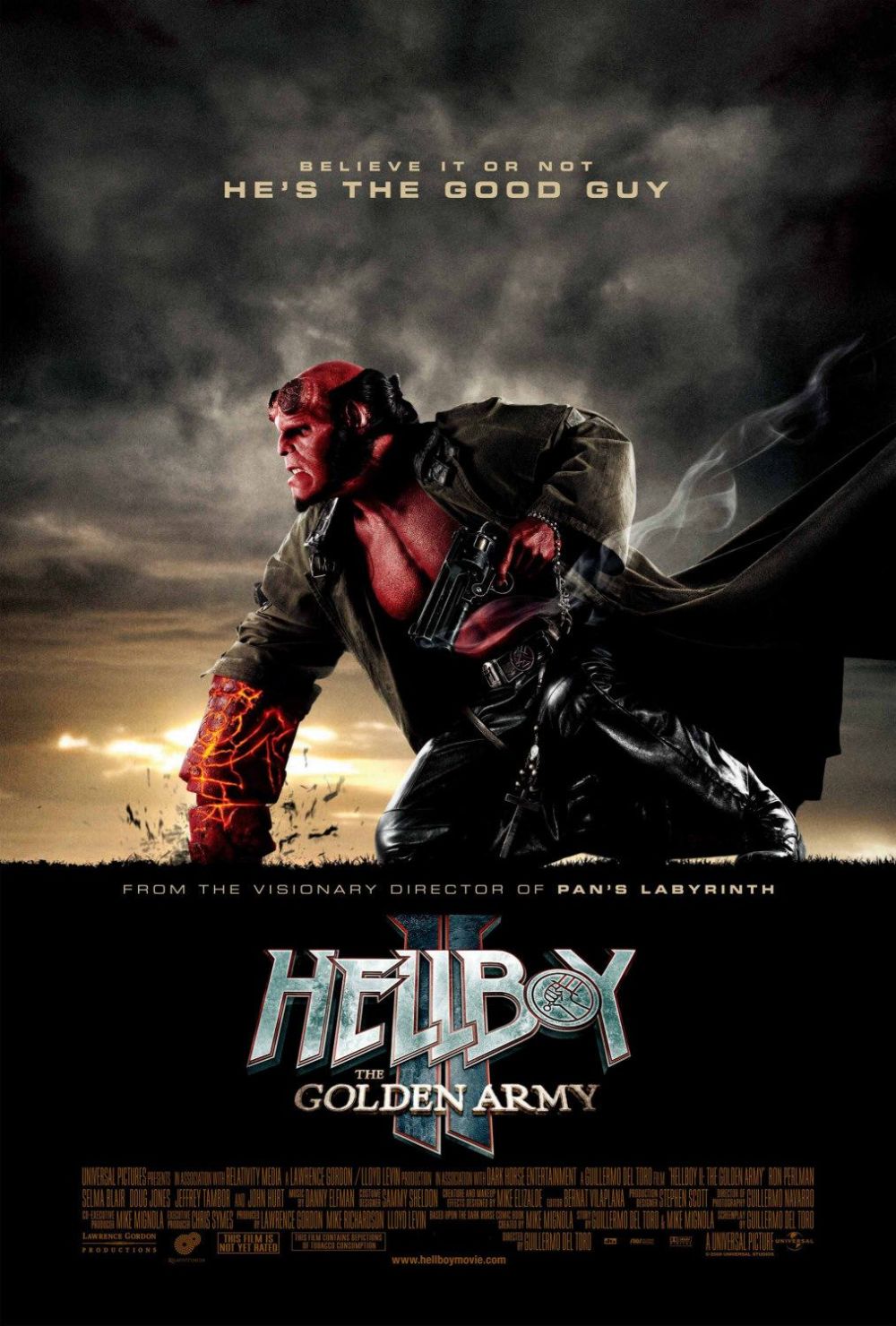
Hellboy II The Golden Army movie poster

WRITER’S NOTE: This review was written back in 2008.

Darn it, I was not able to get around to seeing the original “Hellboy” before checking out its sequel, so I hope I am not missing much. When all is said and done, however, I was able to follow along with “Hellboy II: The Golden Army” and its characters with little, if any, confusion. I would like to know how the fish character, Abraham, breathes outside of the water, but I guess I’ll have to watch the original to find this out. With this sequel, we do get some back story of how the title character came to be, so the uninitiated shouldn’t feel too alienated from what is going on here.

Hellboy II,” like its predecessor, comes to us from the infinitely inspired cinematic mind of Guillermo Del Toro whose work here proves to be endlessly imaginative on a visual level. In the last few years, he has proven to be one of the most original and creative directors working in movies, and his 2006 film “Pan’s Labyrinth” was one of the very best of that year. While this sequel doesn’t reach the creative brilliance of that movie, it doesn’t matter much because this time around Del Toro is just out to give us a fun time. “Hellboy II” is definitely a lot of fun, and there is plenty of creativity on display here which you don’t see from your average movie studio looking to cut down overall budgets wherever and whenever they can.

Hellboy himself is played by Ron Perlman, and there is no one else who could have inhabited this demonic superhero anywhere as effectively. Seriously, I can’t think of one. Perlman previously worked with Del Toro in “Blade II” which was another great sequel, and he is also best known for his roles in “The City of Lost Children” and the television series “Beauty and the Beast.” His imposing height and rough demeanor fit perfectly with this comic book character who has a lot of Casper the friendly ghost inside of him as he wants to get along with people instead of them fearing and hating him. Hellboy is kind of like Snake Plissken from “Escape From New York,” except he does care about more than himself than just staying alive.

The prologue lets those who haven’t seen the original know how Hellboy was actually created by the Nazis, but he was soon rescued by the Army and raised to be one of the good guys instead of becoming a villain. On Christmas Eve, he is told a bedtime story by his surrogate father, Professor Trevor ‘Broom’ Bruttenholm (John Hurt). This allows Del Toro to set up the story of the Golden Army and of how they waged a war against humanity to rule the earth. The truce between the mythical world and humanity, however, is about to be broken as Prince Nuada (Luke Goss) seeks to restore the rule back to the mythical world.

The world of “Hellboy” is much like the one we saw in the “X-Men” movies as it deals with characters rejected by society for being different. Hellboy, while being hurt by the rejection of the humans, seems to have a strong sense of humor about the whole situation. While doing his duty against his and the world’s enemies, he always finds the time to drink a couple 6-packs of imported beer and take care of an unusually high number of cats (how does he keep track of them all?). The other characters around him are just as alienated from humanity, and this is mainly because the majority of them look anything but human. One of the other main characters, Abe Sapien (played by Doug Jones), is a fishlike character who has to wear a special breathing apparatus filled with water wherever he goes. One of the other ingeniously created characters in this movie is Johann Krauss, an ectoplasmic being who lives in a containment suit. While the characters of the “X-Men” movies may stand a chance of having seemingly normal lives, the ones in the “Hellboy” franchise don’t look to be as lucky.

I enjoyed some of the music choices Del Toro made here, and I’m not just talking about Danny Elfman’s score which is the same kind of score he gives to Tim Burton movies. There is one point where the song “Beautiful Freak” by the Eels (one of my favorite alternative bands) is used to help illustrate the strong relationship Hellboy and his girlfriend Liz (Selma Blair) have. No one can love Hellboy the way Liz does, and it certainly not a perfect love to put it mildly. There is also a funny and strangely touching moment between Hellboy and Abe where they start singing to a Barry Manilow song as they seek to find the elusive magic of love.

Selma Blair proves to be terrific as Liz, and she gives her character a don’t mess with me attitude as well as a vulnerability which makes us care about her all the more. You never doubt that she is ready and willing to risk her life and even the fate of humanity to save Hellboy for reasons which are made abundantly clear at this sequel’s start.

I also really admired the character of the Johann Krauss and of how he was created. There is also a hilarious fight scene between him and Hellboy where he ends up fighting the hornless devil boy in the least expected way possible. That scene was one of my favorites, and it also helps that Johann is voiced by Seth MacFarlane, the creator of “Family Guy.”

There’s nothing truly original about the story of “Hellboy II: The Golden Army,” but Del Toro still manages to make it feel original in a way only he can pull off. Right now, he is one of the few directors I can think of who has a really unique filmmaking style. Even if this sequel doesn’t prove to be one of his best works, it still has a wonderful level of creativity missing from many mainstream films.

In the end, “Hellboy II” proves to be a fun ride, and it does make me want to catch the original at some point in my lifetime. Better yet, I should also check out “The Devil’s Backbone,” “Cronos” and “Mimic.” I have a lot of catching up to do.

* * * out of * * * *

‘Gran Torino’ is a Movie Only Clint Eastwood Could Pull Off

Gran Torino movie poster

At its core, “Gran Torino” is a familiar story as it deals with a man in contact with people he does not fully understand but comes to respect and even love by the movie’s end. But it brings out the brilliance of Clint Eastwood the director as his handling of the material makes it anything but familiar. Many of his best movies have a very down to earth feeling which brings you closer to the story and the characters involved in it, and he doesn’t rely on casting picture-perfect actors who would unintentionally suck away all the reality inherent in the screenplay. Eastwood gives us a close-knit Hmong family that is anything but average, and he gets deep into their culture and the traditions they keep. It’s a great family that breaks through whatever stereotypes we have of them, and seeing him hang around them gives the movie some of its best moments.

Eastwood portrays Walt Kowalski, a recently widowed Korean War veteran who is as cantankerous a man as they come. He is alienated from his family who are becoming increasingly eager to put him into a retirement home, and his granddaughter is keen for him to donate his prized 1972 Ford Gran Torino to her when he dies. His neighborhood of Highland Park in Detroit, Michigan used to be filled with working class white families, but now it is dominated poor Asian families and gangs whose violence seems never ending. Like many, Walt is resistant to change, but change is inevitable and something he cannot possibly stop.

The Hmong Vang Lor family lives next door to Walt, and neither are keen to know one another. This is especially the case after the teenage Thao Vang Lor (Bee Vang) attempts to steal Walt’s Gran Torino after being pressured by the local gang to do so. Upon failing to steal it, the gang beats up on Thao until Walt confronts them with his rifle, and they run off. From there, Walt earns the family’s respect and is determined to thank him endlessly for what he has done.

The fact the Vang Lor family lets Walt hang out with them is astonishing when you take into account the vile crap which comes out of his mouth. As an actor, Eastwood never tries to hide from the ugly racist Walt is, and the name calling he does makes it seem insane that any family member would keep him around for five minutes. Watching “Gran Torino,” I tried to think of another actor other than Eastwood who could play such a politically incorrect character and still make you sympathize with and follow him wherever he goes. Eastwood gives Walt Kowalski a toughness and a vulnerability which is not so easy to pull off. To say this is a part which Eastwood could just walk through would be an insult to what he accomplishes here.

In the youth obsessed place that is Hollywood, it’s nice to see an actor of Eastwood’s age show us how it is really done. A part like his in “Gran Torino” cannot be played by some Clearasil clean face actor that adorns many of the shows on the CW network, but by one whose face and body is etched with the marks of a life lived long and hard. One of my favorite scenes has Clint driving up to a trio of African-American men who are messing with Sue (Ahney Her), Thao’s older sister, and her white boyfriend. Eastwood comes in and breaks up the party, going out of his way to insult everyone around him. He calls Sue’s boyfriend a pussy and busts his chops for trying to pretend he’s black (this got one of the biggest laughs in the theater the night I saw it in). He then delivers a line which would have sounded ridiculous coming out of any other actor’s mouth:

“Ever notice how you come across somebody once in a while you shouldn’t have messed with? That’s me.”

Watching this, I felt more than convinced only Eastwood could sell a line like that. I like to believe I could, but a lot of people who know me seem to have a huge misunderstanding of the kind of guy I am.

The more I think of Eastwood’s role in “Gran Torino,” the more multi-dimensional it is, and he nails every part of it perfectly. We see the pain in his face of memories from long past which still haunt him, of the despair he experiences when members of the Vang Lor suffer the worst kind of abuse, and we can clearly see the regret in his face that he was not closer to his children throughout their lives. Even though Walt can seem like a hateful person, Eastwood gives him a strong humanity which comes across from start to finish.

By casting unknown actors as the members of the Vang Lor family, Eastwood the director gives this movie an even stronger authenticity to where you feel like you have known these people forever. One of my favorite performances in the movie was by Ahney Her who plays Sue Lor. She is a real kick to watch throughout as she comes through Walt’s casual insults unphased and even convincingly manages to get him to attend the family barbecue. It takes her a bit, but she manages to draw him in when she mentions there is beer. Her gives us a jaded teenager with a good sense of humor who is no pushover. She’s the kind of girl we knew from high school regardless of race, and Her steals every scene she is in.

As dark as “Gran Torino” seems, the movie has a quirky sense of humor which makes it all the more enjoyable. Another great moment is when Walt teaches Thao how to talk like a man to get what he wants. The scene in the local barbershop of Walt getting Thao to do this is a hilarious moment in how he gets the teenager to talk, and he playfully messes with Thao’s head to get him to realize a few things. This leads to one of the movie’s most gut busting moments when Walt helps Thao get a construction job and lets Thao do all the talking. I almost passed out because I was laughing so hard.

The last half turns bleak as the Vang Lor family deals with devastating events which threaten not only them, but Walt as well. It almost seems like the movie will have a “Death Wish” kind of ending, but Eastwood is much too smart to let things become unforgivably manipulative or sentimental. You may think you know where things are heading, and while you may be right, the terrific screenplay by Dave Johannson and Nick Schenk keeps you on the edge of your seat and has you guessing what will happen all the way to the end. It’s very clear “Gran Torino” is a redemption piece, but the way Walt achieves his redemption is both unexpected and shocking.

“Gran Torino” is the kind of movie which I think really brings out the best in Eastwood as an actor and a director. I am convinced that if this script landed in the hands of another director, it would have ended up being your average anti-racism parable with loads of clichéd characters and predictable situations. But with Eastwood in the director’s chair, he gives the movie a genuine humanity, and he lets the characters propel the plot of the movie. He also gives what we see a strong sense of reality which draws you into the story right away, and a freshness which almost makes you forget you have seen this kind of movie before. I really enjoyed “Gran Torino” a lot more than I thought I would. I figured it would be a decent movie at best, but Eastwood continues to challenge himself and his audience with each project he does. I also have to say that I’m really glad I didn’t have to sit through another ending like the one he gave us in “Million Dollar Baby.” I don’t think I could handle such an ending again.

* * * ½ out of * * * *


‘The Mule’ Movie and Blu-ray Review (Written by Tony Farinella)

THEMULE_1000739013_BD_OSLV_3D_FINAL_DOM_SKEW_6373b5a3

The fact that Clint Eastwood is still directing films at his age is nothing short of amazing.  When he is acting and directing them, it is even more impressive.  “The Mule” marks the first time he has directed and acted at the same time since 2008’s “Gran Torino,” so it’s been a while. He does not disappoint as the usual Eastwood touches are here.  He is a simple yet powerful filmmaker and actor.  He is not going to do a lot with the camera, but he trusts his actors, the writer, and he gives everyone them the space they need to tell the story.  It is what he has always done as a director.  He’s not a flashy filmmaker and he doesn’t need to be since he knows what works.

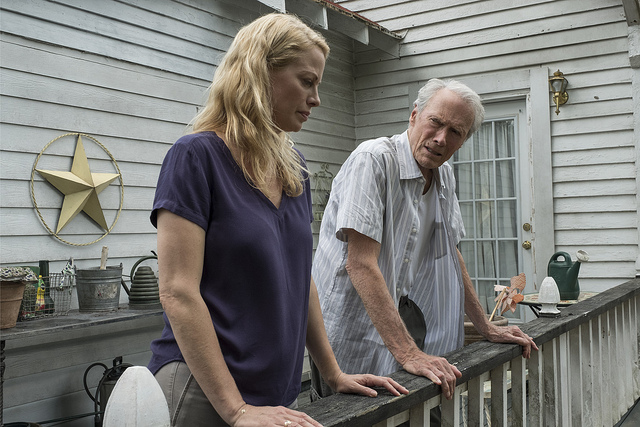
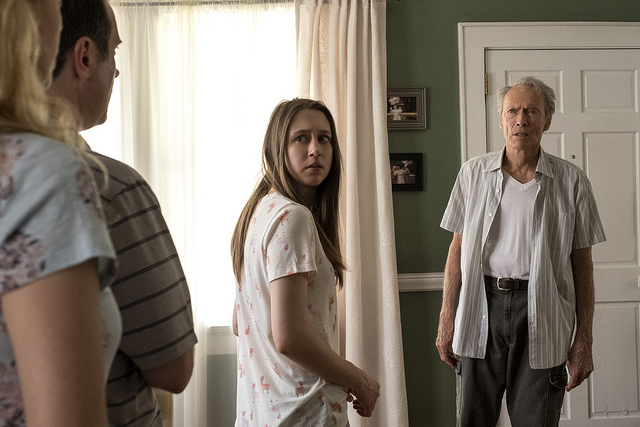
Eastwood stars as Earl Stone, a 90-year old horticulturist from Peoria, Illinois who is seeing the world changing rapidly thanks to the Internet. The film starts out in 2005 and he is winning awards at conventions and making friends left and right.  However, he has forgotten about his family in the process.  He is not on good terms with them and they feel neglected.  Early on in the film, they show him missing out on his daughter’s wedding.  His real-life daughter (Alison Eastwood) is in the film, which is a nice touch.

33554224368_c8af0d0511_z

With the internet growing, Earl has now fallen on hard times.  When he shows up to visit his granddaughter at a brunch for her upcoming wedding, he notices his family has not forgiven him for putting work over family. He wants to make it up to them by pitching in for Ginny’s (Taissa Farmiga) upcoming wedding.  Someone approaches him at the brunch and informs him that all he has to do is drive and he can make a lot of money.  Driving is something he is very good at as he has driven in forty-one states and has never been pulled over or ever had a ticket.

Little does Earl know he will be driving for the cartel and carrying around some cocaine. Since he is such a good driver, and 90-years old, it seems like the perfect way for him to make some easy money and get back in the good graces of his family. At first, he only takes on one job and believes it will be enough to hold him over.  Before long, he is their top driver and highly thought of by the cartel.   However, two DEA agents played by Bradley Cooper and Michael Peña are trying to take down the cartel, and Earl may go down with them as well.

32488382547_95c3b15836_z

There is nothing here which is incredibly moving, profound, or earth shattering. The jokes about cell phone usage are a little overdone.  It is still very entertaining, however, and a very easy movie to watch. The film also features stellar performances from Laurence Fishburne, Dianne Wiest as Earl’s ex-wife, Richard Herd, Andy Garcia, and Clifton Collins Jr. Eastwood is the one leading the charge here, and he always plays it with his usual Eastwood calm, cool, and collected persona even when things get a little hairy.  He makes a decision and he sticks with it.

At 116 minutes, “The Mule” breezes by with humor, suspense, and tension.  At this rate, we don’t know how many more times Eastwood will be in front of the camera, and he is a Hollywood icon, so it’s always a treat.  I don’t see any upcoming films for him as a director/actor, and he is someone who should be cherished.  He still has it and will never lose it. I hope he lives forever and keeps making movies.  This is the kind of movie where you sit back, relax, and enjoy the ride Eastwood and company take you on for almost two hours.  It’s not great, but it’s still quite good.

* * * out of * * * *

______________________________________________________________________________

Blu-Ray Info: “The Mule” is released on a two-disc Blu-Ray, DVD, and Digital Combo Pack from Warner Brothers Home Entertainment.  It has a running time of 116 minutes and is rated R for language throughout and brief sexuality/nudity.

Audio Info: The audio is presented in DTS-HD Master Audio: English 5.1, English Descriptive Audio 5.1, Dolby Digital: French 5.1 (Dubbed in Quebec), and Spanish 5.1. Subtitles are included in English, Spanish, and French.

Video Info:  The film comes to you in 1080p High Definition 16×9 2.4:1.

Special Features:

The Making of The Mule: Nobody Runs Forever (10:59): Clint Eastwood talks about how it was different from other projects he had done in the past.  It was inspired by true events as well. The screenwriter of “Gran Torino” wrote this film, which makes total sense.  Eastwood gives great details about how he approached the character. Many of the main cast members chime in with their thoughts on the film and working with Eastwood.  They also go into detail on how Eastwood was big on getting all of the little things right in this movie.

Toby Keith “Don’t Let the Old Man In” Music Video (02:54)

‘Enter the Void’ is Mind-Blowing and Unique in a Way Few Movies Are

Enter the Void movie poster

WRITER’S NOTE: This review was written back in 2010.

Gaspar Noe’s “Enter the Void,” his first feature length film since the highly controversial “Irreversible,” is one of the craziest and hypnotic cinematic experiences I have ever sat through. A hallucinogenic kaleidoscope of colors, some of which looked like they were taken from Dario Argento’s “Suspiria,” it’s a surreal out of body experience and the kind you do not see today in American cinema today. In a time of soulless remakes and films which shamelessly manipulate our emotions, this is a one of kind motion picture as it breaks boundaries to create something unlike anything we have seen before. Like Noe’s previous films, it is destined to have sharply polarized reactions. Some will admire it, and others will find it excruciating to sit through. As for myself, I was mesmerized from beginning to end, thankful I got to take in something not bound by your typical Hollywood formula.

Straight after the IFC Films logo appears, Noe propels us into this visionary experience by beginning with the end credits, just as he did with “Irreversible,” racing through them at warp speed. Watching this, I was reminded of what Homer Simpson said during the end credits of “The Simpsons Movie:”

“A lot of people worked hard on this film, and all they ask is for you to memorize their names!”

Then the movie goes from there into the opening titles which themselves are exhilaratingly creative and makes you feel like you’re at a rave party in Tokyo. Crazy visuals done to the song “Freak” by LFO, they alone were worth the price of admission and got applause from the audience I saw it with at the Lamelle Sunset 5 in Los Angeles.

The word “enter” gets blasted onto the screen, and we then make it to the seamier side of Tokyo as seen through the eyes of the main character, Oscar (Nathaniel Brown). Just like in the opening sequence of Kathryn Bigelow’s “Strange Days,” we see everything from his perspective as he talks with his sister Linda (Paz de la Huerta) who lives with him in a small apartment, and as he smokes some Dimethyltryptamine (DMT) which provides him with the ultimate high, filled with amazingly beautiful colors. During this time, we see Oscar is reading a book his friend Alex (Cyril Roy) gave him called the “Tibetan Book of the Dead.” Alex describes the book as one person’s experience after death, and of how it eventually leads to rebirth. From there, you get a good idea of where “Enter the Void” is going as Oscar later gets shot dead by police while attempting to flush his drugs down the toilet.

At this point, “Enter the Void” becomes a literal out of body experience as Oscar dies and his soul, no longer caged in its human form, rises from his lifeless body. From there, he floats through the darker sections of Tokyo as he watches over his sister as she moves on with life, devastated she can no longer spend it with her dear brother. Throughout, Noe goes back and forth in time as we come to see the connection Oscar and Linda developed in their youth, and how their promise of always being together is strong even as tragedy threatens to tear them apart.

Many will probably see “Enter the Void” as being a pro-drug movie, but I will leave this up to you, the viewer to decide. This is a movie meant for an adult crowd anyway, not for pre-teens. With drug trips, or so I am told, you are lifted high into a state of euphoria which seems untouchable in our everyday lives, but you are also brought down to emotionally shattering lows you will be desperate to look away from, but you won’t be able to tear your eyes away from what you will soon wish you’d forget. Your mind may be freed up in this state, but don’t ever expect to have any control.

Look, I’m not saying drugs are right, but if we’re not taking something illegal and very dangerous, then we are probably relying on something pharmaceutical. Anyway, this is not a movie to get all political about.

When the movie veers into Oscar’s youth, we get to see the close relationship he and his sister have with their ever-loving parents, and the times we see them together are very sweet and captured with a strong sense of innocence. But this later turns out to be a setup for when the parents are killed in horrific fashion after a truck going in the wrong direction smashes into their car, killing them instantly. It’s impossible not to feel the shattered emotions of the children as their lives are irrevocably altered in ways which rob them of a childhood they deserved to have.

Noe does manage to counter many of the disturbing moments of the movie with scenes of innocence and sweetness, and this is an aspect of his filmmaking people don’t often give him credit for. In the midst of shocking scenes filmed in all their psychologically damaging glory, he does capture intimate moments between which I rarely seen in movies being released these days. This was even the case in “Irreversible” when we watched Vincent Cassel and Monica Bellucci frolicking with one another in their apartment, and the fact the two were married in real life at the time makes those scenes feel more emotionally honest as a result.

As with your typical Noe motion picture, “Enter the Void” is not the kind which can be easily recommended to those interested in mainstream fare. In fact, is as far from mainstream cinema as you can get these days, and those who are easily offended would do their best to keep a marathon-like distance away from it. There’s even a scene where we watch helplessly as Linda gets an abortion, and although I was afraid it would be a much harder to sit through than it was, it is bound shake up a lot of the audience members’ emotions.

The acting for the most part is good. Special praise goes to Paz de la Huerta whose character of Linda has to go through the film’s most viscerally emotional moments, and she portrays them without a hint of simply playing the emotion. I also liked Cyril Roy as Oscar’s mentor Alex and found him to be an enjoyable presence even in the film’s more damning  moments of despair. But let’s be honest here, this is a director’s movie more than anything else, and it is easy to believe this was Noe’s dream project for years. It’s a movie for visual and sound designers to go nuts on, and they must have had a blast trying to bring the director’s own psychedelic visions to the silver screen.

At two and a half hours long, “Enter The Void” does get a bit tedious at times. When the movie ended and the lights came up, I heard one guy say, “So at what point did you fall asleep? For some, this movie will be a lot longer than it should. The only time I got a bit restless was during the hotel orgy scene which overstays its welcome after not too long. Noe uses this scene to make clear the difference of having sex and making love, but he spends far too much energy filming this moment instead of just cutting down to its bare essence. I started to feel like Sean Young at the DGA awards when she told “The Diving Bell and the Butterfly” director Julian Schnabel to “get on with it.”

In spite of this, I was completely mesmerized by “Enter the Void” from start to finish as it took me on a cinematic journey far different than most I have sat through this past year. It will surely go down as one of the definitive love-it or hate-it movies of 2010, but I have no problem sticking up for what Noe has accomplished even if it became a bit overindulgent.

Personally, I’m glad we have directors like Gaspar Noe around because it feels like cinema worldwide is lacking filmmakers who take risks and challenge the conventional structure of your typical corporate product posing as a movie. We need more directors like him now because it has become increasingly understandable as to why many no longer go out to the movies like they once used to.

* * * * out of * * * *


Gaspar Noe’s ‘Climax’ is a Hypnotic Descent Into Hell

Climax movie poster

I will never forget when I first watched Terry Gilliam’s cinematic adaptation of “Fear & Loathing in Las Vegas.” Seeing the main characters played by Johnny Depp and Benicio Del Toro descend into a drug-fueled inferno proved to be one of the most insane and chaotic cinematic experiences I’ve ever had to where I felt like a hammer was constantly bashing at my head. I was in college at the time, and I described it to my friends as being one long acid-trip nightmare. One friend, her name Wendy, looked at me and said, “Oh yeah, like you would know!” This led to another person, Matthew, across the table laughing and responding, “Hey Wendy, he’s right.”

Seriously, you don’t need to have any experience with drugs of any kind to call “Fear & Loathing in Las Vegas” an acid-trip nightmare, and the same goes for “Climax,” the latest cinematic opus from Gaspar Noe. Like the majority of his films, it proves to be exhilarating, hypnotic and gloriously out of control as we watch a group of dancers try to get a hold of their sanity after they discover the sangria they have been drinking has been spiked with LSD. Whether or not you have had any experience with this drug, you will agree the trip these characters go on is not the least bit pleasant.

“Climax” takes us back to the winter of 1996 and opens with a series of audition tapes featuring dancers who are being considered for a French dance troupe being created by Selva (Sofia Boutella) and DJ Daddy (Kiddy Smile). Each dancer makes clear how intense their passion is for this particular artform and what they will do to make a career out of it. What’s interesting about this opening we are watching them on an old-style tube television which is surrounded by VHS tapes and books, all of which have influenced Noe’s filmmaking and personal beliefs. This includes such cinematic escapades like “Suspiria,” “Salo,” “Hara-Kiri” and “Possession,” and among the books are one by Romanian philosopher Emil Cioran, famous for his ultra-negative views on life and humanity, “Junkie” by William S. Burroughs, “LSD Psychotherapy” by Stanislav Grof, and “Wir Kinder vom Bahnhof Zoo” (“We Children of Bahnhof Zoo”) by Christiane F. Seeing these materials around the TV set should make it clear that Noe is not about to play it safe for anybody.

Following this comes one of the most exhilarating dance sequences I have in a movie in a long time as we watch a five-minute-long scene in which characters perform with utter abandon as they contort their bodies in ways which amazed me to no end. As the camera swoops over the performers, we are sucked into their dance space to where I wanted to feel the passion they felt. Seeing this reminded me of when I first watched the music video to Madonna’s “Lucky Star” on MTV, back when they actually showed music videos, and of how I wanted to experience the same level of joy she was having.

Noe is up to his old tricks again as he starts “Climax” with the end credits first and then give us the opening credits about 45 minutes later. As for the title, it appears exactly where it should. It does take a while for things to get crazy as Noe takes his time introducing us to these dancers as they discuss the sexual conquests and/or the future they hope to have sooner rather than later. As this goes on, the techno music plays non-stop, and once you notice it slowing down all of a sudden, you know this shit is about to get real.

Once the characters begin to realize they are under the influence of a psychedelic substance they were not planning on ingesting before their performance, the movie becomes a slow descent into chaos, and I could not take my eyes off the screen for one second. Even as the events became more and more horrifically chaotic, I was sucked into the madness everyone was trapped in, and I had no idea of where the story was going. This kind of unpredictability is very rare in movies today.

It’s especially impressive to learn that “Climax” was shot in just 15 days and with a script only five pages long. Learning of this made me believe this film could have been an enormous mess were it in the hands of another filmmaker, but Noe gives this sheer chaos a structure even as the performers let themselves run wild with the material. Some will complain this movie has no real story or plot, but I am certain anyone who has taken LSD can assure us how most psychedelic trips do not come with a three-act structure.

Once again, Noe employs his and Harmony Korine’s favorite cinematographer, Benoît Debie, who gives us such striking and absorbing colors throughout. Whether the lighting is dark green or blindingly red, Debie captures the insane madness in all its visual beauty, and when the white of the snow appears it feels like such a relief. This makes me look forward to Korine’s upcoming movie “The Beach Bum” all the more as Debie is the cinematographer on it too.

Noe has gone on record in saying the production of “Climax” was the most peaceful he ever had as a director, and this is regardless of the movie’s content. Apparently, there were no arguments on set, and no drugs or alcohol were used by anyone during filming. The latter is worth pointing out as the cast does an excellent job of looking like they are being ravaged by a narcotic they didn’t plan on taking. They could have easily looked ridiculous to where the movie could have been laughable, but everyone looks to be on their game here.

The cast is made of both professional and non-professional actors, and the one who stands out the most is Sofia Boutella. The French-Algerian actress has long since made a name for herself with such memorable performances in “Kingsman: The Secret Service,” “Star Trek Beyond” and “Atomic Blonde,” and watching her here is mesmerizing as she takes her character of Selva from a place of sanity to the polar opposite of it. She could have easily fallen into the trap of emoting here, but she never does as she makes Selva’s helpless predicament all the more frightening as this trip she is forced to take offers no easy escape for her or anyone else.

“Climax” may not reach the nightmarish heights of “Requiem for a Dream,” but it stands out as one of Noe’s strongest efforts. It doesn’t reach of what I feel is his masterpiece, “Enter the Void,” but it is stronger than his last movie, “Love 3D” which many were quick to dismiss as just another porno flick (I disagree). I for one am glad such daring filmmakers are still working in a time where superhero movies continue to dominate everything in the cinematic landscape. We need at least one filmmaker to break the rules, and Noe is no doubt one of them.

Again, I don’t think you need any experience with psychedelic substances to realize “Climax” is one long acid-trip nightmare. While the late Steve Jobs found an amazing level of creativity after experimenting with LSD, I don’t think the characters here will be anywhere as lucky, assuming they survive.

* * * ½ out of * * * *

‘Creed II’ Movie and Blu-ray Review (Written by Tony Farinella)

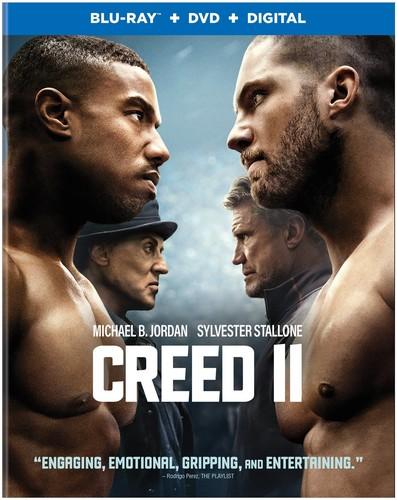
aec.newl1000738717br_0

When “Rocky Balboa” was released in 2006, many wondered how a sixth “Rocky” film would perform when the last one prior to that was released in 1990.  Sylvester Stallone himself was not all too pleased with how “Rocky V” ended, and he wanted to do right by Rocky Balboa.  Needless to say, he did so as he was the writer and the director behind it.  Because of the good will he had built up from the sixth installment, fans were excited for “Creed,” which was released in 2015 and directed by Ryan Coogler.

Coogler was coming off the success of “Fruitvale Station,” and it was set to star Michael B. Jordan, also from the aforementioned film. It was in good hands, as they were wise to hand the franchise over to Jordan while still keeping Stallone around.  The film was organic, funny, entertaining, and powerful at the same time. When it was time for “Creed II,” they handed it over to Steven Caple Jr.  I’m happy to report he did a terrific job with “Creed II,” and the writers also had a fresh idea to bring to the table: bring back Ivan Drago (Dolph Lundgren) and introduce his son Viktor (Florian Munteanu).  After all, everyone remembers how things ended up in “Rocky IV” between Drago and Apollo Creed.

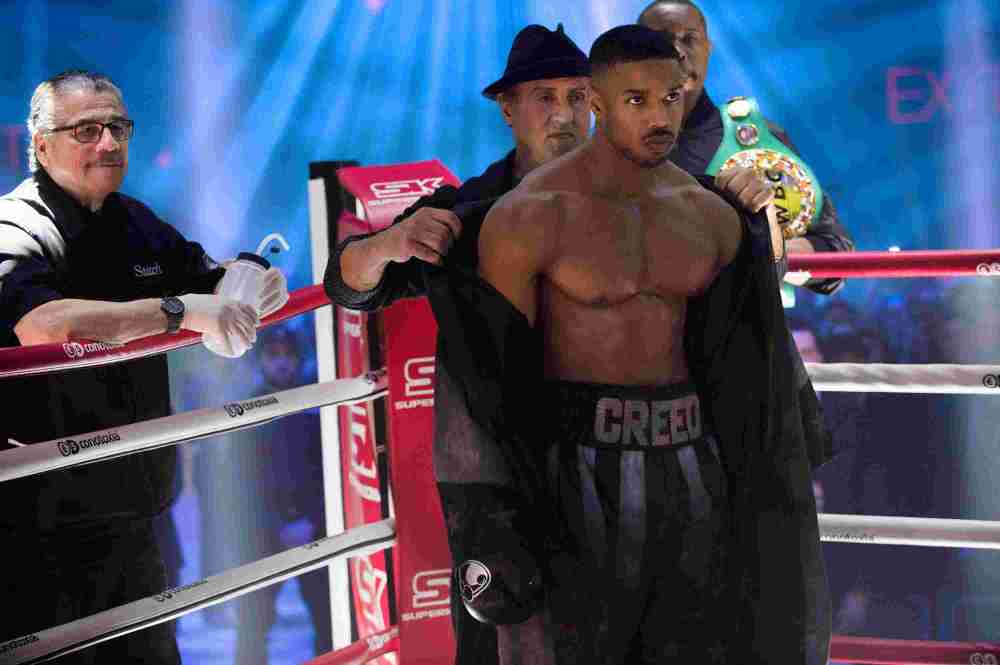
When the film gets started, everything seems to be going well for Adonis Creed.  He wins the World Heavyweight Championship, proposes to his girlfriend, Bianca (Tessa Thompson), and he also has a baby on the way.  His world, however, gets turned upside down when Viktor Drago, son of Ivan Drago, challenges him.  This is the same Ivan Drago who killed his father back in 1985.  Rocky tries to tell him to stay away from the fight and that he is fighting for the wrong reasons.

Adonis’ pride, however gets in the way and he ends up taking on the fight, regardless, and without Rocky his corner.  His life only becomes more complicated and painful from that point forward.  Now, he needs to figure out what to do in order to get his career, his health, and his life back on track.  It won’t be easy for Adonis, but everything in his life has always been a fight.  Rocky just wants him to figure out what he’s fighting for and also realize he has other people counting on him as well.

d24e6495-0c3e-4dab-b23c-8dbb5d45ec29-creed-ii-C2_01907_R2_rgb

There is a lot to like about “Creed II.”  I’m not going to say if it is better or worse than 2015’s “Creed.”  It is just as good.  It is just different, and it is dealing with different themes and different messages.   Jordan gives a knockout (I know, easy pun) performance here.  All of his emotions are in his face, and it’s a performance with a lot of nuance and complexity attached to it.  As an audience member, you understand what he’s doing and why, even if you don’t always agree with him.

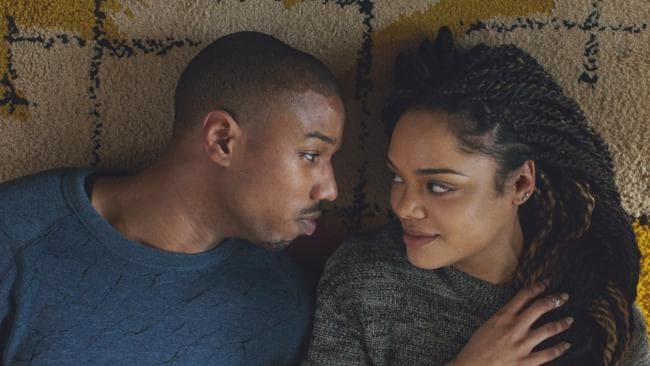
His relationship with Tessa Thompson’s Bianca also brings a big heart to the film.  These two have tremendous chemistry together and it is a joy to watch them on screen.  Stallone has said he is walking away from the franchise after this movie, and it seems like the right move.  Make no mistake about it, Stallone’s the backbone of this franchise and he makes the most of every scene he’s in even though he doesn’t get a lot of screen time.  He does a lot with a little.  I imagine this was intentionally done, as he was one of the writers on the project.

c647a9b07baf8734c2d08e1e71720666

The film deals with the complexity of a father/son relationship and how men are trying to carve out their own image and legacy.  There is a lot of meat in this script, as Adonis is becoming a father himself. Phylicia Rashad is back here once again, and she brings such fierce intensity and knowledge to her role as Mary Anne Creed.  There is not a bad performance in the film.  It’s heartwarming, intense, and very, very entertaining.

With that said, it is not a perfect film.  I would argue it is about twenty minutes too long.  As with most boxing movies, the boxing itself and the training montages are not all that interesting compared to the relationships in the film. What transpires throughout the film will not surprise anyone, but when it’s done with such warmth and commitment from the actors, it helps elevate the material into something really, really special.  While I don’t think we need a “Creed III,” I can’t say I would necessarily mind one if the right people are involved in the project.

* * * ½ out of * * * *

______________________________________________________________________________

Blu-Ray Info: “Creed II” is released on a two-disc Blu-ray combo pack, which also includes a digital copy, from Warner Brothers Home Entertainment. The film is rated PG-13 for sports action violence, language, and a scene of sensuality.  It has a running time of 130 minutes. It is presented in 1080p High Definition with an aspect ratio of 16×9, 2.4:1.  The audio formats are Dolby Atmos-TrueHD: English, DTS MA: English 5.1, English Descriptive Audio 5.1, Dolby Digital: Français 5.1, and Español 5.1. Subtitles are included in English, French, and Spanish.

Special Features:

Fathers and Sons (07:16): This special feature talks about how “Creed II” touches on the father/son dynamic and what a big role it plays in the film and also in life.  Interviews with the cast and crew are featured as well as some famous boxers including Sugar Ray Leonard.  They even talk about the Shakespearean aspects of the story.

Casting Viktor Drago (05:43): This special feature is all about the casting of Florian Munteanu who comes from a boxing background.  Stallone wanted him in the film and saw something special in him.  Munteanu talks about how grateful he is to be in the film as he is familiar with all of the “Rocky” films.  He trained for seven months and really committed to the role, which impressed his fellow actors and the director as well.

The Women of “Creed II” (05:51): Sugar Ray Leonard appears once again, and he gives credit to the women that are alongside the boxers through all of the training and the punishment in the ring.  Director Steven Caple Jr. didn’t just want Tessa Thompson and Phylicia Rashad to be in the background of the film.  He wanted them to get their due.  It’s a big reason why the film is as effective as it is because each and every character serves a significant purpose.

The “Rocky” Legacy (15:01): This is hosted by Dolph Lundgren, and it discusses the impact the “Rocky” franchise has had not only on boxing movies, but also on the sport itself.  They also tie it together with “Rocky IV” and “Creed II.”  The cast and crew of “Creed II” talk about the music, the boxing scenes, and why the franchise has lasted as long as it has going all the way back to 1976.

Deleted Scenes (09:46): One notable deleted scene worth mentioning is one where Rocky performs a eulogy for Spider Rico, the first fighter he ever fought in the “Rocky” films.  It’s a powerful scene and one which should have been in the film despite my issues with its length.  The other three deleted scenes include Rocky training young kids to box, Adonis and Bianca talking about his legacy, and the aftermath of the fight between Adonis and Viktor.