‘We Own The Night’ Has Surprises Up Its Sleeve

We Own The Night movie poster

WRITER’S NOTE: This review was written back in 2007.

We Own The Night” was written and directed by James Gray, and this is the first movie of his I have seen. His previous movies include “The Yards” and “Little Odessa,” and looking at the cast and stories behind those two makes me believe he is more drawn to character driven works. Those kinds of movies threaten to be a dying breed in cinema today, and it is nice to see there are some who are determined to see them still make it to the silver screen even as Hollywood is more obsessed about the latest franchise or blockbuster at their disposal.

From the outside, this movie looks like another Cain and Abel story with two brothers on opposite sides of the law. There is Joseph Grusinsky (Mark Wahlberg), an officer of the New York police department who, as the movie begins, is getting a promotion. He is clearly following in his father’s (Robert Duvall) footsteps, as he is also a cop. Then you have Bobby Green (Joaquin Phoenix) who is also a Grusinsky, but he keeps his mother’s maiden name for his own business ventures. Bobby runs a nightclub which is owned by the Russian mafia, and he revels in the partying and drugs which come along with it. He also has a girlfriend, Amada (Eva Mendes), who dotes on him endlessly.

So, the movie starts off as a story where it looks like one of the brothers is going to kill the other one, and I think this is what kept me from rushing out to see it when it arrived in theaters. From what I had seen in the advertisements, it looked like a story I had already seen far too many times before. I was afraid it was going to be “Backdraft” but with cops instead of firemen. But as the movie went on, it took a number of left turns that broke through all the clichés which threatened to stand in its way. Just when you think you know where things are going, it goes in another direction and keeps you guessing as to what will happen next.

Obviously, Gray has seen a lot of movies from this genre, and he is seriously intent on subverting the expectations of the audience throughout. Not to give anything away, but there is a serious event which occurs early on. Preceding that, Joseph leads a narcotics raid on Bobby’s nightclub which completely infuriates and embarrasses Bobby. They end up getting into a physical confrontation the next day and go their separate ways, but then that serious event happens, and it changes everything and everybody. The person it ends up changing the most is Bobby. He ends up putting his life on the line to right the wrongs which have been inflicted upon his family, and soon his job as a nightclub manager becomes almost completely irrelevant. From there, he moves over to the other side of the law. It’s like the scene where Hugo Weaving waves that sword in front of Viggo Mortensen’s face in “The Lord of The Rings: The Return of the King” and says, “Become who you were born to be!”

This is a purely character driven movie which treads through very familiar waters of many other movies of this genre. At the same time, everything felt fresh and involving to me. A lot of this is due not just to the writing and direction, but also the actors. Joaquin Phoenix has long since escaped the shadow of his famous brother River (he is still missed), and he continues to give one great performance after another. From “Gladiator” and “Walk the Line” to this, he opens himself up completely on an emotional level which makes him all the braver as an actor. He makes you sympathize with a character who starts off as selfish junkie only interested in his own needs and desires. As the movie goes on, he manages to convince you thoroughly of his desire to do good, and to right the wrongs of his sins.

Mark Wahlberg has also put in some strong performances over the past few years as well. He is a guy who has been on both sides of the law, and he managed to come out of the negative elements in one piece. This is a guy who brings his life experience to each role he plays, and he makes you almost completely forget he was Marky Mark and rocking out with the funky bunch years ago. These days, he is the go-to guy for these kinds of roles, and you never doubt his believability as either a good or bad guy.

Then there is Robert Duvall, and he is an actor who cannot seem to do any wrong, and he still never gives us any less than the best of what he has got. There is a moment in this movie where he reacts to an event which has befallen to one of his sons. His reaction to it is not one which can ever be easily faked. It looks from a distance like what he does is easy to do, but it is not. Trust me, you will know the moment when it comes up.

This movie has a number of very intense moments as Bobby goes deep into undercover work and puts his life on the line without even thinking about the consequences. There are action sequences near the end which prove to be very suspenseful and keep you on edge of your seat. There is also a car chase which, while it may not rank among the best ever, is very well done and expertly staged. Seriously, this motion picture was full of surprises throughout.

“We Own The Night” is not quite a great movie as it does tread familiar ground without adding much freshness to it, but it is very well-conceived to where there is no doubt the amount of thought and time Gray put into its making. It is also a movie which cannot be boiled down into one sentence as the story touches on many themes, and that is one of the highest compliments I can pay to any filmmaker these days.

* * * ½ out of * * * *


‘Midsommar’ is the WTF Movie of 2019

Midsommar movie poster

All the horror film fans I have met in the last few months have been saying the same thing: Ari Aster’s “Hereditary” is so fucked up, and they mean this as the highest compliment. Just the name of it is enough to make those who watched it open their eyes ever so wide sound like they are still gasping even months after sitting through it. It reminds me of when I saw Lars Von Trier’s “Breaking the Waves” with my parents, and we are still trying to recover from that cinematic experience twenty years later.

Well, as I write this, I have still not seen “Hereditary,” but I have just seen Aster’s follow up, “Midsommar,” and it was his director’s cut which I got to view. Even before it ended, I found it to be the WTF movie of 2019, and I do not think there will be another released before the end of the year which will equal it in terms of sheer unease. Now I have to watch “Hereditary” as I now wonder which one will seem more messed up than the other. After hearing people attempt to describe “Hereditary” to me before losing their breath, I feel like I have perfect understanding of why they reacted the way they did.

The first fifteen minutes of “Midsommar” is a short film of sorts as we are introduced to graduate students Dani (Florence Pugh) and Christian (Jack Reynor). They are romantically involved, but it does not take long at all to see the cracks in their relationship. Dani confesses to a friend how she is not sure Christian is opening up enough to her, and Christian’s friends keep convincing him to break up with her as he has wanted to for some time. However, when a terrible tragedy suddenly rocks Dani’s already fragile mental state which she treats with Ativan, Christian stays by her side out of a sense of obligation and to not leave out in a wilderness of pain and misery.

Cut to several months later, and Dani is still trying to recover. Christian, although begrudgingly so, invites her to come along with him and some fellow graduate students on a trip to Sweden. Their Swedish friend, Pelle (Vilhelm Blomgren), has invited them to his ancestral commune, the Harga, in Hälsingland, where they can attend a midsummer celebration. The big selling point of this trip is that the specific iteration of this celebration only occurs every ninety years, so it is essentially the equivalent of Haley’s Comet; you miss it now, you may never get another chance.

Aster makes no secret of how “Midsommar” was inspired by, among other films, “The Wicker Man,” and this is even if you have heard of that cult classic but have not seen it. Our main characters are introduced into a place far removed from modern living if not completely removed from technology (someone is always looking for a WIFI signal). Everyone is dressed in the same white clothes, they live off the land and make their own food and crops, and everything seems so beautiful and serene. Of course, looks are always deceiving and, in this story’s case, they are infinitely deceiving.

“Midsommar” has been described as a folk horror film, and Aster himself has called it a “break up movie.” What I admired was how he takes his time with the story to where he does not rush anything at all, and this makes the experience of viewing it all the more enthralling. Even when this loving commune later proves to be a pagan cult which is not always kind to outsiders, you, like the main characters, are not quick to find an escape even if there is a working car nearby. If this were being released by a studio other than A24, I imagine the executives would be asking Aster, “Can you get them to the commune any faster? How about by page 3?

Has this kind of film been made before? Yes, many times, but even as I thought I knew what would happen next, Aster lovingly teases us with our knowledge of the genre to where my expectations were gleefully subverted. While he doesn’t do anything new, he does make this kind of motion picture uniquely his own to where my eyes were pinned to the screen from start to finish.

Aster plays us like a piano throughout as he gives us certain moments which appear to imply what will happen to at least one or more of these characters to where we can only imagine what fate they will bring upon themselves. For instance, the girls in the commune play a game called “skin the fool.” Need I say more?

In addition, Aster has the good fortune of working with cinematographer Pawel Pogorzelski and composer Bobby Krlic, both of whom help make his vision all the more beautiful and deeply haunting. Pogorzelski makes everything here seem so inviting, and this is even after some commune members celebrate the end of life in a most painful way which, if it does not kill them, will involve some Gaspar Noe smashing of the “Irreversible” kind. As for Krlic, he creates a deeply atmosphere music score which sucks us right into the beauty and horror of all we witness. Even if we want to tear ourselves away, there is something which keeps us tightly locked in.

I am not really familiar with Florence Pugh’s work, but she does what many English actors have done before and will do again in the future, play an American character with an American accent. But more importantly, she captures Dani’s fragile mental state perfectly to where all the panic attacks we see her experiencing feel frightening in their authenticity. Trust me, anyone who has experienced any kind of panic attack will tell you this is the real deal, and Pugh inhabits this character fully and fearlessly.

A good deal of credit also goes to Jack Reynor as he boldly makes Christian into one of the most thoughtless boyfriends ever in cinematic history. Upon witnessing a ritual suicide, Christian first reacts in horror, then he decides he wants to do his graduate thesis on the commune despite one of his fellow classmates already planning to do so. Reynor also allows himself to be completely nude during and after one of the most deranged sex scenes ever filmed (trust me, you have to see it to believe it), and he did this after watching films like Wes Craven’s “The Last House on the Left” in which the female characters were made to disrobe, run around nude and be humiliated. The way Reynor saw it, the time had long since come where a male character suffered similar indignations. Well done Mr. Reynor, well done!

“Midsommar” is not your typical horror film in which you jump out of your seat every five minutes. Aster is instead more interested in getting under your skin, and just when you think he cannot get any deeper under it, he does. There was a lot of laughter at the screening I went to, but this should be expected. In reacting to what is shown onscreen, you cannot help but laugh as it is a good way to deal with the more deranged moments this film has to offer. Furthermore, I think Aster wanted us to laugh because even he saw just how fucked up this screenplay could get even as he wrote it. I myself have come to love wonderfully unnerving films as they offer me I kind of release the average studio movie never does, and I am glad we have A24 around to release something like this which freely goes against what is considered mainstream entertainment.

I am now eager to see where Aster will go from here as “Midsommar” as the work of someone who has seen hundreds of horror movies and has since taken what he learned and created one which is all his own. And yes, I will take the time to watch “Hereditary” as well. In a time when Hollywood is still all too frightened by originality, I am eager to see more movies like this made. For crying out loud, it has a Cinemascore rating of a C+. What more evidence do you need to show this is a daring and unique motion picture experience?

I’m just glad one of the characters found their smile again before the screen went to black. Seeing that was a major relief.

* * * ½ out of * * * *

‘Spider-Man: Far from Home’ is a Fun Ride, and it May Be the Web Slinger’s Last in the MCU

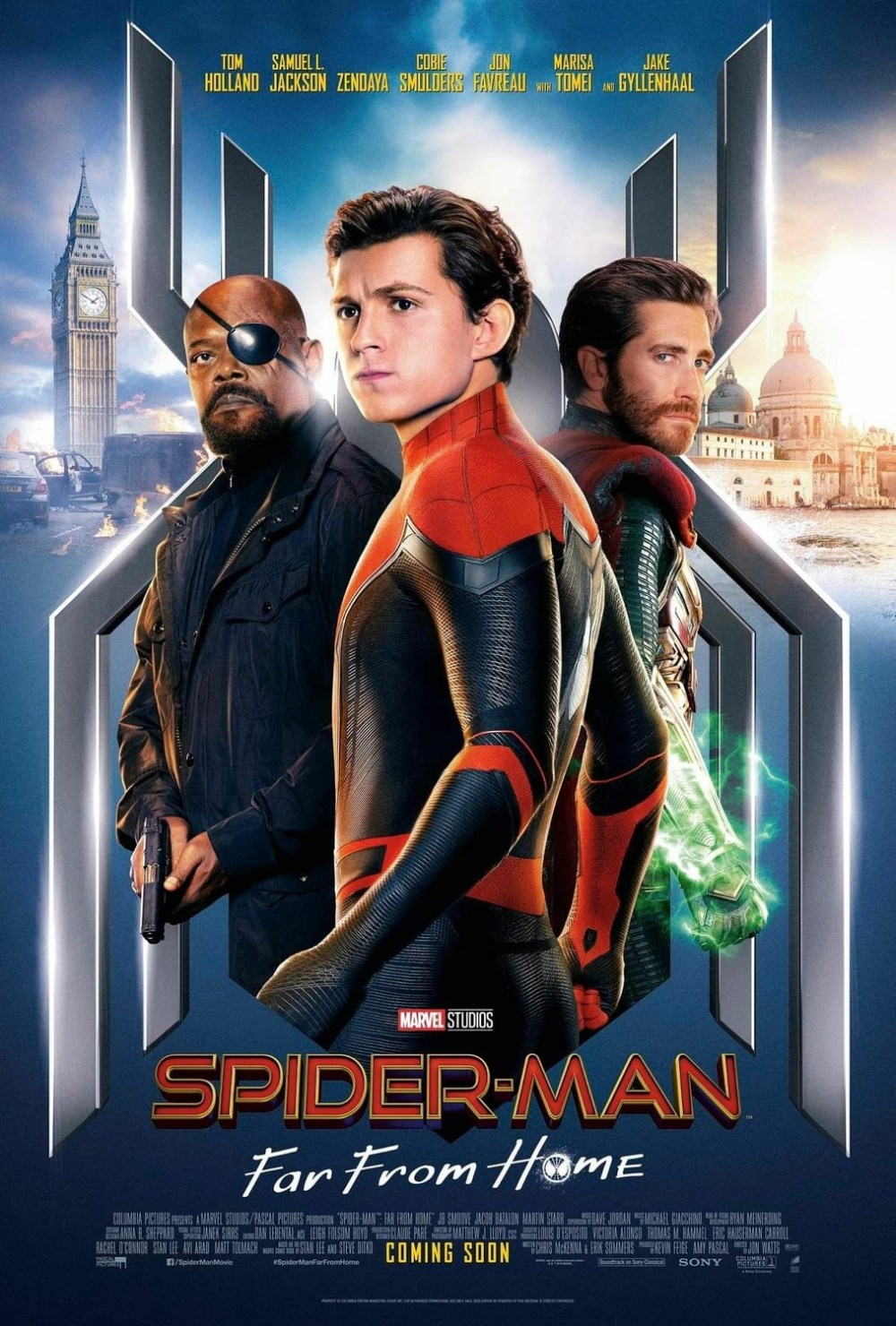
Spider Man Far From Home Theatrical Poster

So, after a summer filled with an endless need to make ends meet, I finally got the chance to check out “Spider-Man: Far from Home.” Watching it at this point proves to be bittersweet as this may be the character’s last time in the Marvel Cinematic Universe since Disney and Sony are in a battle over profits. Spider-Man does whatever a spider can, but even a spider can fight only so much against greed and capitalism before he is undone or rebooted. It’s a crying shame because Peter Parker and his alter-ego were wonderfully reinvigorated thanks to Tom Holland who, ever since “Captain America: Civil War,” has proven to be the best Spider-Man yet. Here is hoping this will not be the last time we see Holland in this role as he keeps us invested in this teenager’s never-ending struggle between managing adolescence and being a superhero.

Eight months have passed since the events of “Avengers: Endgame” in which our heroes thwarted Thanos’ snap (everyone else calls it “the blip”) but did so at a great cost. Peter still mourns the death of Tony Stark as he tries to get back to being just a friendly neighborhood superhero, but Tony’s face is everywhere and it seems like everyone else expects Spider-Man to be the next Iron Man. It’s a lot to place on the shoulders of any one person, let alone those of a teenage boy eager to tell the girl he has a mad crush on how he truly feels about her.

A better title for this “Spider-Man” outing would have been “Spider-Man’s European Vacation” as Peter and his classmates which include his best friend Ned Leeds (Jacob Batalon) and love interest MJ (Zendaya), travel to Europe and some neighboring countries. Peter sees this as a much-needed opportunity to take a break from his Avenger duties and just be a kid, and Ned sees it as a chance for the two of them to be American bachelors in Europe because, or so he says, “Europeans love Americans.”

Of course, none of us can expect any Avenger to get much vacation time as the Water Elemental strikes with a vengeance in Venice, leaving our characters to run for their lives. Peter quickly springs into action, but he is aided by another superhero who goes by the name of Quentin Beck (Jake Gyllenhaal), but we all come to know him as Mysterio. Even though the two of them save the day, Nick Fury (the always reliably bad ass Samuel L. Jackson) shows up to tell him his help is needed. Peter protests how he is not ready to extend his duties beyond Queens, New York, but Fury bluntly reminds him, “Bitch, you’ve been to space!”

“Spider-Man: Far from Home” works best when it focuses more on the human element than on the spectacle. Spider-Man has always proven to be one of the most human of superheroes in movies and literature as his personal problems are no different from the ones we experienced at his age. Deep down, we all wanted to seem normal to our fellow classmates, and so does Peter. Still, hormones and awkwardness among other things needlessly but inevitably complicate our lives to where we are left with a lot of emotional scars which take forever to heal, if at all. Peter Parker is the MCU’s prime example of this, and it makes you admire him all the more as his juggling act is made all the more challenging throughout.

Jon Watts returns to the director’s chair after having done an excellent job with “Spider-Man: Homecoming,” and he infuses this installment with the same amount of fun and excitement. Along with screenwriters Chris McKenna and Erik Sommers, he makes Spider-Man’s predicament parallel with the insane times we live in as “alternative facts” and “fake news” have been given far more power than they ever deserved. Whether or not our heroes win the day, we are left to wonder if they will ever be able to fully control the narrative. As one character points out late in the film, “People need to believe, and nowadays they’ll believe anything.” As much as I hate to quote Rudy Giuliani in this or any other review, his ridiculous statement of how “truth is not truth” is played to great effect throughout this movie and its post credit scenes.

The thin line between reality and fiction is put to the test in an amazing sequence in which Spider-Man is thrust into a simulated world which alters his perception of reality in the same frightening way Jennifer Jason Leigh and Jude Law were in David Cronenberg’s “Existenz.” Just when Peter thinks he has a handle on things, so do we, and this proves to be our Achilles heel as reality is not at all what it used to be.

The climatic battle in “Spider-Man: Far from Home” ends up containing a bit too much in the way of CGI and suffers from overkill as a result. It is entertaining to sit through, but the overuse of visual effects ended up taking me out of the action more than I would have liked, and it makes this sequel pale in comparison to “Homecoming.” It always sucks when you watch a visual effect knowing it is a visual effect because there are many moments in this film which made me feel the exact opposite. Still, it failed to take away much of the enjoyment I had in watching these characters suffer through one of the best and worst field trips any of us could ever hope to have.

I also gotta say just how much I love this cast of actors. Aside from Holland, you have the great Martin Starr who is a deadpan delight as academic decathlon teacher Roger Harrington, “Iron Man” director Jon Favreau who gleefully returns as Harold “Happy” Hogan, Marisa Tomei who has long since proven to be the most alluring Aunt May of all, Cobie Smulders who remains an enticing and powerful presence as Maria Hill, and J.B. Smoove is a hoot to watch as science teacher Julius Dell. In addition, Tony Revolori returns as Peter’s classmate and YouTuber Eugene “Flash” Thompson as it allows us to see something many of us have wanted to see done to the most annoying YouTubers of all; get a swift kick in the balls.

It’s fascinating to watch Gyllenhaal here as he was almost cast as Spider-Man at one point. Seeing him making his first appearance in the MCU is a most welcome one as he has long since proven himself an actor to be reckoned with in movies like “Nightcrawler” and “Nocturnal Animals.” As Mysterio, he makes this character a complex one as he sympathizes with Peter’s plight while proving to be a bit of an enigma. When the truth of Mysterio is revealed to all, it made me respect Gyllenhaal’s performance all the more as it shows how he has to play not just with Peter’s mind, but the audience as well. Looks can be deceiving, and Gyllenhaal makes them especially deceiving here.

Like I said, watching “Spider-Man: Far from Home” proves to be very bittersweet as this may very well be the very last time we see this iconic character as part of the MCU. It’s a real shame as the first post credit scene we get foretells of a dark future for Peter Parker as his life is completely compromised through, among other things, doctored footage. Where can he go from here? It’s an infinitely interesting question.

Whatever happens from here, we will always have J. Jonah Jameson.

* * * out of * * * *


‘The Art of Racing in the Rain’ – Cynicism Be Damned!

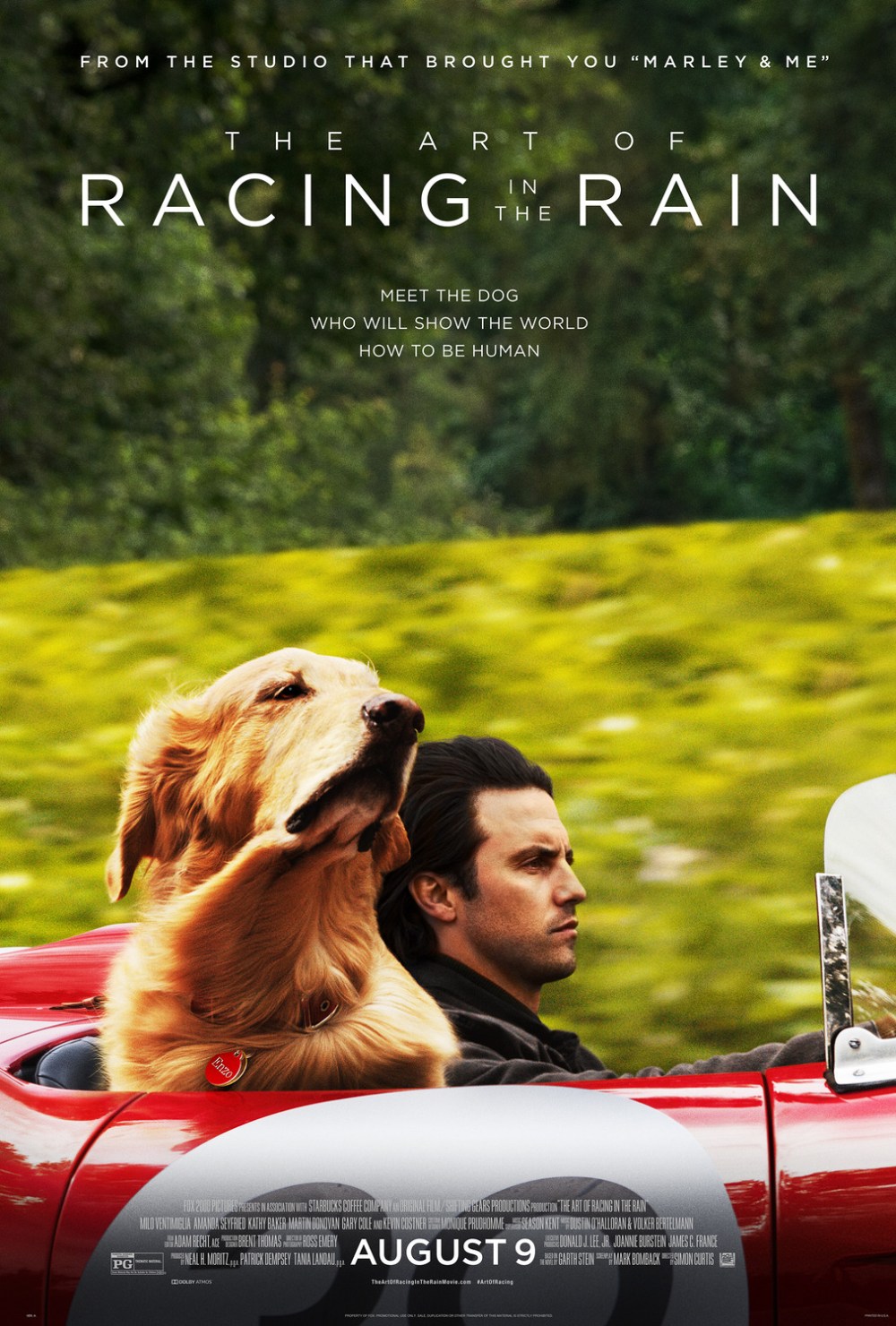
The Art of Racing in the Rain movie poster

Okay, I get why people in general are being resistant to and are cynical about this particular movie. A story told from a dog’s point of view? Even I had trepidations as I entered the theater to check this inescapably sentimental feature which looks to have many visuals of an adorable dog or two. Was this dog going to have a “Mr. Ed” relationship with his owner? How many scenes would we get of the dog sniffing another dog’s butt? Trust me, I have been to dog parks and I have seen them do this endlessly. And considering how this dog’s owner is a race car driver, will the dog be able to advise him of how to keep sliding out of control on the track even if it isn’t raining? Indeed, it says a lot about a race car driver who can drive in the rain without skidding or getting into an accident, and only so many can pull this off.

Well, it should be noted how Garth Stein’s novel “The Art of Racing in the Rain,” upon which this movie is based, brought about a similar reaction as Stein’s literary agent laughed at its concept from the get go. As a result, Stein fired him and had the last laugh as the novel spent over 150 weeks on the New York Times best seller list. Now it has finally been turned into a motion picture, and I have to admit I was truly taken in by it. While it breaks no new ground, “The Art of Racing in the Rain” moved me in a way I did not expect, and it is not at all an exercise in emotional manipulation or filled with an endless supply of cringe-inducing moments.

We meet Denny Swift (Milo Ventimiglia), a race car driver, as he stops by a farm to see the puppies on display. One of them is quick to capture his attention, and we can see how quickly the two form a bond which we know will never be broken. It’s a sweet moment as even the most jaded viewer has to admit how cute puppies are, and no Sarah McLachlan song is utilized at any time to sell us on this connection (for the record, I love Sarah McLachlan).

Denny comes to name his new dog Enzo after Enzo Ferrari, the Italian motor racing driver and entrepreneur who made the kind of car I keep asking my parents for at Christmas time. Enzo completes the bond between him and Denny by taking a piss on his apartment floor, and this is after Denny hurriedly takes him outside to pee on the grass. Still, like Jack Nicholson in “Wolf,” he had to mark his territory before being properly potty trained.

Throughout “The Art of Racing in the Rain,” we are privy to Enzo’s inner thoughts as he spends his days watching races on television with Denny, and he even goes with him to races to where he realizes how racing serves as a metaphor for life. Moreover, Enzo becomes infinitely keen on being reincarnated as human in the next life after watching a documentary about a particular Mongolian legend. Can he make this happen? Does the answer really matter?

The filmmakers prove to be very knowledgeable about dogs, and this made the movie especially interesting to me. A dog’s sense of smell really comes to the forefront as Enzo eventually realizes a certain character is very ill, and it breaks the heart to see the concern on his face which cannot be verbalized to this person. It was at this point I wished dogs could talk because this particular character could have gotten medical attention a heck of a lot sooner. Imagine what Enzo would say, “Hey buddy! You’re sick! See a doctor now or I’ll chase you up a tree!”

But while the characters cannot hear Enzo’s inner thoughts, we can thanks to Kevin Costner. Upon learning he would be voicing Enzo, I was concerned Costner would give Enzo’s narration the same monotone delivery he gave John Dunbar in “Dances with Wolves,” and that movie is a bona fide classic. However, he captures Enzo’s wise nature which is not easily corrupted by money, greed or an inescapable addiction to cellphones, and not once does he overplay a single moment which is much appreciated. Even as Enzo groans about Eve (the ever so radiant Amanda Seyfried) coming into Denny’s life as a certain line of dialogue from “Killing Zoe” flashed through my mind (“never let a woman come between two men”), Costner shows how Enzo evolves through each new person who comes into his life and of the challenges thrown in his way.

Directing “The Art of Racing in the Rain” is Simon Curtis, the filmmaker who first introduced us to Daniel Radcliffe in his version of “David Copperfield,” and who also directed one of the most underappreciated movies of 2017 with “Goodbye Christopher Robin.” This could have been an emotionally overwrought cinematic experience, but Curtis keeps things grounded in a certain reality we can all relate to, and he is very careful to not milk our emotions too much throughout. Just when I thought things would start getting overly sentimental, Curtis succeeds in keeping everything in check to where any cynical thoughts we had about this movie were completely done away with.

I should also add I saw this movie with my parents who have in fact read Stein’s novel, and they both confirmed Mark Bomback’s screenplay is very faithful to the source material. Yes, there are predictable moments such as when a character dies prematurely or when the grandparents (played by Kathy Baker and Martin Donovan) sue Denny for custody of his and Eve’s daughter, Zoe (the delightful Ryan Kiera Armstrong), believing Denny’s career will leave him little time to be at home. My parents, however, reminded me how people with money often do this in life more often than I realize, so this is clearly not so shallow plot device to get us all miffed at the grandparents.

And yes, this movie starts out with the inevitable, with Enzo in his last days lying on the floor and waiting for Denny to come home. Curtis eventually circles back to this moment as we are reminded of the unbreakable bond between humans and dogs, and it leads to a lovely moment where Enzo gets one last spin in a classic car. Few movies in 2019 have gotten me choked up, but this one did.

“The Art of Racing in the Rain” is not a masterpiece of cinema, but it does its job and gives us an emotionally fulfilling time at the movies. Its take on dogs is very thoughtful, and if you were never keen on owning an animal before, this movie may change your mind. It’s a shame this project has proven to be a hard sell for audiences as its storyline seems too ridiculous on paper to be taken seriously. I cannot really blame people for having a cynical attitude to this material as I certainly did, but what results is a very good movie which will check your cynicism at the door if you give it a chance. And if you never thought about owning a dog before, seeing this movie just might change your mind.

As for myself, I am in no hurry to own any pets as stuffed animals, especially Eeyores, are more than enough for me. And to Curtis’ and Bomback’s credit, there is a scene where Denny has to take Enzo to the vet, and we are reminded of just how much caring for a pet can cost. The love of a pet can be a great thing, but it can also be seriously expensive. Still, there is no doubt in mind we can get more love from a dog than Chevy Chase did in “Funny Farm.”

* * * ½ out of * * * *

‘Once Upon a Time in… Hollywood’ – A Quentin Tarantino Fairy Tale

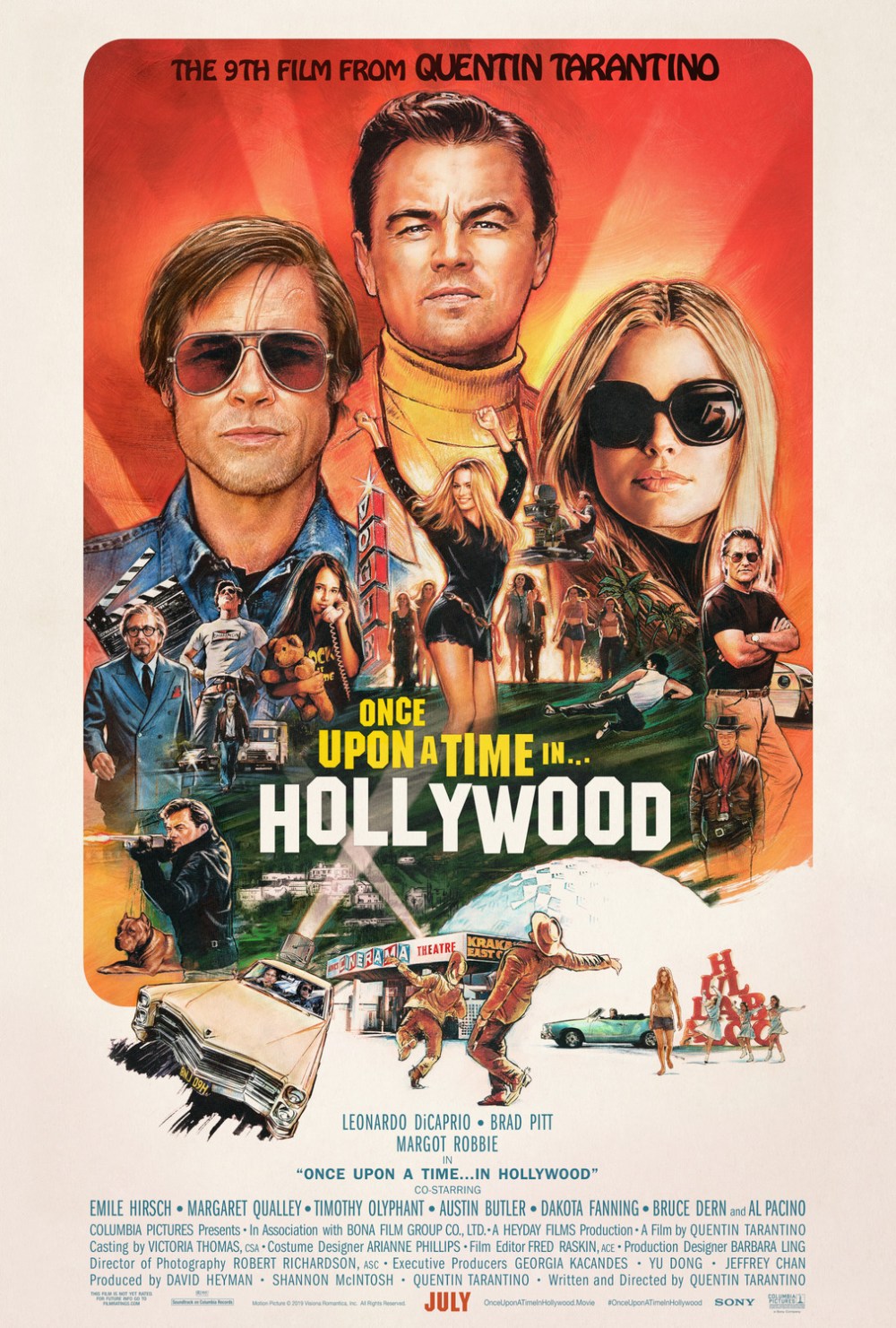
Once Upon a Time in Hollywood movie poster

Quentin Tarantino once said he did not have an “Age of Innocence” in him like Martin Scorsese did, but after watching his 9th film “Once Upon a Time in… Hollywood,” I think he may be mistaken. Yes, it does have an R-rating like and features some truly brutal moments of violence where faces are literally pounded in, but this is largely a loving tribute to the Hollywood of the 1960’s and of the actors and filmmakers which inhabited it. Considering Tarantino’s attention to detail and his fetish for any kind of artifact from this era, I have no doubt he would have loved to have been a filmmaker back then if he could.

Tarantino and his longtime cinematographer Robert Richardson transport us back to the Hollywood of 1969 where we meet Rick Dalton (Leonardo DiCaprio), an actor and former star of a “Wanted Dead or Alive”-like television series called “Bounty Law.” After having a conversation with his agent Marvin Schwarzs (Al Pacino, more restrained than usual), he comes to see how washed up his career has become as he is reduced to doing guest spots as the villain on various television shows. The only person he can talk to about his troubles is his best friend and stunt double Cliff Booth (Brad Pitt) who is always around to have a drink with and drive him around town as Rick has had one DUI too many.

“Once Upon a Time in… Hollywood” is kind of like a Robert Altman film in that it doesn’t have a straightforward plot. Instead, it acts as a day in the life story as we watch Rick Dalton try to move on with his acting career as an important decision hangs over him, whether or not to move to Italy where he can star in low budget spaghetti westerns. When the story isn’t focused on him, it focuses on Cliff who seems content to live in a trailer out in Van Nuys with his dog who is a bit annoyed at him for serving him the kind of dog food which slides out of its steel can as if it were pure slime.

The only thing Rick seems fairly excited about these days is the fact Roman Polanski and Sharon Tate now live next door to him in the Hollywood Hills. But looming in the background is Charlie Manson and his cult of followers who look at first to be harmless hippies, but they later reveal themselves to be devoted to him in a most unhealthy way. Those of us who are familiar with history, and who have a deep respect for historical facts, know Sharon Tate and others were murdered by Manson’s followers, and that this shocking act all but ended the era of love and peace irreparably. But as I watched this film, I began to wonder if Tarantino would stay true to history, or if he would play around with it as he did in “Inglourious Basterds.” Whatever the case, the presence of Manson and his cult cast an ominous shadow over the proceedings, so we know the end of this story will not be the least bit pretty.

Watching “Once Upon a Time in Hollywood” reminded me of how much I love it when a filmmaker sucks us right into another time and place to where we don’t doubt the accuracy and attention to detail. Cameron Crowe did this with “Almost Famous,” Paul Thomas Anderson did wonders with the 70’s and 80’s in “Boogie Nights,” and Tarantino does the same as he brings us right back to 1969 with wonderful abandon. All the famous landmarks of Hollywood are here including the Cinerama Dome, Musso & Frank Grill, El Coyote Restaurant and the classic movie theaters located in Westwood. New Beverly Cinema can be seen from a distance as it is shown having a premiere for an adult film, and this was back when it was a porno theater.

This attention to detail also includes the kind of beer these characters drank, the type of books they read, television antennas and cars. This was back in a time when people smoked an endless number of cigarettes, drove and sat in cars without having to wear seatbelts, and when love and peace was in the air even as wars were being waged overseas.

It is great fun to see DiCaprio in this kind of role after seeing him be so serious in “The Revenant,” a movie which earned him the Oscar he should have received for “The Wolf of Wall Street.” He’s a gas here as he makes Rick Dalton into a study of desperation as he struggles to maintain what’s left of his image and berate himself while alone in his trailer. The scene he has with a child actress played by the wonderful Julia Butters is a special highlight as she shows him the kind of innocence and love of acting he once had before life, alcohol and a corrupted world view clouded his perception.

As I have said in the past, I love it when Pitt gets down and dirty in a role, and he does just this as Cliff Booth. In addition to being Rick’s stunt double, he is also a Vietnam veteran, and the violence he inflicts on others who wrong him can be described at the very least as punishing. Pitt also proves to be as funny as DiCaprio from scene to scene, and he has a classic scene opposite Mike Moh who is pitch perfect as Bruce Lee in which I saw something I never thought I would see or believe, someone getting the best of Bruce Lee.

But one performance I really need to single out here is Margot Robbie’s as Sharon Tate. While at the Cannes Film Festival, someone asked Tarantino why he didn’t give Robbie the same amount of dialogue he gave DiCaprio and Pitt. I don’t remember who asked this question, but whoever it was, they completely missed the point. It’s not always dialogue which aids a performance. Sometimes it’s just a look or an attitude, and Robbie gives off a look or two which is more than enough to capture the essence of Sharon Tate as well as her beguiling innocence.

Tate has long been relegated to history as one of the Manson family’s murder victims, but she deserves to be known for much more. As Robbie sits in a Westwood movie theater watching a movie Tate co-starred in, we are reminded of a talent which was taken away from this world far too soon, and it makes me want to check out everything Tate ever appeared in. Robie does a fantastic job of reminding us how fun it is to see ourselves, let alone our name, on the silver screen as others look on, unaware of who is sitting next to them in the audience, and she is as radiant as Tate was in her far too brief lifetime.

There are so many familiar actors worth singling out here, but some of them you may not see coming and I am not about to spoil any surprises this film has to offer. I will say it’s always a delight to see Kurt Russell in anything and everything, and he is great as a stunt coordinator who is not quick to warm up to Cliff. Margaret Qualley is a memorable presence as Pussycat, a member of the Manson family who does warm up to Cliff. Bruce Dern, in a role originally meant for the late Burt Reynolds, is fun to watch as George Spahn, a man whose ranch was used for many westerns and which later got used by Charlie Manson and his demented followers. And it is quite bittersweet to see the late Luke Perry as it is the last feature film he will ever appear in.

Seriously, as rough and tumble as “Once Upon a Time in Hollywood” gets, it really is a love letter to a Hollywood which time will never forget. As Tarantino nears the end of his long filmmaking career (or so he says), he continues to give us one enthralling motion picture experience after another. Even if his works threaten to be undone by self-indulgence, I am glad people are thoughtful enough to give him the freedom to make what he wants to make. If Tarantino ever had it in him to give us a fairy tale, this would be it. Even as its main characters threaten to be forever swallowed up by bitterness and cynicism, there is a light of innocence which helps lead them to the next stage in their lives. And if this film is any indication, this is time in Hollywood which Tarantino wishes lasted longer than it did.

Now, as with any Tarantino film, I have to go out and buy the soundtrack and then watch it again. And one other thing, I almost didn’t recognize Timothy Olyphant. Did you? Oh yeah, and sauerkraut will never be the same.

* * * * out of * * * *

‘Django Unchained’ – Tarantino’s Down and Dirty Western

Django Unchained movie poster

WRITER’S NOTE: This review was originally written in 2012.

Every time Quentin Tarantino releases a new movie, a celebration should be in order. The man loves movies like many filmmakers do, but he always succeeds in manipulating genre conventions to where he can freely make them his own, and this makes his works all the more thrilling. There’s also no beating his dialogue which exhilarates us in the same way a play by David Mamet can, and words in a Tarantino movie usually prove to be every bit as exciting as the action scenes. His latest movie “Django Unchained” is no exception, but it does suffer from some of his excesses which have taken away (if only slightly) from the films he has given us in the past. But if you can get past its flaws, you are still in for a very entertaining time.

Jamie Foxx stars as the Django of the movie’s title, and it takes place in the year 1858 which was just two years before the start of the Civil War. Django is being led through the freezing cold wilderness along with other slaves when he is freed by Dr. King Schultz (Christoph Waltz), a dentist who has since become a bounty hunter. King needs Django’s help in finding the Brittle brothers, ruthless killers who have a sizable price on their heads. In return for Django’s help, King promises him he will help rescue his wife Broomhilda (Kerry Washington) from slavery. She is currently in the hands of the charismatic but viciously brutal plantation owner Calvin Candie (Leonardo DiCaprio), and you know this will lead to a conclusion which will be anything but peaceful.

Tarantino always loves to mix genres, and he does this brilliantly with “Django Unchained.” On the surface it is clearly a western, but the “Pulp Fiction” auteur also combines it with the Blaxploitation genre which we all know is one of his favorites. Heck, we even get to meet the ancestors of John Shaft, the black private detective made famous by Richard Roundtree in the movie “Shaft.” Just as he did with “Inglourious Basterds,” Tarantino gleefully throws caution to the wind as he subverts both genres to create an exhilarating motion picture experience few other people can give us. He’s not out to make a historically accurate movie, but we’re having too much fun to really care.

Now many people including Spike Lee have complained about Tarantino’s overuse of the n- word in this movie as they have of other films he’s made in the past. In their eyes it’s like they’re saying Tarantino revels in the racist behavior of his characters, but I don’t think that’s even remotely true. All the insanely racist characters in “Django Unchained” end up getting their asses handed to them in the most painful way possible, and while Tarantino’s love of black culture might differ a little from others, the love is there all the same.

And again, Tarantino gives us a terrific soundtrack filled with many songs which are not from the time period this movie takes place in. I love how he complements scenes of Jamie Foxx and Christoph Waltz riding on their horses with songs by James Brown, John Legend and Brother Dege (AKA Dege Legg) among others. He also includes pieces of film scores by Ennio Morricone and Jerry Goldsmith for good measure, and there are even original songs to be found here as well, something exceedingly rare for a Tarantino movie.

Having said all this, the length of “Django Unchained” did drive me up the wall a bit. At a time where filmmakers push the limit and have their movies run longer than two hours, Tarantino proves to be one of 2012’s biggest sinners as this one clocks in at almost three hours and threatens to have as many endings as “The Lord of the Rings: The Return of the King.” Suffice to say, this movie could have been shorter. Perhaps it’s the absence of his longtime editor, the late Sally Menke, who was always good at reigning Tarantino in. Fred Raskin, who has edited the last three “Fast & Furious” movies, was the editor on this one.

Still, there is a lot to appreciate and enjoy about “Django Unchained,” especially the acting. Jamie Foxx has proven to be a terrific actor ever since he held his own opposite Al Pacino in Oliver Stone’s “Any Given Sunday,” and his talent doesn’t waiver in the slightest here. As Django, he gives us a western hero who has earned the right to seek vengeance for what has been done to him, and he is thrilling to watch as he makes this character a shockingly bad ass bounty hunter by the movie’s conclusion.

Christoph Waltz brings a wonderful mirth and a unique liveliness to the exceedingly violent characters he plays, and his role as dentist turned bounty hunter Dr. King Schultz is further proof. It’s fun to see him be so charming to others only to watch him blow them away when the occasion calls for him to do so. Waltz more than earned the Oscar he received for his brilliant performance in “Inglourious Basterds,” and his work in “Django Unchained” proves he is a gifted actor who is here to stay.

Leonardo DiCaprio clearly relishes the opportunity to shed his heartthrob persona to play the charming yet undeniably evil plantation owner Calvin Candie. In a year which has had a large number of unforgettable villains, Calvin is one of the most vicious as his power and wealth has turned him into a raving sociopath who has little hope of finding redemption in his lifetime. DiCaprio is enthralling to watch as he taunts everyone around him with a twisted glee, and he looks to be having loads of fun in playing a character few others would have chosen him to play.

One standout performance which really needs to be acknowledged, however, comes from Samuel L. Jackson, an actor who has played parts both big and small in Tarantino’s movies. Jackson plays Calvin’s head slave Stephen who is the Uncle Tom of “Django Unchained,” and he makes you want to hate his racist, backstabbing character with a passion. Jackson gives a spirited performance as a man who freely betrays the principles he should be standing up for in order to benefit his own desires and keep himself safe in a time where he is anything but.

Kudos also goes to Kerry Washington who plays Django’s kidnapped wife, Broomhilda. Her character suffers many indignities, and Washington makes her pain and fear so vivid to where she leaves you on edge every time she appears onscreen. The moments where she has no dialogue are among her most powerful as her eyes threaten to give away the secrets she is desperate to keep hidden.

Seriously, this movie is filled with actors we know very well, and they keep popping up here when you least expect them to. You have Don Johnson playing plantation owner Spencer ‘Big Daddy’ Bennett, you have Jonah Hill as Randy, a bone-headed KKK member who can’t seem to fix his hood properly, you have Walton Goggins playing an unapologetically vicious cowboy who enjoys the torture he inflicts upon others, and you have Dennis Christopher as the flamboyant Leonide Moguy. If you watch real closely you can also see Zoë Bell, Robert Carradine, Franco Nero, M. C. Gainey, Bruce Dern, Tom Savini, Michael Parks and John Jarratt pop up in roles which would seem small if they were played by anybody else. It’s all proof of how there are no small roles in a Tarantino movie, and all these people are clearly thrilled to be in his company.

Tarantino also has a small role as a mining company employee. While I have no problem defending him as an actor in some movies, his Australian accent could use a bit of work, and that’s being generous.

I’m not sure where I would rate “Django Unchained” in comparison to Tarantino’s other films, but I have to say I enjoyed “Inglourious Basterds” more. This movie’s nearly three-hour length took away from my overall experience, but I can only complain about it so much. When it comes to movies, Tarantino still provides audiences with the kind of enthralling entertainment which never plays it safe.

While it’s far from perfect, “Django Unchained” is a thrillingly alive movie filled with great acting, terrific dialogue and incredibly bloody gunfights Sam Peckinpah would have gotten a kick out of. If you can withstand its excesses and know what you are in for when it comes to a Tarantino movie, you are still bound to have a great time watching it.

* * * ½ out of * * * *


‘Inglourious Basterds’ is a World War II Movie Done The Tarantino Way

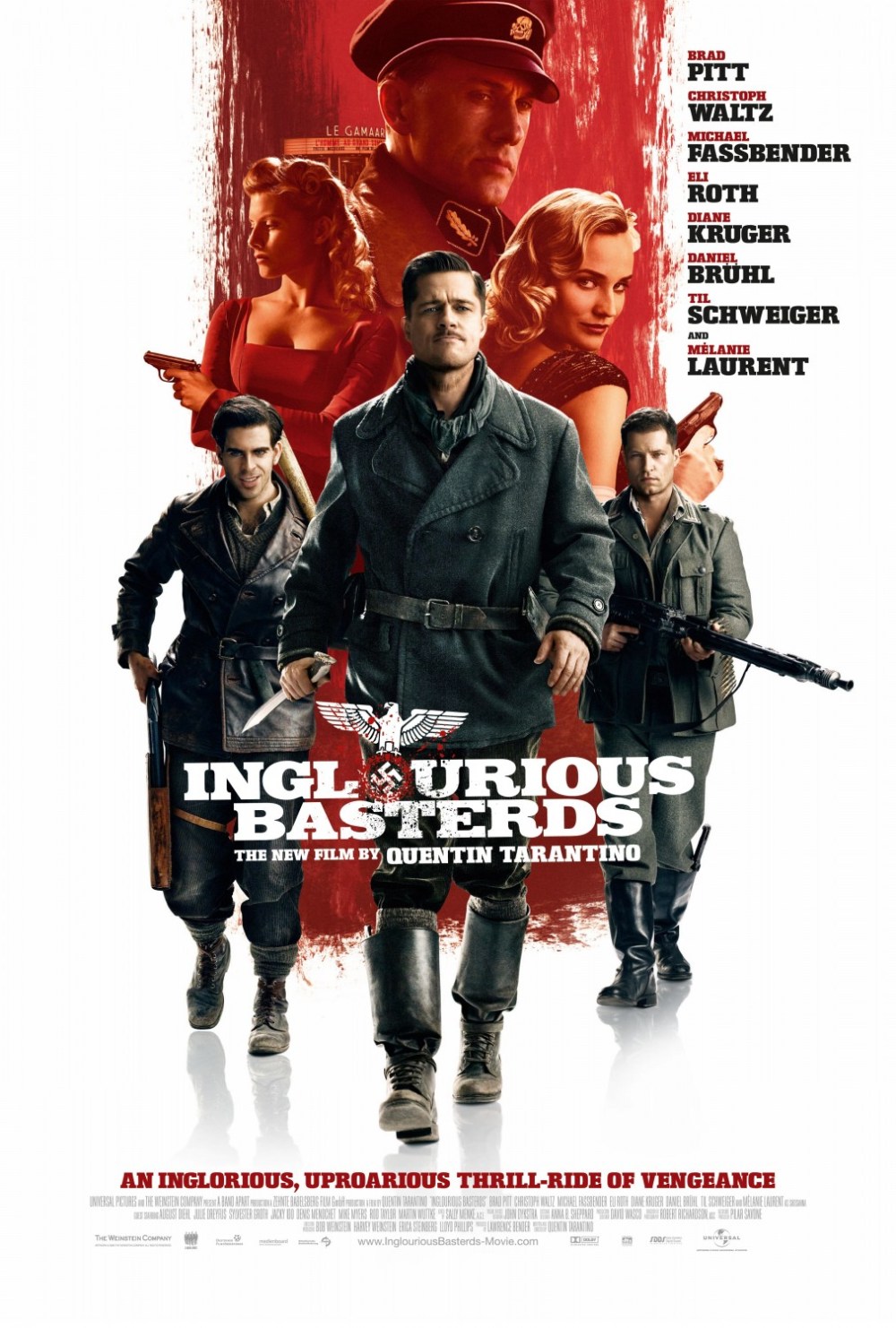
Inglorious Basterds movie poster

WRITER’S NOTE: This review was originally written in 2009.

 “Nazis, I hate these guys!”

                        -Harrison Ford from “Indiana Jones and the Last Crusade”

 “You know somethin’, Utivich? I think this might just be my masterpiece.”

                                                                                    -Brad Pitt as Lt. Aldo Raine

 Could this truly be Tarantino’s masterpiece? Hard to say, but it is indeed his most ambitious movie to date. “Inglourious Basterds” is another brilliant love letter to all things cinema from Quentin Tarantino, and it ends the rather crappy 2009 summer movie season on a high note. With this film, Tarantino has created his own version of World War II and has given it an ending many of us would have preferred to have seen happen. It is also his tribute to movies like “The Dirty Dozen” and other war movies of its ilk. It is not a remake of the film of the same name, but it uses the same title out of respect.

“Inglourious Basterds” is told in a series of chapters, and it features several different threads of story which eventually intersect at the film’s fiery climax. We meet our chief Nazi villain, Col. Hans Landa (Christoph Waltz) as he questions a family as to whether or not they are hiding any Jews, but we soon realize he is asking questions he already knows the answers to. Then we are introduced to the Basterds themselves, and they are led by Lt. Aldo Raine (Brad Pitt) who announces that they are being dropped into Nazi occupied France to do one thing and one thing only, kill Nazis. Not only that, they plan to take souvenirs to show the Nazis they mean business. Then we meet Shosanna Dreyfus (Melanie Laurent), the only Jew to escape Col. Landa’s deadly grasp, and she has since found a safe hiding place as the owner of a German cinema which will soon host the most powerful members of the Nazi party for a film opening gala. Little do they know of the act of brutal vengeance which will eventually greet them…

At a running time of 153 minutes, “Inglourious Basterds” is one of those rare movies which really takes its time. There’s no big rush to get from one big action set piece to the next which is usually case with just about every summer movie released from one year to the next. Even while The Weinstein Company had to work with Universal Pictures to get this film made, Tarantino still gets full creative control which is a blessing for those of us who love his films. We also get the great dialogue we have come to expect from him, and there are moments where words speak louder than actions. There are many verbal duels between characters as each one tries to outdo the other, and what is implied by them ends up generating an amazing amount of tension.

Tarantino also retains a keen eye for casting, and he has said one of the actors he chose did in fact give him back his movie. That actor would be Christoph Waltz who plays the intelligent but deadly Col. Hans Landa. Waltz won the Best Actor award at this year’s Cannes Film Festival, and the way I see it, they should just hand him the Oscar come next March. Brilliant seems too subtle a description to describe his performance. His role is an extremely difficult one to pull off because he has to come off a certain way while allowing us to see in his eyes what he already knows. Waltz comes off with simple gestures which leave us deeply unnerved, and there is a key moment where he deals with a character that serves as a great cat and mouse moment as he tries to figure out the person he sees before him while she tries to remain calm and hide who she really is from him. Waltz’s opening scene with the French farmer is remarkable in how he psychologically tears him down to where he finally admits he has no choice and reveals what Landa already knows.

I’m not sure if I have seen Waltz in other movies before this one, but I look forward to seeing more of his work in the future. Seriously, his character is to “Inglourious Basterds” as Heath Ledger’s Joker was to “The Dark Knight.”

Then we have Brad Pitt who I am glad to see get down and dirty after being all cute and cuddly in “The Curious Case of Benjamin Button.” As Lt. Aldo Raine, he starts off by giving a speech to his men which makes him come off like George C. Scott in “Patton.” It is clear Pitt is having a ball playing this character and saying the dialogue Tarantino has written, and he looks to have saved some of the manic energy he had in “Burn After Reading” for this role. While performance at times comes close to caricature, he has us rooting for Aldo throughout.

Tarantino also continues to be great at writing strong roles for women. Mélanie Laurent does great work here as Shosanna Dreyfus, the Jewish woman who is the only survivor of Landa’s murderous rampage. Throughout the movie, she goes from playing it cool around the Nazis to being terrified as she comes under close examination from them. She has managed to maintain her cover as a German while running her own cinema, and she also has to fend off the advances of Pvt. Fredrick Zoller (Daniel Brühl) who is something of a pop star in the Nazi party when he meets her. She also has a strong relationship with her boyfriend projectionist, Marcel (Jacky Ido), which allows her to show compassion she would otherwise have to keep hidden from the prying eyes of those out to eliminate Jews. Laurent gets to portray many different facets of her character throughout the movie’s running time, and her performance is every bit as memorable to me as Waltz’s was.

I also got a big kick out of Diane Kruger’s highly entertaining performance as film star Bridget von Hammersmark, a Marlene Dietrich type. Kruger is a wonderful presence as she goes from being an outgoing actress who always seems to enjoy the company of others to a tough woman who shares in the Basterds passion of doing in the Nazis, most especially Hitler. Best known for her work in “National Treasure” and “Troy,” she really comes into her own here.

“Inglourious Basterds” has a great cast overall with other memorable turns from actors like Michael Fassbender as a British spy posing as a German officer, and Sylvester Groth who portrays the irrepressibly snooty Joseph Goebbels. It’s also a hoot to see Mike Meyers here in a “guest starring” role as a British general, and it almost fully makes up for the mess he inflicted on us with “The Love Guru.” Eli Roth, the so-called “torture porn” director, is also on board as Sgt. Donny Donowitz, aka “The Bear Jew.” Although this role was originally intended for Adam Sandler, it almost makes sense the “Hostel” director would play a soldier who beats Nazis to death with a baseball bat.

Many of Tarantino’s favorite movie devices are on display here including the “Mexican standoff” and endless talk about movies, but here they feel much fresher and exhilarating to watch. The scene in the German bar where a Nazi soldier is celebrating the birth of his son may seem a bit too long, but Tarantino builds the scene to a fever pitch of tension as everyone has their gun on the other, and you watch in terrifying anticipation as to who will shoot first. With the character of Shosanna, he takes the time to express his love of foreign cinema. In his other movies, especially the “Death Proof” portion of “Grindhouse,” he mostly speaks of his affection for American movies and pop culture, but his love of cinema never stops there.

Tarantino also gives us another great soundtrack which is a collection of film scores from other movies, and of songs capturing the essence of his characters to the letter. Interestingly enough, much of the music is not from the WWII period, and he even uses David Bowie’s theme song from Paul Schrader’s 1980’s “Cat People” remake to perfectly capture Shosanna in her final preparations for her much deserved revenge. As with the “Kill Bill” movies, he makes effective use of the film scores of Ennio Morricone who remains a big influence on his own work. It didn’t take me long after seeing the movie to buy the soundtrack, but I do wish it was on sale.

Many will complain of how inaccurate this film is to the historical facts of WWII, but they are just wasting their time. We should all know by the time we head into the theater that Tarantino is not out to be anymore as historically accurate as Michael Mann was with “Public Enemies.” Every once in a while, you need a movie which breaks the rules, and it is such infectious fun to see “Inglourious Basterds” break down the normal conventions of the typical WWII movie. So many of them over the past couple of years tend to be depressing affairs which deal with the humanity lost, but Tarantino is out to do the exact opposite. “Inglorious Basterds” is a fantastic genre movie which borrows from many movies, and he is still genius at taking elements from them all and making them his own.

2009 has been a bad year for movies thus far, but “Inglourious Basterds” is one of the best and is yet another cinematic triumph for Tarantino as it shows he is no one trick pony. I just hope we don’t have to wait another 6 years for his next film.

* * * * out of * * * *


‘Sword of Trust’ Thrives On the Energy of its Cast

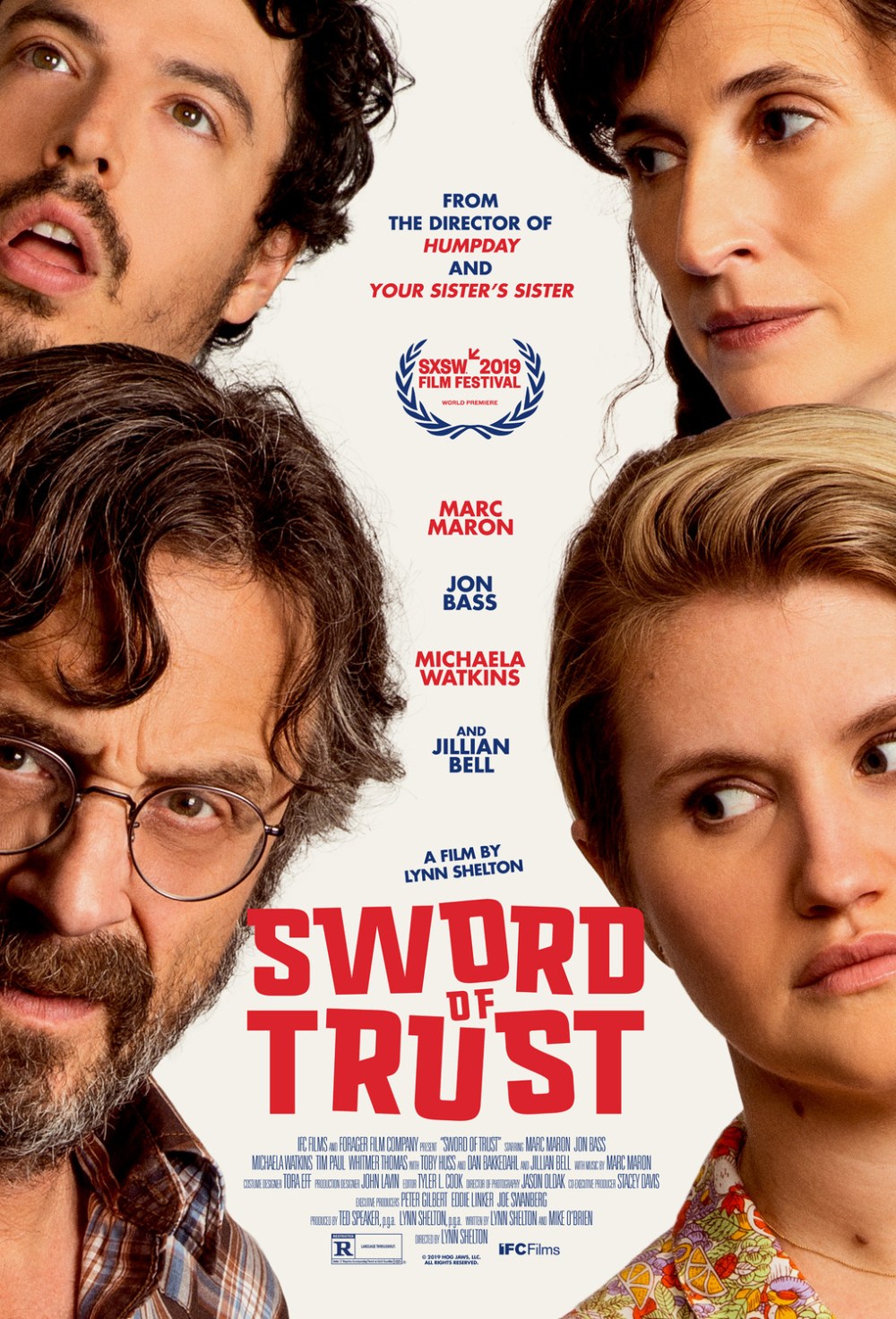
Sword of Trust movie poster

While driving over to a screening of “Sword of Trust.” I ended up in a fender bender which succeeded in ruining my mood for the rest of the day. As a result, I came into this movie wondering if I could look at it objectively as my mind kept going back to the unfortunate incident, and I was fuming at how I could not change what just happened. Well, it’s a good thing I waited a couple of days to write this review on it as my mind is clearer than it was previously. “Sword of Trust” at times feels like a half-realized film, but I did enjoy it and admired the intent of its filmmaker and cast to give us something character driven in a time when cinema is still infinitely dominated by superhero and comic book movies.

We meet Cynthia (Jillian Bell) and Mary (Michaela Watkins), a loving couple who arrive in Alabama to collect Cynthia’s inheritance from recently departed grandfather. They both think they will gain ownership of his home, but they discover it is wrapped up in reverse mortgages which means the bank owns it and is not about to give it up. Don’t you love that? Even if you read the fine print, you and your family members can ever so easily get screwed out of home ownership as greed remains king.

Anyway, Cynthia instead inherits a Civil War era sword, and it comes with a set of letters which prove that it was the South which actually won the Civil War. As a result, the two take the sword to the nearest pawn shop which is run by the cantankerous curmudgeon Mel (Marc Maron) who is quicker to cheat his customers out of the best deal possible for his own capitalistic gains. However, when his man-child employee Nathaniel (Jon Bass) stumbles across a You Tube video in which an overzealous conspiracy theorist appears more than willing to pay thousands of dollars for Civil War artifacts, these two men quickly become very interested in selling this sword to the highest bidder.

I enjoyed how the characters in “Sword of Trust” show themselves to be more capitalistic than they initially realize. Mel initially shuts down Cynthia’s and Mary’s attempt to sell him their sword, but when he shows a renewed interest in it, the two women are not about to be cheated out of any money. Unlike certain people, they refuse to believe Paramount Pictures has yet go profit on the Eddie Murphy comedy “Coming to America,” and they are not about to be swindled out of any substantial profit they are entitled to.

From there, the story moves in unpredictable directions as these four characters attempt to sell the sword to those conspiracy theorists, and I had no idea of where things were going to go which made this film especially entertaining. Considering the depressing rise in white supremacy in the United States of America, I started to believe “Sword of Trust” would descend into an abyss of racism, greed and selfishness. Does it? I refuse to say.

What I can tell you is “Sword of Trust” deals with characters who are more like us than we may initially realize. As they are driven to an undisclosed location in the back of a truck with no windows, they come to reveal things about themselves which no one is quick to another without some level of trust. This scene made me like this movie even more as these characters could have easily been passed off as types instead of individuals who slowly reveal share who they really are to complete strangers.

Directing this movie is Lynn Shelton who co-wrote the screenplay with Mike O’Brien, and she allowed her cast to improvise in a way which has us wondering how everything will turn out. “Sword of Trust” looks to be a cinematic experience we have seen far too many times beforehand, but it is filled with humanity and some strong laughs throughout. Even though it may very well get swept away by the latest summer blockbusters such as the live-action version of “The Lion King,” I think it is worth checking out for those who are looking for something a little different.

All the actors really commit to the material, and it is great fun to watch Watkins and Bell work off of one another throughout. It’s also fun to watch Bass fumble about as Nathaniel, a man-child who has made the mistake of believing in the wrong things to where his mind threatens to be permanently warped. Then again, his character does represent a growing portion of Americans who have somehow led themselves to believe the earth is flat (newsflash, it isn’t).

But the real star by far of “Sword of Trust” is Marc Maron. I have become a big fan of his after watching his IFC show “Maron” and listening weekly to his podcast “WTF.” Having seen and heard him in various formats, it is tempting to say he is simply playing a version of himself as Mel, but that isn’t really fair. Just watch as he tries to keep his guard up when his ex-girlfriend Deirdre (played by Shelton) visits his store; his inability to say something right away speaks volumes. Whether it is that scene or the one in the back of the truck, Maron has proven himself to be a strong actor as he is able to say many things without uttering a word, and it is an example of why he is having a career renaissance which has allowed him to star on the Netflix series “GLOW” and have a co-starring role in the upcoming film “The Joker.”

In addition, Maron also provides the music for this film, and his guitar helps to illustrate the complicated lives of each character and of the absurdity of their current predicament. Whether or not it will have you crying out “Boomer lives” while in the movie theater is another story.

“Sword of Trust” isn’t a great film, but it is an entertaining and absorbing one which I admired. Its resolution is a little pat, and some of the character twists feel a little too manipulative and fly in the face of easy logic, but I did admire what each cast member was able to bring to the material, and their performances alone make this worth a look.

It’s sad to see movies like this get such a short shelf life. Character driven motion pictures are not as prevalent in today’s cinematic landscape as they once were. I am always waiting for things to circle around back to where these kinds of movies will become more popular again, but it looks like we still have a long, long way to go to get there. Still, we have filmmakers like Lynn Shelton around who continue to buck the Hollywood trends, and this is better than nothing.

Now, back to my damaged car… Dammit.

* * * out of * * * *

“Sword of Trust” will be playing at the Nuart Theatre in Los Angeles, California thru July 25, 2019.


‘Stuber’ Has Its Moments, But Not Enough of Them

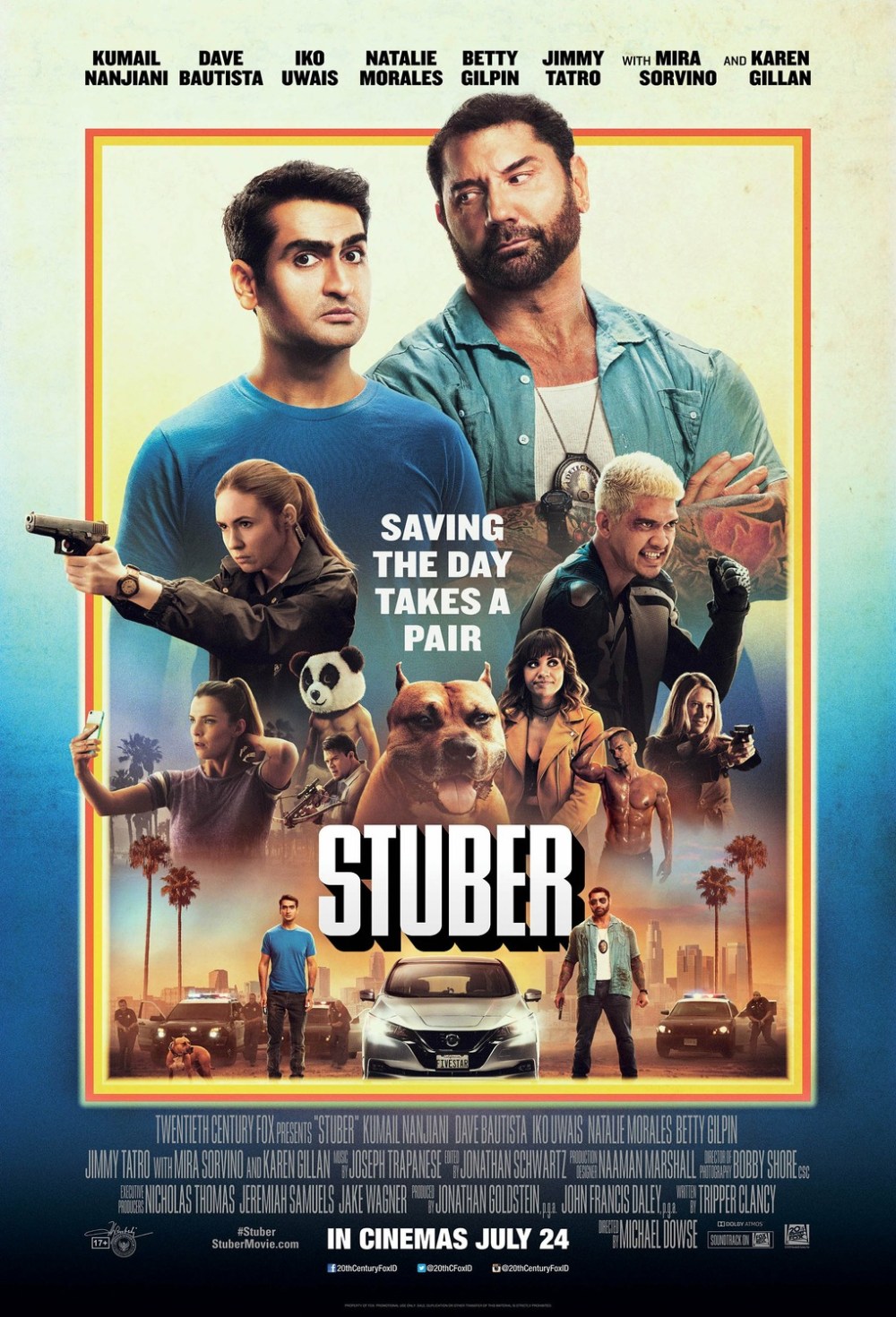
Stuber movie poster

Stuber” feels like an overdue return for me to action comedy genre. Seriously, it feels like I have been away from this particular genre for far too long. While there may have been many action comedies/buddy movies released in recent years, I cannot help but feel like the last one I bothered to watch was 2010’s “The Other Guys” with Mark Wahlberg and Will Ferrell. Watching “Stuber” brought to mind movies like that and also “Stakeout” in which Richard Dreyfuss and Emilio Estevez play Seattle detectives spying on Madeline Stowe, and it remains a classic I never get sick of watching. “Stuber,” however, doesn’t quite reach the greatness of “Stakeout” or “The Other Guys,” and watching it made me feel old as I begun to realize I have seen this type of movie so many times.

This movie starts off with a shockingly visceral action sequence as Los Angeles detective Victor Manning (Dave Bautista) relentlessly pursues ruthless drug trafficker Oka (“The Raid’s” Iko Uwais) inside a downtown hotel. This opening took me for a loop as the violence is not the least bit sugar coated as bullets inflect tremendous damage and the blood flows more freely than in the average comedy. Unfortunately, Oka escapes Victor’s grasp and mortally wounds his partner, Sarah (Karen Gillan), and this leads to a scene which has Victor more or less saying, “don’t you die on me!”

From there, the story moves to several months later where we meet Stu (Kumail Nanjiani) who, when he isn’t working his job at a corporate home improvement store, is out on the town as an Uber driver. Stu is also juggling his work life with his personal one as has deep feelings for his best friend Becca (Betty Gilpin) whom he is about to open a cycling exercise gym with. Then one day, while trying to maintain at least four-star rating on Uber so he can avoid deactivation, he gets a ride request from Victor who finds himself on the path of Oka yet again, and everyone’s life, career and Uber rating is on the line more than ever before.

The one thing which immediately stuck me about “Stuber” is how it reminded me of how the atmospheres of Uber and Lyft are completely different from one another. Whereas in “The Equalizer 2” where Denzel Washington got along with his passengers was only attacked by one but not because he was a Lyft driver, Stu invites trouble simply because Uber passengers are far too quick to give him a one-star rating for reasons which are not necessarily his fault. Seriously, Lyft has a better reputation than Uber, and this movie is a reminder of that.

“Stuber” is a movie aimed at entertaining its target audience and, as a result, employs an endless number of clichés which this genre is known for. Victor is a cop who is obsessed with bringing down the bad guy at any cost, and his endless pursuit has long since cost him the loving relationship he had with his daughter, Nicole (Natalie Morales). When these two men are forced into a situation brought about by circumstance, each wonders who is more manly than the other as they are forced to deal with issues which they have put off to the side for far too long.

On the upside, the pairing presented in “Stuber” is perfect as these two actors and their characters could not be further apart from one another if they tried. Bautista is a former wrestler who became an unforgettable presence in the Marvel Cinematic Universe when he played Drax in the “Guardians of the Galaxy” movies, and he has proven to be a memorable screen presence in “Blade Runner 2049,” “Spectre” and “The Man with the Iron Fists.” Nanjiani is a Pakistani-American stand-up comedian, actor, and podcast host who is best known for writing and staring in “The Big Sick,” a movie I should have already watched. This should be enough to inform you these two individuals are exact opposites from one another.

Bautista makes Vic Manning into the typically obsessed detective you are bound to find in a movie like this, and he makes this character an empathetic one as he tries to fix things with his daughter while bringing down an especially devious criminal. Nanjiani’s character is the more human of the two as he tries to survive a situation he has been unexpectedly thrust into while trying to be honest with Becca about his feelings for her. Together, these two actors make quite the pair as they race through Los Angeles in an electric car which is leased instead of owned.

Having said that, “Stuber” falls victim to playing far too often with clichés this genre has dealt with for far too long, and it gets to where we know the direction this story is heading in. Granted, I did not go into this movie expecting something original, but the filmmakers still had a chance to give us something both fresh and entertaining and they did not quite pull it off here.

The problem filmmakers have in making action comedies is balancing out the action with the comedy, and it is a balance which is harder to achieve than anyone initially thinks. “Stuber” was directed by Michael Dowse, a Canadian filmmaker who previously gave us the “FUBAR” movies which dealt with two lifelong friends and head bangers living out their lives, and also the sports comedy “Goon” which dealt with ice hockey. One of his movies I especially liked was “What If” which starred Daniel Radcliffe and Zoe Kazan in a romantic comedy that followed a well-established formula but still proved to be highly entertaining and absorbing nonetheless.

With “Stuber,” I couldn’t help but think Dowse would really freshen up the buddy comedy formula to great effect, but it only goes so far here. On one hand the action scenes are excellent and visceral, but on the other they seem too brutal for a movie which aims to keep us laughing hysterically. The shift from comedy to action is at times very jarring to where I wasn’t sure whether I should be laughing or clinging to the edge of my seat. And this movie doesn’t have the kind of action which could be seen as make believe. The bullets hit hard and leave a lot of damage, and the blood flows a lot more than it ever did in “Stakeout.”

When all is said and done, “Stuber” is not able to balance out the action and comedic elements with total success, and it is at times more violent than it needs to be. Also, I have seen this kind of movie so many times now to where it all feels routine, free of surprises and run of the mill despite a game cast that gives the material their all. Yes, it has its moments, and it is a reminder of why I would rather drive for Lyft instead of Uber, but for me this one is a near miss. I cannot say I didn’t enjoy it, but it is a movie which will not stay in the memory for very long after you depart the movie theater. Suffice to say, this is no “Stakeout” or “The Other Guys.”

Oh yeah, Mira Sorvino co-stars here as Vic’s boss, Captain Angie McHenry. It’s great to see her here. It’s great to see her in anything.

* * ½ out of * * * *


‘Toy Story 4’ is Yet Another Animated Masterpiece from Pixar

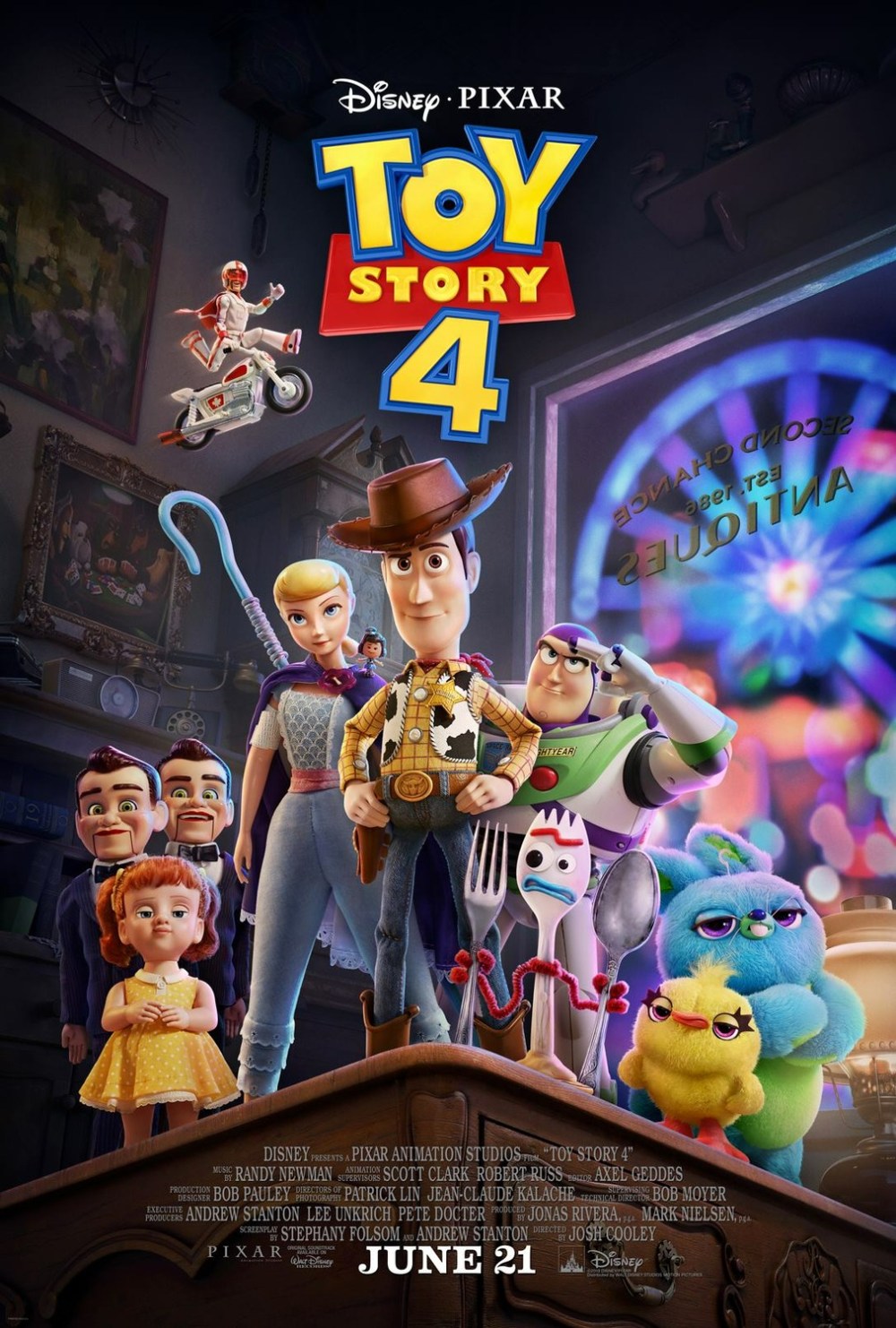
Toy Story 4 movie poster

Did the world really need another “Toy Story” movie, especially after the third one wrapped everything up with a beautiful ribbon? Well, it turns out we did. The news of a “Toy Story 4” sounded like a cash grab, and it’s not like Pixar is lacking in money or funds even after the box office failure of “The Good Dinosaur.” But to my surprise, the fourth movie in this ever so popular franchise quickly proves there is indeed another highly entertaining adventure involving the group of toys led by Woody and Buzz Lightyear.

Unlike other Pixar movies, “Toy Story 4” does not start off with an animated short, but this is because the opening sequence more or less serves as one. We go back several years before the previous sequel as we watch Woody (Tom Hanks) and the others work feverishly to save a remote-controlled car which is about to be washed away into the sewer. With the aid of Bo Peep (Annie Potts), Woody drags the car away from certain destruction, but then things take a sharp left turn when Molly, Andy’s sister, suddenly takes Bo Peep away from the window and donates her to a man eager to share this doll with his own daughter. Woody tries to rescue Bo Peep, but she assures him it is time for her to be someone else’s toy. Still, the deeply heartbreaking moment from “Toy Story 2” in which Jessie (Joan Cusack) is discarded by her owner to the tune of a Sarah McLachlan song immediately quickly comes to mind as this scene proves to be almost as painful.

Moving ahead years later, these toys are now in the care of Bonnie, and we catch up with her when she is about to make a big transition in her life: start going to school. Her kindergarten orientation marks the first time she is separated from her parents and her toys, and she is understandably crippled by separation anxiety like any other kid would be. Woody, having been neglected by Bonnie recently, sneaks himself into her backpack and throws some craft materials onto her table, and with them she creates a new toy out of a spork whom she names Forky (voiced by Tony Hale). This toy quickly becomes her most beloved, and Woody encourages the other toys to make Forky feel welcome in his new environment.

Forky, however, experiences an existential crisis as he feels he was never meant to be someone’s toy, but instead destined for the nearest trash can. Sporks are meant to be used once and then thrown away, but Woody desperately tries to make Forky see how important he is to Bonnie’s well-being. Still, it’s hard to think of another character in animation or family entertainment other than Oscar the Grouch who has had such a passionate love affair with a trash can, or any trash receptacle for that matter.

The “Toy Story” movies all have the same kind of story as the toys, for one reason or another, become separated from their owner and do whatever they can to return to them before it’s too late. Still, each one deals with very intriguing questions about what it means to be a toy and of the importance they play in anyone’s life. What I love about these questions is how deeply they involve the viewer to where you are as caught as the characters as they stress over the right move to make. Either that, or watching these movies really messes with my anxiety.

As always, Pixar provides us with brilliantly animated images, and “Toy Story 4” is full of them throughout. Our gang of toys ends up at a carnival while Bonnie and her parents are on a road trip, and Woody ends up in antique store which is filled with one easter egg after another. Some I recognized like the soda bottle cap from “Up,” but a second viewing is definitely required as there are many more I have yet to discover in this sequel. Just when I thought Pixar could not wow me anymore than they already had, they do.

The big news in this sequel is Woody ends up running into Bo Peep again for the first time in years. She appears to revel in being a free toy after her latest owner gave her away, and now she spends her days with her sheep. Billy, Goat and Gruff, traveling in a remote-controlled skunk in sequences I want to believe were inspired by similar ones in “Mad Max: Fury Road.” Woody reuniting with Bo Peep is a wonderful moment as those who have followed this franchise from the beginning know how affectionate these two toys were with one another, and we spend a good deal of this sequel’s running time wondering if these two can possibly stay together or suffer yet another sudden goodbye.

With any new “Toy Story” movie, there are always new characters to be found, and this was one has several. In the antique store, we meet a beautiful doll named Gabby Gabby (Christina Hendricks) who looks friendly enough at first, but who quickly reveals herself to be a bit devious as she attempts to obtain Woody’s voice box for her own uses. There is also Duke Caboom (Keanu Reeves), friendly Canadian daredevil who suffers from low self-esteem as his owner ditched him when he could not perform the same stunt he performed on a television commercial. Oh the pitfalls of advertising,

But when it comes to my favorite new toys, they are Ducky and Bunny, a pair who resent playing second fiddle to Buzz Lightyear in a carnival game. They are voiced by Keegan-Michael Key and Jordan Peele, the comedic duo we all know and love as Key & Peele, and it is great fun to see them reunited here. These two toys come to aid our heroes, and their methods prove to be hilariously unorthodox as they are quick to attack others in a way they mistakenly believe will be ever so effective.

When “Toy Story 4” comes to its conclusion, I found myself choked up even more than I was with the climax of “Toy Story 3.” With the previous sequel, we saw the end of one era, and with this one has us witnessing the end of another. It’s a deeply emotional finale to where it’s impossible not to feel like you are on the verge of crying as these toys have now been with us for over 20 years. They are like family, and they are now taking another big step into the unknown.

Could there be a “Toy Story 5?” Well, this sequel reminds us of how anything is possible. But if this is to be the final one, it certainly ends things on a tremendously high note. All the voice actors are excellent as they each find the depth in their characters to where not a single one is unforgettable. Josh Cooley makes a tremendous feature film directorial debut with this sequel, Stephany Folsom and Andrew Stanton have given it an excellent screenplay, and the great Randy Newman provides us yet again with another great score and songs this franchise has thrived upon.

2019 has not been a great year for sequels thus far, but along with “John Wick Chapter 3: Parabellum,” “Toy Story 4” proves you at the very least need Keanu Reeves to make your sequel the least bit successful in an overcrowded market. Seriously, you cannot deny this fact after what this summer has given us so far.

* * * * out of * * * *