‘The Outlaw Josey Wales’ Movie and 4K Review
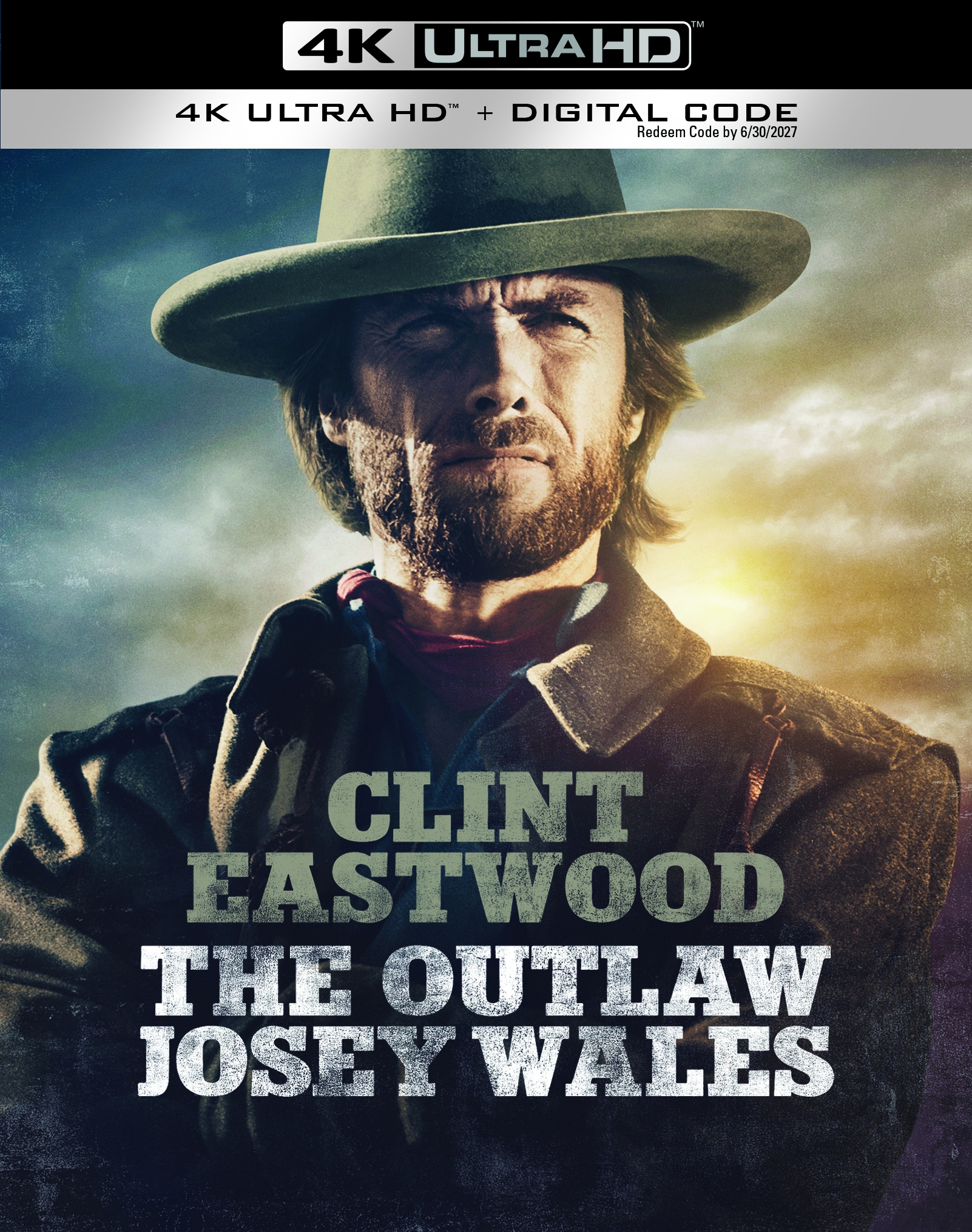
The following review was written by Ultimate Rabbit correspondent, Tony Farinella.

The Outlaw Josey Wales” was directed by Clint Eastwood, and it was adapted from the book, “Gone to Texas” by Forrest Carter. Eastwood is also the lead actor in the film, and he’s certainly in his wheelhouse when it comes to the Hollywood Western. When it comes to certain Clint Eastwood Westerns, some of them stand out more than others.  This film was released in 1976, and it was Eastwood’s second time directing a Western after first directing “High Plains Drifter.” He would return in 1985 with “Pale Rider” before putting his finishing touches on the genre with “Unforgiven” in 1992. For my money, “Unforgiven” is not only one of the best Westerns Eastwood ever directed or starred in, but it’s also one of the best Westerns of all time.

“The Outlaw Josey Wales” is set during the American Civil War, and it opens with the wife and son of Josey Wales (Clint Eastwood) being murdered by Captain Terrill (Bill McKinney) and his group of Union militia. Now, Josey Wales will stop at nothing to seek revenge for the death of his wife and son.  Throughout his journey, he stumbles upon a group of unique and eccentric characters who can either help him or get out of his way. Eastwood plays Josey Wales as subdued, determined, and unflappable. If he gets his pound of flesh, will he be satisfied? He’s on a mission, and he isn’t going to let anything or anyone slow him down or get in his way.
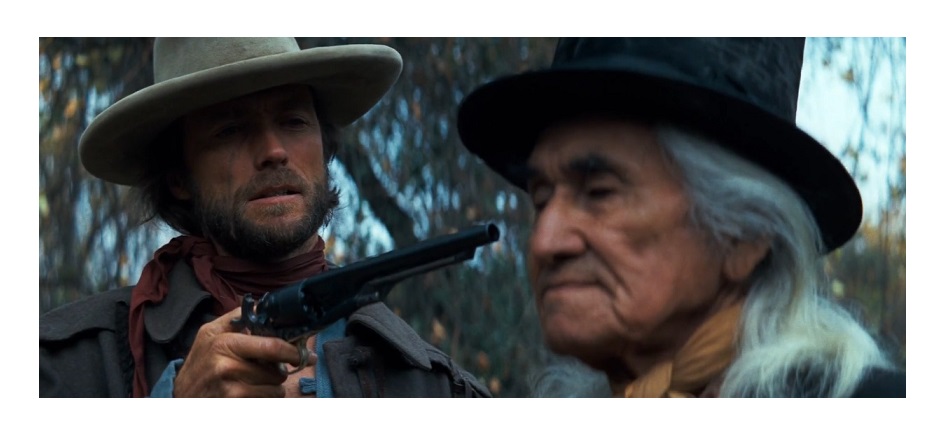
One of the more interesting characters that Josey Wales meets is Lone Watie, played by Chief Dan George. They have had an “Odd Couple” type of relationship, as it’s hard to get a read on Josey whereas Lone Watie is quite chatty. Along the way, they come in contact with various gunmen, and we quickly learn that Josey is not someone to be trifled with when he’s in a battle of life or death.  There are also quiet and reflective moments when the threat of violence isn’t in the air.  The film is shot with a keen eye by Eastwood. He’s always been a skilled and talented director, especially when he’s shooting Westerns. He makes even the mundane look spectacular and mesmerizing.

When I was watching “The Outlaw Josey Wales,” there wasn’t anything happening on screen from a plot or character perspective which drew me in or kept my attention.  I recently reviewed “Pale Rider,” which was done after “The Outlaw Josey Wales,” and that was a film with a strong pulse and interesting characters. I have seen Eastwood portray this character before, and it feels like he’s simply spinning his wheels with this performance. There is not a whole lot going on with this character of Josey, and there isn’t a whole lot going on with the majority of the story either.
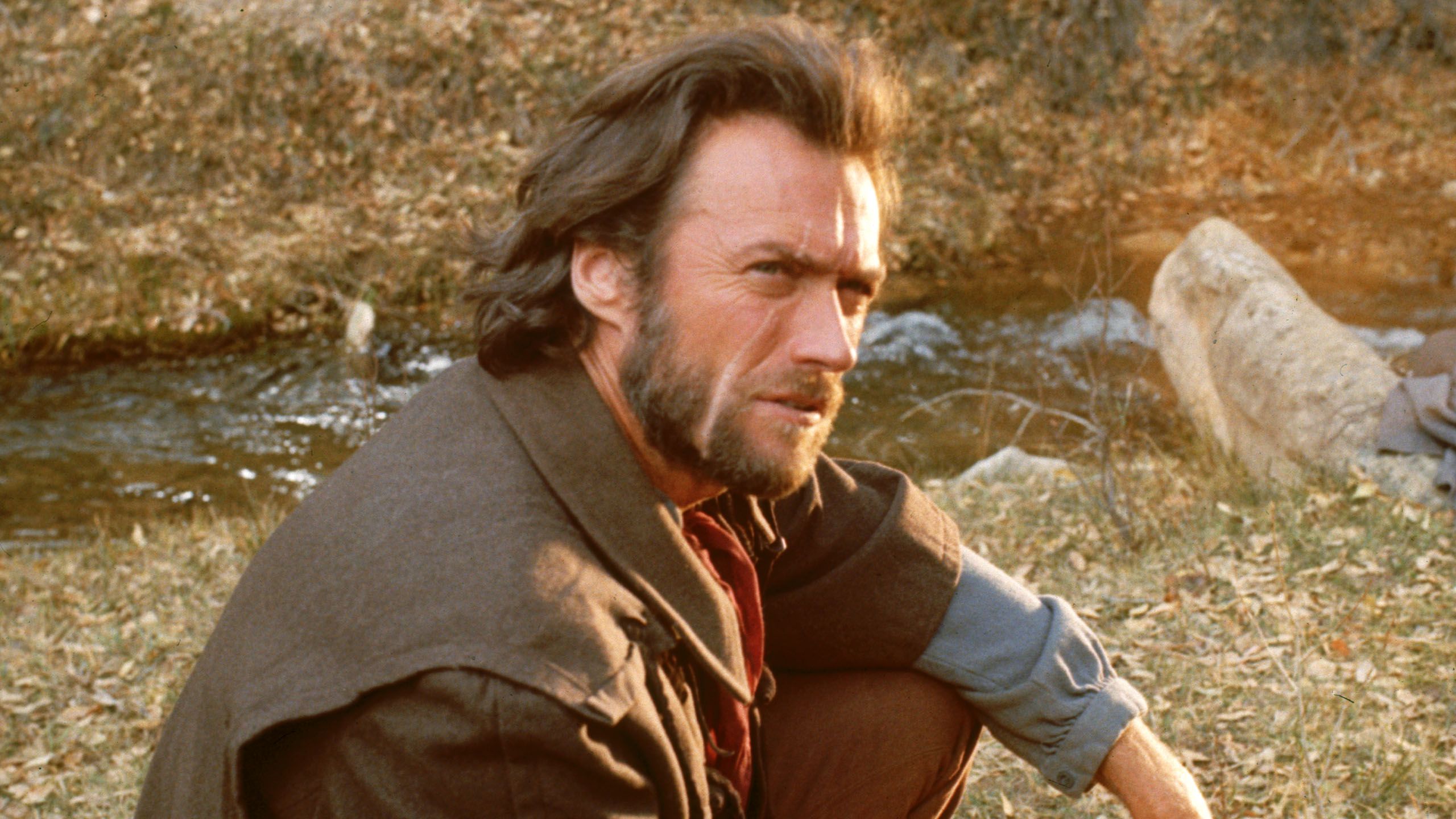
I can only get lost in the scenery and the beautiful sights and sounds for so long before I eventually start to get bored.  Make no mistake about it, “The Outlaw Josey Wales” is a beautiful film from a filmmaking perspective.  There is a ton of skill on display, and it’s a quiet and unassuming film.  The problem is it also feels bland and flat. I didn’t feel as though the film did anything to differentiate itself from a host of other Westerns which have been directed by Eastwood in the past. It’s OK for his character to not be showy, loud or outspoken, as we don’t expect that in an Eastwood Western. However, at times, it looked and felt like he was in a medically-induced coma.

As I was watching this film, I kept waiting for it to spring into action and come to life on screen. After you have seen him take out the bad guys time after time, it begins to become repetitive and it loses its luster the more you see it happen. This is a movie which is a little too focused on its sense of time and place but not focused enough on creating a captivating story.  This is a problem when you have a film that is a little over two hours long. I didn’t hate watching “The Outlaw Josey Wales,” but I didn’t particularly enjoy the experience. It left me feeling very underwhelmed.

* * out of * * * *

4K Info: “The Outlaw Josey Wales” is released on a single 4K disc from Warner Brothers Home Entertainment. It comes in either a 4K slipcover edition or a 4K steelbook. The film has a running time of 135 minutes and is rated PG. The film also comes with a digital code to redeem.

4K Video Info: The 4K of this film is absolutely magnificent.  Westerns, in particular, were made to be released on 4K. You just don’t get this type of viewing experience on Blu-ray or DVD with Westerns. The HDR on this film presents an epic picture that is utterly flawless.

4K Audio Info: The Dolby Atmos audio track also brings the film to life in your living room with a soundtrack that is big and bold. Subtitles are included in Spanish, English, and French.

Special Features:

Commentary by Richard Schickel

An Outlaw and an Antihero – NEW

The Cinematography of and Outlaw: Crafting Josie Wales – NEW

Clint Eastwood’s West

Eastwood in Action

Hell Hath No Fury: The Making of The Outlaw Josey Wales

Clint Eastwood: A Cinematic Legacy – Reinventing the West

Should You Buy It?

I had the pleasure of reviewing three Clint Eastwood 4K’s over the past week: “The Outlaw Josey Wales,” “Dirty Harry,” and “Pale Rider.” “Pale Rider,” without question, was my favorite of the three. With “Dirty Harry” and “The Outlaw Josey Wales,” I admired but didn’t love them.  I felt like I was missing something when I was watching them.  Both films are well-made and they are not terrible, but they didn’t entertain or grab me emotionally. However, I’m well aware that many people out there who love both “Dirty Harry” and “The Outlaw Josey Wales.” When it comes to “The Outlaw Josey Wales,” if you are a fan of the film, you need to add it to your collection as soon as possible.  It looks and sounds out of this world on 4K, and there is a boatload of special features here to enjoy, especially a few new ones as well. I just put this film under the category of, “It wasn’t for me.” If it is for you, you can’t ask for a better physical media release than what they have put together at Warner Brothers for this one.

**Disclaimer** I received a copy of this film from Warner Brothers to review for free.  The opinions and statements in the review are mine and mine alone.
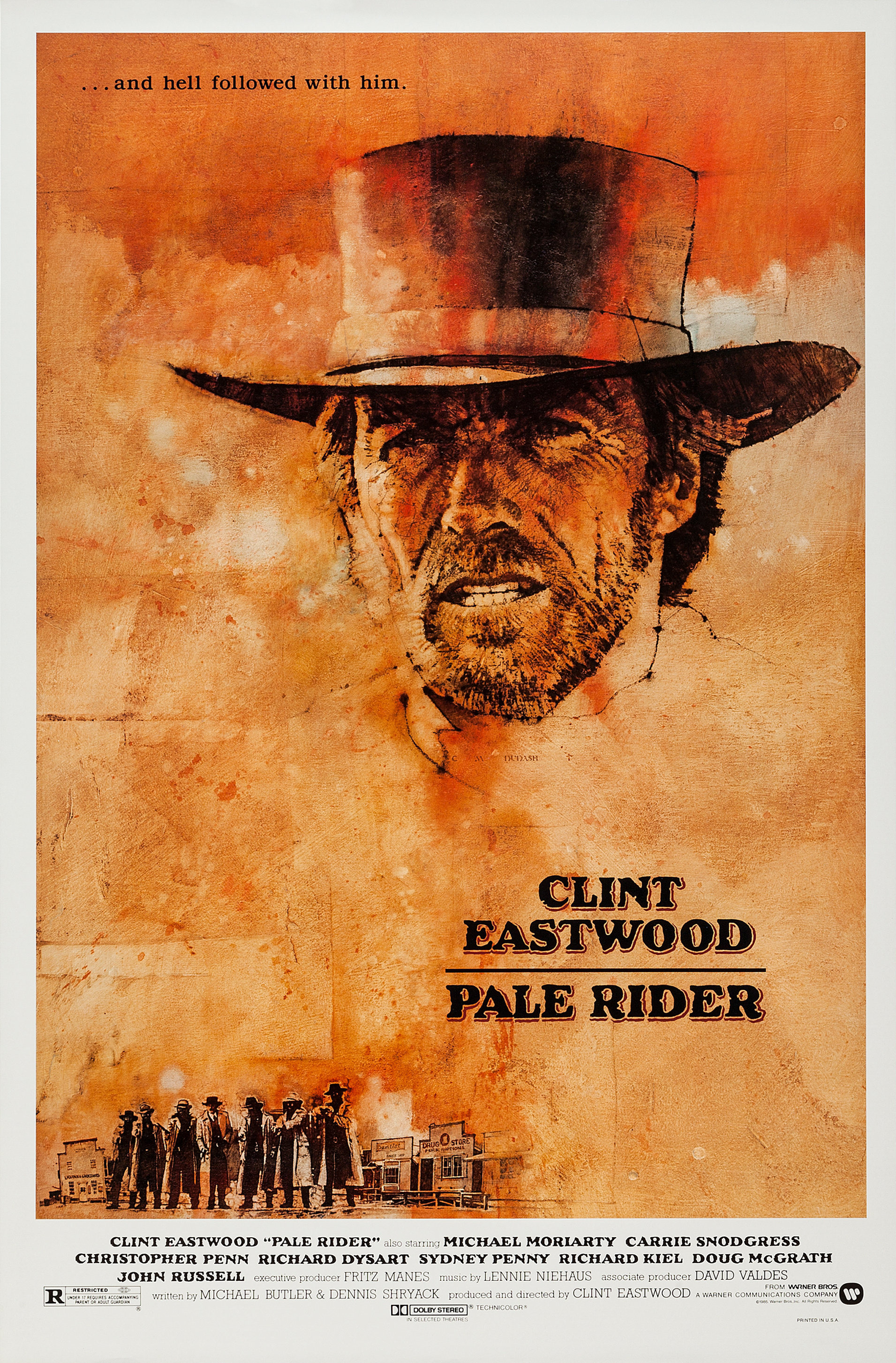
All-Time Favorite Trailers: ‘Pale Rider’

With Tony Farinella’s ever so enthusiastic review of Clint Eastwood’s 1985 western “Pale Rider,” I was quickly reminded of the various trailers made for it back in the day. Each trailer and television commercial made for it was dominated by the music of “Best Endeavours” which was composed by Alan Hawkshaw. That piece of music alone was enough to get me super excited about this particular motion picture.

But one particular trailer for “Pale Rider” which excited and stayed me throughout the years was its teaser. I first watched the teaser when it was included in the VHS release of “City Heat,” a movie which teamed up Eastwood with Burt Reynolds and eventually became one of my most inescapable guilty pleasures.

What makes this trailer for “Pale Rider” stand out for me is how it is composed simply of still images. Like the Italian movie trailer for Dario Argento’s “Suspiria,” it is the images which, in their stillness or frozen moments, spoke volumes. While Warner Brothers might have preferred more in the way of moving images, the still ones had much more of an impact on me.

Plus, it has a narrator telling us how Eastwood had previously directed the last great western back in 1976 with “The Outlaw Josey Wales.” This made the trailer’s promise of “Pale Rider” being the next great American western all the more thrilling. Whether or not you think “Pale Rider” proved to be such the thing, I admired the case the narrator sold us on.

As much as I wanted to see “Pale Rider” when it arrived in theaters, I was only ten years at the time, and it was rated R. The best I could do was watch Siskel & Ebert review it as I got to see movie clips there, and I did get to read the movie’s novelization which was written by Alan Dean Foster. For some odd reason, my parents never kept me from doing that.

I didn’t get to see “Pale Rider” until many years later, but that is a story for another time. And from now on, Alan Hawkshaw’s “Best Endeavours” will always forever be the “Pale Rider” theme to me. To others, it may forever be the theme for the British program Channel 4 News, but Channel 4 never secured permanent exclusivity rights for it at the time, so there!

Please check out the “Pale Rider” teaser trailer down below.

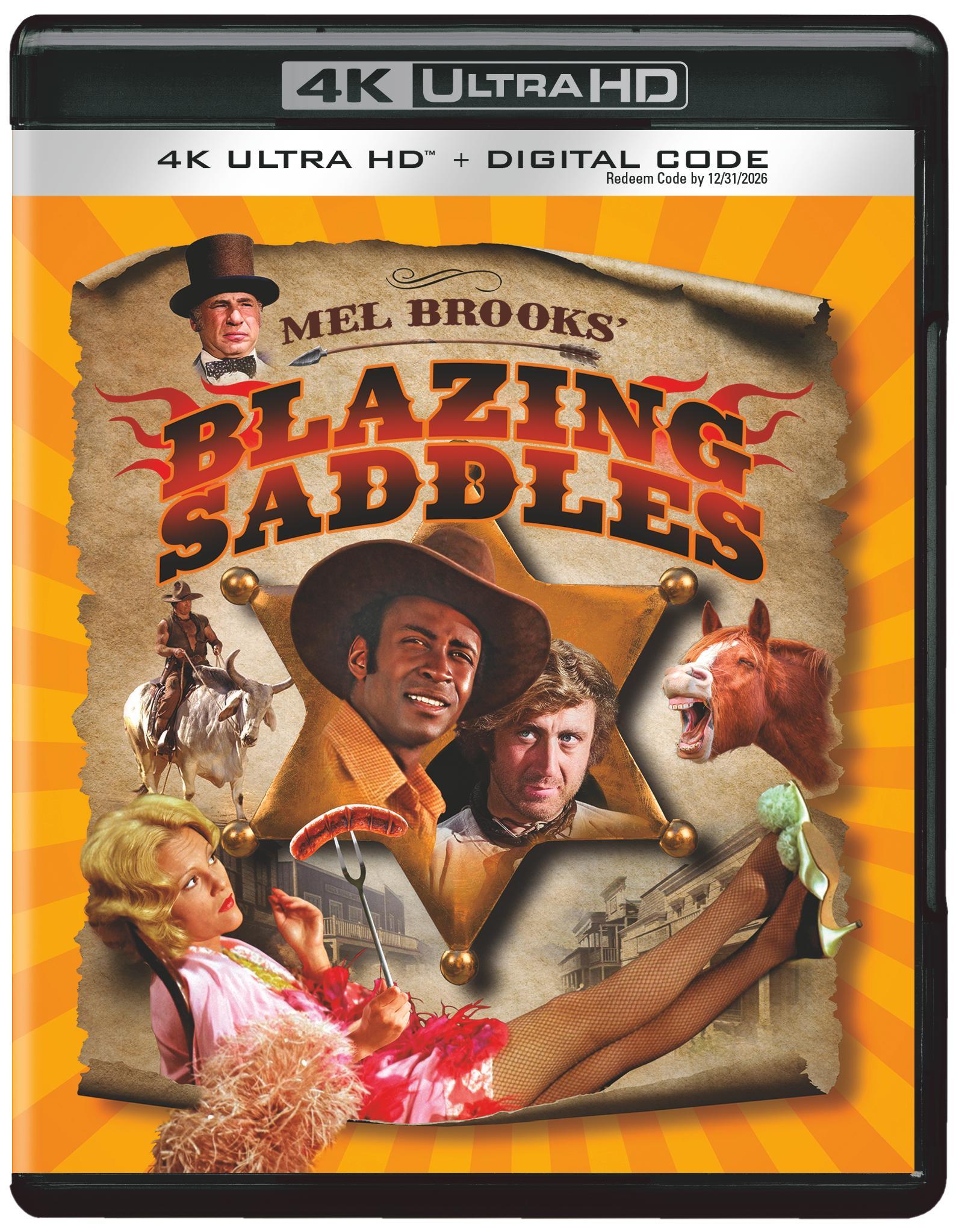
‘Blazing Saddles’ Movie and 4K Review

The following review was written by Ultimate Rabbit correspondent, Tony Farinella.

When it comes to comedy, it’s all a matter of opinion. Comedy, even more than film criticism, is subjective.  For example, I’m not an Adam Sandler fan and I find his films terribly unfunny, but there is a reason why his films keep getting released by studios. There is really no right or wrong when it comes to comedy.  With “Blazing Saddles,” I heard all of the praise surrounding it and how some critics considered it one of the funniest films of all time.  While watching the film for the first time, I understood what they were going for and what they were looking to achieve.  It wasn’t as though the film went over my head or I didn’t understand the style of comedy they were putting on screen.  I just never laughed.

My first issue with “Blazing Saddles” was its lack of plot.  It seems this is mostly a movie filled with random gags and one-liners that are intended to make the audience laugh.  They throw everything but the kitchen sink at us. It must be said the film is filled with the N-word along with other racial and homophobic slurs.  I understand this film was made in 1974, which was fifty years ago, but it’s still uncomfortable to watch.  The film is not funny and the jokes don’t land.  There is a way to be offensive and also be funny, but this movie did not accomplish that goal.  With comedy, you can go almost anywhere if you know what you’re doing.  We have seen films that pushed the comedic envelope in the past, but they have been done in a smart and clever way.  This is just flat-out lazy.

The plot involves a railroad being built through the town of Rock Ridge, a railroad that will make a corrupt politician a lot of money if he is able to force the residents out of their town. One way he is hoping to do this is by having a black sheriff named Bart (Cleavon Little) come in and make some of the local residents uncomfortable. The sheriff is called Black Bart.  Subtlety is not this film’s strong suit.  Bart’s deputy is played by Gene Wilder. Even though they are hoping to get the locals out of Rock Ridge, they end up staying and fighting for their town. Bart must also deal with Lili Von Shtüpp, played by Madeline Kahn, who is looking to find a way to sink her teeth into him.

“Blazing Saddles” features performances from Mel Brooks, Alex Karras and Richard Collier, to name a few.  However, no one can save this movie from its awful screenplay and bad jokes.  It is unwatchable from start-to-finish.  It took every ounce of strength in my body to not only watch this movie, but to finish watching it.  I absolutely hated it in a way I haven’t hated a movie in a very long time. I understand they were trying to make a film that would be a satire on Westerns and how certain demographics view African Americans. It shows how they are exploiting African Americans because the money men are only focused on the bottom line. I know what the message was and what they were trying to do in this film. I just didn’t find it funny.

In the end, “Blazing Saddles” is considered a comedy classic and one of the funniest films of all-time.  I wouldn’t be doing this film any justice if I didn’t acknowledge its reputation and its three Oscar nominations.  It has clearly reasoned with a lot of people.  With this being its 50th anniversary, I know a lot of people are very excited about this 4K release. One of the worst things you can do as a critic is to say a movie should not be watched by anyone, and if anyone likes this movie, they are a moron.  I would never dream of doing that.  I acknowledge the reputation of “Blazing Saddles,” but I simply shrug my shoulders and say, “This was not, at all, my kind of comedy.”  As stated previously, comedy is subjective. If you love the film, you will love the 4K.

ZERO out of * * * *

4K Info: “Blazing Saddles” is released on a single 4K disc from Warner Brothers Home Entertainment. It also comes with a digital copy of the film.  It has a running time of 93 minutes and is rated R. You can purchase either the 4K slipcover or the 4K steelbook.

4K Video: The 4K HDR transfer from Warner Brothers is fantastic and looks terrific.  Westerns, when done right, can look great on 4K. This is a visual feast for the eyes, and I imagine fans of the film will be quite pleased with this 4K transfer.

4K Audio: The Dolby Atmos track is also right on cue, as it’s a strong audio mix throughout the film that hits all the right notes.

Special Features:

Inappropriate Inspiration: The Blazing Saddles Effect

Scene-Specific Commentary by Mel Brooks

Blaze of Glory: Mel Brooks’ Wild, Wild West

Back in the Saddle

Additional Scenes

Should You Buy It?

I imagine some readers might call me too sensitive or say the film went over my head. I’m a huge fan of standup comedy, and I believe just about anything in the world is fodder for comedy when it’s done right. I understood exactly what Mel Brooks was going for in this movie, and I know that one of its writers was Richard Pryor.  It is my job to give my honest assessment of this film, and I thought it was painfully unfunny and wanted to turn it off after twenty minutes.  Because I was reviewing it, I felt obligated to watch the entire film. If this style of comedy is not for you, you won’t find a whole lot to laugh about in “Blazing Saddles.” If you enjoy the film and it fits into your comedic sensibilities, you will be very happy with it.  This is another top-notch 4K release from Warner Brothers.  They are doing a great job with releasing 4K’s from their massive library.  Overall, if you loved this film, buy it. If you haven’t seen it before, I’d recommend watching it and seeing how you respond to it.

**Disclaimer** I received a copy of this film from Warner Brothers to review for free.  The opinions and statements in the review are mine and mine alone.
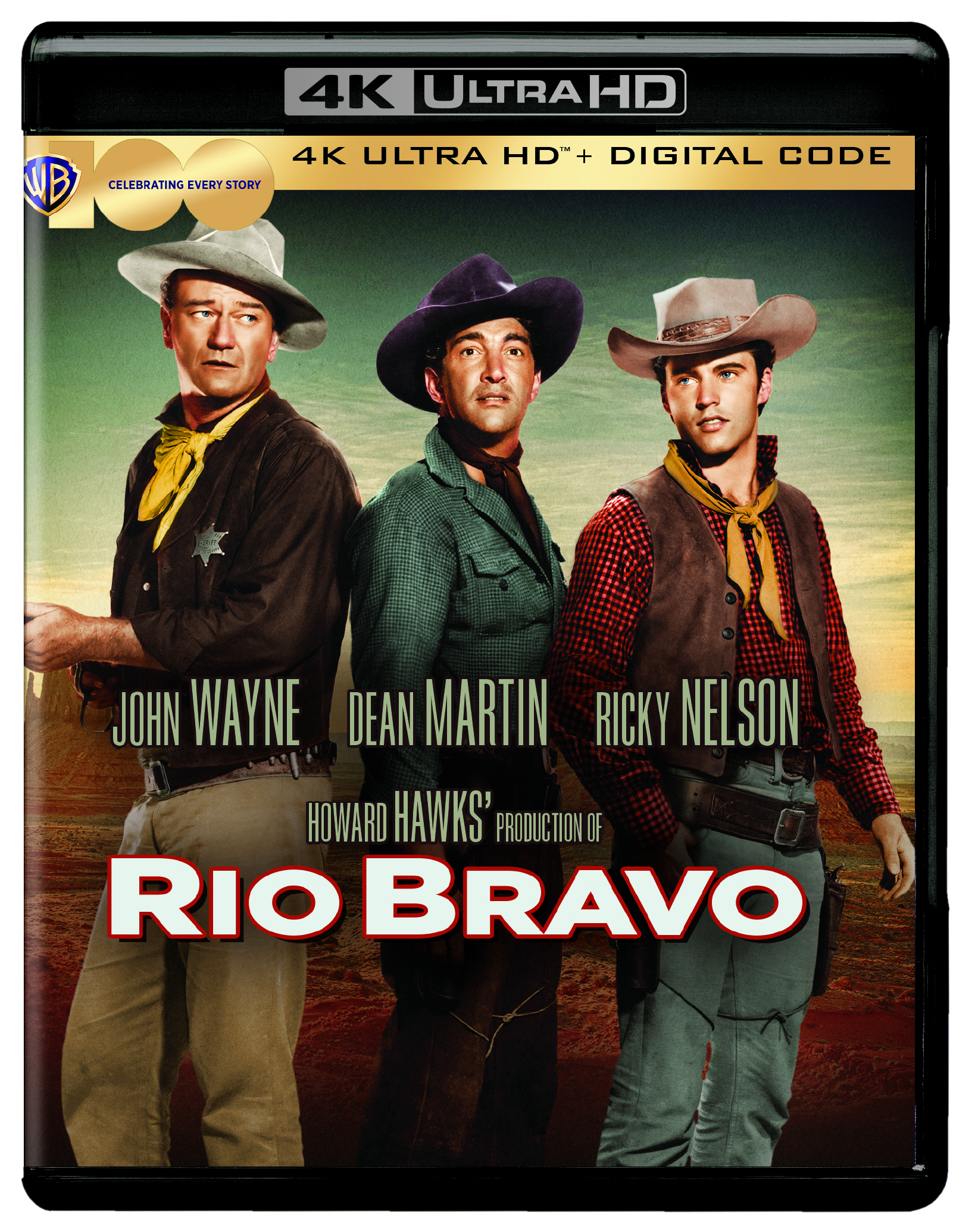
‘Rio Bravo’ Movie and 4K Review

The following review was written by Ultimate Rabbit correspondent, Tony Farinella.

When you think of the western genre in cinema, it’s hard not to think of John Wayne.  Perhaps the only other actor who might be synonymous with westerns is Clint Eastwood, but he would frequently venture into other genres to expand his repertoire. For the most part, John Wayne lived and breathed westerns. When you think of his classic westerns, you think of films such as “The Searchers,” “Red River,” “Stagecoach,” and “The Man Who Shot Liberty Valance” to name a few.  However, I believe his best film in this genre is none other than “Rio Bravo,” directed by the legendary Howard Hawks.  He brought out the humanity and vulnerability from the tough, no-nonsense Wayne persona.

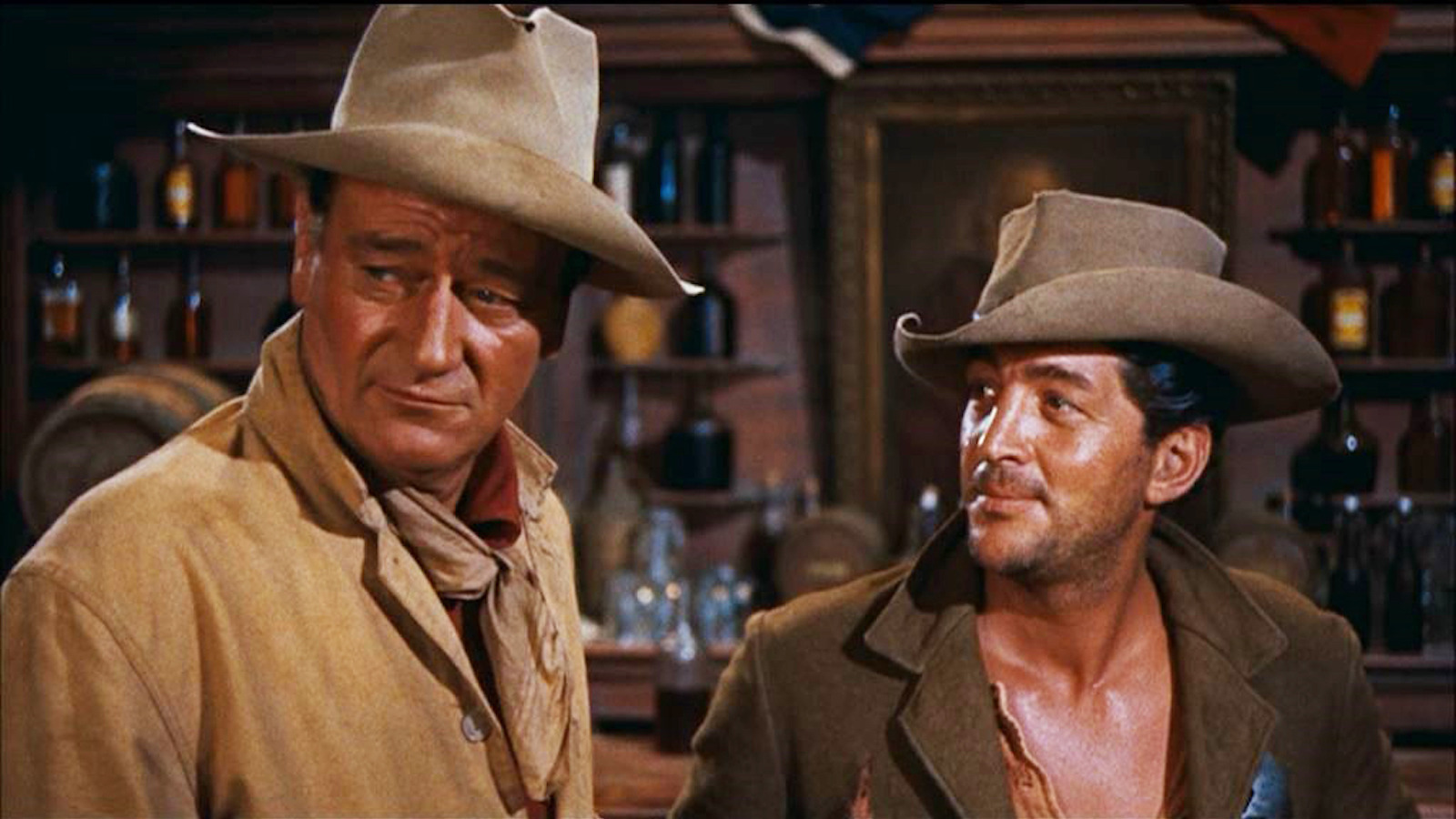
“Rio Bravo” is a patient and detailed film that allows us to really get to know, understand and like our main characters.  There is Sheriff John T. Chance (John Wayne) who is deliberate, fair and direct in his communication and his actions.  His former deputy is named Dude, played by legendary crooner Dean Martin in a fantastic performance.  Dude used to be a reliable deputy and partner to Chance until his drinking got the better of him.  Now, he’s trying to get himself together because he knows John needs him by his side in order to deal with the Burdette’s, Joe (Claude Akins) and Nathan (John Russell). Joe is behind bars after committing murder and is currently being watched closely by Stumpy (Walter Brennan), a trigger-happy deputy with a quirky personality.  While he might be up there in years and also have a limp, John trusts him to keep an eye on Joe and the rest of Nathan’s goons.

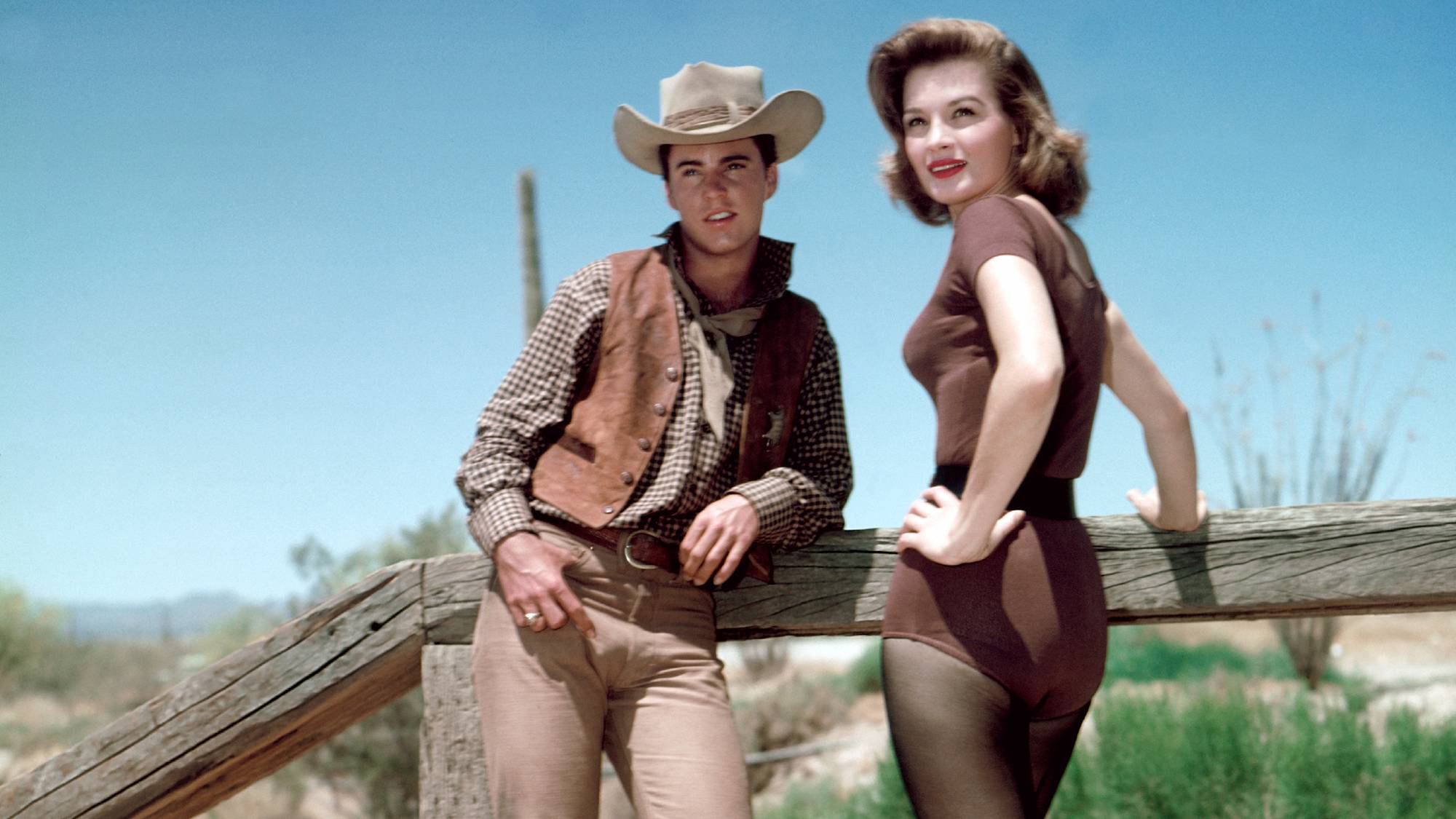
Nathan is a wealthy land tycoon with a lot of connections, and he will stop at nothing in order to get his brother out of prison.  However, with Chance, Dude and Stumpy working together, this is not going to be an easy task for Nathan.  Chance is out to prove there are consequences when it comes to murdering an unarmed man for no reason other than you have the money and power to do so and think you can get away with it. Chance is also developing feelings for a young woman in town named Feathers (Angie Dickinson), whose deceased husband was a shady gambler notorious for cheating.  Chance is not quite sure what to make of Feathers and wonders if he can trust her because of her past connections. However, it is clear there is a connection between the two of them.

At this point, they are waiting for the U.S. Marshal to come and handle things, but that could take up to a week before this comes to fruition.  It’s up to Chance, Dude, Stumpy and the rest of the town to band together and not give in to Nathan Burdette and his greed.  He’s willing to pay hired guns in order to make sure his brother gets out of jail.  This is something Chance is keenly aware of, so he’s on his toes at all times.  The same can be said for Stumpy, who will shoot anyone that dares to enter their jail without announcing themselves first.  Dude sees this as a second chance for himself.  He might be struggling with losing his confidence, but if he can stay away from the bottle and remain focused, people will start to take him seriously again.  Chance has never given up on Dude, even when others around him do not take him seriously.

I really loved the performances in “Rio Bravo” along with the beautiful western scenery.  There is also a sense of humor injected into the film, but it’s not forced and it doesn’t feel phony.  Sometimes when things get really serious and intense, you need to step back and throw a humorous moment in there to lighten things up.  Howard Hawks knows how to do that during just the right moments in the film. I’ve often found Wayne to be a one-note actor, but here he’s still the same badass we have seen in previous films, and he shows good comedic timing, a sense of vulnerability, and a more human side to the character of Chance. He doesn’t seem invincible. He is a real person with feelings, emotions and some depth to him. 

The same is also true of Dean Martin.  I haven’t seen Martin in a film before, but the way we see his inner struggle on screen is truly a work of art.  For my money, he gives the best and most impressive performance in “Rio Bravo.”  He shows tremendous depth here.  He’s not just the town drunk.  There are many layers to his character. Walter Brennan’s Stumpy might look like an old fool, but he still has some fight left in him as well.

There is also a tremendous supporting performance by Ricky Nelson here as Colorado. He becomes part of their little family, and he even gets them out of a few jams as well.  Ward Bond also appears in this film, which has a tremendous cast that works perfectly together. The film is two hours and twenty-one minutes long, but it doesn’t feature a moment on screen that isn’t meaningful to the purpose of the story in some way.  Hawks is one of the great filmmakers of all-time, and he shows that here.  He really brought out the best in everyone throughout this emotional, funny and action-packed film.  This is a movie that has just about everything in it without ever feeling like it’s bloated or too many genres thrown into one.  It’s a fantastic piece of cinema.

* * * * out of * * * *

4K Info: “Rio Bravo” is released on a single 4K disc from Warner Brothers Home Entertainment.  It has a running time of 141 minutes and is not-rated.  However, anyone can watch the film. It comes with a digital copy of it as well.

Video/Audio Info:  The HDR is beautiful here with so many beautiful shots coming to life as we get engrossed in the film. It’s truly eye-popping to watch on screen.  In addition to the great acting and terrific pacing of the story, this film looks stunningly gorgeous.  I couldn’t have asked for a better 4K release of it.  There is no Dolby Atmos track here, but I didn’t feel like it really hurt the sound quality as the film sounds great.  It comes with subtitles in English, Spanish and French.

Special Features:

Commentary by John Carpenter and Richard Schickel

I’m truly loving just about every classic film being restored by Warner Brothers on 4K with this being their 100-year anniversary.  It is filled with films I’m watching for the first time along with others I’m viewing in a whole new light because with age comes wisdom, and also because of how much time and effort they are putting into these releases from an audio and visual perspective.  Classic cinema will always stand the test of time, and it is clearly on full-display here with “Rio Bravo.”  I loved the performances of John Wayne and Dean Martin in this film, if I’m going to single out two of the actors here.  Martin really showed tremendous range and emotional trauma with this performance.  The only special feature is a commentary track, but that’s okay considering the age of the film.  I’m just happy we are being treated to so many great films through the Warner Archives on 4K.  It seems like every month, there is a classic film on 4K, and I’m loving it.  This is one you need to buy on its release date along with “East of Eden.”  They are two totally different films, but they have one thing in common: they are timeless and immortal.  As far as the audio and visual aspects of this release, it truly takes your breath away on 4K with its range of colors.

**Disclaimer** I received a copy of this film from Warner Brothers to review for free.  The opinions and statements in the review are mine and mine alone.

The Coen Brothers’ ‘True Grit’ is a Far More Faithful Cinematic Adaptation Than What Came Before

Watching Joel and Ethan Coen’s version of “True Grit,” it suddenly occurred to me I had read the book it was based on back in my sophomore year of high school. I can’t believe I forgot that as I usually remember every book me and my fellow classmates were made, or forced, to read such as “The Diary of Anne Frank,” “To Kill a Mockingbird,” “Of Mice and Men” or “A Day No Pigs Would Die.” This book, which was written by Charles Portis, however, seemed to have escaped my memory of having read it. When I think of the book now, I am reminded of how Mattie Ross, when she saw the body of her murdered father in his coffin, simply told the undertakers, “Put a lid on it.”

Damn! Mattie seemed cold as ice; hell bent on pursuing her father’s killer no matter what and without ever shedding a single tear. But she is also a human being endowed with an undying sense of purpose, determined to find fairness in a world which often seems devoid of it. Now everyone remembers Rooster Cogburn more than any other character in “True Grit” because John “The Duke” Wayne portrayed him in the 1969 movie as it won him his only Oscar. But those who have read this novel know full well it is really about Mattie Ross, not the easiest person to get along with, but hard not to admire. It’s her story more than it ever was Cogburn’s, and the Coen brothers understand this completely in their cinematic adaptation which proves to be very faithful to its source material.

Jeff Bridges, Matt Damon, and Josh Brolin may have top billing, but the weight of “True Grit” rested on the soft shoulders of then 14-year-old newcomer Hailee Steinfeld. Her astonishing performance brings Mattie Ross right off the written pages of Portis’ book and to vivid life. This was not necessarily the case when Kim Darby portrayed her opposite Wayne in 1969. Our sophomore English class watched some, but not all of, the original film, and once we saw Mattie cry in a way she never would have in the novel, we all knew one liberty too many had been taken with the source material. I guess having a character appear stronger willed than one played by The Duke must have seemed unthinkable at the time.

But seriously, Steinfeld is a revelation as Mattie, and the movie would have completely failed were she not as fantastic as she was here. Seeing her stroll into the town with her no-nonsense attitude and wise beyond her years, the actress sells the character perfectly and has us eager to follow her every step as she pursues Tom Chaney before he escapes the hand of justice. Her eyes show a willful determination which I never doubted, and any sadness she shows is somehow restrained. Steinfeld takes a character who is not altogether likable and makes her one of the most compelling characters I saw in any 2010 movie. She doesn’t so much play the character as much as she inhabits the role. Now how many other 14-year-old actors do you know who can pull this feat off?

As the story goes, Mattie tries to procure the services of Rooster Cogburn because she believes he possesses “true grit;” someone who has courage, fearlessness, and guts. As played by Jeff “The Dude” Bridges, who owned the 2010 holiday season with this and “Tron: Legacy,” Rooster is a drunken lout who never appears to be fit for his line of work, but his sense of duty does manage to keep him sane in an increasingly violent world. The relationship he has with Mattie is not one based on kindness, and he would as soon as leave her in the dust than bring her along. But something about Mattie’s dogged determination, illustrated by her riding her horse across a river while keeping her head above water, wins the whiskey loving Marshall over.

I’m not going to bother comparing The Dude and The Duke because frankly I don’t have the energy. Wayne made his mark in one film after another, and Bridges’ performance works so well because he never tries to outdo what Wayne did. Like any smart actor, he makes the character his own, and his Rooster Cogburn threatens to be every bit as inebriated as Val Kilmer was when he played Jim Morrison in Oliver Stone’s “The Doors.” From the start, I was almost afraid Bridges might turn the character into a parody of sorts, and perhaps rely too much on his “Big Lebowski” persona to get him through the day. But this never was the case as Bridges makes his Rooster Cogburn into a wonderfully complex character who, despite his grungy appearance, still knows the Indian territory like the back of his hand.

Also along for the ride is Matt Damon who portrays Texas Ranger LaBeouf. I thought he would stick out like a sore thumb here, but he makes his character a wonderfully engaging one even as he keeps coming and going throughout. Seeing LaBeouf get his ass handed to him by Mattie Ross is a major highlight, only if to see the shocked expression on his face when he realizes he truly got suckered by a 14-year-old.

Josh Brolin, who previously worked with the Coens on “No Country for Old Men,” makes Tom Chaney not just a simple one-dimensional villain as his crime was motivated more out of jealousy and fear than anything else. Even he can’t intimidate Mattie as she has the strong resolve and moral fortitude he seriously lacks, and his life has lost its sense of purpose. Brolin manages to convey all this in the limited time he has onscreen.

Another guy I was happy to see here is Barry Pepper. As “Lucky” Ned Pepper (no relation I’m sure), he gives us a nasty outlaw and a vicious guy who will not allow anyone to undo his authority any more than he appears willing to brush his teeth; man, his teeth look hideous!

The main difference between the 2010 and 1969 movies is in how the wild, wild west is portrayed. The 1969 movie was more about watching Wayne blow away the bad guys just as he had in every other movie he starred in. But the 2010 version portrays the world it inhabits much more realistically, treating violence as a brutal and very vicious thing. This one is more akin to “Unforgiven” than “Rio Bravo.” Violence is a way of life for all these characters, and it defines the way they see the world around them. We also see how it affects their souls as the specter of death hangs over their every move. There’s no attempt to sweeten up the narrative or make it the kind of western many of us grew up watching.

Still, the Coen brothers have succeeded in making one of their most accessible movies to date for the mainstream audiences with “True Grit.” They also managed to do it without compromising themselves as this film sees them getting the widest audience they ever had before. They continue to employ their regular collaborators who never fail them such as cinematographer Roger Deakins, editor Roderick Jaynes, and their longtime composer Carter Burwell who contributes another in a long line of great movie scores.

If there was any problem I had with this “True Grit,” it was in the way it ended. We see one character many years later, and the effect is disorienting. It was the same thing that happened at the start and the end of Frank Darabont’s “The Green Mile,” and it just took me out of the moment. The effect wasn’t too bad in this one, but I was hoping to see the actor who played said character get more of a proper send off.

Remaking a movie like “True Grit” seems like the last thing the Coen brothers would ever do, but I believe them when they say this was never intended to be a remake. They stayed very true to the source material and even made the language Portis scribbled down seem very much alive and sharp witted. Whether or not you value Wayne’s take on Rooster more than Bridges’, you have to give the Coens credit for staying true to a book written back in 1968.

The Academy Awards showered a number of nominations for this film including Best Actor for Bridges and Best Picture. While I was happy to see Steinfeld nominated for Best Supporting Actress, I still think it was a travesty she was not nominated for Best Actress instead. Once again, this movie rested on her shoulders, and she was cast in a role which 15,000 other actors auditioned for. Seriously, Best Actress, not Best Supporting Actress. Her male co-stars were supporting her instead of the other way around.

* * * ½ out of * * * *

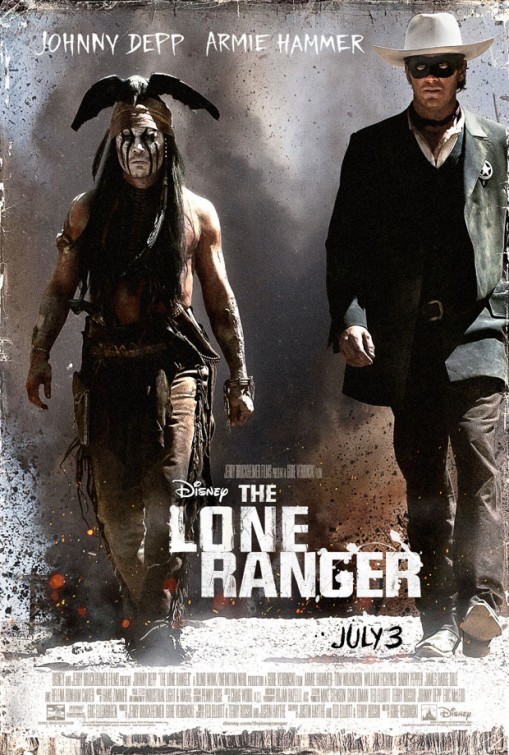
‘The Lone Ranger’ – Hi-yo Silver, What the Heck?

Like so many, I grew up watching “The Lone Ranger” on television and listening to the old-time radio show as well. John Reid, whether he was wearing a mask or not, was a paragon of justice, and seeing him and his faithful sidekick Tonto defeat the bad guys was always deeply satisfying. I was reminded of how much I liked this character while watching Gore Verbinski’s “The Lone Ranger” because I kept asking myself, who is this buffoon that has no business being around a horse during this movie?

Hollywood has had little luck in getting a respectful version of “The Lone Ranger” up on the silver screen, and this supposed 2013 summer blockbuster is the latest example. At two and a half hours, this film is a bloated mess which could have easily been shortened. It sticks its talented cast with a bland story, an uninteresting villain, and it can never seem to figure out if it wants to be a lighthearted adventure or a deadly serious film. Sadly, it is not until the last half hour when this “Lone Ranger” finally comes to life.

This “Lone Ranger” is yet another origin story about how this iconic character and Tonto first met and joined forces to bring justice to the American Old West. John Reid (Armie Hammer) is a lawyer and former Texas Ranger who joins up with his brother, Dan (James Badge Dale), to recapture the ruthless outlaw Butch Cavendish (William Fichtner) who has just escaped. In the process of tracking Butch down, John and Dan are ambushed by him and his law-breaking friends, and he mercilessly takes Dan’s life as well as another part of his body from him. John is assumed to be dead, but Tonto (Johnny Depp) finds his body and nurses him back to health so they can avenge Dan’s life and defeat Butch before he does more harm.

Look, I try to enjoy movies for what they are as opposed to what I want them to be, but I found myself wanting to see a much different version of “The Lone Ranger” because the iconic character is not given the respect he deserves here. I came out of this film feeling sorry for Hammer who is a very good actor and was terrific as the Winklevoss twins in “The Social Network,” but he is forced to portray John Reid as a buffoon and wimp who has no business trying to bring any bad guys to justice. Hammer has some funny moments, but the screenplay by Justin Haythe, Ted Elliott and Terry Rossio robs his character of many of the heroic qualities we love the Lone Ranger for having.

Come on, this is a movie about the Lone Ranger, so why not make it about the character we know him to be? Just like “The Green Hornet” which Seth Rogen and company really messed up, this is a film that blatantly forgets what makes its well-known characters so special. Regardless of the current controversies Hammer is currently enduring, his acting career has fared much better than Klinton Spilsbury’s did after he starred in ill-fated “The Legend of the Lone Ranger.”

As expected, Johnny Depp gets top billing even though he is playing the sidekick in this film because, well, he’s Johnny Depp. While he may be the best thing about “The Lone Ranger,” his performance is a bit problematic. Depp said he chose to play Tonto so he could right the wrongs of the past in terms of how Native Americans are portrayed in the media. While I really want to say he succeeded, I’m not sure he did. He is clearly having a lot of fun playing Tonto, but the character threatens to come off as a comical caricature than a believable Indian. I have no doubt that Depp has Native American blood in him, but it would have made much more sense to get a full-blooded Native American to play Tonto instead.

But in the midst of such comical mischief between the Lone Ranger and Tonto, we get to learn about Tonto’s backstory which involves tragedy and Native American genocide. It is at this point when the movie’s tone becomes completely erratic as it can’t seem to decide whether it wants to be funny or serious. While I would never dare to gloss over the damage we did to Native Americans, this grim history belongs in another movie and not this.

“The Lone Ranger” also starts off with another side story which has a young boy named Will (Mason Cook) visiting a San Francisco county fair where he runs into an elderly Tonto who proceeds to tell him about his adventures. The movie keeps coming back to these two time and time again, and this ends up slowing its already sluggish pace down to a grinding halt. These scenes could easily been cut out of the film because they really serve no good purpose and only make us wish this was much shorter.

William Fichtner remains one of the most dependable character actors working today, but he is unfortunately saddled with portraying a bore of a villain in Butch Cavendish. The character’s makeup basically spells out how this is one very bad dude who never visits the dentist, and it’s almost like Fichtner is letting the makeup do all the work. There’s really not much to this character other than he’s just another evil outlaw, and this gives Fichtner no real opportunities to make him the least bit interesting.

As for the other actors, Ruth Wilson gets to play Dan Reid’s obligatory love interest, Rebecca, and she is given little to do other than be in constant danger. Tom Wilkinson is a welcome presence as railroad tycoon Latham Cole, but it’s no surprise to see what his character ends up becoming. And while it is cool to see Barry Pepper as U.S. Calvary Officer Jay Fuller, his character is just another one of those clichéd corrupt military characters who is just asking to get beaten up. As for Helena Bonham Carter, she is wasted in a bit part as brothel madam Red Harrington. While I love seeing Carter pop up in one role after another, this movie does not deserve her.

Verbinski runs into many of the same problems which undid “Pirates of the Caribbean: At World’s End” as it goes on for far too long, contains characters we never fully care about, and it doesn’t take long for us to give up on trying to understand the plot. While he is indeed a talented filmmaker, and the first “Pirates of the Caribbean” movie really was fantastic entertainment, I thought after “At World’s End” he would rein things in more than he tried previously. That he did not accomplish this makes this cinematic experience all the more frustrating.  

Regardless, I have to admit that I loved the movie’s last half hour where Verbinski executes a number of brilliantly staged action sequences. Once the “William Tell Overture” music started blasting through the speakers, I found myself being immensely entertained. This was “The Lone Ranger” movie I wanted to see, the one where I was genuinely thrilled by this masked man’s crime fighting ways. This proved to be so much fun, but while this spectacle went on, I could not help but ask myself why the rest of this motion picture could not be this entertaining.

“The Lone Ranger” was not the worst movie of 2013, but it was still pretty close to being the biggest stinker of all. While it was not as boring as “The Great Gatsby” nor as abysmally bad as “The Hangover Part III,” this should have delivered far more bang for the buck. Westerns have taken a big hit over the years with poorly received duds like “Wild Wild West” and “Jonah Hex,” and this film is not going to help matters any. This was the first Lone Ranger movie in over 30 years, and now it looks like we’ll have to wait twice than long for the next one to be made.

Hi-Yo, Silver! Away from Hollywood!

* * out of * * * *

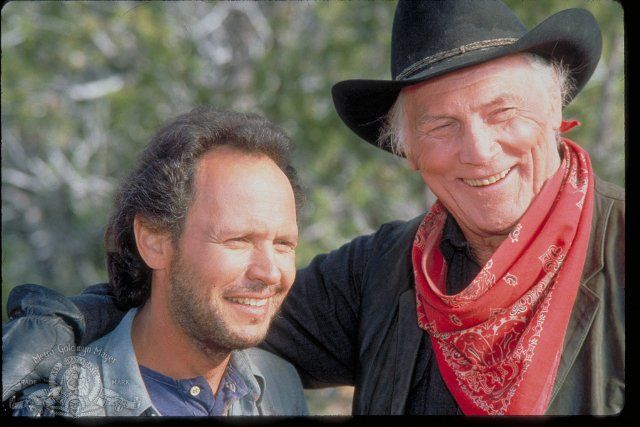
Billy Crystal Talks About Working with Jack Palance on City Slickers

While at the twentieth anniversary screening of “City Slickers” which was held at the Aero Theatre in Santa Monica on August 12, 2011, Billy Crystal talked about working with the late Jack Palance in that film. Palance co-starred as Curly Washburn, the most authentic of cowboys, and it was a role which earned him the Oscar for Best Supporting Actor. In addition, it provided Crystal with one of the best setups in his Oscar hosting history; Palance’s one-armed push-ups which proved he was not too old to ever act in a motion picture.

One movie the “City Slickers” filmmakers viewed before they started shooting was “Shane,” the 1953 western starring Alan Ladd as the title character and Palance as Jack Wilson, and Crystal said this was the first movie he ever saw on the silver screen. When it came to casting Curly, he said they considered no one but Palance for the role. “Shane” marked the last time Palance got an Oscar nomination until he did “City Slickers,” and that’s a difference of 38 years!

Palance worked on “City Slickers” for a total of 10 days. Before he arrived on set, the crew kept saying, “the big cat is coming.” The director of the movie, Ron Underwood, was described by Crystal as the “sweetest guy” and a “puppeteer.” But when it came to the first day of shooting, Palance told Crystal he always got “nervous.” When Underwood asked him to do that “glare” of his one more time, Palance replied, “What glare?!”

After this, Palance put up a fit which had Underwood’s hair standing on end. No one was expecting this kind of tantrum from the former host of “Ripley’s Believe It or Not.” But after the first day, things got better even though Palance was never thrilled about being on a horse. Both he and Crystal continually ran lines with one another, and Crystal described the two weeks they worked together as feeling like nine months.

Crystal described Palance as a “real movie actor” in how he understood the size of his head. Palance owned the camera and his appearance in a way few actors can ever hope to. His role as Curly capped off a long and memorable acting career. While he sadly passed away in 2006, his legacy continues to live on from one generation to the next.

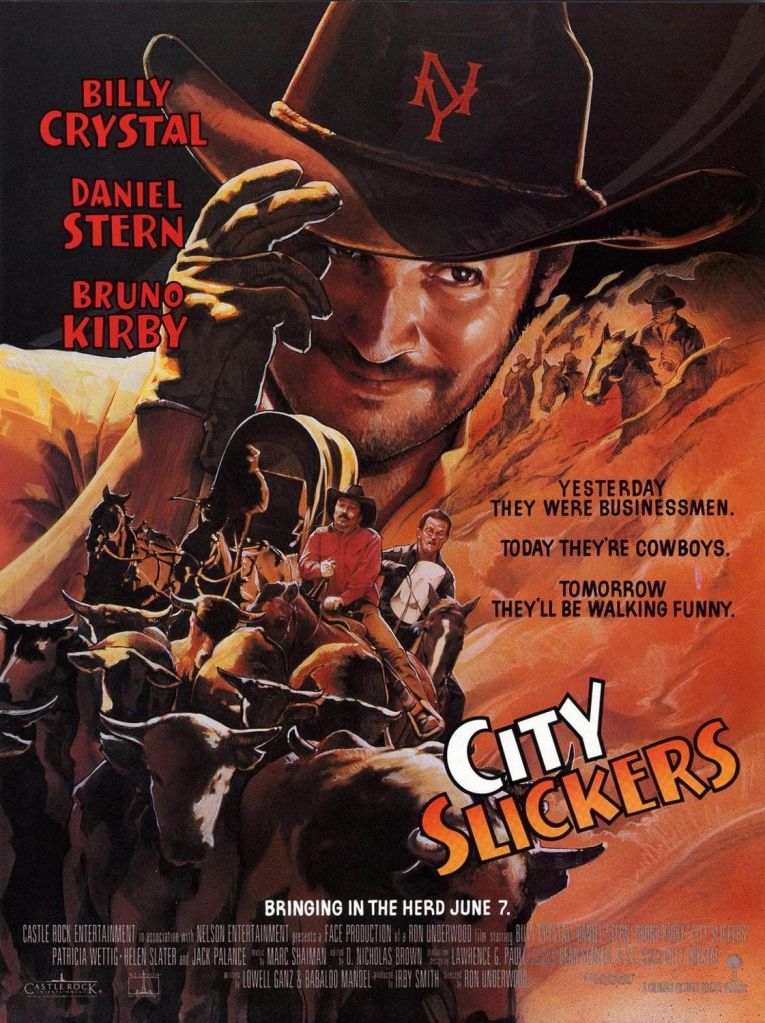
Billy Crystal Looks Back at the Making of City Slickers

Billy Crystal was at the Aero Theatre in Santa Monica, California on August 12, 2011 when American Cinematheque screened “City Slickers” in honor of its 20th anniversary. Unlike other guests, Crystal actually sat through the entire movie with the sold-out audience and a few people involved in its making: director Ron Underwood, director of photography Dean Semler, actors Daniel Stern, Tracey Walter and Bill Henderson, and screenwriters Lowell Ganz and Babaloo Mandel. Afterwards, Crystal did a Q&A with Geoff Boucher of the Los Angeles Times, and he said the last time he saw “City Slickers” was at its premiere in Hollywood.

“City Slickers” was made with the invaluable help of Castle Rock Entertainment. Crystal said he pitched it and “Mr. Saturday Night” to the studio. Unlike “When Harry Met Sally,” which he did before this, “City Slickers” proved to be a logistically difficult film to make. However, the prep time he had with Stern and the late Bruno Kirby was the best ever, and Crystal described the training they had as being so much fun.

Prior to filming, Crystal, the writers and Underwood looked at the classic westerns “Shane” and “Red River” for inspiration. Crystal said it looked like they had 9,000 cows in the shots, and this made him think markets had no beef to sell as a result. Everyone involved felt everything needed to look real, so the production pushed those cows and trained those horses endlessly.

The movie’s opening scene in Pamplona, Spain, was shot there and not on some soundstage. Crystal said Ganz was the one who suggested the bulls running to the studio. An hour after hearing this, the studio had hotel reservations ready for the cast and crew. It was no surprise to hear Crystal say they would never be able to do this scene today as it would all have to be done digitally now.

One audience member asked if Norman the cow was still around. It turns out there were 10 or 11 different cows used as they got old very quickly and had to be replaced. As for Norman’s birth scene, Crystal said it was shot in three different states and that he and Jack Palance, while in the same scene, were not on set together for it. Crystal shot his takes in Colorado while Palance filmed his in New York. Other parts of the scene were shot in California near Simi Valley.

The river crossing scene was the toughest one to shoot in “City Slickers,” Crystal said. The cows kept mounting each other and he, Stern and Kirby were all wearing wetsuits underneath their clothing, as the water was about 50 degrees. This led one of the stunt coordinators to tell Crystal, “Pee in your wetsuit!” Now, as disgusting as this may sound, urine has a temperature of 90 degrees or more, so it sure must have come in handy during filming!

Crystal laments how Hollywood does not make movies like “City Slickers” anymore. While he did not want to sound bitter, he said there was a different sensibility back when it was made, and he hopes movies will come around back to it in the future. Picturing how a studio executive would see it today, Crystal felt they would probably say to him, “Can we get them to the ranch faster? I want those guys there by page nine!”

Still, 20 years later after its release, we were all in agreement with Crystal that “City Slickers” holds up very well and is just as funny and entertaining as it was when it first came out. Seeing it on the big screen where it plays best made this clear to everyone in attendance.

The Movie Trailers Which Played Before ‘Django Unchained’ at New Beverly Cinema

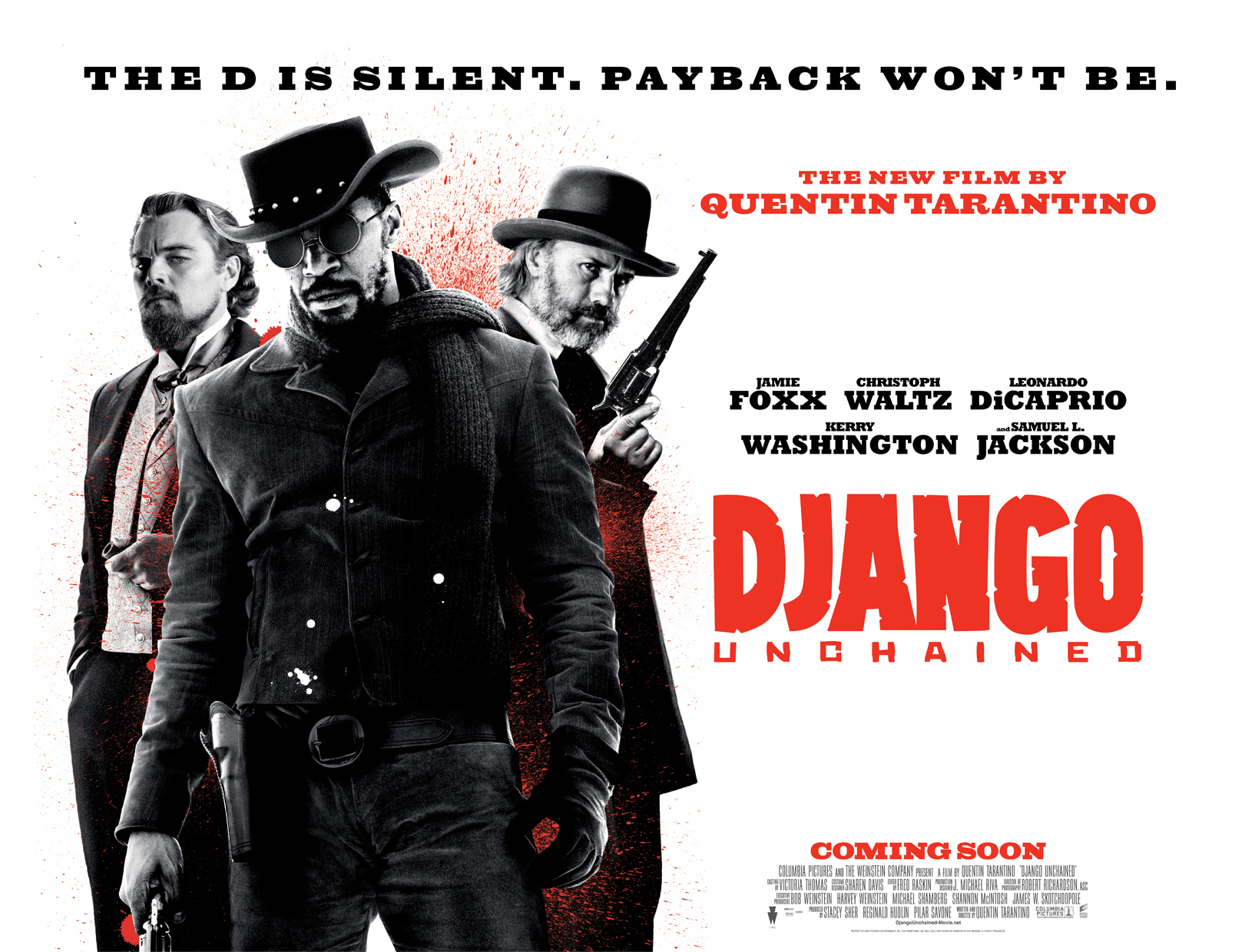
DjangoUnchained_poster2

WRITER’S NOTE: This article was originally back in 2012.

I was lucky enough to check out Quentin Tarantino’s latest movie “Django Unchained” at New Beverly Cinema, the same movie theater he bought and kept from going out of business. It was being shown in 35mm instead of a digital print at other theaters because Tarantino is still a big fan of film, and the New Beverly is known for showing movies in 35mm because that’s exactly what the owners and patrons like best.

One of the real treats of seeing “Django Unchained” at New Beverly Cinema is instead of getting coming attractions for 2013 movies, we instead get to watch movie trailers from the past. These ones were especially campy and represent the kind of movies Hollywood no longer makes, and I wondered if the trailers being shown before “Django Unchained” inspired this particular Tarantino film in some way. Many of the prints of movies and trailers shown at the New Beverly tend to come from Tarantino’s own personal collection, so even if they didn’t inspire this movie of his, then they must have been ones he loves watching over and over.

Let’s take a look.

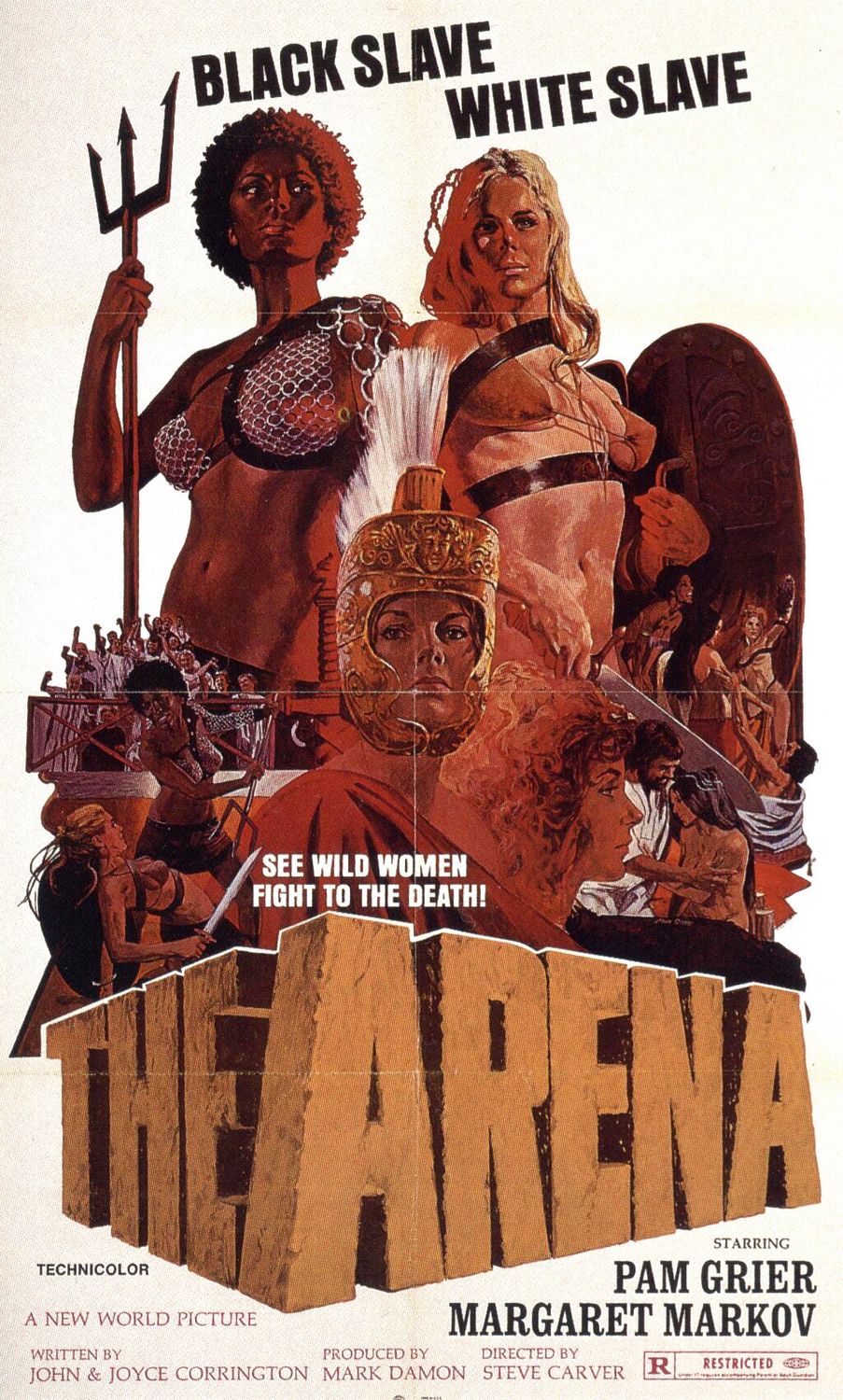
The Arena 1974 movie poster

“The Arena”

This exploitation film from 1974, one which clearly was inspired by “Spartacus,” stars Pam Grier and Margaret Markov as female gladiators who have been enslaved in Rome and are forced to fight for their freedom. The trailer proved to be hilarious as the acting is over the top, and the narrator embellishes the more explicit elements of this movie by saying how the Romans “enslaved the most sensuous women to titillate the perverted pleasures of the Roman public” and how the main characters are “beautiful unchained women” whose bodies are “shaped into superb fighting equipment.” There’s also a bit of nudity and blood on display, the kinds of things you almost never see in a movie trailer today unless it is a red band trailer being shown for restricted audiences only.

Still, it’s great to see Grier here whom Tarantino cast in his movie “Jackie Brown,” and it is said she and Markov did all their own fights and stunts in “The Arena.” We should all known by now that Grier is as tough as the characters she has played in dozens of movies, and seeing her take on the Romans makes this one worth a look.

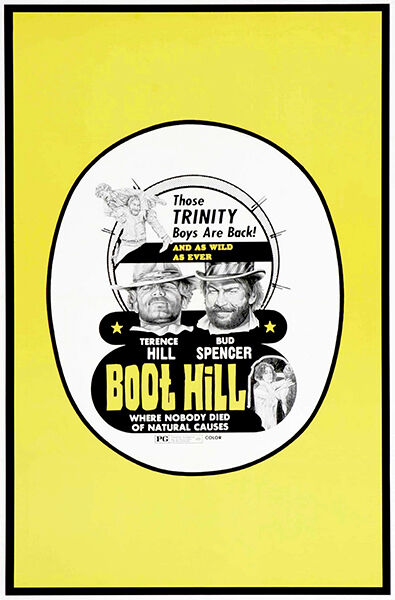
Boot Hill movie poster

“Boot Hill”

The trailer for this 1969 Italian Spaghetti Western runs four minutes long, much longer than the average movie trailer we see in theaters today. It stars Terence Hill as Cat Stevens, but the trailer’s narrator refers to him as “the man with no name.” It also stars football great Woody Strode as Thomas, a man who is quick with a gun and out for revenge over the death of his son. Together, these two help the inhabitants of a gold mining community which is being oppressed by a criminal organization.

This is another trailer which has a male narrator emphasizing the movie’s violence, and it’s fun to hear him say how “Boot Hill” is a town “where death comes quick,” “where death comes hard,” and where “death comes in two colors.” Seeing Hill and Strode walk into town all serious and without a smile on their faces brings to mind how Jamie Foxx and Christoph Waltz roll into town in “Django Unchained.”

“Boot Hill” was actually the last film in a trilogy of movies directed by Giuseppe Colizzi, and it was preceded by “God Forgives… I Don’t!” and “Aces High.”

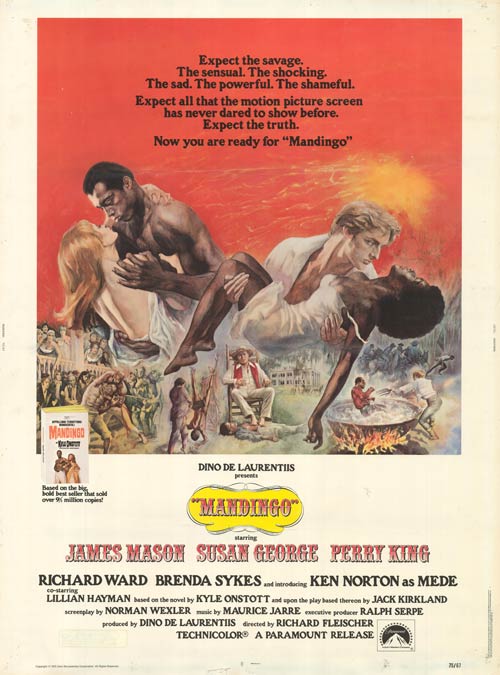
Mandingo movie poster

“Mandingo”

This 1975 film was based on the best-selling novel of the same name by Kyle Onstott, and it stars James Mason, Susan George, Perry King, Lillian Hayman, former boxer Ken Norton and pro-wrestler Earl Maynard. It takes place in the 1840’s where a plantation owner trains one of his slaves to be a bare-knuckle fighter, and there are some brutal scenes of bare-knuckle fighting to be found in “Django Unchained.” It makes me wonder if Tarantino based the character of Calvin Candie (played by Leonardo DiCaprio) on the ones played by Mason or King in “Mandingo.”

The narrator of this trailer describes “Mandingo” as being “the first true motion picture epic of the Old South,” but it’s a little hard to believe this as certain scenes appear to be very overwrought. The audience couldn’t help but laugh at the actress who told her lover “don’t kiss me yet, unless it’s just a cousin kiss” because the kiss which followed seems to be anything but a cousin kiss.

The movie version of “Mandingo” received a severe bashing from film critics like Roger Ebert, Leonard Maltin and Richard Schickel, all of whom gave it their lowest rating. Tarantino, however, said it represents one of only two instances in the last few decades where “a major studio made a full-on, gigantic, big-budget exploitation movie” (the other being Paul Verhoeven’s “Showgirls”).

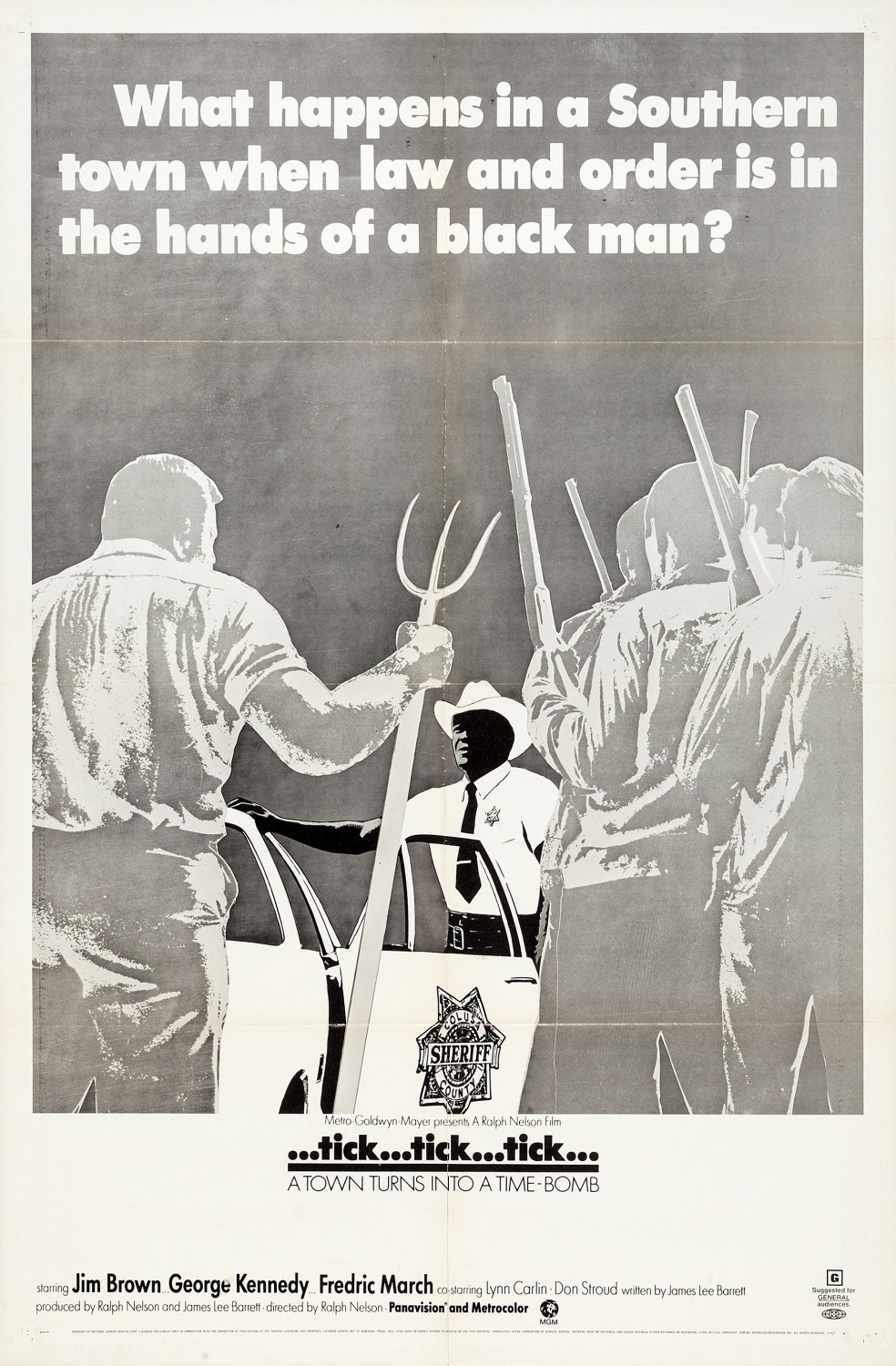
Tick Tick Tick movie poster

“…tick…tick…tick…”

Ralph Nelson’s 1970 movie stars another football great, Jim Brown, as Jimmy Price, a black police officer who has just been elected sheriff of a racially divided town in the American South. The fact he beat out the former Sheriff, a white man named John Little (George Kennedy), does not sit well with some of the townspeople. As the movie’s title and the endless ticking in the trailer indicates, the racial tensions will continue to rise until they boil over into a possibly fatal conflict.

…tick…tick…tick…” has long since become a cult classic for its cutting-edge portrayal of racial tensions and its tense narrative, and of all the trailers shown before “Django Unchained” at New Beverly Cinema, this was the one the audience laughed at the least, if at all. It looks like it still holds up to this day regardless of the passing of time, and the way the white characters treat Jimmy doesn’t seem much different from the way Django is treated in “Django Unchained.” It’s especially cool to see Brown as a Sheriff because he has always had the appearance of someone who can clean up a town single-handedly.

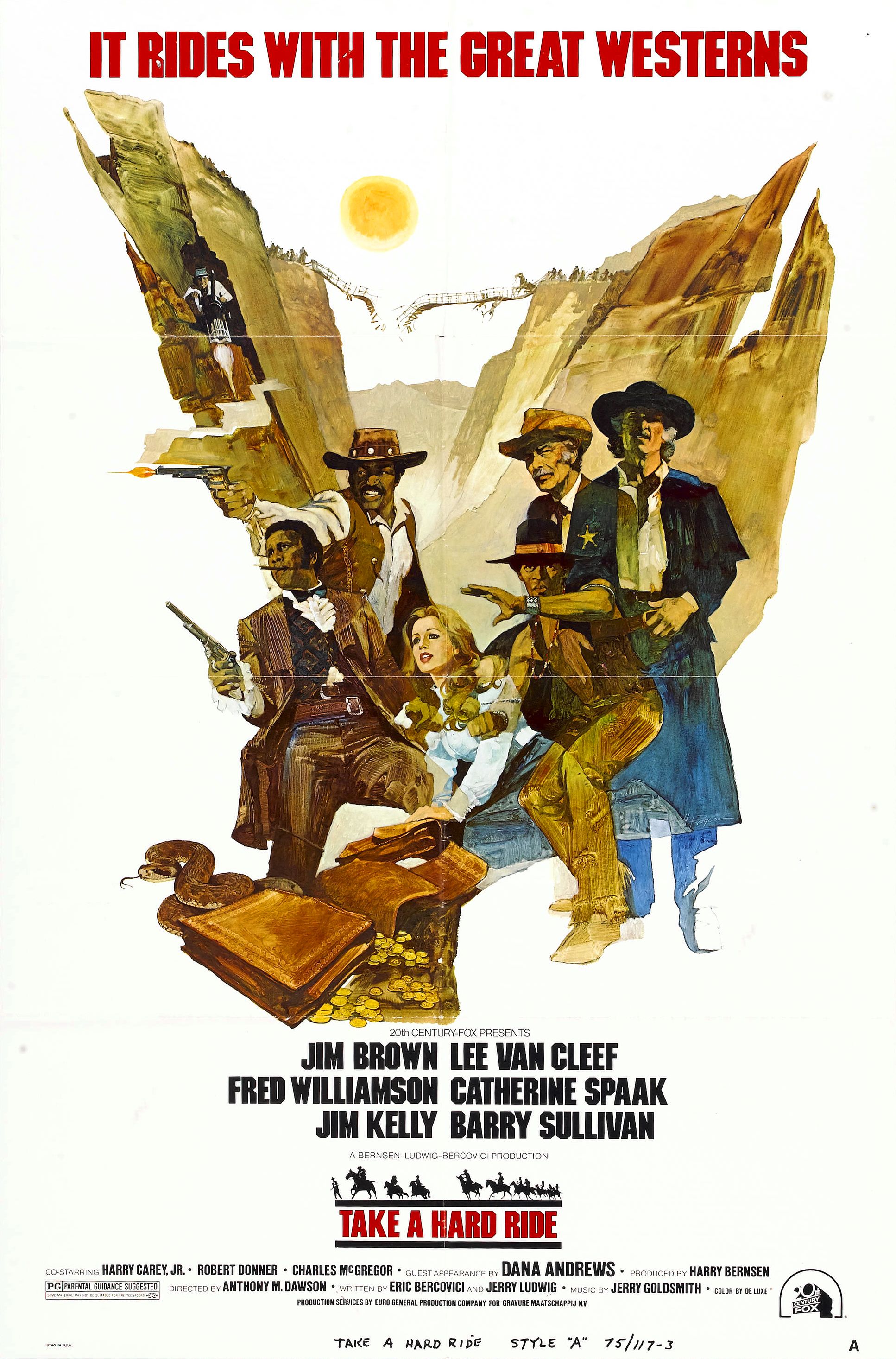
Take a Hard Ride movie poster

“Take a Hard Ride”

This Western from 1975 also stars Jim Brown as Pike, a rugged trail boss and former criminal who promises Bob Morgan (Dana Andrews) he will successfully transport $86,000 across the border to a ranch in Sonora, Mexico. Pike is forced to team up with a dishonest gambler named Tyree (Fred Williamson) for this mission, and they are soon being pursued by the ruthless bounty hunter Kiefer (Lee Van Cleef) and the corrupt sheriff Kane (Barry Sullivan).

The trailer for “Take a Hard Ride” made it look like a movie I really want to check out. Like “Django Unchained,” it is a mix up of the Blaxploitation and western genres and features one of the best casts a movie like this could ever hope to have. Brown and Williamson have always proven to be ultimate bad asses in whatever movies they appear in, and I love how the trailer’s narrator describes Cleef’s character as being “as sly as a rattlesnake and twice as deadly.” It was also great watching the scene where the cowboys and their horses crash down a hill because now I know where the filmmakers of “Young Guns II” got the idea for a similar scene.

After watching all these trailers and “Django Unchained,” it becomes clearer to see where Tarantino took his cues from as a writer and director. It also shows how brilliant he is at taking all the elements and turning them into a movie which is uniquely his own and not just an uninspired homage that pales in comparison to the films it inspired. “Django Unchained” proved to be a lot of fun, and the trailers which preceded it are for movies which look to be just as entertaining.

Jamie Foxx on Saddling Up For ‘Django Unchained’

Jamie Foxx in Django Unchained

WRITER’S NOTE: This article was written in 2013.

It was a role originally meant for Will Smith, but after watching “Django Unchained” it will be hard to think of any actor who could have played Django better than Jamie Foxx. The Oscar-winning actor came from the world of comedy where he has done hilarious work, but he continues to impress us with one terrific dramatic performance after another in films like “Collateral,” “Ali” and “Any Given Sunday.” The role of Django is one of the biggest and most challenging Foxx has taken on, and he convincingly takes this character from being a helpless slave to becoming a slick bounty hunter in splendid fashion.

When it comes to working with Quentin Tarantino, he’s always ready to show his actors movies they can base their characters on. Foxx was no exception to this, and Tarantino got him to watch Sergio Corbucci’s 1966 Spaghetti Western “Django,” a movie which serves as one of “Django Unchained’s” biggest inspirations. It starred Franco Nero as a coffin-dragging gunslinger who comes into town and gets caught up in a feud between the KKK and a bunch of Mexican bandits. While talking with Rebecca Murray of About.com, Foxx explained what impact watching “Django” had on him as well working with Nero who has a cameo in “Django Unchained.”

“I was like, wow, it was amazing. And then to actually have the original Django in the movie. I don’t know if you’ve ever met him but he was the biggest star on the set,” Foxx told Murray. “For him to give his blessing, and I think it really follows true to it and I think that’s what’s going to be the pleasant surprise to people, that it’s a Western and that it stays along the lines of a Western that happens to be in the backdrop of slavery. Slavery almost becomes secondary at a certain point because at the beginning it’s traditional, slave. Then once he becomes this bounty hunter, that’s the backdrop. Now it’s about revenge and about getting this girl, so he stayed true to that and that’s cinematic.”

While at the “Django Unchained” press conference, Foxx made it clear he was ever so eager to work with Tarantino on it. He had no qualms about playing a slave, and what attracted him to the role was Django’s uprising. Movies have always been an outlet for the artists who make them and the audiences that watch them, and Foxx explained what makes this one particularly cathartic.

“When you see movies about slavery…we never get a chance to see the slave actually fight back, actually do for himself, and in this movie there are a lot of firsts,” Foxx said.

Despite the fact it is a genre movie and a revenge fantasy of sorts, “Django Unchained” does deal with America’s dark history of slavery. Tarantino never sugar coats it for mass audience consumption, but then again, why should anyone? It’s an ugly part of the past we’d like to ignore, but it needs to be acknowledged so we can learn from it in the hopes of never repeating it again. As a result, the movie has been greeted with controversy over its subject matter and the frequent use of the n-word with many people (and not just Spike Lee) complaining loudly about it. But Foxx, in an interview with Keith Staskiewicz of Entertainment Weekly, said he is not surprised at the strong response “Django Unchained” has been getting and doesn’t think anyone else should be either.

“You know it’s going to be controversial!” Foxx told Staskiewicz. “That’s what’s been blowing my mind, people saying, did you know this was going to be controversial? It’s like, come on man! Did you read the script? Why would Quentin Tarantino do anything that wasn’t controversial? What movie of his have you seen where you went, oh, this is a Hallmark Movie and rated G? That’s not what you sign up for. You don’t sign up for that.”

Still, Foxx admitted it was a tough movie to make considering part of it was shot at the Evergreen Plantation in Louisiana. It was at this same plantation where slaves were made to work, and they suffered and toiled under brutal conditions. Being there must have been deeply unsettling for everyone involved in the movie’s making, and it certainly had a strong impact on Foxx which he wasn’t about to ignore.

“It’s tough shooting when you’re in plantation row and that’s where your ancestors were persecuted and killed, and we were respectful of that,” Foxx told Staskiewicz.

Regardless of the controversy, “Django Unchained” proved to be one of the most entertaining movies of 2012 thanks to Tarantino’s clever screenplay and direction, and also because of the sensational performances from the cast. Jamie Foxx can add Django to his roster of great screen roles in a career which still has many more to be revealed. Foxx also made a very good point about the film’s subject matter to Adam Edelman of the New York Daily News which people really need to think about.

“Every two, three years there is a movie about the Holocaust because they want you to remember and they want you to be reminded of what it was,” Foxx said. “When was the last time you seen a movie about slavery?”


SOURCES:

Rebecca Murray, “Interview with Jamie Foxx from ‘Django Unchained,'” About.com

Matt Donato, “Interview With The Cast Of Django Unchained,” We Got This Covered

Keith Staskiewicz, “‘Django Unchained’: Jamie Foxx on portraying slavery and filming on an actual plantation,” Entertainment Weekly, December 14, 2012.

Adam Edelman, “‘Django Unchained’ star Jamie Foxx: ‘Every single thing in my life is built around race,'” New York Daily News, December 14, 2012.