‘Creepshow’ Remains a Benchmark in Horror Anthologies
Creepshow movie poster

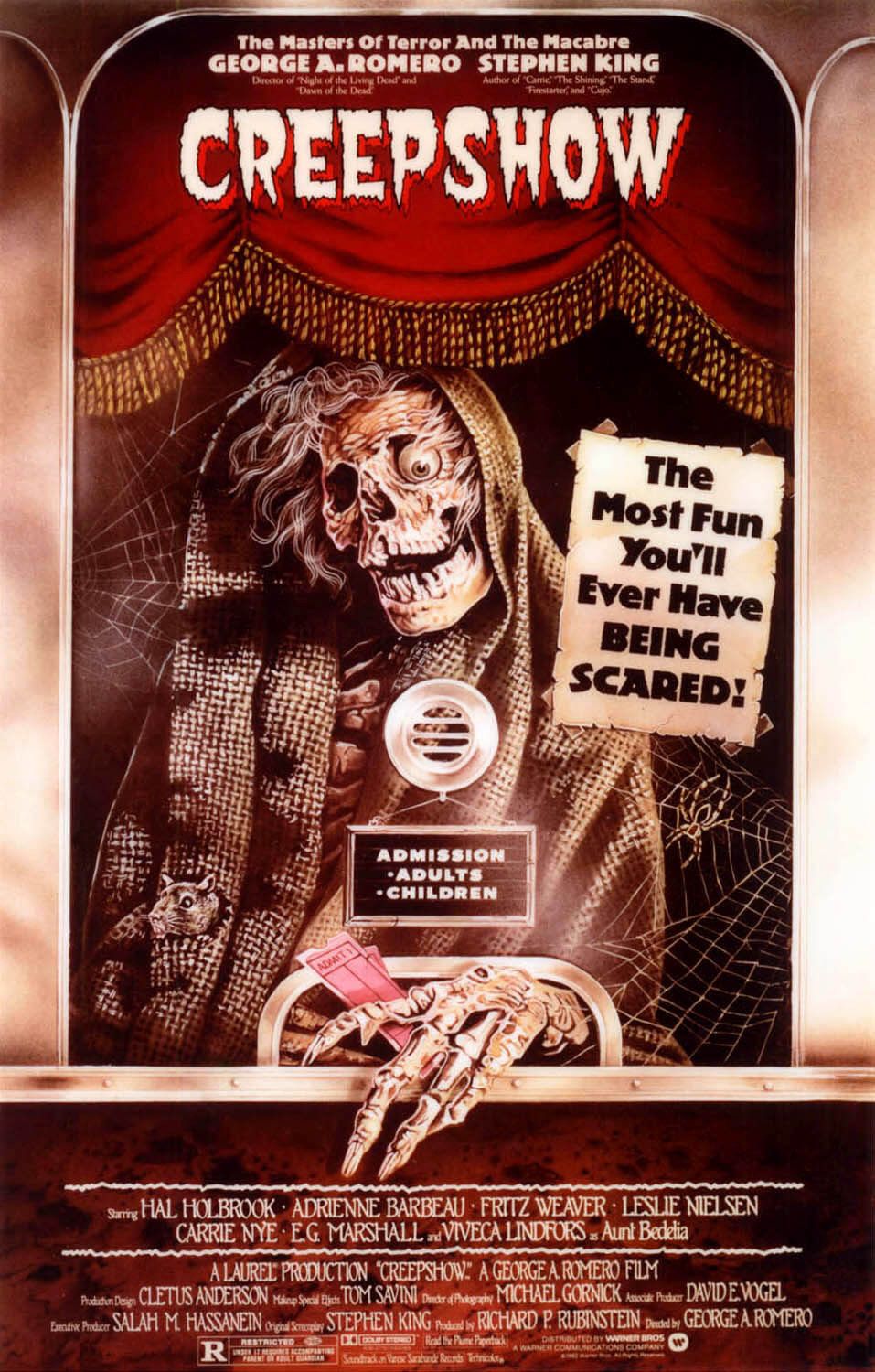
Ah, “Creepshow!” One of the best horror anthologies to come out of the 1980’s, and it is immensely enjoyable if you’re into this sort of movie. It brings us the combined talents of Stephen King and George Romero as they give homage to the E.C. comics of the 1950’s with five different stories of terror. In some ways, this can be seen as more of a comedy than a horror movie. Granted, it does have its scary moments, and a hand coming out of a grave is always good for a jolt, but it is presented in such an over the top fashion to where you have to thank both King and Romero for not taking the things too seriously.

As I write this review, filmmaker Eli Roth is having a two-week festival of his favorite movies at New Beverly Cinema in Los Angeles. This film was playing on a double bill with “Mother’s Day” which I missed, unfortunately, but it was probably because I was more excited about seeing this one. I vividly remember seeing the trailer for it when I went to see, and cry again at, “E.T.” When the image of The Creep first appeared, my brother responded by saying, “Whoa!”

The trailer was amusing and funny, at least until those cockroaches came in during which I had to cover my eyes. Granted, it would years and years before I would have the stomach, let alone the time, to check this one out. Anthology movies and series like “Masters of Horrors” are always intrigued me because they were filled with so many possibilities. Going from one story to the next, you are eager to see where it takes you. The only downside with anthologies is there is usually a weak story among the whole bunch which can weigh down the whole enterprise, but “Creepshow” doesn’t have this problem and is endlessly enjoyable to sit through.

The movie opens with a prologue where a father (Tom Atkins) berates his young son (Joe King, Stephen King’s son) for reading these “crappy” horror comics. The kick of the scene comes from the son calling out his dad for the hypocrite he is when he points out it’s a lot better than the magazines he reads. I couldn’t help but think this kid’s dad has a wide variety of porno magazines hidden where his wife can’t find them. It’s funny how we see fathers not wanting their kids to read “crap,” and then they sit in a recliner with a can of beer boasting of how God made fathers. Poor schmuck.

“Creepshow” then goes straight into its first episode entitled “Father’s Day,” a story of revenge. The patriarch of a family was murdered for being an annoying prick as he furiously demanded his cake to be brought out to him, and now he’s come back from the dead to get that tasty cake he has long been denied. Of all the stories, I consider it the weakest because “Father’s Day” is very short and threatens to be pointless. It does, however, succeed in defining the look of the movie. The acting is over the top, and there is a fantastic use of colors which dominates the movie and gives it a wonderfully pulpy feel. If Dario Argento had ever created a comic book, I’m sure it would look like this.

The great about “Father’s Day” is it allows us to see Ed Harris in a role where he is loosened up. Harris is a great actor who plays mostly dramatic roles in movies, and one day he will win an Oscar. But here, we see him get his boogie on while dancing to some crappy disco music which somehow sneaked its way into a 1980’s movie. You listen to that music, and you’d figure it would have died a fiery death before the 70’s ended. No such luck.

The next story, “The Lonesome Death of Jordy Verrill,” is both funny and sad. It features King in one of his few acting performances as the title character, a dimwit farmer who discovers a meteor which has crashed into his backyard. Jordy gets excited at the prospect of selling this meteor to the local college for a handsome profit, but when he tries to salvage it, it breaks into two and a liquid quickly seeps into the barren ground of the farm. Soon after, everything it touches starts growing green plant life which cannot be contained. It also grows on anything it touches, including Mr. Verrill himself. Seeing King turn into a bush is frightening and morbidly amusing. King may say he is a better writer than an actor, but you can also say he is a better actor than a director (“Maximum Overdrive” anyone?). In the end, he is perfectly cast as the seemingly brainless farmer, and his performance fits both the story and the film.

After that, we get “Something to Tide You Over,” and this one was my favorite of all the stories in the movie. It stars Leslie Nielsen, before his image was permanently altered by “The Naked Gun” movies, as a millionaire husband who takes his revenge on Harry (Ted Danson), the man having an affair with his wife. The way he lures Danson’s character out to the beach and gets him to bury himself in the sand up to his neck is priceless, and you can say there is a bit of “The Vanishing” here as we have a man willing to do anything to find out the fate of his loved one. Danson’s fate, being stuck in the sand as the tide rushes over him is frightening and unnerving to witness. You feel stuck in the sand with him, and it shows how fiendishly clever both King and Romero are at exploiting what we fear the most in life.

Watching this segment today may seem weird as Nielsen is forever known as Lt. Frank Drebin of “The Naked Gun” movies, and Danson is best known for playing Sam Malone on “Cheers.” Seeing them in a serious, albeit a highly exaggerated, story might be hard, but these actors have their serious chops as well as their comedic ones, and both talents serve them well here. Nielsen is a particular hoot as a man so confident of his deviant plan of revenge, yet quickly haunted by the possibility of his crimes coming back to do him in. Nothing can stay buried forever.

Next, we have “The Crate” which features Hal Holbrook as a Professor at a New England college who is saddled with an eternally inebriated wife (played by Adrienne Barbeau) who constantly embarrasses him and herself in front of anybody who happens to be watching. Holbrook’s character is a coward who doesn’t have the cojones to stand up to his wife, but then a colleague of his and a janitor discover a crate beneath the stairs which has not been opened for decades. It turns out to contain a monster who eats human beings whole. After Henry hears of this, he concocts a plan to lure his abusive wife over to the crate.

Holbrook is great at making you feel sorry for his character even while we berate him for being a wimp and not standing up to his wife. Barbeau gives a one-note performance as a humongous bitch with no real redeeming features whatsoever. In the end, this is not a big criticism because Barbeau is given a one-dimensional character to play. The characters are not meant to be complex in the way they handle themselves, and they are here to represent different types of people who meet their predestined fate.

Then comes the last story of the movie, appropriately titled “They’re Creeping Up on You.” This one I had the hardest time sitting through, and I doubt it will be easy for you either if you have an intense phobia of bugs. E.G. Marshall plays Upson Pratt, a thoughtless and hateful bigot who has no sympathy for anyone other than himself. He gleefully takes delight in the suffering of others and lives in a completely sterile apartment which makes him look like he’s a doctor. But his problem now is with the bugs in his apartment, specifically cockroaches. They keep popping up out of nowhere, and their numbers keep growing and growing…I found myself looking at my shoes a lot during this segment, and it reminded me I need to get a new pair soon.

I remember watching one of those “scariest moments in movies” episodes on the Bravo channel. They featured the cockroach segment from “Creepshow” in it, and it turned out the segment was more of a socially conscious piece than people realized. This is after all a Romero film whose “Dead” movies are loaded with social commentary, and the whole point of the “Creeping” segment was to look at bigotry how what we fear the most we end up empowering. We invite our fears to mess with us, and sometimes they eat us whole. Suffice to say, this is very much an anti-racism piece, and it’s the strongest episode in the movie. Marshall gives a brilliantly zany performance as a man who cannot control the world around him any longer, and who could never really control it in the first place.

Eli Roth had programs for his festival entitled “The Greats of Roth,” and in it he summed up this “criminally underrated” movie perfectly:

“It’s amazing to see how many comic book and graphic novel adaptations today are praised for getting the ‘look’ of the comic perfect, and nobody ever seems to mention this film. This was the first time that Romero was really surrounded with a star-studded cast, and you see Romero, King and Tom Savini all coming together to create one of the most visually spectacular and fun horror films of all time. They set out to recreate the look and feel of the old E.C. Comics and nailed it perfectly.”

“Creepshow” is indeed one of the most deliriously entertaining horror movies ever made, and it is a visually stunning achievement made on what must have been an especially low budget. There were many other movies to come out of this which tried for the same look, but none of them succeeded at it quite like this one did. This is just a fun, fun, fun movie for people who dig this sort of thing, and to see it on the big screen was a real treat. As the movie’s tagline says, it is the most fun you will ever have being scared.

* * * * out of * * * *

WRITER’S NOTE: This review was originally written in 2008.
Save

Argo

Argo movie poster

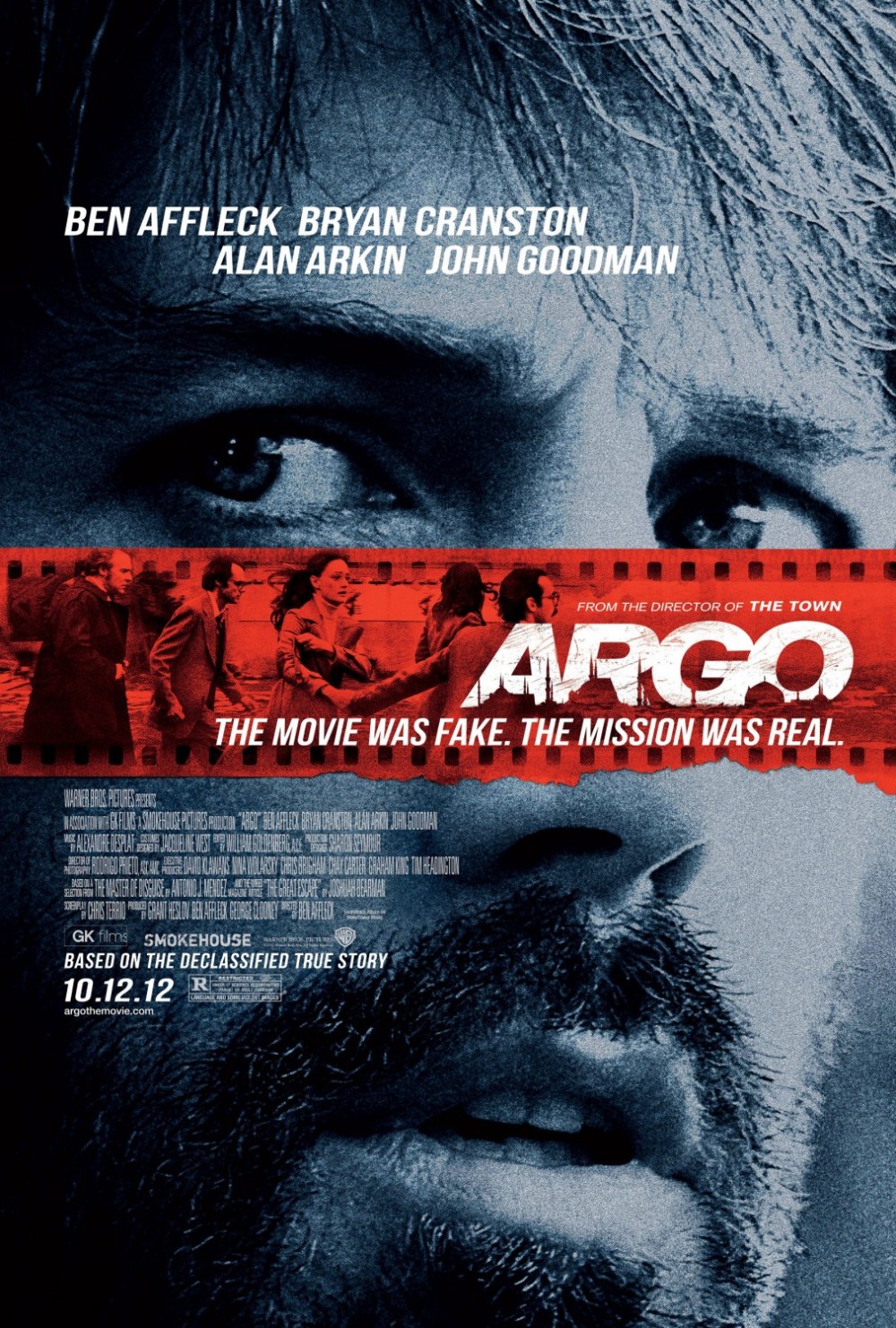
After the one-two punch of “Gone Baby Gone” and “The Town,” Ben Affleck should not have to prove what a great movie director he is. But for those who, for some utterly bizarre reason, still believe they need further evidence to support this conclusion, I give you “Argo.” His third movie as a director tells the story of how CIA specialist Tony Mendez went about trying to extract six U.S. diplomats out of Iran during the 1979 hostage crisis. It proves to be a very intense experience watching this movie, and I also got a huge kick over how it skewers Hollywood and the business of making movies as well.

I loved how Affleck really went out of his way to make “Argo” look like a 70’s movie. He even included the old Warner Brothers logo (referred to as the “Big W” logo) which preceded the studio’s movies from 1972 to 1984. I’ve really missed this logo for the longest time.

Anyway, when Iranian revolutionaries ended up storming the U.S. embassy in Tehran, six diplomats manage to evade capture and find refuge in the home of Canadian ambassador Ken Taylor (Victor Garber). Meanwhile, back in the United States, the State Department has learned of the escapees and their predicament, and they start looking for ways to get them out of Iran. It is Mendez who comes up with the idea, after watching “Battle for the Planet of the Apes” on television, to create a cover story of how the six are actually filmmakers from Canada who are scouting locations for a fake sci-fi movie called Argo. This looks to be one of those “so bad it’s good” kind of movies, and it would have been fun to watch for all the wrong reasons had it ever been made.

The scenes where Mendez goes to Hollywood are among my favorites in “Argo” as he works with movie business veterans who are keenly aware that lying to others is part of their job description. John Goodman and Alan Arkin are priceless as make-up artist John Chambers and film producer Lester Siegel, and they are given great pieces of dialogue to speak throughout. The lines Arkin is given are especially biting:

“You’re worried about the Ayatollah? Try the WGA!”

The tension is then ratcheted up tremendously when Mendez heads over to Iran to prep those six diplomats on how to get out of the country alive. You feel their collective anxiety as they become fully aware of how one little slip up will get them quickly executed in public view, and you are with them every step of the way as the walls continue to close in on them. Emotionally speaking, “Argo” is the first movie I have found myself crying after in a long time, and the tears I cried were from sheer relief.

“Argo” is based on a true story and, while this remains a serious pet peeve of mine, this is one which needed to be told. It wasn’t until 1997 that this rescue operation was declassified for all the world to know about, and it speaks a lot about how two countries can come together in a tough situation (in this case, the U.S. and Canada). Yes, portions of the story were fictionalized for dramatic purposes, but that’s always the case so just get over it.

Affleck casts a lot of great acting veterans in “Argo,” and kudos to him for doing so. I’ve already mentioned Goodman and Arkin, but you will also find Bryan Cranston, Kyle Chandler and Philip Baker Hall doing terrific work here as well. As for the diplomats, they are played by such actors as Clea DuVall and Tate Donovan among others, and they all are uniformly excellent.

In addition to directing this movie, Affleck also stars as Mendez and gives a particularly understated performance. I know we all love to pick on him as an actor, but he’s a better one than we give him credit for. Not once does Affleck try to steal the show from the actors around him, and his work is commendable as acting and directing a movie at the same time can be a real pain in the ass.

“Argo” has more than earned its place among the best movies of 2012, and it makes clear that Affleck’s success as a director is no fluke. This is a guy who has seen the heights of success and the utter embarrassment of failure, and he has come out the other side of it all proving he is a great talent whether he’s in front of or behind the camera.

Be sure to stay through the end credits as well as there is information you will need to hear about this true story.

* * * * out of * * * *

The First Trailer for ‘It’ Floats to the Surface

It teaser poster

I count Stephen King’s “It” as one of my all-time favorite novels, and I very much enjoyed the 1990 miniseries based on it, and that’s even though the ending was incredibly disappointing. Now, after many false starts which saw actors and directors come and go from the project, “It” is finally making its way to the silver screen courtesy of Warner Brothers and New Line Cinema, and now we the first trailer for the film.

After watching this trailer several times, my interest in this new adaptation has tripled. Pennywise the Clown, this time portrayed by one of the many actors from the Skarsgard family, Bill Skarsgard, comes across as far more lethal than the one Tim Curry gave us, and seeing Pennywise leap out at us in the trailer’s final moments has me believing anyone with a clown phobia should seriously consider not seeing this movie. We never get to see all of Pennywise here, and he is instead shown through quick flashes throughout, but it’s enough to send a chill down my spine.

The cast of actors is led by Jaeden Lieberher, who left a strong impression on audiences with his performances in “St. Vincent” and “Midnight Special,” who plays Bill Denbrough, the leader of the Loser’s Club who vows revenge against Pennywise for murdering his little brother Georgie. It’s hard not to be reminded of the Netflix series “Stranger Things” while watching these young actors as they too are on a mission to find out what evil lurks in the underbelly of their hometown of Derry, Maine. The story has also been moved up from the 1950’s to the 1980’s (the slide projector is a dead giveaway), so the filmmakers look to be playing on our collective nostalgia which should make this movie extra fun.

Cary Fukunaga was set to direct this adaptation, but although he eventually dropped out due to those “creative differences” filmmakers just love to throw out there, he is still listed in the credits as one of the screenwriters. Directing “It” is Andrés Muschietti who previously directed Jessica Chastain in the box office hit “Mama.” From this trailer, it looks like he is having lots of fun exploring the many ways Pennywise terrorizes the young children of Derry, Maine as he gets at their deepest fears and exploits them for all they are worth. My hope is he focuses on the characters of King’s classic novel as well as on the scares. One thing’s for sure, he certainly knows how to make a red balloon look especially ominous.

“It” is clearly covering the first part of King’s novel when the members of the Loser’s Club were kids. Here’s hoping this adaptation scares us silly enough to where we get follow-up which will follow them into adulthood as we all know the past stays with us in one way or another. Adaptations of King’s novels range from brilliant (“The Shining,” “Misery,” “The Shawshank Redemption”) to horrendous (“Maximum Overdrive,” “Graveyard Shift”), so let’s hope this is not just one of the better ones, but one of the best.

Check out the teaser trailer below.


Gareth Edwards and Thomas Tull Talk About Making ‘Godzilla’

godzilla-2014-poster

I was invited to attend a special press screening of the 2014 “Godzilla” at Grauman’s Chinese Theatre (it’s now called TCL Chinese Theatres, but I prefer to call it Grauman’s), and it proved to be a huge improvement over Roland Emmerich’s 1998 debacle. Following the screening, we were treated to a Q&A with the movie’s director Gareth Edwards and the CEO of Legendary Pictures, Thomas Tull. The two of them discussed how they saw this version of the giant monster, the first time they became aware of who or what Godzilla was, and of how their film mirrors the current events of today.

There have been dozens and dozens of “Godzilla” movies made since 1954, most of them made in Japan by Toho Company Limited. There have been a couple of American movies made about this enormous monster as well, but they didn’t fare well to say the least. “Godzilla 1985” was universally panned by film critics and died a quick death at the box office. As for Roland Emmerich’s “Godzilla” which came out in 1998, I still cringe at the thought of its existence as it was amazingly awful. But when it came to making the 2014 version, Edwards made clear he was not about to let fans or critics down.

“We were trying to put more into it than just a simple monster movie because the original was definitely a metaphor for Hiroshima and Nagasaki and a very serious film. So we were inspired to try and reflect that,” Edwards said. “We police the world and go, ‘You can’t have nuclear power. You can’t have it. But we can have it, and we have nuclear weapons.’ And what if there were a creature that existed, creatures that were attracted to radiation? Suddenly the tables would be turned, and we’d be desperately trying to get rid of that stuff.”

From there, both Edwards and Tull described the first time they saw Godzilla. Hearing Tull talk about his first exposure to the Japanese monster came to illustrate just how big of an effect monster movies had on him when he was growing up. As for Edwards, he ended up describing his first exposure as being embarrassing.

“First time I saw it, it was the ’54 version,” Tull said. “I was probably around 7 years old. Where I grew up in upstate New York, what I looked forward to every year was the Friday after Thanksgiving when the local TV station would play ‘Godzilla’ marathons all day. That was my favorite thing of the year. I had the incredible fortune of making movies out of all the stuff I loved as a kid: ‘Batman,’ ‘Superman,’ Watchmen’ and now ‘Godzilla.’ Somehow the magic genie made it happen. This is really special to me.”

“In the U.K. when we were kids growing up, they had the Hanna Barbara cartoon. Not many people know that in America. I thought it was a worldwide thing,” Edwards said. “But it was basically Godzilla and I guess his son, Godzuki, and it would fly; it was all very cute. When you’re a kid it was great. I got offered this amazing opportunity. People in the U.K, they like to take the piss out of their friends, so just to mock me they would always refer to it as Godzuki. They’d be like, ‘How’s Godzuki going? Have you been to any Godzuki meetings?’ And I used to play along with it to the point where my phone learned how to spell Godzuki more than Godzilla. So when we used to have regular emails about the film, I’d type Godzilla and it would automatically change it to Godzuki. And for a while, I thought I might get fired.”

Edwards said while he and Tull were in the process of putting the movie together, the Tōhoku earthquake and tsunami, also known as the Great East Japan Earthquake, occurred which decimated much of Fukushima and caused serious accidents at nuclear power plants. Now when horrific events like this occur, Hollywood is quick to distance itself from them for fear of appearing like they are profiting from them. But considering the genres “Godzilla” covers, there was enough of a reason not to ignore the serious events happening around the world.

“There was a point where it felt like, well, maybe we shouldn’t set it in Japan. Maybe we shouldn’t deal with radiation or anything like this,” Edwards said. “We had genuine conversations for quite a while and we talked to a lot of people, and knew a lot of people, who were Japanese obviously working with Toho. And after a while the general consensus was that the 1954 version, the whole point of that movie, and science fiction and fantasy in general I think, they have this opportunity to reflect the period that they’re made in, and so it was thought as long as we did it respectively and the city and the events in our film are not about anything that happened in Japan. So, we felt it kind of appropriate to acknowledge some of these issues as we were figuring out the storyline.”

“When I was a kid, my dad used to have an encyclopedia on the twentieth Century, and on the front cover was Hiroshima, JFK’s assassination, Hitler, all the major events of the twentieth century,” Edwards continued. “I used to look at it and think none of that happened in my lifetime. Nothing significant like that has happened in my lifetime. Maybe nothing like that ever will. And then in the last ten years with the obvious things, it’s nearly impossible to genuinely sit down and say, ‘OK, I want to do a monster movie. I want to try and treat this like it really happened. What would it look like? How would people react and not be infected by the imagery over the last ten years, whether it be the natural disasters or even some of the terrorism?’ So that kind of infected the film a little bit. But we tried to do it in a way that, first and foremost, it’s entertainment. You’re here to see a Godzilla. But I personally like a little meat on my bone, so within that there’s obviously this other imagery and meaning that you can pull from as much as you want or as little as you want.”

Before this, Edwards had only one directorial effort to his name, the 2010 film “Monsters.” It had a budget of only $500,000 and, in addition to directing it, he also worked as writer, cinematographer and the visual effects artist which may explain why it didn’t cost much to make. With “Godzilla,” he had the backing of a major studio and an estimated budget of $160 million. Talk about one heck of a promotion! This has got to put the fear of God into any filmmaker making this kind of transition, but Edwards sounded like he has handled big budget moviemaking very well.

“It’s a massive, massive deal,” Edwards said. “It’s not just a once in a lifetime opportunity; it’s a once in a million-lifetime opportunity to be able to get to do this. The way I dealt with it was to forget we were doing it and just convince ourselves, which was kind of very easy to do, that we’re just in this bubble; it’s just us, and we’re just making a movie that we want to sit and watch, something that will give us goose bumps. And it’s kind of this selfish passion project in the way you kind of approach every day. Because I’d get paralyzed if I really thought about the number of people who would end up seeing the film and all the publicity and press that would come from it.”

“But it’s such a great opportunity,” Edwards continued. “I grew up since I was a little kid desperate to be a film director, and the second they mentioned it I was just like, I could never live with myself if I ever turned this down. I mean, I love monster movies. My first film was a monster movie. This is the ultimate monster movie. So how could you live with yourself having not made ‘Godzilla’ when you had that opportunity?”

Even before its release, “Godzilla” had already sparked conversations about a sequel or a potential franchise. This is not a surprise as movie studios are always looking for the next big movie trilogy to thrust at movie fans eager to pay their hard-earned money for. Edwards, however, said it was his intention to make a stand-alone movie, something I was very pleased to hear. As for Tull, with Legendary Pictures having been purchased by Universal Pictures, he was asked if a sequel would be released by either Universal Pictures or Warner Brothers, the latter which is distributing this movie. In the end, Tull could only say the following:

“We have a little rule: we can’t talk about anything else until this comes out and works,” Tull said. “It’s a little superstition I have. All I can say is, we’re passionate fans of the universe and we love Godzilla and some of those other folks do too, so if this comes out and works we’ll figure it out.”

Save

Jeremiah S. Chechik Looks Back at Making ‘National Lampoon’s Christmas Vacation’

christmas-vacation-movie-poster

Jeremiah S. Chechik was the special guest at Arclight Studios in Hollywood a few years ago when they hosted a screening of his directorial debut, “National Lampoon’s Christmas Vacation.” The third and most beloved in the “Vacation” franchise has long since become a holiday classic, and it is the Christmas film many families watch during the holiday season instead of “A Christmas Carol” and “It’s a Wonderful Life.” After the movie was over and the end credits were all done, Chechik quickly came up to the front of the audience before anyone could introduce him and said, ”I haven’t seen it since the day it opened!”

The screenplay was written by the late John Hughes and was inspired by an article he wrote for the National Lampoon Magazine called “Christmas ’59.” Chechik tipped his hand to Hughes’ wonderful writing and went on to say it was originally written as a stand-alone movie. Warner Brothers, however, read it and immediately wanted to integrate it into the “Vacation” franchise.

When asked how he got the job to direct, Chechik explained he was directing what he described as “high profile” commercials back in a time when it was unusual to go from doing commercials to directing feature films. His work eventually got him discovered by Steven Spielberg who ended up giving him an office at Amblin Entertainment. This brought a lot of awareness to his visual style, and both Chase and Hughes soon became adamant he would be the one to direct the next “Vacation” movie.

With this being his first film, Chechik said he was determined not to back down on actors who wanted to exert their power over him. While it’s tempting to think he and Chase didn’t get along as Chase’s reputation for being hard to work will never disappear, Chechik said they actually had a great working relationship on set. This came after he admitted to not being a big fan of Chase’s comedy as he described it as being “very broad.” Chechik described Chase as having a very strong point of view, a very clear intention of what the movie is about, and they worked together to find things which worked.

Chechik did say, however, that he and Beverly D’Angelo had many arguments, some of which he described as being “very heated,” on set. Still, he said all the bad blood between them is now water under the bridge.

“Christmas Vacation’s” budget was $27 million, and its shooting schedule lasted for 60 days. Much of the movie was shot in Breckinridge, Colorado while other scenes were shot the following summer at Warner Brothers in Burbank, California. Chechik was happy to say Hughes had his back throughout the whole production. When the movie went through previews, the studio heads pressured him to cut the scene where the cat got electrocuted. Chechik claimed he resisted the pressure and kept it in because he thought it was funny (and it was) and that he was more of a dog person anyway. The test audiences also loved the scene, and the studio heads didn’t bother keeping this moment out of the movie’s trailer.

Chechik said “Christmas Vacation” worked so well because we truly cared about Clark Griswold and what he went through. The mood of certain scenes was very important to him, especially the one with Chase in the attic where he watched home movies of past Christmases with tears filling his eyes. Looking at this made Chechik point out the way comedy should be done in movies:

“Funny beats funny,” he said. “If everyone thought the set pieces were funny but they didn’t care about the main character, then the movie won’t work.”

With the squirrel scene, he said a trained squirrel was brought onto the set and there was also a trainer there for the dog featured in it as well. Chechik said the filmmakers “storyboarded the hell out of it” and were eager to start filming it, but when he arrived on set that day he was confronted with the grim faces of the trainers and line producers. After shuffling around for a bit, they informed him the squirrel had died. The squirrel trainer went on to say they don’t live for very long anyway as if that could have possibly softened the blow.

So, they went out and got another squirrel for the scene which they ended up drawing out onto the set with food. From this, Chechik said he learned how to roll with things and use improvisation. About every scene in “Christmas Vacation” had a certain amount of improvisation in it, he pointed out.

As for the most difficult scene to shoot, Chechik said it was the dinner table scene where the whole family begins their Christmas Eve celebration. He did not hesitate in telling everyone that having 9 to 11 actors in a scene is a really bad idea. The blocking proved to be very complicated, and it became such a nightmare as it took days and days for him to get the scene right.

Here are some other “Christmas Vacation” trivia Chechik let us know about:

  • In the scene with the two granddads snoring in front of the television, the actors playing those roles really were fast asleep.
  • Mae Questal, who played Aunt Bethany, was the voice of Betty Boop.
  • Chevy’s angry rant on his boss was done exactly as it was written in the screenplay.

It was really nice of Chechik to come out and talk with us about “Christmas Vacation,” a movie he succeeded in making a timeless classic and, as he put it, “very postcardy.” When asked why he hasn’t seen the film since it first came out, he said he just wanted to let it go and let it live. It certainly has had a long life since 1989, and the series continued on with “Vegas Vacation” and “Vacation” which starred Ed Helms and Christina Applegate. In response to one audience member who said his family watches it every year, Chechik replied, “I like your family!”

Save

Godzilla (2014)

godzilla-2014-poster

The stench which emanated from the sheer awfulness of Roland Emmerich’s “Godzilla” has haunted me ever since I saw it on the big screen in 1998. For a time, it dampened my spirits in terms of where movies were headed as I was afraid many more of them would be dumbed down like Emmerich’s movie was. Had it been an even bigger hit, I feared more summer blockbusters would look exactly like it; filled with lame one-dimensional characters and special effects which look no different from the video games we play at home. But in the end, it was so critically reviled that even Toho, the company that owns Godzilla, looked at Emmerich’s version of the monster as a separate, stand-alone character whom they renamed Zilla. It was if they were saying, “Oh no, that was so not Godzilla. That was a cousin or a step child or maybe the product of a one-night stand.”

But now that stench has vanished as Gareth Edwards has given us his version of “Godzilla,” and it makes for one of the most entertaining movies of the 2014 summer movie season. Instead of having this enormous Japanese monster chase after characters who look like they were part of a rejected sitcom pilot, he stays true to the style of the Toho series of Godzilla films and manages to weave in some commentary about nuclear power. Just as the original “Godzilla” served as a metaphor for Hiroshima, this one doesn’t dare hide away from what happened in Fukushima where nuclear accidents occurred after the massive earthquake and tsunami which occurred there.

The movie starts off with the terrifying destruction of a nuclear power plant, one which ends up dividing a father and his son. We then move to several years later when Ford Brody (Aaron Taylor-Johnson), an explosive ordnance disposal technician in the US Navy, comes home to his wife Elle (Elizabeth Olsen) and their son after a long tour of duty. Their reunion, however, is cut short as Ford gets word his father, nuclear physicist Joe Brody (Bryan Cranston), has once again been arrested in Japan for trespassing into areas blocked off to the general public as the area surrounding the power plant isn’t all that different from Chernobyl when it suffered a meltdown.

Joe is still convinced the power plant accident was really a cover up for something, and he and Ford come to discover what’s left of it has been converted into a laboratory of sorts. Scientists led by Dr. Ishiro Serizawa (Ken Watanabe) and Dr. Vivienne Graham (Sally Hawkins) reveal they have been housing a MUTO (Massive Unidentified Terrestrial Organism) and are trying to keep it contained by giving it doses of radiation. But, of course, all hell breaks loose when the MUTO breaks free of its captivity and heads out to sea, and it is then we learn another MUTO (this one a female) has been held in the United States and has also escaped and quickly laid waste to Las Vegas. Like Natasha Henstridge’s character in “Species,” she is looking to start a big family with offspring which will surely destroy all of humanity, and it’s only a matter of time before she finds her MUTO mate. Clearly, safe sex is not on their agenda.

This is where the iconic Godzilla comes in. Now in the past, this gigantic creature has been portrayed as an enemy to all of humanity and as an antihero who looks to take down any other monster who foolishly thinks it can defeat him. But in Edwards’ movie, Godzilla is really the good guy who, as Dr. Serizawa puts it, is here to “restore balance” to the world, and he doesn’t even bother the battleships which sail alongside him as he swims from one country to the next. We all know Godzilla will end up destroying a lot of expensive real estate which will cause many insurance companies to go bankrupt, but we’re still on the monster’s side as we know the military won’t have enough firepower to bring down the MUTOs.

Edwards takes his sweet time in revealing Godzilla to the audience, and we don’t really get a good look at him until almost an hour into the movie. When he does finally appear onscreen and let out the biggest of roars anyone has ever heard, the audience I saw this movie with broke into a tremendous applause. This is the fiercest Godzilla has looked in many years, and the way he towers over the tallest of buildings had me in awe. This is the way Godzilla should look and feel.

One of the many problems I had with the 1998 “Godzilla” is it never felt like I was watching a real monster on the big screen. It felt more like I was watching a big special effect to where the creature didn’t even fill the least bit threatening. But in 2014’s “Godzilla,” the creature looks and feels real to where I kept praying the human characters would keep themselves from standing underneath its feet. The thought of being crushed by a creature that big is horrifying.

As for “Godzilla’s” human element, it’s not altogether strong, but I still liked how the characters came across as relatable even if they were at times clichéd. I also have to give the screenwriters credit as the movie starts as one thing but surprisingly turns into something else. Just when I thought I knew what kind of movie this “Godzilla” was going to be, it continued to surprise me as it went along. Yes, we all know how things will end, but getting there proved to be more fun than I expected.

It also helps there is a terrific cast of actors to keep us emotionally involved in the characters before and after Godzilla makes his grand entrance. You can never go wrong with Bryan Cranston whether it’s “Breaking Bad” or anything else, and he makes his character very empathetic when he could have been easily laughable. As for Aaron Taylor-Johnson, I almost didn’t recognize him after getting so used to how he looked in those “Kick Ass” movies, and he does good work portraying the typical heroic military character we always see in “Godzilla” movies. Ken Watanabe remains a tremendously gifted actor, and even though I thought stared in horror one too many times in this movie, he is a very welcome addition to this cast. And then there’s David Strathairn who plays Admiral William Stenz, and he can always be counted on to give the military leader the gravitas and humanity a character like this deserves.

As for the female characters, their roles are a bit underwritten and I didn’t get to see as much of them as I would have liked. Still, you have actresses like Elizabeth Olsen, Juliette Binoche and Sally Hawkins making them into memorable characters when they could have been ones who were easily forgettable.

This “Godzilla” does have its problems, and there are times I wished Edwards and company had injected just a little more humor into the proceedings. Also, the big fight between Godzilla and the MUTOs never seems to come soon enough. There’s a moment where it looks like the fight will begin, but then a door closes on the characters and on our view of the monsters, and that was really frustrating. The human characters may have wanted the door shut, but everyone in the audience was clamoring for it stay open so we could see one enormous mutated creature beat the crap out of another. And yes, there probably are some plot holes and gaps in logic in the story, but I really didn’t care. You don’t always go to these movies expecting a whole lot of logic anyway.

What makes this “Godzilla” work is how it is clearly made by filmmakers who have a great love of monster movies. Edwards, whose previous directorial effort was British science fiction film “Monsters,” has talked about just how much he loves those kinds of movies, and he does an excellent job of making Godzilla a truly terrifying force of nature. After being absent from the big screen for over a decade, it is great to see this iconic monster make such a tremendous comeback.

I also got to say watching “Godzilla” makes me really happy that I do not work for an insurance company. Seeing all those destroyed buildings and roads, I can see claim adjustors going nuts as they field one phone call after another regarding totaled Hondas, decimated condos and bridges which now really lead to nowhere because they’ve been destroyed. You can bet no one’s going to take any guff from someone who tells them their insurance policy doesn’t cover attacks from giant mutated monsters!

* * * out of * * * *

Save

Blazing Saddles

Blazing Saddles poster version 2

Blazing Saddles” is one of Mel Brooks’ funniest comedies and one which invites repeat viewings as there are always jokes still waiting to be discovered. It acts as a satire of the western genre as well as the racism which was obscured by Hollywood’s creation of myths regarding the American West. But as funny as it is, it also offers the viewer a moving story about a black sheriff who manages to win over a town on the verge of being taken over by murderers and thieves. It also gleefully breaks the rules to where places and people are added that were never really part of the American West in the first place.

The wonderful Harvey Korman plays Hedley Lamarr, the State Attorney General who wants to get his hands on the town of Rock Ridge where the land is worth millions. His attempts to frighten the people out of their town includes getting cowboys to ride in and shoot their guns, creating a havoc which makes everyone living there fearful and anxious. But when that doesn’t work, Lamarr comes up with what he believes is an ingenious idea; he hires a black man to become the new Sheriff of Rock Ridge with the belief his “mere presence” will scare everyone out of there. Of course, things do not go as planned.

Looking back at “Blazing Saddles” all these years later, it still stands up mainly because Brooks is not out to make the actors simply go for the joke. Instead they play many scenes straight instead of trying to be funny, and this makes the humor work even more than it already does. With a satire like this, it helps to have characters you care about regardless of how ridiculous their actions may be. Most movie satires and spoofs these days keep forgetting this as they are more persistent in selling the joke to the audience instead of giving the story any real substance.

The late Cleavon Little portrays Bart who becomes the Sheriff and immediately meets resistance to his presence because of the color of his skin. Regardless of how infinitely intelligent and cool he is compared to the idiotic residents of Rock Ridge, he has to work real hard to win them over. Little has so many inspired moments in the movie like when he sings a Cole Porter song instead of the “Camptown Races” which the racist cowboys assume blacks sing all the time.

Many may accuse “Blazing Saddles” of playing up black stereotypes in order to get easy laughs, but they completely miss the point. Brooks and his team of writers, which included Richard Pryor, turn those stereotypes upside down and expose them for the falsehoods they have always been. Seeing the residents of Rock Ridge overzealous reactions to Bart’s behavior, such as him saying “excuse me while I whip this out” when he takes out his written speech, are indicative of their overt racism more than anything else. Seeing them act so stupidly out of fear and sheer ignorance gives the movie some of its most side-splitting moments.

Another memorable performance comes from the great Gene Wilder who plays Jim, a.k.a. The Waco Kid, the fastest gun in the world. While Wilder is best remembered at times for playing neurotic characters, he is as cool as can be in this film. Seeing him play it so cool in moments where his precision with a pistol is stupidly questioned by others who don’t know him is so much fun to take in. His character is a riff on the one Dean Martin played in “Rio Bravo,” and Wilder is such a blast to watch throughout.

“Blazing Saddles” also provided the late Madeline Khan with one of her most famous roles, the German singer Lili von Shtupp whose name is inexplicably censored on the movie’s television version. She is endlessly brilliant in her rendition of the song “I’m Tired,” and it makes for one of the most unforgettable comic performances ever captured on film.

There are many unforgettably hysterical scenes throughout “Blazing Saddles” which stand up to repeat viewings. The campfire scene is as obscene as it is gut-bustlingly hilarious, and you may find yourself laughing harder than you ever have before. Brooks himself plays a couple of parts like the severely lacking in intelligence Gov. William J. Le Petomane and an Indian Chief who, for some bizarre reason, speaks Yiddish. Other actors like the great Slim Pickens and Burton Gilliam have us gasping with laughter just by looking at the befuddled expressions on their faces.

Along with a great music score by John Morris and beautiful cinematography by Joseph F. Biroc, “Blazing Saddles” has more than earned its place on the list of greatest comedies ever made. There is tremendous delight in watching Brooks throw caution and logic to the wind as he throws in the unexpected like Count Basie and his orchestra performing in the desert while Bart rides by, or having Nazis sign up for Lamar’s final battle at Rock Ridge. It doesn’t matter if it makes sense or because you just want the laughs to keep on coming (and they do). With a comedy like this, you can never be sure what will happen next!

By the way, be sure to watch “Blazing Saddles” in the widescreen version. Brooks shot the movie in Panavision scope, and it has never ever translated well to the realm of pan-and-scan.

Blazing Saddles poster version 1

Copyright Ben Kenber 2016.

* * * * out of * * * *

Save

The Nice Guys

The Nice Guys poster 1

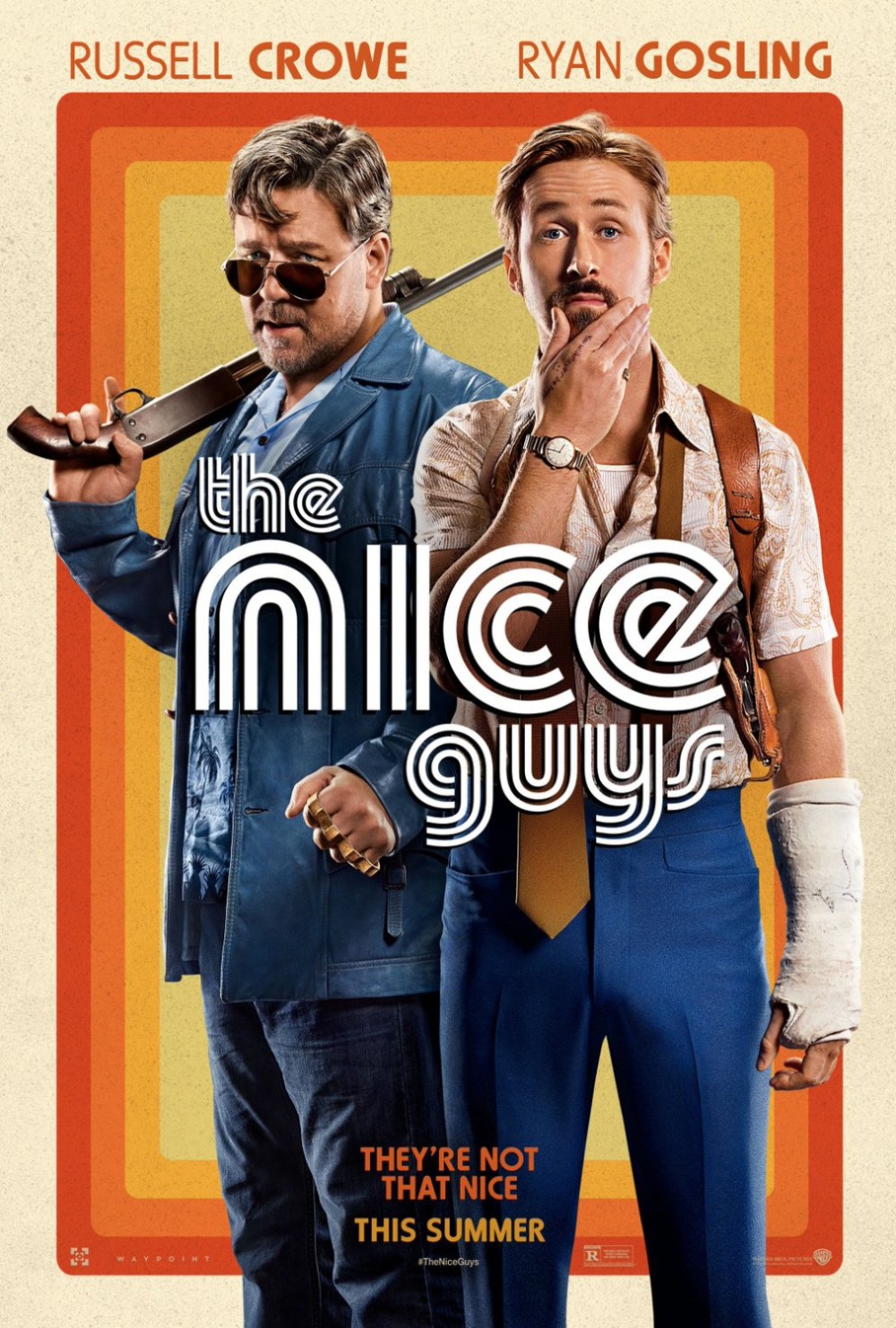
After exploring the superhero genre with “Iron Man 3,” writer and director Shane Black returns to the one he mastered years ago: the buddy cop movie. Black is the same man who wrote the screenplays for “Lethal Weapon,” “The Last Boy Scout,” “The Long Kiss Goodnight” and “Kiss Kiss Bang Bang” which he also directed. Now he gives us “The Nice Guys” which takes us back to the 1970’s and teams up Russell Crowe and Ryan Gosling as men involved in a murder mystery only they can solve.

“The Nice Guys” takes us back to 1977 and even features the “Big W” Warner Brothers logo Ben Affleck used to great effect in “Argo.” We even get some nice retro credits presented to the tune of “Papa Was a Rolling Stone,” so it doesn’t take Black long to transport us back to a time where laws against smoking were nowhere as strict as they are today. Black gives us some wonderful introductions to enforcer Jackson Healy (Russell Crowe) and down-on-his-luck private eye Holland March (Ryan Gosling), men who are not at their peak of their lives and are looking for reasons to justify their existence.

Like Bruce Willis and Damon Wayans in “The Last Boy Scout,” Jackson and Holland do not get off to the best start, and this is especially the case after Jackson breaks Holland’s arm with what seems like little ease. But the both of them come to see they need each other to discover the whereabouts of Amelia Kutner (Margaret Qualley), a missing girl who may be connected to the death of porn star Misty Mountains (Murielle Telio). Actually, describing the plot of this movie is a bit complicated as it is a little hard to follow, but perhaps a second viewing will help to answer questions viewers had the first time around.

Black, along with co-writer Anthony Bagarozzi, still knows how to create potent dialogue with a kick to it, and it makes the chemistry between Gosling and Crowe all the more palpable. After all these years, Black can still deliver a number of zingers few other screenwriters could pull off with as much success. As a director, he captures the mood of the 1970’s with a lot of flair and panache, and he makes the audience feel all the kicks and punches which come at them with fierce brutality.

Gosling nails the vulnerabilities and complications of Holland with a fearlessness, and he renders certain moments like when he suddenly discovers a dead body with an originality which makes them all the more memorable. As for Crowe, he has never had much success with comedy judging from his failed turn as a romantic comedy leading man in “A Good Year.” But here he fares much better as Jackson as this role plays on his strengths as a tough guy while at the same time playing around with this image of his. When he stares down a suspect he’s about to give a serious beating to, it makes you wonder why he even bothers wearing brass knuckles. His demeanor should be more than enough to intimidate anybody foolish enough to cross his path.

I also have to single out Angourie Rice’s performance as Holland’s daughter, Holly, as she more than holds her own opposite Gosling and Crowe. She also reminds us of how the younger generation is quick to call out their parents on the baloney they feed them on a regular basis. Rice makes Holy into a young girl wise beyond her years as a result of watching her dad fumble about much too often in life. She also reminds us of how we eventually become too benumbed by the unfairness of life as she holds a high moral standard that we have long since given up on out of hopelessness, and it makes for some powerful scenes in which she reminds the adults of why they are flat out wrong on certain issues.

“The Nice Guys” provides audiences with the opportunity to seek out a movie not populated with superheroes, and it is unafraid to brush political correctness aside without a second look. It’s giddy fun as it doesn’t conform to the cinematic norm which is overly influenced by corporations and needless test screenings. This one is its own beast, and taming it does it no justice. Either enjoy for what it is or see something else.

Copyright Ben Kenber 2016.

* * * ½ out of * * * *

Suicide Squad

Suicide Squad poster

Oh lord, what happened here? This was supposed to be the movie of the summer where, for a change, we got to root for the bad guys. “Suicide Squad” was a movie I couldn’t help but have high expectations for as I was expecting something along the lines of John Carpenter’s “Escape From New York” which had us rooting for a sociopath more interested in his own survival than saving the world. Instead, we got a mess of a motion picture which is not the least bit exciting. While the previous DC comic book movie, “Batman vs Superman: Dawn of Justice,” proved to be a dour experience, “Suicide Squad” is just flat out boring.

I’m not going to bother going over the plot of “Suicide Squad” as there wasn’t much about it worth remembering. All you need to know is the worst of the worst have been recruited against their will to fight an antagonist bent on (what else?) world domination. We do, however, get a laborious introduction to the squad of the movie’s title which includes characters who are so seductively evil. There’s Floyd Walton/Deadshot (Will Smith) who never misses a target, Harley Quinn (Margot Robbie) who has gone from being a psychiatrist to an insane supervillain thanks to the Joker (Jared Leto), the assassin Digger Harkness/Captain Boomerang (Jai Courtney), former Los Angeles gang member Chato Santana/ El Diablo (Jay Hernandez) who puts all pyromaniacs to shame, Waylon Jones/Killer Croc (Adewale Akinnuoye-Agbaje) who looks more like a reptile than a human being, and Dr. June Moone/Enchantress (Cara Delevingne) who is an archaeologist possessed by an evil spirit (is there any other kind?).

These characters represent a path to the dark side which moviegoers like ourselves are eager to eat up onscreen. It’s no secret we revel in their exploits which go against all the laws we grew up believing in as the movies are a great way to explore humanity’s dark side. Instead, their adventures are unforgivably watered down to where we wonder what he was thinking or if Warner Brothers meddled with his vision too much. The PG-13 rating should have been a warning as this kind of material demands an R like “Deadpool” did.

“Suicide Squad” was written and directed by David Ayer who has given us some strong motion pictures like “End of Watch,” “Harsh Times,” “Street Kings” and “Sabotage.” His movies never sugarcoat reality which makes them all the more viscerally entertaining, but here exits his comfort zone and has made a movie which is not the least bit visceral. It would have been cool to see Ayer combine his real world aesthetic with the DC comic book universe, but what we get instead is something which is astonishingly banal. Not even the appearance of Batman (Ben Affleck, once again proving he was a terrific choice to play the Caped Crusader) does much to make the proceedings the least bit interesting.

Furthermore, the movie is poorly photographed to where everything feels so drab and lifeless. From the posters it looked like this would be an infinitely colorful motion picture as the villains leave their mark on a society which has long since abandoned them. Instead, every scene looks like it was illustrated from the same pastiche which makes it all the more depressing to sit through.

This is also not to mention the choppy editing which robs the action scenes of any excitement they hoped to have. Not even the clever music selections of songs by Eminem, Kanye West or Queen does much to raise our adrenaline levels as the characters show off their devilish talents. Ayer also introduces certain character driven scenes at the most inopportune moments in “Suicide Squad.” While they are meant to give more depth to the characters, they instead slow down an already tedious movie that pretty much lost me from the start.

In terms of the acting, some performances here are better than others. Will Smith and Margot Robbie pull off strong turns as Deadshot and fan-favorite Harley Quinn, but they are saddled with an endless stream of pathetic one-liners which fail to amuse in the slightest. Other are not as lucky such as Jai Courtney who looks more like Tom Hardy to where I thought Hardy was cast as Captain Boomerang. As for Adewale Akinnuoye-Agbaje, he suffers the same indignity Oscar Isaac and Idris Elba endured in “X-Men: Apocalypse” and “Star Trek Beyond;” getting covered up with way too much makeup which robs him of his natural charisma.

One of the best performances in “Suicide Squad” comes from Jay Hernandez who makes El Diablo into much more than just a one-dimensional schmuck. While the other actors have little room to move around, he manages to humanize his character to where we see much beyond the various tattoos covering his body to where his plight is ultimately heartbreaking. Hernandez manages to generate some genuine emotion here, and it’s in a movie which could have used more of it.

But the big surprise is Jared Leto’s turn as Joker in that Cesar Romero’s was far more threatening and memorable on the campy “Batman” television show. Leto does make the role uniquely his own and has a chilling laugh, but there’s nothing particularly special or invigorating about his portrayal. He doesn’t have the ghost of Heath Ledger haunting his every move, but he never comes across as much of a villain. Instead, Leto’s portrayal is nothing more than a cartoon, and his performance here is more of a cameo than a starring role.

Looking back, the most threatening character to come out of “Suicide Squad” is not a superhero or a supervillain, but instead a government official named Amanda Waller. From start to finish she is ruthless and single-minded in her approach to forming this squad and infinitely devious in keeping the team of supervillains under her complete control. It also helps that Amanda is played by the always fantastic Viola Davis who makes this character into a fascinating psychological case study as she proves to be an even bigger sociopath than those she has employed to save the world.

I came out of “Suicide Squad” depressed and wondered how so many talented people came together to make a comic book movie so lifeless and boring. Even if you come into it with low expectations as many are doing now, there’s not much of anything to like here. I was hoping to see an exhilarating motion picture with a devilish sense of humor, but instead we got what is so far the most disappointing movie of 2016. Warner Brothers may have started their own cinematic universe with some success, but now they need to start making better movies because they are way behind Marvel Studios.

To all the DC Comics fans out there who enjoyed “Suicide Squad,” please believe me when I say I’m happy for you. It’s good to know somebody got something out of this movie because I sure as hell didn’t. Here’s hoping and praying that “Wonder Woman” and “Justice League” are infinitely better.

* out of * * * *

Copyright Ben Kenber 2016.