‘Mickey 17’ Movie and 4K Review
The following review was written by Ultimate Rabbit correspondent, Tony Farinella.

Studio movies seem to be falling into two categories these days—they are either inspired by other movies or they are looking to do something unique and different. “Mickey 17” falls into the latter category. Even though it is based on the novel “Mickey7” by Edward Ashton, it is a rather unique and “out there” movie. It is a science fiction comedy with big ideas, over-the-top characters and representations. I can’t compare it to any other movie out there, which is becoming increasingly rare in today’s cinema. So often, when you watch a movie, it reminds you of one or two others that have already been released. Franchises, sequels and reboots are also becoming far too common. Original ideas, even if based off books, are infrequent visitors in the cinematic landscape of today.

“Mickey 17” is directed by the Academy Award-winning director of “Parasite,” Bong Joon Ho, and it follows the story of Mickey Barnes, played by Robert Pattinson of “Twilight” fame. After Mickey and his buddy Timo (Steven Yeun) fall into debt because their macaron business falls apart, they are out of options. This leads them to joining a spaceship crew where they hope to blend in and avoid getting murdered by flying under the radar. While Timo becomes a shuttle pilot, Mickey decides to become an “expendable,” which is a job where he is in charge of dying over and over again in order to find answers for various problems in society.
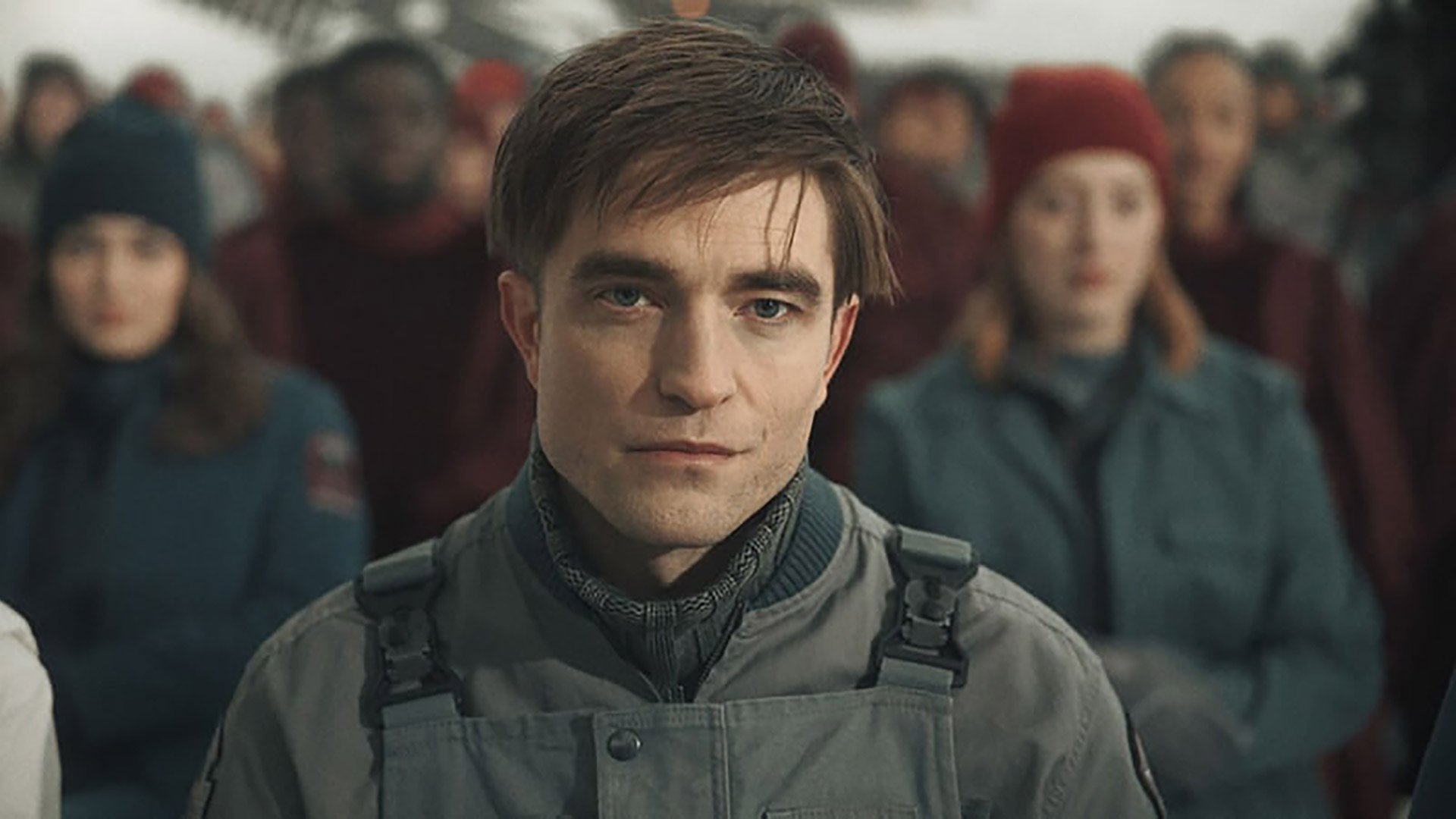
Mickey Barnes is sheepish, dopey, and painfully shy.  However, he enjoys his new lease on life because of his relationship with an agent named Nasha, played by Naomi Ackie. They are madly in love with each other, and she helps Mickey deal with the fact that dying is not a whole lot of fun. Even though he is brought back to life because of a process called “reprinting,” it doesn’t make dying any easier for Mickey as he is, in many ways, a human guinea pig. With his work, they are able to come up with vaccines that will save lives. 
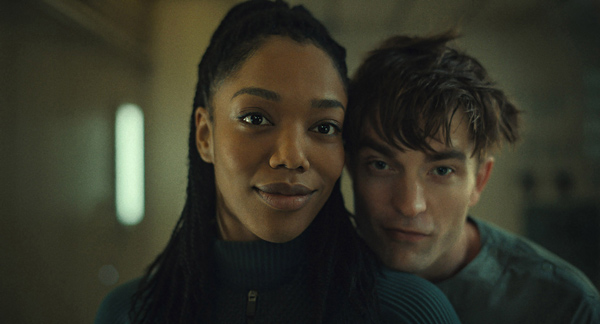
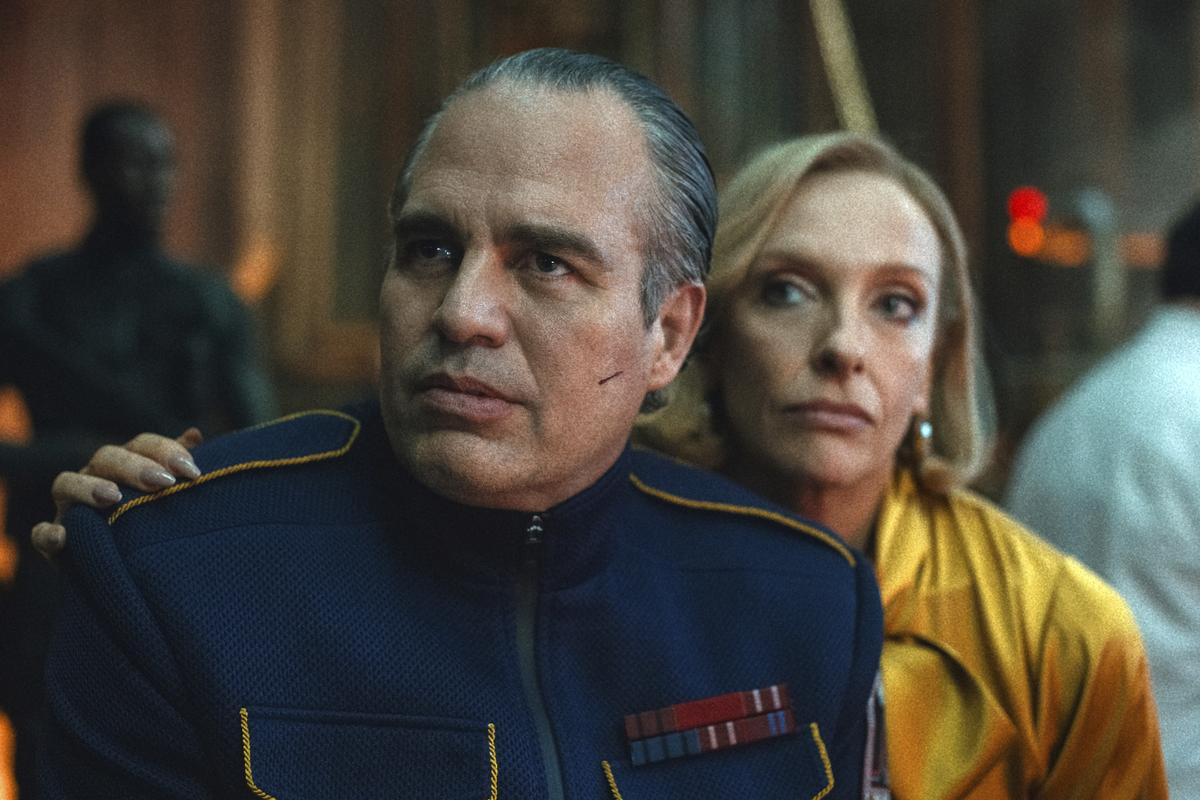
One day, his life is turned upside down when his life is spared by a group of critters known as Creepers. This leads to him being turned into a double, so while he is Mickey 17, there is also a Mickey 18, a version of him that is confident, self-assured and fearless. Nasha doesn’t mind having two Mickey’s, as it is more fun for her to fool around with two versions of her boyfriend. On this expedition, there is a leader named Kenneth Marshall, played by Mark Ruffalo, and it’s hard not to draw comparisons to Donald Trump with his performance. I had to look this up after watching the movie, and I’m not the only one who felt this way, even though Bong Joon Ho and Ruffalo say that was not their intention. If it walks like a duck and quacks like a duck, it’s probably a duck. Kenneth’s wife is played by Toni Collette.
“Mickey 17” is a film high on ambition and ideas, but it doesn’t have a sense of direction, and its pacing is all over the map. One of the most frustrating aspects of this movie is the fact it has a lot to say and there is a lot going on, but it falls apart because there is no sense of where they want to go with all of this. Is it a love story? Is it a commentary on there being two versions of yourself? Is it a commentary on self-sacrifice? Is it about abuse of power? It’s all of those things and a whole lot more, but without a clear and concise vision, not all of these ideas have the time to be fleshed out, even though the film is two hours and seventeen minutes long. The film is wildly uneven and frustrating.

Another big issue with the film is Pattinson and his bland and uninteresting performance. He’s not a good actor, even when he is given good material. I understand he’s trying to be taken seriously as an actor, but he doesn’t have the chops to carry the comedic scenes, and he also struggles with the more serious material as well. This is another problem with the film—it’s in search of a tone. Since it’s trying to do so much at once, it doesn’t know how to balance its themes or tones. It’s also way too long, and it needed a good trip to the editing room.

* * out of * * * *

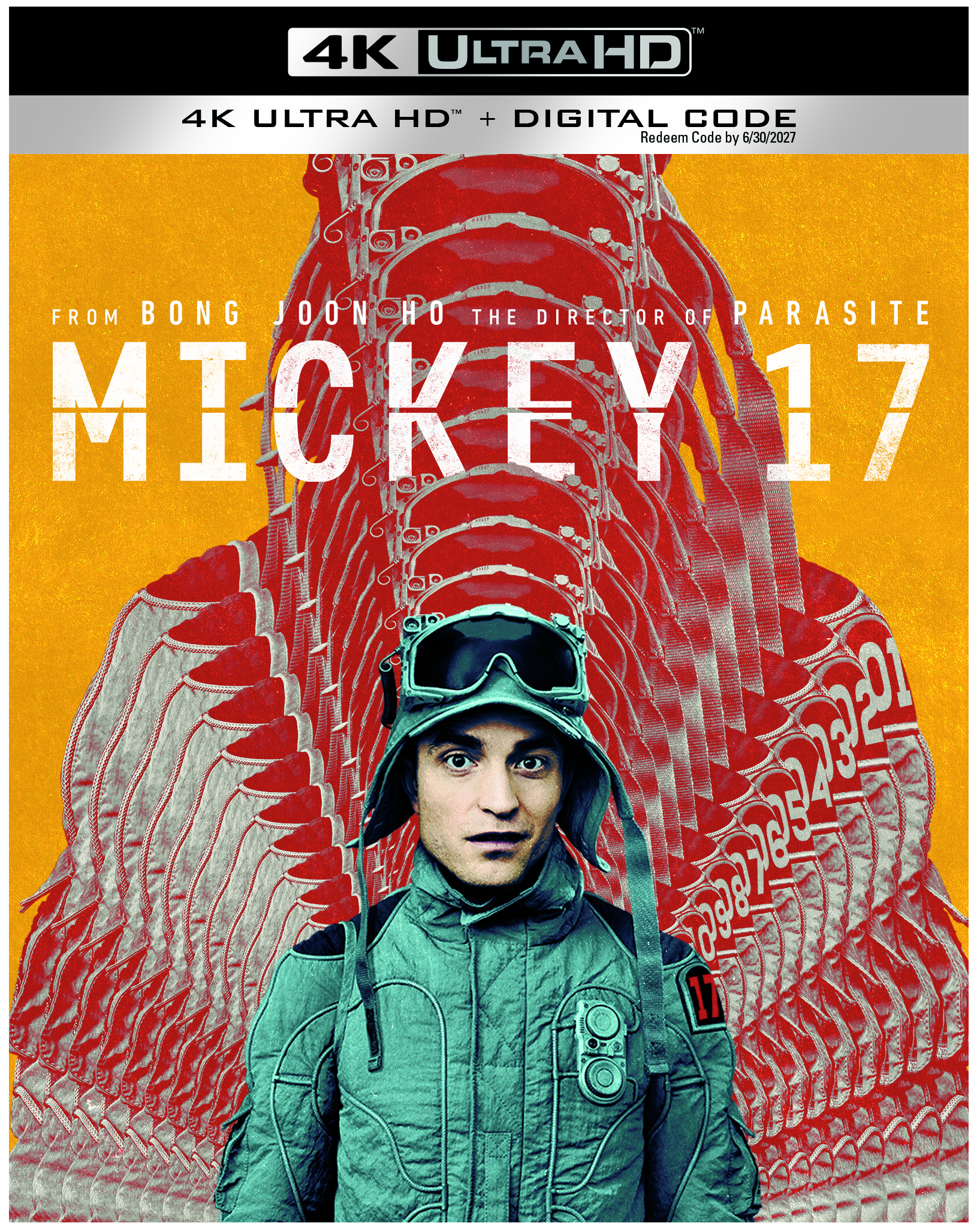
4K Info: “Mickey 17” is released on a single-disc 4K from Warner Brothers Home Entertainment. The film has a running time of 137 minutes and is rated R for violent content, language throughout, sexual content and drug material. It also comes with a digital copy that can be redeemed on most digital platforms.

4K Video/Audio: “Mickey 17” gets the Dolby Vision/Atmos treatment, and it’s a remarkable release.  The color palette really pops on this 4K release, and the Dolby Atmos audio track is also perfect for your home theater setup.

Special Features:

Behind the Lens: Bong Joon Ho’s Mickey 17 (11:32)

Mickey 17: A World Reimagined (9:44)

The Faces of Niflheim (8:00)

Should You Buy It?

“Mickey 17” is a film that might end up gaining a cult following in years to come, but it also might be a film that falls flat with a lot of audiences. I do think it is worth checking out because it is entertaining at times and has individual moments which stand out in a positive way. It’s just too inconsistent for its own good, and it needed better performances from its cast.  I absolutely hated the Mark Ruffalo character, but it probably wasn’t in the way they intended for me to hate the character. After spending a little bit of time with him, I wanted him off my TV, and I would audibly groan when he would reappear. The film does have some good special features and from an audio and visual aspect, it looks and sounds great. The movie is just a jumbled mess, but it’s rarely, if ever, boring. I’d recommend you watch this one first before you decide to add it to your collection.

**Disclaimer** I received a copy of this film from Warner Brothers to review for free.  The opinions and statements in the review are mine and mine alone.
‘Beetlejuice Beetlejuice’ Movie and 4K Review

The following review was written by Ultimate Rabbit correspondent, Tony Farinella.

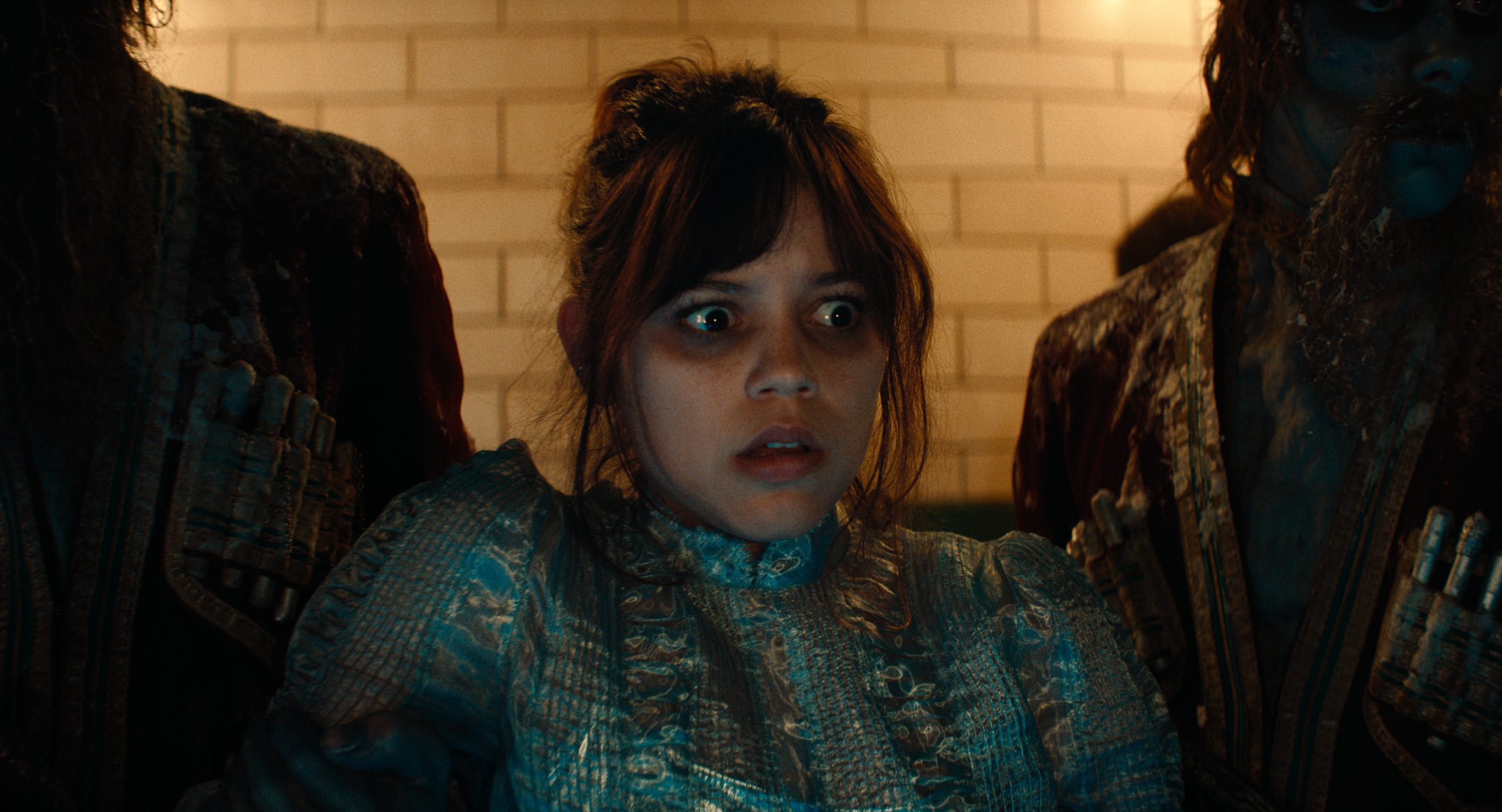
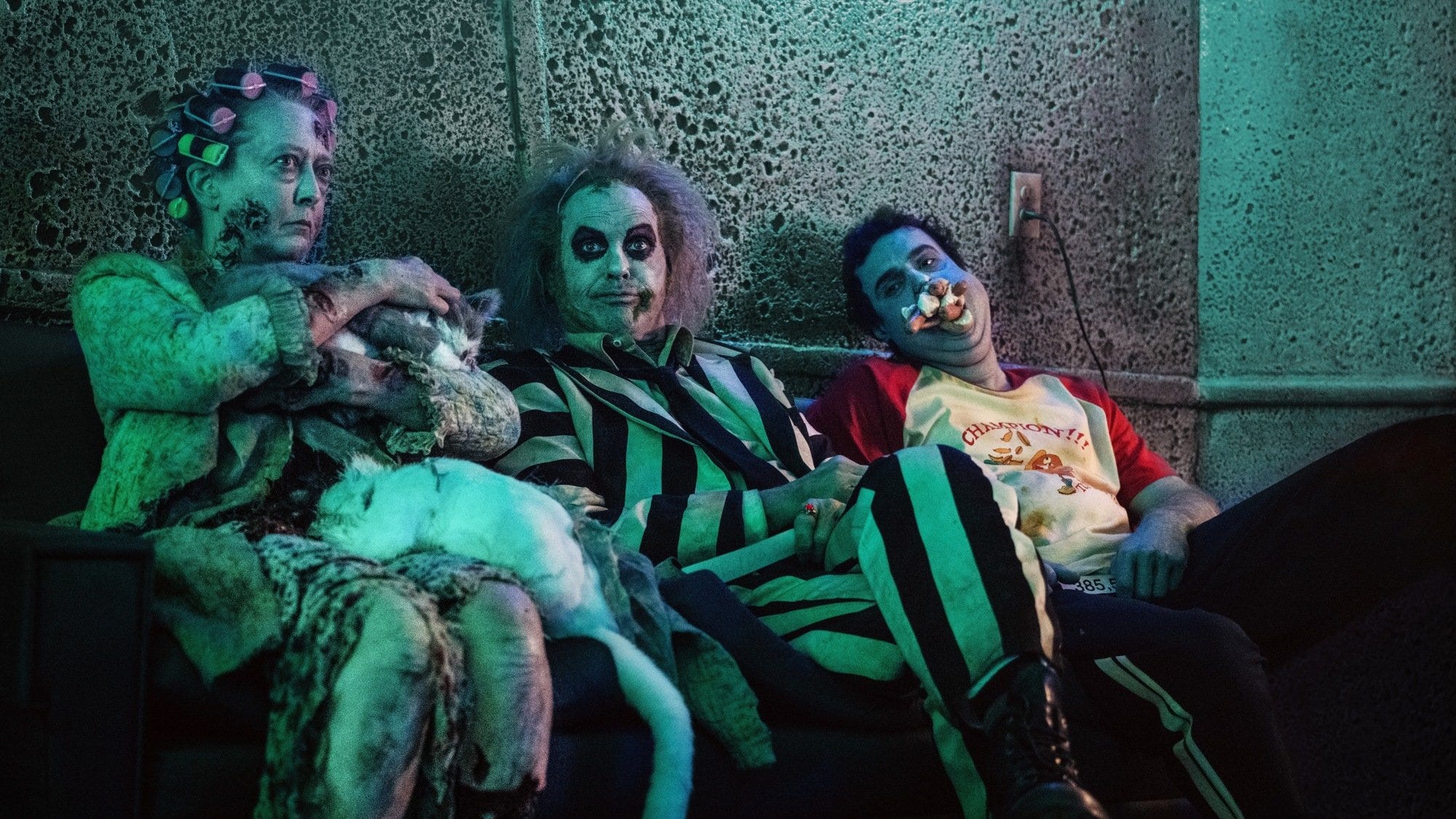
When the sequel to “Beetlejuice” was announced, movie fans all over the world were excited for its release. The original 1988 film has long since become a Halloween classic and required viewing every October. I thought the original “Beetlejuice” was okay, as the style and the tone of the film didn’t always connect with me as a viewer.  With “Beetlejuice Beetlejuice,” one thing fans will have a difficult time accepting is the lack of screentime for Beetlejuice. Michael Keaton returns as Beetlejuice, but he’s more of a supporting character here. If fans are going to a “Beetlejuice” movie expecting to see more of the main character, they will have to adjust their expectations.  I, on the other hand, thought this made the film more enjoyable and entertaining as it opened up the door for other characters to shine on screen.  It added some much-needed heart and humanity to the story.

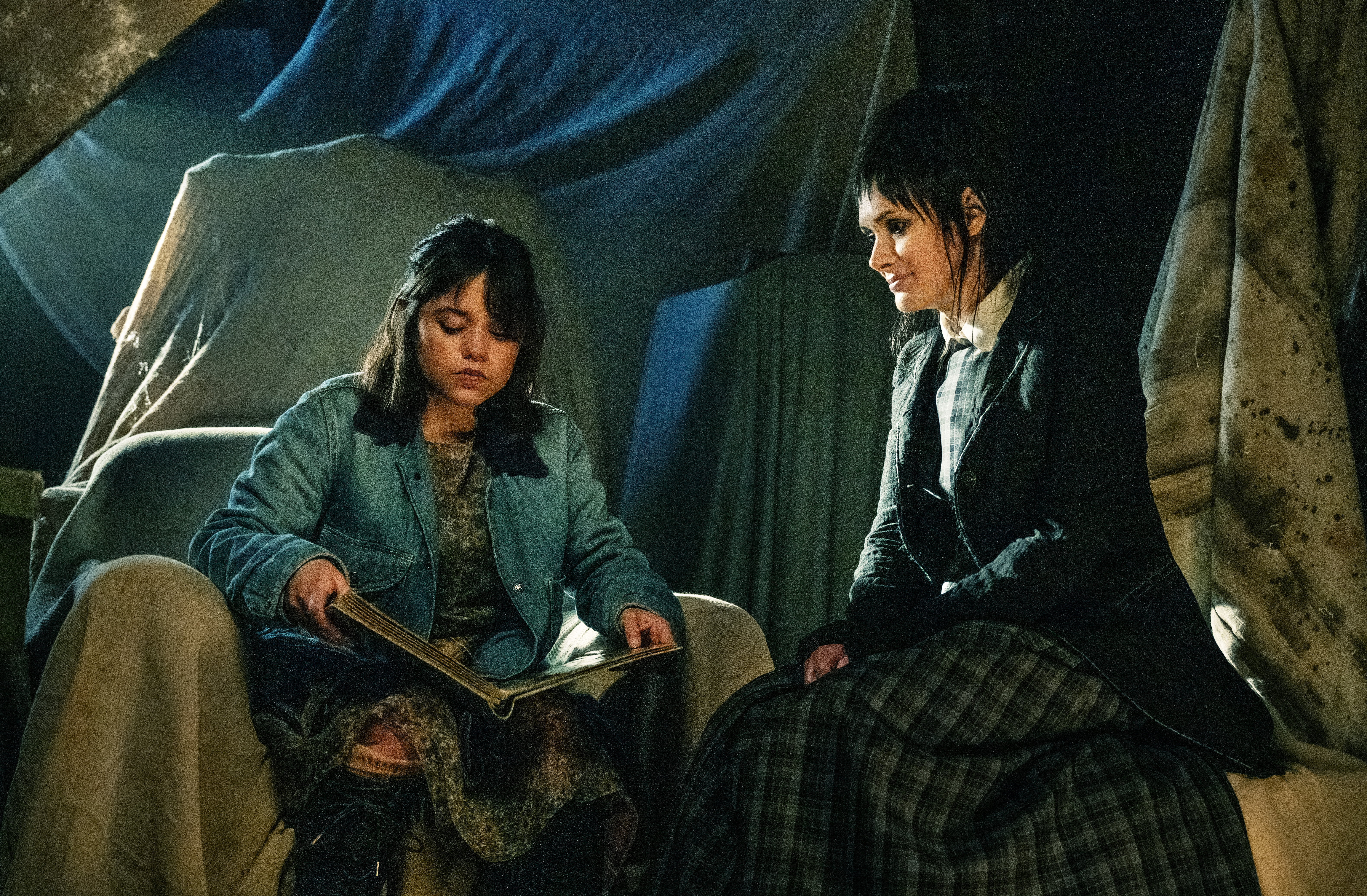
Our film opens by showing us Lydia Deetz (Winona Ryder) hosting her own supernatural talk-show called Ghost House.  She’s not exactly thrilled with this gig, but it comes with some nice perks.  She’s also in a relationship with the show’s producer, Rory, played by Justin Theroux. He’s looking to latch onto Lydia and exploit her for all she’s worth. Lydia is having a difficult time reconnecting with her daughter, Astrid (Jenna Ortega).  They have trouble being on the same page because Astrid wants to know more about her father who passed away.  Lydia is not sure how to process the death of her ex-husband, and Astrid wants to know why her mother can’t use her ability to connect with the dead to reach out to her father. Astrid has more questions than answers about her father, and she is looking for some closure.

After Lydia’s father passes away, Lydia, Astrid, Rory, and Lydia’s stepmother, Delia (Catherine O’Hara) meet up in Winter River, Connecticut for his funeral and to help sell his house. Throughout this whole ordeal, Lydia can’t help but feel the presence of Beetlejuice. At first, she wonders if all of this is just in her head, or if there is some truth to her suspicions.  Beetlejuice has his own problems in the Netherworld as he’s being chased by his ex-wife, Dolores (Monica Bellucci), who is a cultist and a literal soul sucker.  There is also Wolf Jackson (Willem Dafoe), a former actor who has now become a detective in the afterlife. He’s trying to piece together what is going on with Dolores and Beetlejuice.

“Beetlejuice Beetlejuice” is a better film than the original because it’s more grounded in reality.  Of course, there are elements of the usual Tim Burton wackiness here.  This time around, he uses those moments effectively without turning the film into a gimmick. Because of this, they are far more effective when they do happen.  The heart and soul of this film is the relationship between Lydia and Astrid.  I thought Winona Ryder and Jenna Ortega had such a strong bond and connection on screen as mother and daughter.  The good movies make you care about the characters and what happens to them.  You become emotionally invested in seeing them find happiness and peace of mind.

I also thought the way the film used Beetlejuice was effective because he only comes on screen when he absolutely needs to be there.  They don’t overuse the character. This is a film which deals with grief, loss and the inability to process feelings and connect with family.  It’s a really brainy film, and I did not expect it to go in that direction.  With that being said, I think fans of the first film might be disappointed by the choices that Burton made as a director. I thought it was necessary for the story and the characters to evolve. The performances from the cast, from top-to-bottom, are terrific. They understand what they signed up for in this film, and they are more than up to the task.  Burton put together a fantastic cast.

“Beetlejuice Beetlejuice” is one of the biggest surprises of 2024 for me. I did not walk into the film with the greatest of expectations, considering how I felt about the first film.  I walk into every film with an open mind, but I’d be lying if I didn’t say I was looking forward to certain films more than others.  With “Beetlejuice Beetlejuice,” I thought they would up the ante with the gimmicks, the silliness and the in-your-face set pieces.  While those scenes are in the film, they aren’t done so much to where they irritated me.  This is a story about people trying to figure out their place in the world.  They just happen to be occupying a world where strange and weird things are happening all around them.

* * * out of * * * *

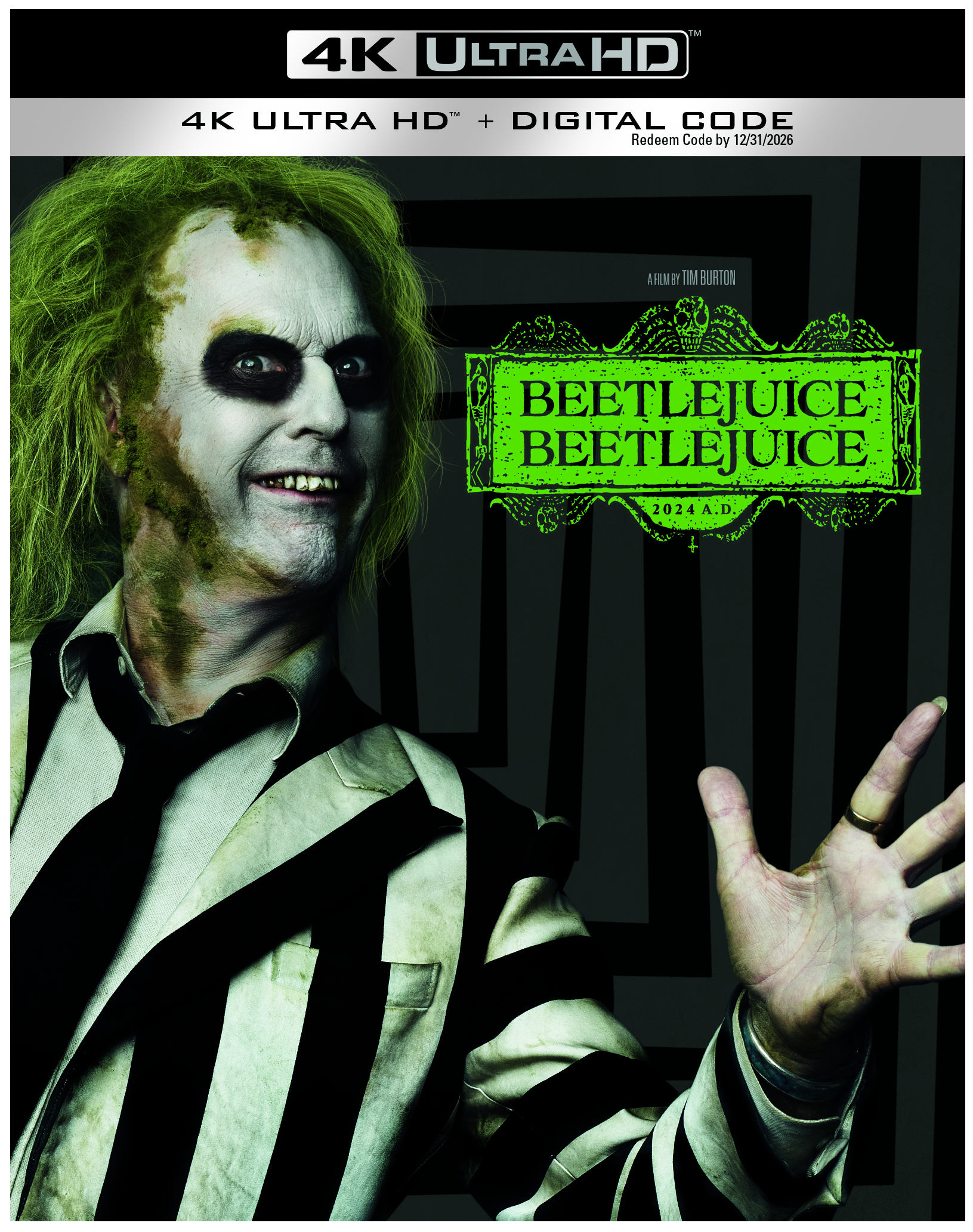
4K Info: “Beetlejuice Beetlejuice” is being released on a single disc 4K from Warner Brothers Home Entertainment.  It also comes with a digital copy of the film. The film has a running time of 104 minutes and is rated PG-13 for violent content, macabre and bloody images, strong language, some suggestive material, and brief drug use. You can either buy the 4K slipcover or the 4K steelbook.

4K Video Info:  The Dolby Vision transfer of this film is really eye-popping and stunning. The film looks great on 4K with a striking balance of dark blacks and bright, vivid colors. Tim Burton’s wacky and crazy world really shines on this format.

4K Audio Info:  The same can be said for the Dolby Atmos track here with subtitles in English, Spanish and French.  This is a movie with a lot of unusual and unique sounds, and they are all enhanced on this audio mix.

Special Features:

“Beetlejuice Beetlejuice” Commentary by director Tim Burton

The Juice is Loose! The Making of “Beetlejuice Beetlejuice”

The Ghost with the Most: Beetlejuice Returns

Meet the Deetz

Handbook for the Recently Deceased

Shrinkers, Shrinkers Everywhere!

An Animated Afterlife: The Stop-Motion Art of “Beetlejuice Beetlejuice”

‘Til Death Do Us Park

Should You Buy It?

This is a tough one for me, as I’m not really the audience for this film. I didn’t love the original, so I imagine, because I enjoyed the sequel, fans of the original might feel differently than I do.  In the end, there is a lot to like about “Beetlejuice Beetlejuice.” The performances from Winona Ryder and Jenna Ortega are outstanding, as they are filled with life and love.  You understand where both of them are coming from and you root for them to work it out.  From an audio and visual standpoint, this is a mesmerizing 4K viewing experience. I ended up having a blast with this movie, and it put a smile on my face.  At times it did drag a little bit, and certain scenes could have been edited out, but this is a good flick.  I’d recommend you rent it from a digital retailer first and then decide if you want to buy it.  I think it’s worth owning on physical media because Warner Brothers released a tremendous 4K of a surprisingly good flick.

**Disclaimer** I received a copy of this film from Warner Brothers to review for free.  The opinions and statements in the review are mine and mine alone.
‘The Departed’ Movie and 4K Review

The following review was written by Ultimate Rabbit correspondent, Tony Farinella.

When it comes to filmmaking, Martin Scorsese is not known for his brevity.  His films are lengthy and complex. However, because there are so many moving parts that are interesting and layered, it rarely feels like a slog to sit through them.  He also makes sure to assemble an all-star cast of some of the best actors in Hollywood so, as an audience, we are glued to the screen with each and every performance. It’s so hard to pick a favorite Scorsese film, as he’s trying to achieve something different and unique with each one.  From an entertainment standpoint, however, I think “The Departed” might be the most thrilling movie he’s ever made.  It was also the film which earned him his first and only Best Director and Best Picture Academy Award.

“The Departed” is initially set in 1980’s Boston and introduces us to a series of seedy and underhanded characters.  The local Mob boss is named Frank Costello, played by Jack Nicholson. He befriends a young Colin Sullivan and buys him groceries, as he knows he comes from a struggling family.  Fast forward to present day in the film, and Colin (Matt Damon) is now working on the inside for the Massachusetts State Police in their Special Investigation Unit.  Frank is still the leader of the Mob, but he has even more power because he knows Colin will keep him in the loop when the police get too close to him.

Billy Costigan (Leonardo DiCaprio), a police academy recruit, is brought in to meet Captain Queenan and Sergeant Dignam, played respectively by Martin Sheen and Mark Wahlberg. Considering Billy’s family has a criminal record a mile along, they think he’s the perfect mole to go undercover and bring Frank down once and for all. In order for Billy to gain the trust of Frank, he needs to serve some time in prison and also commit some crimes with the help of his cousin, so his cover isn’t blown.  However, Billy is starting to feel as though he’s living a double life and his mental health is suffering.  This is when he meets Madolyn (Vera Farmiga), a police psychiatrist who is also currently dating Colin Sullivan.  Needless to say, this is a messy and tricky situation for all parties involved.

The beauty of “The Departed” is that it keeps you guessing all the way until the finale. There are a lot of different characters and pieces of the puzzle here, but the film never feels overplotted or too complicated.  It’s very engaging, well-paced and highly entertaining.  As an audience member, it takes you on quite a ride from start-to-finish. Scorsese also takes his time in developing his characters, and he trusts his actors to put their own personal touches on their performances.  There are so many standout performances here to choose from, but Nicholson and DiCaprio in particular are remarkable.  Nicholson brings an unhinged charisma to his role as the mob boss while DiCaprio is tortured and powerful in his performance.  As the old adage goes, “Do Your Job.” Everyone in this film knows how to do their job, and Scorsese gives them the platform to do their jobs to the best of their abilities.

The screenplay, which was written by William Monahan, is also able to keep the audience engaged and thrilled without ever feeling too gimmicky or implausible.  These are well-written characters that are looking to stay alive and pull the wool over the eyes of those looking to bring them down.  They have to stay one step ahead of the audience and also one step ahead of the characters in the film.  “The Departed” is also a remake of the Hong Kong Film, “Infernal Affairs,” which I own as part of the Criterion Collection. I have yet to see that one, but I definitely need to check it out after having seen “The Departed” numerous times.

All in all, “The Departed” shows Scorsese at his best in a world he has inhibited many times in the past.  This time, though, he has new players to work with.  Of course, we are familiar with the Martin Scorsese/Robert De Niro films of the past such as “Casino” and “Goodfellas,” but it’s great to see him working with Nicholson for the first and only time along with Damon, Mark Wahlberg, and Alec Baldwin. Of course, his collaborations with DiCaprio have become legendary, but this was in the early stages of their working relationship, and you can see why they work so well together.

Screenshot

Hollywood has always had a fascination with crime movies and the characters who inhabit that world. Scorsese knows this world very well and how to make it accessible and fun for mainstream audiences. If I had to choose, my favorite Scorsese movies are “Raging Bull,” “The King of Comedy,” and “Taxi Driver.”  However, as stated earlier, if you are talking about pure entertainment value and pure fun, it’s hard to deny the power of “The Departed.” Even eighteen years later, this film still captivates and engages with its words, its story, and its players.   It only gets better and better with age. If you are seeing it for the first-time, you are in for a real treat.

* * * * out of * * * *

4K Info: “The Departed” is being released on a single disc 4K from Warner Brothers Home Entertainment.  There is also a steelbook version of the film as well.  Whether you pick up the steelbook or the 4K slipcover, you can’t go wrong with either copy of “The Departed.”  It also comes with a digital copy of the film. It has a running time of 151 minutes and is rated R for strong brutal violence, pervasive language, some strong sexual content and drug material.

Video Info: This is a gritty looking 4K that is able to keep the dark and moody look of Boston and its seedy characters alive while also cleaning up the dirt and artifacts to make it look sharp and vivid.  This is a solid 4K transfer. The HDR is a big improvement from the Blu-ray.

Audio Info:  I would have liked a Dolby Atmos soundtrack on this 4K release, but as it stands, this is still a powerful audio transfer. At times, the music and the action scenes can be a little too loud as the dialogue is more leveled, but that’s a minor issue.

Special Features:

Guilt and Betrayal: Looking into The Departed (new)

Stranger than Fiction: The True Story of Whitey Bulger, Southie, and The Departed

Crossing Criminal Cultures

9 Deleted Scenes with introductions by Martin Scorsese

Should You Buy It?

When great films, Academy Award winning films at that, are available on 4K, you have to buy and add them to your collection, if you are a film collector.  It is the only way studios are going to keep releasing these films on physical media. Now, more than ever, with more and more brick-and-mortar stores getting rid of physical media altogether, we have to purchase these films and add them to our collection.  “The Departed” looks really, really sharp on 4K.  There are the previously released special features from the Blu-ray along with a new special feature as well. This is a great film from the legendary Martin Scorsese being released in the best format possible to watch movies.  This is a no-brainer in my book.  You can’t go wrong with either the steelbook or the slipcover version of this film on 4K. This 4K of “The Departed” comes highly recommended!

**Disclaimer** I received a copy of this film from Warner Brothers to review for free.  The opinions and statements in the review are mine and mine alone.
‘Moneyball’ – One of the Best Baseball Movies Ever

WRITER’S NOTE: This movie review was written in 2012. I present it now as the latest baseball season has now begun.

Moneyball” is, for my money, the best baseball movie since “Bull Durham” as, like Ron Shelton’s 1988 classic, it takes a very unique look at this American pastime and the players who inhabit it. Whereas most baseball movies are about rising to the occasion and winning the big game, this one is more interested in the mechanics and statistics as the characters, all based on real life people, work to see if the current state of this sport can be improved. This is not about winning mind you, but of recapturing a love for the game which has long since passed so many people by.

Brad Pitt stars as Billy Beane, general manager of the Oakland Athletics (a.k.a. the Oakland A’s) who has just witnessed his team’s tough postseason lost to the New York Yankees. In its aftermath, he watches as the team’s key players of Johnny Damon, Jason Giambi and Jason Isringhausen leave for more lucrative deals with other more desirable franchises. From there, the team’s management becomes obsessed about finding the best players to fill their spots. What stands in their way, however, is they have a budget of $40 million to work with which, in any other case, would sound like a lot, but it’s pitiful compared to the Yankees’ overall budget of $100 million.

While visiting a coach from a rival team, Beane comes across Peter Brand (Jonah Hill), a Yale economics graduate who has new and radical ideas of how to assess a baseball player’s value. After hearing Brand’s theories, Beane hires him to join the Oakland A’s, and they both put his unusual theories to the test. This quickly upsets the team’s scouts who cannot, and do not, want to see the validity of these chances being taken. Regardless of the objections, Beane is insistent everyone go in this new direction. But as “Moneyball” goes on, it becomes clear that Beane is not just doing this because of a lack of money, but to find a new way to fall in love with baseball as it ended up betrayed him years before he became a manager.

There are a number of things at work in this film; the need to change the game, the disadvantage some teams have compared to others, and the demons that keep fighting certain baseball players who continue playing this game even when they are long past their prime. In flashbacks, we discover how Beane was an exceptional baseball player in high school, and that scouts for the big teams were serious about signing him up for the major leagues before he could even consider college. His baseball playing career, however, turned out to be a stunning disappointment, and it is this failure which haunts him to this day.

Brad Pitt gives one of his best performances ever as Billy Beane, and he finds a balance to where he inhabits the character more than acts. He draws us emotionally into this movie even more than some might expect, and he brings a realism to Beane which makes his acting never less than compelling.

Jonah Hill, best known for “Superbad,” “Funny People” and “Get Him to The Greek” among other films, gets to go against type here with this dramatic role. He does an excellent job of playing Brand as so fresh-faced to this job and becomes our eyes to the realities of baseball which many people may not be aware of. Seeing Hill imbue Brand with a strong intelligence and a big heart proves he has a lot more to offer than just hilarious performances in comedy movies, and it marks an important change of pace for him as a result.

Another great performance comes from Philip Seymour Hoffman as Art Howe. You never catch Hoffman acting as he portrays Howe as an individual being worn down by endless contract negotiations and is constantly questioning the control he has over his own team. Howe is adamant that he is the one to manage the players above everyone else, but he eventually finds he does not have the energy for a prolonged argument with Beane or Brand as they have their own plans. It is the weariness of Howe which Hoffman so perfectly captures, and he remains one of the best actors working today.

“Moneyball” is based on Michael Lewis’ non-fiction novel of the same name, and it has been adapted by two of Hollywood’s best screenwriters: Steven Zaillian and Aaron Sorkin. Neither of them ever tries to spell out everything for the audience because they are smart enough to give them enough information to where we can all come to very understandable conclusions. And on top of everything, their dialogue remains as brilliant as ever.

In a year which has seen more remakes or recycled ideas as opposed to anything resembling originality, “Moneyball” succeeds in giving us a story which feels so fresh and highly innovative. In dramatizing real-life events, the movie makes you want to see people go against the grain because it does not help to keep things the same as they have always been. It also makes us remember what is so great about the game of baseball in a time where headlines about steroids and other performance enhancing drugs and the constant abuse of them make it all seem like a sick joke. Surely there is plenty of innocence left to this American pastime, right?

* * * * out of * * * *

‘Ad Astra’ is an Enthralling Cinematic Experience

Ad Astra movie poster

The title of this movie is Latin for “to the stars,” and boy does co-writer and director James Gray ever take us there in “Ad Astra.” Like “Gravity,” “Interstellar” and “The Martian,” this is the rare science-fiction film which deals with the possibilities of space travel from a credible perspective, and it is a feast for the eyes throughout. While the human drama may be lacking, I could never ever take my eyes off the screen for a single second as this is a study in enthralling entertainment.

Brad Pitt, in his second great performance of 2019 (the other as Cliff Booth in “Once Upon a Time in Hollywood”), stars as Roy McBride, an astronaut who is able to keep his heart rate at a stable level even during the most strenuous of circumstances. In many ways he is the perfect astronaut, but his ambition to travel to the final frontier comes at a cost as he is emotionally distant from others around him, particularly his wife Eve (Liv Tyler, in a nearly wordless performance). When we see Eve dropping her keys on the counter before leaving the house, it is enough to tell us how good their relationship is going (which is to say, not at all).

Roy is also living in the shadow of his legendary father, Clifford McBride (Tommy Lee Jones), a pioneer of deep space travel who later disappeared into the far reaches of our solar system without a trace. But as Roy recovers from a catastrophic accident which sends him into a terrifying freefall he barely survives, he is told there is evidence his father may still be alive, and he embarks on a voyage to the outer edges of the galaxy to see if this is indeed true.

“Ad Astra” is said to take place in “the near future,” but considering all the flying spaceships we see here, this future is not all that near. One of the opening shots has Roy working near the top of what is called the International Space Needle, and it gives us an astounding moment of vertigo when we realize just how far this structure goes. This scene proved to be a quick reminder of when Felix Baumgartner made his record-breaking jump from a helium balloon above Earth’s stratosphere to the ground below, and it was both a terrifying and exhilarating moment which I watched as it happened. It is also the first of many spectacular images we are made to witness in this film.

Even though this story deals with technology of the future and space travel, the production design gives everything we see here an earthbound quality as spacesuits looked to have changed only so much throughout the years. It is quite fitting “Ad Astra” is being released in the same year we are celebrating the 50th anniversary of Apollo 11’s mission to the moon. The suit Neil Armstrong wore looks much like the one Pitt suits up in here, and along with the designs of the spacecrafts and controls designed to fly them, this makes everything we see here all the more believable to where nothing ever feels far-fetched.

Gray has crafted the story which he concocted along with Ethan Gross into a cross between “Apocalypse Now” and a Terrence Malick film. Like “Apocalypse Now,” this movie is not about the destination as much as it is about the journey. And like the average Malick cinematic experience, the move is paced in a slow and deliberate manner, and we get to hear Pitt provide a narration which encapsulates everything going on in his mind as his perfected astronaut ways are put to the test in ways he cannot see coming. This may put off some audience members who will find the film to be ponderous and a slog to sit through, and this is even though it barely runs over two hours. For myself, however, I felt this made the experience of watching “Ad Astra” all the more enthralling as we are sucked into a place the majority of us have only seen from a safe distance.

Yes, “Gravity” is still the ultimate outer space movie to where I had to admire Gray’s attempt to make “Ad Astra” in the wake of it as he could only hope to at best equal what Alfonso Cuaron pulled off. Like Cuaron, Gray not only captures the beauty of outer space, but also of its unforgiving nature. We are quickly reminded of how, in space, there is nothing to carry sound, no air pressure and no oxygen, and this adds an extra level of intensity to the proceedings as everyone here looks to be on a suicide mission.

But one thing I have to give Gray extra points for is how he portrays the psychological dangers of traveling through space. We all know how physically dangerous space travel can be, but many movies fail to illustrate how the mind can be almost irrevocably impaired the further we travel into what Captain Kirk called “the final frontier.” We watch Pitt as his character suffers through emotional turmoil which no mood stabilizer can offer him respite from, and it is emotionally draining to watch.

Pitt for the most part underplays his role here as his character starts off as emotionally withdrawn, but who eventually opens up to see what is most valuable in life. As Roy struggles to get closer and closer to where his father is believed to be, we see him getting increasingly desperate to find answers we know are being kept from him, and this forces him to make drastic decisions which will affect not only his sanity, but the lives of those around him. Like “Apocalypse Now,” “Ad Astra” is about a man on an obsessive journey, and many lives will be lost on the way to the final destination.

I also have to take my hat off to Tommy Lee Jones who, even though much of his performance comes across in video transmissions of a mission gone awry, shows Clifford’s transition from a loving father to an overly ambitious astronaut who is devalued the things in life he should have held most dear to his heart. When we see Jones in the film’s third act, he is just devastating to watch as he shows how Clifford knows all too well the damage he has left behind on Earth to where he is uncertain if he can live what he has done.

As serious as “Ad Astra” is, there are moments of levity and sardonic humor throughout as Roy’s arrival on the Moon shows it to have long since been taken over by corporate interests. There are fast food joints like Subway and delivery services like DHL on display, and it makes perfect sense how Roy could fly there only on Virgin Atlantic. Nothing is cheap in space either as a blanket and pillow pack costs $125. Gray’s vision of the future is meant to be one of hope, but I could not help but be reminded of a piece of dialogue from “Fight Club:”

“When deep space exploration ramps up, it’ll be the corporations that name everything, the IBM Stellar Sphere, the Microsoft Galaxy, Planet Starbucks.”

I was also amused to see how “Ad Astra” serves as a “Space Cowboys” reunion of sorts as, in addition to Jones, actors Donald Sutherland and Loren Dean also co-star here. I am almost tempted to call it a sequel to “Space Cowboys” as Jones plays astronauts in both films who end up far, far away from Earth. But while Clint Eastwood and company left him alone previously, now we have a new set of characters determined to find him.

Still, there is something which keeps me from calling “Ad Astra” a masterpiece, and it is a deficit in the human drama department. I am not about to say the human element is weak, but I came out of the theater feeling like it could have been stronger than it was. Perhaps there was a degree of predictability to this film which kept me from being completely enthralled by it. In some ways, it reminded me of “Tron Legacy” as both films deal with a son looking for his father who has long since lost himself in a realm which is not easily reached. As a result, I felt I knew where this story would end up heading, and this blunted the emotional impact to a certain extent.

It is always a bit frustrating when a film comes ever so close to being a masterpiece but does not quite reach that milestone. Regardless, it would be foolish to dismiss “Ad Astra” for its faults as it is still a visual spectacle which demands your attention in a theater with the biggest screen and best sound available. Along with ace cinematographer Hoyte van Hoytema and composer Max Richter, Gray has crafted a motion picture which makes you believe we can travel farther than we already have. At the same time, he also makes us see how the most valuable things we could ever find in our lives are not an infinite distance away, but in front of our very eyes.

* * * ½ out of * * * *


‘Vice’ Examines The Most Powerful Vice President of Them All

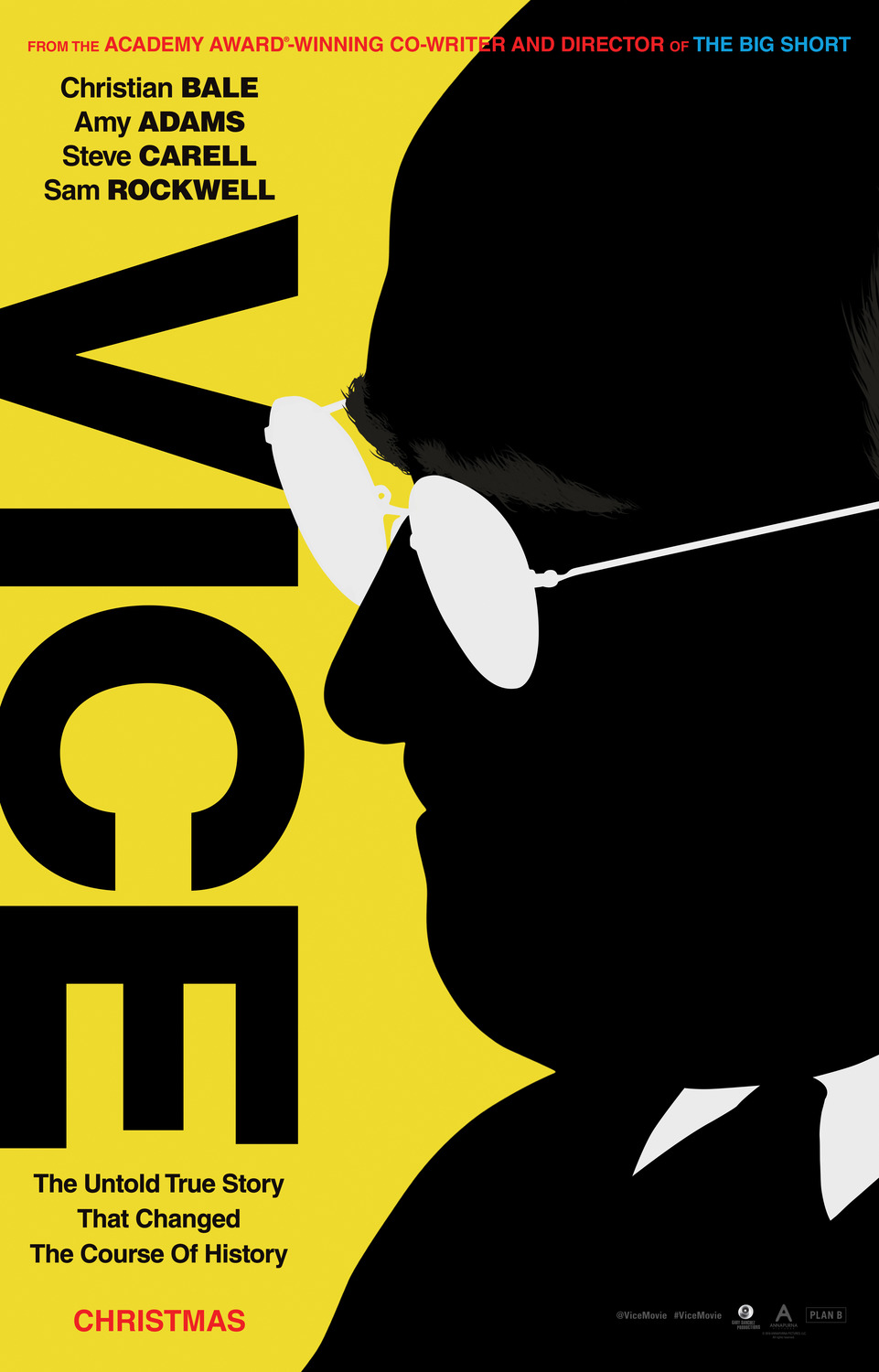
vice movie poster

“Is it better to be loved or feared?”

“I would rather be feared because fear lasts longer than love.”

-from “A Bronx Tale”

There is a key scene in Adam McKay’s “Vice” which serves as a reminder of how Dick Cheney was the most powerful Vice-President who ever lived. It takes place on September 11, 2001, and Cheney and the key members of George W. Bush’s administration are gathered together in room, but Bush himself is away from the White House. During a conversation with a military general, Cheney orders any suspicious aircraft to be shot down. Another person quickly raises an objection, but Cheney simply raises his hand ever so slightly to silence her. He doesn’t have to yell at or ask her to be quiet; just a simple movement was all that was needed to remind everyone in the room who was the one with all the power. Cheney instilled fear in everyone, even George W.

Christian Bale goes to great lengths in transforming his body into the characters he portrays, and his performance as Cheney will definitely go down as one of his memorable to say the least. There were times where I kept waiting for Bale to raise his voice a little higher as the monotone he was speaking at threatened to be more grating than the voice he gave Batman. But again, Cheney never has to speak up to get his point across. It reminded me of what Henry Hill said about Paulie Cicero in “Goodfellas:”

“Paulie may have moved slow, but it was only because Paulie didn’t have to move for anybody.”

Bale put on 45 pounds for to play Cheney, and he gets the former Vice-President’s mannerisms down perfectly to where you completely forget it is an English actor playing this American politician and one-time CEO of Haliburton. It is such a mesmerizing portrait as he makes us see how slowly but surely Cheney got seduced into the realm of power hungry politicians whether it was serving under his mentor Donald Rumsfeld (Steve Carell) or being manipulated by his wife Lynne (Amy Adams). But even better is the way Bale, as Cheney, subtly worms his way into becoming George W. Bush’s (Sam Rockwell) VP to where he has more control over certain areas of government than Bush, as he is portrayed here, would care to have.

The fact we have any kind of biopic on Dick Cheney is astonishing as he and Lynne remain very secretive about their lives to where McKay employs a disclaimer at the film’s beginning which is as wickedly clever as the one Steven Soderbergh gave “The Informant.” This disclaimer ends with McKay saying he and his fellow collaborators “did our fucking best,” and I guess that’s all we can ask for.

It’s no surprise the director and co-writer of “The Big Short” has chosen an unorthodox approach to making this biopic as it shifts back and forth in time to Cheney’s college days where he spent more time getting drunk than studying or playing football. McKay also has Jesse Plemons playing Kurt, an everyman narrator who says he has a close connection to Cheney, a connection which will eventually be made clear. Throughout, we are shown images from real life which, if they haven’t already, should forever be burned into your conscious memory. Among them is former President Ronald Reagan at the Republican National Convention where he vows to “make America great again.” From here on out, this is a phrase which should forever live in infamy.

One of “Vice’s” most inspired moments comes when McKay begins the end credits midway through the film. What’s especially hilarious about this is how it reflects the conclusion many of us would have preferred Cheney’s to have had in American politics; the kind where he never would have become Vice President. But those familiar with American politics and the Bush Administration cannot and should not expect a happy ending here. Cheney left a lot of damage in his wake, and his political power still remains constant even though he no longer holds public office.

Indeed, Dick Cheney is a tough nut to crack as “Vice” can only get so far under his skin to where you wonder if this man has anything resembling a soul to explore. As the film goes on, he is shown increasingly to be a heartless individual, both figuratively and literally speaking (he did have a heart transplant), and he comes across as such a cold human being to where his muted reactions to the multiple heart attacks shouldn’t be seen as much of a surprise. The fact he even noticed he was having them is more surprising.

Where McKay really succeeds is in showing those closest in Cheney’s inner circle, among which is his wife Lynne. Amy Adams gets the opportunity to play a Lady Macbeth-like character much like the one she played in Paul Thomas Anderson’s “The Master,” and she is fantastic from start to finish. Adams makes Lynne into the key motivator for Dick’s ascent into American politics to where she fearlessly campaigns for her husband while he is laid up in the hospital. Lynne recognized she lived in a time where she could not do all the things she wanted because of her gender, and she finds immense satisfaction through her husband’s rise to power. Adams is brilliant in portraying Lynne’s fascination with the political world and in showing her quick concerns when anything threatens Dick’s standing in Washington D.C.

Another great performance comes from Steve Carell as former Secretary of Defense Donald Rumsfeld. Carell makes Rumsfeld into a gleefully cynical politician whose values have long since been corrupted by the quest for power. Just watch when Cheney asks him what they are supposed to be believe in. The gut-busting laugh Rumsfeld gives off speaks volumes as it illustrates exactly where his interests lie, and it is not with working class Americans.

As for Sam Rockwell, his portrayal of George W. Bush feels pitch perfect as he portrays a man whom even Cheney can see is more interested in pleasing his father when it comes to running for President. After watching Will Ferrell’s classic impersonation on “Saturday Night Live” and Josh Brolin’s portrayal of him in Oliver Stone’s “W,” it seemed all too difficult for any other actor to offer a unique interpretation of this unfortunate White House resident. Then again, Rockwell proves once again what a brilliant actor he is as he captures George W.’s mannerisms while humanizing this man in a way I did not expect or was ever in a hurry to see.

I was very much entertained by “Vice,” but I did come out of it feeling like it could have dug deeper into Dick Cheney’s life. Also, the nonlinear storytelling format is at times jarring as we are thrust from one moment in history to another with little warning. Then again, in retrospect, I wonder what more could have been said about Cheney as he seems to be this malignant vessel of a human being who is never has the look of someone who could ever be fully satisfied by anything. The only positive thing I saw of him was his acceptance of his daughter Mary’s (played by Alison Pill) sexuality when she comes out as a lesbian. If only Cheney had treated all Americans like they were Mary, things would have been much different than they ended up being. Of course, when his other daughter Liz runs for public office…

One of the last moments of “Vice” has Bale breaking the fourth wall as Cheney where he looks directly into the camera and tells all those listening he is apologizing for who he is or anything he has done. I’m fairly certain Cheney has not made any statement like this on camera in real life, but the speech Bale gives as him rings frighteningly true. Considering how complicit the former Vice-President was in war crimes which included torture and sending American troops into a war based on false evidence, he has a lot to apologize for, let alone answer to. But let’s face it, he’s never going to apologize. Ever. “Vice” has as many funny moments as it does haunting ones, and this speech is especially haunting because, let’s face it, he will die before he ever considers apologizing. Heck, he almost did.

* * * ½ out of * * * *