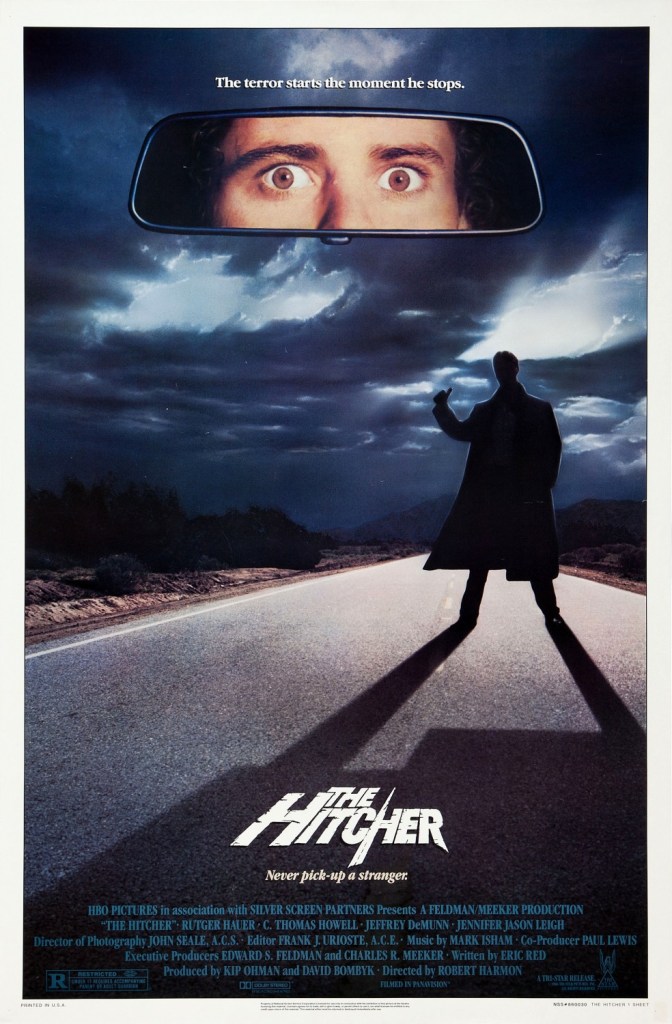
After all these years, “The Hitcher” (the original, not the godforsaken 2007 remake) has lost none of its suspenseful power, and it continues to terrify new generations of horror movie fans. In addition, it also marked a memorable point in the careers of the actors cast in it. Rutger Hauer created one of his most devilish villains ever with John Ryder, C. Thomas Howell gave one of his very best performances as Jim Halsey, and Jennifer Jason Leigh’s performance as Nash proved to be a real stretch for the actress (that pun was most definitely intended).
When the screenwriter of “The Hitcher,” Eric Red, arrived to do a Q&A at the Silent Movie Theatre in Los Angeles on October 9, 2011 where Cinefamily was showing the film, he gave the small but very attentive audience a lot of great stories involving the actors involved in the production, and he had plenty of unforgettable things to say about Hauer.
The audience was very surprised to hear Sam Elliott was originally cast as John Ryder before Hauer came along. Apparently, Elliott’s audition was so terrifying, one of the movie’s producers refused to stay inside the casting office whenever Elliott was around. Somewhere along the line, however, Elliott got cold feet and ended up dropping out of the production.
But even after hearing that, it is still hard to think of another actor who could have played this truly frightening character as memorably as Hauer. As Ryder, Red said Hauer “evoked the character to such a degree” and was always “unpredictable” in what he did. Red described his screenplay as being “sparse” and said it was more about looks than it was about dialogue as there wasn’t much of the latter. Hauer, however, brought so many ideas to the role which were not on the page. During this particularly screening, some of us actually noticed how Ryder was actually wearing a wedding ring. To this, Red simply said, “That’s Hauer!”
Oddly enough, the evening’s funniest story involved the scene where Leigh’s character of Nash was tied between a truck, and Halsey has to keep Ryder from stepping on the gas and ripping her apart. It turns out Hauer did not want to shoot this scene and would not even come out of his trailer when everything was ready to start shooting. The filmmakers talked to him regarding his concerns, and Hauer told them the following:
“I don’t want to shoot the scene because the audience will end up figuring out that my character is the bad guy.”
Hmm … Dismembering the driver who picked up Ryder before Halsey did, murdering a whole family and sticking a human finger in a pile of French fries was not enough to indicate Ryder was the bad guy? How scary it is to learn of this!
When it came to casting Halsey, the filmmakers did not have any particular actors in mind. Red said they all went with Howell as they remembered him from “The Outsiders” and described him as having “the right look.” Ryder is described as being a “father figure” to Halsey, and he wants Halsey to kill him. Howell convincingly portrays his character, who goes from a terrified young man in over his head to one who gains control and becomes almost as cold-blooded as Ryder.
With “The Hitcher,” Red was aiming to create a movie where the audience got an inescapable feeling of claustrophobia in wide open spaces. He said it does not only have to happen in a tiny room or an elevator. Even with the infinite expanse of land on display, no one can escape their pursuers. But the movie also benefits from its memorable performances from a cast who bring more to their characters than what was on the page. Without Hauer, Howell and Leigh, “The Hitcher” would never have been half as effective as what we ended up seeing onscreen.
WRITER’S NOTE: This article was originally written in 2013.
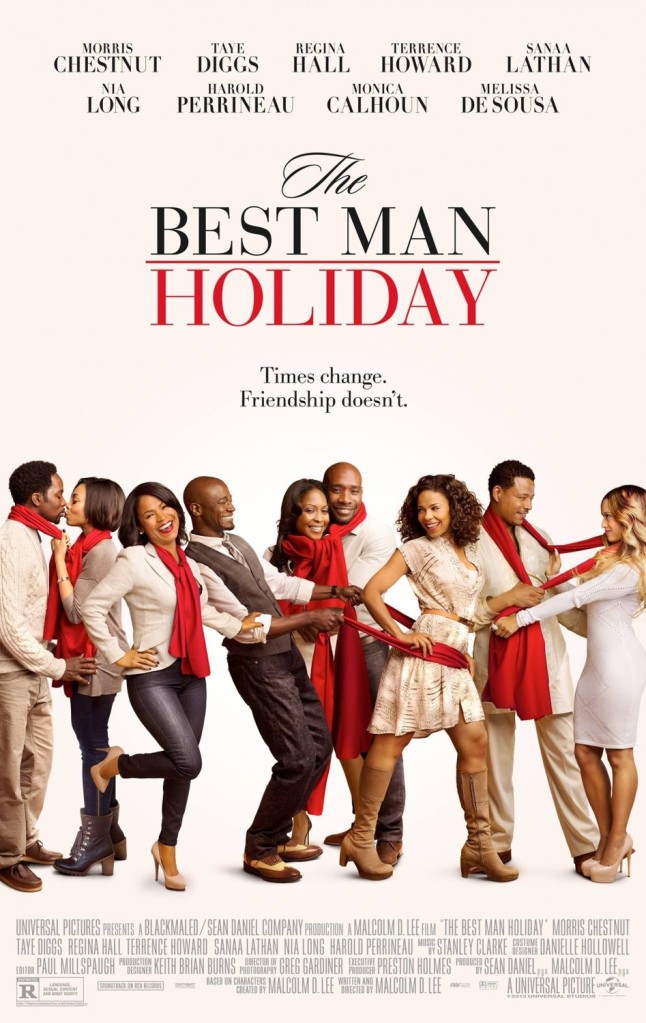
Taye Diggs and Sanaa Lathan return to reprise their roles of Harper and Robin from 1999’s “The Best Man” in writer/director Malcolm D. Lee’s long-awaited sequel, “The Best Man Holiday.” When we last saw these two, Harper proposed marriage to a very shocked Robin. Now its 14 years later and they are happily married and expecting their first child. But while Harper’s previous book “Unfinished Business” proved to be a bestseller, his latest book gets rejected by his publisher. To make matters even worse, he is laid off from his teaching job at New York University, and he doesn’t have the nerve to break the bad news to Robin.
All those concerns get put on hold, however, when Harper and Robin travel to Lance (Morris Chestnut) and Mia’s mansion to celebrate the holidays, and it reunites them with the other characters from the original film. But old rivalries and passions are quickly reignited as Lance has not forgotten about the affair Harper had with Mia all those years ago. Can these two men find it within themselves to forgive one another and move on from their past?
We got to catch up with Diggs and Lathan when they appeared at “The Best Man Holiday” press junket which was held at the Four Seasons Hotel in Los Angeles, California. Together they talked about what made them decide to do this sequel, how everyone has evolved since the first movie, and what it was like returning to play these characters 14 years later.
Question: For this movie to work, essentially everybody in the original cast had to sign on to do it. At what point did you to decide to do the sequel?
Sanaa Lathan:A couple of years ago, Malcolm actually got us all together and we went to Boa (Steakhouse), and he hadn’t written a script yet and at a loud restaurant with lots of drinks flowing, he literally pitched moment by moment and beat by beat the story. In that environment which is very challenging for a pitch, we were on the edge of our seats and we all at that moment said, “If you write it, we’re gonna do it.” So, for me it was that, and then the script came much later…
Taye Diggs:And then it just became about fine-tuning.
Sanaa Lathan:Exactly.
Taye Diggs:We all obviously had a great time doing the first one. Great friendships and bonds were made and we’ve kept all those friendships, so at this dinner it was so great to see each other just on general principle. It’s great to see old friends that we haven’t seen in a while. I think a couple of us knew possibly what Malcolm was going to come with, and then to actually hear him say it and then to hear the story and then to kind of get together as a group and do what we all needed to do to get this project done and made, it has been a great experience.
Question: How do you think Malcolm has evolved since directing the first movie?
Sanaa Lathan:He actually regressed… No, I’m kidding.
Taye Diggs:I was there every day on set, and good is good. I think we all evolved. We’re all older, we’re all more mature, and we have all had more experience. For me what I noticed this time around, when it pertains to Malcolm, was the outside pressures. I could tell this time around that he had a lot more on his shoulders, so I would say he has evolved in the sense that he was able to deal with a lot more pressure.
Sanaa Lathan:Yeah, and there’s the pressure of the first movie and of living up to it too. That’s a huge pressure.
Taye Diggs:Right and he did it again with a lot more on his shoulders. He had a cast that had experience…
Sanaa Lathan:(We were) very vocal. We tested him a lot and we were having a lot of fun, but we were always like, why? Why are you doing that? I know that we tested his patience but he dealt with it well, right?
Taye Diggs:Yeah. We were all new (at least I was) for the first one, so we weren’t nearly as vocal. But now we have matured as actors and we look at a script differently and challenged him on character and through lines and story structure, so he handled it well.
Question: Taye, have you seen “The Best Man” with your real-life wife?
Taye Diggs:Oh, of course. My wife was at the premiere and was a huge supporter, and hopefully she will enjoy the second one as much or even more than the first.
Question: You all look like you had an absolute blast on this movie. How much fun would you say you had on set?
Sanaa Lathan:They (the men) turned into like seven-year-olds (for the dance sequence). They had dance rehearsal because it wasn’t that simple and Tate has a dance background and Morris has no background. So literally in between takes for weeks they would be like okay, and 5, 6, 7, 8 (laughs). All the girls were so excited. This was like their debut at Alvin Ailey (laughs).
Taye Diggs:I have a stage background. I don’t know if you all know that. For me, stage is a lot more nerve-racking than film acting because no matter what you’re in front of people. With film acting you have control. If we’re shooting an emotional scene and its private you can say I don’t want anybody in the room except for the cinematographer and the director. It’s less nerve-racking doing film, but with this dance sequence Malcolm said, “Be on your stuff because the girls are gonna be watching.”
Sanaa Lathan:The first time we saw it was real-time reactions (laughs).
Taye Diggs:Yes, and there was a level of performance that we had to take into account because we wanted them to think we were good. So, we were nervous, at least I was, and I wanted to make sure that we had the counts and whatnots and it worked. It helped and when we filmed it, seeing them and getting that live, real energy…
Sanaa Lathan:And those reactions that you see in the movie are real.
Taye Diggs:That was great.
Question: Some of the themes in this movie are about unity and brotherhood and sisterhood amongst friends and family. Why do you feel it is so important that we see these images so often for minorities?
Taye Diggs:We don’t see them enough.
Sanaa Lathan:I think it’s important for us to see ourselves reflected in all that we are instead of one type of genre like the over-the-top comedy. It’s really important for the art form of film to reflect the world that we live in and who we are, and I think that it hasn’t really done that for people of color at this time in history.
Taye Diggs:We’ve come a long way but we are still struggling.
Sanaa Lathan:We still have a ways to go, but I think that’s why a movie like “The Best Man” resonates so much because people are hungry for stories that are layered, and they can recognize themselves and their family and friends in the things that they’re going through.
Question: What are the holidays like at your houses?
Taye Diggs:It’s crazy, fun and there’s always a little tension with those couple of family members who always bring something surprising. But growing up I’ve always looked forward to the holidays. Now I got my own little boy so there’s that level of enjoyment and excitement that comes with having a baby, and this Halloween was the first Halloween where he understood what was going on.
Sanaa Lathan:What was he?
Taye Diggs:He was, and he chose this, a zombie Michael Jackson from “Thriller” and he was into it. I had a different take on Halloween this time. I was just loving being able to live through him.
Sanaa Lathan:What were you?
Taye Diggs:I wasn’t anybody because I was so focused on him which is something different. Usually I’m worried about what I’m going to be and dressing up and leaving him with the sitter and partying myself, but this time it was all about Halloween for him. It’s fun. The holidays are fun, and they are way more fun with a four-year-old.
Question: Sanaa, how did playing a pregnant character throughout the entire film affect your craft, and how do you think your character handled being under the same roof with two women who have a romantic history with your movie husband?
Taye Diggs: Usually they ask how it affected me (laughs).
Sanaa Lathan:When Malcolm pitched the idea that I was nine months pregnant, I was (coming from a female vain perspective) like, well damn (laughs). I’m like, the whole movie? And it’s not like three or four months where it’s cute, it’s nine months. But I think that energy and “well damn” is what women feel in their ninth month, so it worked. I had to put on this huge belly that they actually… I did “Blade” where I played a vampire years ago, and the same people that did the prosthetics for “Blade” did my belly, so it was like a real belly. It was heavy, it made me hot and you have to waddle. It was a drag, but it worked for the character. And I realized how sick and sadistic people are. Literally every day, I would get about three punches in the belly out of the blue (laughs). They were just laughing. Malcolm would do it and it was crazy! Something about knowing that it wasn’t real (laughs).
Taye Diggs:We were awful.
Question: How has your real lives paralleled what your characters go through, and how was it coming back after 14 years?
Sanaa Lathan:In terms of the parallel, I tried to be a glass half-full person and I think Robin has always been that especially for Harper. He’s kind of the glass half empty and she’s the glass half-full, and a lot of my friends call me a hippie. I cultivate that mindset to see the bright side of things, and I come from a family of artists and Bohemians in the 70’s so there’s that aspect. But other than that, the reunion was great. It was fun and it didn’t feel like work. We had so much fun in between takes.
Taye Diggs:It helps. I think it shows in the chemistry. You can choose to act it or you can just be real, and obviously it always helps when it’s real. Just being able to hang out socially and look forward to the time when the cameras aren’t rolling as well as the time when the cameras are rolling, it makes the entire experience truly enjoyable. It just worked out. I think we were so blessed, lucky, fortunate or however you want to term it. The fact that we even got everybody together in the first place I think was miraculous, and then to have that type of script and then to have everybody mature the way that they did. We all brought our life experiences to these roles. We’ve all been through our ups and downs, and that has affected us as people and as actors. We were lucky in that we could apply that to these characters.
Question: Sanaa, having grown up with a parent who is a director, has that affected how you approach filming and have you ever worked with your dad?
Sanaa Lathan:You know I’m about to work with my dad. I’m going to do kind of like a cameo thing on “Real Husbands of Hollywood.” I think that’s his show.
Taye Diggs:Oh, I want to do that. You tell him I want to be on it.
Sanaa Lathan: I will. You’d be perfect because you are a real husband of Hollywood. It’s a fake reality show, but Regina (Hill) is going to do it too. I wasn’t really around on set with my dad coming up. He and my mother broke up when I was five so I didn’t see him. He was always in my life but he was always so busy. The sets that I remember going to were “Sesame Street” when I was very young… I don’t know, I just didn’t go to a lot of sets and I have never worked with him. The great thing that I think I have in having parents that have been in the business is that they understand, and I think that’s a very special thing. I realize with a lot of my peers that they don’t have parents who really get what they are going through, and it’s great to have parents that you can lean on when you are going through some stuff.
Taye Diggs:You probably were blessed that you weren’t raised on set. A lot of times kids that have that early exposure end up going down the wrong avenues and you’re fairly sane.
Sanaa Lathan:Thanks!
Question: So, when it comes to your mentors, who would you say have been some of the people you go to for guidance in this industry?
Taye Diggs:For me, it was a very emotional shoot and Sanaa has always been in my life someone who I can bounce stuff off of and she always has really, really great and positive things to say. I have a best friend who is not an actor and we’ve been close since junior high school. No one knows me better than him and he has a good perspective. A lot of times you don’t want to go to someone that knows the business. You want a more accurate kind of view that doesn’t give you a lot of excuses like people in the business do. So yeah, I’ve leaned on him as well.
Sanaa Lathan:You know I get it from everybody, from my parents and I have great girlfriends. I feel like having some really close black actress friends is actually great because it’s such a unique road that we travel. There are so many blessings and so many challenges, but it’s great to have that community because there are days where you don’t want to do it anymore, and it’s great to have that person who is kind of in the trenches who would say to you, get up. So, I get it from everywhere. I don’t really have any one mentor.
“The Best Man Holiday” is available to own and rent on DVD and Blu-ray, and you can also stream it on various digital platforms.
WRITER’S NOTE: This interview was from a press day which took place in 2013.
In Hollywood, most sequels usually come out one to two years after the original because the studios want the money to keep rolling in while the property is still fresh in audiences’ collective minds. But when it came to making a sequel to “The Best Man,” writer and director Malcolm D. Lee was not about to rush it. “The Best Man Holiday” is being released 14 years after its predecessor, and it reunites Lee with Terrence Howard, Taye Diggs, Morris Chestnut, Harold Perrineau, Nia Long, Sanaa Lathan, Monica Calhoun and Melissa De Sousa who reprise their roles. This time the college friends reunite for the holidays at Lance and Mia’s mansion, and it soon reignites old rivalries and romances from the past.
Since “The Best Man,” Lee has gone on to direct the comedy “Undercover Brother,” the roller-skating comedy-drama “Roll Bounce,” “Welcome Home Roscoe Jenkins,” the musical comedy “Soul Men” and the horror spoof “Scary Movie 5.” We got to catch up with him when he appeared at “The Best Man Holiday” press junket held at the Four Seasons Hotel in Los Angeles, California. While there, Lee discussed why it took so long to make this sequel, what he thinks about the success that African American films have had in 2013, and of the possibility of there being a third “Best Man” movie.
Question: In a world where people are making sequels a year to three years later, what took you so long?
Malcolm D. Lee:Honestly, there was talk of doing a sequel very early on when the first movie came out, but I wasn’t interested in doing the sequel right away. I didn’t want to get pigeonholed as a director. It was my first movie and I didn’t want to just do the same thing. My idea was if I was going to revisit these characters, and I thought I would want to, it would be like 10 years later after they’ve lived some life and had kids. Around late 2005 or so I just started percolating the idea and I would see the cast over the years and say hey I’m thinking about doing the sequel, and they were like, oh okay. It just got to the point where I was like, okay I’m ready to do this now, and I had taken enough notes and put enough of a structure together where I said well, let me get the cast together and let’s see what can happen. I basically got them together in early 2011 and said okay, let’s all get in the same room and at least we will have all caught up. I have an idea for a sequel, and if we all think at the end of this meal that it’s worth doing then I’ll pursue it. So, I pitched them the idea and they were all into it and they liked it, and I said well, let’s go. Then a couple months later I went to Universal and pitched them the idea and we got it going. It took a while to get it going because I wrote the script pretty quickly because I had been thinking about it for so long, and it wasn’t easy. It was, as you’ve seen from the film, very different tonally speaking than the first one, and I think that was part of their hesitation of wanting to make it. I didn’t want to do the same thing again. I didn’t want to tell the same story. The things you think about when you are in your mid to late 20’s is very different than what you think about when you are in your late 30’s and early 40’s and married and have children and have bills to pay and do grown up stuff and dealing with grown up things. So, I said to them it’s not about wanting to do a destination wedding or anything like that. People loved this movie because they loved the characters. They loved the people. They don’t just love that it was a wedding. It took us bringing the cast together and doing a read through, and once they did the read through they were like okay, we get it.
Question: Could you talk a little bit about the process of getting into the minds of these characters after so long?
Malcolm D. Lee:I know these characters very well. I’ve lived with them in my head for a long time so when you evolve as a person you have to have your characters evolve too. Not only that, but my actors were great actors in the first movie, and they are even better now. I have grown as an artist, as a writer and as a director. I’m better, so I wanted to make something that was more sophisticated, something that spoke to these characters that would be similar to where they were but which also showed their growth and evolution. I don’t think it was that difficult. It was just a matter of really knowing the characters and making them evolve.
Question: Did you seriously entertain other alternatives to the storyline for each character at any point?
Malcolm D. Lee:What I had come up with I pretty much stuck to. There wasn’t a whole lot of deviation. There were a lot of suggestions by the studio about making it a wedding movie and blah, blah, blah, and I was just like no I don’t want to do that. So, it was pretty much what I wanted to do, and the actors had some input about what they felt about their characters and where they could be strengthened and layered. Some of the suggestions from the studio were like, well this person is out of the picture already, this person is that already, and this person is divorced, and I was like I brought the cast back together and we are going to do this collectively, period. At least you’ve got to give this a fair shot. So that’s why we did the reading, and that’s what made them say oh okay, we get it.
Question: Futuristically speaking, do you foresee a production of a series or a spinoff from this kind of film like “Soul Food” or something similar to that?
Malcolm D. Lee:It’s possible. People love these characters and they want to live with these characters, so it’s a rich enough world and a world that’s rarely seen on network or cable television. The only danger would be like, could you get all the actors to do a series and where do you start it? Do you cast different people? So, I don’t know. I had the idea of, were this movie to be successful, to do a series that would take place from the end of the first movie until the second movie. That 14-year span might make for an interesting television show, but how do you cast that too? It’s possible. We’ll see.
Question: Have you thought about doing a third movie?
Malcolm D. Lee:Well we have to see how this one’s going to perform first. That will dictate whether a third one gets made or even talked about. There have been some whispers. I have an idea, let’s put it like that.
Question: What’s the idea?
Malcolm D. Lee:I’m not going to say.
Question: Are you going to wait another 15 years to make it?
Malcolm D. Lee:I will not wait another 15 years. If it happens at all, it’ll happen quickly.
Question: “The Best Man Holiday” actually feels like a stand-alone movie in that you don’t have to go back to the first movie to catch up with or relate to the characters. Was it important to you to make it a stand-alone film so that you can capture new audiences as well as retain the fans of the first?
Malcolm D. Lee:I don’t know if that was a conscious decision. When I set out to make the first film, I set out to make a classic movie, one that will stand the test of time. Fortunately, that has been the case. People really love “The Best Man,” and with this one I knew I had to, in my mind, make a movie that was better than the first. Or at least, in my mind, more sophisticated and more layered and have some deeper things to explore. So as a result, yes I guess the movie stands on its own but that’s what the whole opening credits are about which is trying to fill in people who may not know, and then also the fans of the first one get kind of tickled about remembering them then and this is what they’ve been doing and this is where they’re at now. I certainly wanted the movie to stand on its own and I think that there are people who really loved the first one will be more deeply connected. I think people that have not seen the first one was still enjoy this, but I think the fans of the first one will really enjoy this because they’ve had the experience of 14 years of viewing it.
Question: 2013 has been a great year for critically acclaimed black films. What do you think that means for the future of black filmmaking?
Malcolm D. Lee:We’ve seen these bursts before, and what happens is that studios and filmmakers start to churn out carbon copies of these movies. When Spike (Lee) first came out with “She’s Gotta Have It” and “School Daze,” it was like this Spike Lee phenomenon. There were a couple of movies that came out like “House Party” and “New Jack City,” and they were all different. John Singleton started with “Boyz n the Hood,” and that was like the whole hood genre and pushing that. Then “Menace II Society” and “Juice” came out and we got saturated with that and we were like, okay, what’s next? On their tail came “Love Jones,” “The Best Man” and “Soul Food” which gave us a different side of African-American life. Then in 2008, nobody wanted to make any black movies. They weren’t profitable, nobody was going to support them, people got tired of them and they petered out which is why I had to wait until “Jumping the Broom” came out before I went ahead and pitched the movie to Universal to see what the appetite of the studios and the audience was going to be. I hope that the diversity of African American fare this year will continue. It has been a very refreshing year to see sports movies, comedies, musicals, romantic comedies, historical drama and indie movies that are made by black filmmakers. So, I hope that it continues and that the quality of the work keeps getting better because I feel like that’s great. But if there’s like, oh, we can make money because they’re going to come out for Kevin Hart or this person or that person, then it’s going to be a money grab. It’s got to be about having choices at the movie theater that African-American audiences can enjoy and general audiences can enjoy, and just let it be a regular thing. Let’s see great movies.
Question: Can you tell us about more about the movie’s soundtrack and what role you played in it?
Malcolm D. Lee:One of the things that I was doing back in 2005 was listening to Christmas music and thinking about where it could fit into the movie. I love music. I think music and songs are such an integral part of filmmaking so I was playing a lot of Stevie Wonder’s Christmas music and Nat King Cole and Marvin Gaye. So, a lot of those songs were written into the movie, and then we get updates of many of them. It was very, very integral in the soundtrack and making sure that the sound that was created was going to be integral to the movie. I don’t like soundtracks that just are “inspired by.”
Question: How did you decide which artists to include in the soundtrack?
Malcolm D. Lee:You work with a label and they say well we got this person and we’ve got that person and it’s kind of like casting. I thought Fantasia would do a good job on this song, I think Jordan Sparks would do a good job on that song. Someone like Ne-Yo who came out of the blue, the song that he sings is a Marvin Gaye song called “I Want to Come Home for Christmas.” I thought that nobody was going to be able to replace that, but Ne-Yo came in and I showed him the scene and where it fit, and I showed them how important was for the movie and how the emotion was going to play. He said listen, I’m not going to sound like Martin, but I’m going to do it in a way that is me and it will be faithful, and he killed it. First time out and I was like, wow! That doesn’t always happen. Sometimes you’re just no, that’s not quite it. Let’s try that again. Also, the one song that’s featured, the Stevie Wonder song that Marsha Ambrosius and Anthony Hamilton sing on camera (“As”), that had to be in the movie where it was because it was very integral to the first film. I always felt that it was one of the greatest love songs ever made and it would be great to do it as a ballad or as a duet, so Marsha and Anthony were a great choice for that. It’s funny because people, when I’ve been watching the movie with audiences, love seeing Anthony, and then they recognize the song. And if that’s not enough, then they see Marsha and they are like, oh my god! It’s really a beautiful combination. We struck gold with that, I think.
Question: Which of the characters do you relate the most to and why, and did that change from the first movie to the second movie?
Malcolm D. Lee:There’s a little bit of me in all the characters. They’re all within me. I lived with them in my mind. Of course, there are female characters and there are certain things that I don’t know because I’m a man, and I observe and talk to people about how they feel about fidelity. Murch (played by Harold Perrineau) finding out those kinds of things about his wife and they have a great open relationship, but it’s like whoa, that’s something I didn’t expect. How do I deal with that? Should I be mad about that? I don’t think they’ve changed over the years. They’re pretty much the same to me.
Question: Can you walk us through what it’s like with your writing process when it comes to creating these characters? Where does it start and how does it develop?
Malcolm D. Lee:When it came to these characters, I want to see where they left off. From the get-go I just started saying that I wanted to set this movie at Christmas time because it’s a cinematic time of year, and it makes it a reason for being together. If you are going to bring these characters back together, it’s got to be for a reason. Harper (Taye Diggs) was kind of on top of the world when we left off. He had learned some things and had been beaten down a little bit, literally and figuratively, but he was on his ascension. So now I want to say okay, what if he has a couple of failed things? Lance (Morris Chestnut) has this seemingly charmed life and he does; he’s about to break a record, he’s got four beautiful children, he’s got this ginormous house and this wonderful, beautiful, supportive, loving wife, but there’s something that’s going to test his faith even more than in the first movie. And then you have the other characters and you just try to give them conflicts and obstacles that they have to get around. I’ve learned over the years to be a better writer and what characters are used for. Quentin (Terrence Howard) is going to be that button pusher still and he’s going to give us the comic relief and so is Shelby (Melissa De Sousa) and they’re going to be my comic fastballs, but at the same time they are more than they were in the first movie. I tried to write something sophisticated, challenging for myself and challenging for the actors because why come back together because it wasn’t for the money. This wasn’t a money grab at all. We did this for price and it was about displaying their acumen as actors, mine as a director and writer, and kind of re-introducing ourselves to the world and the time was right. We also knew that there was a large fan base for this movie that really wanted to see these characters again, so let’s give the people what they want.
“The Best Man Holiday” is available to own and rent on DVD and Blu-ray, and it is available to stream on various digital platforms.
WRITER’S NOTE: This article is based on a screening and Q&A which took place back in 2014.
“The Butterfly Room” is one of those movies which is being released under the radar. It just debuted at the Laemmle NoHo 7 without much in the way of publicity, and this a shame because this thriller directed by Jonathan Zarantonello proves to be a real treat for horror fans as it features several actors we affectionately remember from various horror and cult classics. Among them are Barbara Steele who is best known for her work in a number of Italian gothic horror films like “Black Sunday,” Ray Wise who left an indelible impression on us with his performances in “Robocop” and “Twin Peaks,” Erica Leerhsen who survived a few ill-fated horror movies like “Book of Shadows: Blair Witch 2” and the remake of “The Texas Chainsaw Massacre,” Camille Keaton who suffered such unforgivable brutality in “I Spit on Your Grave,” Adrienne King who memorably decapitated Jason Voorhees’ mother in “Friday the 13th,” and P.J. Soles who showed us things we really liked in John Carpenter’s “Halloween.” Looking at this cast, you might think this was another version of “The Expendables” but with horror icons.
Another big horror favorite in “The Butterfly Room” is Heather Langenkamp who is still best remembered for her role as Nancy Thompson in “A Nightmare on Elm Street.” Here she plays Dorothy, a single mother who has her own reasons for keeping her son away from butterfly collector Ann (Barbara Steele). As the movie goes on, you find out exactly why Dorothy has such a bone to pick with her, and it is not worth spoiling here.
Langenkamp dropped by the Laemmle NoHo 7 for “The Butterfly Room’s” opening night to participate in a Q&A with the movie’s second assistant director Brian McQuery. When asked how she became involved with this production, Langenkamp explained it all started with a journalist friend of Zarantonello’s who introduced the director to her while at a horror convention.
Heather Langenkamp: This journalist friend was my introduction, and I noticed that Jonathan was lurking in the background (laughs) for several hours. Finally, we struck up a conversation and he gave me the script later. I have to say that when I read it, I felt that the part of Dorothy was one of the better parts that I’ve read in many, many years. I think, from what you see on the screen, she’s a very strong woman and she’s a very fierce mother and I really enjoyed playing such a part. I remember we got together at this restaurant in Santa Monica, and I think I shocked Jonathan a great deal by telling them how much I liked it and how I really loved this idea that this horror movie focuses on an elderly woman which is something that is really rare.
In addition to all the horror icons, there are also several child actors here who play kids that become way too friendly with Ann. Now there is a saying, the things to avoid while making a movie are working with animals and children, but Langenkamp found working with child actors like Ellery Sprayberry and Julia Putnam very informative and fascinating.
Heather Langenkamp: It’s kind of a lesson every day in how to be so natural and so in the moment, and I always get a lot of inspiration from children like Miko Hughes (who appeared opposite Langenkamp in “Wes Craven’s New Nightmare”) who was like that for me. You just zone in with them as they really experience the movie in a different way I think, and it is really refreshing. Ellery was really fun to work with, and I remember this one day when she had to go too long here to short hair too long hair and everybody was panicked. But Ellery was just smiling and taking it all in stride, and we had a lot of fun on the set as I remember.
Ever since her days battling Freddy Krueger, we have not seen much of Langenkamp. Acting for her has since become a part time job as she spends most of her days running AFX Studio, a Special F/X Make-Up studio in Los Angeles, with her husband David LeRoy Anderson. One of her more recent acting roles was as a character named Moto in “Star Trek into Darkness,” but her role as Dorothy in “The Butterfly Room” is the biggest one she has had in some time. This led one audience member to ask her if coming back to acting was like getting back on a bicycle to where everything comes back to you quickly.
Heather Langenkamp: I would have to say not at all like riding a bike. I think that you’re much more self-conscious about how you’re doing as you get older especially if you’ve taken time off. I was really worried a lot of the time about whether I was going to be able to get my chops back up to speed, and I’m happy with the way the movie looks on the screen. I’m much happier than I actually thought I was at about 6:45 tonight (the movie started at 7:40 pm) because I get a lot more critical of myself too as I get older. Both of those things combine actually, making for a very uncomfortable day today, but now I can relax. I don’t think it’s like riding a bike. I wish it was more like that.
But even after being away from acting, Langenkamp still has a great love for it. She explained why and also talked about what it was like working with Steele who is probably the biggest horror icon in this cast.
Heather Langenkamp: It’s probably my favorite thing to do. I think one the most creative things that a person can do is bring a script to life and think of the character and think of how you’re going to interact with someone like Erica. Those scenes were a lot of fun and especially all the scenes with Barbara Steele. She is one of my personal heroes and someone that I greatly admire, so I often watched her. She’s a very elegant woman and she’s very powerful, so sometimes I would just watch her and try to learn from her in the thing she did to be kind of a majestic creature in the film. I learn a lot from the people that I work with and I always and see what their techniques are and how they get prepared, and I take whatever I can from people like that.
Like many horror movies coming out today, “The Butterfly Room” was shot on a very low budget and had a tight shooting schedule. Moreover, Zarantonello started filming this movie back in 2010, and it is finally making its premiere four years later. With little time to make this movie, actors do not have the same luxuries available to them on big budget studio productions. Langenkamp described the pressures she faced and how she learned to deal with them.
Heather Langenkamp: It’s always difficult especially with wardrobe and hair when there’s really not enough time to get all that is necessary, and maybe there’s not enough personnel to take care of everybody. There are four or five ladies sometimes who all need to be ready within an hour of each other, and so we had very quick moments in the makeup chair sometimes (laughs) and you just have to put your vanity aside. That’s the hardest thing for an actor to do, but you realize you’re not going to get the hour in the chair that may be would make you feel more comfortable. In the end I really do feel like naturalism is the rule of the day, and looking as natural as possible as much as an actor. Maybe you don’t love it, but I do think that it adds to the reality of filmmaking. So, every time I didn’t get enough time in the chair, I would say in the end that it’ll be better for the film.
It is really great to see Heather Langenkamp back on the big screen after being absent from it for what feels like years. She may not be interested in stardom and is not looking to make a big comeback in movies, but she is still very much interested in giving the best she can as an actress. While she may forever be linked to “A Nightmare on Elm Street” to where many cannot see her as anyone other than Nancy Thompson, she can still hold our attention whenever she appears in a movie. Clearly, she is more comfortable these days running a special effects studio, but I do hope we get to see more of her on the silver screen sooner than later.
With “The Dark Knight Rises,” we need to look at its actors more closely. In this chapter, all eyes are on Tom Hardy who is playing Bane, the mysterious and physically imposing revolutionary who was excommunicated from the League of Shadows but still intent on completing Ra’s al Ghul’s legacy by destroying Gotham. The question, however, is not whether Bane will be a more memorable villain than the Joker, but of how Hardy transformed himself into this brutal character and made him his own in the process. “Inception” and “This Means War” showed him as being physically average for his age, but his role as Bane has him portraying a massive tank of a human being who maims, if not outright kills, those who attempt to defy him and his ultimate plan.
Now Hardy is no stranger to transforming himself for a role as he did so for Nicolas Winding Refn’s “Bronson” in which he portrayed one of the world’s most dangerous criminals who spent almost his entire life in solitary confinement. But here, he is playing a character made famous in comic books for learning to be a brutal fighter. Bane ended up serving the life sentence meant for his father, and he became the one who defeated Batman in the worst way possible.
To prepare for the role, Hardy gained 30 pounds and learned various fighting styles to use in “The Dark Knight Rises.” The actor also described Bane as an “absolute terrorist,” and “brutal,” but also “incredibly clinical in the fact that he has a result-based and oriented fighting style. The style is heavy-handed, heavy-footed… it’s nasty. It’s not about fighting, it’s about carnage!”
Surprisingly though, when Hardy first learned about the origins of Bane, he thought he was the wrong actor to play him. It was through Nolan’s interpretation of the Batman universe, however, which convinced Hardy he could play this role effectively.
“Chris Nolan’s take on [Bane] was intrinsically lateral because he has a way of wanting and desiring to breathe a realism and a lateral thought into that which has already come through the comic book world. I think largely that’s going to upset some people, and there are some people that are going to really hang on to that. And I’m one of those people that really enjoys that actually, to be quite honest – carving a new way through something that’s already a set piece on the planet.”
As for Bane’s accent, Hardy found inspiration in Bartley Gorman who was the undefeated bare-knuckle boxing champion of the United Kingdom and Ireland. Hardy ended up describing him in more detail:
“The choice of the accent is actually a man called Bartley Gorman, who was a bare-knuckle fighter. A Romani gypsy. I wanted to underpin the Latin, but a Romani Latin opposed to Latino. His particular accent is very specific, which was a gypsy accent. So that’s why it was difficult to understand. But once you tune into it, you get it. I hope.”
Clearly a lot of thought went into preparing this role, so it should go without saying Nolan picked the right actor to portray Bane. While it is easy to say Hardy’s interpretation of this character easily bests Robert Swenson’s in “Batman & Robin,” it is also a testament to how great an actor he truly is. Whether or not his performance compares favorably to Heath Ledger’s Joker in “The Dark Knight,” his portrayal of Bane is will never be easily forgotten once you leave the movie theater.
WRITER’S NOTE: This article was written back in 2013.
While we endlessly applaud Naomi Watt’s emotional powerhouse of a performance in J.A. Bayona’s “The Impossible,” there’s no leaving out Ewan McGregor who is every bit as good. McGregor stars as Henry, husband to Watt’s character of Maria and the father of three young boys. After the Thailand beach resort they are staying at is laid waste by the 2004 Indian Ocean tsunami, Henry goes on a desperate search for Maria and his eldest son Lucas who are separated from him in its aftermath. McGregor convincingly portrays a man physically and emotionally battered by this horrific tsunami which destroyed thousands of lives, and he gives the movies of 2012 one of its most heartbreaking moments with a cell phone call back home.
I got to catch up with McGregor at the Los Angeles press day for “The Impossible” which took place at the Four Seasons Hotel in Beverly Hills. While there, he said what made him want to do the movie was the script by Sergio G. Sánchez which he described as “an amazing read.”
“I didn’t know that it was a true story when I read it but I was grabbed by how there was something very honest and true about it,” McGregor said. “So, when I found out that it was a true story, it wasn’t a surprise. Some of the lines of dialogue were very extraordinarily accurate and powerful.”
Now whereas Watts got to meet Maria Belon, the tsunami survivor her character was based on, McGregor admitted he did not get to meet his real-life counterpart before shooting began. While this might have put the actor at a disadvantage, he was still able to use his imagination for the role and did get the opportunity to talk to other survivors as well.
McGregor in real life is the father of four girls, and we could not help but wonder if he thought about what he would do if they were caught up in the tsunami. Acting sometimes has you asking questions you may not want to know the answers to, but those questions are still hard to ignore. McGregor’s performance feels so emotionally honest to where it seems like he did ask himself that question, but when we asked him if being a father affected his work here in any way, he made it clear to us what his acting process is.
“Well I suppose you’re always acting from two things: your imagination and your experience in life. But it’s not very nice to think about those things and I tried not to make myself think about my kids because I wouldn’t do that,” McGregor said. “But I had these great little boys, these three fantastic kids that Naomi and I were lucky to work with. I was able to think about them and we created this family that I believed in, and it felt that there was a reality to what we created that I was able to use. I just thought about them really and how desperate it would be to be in that situation.”
Speaking of which, McGregor considers his role in “The Impossible” to be the first film where he explores what it is to be a parent. Now while he may have played a dad in other movies, none of them spring to mind as quickly or are anywhere as memorable as this one. McGregor talked about this in more detail with Damon Wise of The Guardian and told him the only other film he could think of where he played a dad was “Nanny McPhee Returns.”
“I’ve certainly never made a film that felt to me like an exploration of that, of what it means to be a parent and that love you have for your kids,” McGregor told Wise. “This is something I’ve been experiencing for 16 years of my life, and it’s not in my work really anywhere. I thought – albeit a really extreme version of that – it was a nice way to look at that specific and unique love you have for your kids.”
“The Impossible” has been criticized in recent months for focusing more on an English family when the real-life family which inspired this movie was Spanish, and for also leaving the Thai people on the sidelines. Those who have seen the movie, however, can verify this criticism is not true and is deeply unfair to the filmmakers who have made a movie which is actually about many families and not just one. McGregor, in his conversation with Wise, was not the least bit surprised by this criticism and went on to describe it as being “not very clever.”
“The truth is it’s a story about this family, this western family, who are on holiday there. And that story is many, many people’s story,” McGregor explained. “But to say that it doesn’t tell the Thai people’s stories … Naomi’s character is saved by a Thai man, and taken to safety in a Thai village where the Thai women dress her. It’s one of the most moving scenes in the film, really. In the hospital they’re all Thai nurses and Thai doctors – you see nothing but Thai people saving lives and helping. Most of the survivors we spoke to had nothing but amazing things to say about the Thai response to the tsunami, in that they mobilized themselves very quickly.”
Ewan McGregor’s defense of “The Impossible” speaks volume of how emotionally involved he became with the film’s story, and it resulted in one of the very best performances he has given to date. Whether or not he gets serious Oscar consideration for his work, you will never be able to forget the impact he has on you here. And once again, the scene where he’s on the cell phone will break your heart.
WRITER’S NOTE: This article is about a screening which took place in 2013.
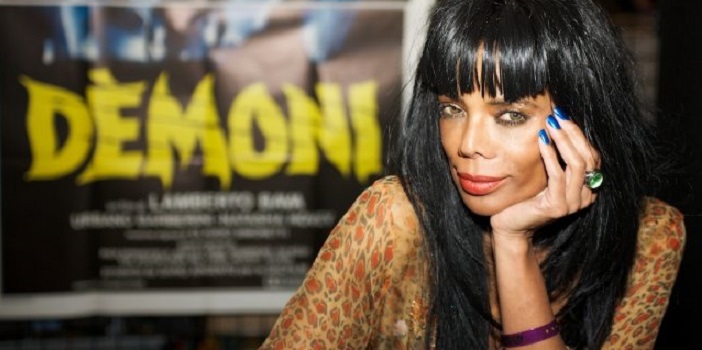
Actress Geretta Geretta (a.k.a. Geretta Giancarlo) was at New Beverly Cinema to talk about her role in Lamberto Bava’s Italian horror movie “Demons.” It turns out that movie was one of ten she made while living in Italy for several years, and her time there also had her working with a couple of other Italian filmmakers: Lucio Fulci and Bruno Mattei. Both have long since gained a large cult following for their cinematic work, and Geretta took the time to tell the audience what it was like working with them.
Fulci has been called the “Godfather of Gore” by many, and he is best known for his films “Zombie” and “The Beyond.” Geretta worked with Fulci on “Murder Rock: Dancing with Death” which was about the owner of a prestigious New York ballet school who teams up with a male model in an attempt to solve the murders of a few students. One male audience member told Geretta how the movie has one of his favorite death sequences ever, and she was thrilled to hear this and quickly responded, “kiss that man!” Her description of Fulci as a filmmaker and as a person surprised those who didn’t know him as well as she did.
Geretta Geretta: He was known to have a difficult personality, and that’s putting it lightly. He had a lot of tragedy in his life. A couple of his wives committed suicide, and his kids were on drugs. Everything was really bad for him, and he had to work. He had to keep working and get that job done. So, when you went to the audition your agent said, don’t talk back, don’t say anything, and don’t ask any questions. What’s your motivation? Your check. Just shut up and do whatever he says. For me, working with him was a dream. I have no problem following direction. But he literally would go into a shaking fit, start screaming, spit coming out of his face, rolling on the ground furious. That’s what it was like working with Fulci.
Mattei was another Italian filmmaker who had gained a significant cult following for his exploitation movies such as “SS Girls” and the zombie flick “Virus: Hell of the Living Dead.” In many circles he is considered to be the “Ed Wood of Italian filmmaking” as his films were filled with a lot of stock footage, bad acting and utterly ridiculous dialogue. Still, Mattei got to work with many noted filmmakers such as Fulci and Claudio Fragasso, and he was lucky enough to direct actors like Lou Ferrigno, Donald Pleasance and Richard Harris before they became famous.
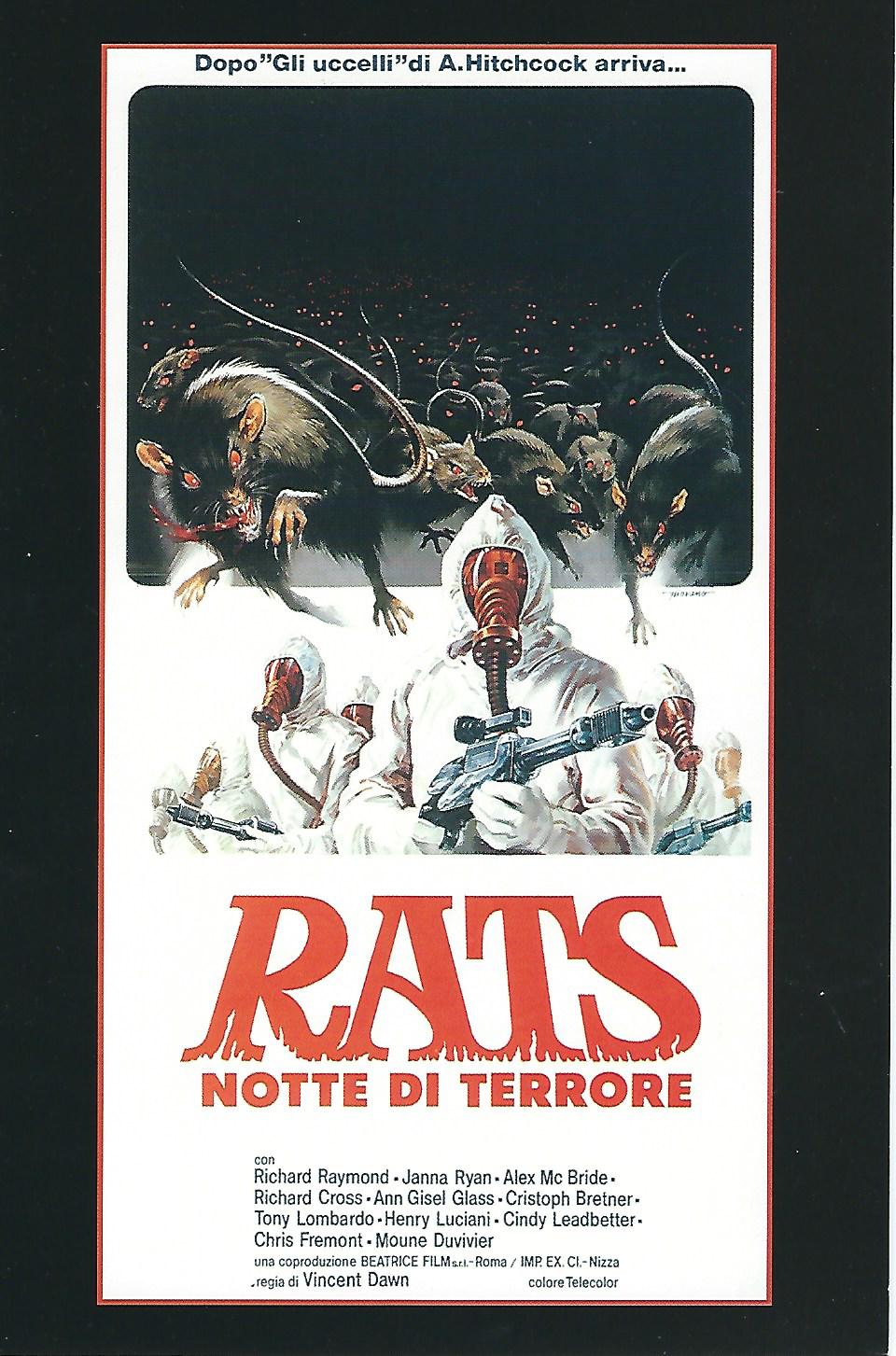
Of all the movies Mattei made, the one he was proudest of was “Rats: Night of Terror.” Inspired by the look of futuristic 1980’s movies, it takes place more than a century after a nuclear war has devastated Earth. What is left of society has been divided into two groups; those who live comfortably in underground cities, and the scavengers who are forced to live in the sunlight. But soon, these two groups are forced to work together to defend themselves against a horde of flesh-eating mutant rats which are prepared to devour everything and anything in their path.
Geretta played Chocolate in “Rats: Night of Terror,” and she gleefully shared what it was like auditioning for Mattei.
GG: With Bruno (Mattei) it was kind of different because with Dario (Argento) it’s all hushed in the halls and everything’s like yes sir, yes sir, and Bruno was like all excited about everything. He asked me, hey kid! You afraid of animals? And I go, no. He then asked, are you worried about furry things? I said no. And he’s all, great because it’s gonna be rats! And I won’t even tell you the things we used to do before the cameras started rolling because it was very scary.
Geretta then went on to say while Bava and Argento had a million dollars to make “Demons” with, Mattei’s budget on “Rats: Night of Terror” was so low to where the film crew kept the dead rats they threw at the actors so that they could reuse them (yikes!).
It was great to listen to Geretta Geretta talk about these two filmmakers, both of whom have since passed away. While some critics have long since dismissed the films of Lucio Fulci and Bruno Mattei, they both still have a strong legion of fans who are more than willing to see every single movie they created. Both Anchor Bay Entertainment and Blue Underground have gone out of their way to remaster their films for new generations of movie buffs to discover, so the stamp they left on the world of cinema is not about to disappear.
It was a role originally meant for Will Smith, but after watching “Django Unchained” it will be hard to think of any actor who could have played Django better than Jamie Foxx. The Oscar-winning actor came from the world of comedy where he has done hilarious work, but he continues to impress us with one terrific dramatic performance after another in films like “Collateral,” “Ali” and “Any Given Sunday.” The role of Django is one of the biggest and most challenging Foxx has taken on, and he convincingly takes this character from being a helpless slave to becoming a slick bounty hunter in splendid fashion.
When it comes to working with Quentin Tarantino, he’s always ready to show his actors movies they can base their characters on. Foxx was no exception to this, and Tarantino got him to watch Sergio Corbucci’s 1966 Spaghetti Western “Django,” a movie which serves as one of “Django Unchained’s” biggest inspirations. It starred Franco Nero as a coffin-dragging gunslinger who comes into town and gets caught up in a feud between the KKK and a bunch of Mexican bandits. While talking with Rebecca Murray of About.com, Foxx explained what impact watching “Django” had on him as well working with Nero who has a cameo in “Django Unchained.”
“I was like, wow, it was amazing. And then to actually have the original Django in the movie. I don’t know if you’ve ever met him but he was the biggest star on the set,” Foxx told Murray. “For him to give his blessing, and I think it really follows true to it and I think that’s what’s going to be the pleasant surprise to people, that it’s a Western and that it stays along the lines of a Western that happens to be in the backdrop of slavery. Slavery almost becomes secondary at a certain point because at the beginning it’s traditional, slave. Then once he becomes this bounty hunter, that’s the backdrop. Now it’s about revenge and about getting this girl, so he stayed true to that and that’s cinematic.”
While at the “Django Unchained” press conference, Foxx made it clear he was ever so eager to work with Tarantino on it. He had no qualms about playing a slave, and what attracted him to the role was Django’s uprising. Movies have always been an outlet for the artists who make them and the audiences that watch them, and Foxx explained what makes this one particularly cathartic.
“When you see movies about slavery…we never get a chance to see the slave actually fight back, actually do for himself, and in this movie there are a lot of firsts,” Foxx said.
Despite the fact it is a genre movie and a revenge fantasy of sorts, “Django Unchained” does deal with America’s dark history of slavery. Tarantino never sugar coats it for mass audience consumption, but then again, why should anyone? It’s an ugly part of the past we’d like to ignore, but it needs to be acknowledged so we can learn from it in the hopes of never repeating it again. As a result, the movie has been greeted with controversy over its subject matter and the frequent use of the n-word with many people (and not just Spike Lee) complaining loudly about it. But Foxx, in an interview with Keith Staskiewicz of Entertainment Weekly, said he is not surprised at the strong response “Django Unchained” has been getting and doesn’t think anyone else should be either.
“You know it’s going to be controversial!” Foxx told Staskiewicz. “That’s what’s been blowing my mind, people saying, did you know this was going to be controversial? It’s like, come on man! Did you read the script? Why would Quentin Tarantino do anything that wasn’t controversial? What movie of his have you seen where you went, oh, this is a Hallmark Movie and rated G? That’s not what you sign up for. You don’t sign up for that.”
Still, Foxx admitted it was a tough movie to make considering part of it was shot at the Evergreen Plantation in Louisiana. It was at this same plantation where slaves were made to work, and they suffered and toiled under brutal conditions. Being there must have been deeply unsettling for everyone involved in the movie’s making, and it certainly had a strong impact on Foxx which he wasn’t about to ignore.
“It’s tough shooting when you’re in plantation row and that’s where your ancestors were persecuted and killed, and we were respectful of that,” Foxx told Staskiewicz.
Regardless of the controversy, “Django Unchained” proved to be one of the most entertaining movies of 2012 thanks to Tarantino’s clever screenplay and direction, and also because of the sensational performances from the cast. Jamie Foxx can add Django to his roster of great screen roles in a career which still has many more to be revealed. Foxx also made a very good point about the film’s subject matter to Adam Edelman of the New York Daily News which people really need to think about.
“Every two, three years there is a movie about the Holocaust because they want you to remember and they want you to be reminded of what it was,” Foxx said. “When was the last time you seen a movie about slavery?”
WRITER’S NOTE: This article was written back in 2013.
Matthew Goode’s performance as the enigmatic Uncle Charlie in “Stoker” brings to mind the one Joseph Cotton gave as Charlie Oakley in Alfred Hitchcock’s “Shadow of a Doubt.” Both men show a pleasant and courteous exterior, but there’s something in their eyes which tells you they are really twisted. Goode has delivered many strong performances in movies like “Match Point,” “Watchmen” and “A Single Man,” but it’s going to be impossible to forget him after seeing him playing a very frightening sociopath in this one.
Now playing a character as evil as Uncle Charlie has got to be a lot of fun for actors, but at the same time they really can’t judge a character like this too much. Once they do, they fail to portray them in a truthful way and their performance eventually rings false. Goode, in an interview with Nigel M. Smith of Indiewire, however, made it clear he was not about to fall into the same trap.
“I’m not a method actor; I think that would be rather exhausting on this sort of a project. But I don’t judge the character; I think that’s safe to say,” Goode told Smith. “You’re conning yourself between action and take. I don’t think about it too much, I just do what you have to do. You know there’s a camera in your face, and there are times when you can just get completely lost in it and the take is over. Then sometimes it’s very choreographed and you have to get your head in there to match with someone’s eye line, and I love that. I love the technique.”
“So with a darker character like this, it’s quite fun,” Goode continued. “It’s something that’s very different to who I am. I’m not a sociopath and I don’t go around strangling people. It’s just like kids playing. That’s really what our job is. We haven’t grown up.”
The other important thing to remember with a role like this is not to play it as evil. Yes, Uncle Charlie is evil as can be, but to portray just that one side of him would make for a very boring performance. You have to look at this character like you would any other and examine their wants, needs and motivations. In doing so, you will give yourself different areas to explore, and your performance will be all the better for it. In talking with Katie Calautti of Spinoff Online, Goode explained how he went about preparing to play Uncle Charlie.
“You can’t just play bad,” Goode told Calautti. “I wouldn’t even know how to start playing bad, or what that even means – it’s so two-dimensional. So you have to find some sense, despite his despicable acts, some kind of psychological truth of why. And director Park (Chan-wook) talked about bad blood and the idea that there was a predisposition within the family bloodline to want or need to commit these acts, and where does evil come from, is it nature or nurture? And for me they’re all very lonely, isolated characters. So I felt like, as much as this is a coming-of-age story for Mia (Wasikowska’s) character, Charlie’s kind of trapped in the past.”
The best scene in “Stoker” comes when Goode joins Wasikowska on the piano, and the two engage in a duet which can be best described as beautifully intense. Watching these two actors duel with one another while pounding away at those black and white keys was exhilarating, and it was the one scene from this film I wanted to know the most about. Karen Benardello of We Got This Covered was at the film’s press conference and asked Goode what it was like shooting this particular scene.
“It became liberating in the end,” Goode said. “I hadn’t played the piano in 20-odd years. So coming back into the fold of the piano, it was unbelievably daunting. Luckily, I don’t have a bad-sized hand, so I didn’t have to leap or anything like that. But it was hard work, but it was great working with Mia. We learned about three quarters of it, because some of it was just too hard, and too much going on with both hands. But we were able to fake some of that, and he was able to shoot the whole thing from whatever angle he wanted. We kind of recognized that in the vocabulary of filmmaking. When someone starts playing, you think, is he actually playing that? (laughs) He was able to dip down, and you go, they are! It’s not a trick on the audience, so it was nice.”
Hopefully Matthew Goode’s performance in “Stoker” will help burn his name into our collective consciousness because every moment he is onscreen is filled with a rising tension which never lets up. While he doesn’t let you in on all his character’s secrets, you know he is like a snake waiting to strike. He has already worked with a number of well-known directors such as Woody Allen, Tom Ford and Zack Snyder, but Goode makes it clear how a lot of the opportunities which have come his way so far have been the result of sheer luck.
“I’m not the person who’s able to pick and choose their roles,” Goode said. “But I know that Nicole [Kidman], for example, has said that she’s interested now – there might be a film in the studio system, but she loves independent film and she thinks that’s much more where her desires are, and the films she kind of likes. And so I think she is able to say to herself, ‘I like to choose projects not only based on the material but also the filmmaker,’ which is wonderful for her. And I think I just happen to have been quite lucky in the fact that the material that I gravitate towards or the people that have thought I am going to be better suited to it – because it’s not my choice, they’ve picked me. I’ve been lucky as hell, and the parts have been quite varied.”
WRITER’S NOTE: This article was written back in 2012.
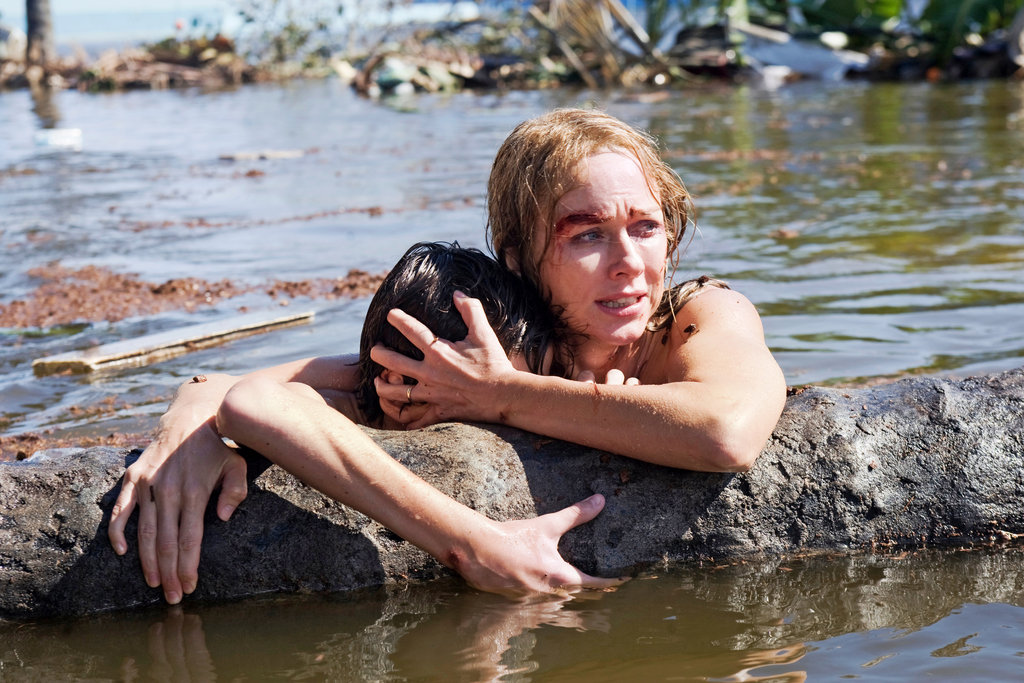
Australian actress Naomi Watts gives an emotionally pulverizing performance in J.A. Bayona’s “The Impossible,” a film which chronicles one family’s struggle for survival in the aftermath of the 2004 Indian Ocean tsunami. In it, Watts plays Maria, a doctor who is staying with her husband and children in a beautiful resort in Thailand for the Christmas holiday. This vacation comes to a horrific end when the tsunami decimates the country’s coastal zone and separates Maria and her son Lucas from the rest of her family. The role has Watts dealing with her fear of water, playing a character based on a real-life person, and the immense difficulty of shooting in not one, but two giant water tanks.
While at the movie’s press conference which was held at The Four Seasons Hotel in Beverly Hills, Watts described playing Maria as being “the most physically, emotionally draining role” she has ever taken on since “King Kong.” Considering she has played such equally draining roles in “21 Grams” and “Mulholland Drive,” that’s saying a lot. After doing “King Kong” she said she would never take on a role like that again, but even she couldn’t say no this script or working with Bayona who made the acclaimed horror movie “The Orphanage.”
Unlike the tsunami sequence in Clint Eastwood’s “Hereafter,” the one in “The Impossible” was done with real effects and no CGI. This makes the sequence all the more harrowing to watch, and seeing Watts hang onto a tree for dear life while water keeps rushing furiously by here makes for one of the most emotionally intense sequences in any 2012 movie. In an interview with Steven Rea which was featured on the Philly.com website, Watts talked about what it was like shooting the sequence which itself took four weeks to complete.
“I didn’t know it was going to be so difficult,” Watts told Rea. “They had it all very well prepared – we had allegedly the second largest water tank in the world, and they had these giant cups that we were anchored into . . . so you were just above water level, you could use your head, and you can use your arms so you looked like you were swimming. . . . And you’re on this track, and then a giant wave was coming towards you . . . and then side pumps were shooting more water, and all the garbage and debris. . ..”
“So, it got increasingly difficult, and then we noticed that we couldn’t actually act, or speak,” Watts continued. “We were lucky if we could get one word out, and that word would be ‘LU-CAS!’ It was tough, and then the underwater stuff was even more difficult. That was very scary.”
You have to give Watts a lot of credit not just for the brave performance she gives, but also for how making this movie made her deal with her fear of water. This was not the result of watching “Jaws” several dozen times, but of a near drowning accident she had when a teenager. She related this story to NPR’s Melissa Block.
“When I was about 14, my family emigrated from England to Australia, and we decided to stop in Bali on the way through. And having grown up in England, we were not great swimmers and knew nothing about riptides,” Watts told Block. “Anyway, we got caught in a riptide, and I didn’t know what to do other than swim against it, and got to the point of exhaustion, and then just about gave up. But then my mother, somehow, miraculously found sand beneath her feet and just managed to pull me in. And so, as a result of that experience, I’ve always been afraid of the waves and strong currents, so it’s quite interesting that I ended up doing this.”
It’s very interesting indeed, and it makes you admire Watts all the more for playing this character. After learning about her near-death experience, it becomes clear the fear which crosses the actress’ face onscreen was not at all faked.
Another big challenge for Watts in playing this role was it was based on a real-life person, Maria Belon, who, along with her family, amazingly survived the tsunami which claimed thousands of lives, and she herself suffered some serious injuries which had her at death’s door a few times. It’s always intimidating to portray a person from real life, especially one who’s still alive and has been through an experience we are grateful not to have gone through ourselves. While at “The Impossible” press conference, Watts talked about what it was like to meet Belon.
“Originally when I met Maria, I was incredibly nervous and I didn’t know where to begin. I felt like, I’m just an actor and you have lived through this extraordinary horrendous thing, and I just don’t know where to start,” Watts said of their first meeting. “But we sat there in front of each other for five minutes, she didn’t feel the need to speak and I couldn’t, and then she started just welling up and the story was told just through a look. I started welling up and then we just thought okay, let’s get on with this, and she continued to speak for three and a half hours and time just went by like that.”
“She stayed with me the whole time,” Watts continued. “I don’t just mean physically, but we were connected. We sent emails back and forth, and she would write endless letters about all the details that took place. The thing that she talked about was her instinct and her ability to trust herself which I think we lose so often. I feel like I am full of self-doubt and second guessing which is why this story becomes an interesting one because you wonder how you would deal with this.”
Naomi Watt’s performance in “The Impossible” deserves a Purple Heart as much as it does an Oscar. As an actress, she appears to be plumbing the depths of her soul to pull off roles like this one, and I think she’s one of the bravest actresses working today. While she may be yearning to stay away from roles like this in the future, it’s hard to think of many other actresses who can go to the places she goes to portray raw emotion so honestly.