Dave Bautista on Playing Brass Body in ‘The Man with the Iron Fists’

WRITER’S NOTE: This interview took place back in 2012.

David Bautista has made a big name for himself during his time in World Wrestling Entertainment where he became a six-time world champion. Like many major athletes, he has since turned his attention to acting, and he gets one of his biggest roles in RZA’s “The Man with the Iron Fists” in which he plays Brass Body, one of the main antagonists and a mercenary who can turn his body into metal. This makes him almost completely invulnerable; much like Bautista seemed like whenever he was in the ring.

While at a press conference for “The Man with the Iron Fists” which took place at the House of Blues in Los Angeles, Bautista talked about what it was like making the movie. Co-starring alongside him was Cung Le who plays Bronze Lion and was also at one point a major kickboxing champion. Bautista was asked what it was like working with Le and if he had ever fought with him “in the cage.”

Dave Bautista: I never fought with him, but we actually trained a lot together in China (where the movie was made). I wish we had some scenes together. I’m determined in my life to do a movie with Cung Le just so I can get that fight scene with him just because he’s so dynamic and so intense. So, we never fought together but I picked up a lot of good things from him.

Bautista said he accepted the role of Brass Body without even reading the script and that the character originally only had one or two lines as it was more of a physical role. This soon changed once he was cast. The biggest challenge for him, however, was filming the fight scene between Brass Body and Blacksmith who is played by star and director RZA.

Dave Bautista: The fight scene itself took days and days and it was just a pain in the ass. It was cold, it was brutal, and RZA had those damn iron fists on and they were just killing my arms because he was hitting me. I had scratches and I was bleeding. We actually started the fight scene a few days after I arrived in China, and then we had to go back to it at the end and finish it because it was so drawn out. The two characters (the Blacksmith and Brass Body) were so strong and kind of invincible that we really didn’t know where to go with the fight scene. We really went without a plan and thought we could wing it and ad-lib and come up with stuff here and there, so that was really a challenge in itself.

One of Brass Body’s other big scenes comes when he viciously attacks one of the female characters, and Bautista said shooting it was “awkward.” He described himself as a “passive” person especially when it comes to women, and since this was essentially a “rape and murder scene,” it became very uncomfortable for him to do.

Dave Bautista: I kept coming out of character because my first instinct was to tell the actress, are you okay? But she actually made it a lot of fun for me because I had this little thong on and I was freezing because the set wasn’t heated. Even when I picked her up, I didn’t know where to touch her, so I picked her up and threw her over my shoulder and I’m trying not to grope her because I don’t want to make her uncomfortable. Then RZA stepped in and said ‘you gotta make it look more real. Grab her over her ass because it’ll help her out because it will cover some of her stuff up.

The actress Bautista was working with thanked him for doing her that favor.

In addition to wrestling, Bautista is also a skilled mixed martial arts fighter. The first martial art he learned was Kali which comes from the Philippines and emphasizes weapons-based fighting with sticks, knives and other weapons. When asked if he tried to influence his fighting style in this movie, Bautista replied he did to a certain extent but that it only went so far.

Dave Bautista: The stuff that we were doing just didn’t translate as well as we thought it would on film, so we had to switch it up a lot and bring Corey Yuen (the movie’s fight choreographer) in to help us through this. We wanted this to look like a traditional kung fu fight movie especially with the characters being so strong, but I did utilize a little bit of my Kali.

Those who have seen “The Man with the Iron Fists” can agree Bautista is perfectly cast as Brass Body as he truly comes off as a badass who cannot easily be defeated. When asked if he shares any similarities to his character and if he could offer advice to those of us who are not as athletically inclined as he is, Bautista’s response was actually quite surprising.

Dave Bautista: I never felt like I was invincible. Throughout my whole life I always felt like I was an underdog. It’s kind of hard to relate to a kung fu action hero. I was trying to stay in character to where he (Brass Body) would always feel invincible and how he would react when he realized he wasn’t invincible and started to break down. I tried to get that in my head and I tried to make it come out on film, but not being the best actor made it kind of a challenge for me. I wouldn’t be the best person to give advice on how to be invincible because I’ve never felt that way. Everything’s a challenge for me, but I’m a hard worker.

Before he concluded his time with us, Bautista was asked what his dream role is.

Dave Bautista: I hate to sound cliché but I’ve always wanted to do a vampire movie. Any kind of superhero stuff, that’s what I’m a fan of. I wouldn’t mind doing that, I just don’t see myself as a leading man type character. I like the drama; I just don’t know if I fit that type of role. But that’s the kind of stuff I like to watch though.

John Carpenter on ‘The Ward’ and the State of Movies

WRITER’S NOTE: This article was originally written in 2011.

In July, America will finally get to see John Carpenter’s first feature length film in 10 years, “The Ward.” After the critical and commercial disappointment that was “Ghosts of Mars,” Carpenter seemed determined to retire from filmmaking as he felt it was no longer fun for him. But after working on a couple of “Masters of Horror” episodes, he seemed rejuvenated and ready to take on another film of his choosing. While appearing at the Egyptian Theatre in Hollywood for a 25th anniversary screening of “Big Trouble in Little China,” Carpenter talked about the upcoming movie, and what he thinks about the state of movies today.

The famed director described “The Ward” as an “old school horror film” and a “psychological thriller.” It stars Amber Heard as Kristen, a young woman who is institutionalized in a psychiatric ward which turns out to be haunted by a ghost as mysterious as it is deadly. Carpenter said he was attracted to the project because it had a low budget which would give him creative control, limited locations, and a short schedule which he especially liked. With the schedule being short, Carpenter knew he could finish the film before any form of exhaustion did him in.

“The Ward” first premiered at the Toronto International Film Festival and has since opened in the United Kingdom. Word of mouth indicates the movie has received mixed reviews thus far, but his fans are thrilled he went back behind the camera once again. Carpenter feels that “The Ward,” in his own estimation, is “pretty good” and found some fanboys liked it while others felt it was not “gruesome enough.”

Audience members asked Carpenter’s opinion on the state of movies today which is swamped with endless remakes and a frightening lack of originality. He openly described most films which are out now as being “still bad,” said some were fair, and others were “really good.” In his view, the movie industry has not changed. The present cycle of movies will pass, he said, and he is looking to a “more positive future” and encouraged the audience to do the same.

John Carpenter said his career as a filmmaker has really been the result of luck, and he’s done many of the things he always wanted to do. While he still gets caught up in video games (he was a creative consultant on “F.E.A.R. 3”) or contemplates perhaps doing a music score for another director’s movie, it is great to see him behind the camera once again. And, if we’re lucky, he and Kurt Russell will get another chance to work together in the future, and that’s even if it’s not a sequel to “Big Trouble in Little China.”

Exclusive Interview with Dominik Garcia-Lorido about ‘Wild Card’

WRITER’S NOTE: This interview was conducted back in 2015.

Dominik Garcia-Lorido is an actress on the rise. So far, she has turned in memorable performances in movies like “The Lost City” and “City Island” which had her co-starring with her father, Andy Garcia. On television she co-starred on the Starz television series “Magic City” (sense a trend here?) as Mercedes Lazaro, a housekeeper training to become a stewardess for Pan Am Airlines. Now she co-stars opposite Jason Statham in “Wild Card” which was directed by Simon West and written by the great William Goldman who adapted it from his novel “Heat.” It is also a remake of the 1986 film “Heat” which starred Burt Reynolds and is better known for the behind-the-scenes troubles which resulted in six directors coming and going from the production.

Garcia-Lorido plays Holly, a young woman living in Las Vegas who gets brutally assaulted and calls on her friend Nick Wild (Statham), a lethal bodyguard with a gambling problem, to help her get revenge on those who did her wrong. I got to speak with Garcia-Lorido on the phone while she was doing press for “Wild Card,” and she helped fill me in on the kind of character Holly is. In addition, she also discussed how she approaches each character she plays and described what it was like being a student at UCLA’s School of Theatre, Film and Television.

Ben Kenber: Could you tell me more about your character of Holly? We only get to know so much about her in the movie.

Dominik Garcia-Lorido: The backstory for her was just that she was a teenage runaway who came to Vegas. Nick always knew her and he says it in the movie. I think it’s still in the movie, when he says, “When I first met you, you are this kid with braces” and all that stuff. I think she’s like the love of his life and they just couldn’t make it work, but he’s still very close to her. She’s an escort in Vegas and does very well for herself, and she seen a lot and has grown up really fast and can really take care of herself. This isn’t the first time she’s probably been disrespected on the job, but to this extent was really the first time that she’s been this disrespected.

BK: I definitely get the sense that she’s grown up a lot faster than anyone should have to.

DGL: Exactly. I just never thought she was this young girl. When we went to shoot my first scene where he (Nick Wild) comes in and sees me, we shot at that location at this big house, we see that she lives a good life. She lives very well and does very well for herself. She’s not this broken down hooker doing drugs. She’s got her shit together and this is her job.

BK: Holly does get very disrespected in some scenes which I’m sure were not the least bit easy to shoot. What was it like shooting those scenes?

DGL: You know, those kinds of scenes are those kinds of scenes. Whether it’s a love scene about two people in love or whether it’s like this, they are so choreographed. That’s just like the perfect word for it; they are so choreographed. Milo (Ventimiglia) was such a nice guy and I felt really comfortable with him and he made me feel very comfortable. I felt very safe doing those scenes, but yeah that’s sort of how they are. We shot so much more than what you see of this flashback scene. And then being hauled into the hospital and on a gurney there were a couple of actors that were medics around me, but one was a real nurse and I was asking her questions before we shot in between takes about how would my breathing really be. That’s really scary. That’s a lot of acting you have to do when you’re shooting really fast. You have to show pain and that’s where you do the most acting. I was just asking her; how would I be breathing if I just experienced trauma? How would I be speaking? Would I be crying? She was very helpful with that. So that’s like always a little hard to do. You want to get that right.

BK: “Wild Card” was based on the novel “Heat” by William Goldman, which in turn was adapted into the movie “Heat” back in 1986 which starred Burt Reynolds. Were you aware of that movie before you started making this one?

DGL: Well, I wasn’t aware before I read the script, but then I knew it was a remake when I got it. But I never watched it.

BK: Did you ever get the chance to talk to William Goldman?

DGL: I never did. I don’t know if any of the actors really did unless Jason did. I don’t think any of us really have that opportunity.

BK: The making of “Heat” was said to be a very messy affair.

DGL: Yeah, that’s what I heard.

BK: I imagine the making of this movie went a lot more smoothly.

DGL: This wasn’t messy at all. I think there were a lot of difficulties with the director on the first film. I think Burt Reynolds punched him or something, I don’t know. We were really taken care of with Simon (West) and the producers. It was smooth sailing.

BK: Did you base Holly on any people you knew, and what were your influences on the role?

DGL: I didn’t base her on anyone I knew. I tried to personalize it in some way I can. With anything I play, I try to be as honest as I can. I wear my heart on my face more than Holly, but Holly wasn’t that to me. Her vulnerability is like creeping through the cracks, and she has poker face. She has to.

BK: Absolutely, she can’t let everybody see what’s going on inside her.

DGL: she still fresh from the night before, I think was important to me to show that a little bit because Nick needs to see the pain in this.

BK: I saw that you attended the UCLA School of Theatre, Film and Television. What did you learn there that really helped you the most as an actress?

DGL: UCLA was such a strenuous program. We did so much. In our first year we were constantly working. Every weekend we were seeing a play and writing a paper on some aspect of the play whether it was the lighting, the production design, the costumes, the acting or whatever. During the week we had so much work. UCLA just taught me to be a hard worker, number one. It really just has you focusing on the craft and all aspects of it. I never had done that much work before. I cruised through high school before that. So I think that’s just the training because acting is a lot of work. I had a good acting teacher there that I continued to work with for a little bit when I left named Marilyn Fox. I’ve seen her act and she’s the kind of actress you want to be. She’s so grounded and so honest. She’s just always brought that out of me. I learned a lot and I grew a lot there.

Thank you to Dominik Garcia-Lorido for taking the time to talk with me. “Wild Card” is now available to own and rent on DVD, Blu-ray and Digital.

Skylar Astin on Being the Moral Compass in ’21 & Over’

WRITER’S NOTE: This interview took place back in 2013.

Skylar Astin has had the privilege of entertaining us onstage in the Tony Award-winning musical “Spring Awakening” and onscreen in movies like “Hamlet 2” where he sang the song “Raped in the Face” and “Pitch Perfect” in which he appeared opposite Anna Kendrick and Rebel Wilson. Now he’s starring in “21 and Over,” the comedy which marks the directorial debut of “The Hangover” screenwriters Jon Lucas and Scott Moore. Astin plays Casey who quickly proves to be the moral compass the other main characters need to survive the mess they end up getting caught in.

I got to catch up with Astin while at the “21 and Over” press conference held at the Saddle Ranch Chop House off of Sunset Boulevard in Los Angeles. Now when it comes to college comedies like this one, most actors would prefer to play the character who is wild and crazy and comes across as the life of the party. Casey, however, is exactly the opposite of that even though he gets into as much trouble as his friends do. Still, Astin saw the benefits of playing such a level headed and grounded character in this film.

Skylar Astin: “You’ve got to have a moral compass of the movie and you got to like steer the ship a little. It’s cool that we all got our opportunity to be funny though.”

One pivotal scene in “21 and Over” has Astin and his co-star Miles Teller walking around campus wearing nothing but a tube sock over their privates. Now this could not have been a very comfortable scene to do, especially when you have a lot of people on set looking at you and wondering how much time you spent at the gym. Astin talked in detail about he approached this scene in the film which was filmed in Seattle, Washington.

Skylar Astin: “Funny enough, it was supposed to be approached very delicately. We were told that it was going to be a closed set and that it was gonna be the warmest day of the shoot. It turns out that it’s freezing, everyone’s there, and actually at our first costume fitting they just had a sock and a little underneath sock to keep everything in place and they’re like ‘here’s your fitting!’ At first, we had a moment of where it was like fight or flight, and I think I was just like ‘let’s just do it man. We have to do it eventually.’ I just de-robed and was like this is everything I got. I don’t think I was like proud, but I just had to play the role of being okay with it. I had the idea of making the whole crew where just socks and they didn’t oblige, especially the women, but it worked out thankfully.”

In the film, Astin and Teller take their best friend from high school, Jeff Chang (played by Justin Chon), to celebrate his 21st birthday in an appropriately drunken style. Now the really good actors are able to draw on their own experiences when playing the role, and we couldn’t help but wonder if Astin has been through similar nights in his own life. It was actually a bit surprising to hear the similarities he shares with Casey.

Skylar Astin: “Personally for me, my younger brother is my best friend and my partner in crime and I’ve definitely had several nights that had the spirit of this movie. I’ve always been the one that has a good time, but at the end of the bender it’s like ‘both of our phones are dead and we both have to call our parents and tell them we’re alive.’ That’s kind of always been my responsibility so I can relate to the feeling of just being a little irritable on those nights but also letting loose and have a good time. There is a little bit of Casey in me, but I don’t think I’m as much of an over thinker though. I always try to draw from personal experiences and my own personality whenever I play a role, and it’s not hard to play a role that close to my age, close to home and in a movie that I would go see if I wasn’t in it.”

Working with two different directors on the same film must seem challenging as this is typically a one-person job. What if one director tells you to do one thing and the other director instructs you to do the exact opposite? Where do you draw the line? Astin, however, said both Lucas and Moore were on the same page as they had written the screenplay together and have been friends for many years. As a result, there was never any conflict between either of them.

Skylar Astin: “What they have in common is that they are both the writers so it comes directly from one vessel. That’s always really great as an actor to have that wealth of knowledge coming from two voices. For me, I loved the different kinds of conversations that I would have with each one. Since I had a love story on top of the funny moments, there were different kind of conversations like the leading man type of thing I would have with Moore and to be more sincere in certain moments, and then Lucas was great because he was giving me jokes every five minutes. So, I had this well-rounded voice coming from two different people. They worked together so well, and they almost know this age better than I do and I’m closer to it. It’s kind of crazy.”

For a film filled with such drunken debauchery as “21 and Over,” Skylar Astin proves to be the most well-rounded person these characters need to get them through the night. It is now available to own and rent on DVD, Blu-ray and Digital.

Steven Knight on Tobey Maguire, Bobby Fischer and ‘Pawn Sacrifice’

WRITER’S NOTE: This interview took place back in 2014.

“Pawn Sacrifice,” the movie about Bobby Fischer’s quest to beat the Russians in the game of chess, proves to be another cinematic triumph for both Edward Zwick and Tobey Maguire. Another person who deserves credit for this movie’s critical success is Steven Knight who wrote the screenplay. Knight’s previous writing credits include David Cronenberg’s “Eastern Promises,” Stephen Frears’ “Dirty Pretty Things” and John Crowley’s “Closed Circuit,” and he wrote and directed “Hummingbird” which starred Jason Statham. He also wrote and directed “Locke” which featured Tom Hardy in what proved to be one of the most underrated movies of 2014.

I got to sit in on an interview with Knight while he was in Los Angeles, California at the Four Seasons Hotel to promote “Pawn Sacrifice,” and it was really nice to talk with him again after having interviewed him about “Locke” for the website We Got This Covered. His screenplay showed how well researched he was in Bobby Fischer and the world championship games he ended up playing against the Soviet chess grandmaster Boris Spassky.

Ben Kenber: I read that when you found out Tobey Maguire was going to be playing Bobby Fischer in this movie that it made it easier for you to write the script.

Steven Knight: Yeah, well it was Tobey who came to me with the idea, so from the outset it was always going to be Tobey playing Bobby. That really helped because this is about a battle being fought with the face if you like. It’s the intensity of the movement, and Tobey has got that intensity so much.

BK: Boris Spassky (played by Liev Schreiber) is an interesting character as presented in this movie. This could have easily become a good guy/bad guy story, but the movie avoids that thank goodness.

SK: Yeah because that wasn’t the case. If anything, Bobby was the bad guy. He was the one with the unreasonable demands. He was the one everyone chased around for reasons that we know. But Boris was a decent person, and when he applauds at the end of game six you realize that this is a man who knows how to lose and have the dignity. If there’s any message about this Cold War, it’s that when two human beings can overcome that conflict.

BK: It’s almost scary to think about how Bobby would’ve handled fame if he were to become famous in this day and age because there would have been nowhere for him to hide.

SK: No, definitely not. If he came along today, he would get the best agent and he would get the best lawyers. They would come to him. He wouldn’t choose. They would get him than make a fortune.

BK: The last image of the movie, when Bobby Fischer wins and gets what he wants, has haunted me ever since because it’s all downhill for him from there. It’s sad to see that he’s not able to enjoy the success he earned.

SK: Yeah, and the image that’s always in my mind was he’s been running away and he’s hit a brick wall, and now they are gonna get him.

BK: It’s interesting that the movie ends there instead of following Bobby and observing what happened to him afterwards. It could almost make for a good sequel.

SK: It would make for an odd sequel (laughs).

Thanks to Steven Knight for taking the time to talk about what went into his screenplay for “Pawn Sacrifice,” and I look forward to what he has in store for us next. The movie is now available to own and rent on DVD, Blu-ray and Digital.

CLICK HERE TO READ THE EXCLUSIVE INTERVIEW I DID WITH STEVEN KNIGHT ABOUT HIS FILM LOCKE.\

Michael Stuhlbarg on Managing an Unstable Genius in ‘Pawn Sacrifice’

WRITER’S NOTE: This interview took place back in 2014.

Ever since he made his cinematic breakthrough in the Coen brothers’ “A Serious Man,” actor Michael Stuhlbarg has presented us with an array of characters he completely disappears into in movies like “Men in Black 3,” “Lincoln,” “Seven Psychopaths,” “Blue Jasmine,” “Cut Bank” and “Steve Jobs.” In “Pawn Sacrifice,” the Julliard trained actor portrays Paul Marshall, the manager and attorney to chess prodigy Bobby Fischer (played by Tobey Maguire). Bobby proves to be a hard man to get control of, and Stuhlbarg makes you see how exhausting it was for Paul as he was determined not to lose his most famous client even as the chess genius descended into madness

Stuhlbarg was at the Four Seasons Hotel in Los Angeles, California for the “Pawn Sacrifice” press day, and he talked in depth about he prepared to play a character who is based on a real-life person. Always a daunting task for any actor, Stuhlbarg appeared to handle this task with what seems like relative ease.

Ben Kenber: Your character of Paul Marshall reminded me a bit of Paul Giamatti’s character of Jerry Heller in “Straight Outta Compton” as both men are managers and forced to manage their clients under increasingly difficult circumstances. In your research, did you look a lot at different managers and how they worked with their clients?

Michael Stuhlbarg: Not so much. I stuck primarily with who Mr. Marshall was. It seemed to be enough. And also, particularly with what the script was asking of the dramatic situation, I just sort of threw myself into it and sort of said how can I get him into the next room if I need to get him there. And how can I please him as much as I can? Because it behooves all of us that he gets where he needs to go and he gets what he asks for. I tried to reason with him and just sort of placed myself in that dramatic context, so that was the dramatic result.

BK: Like Edward G. Robinson (whom he plays “Trumbo”), your character is based on a real-life person, but it’s a person most people don’t know as well as Bobby Fischer. Did this make your job as an actor harder or easier?

MS: The job is the same either way. I imagine I didn’t have to necessarily push myself to behave too much like Paul Marshall because not too many people, I believe, out there would have known him or perhaps fewer people would have known someone like him, Bobby Fischer or Edward G. Robinson. So I didn’t worry about that too much, but on the flipside of that is I tried to get as much video on him as I could so that I knew who he was, and I could listen to his rhythms and hear where he came from and try to embody it is truthfully as I could. At the same time, I was trying to be truthful to the situation.

BK: As an actor, would you say it’s more like working from the inside out or the outside in?

MS: I guess it has to be a marriage of both honestly. You ask questions enough about what you would do in a particular situation that a character finds himself in and you go from there. If he wore a particular pair of glasses which Paul did, it’s then let’s put on those glasses and how does it make me behave. Does it make me behave differently? Perhaps it does. Perhaps I hold my head a little differently. There are the outside influences that will change the way I behave, and there are questions that I could ask that he may have had to ask in his life that may also change me internally. So, I guess it’s always kind of a combination of the two for me.

Like the best character actors working in movies today, Michael Stuhlbarg shows no signs of slowing down as he has a number of projects coming up. It will be fascinating to see which role he will bring to life next.

“Pawn Sacrifice” is now available to own and rent on DVD, Blu-ray and Digital.

PLEASE CHECK OUT THE VIDEO INTERVIEW I DID WITH STUHLBARG WHICH I DID FOR WE GOT THIS COVERED DOWN BELOW:

Tobey Maguire on Chess, Poker and ‘Pawn Sacrifice’

WRITER’S NOTE: This interview took place back in 2014.

Tobey Maguire brings his usual coiled intensity to the role of American chess prodigy Bobby Fischer in “Pawn Sacrifice.” Directed by Edward Zwick, the movie takes us back to the days of the Cold War where Russia and America were constantly facing down one another. Having become a master at chess at such an early age, Bobby eventually becomes determined to beat the Soviet Empire at the game as they have dominated it for decades. This puts Bobby in the crosshairs of Soviet chess grandmaster Boris Spassky (played by Liev Schreiber), and they come to face each other in what became known as the “Match of the Century,” a 21-game competition held in Iceland back in 1972.

Maguire dropped by the Four Seasons Hotel in Los Angeles, California to talk about his experience making “Pawn Sacrifice” and playing a real-life person. In addition to being an accomplished actor and producer, he is also known for being quite the poker player as he has played in various tournaments throughout the years and has won a lot of money. Front Row Features Managing Editor Angela Dawson asked him if he was able to utilize his knowledge of poker in this role.

Tobey Maguire: I think it doesn’t hurt. I mean it’s very different, and I think Bobby himself hated games if there was any element of chance. When he was six years old he would play some other games, but where there was any element of chance, whether it was cards or dice or something like that, he would get really frustrated because his skill would maybe gain him an advantage but then the chance element might take that advantage away. He almost felt that was unfair, so he no longer played games that have any element of chance and only wanted to play a strictly skilled based game which is essentially chess. He had all of the control and it was all skill, and the communication is very pure. He loved that there was this framework and essentially this pure communication with the person he was playing with. There’s no kind of manipulation or something else that could happen. It was like a safe place to communicate purely. But I also think it doesn’t hurt that I’ve played games and sort of battled with people over boards and across felt tables.

Looking at both games, it seems like there’s a similarity between them because both games require a lot of mental energy as you constantly second guess your moves and the moves you think your opponent will make. Whether you are about to move a chess piece or put down a poker bet, there’s a lot to consider beforehand as a player has to be actively concerned about making a wrong move that will have them suffering a loss they could have avoided. I brought this up to Maguire who sees similarities between the games, but he was also quick to describe how they are different from one another.

Tobey Maguire: Yeah, although with cards you’re acting on current, partial information. You have cards that I don’t see, so I’m then kind of mostly looking at your historical behaviors as it relates to betting and less on tics and moves and stuff. I think that there’s way too much put on so-called tells of poker. I think it’s much more about patterns of betting. I think that’s much more reliable than behavioral tells. I do think it’s a huge differential because in chess there is no hidden information. On a chessboard all the information is right in front of you. There is nothing hidden. The only thing you are guessing or second-guessing is really in your preparation. Bobby Fischer was extremely consistent and would play the same opening move over and over and over and over and over and over again. He actually went and I believe, although I don’t have the proof of this but based on people I talk to, that he basically studied variations that he hadn’t played before and ended up using a different opening move in game six that was very unusual for Bobby. It’s possible that he was doing what you’re talking about, kind of not counting on but anticipating that they would not have prepared to open with that. So, in that way, that’s a comparison that I could draw in relation to what you asked.

Maguire is riveting as always in “Pawn Sacrifice,” and the movie is now available to watch on DVD, Blu-ray and Digital.

You can also check out my video interview with Tobey Maguire below which I conducted for We Got This Covered.

Steven Soderbergh Looks Back at King of the Hill

WRITER’S NOTE: The following article is about a screening which took place back in 2011.

In the midst of promoting “Contagion” in Los Angeles, California, filmmaker Steven Soderbergh dropped by the Silent Movie Theater where Cinefamily was screening one of his earlier and most underrated features, “King of the Hill.” Not to be confused with the Fox animated series, the film follows 12-year-old Aaron Kurlander (Jesse Bradford) who is forced to fend for himself in Depression era America after his parents leave him alone at the Empire Hotel in St. Louis. Aaron is forced to grow up a lot faster than any kid should ever have to, and he desperately searches for ways to avoid eviction from the family’s apartment. Soderbergh thanked the sold-out crowd for coming to the theater, and he started off by saying, “Why aren’t you guys going to see ‘Contagion’? This film is never going into profit!”

“King of the Hill” was Soderbergh’s third film after “Sex, Lies & Videotape” and “Kafka,” and it was released back in 1993. Based on the memoir of the same name by A.E. Hotchner, it was given to him as a gift by a friend. At the time he was looking for something different than “Sex, Lies & Videotape,” and he found Hotchner’s story to be just what he needed. He did, however, describe it as a “tricky adaptation” since he only had a budget of $8 million and 48 days to shoot the film, and it was a period piece. On the upside, though, he said Universal Pictures, which released the movie through its Gramercy Pictures division, was “hands off” during the production.

Watching it again, Soderbergh described it as the one movie of his he might change aesthetically. He felt the prettiness of the picture would help counteract the harsher parts of the story, but now finds the film to be “almost too pretty.” Most of the conversation he had in pre-production involved the overall palette color which he and cinematographer Elliot Davis wanted to remain within a certain range. Were he to film it today, Soderbergh said he would go out of his way to make it “less commercial.”

Soderbergh recalled doing three preview screenings of his movie, none of which went well. When finished with the project, he admitted feeling somewhat dissatisfied as the movie’s ending did not seem entirely satisfactory to him. Whatever problems he had, they did not stop him from trying to adapt Hotchner’s follow up memoir “Looking for Miracles” which focused on the writer’s relationship with his brother. Sadly, Soderbergh’s hopes were quickly dashed when “King of the Hill” did not find an audience upon its release.

Regardless of his feelings, the audience was in agreement that “King of the Hill” is a great film, and it truly is one of Soderbergh’s best works. The director also found a big fan in Sid Sheinberg, the famous entertainment executive, who, soon after seeing it, introduced him to Lew Wasserman. It also made Soderbergh how that he didn’t enjoy writing as much as he thought, but he did continue writing screenplays for his films “The Underneath,” “Schizopolis,” and his remake of “Solaris.” This was one of five films he did after “Sex, Lies & Videotape” which he openly admitted “did no business,” but perhaps they will eventually.

“King of the Hill” is not currently available on DVD (not in America anyway) or Blu-ray, nor is it available to stream on Netflix. Soderbergh remarked this is because “cult flicks are not marketable right now” and that “no one buys DVD’s anymore.” But with this director being so highly regarded in Hollywood, hopefully this third film of his will get the digital release it deserves so fans can discover it for the great movie it is.

UPDATE: “King of the Hill” has since been released by the Criterion Collection in a DVD/Blu-ray combo pack. It features a new restored 2K digital film transfer, interviews with Soderbergh and Hotchner, movie trailers, and Soderbergh’s fourth film “The Underneath.” To find out more about this release, click here.

Richard Tyson on Playing Buddy Revell in Three O’Clock High

WRITER’S NOTE: This article is about a screening which took place back in 2012.

“Every day of my life for the last twenty years, people come up to me, look me in the eyes and say ‘Buddy Revell!'”

That’s what actor Richard Tyson told the audience at New Beverly Cinema in Los Angeles where the theater was showing “Three O’Clock High” in honor of its 25th anniversary. The 1987 high school comedy marked Tyson’s film debut, and his character of Buddy Revell was the school bully who threatens the meek Jerry Mitchell (Casey Siemaszko) to a fight after Jerry touches him on his leather jacket. From that point on, it is clear you never ever touch Buddy Revell at any time.

Around the time the movie was headed into pre-production, Tyson had just graduated with a Master of Theater Arts degree from Cornell University and was living out of his truck when he heard about it. Apparently, he went through about 14 callbacks before he got cast as Buddy, but the film’s director Phil Joanou was always convinced Tyson was the only one for the role.

Phil Joanou: While Jerry is so manic and nervous and flopping like a fish on the deck, Buddy is like an iceberg floating across. Just cool, he sits in the class, he just looks over at Jerry then he looks back. Buddy’s almost expressionless, and so many other actors would have been expressionless, but what was so cool about what Richard did is that he’s doing nothing but he’s doing something. That’s really hard to do, but you can see that there’s something going on behind this guy’s eyes.

In talking about how he established Buddy Revell’s physicality, Tyson brought up the scene where Buddy gets in a fight with the jock in the library. Joanou asked Tyson what he would do if someone came up and poked him in you the chest the way Buddy gets poked, and Tyson responded he would “break his fucking finger” and then showed him how he would do so. Once he was convinced, Joanou asked Tyson if he could throw a right cross punch after breaking the finger and Tyson had no problem doing so.

It’s important to note that the screenwriters of “Three O’Clock High,” Richard Christian Matheson and Thomas Szollosi, were on set the day the library scene was being shot. Matheson and Szollosi had their doubts about Tyson at first, but after watching him in action, they were convinced the filmmakers got the right guy to play Buddy.

In comparison to all the bullies we see and hear about on school campuses these days, Tyson said he didn’t think Buddy was really a bully.

Richard Tyson: I think the system, the school and the environment were worse than him. It’s not just the guy in the leather jacket. The leather jacket guys are usually left alone. Just don’t touch them in the bathroom!

What was great about Tyson’s performance in “Three O’Clock High,” and Joanou pointed this out, was in showing how Buddy was always in control and of what happened when he loses control. When Jerry manages to punch Buddy in the nose, you suddenly see the rage in his face as he registers this is the first time he has ever been hit and drawn blood. Seeing that look of rage which crosses his face shows what makes Tyson’s performance so damn good: he shows you the character’s emotions without ever having to spell it out for you.

Richard Tyson went from “Three O’Clock High” to starring in such movies as “Two Moon Junction,” “Kindergarten Cop” where he played Arnold Schwarzenegger’s nemesis, and “There’s Something About Mary” in which he banged Ben Stiller’s head on a table several times. Tyson’s still got a lot of great work ahead of him, but we will never ever forget his performance as Buddy Revell.

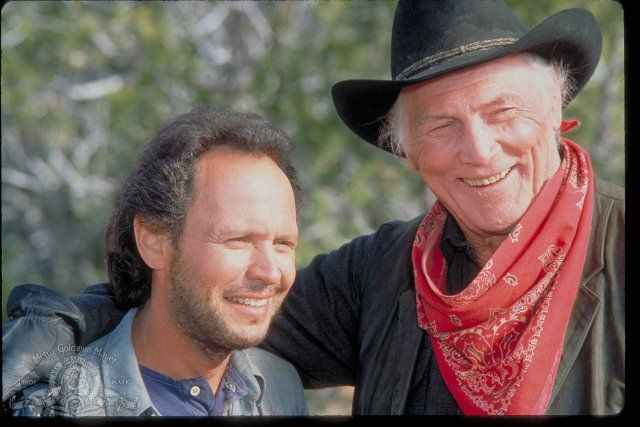
Billy Crystal Talks About Working with Jack Palance on City Slickers

While at the twentieth anniversary screening of “City Slickers” which was held at the Aero Theatre in Santa Monica on August 12, 2011, Billy Crystal talked about working with the late Jack Palance in that film. Palance co-starred as Curly Washburn, the most authentic of cowboys, and it was a role which earned him the Oscar for Best Supporting Actor. In addition, it provided Crystal with one of the best setups in his Oscar hosting history; Palance’s one-armed push-ups which proved he was not too old to ever act in a motion picture.

One movie the “City Slickers” filmmakers viewed before they started shooting was “Shane,” the 1953 western starring Alan Ladd as the title character and Palance as Jack Wilson, and Crystal said this was the first movie he ever saw on the silver screen. When it came to casting Curly, he said they considered no one but Palance for the role. “Shane” marked the last time Palance got an Oscar nomination until he did “City Slickers,” and that’s a difference of 38 years!

Palance worked on “City Slickers” for a total of 10 days. Before he arrived on set, the crew kept saying, “the big cat is coming.” The director of the movie, Ron Underwood, was described by Crystal as the “sweetest guy” and a “puppeteer.” But when it came to the first day of shooting, Palance told Crystal he always got “nervous.” When Underwood asked him to do that “glare” of his one more time, Palance replied, “What glare?!”

After this, Palance put up a fit which had Underwood’s hair standing on end. No one was expecting this kind of tantrum from the former host of “Ripley’s Believe It or Not.” But after the first day, things got better even though Palance was never thrilled about being on a horse. Both he and Crystal continually ran lines with one another, and Crystal described the two weeks they worked together as feeling like nine months.

Crystal described Palance as a “real movie actor” in how he understood the size of his head. Palance owned the camera and his appearance in a way few actors can ever hope to. His role as Curly capped off a long and memorable acting career. While he sadly passed away in 2006, his legacy continues to live on from one generation to the next.