Kimberly Pierce’s ‘Carrie’ Not Really Necessary, But Better than Expected

Carrie 2013 poster

“Carrie” was the first Stephen King novel ever published, and it’s the one people keep coming back to. Filmmakers had the hardest time, until recently that is, getting “The Dark Tower” made into a movie, and bringing “It” to the silver screen seemed to be an impossible challenge. This serves as a reminder of how development hell is still alive and well in Hollywood. “Carrie,” however, has been adapted into the horror classic Brian De Palma directed in 1976, turned into a musical that became famous for how long it didn’t run on Broadway, generated a sequel called “The Rage: Carrie 2” which disappeared from theaters not long after its release, and was later remade into a TV movie where the only saving graces were Angela Bettis as Carrie White and Patricia Clarkson as Margaret White. Now we have yet another remake of “Carrie” which would have been totally unnecessary were it not for Kimberly Peirce, the same filmmaker who gave us the brilliant and emotionally devastating “Boys Don’t Cry” which dealt with a human being cruelly cast out of regular society. As a result, this remake suddenly felt a lot more promising than I expected it to be.

Why do people keep coming back to this particular King novel? Well, with its themes of bullying, isolation and the pain of adolescence, “Carrie” proves to be as timely now as it was when the novel came out in the 1970’s. The story remains the same, but the tools of humiliation and anger have been slightly updated. Carrie White (Chloë Grace Moretz) still has her first period, but this time it is captured on an iPhone and posted on the internet with gleeful malice and a complete lack of sympathy. Granted, Carrie probably doesn’t have a Facebook page as her mother Margaret (Julianne Moore) has spent a lot of time homeschooling her daughter before being forced to send her to a public high school, and she remains as strictly religious as ever; locking her poor daughter into a closet to pray to a bleeding Jesus on a cross.

The main fault with this version of “Carrie” is it follows De Palma’s film a little too closely. For those who have seen the 1976 movie, not much has changed, so this may not seem as scary as before. At the same time, I found myself admiring what Peirce was able to convey with the characters, particularly the females. While certain characters end up coming off as a bit too generic, we get to see the different dimensions which make them more human than the average character we constantly get exposed to in horror movies.

Moretz successfully makes the character of Carrie White her own, and you never feel the shadow of Sissy Spacek’s performance hovering over her. She is able to bring more of Carrie’s rage we saw in King’s book, and we see her as a powder keg just waiting to explode. We all know her as Hit Girl from the “Kick Ass” movies, and it’s only a matter of time before she starts kicking some serious ass at the prom. Even though Moretz doesn’t quite match the description King made of Carrie in the book (she’s one of those actresses you can’t make look ugly), it’s clear from her performance how deeply she understands this horribly shy and alienated teenager inside and out. While this Carrie isn’t ugly by a long shot, she is made to feel ugly by everyone around her, and you can see this weighing heavily on her psyche.

Julianne Moore continues to put in one great performance after another, and her work here as Margaret White is very effective. Whereas Piper Laurie played Margaret as a deranged religious zealot whose devotion to Jesus was unwavering, Moore instead makes the character surprisingly empathetic. Margaret is still deranged, but Moore shows her to be a loving mother who does care ever so deeply about her daughter even if her love comes with a lot of mental anguish. Moore even shows Margaret engaging in self-mutilation which is painful to watch and adds another layer to this character which wasn’t in the book.

Actually, for me one of the most fascinating characters in “Carrie” is Chris Hargensen who is played here by Portia Doubleday. Chris hates Carrie with a passion and looks forward to humiliating her with a vengeance on prom night, but I found myself really getting caught up in how the character goes from being just another spoiled girl to someone who slowly gravitates towards the dark side. Chis initially shows some hesitation when her never do well boyfriend Billy Nolan (Alex Russell) kills the pig whose blood they will use to dump on Carrie, but once she starts cutting the dead pig’s throat, I found the look on her face to be one of the movie’s most horrifying moments. As she gets deeper into criminal activity, we see Chris starting to get both aroused and scared by it, and she doesn’t realize until it’s too late that there’s no turning back.

I was also glad to see Judy Greer playing PE teacher Miss Desjardin, and the role allows her to balance out her sweet side with a rougher exterior as she gets constantly exasperated by her students who show little signs of being the least bit sympathetic towards Carrie. I also have to give Ansel Elgort some credit as he makes Tommy Ross’ transition from not wanting to take Carrie to the prom to making sure the two of them have the best time possible very convincing. Then there’s the lovely Gabriella Wilde who plays Sue Snell, the popular girl who encourages Tommy to take Carrie to the prom. She’s very good in the role and shows us the inner turmoil going on as she sees her goodwill get dumped on, literally.

Look, there’s no way that Peirce could have topped De Palma’s “Carrie.” Having read the book, it would have been interesting to see it done as kind of a documentary as the book is told from various points of view where the townspeople share their memories of what happened on the night of the prom. Still, it’s Peirce’s approach to the characters which made her version of “Carrie” worth watching for me.

Was a remake of “Carrie” really necessary? Not really, but it happened anyway and not for the first time. Having Peirce behind the camera for this one gives this remake a reason for being, and she is blessed with a cast who did not let their memories of De Palma’s horror classic get in their way. If anyone else had directed this version, I’m not sure I would have bothered watching it. Peirce remains a filmmaker who understands how cruelly we can alienate someone for being different, but she never gets caught up in making this into a message movie. She is determined to have us rooting for Carrie even as she lays waste to a town and its inhabitants who have been relentlessly cruel to her. That’s why we go to the movies anyway, to engage in our fantasies.

Now let’s think about adapting some Stephen King novels which haven’t already been made into movies or miniseries. There are so many to choose from.

* * * out of * * * *

Click on the video below to check out the interviews I did with Chloe Grace Moretz, Julianne Moore, Judy Greer and Kimberly Pierce on “Carrie” for the website We Got This Covered.

No, I Haven’t Seen It Until Now: ‘The Texas Chainsaw Massacre’

The Texas Chainsaw Massacre poster

Tobe Hooper’s “The Texas Chainsaw Massacre” is a movie I had heard a lot about over the years, and I have watched numerous documentaries about its making to where it felt like I had seen it even though I had not. It wouldn’t be until the year 2000, just after I graduated from college, when I sat down to watch it on my new 27-inch JVC television set. I just started my subscription with Netflix, and this was one of the first movies I rented from it.

“The Texas Chainsaw Massacre” came out in 1974, so I went into it thinking there was no way it could be as horrifying now as it was when first released. I sat down in front of my TV prepared to eat my dinner, a Cedarline Mediterranean Stuffed Focaccia, while watching this horror classic. One of the first images, however, was of a pair of rotting corpses draped over a gravestone in a cemetery, and I decided it would be better to turn off the TV and finish my dinner before continuing. Once I was done and tossed my plate into the dishwasher, I turned the set back on and continued watching, believing it would be a piece of cake to sit through this lauded horror classic.

It has now been over 40 years since the original “Texas Chainsaw Massacre” was unleashed on the world, but when I watched it on DVD, I had no idea it would prove to be one of the most unnerving and brutal motion pictures I ever sat through. I figured no movie going experience would ever be more intense than “Requiem for a Dream” was when I saw it in Hollywood with a sold-out audience, but then I watched Hooper’s horrifying masterpiece. After it was over, I wondered to myself if I could have possibly endured this film had I first watched it on the silver screen.

“The Texas Chainsaw Massacre” opens with a crawl, narrated by John Larroquette, stating it is based on a true story, but it turns out this was not the case. However, certain plot elements were inspired by serial killer Ed Gein whose acts of violence came to inform many other movies including Alfred Hitchcock’s “Psycho.” We are introduced to a group of two siblings and three of their friends as they travel out to Texas to visit the grave of their grandparents. As you can imagine, what they discover far surpasses any imagined fears anyone could have endured when they were young.

I knew I was in trouble when this group of kids picked up a hitchhiker (played by Edwin Neal). This guy looked like he hadn’t showered in weeks as his face and hair seemed much slimier than anyone else’s on planet Earth. Seeing him cut himself and one of the kids had my hair standing on end, and this was just the beginning. The horror this movie had to offer was just starting, and the intensity would only increase exponentially from there.

By the time everyone got to the house, I was already sweating. I hadn’t seen the movie, but I already knew what was coming. People don’t just die a horrible death in “The Texas Chainsaw Massacre,” they die a realistic one. When Leatherface (Gunnar Hansen) smashes one guy on the head with a hammer, the guy falls down and convulses horribly. Watching this sequence, I felt this is the way a person would react if bashed in the head with the hammer, and it showed me this would not be your average horror movie in the slightest.

What’s especially surprising about this film is it’s not as bloody or gory as you might expect. I figured there would be an ocean of blood on display, but instead it’s what I didn’t see which really messed with my head. We see Leatherface impale the beautiful Pam (Teri McMinn) on a meat hook, but we never see the hook go into her body. The expression you see on Pam’s face ends up feeling all the more unbearably real as a result because you can’t help but wonder how the hook went in and of how long she could hope to last before all her blood drained out.

In some ways, the powerful effect “The Texas Chainsaw Massacre” gives off was something of an accident. When making this movie, Hooper was aiming for a PG-rating and even talked with members of the MPAA to find out how he could earn such a rating for a horror film like this one. A lot of the advice het got was to not show any body penetration or the chainsaw slicing into human flesh, and of course, he needed to limit the amount of blood shown. But instead of getting the PG-rating, Hooper saw his film get an X as these guides he was given proved to have the opposite effect. The fact it managed to get an R seems astonishing even by today’s standards. Still, this seems as welcome an accident as the shark not working on the set of “Jaws” was.

This could have been nothing more than a mere horror flick of the exploitation kind, but there really is a lot of artistry on display throughout. The acting all around is never weak, cinematographer Daniel Pearl gives everything a dirty look which will make you want to take a shower quickly after this movie’s conclusion, and the sound design makes you feel like you are in a real-life slaughterhouse. Hooper may have had a simple mission in mind while making this horror classic, but it turned into something far scarier than he ever intended.

Leatherface remains one of the scariest villains any horror movie could ever hope to have, and it’s a real shame this was the only time Gunnar Hansen played this iconic character as he brought a lot of thought and an instinctual energy to the role. Seeing him wander around in that human flesh-made mask of his, I started to fear what Leatherface looked like without the mask.

But while I want to give credit to all the other actors, I have to single out Marilyn Burns who plays Sally Hardesty. While she has an easy time during the movie’s first half, the last half has her screaming endlessly to where you want to see her get a Purple Heart instead of an Academy Award for her work. She screams and screams and screams to where I wondered just how tortured she felt throughout shooting. The closeup of her eyes while she is a guest at the most devilish of family dinners had me staring at the screen in utter horror. Even though I knew exactly how this movie would end, I was still gripped as I became desperate for Sally to escape any and every which way she could.

The movie’s last half is a frenzy to where I wondered how I could have survived this had I first watched it on the silver screen. Watching it on my television set with the volume turned down was hard enough as I wanted Sally’s hellish experience to end sooner rather than later, but her torture dragged on longer to where I refused to believe “The Texas Chainsaw Massacre” is a mere 84 minutes long. When the screen finally went to black, it felt like such a welcome relief as I wondered just how much more I could have sat through had Hooper extended things out to two hours.

“The Texas Chainsaw Massacre” has long since earned its place alongside the greatest horror movies ever made, and the fact it hasn’t lost any of its power to unnerve and horrify the bravest of film buffs speaks to a power most filmmakers hope to have in their lifetime. The only other horror movies which equal this one’s power to terrify decades after their release are John Carpenter’s “Halloween” and William Friedkin’s “The Exorcist.” Some horror movies play better on the big screen than on television, but this one proves to be every bit as effective on both.

I still have yet to watch any of the sequels as I feel like I am still recovering from this cinematic experience over 10 years later. I did watch the Platinum Dunes remake, but the only thing about it which truly unnerved me was when Leatherface took off Eric Balfour’s face and made it into a mask for himself. As I write this review, the prequel “Leatherface” is about to released in theatres everywhere. Filmmakers can only hope to equal Hooper’s film, but it hasn’t stopped them from trying.

* * * * out of * * * *

‘Poltergeist III’ Shows Just How Unnecessary Certain Sequels Can Be

Poltergeist III poster

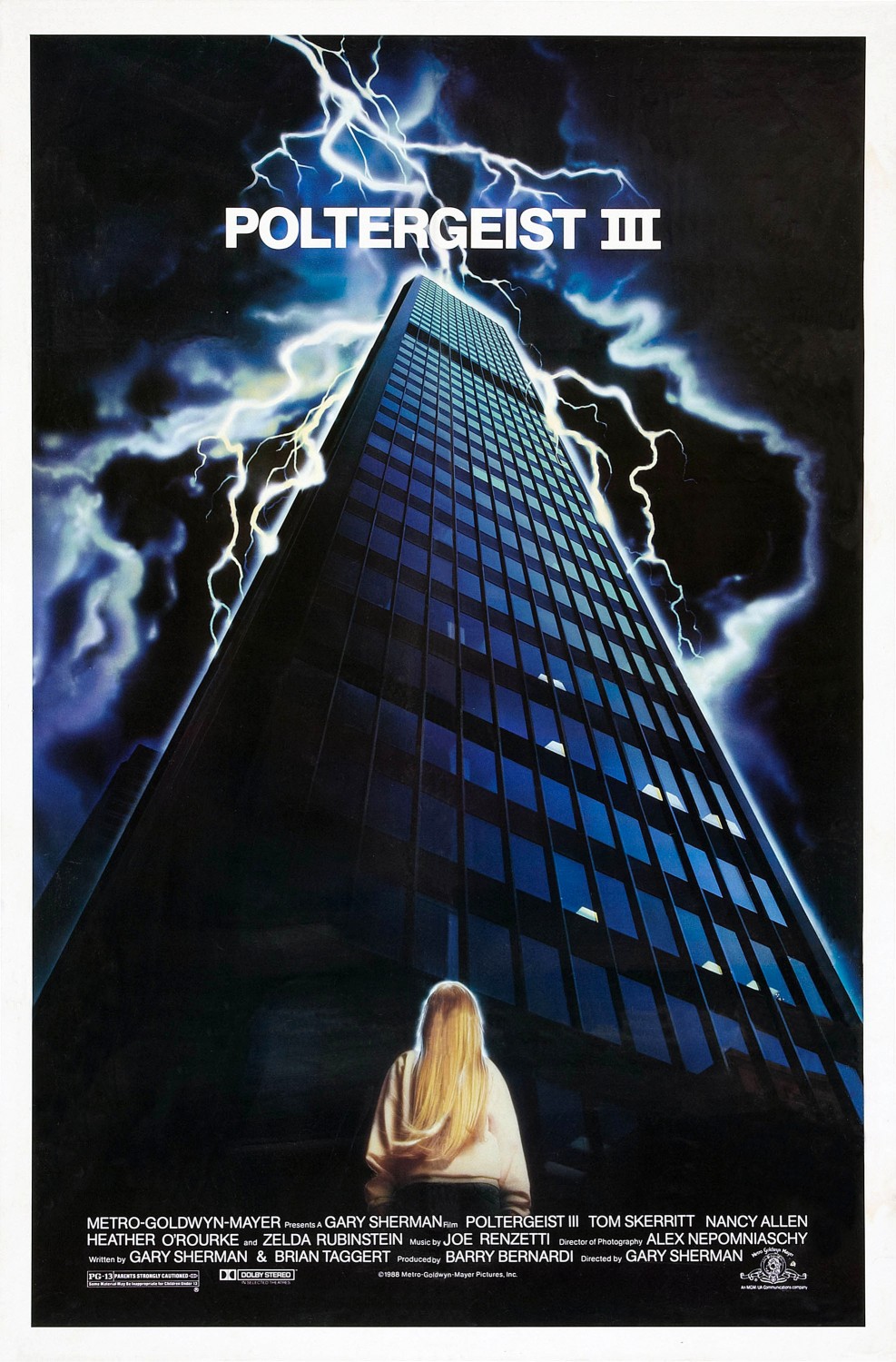
It’s only with an obscene amount of free time, combined with a morbid curiosity, which had me watching “Poltergeist III” on cable. My only real memories of it beforehand were a behind the scenes show detailing the special effects and Siskel & Ebert’s scathing review of it. By the time this sequel came out in 1988, the series had already worn out its welcome. I don’t remember anyone liking “Poltergeist II: The Other Side,” and it was said to have been one of 1986’s big losers at the box office. Nevertheless, the powers that be at MGM decided they could wring just a little more money out of this franchise with one more sequel.

Once again, Carol Anne (Heather O’Rourke) is at the center of the story which has her shipped off to Chicago to live with Aunt Pat (Nancy Allen) and her husband Bruce (Tom Skerritt) who manages the luxurious high rise building they reside in. However, it doesn’t take long before those evil spirits and Reverend Henry Kane find Carol Anne and start their nasty little tricks to get her to come to the other side.

Now I can’t help but wonder if Carol Anne’s parents just dumped her in Chicago so they could be rid of those evil spirits for good. What if this series continued on? Would Carol Anne have resided with a different family member in each successive sequel to where she would become the ultimate unwanted house guest? Just imagine what Aunt Pat’s conversations with the girl’s parents (played by Jo Beth Williams and Craig T. Nelson) were like. I mean, Pat at one point says all she heard was they were caught up in a land deal gone bad, but maybe it went more like this:

“Pat, we love our daughter, but this poltergeist problem is really just rubbing us the wrong way.”

“Oh come on, stop kidding around sis! Your daughter is being bothered by a poltergeist! You expect me to fall for that?”

“Oh yeah Pat? You think I’m joking?! C’mon! I dare you to let her stay with you! I double dare you!”

“Yeah right! So that the ghosts or spirits or whatever the hell they are can haunt me and my family?”

“What are you, chicken?”

“Pat, stop teasing me! You called me a chicken all the time when we were kids! I AM NO CHICKEN!!!”

“Alright, prove it!”

Now guess what happened after that…

Apparently, Carol Anne was told by her mommy and daddy she was to attend a school for “gifted children with emotional problems” in Chicago. Once there, she meets up with one of the dumbest psychiatrists in cinematic history, Dr. Seaton (Richard Fire). He’s the one who foolishly opens Pandora’s Box by getting Carol Anne to talk about her experiences from the first two movies. By doing so, a slimy hand bursts out of his desk and throws a coffee cup at him while an evil voice cackles away.

So, what’s Dr. Seaton’s explanation for this? He says Carol Anne is a manipulative child who has the power to create mass hysteria and perform mass hypnosis on people to make them think they see ghosts. What?! Are you serious?! People pay this guy money to say shit like that? Where’s this guy’s degree? Is he a legitimate psychiatrist, or is he like Leonardo DiCaprio’s character in “Catch Me If You Can,” faking his lifestyle while forging checks?

The character of Dr. Seaton basically exists for the audience to despise him whenever he opens his mouth. His disbelief in all the strange and bizarre things happening in the building is excruciating to sit through, and you just want these evil spirits to strangle him to death so he’ll shut up. Seriously, it says a lot about a movie when you start siding with evil spirits against the humans.

In fact, this is the big problem with “Poltergeist III;” you don’t care much for the majority of these characters. They exist merely as clichés instead of living breathing human beings, and seeing them suffer becomes more fun than fearing for their safety which all but kills the suspense. You have the teenage guy Scott (Kipley Wentz) who’s slobbering over his girlfriend Donna (Lara Flynn Boyle of all people), and they look like they’ve come out of a thousand movies from this genre. Then there are Pat and Bruce’s hopelessly self-absorbed and shallow friends who are too interested in their own needs to notice signs of evil spirits invading the building. And where exactly are the cops in all of this?

Looking back at the Siskel & Ebert review, the one major complaint they had about this sequel, which I am in total agreement with, was all the characters kept incessantly crying out for one another:

“CAROL ANNE!!! CAROL ANNE!!!”

“SCOTT!!! SCOOOOOOOOOT!!!”

“BRUCE!!! BRUCE!!!”

“CAROL ANNE!!! CAROL ANNE!!! CAROL ANNNNNNNE!”

I swear, Carol Anne’s name is mentioned as many times as Al Pacino used the F-word in “Scarface.” It didn’t take long for me to figure out what Kane was saying to his fellow evil spirits as well as their quick reply:

“We must bring her to the other side!”

“Yes Reverend, but we also got to get this screaming bitch to shut the hell up!”

Remember the bottomless pit that opens up in the garage? Those slimy hands reaching out to grab the main characters look like those rubber gloves you buy at the supermarket but with extra makeup applied to them. The overall budget for “Poltergeist III” was just under $10 million, but it looks like it cost a lot less. While the other “Poltergeist” movies have state of the art special effects, the filmmakers here get short served and have to work with whatever’s available. Yes, some of those mirror scenes are cool as characters pass by without their reflections showing up on them, but that’s just an old trick.

Directing “Poltergeist III” is Gary Sherman who made “Dead & Buried” which has since become a cult classic. He also made the superb exploitation feature “Vice Squad” which featured one of the scariest and most vicious pimps ever played by Wings Hauser. A lot of Sherman’s skill isn’t evident here, and even he admits this is his least favorite film of the ones he made. Perhaps the studio played around with the sequel more than he liked, and with a franchise like this you know he’s never going to get complete control over the final product.

My hat is off, however, to Skerritt and Allen who came out of this movie relatively unscathed. They overcome the ridiculous material and manage to keep a straight face as the movie becomes increasingly laughable and confusing as it heads towards its unnecessarily reshot climax which leaves the fate of certain characters up in the air.

Aside from O’Rourke, the only other cast member to appear here from the previous “Poltergeist” movies is Zelda Rubinstein as Tangina. I find it funny how she received both Saturn and Razzie Nominations for her work here. I for one can’t figure out if she’s good or bad in this movie, but her mystical dialogue gets a bit ponderous with her overzealous delivery of it.

Of course, the lasting significance of “Poltergeist III” is the fact it was O’Rourke’s last movie before her tragic death at far too young an age. Her loss is inadvertently emphasized in the film’s final scene in which she is substituted with a body double. Since she passed away during post-production, you know it’s not her being held by Allen. For what it’s worth, she is very good here despite the cruddy material, and the film was dedicated to her memory.

Who knows what would have happened if O’Rourke lived to see another “Poltergeist” sequel. With Carol Anne quickly growing up, it would have been a kick to see her turn into an Ellen Ripley type of character who is prepared to go to war with these evil spirits. While others will be horribly terrified by them, she’ll see it as just another day at the office. I can just see her talking with girls her age:

“You think you have it rough? I got sucked into another dimension by evil spirits when I was five! Going through puberty was a piece of cake compared to that! Stop. complaining about the run in your nylons!!!”

I wonder what the tagline was for “Poltergeist III.” The tagline for the first one was:

“They’re here.”

With “Poltergeist II,” it was:

“They’re back.”

I guess the tagline for the third film was:

“I’m screwed!”

* ½ out of * * * *

No, I Haven’t Seen It Until Now: ‘Cujo’

Cujo movie poster

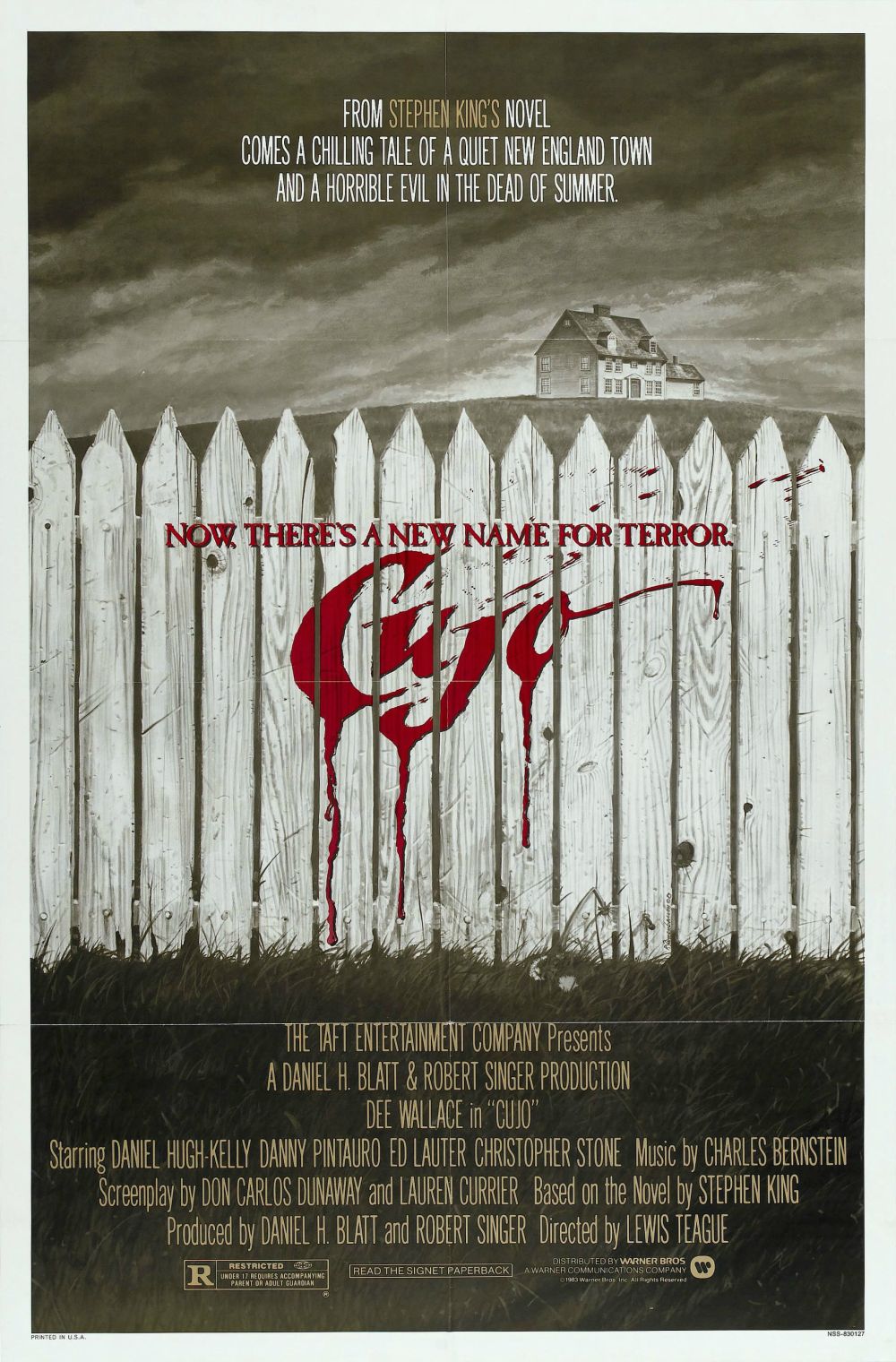
It took Cinematic Void putting together a Stephen King film festival at the Egyptian Theatre in Hollywood to give me a reason to finally check out the cinematic adaptation of “Cujo.” It was a movie I have heard a lot about, and I remember the book’s original artwork with those growling teeth which indicated this particular dog was looking for more than puppy chow and snausages. Moreover, the word Cujo has long since been burned into my consciousness, and it seems to exist as a description of a dog who has gone mad and cannot be mistaken for man’s best friend. In “Fletch,” it made perfect sense when Chevy Chase said “Cujo” as he wandered through a seemingly abandoned house in Utah. Considering he was attacked by a Doberman Pinscher earlier in the film, his fear of being attacked again was completely understandable.

“Cujo” was released in 1983 during a decade when adaptations of King’s work were plentiful and varied in quality. While some were exceptional (“Stand by Me,” “The Shining,” and “The Dead Zone”), others like “Maximum Overdrive” just didn’t work. “Cujo,” however, proves to be an above average adaptation of his work as well as one of the more unusual. While many of his books deal with the supernatural, this one deals more with the horrors of real life instead of just monsters.

I’m sure you all know the story to “Cujo” by now. In case you don’t, it involves a beautiful St. Bernard who, at the movie’s start, chases a rabbit through the woods. In the process, he gets his head stuck in a cave filled with bats, one of which bites him on the nose. From there, he goes from being a lovable household pet to an infinitely vicious one as he attacks any and every human being in his sight.

From the outside, “Cujo” seems to have a very straightforward plot which indicates to the viewer it will be one of those animal attack movies we have seen time and time again. But what really surprised me most is how it focused more on the human element to where I realized the dog was really a supporting character more than anything else.

You have Vic and Donna Trenton (Daniel Hugh Kelly and Dee Wallace), a married couple and the proud parents of a highly imaginative boy named Tad (Danny Pintauro). But while they appear to be leading the perfect life in Castle Rock, Maine, there are cracks beneath the surface which will inevitably become visible to everyone. Vic is increasingly concerned with economic security, something even more understandable these days. Donna is having an affair with Steve Kemp (Christopher Stone), her ex-boyfriend from high school, as she is terrified of being trapped in a small town for the rest of her life. And Tad, he is still at an age where it’s far too easy to believe monsters are hiding in the closet and waiting to jump out at him. Seriously, seeing Tad race to his bed after turning off the light and hiding under the covers brings back a lot of memories.

Taking the fears of each character into account, it serves as a reminder of how brilliant King is at examining not just horrors of the unknown, but also the ones we are forced to experience in the real world. This makes “Cujo” especially effective as the obstacles these characters are forced to deal with feel almost as scary as the thought of this dog tearing their flesh apart.

“Cujo” was directed by Lewis Teague who also helmed the Stephen King anthology film “Cat’s Eye” as well as the cult classic “Alligator” and “The Jewel of the Nile.” Teague was lucky he got to make “Cujo” back in the 80’s, a decade where filmmakers had the opportunity to build up to a furious climax instead of being forced to rush straight to one. These days, studio executives would have begged, if not ordered, him to rush right into the sequences where the dog attacks the hapless humans and increase the blood and gore horror fans are expecting. Instead, Teague got to take his precious time introducing us to characters who are not mere stereotypes and whose struggles will soon pale in comparison to the dog whose appearance becomes increasingly dirty and slimy.

This movie’s major set piece comes when Donna and Tad become trapped in a Ford Pinto as Cujo thrashes away at it, trying to get inside. From there, “Cujo” becomes a major exercise in sheer intensity as we watch Donna do what she can to save herself and her son before the dog makes chop suey out of them both. But if the dog doesn’t get to them, the sweltering summer heat may do them in instead. Suffice to say, they cannot stay in the car forever.

It’s interesting King chose a St. Bernard as the type of dog instead of another like a Doberman Pinscher. Of course, casting a Doberman might have seemed like typecasting as they have always been the villains of dogs. St. Bernard dogs seem more like comic relief, and this was made clear back in the 1990’s with those “Beethoven” movies starring Charles Grodin. Therefore, choosing a St. Bernard as a dog is an inspired choice as it shows how easily a dog, any dog, can turn deadly after being bitten by a bat. When we first see Cujo, he is a beautifully groomed dog you just want to hug. But he soon becomes a dog in desperate need of a shower as he looks disgustingly slimy and has what looks like an abundance of snot sliding off his face. Eventually he becomes an evil force to be reckoned with, and it’s easy to understand how no one could have prepared for him.

But while this dog looks to be the main star of “Cujo,” he is not. The real star is instead Dee Wallace who, just as she did in “E.T. The Extra Terrestrial,” gives us a mother who cannot be mistaken for the average movie mother. I love talking about when actors inhabit roles more than play them, and it is certainly the case with Wallace here as she gives a performance best described as emotionally blistering. She makes us feel Donna Trenton’s frantic struggles as well as her mental and physical exhaustion in dealing with a crumbling marriage, an affair, her son and, of course, the dog. Also, she makes us feel every single bead of sweat coming off of her body as she and Tad are trapped not just in the car, but in the sweltering summer heat as well.

There also moments where Donna loses her patience with Tad, and this makes Wallace’s performance feel all the more real. Just as “Cujo” was being released, some associated with its production were keen to cut a scene where Donna snaps at her son as she grows tired of his crying out for daddy. This, however, would have been mistake as all parents lose their patience with their children. Seriously, just as my mom. I’m sure she has tons of stories she would love to share with you.

While I’m at it, let’s not leave out Danny Pintauro whose performance as Tad feels unbearably real at times. Seeing him weep and panic when the dog tries to get at him and his mother makes an already intense motion picture even more intense.

Teague and his collaborators which include composer Charles Bernstein, director of photography Jan De Bont, and editor Neil Travis clearly had more on their mind than giving us the average horror film with “Cujo.” While there is a conventional feel to much of what we see here, the filmmakers were more invested in the human element than the animal one. Lord only knows how this movie would look if it were made today, and I’m stunned it has not been remade yet. As this cinematic adaptation shows, horror movies can’t thrive unless we are emotionally invested in the characters to where they are not just stock or filler. This film may not be a masterpiece, but it proved to be far more effective than I ever could have expected it to be.

* * * ½ out of * * * *

No, I Haven’t Seen It Until Now: ‘Creepshow 2’

Creepshow 2 movie poster

Creepshow” proved to be a great deal of ghoulish fun, and it’s a film which had me begging for a sequel. There are many other short horror stories worthy of a cinematic adaptation regardless of whether or not they are written by Stephen King. Plus, at the time, it seemed to be a given George Romero would have had easier luck in securing financing for this than for a sequel to “Day of the Dead.” And with the same gothic-looking title, what could possibly go wrong? Even if it’s not one of the greatest horror movies ever, we can still enjoy this sequel for what it is, right?

Well, perhaps you can, but for me, “Creepshow 2” is a serious disappointment. Sure, the three stories contained in it are based on the works of King, and Romero did write the screenplay, but this sequel suffers right from the get go. It falters due to a budget much lower than a horror film deserves, a cast of actors who emote more than act, a weak music score, and animation which just reeks of cheapness.

The movie’s prologue has a young blonde boy named Billy (Domenick John) peddling fast on his bike as he chases a delivery truck into town to deliver the latest edition of Creepshow magazine. The back of the truck opens up to reveal The Creep played by Tom Savini, but voiced by Joe Silver. The makeup on this devilish character is less than convincing, and he is nothing compared to the ghostly apparition from the first movie. Even worse, he is made to crack jokey one-liners which will have you groaning more than laughing. Clearly, this character is “Creepshow 2’s” answer to the Crypt Keeper from “Tales from The Crypt,” or perhaps even John Carpenter’s Coroner from “Body Bags,” but it would have been to this sequel’s benefit had it not featured a wisecracking character as this kind had already started to wear out its welcome back in 1987.

One other thing, if you are going to have Savini playing a ghoulish character, do you really have to put makeup all over him? The infamous makeup artist and actor has a wonderfully devilish look about him, and the mask he wears just takes away from him.

“Creepshow 2’s” first story, “Old Chief Wood’nhead,” is its weakest by far. George Kennedy and Dorothy Lamour play Ray and Martha Spruce, an elderly couple who run a general store in Dead River, a town which, as we can tell from its first appearance, is finally living up to its name. One day they are visited by a Native American elder named Benjamin Whitemoon (Frank Salsedo) who gives the Spruces turquoise jewelry, his tribe’s sacred treasures, to look after. Unfortunately, not long after Benjamin leaves, a group of thugs arrive at the store, killing the Spruces and making off with the jewelry. Oh yeah, the Spruces also have an Indian statute standing prominently outside of their store named Old Chief Wood’nhead, and it doesn’t take long for us to see he will avenge the Spruces as you don’t mess with Indian spirits, ever.

Directing “Creepshow 2” is Michael Gornick who served as Director of Photography on its predecessor. As this first story demonstrates, he doesn’t quite have Romero’s panache or wicked sense of humor as he can’t balance out the horrific aspects with the comedic ones, and everything feels off balance as a result. Also, he shows far too much of Old Chief Wood’nhead coming to life which was a mistake. Gornick starts off by giving us glimpses of this character, played by Dan Kamin, to where we can tell the Chief is more than just another statute. But as the Chief goes on a mission of bloody justice, the character becomes cartoonish to where his bloody revenge isn’t the least bit fulfilling.

For what it’s worth, Holt McCallany, who plays Sam, the leader of the thug gang, does have beautiful hair here, and seeing him show it off as he sees it as his ticket for making it in Hollywood makes him all the more drolly hilarious. Still, MCCallany has nothing on Melissa Leo as her hair was infinitely beautiful from one episode of “Homicide: Life on the Street” to the next.

The second story, “The Raft,” is a bit of an improvement. Based on one of King’s scariest short stories from “Skeleton Crew,” it features our college kids who drive out to a predictably isolated lake, located a good 50 miles away from their school, for a swim. The lake’s only real notable feature, at first anyway, is a wooden raft in the middle of it. This raft, however, is soon upstaged by what looks like a slimy oil slick which begins to make its way over to the kids once they get in the water, and they soon find themselves stranded on the raft as the slick surrounds them.

“The Raft” has a lot of cinematic possibilities, and seeing these kids getting consumed by the oil slick provides “Creepshow 2” with some of its most horrifying moments. But in the end, it is undone as Gornick isn’t able to generate enough of a claustrophobic terror this story demands. Plus, the performances of Paul Satterfield, Jeremy Green, Daniel Beer and Page Hannah are weak as they are forced to emote more than act, and this just takes away from the situation and terror their characters are trapped in. Granted, this is not a movie which demands Oscar worthy performances, but it does need good acting to help bring you fully into such a terrifying story.

I do have to give the actors some credit though as they don’t have to do any acting when they first get in the water as it does appear to be very cold. Beer even said he almost died from hypothermia while filming “The Raft,” and keeping this in mind while watching this segment makes it even more unnerving. But despite a bravura conclusion, I came out of “The Raft” feeling like it could have been much better than it was. Perhaps this is partly due to having read King’s short story beforehand, and what he came up with couldn’t possibly be matched here.

The final story, “The Hitchhiker,” proved to be my favorite as it featured Lois Chiles, the Bond woman Dr. Holly Goodhead from “Moonraker,” in a strong performance as businesswoman Annie Lansing. The story begins with Annie leaving a hotel after having an adulterous fling with a gigolo, and she begins thinking of ways to explain to her husband why she is arriving home so late. But as she fumbles around with a lit cigarette while driving her expensive Mercedes down a lonely highway, she accidentally hits a hitchhiker played by Tom Wright. Did Annie kill him? She isn’t sure, and with oncoming headlights heading in her direction, she isn’t keen to wait around. From there, she goes from wondering how to cover up her affair to finding ways to justify leaving the scene of an accident, and then the hitchhiker reappears…

This story reminded me of the “Creepshow” segment entitled “They’re Creeping Up on You!” which starred E.G. Marshall as Upson Pratt, a ruthless businessman whose fear of bugs comes to haunt him big time. Like that segment, “The Hitchhiker” plays with your mind as you ponder if what you saw actually happened, or if it was all in the mind of the main character instead. On first glance, the story doesn’t make much sense as Annie keeps coming across this man she accidentally ran over for no real reason, but, in retrospect, perhaps the hitchhiker represents Annie’s conscience torturing her for hitting a pedestrian and failing to take responsibility for her actions.

This final segment for me reminds me of why I liked the first “Creepshow” so much; it’s a wickedly gleeful mix of horror and black comedy as Annie tries to kill off a hitchhiker who won’t stay ahead. In the process, she also lays waste to her precious Mercedes as her priorities shift from protecting her most valuable possession, a car, to defending herself from a crime which becomes something even worse. It is so over the top to where I was infinitely eager to see where the story would end up, and had the rest of “Creepshow 2” been like this, it would have been so much better. Chiles gets to show more life here than she got to in “Moonraker,” and she steals this sequel easily thanks to her unrestrained turn.

Horror movies in general tend to be made on low budgets, and this was certainly the case with “Creepshow” as Romero only had $8 million to work with. Gornick, however, had a budget half the size of that on “Creepshow 2” ($3.5 million to be exact), and he is unable to stretch it out the way Romero did. I’m always fascinated with what filmmakers are able to pull off creatively with little money, but this sequel shows that sometimes a low budget can be too low to work with. This has the appearance of a motion picture where the filmmakers were forced to cut corners at every turn due to limited funds, and it makes me feel sorry for Gornick as I’m sure he could have accomplished more if the budget allowed him to. While Warner Brothers distributed the first movie, the sequel was instead released by New World Pictures, a small independent production company which inched closer and closer to bankrupt around the time “Creepshow 2” came out.

I also didn’t care for the film score by Les Reed and Rick Wakeman as their themes came across as unbearably generic. Both are very talented musicians, but their music here just made me pine for John Harrison’s music from “Creepshow” as well as “Day of the Dead.” Back in the 1980’s, Harrison came up with some wonderfully creepy cues, but Reed and Wakeman have no such luck here.

“Creepshow 2” does have its inspired moments, but I came of it feeling like it could have been so much better. Instead of enjoying what I saw, I spent more time analyzing things which could have been easily improved. I do, however, have to applaud the filmmakers for including the following quote from Colliers Magazine in the end credits:

“Juvenile delinquency is the product of pent up frustrations, stored-up resentments and bottled-up fears. It is not the product of cartoons and captions. But the comics are a handy, obvious, uncomplicated scapegoat. If the adults who crusade against them would only get as steamed up over such basic causes of delinquency as parental ignorance, indifference, and cruelty, they might discover that comic books are no more a menace than Treasure Island or Jack the Giant Killer.”

This quote was from the year 1949, and yet all these years later many still seek scapegoats, be it comic books or Marilyn Manson, instead of dealing with things in a more rational manner. I loved that the filmmakers included this quote, but I would have loved it even more if they had opened the movie with it.

* * out of * * * *


David Cronenberg’s ‘The Fly’ Proves to Be More Than the Average Gross-Out Movie

The Fly 1986 movie poster

David Cronenberg’s remake of “The Fly” was released in 1986, a year filled with everlasting cinematic classics like “Aliens,” “Ferris Bueller’s Day Off,” “Star Trek IV: The Voyage Home,” “Platoon,” and “Top Gun.” More importantly, it came out during a time where remakes were very rare compared to today, and also when remakes were actually worth watching. Whereas remakes these days serve to capitalize on a known quantity or are being exploited for the sake of some potential franchise, “The Fly” is one where the director took what came before and made it completely his own.

You should all know the story by now. Seth Brundle (Jeff Goldblum) is a brilliant and eccentric scientist who has invented a set of telepods which allow objects to travel instantaneously from one pod to another. Seth shares the story of his invention with science journalist Veronica Quaife (Geena Davis) as he attempts to test teleportation on living subjects. Eventually, Seth decides to test it on himself, but he doesn’t realize a common housefly has entered the telepod with him, and the computer gets confused and ends up merging the two lifeforms at a molecular-genetic level. Seth believes the teleportation has purified his body as he discovers a strength he didn’t previously have, but it’s all a build up for a transformation which becomes all the more horrifying as “The Fly” reaches its gruesome climax.

What I love about “The Fly” is its slow build as Cronenberg makes Seth’s transformation into “Brundlefly” all the more unnerving by taking it one step at a time. We first see him engaging in an extraordinary set of gymnastics we would all love to be capable of, and then we watch as he puts an enormous amount of sugar into his coffee at a local diner. This leads Veronica to ask him, “Do you normally take coffee with your sugar?” While I expected a reply along the lines of Christian Slater’s in “True Romance” where he said, “I’m not satisfied until the spoon is standing straight up,” it is immediately clear that Seth is too involved in his own process to see the damage it is doing to his body.

Seth’s face comes to look like it is riddled with severe acne scars, and this brought about a number of PTSD flashbacks for me of when I dealt with my own acne outbreaks back in high school. But the key moment doesn’t come when Seth snaps a guy’s arm in half during an arm wrestle contest (it’s always painful to see a bone sticking out of a person’s body), but instead when he finds himself pulling out his own fingernails. Just the idea of pulling out your own fingernails is painful in itself, but seeing Seth pulling his out to where a great deal of puss explodes from his fingers proves to be even more painful than watching George Clooney getting his fingernails pulled out with a pair of plyers in “Syriana.”

At this point, I want to point out one of “The Fly’s” biggest stars which is Chris Walas. Walas won an Academy Award for Best Makeup for his work here, and it should go without saying just how much he deserved it. As Seth’s body continues to deteriorate in the midst of an unwanted, let alone unexpected, transformation, Walas makes each moment sting with a thankfulness we are not going through what this misguided scientist is. He also gives you the assurance that he and his colleagues have researched all there is to know about this kind of metamorphosis, and this makes Seth’s transformation all the more horrifying. Walas makes you believe something like this could actually happen to where you cannot help but react strongly to everything unfolding before you.

1986 was a big year in science fiction as Sigourney Weaver not only had the lead role in “Aliens,” back when it was rare for an actress to have such a role in a movie, but she also scored an Oscar nomination for her performance which was well-deserved. It’s a shame Goldblum didn’t get the same respect from the Academy as his performance is truly brilliant and wholly original. Just as Weaver dominated all those special effects in “Aliens,” Goldblum makes it clear the makeup is not doing all the acting for him as he fully inhabits Seth Brundle at every stage of his transformation. For the actor, the makeup becomes a costume which comes to inform his character throughout, and Goldblum is fearless in portraying this scientist’s descent into an unwanted fate.

Scientists in movies tend to be either over the top or exceedingly modest and timid, but Goldblum gives us one whose eccentricities make him more alluring than the average one. The actor even sells us on a wonderful moment where he explains why he wears the same suit, shirt and tie each day, and seeing his closet reminded me of a number of movie spoofs where this same situation was used for sheer comedic effect. Even as Seth becomes increasingly unpredictable, let alone unlikable, to be around, Goldblum seduces us deeply into his strange plight which brings about a change he never saw coming.

But let’s not leave out Geena Davis who shares a strong chemistry with Goldblum throughout, and this only makes sense as they were a couple at the time and were briefly married. As Veronica Quaife, Davis creates a complex character whom is eager to take advantage of Seth’s invention for the story of the century, but she soon finds herself falling for him to where she cannot tear herself away from his hideous transformation. The scene where she hugs him after getting her first glimpse at the horrific changes his body is going through brought about a loud gasp of disgust from the audience I watched this movie with at New Beverly Cinema, but it shows just how powerful her performance is. Veronica is at once mortified at how bad things are getting for Seth, and yet she can’t tear herself away from him because she is too emotionally involved to just give up on him. Davis’ commitment to her performance shows the range which would eventually earn her an Academy Award for her work in “The Accidental Tourist.”

Many see Cronenberg as a filmmaker who makes nothing more than gross-out horror movies, but they neglect to see the intelligence and thought he puts into each movie he makes. Whether it’s “The Fly” or “Rabid” or “Scanners” or “Dead Ringers” or “eXistenZ,” Cronenberg has fearlessly explored the phobias we all have of bodily transformation and disease to unforgettable effect. His movies are not designed to make you throw up, but instead to confront how our bodies deteriorate in one way or another. His remake of “The Fly” is one of his most unforgettable motion pictures as we can’t take our eyes off the screen even as Seth Brundle’s transformation becomes all the more disgusting. Its power comes from how it draws you in emotionally more than anything else, and we have as much luck at disconnecting ourselves from Seth’s unnerving plight as Veronica does.

Watching “The Fly” again, it is clearer than ever that this movie is about a tragic romance more than anything else. Heck, Shakespeare would have been proud to have written a tragedy like the one presented here. While much of the attention on this remake is forever directed at the makeup design which still grosses audiences out to this very day, it is the romance between Seth and Veronica which drives the story more than anything else. The two of them want to tear themselves away from one another, but deep down neither of them can truly bare to do so, and they are the kind of couple U2 sang their song “With or Without You” about.

If there’s anything wrong with “The Fly,” it’s the ending as things are resolved in a way which is not altogether satisfying. We are left with questions which would not be answered until “The Fly II,” and while that sequel had its moments, it’s no surprise how it paled in comparison to Cronenberg’s remake.

Horror movie remakes are a dime a dozen these days, but Cronenberg’s “The Fly” remains one of the best and most visceral. It is still the director’s biggest commercial hit to date, and I prefer to see this as proof of how his unique style of filmmaking can reach a wider audience than we typically realize. All these years later, Cronenberg remains one of the most original filmmakers working today, and we eagerly await his next cinematic opus with great anticipation.

* * * * out of * * * *


‘Diary of the Dead’ Has Romero Taking Aim at the Internet Generation

Diary of the Dead movie poster

I had an English teacher who once said, “We have all been mediatized. This is a generation that has been robbed of its innocence.” This has stayed with me since because nothing could be truer. She said this back in 1994, back when we had yet to fully discover the internet, and we were not yet addicted to Facebook, You Tube or our cell phones. She remarked of when she watched a trailer for “Far from Home: The Adventures of Yellow Dog.” It looked like a very innocent movie, and yet there were teenagers in front of her who said, “This looks so lame!” As a result, she felt they were robbed of any chance of enjoying this movie as they were more interested in watching something which was its polar opposite. When you combine the loss of innocence to the ever-growing world of technology, it is apparent there is no going back to the way things were. We are now more “mediatized” than ever, and it’s hard to imagine what it would be like to live without the internet or cell phones.

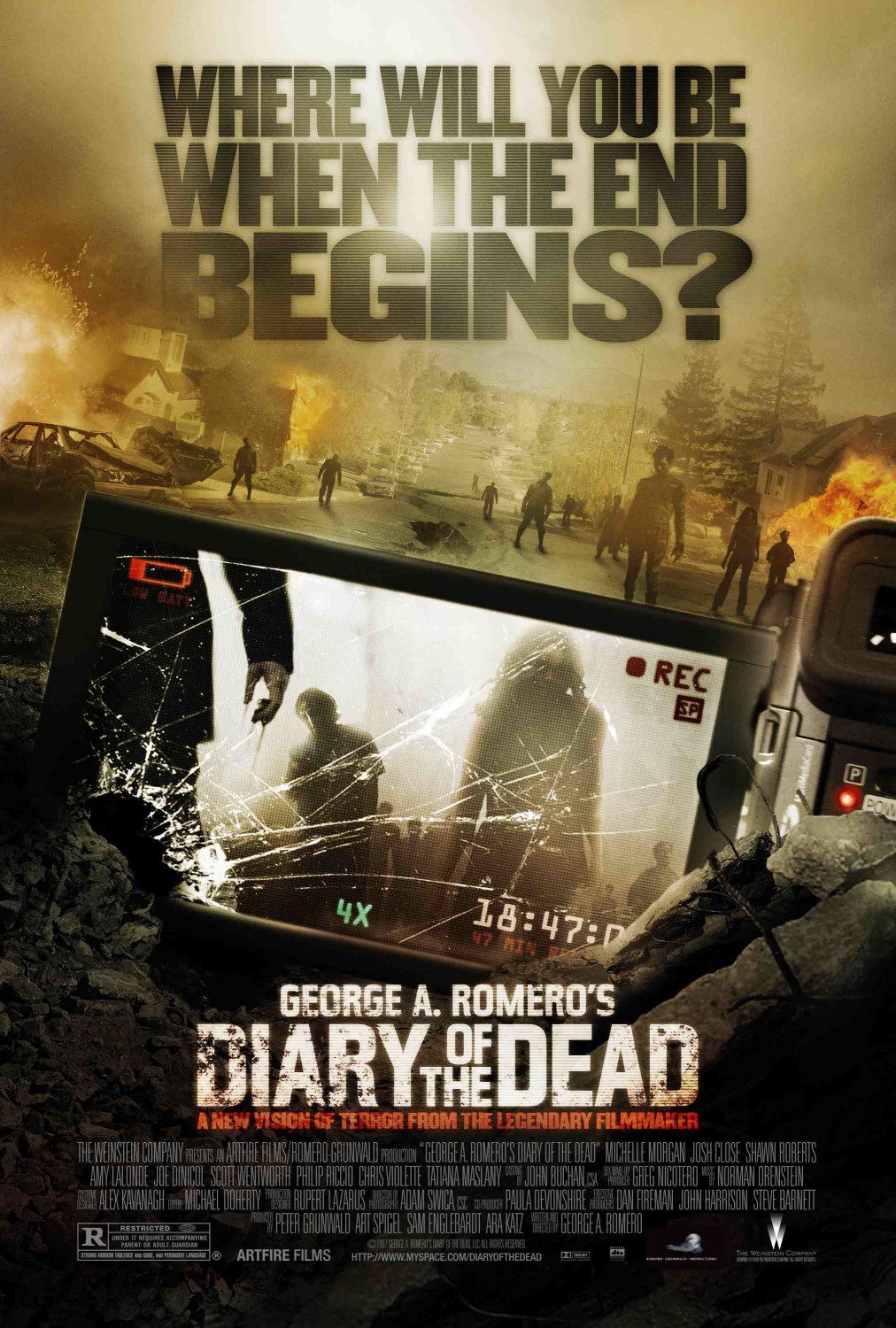
This is the main sticking point of George Romero’s zombie flick, “Diary of The Dead,” as he takes aim at a generation so sucked into You Tube and of watching things not just from a distance, but an emotional distance as well. We have become so enamored of watching disasters and car crashes from afar to where it appears we have been robbed of our ability to actually help others. As a result, Romero’s vision of humanity is especially bleak as he wonders if it is even worth saving.

The movie starts off as a film within a film as we watch a horror movie turned documentary called “The Death of Death.” The horror film itself is not going well as everything is behind schedule and the crew and actors are restless. All of a sudden, they hear on the news of the dead coming back to life, and everything changes forever. Some head home, and others head to the college to rescue their girlfriends. From then on, it’s a race for survival as the world is soon overrun by zombies, or so the internet and television tells them. What are they gonna believe?

“Diary of The Dead” could be seen as being released too late as “Cloverfield” had arrived in theaters just before. Both films are shot in a handheld style, but whereas “Cloverfield” used the technique as a gimmick, “Diary of The Dead” uses it as a commentary on our fascination with watching the worst life has to offer. Many people went crazy and beyond nauseous with the camerawork in “Cloverfield,” but those same people will be relieved to see Romero and his Director of Photography Adam Swica have reined it in to where it shouldn’t alienate the audience.

The film crew on “The Death of Death” is made up of different characters. There’s the director, Jason (Joshua Close), who believes if it didn’t happen on camera, it never happened at all. There’s his girlfriend, Debra (Michelle Morgan), who gets increasingly annoyed at his filming everybody, Tony (Shawn Roberts) who always looks like he is prepared to beat Jason to death, and there’s the drunken film professor, Maxwell (Scott Wentworth), who looks upon everything with a bemused detachment. What Romero succeeds in doing as a writer is giving us characters who aren’t simply types. If they come across as clichéd, he and the actors subvert those clichés as each character becomes increasingly unpredictable in their actions.

Romero also gives us strong characters who are females and minorities. He started doing this years ago with “Night of The Living Dead,” and he continues this tradition here. The female character who is the strongest in “Diary” is Debra as she is driven to get back to her family and is not about to get sucked into watching everything through a camera lens. Michelle Morgan gives this movie its best performance, and she also narrates the film within the film which gives you a pretty good idea of what happens to her character in the end (or does it?).

While the crew ventures home in an old and stuffy Winnebago, they run into all sorts of people who are quickly learning how to survive in a world being overrun by zombies. They run into a squad of African Americans who have taken over a small town and refuse to leave. This is because, for once, they have power over something they have never power over before, and you could see it as a revenge for all they have been put through over the years. There is also a deaf Amish man who provides some of the funniest moments as he blows up zombies with dynamite before introducing himself to the frenzied group of film students.

What makes these “Dead” movies so relevant even after four decades is they are really social commentary movies designed as zombie movies. Romero looks at how society is enslaved by its own wants, needs, beliefs and prejudices in. “Night of the Living Dead” dealt with civil rights and gave us a black man as the chief protagonist, something you didn’t see in movies back then. His ultimate destiny at the film’s climax said much about the times when the movie was released. “Dawn of The Dead” dealt with our quest for materialism, wealth, and of having everything we could possibly want, and it looked at how it leaves us feeling as empty and dead as the zombies who look to tear their way into the mall for fresh human flesh. “Day of The Dead” dealt with the paranoia and crazed determination of the military and its inherent sexism. Then you had “Land of The Dead” where Romero went after the wealthiest people of all and how selfishly involved they are in their own interests, and it served as a huge criticism of Reganomics which gave us the great lie of how this great wealth and riches could be yours even though this would never be the case.

Now with “Diary,” Romero looks at our addiction to watching the unthinkable instead of doing anything to stop it. You have to look at all of Romero’s “Dead” movies in context to see they are really a long chronicle about the decline of western civilization. It all started with civil rights and the reaction to it, and it’s been downhill ever since. To call this latest film bleak is a severe understatement. Romero doesn’t seem to hold out much hope for the human race, and the last scene questions whether humans are really worth saving.

If you’re wondering about the blood and gore, there is a good deal of it in “Diary” even though it is not on the same level as “Dawn” or “Day.” Still, there are some good kills throughout, and the characters make good use of a scythe as well as a bow and arrow. Romero, after all these years, doesn’t skimp on the gory stuff. However, it still takes these characters way too long to figure out the best way to defeat a zombie, which is to shoot it in the head.

The other interesting thing about “Diary” is the way the characters and their reality are drawn out. Whereas in “Cloverfield” where there was a chance for safety and victory against what was attacking New York, there is no real hope for anyone in here. Whether or not they make it home, they quickly realize this is a conflict which will never cease. It will just get worse and worse until there is nothing left. “Diary” forces you to think about what you would do if you were in this situation, and this makes the movie all the more terrifying.

One big difference in this specific “Dead” film is, unlike the others, there is no military presence. None of the characters have a clear idea of whether or not there is even a military left. They are left to fend for themselves in a world which has gone dead on them, and their only link to the world is technology and the internet. But with everyone voicing their opinions through videos and blogs, who is to be believed when they’re so many different opinions circling all over? All you have left is chaos and anarchy, and every man and woman for themselves. The characters in this movie are smart enough to recognize this, and this makes the events for them all the more suffocating.

I liked “Diary of The Dead” a lot, and it shows Romero is still a strong force in the realm of independent filmmaking. While the first three “Dead” movies are pretty much untouchable at this point, I would put this one ahead of “Land of The Dead” which I thought was good but may have been encumbered by too much studio interference from Universal Pictures. While Universal gave Romero the money he had been begging for years to get, he’s back to his indie roots this time around and seems a lot more comfortable as a result. The movie’s pace does slow in its last half which had me a bit restless, and some moments last longer than they should have, but these are minor complaints at best.

Regardless of how bleak Romero’s worldview continues to get in each “Dead” movie, there is something to be said for his efforts to spend decades raising money to make them. There was a big lull between “Day” and “Land,” and this shows his endless determination to see his vision reach the screen one way or another. And here he is 40 years later, making a new zombie movie for generations old and new. There may be room for another one Romero zombie yet, and there is hope to be had even if our world continues falling apart. I wouldn’t mind seeing him do one more, but I hope it comes out before the apocalypse hits us.

* * * ½ out of * * * *

‘The Thing’ Prequel Should Have Been a Sequel

The Thing 2011 poster

It says a lot about John Carpenter’s “The Thing” that it could generate a prequel almost 20 years after its release. A critical and commercial failure back in 1982, it has since been justly reappraised as a true horror classic and remains Carpenter’s masterpiece. It proved even more terrifying than “Halloween,” and it also holds a special place on my list of my top ten favorite movies of all time. These days, it is even more frightening as the scenario it presents feels all too possible.

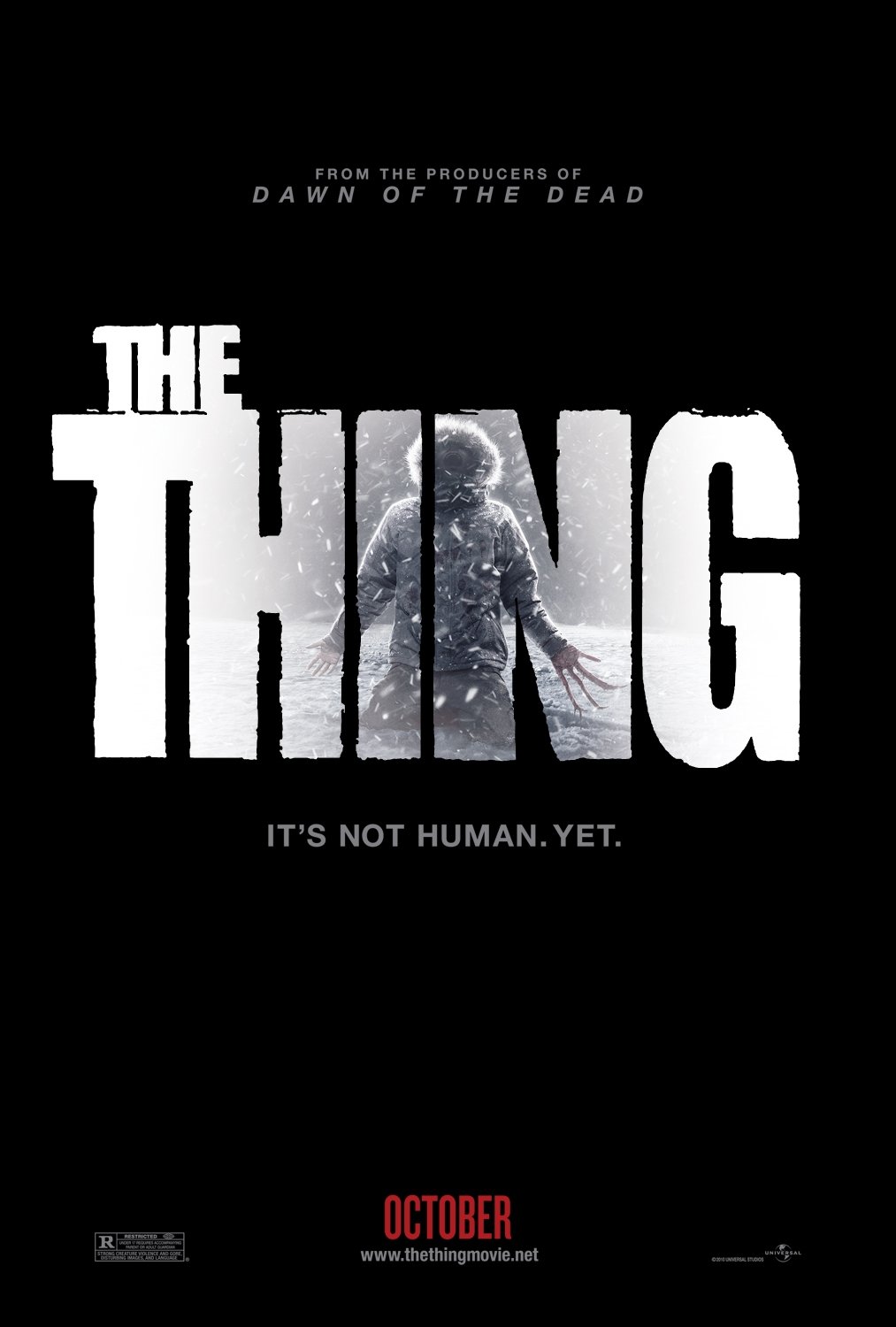
Now we have Matthijs van Heijningen Jr.’s “The Thing,” a prequel to Carpenter’s movie which explores the events leading up to it. Remember the Norwegian camp Kurt Russell and Richard Dysart visited which had been completely burned down? Now we get to see how it got laid waste by both the thing and the humans. But therein lies the problem; knowing the events precede those of the 1982 movie and who survives, much of the potential suspense and tension gets drowned out almost immediately.

Frankly, I would much rather see a sequel to Carpenter’s “The Thing” instead of this. His film was very effective because we never had a clear idea of who to trust. But in Heijningen’s film, we know the characters on display will eventually bite the dust, and it becomes a question of when these characters turn into the thing. After a while, it becomes more shocking when a character dies but doesn’t turn into a gooey alien. What spoils it even more is we know of at least one character who will survive what happens very early on, and all we can do is wait impatiently for him to get on the helicopter with his rifle and take shots at the wolf.

Heijningen is respectful of Carpenter’s movie and pays homage to it throughout, but I kept wondering if this was a remake instead of a prequel. Various scenes are clear imitations of the 1982 movie’s most classic moments, and I wish he had worked harder at distinguishing the prequel from it instead of just presenting us with something way too similar. He does wring some suspense and strong tension at different points, and his unique take on the blood test scene is very clever, but he is unable to sustain the tension which made Carpenter’s movie so utterly terrifying.

The special effects are very good, but they pale in comparison to the genius of Rob Bottin. Audiences are always quick to tell when CGI effects are overused. As for the performances, they are generally good even though the characters could have come out of any monster movie.

The best performance comes from Mary Elizabeth Winstead as paleontologist Kate Lloyd. Such a terrific presence in “Scott Pilgrim vs. The World” and “Live Free or Die Hard,” she holds our attention throughout and is one of the best reasons to see this prequel. While Lloyd is predictably inspired by Ellen Ripley from “Aliens,” Winstead makes the character her own and more than just another tough chick which movies like these typically rely on.

“The Thing” prequel is not terrible, but it will be of interest more to those who haven’t seen the 1982 film which itself was a remake and made back in a time when remakes were rare and actually worth watching. This particular version of John W. Campbell’s “Who Goes There?” feels like a lost opportunity, and it gets caught in the prequel trap of busily matching everything up to the film it leads into. It really sucks when you can see a movie’s ending long in advance. I did however admire the ambiguous ending shown before the end credits as it leaves you wondering if the alien really infected one of the last characters standing. Not knowing is always more unnerving than knowing, and at least the director got this right.

* * ½ out of * * * *

John Carpenter’s ‘The Thing’ is One of the Best Horror Movies Ever Made

The Thing movie poster

Many of you probably know the story behind John Carpenter’s “The Thing.” It came out in the summer of 1982, two weeks after Steven Spielberg’s “E.T,” and while the alien from Spielberg’s movie was warm and cuddly, the one in Carpenter’s was cold, ugly, and utterly vicious. As a result, “The Thing” was quickly derided by both critics and fans alike, and no one hid their disgust towards Carpenter for what they saw as pornography of violence. In all fairness, however, the movie was released at the wrong time of the year. To release it during what Carpenter called the “summer of love” opposite not just “E.T.,” but also “Star Trek II” and “Tron” was a big mistake on the part of Universal Pictures, and they would have had more luck had they released it in the winter of 1982.

Years later, “The Thing,” like many of Carpenter’s movies, found the audience it deserved through home video and digital media. Perhaps it was ahead of its time, but it is now considered, and rightly so, one of the best horror and sci-fi movies ever made, and it is easily the best horror remake in a sea of horrendously crappy ones. It certainly plays better today than it did when first released, and it is still utterly terrifying 35 years after its release.Unlike the original Howard Hawks version of “The Thing,” Carpenter’s movie hews much closer to the short story “Who Goes There?” by John W. Campbell, Jr. The movie takes place at an American scientific research outpost in Antarctica, perhaps the coldest place on Earth. We are introduced to a bunch of men who are studying the surrounding area, and they look bored and listless as they pass the days smoking, drinking scotch, watching “Let’s Make a Deal” reruns, and playing ping pong. One day, they are met by a wolf being shot at by a Norwegian for no discernable reason. This later leads to events which make them realize they have encountered an alien of unknown origin unearthed from the ice after thousands and thousands of years. It then proceeds to imitate every creature it comes into contact with, and it is revealed any of them could be the thing. They have to destroy the thing before it reaches civilization because, once it does, it would mean the end of the world.

The premise of “The Thing” is genius because it allows for an unending escalation of tension and suspense throughout. Like the characters, you have no idea who to trust. The paranoia which closes in on the characters puts them in an airtight cage, and this cage gets smaller and smaller as it heads to its infinitely bleak climax. There are no women to be found which eliminates any sexual tension and could have added an unnecessary element to the movie. Many say this makes the movie sexist, but it is a ridiculous charge.

“The Thing” was released when the whole world started to become aware of the AIDS virus. The idea of any virus infecting us completely and rearranging our body to the point may have seemed unreal to us back in 1982. But today, it is a reality more horrifying than ever, and it presents itself with no cure. This makes “The Thing” even scarier to take in when watching it now. The scene where Dr. Blair (Wilford Brimley) observes a computer image of the virus infecting a human host is one of the movie’s scariest moments, and it feels like an all too real a possibility today. The only thing truly dated about the scene is the computer graphics look like they are from some old Atari game, but it doesn’t change anything.

This movie also marks one of several collaborations between Carpenter and Kurt Russell who started working together on the TV movie “Elvis.” After all these years, Russell can still make you believe he is a regular guy like the rest of us, and his role as helicopter pilot R.J. MacReady is one of his best. You never get the feeling Russell is acting here. Instead, he inhabits the character he plays, and you follow him every step of the way without any doubt of who the hero really is.

Carpenter cast “The Thing” perfectly with actors like Richard Masur, Richard Dysart, Donald Moffat and David Clennon. But one of the best performances comes from Brimley as Dr. Blair. In the past, we have seen him in countless oatmeal commercials and in roles as the grandfather we wished we had in our lives. But his role in “The Thing” offered him an opportunity to go completely against type. Brimley goes from curious to utterly horrified by what this unknown creature can do, and he ends up wreaking havoc in a way you would never ever see in an oatmeal.

Another great actor in this movie is Keith David who plays Childs. David has a don’t mess with me intensity, and he matches Russell’s intensity every step of the way. The tension between them is as frightening as is waiting for the thing to make its next horrifically gory entrance.

But let’s talk about who the real star of “The Thing” really is, and that is Rob Bottin who designed the movie’s horrifically brilliant special effects and makeup designs. Long before the advance of computer technology, Bottin had to make all these designs from scratch, and what he came up with is now considered a benchmark in his field. The thing mimics everything it touches, and this must have been a huge inspiration for him as it allowed his imagination to run amuck with infinite possibilities. You never know what’s coming next, and this makes “The Thing” even scarier.

Some have called this movie a “geek show” made only with the intention of grossing people out. Granted, a good case could be made for that, but “The Thing” explores a theme that is commonplace in many of Carpenter’s movies; the struggle to maintain one’s individuality. Of never letting go of who you are because it allows you to survive in a world which keeps finding new ways of robbing your individuality at any given opportunity. The threat of this loss is very real, and the characters have the unfortunate disadvantage of being stuck in one of the most remote and desolate places on Earth.

I also imagine a big complaint people have about “The Thing” is we never learn about the alien or where it came from. Basically, we know it’s from outer space which imitates whatever it comes in contact with, and it clearly deals with the cold better than any of us do. Here’s the thing, do we really need to know everything about this creature? Maybe not knowing is more terrifying than knowing. It leaves a lot of things to the viewer’s imagination which I love because it leaves so many possibilities open for how this horrific situation is going to play out.

“The Thing” truly is Carpenter’s masterpiece as it shows him to be a true master of horror and suspense. He endlessly generates unbearable tension throughout, and just when you think the movie has peaked, you realize it has not. Carpenter’s goal here is not just to make us jump out of our seats, but to make us feel the terrifying isolation and complete lack of trust these characters are forced to endure.

Carpenter has said “The Thing” was the first in his apocalypse trilogy (the other two were “Prince of Darkness” and “In the Mouth of Madness”), and it does have an unrelentingly bleak tone which made it seem completely out of place back in 1982. As time goes on though, many of us keep thinking the world is coming to an end with more deadly diseases like the Ebola Virus among others, and the scenario this movie presents us feels all the more frightening and immediate as a result.

Some movies are robbed of their greatness through the passage of time, and we watch them and wonder why we liked them in the first place. But “The Thing” is an exception as the passage of time has made it all the more effective. You can’t help but think its story was ahead of its time, and it remains one of those movies I never ever tire of watching. It has more than earned its place on the list of my all-time favorite movies.

* * * * out of * * * *


John Carpenter Revisits ‘The Thing’ at the Aero Theatre

John Carpenter Dummy Magazine photo

“Escape Artist: A Tribute to John Carpenter” was held a few years ago by American Cinematheque at the Aero Theater. In addition to being treated to a double feature of “The Thing,” which is widely regarded as his best film, and “The Fog,” the writer, director and composer also showed up in between both films to give us more insight on their making and took questions from the audience. Even though these movies are now twenty to thirty years old, they still resonate deeply for movie fans today. This was proven true by the fact these screenings were sold out and packed with Carpenter’s biggest fans.

While “The Thing” was not a big hit upon its release, it has since developed a huge cult following and been critically re-evaluated as the masterpiece it always was. Eighty percent of the audience had probably seen this movie several dozen times, but they still jumped during its most shocking moments.

The Thing movie poster

After the movie ended, Carpenter came to the stage and was met with a standing ovation and thunderous applause. He thanked them for coming on out to see this movie when they could have just watched it at home. One fan in turn thanked him for coming on out to visit with us as he has millions of fans all over the world, and yet he chose to hang out with us.

Today, as the emcee pointed out, many are surprised “The Thing” was not a big hit when released back in 1982. Carpenter put it all the more bluntly:

“It tanked! 1982 was supposed to be the summer of love. It was the summer of ‘E.T.’ and it was the summer of freedom and hope, and ‘The Thing’ was about as bleak a movie as any that could have been released that year. People hated it for that, and all the sci-fi fans out there absolutely hated it and trashed it when it first came out.”

As Carpenter pointed out to actor and friend Kurt Russell on the movie’s DVD commentary, “We came out two weeks after ‘E.T.’ And while there’s was all warm and cuddly, ours was ugly and hideous.” Universal Pictures, which released both movies that summer, attempted to make it the summer of extra-terrestrials, but the timing did not work at all in Carpenter’s favor and it later cost him the job of directing the Stephen King adaptation, “Firestarter.”

One fan pointed out how “The Thing” was unique in a sense as it is one of the few Carpenter movies he did not compose the score for. While the score does have the Carpenter sound, it was actually composed by Ennio Morricone. Carpenter said Morricone is one of the greatest film composers ever, and he did point out there is one synthesizer piece of music which was not composed by Morricone. Now he wouldn’t say who composed it, but it’s safe to say he did, and in association with Alan Howarth.

Another fan pointed out several of Carpenter’s movies have been remade like “Assault on Precinct 13,” “The Fog” and “Halloween,” and a remake of “Escape From New York” is in the works. This fan said he found remakes blasphemous, and to this Carpenter replied, “I actually find it flattering. They also have to pay me a lot of money when they do that.”

Dean Cundey, director of photography on “The Thing,” worked on several of Carpenter’s movies including “Halloween.” Carpenter has not worked with Cundey for some time now, and one man asked why and if there had been a falling out between them. Carpenter replied they have not fallen out, and he recently caught up with Cundey at a movie shoot in Canada. Carpenter did, however, point out why they haven’t worked together for a while, “Dean wanted to be a director. And when you have a director on a movie, and a director of photography who wants to be a director, that’s just not going to work out.”

Everyone who knows Carpenter knows he is a big fan of westerns, and he recently recorded a commentary track for the special edition release of “Rio Bravo.” Many wonder why he still hasn’t directed a western of his own, and Carpenter replied he honestly didn’t know but that he came close several times. The closest was when he wrote the script for “El Diablo” which was made into a cable movie that earned him a Cable Ace Award. If you look closely, all of his movies do have western elements to them. The closest he has ever gotten to making a western is “Vampires” with James Woods.

Many also wondered, and it was asked, what future projects he has on tap and of what his current passions are. His reply was, “Current passions? I’m playing Ninja Gaiden, I just got Metal Gear Solid 4 for PlayStation 3… No seriously, I have a couple of things I’m looking at doing, so we’ll see what happens.”

Before he left, he did have some things to say about “The Fog,” “I have heard that the print for this movie is not in the greatest shape, and that it is pretty faded. But keep in mind that when we made this movie, we made it for only $1 million dollars, so please be kind.”