‘Only the Brave’ Celebrates the Lives of Those who Risk Everything to Keep Others Safe

Only the Brave movie poster

While watching “Only the Brave,” I kept thinking of what Mike Kellerman said in an episode of “Homicide: Life on the Street:” “Fire is a living thing. It eats, it breathes air, it can be killed. Something about that power draws people in.” This dialogue played in my head while Josh Brolin stares at a wildfire off in the distance, wondering which direction it will spread in. From this, we can tell he doesn’t just see fire as simply something to be put out, but as a force to be fought with on its own term. The term fight fire with fire takes on a special meaning here, and it is shown to be more than just the title of a Metallica song.

“Only the Brave” is, yes, based on a true story. In this case, it is about an elite crew of firefighters who came to be known as the Granite Mountain Hotshots and who risked their lives on a regular basis to stop wildfires in their tracks. In June 2013, 19 of their members died while fighting the Yarnell Hill Fire in Arizona, and it remains one of the deadliest incidents involving United States firefighters outside of the September 11th attacks. I figured the movie would be all about this fire and of who survived it and who didn’t. However, it is really about these group of men who come together to form a brotherhood of sorts as they come to depend on one another as their work is always very dangerous. In the process, we also see the bonds they have with their families and loved ones, and of the constant balance they have to work at between work and family life.

Brolin plays Eric Marsh, the leader of the Granite Mountain Hotshots who is eager to build a team of firefighters which will not simply serve as background performers while other elite firefighters push them to the side. You would think firefighters from different places would be quick to band together in the face of mother nature’s havoc, but each individual firefighting group is shown to be a competitive bunch as they want to claim the glory of being a hero before anyone else. After dealing with conflicts and money problems inherent in the realm of politics, Eric gets the funding he needs to begin training men who are infinitely eager to fight fire with fire.

Now a movie like this typically employs a number of stereotypical characters like the ladies’ man, the fearless leader, the trusted second-in-command the one who looks as if he is in the wrong place, and “Only the Brave” does traffic a bit in this area to where I thought this might become “Top Gun” but with firefighters instead of pilots. But thanks to an excellent cast which includes Miles Teller, James Badge Dale, Taylor Kitsch, Scott Haze, Alex Russell and Ben Hardy, we get to be intimately involved in the exploits of these firefighters to where we have to admire their selflessness in what they do.

An actor worth noting in particular is Teller who has given excellent performances in “Whiplash” and “The Spectacular Now.” Teller plays Brendan McDonough who, at the movie’s start, is a hopeless drug addict. From the character’s first appearance, I figured Brendan would be the one to start the Yarnell Hill Fire as he carelessly is shown smoking crystal meth to where he is barely conscious, and I kept waiting for him to drop a match in a field without even realizing it. Brendan comes to discover his ex-girlfriend is pregnant, and he reacts to this news flippantly as it only increases his capacity for self-destruction. But upon seeing his baby for the first time, he suddenly begins to turn his life around and looks to get employed on Eric’s firefighting team.

Teller’s performance is superb as he doesn’t make Brendan into the typical cinematic addict, but instead a person who goes from being lost in life to one who finds a purpose as he seeks to give his child the life his father never gave him. The interview scene he has with Brolin is superb as Teller never overdoes it as Brendan knows full well he can’t fool Eric since he sees right through his addiction. I kept waiting for Brendan to relapse as this is usually the case for addicts in a movie, but Teller makes his character’s hard-fought battle towards sobriety noble and believable. This is also the second movie he’s been in these past few years where he plays a man determined not to take painkillers even though they certainly would help (the other is “Bleed for This”).

Brolin is an ace at playing blue collar workers, and he never has to do much to convince us how believable he can be in portraying a firefighter. Through his expressions and actions, we quickly see this is someone who can tame the nastiest fires he and his team come into contact with. The “No Country for Old Men” actor shares a lot of great scenes with his male-costars, but his best moments come between him and the always terrific Jennifer Connelly who plays Eric’s wife, Amanda. Their relationship is a strong one, but it takes on an increasing strain when Amanda wants kids, something Eric is not quick to agree on. From this description, it sounds like the average marital conflict we see in every other movie, but Brolin and Connelly bring a lot of raw emotion to their roles to where they inhabit their characters more than anything else. This could have felt clunky, but the actors keep this from happening, and this is especially the case when Amanda reminds Eric what she goes through every day when he walks out the door to go to work.

“Only the Brave” was directed by Joseph Kosinski whose previous films were “Tron: Legacy” and “Oblivion.” This one takes place in the real world instead of in the realm of science fiction, and yet he still brings a strong visual flair to each scene as we watch the fires lay waste to the land with an unforgiving power, and we fear for the deer running through the fields even as a wildfire gets closer and closer. At the same time, he also puts much of his attention on these men as this movie is about the job they did, not the fire which killed many of them. Kosinski makes us share in the friendships they build with one another and of the joyous moments they spend with their families to where we feel we are a part of their lives. Nobody involved with this motion picture should need to convince anyone of the emotional investment they put into this material, and this makes its tragic climax all the more devastating to witness.

Even though I knew how things would end for this group of firefighters, it didn’t make it any easier to sit through. These men had the best training and were constantly being drilled on how to protect themselves in the event of being trapped in a fire, but like other natural disaster, a fire is indiscriminate in who and what it attacks as it seeks to breathe for as long as it can. What everyone is left with are a tremendous amount of grief and survivor’s guilt, both of which deserve a movie of their own to explore.

I walked out of “Only the Brave” in tears as the filmmakers paid special tribute to the men of the Granite Mountain Hotspots, those who lived and those who died. Even the best of preparations could not spare them from the destructive flames they perished in, but it still never took away from the bravery the showed us, and this movie gives them a well-deserved memorial to their selfless efforts. While we mourn the loss of life, we celebrate the lives these men led as they deserve much more than being just a footnote in history.

“Only the Brave” marks a big leap forward for Kosinski as he shows there is more to him than directing big science-fiction films with awesome music scores. It is also worth noting how the movie’s credits are shown at the beginning as opposed to at the end like in “Tron: Legacy” and “Oblivion.” Not only that, but the credits are presented in a surprisingly subtle fashion as Kosinski must have realized his talents could not and should not upstage the firefighters of the Granite Mountain Hotshots.

As I write this review, wildfires have been doing tremendous damage in Northern California near where my brother lives with his family. Seeing this film makes me think about what his family and others are enduring right now as the damage left in the fires’ wake is just awful. I also find myself thinking of those firefighters up north and wonder if they are getting the respect, not to mention the funding, they deserve. Whereas “Backdraft” felt more like a Hollywood take on the lives of firefighters, “Only the Brave” feels like the real deal, and it makes me want to go up to those who are working tirelessly to keep wildfires from spreading and shake their hands. This movie is proof of how much they deserve our respect.

* * * ½ out of * * * *
Save

‘Blade Runner 2049’ is Astonishing, Glorious and Mesmerizing

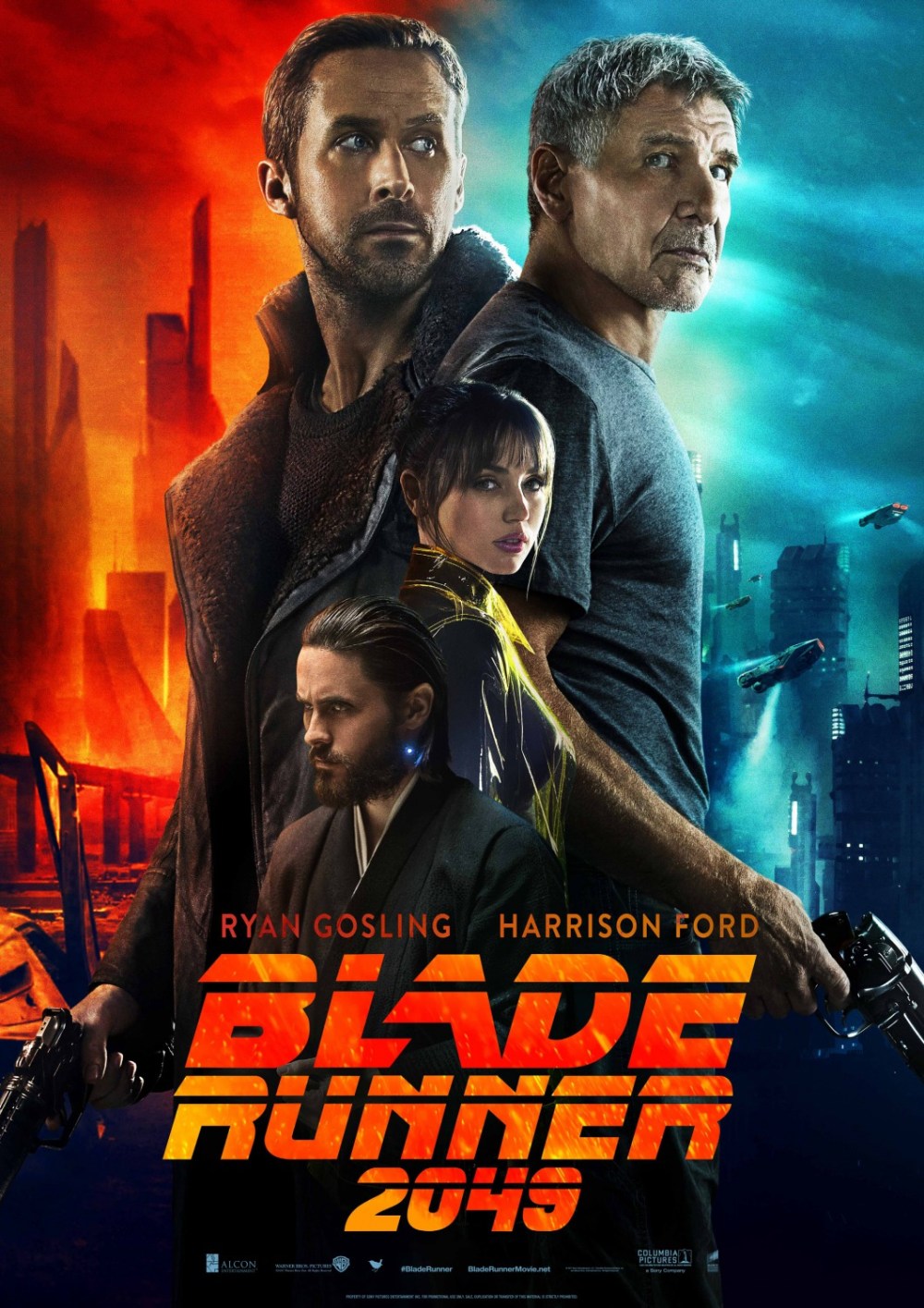
Blade Runner 2049 movie poster

Many words come to mind when describing “Blade Runner 2049.” Among them are mesmerizing, amazing, glorious, beautiful, and astonishing. I put special emphasis on the word astonishing because it is almost unbelievable to see what director Denis Villeneuve and company got away with here. Not only have they conceived a sequel which does its predecessor, Ridley Scott’s 1982 cult classic “Blade Runner,” proud, but they also got away with making an art house film with a budget of over $150 million and a running time of almost three hours. What were the studio executives thinking? Well, it doesn’t matter as this eagerly awaited sequel proves to be well worth the wait.

Taking place thirty years after the events of the original, the sequel introduces us to a new blade runner played by Ryan Gosling, and he comes to be known by a pair of names for reasons best left unsaid here. After enduring a brutal battle as he attempts to retire rogue replicant Sapper Morton (Dave Bautista), he becomes aware of a long-buried secret which is overdue for a thorough investigation. In the process, he tracks down former blade runner Rick Deckard (Harrison Ford) who has been off the grid for many years as he seeks answers only Deckard can give. What results is a form of evolution no one could have seen coming.

Telling you more about “Blade Runner 2049” will prove to be detrimental to your viewing experience as you should only know so much about its plot before going into the theater. What I can tell you is the future world portrayed is even more beautifully bleak than the one Scott gave us 35 years ago, something I didn’t even think was remotely possible. The colors are vibrant, but everything is still subject to a never-ending rainstorm, the kind we needed in California for the longest time. And in this fictional universe, Pan Am is still a corporate giant even though it ceased operations in the real world back in 1991.

While I was bummed to learn Scott would not be directing this sequel (he serves as executive producer instead), they couldn’t have found a better filmmaker here to fill his shoes as Villeneuve takes on what must have been a truly daunting challenge here. “Blade Runner,” despite being a critical and commercial disappointment, has long since been considered one of the greatest science fiction movies ever made, and it certainly is. Making a sequel to it interested many including myself, and yet it could easily take away from the original as nothing easily compares to what came before. But Villeneuve is the same guy who gave us “Arrival,” another sci-fi masterpiece which invited and deserved comparison with “Close Encounters of the Third Kind,” and this gave me confidence he could bring something special to “Blade Runner 2049.” Indeed, he has made a sequel which will prove to be every bit as memorable as its predecessor as the years go by as he expands on the themes and delivers a cinematic experience which is equally profound.

Furthermore, Villeneuve allows things to go at the same methodical pace Scott went at back in 1982. If you go into “Blade Runner 2049” expecting something along the lines of “Star Wars,” you will be seriously disappointed as the original defied sci-fi conventions with a vengeance. What was unique about “Blade Runner” is how it enthralled audiences with big ideas more than with wall-to-wall action sequences. The same is true with “Blade Runner 2049” as it probes the idea of what it means to be human, and it deals with characters searching for something which doesn’t feel the least bit artificial in a world dominated by technology. For me, the key line of dialogue comes when Lieutenant Joshi (played by Robin Wright) tells Gosling’s blade runner, “We’re all just looking out for something real.” This is certainly the case here, but as we catch up with these characters, their chances of finding anything real seem very small.

By the way, if Roger Deakins does not get this year’s Oscar for Best Cinematography, I will be seriously miffed. For far too long, this man has been the Randy Newman of the cinematography category, and this feels criminal as has given us beautiful and extraordinary images in “Sicario,” “Skyfall,” “No Country for Old Men,” and “The Shawshank Redemption” to where it is not easy to compare his work to others. Deakins, however, really outdoes himself here as he gives each scene in “Blade Runner 2049” a stunning look which shows both the beauty and the emptiness of the world these characters are forced to inhabit. What he has accomplished here is simply extraordinary as it all feels incredibly unique.

Gosling has long since proven to be as good an actor as he is a tremendously sexy one, and he is superb in a role which is very tricky to pull off. Again, I can only say so much about his character as it is too easy to spoil certain aspects of this movie, but once you understand who this blade runner is, it becomes clear as to the kind of balancing act Gosling has to play here. While life in the rainy and futuristic city seems to have burned this blade runner out completely, there are still glimpses of humanity to him which come out in a way which feels spontaneous and never forced. As a result, the “Drive” actor proves to be a genius at playing someone who is no longer certain as to how he should feel about the discoveries he has made.

Harrison Ford doesn’t show up as Deckard until the movie’s third act, but he makes it worth your time to wait for his first appearance. After watching him have tremendous fun playing Han Solo again in “Star Wars: The Force Awakens,” it’s great to see him bring another of his iconic characters back to life. Ford makes Deckard into a burned out shell of a man who is forced to hide not just from those threatening his existence, but also from the things he yearns to connect with most of all, and he illustrates the character’s never ending internal conflict without ever having to spell everything out for the audience.

The rest of the cast is superb as they bring a unique quality to roles which have them acting in both human and inhuman ways. Robin Wright kicked ass earlier this year in “Wonder Woman,” and she does it again here as Gosling’s superior officer who is a no-nonsense Lieutenant and eager to keep a war from being ignited. Ana de Armas, whom you might remember from Eli Roth’s “Knock Knock,” is perfection as Joi, Gosling’s hologram girlfriend who is definitely even better than the real thing as she comes equipped with a humanity which strikes at your emotions. Sylvia Hoeks is riveting as Luv, a replicant who can appear charming at one moment and incredibly lethal in the next, and she makes this character vicious and frightening as she is determined to make discoveries before others do. Jared Leto and Dave Bautista have essentially cameos here, but they make the most of their time onscreen and show the depth they are willing to give to even the smallest of roles.

My only real disappointment with “Blade Runner 2049” is we will never get to hear the music score by Villeneuve’s regular composer, Johann Johannsson. For some odd reason, he was removed from this project and is contractually forbidden from talking about why he was let go. His score to “Sicario” is one of my favorites, and it would have been great to hear what themes he could have brought to this sequel.

Having said that, the score by Hans Zimmer and Benjamin Wallfisch, the latter who recently did the music for “It,” is excellent as it captures the vibe of Vangelis’ score from the original without simply updating it for a new audience. It doesn’t even sound like the typical Hans Zimmer score as his music is usually pretty easy to recognize, although the last few cues do have a bit of “Dunkirk” in it. I feared “Blade Runner 2049” would get a more conventional score than the great one Vangelis composed years ago, but Zimmer and Wallfisch bring something wonderful, beautiful and thrilling to everything we see and listen to here.

The original “Blade Runner” came out in 1982, one of the greatest years for movies and one which many have called the year of the nerd. In addition to “Blade Runner,” we also got “Star Trek II: The Wrath of Khan,” John Carpenter’s “The Thing,” “The Dark Crystal,” “Tron” and “E.T. The Extra Terrestrial” among many others. “Blade Runner” was not a commercial hit and critical reaction to it was sharply divided, but like “The Thing” and “Tron,” its stature has grown over time to where it is now revered as the great motion picture it always was.

“The Thing” and “Tron” managed to generate a prequel and a sequel more than 20 years later, but neither could equal the power of their predecessors. This makes the achievements of “Blade Runner 2049” all the more profound as it equals the original film and digs even deeper into its theme which Scott explored to brilliant effect. What Villeneuve and company have come up with here feels as unique in today’s cinematic landscape as “Blade Runner” did in the 1980’s. I had every reason to lower my expectations on this one as sequels which come out decades later are typically doomed to failure, but this one defies the odds and I am so thankful everything worked out so well. It may not have Rutger Hauer, but very few movies can ever be perfect.

And for God’s sake, give Deakins the Cinematography Oscar! No excuses!

* * * * out of * * * *

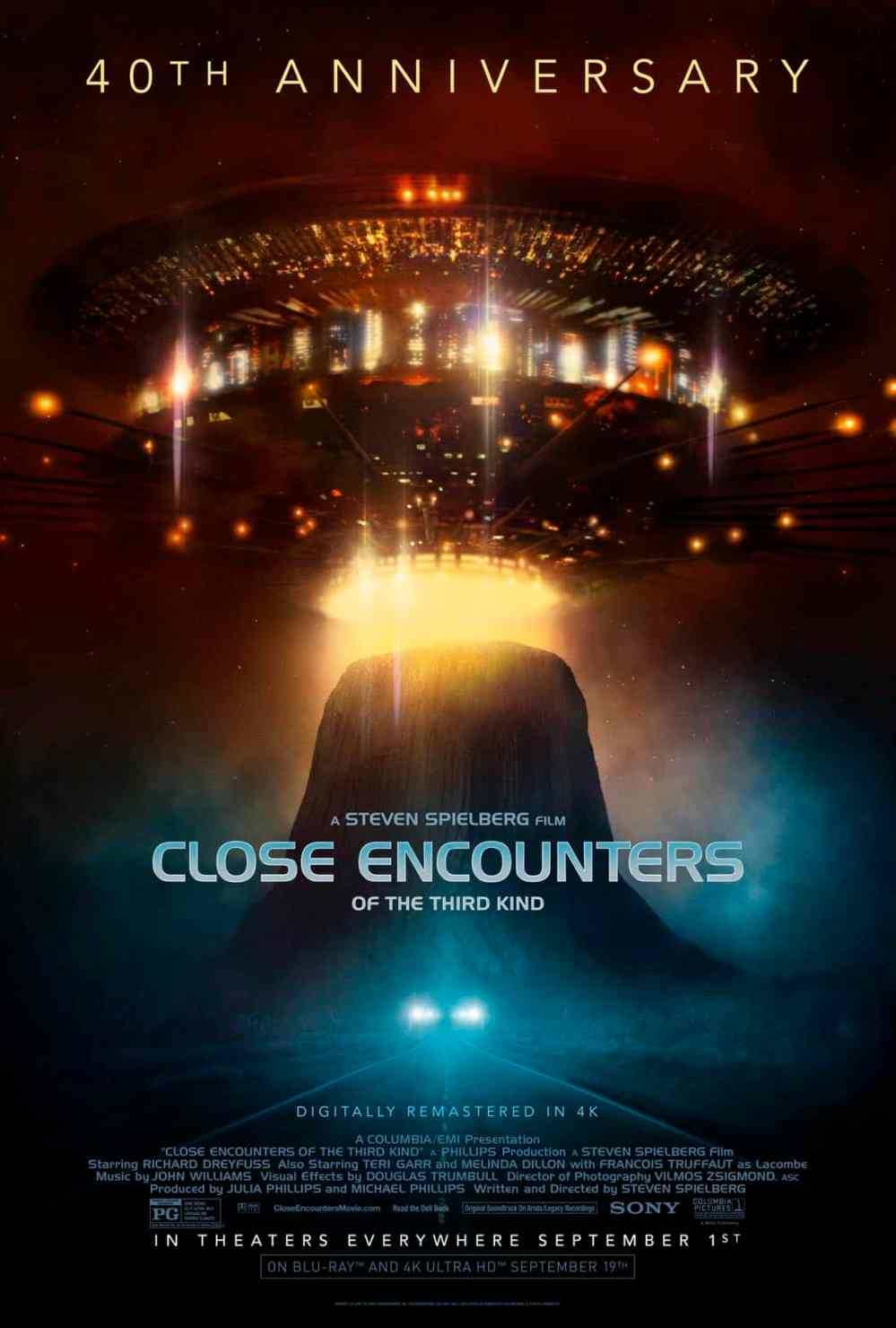
‘Close Encounters of the Third Kind’ Still Leaves Us in Awe 40 Years Later

Close Encounters of the Third Kind 40th poster

On this week’s edition of yes, this movie really is that old, we have Steven Spielberg’s “Close Encounters of the Third Kind.” Released back in 1977, it is now being re-released in a new 4K remastered version in honor of its 40th anniversary. I first watched it on laserdisc at a friend’s house back in the 80’s, and I remember being somewhat traumatized by it as there were scenes which proved to be quite scary. I have since watched the film several times, but this 40th anniversary re-release allowed me to see it on the big screen for the first time. Suffice to say, this is the way you should view this particular Spielberg classic.

The film begins with strange discoveries being made in various parts of the world which include the appearance of Army airplanes reported to have gone missing back in the 1940’s, a lost cargo ship which has reappeared in the Gobi Desert for no discernable reason, and witnesses living in India are found singing a five-tone musical phrase which is revealed to be the distinctive sounds of UFO’s. Meanwhile, out in Indiana, Ray Neary a blue-collar worker, husband and father to three very loud kids, is working late at night after a large-scale power outage takes place, and he finds himself having a very close encounter with a UFO, one which lightly burns his face with its bright lights. From there, he becomes obsessed with finding out more about these alien visitors to where he gets left with subliminal messages he is desperate to find answers for.

Throughout the decades, there have been countless movies dealing with human beings and their first contact with extra-terrestrials, many of which feature the last remnants of humanity fighting off an alien invasion determined to wipe them out with extreme prejudice. As I got older, I came to realize how rare it is to have a science fiction movie which deals with aliens in a highly intelligent way. Among them are Stanley Kubrick’s “2001: A Space Odyssey,” Robert Zemeckis’ “Contact,” Spielberg’s “E.T.,” and Denis Villeneuve’s “Arrival” which was one of the very best movies of 2016. Even rarer these days is the motion picture which leaves you in an extended state of wonder and awe from start to finish and even after you leave the theater.

Even 40 years after its release, “Close Encounters of the Third Kind” still has an immense power to enthrall us as its characters come into contact with something they have longed to see. There is nothing about it which comes across as unintentionally laughable, and while technology has evolved to a whole other level since the 1970’s, this movie feels timeless in its exploration of possibilities and discoveries. It also works on many different levels in that it is funny, scary, thrilling, and deeply emotional.

This film is especially unique on Spielberg’s resume as it is one he directed and also wrote the screenplay for. It would also mark the last time he would direct his own screenplay until he made “A.I. Artificial Intelligence” in 2001. As a result, there should be no doubt of just how personal this film is to him. It turns out he wanted to make this one before “Jaws,” but he didn’t have the commercial clout at the time to get the budget he wanted. Of course, when “Jaws” came out, this changed forever.

Spielberg has said “Close Encounters of the Third Kind” is not actually a science fiction film, and watching it again has me agreeing with him completely. Yes, it does feature aliens and UFO’s, but they are not really the point. Also, this film takes place in a reality we all know and relate to. “Close Encounters” does not take place in some future dystopian world, but instead one we all inhabit as the main characters are regular people working regular jobs and supporting their families. They don’t want to see UFO’s, but they did, and now they cannot and will not deny their existence. Throughout this movie, we remain in the human universe and we never enter an alien one, and this is very important to point out here.

“Close Encounters” also deals with stories which would become a hallmark of future Spielberg films and productions such as “E.T. The Extra Terrestrial” and “Poltergeist” among others. Seeing the government conspire to keep this alien visitation a secret is presented in a way which feels not only realistic, but also very possible to pull off back in the 1970’s. But he also shows how the truth of things cannot be kept a secret forever, and, like Ray Neary, we want to see this all the way to the end because we won’t stop and until we get answers to fulfill our curiosities.

When it comes to the actors, Spielberg really just lets them loose here. He doesn’t direct them as much as he lets them run wild, and I don’t just mean the kids who are a noisy bunch as presented here. Richard Dreyfuss is perfectly cast as Ray Neary as he brings a crazed and enthusiastic energy to the role of a man who has seen things he wasn’t supposed to see, and he is not in a position to unlearn what he has learned. Even as Ray’s actions increasingly alienate him from his wife and kids, Dreyfuss makes us empathize with his plight as he is caught up in something he cannot turn his back on.

Melinda Dillon is equally wonderful as Jillian Guiler, another character who, along with her fearless son Barry (Cary Guffey), experiences a close encounter of her own. She also suffers the indignity of her son being kidnapped by aliens, but she is eventually reunited with him in the movie’s last half. It may sound like I’m giving plot points away here, but I’m not because Dillon’s performance is such an emotionally fulfilling one to witness as she takes Jillian through the stages of fright, grief, desolation, and eventually joy and happiness. She makes you experience these emotions with her, and seeing her smile when Barry reappears is a moment of pure elation.

Spielberg’s casting of filmmaker Francois Truffaut as Claude Lacombe, a French government scientist, was truly inspired. Along with Bob Balaban who plays David Laughlin, Lacombe’s assistant and interpreter, he portrays a government official who brings sanity to a situation which has other government officials responding to in a panic to where the quick answer is cover everything up and keep the number of witnesses to a bare minimum. Truffaut brings a strong level of thoughtfulness and wonderment to his character as Lacombe shows an openness to first contact others would not be quick to embrace. While military officers are eager to keep Ray and Jillian out of the area, Lacombe tries to make them see they were invited to be here.

Many images from “Close Encounters” will forever remain burned into my consciousness. The most prominent image of all is when young Barry opens the front door where an alien ship hovers outside, waiting to make contact with someone, anyone. This is still the defining image of who he not just as a filmmaker, but as a human being. Spielberg’s eagerness to make contact with aliens from another galaxy is no secret, and here’s hoping a UFO does make contact with him in his lifetime. Better they meet him than a certain person who is currently occupying the White House.

I think people these days who are seeing “Close Encounters” for the first time might say it takes too long to get to the last half where humans finally get to communicate with aliens. But like Francis Ford Coppola’s “Apocalypse Now,” this film is more about the journey than the final destination. Spielberg wants us to question what we believe and how far we will go to get answers to questions which have plagued us for an infinite amount of time, and we share the awe of the characters once those answers are delivered to us here. And it’s not just that the characters get answers here, they truly earn them as well.

This is also one of those films its director couldn’t stop tinkering with over the years. Ridley Scott couldn’t leave “Blade Runner” alone years after its release, and Oliver Stone continued to tinker with his dream project “Alexander” to where the final cut he gave us still doesn’t feel final. As Spielberg was finishing up “Close Encounters,” Columbia Pictures was in dire straits financially and begged the filmmaker to release his pet project sooner rather than later. What came out in 1977 wasn’t his complete vision, and he eventually got to make a special edition of the film which was released in 1980. The 4K restoration of “Close Encounters” is essentially a combination of both versions, but the scenes with Ray Neary exploring the inside of the mothership have been cut out. Spielberg has said over and over he never should have taken us inside the ship, and I completely agree. While Spielberg provides the characters with many answers, there are still some things better left to the imagination.

Seeing “Close Encounters of the Third Kind” at the Cinerama Dome afforded me the opportunity to see the movie in its most desirable format. The audience I saw it with was left spellbound at what unfolded, and this says so much about this movie’s staying power. Just when I think I have become so jaded and embittered a filmgoer as studios continue in their desperate search for the next big franchise, a motion picture like this comes along to remind us filmmakers still have the power to leave us in a state of sheer wonderment. It feels like we have had an overabundance of movie anniversaries lately to where these celebrations feel more like a ploy to get more money out of our pockets. But this particular anniversary is one worth acknowledging as it continually reaffirms the power of cinema to truly transport to another time and place and, in the process, rescue us from the real world even if it’s only for a temporary time.

The only thing which bugs me about “Close Encounters” these days is Ray’s decision to leave his family behind and travel with the aliens. Essentially, he is presented with the same question Captain Decker is faced with in “Star Trek: The Motion Picture;” Would you leave everything and everyone you have ever known behind just to explore another world and dimension? Seeing Ray getting on board the ship made me wonder how his family would have reacted to this decision, and it plagues my mind long after the end credits have finished. Then again, Spielberg did make this film before he had any kids of his own. Had he made it after he became a father, there’s no doubt Ray would have made a different decision. Still, one could not blame Spielberg or Ray for being tempted to go. I certainly would be tempted.

* * * * out of * * * *

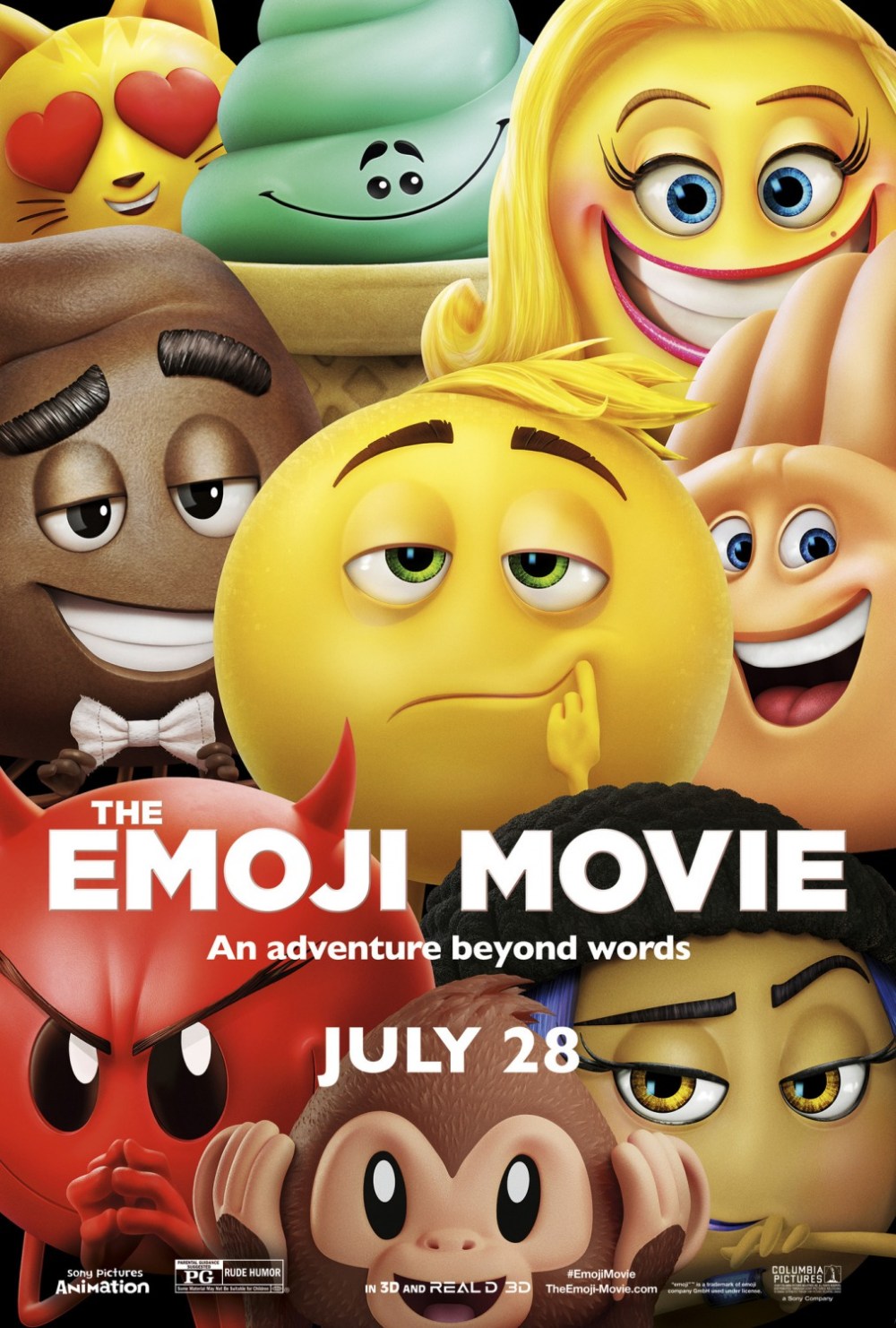
‘The Emoji Movie,’ Like its Main Character, is Simply Meh

The Emoji Movie poster

This never seemed like a good idea for a movie. Sure, there was “Toy Story” which brought those toys we grew up playing with to wonderful life, and we had “The Lego Movie” which featured those building blocks in a story which had profound things to say about the power of our imagination. But emojis? Seriously, where can you go with those things? They are just faces with one single emotion to exhibit. How can you possibly make a movie out of them?

Going into “The Emoji Movie,” I was reminded of an episode of “Hollywood Babble-On” in which Ralph Garman and Kevin Smith ranted about the news of this movie being made following a bidding war between three studios.

“To go into a room and say, ‘Guys, I got the idea. You know the fucking face at the end of your text with the fucking tongue out and one eyebrow is up and shit? You know that shit? Here’s my idea. Hey, bring out my Power Point presentation. See that fucking round yellow face? That’s going to be my new movie!’ WHO FUCKING THINKS LIKE THAT?!”

“We could go pitch ‘Hieroglyphics: The Movie!’”

“But ‘The Emoji Movie?’ A movie about the emojis? What’s it going to be, the fucking family of emojis going on vacation together and, oh no, Tongue-Out is upset because Cross-Eyes is pissed off that Thumbs-Up is hogging the backseat? WHAT THE FUCK?! Seven figures they paid for this idea! Seven figures!”

Actually, what Garman thought the story would be could have been more interesting than this. ‘The Emoji Movie,” like its main character, proves to be a meh affair with jokes which fall flat more often than not, a voice cast which cannot lift the material up beyond its banal confines, and ideas which were dated by the time this movie went into pre-production. The fact it is coming out at a time when GIFS are proving to be very popular doesn’t help either.

For the most part, “The Emoji Movie” takes place within the cell phone belonging to Alex (Jake T. Austin), a human teenager who lives and sleeps with his phone like every teenager does to where kids colliding with each other because they can’t take their eyes off their devices is to be expected. Fortunately, there are no scenes of teenagers texting while driving which is a relief. Imagine how traumatic it would be for children to watch them getting into a car crash because the characters were texting each other about the latest school gossip.

Anyway, inside Alex’s phone live the emojis who are always around to help provide him with text responses which need no description with words, and among them is Gene (T.J. Miller), a meh emoji, who is super-excited about going to his first day at the office. Gene just wants to be a normal emoji like everybody else, but we soon discover he is capable of exhibiting multiple expressions and ends up having a panic attack which shows him to be anything but meh. Smiler (Maya Rudolph), whose infinite smile cannot hide her vindictive nature, orders Gene to be deleted from the phone. Of course, Gene manages to escape her cheerful façade and goes on a mission to become a normal emoji like all the others.

Director Tony Leondis was interested in exploring life inside a phone, and he also explored the plight of being different in a world which unrealistically expects everyone to be the same. The latter part is noble as we need movies which remind us all of how we should not exclude those who are different (you listening Donald Trump?) as this world is hard enough without people ostracizing others who are not seen as the norm. Even in this day and age, we need these stories as life seems to mostly be about conforming to societal norms, and not everything can or should be the same.

Regardless, this movie never has enough to work with. The problem with emojis is they, as characters, are far too simplistic. You cannot do much with them as their role in life or, in this case, Alex’s phone has been decided from the get go to where, even if they tried to do something, there’s no real reason to expect anything different from they are already programmed to do.

The plot of “The Emoji Movie” also suffers as it is the same kind of story where the underdog goes on a journey which will eventually lead him to becoming the hero, at which point everyone will accept him for who he is. It sucks a lot of times when you know the outcome long in advance, and it really tears away at the inspired movie this one could have been.

Leondis was clearly inspired by the “Toy Story” movies as well as “The Lego Movie,” but those movies managed to surprise us not just with their splendid animation, but with their stories which took audiences on rides they weren’t really expecting to go on. “The Emoji Movie,” however, isn’t much more than your typical outsider movie, and this is a shame as so much more could have been done here. This could have been an insanely inspired movie, but instead it travels down a road many of us have already traveled one too many times. Kids may get a kick out of it, but adults will be left wondering why this one couldn’t be as good as anything Pixar puts out.

Many shots are taken at various mobile apps like YouTube, Instagram, and even Candy Crush, a game for which I still get countless invitations to play (FYI, I’m not interested). Even Pikotaro’s “Pen-Pineapple-Apple-Pen” video makes a brief appearance, reminding us it was 2016’s most viewed video on YouTube. However, Leondis and his screenwriters, Eric Siegel and Mike White, don’t mine this material enough for all the satirical value it holds. Moments like the reveal of Candy Crush generate a chuckle, but nothing in the way of real laughs.

It’s a real shame because the voice cast is nothing short of terrific. T.J. Miller of “Silicon Valley” fame makes Gene an emoji we want to follow along with, and Anna Faris lends her everlasting charm to the codebreaker emoji Jailbreak. Maya Rudolph makes Smiler a wonderfully devious presence as her infinitely cheerful demeanor and pearly white teeth reveal her to be anything but truly happy. James Corden brings the same giddy energy he brings to his late-night CBS show to the role of Hi-5, and he steals just about every scene he has. I also have to say the casting of Steven Wright as Gene’s father, Mel Meh, was priceless.

Sir Patrick Stewart, however, is wasted in a role I expected to be the real scene stealer here, the poop emoji. Stewart has some choice moments which had me chuckling a bit, but he disappears from this movie too often to where I wondered why the filmmakers bothered to cast him. And the scene where poop is in the cube shouting “red alert!” makes me pine for another “Star Trek: The Next Generation” movie which will probably never happen. Regardless of how you felt about “Star Trek: Nemesis,” the “Next Generation” crew still deserves a better curtain call.

There was an animated movie which came out earlier this summer called “Captain Underpants: The Epic First Movie” which I wasn’t expecting much from when I walked into the theater. I came out of the movie pleasantly surprised as it proved to be very entertaining, full of imagination, and wonderfully subversive. I was hoping “The Emoji Movie” would surprise me in the same way, but the cards were stacked against this one right from the start. Emojis only have one function, to show a specific emotion. While Gene can show off many different emotions, it doesn’t change this fact. What we are left with is a thin story with jokes which are as funny as the hopelessly corny ones at all those Disneyland park shows, and animation which, while not at all bad, never comes across as the least bit wondrous. And yes, there is a post-credit sequence, but don’t bother waiting for it. All it does is show the fate of a certain character, and the moment is over in a flash.

“The Emoji Movie” does have a short-animated film preceding it called “Puppy!” which is based on the “Hotel Transylvania” franchise. It has Dennis getting a puppy, albeit one which is almost as big as King Kong. This short might pale in comparison to the ones Pixar makes, but it is very funny and playful and everything “The Emoji Movie” could have been.

Perhaps Garman was right. It would have been better to do an emoji road movie. Leondis would have had more luck with this genre than “The Diary of a Wimpy Kid: The Long Haul” did.

* * out of * * * *

‘The Amazing Spider-Man 2’ Has Way Too Much Going On

The Amazing Spiderman 2 poster

I figured after “Spider-Man 3,” movie studios and filmmakers would think twice before putting three villains in a film, but lo and behold they have done it again with “The Amazing Spider-Man 2,” a sequel to the surprisingly successful reboot which wasn’t necessarily needed so soon. Director Marc Webb is forced to deal with a story that doesn’t have much of a focus and contains too many characters for it to deal with. What results is a incredibly underwhelming superhero movie which plays more like a two-hour plus trailer for other movies, and while this is the fifth “Spider-Man” film in just over a decade, my disappointment with this one has little to do with franchise fatigue.

Not much time has passed since the events of “The Amazing Spider-Man,” and we find ourselves catching up with Peter Parker/Spider-Man (Andrew Garfield) and Gwen Stacy (Emma Stone) as they are graduating from high school. Of course, Peter is delayed a bit as his alter ego of Spider-Man has to fight crime when Russian mobster Aleksei Sytsevich, who will later be revealed as Rhino, tries to drive out of New York City with a case full of plutonium vials. Paul Giamatti plays Aleksei and he clearly is having a blast playing such an over the top character, but he’s barely in the movie. We see him at the very beginning and at the end, but nowhere in between.

This brings me to one of my major gripes with superhero movies today. Studios are so insanely desperate in starting the next big franchise to where they already have at least two sequels planned before their big tent pole movie is even released, and it has gotten to where everyone has forgotten how to make a self-contained movie. Rhino is basically here to act as a bridge to the future spinoff “The Sinister Six,” and it ends up taking away from a movie which already has way too much on its plate.

Then we get to meet Max Dillon, an electrical engineer who is invisible to everybody and has no real friends. But after a freak accident lands him in a tank full of genetically modified electric eels, he quickly mutates into an electric generator of a monster who calls himself Electro. Jamie Foxx plays this character who is considered one of the greatest villains in comic book history, and his performance in a way reminded me of Jim Carrey’s in “Batman Forever” where he played Edward Nygma/The Riddler. Both characters come to idolize the heroes which dominate their lonely lives, but when they feel betrayed by those same heroes, the affection they have toward them is revealed to be a deep-seated resentment that soon evolves into sheer anger.

Foxx is a terrific actor and this role could have given him a number of great avenues to explore, but once again this movie has too much to deal with which results in Max Dillon/Electro not getting enough screen time. In fact, Electro ends up disappearing for a good portion of the movie to where you wonder if he’s disappeared for good. When he does come back onscreen, he’s reduced to spewing out a lot of lame one-liners I kept thing were rejected from “Batman & Robin.” Electro could have been one of the most memorable villains to appear in movies this year, but instead he turns out to be one of the lamest.

Next, we come to villain number three which is Harry Osborn/Green Goblin who has just inherited his late father’s business, Oscorp Industries. Played by James Franco in Sam Raimi’s “Spider-Man” movies, he is portrayed here by Dane DeHaan who has made quite the name for himself after his acting triumphs in “Chronicle” and “Kill Your Darlings.” DeHaan does excellent work as Harry in portraying his manipulative control over his newly acquired board of directors, and he makes us feel his desperation to escape the same fate which befell his father. But when DeHaan becomes the Green Goblin, he goes from giving one of the best performances in “The Amazing Spider-Man 2” to one of the worst as his acting is reduced to hissing a lot at people. Don’t even get me started on his makeup because it made me miss that cheap looking mask Willem Dafoe was forced to wear in the first “Spider-Man” movie.

So, is there anything which works in “The Amazing Spider-Man 2?” Well yes, the scenes between Andrew Garfield and Emma Stone which continue to be the best parts of this rebooted franchise. Whenever they are together onscreen, the movie comes to life in a way that doesn’t require a single special effect. Like Tobey Maguire before him, Garfield understands what makes Spider-Man such a relatable superhero as, aside from his amazing superpowers, he is a really down to earth guy who has problems like everybody else. As for Stone, she makes Gwen Stacy a wonderfully intelligent human being and the appealing girlfriend many of us hope to have.

Seeing them together also reminded me how Webb directed one of the best romantic movies of recent years, “(500) Days of Summer.” While his handling of this superhero franchise has become shoddy, he really does know how to direct actors to where their intimacy feels ever so genuine. I hope he goes back to directing character dramas very soon.

Actually, when it comes to the failure of “The Amazing Spider-Man 2,” I find myself blaming Sony and Columbia Pictures more than I blame Webb. In trying to make a hugely entertaining movie, everyone involved got so caught up in setting the stage for future sequels and spinoffs to where this feels like a coming attraction for something far more entertaining. Yes, there are some fantastic special effects on display here which look great in either 2D or 3D, but even they can’t lift this movie out of the muck. There’s never a shortage of fights, explosions and chases, and maybe that’s the problem. While Webb is looking to unlock his inner Michael Bay here, this sequel ends up getting robbed of much of its soul.

I really hate it when history repeats itself, be it in the real world or at the movies. Maybe you can get away with two villains in a movie, but you should not have three. “Spider-Man 3” and “Iron Man 2” should have taught us all this, but some people just don’t listen. Seriously, haven’t we learned anything? Are we destined to keep repeating the same mistakes over and over again?

* * out of * * * *

‘The Amazing Spider-Man’ is a Better than Expected Reboot

The Amazing Spiderman poster

When “The Amazing Spider-Man” was finally released in movie theaters everywhere, we finally got to answer the question nagging at us: isn’t it far too soon for a franchise reboot or remake or whatever the hell you want to call this? Well, the answer ends up going both ways here as Marc Webb’s film does tread familiar ground, but it gets better as it goes on. This time, our friendly neighborhood Spider-Man has a lot more edge to him and is a little more complex than he was in the Sam Raimi-directed movies.

This version starts off with a very young Peter Parker being left in the company of his Uncle Ben (Martin Sheen) and Aunt May (Sally Field) by his parents, Richard and Mary Parker (Campbell Scott and Embeth Davidtz), who are forced to leave town under mysterious circumstances. Forward several years later, and Peter is now a sullen teenager played by Andrew Garfield, one of several actors who should have gotten an Oscar nomination for “The Social Network.”

Like before, Peter is a social outcast who is not exactly the most popular person on the high school campus. But unlike Tobey Maguire’s interpretation, Peter here is sullener this time around; sensitive and shy while dealing with anger at the life he has been dealt which is anything but normal. In essence, he is more of a real-life teenager than he was in previous incarnations; confused about his place in life and unsure of himself. “The Amazing Spider-Man” hence becomes the story of a young man on a journey to find himself, and this helps ground the superhero in a reality we all know and understand.

The first part of “The Amazing Spider-Man” made me a bit impatient as it travels through all the things leading up to Peter adopting his alter-ego. Sam Raimi’s first “Spider-Man” movie may have come out ten years ago, but its images are still fresh in our minds. I’m not just talking about Kirsten Dunst kissing Maguire while he hangs upside down. Still, Webb and company do their best to make the material their own. The moments where Garfield develops his power to swing from place to place is exhilarating to watch, and whereas Raimi’s “Spider-Man” movies were like a comic book brought to life, Webb deals with Peter Parker in a more realistic fashion.

Speaking of Garfield, he has repeatedly said how happy he was to get this role, and the thrill he gets from playing this iconic comic book character is clearly on display. Throughout “The Amazing Spider-Man,” the actor looks to be having the time of his life, and he certainly has earned the right to enjoy himself based on his excellent performance here as he makes this role his own. I also really liked was how he wasn’t afraid to make Parker unlikable at times. Clearly this is a young man with issues, having lost his parents in a way no child should, and the actor makes Parker’s confusion over what is expected of him all the more palpable.

Matching Garfield scene for scene is the wonderful Emma Stone who plays his highly intelligent love interest, Gwen Stacy. Stone shares a strong chemistry with Garfield, and she gives the role a feisty kick which makes her so much fun to watch. She also infuses her Gwen with a strong humanity which keeps her from being just another love interest, and her performance goes way beyond what we could have expected.

Rhys Ifans portrays Dr. Curt Connors, once a friend of Parker’s father, who is developing ways to regrow limbs and human tissue. But something ends up going terribly wrong, as it always does, with an experiment, and he is soon turned into The Lizard. The dilemmas this character faces are not too different from what Norman Osborn/Green Goblin character dealt with, but Ifans makes the character a fascinatingly complex one as his intent to test his experimental serum on himself is not about proving oneself to a whole bunch of doubters as it is about taking responsibility for one’s creation when others are more interested in results and profit.

While I miss seeing the late Cliff Robertson and Rosemary Harris as Uncle Ben and Aunt May, both Martin Sheen and Sally Field fill the roles wonderfully. I also really liked Denis Leary as Gwen Stacy’s father, NYPD Captain George Stacy, who gets into an argument with Peter as to why he considers Spider-Man a vigilante. After watching him on “Rescue Me” and as an endlessly cynical standup comedian all these years, Leary once again reminds us of just how effective an actor he can be in playing an upstanding citizen and a strong family man.

Previously, Webb was best known for directing music videos, and the only other movie he made was “(500) Days of Summer.” You can’t help but wonder what the studio executives were thinking when they hired him after he made a $7.5 million indie movie to helm a summer blockbuster with a reported budget of over $220 million. Maybe all the other big name directors were busy or something. Then again, when you look at both “(500) Days of Summer” and “The Amazing Spider-Man,” they have strong similarities. Both feature main characters in the process of figuring themselves out while moving on to the next stage of their lives, and they also have them romancing a female who is as intelligent as she is attractive. Each movie succeeds in giving us relationships which were not the usual dopey romantic kind, and they are all the better as a result.

With “(500) Days of Summer,” Webb also showed a keen understanding of how important it is for the audience to be emotionally involved with the characters in a movie. This ended up making him an ideal choice to direct “The Amazing Spider-Man” as we need to care about these characters in order for the movie’s story and its special effects to work effectively. Webb succeeds in getting us emotionally involved in what goes on, and it makes this reboot stand out from the typical summer blockbuster which invades our local movie theaters more often than not.

Another thing I have to point out is the film score by James Horner. Danny Elfman had done such a brilliant job defining the sound of Spider-Man in Raimi’s movies, and this gave Horner a hard act to follow. But Horner succeeds in giving us music which is as adventurous and invigorating to listen to as Elfman’s was. Of course, this doesn’t keep him from stealing from himself as there is a musical cue from “Star Trek II” in here, and it is instantly recognizable to those who have listened to that soundtrack over and over again.

It would have been nice if Raimi and Maguire got to make a “Spider-Man 4,” if for no other reason than to make up for the huge disappointment that was “Spider-Man 3.” But in retrospect they must have seen the writing was on the wall as there was nowhere else for them to take the character. While a reboot still feels way too soon for this franchise, “The Amazing Spider-Man” is a very entertaining movie which looks to get this series back on track. Now that we got the origin story out of the way once again, we can get to an even more exciting chapter in Peter Parker and Gwen Stacy’s lives.

* * * out of * * * *

‘Spider-Man 3’ is a Major Disappointment

Spiderman 3 poster

After the brilliance of “Spider-Man 2” one of the best comic book movies ever made, “Spider-Man 3” proves to be an astonishing disappointment. Even though this sequel has the same actors and directors as its predecessors, they are faced with a screenplay with too many characters, too many subplots which don’t reach a satisfying conclusion, villains who are not very satisfying, and some character choices which feel out of place in a movie like this.

I already had a problem with “Spider-Man 3” before I went in as there were too many villains for one motion picture. It would have been better for it to have just one villain for Spider-Man to face because it allows the filmmakers to give more attention to the characters to where they can become unforgettable. You can get away with two villains sometimes, but you are better off with one as this movie shows.

This ended up being the last “Spider-Man” movie Sam Raimi directed, and my original thought was he knew this would be the case, so he ended up putting in everything but the kitchen sink. In retrospect, I think the studio forced him to add characters who were big comic book fan favorites, and Raimi obliged even though there was little chance of those characters getting enough screen time. In the process of pleasing the fans, “Spider-Man 3” succeeded in alienating them by throwing things at us the filmmakers assumed we would like.

Spider-Man’s first nemesis is the New Goblin, same as the Old Goblin. We all know the New Goblin is actually Harry Osborn, played once again by James Franco, and he ends up giving his best performance in all of the “Spider-Man” movies here. Franco revels in going all over the place as he seethes at Peter Parker whom he is still convinced killed his father. In the process of trying to kill Peter, Harry gets amnesia and forgets about what Peter supposedly did. But this doesn’t keep Harry from messing with Peter’s life or stealing away those closest to him.

Then comes Spidey’s next darn nemesis, Sandman/Flint Marko played by Thomas Haden Church who was on a roll after his Oscar nominated performance in “Sideways.” This is an interesting villain as you can clearly see what drives him: his love for his sick little girl. While Church does what he can with an underwritten part which has him disappearing from the screen for far too long, he is nowhere as compelling as Alfred Molina was as Doc Ock was in “Spider-Man 2.” Flint never gets the chance to revel in his new-found powers, and he doesn’t feel as threatening as a result.

After that, we get yet another antagonist in the form of Eddie Brock who later turns into one of the most famous comic book villains ever, Venom. Now while I can see how Venom is such an immensely popular character in the “Spider-Man” universe, his appearance in “Spider-Man 3” feels like an afterthought. Furthermore, he is portrayed by Topher Grace who, while having given terrific performances in movies like “Traffic,” is completely miscast. Eddie Brock/Venom feels too broad as he is portrayed here, and we don’t get to invest emotionally in this character as much as we would like to.

Tobey Maguire has long since proven to be one of the best Spider-Man’s we have ever seen on the big screen, and the best acting he does here is with his eyes and face. He can get you right in the heart with just one look, and he never gives you a false emotion in any scene. This is especially the case in a pivotal moment between him and Mary Jane Watson which is truly heartbreaking to watch.

“Spider-Man 3” also sees the famous web-slinger exploring his dark side when an alien symbiote lands down on earth in his vicinity and infects him and changes his behavior. But things soon degenerate as Maguire is forced to play Peter as if he is some sort of emo dude to where he is suddenly struck with the urge to dance in public for no particularly special reason. Some of these scenes are amusing to watch, but they belong in a different film.

It also sucks to see the female characters underused here. Kirsten Dunst is back as Mary Jane Watson, and it’s great to see her again as she has been fantastic in this series. But in “Spider-Man 3” she doesn’t have much to do here other than end up in a perilous state and hanging on for dear life. You’d think at this point Mary Jane would realize she’s better off without Peter as her life remains in constant danger while they are together. How many times do you think you could take fighting for your life when your boyfriend is Spider-Man? Well, if you’re Jack Bauer, I guess you could do it quite a bit. This is regardless of the fact Mary Jane Watson is not Jack Bauer’s girlfriend, but anyway…

Bryce Dallas Howard co-stars as Gwen Stacy, a huge fan favorite of the Spider-Man series, but she gets even less to do than Dunst. I think Gwen ended up here because Marvel and Columbia Pictures insisted on her inclusion as they figured the fans were ever so eager to see this character in any “Spider-Man” movie at that point. Howard is a fantastic actress and makes for a very good Gwen Stacy, but this character has little purpose for being in “Spider-Man 3” other than to please the most die-hard fans.

There are other welcome returns in “Spider-Man 3” like Rosemary Harris who plays Aunt May, the Yoda of Peter Parker’s life who gives him the wisdom he needs to hear. J.K. Simmons remains the consummate scene stealer as J. Jonah Jameson, and he had me in hysterics from his first scene where his secretary reminds him to watch out for his high blood pressure. And yes, Bruce Campbell does his usual “Spider-Man” cameo, this time as a waiter desperate to help Peter and Mary Jane have the most wonderful of times at a restaurant. It’s always good to see Campbell in a movie no matter what kind of role he plays.

The climax has the Sandman teaming up with Venom to take down Spider-Man, and while it is an emotionally charged climax, we still come out of this movie very disappointed as it feels like there are so many missed opportunities. Once again, each of these villains are very underdeveloped to where the stakes don’t feel high, and everything ends up feeling far less exciting. Plus, we have seen Mary Jane in danger far too many times to where everything going on begins to feel boring and redundant. I ended up going on a bathroom break during the movie, something I usually never do, but I’m positive I didn’t miss much.

For what it’s worth, I liked how Raimi deals with the futility of revenge and how it destroys the soul, and he also shows how it is better to forgive. This is something I need to remind myself of more often. It makes for a strong moment between Peter and the Sandman as well as with Harry. It’s these moments where you feel the strength and pain of the characters ever so purely, and this movie could have used many more moments like these.

I couldn’t help but come out of “Spider-Man 3” feeling completely let down. “Spider-Man 2” was so good to where I couldn’t help but come into this one with high expectations. The fact everyone involved screwed this motion picture up feels utterly baffling considering what came before, and the disappointment this sequel generates really stings. I’d like to think that “Spider-Man 3” stands as an example of how not to make a comic book movie, but after watching “The Amazing Spider-Man 2,” it is still a lesson everyone needs to learn.

* * out of * * * *

‘Spider-Man: Homecoming’ Gives the Web-Slinger a New Lease on Life

Spiderman Homecoming poster

The thought of another “Spider-Man” reboot had me rolling my eyes as this comic book character has already gotten through one too many versions already. But after watching Tom Holland portray him in “Captain America: Civil War,” I found myself getting excited about where the character could go from there. So, it’s my relief and delight to tell you all that “Spider-Man: Homecoming” proved to be a really good movie which successfully breathes new life into a franchise suffering from misdirection and too many chefs in the kitchen. With Holland, we also get the best incarnation of Spider-Man/Peter Parker yet as he gives the role a spirited turn full of youthful energy and boundless enthusiasm.

Director Jon Watts and the screenwriters, too many to name here, wisely avoid regurgitating Peter Parker’s origin story the way “The Amazing Spider-Man” did, and they instead hit the ground running. Peter has received a new Spidey suit courtesy of Tony Stark (the always welcome Robert Downey Jr.), but he is not quick to welcome Peter into the Avengers fold. Instead, Peter has to spend his days at high school like any other teenager and with his equally intelligent best friend Ned (Jacob Batalon). But when a new villain who even the Avengers don’t see coming called the Vulture starts wreaking havoc in Queens, New York, Peter finds himself too impatient to just sit on the sidelines and let him get away with his felonious deeds.

Holland really hits it out of the park here, and his boundless enthusiasm is set up perfectly through a home movie Peter Parker makes which encapsulates his time with the Avengers and battling Captain America. While the character remains the conflicted superhero who has trouble balancing out his school life with his crime stopping job, Holland makes the role his own and brings such an infectious spirit which makes the proceedings endlessly entertaining. Whereas Tobey Maguire and Andrew Garfield made Spider-Man too emo for his own good, Holland doesn’t go the same route, and his interpretation is much closer to the character we grew up reading in the comic books. I was frightened he might become too enthusiastic for Spider-Man’s own good, but his performance never becomes ingratiating and he also shows us a vulnerability which feels genuine and not easily achieved.

Of course, comic book movies need a good villain, and “Spider-Man: Homecoming” has one and, thank goodness, only one. The Vulture is an interesting choice as the person who inhabits him, Adrian Toomes, is as regular a guy as Peter Parker is a regular kid. Adrian is not so much a bad guy as he is a man who feels betrayed and left behind by those who have it all. His belief is that those in power couldn’t care less about the little man or anything he could possibly contribute to society, so he does many villainous things for his own benefit. But unlike many James Bond villains, he is not out for world domination. He just wants to provide for his family like any parent does.

It is a great pleasure to see Michael Keaton return to the world of comic book movies, and he arrives here just as “Batman Returns” celebrates its 25th anniversary. As Adrian Toomes/The Vulture, Keaton renders him into someone all too human even as he lays waste to Queens, New York and anyone foolish enough to get in his way. Even as the character sinks deeper and deeper into the criminal life, Keaton gives Vulture a humanity, albeit a corrupted one, which makes him seem more threatening and morally complex.

The rest of the cast is excellent, and it’s great to see Jon Favreau here as Happy Hogan gets more screen time here than he has in previous Marvel movies. One of the last scenes he shares with Holland is especially good as Hogan comes to see just how much attention he really should have paid to Peter. Downey Jr. continues to bring a sharp attitude to Tony Stark/Iron Man, but he also allows the character to evolve as Tony finds himself becoming a father figure to Peter, albeit a reluctant one. Even Chris Evans shows up in a cameo as Steve Rogers/Captain America, and he steals every scene he is in.

There has been a lot of talk of how Marisa Tomei was too young to play May Parker in “Spider-Man: Homecoming,” but that’s ridiculous. If May Parker is the sister to Peter’s mother, she wouldn’t be as old as Rosemary Harris now, would she? Either way, she brings a wonderful sass to this role, and she remains an enormously gifted actress after all these years. All the same, I wished we got to see more of her here as she has a wonderful chemistry in her scenes with Holland. I kept waiting for Tomei to be the Yoda to Holland just as Harris was to Tobey Maguire, but I guess we will see this come about in the inevitable sequel.

Watts previously directed “Cop Car” which was about two young kids who steal a police car from a corrupt sheriff. Essentially, that movie was about kids getting into the kind of trouble they would be smart to avoid, and “Spider-Man: Homecoming” has the same thing going on. Peter eventually comes to see he is in over his head to where Tony has to take away his Spidey suit. This sets up the third part of the movie where Peter has to see there is more to being a superhero than having a really cool suit. With great power does come great responsibilities, but this Spider-Man comes to see how great power needs to come from within as it cannot simply be co-dependent on nifty gadgets.

Some of the action scenes are a little too frenetic to where it’s hard to tell what is going on, and I was hoping for a little more in the way of emotional gravitas which highlighted Raimi’s first two “Spider-Man” movies. Still, it is a surprise to see how wonderfully inventive “Spider-Man: Homecoming” is as it gives us what appears to be a formulaic story, and yet it keeps giving us one surprise after another, all of which are too clever to spoil here. Just when you think you know how things will play out, the script veers in another direction you don’t see coming, and it makes the movie more interesting as the conflicts become increasingly intense.

I came into “Spider-Man: Homecoming” believing it could never top “Spider-Man 2” which has earned its place among the best comic book/superhero movies of all time. This one doesn’t, but it lands at number two among the “Spider-Man” movies as it is endlessly entertaining and wonderfully cast. My hat is off to the filmmakers for breathing new life into this franchise during a summer where so many others are suffering from fatigue, and I am infinitely eager to see where Spider-Man will go from here. For now, Columbia Pictures appears to have learned from the mistakes made with “Spider-Man 3” and “The Amazing Spider-Man 2” as this iteration is neither an overstuffed bird or a 2-hour long trailer for movies which never materialized. Here’s hoping the filmmakers keep from making those same mistakes in future installments.

And yes, there are two post-credit sequences, and both are worth sitting through the end credits to get to. The second one is priceless and brilliant. Trust me, you’ll see.

* * * ½ out of * * * *


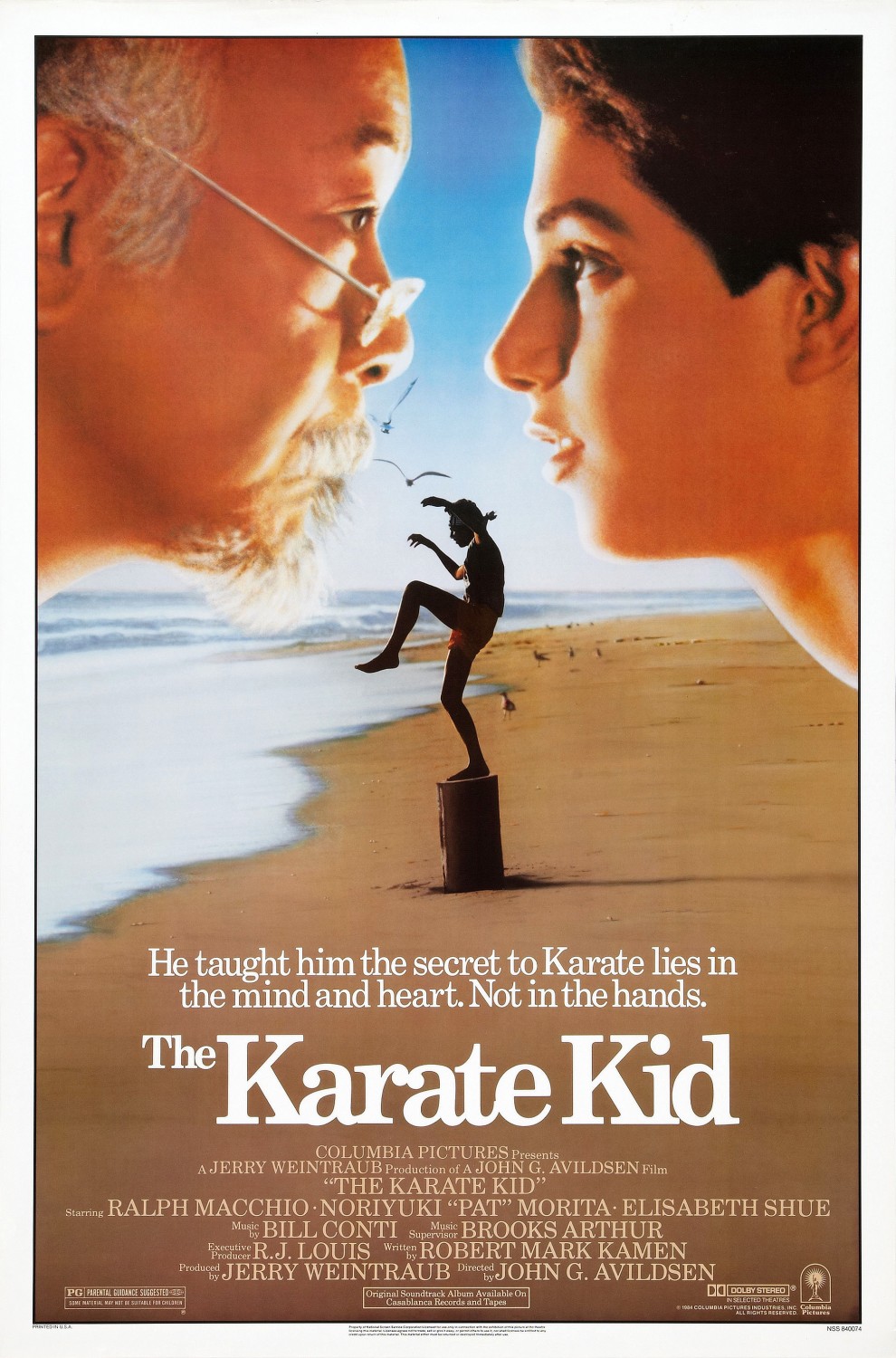
John G. Avildsen’s ‘The Karate Kid’ is Still the Infinite Crowd Pleaser

The Karate Kid 1984 poster

I wanted to write about “The Karate Kid” because it’s one of those movies which stays with me to where I know every piece of dialogue in it. I got to see it at the long-gone Melody Theater back in Thousand Oaks where I saw many classic 1980’s movies. I still vividly remember seeing it with my older brother and mom, and it was one of the few movies she would ever take us to see in a theater back then.

It has now been more than 30 years since the original it came out, so I guess it’s safe to say you all know the story by now. Ralph Macchio plays Daniel LaRusso, a high school teenager who moves with his mom from New Jersey to California. Having moved a lot as a kid, I can appreciate his frustration at having to adapt to new surroundings which are not prepared to welcome you with open arms. He runs afoul of a tough gang known as the Cobra Kais, and they are led by Johnny Lawrence (William Zabka). When he sees Daniel flirting with his girlfriend Ali (Elisabeth Shue), Johnny lays down the law and kicks Daniel’s ass without any pity.

“The Karate Kid” had a strong impact on me. I got picked on a bit when I was a kid, and seeing him get messed around with filled me with a sadness and anger in how unfairly people get treated. You want to see him get his revenge against these guys even though it will likely bring the same vicious reaction from the Cobra Kai. When you see him get beat up again, I remember how angrier and angrier I got. But that’s when this movie gave us one of its best moments as Mr. Miyagi came to the rescue and kicked ass. Seeing Miyagi coming from behind in the shadows got my heart and excitement up, and it was a pleasure to see him give those bullies the beating they deserved.

Mr. Miyagi is one of the best characters to come out of the 1980’s, and he remains one of my favorites from that decade. He is basically an Okinawan Yoda, and he is brought to life by the late Pat Morita in a performance I was so hoping would snag him the Best Supporting Actor Oscar he was nominated for. Although this character became a cliché for many other movies, the guy who does a low profile and lonely job but who is actually a war hero with the greatest of skills and training, Morita is brilliant in how he shows the seriousness of Miyagi as well as his joyous and humorous side as well. I did not realize Morita was a stand-up comedian before he did this movie. Then again, he was on “Happy Days” for a while.

After all these years, “The Karate Kid” still proves to be one of the few movies which really shows us the truth about karate. Karate is a spiritual thing more than anything else, and it was not about being trained to attack the way John Kreese (Martin Kove) taught others to do. It was about defense more than anything else. Moreover, it was about making yourself a better person on the inside as opposed to just the outside. I have heard from my closest friends about how studying karate helped raise their self-esteem to where they felt better about themselves. I even studied karate for a bit to experience it for myself, and it’s something I hope to continue in the near future.

The friendship between Daniel and Miyagi is one of the best I have ever seen portrayed onscreen. You are pretty much in Daniel’s shoes as he tries to figure out what the heck is going on when Miyagi has him washing his cars, painting his fence, sanding his floor and painting his house instead of teaching him karate. This leads to one of my favorite moments where Daniel realizes Miyagi has trained him in karate without him even knowing it. All these chores give him reflexes which have become ingrained in his consciousness to where they are practically automatic, and it is then that he realizes he has long since learned how to defend himself.

As Daniel LaRusso, Macchio gave us his quintessential performance from the 80’s. In the first two “Karate Kid” movies, he found a balance between being obnoxious and sincere, and he makes LaRusso a likable guy to where his transformation into a true karate student feels real and authentic.

Shue was so beautiful in this movie, and I liked how she embodied her character to where she practically spits at the clichés of the typical spoiled rich girl we have seen in far too many movies. Shue and Macchio might seem like a highly unlikely couple, but these two convince you they could be together. I always hated how Shue’s character got dumped in “The Karate Kid Part II.” I never really bought how that all came about, and I thought it was really shitty to not include her in the sequel. Shue was a wonderful and vivacious presence here, and she went on to give an unforgettable performance in “Leaving Las Vegas.”

Morita’s career went downhill after appearing in “The Karate Kid.” Seeing him doing local car center commercials was frustrating, but what he does here with Miyagi is amazing. It’s one of those performances where the actor becomes the character to where you never really see him acting, and that’s great film acting.

John G. Avildsen, best known for directing “Rocky,” helmed this movie with the same level of confidence as he did with the one he won a Best Director Oscar for, and he gives us a rousingly good time at the movies in the process. Since he has two great actors in the lead roles, he doesn’t waste time trying to manipulate our emotions because he makes everything in “The Karate Kid” feel very real. You’re not just watching this movie, you’re experiencing it along with the characters.

I also want to mention Kove’s performance as John Kreese as he proves to be the real villain of “The Karate Kid.” He trains his students viciously as if they are in a constant state of military basic training you would rather see end sooner than later. Kreese has programmed these kids to hurt and inflict punishment, any they look up to him for all the wrong reasons. But towards the end, they come to see Kreese is not all he is cracked up to be. There’s a great moment where he looks at Zabka as he is taking a break in the climatic fight with Daniel LaRusso and tells him to “sweep the leg.” Zabka’s character of Johnny Lawrence looks at Kreese like he is out of his mind, and it adds another to where it keeps the characters from becoming a pair of one-dimensional jerks we have seen too often.

“The Karate Kid” is a well written movie directed to near perfection and acted with supreme skill. After all these years, I never get sick of watching it, and I don’t think I ever will.

* * * * out of * * * *

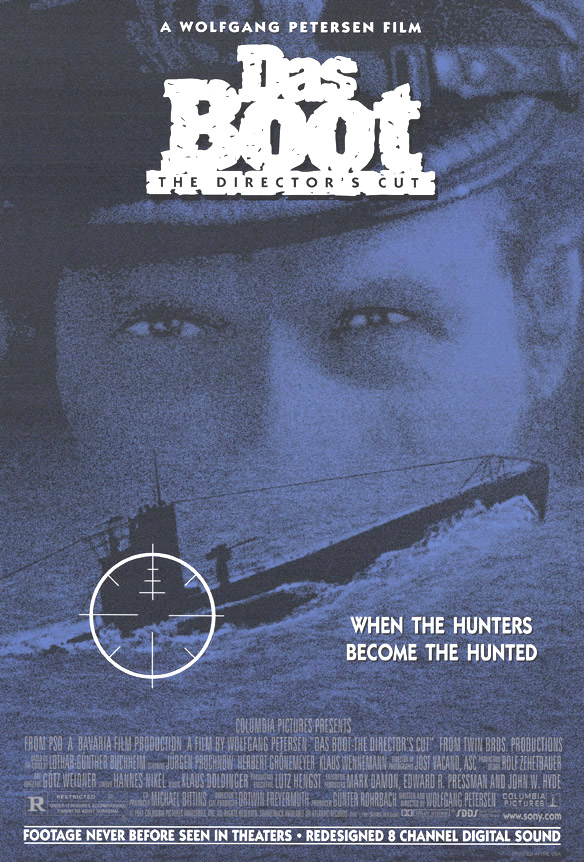
Das Boot

das-boot-movie-poster

With it out on Blu-ray, viewers can once again see that “Das Boot” is still the greatest submarine movie ever made. Other underwater sea adventures like “Run Silent, Run Deep,” “Crimson Tide,” and “The Hunt for Red October” may come close, but none of them can capture or match its power in unbearable claustrophobic tension. It remains Wolfgang Petersen’s crowning achievement as a director, and it has lost none of its power in sucking us into the inescapable terror people face in the deep dark sea.

“Das Boot” takes place in World War II as Commander Willenbrock leads a group of boys to sea on a U-Boat, the German version of a submarine, and covers the tedium of life at sea when no battles are fought. You feel the sweat and body odor of the crew quite vividly to where you will want to take a cold shower afterward. But it’s when they face off against destroyer ships when the intensity really goes into serious high gear.

Petersen does a brilliant job of conveying the terror and claustrophobic nature everyone on the U-Boat is forced to endure. You are right there with the crew and experiencing their frenzied emotions as the destroyers sail over them dropping depth charges which threaten to sink their boat in a heartbeat. The “ping” noises make the suspenseful tension even worse as the position of the submarine becomes easier to determine, and this becomes a film you experience far more than watch.

The director also does a really good job of getting viewers to know various crew members and the important roles they have on the ship. There is Chief Engineer Fritz Grade (the wonderful Klaus Wennemann) who finds looking at pictures of his wife too painful. Then there’s Chief Mechanic Johann (Erwin Leder) who is in love with his engines the same way Scotty loved the Enterprise in “Star Trek.” And there is also Senior Cadet Ullmann (Martin May) who is constantly worried about his fiancée who is French and pregnant. The more viewers know about the crew, the more emotionally drawn they are to their predicament.

There may some people who object to seeing “Das Boot” on the grounds the crew members were Nazis. Truth be told, not all of them are big fans of Adolf Hitler, and they are never seen wearing a Nazi insignia on their uniforms while at sea. But regardless of this, take away the politics of what’s going on and you will realize just how universal this movie is in what it portrays. Had it been the “good guys” instead, they would have endured the same crippling terror and fatigue so this crew could have been of any nationality.

It is also a powerful anti-war movie as well in showing not just the horrors and destruction of war, but also of the victories which become empty ones when soldiers see what is left behind. This is especially the case in one scene when the crew members are on the surface and surveying a freighter they successfully destroyed. They revel in their victory, but then they see survivors jumping off the ship into the ocean. They swim to the submarine pleading for help, but while the German crew members want to assist them, the Captain concedes there is no room for them onboard, and they are left to drown. It’s an emotionally devastating moment which captures the senselessness and the price of war.

“Das Boot” is based on the novel by Lothar-Günther Buchheim which was inspired by his own wartime experiences as a war correspondent onboard submarines. The character most resembling him here is Lieutenant Werner, and he is our guide through the chaos as his lack of experience aboard a submarine mirrors our own. What he discovers about life at sea, viewers discover along with him. Playing him is German singer Herbert Grönemeyer, and he does great work in conveying his naivety while covering the goings on of a German crew.

The best performance, however, comes from the great Jürgen Prochnow who plays Commander Willenbrock, the hardened sea veteran who looks like he’s seen everything war has to offer. The other officers freak out easily during an attack, but he keeps his cool because he needs everyone to do their jobs. It’s when he starts losing it, however, when things get really bad, and then the audience has a reason to freak out. Prochnow creates a multi-dimensional character which feels very much lived in, and he gives the Commander a subtle vulnerability which looks and feels effortless.

Petersen has been known best for making movies about people who are stuck in small places where there’s not much room to hide. He enthralled us when the American President’s plane was hijacked in “Air Force One,” he had Clint Eastwood chasing after John Malkovich during “In the Line of Fire,” and he has George Clooney and company trapped in the rocky sea in “The Perfect Storm.” “Das Boot” is where it all started for him, and it is a seriously intense and emotionally exhausting experience which thrills and terrifies you in equal measure. The accuracy to detail is never in doubt, and the audience will come up gasping for air once the credits roll.

There may be another submarine movie or two coming to movie theaters in the future, but after watching “Das Boot,” you can bet they won’t come close to topping it. Movies don’t get much more thrilling than this one, and it is a must see for those who are fans of Petersen’s work or war movies in general. It is also more preferable to some of the director’s more recent work like “Poseidon” and “Troy.”

* * * * out of * * * *

Note: There are currently many different versions of “Das Boot” available. The original theatrical cut lasts about two and a half hours. The director’s cut of it added an hour of footage which gave more depth to each character. And before it made its way onto Blu-ray, there was the uncut miniseries version which runs for almost five hours. You may want to start off with the director’s cut and then move on to the miniseries which perfectly captures the infinite tedium of the crew that feels endless.