‘Lyle, Lyle, Crocodile’ – Fun for the Kids. Adults? Not so Much

For some reason, I have found myself thinking about “The Muppets Take Manhattan” over the past few days. I’m not sure why as, while it is very good, it does not rank as highly for me as “The Muppet Movie” or “The Great Muppet Caper” do. Perhaps it came to mind because it was one of the last Muppet movies to appeal to both kids and adults at the same time. The equivalent to that these days are Pixar movies, and yet many of them end up streaming on Disney Plus instead of being shown on the silver screen where they belong.

When it comes to family movies these days, I always hope and pray they will appeal to both kids and adults, but that is often not the case. The latest example of this is “Lyle, Lyle, Crocodile” which is based on the children’s story of the same name by Bernard Waber as well as its prequel, “The House on East 88th Street.” Apart from featuring quite the cast of actors, it also contains songs from those who wrote the music for “The Greatest Showman,” and I still remember that cinematic musical as being quite invigorating. When it comes to this movie musical, however, the kids are bound to have a fun time, but adults will find the proceedings watchable at best.

“Lyle, Lyle, Crocodile” introduces us to Hector P. Valenti (Javier Bardem), an aspiring actor and musician who looks to make it big in show business and on a show which is the equivalent of “America’s Got Talent.” We quicky learn, however, that Hector has been around this show’s tryouts quite a bit, and those involved are quick to eject him from the premises before he embarrasses himself any further.

Regardless of his circumstances, Hector is still determined to become a big star no matter what, and he finds his key to success while visiting a pet store in downtown New York. While there, he comes across a young saltwater crocodile named Lyle (Shawn Mendes) who has the kind of singing voice which would wow the judges on “American Idol.” They quickly form a singing and dancing act which Hector believes will lead them to a life of infinite fame and fortune, Lyle, like Michigan J. Frog from the Merrie Melodies short “One Froggy Evening,” finds he is not up to performing in front of an audience. Due to financial necessity, Hector is forced to leave Lyle behind as he goes solo in an attempt to make the money he so desperately needs to pay off those he is in debt to.

Cut to 18 months later (Enya was right when she sang about how time flies), and Hector’s residence is now being inhabited by the Primm family which is made up of Joseph (Scoot McNairy), Katie (Constance Wu) and their son Josh (Winslow Fegley). These three have just moved from the suburbs to downtown because what better way to uproot themselves and their son. As you can expect, Josh ends up befriending Lyle in an unexpected way, and the two quickly bond as two strangers in a strange world can.

Like “Don’t Worry Darling,” “Lyle, Lyle, Crocodile” deals with a storyline which is as old as they come. Whether we are talking “E.T.” or “Mac and Me,” one of Paul Rudd’s favorite motion pictures ever, a young child alienated in their environment and befriending a creature who quickly becomes their best friend has been done to death. Judging from the reception I witnessed at the press screening I went to; young kids will very much enjoy this. As for the adults, they will get much enjoyment over how their children react to what is on the silver screen, but they may find themselves tunning out more often than not.

When it comes to Lyle, this is a crocodile you want to hug and keep Michael J. “Crocodile” Dundee away from as Lyle is not about to take anyone on a death roll. Directors Will Speck and Josh Gordon have gone out of their way to make this creature a lovable one to where kids will be begging their parents for a crocodile of their own come Christmastime. To this, parents will be wondering if they actually want a real one or if a stuffed animal will do.

The best things about this movie is, of course, Javier Bardem who makes the wannabe actor and magician Hector P. Valenti all the more charismatic. What seems like a simple two-dimensional character on the page is made all the more complex as Bardem makes you love, despise and pity Hector all at the same time. I figured a role in a movie like this would seem like a walk in the park for him, but clearly this is not the case.

As for the other human actors, Winslow Fegley makes Josh Primm into an appealingly alienated young dude whose earnestness is well earned. Constance Wu gives her a scenes a wonderfully physical and comedic flair while Brett Gelman wastes no time in making us see why his character of Mr. Grumps has the name he has. As for Scoot McNairy, I get the feeling he would rather be in another picture than this one.

When it comes to the songs by Pasek and Paul, the same duo who penned the music for “La La Land” and “The Greatest Showman,” for me they went in one ear and right out the other. Sure, they have a boisterous quality to them and get the adrenaline going for a minute, but they also don’t leave much of an aftertaste. Some musicals you come out of humming a tune or two, but this one had me struggling to remember any lyrics.

Shawn Mendes does have quite the voice as Lyle sings to communicate with the Primm family and others, but it eventually got to where I wanted this crocodile to speak as well as sing. I wanted Lyle to discuss how he felt about movies like “Crocodile Dundee,” or if he found the 1980 cult classic “Alligator” in any way offensive to his species. Or perhaps this is just my way of saying that my wandered from time to time as the events unfolded, and that is never a good sign.

You know what? “Lyle, Lyle, Crocodile” is not a bad movie. It is watchable and at times a lot of fun, but it seems rather generic as compared to so many others from this genre. I have no doubt kids will enjoy this, especially the very young ones. As for the adults, hopefully they will enjoy how their children react to what they see on the silver screen.

For me, it’s not enough for a movie to be passable at best, and this is especially the case with family or children’s’ movies.

* * ½ out of * * * *

‘Public Enemies’ – Michael Mann and Johnny Depp Take on John Dillinger

“The reason you caught me, Will, is we’re just alike! You want the scent? Smell yourself!”

-Dr. Hannibal Lecktor (Brian Cox) speaking to Will Graham (William Peterson) from a scene in Michael Mann’s “Manhunter.”

After all these years, Michael Mann still has a strong fascination with criminal masterminds and those who spend their careers chasing them down. Film after film, he has spent his time delving into how the “good guys” and “bad guys” feed off of one another, and if they could not exist without one another. “Public Enemies” reminded me a lot of “Heat” in that respect, and it shares a lot of similarities as it looks at the famous John Dillinger, played here by Johnny Depp, and at the man sent to catch him, Melvin Purvis. It’s not as great a film as “Heat” was, but it is still a masterful piece of filmmaking and the kind we have come to expect from director Michael Mann.

“Public Enemies” starts with Dillinger and his friends breaking out of a maximum-security prison, something which seemed easy to do back in 1933. It turns out Dillinger is actually quite the celebrity and can find safe havens in one town or another. To many he is seen as a hero, and to others he is nothing more than a criminal. But as Dillinger continues to rob more banks, the FBI and J. Edgar Hoover (played by Billy Crudup) become increasingly persistent in bringing him to justice. In the process, Hoover turns to Melvin Purvis (played by Christian Bale) who subsequently leads a manhunt to take down Dillinger, and in the process changes from the person he thought he could be to the one he is chasing after.

One thing which has not changed about Mann’s movies is he still knows how to stage one hell of a gunfight. Back in 1995, he gave us one of the greatest in Downtown Los Angeles with “Heat,” and he has lived in the shadow of that brilliantly staged moment ever since. Sure, he has choreographed gun battles every bit as effectively brutal like in “Collateral” and his film version of “Miami Vice.” In his films, you don’t just watch guns go off, you feel them going off. When a bullet hits a body, characters don’t just fall down like in an old western. Their bodies are forever shattered, and the wounds they carry last long after the end credits have finished. There are a lot of strong action scenes like this throughout “Public Enemies,” and each one is equally hair raising. While “Heat” may remain his masterpiece, his other works do not pale in comparison necessarily.

Having Johnny Depp cast as Dillinger must have seemed like a no brainer. They appear to share some similar tastes minus the heavy gunfire, given Depp’s previous reputation as a “wild boy:”

“I like baseball, movies, good clothes, fast cars… and you. What else you need to know?”

-Johnny Depp as John Dillinger from “Public Enemies”

Depp remains one of the best actors of his generation, and he has constantly challenged himself to where this particular role is no exception. Dillinger was a criminal celebrity, perhaps one of the first, and Depp effortlessly shows you how Dillinger made this seem possible. With his eyes, Depp can still seduce the most knowledgeable and naïve of women without even having to try too hard. The actor also clearly brings out the joy Dillinger gets out of life, and he also gets at the depth of pain he experiences as those closest to him leave him, cut him loose, or get killed.

As Melvin Purvis, Christian Bale delves into many of the same situations which haunted Bruce Wayne/Batman in “The Dark Knight.” Melvin starts off as a man who is dedicated to the law and follows the rules and regulations to the letter. But after some serious setbacks, Melvin finds he has to use different methods in order to get his man. These methods include acts and people which and who work outside of the law. In the process, he comes to see what he has to become in order to capture Dillinger. But unlike Bruce, Melvin may not be able to live with himself when this is all through. Bale pulls off a really solid accent while playing Melvin, and he has a much more nuanced character to play here than he did in movies like “Terminator Salvation.”

But the one performance I enjoyed most in “Public Enemies” was Marion Cotillard’s who plays Dillinger’s girlfriend, Billie Frechette. Cotillard won the Best Actress Oscar for giving one of the greatest performances of all time in cinematic history in “La Vie En Rose.” She shares great chemistry with Depp throughout, and she is delightful to watch as Billie is ever so quickly drawn into Dillinger’s dangerous world. Billie does sense the trouble which lies ahead, but everything happening is too exciting for her to pass up. Showing both fear and excitement in a film scene without words is easier said than done, and she pulls it off like it’s no big deal.

If there’s anything which takes away from “Public Enemies,” it is that it doesn’t delve as deeply into the characters’ lives as I had hoped it would. If anything, this film would have benefited more from a back story, especially for Dillinger as to why and how he became a bank robber. It was also said that Dillinger was a hero because the banks he robbed ended up freeing things up for those who were economically challenged because of the Great Depression. I would have liked to have seen more of this because Mann may have thought this was clear from the way regular people treat Dillinger, but it doesn’t feel like they have a good enough reason to. Had there been a little more depth to these characters, this could have been as great a movie “Heat.”

Still, “Public Enemies” is fine filmmaking and continues Mann’s theme of looking at how the line between cops and criminals is often blurred and how both are actually one and the same. You could almost call this “Heat” as a period piece. Mann makes you wonder if a criminal can ever find and hang onto a love despite their law-breaking nature, and if the cop can ever lead a normal life outside their career of going after the crook. From William Petersen trying to think like the killer in “Manhunter” to James Caan trying to leave a life outside of crime in “Thief,” it’s a thin line indeed. Perhaps Mann keeps pursuing this theme in hopes that there will be a tomorrow for characters like these regardless of their opposing natures. Maybe he will find the answer in a future motion picture, and hopefully we will not have to wait too much longer for such a cinematic work.

* * * ½ out of * * * *

‘Bullet Train’ – A Bumpy but Entertaining Ride Thanks to Brad Pitt

Bullet Train” is one of those movies which takes you on an adrenaline-fueled ride and leaves you wrung out at its incredibly chaotic conclusion. Now I usually begin writing movie reviews soon after I watch one, but I had to sit down for a bit after and gather my thoughts when it came to this particular feature film. Yes, it is furiously entertaining, but the story does drag from time to time and there are moments which defy simple logic. Also, some have accused the film of trying to be Tarantino-esque as the director wants the characters to look and sound cool when they talk. My response to those criticisms is this: didn’t the trailers spell out to you that this is a motion picture which you will need to check your brain at the door while watching it?

Based on the Japanese novel “Maria Beetle” by Kōtarō Isaka, “Bullet Train” is not a perfect movie, few movies are for crying out loud, but for the most part I found myself really enjoying the chaos on display as we watch Brad Pitt portray an American assassin who makes his way through a Japanese train going at a speed of about 200 miles an hour through the country’s vast railway system.

Pitt’s character has no name here, but he is given the codename of Ladybug by his contact and handler, Maria Beetle (voiced by an Oscar winning actress whose voice you will recognize). His mission is a snatch-and-grab one as he is to collect a suitcase on a train heading to Kyoto and then get off at the next stop. Ladybug is also an experienced assassin who has been doing his job for far too long, and this looks to be one of those last mission before retirement gigs for him. Also, he is trying to find some inner peace in the midst of all his deadly deeds and is quick to encourage others to do the same. Yes, “Bullet Train” is that kind of movie.

Now Ladybug is quick to acquire the briefcase which acts as this movie’s McGuffin, but getting off the train quickly turns into an insane comedy of errors as he keeps running into other assassins whose missions prove to be very similar to his. Among them are British assassins Lemon and Tangerine (Brian Tyree Henry and Aaron Taylor-Johnson), Japanese assassin Yuichi Kimura (Andrew Koji) who looks to avenge his son who lies in the hospital in critical condition, a Mexican assassin known as The Wolf (Benito A. Martinez Ocasio, a.k.a. Bad Bunny) who has a special grudge against Ladybug, and Prince (Joey King) who is a British assassin who received her codename only because her parents really wanted a boy instead of a girl.

With everything set up, we know these characters will eventually collide with one another in inventive and creative ways as their individual missions have an inevitable connection. Seeing it all happen on a train traveling at a very high speed is especially exciting as, while these assassins are trying to kill or trick one another, the rest of the passengers are sitting in their seats as, to quote a line from another movie starring Pitt, “calm as Hindu cows.” Oh yeah, there is a venomous snake which manages to escape its cage and slither about the train in the same way that spider crawled around the McCallister house in “Home Alone,” and you sit in fear of it striking at the least suspecting passenger.

Directing “Bullet Train” is David Leitch who helmed the very first “John Wick” film, the insanely entertaining “Deadpool 2,” and “Atomic Blonde” which starred Charlize Theron who gave a performance which should have had you saying, “not bad for a human.” Clearly, he is out to give us a fun-filled ride, and he delivers for the most part. Not everything lands in the way it should as some moments fall flat, but those which do hit had me enthralled and laughing my ass off. While it may not be as thrilling as “Top Gun: Maverick” or the vastly underappreciated “Ambulance,” Leitch for my money gives this motion picture more entertaining set pieces than not, and that makes it worth seeing in my opinion.

The other actors go out of their way to fully inhabit their roles regardless of whether or not their screen time is long or short. Both Taylor-Johnson and Henry work off of one another very well, and that’s even though I could not always understand every word coming out of their mouths. As for Henry, his character of Lemon goes out of his way to give us all a special appreciation of the British children’s television series “Thomas & Friends” and of all the different kinds of trains there are in the world.

One of my favorite performances comes from Joey King as the oddly named Prince. From the first time we see her, she proves to be an alluring presence as she uses her disguise as a schoolgirl to gleefully throw her antagonists off-balance in an almost sublime manner. Her eyes show us a character who is infinitely dedicated to taking out her main target with extreme prejudice, but she also succeeds brilliantly in deceiving those around her ever so easily. Seriously, King steals every scene she is in.

But yes, the one person who manages to connect everything together here is Brad Pitt who once again proves why he is one of Hollywood’s best and most dependable of movie stars. Even if his performance threatens to be too broad at times, he made this film especially fun and looks to be having the time of his life. There’s also a scene where we see him traveling through the train cars in slow motion (you will now what I am talking about when it happens), and the expressions he gives off prove to be absolutely priceless.

Now I cannot say that “Bullet Train” will remain in the mind long after you have watched it but watching proved to be a blast for the most part. While many may say it pales in comparison to other films from its genre, I was never quick to compare it to others. There may a few bumps and lags on this particular train ride, but I still enjoyed this film for what it was, and that was enough for me. And, like “Where the Crawdads Sing,” it makes me want to read the book it is based on.

Oh, there are some truly brilliant celebrity cameos to be found here, especially towards the end. Seriously, they are alone worth the price of admission, particularly when it comes to the one actor playing an assassin named Carver.

* * * out of * * * *

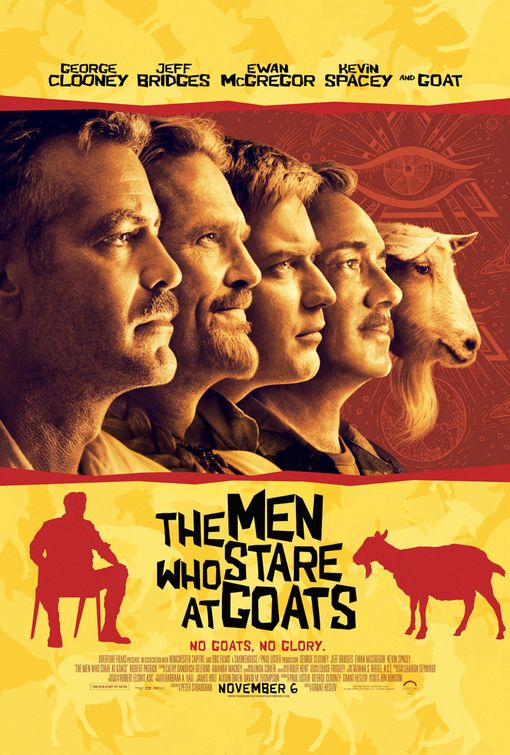
Underseen Movie: ‘The Men Who Stare at Goats’ – A Highly Unusual War Movie

WRITER’S NOTE: This review was written in 2009.

“More of this is true than you would believe.”

You know something? It’s really nice to see a movie use a phrase other than “based on a true story” or “inspired by true events.” Those descriptions have all but lost their meaning because even if what we are seeing actually did happen, it has all been watered down into a formulaic feel-good movie we have seen over and over again to where we want to gag. Even worse, we keep getting suckered into seeing them even when we should know better. Either that, or there’s nothing better to watch. But this year has proven to be great as filmmakers have worked hard to subvert those worthless phrases with movies like “The Informant.” That Steven Soderbergh film made it very clear how it was based on actual events but that certain parts had been fictionalized, and it ended by saying:

“So there!”

Now we have “The Men Who Stare at Goats” which opens with the sentence at the top of this review. The story behind this one is so bizarre to where it’s almost impossible to believe any of what we are watching could ever have happened. All the same, it appears a good portion of these happenings did take place, and it makes for what is truly one of the more unique war movies I have seen in a while. The film is based on a non-fiction book by Jon Ronson which looked at how US military forces used psychic powers against their enemies. They look at New Age concepts as well as paranormal activities to achieve these goals, and of how they worked to use these methods to their advantage. The movie takes place during the Iraq war, but not to worry, the filmmakers is not trying to shove any politics down your throat (not consciously anyway).

Ronson serves as the inspiration for Bob Wilton, an investigative journalist played by Ewan McGregor. Bob’s wife has just left him for his editor and, of course, he is depressed and decides he needs to do something more important with his life in the hopes he can win her back. As a result, he travels to Kuwait to do firsthand reporting of the Iraq War, with hopes of finding someone who can get him across the border. Bob ends up having a chance meeting with a Special Forces operator named Lyn Cassady (George Clooney) who was in the military, but now runs a dance studio. Lyn reveals to Bob he was part of an American unit that was trained to be psychic spies or, as he eventually calls them, “Jedi warriors.” From there, Bob learns everything about this special unit which sounds like something out of a science fiction novel.

I love the irony of all the talk about “Jedi warriors” here, especially since McGregor played one in the “Star Wars” prequels.

Anyway, “The Men Who Stare at Goats” is really a cross between a war movie and a road movie as Lyn and Bob traverse the sandy dunes of the Middle East to where not everything is as it appears. This film is also a mix of comedy and drama the same way “Three Kings,” another war movie which starred Clooney, was. While the tone is largely uneven, especially towards the end, this was definitely an inspired film which kept me entertained throughout and proved to be quite unpredictable.

McGregor is playing the main character here, but let’s face it, Clooney steals the show right out from under his feet. His performance as Lyn Cassady is truly one of his most surprising and inspired. Despite how ridiculous Lyn may seem, Clooney plays him straight and never appears to be self-conscious. Seeing Clooney trying to burst clouds with his mind, and trying to reach into his enemy’s mind by staring right at them has the actor going through emotions ranging from serious to funny to downright tragic. Having gone from playing dramatic roles in movies like “Syriana” to “Michael Clayton,” Clooney once again shows he is really good at comedy and never has to strive hard for a laugh.

I don’t want to take away from McGregor though, who pulls off a convincing American accent. In many ways, his role is more of a reactionary one as he is subjected to conditions one is never fully prepared for. Bob is bewildered at what Lyn is telling him, and yet he still wants to journey further and further into Lyn’s head. I also have to give McGregor a lot of credit because he could have made it look like he was consciously aware of all those “Star Wars” references, but he never did.

But one of the great delights is watching Jeff Bridges channel his inner-dude-ness from “The Big Lebowski” into his role of Bill Django, a military leader who, after being wounded in Vietnam, has a New Age vision of combat he wants to develop. This leads him to study concepts which he incorporates into a special unit called the New Earth Army. Bill becomes a teacher of using non-lethal techniques to gain advantage over the enemy, and his training techniques are unorthodox to say the least. Bridges plays the character broadly, but not too broadly. As funny as Bridges is, he infuses Django with a disappointment which threatens to render him useless to those around him, and with a deep sense of fear and tragedy as his techniques are misused or taken advantage of by those who seek to profit from them.

Having been in London doing tons of theater, it seemed like it would require a herculean effort to bring Kevin Spacey back to the big screen. Seeing him here is a kick as he plays the real antagonist of the film, Larry Hooper. Larry is basically the Darth Vader to Bill’s Obi Wan Kenobi and Lyn’s Luke Skywalker as he takes the non-lethal methods of the New Earth Army and ends up using them for more lethal purposes. Larry ends up doing this not so much out of greed as he does resentment since Django does not consider him in the same light as Lyn. His actions bring about the downfall of the New Earth Army, and he turns all these abilities they developed into something far more insidious. From there, you will see why the movie and the book it is based on has the title it does.

Spacey has great fun as he channels the inner smugness which has enveloped Larry over time. While his role is a little more serious than the others, he still has great moments of comedy which remind us of what a talented actor he is as he balances out the serious and comedic aspects of Larry without tilting too much in one direction.

“The Men Who Stare at Goats” was directed by Grant Heslov, Clooney’s business partner on many films. He has his work cut out for him here as he must find a balance between the humorous and dramatic aspects of the story. Granted, Heslov doesn’t always succeed but he creates a most unusual war movie, and it is all the more entertaining as a result. Even more telling is the way he portrays the Iraqi people in certain scenes. They are not shown as gun toting terrorists, and he captures the look of their helplessness in having to deal with a military occupation they did not ask for.

Like I said, there’s no serious politicizing of the Iraq war in this movie, so don’t feel like you are walking into some sort of trap. Like “The Hurt Locker,” it merely focuses on what those Americans in Iraq were doing in the midst of the chaos, albeit in a more comical way. “The Men Who Stare at Goats” seems almost far too bizarre to be real, but a part of you just might want it to be real. One thing’s for sure, you will never look at “Barney and Friends” in the same way ever again, assuming you ever watched it in the first place (c’mon! Don’t deny it!).

* * * ½ out of * * * *

‘Where The Crawdads Sing’ Doesn’t Dig Deep Enough into the Marsh

After watching “Where the Crawdads Sing,” I immediately went out and purchased a copy of Delia Owens’ novel upon which it is based. Judging from the opening narration in which the main character of Catherine “Kya” Clark tells the audience how “marsh is not swamp” but instead is “a space of light where grass grows in water, and water flows into the sky,” this cinematic adaptation looked to defy all the perceptions we typically have of such places on Earth. This is further emphasized by her describing how swamp exists within the marsh and is “quiet because decomposition is cellular work,” and how it “knows all about death, and doesn’t necessarily define it as tragedy, certainly not a sin.” This dialogue comes straight from Owens’ prose, and it stayed with me throughout the film’s 126-minute running time.

This cinematic adaptation of “Where the Crawdads Sing” comes to us from Reese Witherspoon who has gushed endlessly about how much she loves the novel, and she produced this film alongside Lauren Neustadter. The screenplay was written by Lucy Alibar who co-wrote “Beasts of the Southern Wild,” and it was directed by Olivia Newman who is best known for her Netflix film “First Match.” Clearly, there is a lot of talent in front of and behind the camera here, and the appreciation everyone has for the source material cannot be doubted. Still, while this film held my attention throughout, I Pate’s came out of it thinking, couldn’t the filmmakers have dug into the material even deeper?

We first meet Kya as a young girl who lives with her family in the North Carolina marsh, and it is fun to watch her being embraced by her loving mother. But then we see her dad (played by Garret Dillahunt) is an abusive bastard who treats every member of his family like crap. From there, Kya’s mother and siblings leave their home one by one to where it is just her and dad, and she learns to survive his drunken wrath in more ways than one. But soon he disappears, and Kya is forced to fend for herself and survive on her own to where she copes with loneliness in a way few others do.

Indeed, seeing Kya grow up in the marsh to where we can believe she can more than survive on her own provides this film with its most interesting moments, but it is all surrounded by a courtroom drama which makes the proceedings feel utterly routine and ordinary. As the story begins, the police come upon the body of Chase Andrews (played by Harris Dickinson), a high school quarterback who had been in a relationship with Kya which ended on a bitter and violent note. People in town are quick to label Kya as the key suspect as they have always viewed her as an outsider to where they fear her for all the wrong reasons. It is not long before Kya is arrested and charged with his murder.

Part of my problem with this film is that it treats many of the characters as caricatures instead of fleshed out human beings. More often than not, the filmmakers only touch on the surface of these individuals instead of transcending their nature to present something more unique. While certain characters are given special attention, others are painted in broad strokes to where they could have come out of so many other motion pictures. The period detail is spot on as the film immerses us in the times and tribulations of the 1960’s, but it still feels like we are just watching events unfold instead of living them through Kya and everyone else.

One actor who elevates his material here is the great David Strathairn who co-stars as Kya’s defense attorney, Tom Milton. While the prosecuting attorney looks and acts like a Jake Brigance wannabe, Strathairn transcends his character’s mannerisms and background to give us a performance which feels alive and lived in. Not once does he ever give us a moment which feels false as his character comes out of retirement to defend Kya in her murder trial. At the start, he asks Kya to her that he cannot help her until het gets to know her better. His character becomes key from there to the story as, like him, we want everyone to see Kya as an individual instead of some odd human being who exists in the shadows where few others dare to travel to.

Speaking of Kya, the actress who plays her is Daisy Edgar-Jones, and her performance for me was worth the price of admission. She more than inhabits Kya to where the character never comes across as some female version of Tarzan, but instead one who merely exists in the marsh as it is the only home she has ever known and feels comfortable in. Jones also renders many scenes she appears in with heartbreaking honesty as we watch her discover love for the first time, and later heartbreak which is always devastating, especially for the young.

It is also worth singling out Jojo Regina who plays the younger Kya as she embodies the character at a fragile point in her life. She shows us how lost the young Kya is when she first goes to school and discovers how cruel children can be to someone different from them. More importantly, Regina sets the stage for Kya becoming wholly independent as she digs in the marsh for mussels to sell to the local general store. Watching her, I believe Regina gave Jones so much great stuff to work with.

I also enjoyed the performances of both Sterling Macer Jr. and Michael Hyatt as Jumpin and Mabel, the kindly African-American couple who own and run the local general store where boats get their gas. They respect and care they have for Kya is strong and shows through their eyes and actions. Plus, Mabel has one of the movie’s best lines as she rightly points out that the Bible says nothing about being careful.

But as for the rest of “Where the Crawdads Sing,” it all feels inescapably routine. Sure, the cinematography by Polly Morgan is gorgeous, the music score by Mychael Danna fits the material perfectly, and it is clear everyone here has great love for the source material. But in the process of being slavish to the novel, they don’t do enough bring everything it to life. I cannot help but believe this adaptation could have been given much more depth as this movie could have stood out in the same way Michael Apted’s “Nell,” which starred Jodie Foster as a similar individual raised away from civilization. While the novel may have given many a unique experience, this movie fails to do the same as it becomes like many we have seen time and time again.

I think it would have been best to focus much more on the trifecta of Kya, her first boyfriend Tate (Taylor John Smith), and her second boyfriend Chase. Where Kya is a child of the wilderness and the marsh, Tate has one foot in the civilized world and another in the wilderness, and Chase himself is a product of the civilized world which has given him a lot of bad ideas about social status and women. These relationships are dealt with, but in a rather shallow way with some acting which is too theatrical for motion pictures.

Heck, I would have liked to have seen more of Dillahunt as Pa as, from what I have read of the novel thus far, there is more to him than being just a drunken bully. Perhaps we could have been given more depth into this character as a result to where we could understand why he acts the way he does even as we rightly despise his actions. Still, the movie decides to keep him at arms’ length. Granted, the main focus is, and absolutely should be, on Kya, but perhaps knowing more about the key people in her life would have made her coming of age adventures all the more enthralling.

If you are a fan of the novel, I think you will have to see how the movie “Where the Crawdads Sings” compares to it. There is a lot to like about it, and again, Jones is simply wonderful in the lead role. But considering how beloved this novel is, I imagine many will come out of it feeling like more could have been done with the material.

For what it’s worth, both the movie and the novel serve as a reminder of how the civilized and uncivilized worlds don’t go by the same laws as survival takes on different forms in each. And remember, unlike animals, human beings are the only species to put their own in cages, behind bars.

* * ½ out of * * * *

‘Edge of Tomorrow’ Movie and 4K/Blu-ray Review

The following review was written by Ultimate Rabbit correspondent, Tony Farinella.

Edge of Tomorrow” is a film that, on paper, had all the ingredients for a film I would enjoy.  Tom Cruise has always been an actor who has never been afraid to really throw himself into a project.  He takes his work seriously, and it shows with the films he releases.  He has great quality control.  Emily Blunt is one of the best-working actresses in Hollywood with a ton of range and depth.  When you throw in director, Doug Liman (known for action films such as the “The Bourne Identity” and “Mr. and Mrs. Smith”), it seemed like a recipe for a fun action film featuring some impressive action sequences and top-notch performances by its leads. However, the film forgot one of the most important ingredients of any truly successful action film: a great story.  It uses the Groundhog Day gimmick of repeating the same day over and over again.

A group of aliens, which are known as “Mimics,” are coming to destroy Earth.  They are fast, smart, and incredibly difficult to defeat. U.S. Army Major William Cage (Tom Cruise) is thrown into the fire by General Brigham (Brendan Gleeson) to help what is essentially a suicide mission against these Mimics. William Cage makes sure to tell him he has no combat experience, and he is not fit for any type of action. Brigham, however, is only looking out for himself, and he is looking to make Cage the fall guy. When he’s arrested and sent to Heathrow Airport, Cage soon discovers he is in way over his head. He’s part of a ragtag group of misfits known as the J-Squad.

Cage is killed instantly and starts to have the same day over and over again.  If this sounds familiar, it is because this formula has been used countless times in other films, most recently with the “Happy Death Day” franchise. During one of his multiple trips to France, he ends up meeting Sergeant Rita Vrataski (Emily Blunt).  It doesn’t take long for them to connect, and she reveals to Cage she also once had the same power he now possesses, where she had to repeat the same day over and over again.  She has since lost it.  If the two of them can team up, maybe together they can figure out a way to save the world from the Mimics.

“Edge of Tomorrow” is a very complicated film to follow at times. All of this talk about Mimics, alphas, betas, superorganisms and loops starts to become quite tedious after a while.  This should have just been a fun, easy-to-follow film with some action and laughs thrown in the mix.  There is plenty of action, in fact, there is too much of it.  At times, it really took me out of the film. A little bit of character development and a little time to stop and smell the roses would have been appreciated. Any great action film takes the time to really let us get to know about our main characters. We know absolutely nothing about them. Cruise and Blunt are entertaining when paired together, but it doesn’t take long for the film to resort to wall-to-wall action right away.

Between the convoluted story, the non-stop action and lack of character development, I found it hard to really get into “Edge of Tomorrow.” I can’t deny the special effects are impressive and the Mimics look really good, but I didn’t sign up for either of them though, I realize I’m in the minority on this 2014 film, which made quite an impression with a majority of critics. I truly wanted to like this film, and I was prepared to sit back and shut my brain off and enjoy myself for two hours. I just couldn’t suspend my disbelief for that long because the film was throwing too much at me with little rhyme or reason.  It didn’t take the time to explain things or to make us care about what was happening on screen.

* * out of * * * *

4K Info: “Edge of Tomorrow” is released on a two-disc 4K Combo Pack from Warner Brothers Home Entertainment. It comes with the 4K, Blu-ray, and a digital copy of the film.  It has a running time of 113 minutes and is rated PG-13 for intense sequences of sci-fi action and violence, language, and brief suggestive material.

Audio Info: The audio formats for this film are Dolby Atmos-TrueHD: English, DTS-HD MA: French, Dolby Digital: English Descriptive Audio, French, and Spanish. The film has subtitles in English, French, and Spanish. I’m always a huge fan of Dolby Atmos audio, and it really stands out in a film like this.

Video Info: The 4K is released on 2160p Ultra High Definition. The High Dynamic Range really makes the film look moody, dark, and shadowy. It’s an impressive looking 4K. The Blu-Ray is in 1080p High Definition.

Special Features:

Operation Downfall – Adrenaline Cut

Storming the Beach

Weapons of the Future

Creatures Not of This World

On The Edge with Doug Liman

Deleted Scenes

Should You Buy It?

Sadly, I can’t recommend you go out and purchase “Edge of Tomorrow.”  However, if you are a fan of the 2014 film, I would encourage you to upgrade from the Blu-ray to the 4K.  There is a noticeable difference between the two formats in terms of picture quality and audio.  It had been eight years since I watched the film, and I didn’t think much of it back then.  I thought maybe a second viewing would give me a new appreciation for the film.  I’m sad to report that is not the case.  It’s still not a film I enjoy or can recommend you pick up unless you own the Blu-ray and want the 4K experience.  I like all of the participants in the film, but the storyline has been done before and done better. The actors are really hampered by the exhausting script. It’s too much movie and there is no brain behind it.  The characters are also written without a lot of thought behind them. The film is simply eye candy with its special effects.

**Disclaimer** I received a copy of this film from Warner Brothers to review for free.  The opinions and statements in the review are mine and mine alone.

‘The Great Gatsby’ – Even Baz Luhrmann Can’t Bring Fitzgerald’s Classic Novel to Life

I once had a teacher in college who told me filmmakers keep making the same movie over again and again without even realizing it, and Baz Luhrmann is a prime example of this. His “Romeo & Juliet” and “Moulin Rouge” dealt with characters looking back at a past they can never return to and of love affairs which ended tragically. His adaptation of F. Scott Fitzgerald’s classic novel “The Great Gatsby” is not any different from those two films, and it is filled with extravagant scenes that dazzle us with amazing choreography and beautiful images. But while it is a beautiful movie to look at, this film lacks the heart and soul I usually expect Luhrmann’s works to have in an infinite degree.

This “Gatsby” adaptation starts with Nick Carraway (Tobey Maguire), a writer and bond broker, telling us about his time in New York during the 1920s (better known in the history books as the “Roaring 20s”). Right there I knew the movie was in trouble as Luhrmann started “Moulin Rouge” off with Ewan McGregor reflecting on an exhilarating past and a great love which has long since passed him by, and Maguire is a very similar character in that respect. From there, it is clear that this movie will not have a happy ending, and the characters we see enjoying themselves will soon experience a suffering which will be endless. We’re not even five minutes into this cinematic adaptation, and already I can tell this will be familiar territory for Luhrmann, way too familiar.

The 1920s were a time of great wealth and endless partying which came to a crashing halt the following decade when the stock market crashed and Americans found themselves out of a job (sound familiar?). Carraway finds himself caught up in all the hoopla which came with those times, and it’s at an especially over the top party where he meets Jay Gatsby (Leonardo DiCaprio), a man as rich as he is mysterious. From there they become inseparable friends as Gatsby shows Carraway around town and introduces him to the most influential people one could ever hope to meet. But it’s when Gatsby takes a strong interest in Carraway’s cousin, Daisy (Carey Mulligan), that things start changing and not for the better. It turns out Gatsby knew Daisy in the past, and now Gatsby will do everything in his power to win Daisy back from her suspicious husband, polo player Tom Buchanan (Joel Edgerton).

“The Great Gatsby” has the same problem Luhrmann’s “Romeo & Juliet” had during its first half; it thrust a lot of style and flash cuts at us at an alarming rate to where I was desperate for things to slow down so I could breathe and actually everything in on a deeper level. Now Luhrmann did slow things down in “Romeo & Juliet” to where we connected emotionally with the story and its characters, and he successfully reinvigorated one of William Shakespeare’s most overdone plays to where it felt fresh and exciting again. But this time he gets so caught up in the spectacle he is putting up for us all to see to where it became impossible for me to connect with anything or anybody here. The sensory overload I got in his previous films was exhilarating, but here everything feels so exhausting and artificial to where it doesn’t matter if you watch this film in 2D or 3D (I watched it in 2D because I refused to spend the extra money). The characters may be starving for emotion, but it’s the audience that needs it even more.

Whether or not you have read Fitzgerald’s classic novel, it’s easy to see the direction this movie was going to take. As a result, I found myself getting very bored and impatient as I knew Gatsby would eventually stumble over his own ambitions, and I just wanted see him get his ass kicked sooner rather than later. Heck, I even got up and went to the bathroom at one point, and that should you give you an idea of how frustrating this movie was for me. I was able to sit through “Star Trek V: The Final Frontier” despite needing to pee really bad, but this one I could not hold it in. Yes, that’s too much information for you readers, but anyway…

On the upside, the actors acquit themselves very nicely. You can’t really go wrong with DiCaprio, and he does make quite the dashing Gatsby, but there should be a drinking game based on how many times he calls people “old sport” throughout, and I seriously got sick of him saying that. His good friend Tobey Maguire has his back as Nick Carraway, and he does a lovely job of reading Fitzgerald’s words to where I’d like to hear him do a reading of the novel as he brings us a lot closer to the author’s dialogue than Luhrmann does.

Carey Mulligan, however, is seriously miscast as Daisy Buchanan. She still gets to do her whole woefully vulnerable lady act which she played to perfection in “An Education,” but Mulligan is not able to nail the other complexities this role has to offer. Yes, she is a lovely presence to watch in this or in any other movie, but this is not enough to save her performance here.

Clearly a tremendous amount of effort was put forth by the cast and crew on “The Great Gatsby,” but it doesn’t change the fact that the movie is a profound disappointment. Fitzgerald’s novel has been adapted several times with limited success, and many say it is an exceedingly hard book to translate to the silver screen. Luhrmann looked like he was the man who could do it justice, but he doesn’t come close. What a shame. We can always count on him to give us spectacle as well as substance, but this movie is all spectacle and not enough substance.

* ½ out of * * * *

‘The Lincoln Lawyer’ – The Beginning of the McConaughey Renaissance

WRITER’S NOTE: This review was written in 2011, back when the McConaughey renaissance was just beginning. This almost marks the 1,000th post on The Ultimate Rabbit website!

Okay, now how many dramas and thrillers featuring a lawyer as the main character have we had these past few years? Heck, how many novels featuring lawyers have been thrust at us? After everything written by John Grisham and Scott Turow, you’d think the world would have had enough of legal thrillers whether or not they made it to the silver screen. It all reminds me of that joke we’ve all heard:

“What do you call a thousand lawyers at the bottom of the ocean? A good start!”

As a result, I was in no immediate hurry to check out the latest legal thriller adapted into a movie, “The Lincoln Lawyer.” This particular one is about a defense lawyer who has no scruples about what he does, but he ends up getting involved in a case which haunts his conscience like no other. Looking this plot line over, it sounds like “Primal Fear” all over again. How many times have we been down this road? Yes, I agree, far too many.

But alas, while “The Lincoln Lawyer” breaks no new ground in the legal thriller genre, it does contain many clever twists up its sleeve which distinguishes it from others of its ilk. It is based on the novel of the same name by Michael Connelly who is best known for writing detective novels and crime fiction. One of his previous books, “Blood Work,” was turned into a movie by Clint Eastwood, and it is one of the very few Eastwood directed movies which really sucked. It turns out, however, that “The Lincoln Lawyer” was actually Connelly’s first legal novel, and it introduced the world to one of his most popular literary creations, Mickey Haller.

Mickey Haller is a criminal defense attorney who spends his time defending the kind of people we would all rather see behind bars. Instead of a regular office, he works out of his Lincoln Town Car which he gets driven around in by Earl (Laurence Mason), a former client of his who is working off legal fees he owes. He has an ex-wife, Margaret McPherson (Marisa Tomei), whom he is still on good terms with even though she works on the opposite side of the court as a prosecutor, and they have a daughter whom they both dote on, and you at times wonder why these two ever bothered to divorce. If James Carville and Mary Matlin can maintain a marriage, why can’t these two?

Anyway, Mickey ends up defending Louis Roulet (Ryan Phillippe), a Beverly Hills realtor who is accused of viciously assaulting a prostitute. The case, after some research, looks to be an open and shut deal for this ever so confident lawyer. However, more problems arise to where things are not what they appear to be.

That’s all I’m going to say about the plot. To say anymore would be to give away a good deal of what happens. What I will say is that it makes for a good story in how someone has to find a way to find justice without being forever disbarred from practicing law.

Much of the success of “The Lincoln Lawyer” belongs to the actor chosen to play Mickey, Matthew McConaughey. After seeing him in so many useless romantic comedies, he gets one of his best roles to date here. Believe me when I say he is perfectly cast in this role, and he nails Mickey’s sly confidence and cocky demeanor as he works his way through the courtroom to get what he wants and needs. Mickey is to an extent an amoral character, one who appears to care less about whether or not those he represents will commit crimes again after he gets them off. But McConaughey is so cool here that we find it impossible to hate Mickey, and we love his (if you’ll forgive the expression) “Rico Suave” ways which he utilizes around everyone he meets. Whether or not you agree with what he does, we all would love to have his coolness and persuasiveness when it comes to talking with and influencing others.

It also helps that McConaughey is surrounded by a great cast of actors who give him plenty to work with. Tomei remains as terrific and super sexy as ever in her portrayal of Margaret, and she shares strong chemistry with McConaughey throughout. We also get an entertaining turn from the always dependable William H. Macy as investigator Frank Levin, Haller’s right-hand man who succeeds in getting the facts whether he does it legally or illegally. We also get strong turns from John Leguizamo, Michael Peña, and Frances Fisher who all bring their best selves to this material.

But one performance I want to single out here is Ryan Phillippe’s. As a Beverly Hills playboy who has had everything handed to him on a silver platter throughout his life, Phillippe excels in convincing everyone around and the audience of Louis’ intentions. Still, there is that glimmer in Louis’ eyes which suggests not everything he says or implies is on the level. Phillippe has been better known these past few years as Mr. Reese Witherspoon, but however things went down in that relationship, he deserves to be noted for his acting here and in other movies he has been in. Watching him onscreen here is riveting because he always leaves you guessing as to what will happen next.

Directing “The Lincoln Lawyer” is Brad Furman, and the only movie he previously directed is “The Take.” I really liked how vividly he captured the urban environment of Los Angeles, and it never felt like he was filming on some ordinary Hollywood set. With a story like this, Furman could have easily gone in that direction, but he gives each scene a solid reality which doesn’t feel all that far from the one we inhabit. He also keeps the suspense up throughout and gives us some tension filled scenes which keep us at full attention as if someone is about to come from behind us and bash our brains in.

Like I said, “The Lincoln Lawyer” does not reinvent the legal thriller genre, but it reinvigorates the genre with a strong and enigmatic main character and a story with twists we haven’t seen in some time. In a way, this movie brings McConaughey around full circle as he made his big breakthrough in the film adaptation of John Grisham’s “A Time to Kill.” Soon or later, this man who keeps telling us to just “keep on livin’” had to play another lawyer. I hope for his sake he gets to do a follow up to this one as he has this character down flat. Maybe others could have done it better, but who comes to mind as quickly as McConaughey?

* * * out of * * * *

‘Deep Water’ – Neither Erotic Nor Mysterious Enough For Your Enjoyment

With “Deep Water,” I could not help but feel a certain level of excitement at its arrival. With erotic thrillers, it feels like we have been in a drought of them at our local cinema. Sure, there was the “Fifty Shades of Grey” trilogy, but those movies were far more laughable than they ever were truly entertaining. This one also marks the return of Adrian Lyne to the director’s chair for the first time in 20 years, and he is known for specializing in erotic films such as “9 ½ Weeks,” “Fatal Attraction” and “Unfaithful.” And yes, the trailer in which we get to gaze at Ana de Armas’ lovely body as Ben Affleck gazes at her from a distance proved to be ever so alluring. Oh, I almost forgot to mention, it is based on the novel of the same name by Patricia Highsmith, the same author who wrote “The Talented Mr. Ripley” and “Strangers from a Train?” This should have been the first I pointed out here.

Seriously, all these elements were in place for a great motion picture for us to take in, but despite an interesting start, “Deep Water” ends up faltering long before it ends as secrets are revealed far too soon to where the suspense is completely destroyed for no good reason. Also, the film is nowhere as erotic as you may hope it will be. Moreover, Disney, which bought 20th Century Fox and since renamed it 20th Century Studios, decided to dump it on Hulu as even Mickey Mouse was saying, “Even Minnie wouldn’t show me that much skin!” Well, some only get so lucky,

Ben Affleck and Ana de Armas star as Vic and Melinda Van Allen, a married couple living in the small town of Little Wesley, Louisiana who appear to have it all: an affluent lifestyle, a gorgeous home where they host many parties for their equally affluent friends, a beautiful daughter named Trixie (Grace Jenkins) who keeps telling Alexa to play “Old McDonald Had a Farm” to her mother’s infinite annoyance, and anyone outside of their lifestyle must be looking at them with either envy or tremendous resentment. Their marriage, however, appears to be a loveless one as Melinda seems far more interested in flirting with the many incredibly handsome men around her as Vic looks on, wondering what she is up to. On one hand, Vic seems content with her being with other men as he is willing to accept her for who she is, but the more you look into his eyes, the more you see how frustrated he is with this situation to where he might actually become emotional. This frustration becomes even more pronounced once some of the men Melinda is seen with are found dead. Were they murdered? What’s really going on with this couple?

Lyne tantalizes us with these questions in the first half of “Deep Water” as, while he used to show us a lot of wild sex in his previous films, only hints at what is going on here. Vic may be convinced Melinda is sleeping with other men, but he only sees so much of what she is up to. In the meantime, he tells her potential suitors that he murdered a man who was once her boyfriend. Is he being serious? It’s hard to say as Affleck is quick to remind us what a gifted poker player he can be, and that’s even if he has been banned for life from a casino or two.

Indeed, this film works best when the screenplay does not reveal all its cards to the audience. Affleck seems to revel in getting under the skin of others to where you wonder just how much his character enjoys in doing so. The same goes with de Armas who appears to revel in her husband’s inability to obtain her in the ways a husband can. As Vic and Melinda circle around one another like bloodthirsty sharks, I began to wonder if their continued relationship was strengthened by their endless strife with one another. While divorce might make more sense for these two, the conflicts between them seem to invigorate them to where a normal life is completely out of the question for them. It even reminded of a season six episode of “Homicide: Life on the Street” entitled “Strangled, Not Stirred” in which we see a couple achieve supreme intimacy through murder. I figured things here would go in this direction with these characters, but no such luck.

When “Deep Water” reaches its midway point, it completely implodes as it reveals its cards to where the suspense is killed. In fact, things become increasingly laughable as the story barrels towards a conclusion that is unforgivably abrupt and unsatisfying. Like I said, this one comes from the director of “Fatal Attraction” which had one of the most divisive endings in cinematic history, but at least its ending had a catharsis which it demanded despite what others thought. This one, however, leaves far too many story threads to where I have to wonder if there’s a director’s cut just waiting for us to check out.

In retrospect, “Deep Water” might have been far more interesting if Lyne had focused more on the characters played by Affleck and Tracy Letts who plays Don Wilson. Don is immediately suspicious of Vic, especially after he playfully admits to murder, and seeing these two together in one scene to the next is especially fulfilling as we are watching actors who enjoy not just facing against one another, but are also eager to turn their characters into anything but mere cliches this genre often employs to a detrimental extent.

Considering the talent involved, I could not help but have high expectations for “Deep Water” as it arrives at a time when superhero/comic book movies continue to dominate our local multiplexes to where we wonder if variety is still a thing. Moreover, movies for adults are a thing I have been deprived of for far too long. Even with it going straight to streaming, I figured there was much more in store for the audience. That it falls short of greatness is frustrating as it may be a long time before we get another motion picture of its ilk.

In my research, I did learn this particular Highsmith novel is a favorite of Gillian Flynn’s who deeply admired how it showed the in-your-face warfare between a husband and wife. I believed this novel inspired her to write “Gone Girl” which became a bestseller and was later adapted into the twisted cinematic masterpiece directed by David Fincher. Whether or not “Deep Water” aspired to be on the same level as “Gone Girl,” it came up far too short.

When all is said and done, Lyne’s movie makes me want to pick up a copy of Highsmith’s novel even though I have so many books on my shelf to where it looks like a Jenga piece on the verge of collapsing. I am convinced a great movie can be made out of this novel, but we have yet to see it.

* * out of * * * *

‘The Green Mile’ Movie and 4K/Blu-ray Review

The following review was written by Ultimate Rabbit correspondent, Tony Farinella.

The Green Mile” is a special film that can be watched over and over again, and its impact is still felt.  In today’s trying times where people are still divided, it’s a healthy reminder of the power of being kind to one another. Frank Darabont had previously tackled the world of prison with “The Shawshank Redemption,” which many people consider one of the greatest films of all time.  It has battled for the top spot with “The Godfather” for quite some time on IMDB. While “The Green Mile” is not in the category of “The Shawshank Redemption,” it’s still an incredible film.  It has a running time of over three hours, but with a cast and screenplay as good as the one featured in this film, one does not pay attention to the running time.

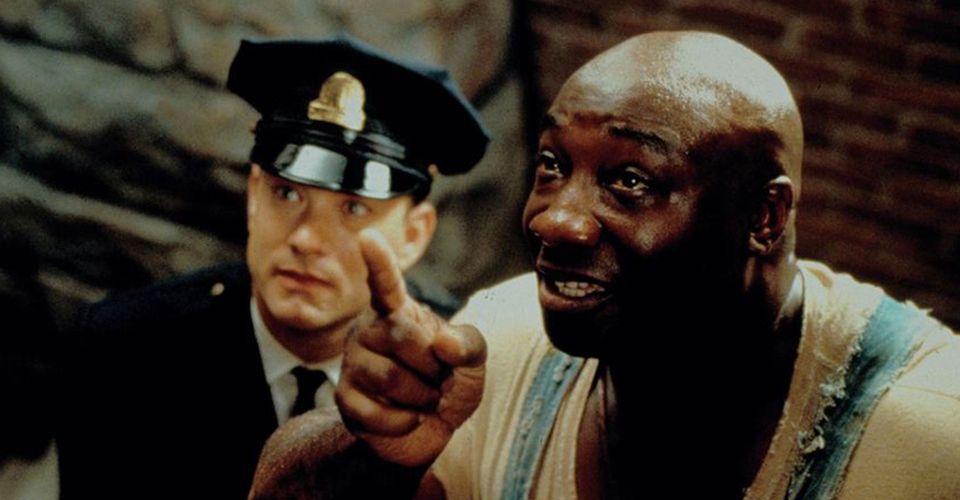
The film is set in 1935 and follows Paul Edgecomb (Tom Hanks), a prison guard who overlooks death row inmates.  He’s firm but compassionate. His sidekick is Brutus “Brutal” Howell, played by David Morse. They see eye-to-eye on most things, especially when it comes to the evil and heinous Percy Wetmore (Doug Hutchison), another prison guard with an evil and aggressive side to him because of the fact his aunt is married to the governor.  Even though these inmates are on “The Green Mile,” which is where they walk before they are to be executed, Paul has humanity and kindness in a job that is not easy to navigate.  Even though they are inmates with varying degrees of crimes committed, he sees them as human beings.  This is the strength of Darabont’s film: the heart attached to it.  There is also a good deal of humor in the story as well when the scene calls for it.

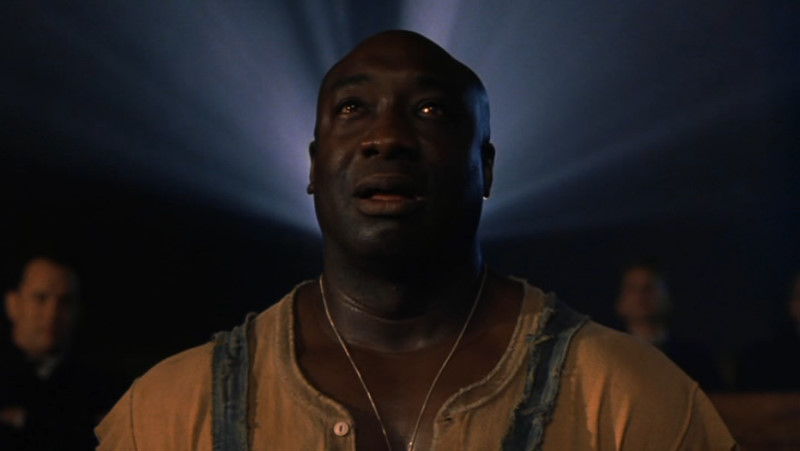
Everything changes at the Cold Mountain Penitentiary when they meet a large inmate with an even larger heart in John Coffey, played by Michael Clarke Duncan. He has been convicted of raping and killing two white girls.  Paul and Brutus, however, have a hard time believing he could be capable of such a crime when they see such a gentle and kind soul inside of him.  They also notice he has magical healing powers as well.  In the hands of a lesser filmmaker and lesser source material (the film is based on the novel by Stephen King), this could have been very cheesy and hokey.  Here, the emotion and the heart, as mentioned earlier, are felt very powerfully.  This is a film that makes the audience believe in the goodness of John Coffey and in humanity.

However, it doesn’t shy away from the dark side of the inmates.  Not all of them are great human beings.  Some of them are downright evil and cruel, such as William “Wild Bill” Wharton who is played by Sam Rockwell.   He’s racist, violent, and completely out of control. The film is told in flashback style from the perspective of an older Paul Edgecomb.  It’s a sensitive film that really allows the audience to spend time with all of the characters and get to know them.  The attention to detail shown here is truly remarkable.  Even though the film is filled with happy and sad moments, I tend to think of it more as an uplifting film about life and how fragile it is and how there can be beautiful moments we don’t always believe in at first, but we believe in them when we allow ourselves to really look at what’s happening right in front of us.

“The Green Mile” is now 23 years old, having been released in 1999. The film was nominated for four Academy Awards including Best Picture, Best Supporting Actor, Best Adapted Screenplay, and Best Sound. It did not win any Oscars, but it was another great film released in 1999, a groundbreaking year for cinema.  It’s a feel-good movie, yes, but it’s done in a realistic way that doesn’t insult the audience.  There have been a lot of prison films in Hollywood, but this is one of the better ones because of the acting, writing, and direction.  It’s an emotional film that leaves you with a lot to think about after the credits are done rolling. Now that it’s on 4K, I imagine a lot of people are going to enjoy revisiting this classic.

* * * * out of * * * *

4K/Blu-ray Info: “The Green Mile” is released on a two-disc 4K/Blu-ray combo pack from Warner Brothers Home Entertainment.  It has a running time of 188 minutes.  It is rated R for violence, language, and some sex-related material.  The film also comes with a digital code.

Video Info: The 4K is released on 2160p Ultra High Definition, and it is a massive upgrade over the Blu-ray.  In 4K, the film really stands out with its vibrant colors and imagery. The Blu-ray is released in 1080p High Definition. While the Blu-ray looks good, the 4K simply looks fantastic. I’m really glad Warner Brothers and other studios are looking into their vaults to re-release classic films in 4K.

Audio Info: The 4K comes in the following audio formats: Dolby Atmos-TrueHD: English, Spanish, and French. The Blu-ray has the following audio formats: Dolby TrueHD: English 5.1, Dolby Digital 5.1, and Dolby Digital: English, French, and Spanish.  With 4K releases, I tend to notice the difference in the video more than the audio.  The high dynamic range is where it’s at with 4K.

Special Features:

Commentary by Frank Darabont

Additional Scenes

Walking the Mile: The Making of “The Green Mile” Documentary

Miracle and Mystery: Creating “The Green Mile” Featurette Gallery

Tom Hanks Makeup Tests

Michael Clarke Duncan Screen Test

The Teaser Trailer: A Case Study

Theatrical Trailers

Should You Buy It?

I loved this film even more on 4K.  It’s an amazing upgrade that is worth every penny.  The only downside, which I’ve noticed with a lot of these upgrades, is the fact they are re-releasing the same special features from the Blu-ray.  I really wish if they were going to re-release these, they would add some new special features, even if it’s Zoom interviews with various cast and crew members.  As a film, it’s absolutely perfect to me.  A lot of people see it as a downer, but I see it as a very, very moving and inspirational flick despite some of the subject matter. The performances are great across the board, but the heart and soul of the film is with Michael Clarke Duncan.  There are also solid performances from Harry Dean Stanton, Barry Pepper, James Cromwell, Bonnie Hunt, and Patricia Clarkson.  It’s an all-star cast for an all-star movie.  This is a film which should be a day-one purchase for film lovers.

**Disclaimer** I received a Blu-ray copy of this film from Warner Brothers to review for free.  The opinions and statements in the review are mine and mine alone.