‘Oblivion’ is Familiar, and Yet Visually Unique
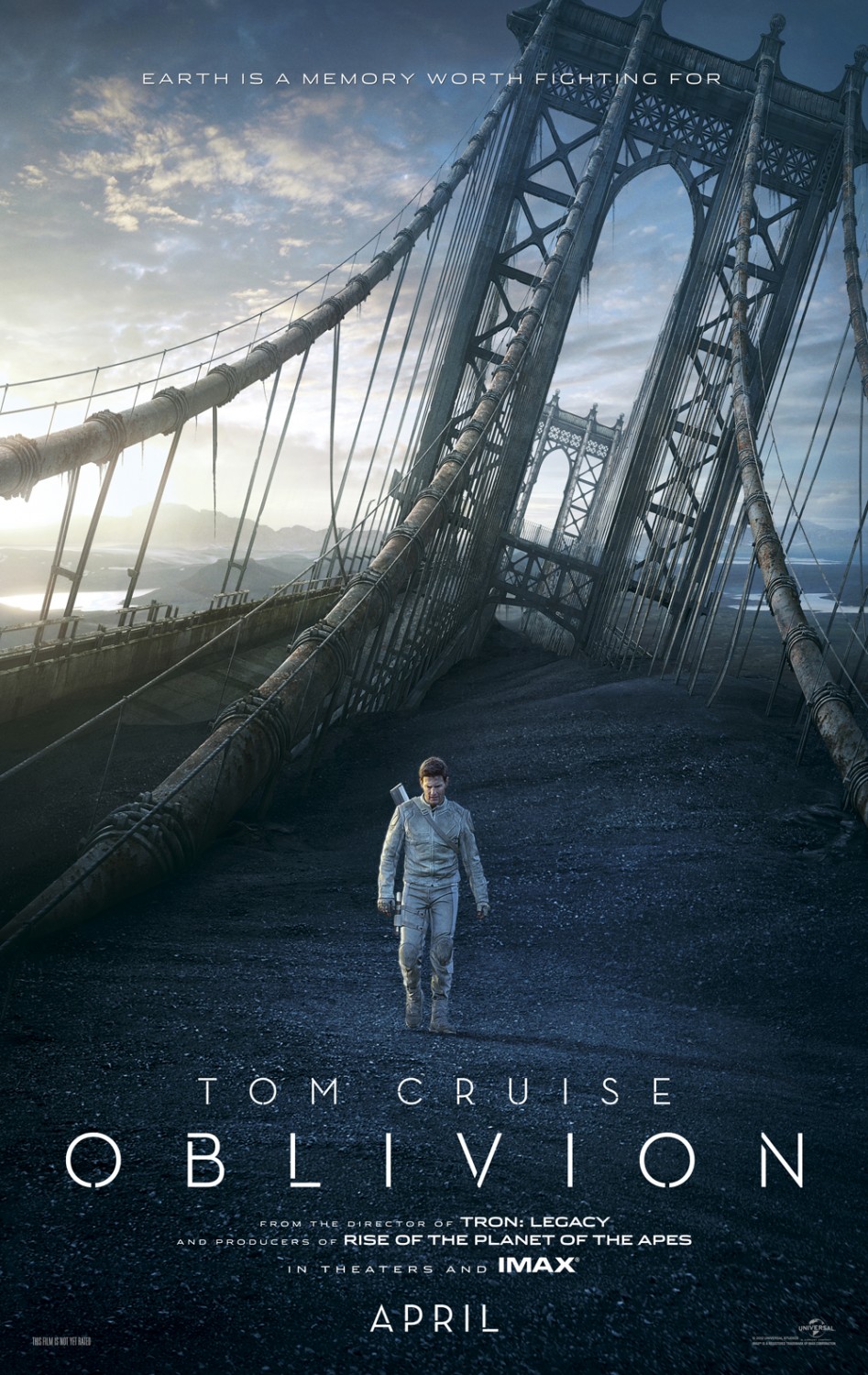
Oblivion movie poster

On one hand, I feel like I should be punishing “Oblivion” for its lack of originality as the story will easily remind viewers of other science fiction movies like “Total Recall” (the original, not the remake), “Moon,” “The Matrix” and “Logan’s Run.” On the other, I found Joseph Kosinski’s film to be a compelling piece of entertainment, and I liked how he took various elements from those sci-fi movies and put them together to create something which feels more original than I expected it to. The look of “Oblivion” is incredible, and the film benefits from a very strong cast, great visuals, and a truly awesome music score.

Like many science fiction movies, this one takes place in a distant future. The year is 2077, and sixty years earlier an alien invasion destroyed the Moon, which in turn decimated Earth and left it in shambles. Jack Harper (Tom Cruise) is one of the last human beings left, and he and his communications officer Victoria Olsen (Andrea Riseborough) spend their days helping to harvest what’s left of the planet’s natural resources and repairing drones which help protect it from further alien invasions. They are due to leave Earth in two weeks so they can rejoin the rest of humanity which has long since relocated to another planet. Of course, we all know what happens when people say they only have a few weeks before they leave Earth; they don’t.

Talking about “Oblivion” from here gets complicated because I don’t want to give away the story’s twists and turns and have it seem like a plot summary stolen from Wikipedia, but I’ll do my best. One day, a spaceship crashes on Earth which carries a number of capsules with astronauts sleeping inside them. One survivor is astronaut Julia Rusakova (Olga Kurylenko) who, once awoken from her deep sleep, she makes Jack see he has a past which has long since been denied to him.

This is all I’m going to say about the plot as telling you more would be spoiling the fun. Granted, I have seen many science fiction movies, so when the plots twists and turns came here, I wasn’t surprised. At the same, I was very much enthralled by what was going on. Even if I had a pretty good idea of what was coming next, I was still glued to my seat and eager to see what direction the film was going to head in next.

Much of the success with “Oblivion” comes from its distinct visuals which are very striking, and a lot of the credit for this goes not just to Kosinski but also his director of photography Claudio Miranda. I’ve lost count of how many post-apocalyptic movies which show Earth obliterated beyond all repair to where everything is dark, grey and gloomy. Many famous landmarks like the Empire State Building are shown to be either barely standing or covered up with a lot of dirt in “Oblivion,” but this is the first movie of its kind I can remember which takes place mostly in the daylight. While Earth isn’t in one piece in “Oblivion,” there is still a unique beauty to how it looks here. Those snowy mountains still look worth skiing on, and I found it rather comforting to see plants, grass and trees still growing even after an alien invasion, and this gives the movie an uplifting feel.

The other thing I really liked about “Oblivion” was the architecture of the buildings and the design of the spaceships. The Sky Tower which Jack and Victoria live in is beautiful, and I would love to live in it. This tower looks like the world’s most unique condominium, and I’ve never seen anything quite like it before. Also, it has the coolest swimming pool ever, and it makes me more excited about swimming pools than I have been in ages. Plus, I doubt I will see a cooler looking spaceship than the Bubbleship Cruise flies all over the place.

This is only Kosinski’s second movie as a director, but here he seems to have found his filmmaking voice this time around. His first film was “Tron: Legacy,” and like many eagerly awaited science fiction events, it was greeted with an obscene amount of hype and a lot of fan indifference. With “Oblivion,” however, he is not restricted to staying within certain boundaries dictated by a previous film or a long-running franchise, and he also has a stronger story (based on the graphic novel of the same name by him and Arvid Nelson) to work with as well.

Kosinski also benefits greatly from having M83 and Joseph Trapanese as his music composers here. Their score to “Oblivion” is much like what Daft Punk’s was to “Tron: Legacy:” a beautiful combination of electronic and orchestral music which sounds far more original than any other film score I have listened to recently, and it adds so much to the striking visuals of “Oblivion” as well as the emotion inherent in the story.

Much has been said about Cruise as a person these past few years, but I’m still happy to defend him as an actor. His work as Jack Harper is actually quite understated, and he never descends into the state of “grinning like an idiot every fifteen minutes” (as Dougray Scott described him in “Mission: Impossible II”) for too long. That grin does come along from time to time, but not in a way which ends up annoying half the audience. Along with his strong performance in “Jack Reacher,” his work in “Oblivion” proves he’s still a better actor than people tend to give him credit for.

Kurylenko, since her performance as a Bond woman in “Quantum of Solace,” has proven to be far more than a pretty face. This should have been made clear after we saw her in Terrence Malick’s “To the Wonder,” but there’s no mistaking her talent in “Oblivion” as she creates a complex portrait of someone who knows more than she lets on. I also very much enjoyed Riseborough’s performance as Victoria which was sweet and yet somewhat devious, and I look forward to seeing more of her work in the future.

Then there’s the great Melissa Leo who plays Sally, the mission control commander with a thick accent who oversees Jack and Victoria’s work from afar. Just like in “Flight,” she gives her character a sweet voice tinged with serious intentions which leaves the viewers on edge. As nice as she sounds, you can tell there’s some evil plot lurking behind her eyes. Some may see the role of Sally as a small one, but in Leo’s hands, no role can ever seem small when she plays it.

Oh yeah, Morgan Freeman shows up as well as Malcolm Beech. To say more about his character would further give away certain plot points, but I can confirm he gives the usual strong performance we always come to expect from him. Also, it was really cool to see him shooting a heavy-duty pair of fifty caliber machine guns as I’m not sure I have seen him do so before.

“Oblivion” may seem overly derivative, but then again, most movies released these days are far from original. What matters to me is that a filmmaker can take elements from the movies which inspired him/her and make them their own, and Kosinski has succeeded in doing so here. I very much enjoyed how “Oblivion” took me down the rabbit hole films often do, and I absolutely loved the visual look of it. It also benefits from a number of strong performances and a fantastic film score which sounds epic in a way other scores can only aspire to. When all is said and done, this film is quite a cinematic accomplishment.

If you can, see it in IMAX.
* * * ½ out of * * * *

‘Prisoners’ is Not Your Average Child Abduction Thriller

Prisoners movie poster

From the trailers, “Prisoners” looked like just another average child abduction movie with a strong cast which would hopefully make it seem slightly above average. I have seen so many movies like this to where they now seem like the same one no matter who is starring or directing. Boy, was I wrong about this one! “Prisoners” is a heavy-duty character driven drama which generates an agonizing amount of tension and never loses any of it throughout its two and a half hour running time. In a time when many movies are in serious need of an editing job, this one manages to make every single minute count.

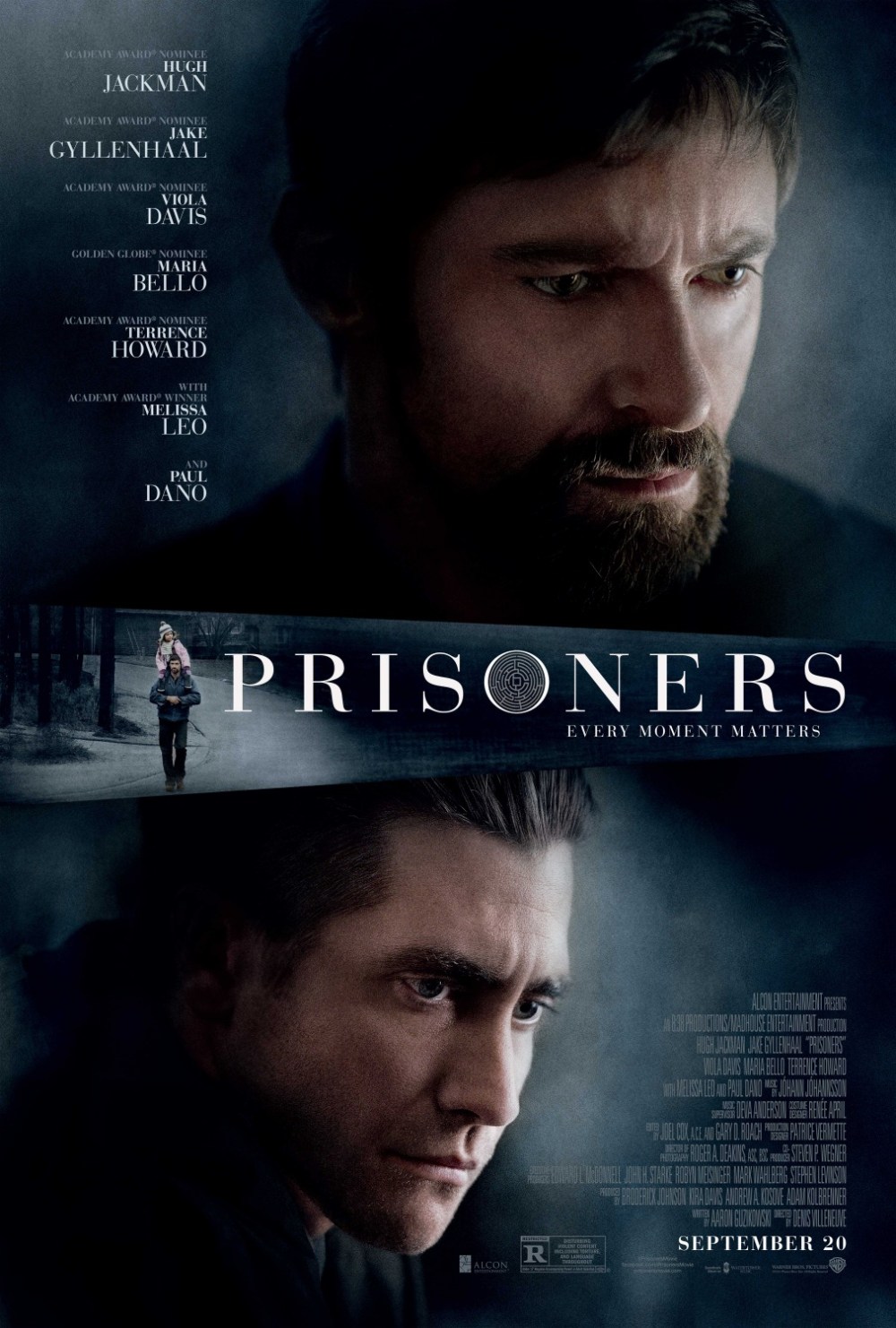
It’s a snowy day when Keller Dover (Hugh Jackman) takes his family over to his friend Franklin Birch’s (Terrence Howard) house to celebrate Thanksgiving with a big feast. Both men have loving wives, two teenaged children who are unsurprisingly not all that interested in hanging out with their parents, and they have two beautiful six-year old daughters named Anna and Joy who can never seem to sit still for a single moment. But when Anna goes back to her home with Joy to fetch her safety whistle, both of them disappear without a trace and their families begin a desperate search to find them before it is too late.

The only suspect in the case is Alex Jones (Paul Dano), a man with the IQ of a 10-year old, whose RV Anna and Joy were playing around earlier in the day. When the police and Detective Loki (Jake Gyllenhaal) are not able to get any answers from Alex as to where the girls are, they are forced to let him go for lack of evidence. Keller, however, becomes convinced Alex does know where they are at, and he becomes infinitely, and frighteningly, determined to make Alex give him the answer he wants. Suffice to say, some moral boundaries are definitely crossed.

It should be no surprise Hugh Jackman gives a seriously intense performance here as a father obsessed with finding his child as we have gotten used to him playing the Wolverine in all those “X-Men” movies. But as furious as he got in “Logan” this past year, Jackman seems even more frightening here as he loses his moral perspective while desperately searching for answers. Just watch him as he bashes a bathroom sink with a hammer.

Jake Gyllenhaal also gives one of his best performances ever as Detective Loki, a man equally obsessed with getting the girls back even as he struggles with an uneasiness which will not let him be. What I especially like about Gyllenhaal here is how he implies certain things about this character without ever having to spell it out for the audience. Loki is a man with a troubled past who has his own demons to fight, and while we don’t always know what those demons are, this allows Gyllenhaal to add another layer to his character which only increases Loki’s complexity.

Terrence Howard, who gave a terrific performance in “Dead Man Down,” gives another one here as the other desperate father. It’s interesting to see him go from playing an intimidating crime lord to a helpless dad who finds himself in a morally dubious position when he is presented with a way of getting the answers, but he becomes increasingly unnerved at the way Keller is trying to obtain them. Howard is great at showing how helplessly conflicted his character is, and he makes you feel his inescapable pain and confusion as he is forced to go down a path he becomes convinced is the wrong one to go down.

Kudos also goes out to Maria Bello and Viola Davis who play the wives to Jackman and Howard. Bello portrays Grace Dover, and she has an especially difficult to watch scene in which she completely falls apart emotionally as she faces the worst nightmare no parent ever wants to face. As for Davis, she once again proves how powerful she can be in the smallest of roles. It should also be noted how each of these actors is a parent in real life, and I cannot even begin to think of what emotional depths they went to give such authentic portrayals.

Paul Dano continues to astonish in each film he appears in, and his performance as Alex Jones is one of his most enigmatic to date. Dano could have just fallen into the trap of making an Alex a caricature or the clichéd mentally disabled character we have seen too many times, but he is much too good an actor to do that. We can never figure out if Alex is truly helpless or cleverly manipulative, and Dano keeps us guessing as to what the answer is for the majority of the movie.

“Prisoners” was directed by Denis Villeneuve, a Canadian writer and director who won the Genie Award (Canada’s equivalent of the Oscars) for Best Director three times for his films “Maelström,” “Polytechnique” and “Incendies,” the latter which earned an Academy Award nomination for Best Foreign Film. In recent years, he has given us the brilliant “Sicario” and “Arrival,” and it makes sense he is at the helm of the eagerly anticipated “Blade Runner 2049.” Like I said, I have seen many movies involving child abduction, but he succeeds in making this one of the most intense and agonizing ever made. The fact he is able to main such a strong level of suspense and tension for over two hours is very impressive, and “Prisoners” would make for a great, albeit an emotionally exhausting, double feature with Ben Affleck’s “Gone Baby Gone.”

The screenplay by Aaron Guzikowski seems well thought out and has characters who don’t seem like anything the least bit stereotypical. Looking back, this could have been one of those scripts where the writer would come out saying, “Look how clever I am! I kept you guessing, didn’t I?” Guzikowski, however, is not out to make us feel like an idiot and instead gives us a fairly realistic scenario of just how harrowing a kidnapping situation can get.

The filmmakers have also employed the brilliant cinematographer Roger Deakins, who should have gotten the Oscar for “Skyfall,” and he makes the snowy climate these characters inhabit all the more vividly freezing. Even as the setting gets bleaker, Deakins still manages to find a haunting beauty in everything going on.

Child abduction movies can be very difficult to pull off because it is easy to fall into the realm of exploitation. It’s a credit to the filmmakers and actors that “Prisoners” never falls into this trap as it instead focuses on how frayed and unraveled emotions can get when parents have no idea where their children are. This is definitely not a film for new parents or those with small children to watch as I’m sure it will make them seriously uncomfortable. But for those who like their movie going experiences to be infinitely intense, “Prisoners” is definitely worth checking out. It was not at all what I expected it to be, and that’s a good thing.

* * * ½ out of * * * *

‘Dead Man Down’ Reunites Niels Arden Oplev with his Lisbeth Salander

Dead Man Down movie poster

The tagline for “Dead Man Down” is “revenge is coming.” But while revenge is a big theme, it’s really about forgiveness. These characters have been forever wounded by a past which will not let them be, and they spend their time trying to avenge it in order to find some form of peace in their lives. What results is a movie which doesn’t break any new ground (few movies these days do anyway), but it is still a compelling one filled with complex characters and twists I didn’t see coming.

We meet Victor (Colin Farrell), the right-hand man to ruthless New York crime lord Alphonse Hoyt (Terrence Howard), and he defends his boss in a nasty firefight at the movie’s start. Quickly, we assume Victor is as loyal to Alphonse as any gangland player could ever be and that he will soon get a meteoric rise to the top of the criminal food chain. However, it turns out Victor is actually seeking revenge against Alphonse for killing his wife and child, and he is getting closer and closer to exacting his revenge.

But then Beatrice (Noomi Rapace), a woman who lives in an apartment across from Victor’s, enters the picture. Beatrice is still recovering emotionally from a nasty car accident which has left her face permanently scarred. While the scar hasn’t taken away all her beauty, it has destroyed her self-image and left her with a deep-seated rage she is desperate to be rid of.

After a dinner where the two of them make small talk and discover things they have in common, Beatrice makes her real intentions clear to Victor; she wants him to kill the drunk driver who plowed into her car and ruined her face. Moreover, she is willing to blackmail Victor into doing this as she has evidence of him killing another man. Knowing Victor is capable of taking a life, she gives him no choice but to take another. Both have strong motivations for vengeance, but can they tear themselves away from their rage long enough to see the damage they are doing to one another?

Right from the start, “Dead Man Down” is filled with twists and turns which makes this average revenge thriller all the more entertaining to sit through. Even if the twists aren’t entirely plausible, they keep us on the edge of our seats as we can only guess what will happen next. Just when you think you know where things are going, you don’t.

But what I really liked about this movie was how wonderfully complex the characters were. There is nothing black and white about them as everyone exists in a morally grey area. While Victor and Beatrice are clearly justified in having their revenge, we know the ways they are seeking it will do not make them good people. Even Alphonse comes across as much more than an average one-dimensional bad guy as he is someone who certainly wasn’t born evil. While certain characters may deserve some form of punishment over others, no one comes out of this story the least bit innocent.

“Dead Man Down” marks the first English language film from writer and director Niels Arden Oplev, the same man who gave us the original version of “The Girl with the Dragon Tattoo” as well as the recent remake of “Flatliners.” Now when filmmakers from a foreign country come over to America, their talents usually get compromised in the process. But Oplev doesn’t appear to have lost any of his skill here as he gives us a strong motion picture filled with fascinating characters. He also gets terrific performances from each of his actors as well as some strong visual moments such as a descent down the middle of a stairwell.

Colin Farrell has gone from doing needless remakes like “Fright Night” and “Total Recall” to terrific movies such as “In Bruges” and “Seven Psychopaths.” He has become an actor who can go from playing a good guy to a bad guy with relative ease, and this makes him perfect for a character like Victor who could be seen as either. Farrell does excellent work in conveying Victor’s conflicted emotions as he goes about exacting his revenge. As he gets closer to achieving his goal, Victor begins to see how he is becoming just like those who destroyed his life. Seeing the pain in Farrell’s eyes as he makes this clear to the audience without words shows us how great of an actor he can be when given the right material.

Noomi Rapace, the original Lisbeth Salander, is a powerhouse as Beatrice. Watching Rapace deal with her rage as well as the bad luck life has dealt her is enthralling to take in, and the scenes where she is attacked by a group of children who see her as a monster are devastating to witness. Like Salander, Beatrice is stuck in a moment which forever changed the course of her life, but Rapace gets to showcase more of a vulnerability here she wasn’t able to express as much in her star making performance. She remains a compelling actress to keep an eye on, and it’s great to see her reunited here with Oplev.

But I the performance which most impressed me was Terrence Howard’s as Alphonse Hoyt. Now when you see an actor take on the role of an evil crime lord, you expect them to chew the scenery and give an over the top performance. But Howard doesn’t do this here, and it is clear he has given this role a lot of thought. There is no doubt that Alphonse is an evil dude, but Howard is excellent in giving a method to this man’s madness. Howard left such a powerful impression on us with his Oscar nominated performance in “Hustle & Flow,” and his performance in “Dead Man Down” is a reminder of how he never lets us down as an actor.

In addition, there is a really good supporting performance by Dominic Cooper as Victor’s friend Darcy, and he has a wonderful scene at the start where he is holding his baby and talking about how he hopes being a father will lead him to a better future. The great Isabelle Huppert also shows up as Beatrice’s mom, Valentine, and she remains a remarkable actress even in the smallest of roles. There’s also strong cinematography from Paul Cameron and a wonderfully atmospheric film score from composer Jacob Groth to take in as well.

“Dead Man Down” is not the equal of “The Girl with the Dragon Tattoo,” and its climax is a bit over the top for a movie like this, but I liked how character driven it was and you don’t see many movies like that these days. It is also a compelling story about how the power of forgiveness is more important than the need for revenge. In this day and age, it is important to remember that.

* * * out of * * * *

Exclusive Interview with Nicole Holofcener about ‘Enough Said’

Enough Said movie poster

With movies like “Lovely & Amazing,” “Friends with Money” and “Please Give,” Nicole Holofcener has firmly established herself as a filmmaker with a unique voice. In a time where romance and relationship movies are being critically and commercially crucified, her films are wonderfully refreshing as they feature characters who feel real, are remarkably down to earth and have flaws we can all understand and relate to. Even if you think her films deal with familiar subjects and situations, the attention Holofcener gives to her characters and the actors who play them make you feel like you are experiencing a story you have never watched before.

Her film “Enough Said” is no exception to this, and it stars Julia Louis-Dreyfus as Eva, a professional masseuse and single mother who is slowly getting back into the dating game. While at a party, she meets Albert (James Gandolfini, in one of his last performances), and the two find themselves forming a deep connection very quickly. Things, however, get complicated when (SPOILER ALERT) Eva discovers that one of her patients, Marianne (Catherine Keener), is actually Albert’s ex-wife. Throughout their sessions together, Marianne has been giving Eva many different examples about what a lousy husband Albert was, and this makes Eva wonder if her first impressions of Albert were the right ones to have.

I talked with Holofcener while she was doing press for the “Enough Said” digital release, and the movie itself has since received various nominations from the Golden Globes, the Independent Spirit Awards and the Screen Actors Guild Awards. During our interview, I got to find out how she comes up with such wonderfully unique characters, what it was like for her to work with the late James Gandolfini, and we also talked about Catherine Keener who has appeared in most of her films and how their creative relationship has evolved from their first film together.

Ben Kenber: “Enough Said” is fantastic and one of the best films of 2013. With this and “Please Give,” I really love how your movies deal with characters that are down to earth and have flaws like everybody else. Most romantic movies usually don’t have that, but your films are among the exceptions.

Nicole Holofcener: That’s very nice. Thank you. That’s what I’m going for.

Ben Kenber: With “Enough Said” and the other movies you have made so far, how do you come up with such unique characters?

Nicole Holofcener: I have no idea (laughs). I mean they’re kind of an amalgamation of people I know and people in my imagination. I guess, by going very specific, sometimes I’ll focus on a character’s habit or a quirk or a mannerism or something irritating or something specific. I started with the Sarah character (played by Toni Collette) in this movie with the fact that she has made problems that started with a friend of mine who said she left bracelets on the kitchen counter, and she finds them in the kitchen and how much that annoys her and why she won’t simply ask her housekeeper not to do that. Then I have Sarah, and it’s like everything kind of falls into place after that, not easily. I’m not saying it’s easy, but it informs who that person is and what her issues might be. And then all of a sudden, she had this whole story with her housekeeper and it ended up being a good scene, but it started with the bracelet on the kitchen counter. So very specific, I guess. By going very specific and individual. When I read a script, I hate it when they say things like, “Sarah, 35, driven, type A, but inside falling apart.” It’s like, well then, you don’t even have to read what happens because you’ve already been told who she is.

Ben Kenber: This looks like a movie which sticks very closely to the script you wrote, but was there any improvisation used by the actors?

Nicole Holofcener: Yeah, absolutely. The story is very much the script as written, but they (the actors) ad-libbed all over the place, and I got rid of some and I kept some. But they had the freedom to do that especially because they were so funny and smart. They changed things but not the story.

Ben Kenber: The characters are so down to earth, and everybody seemed so relaxed onscreen. How did you manage to get such naturalistic performances from your cast?

Nicole Holofcener: They were sedated. I just gave everyone a Xanax every day. If only it could be like that (laughs). Some days were more relaxed than others but, as they say, the director sets the tone. I’m pretty relaxed, and while I take directing seriously, we’re not in a war zone. I try to have a good time and help people feel safe and relaxed so that they can give vulnerable performances and trust me. I try to earn their trust, and then I try to help them feel comfortable.

Ben Kenber: Well it definitely looks like he succeeded in doing so.

Nicole Holofcener: Well that’s good.

Ben Kenber: I do have to ask you about the late James Gandolfini because this is a great role to see him in. It shows audiences there was more to him than Tony Soprano. People should’ve known this before “Enough Said” came out, but the movie makes it clear to those who couldn’t get “The Sopranos” out of their heads. What was it like to work with him?

Nicole Holofcener: It was great to work with him. It was often challenging. He asked a lot of questions. I think we were sometimes mutual pains in the asses, but in a very affectionate way. He’d look at me like, “C’mon!” I’d look at him like, “C’mon!” He was playful and very hard-working, very self-effacing and sweet, shy. The crew loved him. He was very friendly and warm toward the crew which was very nice and so was Julia (Louis-Dreyfuss). So, I had a very relaxed family kind of feeling.

Ben Kenber: Yeah, you definitely get that from watching the movie. Catherine Keener also stars in this movie as Marianne, and you’ve worked with her several times in the past. How has your working relationship with her evolved from the first time you worked with her to this one?

Nicole Holofcener: Well, the first time I worked with her I was kind of scared. She had more experience than me. It (“Walking and Talking”) was my first feature, and I was pretty intimidated by her. But she was very giving and warm, and that’s why we continue to work together. We’ve gotten to know each other so well, and discovering how wonderful she is, every part, just made me want to work with her again and again. And now that it has been so many years, it’s a short hand. Even though she’s still great, I’m not intimidated by her anymore (laughs). She can still be a little scary.

Ben Kenber: Keener is a terrific actress, and the rapport between you and her really shows with each movie you work together on.

Nicole Holofcener: Good, yeah. It’s a pretty special relationship, definitely.

Ben Kenber: Well, I really, really liked this movie a lot. I really gravitate towards movies with very down-to-earth characters. I usually avoid romantic movies like the plague, but with movies like yours where you can really relate to the characters and the problems they experience in life, they really stand out in a wonderful way. “Enough Said” is one of those movies.

Nicole Holofcener: I’m so glad. I hope that people who avoid romantic movies will watch this one for the same reason (laughs). Thanks, that’s good.

I want to thank Nicole Holofcener for taking the time to talk with me. “Enough Said” is available to own and rent on DVD, Blu-ray and Digital.


Kimberly Pierce’s ‘Carrie’ Not Really Necessary, But Better than Expected

Carrie 2013 poster

“Carrie” was the first Stephen King novel ever published, and it’s the one people keep coming back to. Filmmakers had the hardest time, until recently that is, getting “The Dark Tower” made into a movie, and bringing “It” to the silver screen seemed to be an impossible challenge. This serves as a reminder of how development hell is still alive and well in Hollywood. “Carrie,” however, has been adapted into the horror classic Brian De Palma directed in 1976, turned into a musical that became famous for how long it didn’t run on Broadway, generated a sequel called “The Rage: Carrie 2” which disappeared from theaters not long after its release, and was later remade into a TV movie where the only saving graces were Angela Bettis as Carrie White and Patricia Clarkson as Margaret White. Now we have yet another remake of “Carrie” which would have been totally unnecessary were it not for Kimberly Peirce, the same filmmaker who gave us the brilliant and emotionally devastating “Boys Don’t Cry” which dealt with a human being cruelly cast out of regular society. As a result, this remake suddenly felt a lot more promising than I expected it to be.

Why do people keep coming back to this particular King novel? Well, with its themes of bullying, isolation and the pain of adolescence, “Carrie” proves to be as timely now as it was when the novel came out in the 1970’s. The story remains the same, but the tools of humiliation and anger have been slightly updated. Carrie White (Chloë Grace Moretz) still has her first period, but this time it is captured on an iPhone and posted on the internet with gleeful malice and a complete lack of sympathy. Granted, Carrie probably doesn’t have a Facebook page as her mother Margaret (Julianne Moore) has spent a lot of time homeschooling her daughter before being forced to send her to a public high school, and she remains as strictly religious as ever; locking her poor daughter into a closet to pray to a bleeding Jesus on a cross.

The main fault with this version of “Carrie” is it follows De Palma’s film a little too closely. For those who have seen the 1976 movie, not much has changed, so this may not seem as scary as before. At the same time, I found myself admiring what Peirce was able to convey with the characters, particularly the females. While certain characters end up coming off as a bit too generic, we get to see the different dimensions which make them more human than the average character we constantly get exposed to in horror movies.

Moretz successfully makes the character of Carrie White her own, and you never feel the shadow of Sissy Spacek’s performance hovering over her. She is able to bring more of Carrie’s rage we saw in King’s book, and we see her as a powder keg just waiting to explode. We all know her as Hit Girl from the “Kick Ass” movies, and it’s only a matter of time before she starts kicking some serious ass at the prom. Even though Moretz doesn’t quite match the description King made of Carrie in the book (she’s one of those actresses you can’t make look ugly), it’s clear from her performance how deeply she understands this horribly shy and alienated teenager inside and out. While this Carrie isn’t ugly by a long shot, she is made to feel ugly by everyone around her, and you can see this weighing heavily on her psyche.

Julianne Moore continues to put in one great performance after another, and her work here as Margaret White is very effective. Whereas Piper Laurie played Margaret as a deranged religious zealot whose devotion to Jesus was unwavering, Moore instead makes the character surprisingly empathetic. Margaret is still deranged, but Moore shows her to be a loving mother who does care ever so deeply about her daughter even if her love comes with a lot of mental anguish. Moore even shows Margaret engaging in self-mutilation which is painful to watch and adds another layer to this character which wasn’t in the book.

Actually, for me one of the most fascinating characters in “Carrie” is Chris Hargensen who is played here by Portia Doubleday. Chris hates Carrie with a passion and looks forward to humiliating her with a vengeance on prom night, but I found myself really getting caught up in how the character goes from being just another spoiled girl to someone who slowly gravitates towards the dark side. Chis initially shows some hesitation when her never do well boyfriend Billy Nolan (Alex Russell) kills the pig whose blood they will use to dump on Carrie, but once she starts cutting the dead pig’s throat, I found the look on her face to be one of the movie’s most horrifying moments. As she gets deeper into criminal activity, we see Chris starting to get both aroused and scared by it, and she doesn’t realize until it’s too late that there’s no turning back.

I was also glad to see Judy Greer playing PE teacher Miss Desjardin, and the role allows her to balance out her sweet side with a rougher exterior as she gets constantly exasperated by her students who show little signs of being the least bit sympathetic towards Carrie. I also have to give Ansel Elgort some credit as he makes Tommy Ross’ transition from not wanting to take Carrie to the prom to making sure the two of them have the best time possible very convincing. Then there’s the lovely Gabriella Wilde who plays Sue Snell, the popular girl who encourages Tommy to take Carrie to the prom. She’s very good in the role and shows us the inner turmoil going on as she sees her goodwill get dumped on, literally.

Look, there’s no way that Peirce could have topped De Palma’s “Carrie.” Having read the book, it would have been interesting to see it done as kind of a documentary as the book is told from various points of view where the townspeople share their memories of what happened on the night of the prom. Still, it’s Peirce’s approach to the characters which made her version of “Carrie” worth watching for me.

Was a remake of “Carrie” really necessary? Not really, but it happened anyway and not for the first time. Having Peirce behind the camera for this one gives this remake a reason for being, and she is blessed with a cast who did not let their memories of De Palma’s horror classic get in their way. If anyone else had directed this version, I’m not sure I would have bothered watching it. Peirce remains a filmmaker who understands how cruelly we can alienate someone for being different, but she never gets caught up in making this into a message movie. She is determined to have us rooting for Carrie even as she lays waste to a town and its inhabitants who have been relentlessly cruel to her. That’s why we go to the movies anyway, to engage in our fantasies.

Now let’s think about adapting some Stephen King novels which haven’t already been made into movies or miniseries. There are so many to choose from.

* * * out of * * * *

Click on the video below to check out the interviews I did with Chloe Grace Moretz, Julianne Moore, Judy Greer and Kimberly Pierce on “Carrie” for the website We Got This Covered.

‘Fruitvale Station’ Puts a Human Face on a Tragic Shooting

Fruitvale Station movie poster

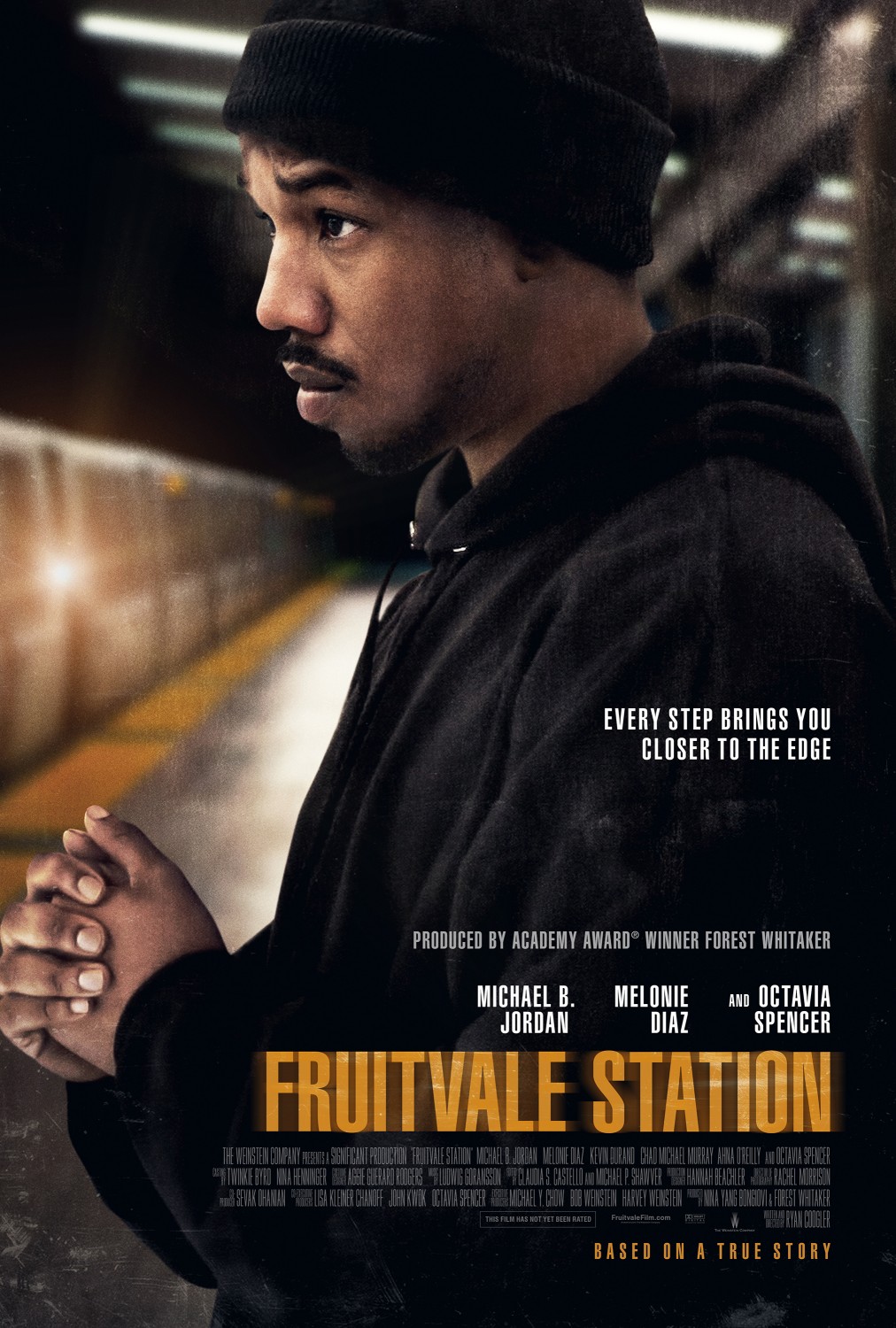
It’s a strange and cruel irony “Fruitvale Station” opened in theaters the same week George Zimmerman was found not guilty of shooting Trayvon Martin. Like Martin, Oscar Grant was a young African American male whose life was cut short under needlessly tragic circumstances. On the night of January 31, 2008, Oscar was traveling home with his girlfriend and their friends on BART (Bay Area Rapid Transit) when a fight broke out on the train which he gets caught up in. When the train arrives at the station of the movie’s title, Oscar was pulled off it by BART police officers, and one of them, either accidentally or intentionally (depending on who you ask) shot him. He died the following day, and his death brought about protests and a call for justice.

The cases of Martin and Grant appear to illustrate that, despite strides we have made in race relations, it’s still not safe to be a young black man in America. Now “Fruitvale Station” is not a movie out to offer a solution to this continuing problem, but it does put a human face on it. After watching it, Grant will no longer seem like a mere statistic to anyone.

The movie follows Oscar (Michael B. Jordan) on the last day of his life as he goes about his business while trying to survive in an unforgiving world. He still lives with his girlfriend Sophina (Melonie Diaz) and their daughter Tatiana (Ariana Neal) in a rundown part of the Bay Area, and this is despite the fact Sophina knows he cheated on her. But regardless his wayward ways, Oscar is clearly dedicated to taking care of them both and in doing what he can to give them a better life.

“Fruitvale Station” is the first feature film for director Ryan Coogler, and he made it because he wanted people to get to know Oscar as a human being instead of just another name in a newspaper. Having seen the film, I can honestly say he succeeded in doing so. Not once does Coogler try to sanctify Oscar or water him down for an easier movie going experience. Coogler presents Oscar warts and all, and while he is far from perfect, we come to respect him for what he’s trying to do with his life on this fateful day.

We see Oscar trying to get his supermarket job back even though his boss isn’t about to rehire him, and it’s the first time we see Oscar’s hair trigger temper come to life. His mission now and throughout this fateful day is to provide for his family. Of course, this may lead to him selling drugs to help pay the rent and put food on the table, the same thing which landed him in prison. While his desire to lead a good life is strong, the lure of the criminal life and the money it can generate for him keeps percolating below the surface.

Michael B. Jordan made a name for himself on television shows like “The Wire” and “Friday Night Lights,” and he also appeared in the surprise hit movie “Chronicle.” His performance in “Fruitvale Station” is nothing short of sensational, and it made him one of the great breakout stars of 2013. It’s exhilarating to watch him as he takes Oscar from the joys of being a father to his frightening lows when he begs his mother not to leave him all alone. It’s a shame Jordan didn’t get an Academy Award nomination for his performance, but then again 2013 was a year overflowing with great performances, many of which were bound to be left out.

Octavia Spencer gives another one of her great performances in this movie as well. As Wanda, she gives us a mother who tries to be strong for her wayward son, but who struggles with the reality she may need to keep her distance from him for his own good. This is not the typical clichéd mother character who goes through the usual motions of the parental ups and downs, but one who has stood up against the tides life has thrown at her and whose love for her son you never doubt for a second.

“Fruitvale Station” starts off with footage of the actual incident where Oscar was shot, but it cuts to black before we can see if the shooting was intentional or accidental. This gives the movie a certain tension as we know how things will end, but even as we get to that moment, there’s a still a part of us which wants this situation to have a different outcome. Even though the end of the movie is never in doubt, we desperately want him to survive the night and get home safe.

The other thing I really liked about this movie is how it showed us a part of the Bay Area many of us don’t get to see. I grew up in Northern California, and while much of it is not crime ridden, there are parts of it I dare not venture into. Like the brilliant documentary “Hoop Dreams,” it sheds a light on how African-Americans live and subsequently breaks a lot of the preconceptions many of us have about them.

There have been several other tragic incidents following what happened to Oscar Grant such as the death of Michael Brown in Ferguson, Missouri. It’s always depressing to see how history keeps repeating itself despite our best attempts to learn from it. What makes “Fruitvale Station” so remarkable is it’s not out to give us glib answers on how to end the violence, but it instead puts a human face on a man who didn’t deserve to die. We hear about these stories in the news far too often, and they are usually shown to us with an unnecessary amount of bias. Both Coogler and Jordan have done a great service as they force us to see Oscar Grant as a person with strengths and flaws, and this makes “Fruitvale Station” one of the very best movies of 2013.

* * * * out of * * * *


‘Gravity’ is the Ultimate Outer Space Movie

Gravity movie poster

I remember being fascinated and terrified by outer space movies when I was a young boy. Seriously, I kept getting vertigo when I saw all those stars shining brightly to where I was afraid I would fall into space and be lost forever. Of course, back then I still had a lot to learn about gravity. It’s been a long time since an outer space movie gave me this kind of sensation. The last one was Ron Howard’s “Apollo 13” which, when it came out in 1995, was perhaps the most realistic motion picture about life in space and of how dangerous it can be. But now that same sensation has come back in an exhilarating rush with Alfonso Cuarón’s “Gravity,” which may very well be the greatest movie about life in outer space I have ever seen.

“Gravity” is an amazing movie, just amazing. It left me speechless with its amazing visual effects and the tour de force performances from George Clooney and Sandra Bullock, and it made me feel like I was right up there in outer space with them both. The movie opens with the following:

At 372 miles above the Earth

There is nothing to carry sound

No air pressure

No oxygen

Life in space is impossible

For 90 minutes, Cuarón never lets you forget this as we watch astronauts Matt Kowalski (Clooney) and Dr. Ryan Stone (Bullock) struggle to survive after their space shuttle is destroyed by debris from a satellite. From there, they are floating in space with little oxygen and very few options. It may sound like a thin plot for a movie, but it’s more than enough to make “Gravity” one of the most nail biting films to sit through in some time.

I almost don’t want to know how the special effects were accomplished for fear the film’s magic will forever be ruined for me. “Gravity” reminds you of how great going to the movies can be as it sucks you right in to a world many of us have never seen up close. Cuarón shows the inherent dangers of space as well as the sheer beauty of it, and there’s no beating the view of planet Earth hundreds of miles above its surface.

Cuarón, just as he did with “Children of Men,” gives us truly brilliant scenes which look like they were all done in one shot. I’m still trying to wrap my head around how he managed to keep the camera rolling for such a long period of time. “Gravity” starts in space and pretty much ends there, and it’s the lack of gravity which makes the film seem like a new kind of roller coaster ride. I bet a number of audience members will get motion sickness while watching this movie as they’ll be struggling to find their center of balance just like Bullock does when she becomes untethered from the space shuttle. I remember all those trailers for horror movies like “Dawn of the Dead” which said the theater had barf bags available for those who needed them. Well, “Gravity” is proof movies don’t have to inhabit the horror genre for you to need a barf bag. Anyway, that’s more information than you need to know.

But as technically brilliant as “Gravity” is, it never forgets the human element which other filmmakers don’t pay as much attention to. We come to care deeply about the characters Clooney and Bullock play because they are not just a couple of stereotypical astronauts spouting clichéd dialogue. They are flesh and blood human beings with needs and desires, and they need each other to survive. Seeing them tumble through space will make you appreciate the brakes you have on your car.

Clooney rarely, if ever, lets us down as an actor, and he is perfectly cast as the veteran astronaut Matt Kowalski. He immediately gives the sense Matt has been to outer space countless times without having to point it out. From start to finish, Clooney is the calm center in the middle of the storm, and he gives the movie the positive energy it needs. Even as things get worse, he gives Dr. Stone a reason to keep on going.

But when all is said and done, “Gravity” really belongs to Bullock. She may still wonder if she deserved her Oscar for “The Blind Side,” but after watching her here, it’s clear she did, and she may be getting another one. Bullock gives the performance of her life as she reveals her character’s inner struggles which illustrate how there’s more going on with her than just trying to stay alive. The more we learn about Dr. Stone, the more we see this is not so much a movie about a woman lost in space as it is a woman trying to escape the darkness which has engulfed her soul.

Bullock can just draw you into a scene with her eyes which easily reveals much of her character’s inner torment as her oxygen continues to run out. I’ve always admired her as an actress, and her roles in “Demolition Man” and “Speed” showed her to be an unforgettable talent. In recent years, we have seen her do an endless number of romantic comedies, so it feels rare to see her in a dramatic film. But Bullock is so enthralling to watch here, and there is not a single false note to be found in her performance.

I don’t think it’s too much to say Cuarón is a magician when it comes to making a movie. He gave us an enchanting childlike vision of the world with “A Little Princess,” a marvelous coming of age story with “Y Tu Mamá También,” the first truly great Harry Potter movie with “Harry Potter and the Prisoner of Azkaban” and one of the more unique dystopian science fiction movies of recent years with “Children of Men.” From one film to the next, he has given us astonishing visions which have us in awe over what he can accomplish. Cuarón leaves you with a strong sense of wonder with “Gravity,” and it’s a quality seriously lacking in most movies these days.

Cuarón is also aided tremendously by a strong creative team which includes his son Jonás who co-wrote the screenplay with him, Steven Price who composed the movie’s hypnotic score, cinematographer Emmanuel Lubezki who makes space look as beautiful and inhospitable in equal measure, and David Heyman who makes this his first film as a producer outside of the “Harry Potter” franchise. All have come together to create something which redeems our collective hope in the possibility of cinema.

“Gravity” demands to be seen in a movie theater and, yes, I’m going to say it, in 3D. Few film going experiences have been as enthralling as this one, and it is not to be missed. Thank you Cuarón for this film and reaffirming what can be accomplished in Hollywood today. But more importantly, thanks for creating a movie which gave me the sensation of being in outer space I used to have as a child.

* * * * out of * * * *


Daniel Radcliffe on the Young Actor who Played Him in ‘Horns’

Horns movie poster

The “Horns” press conference held at the Four Seasons Hotel in Beverly Hills, California proved to be a lot of fun as stars Daniel Radcliffe, Juno Temple and writer Joe Hill, whose book the movie is based on, shared great memories about the making of this dark fantasy. Radcliffe plays Ig Perrish, a young man madly in love with Merrin Williams (Temple) and who will do anything for her. But as the movie opens, we discover Merrin was brutally murdered, and everyone thinks Ig was the one who killed her.

In addition to scenes where we see Ig and Merrin being intimate with one another, we also get to see a flashback where these two lovers first met. This resulted in two younger actors being hired to play these characters: Mitchell Kummen as Ig and Sabrina Carpenter as Merrin, and both look a lot like Radcliffe and Temple. While watching this sequence, I started thinking of the movie “Contact” in which Jodie Foster plays Eleanor Arroway and Jena Malone plays the same character as a young girl. In her commentary track on the “Contact,” Foster said the following:

“I always love watching actors play me, and actually it’s always the reverse; whenever you hire a child actor to play the adult actor, you just ask the adult actor to copy the kid. That’s certainly what Tom Hanks did in ‘Forest Gump,’ and that’s what I tried to do a little bit in this movie.”

That remark stayed with me long after the first time I heard it, and I wondered if Radcliffe or Temple had the same experience with the actors playing the younger versions of themselves in “Horns.” I asked Radcliffe about that, and his answer led to one of the funniest moments of the day.

Daniel Radcliffe: That’s interesting because we didn’t really see a huge amount of what the kids were doing. I was often, when they would be doing stuff, getting made up or de-made up or something would be going on so they would try and time it like that, so I didn’t really get to see a lot of what they were doing. I got to spend quite a lot of time particularly with Mitchell on the movie, and it was funny because Sabrina lives in L.A. now and she’s 13 going on 21. She’s incredibly mature and well above her years, and Mitchell is like I was when I was like 13. He’s a kid from Winnipeg, and he’s like a kid and he’s incredibly sweet. He’s awesome and I just like the fact that… Obviously, Mitch is blond naturally and he’s got much fairer hair than I do, and they dyed his hair on the first day. He went back to his hotel in Vancouver and nobody knew what he was doing, and then one of the girls just happened to say, ‘Oh you look like Harry Potter.’ That just made his day. He was so happy.

So, while Radcliffe didn’t necessarily take anything specifically from Kummen’s performance, he did illustrate how difficult it can be for casting directors to find an actor to play him as a younger person. Still, both Radcliffe and Kummen took the same character and made it their own in this movie. Thanks to their performances, we succeeded in getting the best of both worlds in “Horns.”

About Time

About Time movie poster

Those who know me best know I typically cannot tolerate romance movies. Sure, there are exceptions like “When Harry Met Sally” and “(500) Days of Summer,” but I usually find most of them to be unforgivably manipulative, inherently cheesy and full of cringe inducing dialogue. As a genre, I typically avoid it whenever possible, so my enthusiasm for “About Time” was not at an all-time high. But then I noticed a familiar name on the movie’s poster, Richard Curtis. This is the same man who wrote the screenplay for “Four Weddings and a Funeral,” one of the few romance movies which actually had me on the edge of my seat, and he also wrote and directed “Love Actually” which has become my dad’s favorite film to watch on Christmas Eve. As a result, my excitement for this movie suddenly went up to an unexpected height.

“About Time,” on the surface looks, like the kind of romantic comedy where a man and woman get together, fall in love and then break up only to become a couple again by the movie’s end. But the fact is its trailer doesn’t do the movie any justice. The story ends up becoming more than the usual romance, and it ended up go in directions I didn’t expect it to. Curtis is obviously aware of the trappings inherent in this genre, and he succeeds in avoiding them and gives yet another film which is genuinely moving and full of characters who are relatable and refreshingly down to earth.

The main character of this romantic tale is Tim Lake (Domhnall Gleeson), a 21-year-old desperate to have a girlfriend in this lifetime. His attempts at getting a kiss on New Year’s Eve don’t work out as planned, and it only adds to his self-deprecating attitude which he has clearly spent years perfecting. He can’t even capture the heart of his sister’s best friend Charlotte (Margot Robbie) who is quite the looker.

Before he heads off to London to become a lawyer, Tim’s dad (played by Bill Nighy) lets his son in on a little secret: the men in his family have the power to time travel. All Tim has to do is go inside a closet, clench his fists tightly and think about a place he wants to go to, and suddenly he’s there. He immediately tests this time travel power out and goes back to New Year’s Eve to get the kiss he missed out on, and from there he uses it to benefit himself and those closest to him whenever possible.

Now on the surface this seems like a silly plot for a movie, and the Bill Murray comedy “Groundhog Day” quickly came to mind as I watched “About Time,” but Curtis has not given us the typical time travel movie here. In fact, the time travel aspect gets pushed more and more into the background as Curtis aims to focus on not one but two love stories.

Tim ends up meeting an American woman at a blind dating restaurant where everyone is served food in the dark, and through their conversations they form a connection which becomes unbreakable. Once he gets outside and back into the light, he discovers the person he spoke with is the beautiful but insecure Mary (Rachel McAdams), and their moment on that quiet London street had me rooting for them to make this relationship work.

The other love story in “About Time” is between Tim and his dad, and I found it to be the most moving part of this movie. At first it looks like they have the usual father-son relationship where the father gives his son life advice and the son takes it with a grain of salt, but their relationship feels a lot more real than those I have seen in recent movies. Once Tim learns his dad is headed for a certain fate he can’t escape from, their relationship becomes even deeper and you dread the moment these two people will have their last ever conversation.

Are there some logistic problems with the time travel aspect of this movie? Probably, but I didn’t care. It serves as an interesting plot device as Tim accidentally erases his initial encounter with Mary after helping a friend, and he ends up having to make her fall in love with him all over again. It’s also amusing to watch Tim try to improve on certain moments in his life with Mary like when they have sex or when he proposes marriage. Heck, we’d all love to have the power to undo the more embarrassing moments in our lives, and I got a huge kick out of Tim undoing his.

But the time travel device does serves to illuminate one of the movie’s main themes which is to not be overly concerned with the past or the future, but to instead stay in the present and take pleasure in every moment. This is what I love about Curtis’ movies, how he takes the most mundane, ordinary things and turns them into a thing of beauty. They are the things in life we take for granted and don’t always take the time to appreciate. By the movie’s end, Curtis makes us realize this, and we come out of “About Time” with an upbeat look on life we don’t always have.

The other thing I’ve come to love about Curtis is how populates his films with multi-dimensional characters we can relate to. The thing that drives me nuts about a lot of movies, especially ones from the romantic genre, is how they give us characters that are doing so much better than the rest of us, and it gets to where we just believe that all these problems with love only happen to successful white people. Curtis, however, continues to give us the most memorable characters we could ever hope to meet in our lifetime.

It also helps that Curtis has quite the cast to work with. Domhnall Gleeson, whom you might remember as Bill Weasley in “Harry Potter and the Deathly Hallows,” is terrific in the way he radiates that Hugh Grant awkwardness as his character goes from being unlucky in love to being very lucky in life. As for Rachel McAdams, I’m trying to remember the last time I found her to be so radiant in a movie. McAdams does some of her best work here as Mary, and every time she smiles it just fills your heart with joy. There’s also some nice performances from Lydia Wilson as Tim’s wayward sister Kit Kat (yup, that’s her name), Lindsay Duncan as Tim’s mom, and the late Richard Griffiths has a wonderfully memorable moment as an actor who doesn’t need help memorizing his lines and will bluntly let you know this.

But the best performance in “About Time” comes from Bill Nighy who portrays Tim’s dad (we never learn his character’s real name). It’s the simplicity of his performance which really gets to you as he never overplays or underplays the character. He never tries to go for that “Oscar moment” which the Academy easily goes crazy over for all the wrong reasons. Nighy doesn’t give us an extraordinary man or a boring father. Instead, he just gives us a man and a dad who is no different from the one we’ve grown up with, and he makes it so, when we watch him, we can’t help but think of our own dad.

Seriously, “About Time” moved me to tears. The only other movie this year I’ve cried after was Terrence Malick’s “To the Wonder,” but that’s mainly because he just had to use Henryk Gorecki’s “Symphony of Sorrowful Songs” which remains the saddest piece of music I have ever heard. With this film, Curtis reminds you of how the simple pleasures in life can often be the greatest, and of how you need pain in order to better appreciate happiness. There are a lot of movies out there which try and make you see this, but few filmmakers these days can make us appreciate this as much as Curtis does.

It’s a bummer to hear Curtis say “About Time” will be his last film as a director. He’s not leaving the movie business, but he is going to spend more time on the charities he works for. Still, it’s hard to think of any director, other than Mike Newell, who can better convey Curtis’ views on life as well as Curtis. Here’s hoping he changes his mind at some point in the future.

* * * * out of * * * *

Fast & Furious 6

Fast & Furious 6 movie poster

After watching “Fast Five,” I kept wondering what the filmmakers would end up calling the sixth film in the franchise. One guy told me they should call it “Sexy Six” which I thought would be pretty cool, but the filmmakers decided not to be all that creative with the title this time and they just called it “Fast & Furious 6.” Then again, you will notice during the opening credits (yes, this one actually has opening credits) that the movie is called “Furious 6.” Why they decided not to put this title on the trailers, posters and TV commercials is beyond me because it sounds perfect.

Anyway, it doesn’t matter because “Fast & Furious 6” proves to be just as much fun as its predecessor, and it delivers the kind of crazy and illogical entertainment we have come to expect from these movies. You can bitch and moan about the plot holes and the absurdity of certain stunts, but this franchise is now over a decade old and we have long since given up trying to make sense of everything which goes on. I’m just astonished director Justin Lin and company still managed to make an incredibly entertaining movie while not introducing much of anything new to this series.

After pulling off the mother of all bank heists in “Fast Five,” the merry band of car racers have retired rich and are enjoying life. Brian O’Connor (Paul Walker) and Mia Toretto (Jordana Brewster) are now the parents of a baby boy, Dominic Toretto (Vin Diesel) has a ridiculously beautiful estate in which he lives with Elena (Elsa Pataky), Gisele (Gal Godot) and Han (Sung Kang) have moved to Hong Kong, and Roman (Tyrese Gibson) and Tej (Chris “Ludacris” Bridges) flaunt their wealth in ways both loud and generous.

But with this being a “Fast & Furious” movie, there’s no way any of these people will stay retired. Into the picture comes Luke Hobbs (Dwayne Johnson) who meets up with Dom not to arrest him, but to ask for his help in bringing down a former British Special Forces soldier named Owen Shaw (Luke Evans) who has taken down various military convoys. Dom, of course, has no interest in working with Hobbs, that is until Hobbs shows Dom a picture of one of Shaw’s crew members: his ex-girlfriend Letty (Michele Rodriguez). From there, the whole crew reassembles to take Shaw down, rescue Letty, get full pardons, and drive some super-fast cars in the process.

It should be of no surprise to anyone that Letty is alive as this was confirmed during a post-credit sequence in “Fast Five,” and it’s good to see Rodriguez return to this franchise. While the explanation of how she survived doesn’t make much sense (these movies have never been high on logic), I’m glad to see her back. Letty looks to have turned bad and is suffering from amnesia, but you’ll have to see the movie for yourself to see how far from grace she has fallen.

It’s a shame this will be Justin Lin’s last film in this long running franchise (James Wan will be taking over for the next installment) as he continues to outdo himself in terms of the stunts he gets onscreen. Even when certain stunts stretch the boundaries of what’s even remotely possible, Lin still leaves us on the edge of our seats and begging for more. He also understands that while we love the action, it’s the characters which bring us back as well as we have come to deeply care about what they go through.

We could get into a long discussion about whether or not Vin Diesel and Paul Walker are really acting in these movies, but this issue has long since been rendered moot. They are these characters, and they are key part of this franchise’s success as we root for them to get away with everything and anything. This also goes for Jordana Brewster who, while a bit underused in this one, is still a kick to watch as Mia. Recent additions like Dwayne Johnson have also given the “Fast & Furious” movies a swift kick in the butt, and we leave this movie wondering if his muscles can get any bigger than they already are. It’s like what Danny DeVito said about Arnold Schwarzenegger in “Twins:”

“You’re all swelled up and you look like you’re ready to explode!”

Actually, the best thing about “Fast & Furious 6” is watching Tyrese Gibson and Ludacris play off of each other. These two are so damn funny as they try to one-up each other as to who’s the cooler dude, and I wonder if the filmmakers would ever consider doing a spin-off series with their characters.

As for the newest additions to the “Fast & Furious” family, Luke Evans gives us the strongest villain this series has seen in a long time with Owen Shaw. This is not to say the villains in the previous installments were weak (the actors playing them were quite good), but they proved to be generic in the large scheme of things. With Shaw, we get a character bound by a philosophy as strong as it is twisted, and Evans sees to it we do not forget about this particular nemesis once we leave the theater.

Gina Carano, whom Steven Soderbergh directed in “Haywire,” is another newbie here as Hobbs’ partner Riley, and you can sure bet she puts her mixed martial arts fighting skills to good use in this movie. Her fight scenes with Rodriguez are exhilarating to witness, and those looking for a good catfight will get more than what they expected here.

Some of the craziest stunts in “Fast & Furious 6” include a tank which mows down every car in its path, regardless if the cars are imports or American made, and a cargo plane which our heroes use everything in their power to bring down. One automobile which stands out in particular is “The Flipper” which Shaw drives, and it’s a car designed to flip over any car foolish enough to get close to it. Whether you’re driving head on at this thing or trying to ram it from behind, you’re in a no-win situation as you will find yourself unexpectedly flying through the air and crashing painfully. Just look at Walker’s face as he finds this out the hard way.

“Fast & Furious 6” does have its share of plot holes which are becoming harder to forgive, and the airplane runway featured in the movie’s climax is even longer than the one in “Die Hard 2,” but it’s still a slam-bang piece of entertainment to where you can only complain about its problems so much. It’s not better than “Fast Five” which was a wicked blast, but it’s still delivers the kind of fun we have come to expect from films like this. As always, be sure to stick around for a post-credit sequence which introduces us to the main villain of the next sequel. While the identity of the actor playing this villain has long since been spoiled, you’ll still get a kick out of seeing this guy appear on the big screen.

* * * out of * * * *