Charlie Hunnam on Acting in ‘Deadfall’ and Portraying a Former Boxer

WRITER’S NOTE: This article was written back in 2012.

Best known for his roles in the film “Green Street Hooligans” and on the television series “Sons of Anarchy,” actor Charlie Hunnam gets to do a variation on his tough guy image in “Deadfall.” Directed by Stefan Ruzowitzky, he portrays Jay, an ex-boxer who has just been released from prison. He is contemplating going back home to have Thanksgiving dinner with his parents, but things go awry for him after he seriously injures, albeit accidentally, his former coach who had betrayed him. Fearing he will be sent back to jail, Jay flees the scene and goes on the run.

While talking with Christina Radish of Collider, Hunnam said there was “real poetry” to Zach Dean’s script when he first read it and that he related to Jay’s frustration and anger over how his life felt completely out of his control. When actors study and prepare to play a role, they are always expected to go over the similarities they share with their characters as well as how they are different from them. Hunnam found that his life as an actor was similar to Jay’s career as a boxer.

“I thought that was really interesting and I could relate to it, in a way, living in Hollywood,” Hunnam told Radish. “I’m very disciplined and I have a very clear idea of how I want to be spending my time, but I’m at the mercy of everybody else who decides how I get to spend my time and whether I get to work or not. In classic storytelling terms, with the classic hero’s journey and contemporary male narrative, a man being released from prison is a dynamic that I was predisposed to be interested in and like.”

The other interesting thing Hunnam brought up in his interview with Radish was how Jay was a successful athlete. Now in crime dramas like “Deadfall,” we typically expect boxers like Jay to have failed in their profession in one way or another, be it through drugs or some sort of gambling controversy. But here, Jay proves to be a victim of circumstance which has rendered his past achievements non-existent.

“This guy seemed like a guy who had dedicated his entire life to this goal of becoming a world class athlete and actually achieved it,” Hunnam said of Jay. “We just all inherently understand the dedication and sacrifice that is needed to achieve that because we’ve all grown up watching professional athletes on TV, so I understood that. He seemed like a guy where it was day one of the rest of his life. He had ruined the prior 30 years and he was coming out completely with nothing, at all.”

One of the best things about “Deadfall” is how beautiful the snowy landscapes look and how brutally cold they appear. I got to attend the movie’s press conference at the Four Seasons Hotel in Beverly Hills, and it was surprising to hear Hunnam say how he looked forward to working in the freezing cold. Many actors would give anything not to work in such frigid temperatures, but for Hunnam it offered a change of pace. Still, he did find the snow to be a challenging environment to work in.

“I had actually been really excited about a period in the cold weather because we shoot ‘Sons of Anarchy’ in LA through the course of the summer, and I’m a skinny guy who wants to look as big as possible so I wear several layers of clothing; it gets really old being that hot,” Hunnam said. “But I must say that a couple of days in, I was craving the sunshine. You know when you’re really hot you get miserable and a little bit grumpy, but the cold is really debilitating.”

Hunnam did take the time to train as a boxer which helped him better understand his character. It also turned out he had a unique way of getting into Jay’s psyche which he accomplished by working out a lot and then suddenly stopping. Anyone who has exercised a lot at the gym and then stopped for a period can clearly understand how difficult it is to start all over again.

“I’ve also always been interested in boxing so I put myself through an intense boxing academy where I got up and ran five miles every morning and then went and had breakfast and boxed a couple of hours and then came home and watched fights all day long and then went and swam, and I did this seven days a week for five weeks before filming this movie. Then when I got to Montreal (where the film was shot) I wanted to stop completely and feel the absence, and I knew that was going to have a very negative effect on my psychology. It’s kind of a shortcut, rather than intellectually empathizing, to actually feeling the emotion. I got into a very dark and happy place during shooting because of that preparation,” Hunnam said.

Charlie Hunnam still has “Sons of Anarchy” to work on, and many are excited at what the show’s upcoming season finale has to offer. Up next for him is Guillermo Del Toro’s “Pacific Rim” in which he will be playing Raleigh Antrobus, a washed-up former pilot who has to defend the world by piloting a giant robot and fighting monsters who are rising out of the depths of the ocean. Thar one looks to be Hunnam’s biggest movie yet.

SOURCES:

Christina Radish, “Charlie Hunnam Talks DEADFALL, SONS OF ANARCHY Season 5, PACIFIC RIM, and Writing a Movie About a Drug Lord for WB and Legendary,” Collider, December 5, 2012.

Ben Kenber, “Interview with the Cast and Director of Deadfall,” We Got This Covered, December 7, 2012.
Tony Gilroy on ‘The Bourne Legacy’ and how it Differs from What Came Before

WRITER’S NOTE: As the opening paragraph indicates, this article was written over a decade ago.

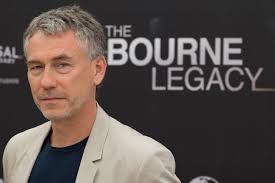
Writer/Director Tony Gilroy and actor Jeremy Renner dropped by the AMC movie theater in Century City on July 9, 2012 to answer questions regarding their upcoming summer blockbuster, “The Bourne Legacy.” The emcee of this Q&A was Dan Gilroy, Tony’s brother, who also co-wrote the screenplay for it. The film itself was not shown that evening, and the audience had to settle for its latest trailer instead, but people were allowed to ask questions about how it will differ from the “Bourne” films which came before it.

This event was presented over the internet live as well as in front of a live audience, so questions came from all over the world as well as Century City. One question came from a guy named Jose on Facebook who asked how “The Bourne Legacy” will differentiate itself from the previous three films. To this, Tony said:

“If you’ve been a casual observer of the films before, it will have an extra bit of boost. If you’re a freak, if you’re a real fan, there’s a lot of stuff that’s in there that’s designed to pay back people who have really been paying attention.”

Catherine, who submitted her question through Twitter, asked, “what does Aaron Cross bring to the Bourne franchise that makes it different from the previous movies?” Tony’s response to this was very descriptive:

“What we’re saying in this film is that there were many programs. The Treadstone program, that Jason was a part of, was an early program that was shopped out to the CIA. The program that Jeremy is in is called Outcome. The Outcome agents are not designed as assassins; they are long lead isolated people who bury down into places. So, the skill set is slightly different, and there’s an adaptive quality, there’s a verbal quality, and there’s a curiosity that we really shine on for the Outcome agents that we meet. In ‘badassery,’ the physical aspects of a lot of this are very familiar; he is a cousin to Jason Bourne in that regard. But the job is different, the design is different, and the flaws are very different. The things that go wrong are very different.”

Dan himself said, as one of the writers of this screenplay, that he was especially interested in the conspiracy side, and he asked his brother Tony how it differs from the franchise:

“Well, this time we’re pulling back (the curtain). We’re saying that what you saw before was a small piece; you watched the other three films and thought that that was the entire universe. It turns out now when we pull back the curtain that there has been a mastermind behind the entire program and these other programs, and that’s Edward Norton. In a way he’s been sitting beside you in the theater for the last 12 years watching this all go on, wondering if it’s going to cause larger problems for him and getting irritated as (“The Bourne) Ultimatum” explodes.”

Many fans of the Jason Bourne movies have been arguing loudly about the series continuing on minus Matt Damon and Paul Greengrass, but Tony Gilroy has made it clear how he made “The Bourne Legacy” with them in mind. It sounds like he has put together an exciting movie which audiences will get a kick out of, and I for one cannot wait to see it.

Jeremy Renner on ‘The Bourne Legacy’ and Preparing a Character

WRITER’S NOTE: This article was written back in 2012.

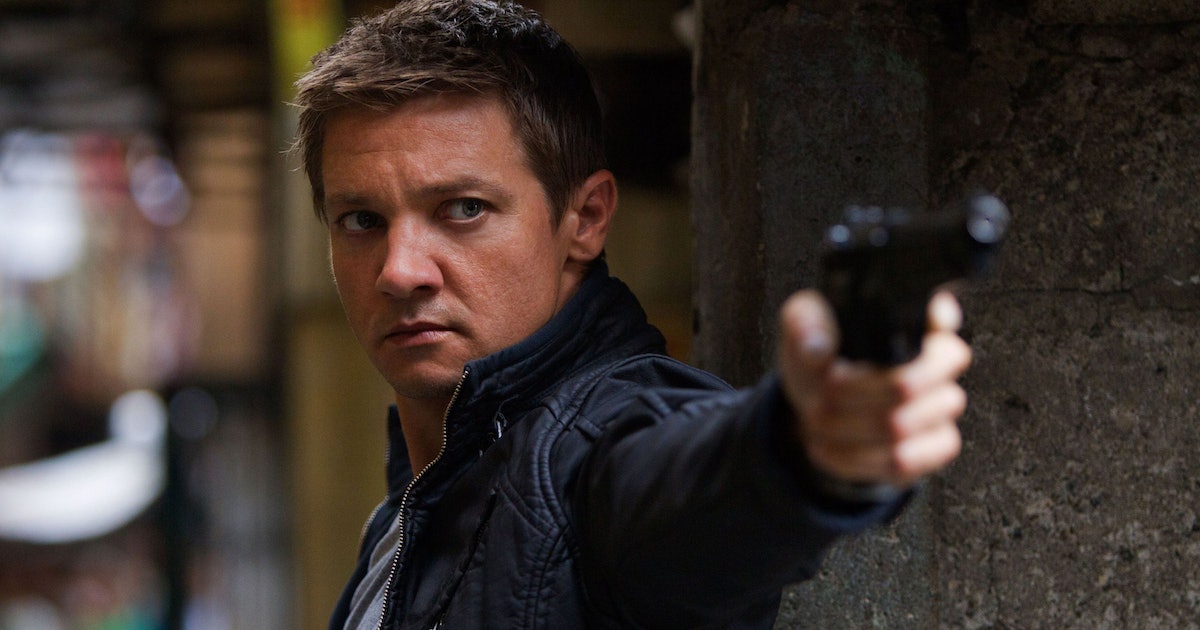
Jeremy Renner appeared at the AMC Century City on July 9, 2012 along with writer/director Tony Gilroy to talk about “The Bourne Legacy.” In addition, Renner also took time to answer questions regarding how he went about preparing to play Aaron Cross, and of his preparation for roles in general. His answers showed him to be an actor always looking to challenge himself constantly and to not get trapped in a comfort zone.

Renner has long since made a name for himself with his performances in “The Hurt Locker,” “The Town,” “Mission: Impossible – Ghost Protocol” and “The Avengers.” One person asked him which movie has required him to do the most training, and he said it was definitely “The Bourne Legacy.” Renner said this was because it required from him “a level of authenticity” the other movies did not ask of him, and that he “had to work diligently to make the fights look like I could actually do them.”

Another person quoted Renner as once saying he “makes himself uncomfortable” when he can and asked him if that has made all the difference in his life. Renner replied it makes all the difference and said it is about constantly challenging himself:

“It’s about not being complacent and not fall into the trappings of repeated behaviors and getting comfortable. As I’ve gotten older, if there are things I knew I don’t like, I would still go try them again just to make sure that I don’t like them.”

Unlike his previous movies which had him acting in a supporting role, “The Bourne Legacy” marks Renner’s first starring role in a big budget Hollywood movie. He did, however, make it clear that his preparation for this movie was no different than any other he has appeared in, and that it remains the same on each role plays. He did say, however, that his workout regimen has changed a lot from “Mission: Impossible – Ghost Protocol” to “The Bourne Legacy:”

“For ‘Mission’ I was really out of shape. I mean, I stretched for twenty minutes and that was my workout. And now I stretch for an hour and a half, fight for two hours, workout for an hour and a half, and then stretch for another hour and then go to work.”

For Renner, saying yes to “The Bourne Legacy” was actually very easy as he felt all the elements were fantastic and that he could not say no to it even if part of him wanted to. And while he may have graduated from indie films to big budget action movies, his mindset has not changed in the slightest as he compared making this sequel to movies he has done beforehand:

“For a big movie, it felt very tiny in the sense of it was not just the stunts but also the intimacy of really quiet scenes I feel I’d rather be doing as an actor. So, for me it had the balance of both; it felt like a little independent movie and a massive action movie, so I got both feels all in one.”

In answering what it was like to play Aaron Cross and how he would turn off the character at the day’s end, Renner’s response did not have any Hollywood ego in it at all:

“Oh, come on man! It’s something that’s not that far away in that we’re talking about every physical role here. I have to stick to the truth on page one to page whatever and just stick to the truths within that. There’s no turning it on or turning it off; I’m not some freak actor that way. This is a character that’s closer to me than say Jeffrey Dahmer (whom the actor played in the 2002 movie “Dahmer”), so it’s not something I have to completely lose myself in. It’s just part of my job, and I can’t explain my job.”

From this evening, we can see that Jeremy Renner is a very respectful actor who takes his craft very seriously, and he revels in his unexpected success and working with actors like Rachel Weisz and Edward Norton whom he resented for stealing so many interesting movie roles from him in the past. We look forward to what Renner has to give us not just in “The Bourne Legacy,” but in so many other performances he has yet to deliver.

Eric Bana on Portraying Such a Charming Villain in ‘Deadfall’

WRITER’S NOTE: This article was originally written in 2012.

Watching Eric Bana as Addison in Stefan Ruzowitzky’s “Deadfall” will remind many of his breakthrough performance as Chopper Read in “Chopper.” Both films have him playing characters who are charming yet fearsome, and his unpredictability as an actor had us on the edge of our seats throughout. But hearing Bana talk about how he prepared to play Addison is a reminder to all actors on how to approach a role like this; the character may be a bad guy, but he’s still a human being with wants and needs like anybody else. It’s not just about acting evil all the time.

I was lucky enough to attend the “Deadfall” press conference at the Four Seasons Hotel in Beverly Hills, and Bana said he really liked Zach Dean’s screenplay and was “immediately compelled” by Addison. Bana described the character as being “quite hilarious actually,” and this was one of the main reasons he wanted to play him. It was interesting to hear him say that because funny is not an easy adjective to give to a character like Addison who can react violently without little or any notice. Bana, however, started out as a stand-up comedian and saw the opportunity to bring some darkly comedic touches to this role.

“I don’t think there was anything deliberately funny in Addison, but I think the situations that all the characters find themselves in and some of the things he does are inadvertently very funny,” Bana said. “It wasn’t like playing for laughs but I knew the audience probably would laugh at some of the ridiculous nature of what we’re all forced to do.”

Bana also went on to say he thought Addison was “morally straight” and that he really did not see the character as being a bad guy. Now while the crimes he commits in “Deadfall” certainly tell us otherwise, I really liked Bana’s approach to this role. It reminded me of a behind the scenes special on “Die Hard” where Alan Rickman talked about how he saw his character of Hans Gruber:

“As far as I’m concerned, I am not playing ‘the villain.’ I’m just playing somebody who wants certain things in life, has made certain choices and goes after them.”

The same can be said about Bana in the way he portrayed Addison.

“He had a strong sense of purpose in what he was doing and that is what makes those characters so scary, knowing you can’t really negotiate with him,” Bana said of Addison. “In his mind everything he’s doing is completely and morally correct and there’s a real reason for it. It’s not the actor’s place to judge, but I’m more than happy to be morally corrupt for a few months for the benefit of my career.”

This thought process was even more on display when Bana was interviewed by James Rocchi of MSN Entertainment. Rocchi talked about “Deadfall’s” first scene in which Addison’s car crashes and ends up shooting a state trooper in the process, and he described Addison as being spontaneous in his actions as this guy is thinking on his feet and improvising constantly. Bana explained that when the actor commits fully to their character’s actions, they should all come out naturally.

“I don’t like to think too much about what my physicality’s going to be here. I’d rather immerse myself in the character’s brain and allow my body to react accordingly,” Bana told Rocchi. “But that instance in the beginning of the film kind of sets in motion the rest of the stakes really for Liza (Addison’s sister who is played by Olivia Wilde) and Addison from that point on in that it just keeps getting worse and worse and worse. But you’re right. I mean he had no intention of shooting anybody. They got away from the casino, they got the cash, and all was going really well until that freaking deer popped out into the middle of the road and it all changed.”

Throughout “Deadfall,” Addison ends up engaging a couple of nasty fights, some of which are with Jay who is played by Charlie Hunnam (“Sons of Anarchy”). We keep hearing actors say how they did their own stunts in this or that movie, but we can never be too sure as the insurance people are usually dead set against that ever happening. But I believed Bana when he said that he did his own stunts in “Deadfall” because even he couldn’t hide the toll it took on his body.

“My neck was ruined,” Bana told Ariel Kashanchi of Screen Picks. “Charlie Hunnam beat the shit out of me. I don’t think I landed a punch. It was just like bang, bang. I remember after about five takes I was stiff all over and thinking ‘how much more can my neck take.’ I’m used to throwing punches and now I just have to just sort of take it. But it was kind of fun.”

“Deadfall” has received mixed reviews, but there is no denying Bana gives a riveting performance as Addison. Playing a charming bad guy is nothing new for this Australian actor, and he is still great at it. In a year of movies filled with truly intimidating antagonists, Bana’s performance deserves to be held up alongside the best of the bunch.

SOURCES:

Ben Kenber, “Interview with the Cast and Director of ‘Deadfall,’” We Got This Covered, December 7, 2012.

Alan Rickman: Hans Gruber is not a villain,” YouTube

James Rocchi, “Interview: Eric Bana of ‘Deadfall,’” MSN Entertainment, December 7, 2012.

Ariel Kashanchi, “Interview: Eric Bana on ‘Deadfall,'” Screen Picks, December 6, 2012.

‘Savages’ – Oliver Stone Once Again Descends into a Realm of Drugs

WRITER’S NOTE: This review was written back in 2012. Some edits have been made since then to make it more interesting in the Ultimate Rabbit’s eyes.

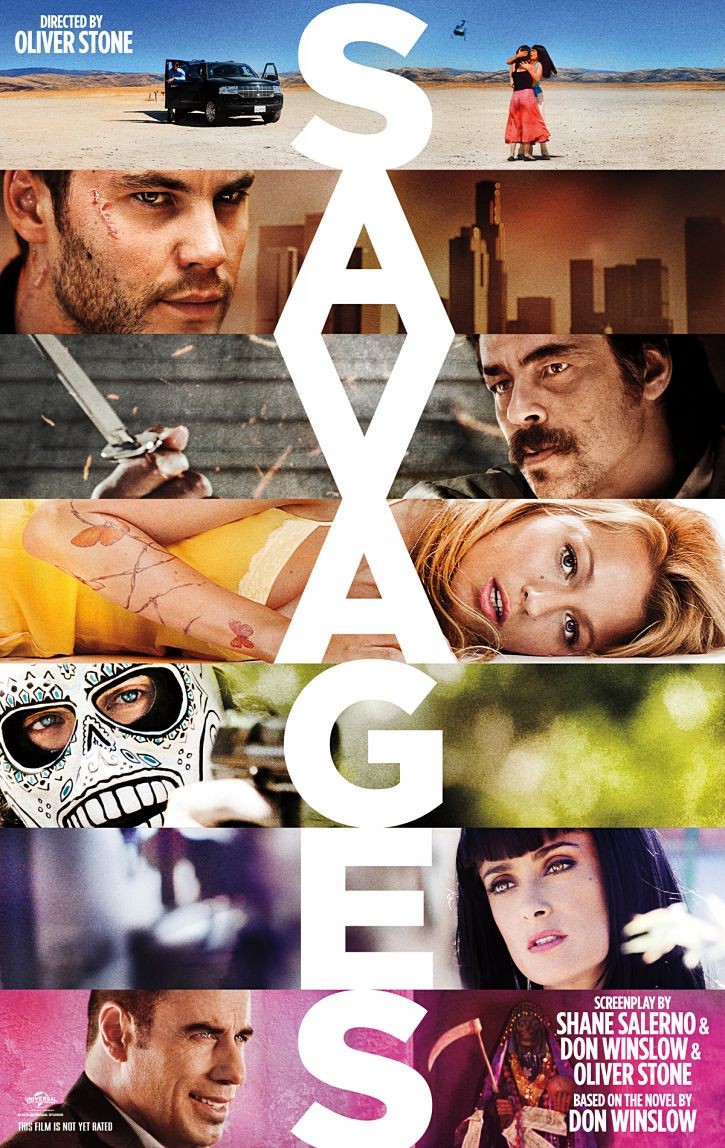
Savages” is being looked at as Oliver Stone’s comeback movie, as if it is implied that he hasn’t made one worth watching in years. Granted, movies like “World Trade Center,” “Wall Street: Money Never Sleeps” and even “W.” might have made it look like Stone was starting to get too soft on us, but none of these movies, however, showed him to be losing any of his power as a filmmaker. I guess we just miss him generating some kind of controversy because we all expect him to have some conspiracy he is just waiting to unleash on an unsuspecting populace.

Based on the book of the same name by Don Winslow, “Savages” shows Stone getting down and dirty again as the film deals with a couple of weed producers who, quite unfortunately, capture the attention of a brutal and greedy Mexican cartel. While it doesn’t reach the exhilarating highs of “Natural Born Killers” or “Scarface” (which he didn’t direct but wrote the screenplay to), it is still a compelling film to watch. However you look at it, Stone is not about to play it safe with the story or its characters this time around.

Blake Lively stars as O (short for Ophelia) who begins “Savages” by saying that just because she’s narrating the movie does not mean she will be alive at the end of it. Now this is a clever beginning as Stone teases us with the possibilities of what is to come, fully ready to rip the rug out from right under us if the occasion calls for it. These days, it is so nice to see any filmmaker, let alone one who has won several Oscars, take such risks these days.

O lives with her two boyfriends, former U.S. Navy SEAL Chon (Taylor Kitsch) and University of California at Berkeley graduate Ben (Aaron Johnson), both of whom happen to grow some of the best marijuana you could ever hope to inhale. They live their days in Laguna Beach, California which is so beautifully captured by cinematographer Dan Mindel to where I want to drive down there in a New York minute. Heck, I used to go to school near there!

Anyway, Chon and Ben receive a very cryptic message from the Baja Cartel which comes along with a video featuring beheaded drug dealers whom, like these two guys, were independent sellers. Basically, the cartel wants to go into business with them and take a cut of their profits. Chon and Ben, however, refuse to get involved with any cartel, and they make plans to move out of the country with O to another where they can stay for at least a year. But the head of the cartel, Elena Sánchez (Salma Hayek), believes these guys need to show her some respect, so she gets her henchmen to kidnap O in order to make them comply with her demands. But Chon and Ben are not about to let go of their O without a fight.

The movie’s title, “Savages,” makes me wonder who it is referring to among its cast of characters. It is tempting to think it refers to the Baja Cartel as they utilize horrific methods to get what they want, but it could really be referring to any of the characters we see here. Stone is examining just how far we can be pushed before we are forced to embrace our animalistic nature, and he gets at this horrifying truth of what violence we are all capable of when we get pushed to extremes.

“Savages” is far from original as its story may remind many of their favorite “Miami Vice” episodes. With a movie like this, I expected Stone to be pushing our buttons a little bit harder than he does here. But even though I came out of it feeling Stone could have gone even further with the violence, the action is still jolting and, at times, extremely graphic; one guy even finds one of his eyes hanging out of its socket during a moment of torture. Stone also utilizes his many ways of shooting which include black and white footage along with scenes of psychedelic power as characters find themselves under the influence either by choice or by force.

Now I don’t care what anybody says, Blake Lively is a good actress. Many seem to sneer whenever she is starring in a movie, but maybe this is because she was on “Gossip Girl,” a show I have never bothered to watch. Lively has to take her character of O from being a fun seeking woman to one who has to learn to live again, and she is excellent throughout. After her turn as a drug addicted single mother in Ben Affleck’s “The Town,” there should be zero doubt that she can act.

It has been a tough year thus far for Taylor Kitsch who has seen two big budget blockbusters he starred in, “John Carter” and “Battleship,” bomb hard at the box office. Then again, those movies probably would have bombed no matter who starred in them. With his role as Chon, he shows a toughness and attitude which is not easily faked, and you can see why so many were looking to cast him in their projects. Many actors yearn to play a ballbuster when given the opportunity, and Kitsch rises to the occasion and gives a terrific performance.

Aaron Johnson, who plays Chon’s more philosophical partner Ben, seems to have grown up a lot between this movie and “Kick Ass.” Once again, Johnson is playing a character who is eager prove himself and yet completely unaware of what that will take. From start to finish, he does an excellent job of transitioning his character from a peaceful man to a bloody defender of what he loves.

But leave it to some acting demigods to give “Savages” its potent power which nails us right into our seats. Benicio Del Toro is brilliant as the sociopathic henchman Lado. Like the most entertaining cinematic sociopaths, Lado is at times charming while more often menacing and extremely sick. He thinks nothing of killing people when the opportunity presents itself, and Del Toro looks to be having a blast as he explores the different facets of his character’s twisted personality.

And then there’s Salma Hayek who singes the screen as drug queen Elena Sánchez. All Hayek has to do is give the audience one look, and you know this is a person you do not want to mess with. She also gets a surprisingly complex character to play as Elena’s ascent to being a big-time drug dealer had more to do with tragedy than it did with opportunity.

“Savages” also features strong performances from John Travolta as a corrupt DEA agent, Emile Hirsch as the money launderer Spin, and Demián Bichir as one of Elena’s representatives, Alex. There is not a single weak performance to be found here as everyone looks to be as thrilled as can be to be acting in an Oliver Stone movie.

Now there has been some controversy over the movie’s ending as it offers up two very different conclusions. The way it comes across reminded me of when Michael Haneke got one of his characters to grab a remote control to reverse and alter the events in “Funny Games.” Both directors are looking to mess with our heads. While the fates of the characters are not entirely resolved, it was worth seeing things turn out the way they did as some end up getting very clever about the situations they are trapped in.

Is “Savages” classic Oliver Stone? Not quite, but it is certainly more potent and energetic than some of his other recent work. Give him the right story, and he can still give you a cinematic experience like few others can.

* * * ½ out of * * * *

‘Ted’ Remains One of the Funniest Comedies Ever

Man, I would have loved it if this had happened to me as a kid; having one of my stuffed animals come to life and me forming a lifelong friendship with it. That is what makes “Ted” one of the most enjoyable and funniest movies I saw back in 2012 as it makes that dream become a reality. Seth MacFarlane, the creator “Family Guy,” makes his live-action motion picture directorial debut here, and it is one of the few comedies which is not hit and miss as the laughs just keep on coming. “Ted” also balances out its wickedly crude humor with a lot of heart as the movie comes to look at how important friendships can be in life no matter what form they take.

At the movie’s start, we meet young John Bennett (Bretton Manley) who lives with his family in a town near Boston. The narration, delivered in brilliant fashion by Patrick Stewart, goes over how John has no friends and that even the Jewish kid in the neighborhood who keeps getting the crap kicked out of him by bullies wants nothing to do with him. Things change for the better when he receives a teddy bear for Christmas, whom he names Ted. John loves Ted so much to where he makes a wish for the bear to come alive, and I am sure you know what happens from there.

“Ted” doesn’t take long to get the comedy juices rolling as John’s parents (Alex Borstein and the hilarious Ralph Garman) are incredibly shocked to see their son’s teddy bear walking and talking on its own. After that, Ted becomes a celebrity of sorts as he has Johnny Carson in hysterics and ends up getting arrested at the airport for drug possession. Throughout all of this, he and John remain the best of friends through all things and share many common interests including a serious fear of thunder.

Moving forward to the present, John is now played by Mark Wahlberg and works at a car rental agency. He and Ted still enjoy hanging out together while getting high and doing stupid things when left to their own devices. At the same time, John has been in a long-term relationship with the beautiful Lori Collins (Mila Kunis), and she ends up giving John an ultimatum to get Ted to move out of their apartment so they can move on with their lives.

The fact is Ted has become incredibly obnoxious, unthinkably vulgar, and gleefully hedonistic; something which does not stop once he is finally forced to move out and get his own apartment. He even finds a job at a supermarket despite being grossly inappropriate during an interview with the manager. Instead of giving the manager a reason not to hire him, Ted impresses him with his behavior. Either that or he is just desperate for any employee he can get to work for minimum wage.

During this time, Ted still manages to get John to hang out with him, and this results in John having to lie to Lori while making ridiculous excuses to get out of work. One night with Ted which John cannot possibly turn down is when Sam J. Jones, the star of their favorite movie “Flash Gordon,” shows up for a party at Ted’s apartment. You have to give Jones a lot of credit for sending himself up and having a good sense of humor about the popularity of the 1980 camp classic as he portrays himself as a hard living actor looking for a comeback. Even Ted cannot help but remind John about how Jones’ performance in “Flash Gordon” ended up redefining what it means to act in a movie (and not necessarily in a good way).

Truth be told, “Ted” could have just worked with its crude yet irresistible humor as it scores one big laugh after another. But its main success is how it also combines that crude humor with a lot of heart. The movie is really about the power of friendships and the struggle to keep them going when other things get in the way. As crazy as Ted gets, be it humping a checkout scanner or even snorting cocaine, even he comes to see he has to change his ways just like John has to in his own way. But whatever you do, do not get Ted started on Teddy Ruxpin, seriously!

I have never watched “Family Guy” on a regular basis, so I cannot compare “Ted” to it. Regardless, this film does show him to have a great sense of humor as well as a good appreciation for the stranger parts of popular culture. It is also a must for fans of “Flash Gordon” as it pays homage to its so bad it is good qualities. MacFarlane also throws in jabs at other pop culture targets like Taylor Lautner, Justin Bieber, and even Brandon Routh whose performance in “Superman Returns” is not exactly respected here.

Wahlberg is utterly hilarious, but this should be no surprise to anyone who saw him share the screen with Will Ferrell in “The Other Guys.” The scene where he lists off “white trash girls names” in rapid fire succession is a comic highlight, but even that gets outdone by the vicious fight scene he and Ted have. For a moment I thought Ted would descend into Chucky (the doll from the “Child’s Play” movies) territory, but even he doesn’t get that crude. Still, it results in some of the biggest laughs I have ever had in a movie theater.

Mila Kunis remains as engaging as ever, playing the same wonderful type of character she played in “Forgetting Sarah Marshall.” Having her in this movie as Lori makes John’s need to get rid of Ted seem like a real no-brainer. Kunis also gets to play Lori as someone not bound by typical clichés, and she ends up making Lori the most intelligent person in the entire movie as a result.

There is also Giovanni Ribisi showing up as crazed stalker Donny who wants to buy Ted from John so he can give the teddy bear to his son Robert (Aedin Mincks). Donny cannot bring himself to say no to anything his son wants (bad parent alert!), and this includes giving Robert a toy he may very well end up destroying. Granted, Ribisi’s role in “Ted” might seem unnecessary as it adds something the plot does not necessarily need, but it’s worth it just so we can watch his truly creepy dance to Tiffany’s “I Think We’re Alone Now.”

The design of Ted is that of a generic teddy bear, the kind you end up adding your own personality to. It was smart to go with this kind of bear instead of with some iconic stuffed animal with a built-in personality. You never quite know what is going to come out of Ted’s mouth next. While it may seem somewhat unrealistic for any teddy bear or stuffed animal to be having this much fun, women of any age are quick to hug one quicker than men nearby. This is the story of my life these days, dammit.

Seriously, “Ted” was one of the best comedies I ever got to watch in a theater. Now a lot of this has to do with my continued affection for stuffed animals after all these years, but it also proved to be one of those comedies which was not hit and miss like many I see. It speaks to those special memories we had with our stuffed animals growing up, and of how they eventually bec0me as crazy as us.

* * * * out of * * * *

Helen Hunt on Portraying a Sex Surrogate in ‘The Sessions’

WRITER’S NOTE: This article was written in 2012.

Ever since her Oscar win for “As Good as It Gets,” it seems like Helen Hunt has been keeping a markedly low profile. She has kept busy with other projects and even took the time to make her directorial debut with “Then She Found Me,” but we do not hear about her as much these days as we did back in the 1990s during her “Mad About You” heyday. But now she is back in a big way with her critically acclaimed performance as sex surrogate Cheryl Cohen Greene in Ben Lewin’s “The Sessions,” and it serves as a reminder of how great she can be when given the right material.

“The Sessions” is based on the true story of poet Mark O’Brien (played by John Hawkes) who hired Greene to help him lose his virginity at the age of 38. O’Brien had spent the majority of his life in an iron lung and was paralyzed from the neck down due to getting polio as a child. However, a certain part of his body below the waist still works, and Greene became the person he hired to help him exercise it.

Now playing a real-life person has its challenges because you want to honor the individual without impersonating them. For Hunt, however, the challenge became understanding Greene’s job of being a sex surrogate as she was never aware a job like this existed before. Talking with Greene opened Hunt up to how she could respectfully portray such a person onscreen.

“She used the term ‘sex positive,’ ” Hunt said of Greene. “And I went: ‘Wow, I want to be sex-positive. I want to be part of a movie that is that; I’ve never seen that.’ So, it was more her vibe about her positive, enthusiastic, nonjudgmental way of talking about this topic that is usually laden with weirdness.”

Hunt ended up doing 90% of her research for the role with Greene, and it was Greene’s enthusiasm and frankness about everything which made Hunt ever so excited to portray her in “The Sessions.”

“She (Greene) has a sense of adventure about her grandkids growing up, helping someone have an orgasm, making this movie, meeting me and my boyfriend, chocolate from the raw restaurant I took her to,” Hunt said. “All of those things light her up. I thought, ‘What if I could be like that about sex in a movie?’ That would be amazing.”

Greene also made it very clear to Hunt how her job as a sex surrogate differs greatly from being a prostitute.

“The prostitute wants your return business, and she (the sex surrogate) doesn’t. She wants you to learn what you need to learn, so you can go off and have a relationship. That’s a substantial difference,” Hunt said of Greene’s description of her work.

Director Lewin went even further in describing Greene as being “a middle-class soccer mom who has sex with strangers.” As a result, the role Hunt plays in “The Sessions” proved to be more complex than the one Hawkes plays.

“Her preoccupation was in achieving the emotional journey,” Lewin said of Hunt. “I got a real buzz talking with her because there were aspects of the character I hadn’t thought through that she had. She’s a frighteningly intelligent actor.”

The sex scenes between Hunt and Hawkes have a wonderfully awkward feel to them as his character gets to experience sexual intimacy for the very first time. Hunt said neither she nor Hawkes ever did a full read-thru of the script or even rehearsed together much. Instead, Hunt spent a lot of time on her own writing down her own feelings about sex, and what she ended up saying about the act really shows up in the film.

“Sex is never perfectly elegant: The light isn’t just right, and the underwear doesn’t fall on the floor perfectly, and the hands don’t clutch, and you don’t come at the same time. It’s all bullshit, basically,” Hunt said. “And the disability of this character renders all of that impossible, so you’re left with something much more like your own experience as a nondisabled person, which is that you’re human and that it’s good and it’s bad and it’s weird that it’s silly, and it’s embarrassing that it’s scary, so I think that the disability is just a way to get to what it’s actually like.”

Like her co-star Hawkes, Helen Hunt deserves all the accolades she has been getting for her performance in “The Sessions.” You believe her when she says that parts like this one don’t come around often enough, and you can sense her sheer excitement in playing Greene in this movie.

“She was someone who radiated this unabashedly humanistic view of what the human body is capable of,” Hunt said of Greene. “As an actress, I was hungry to play someone like that. As a person, I’m hungry to live that way.”

SOURCES:

Jordan Zakarin, “Helen Hunt, Star of ‘The Sessions,’ Wants to Be Sex Positive,” The Hollywood Reporter, October 19, 2012.

Julie Miller, “Helen Hunt on Overcoming Inhibitions for The Sessions, the Difficulty of Playing a Real Person, and ‘the Sexiest Quality There Is,'” Vanity Fair, October 18, 2012.

Marshall Fine, “Helen Hunt says intense emotional journey of sexual surrogate made ‘The Sessions’ a can’t-miss role,” NY Daily News, October 18, 2012.

John Horn, “Helen Hunt fully invests in ‘The Sessions,’” Los Angeles Times, August 31, 2012.

John Hawkes on Playing Mark O’Brien in ‘The Sessions

WRITER’S NOTE: This article was written back in 2012.

The Sessions” and John Hawkes’ performance in it as journalist and poet Mark O’Brien have earned some of the most rapturous praise of any movie in 2012. The film tells the story of how O’Brien, who was confined to an iron lung due to being stricken by polio as a child, hired sex surrogate Cheryl Cohen Greene (Helen Hunt) to help him lose his virginity at the age of 38. Hawkes, who earned an Oscar nomination for his performance in “Winter’s Bone,” has talked extensively about his concerns about taking on the role as well as the physical challenges he faced in playing O’Brien.

Hawkes’ biggest concern was whether or not it might be better for a disabled actor to play O’Brien instead of him. As a result, he’s still waiting for some sort of backlash to hit him. Ben Lewin, who directed “The Sessions” and is himself a Polio survivor, did take the time to find a disabled actor to play Mark, but he eventually became convinced Hawkes was the man for the job.

“Of course, that was my first question: Why not a disabled actor? They are a uniquely qualified group of people for this role, who are undervalued and underused,” Hawkes said. “I’ve had a lot of disabled actors come to me after screenings, and they told me to get over it.”

“It is the 800-pound gorilla in the room in a way,” Hawkes continued, “but it’s something that, Ben (Lewin) being a polio survivor himself, and the fact that he put the time in to look for disabled actors, he felt like, would it be politically correct to hire a slightly disabled actor to play a severely disabled actor? He ultimately just hadn’t found his guy. We met, and he felt like I could do it.”

Once cast, Hawkes became determined to mirror the physical condition O’Brien was stuck in for the majority of his life. To that extent, he and the props department created what was described as a “torture ball;” a soccer ball-sized foam pad that he tucked under the left side of his back to force his body to curve dramatically. In addition, he also used a mouth stick which was much like the one O’Brien used to turn the pages of a book or dial a telephone. It was this “torture ball,” however, which threatened to leave Hawkes with permanent physical damage to his body.

“Finding that position was difficult and did hurt. I’ve got a guy that I’ve been seeing for years, who is a combination massage therapist and chiropractor. I’d have 15 minutes with him, two or three times a week, or half an hour, if I was lucky. He told me that I wasn’t doing very good things to my body, but it was my choice. I’m not a martyr or masochist, but when the script says that your spine is horribly curved, you can’t just lie flat on your back and pretend,” Hawkes said.

But ultimately what makes Hawkes’ performance so good is that he doesn’t turn him into just another pity case. Filmmakers are typically expected to give us an emotionally manipulative experience when it comes to portraying physically disabled characters, making us feel sorry for them and of what they are unable to accomplish because of their limitations. Hawkes and Lewin, however, were determined not to go down this route.

“A character like that had every reason to wallow, but that’s just not interesting to watch on screen,” Hawkes said. “I’ve played a lot of underdogs and I like people who aren’t equipped to solve their problems but just keep trying anyway. There’s something really noble and interesting about watching someone keep banging their head against the wall.”

One of the other things which helped Hawkes was watching the documentary “Breathing Lessons: The Life and Work of Mark O’Brien” which won its director Jessica Yu the Oscar for Best Documentary Short Subject in 1997.

“There was Mark’s body, and there was his voice,” Hawkes said, referring to the documentary. “And so, I didn’t invent a lot. I just tried to really take as much of the Mark that I saw and tried to make it my own, to embody him.”

The effect Hawkes’ performance has had on those who were very close to O’Brien has been profound. Just ask Cheryl Cohen Greene, the sex surrogate whom Hunt’s character is based on.

“The first time I heard John I got chills,” said Greene. “I’m sitting there on the set with headphones thinking, that’s Mark. It’s scaring me. John got him completely.”

John Hawkes’ performance as Mark O’Brien looks very likely to earn him an Academy Award nomination for Best Actor, and many will agree that he deserves the recognition for his work. It marks another memorable role for this actor who first came to Hollywood over a decade ago, and he has many more great performances ahead of him.

SOURCES:

Jordan Zakarin, “John Hawkes: Hopeful, but Ready for Backlash and (Maybe) Permanent Back Pain,” The Hollywood Reporter, October 22, 2012.

Christina Radish, “John Hawkes Talks THE SESSIONS, Conveying His Performance Using Only His Face, Being Confined in an Iron Lung, and More,” Collider, October 16, 2012.

Rebecca Keegan, “John Hawkes enters virgin territory in ‘The Sessions,’” Los Angeles Times, October 11, 2012.

Oliver Gettell, “‘The Sessions’: John Hawkes and Helen Hunt on playing real people,” Los Angeles Times, October 29, 2012.

Rachel Nichols Talks About the Making of ‘Alex Cross’

RACHEL NICHOLS stars in ALEX CROSS

WRITER’S NOTE: This article was originally written back in 2012.

She has had memorable roles in movies like “P2,” “Star Trek” and “G.I. Joe: The Rise of Cobra,” but it’s going to be hard to forget about Rachel Nichols after watching her in “Alex Cross.” As Detective Monica Ashe, partner to Cross and lover to Detective Tommy Kane (Ed Burns), Nichols is a strong and alluring presence as she holds her own with a very talented cast which includes Tyler Perry. While the movie is not exactly a critics’ darling according to Rotten Tomatoes, Nichols registers as one of its best assets to where you wish her character was in it a little longer.

While at the “Alex Cross” press conference which took place at the Four Seasons Hotel in Beverly Hills, Nichols said she was familiar with James Patterson’s books and the Alex Cross character, but what drew her to this project was the script.

Rachel Nichols: I read the script and I just thought to myself this is going to be sort of an interesting combination of the drama aspects and also a lot of action. I knew that Rob (Cohen) was attached and obviously everyone is familiar with his work, and I knew that he’d put a really exciting and very different spin on it and I wanted to be part of that.

As I said earlier, I really wish Nichols was in the movie longer. Her character ends up, shall we say, disappearing from it rather early on, and Nichols commented that she has a sad history of getting the “not” part in several movies. She also said her parents wish she would do a romantic comedy next where she survives and ends up happy in the end. Regardless, Nichols had a lot of fun during the filming of “Alex Cross.”

Rachel Nichols: I honestly felt that I was there for the entire film. When I watched it the first time I didn’t actually know where in the course of things that I would no longer be in the film. I like the element of surprise that comes along here. That and what happens to Cross’ wife supports the vigilante aspect of it and makes everyone get on Cross’ side.

Like her co-star Burns, Nichols has played her fair share of law enforcement officers on screen. When asked if this has helped her develop a talent for figuring out the mystery or solving the case in each movie she’s in, Nichols replied she certainly tries to.

Rachel Nichols: I don’t think I’m terribly successful at it. There is that element of trying to figure things out which is fun, but I certainly don’t think that I’ve accrued any new skills to do that.

But although she has played cops in the past, Nichols made clear that she still had to relearn the techniques of sweeping a room and proper weapons procedure while working with the Detroit Police Department in preparation for her role.

Rachel Nichols: You’d think it would be like getting back on a bicycle but it’s not.

In talking about working with Burns, she said the first thing they shot together was their love scene. It happened a month after they first met at the casting sessions, and she recalled that they looked at one another and said, “Hey, how are you? Let’s get naked!” Looking back, Nichols said this was totally the way to do it.

Rachel Nichols: I love that scene because two people sitting on a bed is not as dynamic as that scene was. We did the roundabout and it was moving and constantly emotional and he (Burns) is out the door. But thanks to Cohen, it felt very easy for us to do and we had a great day on set.

I am very serious when I say Rachel Nichols is really good in “Alex Cross,” and I think the roles she gets offered from here on out will be much bigger than what she’s received so far. Hearing her talk about her role as Monica Ashe shows us an actress who has done her research and never just walks through any part given to her. I look forward to seeing what she does next.

‘Game Change’ – When Julianne Moore Gave Empathy to Sarah Palin

WRITER’S NOTE: This review was written in 2012. With the 2022 midterm elections now concluded, I thought it would be fun to revisit this one.

It will be interesting to see what people think of “Game Change,” assuming of course they can get past their own political prejudices while watching it. We have long since made up our minds about the former Vice-Presidential candidate Sarah Palin and are either for or against her, but this HBO movie offers a more intimate look at her life which you won’t find on any episode of “Saturday Night Live.” Then again, this movie is not all about her, and it deals more specifically with how people are selected to become national leaders. While you may think it’s the Presidential candidate who makes the final decisions, that is not always the case.

“Game Change” opens with a scene from a “60 Minutes” interview Cooper Anderson did with John McCain’s chief campaign strategist, Steve Schmidt (Woody Harrelson), after the Presidential campaign ended in which he asks Schmidt if he regretted choosing Palin as McCain’s running mate. The look on his face is perplexing as if he wants to say yes, or maybe he is instead looking for a better answer so he can seem more thoughtful. Either way, we don’t find out his answer until the end, but we wonder about this question throughout.

Schmidt is seen as reluctant to join McCain’s Presidential campaign, but his respect for McCain eventually makes him a chief participant. But after McCain wins the Republican nomination, a bigger problem looms; the politicians he is considering for his running mate won’t help him overcome the excitement Americans have for Barack Obama. This leads his political advisers Rick Davis (Peter MacNicol) and Mark Salter (Jamey Sheridan) to suggest Governor of Alaska Sarah Palin who they see as a game changer. Even though Palin has not been Governor for very long, they believe choosing her will enhance McCain’s image as a political maverick. Sure enough, Palin energizes McCain’s campaign in a way few others could with her strong presence and conviction of purpose. But when it comes to world and political affairs, that’s where everyone, including Palin, comes to develop a severe case of anxiety.

Now I know Plain herself has made it clear that she has no interest in watching “Game Change,” but she is actually portrayed here with a lot of empathy. As played by Julianne Moore, Palin is sincere in her efforts in wanting to help McCain win the Presidency and is shown to be a loving mother and wife. Upon being introduced to the world, Palin becomes overwhelmed with the negative press thrown in her direction to where she’s not sure how to deal with it. There are scenes where she watches helplessly as Tina Fey does an impersonation of her on “Saturday Night Live,” and you can’t help but feel for her even if it made for some great comedy.

Speaking of Fey, after watching her do a flawless imitation of Palin, it seemed insane for anyone else to try and play Palin in a movie or skit (did you see Andy Samberg try to do it?). But Moore never stoops to impersonating Palin here, but instead inhabits her so brilliantly. The whole time we watch Moore in “Game Change,” we never see her acting but instead searching for what drives Palin in this political race and her life. I really felt like I was watching Palin here and not Moore as the actress seems to just float away and has let the former Governor of Alaska take over for her.

As the campaign rolls on, we see Palin rebelling against the advisers who tell her what to say, do, and wear. While part of us wants her to really listen to them, you can’t help but admire her for not wanting to put on an act for the American people. Deep down, we really don’t want to see politicians play us for fools as we always feel we can see right through their act. Would you be ever so willing to compromise the things you believe in just to win political office?

I love how Harrelson embodies Schmidt, a man who’s trying his best to handle a delicate situation which threatens to implode each and every day. Schmidt is a guy who thinks he can handle any problem thrown at him but ends up being confronted by one he cannot control. Seeing Harrelson’s eyes stare like daggers at Palin when she goes rogue is an unforgettable image as Schmidt eventually makes clear this is McCain’s show, not hers.

Ed Harris doesn’t look or sound much like McCain, but that doesn’t matter here. What he does accomplish is making McCain seem like an honorable politician trying to run a campaign which is not full of nastiness like the one George W. Bush ran against him in 2000. Seeing him grimace when his supporters start hating on Obama more intensely, calling him an “Arab” or a “communist,” is a painful sight as he realizes this is not the kind of race he ever wanted to be a part of. Harris is an actor who always delivers the goods, and he certainly doesn’t fail us here.

One performance which stands out here is Sarah Paulson’s as McCain adviser, Nicole Wallace. Paulson gives her role a wonderful complexity as her sincere dedication to McCain’s campaign is severely tested by her utter resentment of Palin. As much as Wallace wants to help Palin do her best, you can see in Wallace’s eyes that she is thinking, “is this the best we can come up with?”

“Game Change” was directed by Jay Roach who also directed the superb HBO movie “Recount” which dealt with the craziness of the 2000 Presidential election. As with that one, he attempts to make “Game Change” a balanced look at a politician and campaign we feel we know everything about already. Whether or not he has succeeded here is hard to tell because America is as politically divisive as it has ever been, and many people have been vocal with their criticisms even before they bothered watching this movie.

Roach show us history as if it were unfolding right in front of us, and he lets get us get all caught up in it. We all know the outcome of this election, but we still cringe when Palin makes mistakes like on the Katie Couric interview. Even if she didn’t have our support during the general election, seeing her suffer through a process which proves to be beyond anyone’s control is painful, and we want to see her overcome obstacles most people don’t get to experience. Regardless of what it is we’re watching we always find ourselves rooting for the underdog. As “Game Change” comes to an end, Roach keeps us on the edge of our seats as we wonder what Palin has up her sleeve next as she has long since proven to the world that she is nobody’s puppet.

Is “Game Change” accurate to what actually happened? It depends on who you ask. Both Palin and McCain have described it as inaccurate and based on a false narrative while Schmidt and Wallace have said it tells the truth and captures the spirit of the campaign. When all is said and done though, I’m not sure I care if it is because most movies “based on a true story” are usually not altogether accurate as dramatic considerations need to be taken into account. In the end, all we can do is hope for a compelling motion picture which holds our attention throughout, and “Game Change” certainly held mine.

Palin should at least be happy that she does not come off as the bad guy here. It’s really her political handlers who come off looking bad by throwing a barely tested Governor into a political minefield which is unforgiving and endlessly vicious. Long before the election ends, the handlers see that their thirst for victory has overcome their better judgment as they picked a celebrity more than a true candidate. This brings me to scariest thing “Game Change” reveals though which is a truth that many of us don’t want to see: that these days the news is nothing more than “entertainment,” and that celebrities seem more entrancing to the public than a thoughtful politician.

* * * ½ out of * * * *