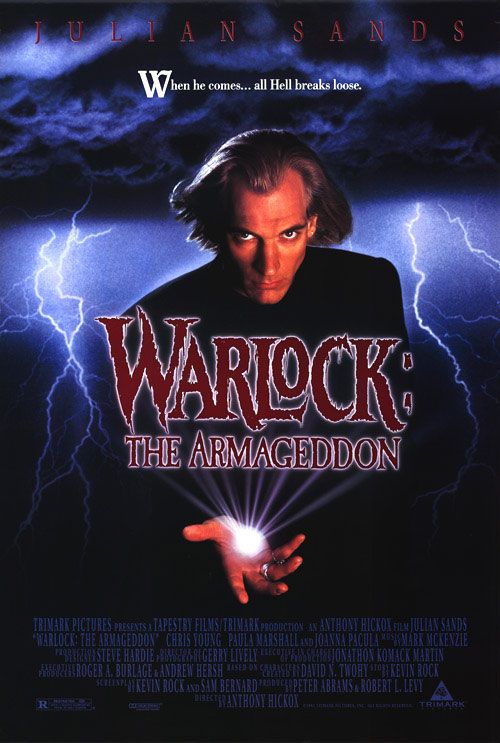
I remember seeing this movie trailer back when I was an employee at Crow Canyon Cinemas in Northern California. I was aware of the original “Warlock” which starred the late Julian Sands as the title character, a son of Satan who is intent on destroying the world. And like any horror film from the 1980’s, it had to be followed by a sequel. This teaser showed some promise as we watch a peaceful landscape of nature become infinitely degraded to where the end of the world feels far too near for our comfort. And it always feels like the end of the world is just around the corner these days and, unlike R.E.M., we do not feel fine about it. Plus, the man narrating the trailer does make your blood curdle as he talks about “when he comes” and how “the land will be tainted with blood.”
So, why does this teaser trailer for “Warlock: The Armageddon” end up on my list for the worst movie trailers ever? Because it shows a lot of promise, and yet it feels so incredibly and unforgivably cheap. This could have been one for the ages, but it instead illustrates how this sequel had to deal with a far too low budget than its predecessor. While “Warlock” had a budget of $15 million to work with, “Warlock: The Armageddon” was made for only $3 million. Watching this trailer makes me realize how the producers were clearly pinching every penny they had when going into this production, and it makes everything here look so sad.
Seriously, this could have been one of the greatest movie trailers ever had more money and creativity been put into its making. That land tainted with blood looks like it was painted with a red Crayola marker. I look at this piece of marketing, and I cannot help but think about all the things about it which could have been improved on. While the narrator does what he can to sell it to the moviegoing public, the images betray the fact that not enough money was put into this particular film. Talk about a power point presentation gone bad!
It’s no wonder that this sequel’s follow up, “Warlock III: The End of Innocence,” would have an even lower budget to where Julian Sands bailed on the proceedings and was replaced by Bruce Payne and didn’t even get a theatrical release. Going straight to video back then never made anyone look all that good.
The following review was written by Ultimate Rabbit correspondent, Tony Farinella.
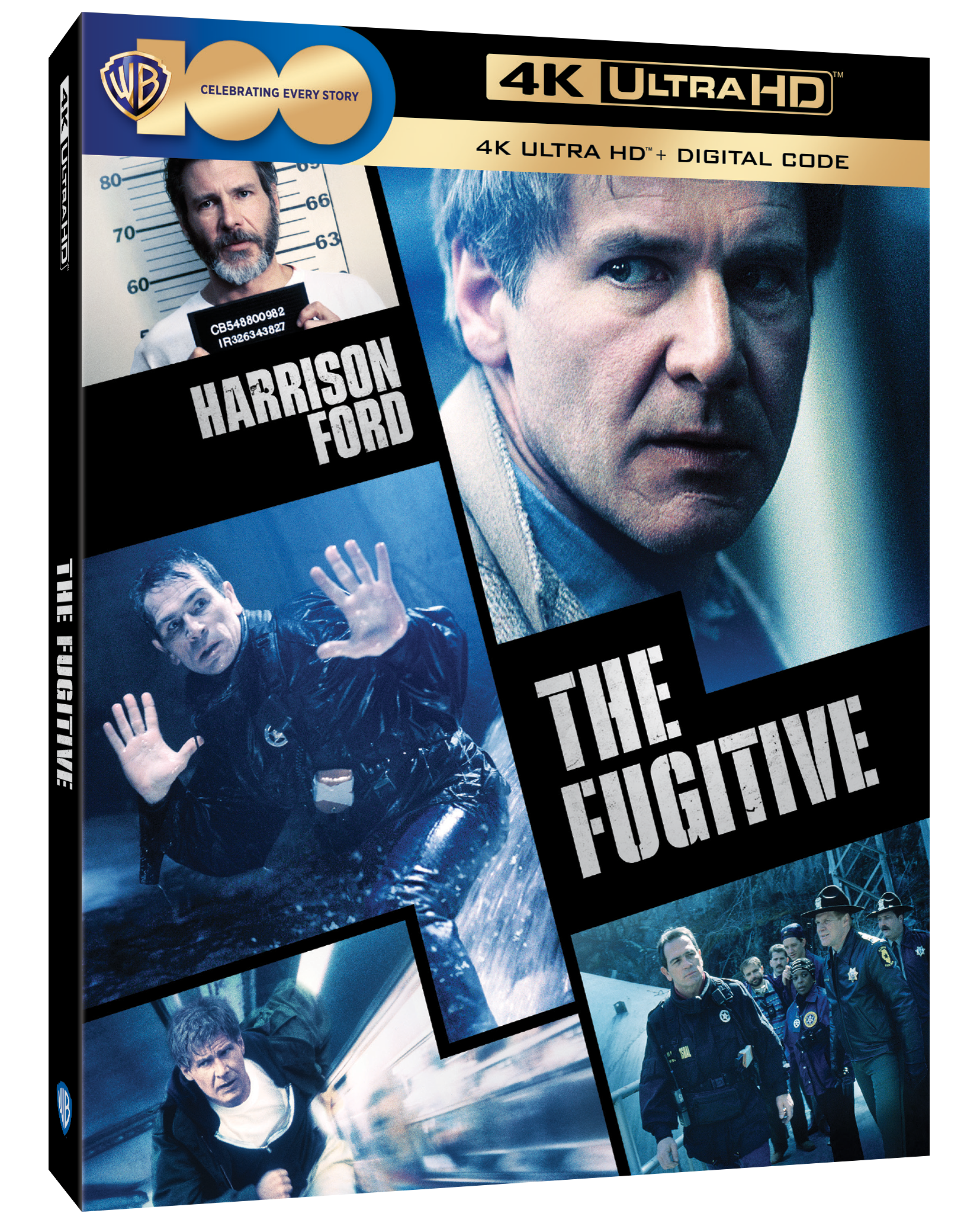
It’s rare I use the word perfect to describe a film, but it certainly applies to 1993’s “The Fugitive.” Now, when I say this film is perfect, I’m not saying it is one of the greatest films in the history of cinema. It is perfect because it is a film that is exactly what it needs to be for its genre in terms of what is expected of it and how it goes out and executes its formula. When I’m using that as my template, it’s a perfect action/thriller flick. The film is two hours and ten minutes, and there is not a wasted moment or scene throughout the course of its running time. It’s one of those movies where it has you hooked in its story from start to finish.
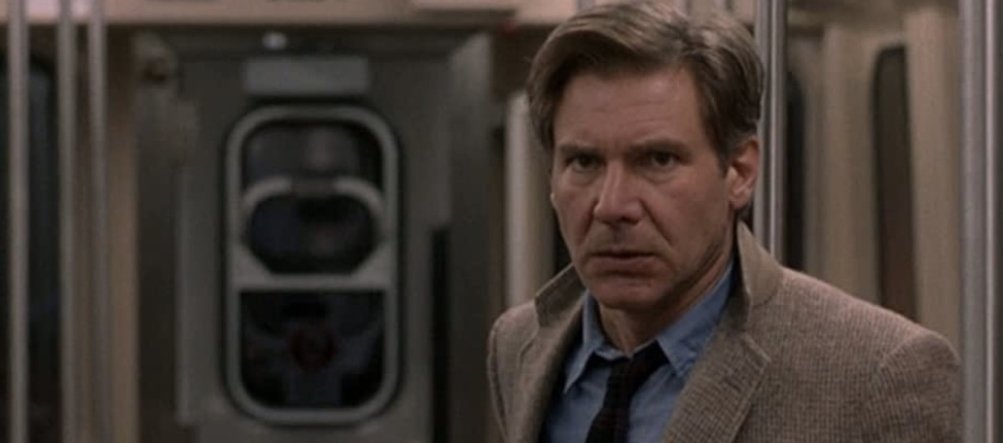
The film stars Harrison Ford as Chicago surgeon, Dr. Richard Kimble, who is thrown in prison after being falsely accused of murdering his wife, played by Sela Ward. Richard says a one-armed man did it, and he’s completely innocent. However, all of the clues make him look guilty. The police think he did it because his wife had a lot of money and a lucrative life insurance policy. With no signs of forced entrance, all signs point to the husband. At the moment, he doesn’t have a leg to stand on in their eyes.
Kimble is able to escape from prison when his transportation bus is hit by a train on its way to death row. He’s now free, and he is bound and determined to prove his innocence and find this one-armed man. Deputy US Marshal Samuel Gerard (Tommy Lee Jones) has one mission in life now: to catch Richard Kimble and bring him back to death row. From here, we are treated to a delightful game of cat and mouse between Harrison Ford and Tommy Lee Jones. Throughout the course of the movie, Ford is always one step ahead of him, even when they are face-to-face. His character is incredibly smart and wily. Because of this, he’s not going to make any mistakes or leave himself vulnerable to getting caught.
Ford is really, really effective at being a charming and intense underdog to root for in “The Fugitive.” On the other hand, Jones’ character is also incredibly well-written and fleshed out by the script, which was written by Jeb Stuart and David Twohy. He’s not really a bad guy or a villain. He’s just doing his job, and, at the time, is completely unaware of the fact that Richard is innocent. He also brings great comedic timing to the role, which makes for a fun action film that doesn’t take itself too seriously. It’s a performance which relies on his perfectly timed facial reactions. Veteran action director Andrew Davis also knows how to make the big action scenes mean something, as the pacing here is terrific. He trusts his actors, and he trusts his script as well.
The movie was partially filmed in Chicago, and Chicago plays a big part in this movie. He captures the hustle and bustle of the city with a great visual eye. The cinematography is top-notch, as it also shows the toughness and the grit that comes from the city. When you have great acting, great direction, a great script, and a great sense of place, you have a great action movie. There are so many scenes that were brilliant because they never insulted the intelligence of the audience. When Ford is able to get free from Jones time after time, it makes sense because of the set-up and the execution of the scenes.
I’m embarrassed to say this, but this was my first time watching “The Fugitive,” either the movie or the TV show. As they say, better late than never. I wish Hollywood would do more brainy action films like this today. It really starts with trusting your screenplay and your actors. When you have that, everything else falls into place. This is a great film with tons of action, suspense, and a sense of humor that is put in at just the right moments. They didn’t overdo it with the comedy to where it was poking fun at the movie. It was done because the moment and the scene called for it.
There is also a great supporting cast here, filled with actors and actresses you have come to know and love such as Julianne Moore, Joe Pantoliano, Ron Dean, Jane Lynch and Neil Flynn. “The Fugitive” is fun with a capital F. It is a film I look forward to revisiting many times in the future now that I own it on 4K. It’s remarkable how they were able to cram so much into this movie without it ever feeling tedious or laborious. It’s a movie where you are invested in everything happening on screen, and as Roddy Piper once said, “Just when you think you have all the answers, I change the question.” You find yourself as an audience member wondering how Dr. Richard Kimble is going to find his way out of a jam, and he does it time and time again. Even though it took me far too long to sit down and watch “The Fugitive,” it was well worth the wait. I love this movie.
* * * * out of * * * *
4K Info: “The Fugitive” is released on a single disc 4K from Warner Brothers Home Entertainment. It comes with a digital copy of the film as well. It is rated PG-13 for a murder and other action sequences in an adventure setting. It has a running time of 130 minutes.
4K Video/Audio Info: Let’s start with the visuals on this film: WOW! This film looks incredible on 4K. You are able to see all of the pores on the actor’s faces, and they have really brightened up the look and feel of this film without making it look too over-saturated or washed out. They have cleaned up the picture a lot while also maintaining the cinematic grain that is part of the film’s charm. This is one of the best looking 4K’s of 2023. The Dolby Atmos soundtrack is also lively without being too punchy or loud. It’s perfect. I give both the audio and visuals an A+ here.
Special Features:
Introduction by Andrew Davis and Harrison Ford
Commentary by Andrew Davis and Tommy Lee Jones
“The Fugitive: Thrill of the Chase”
“On the Run with the Fugitive”
“Derailed: Anatomy of a Train Wreck”
Theatrical Trailer
Should You Buy It?
“The Fugitive” is celebrating its 30th anniversary with this 4K release on November 21st, and let me tell you right now, this is a day one purchase if you are a film historian and lover. If you have seen the film before and own the Blu-Ray, you need to upgrade to this magnificent 4K that showcases everything that is beautiful about HDR and Dolby Atmos. If you have never seen the film before, like yours truly, you can confidently buy this film on day one without hesitation or regret. It is worth every single penny. There is also a 4K steelbook release, which looks awesome! Warner Brothers did a magnificent job with this 4K transfer of “The Fugitive.” Yes, the special features are imported over from the Blu-ray, but at least you get them here, including a commentary track with Tommy Lee Jones and Director Andrew Davis. I loved this movie, and I equally loved what they did with this release. It comes HIGHLY recommended!
**Disclaimer** I received a copy of this film from Warner Brothers to review for free. The opinions and statements in the review are mine and mine alone.
In my review of “The Assistant,” I wrote about how the Human Resources department is the place people should go to if they feel threatened or uncomfortable in their working environment. The fact HR failed the film’s main character of Jane proved to be a devastating moment as the company she works at had long become knowingly complicit in its boss’ sexual harassment of aspiring actresses. But on Reddit, some schmuck called this scene accurate as he felt HR’s job is to protect the company above all else. I felt this was crap as they should be responsible to the needs and concerns of the employees as a healthy working environment is more beneficial than a toxic one. Then again, I have worked at companies where employee concerns were not always taken as seriously as they should have.
I bring this up because I found myself watching “Stalking Laura” (a.k.a. “I Can Make You Love Me”) on Amazon Prime which has just been given a 4K restoration. It features a scene in which Laura Black (played by Brooke Shields) goes to HR to report on one of her co-workers, Richard Farley (Richard Thomas), who has been endlessly harassing her. Instead, the HR director informs Laura of how her smiling at Richard may have invited such harassment and that she should watch how she acts around him. As the movie goes on, we see how the company is keen to protect Richard even after it has terminated his employment and given him a letter of recommendation to other workplaces.
“Stalking Laura” is a 1993 television movie which is, yes, based on a true story. Richard Farley was a software technician who worked at ESL Incorporated in Sunnyvale, California, and he became infinitely smitten with Deborah Black upon first seeing her. Richard asked her out many times, but Deborah felt any relationship the two of them would ever have should be professional more than anything else. For one reason or another, he believed Deborah was destined to be the love of his life, and he was determined to make her see this no matter what.
Deborah eventually filed a restraining order against Richard, and a court date was set for February 17, 1988 to make it permanent. But a day before this, Richard drove up to his old office loaded with a huge arsenal of weapons and bullets, and he laid waste to it and killed seven people and wounded four others including Laura. Richard eventually surrendered hours later and was later convicted of first-degree murder and has been living on death row at San Quentin ever since. As for Laura, she managed to make it out of the building after being shot in the left shoulder, and it took several surgeries for her to regain even partial use her shoulder.
“Stalking Laura” starts off with Laura leaving her family in Virginia and driving out to her new place of employment, Kensitron Electronics International (KEI, renamed for obvious reasons) in Silicon Valley, California. During a tour given to her by Chris (William Allen Young), she comes to meet Richard who is immediately smitten with her. After a nice lunch, he invites her to attend a sporting event with him as he just happens to have a couple of tickets on hand. Laura politely declines as she just met him, but this does not deter him from pursuing her further.
We watch as Richard spies on Laura during her aerobics class where she takes off her shirt to reveal the leotard she is wearing underneath, and we cringe as he continually tries to forge an undying connection to her even while she rejects his advances at every and any given opportunity. But when Laura appears to laugh at Richard as he watches her during a softball game, that’s when he really starts going off the rails.
Look, I have never been a big fan of television movies as they seem inevitably burdened by cliches and a formula they can never escape from. “Stalking Laura,” however, proved to be much better than the average TV movie as it does not present this true story in a shallow way. We see and understand just how brutal the harassment Laura is forced to endure. At one point, Richard gives Laura a small remote-controlled tractor as punishment for laughing at him as he feels the need to treat her like a child as a result. This makes Laura’s first scene with HR all the more infuriating as she is made to believe by the department director how she was the one who exacerbated the incident.
When it comes to Brooke Shields, her career as a model for a time seemed far more laudable than her work as an actress. While she received acclaim for performance in Louis Malle’s “Pretty Baby,” her work in “Endless Love,” “Sahara,” “The Blue Lagoon” (a film best appreciated with the sound turned off) and “Brenda Starr” were loudly disparaged. But in “Stalking Laura,” she gives a strong performance as a bright-eyed new employee who is forced to stand up for herself when a male co-worker harasses her to an endless extent. You cannot blame Laura for getting in the HR director’s face when the moment calls for it, and Shields makes it count for all it is worth.
Many know Richard Thomas from his work on “The Waltons,” but I remember him best for playing Bill Denbrough in the miniseries version of Stephen King’s “It.” Regardless, Thomas inhabits his character, also named Richard, with a frightening enthusiasm as he pursues Laura relentlessly even after she makes it perfectly clear she wants nothing to do with him. While Richard looks innocent and friendly at first glance, Thomas makes us see the cracks in his psyche which worsen to where his desperation leads him to resort to violence. The actor is especially chilling when he tells the HR director he is prepared to kill himself and his co-workers if he is fired from the company. Thomas makes you see how far Richard is willing to go, and it is infinitely chilling to watch him purchase 2,000 rounds of ammunition for his shotgun. Even the gun store owner is freaked out at this request, and someone like him is always looking to make a big sale.
The last half of “Stalking Laura” deals with Richard laying waste to his former place of employment while armed with a barrage of firepower. Being this is a television movie, the blood and gore are kept to a minimum, but the rampage is still pretty terrifying. Director Michael Switzer keeps the tension running high up until the last scene where we can finally take a breath as this desperate situation comes to a conclusion. The most unnerving moments come when the characters stuck in the building hear loud gunshots from a distance. This should give everyone an idea of how terrifying it is to be stuck in a school shooting or something equivalent as you cannot tell if it is safe to stay or go. Seeing your co-workers lying dead under fluorescent lights is brutal enough, but hearing guns going off close by is enough to make one hide under a desk, any desk.
Other things worth pointing out here are how the police characters introduced to deal with this shooting are given various dimensions even though they are not given much screen time. While they want to resolve this violent situation, they all know it may involve a sniper eliminating the shooter at any given opportunity. There is also a nice score composed by Sylvester Levay, and I say this even though his main theme to this film sounds like something out of a Cinemax skin flick.
We do not see many movies like “Stalking Laura” these days as shootings like the one portrayed here have become far too commonplace in America. The only other movie I can think of which covered a shooting like this was Gus Van Sant’s “Elephant” which served as a meditation on the events at Columbine High School. Watching something like this should serve as a reminder of how senseless shootings like these are as they accomplish nothing. But with these violence occurrences still happening at alarming numbers in America, one has to wonder if enough people will listen.
But hey, at least HR did the right thing by firing Richard. Of course, this was after Laura made them do something about her problem. And yes, the HR director did describe his termination as the result of poor work performance, and that’s even after he told the director he has weapons and would kill people. When it came to the restraining order, Laura had to get it herself as the company no longer had to deal with the situation since Richard was fired. So seriously, HR did attest to the needs of a certain employee, right? RIGHT?!
In this time of quarantine due to the global pandemic known as Coronavirus (COVID-19), I have not stayed in my apartment all day long as I have no choice but to work. Still, getting my ass out of bed continues to be a struggle, and while I keep saying I have no time to watch any new releases, I do find myself watching whatever is playing on one of the various Starz cable channels. And I have to be honest, there is always a certain movie which captures my attention regardless if I already have the movie on DVD or Blu-ray.
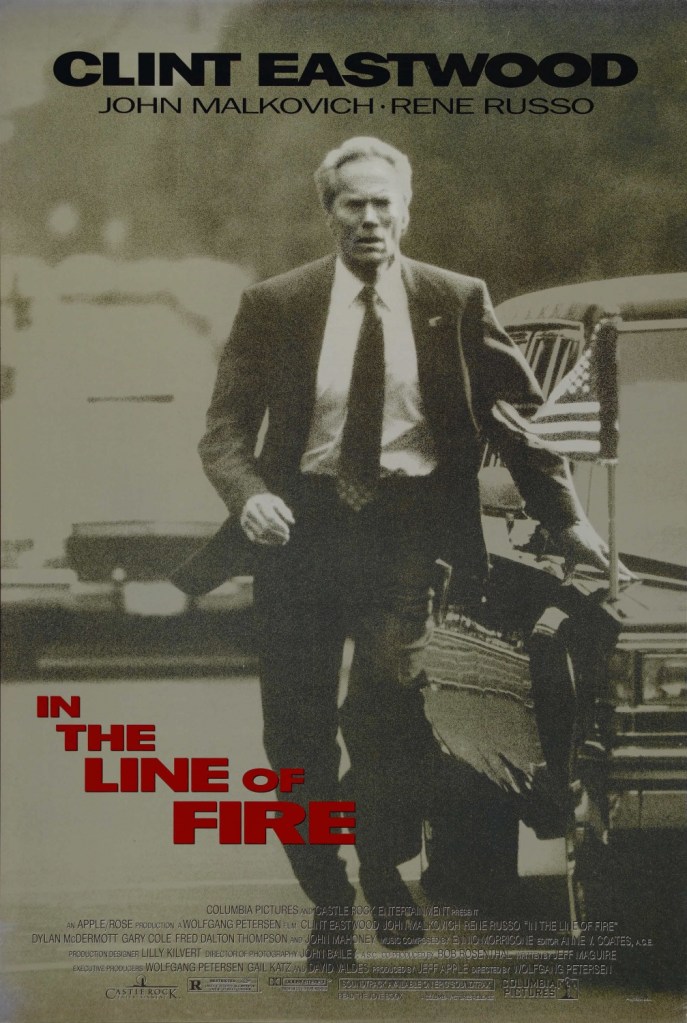
One movie which has been playing on Starz a lot recently is “In the Line of Fire,” the 1993 political action thriller which was directed by Wolfgang Petersen and stars Clint Eastwood as the grizzled and cantankerous veteran Secret Service Agent Frank Horrigan.
I worked at a movie theater in my hometown, Crow Canyon Cinemas, which played it, and during my lunch breaks I would go and watch it to take in the excellent direction, brilliant acting and terrific action sequences. It also provided me with one of my most frustrating moments while I worked there. While working a shift, an audience member came up to me and said the lights were still up inside the theater. I rushed in to see what was going on, and the lights were indeed still on as the movie opened up on Washington, D.C. and Ennio Morricone’s began playing. Another audience member yelled out, “ARE YOU GOING TO TURN THE LIGHTS OFF?!” This caused others in the audience to laugh, and I walked out of there inescapably pissed. Hey, if I was operating the film projector, I would have made certain the lights were turned off when the movie began. Please do not automatically assume it’s my fault! Do you even know who I am?! Do you know what us concession workers, ushers and box office personal are forced to deal with on a regular basis?!
Anyway, Frank Horrigan is a veteran Secret Service Agent who is busy breaking in a rookie named Al D’Andrea (Dylan McDermott) whom, as you will see, has a really bad first day at work. Upon arriving back at his apartment, Frank receives a call from a man who calls himself Booth, short for John Wilkes Booth, the man who assassinated President Abraham Lincoln. Booth is later revealed to be Mitch Leary (John Malkovich), a disillusioned and deeply obsessed CIA assassin who is determined to assassinate the current President of the United States. From there on out, Frank becomes determined to stop Mitch from ever reaching his murderous goal.
Of course, Mitch has a special reason for telling Frank about his plan as he is the sole active agent remaining from the detail guarding President John F. Kennedy back in 1963 when he was assassinated. Mitch prods Frank into thinking he could have done more to keep Kennedy alive, and we see in Frank’s eyes why this is still a gaping wound which has aversely affected his life for far too long
What really fascinated me about “In the Line of Fire” was the relationship between Frank and Mitch as it worked on different levels. At first, it felt like Mitch was viciously deriding Frank for his failure in Dallas on that fateful day, but perhaps Mitch was taunting Frank in an effort to see if there was any government worker who was still worth believing in. Either that, or perhaps Mitch was eager for some competition as he had long since become such a skilled assassin to where this particular job was easier for him than it should have been. The screenplay by Jeff Maguire is not clear on the answer to this, but this is part of this movie’s charm.
“In the Line of Fire” was the first movie Eastwood had acted in following his Oscar winning triumph, “Unforgiven.” When I saw “Unforgiven,” it forever changed the way I looked at Eastwood as I figured he was just coasting on the success of “Dirty Harry” for far too many years to where he could easily phone in a performance before we realized it But when it came to “Unforgiven,” this movie made me realize he was a consummate artist both in front of and behind the camera. Watching him in “In the Line of Fire” made me see this all the more as, behind that famous glint of his, he succeeds in giving a wonderfully complex performance as Frank Horrigan. From start to finish, Eastwood makes Frank into a difficult, thoughtful, charming, guilt-ridden and stubborn human being, and it is a real shame he didn’t get an Oscar nomination for his performance.
The key scene for Eastwood comes when Frank reminisces about the day of Kennedy’s assassination with Agent Lilly Raines (the always terrific Rene Russo), and he paints a very vivid picture for the audience to where no flashbacks are needed to illustrate what he is talking about. It was also one of the few times back then where we got see Eastwood cry, and an image like this seemed unthinkable for so long. Still, watching this iconic star lose it over an American tragedy which has long since been burned into our collective memory is a beautiful moment. Some are forever trapped in a time and place they can never escape from, and the assassination of J.F.K. is one which still holds many in its grasp.
One actor who did score an Oscar nomination for their performance was John Malkovich. With his character of Mitch Leary, Malkovich created one of the most malevolent psychopaths the world of cinema has ever seen. But as demented as Malkovich makes Mitch (the scene where he puts Eastwood’s gun in his mouth was his idea), he also allows us to see this character has some form of empathy. When Mitch talks about how he doesn’t remember who he was before the CIA “sunk their claws” into him speaks volumes as he has long since become a former shell of his former self to where he has nothing left to live for except revenge. When it comes to Malkovich, you can always count on him to take any character he plays and mold him into something undeniably unique.
I also have to single out Rene Russo who is an absolute joy to watch here as Special Agent Lilly Raines. She made her film debut in “Major League,” but she really caught my eye after co-starring in “Lethal Weapon 3” as Lorna Cole, an internal affairs detective who beat up the bad guys every bit as effectively as Martin Riggs did. When we first saw her in “In the Line of the Fire,” we knew her character was not an agent to be easily messed with as she could kick ass with the best. Still, Russo shows a wonderful vulnerability throughout as Lilly confesses to Frank how she broke off a relationship because she would not give up her job for anyone. Russo does not even have to spell out in words why Lilly is hesitant to become involved with Frank as any potential relationship comes with a lot of baggage, and yet the chemistry between these two proves to be so strong to where we have one of the more hilarious love-making scenes in cinema history. As we see the various objects drop off them as they climb into bed, we can understand Frank’s frustration about having to put all of it back on.
“In the Line of Fire” was directed by Wolfgang Petersen, the same man who gave us the greatest submarine movie ever made, “Das Boot.” Petersen directs this movie in a way which makes it clear to us how character means more to him than spectacle. Whether or not the stunts are the best you have ever seen, they are exciting as hell because we are rooting for the characters from start to finish. As the story heads to a most thrilling climax, I could not take my eyes off the screen for a second.
This movie also has one of my favorite film scores ever by the great Ennio Morricone as he nails every single moment for all its emotional worth. Whether it’s the main theme which is filled with a hard-fought for patriotism, the romantic themes which illustrate the growing relationship between Frank and Lilly, or the themes which add to the taut action sequences, there is not a single false note to be found here.
It is nice to revisit “In the Line of Fire” after all these years, and it still holds up in this day and age. It is a top-notch thriller and the kind of character driven motion picture we do not see enough of these days. It also makes you respect the secret service in a way we always should have. They have to defend the President of the United States regardless of how they feel about him or her as a person. I mean, heaven forbid we have another President serve as a martyr for this great country the way John F. Kennedy did. I bring this up because this is especially the case when we are forced to deal with an infinitely unpopular President, and I will just leave it at that.
WRITER’S NOTE: The following article is about a screening which took place back in 2011.
In the midst of promoting “Contagion” in Los Angeles, California, filmmaker Steven Soderbergh dropped by the Silent Movie Theater where Cinefamily was screening one of his earlier and most underrated features, “King of the Hill.” Not to be confused with the Fox animated series, the film follows 12-year-old Aaron Kurlander (Jesse Bradford) who is forced to fend for himself in Depression era America after his parents leave him alone at the Empire Hotel in St. Louis. Aaron is forced to grow up a lot faster than any kid should ever have to, and he desperately searches for ways to avoid eviction from the family’s apartment. Soderbergh thanked the sold-out crowd for coming to the theater, and he started off by saying, “Why aren’t you guys going to see ‘Contagion’? This film is never going into profit!”
“King of the Hill” was Soderbergh’s third film after “Sex, Lies & Videotape” and “Kafka,” and it was released back in 1993. Based on the memoir of the same name by A.E. Hotchner, it was given to him as a gift by a friend. At the time he was looking for something different than “Sex, Lies & Videotape,” and he found Hotchner’s story to be just what he needed. He did, however, describe it as a “tricky adaptation” since he only had a budget of $8 million and 48 days to shoot the film, and it was a period piece. On the upside, though, he said Universal Pictures, which released the movie through its Gramercy Pictures division, was “hands off” during the production.
Watching it again, Soderbergh described it as the one movie of his he might change aesthetically. He felt the prettiness of the picture would help counteract the harsher parts of the story, but now finds the film to be “almost too pretty.” Most of the conversation he had in pre-production involved the overall palette color which he and cinematographer Elliot Davis wanted to remain within a certain range. Were he to film it today, Soderbergh said he would go out of his way to make it “less commercial.”
Soderbergh recalled doing three preview screenings of his movie, none of which went well. When finished with the project, he admitted feeling somewhat dissatisfied as the movie’s ending did not seem entirely satisfactory to him. Whatever problems he had, they did not stop him from trying to adapt Hotchner’s follow up memoir “Looking for Miracles” which focused on the writer’s relationship with his brother. Sadly, Soderbergh’s hopes were quickly dashed when “King of the Hill” did not find an audience upon its release.
Regardless of his feelings, the audience was in agreement that “King of the Hill” is a great film, and it truly is one of Soderbergh’s best works. The director also found a big fan in Sid Sheinberg, the famous entertainment executive, who, soon after seeing it, introduced him to Lew Wasserman. It also made Soderbergh how that he didn’t enjoy writing as much as he thought, but he did continue writing screenplays for his films “The Underneath,” “Schizopolis,” and his remake of “Solaris.” This was one of five films he did after “Sex, Lies & Videotape” which he openly admitted “did no business,” but perhaps they will eventually.
“King of the Hill” is not currently available on DVD (not in America anyway) or Blu-ray, nor is it available to stream on Netflix. Soderbergh remarked this is because “cult flicks are not marketable right now” and that “no one buys DVD’s anymore.” But with this director being so highly regarded in Hollywood, hopefully this third film of his will get the digital release it deserves so fans can discover it for the great movie it is.
UPDATE: “King of the Hill” has since been released by the Criterion Collection in a DVD/Blu-ray combo pack. It features a new restored 2K digital film transfer, interviews with Soderbergh and Hotchner, movie trailers, and Soderbergh’s fourth film “The Underneath.” To find out more about this release, click here.
Michael Crichton’s book “Jurassic Park” served as a cautionary tale on scientists’ tampering with biology as they bring dinosaurs back to life without thinking about the consequences of their actions. When Steven Spielberg adapted it to the silver screen in what turned out to be a genuinely thrilling movie, much of it was changed and details were omitted to make it the kind of audience pleasing movie he was best known for making at the time. He doesn’t delve as much into the darker side of Crichton’s characters and made them more likable, and the changes proved impossible to miss.
Working with David Koepp, who got screenwriting credit along with Crichton, Spielberg developed the cartoon the main characters watch during the park tour to remove much of the exposition found in the book. Crichton goes into extensive detail about how dinosaurs were recreated using their DNA which ends up being found in mosquitoes trapped in fossilized tree resin. Despite many scientists saying it is impossible to create dinosaurs in this way, it still makes for a very compelling story.
Koepp also cut out a sequence from the book which had Grant and Hammond’s grandchildren being chased down the river by the Tyrannosaurus. This was done for budgetary reasons, but this dinosaur would later appear in “Jurassic Park III.”
The book also had a sub-plot about young children getting attacked by small theropod dinosaurs, but Spielberg cut this out because he found it too horrific. However, that same sub-plot would be used to start off the movie version of “Jurassic Park: The Lost World.”
When it came to the characters, some of the biggest changes occurred with John Hammond, the curator of Jurassic Park. The book describes him as a ruthless businessman who is arrogant, deceptive, utterly disrespectful, and thoughtlessly rude. Even though he eventually comes to see the consequences of his experiments, he still moves ahead with his plans in the name of profit. He is even willing to sacrifice his grandchildren to the dinosaurs if that’s what it takes.
In the movie where Hammond is portrayed by Sir Richard Attenborough, he is instead an eccentric and friendly old man who is caught up in the wonder of what he has helped bring to life. However, he eventually realizes he cannot control the dinosaurs and is desperate to see his grandchildren brought back safely. This change came about because Spielberg very much related to Hammond’s obsession with showmanship.
Dr. Alan Grant, played by Sam Neil, is shown to like kids and enjoys being around them in the book. However, the movie has him being not the least bit fond of them. This change was made to give Grant more room for character development as he comes to be the father figure Hammond’s grandchildren lack when things go wrong.
Ellie Sattler, played by Laura Dern, is described as a 23-year old graduate student of Grant’s who is planning to get married to someone other than him. In the movie, she is Grant’s love interest and hopes he will one day be open to having children with her.
Jeff Goldblum gave a scene stealing performance as chaos theorist Ian Malcolm, and he gives Spielberg’s film the bulk of its comic relief. Crichton, however, wrote Malcolm as being more serious, philosophical, and at times downright condescending. Unlike the movie, Malcolm is killed off at the end of the book, but in the follow-up book “The Lost World” he is revealed to have survived.
One character that got drastically downsized was Dr. Henry Wu who is played by B.D. Wong. Crichton has him providing much of the detail about how the dinosaurs are cloned, and he stays on the island and is eventually killed off while the movie has him heading off to the mainland where he survives, and he was the only actor from this movie to appear in “Jurassic World.”
The lawyer Donald Gennaro, one of the movie’s greediest and thoughtless characters, comes across as rather likable in the way Crichton writes him. While he becomes something of a scapegoat towards the end, he is the one most insistent on the island being destroyed to protect the rest of the world from these dinosaurs. But in the movie, he is ever so eager to exploit the park’s profit potential any which way he can.
Then there are Hammond’s grandchildren, Lex and Tim, who are along for the tour of the island as well. In the book, Tim is the oldest of two at 11 years old and is good with computers while Lex is only 7 and more into sports. Spielberg switched these characters around to where Lex was the oldest, and he did this in order to cast Joseph Mazzello as Tim. Ariana Richards plays Lex, and she’s the more into computers and helps save the main characters in one critical scene.
Looking back at “Jurassic Park” the movie, it was the last time Spielberg adapted a book and changed the characters to where they were likable and easier for audiences to spend time with. His next movie was “Schindler’s List” which had him exploring one of the darkest periods of human history, and making it had a major effect on the movies he directed afterwards. When it came to turning “The Lost World” into a movie, Spielberg was more willing to embrace the darker aspects Crichton explored intensely in his books, and this was something readers wished he had done with the first movie.
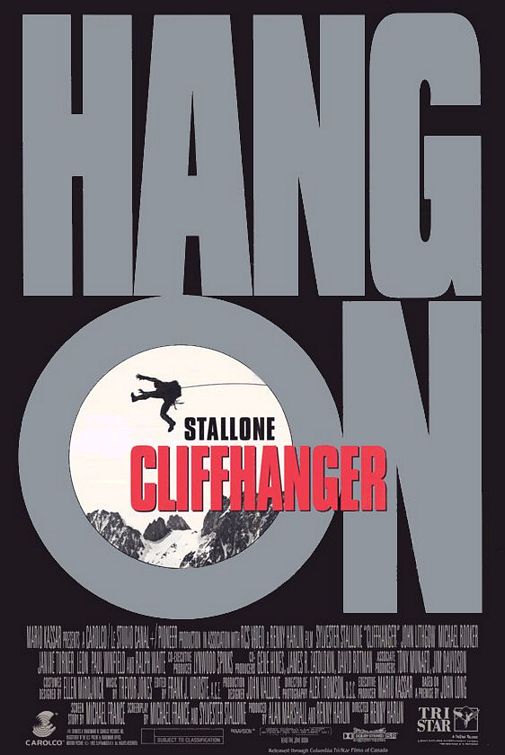
The 1990’s were not a kind decade to Sylvester Stallone. “Rocky V,” which was supposed to be Stallone’s last go around as Rocky Balboa (LOL), proved to be a critical and commercial disappointment, and his foray into comedy with “Oscar” and “Stop or My Mom Will Shoot” was disastrous to say the least. Clearly, Stallone was in serious need of a comeback as well as a return to the dramatic action movies he became best known for. As a result, he teamed up with “Die Hard 2” director Renny Harlin and Carolco Pictures to star in the action adventure film “Cliffhanger,” and the first trailer made for it remains forever burned into my memory.
The genius of this teaser trailer was how the filmmakers scored the images to Mozart’s “Dies Irae,” a powerful piece of music which served to make this movie seem more epic than it ended up being. There is no dialogue to be heard here as the focus is on the snowy mountain landscape which proves to be as beautiful an environment as it is a brutal one for those unprepared to deal with its frigid temperatures. As we watch Stallone and his fellow cast members John Lithgow, Michael Rooker, Leon and Janine Turner battling the elements which range from climbing up a mountain without a winter jacket or being trapped in a cold lake beneath a thick sheet of ice, it made “Cliffhanger” look like the end all of mountain movies as it captured a reality which is usually faked on a Hollywood soundstage.
Then there is the trailer’s final image of Stallone making a death-defying leap from one mountain side to another, and it’s a fantastic visual to close out on before the movie’s title comes up. Watching him do this quickly reminded me of when he performed similar feats as John Rambo in “First Blood” and its sequels as he the situations Rambo was caught up in were not entirely realistic, but Stallone’s physicality and performance made us believe he one could survive such impossible circumstances to where stopped asking questions and just went along for the ride.
Of course, upon learning Stallone had co-wrote the screenplay, I went in to see “Cliffhanger” with reduced expectations as I figured it would be a variation on the story he writes about more often than not of a man haunted by a tragedy and of his need for redemption. The movie did prove to be very entertaining, but it was not as deep and epic as this trailer promised. Regardless, I look back on this particular trailer very fondly as I said to myself after watching it, “Now that’s how you sell a movie!”




 The Ultimate Rabbit