The Stars of ‘Repo Man’ Drop By New Beverly Cinema

Repo Man poster

More than 30 years after its release, Alex Cox’s cult classic “Repo Man” still holds up with its truly authentic punk attitude and black humor. This was proven to be the case when a special screening of the movie was held at the New Beverly Cinema which brought out many fans eager to see some of the actors who starred in it. Among them was the great character actor Harry Dean Stanton who plays Bud, the Mr. Miyagi or Yoda to Emilio Estevez’s Otto. Also there was Tracey Walter who played the philosopher of mechanics, Miller, Olivia Barash who played Otto’s would-be girlfriend, Leila, and Del Zamora as Lagarto, one of the Rodriguez brothers.

“Repo Man” is so defiantly punk and proudly refuses to fit into the realm of regular mainstream entertainment. Never politically correct, it delves into a highly exaggerated, not to mention intense, depiction of the life of a repossession agent. Watching it makes you realize there are not enough movies like this these playing at the local multiplex. We need something to balance out all these watered-down blockbusters which comes to us like McDonald’s Happy Meals from the world of corporate cinema. This movie was actually intended to be a UCLA student film, but somehow it managed to become something much bigger.

The actors came out immediately after the end credits concluded, and they looked really happy to be at the New Beverly. Stanton, however, looked like he was three sheets to the wind and occasionally spoke about things not really related to “Repo Man.” At one point he even asked, “Can I smoke in here?” The other actors sympathetically told him they weren’t sure the theater would allow him to smoke. “We can’t smoke in here?” Stanton said, “That’s fucking nonsense!” The crowd couldn’t help but laugh as Stanton looked like he was perfectly prepared to keep smoking for the rest of his days.

Stanton said he couldn’t remember exactly how he got involved in “Repo Man,” and added this lack of memory up to being one of his “senile” moments. Walter, however, said he got his role after having previously worked with producer Michael Nesmith on “Timerider.” Barash said she was originally encouraged not to do the movie on the advice of her agents as they didn’t know the people involved in it very well, and they thought it might be dangerous for her to even go to the audition. But Barash was and still is a huge punk rock fan, and she got immediately sold on “Repo Man” upon seeing that bands like Black Flag were going to be involved. She even told us Iggy Pop, who composed the movie’s theme song, was her neighbor in the apartment building she lived in back then.

Zamora didn’t say exactly how he got cast, but he did remember how Cox got Nesmith involved as a producer. Simply put, Nesmith’s car had gotten repossessed, so he could relate to those car owners who were not paying up on what they bought. Zamora also talked about how Cox got both Stanton and Estevez involved in “Repo Man.” Basically, Cox caught up with Estevez and told him Stanton was already connected to the movie even though he wasn’t at that point, and then he went to Stanton and told him Estevez was connected to the film even though he wasn’t. Suffice to say, both actors did become involved.

Stanton then went on to say he and Cox didn’t always get along. During the shooting of “Repo Man,” Cox got so sick and tired of Stanton telling the actors what to do and threatened to fire him on the spot. To this Stanton replied, “Kiss my ass! Fire me so I can get paid!” Later on, Stanton asked Zamora to let Cox, whom Zamora is still in touch with, know he’s not mad at him anymore and that he would welcome him as an honored guest the next time he saw him.

“Repo Man” also had an abundance of generic food and drink items on display, and the audience couldn’t help but laugh at just how openly generic they all were. Product placements are usually reserved for big budget movies which are more likely to be bland and inoffensive. Zamora said they really had no money so they did talk with companies who were willing to do product placements in the movie. And then they read the script… What they ended up using was a generic brand from Ralphs Supermarket, one of the most dominant of supermarket chains in Southern California today. Of course, had “Repo Man” been made today, Ralphs might not have been as inclined to be involved.

In the end, Zamora and Walter said the art directors did the majority of the work and succeeded in creating the world of the movie which was very convincing despite the low budget. Then Stanton spoke up again and asked who Zamora played in “Repo Man,” and Zamora told him he played Lagarto, one of the Rodriguez brothers, to which Stanton replied, “How many brothers were there?”

 Speaking of the Rodriguez brothers, Stanton’s character of Bud has this intense confrontation where he wields a baseball bat which he threatens to bash the brothers with. Stanton said Cox gave him a rubber bat to use, but he wanted to work with a real one instead, and this led to a fight between the two of them. Zamora remembered this moment on set and said Stanton was under control, but Stanton, who was starting to remember more of the filming, made it bluntly clear he was really crazy and didn’t have any idea of what he was doing.

Walter was asked about his famous “shrimp monologue” scene, and he said it was originally meant to be just an audition piece. It was never intended to be in the film, but Walter fought for it. Indeed, it makes for one of the most memorable moments in “Repo Man” as his character of Miller describes the way he sees things:

“A lot o’ people don’t realize what’s really going on. They view life as a bunch o’ unconnected incidents ‘n things. They don’t realize that there’s this, like, lattice o’ coincidence that lays on top o’ everything. Give you an example; show you what I mean: suppose you’re thinkin’ about a plate o’ shrimp. Suddenly someone’ll say, like, plate, or shrimp, or plate o’ shrimp out of the blue, no explanation. No point in lookin’ for one, either. It’s all part of a cosmic unconsciousness.”

To this day, Walter says that every once in a while he runs into someone who utters one of his signature lines from “Repo Man” like, “John Wayne was a fag!” But of course, the real signature line of “Repo Man” belongs to Stanton’s character of Bud who says, “The life of a repo man is always intense.”

One audience member asked the actors if they still talk to Estevez after all these years. Zamora and Walter said Estevez still works, but more as a producer and director these days because that’s where his passion lies. Estevez still acts occasionally, but it apparently doesn’t interest him as much as it used to.

Wrapping up the evening, the actors were asked if they knew they were making something special during the filming of “Repo Man.” Some of them believed they were, but Stanton bluntly said, “I didn’t give a shit if it was special while making it.” Despite his apparent demeanor and not being able to remember his entire experience on this particular movie, Stanton still had us laughing hysterically. Not once did he try to ruin the fans’ appreciation of “Repo Man.” Whether he realizes it or not, no one could have played Bud better than him.

Many were in agreement when Stanton said both “Repo Man” and “Sid & Nancy” were truly the peak of Cox’s directing career. We haven’t heard as much from him since then, but Barash said he just finished making a quasi-sequel called “Repo Chick” which she has a cameo in it. However, this has not stopped Universal Pictures from sending Cox cease and desist letters as they insist only they have sequel rights to “Repo Man.” Still, Cox has been showing it at festivals, so it looks like nothing is going to stop him.

Before everyone got up and applauded, another audience member asked a question which brought to mind one of Bud’s great lines from “Repo Man,” “Is there any good place around here to get sushi and not pay?” Stanton left us with his best answer of the evening, “That’s where we’re going right now.”



No, I Haven’t Seen It Until Now: ‘Platoon’

Platoon movie poster

I think its use of “Adagio for Strings” by Samuel Barber is one of the reasons I stayed away from watching “Platoon” for the longest time. It still is one of the saddest pieces of music I have ever heard, although it would later be eclipsed by the even more emotionally devastating “Symphony No. 3” (subtitled “Symphony of Sorrowful Songs”) by Henryk Górecki which Peter Weir used to powerful effect in “Fearless.” Plus, the way the violence in “Platoon” was described to me by friends at school, like when a soldier gets his arms blown off by a bomb, filled my mind with horrible images which had no business infecting my mind at such a young age.

It took buying the 25th anniversary edition of “Platoon” on Blu-ray for me to finally sit down and watch it. I hadn’t even seen the movie yet, and here I am buying it at Costco for $11.99 By then, I had seen many Oliver Stone movies like “Born On the Fourth of July,” “JFK,” and “Natural Born Killers,” so I was long overdue to give this Best Picture winner a look.

Before “Platoon,” I had seen “Apocalypse Now,” “The Deer Hunter,” and “Full Metal Jacket” which viewed the Vietnam War from different perspectives. The one thing they had in common was they were directed by filmmakers who had never served in Vietnam. Stone, however, had served there, so “Platoon” is largely autobiographical for him. As a result, this is probably the first truly realistic depiction of the Vietnam War anyone could have ever hoped to see in a movie.

Charlie Sheen stars as Chris Taylor, and it’s interesting watching him here as this was long before his days on “Two and a Half Men.” Taylor serves as the narrator and most relatable character as, like him, we are coming into this war fresh-faced, naïve and innocent. The first scene where Taylor comes off a plane with a bunch of newbies is an omen of what is to come. Seeing body bags filled with fallen soldiers and crossing paths with those men who have seen the war up close quickly gives you a good idea of what Taylor will probably end up looking like at the movie’s end.

Sheen is perfectly cast as he makes Taylor go from being a newbie to an experienced combat veteran in little time. It’s a shame Sheen has since pissed away a good portion of his talent to where he’s pretty much playing a version of himself as some drunken womanizer, be it on a television show or a movie. His work here is a strong reminder of how good he can be as he is utterly believable in a role no one would cast him in today.

Seeing Taylor struggle on through the Vietnamese jungle after the opening scene is a quick indication of how unprepared he is for combat. Like many wars Americans have fought, it was on the soil of another country they were completely unfamiliar with. We see how this puts them at an immediate disadvantage as they look completely exhausted and depleted even at the start of the day.

When it comes to Vietnam, Taylor makes it clear he is a unique case as he tells everyone he dropped out of college to volunteer and serve in the war. This makes him seem like part of a generation raised to believe fighting in a war is both noble and infinitely patriotic, something to be proud of. Taylor also feels that not only poor kids should be sent to fight instead of the rich, but he soon learns the truths about war, one of which is given to him by King (Keith David) who tells him something which resonates strongly even today: “You got to be rich in the first place to think like that. Everybody know, the poor are always being fucked over by the rich. Always have, always will.”

The other two performances worth noting are given by Willem Dafoe as Sergeant Elias and Tom Berenger as Sergeant Barnes. Both figure prominently in Taylor’s tour of duty, and even he says these two were fighting for his soul. Dafoe is mesmerizing as the idealistic soldier who sees America’s involvement in Vietnam ending badly. The Christ-like pose he gets in, whether its holding a machine gun over his shoulders or as he runs from the Vietnamese soldiers, is no mistake. Elias ends up dying for the sins of his fellow soldiers while doing his best to protect them.

Berenger’s performance as Barnes ranks among his best ever. He succeeds in getting inside the head of someone who has been shot at so many times to where they are forever psychologically altered. Having seen death up close, Barnes acts as if he has surpassed it. In some ways, Berenger doesn’t need those makeup scars to show you how many firefights his character has been in as watching him walk through the jungle, completely unaffected by explosions going off around him as if he were Colonel Kilgore in “Apocalypse Now,” is more than enough proof of this.

Stone makes you feel the blood, sweat, tears and exhaustion these soldiers experience, and it’s all so vivid to where we come out of “Platoon” feeling like war veterans ourselves. It leaves all those other movies which make war seem like fun to utter shame. Coming from a filmmaker who has seen this particular war up close, we cannot deny the authenticity he puts on display.

“Platoon” also captures how quickly people can lose their moral bearings in the face of war. The scene in the village is by far the movie’s most unnerving moment as we watch Taylor and the other soldiers get overcome by their boiling anger and hatred. What’s so horrifying is that while you would like to believe you would have acted differently than they did, there’s no way you can be sure if you haven’t been in combat. The line between soldier and killer gets seriously blurred here, and it’s not hard to understand why.

Before filming began, the cast was treated to an intensive military training course under the tutelage of former Marine Captain Dale Dye who also served in Vietnam. They were made to dig foxholes and subjected to forced marches and nighttime ambushes which utilized explosions. This succeeded in breaking them down, and you can see and feel the weariness in them throughout. It more than adds to the sheer realism we see here.

There’s no victory to be found in “Platoon,” only death and destruction on both sides of the conflict. The movie gets at the truth of war which Danny DeVito talked about in “The War of the Roses” when he said, “There is no winning! There’s only degrees of losing!”

The violence and death portrayed may not seem quite as visceral as it did when the movie first came out. There have been many other war movies since like “Saving Private Ryan” which featured scenes of such brutal violence that no other filmmaker could possibly match. Plus, we all know about the Vietnam War in general and big a mistake it was for America for many years now. Still, “Platoon” is nothing less than powerful as its vision of the craziness and insanity of war is impossible to shake once you have seen it.

The Vietnam War may be a thing of the past, but the lessons we learned from it still need to be taught over and over again. America keeps fighting wars which, whether necessary or not, continually overstay their welcome and leave a lot of people feeling angry and betrayed. Oliver Stone certainly understands that, and he makes “Platoon” into a movie which shows the damage of war and why we can’t just let the past be the past.

* * * * out of * * * *

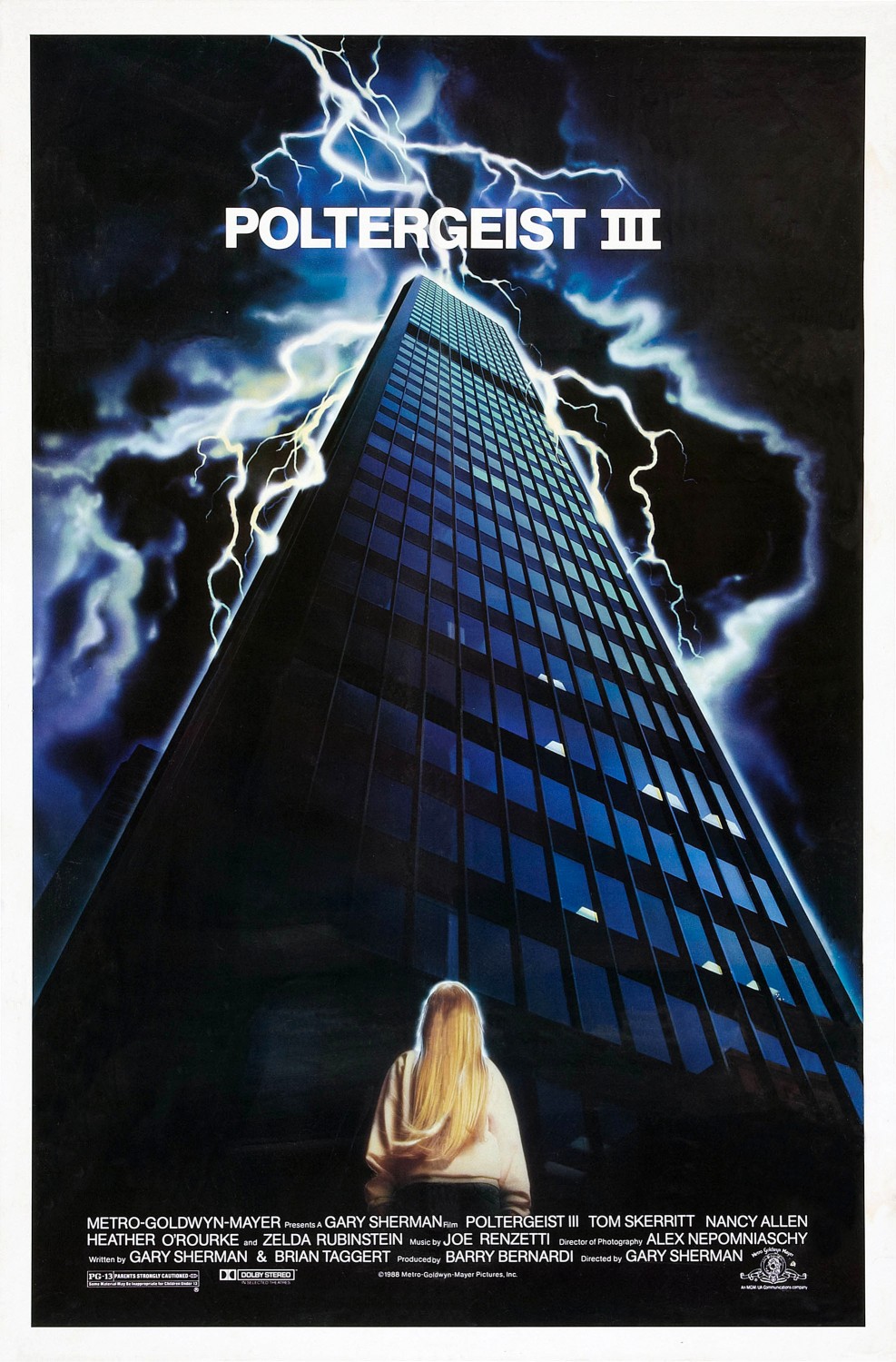
‘Poltergeist III’ Shows Just How Unnecessary Certain Sequels Can Be

Poltergeist III poster

It’s only with an obscene amount of free time, combined with a morbid curiosity, which had me watching “Poltergeist III” on cable. My only real memories of it beforehand were a behind the scenes show detailing the special effects and Siskel & Ebert’s scathing review of it. By the time this sequel came out in 1988, the series had already worn out its welcome. I don’t remember anyone liking “Poltergeist II: The Other Side,” and it was said to have been one of 1986’s big losers at the box office. Nevertheless, the powers that be at MGM decided they could wring just a little more money out of this franchise with one more sequel.

Once again, Carol Anne (Heather O’Rourke) is at the center of the story which has her shipped off to Chicago to live with Aunt Pat (Nancy Allen) and her husband Bruce (Tom Skerritt) who manages the luxurious high rise building they reside in. However, it doesn’t take long before those evil spirits and Reverend Henry Kane find Carol Anne and start their nasty little tricks to get her to come to the other side.

Now I can’t help but wonder if Carol Anne’s parents just dumped her in Chicago so they could be rid of those evil spirits for good. What if this series continued on? Would Carol Anne have resided with a different family member in each successive sequel to where she would become the ultimate unwanted house guest? Just imagine what Aunt Pat’s conversations with the girl’s parents (played by Jo Beth Williams and Craig T. Nelson) were like. I mean, Pat at one point says all she heard was they were caught up in a land deal gone bad, but maybe it went more like this:

“Pat, we love our daughter, but this poltergeist problem is really just rubbing us the wrong way.”

“Oh come on, stop kidding around sis! Your daughter is being bothered by a poltergeist! You expect me to fall for that?”

“Oh yeah Pat? You think I’m joking?! C’mon! I dare you to let her stay with you! I double dare you!”

“Yeah right! So that the ghosts or spirits or whatever the hell they are can haunt me and my family?”

“What are you, chicken?”

“Pat, stop teasing me! You called me a chicken all the time when we were kids! I AM NO CHICKEN!!!”

“Alright, prove it!”

Now guess what happened after that…

Apparently, Carol Anne was told by her mommy and daddy she was to attend a school for “gifted children with emotional problems” in Chicago. Once there, she meets up with one of the dumbest psychiatrists in cinematic history, Dr. Seaton (Richard Fire). He’s the one who foolishly opens Pandora’s Box by getting Carol Anne to talk about her experiences from the first two movies. By doing so, a slimy hand bursts out of his desk and throws a coffee cup at him while an evil voice cackles away.

So, what’s Dr. Seaton’s explanation for this? He says Carol Anne is a manipulative child who has the power to create mass hysteria and perform mass hypnosis on people to make them think they see ghosts. What?! Are you serious?! People pay this guy money to say shit like that? Where’s this guy’s degree? Is he a legitimate psychiatrist, or is he like Leonardo DiCaprio’s character in “Catch Me If You Can,” faking his lifestyle while forging checks?

The character of Dr. Seaton basically exists for the audience to despise him whenever he opens his mouth. His disbelief in all the strange and bizarre things happening in the building is excruciating to sit through, and you just want these evil spirits to strangle him to death so he’ll shut up. Seriously, it says a lot about a movie when you start siding with evil spirits against the humans.

In fact, this is the big problem with “Poltergeist III;” you don’t care much for the majority of these characters. They exist merely as clichés instead of living breathing human beings, and seeing them suffer becomes more fun than fearing for their safety which all but kills the suspense. You have the teenage guy Scott (Kipley Wentz) who’s slobbering over his girlfriend Donna (Lara Flynn Boyle of all people), and they look like they’ve come out of a thousand movies from this genre. Then there are Pat and Bruce’s hopelessly self-absorbed and shallow friends who are too interested in their own needs to notice signs of evil spirits invading the building. And where exactly are the cops in all of this?

Looking back at the Siskel & Ebert review, the one major complaint they had about this sequel, which I am in total agreement with, was all the characters kept incessantly crying out for one another:

“CAROL ANNE!!! CAROL ANNE!!!”

“SCOTT!!! SCOOOOOOOOOT!!!”

“BRUCE!!! BRUCE!!!”

“CAROL ANNE!!! CAROL ANNE!!! CAROL ANNNNNNNE!”

I swear, Carol Anne’s name is mentioned as many times as Al Pacino used the F-word in “Scarface.” It didn’t take long for me to figure out what Kane was saying to his fellow evil spirits as well as their quick reply:

“We must bring her to the other side!”

“Yes Reverend, but we also got to get this screaming bitch to shut the hell up!”

Remember the bottomless pit that opens up in the garage? Those slimy hands reaching out to grab the main characters look like those rubber gloves you buy at the supermarket but with extra makeup applied to them. The overall budget for “Poltergeist III” was just under $10 million, but it looks like it cost a lot less. While the other “Poltergeist” movies have state of the art special effects, the filmmakers here get short served and have to work with whatever’s available. Yes, some of those mirror scenes are cool as characters pass by without their reflections showing up on them, but that’s just an old trick.

Directing “Poltergeist III” is Gary Sherman who made “Dead & Buried” which has since become a cult classic. He also made the superb exploitation feature “Vice Squad” which featured one of the scariest and most vicious pimps ever played by Wings Hauser. A lot of Sherman’s skill isn’t evident here, and even he admits this is his least favorite film of the ones he made. Perhaps the studio played around with the sequel more than he liked, and with a franchise like this you know he’s never going to get complete control over the final product.

My hat is off, however, to Skerritt and Allen who came out of this movie relatively unscathed. They overcome the ridiculous material and manage to keep a straight face as the movie becomes increasingly laughable and confusing as it heads towards its unnecessarily reshot climax which leaves the fate of certain characters up in the air.

Aside from O’Rourke, the only other cast member to appear here from the previous “Poltergeist” movies is Zelda Rubinstein as Tangina. I find it funny how she received both Saturn and Razzie Nominations for her work here. I for one can’t figure out if she’s good or bad in this movie, but her mystical dialogue gets a bit ponderous with her overzealous delivery of it.

Of course, the lasting significance of “Poltergeist III” is the fact it was O’Rourke’s last movie before her tragic death at far too young an age. Her loss is inadvertently emphasized in the film’s final scene in which she is substituted with a body double. Since she passed away during post-production, you know it’s not her being held by Allen. For what it’s worth, she is very good here despite the cruddy material, and the film was dedicated to her memory.

Who knows what would have happened if O’Rourke lived to see another “Poltergeist” sequel. With Carol Anne quickly growing up, it would have been a kick to see her turn into an Ellen Ripley type of character who is prepared to go to war with these evil spirits. While others will be horribly terrified by them, she’ll see it as just another day at the office. I can just see her talking with girls her age:

“You think you have it rough? I got sucked into another dimension by evil spirits when I was five! Going through puberty was a piece of cake compared to that! Stop. complaining about the run in your nylons!!!”

I wonder what the tagline was for “Poltergeist III.” The tagline for the first one was:

“They’re here.”

With “Poltergeist II,” it was:

“They’re back.”

I guess the tagline for the third film was:

“I’m screwed!”

* ½ out of * * * *

William Friedkin and Guests on Making ‘To Live and Die in L.A.’

To Live and Die in LA

Director William Friedkin declared “To Live and Die in L.A.” to be one of his personal favorites of his career when he dropped by the Aero Theatre in Santa Monica. The film was being shown as part of American Cinematheque’s tribute to him, and it played as a double feature with “The French Connection.” But while Friedkin was scheduled to be there, he brought along two of the movie’s stars as surprise guests: William Petersen who played Secret Service Agent Richard Chance, and Darlanne Fluegel who portrayed his “girlfriend” and informant Ruth Lanier.

With “To Live and Die in L.A.,“ Friedkin worked with casting director Bob Weiner who had also worked on “The French Connection.” With this film, Friedkin didn’t want any stars and could only consider no-name actors as the budget was only $6 million. In a sense though, casting unknown actors was a plus for this film as the characters they play walk a thin line between good and evil, and having recognizable stars might affect how this came across.

Known these days for “C.S.I.,” it was a shock to realize that “To Live and Die in L.A.” was Petersen’s first lead role in a movie (he previously had a small role in Michael Mann’s “Thief“). Weiner discovered the actor when he was playing the lead in a Canadian production of “A Streetcar Named Desire.” Petersen said he hadn’t done any movies nor did he have an agent at the time. All he knew about Friedkin was the films he directed, and they met in New York to do a scene together. But Petersen didn’t ever get around to finishing when Friedkin interrupted him to say, “That’s good enough for me. You got the part!”

From there, Petersen said he didn’t know what to do. Excited as he was for the opportunity, he was already scheduled to be in another play soon and wasn’t sure how to go about negotiating with Friedkin or the studio. It didn’t even occur to him he would be making $400 a week! So, he ended up talking with John Malkovich, who knew him from Steppenwolf, to get advice on what to do. Later, Petersen went back to Friedkin saying he wouldn’t be able to play Richard Chance due to his prior theatrical commitment. To this, Friedkin told him, “No problem. We’ll wait for you.”

Now how cool was that?! Seriously, how many other directors, let alone movie studios, would wait on an actor who is not even an established name yet? Considering the sheer charisma Petersen exudes onscreen just from one look on his face, it makes perfect sense why Friedkin waited on him before he started production.

Although he was used to doing theater more than film, Petersen said he found making “To Live and Die in L.A.” a “freeing, fun experience” and thought all movies would be exactly like it. This, of course, got a good dose of laughter from the audience as we know they are not. Despite the long hours on set, Petersen was never tired at day’s end.

In researching his role, Petersen worked with Gerald Petievich, the former Secret Service Agent who wrote the book this movie is based on, and with criminals including actual counterfeiters. This led Friedkin to tell the audience how Petievich ended up getting a counterfeiter paroled from jail just so he could create the fake money they needed. Friedkin even admitted he passed so many fake bills to where he concluded the government’s money was worthless and only paper. Some kids of the special effects supervisor were not as lucky as they ended up taking some of the fake money to buy candy, and a Treasury Agent got called on them in ten minutes flat.

Fluegel was shocked about getting a part in “To Live and Die In LA,” and she created one of the film’s most unforgettable characters. She said working with Petersen was “so easy,” and they both agreed there never was a moment between them which didn’t feel real. We always hear these stories about how actors don’t like doing sex scenes and how awkward they can get, but Fluegel said they were actually easy to do. She also made it clear neither of them actually had sex onscreen even though it looked like they did. When they worked together, everything always flowed perfectly.

But one great behind the scenes story Petersen told was when they were at the airport and Chance was chasing down John Turturro’s character of Carl Cody. This had Petersen jumping on top of the moving walkway while in pursuit, but in rehearsing it, security came over and told him and Friedkin it was against safety regulations and didn’t want him to do that again. Petersen, however, was insistent as it was easier for him to jump on top, and it worked better for the scene. So, when security was out of hearing range, Friedkin told Petersen to jump on top anyway when he said action, and that after he said cut, Friedkin would yell at him not do it again, making it look like he didn’t forget what security said previously. Once again, Friedkin does movies his way regardless of the warnings others throw at him.

Like several of William Friedkin’s movies which came out after his heyday with “The French Connection” and “The Exorcist,” “To Live and Die in L.A.” was not a big hit when first released. It was only after its debut on video and DVD when it gained a cult following which has gotten bigger and bigger over time. Seeing it on the big screen was a blast, and it deserves to be ranked alongside the best movies of Friedkin’s career. Besides, this is much more preferable to watching him pick his feet in Poughkeepsie.

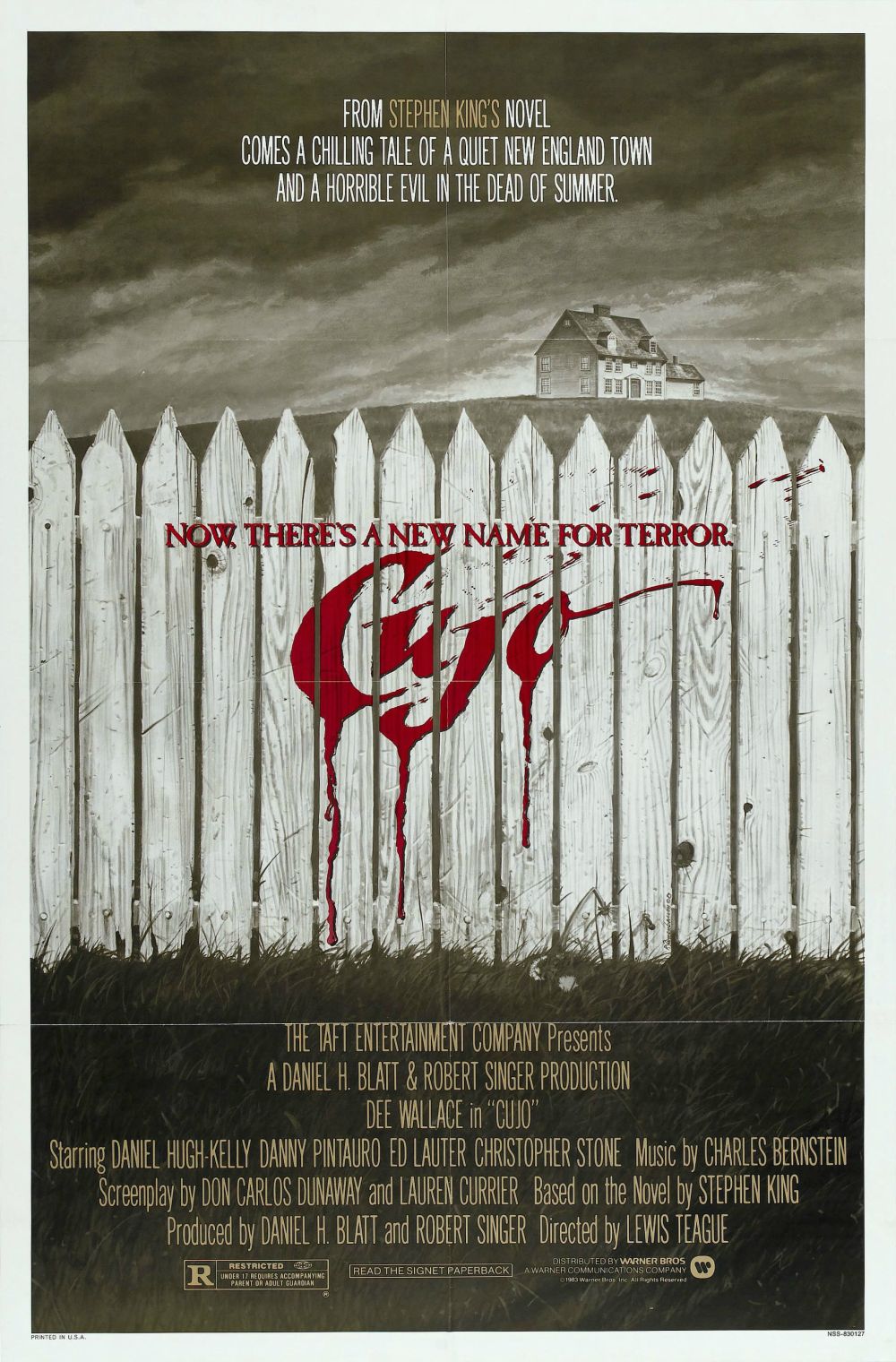
No, I Haven’t Seen It Until Now: ‘Cujo’

Cujo movie poster

It took Cinematic Void putting together a Stephen King film festival at the Egyptian Theatre in Hollywood to give me a reason to finally check out the cinematic adaptation of “Cujo.” It was a movie I have heard a lot about, and I remember the book’s original artwork with those growling teeth which indicated this particular dog was looking for more than puppy chow and snausages. Moreover, the word Cujo has long since been burned into my consciousness, and it seems to exist as a description of a dog who has gone mad and cannot be mistaken for man’s best friend. In “Fletch,” it made perfect sense when Chevy Chase said “Cujo” as he wandered through a seemingly abandoned house in Utah. Considering he was attacked by a Doberman Pinscher earlier in the film, his fear of being attacked again was completely understandable.

“Cujo” was released in 1983 during a decade when adaptations of King’s work were plentiful and varied in quality. While some were exceptional (“Stand by Me,” “The Shining,” and “The Dead Zone”), others like “Maximum Overdrive” just didn’t work. “Cujo,” however, proves to be an above average adaptation of his work as well as one of the more unusual. While many of his books deal with the supernatural, this one deals more with the horrors of real life instead of just monsters.

I’m sure you all know the story to “Cujo” by now. In case you don’t, it involves a beautiful St. Bernard who, at the movie’s start, chases a rabbit through the woods. In the process, he gets his head stuck in a cave filled with bats, one of which bites him on the nose. From there, he goes from being a lovable household pet to an infinitely vicious one as he attacks any and every human being in his sight.

From the outside, “Cujo” seems to have a very straightforward plot which indicates to the viewer it will be one of those animal attack movies we have seen time and time again. But what really surprised me most is how it focused more on the human element to where I realized the dog was really a supporting character more than anything else.

You have Vic and Donna Trenton (Daniel Hugh Kelly and Dee Wallace), a married couple and the proud parents of a highly imaginative boy named Tad (Danny Pintauro). But while they appear to be leading the perfect life in Castle Rock, Maine, there are cracks beneath the surface which will inevitably become visible to everyone. Vic is increasingly concerned with economic security, something even more understandable these days. Donna is having an affair with Steve Kemp (Christopher Stone), her ex-boyfriend from high school, as she is terrified of being trapped in a small town for the rest of her life. And Tad, he is still at an age where it’s far too easy to believe monsters are hiding in the closet and waiting to jump out at him. Seriously, seeing Tad race to his bed after turning off the light and hiding under the covers brings back a lot of memories.

Taking the fears of each character into account, it serves as a reminder of how brilliant King is at examining not just horrors of the unknown, but also the ones we are forced to experience in the real world. This makes “Cujo” especially effective as the obstacles these characters are forced to deal with feel almost as scary as the thought of this dog tearing their flesh apart.

“Cujo” was directed by Lewis Teague who also helmed the Stephen King anthology film “Cat’s Eye” as well as the cult classic “Alligator” and “The Jewel of the Nile.” Teague was lucky he got to make “Cujo” back in the 80’s, a decade where filmmakers had the opportunity to build up to a furious climax instead of being forced to rush straight to one. These days, studio executives would have begged, if not ordered, him to rush right into the sequences where the dog attacks the hapless humans and increase the blood and gore horror fans are expecting. Instead, Teague got to take his precious time introducing us to characters who are not mere stereotypes and whose struggles will soon pale in comparison to the dog whose appearance becomes increasingly dirty and slimy.

This movie’s major set piece comes when Donna and Tad become trapped in a Ford Pinto as Cujo thrashes away at it, trying to get inside. From there, “Cujo” becomes a major exercise in sheer intensity as we watch Donna do what she can to save herself and her son before the dog makes chop suey out of them both. But if the dog doesn’t get to them, the sweltering summer heat may do them in instead. Suffice to say, they cannot stay in the car forever.

It’s interesting King chose a St. Bernard as the type of dog instead of another like a Doberman Pinscher. Of course, casting a Doberman might have seemed like typecasting as they have always been the villains of dogs. St. Bernard dogs seem more like comic relief, and this was made clear back in the 1990’s with those “Beethoven” movies starring Charles Grodin. Therefore, choosing a St. Bernard as a dog is an inspired choice as it shows how easily a dog, any dog, can turn deadly after being bitten by a bat. When we first see Cujo, he is a beautifully groomed dog you just want to hug. But he soon becomes a dog in desperate need of a shower as he looks disgustingly slimy and has what looks like an abundance of snot sliding off his face. Eventually he becomes an evil force to be reckoned with, and it’s easy to understand how no one could have prepared for him.

But while this dog looks to be the main star of “Cujo,” he is not. The real star is instead Dee Wallace who, just as she did in “E.T. The Extra Terrestrial,” gives us a mother who cannot be mistaken for the average movie mother. I love talking about when actors inhabit roles more than play them, and it is certainly the case with Wallace here as she gives a performance best described as emotionally blistering. She makes us feel Donna Trenton’s frantic struggles as well as her mental and physical exhaustion in dealing with a crumbling marriage, an affair, her son and, of course, the dog. Also, she makes us feel every single bead of sweat coming off of her body as she and Tad are trapped not just in the car, but in the sweltering summer heat as well.

There also moments where Donna loses her patience with Tad, and this makes Wallace’s performance feel all the more real. Just as “Cujo” was being released, some associated with its production were keen to cut a scene where Donna snaps at her son as she grows tired of his crying out for daddy. This, however, would have been mistake as all parents lose their patience with their children. Seriously, just as my mom. I’m sure she has tons of stories she would love to share with you.

While I’m at it, let’s not leave out Danny Pintauro whose performance as Tad feels unbearably real at times. Seeing him weep and panic when the dog tries to get at him and his mother makes an already intense motion picture even more intense.

Teague and his collaborators which include composer Charles Bernstein, director of photography Jan De Bont, and editor Neil Travis clearly had more on their mind than giving us the average horror film with “Cujo.” While there is a conventional feel to much of what we see here, the filmmakers were more invested in the human element than the animal one. Lord only knows how this movie would look if it were made today, and I’m stunned it has not been remade yet. As this cinematic adaptation shows, horror movies can’t thrive unless we are emotionally invested in the characters to where they are not just stock or filler. This film may not be a masterpiece, but it proved to be far more effective than I ever could have expected it to be.

* * * ½ out of * * * *

No, I Haven’t Seen It Until Now: ‘Creepshow 2’

Creepshow 2 movie poster

Creepshow” proved to be a great deal of ghoulish fun, and it’s a film which had me begging for a sequel. There are many other short horror stories worthy of a cinematic adaptation regardless of whether or not they are written by Stephen King. Plus, at the time, it seemed to be a given George Romero would have had easier luck in securing financing for this than for a sequel to “Day of the Dead.” And with the same gothic-looking title, what could possibly go wrong? Even if it’s not one of the greatest horror movies ever, we can still enjoy this sequel for what it is, right?

Well, perhaps you can, but for me, “Creepshow 2” is a serious disappointment. Sure, the three stories contained in it are based on the works of King, and Romero did write the screenplay, but this sequel suffers right from the get go. It falters due to a budget much lower than a horror film deserves, a cast of actors who emote more than act, a weak music score, and animation which just reeks of cheapness.

The movie’s prologue has a young blonde boy named Billy (Domenick John) peddling fast on his bike as he chases a delivery truck into town to deliver the latest edition of Creepshow magazine. The back of the truck opens up to reveal The Creep played by Tom Savini, but voiced by Joe Silver. The makeup on this devilish character is less than convincing, and he is nothing compared to the ghostly apparition from the first movie. Even worse, he is made to crack jokey one-liners which will have you groaning more than laughing. Clearly, this character is “Creepshow 2’s” answer to the Crypt Keeper from “Tales from The Crypt,” or perhaps even John Carpenter’s Coroner from “Body Bags,” but it would have been to this sequel’s benefit had it not featured a wisecracking character as this kind had already started to wear out its welcome back in 1987.

One other thing, if you are going to have Savini playing a ghoulish character, do you really have to put makeup all over him? The infamous makeup artist and actor has a wonderfully devilish look about him, and the mask he wears just takes away from him.

“Creepshow 2’s” first story, “Old Chief Wood’nhead,” is its weakest by far. George Kennedy and Dorothy Lamour play Ray and Martha Spruce, an elderly couple who run a general store in Dead River, a town which, as we can tell from its first appearance, is finally living up to its name. One day they are visited by a Native American elder named Benjamin Whitemoon (Frank Salsedo) who gives the Spruces turquoise jewelry, his tribe’s sacred treasures, to look after. Unfortunately, not long after Benjamin leaves, a group of thugs arrive at the store, killing the Spruces and making off with the jewelry. Oh yeah, the Spruces also have an Indian statute standing prominently outside of their store named Old Chief Wood’nhead, and it doesn’t take long for us to see he will avenge the Spruces as you don’t mess with Indian spirits, ever.

Directing “Creepshow 2” is Michael Gornick who served as Director of Photography on its predecessor. As this first story demonstrates, he doesn’t quite have Romero’s panache or wicked sense of humor as he can’t balance out the horrific aspects with the comedic ones, and everything feels off balance as a result. Also, he shows far too much of Old Chief Wood’nhead coming to life which was a mistake. Gornick starts off by giving us glimpses of this character, played by Dan Kamin, to where we can tell the Chief is more than just another statute. But as the Chief goes on a mission of bloody justice, the character becomes cartoonish to where his bloody revenge isn’t the least bit fulfilling.

For what it’s worth, Holt McCallany, who plays Sam, the leader of the thug gang, does have beautiful hair here, and seeing him show it off as he sees it as his ticket for making it in Hollywood makes him all the more drolly hilarious. Still, MCCallany has nothing on Melissa Leo as her hair was infinitely beautiful from one episode of “Homicide: Life on the Street” to the next.

The second story, “The Raft,” is a bit of an improvement. Based on one of King’s scariest short stories from “Skeleton Crew,” it features our college kids who drive out to a predictably isolated lake, located a good 50 miles away from their school, for a swim. The lake’s only real notable feature, at first anyway, is a wooden raft in the middle of it. This raft, however, is soon upstaged by what looks like a slimy oil slick which begins to make its way over to the kids once they get in the water, and they soon find themselves stranded on the raft as the slick surrounds them.

“The Raft” has a lot of cinematic possibilities, and seeing these kids getting consumed by the oil slick provides “Creepshow 2” with some of its most horrifying moments. But in the end, it is undone as Gornick isn’t able to generate enough of a claustrophobic terror this story demands. Plus, the performances of Paul Satterfield, Jeremy Green, Daniel Beer and Page Hannah are weak as they are forced to emote more than act, and this just takes away from the situation and terror their characters are trapped in. Granted, this is not a movie which demands Oscar worthy performances, but it does need good acting to help bring you fully into such a terrifying story.

I do have to give the actors some credit though as they don’t have to do any acting when they first get in the water as it does appear to be very cold. Beer even said he almost died from hypothermia while filming “The Raft,” and keeping this in mind while watching this segment makes it even more unnerving. But despite a bravura conclusion, I came out of “The Raft” feeling like it could have been much better than it was. Perhaps this is partly due to having read King’s short story beforehand, and what he came up with couldn’t possibly be matched here.

The final story, “The Hitchhiker,” proved to be my favorite as it featured Lois Chiles, the Bond woman Dr. Holly Goodhead from “Moonraker,” in a strong performance as businesswoman Annie Lansing. The story begins with Annie leaving a hotel after having an adulterous fling with a gigolo, and she begins thinking of ways to explain to her husband why she is arriving home so late. But as she fumbles around with a lit cigarette while driving her expensive Mercedes down a lonely highway, she accidentally hits a hitchhiker played by Tom Wright. Did Annie kill him? She isn’t sure, and with oncoming headlights heading in her direction, she isn’t keen to wait around. From there, she goes from wondering how to cover up her affair to finding ways to justify leaving the scene of an accident, and then the hitchhiker reappears…

This story reminded me of the “Creepshow” segment entitled “They’re Creeping Up on You!” which starred E.G. Marshall as Upson Pratt, a ruthless businessman whose fear of bugs comes to haunt him big time. Like that segment, “The Hitchhiker” plays with your mind as you ponder if what you saw actually happened, or if it was all in the mind of the main character instead. On first glance, the story doesn’t make much sense as Annie keeps coming across this man she accidentally ran over for no real reason, but, in retrospect, perhaps the hitchhiker represents Annie’s conscience torturing her for hitting a pedestrian and failing to take responsibility for her actions.

This final segment for me reminds me of why I liked the first “Creepshow” so much; it’s a wickedly gleeful mix of horror and black comedy as Annie tries to kill off a hitchhiker who won’t stay ahead. In the process, she also lays waste to her precious Mercedes as her priorities shift from protecting her most valuable possession, a car, to defending herself from a crime which becomes something even worse. It is so over the top to where I was infinitely eager to see where the story would end up, and had the rest of “Creepshow 2” been like this, it would have been so much better. Chiles gets to show more life here than she got to in “Moonraker,” and she steals this sequel easily thanks to her unrestrained turn.

Horror movies in general tend to be made on low budgets, and this was certainly the case with “Creepshow” as Romero only had $8 million to work with. Gornick, however, had a budget half the size of that on “Creepshow 2” ($3.5 million to be exact), and he is unable to stretch it out the way Romero did. I’m always fascinated with what filmmakers are able to pull off creatively with little money, but this sequel shows that sometimes a low budget can be too low to work with. This has the appearance of a motion picture where the filmmakers were forced to cut corners at every turn due to limited funds, and it makes me feel sorry for Gornick as I’m sure he could have accomplished more if the budget allowed him to. While Warner Brothers distributed the first movie, the sequel was instead released by New World Pictures, a small independent production company which inched closer and closer to bankrupt around the time “Creepshow 2” came out.

I also didn’t care for the film score by Les Reed and Rick Wakeman as their themes came across as unbearably generic. Both are very talented musicians, but their music here just made me pine for John Harrison’s music from “Creepshow” as well as “Day of the Dead.” Back in the 1980’s, Harrison came up with some wonderfully creepy cues, but Reed and Wakeman have no such luck here.

“Creepshow 2” does have its inspired moments, but I came of it feeling like it could have been so much better. Instead of enjoying what I saw, I spent more time analyzing things which could have been easily improved. I do, however, have to applaud the filmmakers for including the following quote from Colliers Magazine in the end credits:

“Juvenile delinquency is the product of pent up frustrations, stored-up resentments and bottled-up fears. It is not the product of cartoons and captions. But the comics are a handy, obvious, uncomplicated scapegoat. If the adults who crusade against them would only get as steamed up over such basic causes of delinquency as parental ignorance, indifference, and cruelty, they might discover that comic books are no more a menace than Treasure Island or Jack the Giant Killer.”

This quote was from the year 1949, and yet all these years later many still seek scapegoats, be it comic books or Marilyn Manson, instead of dealing with things in a more rational manner. I loved that the filmmakers included this quote, but I would have loved it even more if they had opened the movie with it.

* * out of * * * *


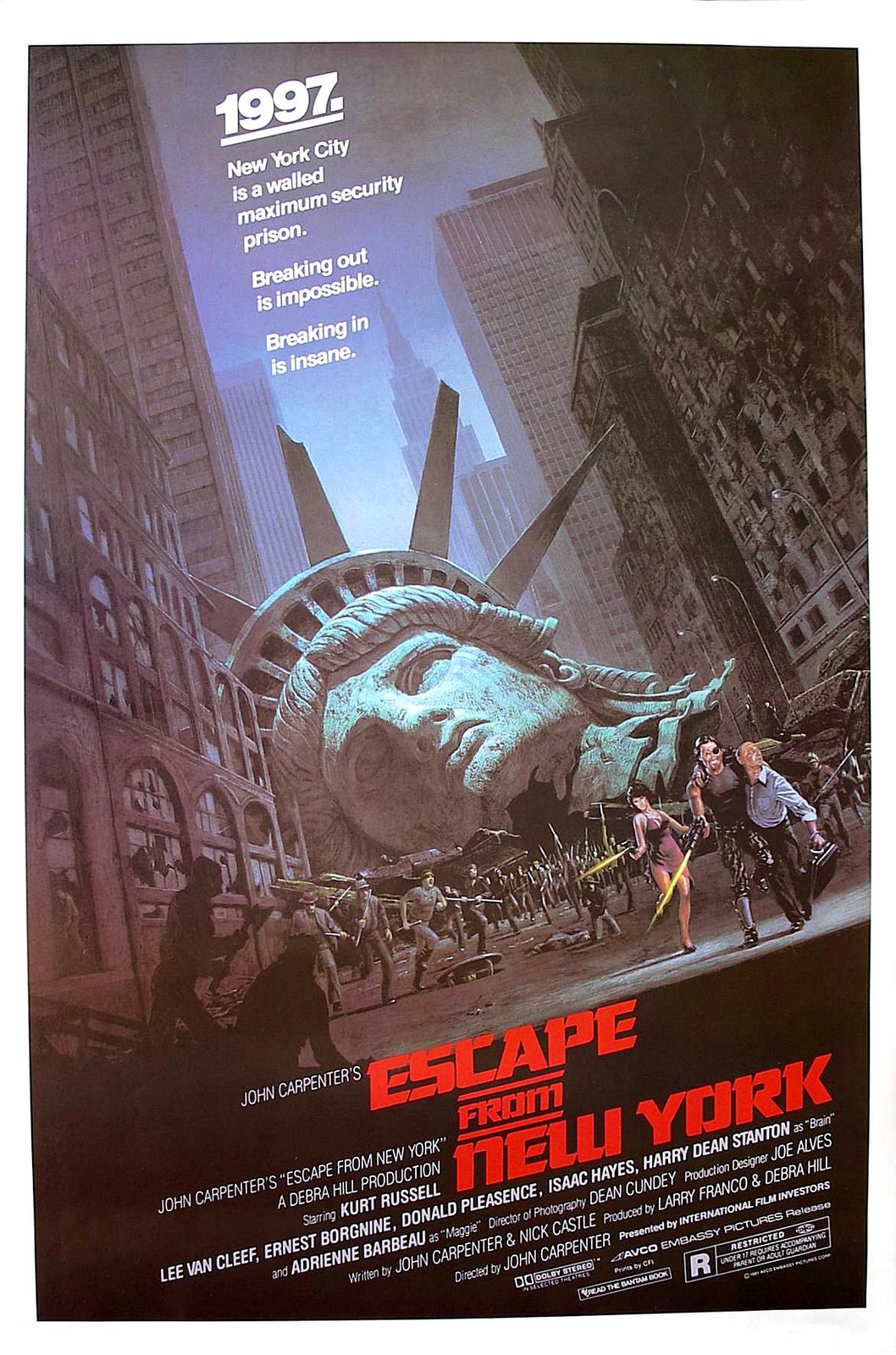
John Carpenter Looks Back at ‘Escape From New York’ and ‘Escape From LA’

John Carpenter Escape From New York photo

“Escape Artist: A Tribute to John Carpenter” continued with the exploits of Snake Plissken in the double feature of “Escape From New York” and “Escape from LA” at the Aero Theater in Santa Monica. These films featured some of the collaborations between Carpenter and Kurt Russell who first worked together on “Elvis.” They quickly became great friends and went on to work together on several other films including these two and “Big Trouble in Little China.”

The emcee warned us that the print of “Escape From New York” was pretty faded as it was an original print and the only one American Cinematheque could get their hands on. This was being generous as it looked like it had been slaughtered by countless film projectors, and the color was faded to where everything looked pink. It is astonishing it didn’t break apart in the projector. Still, the fans still enjoyed watching the film, one which they have seen hundreds of times before. They laughed when “1997 NOW” came up and when Lee Van Cleef speaks into this enormous cell phone no one would have today, let alone in 1997.

After “Escape From New York” ended, Carpenter came to the stage and was greeted with another thunderous standing ovation. Carpenter quickly acknowledged the crowd by saying, “Thank you for coming out to see the movie tonight, but I got to tell you this is the worst fucking print. My fucking God! There’s no color in it!” The audience laughed loudly as they were in complete agreement.

Escape from New York poster

The discussion started off with a question about the genesis of the project. Carpenter talked about writing the script back in the early 1970’s when there was a great sense of cynicism in America about our President and in response to the hostage crisis in Iran. He also admitted he was inspired by two of his favorite movies back then, “Dirty Harry” and “Death Wish.” Those two movies involved men driven to the brink emotionally and who took it upon themselves to wreak vengeance on those who wronged them. Like those characters, Snake Plissken gets the job done, and this brought a lot of satisfaction to audiences as nobody in the real world seemed to be accomplishing anything.

Carpenter said he initially wanted Clint Eastwood to play Snake Plissken. For one reason or another, it did not work out. He also said he had shopped this screenplay around to several studios which rejected it outright, but fortunately he had a multiple picture deal with Avco Embassy which had produced “The Fog.” Ironically, they wanted Charles Bronson for the title role. Somehow, everything came together when Russell got cast as Snake Plissken, and he portrayed the character as an asexual human being who cares about nothing more than staying alive. In the process, he created one of the most memorable anti-heroes ever seen in a movie.

Carpenter also talked about Lee Van Cleef, a favorite actor of his from Sergio Leone westerns, who played Police Commissioner Bob Hauk. Lee had seriously injured his knee during the filming of another movie and had never gotten it fixed, and as a result he was in constant pain while making “Escape from New York.”

With a budget of only $5 million dollars, “Escape From New York” needed to be filmed as quickly as possible. Carpenter said the rule of low budget filmmaking was to shoot as little film as possible and to make it as long as you can. In fact, there is actually only one real shot of New York in the entire movie which features the Statue of Liberty, and it pans from there and dissolves into a set in Los Angeles. A lot of what you see of New York in the movie are actually models and matte paintings done by artists from Roger Corman’s New World Pictures, among them James Cameron. Much of the movie was filmed in downtown St. Louis which had had a huge fire that destroyed several city blocks. The city let Carpenter and his crew film there in triple digit temperatures, and they even shut the power down for them when they filmed at night.

Escape from LA movie poster

When it came to making “Escape from LA,” Carpenter had a budget of around $50 million to work with. But while he and Russell had more time and money, Carpenter said he had the hardest time writing the screenplay for it because he felt that everything he was writing was “bullshit.” What got him to revisit Snake Plissken was that Russell was so keen on playing the character again, and they solved their script problem by moving the action to Los Angeles which was in a constant state of denial with all the earthquakes and natural disasters occurring there. They simply took the same scenario of the original movie and updated it to reflect the current state of the city while filming.

“Escape From New York” may have had only one real New York shot in the entire movie, but all of “Escape from LA” was filmed in Los Angeles. The sequel was shot over a period of one hundred and three nights, and Carpenter said he found filming at night to be very “soul draining” as it changes the way you see things and the darkness infects you in a very unhealthy way.

One audience member brought up how at one point it looked like Carpenter and Russell might do a third movie called, “Escape from Earth.” This never panned out because “Escape from LA” unfortunately bombed at the box office. There was also supposed to be a video game based on the movies, but the company involved with it ended up going back to the past by resurrecting Pac-Man. There was even talk of a television series which would act as a prequel to the movies and even an anime movie chronicling the further adventures of Snake Plissken, but neither of those projects became a reality. Despite the box office failure of “Escape from LA,” there are still many people out there who are intent on continuing the exploits of their favorite antihero.

These days, Carpenter said he is content to sit at home and watch the NBA Finals or play video games. He told the audience he had just finished playing “Ninja Gaiden 2” and would be moving on to “Metal Gear Solid 4” next. It doesn’t seem like he is in a big hurry to make another movie, but this could change if the studios pay him a lot of money. Carpenter feels the movie business keeps changing on him, and he does not appear to be as enthusiastic about making films as he once was.

Carpenter closed out the evening by saying he had to go meet with his drug dealer. Before he left, the moderator gave him a gift saying Carpenter had given so much to us that he wanted to give something back. This something was the “Escape from New York” board game which is, apparently, the most complicated board game ever.

After the discussion ended, he did take some time outside the theater to sign autographs and pose for pictures with fans who still see him as a big inspiration. If you look at movies of recent years, you will see Carpenter’s influence over many of them both in their visuals and the music. To this day, he remains one of the important directors of the sci-fi and horror genre, and his cult following remains as strong as ever.

As the evening wore on, many came back inside to watch “Escape from LA.” The print was in much better condition, but this didn’t stop it from breaking down during the movie’s last seconds. For those who know how this sequel ends, it only seemed comically appropriate as Snake shut down… Well, you know.

An Ultimate Rabbit Guilty Pleasure: ‘The Cannonball Run’

The Cannonball Run poster

So sue me, I still enjoy watching “The Cannonball Run” after all these years. The critics eviscerated it upon its release, especially Roger Ebert who awarded this movie half a star out of four, but my enjoyment for it has only dampened so much. I was just a kid when I saw first watched it with my brother, and I had yet see “Smokey and the Bandit” which we can all agree is a better movie. Looking back, I dug Burt Reynolds’ ever so cool demeanor, Dom DeLuise’s over the top performance, the ever so beautiful Farrah Fawcett who makes you want to love trees as much as she does, Roger Moore gleefully spoofing his role as James Bond, and Jackie Chan kicking Peter Fonda’s butt among others. Hal Needham may have never directed a motion picture worthy of being compared to “Vertigo” or “Citizen Kane,” but he sure did know how to give audiences a fun time (this time around anyway).

recently got to revisit “The Cannonball Run” when New Beverly Cinema screened it as part of a tribute to the late Roger Moore. This offered me my first chance to see it on the big screen after seeing it on television time and time again, and I couldn’t resist the opportunity. After all this time, I still have a blast seeing the filmmakers have fun with the 20th Century Fox logo as a couple of cars keep crashing into those famous spotlights.

For those who have avoided “The Cannonball Run” because of the dreadful reviews, it is about a variety of different personalities who participate in a highly illegal cross-country race which takes them from Connecticut all the way to California. For these drivers, the speed limit of 55 miles per hour means nothing, and they have their own individual plans for reaching the finish line before everyone else. The most prominent of these drivers is J.J. McClure (Burt Reynolds) who is joined by his best friend Victor Prinzi (DeLuise) who at times breaks out into his alter ego of Captain Chaos when times get rough.

Watching “The Cannonball Run” today, I am reminded of what filmmakers used to get away with in a PG-rated movie. You have Terry Bradshaw and Mel Tillis driving their Chevrolet Malibu NASCAR Grand National race car with a pathetic paint job while having dozens of Budweiser Beer cans clearly visible in the back seat. When they are intercepted by the uptight antagonist Arthur J. Foyt (George Furth) at a road block, it’s astonishing they get busted for participating in the Cannonball instead of having an infinite supply of Budweiser on display, let alone open cans in their hands. Foyt is determined to stop the race, but drunk driving doesn’t appear to be as big a concern to him. Go figure.

Heck, most of the drivers we see here are as interested in getting hopelessly inebriated as they are in winning this illegal race. Jamie Blake (Dean Martin) and his partner Morris Fenderbaum (Sammy Davis Jr.) are unsure of who should be at the wheel as they are both sloshed to the point where they should get a designated driver like Richard Petty. J.J. McClure is flying a plane and becomes pissed upon realizing he and Victor are out of beer and ends up landing in the middle of a street near a convenience store where Victor can rush in to get a 6-pack. Seriously, the last 80’s movie I can remember its characters having too much alcohol was “Star Trek V: The Final Frontier,” and that also had a PG-rating.

The first time I saw Jackie Chan in anything was in “The Cannonball Run” where he played a version of himself as a talented race car driver who, along with Michael Hui, navigates a super high-tech Subaru across America. Seeing Chan beating up members of a motorcycle gang was awesome to a 10-year-old like myself, and it was hysterical watching him cover up the rips in his jeans after knocking two guys out. Chan also showed us the future of texting while driving as he watched the Marilyn Chambers porn classic “Behind the Green Door” while behind the wheel. I would like to think this movie predicted the future where drivers stopped paying much attention to what was on the road ahead of them, but I’m pretty sure few would be willing to give Needham and company the credit.

“The Cannonball Run” was also my introduction to Rick Aviles, an actor and comedian who would later become famous for doing the unthinkable in a 1990’s movie, killing Patrick Swayze in “Ghost.” We get a taste of his comedic acting here which wasn’t as present in other movies he appeared in, and he does a Richard Nixon impersonation which still has me in hysterics. What a shame Aviles’ life was cut short at the age of 42.

Burt Reynolds has gone on the record to say “The Cannonball Run” is not one of his favorite movies, and to be honest, he does look to be coasting on his natural charisma as J.J. McClure. Regardless, I still loved how he coasted on it here as it makes his job seem ever so easy. All he needs to do is give you a certain look, make a certain sound, or just twist his mustache in a certain direction to get your full attention. Now how cool would it be to go through life being so cool without putting too much effort into it? Like Rod Stewart said, some guys have all the luck.

It’s a shame Dom DeLuise is no longer with us. Whether he was in the best of movies or the worst of movies, he was such a delightful presence in them all. His character of Victor Prinzim has an upbeat attitude about himself even as J.J. tries to keep it under control, especially when Victor talks about “him.” The him is Captain Chaos, Victor’s alter ego who jumps into action when things get threatening or when he finds himself falling behind in the race. Watching DeLuise become Captain Chaos is a blast, and this is even though he saves the day one time too many near the finish line.

For me, Roger Moore was the James Bond I grew up on, and seeing him here shows what a great sense of humor he had about his tenure as 007. Moore never ever plays his role of Seymour Goldfarb, a Jewish heir to a family fortune pretending to be a movie star named Roger Moore, as if he is in on the joke. Seeing him keep his cool even as the police pursue his speeding silver Aston Martin is great fun, and you know Sean Connery and Daniel Craig would never be quick to do the same thing. George Lazenby maybe, but never Connery.

Watching Jamie Farr as the oil-rich Middle-Eastern sheikh Abdul ben Falafel serves as a reminder of how there is more to this actor than him playing Maxwell Klinger on “M*A*S*H.” Some may consider his performance to be an offensive caricature, but he is so wonderfully over the top here as he proclaims his driving is only rivaled by the lightning bolts from the heavens to where it is a waste of time to take what he does here seriously. Farr makes his character’s unchecked ego all the more palpable, and the scene where he essentially flips the bird to the cops is one to cheer for if you have ever been given a speeding ticket. And yes, Farr makes you believe this is a character who knows when you have had too much couscous.

Was there anything I saw in “The Cannonball Run” that I had not seen before when watching it at New Beverly Cinema? Yes, a few actually. The grotesque Doctor Nikolas Van Helsing (Jack Elam) announces himself to be a proctologist to where a certain finger on his hand becomes far more frightening to me now than ever before. Then again, I had no business knowing what a proctologist does when I was a pre-teen.

Also, Farrah Fawcett’s nipples are much more present as they poke prominently through her dress during the scene where she first catches the attention of Reynolds. Then again, there is an enormous amount of cleavage on display from start to finish, much of it courtesy of Adrienne Barbeau and Tara Buckman who use their sex appeal to avoid the much-deserved speeding tickets which should automatically come with the purchase of a Lamborghini, any Lamborghini.

But after all these years, I still get won over with moments like when Fawcett bonds with DeLuise as he talks about the first appearance of Captain Chaos in his life, or when Reynolds tells Fawcett why he races cars. This might seem like a movie too shallow to contain moments like these, but they were pretty deep to me when I watched “The Cannonball Run” back in the 1980’s, and today they still are.

I don’t know, maybe my opinion of this movie would be different had I seen “Cannonball” or “The Gumball Rally” beforehand, both of which are said to be much better than “The Cannonball Run.” Well, fate had it that I would watch Needham’s 1981 comedy ahead of them, and I still enjoy watching it despite the numerous detractors it has. For those who think this is a prime example of lazy filmmaking, check out “Cannonball Run II” which is exactly that (or better yet, don’t bother).

I feel like I should apologize liking “The Cannonball Run” as much as I do, but I am sick and tired of apologizing for who I am. Besides, this movie remains a prime example of the things filmmakers could get away with in a PG-rated movie back in the 80’s. They wouldn’t get away with any of this today.

* * ½ out of * * * *

David Cronenberg’s ‘The Fly’ Proves to Be More Than the Average Gross-Out Movie

The Fly 1986 movie poster

David Cronenberg’s remake of “The Fly” was released in 1986, a year filled with everlasting cinematic classics like “Aliens,” “Ferris Bueller’s Day Off,” “Star Trek IV: The Voyage Home,” “Platoon,” and “Top Gun.” More importantly, it came out during a time where remakes were very rare compared to today, and also when remakes were actually worth watching. Whereas remakes these days serve to capitalize on a known quantity or are being exploited for the sake of some potential franchise, “The Fly” is one where the director took what came before and made it completely his own.

You should all know the story by now. Seth Brundle (Jeff Goldblum) is a brilliant and eccentric scientist who has invented a set of telepods which allow objects to travel instantaneously from one pod to another. Seth shares the story of his invention with science journalist Veronica Quaife (Geena Davis) as he attempts to test teleportation on living subjects. Eventually, Seth decides to test it on himself, but he doesn’t realize a common housefly has entered the telepod with him, and the computer gets confused and ends up merging the two lifeforms at a molecular-genetic level. Seth believes the teleportation has purified his body as he discovers a strength he didn’t previously have, but it’s all a build up for a transformation which becomes all the more horrifying as “The Fly” reaches its gruesome climax.

What I love about “The Fly” is its slow build as Cronenberg makes Seth’s transformation into “Brundlefly” all the more unnerving by taking it one step at a time. We first see him engaging in an extraordinary set of gymnastics we would all love to be capable of, and then we watch as he puts an enormous amount of sugar into his coffee at a local diner. This leads Veronica to ask him, “Do you normally take coffee with your sugar?” While I expected a reply along the lines of Christian Slater’s in “True Romance” where he said, “I’m not satisfied until the spoon is standing straight up,” it is immediately clear that Seth is too involved in his own process to see the damage it is doing to his body.

Seth’s face comes to look like it is riddled with severe acne scars, and this brought about a number of PTSD flashbacks for me of when I dealt with my own acne outbreaks back in high school. But the key moment doesn’t come when Seth snaps a guy’s arm in half during an arm wrestle contest (it’s always painful to see a bone sticking out of a person’s body), but instead when he finds himself pulling out his own fingernails. Just the idea of pulling out your own fingernails is painful in itself, but seeing Seth pulling his out to where a great deal of puss explodes from his fingers proves to be even more painful than watching George Clooney getting his fingernails pulled out with a pair of plyers in “Syriana.”

At this point, I want to point out one of “The Fly’s” biggest stars which is Chris Walas. Walas won an Academy Award for Best Makeup for his work here, and it should go without saying just how much he deserved it. As Seth’s body continues to deteriorate in the midst of an unwanted, let alone unexpected, transformation, Walas makes each moment sting with a thankfulness we are not going through what this misguided scientist is. He also gives you the assurance that he and his colleagues have researched all there is to know about this kind of metamorphosis, and this makes Seth’s transformation all the more horrifying. Walas makes you believe something like this could actually happen to where you cannot help but react strongly to everything unfolding before you.

1986 was a big year in science fiction as Sigourney Weaver not only had the lead role in “Aliens,” back when it was rare for an actress to have such a role in a movie, but she also scored an Oscar nomination for her performance which was well-deserved. It’s a shame Goldblum didn’t get the same respect from the Academy as his performance is truly brilliant and wholly original. Just as Weaver dominated all those special effects in “Aliens,” Goldblum makes it clear the makeup is not doing all the acting for him as he fully inhabits Seth Brundle at every stage of his transformation. For the actor, the makeup becomes a costume which comes to inform his character throughout, and Goldblum is fearless in portraying this scientist’s descent into an unwanted fate.

Scientists in movies tend to be either over the top or exceedingly modest and timid, but Goldblum gives us one whose eccentricities make him more alluring than the average one. The actor even sells us on a wonderful moment where he explains why he wears the same suit, shirt and tie each day, and seeing his closet reminded me of a number of movie spoofs where this same situation was used for sheer comedic effect. Even as Seth becomes increasingly unpredictable, let alone unlikable, to be around, Goldblum seduces us deeply into his strange plight which brings about a change he never saw coming.

But let’s not leave out Geena Davis who shares a strong chemistry with Goldblum throughout, and this only makes sense as they were a couple at the time and were briefly married. As Veronica Quaife, Davis creates a complex character whom is eager to take advantage of Seth’s invention for the story of the century, but she soon finds herself falling for him to where she cannot tear herself away from his hideous transformation. The scene where she hugs him after getting her first glimpse at the horrific changes his body is going through brought about a loud gasp of disgust from the audience I watched this movie with at New Beverly Cinema, but it shows just how powerful her performance is. Veronica is at once mortified at how bad things are getting for Seth, and yet she can’t tear herself away from him because she is too emotionally involved to just give up on him. Davis’ commitment to her performance shows the range which would eventually earn her an Academy Award for her work in “The Accidental Tourist.”

Many see Cronenberg as a filmmaker who makes nothing more than gross-out horror movies, but they neglect to see the intelligence and thought he puts into each movie he makes. Whether it’s “The Fly” or “Rabid” or “Scanners” or “Dead Ringers” or “eXistenZ,” Cronenberg has fearlessly explored the phobias we all have of bodily transformation and disease to unforgettable effect. His movies are not designed to make you throw up, but instead to confront how our bodies deteriorate in one way or another. His remake of “The Fly” is one of his most unforgettable motion pictures as we can’t take our eyes off the screen even as Seth Brundle’s transformation becomes all the more disgusting. Its power comes from how it draws you in emotionally more than anything else, and we have as much luck at disconnecting ourselves from Seth’s unnerving plight as Veronica does.

Watching “The Fly” again, it is clearer than ever that this movie is about a tragic romance more than anything else. Heck, Shakespeare would have been proud to have written a tragedy like the one presented here. While much of the attention on this remake is forever directed at the makeup design which still grosses audiences out to this very day, it is the romance between Seth and Veronica which drives the story more than anything else. The two of them want to tear themselves away from one another, but deep down neither of them can truly bare to do so, and they are the kind of couple U2 sang their song “With or Without You” about.

If there’s anything wrong with “The Fly,” it’s the ending as things are resolved in a way which is not altogether satisfying. We are left with questions which would not be answered until “The Fly II,” and while that sequel had its moments, it’s no surprise how it paled in comparison to Cronenberg’s remake.

Horror movie remakes are a dime a dozen these days, but Cronenberg’s “The Fly” remains one of the best and most visceral. It is still the director’s biggest commercial hit to date, and I prefer to see this as proof of how his unique style of filmmaking can reach a wider audience than we typically realize. All these years later, Cronenberg remains one of the most original filmmakers working today, and we eagerly await his next cinematic opus with great anticipation.

* * * * out of * * * *


Jeremy Licht Reflects on the Making of ‘Twilight Zone: The Movie’

Twilight Zone Movie Jeremy Licht

Grauman’s Chinese in Hollywood had a special screening of “Twilight Zone: The Movie” in honor of its 30th anniversary, and the screening was put together by Mad Monster. Before fans got to watch the movie in its pristine digital presentation, there was a Q&A with one of the movie’s stars, Jeremy Licht. Perhaps best known for his work as a child actor on television shows like “The Hogan Family,” Licht was very happy to share his memories of making this film.

Twilight Zone The Movie poster

Licht appears in the movie’s third segment, “It’s a Good Life,” in which he plays Anthony, a young boy who is suddenly befriended by schoolteacher Helen Foley (Kathleen Quinlan). But when Anthony takes Helen home to meet his “family,” she ends up meeting a group of people who live in sheer horror of Anthony as he lives to terrify them if he suspects they disapprove of him.

The movie is the theatrical version of Rod Serling’s classic television series “The Twilight Zone,” and it is essentially an anthology of four different films by four directors. Licht described the audition process for it as being “really interesting” and that he was not hired until after the filmmakers started shooting the first couple of segments.

“I auditioned a couple of times and knew it was starting to get close, and it was really exciting,” Licht said of the process. “On the second audition that I had, Joe Dante was in there (who directed “It’s a Good Life”). It wasn’t often that I got star struck, but I was kind of in awe of him because of what he had done. He had made ‘Piranha’ which I’m sure you all know more than I do.”

Of course, it’s impossible not to talk about “Twilight Zone: The Movie” without mentioning the tragic accident which still casts a heavy shadow over it. During the filming of the first segment, “Time Out” directed by John Landis, a helicopter crashed and killed actor Vic Morrow and two child actors, Myca Dinh Le and Renee Shin-Yi Chen. Licht got the news about the accident a week after his second audition.

“I figured that was it. That was the end of it and they were going to shelve the film,” Licht said. “About six months later, I ended up getting a call from my agent that they were actually back in production and that they had wrapped up that segment (“Time Out”), and to come back and for a third audition. I went back in, and at this point I knew it (the material) back and forth, and I walked in and there was Steven Spielberg. He had just come off of ‘E.T.’ and it was really an amazing audition. By the time I had gotten home from that audition there was an offer. It was extremely exciting time for me and for my family and we accepted the offer, and we wound up on the Warner Brothers soundstage in Burbank within a week and we spent three months in principal photography.”

“It’s a Good Life” was a remake of the classic “Twilight Zone” episode of the same name, but Licht said he never watched it until after filming was complete. It also turns out Bill Mumy, who played Anthony in the original episode, makes a cameo appearance as a restaurant patron who intervenes when his friend starts pushing Licht’s character around.

But unlike the original television episode, Dante ended up taking “It’s a Good Life” in a different direction as it was more cartoony. Licht went on to describe Dante as a very “hands-on” director as well as a “big kid,” and that this movie was “his playground.”

“Working with a director like him truly was a treat,” Licht said of Dante. “He was really into letting the actors find what they were looking for. Obviously it was over the top; he was looking for that. He was looking for that cartoonish, extremely uncomfortable feel which I think we certainly accomplished.”

In terms of what was the most rewarding thing about doing “Twilight Zone: The Movie,” Licht replied it was being part of a film which has a huge following. The television series was always unpredictable in how you never knew what direction it would take from episode to episode, and it made fans wonder what the movie was going to be like. Having acted mostly on television and in several “movies of the week,” Licht also came to discover how fortunate he was to play Anthony in this film.

“It’s very rare as a kid, let alone at 13, to be asked to lead or be one of the principals in a film or play a character where nothing is what you think it is,” Licht said. “It’s rare to have that kind of a script, to have something like that come to you, let alone be asked by Joe Dante or Steven Spielberg to be in it. I was pretty honored and pretty humbled, and I am to this day really.”

As for the question Licht gets asked the most about “Twilight Zone: The Movie,” he said it was if the cast really had to eat those peanut butter covered hamburgers.

“I read the script and I thought, ‘Wow, that is really vile! I can’t imagine doing that,’” Licht said of this unusual meal. “The day that we shot it, they actually brought in McDonald’s hamburgers and basically we tried it. First of all, if you’re peanut butter person, it’s really not bad. The problem is, good luck saying your lines with a mouthful of peanut butter!”

Licht retired from acting in the 1990’s although he did appear in a short film in 2009 called “The Closer.” These days, he has his own financial planning company called JL Capital Management which has turned out to be very successful. For a former child actor, he has done very well for himself, and he has not allowed himself to be swallowed whole by the kind of vices which have destroyed so many lives. When asked why some child actors easily transition to an adult career while others don’t, Licht sounded very level-headed in his explanation.

“When I was doing it, there were paparazzi but nothing like things are now where every moment is recorded and every stumble that you take is magnified,” Licht said. “I’ve seen it all. I’ve had friends that have had very successful careers, and sadly I’ve had friends that have fallen. I grew up with good people around me and I still do surround myself with good people. My folks are important and my family is really important. I got into the business very young, but not necessarily at the urging of my family. I wasn’t supporting my family. It (acting) was a hobby that sort of took off. My parents said to me the whole time, ‘If you stop liking this or you become unpleasant to be around, you’re out. You’re gone because this is not what that’s for.’”

“I think a degree of it is luck, I think a degree of it is also upbringing and family, but I think a lot of it is luck,” Licht continued. “It’s like any of your lives growing up, but under a big microscope. I’m sure that we’ve all had times in our life, if you can imagine if cameras were on you, when you stumble the hardest, and how can you recover from that? You can recover privately, but when everybody’s watching you and judging you it’s a tough deal.”

We keep hearing stories day after day of child actors going bad, but we never hear enough about the ones who don’t. Licht is one of those former child actors who has done very well for themselves, and it would be great to hear more about people like him instead of getting all these random updates on others who don’t have the same support.