Michael Crichton’s book “Jurassic Park” served as a cautionary tale on scientists’ tampering with biology as they bring dinosaurs back to life without thinking about the consequences of their actions. When Steven Spielberg adapted it to the silver screen in what turned out to be a genuinely thrilling movie, much of it was changed and details were omitted to make it the kind of audience pleasing movie he was best known for making at the time. He doesn’t delve as much into the darker side of Crichton’s characters and made them more likable, and the changes proved impossible to miss.
Working with David Koepp, who got screenwriting credit along with Crichton, Spielberg developed the cartoon the main characters watch during the park tour to remove much of the exposition found in the book. Crichton goes into extensive detail about how dinosaurs were recreated using their DNA which ends up being found in mosquitoes trapped in fossilized tree resin. Despite many scientists saying it is impossible to create dinosaurs in this way, it still makes for a very compelling story.
Koepp also cut out a sequence from the book which had Grant and Hammond’s grandchildren being chased down the river by the Tyrannosaurus. This was done for budgetary reasons, but this dinosaur would later appear in “Jurassic Park III.”
The book also had a sub-plot about young children getting attacked by small theropod dinosaurs, but Spielberg cut this out because he found it too horrific. However, that same sub-plot would be used to start off the movie version of “Jurassic Park: The Lost World.”
When it came to the characters, some of the biggest changes occurred with John Hammond, the curator of Jurassic Park. The book describes him as a ruthless businessman who is arrogant, deceptive, utterly disrespectful, and thoughtlessly rude. Even though he eventually comes to see the consequences of his experiments, he still moves ahead with his plans in the name of profit. He is even willing to sacrifice his grandchildren to the dinosaurs if that’s what it takes.
In the movie where Hammond is portrayed by Sir Richard Attenborough, he is instead an eccentric and friendly old man who is caught up in the wonder of what he has helped bring to life. However, he eventually realizes he cannot control the dinosaurs and is desperate to see his grandchildren brought back safely. This change came about because Spielberg very much related to Hammond’s obsession with showmanship.
Dr. Alan Grant, played by Sam Neil, is shown to like kids and enjoys being around them in the book. However, the movie has him being not the least bit fond of them. This change was made to give Grant more room for character development as he comes to be the father figure Hammond’s grandchildren lack when things go wrong.
Ellie Sattler, played by Laura Dern, is described as a 23-year old graduate student of Grant’s who is planning to get married to someone other than him. In the movie, she is Grant’s love interest and hopes he will one day be open to having children with her.
Jeff Goldblum gave a scene stealing performance as chaos theorist Ian Malcolm, and he gives Spielberg’s film the bulk of its comic relief. Crichton, however, wrote Malcolm as being more serious, philosophical, and at times downright condescending. Unlike the movie, Malcolm is killed off at the end of the book, but in the follow-up book “The Lost World” he is revealed to have survived.
One character that got drastically downsized was Dr. Henry Wu who is played by B.D. Wong. Crichton has him providing much of the detail about how the dinosaurs are cloned, and he stays on the island and is eventually killed off while the movie has him heading off to the mainland where he survives, and he was the only actor from this movie to appear in “Jurassic World.”
The lawyer Donald Gennaro, one of the movie’s greediest and thoughtless characters, comes across as rather likable in the way Crichton writes him. While he becomes something of a scapegoat towards the end, he is the one most insistent on the island being destroyed to protect the rest of the world from these dinosaurs. But in the movie, he is ever so eager to exploit the park’s profit potential any which way he can.
Then there are Hammond’s grandchildren, Lex and Tim, who are along for the tour of the island as well. In the book, Tim is the oldest of two at 11 years old and is good with computers while Lex is only 7 and more into sports. Spielberg switched these characters around to where Lex was the oldest, and he did this in order to cast Joseph Mazzello as Tim. Ariana Richards plays Lex, and she’s the more into computers and helps save the main characters in one critical scene.
Looking back at “Jurassic Park” the movie, it was the last time Spielberg adapted a book and changed the characters to where they were likable and easier for audiences to spend time with. His next movie was “Schindler’s List” which had him exploring one of the darkest periods of human history, and making it had a major effect on the movies he directed afterwards. When it came to turning “The Lost World” into a movie, Spielberg was more willing to embrace the darker aspects Crichton explored intensely in his books, and this was something readers wished he had done with the first movie.
I still vividly remember when “Jurassic Park” came out in 1993. I was in high school back then, and many of my friends got to see it before I did. Their reactions always stayed with me as they described how thrilling a movie it was. One guy kept holding his arm intensely and kept saying, “It steamed the glass!” I would later find out what he meant when I saw the movie a few days later, and it was quite the thrill ride as well as groundbreaking in terms of special effects. Steven Spielberg delivered us the kind of blockbuster he had been delivering to us since he made “Jaws” all those years ago, one which is thrilling and fills you with wonder and awe.
It was later followed by “The Lost World: Jurassic Park” which was more of the same but fun if you could get past the fact that Spielberg pretty much directed in on auto pilot. As for “Jurassic Park III,” a better title for it was “300 special effects in search of a screenplay.” Now we have “Jurassic World,” the latest sequel in this franchise which arrives over a decade after the previous installment. While there’s little chance in recapturing the wonder of the original, this sequel still proves to be a fun time at the movies.
Intended as a direct sequel to “Jurassic Park,” “Jurassic World “shows us how the island of Isla Nublar has long since become an infinitely popular theme park. John Hammond’s dream is now a reality, and guests are treated to a variety of shows and rides which depict these once extinct creatures in all their incredible glory. But now tourists have long since gotten used to dinosaurs being brought back from extinction, and now they want something more intense and scary. As a character notes, the park’s attendance level spikes when a new dinosaur is unveiled, and this makes the park operators create one which ends up scaring not just the children but their parents as well. And just as before, the results prove to be disastrous as the road to hell is always paved with good intentions and a misguided quest for profit.
What I liked most about “Jurassic World” is how its screenplay acknowledges how tired and worn out people are by watching dinosaurs in this day and age. This is exactly how I felt after watching “Jurassic Park III” as what was once thrilling and magic had since become depressingly routine. As a result, the script has a subversive feel as it ponders our need for the same level excitement we had in the past, and of how desperate we are to relive or top it. Now on one hand this sequel has a lot of things going for it as the filmmakers explore the desires of both the public and the corporate world which continues to be blinded by dollar signs at the expense of everything else. This wouldn’t be a theme park without a Starbucks or a Jimmy Buffet Margaritaville Restaurant in it, and both are on display here. Heck, even Buffet makes a cameo carrying a couple of margaritas, but when the dinosaurs start wreaking havoc, it’s clear he won’t have time to look for his lost shaker of salt.
On the other hand, the movie has its characters making incredibly dumb decisions which will have audience members scratching their heads in disbelief. Then again, this wouldn’t be much of a movie if everyone used their common sense on a regular basis. Those of you who have watched “Jurassic Park” over a thousand times will be instantly reminded of famous dialogue like when Ian Malcolm talked about how scientists were so preoccupied with whether or not they could create dinosaurs to where they never stopped to think if they should. Then there’s Ellie Sattler who made it clear to Hammond he will never have control because that’s the illusion he was trying to avoid.
Then again, the one line which stands out most is when Hammond said how he “spared no expense.” When we get our first glimpse of what has become of Isla Nublar, we are reminded of what Hammond said as it has accommodations your local Motel 6 can only dream of offering guests. They may leave the light on for you, but they can’t give you amazing vistas or prehistoric creatures to look at.
Actually, one of the best moments in “Jurassic World” comes from B.D. Wong who reprises his role of Dr. Henry Wu from the first movie. When asked why he and the other scientists created the new dinosaur, Indominus Rex, Henry responds, “Monster is a relative term. To a canary, a cat is a monster. We’re just used to being the cat.”
In terms of the human element, “Jurassic World” does suffer a bit. Then again, these movies have never been about complex characters as much as they have been about dinosaurs. Still, one of the best things about this long-awaited sequel is Chris Pratt who lends his “Guardians of the Galaxy” charisma to his role as Owen Grady, a former military officer and velociraptor trainer. Pratt adds the heroic element this movie demands, and his comedic skills are put to good use.
Another terrific performance comes from Bryce Dallas Howard as the park’s operations manager, Claire Dearing. It’s great to watch Howard take Claire from being a work obsessed park employee to a badass heroine who ventures out into the danger zone to save her two nephews before they become the dinosaurs’ main course.
It’s also a kick to see Vincent D’Onofrio here as the antagonist Vic Hoskins, head of security operations for InGen. The actor manages to take what could have been a simple one-dimensional villain and makes him a lot more interesting. You can see in his eyes how he has a secret plan for the dinosaurs which has yet to be revealed to our heroes. Of course, we all know how D’Onofrio’s character is going to die, and it is not pretty.
Spielberg once again stayed in the executive producer’s chair for this sequel, and the director is Colin Trevorrow who is a very lucky filmmaker as he went from directing a movie with a budget of $750,000 (“Safety Not Guaranteed”) to this $150 million summer blockbuster. While he is not able to fully recapture the wonder of “Jurassic Park,” he makes “Jurassic World” a solid piece of summer entertainment which brings out the kid in you. Trevorrow also creates moments which will have the audience cheering loudly, showing he is more than capable of giving us the kind of crowd pleasing movie we expect in the summertime.
“Jurassic World,” like “Mad Max: Fury Road,” was stuck in development hell for years before it finally came to fruition. For the most part it was worth the wait as it comes with a stronger story and screenplay than the last two “Jurassic” movies could ever hope to have. There’s plenty of great dinosaur fights, tourists getting terrified, and there are characters here worth rooting for. All in all, it does what a summer movie should do which is entertain you from beginning to end.
Of course, when you look more closely at the story, it illustrates how history keeps repeating itself when dollar signs get in the way. Once again humans deluded themselves into thinking they could control dinosaurs, and nature finds a way to prove them wrong. With “Jurassic World: Fallen Kingdom” about to be released, I imagine we will watch humans again trying to tame these prehistoric creatures, and their efforts will prove to be largely futile. Oh well, hopefully we’ll get another entertaining sequel in the process.
The 1990’s were not a kind decade to Sylvester Stallone. “Rocky V,” which was supposed to be Stallone’s last go around as Rocky Balboa (LOL), proved to be a critical and commercial disappointment, and his foray into comedy with “Oscar” and “Stop or My Mom Will Shoot” was disastrous to say the least. Clearly, Stallone was in serious need of a comeback as well as a return to the dramatic action movies he became best known for. As a result, he teamed up with “Die Hard 2” director Renny Harlin and Carolco Pictures to star in the action adventure film “Cliffhanger,” and the first trailer made for it remains forever burned into my memory.
The genius of this teaser trailer was how the filmmakers scored the images to Mozart’s “Dies Irae,” a powerful piece of music which served to make this movie seem more epic than it ended up being. There is no dialogue to be heard here as the focus is on the snowy mountain landscape which proves to be as beautiful an environment as it is a brutal one for those unprepared to deal with its frigid temperatures. As we watch Stallone and his fellow cast members John Lithgow, Michael Rooker, Leon and Janine Turner battling the elements which range from climbing up a mountain without a winter jacket or being trapped in a cold lake beneath a thick sheet of ice, it made “Cliffhanger” look like the end all of mountain movies as it captured a reality which is usually faked on a Hollywood soundstage.
Then there is the trailer’s final image of Stallone making a death-defying leap from one mountain side to another, and it’s a fantastic visual to close out on before the movie’s title comes up. Watching him do this quickly reminded me of when he performed similar feats as John Rambo in “First Blood” and its sequels as he the situations Rambo was caught up in were not entirely realistic, but Stallone’s physicality and performance made us believe he one could survive such impossible circumstances to where stopped asking questions and just went along for the ride.
Of course, upon learning Stallone had co-wrote the screenplay, I went in to see “Cliffhanger” with reduced expectations as I figured it would be a variation on the story he writes about more often than not of a man haunted by a tragedy and of his need for redemption. The movie did prove to be very entertaining, but it was not as deep and epic as this trailer promised. Regardless, I look back on this particular trailer very fondly as I said to myself after watching it, “Now that’s how you sell a movie!”
“Creed” may not have reinvented the “Rocky” franchise, but Ryan Coogler and Michael B. Jordan succeeded in making it feel fresh and reinvigorated to where a sequel was not only inevitable, but more than welcome. Now we have the first trailer for “Creed II” which promises a powerful follow-up as Adonis Creed faces the son of Ivan Drago, the man who killed his father Apollo Creed in “Rocky IV,” Viktor Drago.
In some ways this trailer is a bit anti-climatic as we have known for a while already how the son of Ivan Drago was going to Adonis’ next big opponent, and the trailer keeps building up to a reveal we can see coming from miles away. Viktor is played by Florian Munteanu who previously appeared in “Bogat.” Now we never get a clear look at his face, but when he turns around we see “DRAGO” stenciled on the back of his robe. Personally, I was hoping for a little more than just this reveal, but then again, this is a teaser trailer.
I also kept waiting for Dolph Lundgren to reappear as Ivan Drago as he is slated to be co-starring in “Creed II,” but no such luck. One of the things I am really looking forward to is seeing him come face to face with Rocky Balboa (Sylvester Stallone) as I wonder how each character feels about the other following their bloody bout in Russia 30 years ago. I’m guessing Brigette Nielsen will not be back as Ivan’s wife and official spokesperson, so Lundgren will obviously have more dialogue to work with than he did back in 1985.
The trailer does have a lot of cool shots of Adonis training and throwing brutal punches, and the moment where we see him practicing punches underwater is especially cool to where I’m surprised there wasn’t a scene like this in the previous “Rocky” films. Using Kendrick Lamar’s “Loyalty” to score the trailer was a great move as it has a powerful beat which will stay with you to where downloading the song off of iTunes is a must unless you own it or the album it is on already.
But what I really liked about this “Creed II” trailer is how it reflects the challenges Adonis and Rocky face outside of the ring as opposed to in it. Both characters are still stuck in a past which will not let them be. Whether it is the guilt Rocky feels over letting Apollo die in the ring or the feeling of inadequacy which gnaws constantly at Adonis, their struggles are never limited to a boxing match. Seeing this quickly reminded me of when Rocky and Adonis were looking at themselves in a mirror in “Creed” and of Rocky telling him how he will always be his own biggest opponent. And as Rocky talks about the “cheap shots” life is constantly giving him, I was taken back to his great speech in “Rocky Balboa” in which he said the following:
“The world ain’t all sunshine and rainbows. It’s a very mean and nasty place and I don’t care how tough you are it will beat you to your knees and keep you there permanently if you let it. You, me, or nobody is gonna hit as hard as life. But it ain’t about how hard you hit. It’s about how hard you can get hit and keep moving forward. How much you can take and keep moving forward. That’s how winning is done!”
Taking this into account, I believe “Creed II” looks to focus on the characters even over the intense fight sequences we can expect to see. Besides, what’s a fight like without the psychological depth? You can have great choreography, but it won’t mean as much if you are not fully invested in the characters’ plights and of what they stand to win or lose.
Directing “Creed II” is Steven Caple Jr., and the returning cast includes Tessa Thompson and Phylicia Rashad who proves she is still a badass with her brief appearance here. The sequel is set to be released on November 21, 2018.
I was beginning to think Pixar had made one too many sequels to their biggest hits, but now we have “Incredibles 2” which brings writer and director Brad Bird back into the Pixar fold as he continues the fantastic adventures of Bob and Helen Parr who try to balance out their crime-fighting ways with raising three kids, each who has their own unique super powers they are ever so eager to use. It is no surprise how this sequel is not as fresh or as inventive as its predecessor, but I am thrilled to say “Incredibles 2” proves to be just as much fun as the original, and it is a blast from start to finish.
It has been 14 years since “The Incredibles” was unleashed on us, but “Incredibles 2” begins just mere seconds after it ended with the Parr family doing battle with the Underminer who lays waste to their town while robbing the Metroville bank. They manage to thwart the Underminer’s dastardly plans, but in the process they leave a tremendous amount of damage in their path. Despite their goodwill in preventing many citizens from getting hurt, the police do not even try to contain their fury at these supers to where they flat out tell them it would have been better to let the bad guy get away as the bank are insured. Hmm, it kind of makes you think how the story might just reflect the state of our society today…
While attempting to do the right thing, the Parrs forgot that, in spite of their victories, supers are still illegal and have long since been forced to adhere to their secret identities. With this latest incident, the family has been forced to say at a motel as their home was destroyed, and they are informed by government agent and friend Rick Dicker (Jonathan Banks) that the “Super Relocation” program is being shut down permanently. Bob and Helen now have two weeks to figure out what they can do to support their family before they find themselves homeless and out on the street.
Their savior comes in the form of Winston Deavor (Bob Odenkirk), a telecommunications tycoon who has been a big fan of superheroes since he was a child. Winston is intent on changing the public’s perception of supers with the help of his tech savvy sister Evelyn Deavor (Catherine Keener), and he chooses Helen to revive her superhero alter-ego of Elastigirl to make this happen. However, this leaves Bob, better known as Mr. Incredible, at a loss as he feels he should be the one to start things off, but Winston feels Elastigirl is a better choice as she does not leave the same path of destruction Mr. Incredible does on a regular basis. This ended up reminding me of what Al Powell told John McClane in “Die Hard 2” after McClane said he had a feeling about something:
“Ouch! When you get those feelings insurance companies start to go bankrupt!”
Seeing Helen/Elastigirl take center stage as the main superhero in “Incredibles 2” is a wonderful twist on the original when Bob/Mr. Incredible did his superhero thing while Helen stayed at home to look after the kids. With “Wonder Woman” having been a critical and commercial smash hit, lord knows we have been long overdue for female superheroes to take charge as this genre can no longer be considered a male dominated club. Holly Hunter returns to her role with great relish as she makes Helen/Elastigirl into a wonderfully realized human being who runs the gamut of emotions throughout, and the action sequences she is featured in puts those in so many live action movies rendered in this past year to utter shame.
It’s also great to have Craig T. Nelson back voicing Bob/Mr. Incredible, and hearing him here reminded me of the welcome presence he gave us in movies like “Poltergeist,” “All the Right Moves” and on the television series “Parenthood.” He does great work in making Bob’s heroic efforts in caring for his children by himself all the more palpable as he experiences sleep exhaustion any parent can relate to. Whether its desperately trying to understand how Dash’s teachers want him to do math in a completely different way from what he as taught or dealing with Violet’s descent into adolescence, Bob has more to deal with than any parent could ever expect, and having to handle so many real-life obstacles on your own has to be admired more than criticized.
This is Brad Bird’s first movie since “Tomorrowland” which proved to be a critical and commercial disappointment. After his phenomenal success with “The Incredibles,” “Ratatouille” and “Mission: Impossible – Ghost Protocol,” “Tomorrowland” was greeted with a lot of criticism to where it seemed like Bird lost his mojo, but every director has their failures, and we are always eager to see them make a comeback. With “Incredibles 2,” Bird shows us how quickly a filmmaker can recover from a cinematic failure as he raises the bar for the other movies to be released in the summer of 2018. When “The Incredibles” was released, the superhero genre was not at the same level of popularity it is at now, and this created challenges for any sequel destined to follow it. But Bird more than rose to the occasion as he has given us a sequel which is gloriously entertaining and full of heart.
I also have to say Jack Jack steals every scene he’s in here. Whereas we saw some of what Jack Jack was capable of in the first movie, his parents are only now discovering he has many superpowers. This makes Bob’s role as a parent more challenging as Jack Jack won’t stay still, refuses to fall asleep, and turns himself into an angry beast at the most inconvenient of moments. Even Lucius Best/Frozone (Samuel L. Jackson) cannot maintain his cool self once he sees how this baby boy can make himself invisible and not easily detectable.
And yes, Bird reprises his brilliant character of Edna Mode, fashion designer to the supers who, in her first appearance, reveals herself to be infinitely perturbed to learn Elastigirl is wearing a suit not designed by her. Still, she becomes Bob’s savior when upon agreeing to babysit Jack Jack so he can for once get a decent night’s sleep. The bond she forms with this baby boy is a hilarious sight to take in as he is quick to mimic Edna’s every move, and it makes her appearance all the more delightful to take in.
I got to see “Incredibles 2” with a nearly sold out audience, and it reminded me of how much fun it is to watch a movie with so many enthusiastic people. You could complain at length about how this sequel doesn’t have the freshness of the original, but it would just take away from the fun it contains. I had a great deal of fun watching this long-awaited motion picture, and the rest of the audience clearly felt the same all the way through the end credits. Pixar still succeeds in making movies for audiences young and old, and I eagerly await an “Incredibles 3.” Of course, it would be nice to see it come out in less than 14 years.
“World’s Greatest Dad,” which was written and directed by comedian Bobcat Goldthwait, was one of those small movies from 2009 which got released under the radar. It does star the late Robin Williams, but it never got the same level of marketing some of his others got that year, namely “Night at the Museum: Battle of the Smithsonian” and the god awful “Old Dogs.” But those who have a deep love for twisted humor should enjoy this one, and it features one Williams’ last great performances before he prematurely left the land of the living.
Along with Jody Hill’s “Observe and Report,” 2009 was quite a year for black comedies which managed to mine comedy out of the most sensitive of subjects. Williams plays Lance Clayton, a failed writer and poetry teacher who is the antithesis to Mr. Keating from “Dead Poet’s Society.” The class he teaches is not at all popular, and he is unable to inspire his students or make them seize the day. Lance dreams of publishing one of his novels and of becoming rich and successful, but this success has eluded him throughout his life. Of course, once you look at the kind of novels he writes, it becomes sadly understandable why he has received a truckload of rejection letters.
Lance is also a single father to his son Kyle, a kid who many would go out of their way to nickname the antichrist. Has there ever been a ruder, endlessly selfish, thoughtless, or verbally abusive son in the history of cinema? I’m sure there are, but none come to mind at the moment. Kyle makes Rhoda Penmark from “The Bad Seed” look like Teddy Ruxpin, and he’s what Macaulay Culkin’s character from “The Good Son” would have been like if the filmmakers weren’t subjected to the iron grip of Kit Culkin. Maybe these are extreme comparisons, but they seem to fit.
Then one day, Lance comes home to find his son Kyle dead in front of his computer after accidently strangling himself during the act of autoerotic asphyxiation. Knowing the way he died, once revealed to the public, will be humiliating for him and forever put a stain (no pun intended) on his son’s memory, Lance makes Kyle’s death look like a suicide and even writes a suicide which ends up having more emotional depth than anything which could possibly have come out of Kyle’s shallow little mind. Once the note is made public on a police website, everyone at school starts seeing Kyle in a different, albeit completely false, light, and Lance soon gets the fame and adoration he always dreamed of having, and this leads him to pen a fake memoir in his son’s name.
From this description, “World’s Greatest Dad” looks to travel down the same satirical roads as “Heathers” in how it depicts the absurd effect a person’s death can have on us, especially when it involves someone we hardly knew or truly despised. But as familiar as these roads are, the timing worked to this movie’s advantage as it was released not long after the death of Michael Jackson. With his sudden passing, all the crimes he was accused to have committed, but was never convicted of, quickly seemed to disappear as if they were all a fiction, and all we could think about was the great music and dance moves he left us. With Kyle, his sins seem to be miraculously absolved upon his death, and people look to his spirit as if he was some kind of cult hero. It’s all further proof of how we have tremendous respect for the dead, but none for the living, and this saying is amped up to such a crazy degree by Goldthwait.
But Goldthwait also has an even bigger target than our adulation for the not so dearly departed, and that’s the hollow pursuit of fame. We all know this filmmaker best from his days as a comedian, and his off-kilter voice had us laughing endlessly time after time. Seeing his work as a filmmaker should make you realize there is more to him than his talent for burning up furniture on “The Tonight Show.” Being as famous as he is, Goldthwait understands how fame can bring you in touch more with people who don’t have your best interests at heart as well as others who never have cared about you in the first place. It becomes easier to see why having all this adoration can make you feel even more than you ever have before.
Kyle’s death ends up turning just about everyone at school into an utter hypocrite. Many who would rather have beaten the leaving crap out of him suddenly come forth to say they were actually friends of his. Even the principal and school psychologist try to use Lance’s new-found fame to advance their career goals. Heck, a Goth chick becomes a Bruce Hornsby fan after Lance tells her Kyle was as well. Of course, we have already previously seen how Kyle hated Bruce Hornsby as much as Lance loved to listen to him, and the level of absurdity reaches epic heights once Lance publishes his son’s fake memoir, and the book deal which has long eluded him suddenly becomes a reality.
Williams’ performance in “World’s Greatest Dad” showed how great and subtle he was to where it wasn’t always necessary for him to act crazy 24/7. Aside from his concert tours, seeing him going all nuts in a movie eventually wore out its welcome, and at times it felt like he was desperate to make us laugh. But as Lance Clayton, Williams never overdoes anything, and he makes the character sympathetic even when we know what he is doing is very wrong.
Williams also captures the lonely life of an unpublished writer whose existence is filled to rim with endless rejection. Seeing another teacher getting an article published in the New Yorker, and on his very first try by the way, brings about a resentment in him he can’t quite hide. The “Good Will Hunting” actor captures Lance’s pain perfectly, and he grounds this character in a reality which grows increasingly bizarre as the movie goes on to where he never has to a single scene just for laughs.
But one actor who truly deserves a lot of credit is Daryl Sabara who plays Kyle. Perhaps best known for his work in “Spy Kids,” Sabara doesn’t even try to find any redeeming qualities in this astonishingly vulgar character because it feels like there are none to find. Building on the school bully he played in Rob Zombie’s “Halloween,” he fearlessly makes Kyle one of the most despicable teenage characters I have ever seen in motion pictures, and he even makes Danny Lawrence from “The Karate Kid” look like a real pushover. Sabara’s work here is fearless, and you have to give him big props for how far he was willing to go.
I also really liked the lovely Alexie Gilmore as Claire, the younger teacher who is more or less dating Lance while having eyes for another teacher, Mike (Henry Simmons from “NYPD Blue”). Her adorable personality and warm smiles make you almost completely forget how incredibly self-serving she is. Perhaps Claire doesn’t even know how selfish she is as she remains very coy about her relationship with Lance, but we cannot look past how selfish she is in her own desires. Despite all this, Gilmore still makes you root for her to be with Lance even after we realize this relationship is not in Lance’s best interest.
Many have complained about how “World’s Greatest Dad” ends with a number of issues unresolved, and this is true. Things are tied up a little too neatly, and you get the impression Goldthwait could have made this black comedy even blacker than it already is. Still, he shows a lot of guts taking on such touchy subject matter which other filmmakers would never dare deal with. As dark a comedy as this may seem, he also makes it a very moving one. Once you get past what you see on the surface, there’s actually quite a bit to take in. With this film, Goldthwait makes us understand how being alone can be nowhere as bad as being surrounded by people who make you feel lonelier than ever. Remember when Travis Bickle talked about being “God’s lonely man?” Well, I was reminded of that here.
Goldthwait previously directed several films before this one including “Shakes the Clown” and “Sleeping Dogs Lie,” and he would later give us an even darker and more biting black comedy with “God Bless America.” But aside from working in comedy, he also directed the found-footage horror movie “Willow Creek,” and he gave us one of the most unforgettable documentaries of recent years with “Call Me Lucky” about the late comedian Barry Crimmins. Like “World’s Greatest Dad,” they deserve a bigger audience than they have received to date, and they demonstrate how talented Goldthwait is behind the camera as well as in front of it.
Williams and Goldthwait were great friends off screen, and their appreciation for one another really showed here. “World’s Greatest Dad” may seem like an unusual movie to view on the very important occasion of Father’s Day, but you can only watch Gregory Pick in “To Kill a Mockingbird” so many times. Lance Clayton may not be the greatest dad as the title infers, but you never doubt the love he lies about him to the world to achieve fame and cover up what an infinite little prick he was in his short life. For those in the mood for a thoughtful black comedy, this one delivers.
Besides, is there any other movie out there featuring two teenage girls getting in a catfight over a Bruce Hornsby CD?
2008 was a year more memorable for those who died as opposed to the movies which were released. We lost Heath Ledger, Brad Renfro, George Carlin, and Paul Newman among many others, and their individual deaths spread through the news like an uncontrollable wildfire. Their passing left a big mark on us all. When we look back at this year, I think people will remember where they were upon learning of their deaths more than anything else. Many of us will remember where we were when we got the news that Ledger died, but they will not remember how much money they wasted on “Righteous Kill,” the second movie featuring Al Pacino and Robert De Niro sharing the screen at the same time.
2008 did pale in comparison to 2007 which saw a wealth of great movies released. Many said this was a horrible year for movies as high expectations ruined some of the big summer tent pole franchises, and that there were too many remakes being made. The way I see it, 2008 had a lot of really good movies, but not a lot of great ones. There was a big drought of good ones worth seeing at one point in this year, and I started to wonder if I would have enough of them to create a top ten list. If it were not for all those Oscar hopefuls released towards the year’s end, I am certain I would have come up short.
So, let us commence with this fine list, if I do say so myself, of the ten best movies of 2008:
I had to put these two together for various reasons. Of course, the most obvious being Kate Winslet starred in both movies and was brilliant and devastating in her separate roles. Also, these were movies with stories about relationships laden with secrets, unbearable pressures, and deeply wounded feelings. Both were devoid of happy endings and of stories which were designed to be neatly wrapped up. Each one also dealt with the passing of time and how it destroys the characters’ hopes and dreams.
“The Reader” looked at the secret relationship between Winslet’s character and a young man, and of the repercussions from it which end up lasting a lifetime. There is so much they want to say to one another but can’t, as it will doom them to punishments they cannot bear to endure.
Speaking of escape, it is what the characters in “Revolutionary Road” end up yearning for, and the movie is brilliant in how it shows us characters who think they know what they want but have no realistic way of getting it. Each movie deals with characters who are trapped in situations they want to be free from but can never be, and of feelings just beneath the surface but never verbalized until too late.
Both Stephen Daldry and Sam Mendes direct their films with great confidence, and they don’t just get great performances from their entire cast, but they also capture the look and setting of the era their stories take place in perfectly. All the elements come together so strongly to where we are completely drawn in to the emotional state of each film, and we cannot leave either of them without being totally shaken at what we just witnessed.
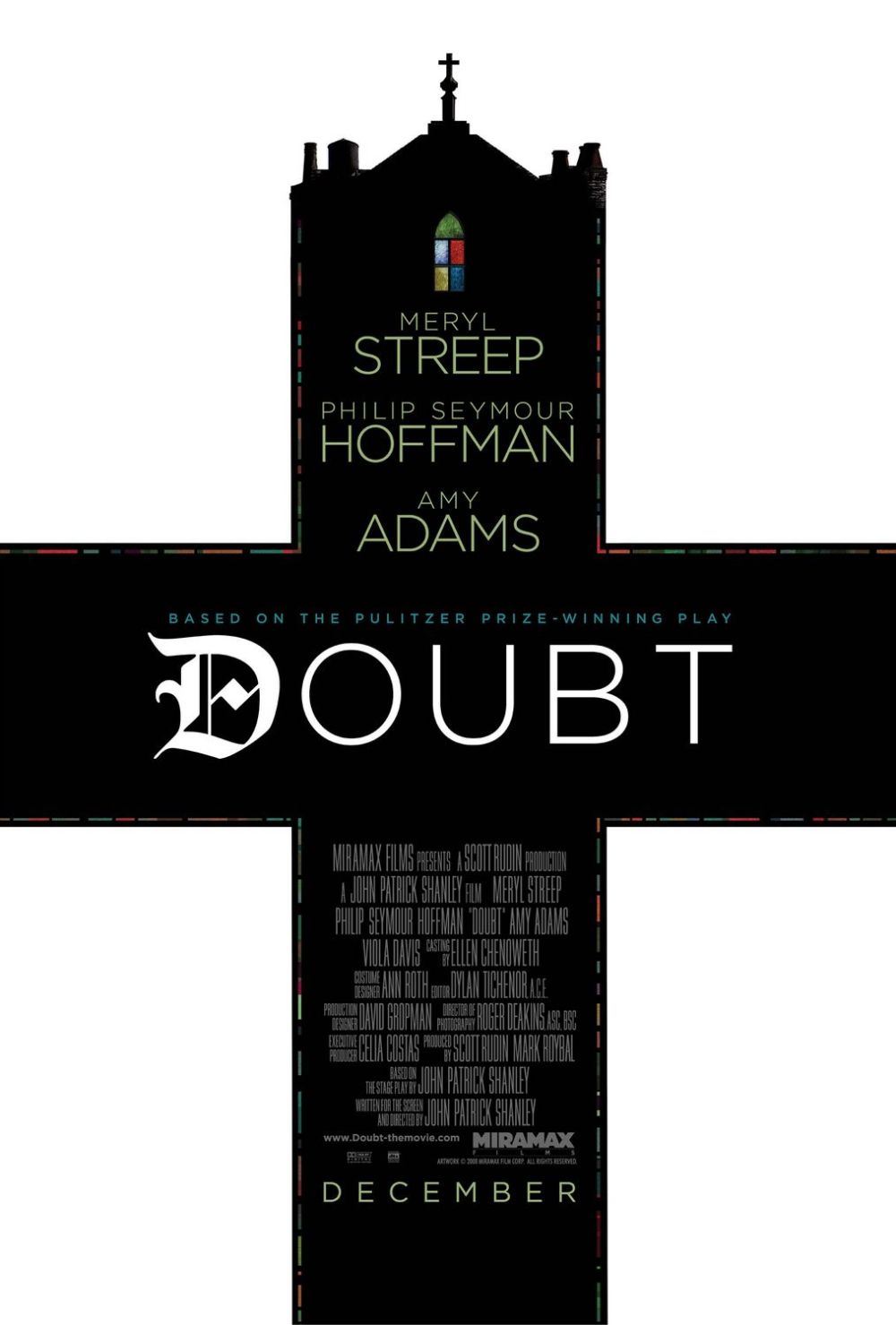
Looking back, I wondered if I was actually reviewing the play more than I was John Patrick Shanley’s movie of his Pulitzer Prize winning work. But the fact is Shanley brilliantly captures the mood and feel of the time this movie takes place in, and it contains one great performance after another. Meryl Streep personifies the teacher you hated so much in elementary school, Philip Seymour Hoffman perfectly captures the friendly priest we want to trust but are not sure we can, and Amy Adams illustrates the anxiety and confusion of the one person caught in the middle of everything. Don’t forget Viola Davis who, in less than 20 minutes, gives a galvanizing performance as a woman more worried about what her husband will do to their child more than the possibility of her child being molested by a priest who has been so kind to him. Long after its Broadway debut, “Doubt” still proves to be one of the most thought provoking plays ever, and it lost none of its power in its adaptation to the silver screen.
This is the best Woody Allen movie I have seen in a LONG time. Woody’s meditation on the ways of love could have gone over subjects he has long since pondered over to an exhausting extent, but this is not the case here. “Vicky Cristina Barcelona” is a lovely and wonderfully character driven piece filled with many great performances, the best being Penelope Cruz’s as Javier Bardem’s ex-wife. Cruz is a firecracker every time she appears on screen, and she gives one of the most unpredictable performances I have seen in a while. Just when I was ready to write Allen off completely, he comes back to surprise me with something funny, lovely and deeply moving.
One day, I will be as sexy as Javier Bardem. Just you wait!
Danny Boyle, one of the most versatile film directors working today, gave us a most exhilarating movie which dealt with lives rooted in crime, poverty and desperation, and yet he made it all so uplifting. It is a love story like many we have seen before, but this one is done with such freshness and vitality to where I felt like I was seeing something new and utterly original. Boyle also reminds us of how “Who Wants to Be A Millionaire” was so exciting before ABC pimped it out excessively on their prime-time schedule. “Slumdog Millionaire” was pure excitement from beginning to end, and it was a movie with a lot of heart.
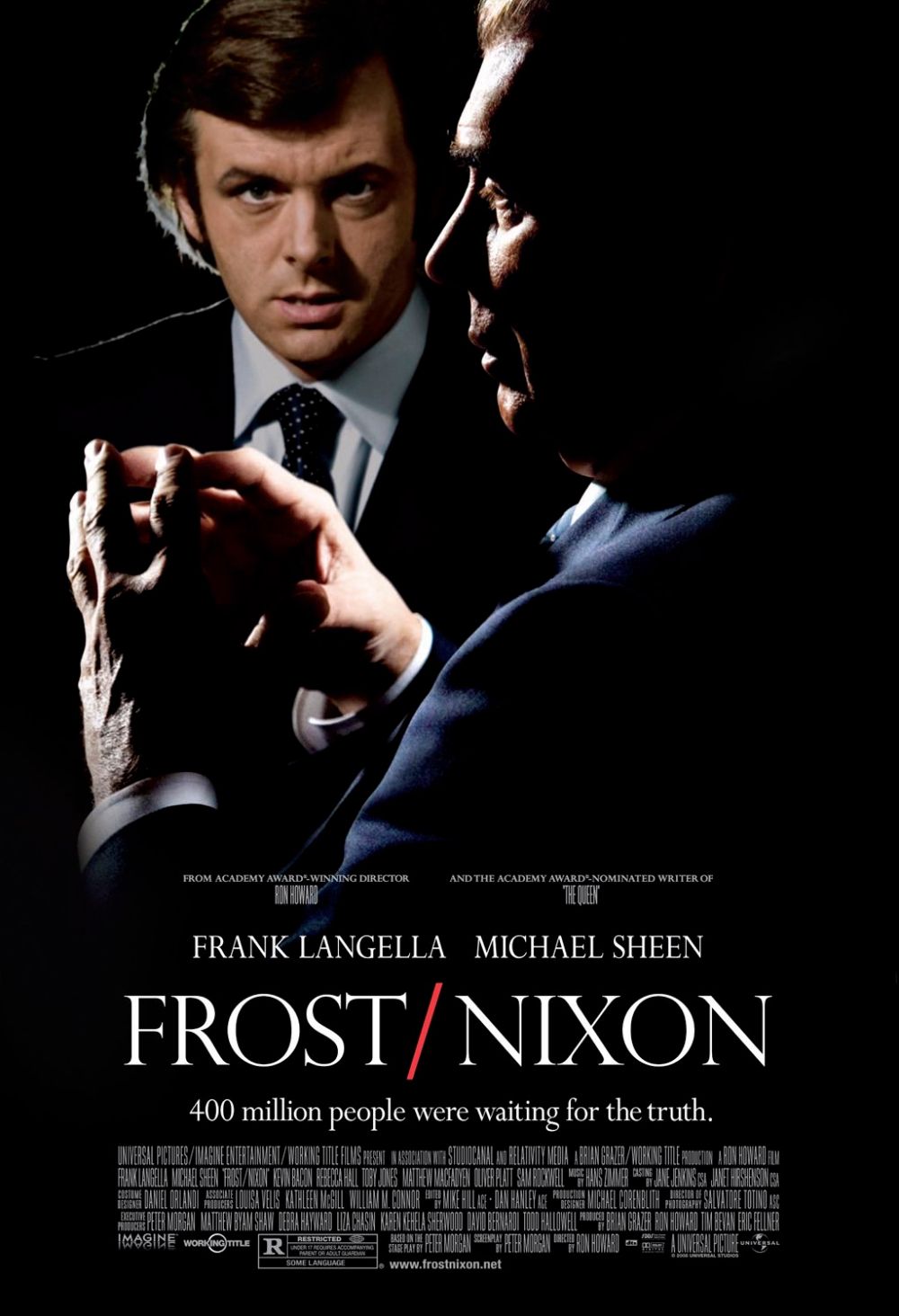
Ron Howard turns in one of the best directorial efforts of his career with this adaptation of Peter Morgan’s acclaimed stage play, “Frost/Nixon,” which dealt with the infamous interview between former President Richard Nixon and TV personality David Frost. Despite us all knowing the outcome of this interview, Howard still sustains a genuine tension between these two personalities, one being larger than life. Howard also has the fortune of working with the same two actors from the original stage production, Frank Langella and Michael Sheen. Langella’s performance is utterly riveting in how he gets to the heart of Nixon without descending into some form of mimicry or impersonation. You may think a movie dealing with two people having an interview would be anything but exciting, but when Langella and Sheen are staring each other down, they both give us one of the most exciting moments to be found in any film in 2008. Just as he did with “Apollo 13,” Howard amazes you in how he can make something so familiar seem so incredibly exciting and intense.
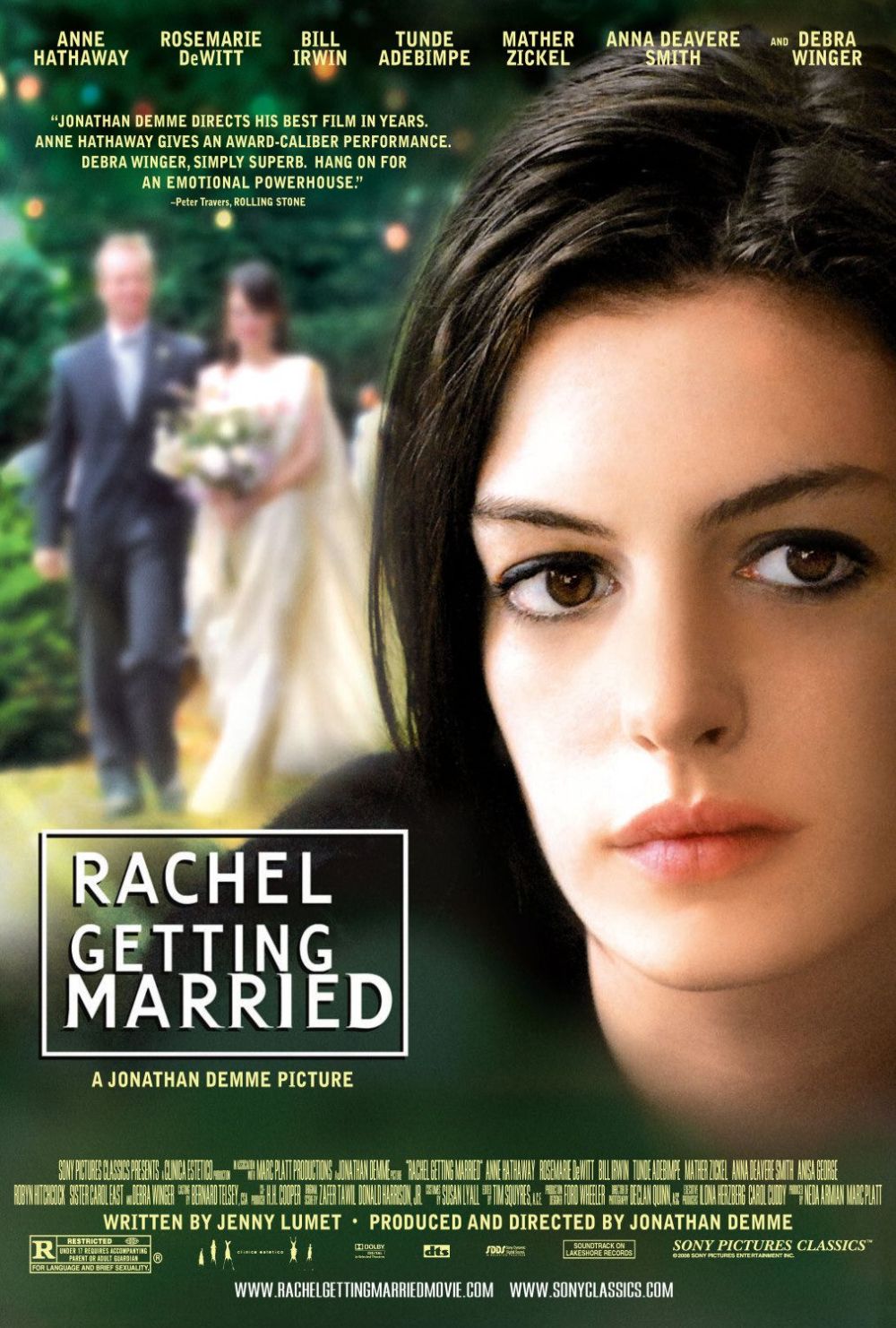
Jonathan Demme’s “Rachel Getting Married” had a huge effect on me with its raw emotion, and I loved how he made us feel like we were in the same room with all these characters. When the movie ended, it felt like we had shared some time with great friends, and Demme, from a screenplay written by Jenny Lumet, gives us a wealth of characters who are anything but typical clichés. Anne Hathaway is a revelation here as Kym, the problem child of the family who is taking a break from rehab to attend her sister’s wedding. Kym is not the easiest person to like or trust, but Hathaway makes us completely empathize with her as she tries to move on from a tragic past which has long since defined her in the eyes of everyone. Great performances also come from Bill Irwin who is so wonderful as Kym’s father, Rosemarie DeWitt, and the seldom seen Debra Winger who shares a very intense scene with Hathaway towards the movie’s end. I really liked this one a lot, and it almost moved me to tears.
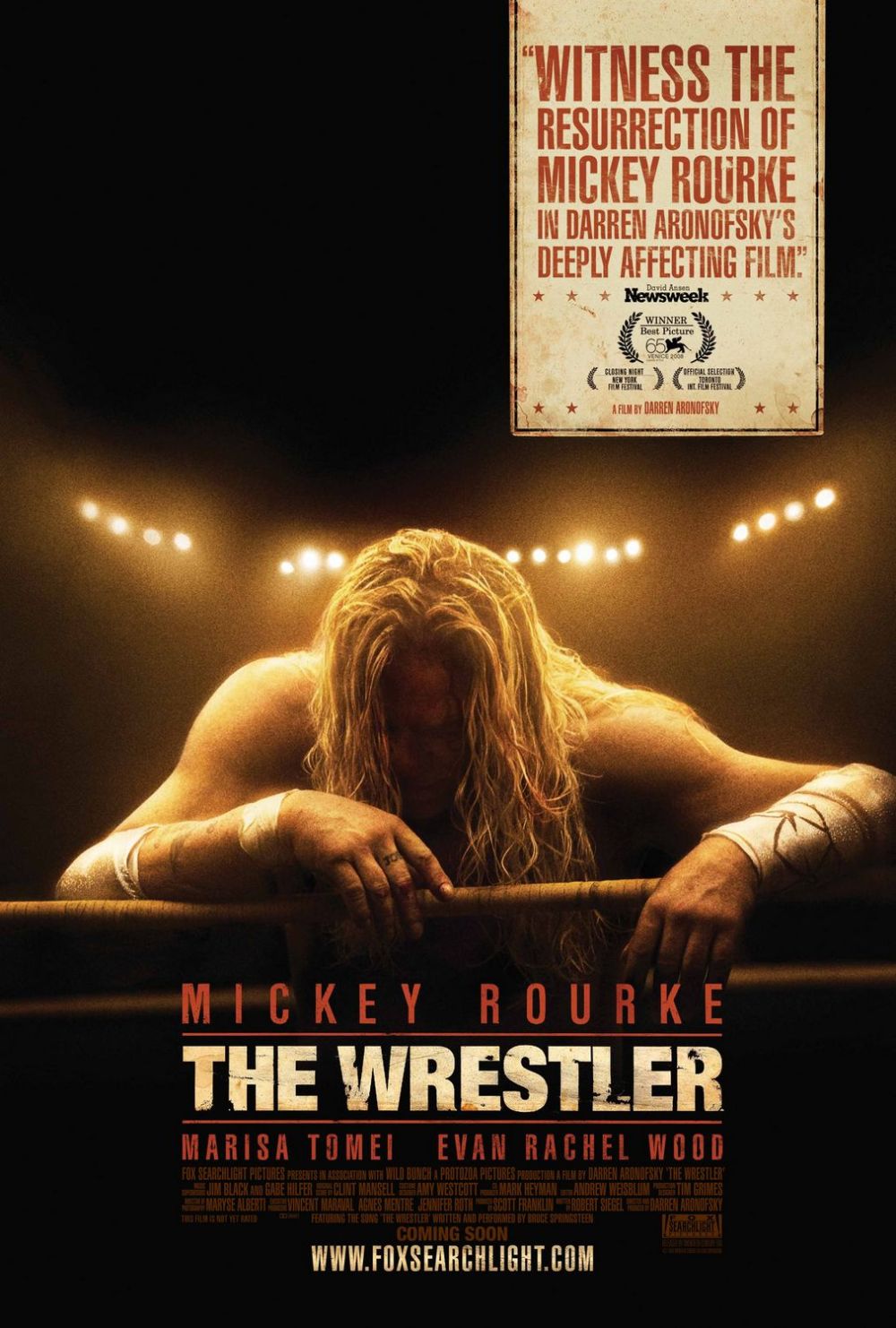
Darren Aronofsky’s “The Wrestler” has grown on me so much since I saw it. While it may be best known as the movie in which Mickey Rourke gave one hell of a comeback performance, this movie works brilliantly on so many levels. To limit its success to just Rourke’s performance would not be fair to what Aronofsky has accomplished as he surrounds all the characters in the bleakness of the urban environment they are stuck in, and he makes you feel their endless struggles to keep a roof over their heads and food on the table. “The Wrestler” succeeds because Aronofsky’s vision in making it was so precise and focused, and he never sugarcoats the realities of its desperate characters. Rourke more than deserved the Oscar for Best Actor, which in the end went to Sean Penn for “Milk.” Furthermore, the movie has great performances from Marisa Tomei and Evan Rachel Wood as those closest to Rourke’s character, and who look past his faded fame to see the wounded man underneath. The more I look at “The Wrestler,” the more amazed and thrilled I am by it.
Tomas Alfredson’s film of a friendship between a lonely boy and a vampire was so absorbing on an atmospheric level, and it surprised me to no end. What looks like an average horror movie turns out to actually be a sweet love story with a good deal of blood in it. Widely described as the “anti-Twilight,” “Let the Right One In” gives a strong sense of freshness to the vampire genre which back in the early 2000’s was overflowing with too many movies. The performances given by Kåre Hedebrant as Oskar and Lina Leandersson as Eli are pitch perfect, and despite the circumstances surrounding their improbable relationship, I found myself not wanting to see them separated from one another.
Pixar does it once again and makes another cinematic masterpiece which puts so many other movies to shame. With “Wall-E,” director Andrew Stanton took some big risks by leaving a good portion of the movie free of dialogue, and this allowed us to take in the amazing visuals of planet Earth which has long since become completely inhospitable. Plus, it is also one of the best romantic movies to come out of Hollywood in ages. The relationship between Wall-E and his iPod-like crush Eve is so much fun to watch, and the two of them coming together gives the movie a strong sense of feeling which really draws us into the story. The fact these two are machines quickly becomes irrelevant, especially when you compare them to the humans they meet in a spaceship who have long since become imprisoned by their laziness and gluttony.
I gave the DVD of this movie to my mom as a Christmas present, and she said you could do an entire thesis on it. Nothing could be truer as it is such a brilliant achievement which dazzles us not just on a visual level, but also with its story which is the basis from which all Pixar movies originate. “Wall-E” is the kind of movie I want to see more often, a film which appeals equally to kids and adults as this is not always what Hollywood is quick to put out.
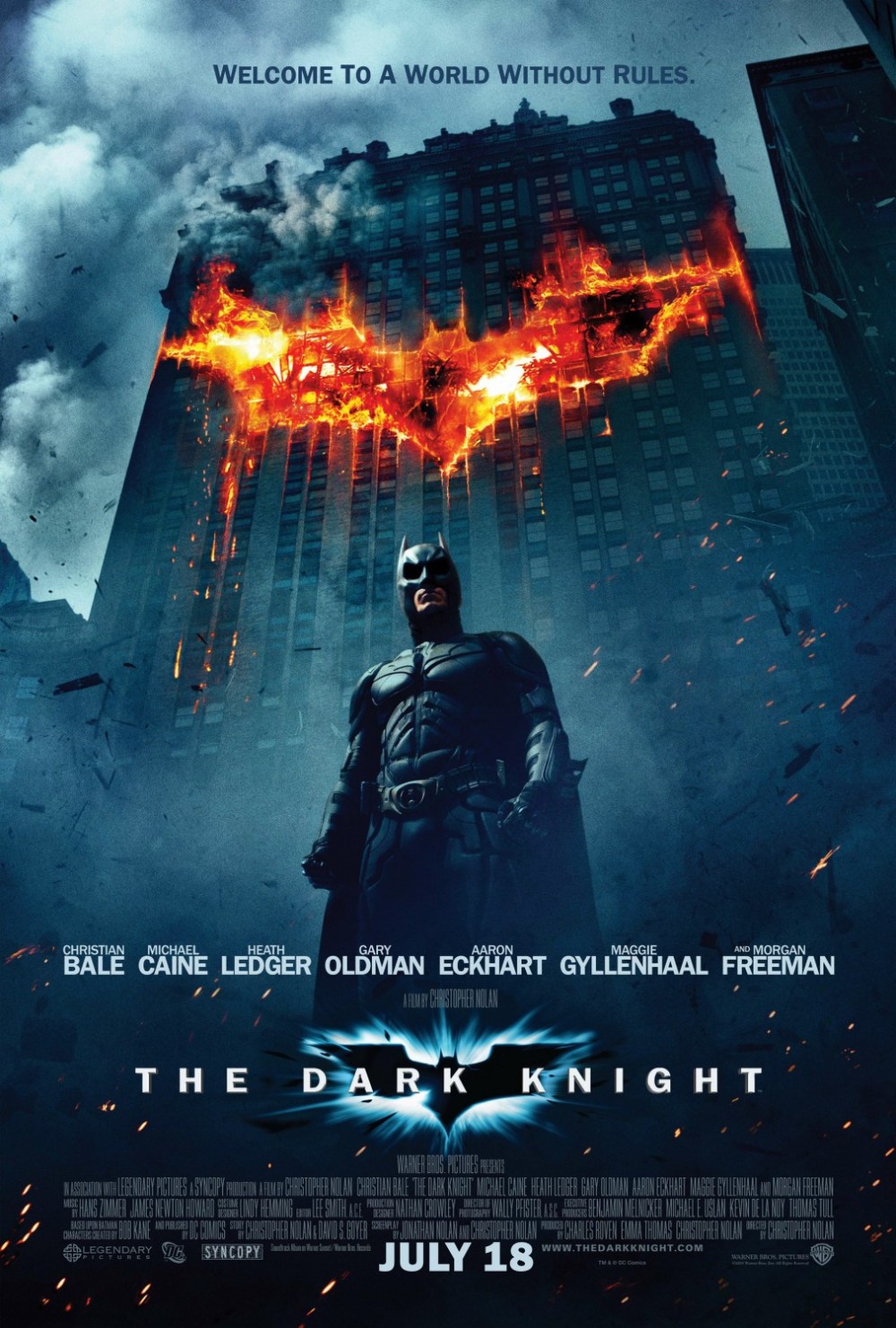
The biggest movie of 2008 was also its best. I was blown away with not just what Christopher Nolan accomplished, but of what he got away with in a big budget Hollywood blockbuster. “The Dark Knight” is not just an action movie, but a tragedy on such an epic scale. Many call it the “Empire Strikes Back” of the Batman series, and this is a very apt description. Many will point to this movie’s amazing success as the result of the untimely death of Heath Ledger whose performance as the Joker all but blows away what Jack Nicholson accomplished in Tim Burton’s “Batman,” but the sheer brilliance of the movie is not limited to the late actor’s insanely brilliant work. Each performance in the movie is excellent, and Christian Bale now effectively owns the role of the Caped Crusader in a way no one has before.
Aaron Eckhart also gives a great performance as Harvey “Two-Face” Dent, one which threatened to be the most underrated of 2008. The “white knight” becomes such a tragic figure of revenge, and we come to pity him more than we despise him. The movie is also aided greatly by the always reliable Michael Caine and Morgan Freeman. Everyone does excellent work here, and there is not a single weak performance to be found.
Whereas the other “Batman” movies, the Joel Schumacher ones in particular, were stories about the good guys against the bad guys, “The Dark Knight” is a fascinating look at how the line between right and wrong can be easily blurred. Harvey’s line of how you either die a hero or you live long enough to see yourself become the villain perfectly personifies the dilemmas for every character here. To capture the Joker, Bruce Wayne may end up becoming the very thing he is fighting against. I can’t think of many other summer blockbusters which would ask such questions or be as dark. “The Dark Knight” took a lot of risks, and it more than deserved its huge success. It set the bar very high for future comic book movies, and they will need all the luck they can get to top this one.
The original “Super Fly” directed by Gordon Parks Jr. was a notable blaxploitation classic as it provided many advancements for African-Americans in show business. Many accused it of glamourizing the drug business and of drug dealing in general, but others saw its glorification of drug dealers as a critique of the civil rights movement’s failure to provide better opportunities for black America. Either way, it gave a lot for audiences to talk about, and it provided us with one of the greatest soundtracks of all time courtesy of Curtis Mayfield.
Now it is 2018, and we have the remake of the 1972 movie which the filmmakers have entitled “Superfly” because, you know, why separate the two words? While it made more sense to separate the words “super” and “fly” decades ago, the rules of grammar continue to change for no special reason. But while the original movie still resonates with audiences more than 45 years after its release, I walked out of this remake constantly saying to myself, what was the point? Updating a classic of any kind is one thing, but this “Superfly” has little reason to exist as it offers us the same old tale of a gangster who is looking to go straight after spending too much time in a life of crime, and it offers nothing new or fresh to this story. While it is never boring, this movie will not have the same staying power of its predecessor.
The story remains the same, but this time the action has been moved from New York to Atlanta, Georgia (or ATL as the locals like to call it). Playing Youngblood Priest is Trevor Jackson, a 21-year-old actor, singer and dancer whose taste in clothes and cars is almost upstaged by his silky head of hair. Priest has it all, and this includes a luxurious house which has a beautiful view of downtown Atlanta, a pair of loving and tough-minded girlfriends in Georgia (Lex Scott Davis) and Cynthia (Andrea Londo), and he drives around town in a super-expensive Lexus car which, unlike Ron O’Neal’s 1971 Cadillac Eldorado, needs no customization. One look at it is enough to give you an idea of how well-off Priest is to where putting a spoiler on his Lexus would just look stupid.
Yes, Priest is a career criminal who is now more serious than ever about leaving the Atlanta drug scene, but no one is about to make things easy for his departure, and this is especially the case when one particular drug deal goes horribly awry. From there, those who have seen the original “Super Fly” will not be surprised at the turns the story takes, and those who have not watched it will marvel at how convoluted things become as the remake heads to its largely unsurprising climax.
The first thing I got to say about “Superfly” is when it comes to Jackson, I cannot help but feel he is too young to play Priest. Jackson is not bad as he exhibits a natural charisma and does have the necessary aura of coolness Priest requires, but he never struck me as a gangster who has led a rough and tumble life. Instead, he looks more like someone who just entered the life to where he has yet to show off any of the scars which come with it. Alex Tse’s screenplay does make mention of how Priest started out hustling at the tender age of 11, but even with this realization, Jackson still looks like an intern who just entered this life.
The other big problem is Jackson is constantly upstaged by his fellow actors, several of whomwould have been more believable as Priest. Chief among them is Michael K. Williams, best known for playing Omar on “The Wire,” who plays Scatter, Priest’s chief drug supplier and martial arts teacher. The scene in which they spar with one another is one of “Superfly’s” best moments as their physical moves match up with their mental ones to where you can see them working out scenarios in their heads about surviving into the future. Williams has the look of someone who has worked in the Atlanta drug trade for many years, and he makes Scatter look like someone with more of a reason to retire from this life than Priest does. I think Williams would have been a better fit for the role of Priest, but I guess considerations in regards to demographics were taken into consideration here above all else.
Jason Mitchell, who was fantastic as Easy-E in “Straight Outta Compton,” steals one scene after another as Priest’s right-hand man, Eddie. He keeps you guessing as to what Eddie’s next move will be to where you constantly wonder where his loyalties lie. While Eddie seems eternally dedicated to Priest, Mitchell constantly gives you the sense he may bolt to the other side as being a supporting player in this trade can be infinitely frustrating at times, and his high energy performance is one of “Superfly’s” great delights.
Lex Scott Davis makes Georgia into a formidable girlfriend for Priest to where he needs her more than she needs him. Andrea Londo provides “Superfly” with its most alluring presence as Cynthia, Priest’s other girlfriend. From start to finish, Londo inhabits Cynthia to where she cannot be mistaken for anything other than a fierce self-provider who is more than prepared to fight to the death for her loved ones. Outkast’s Big Boi shows up as Mayor Atkins, a man whose political influence knows no bounds until Priest puts some directly in his path. And I have to single out Jennifer Morrison for her wonderfully wicked performance as the infinitely corrupt Detective Mason. She doesn’t hesitate to show far off to the dark side Mason is as she makes clear how quick she is to bend the rule of the law to her hardened heart’s content, and I could never take my eyes off her whenever she appeared onscreen.
Directing “Superfly” is Julien Christian Lutz, better known by the name of Director X. Whether or not this name is meant to define some sort of political belief I will leave for him to explain. X is best known for making music videos with Drake, Kendrick Lamar and Rhianna among others, and his trademark involves tweaking the letterbox format to where he plays with our expectations with glee. He crafts a strong opening sequence in which we follow Priest into a nightclub whose membership is clearly restricted to a select few, and it reminded me of the scene in Martin Scorsese’s “Goodfellas” when Henry Hill and Karen entered the Copacabana nightclub through the back way. As we follow Priest into this particular nightclub, X makes it feel like an invitation into a side of life many of us never get to experience. After this sequence, everything ends up feeling inescapably routine.
There have been many gangster movies like “Scarface,” “Carlito’s Way,” “Sugar Hill” and “Light Sleeper” which depict their lives in a way which is endlessly fascinating even as the characters are looking to escape the life they were not necessarily aiming to enter. “Superfly,” however, feels stale in comparison as it offers nothing new or unique to the genre. As the movie went on, I kept wondering what the point was of remaking this blaxploitation classic. Many have said how the original glamourized crime and drug dealing, but this remake seems to do this to a shameless extent as the characters sport not only designer clothes, but designer guns which more lethal than the kind we usually see in movies. Whereas O’Neal’s Priest was moving through life the only way he knew how, Jackson’s Priest looks to live the life of the richest 1% in America as drug dealing provides what seems like an unrealistic route to it.
I cannot say I didn’t enjoy parts of “Superfly” as it is never the least bit boring, but this kind of movie has been played out too many times to where this remake serves no real purpose. After all these years, the most memorable thing to come out of the 1972 blaxploitation classic will be Curtis Mayfield’s soundtrack, and even the filmmakers behind the remake could not escape this fact as one of his songs is featured here. If there was a reason to update this story for the year 2018, this is never made apparent here. Besides, there is bigger gangster for Priest to deal with in this day and age, and his name is Donald Trump.
With the remake about to be released, it was time to check out “Super Fly,” the 1972 blaxploitation crime drama which is considered one of the biggest classics of the genre. I have been aware of this film’s existence for years, and the photo on its VHS cover of Ron O’Neal holding a gun and looking ever so cool in his white suit and pants has been burned into my memory for decades. But like many movies I perused at local video stores, all of which have since vanished, I never got around to watching it until now.
While I certainly understand why “Super Fly” is long considered a classic blaxploitation film, it is not necessarily a great movie. On one hand the signs of its low budget are very much on display throughout to where I was reminded of what John Carpenter once said about the rule of making independent movies: “Shoot as little film as possible and make it as long as you can.” But on the other, it presents us with a New York time which no longer exists in modern day America, and the gritty realism of the city streets is on display throughout to where the movie’s existence is especially important as you can only fake this kind of realism in today’s cinematic world.
Ron O’Neal plays Youngblood Priest, an African-American drug dealer who enjoys a luxurious lifestyle in Harlem, New York. He got the name Priest because of the cross he wears around his neck. While this cross may or may not reflect his belief in God or any religious deity, a closer inspection reveals that the tip of the cross is fashioned in the shape of a spoon, and this allows him to do lines of cocaine whenever he needs a hit. In addition to his high-class apartment, the kind which would fetch at least a million in today’s New York real estate market, he also has a dedicated girlfriend in Georgia (Sheila Frazier), a white girl mistress named Cynthia (Polly Niles), the best set of clothes any man would be lucky to own and wear at the time, and he drives around town in a 1971 customized Cadillac Eldorado. Looking at Priest is to be convinced this is a man who has a lot of power and confidence you would be foolish to question, and this is something he does not have to spell out to anyone in words.
But as successful as Priest is, he yearns for a life outside of the underground drug business. This, of course, leads to him to plan one last “big score” which he believes will allow him to retire and go straight, but those of us who have watched countless gangster movies know this last big score will be the one fraught with the most danger. It gets to where there I expected the one scene where Priest just shakes his head as if to say to himself, “I should have gotten out of the life sooner, and now it’s too late.” Still, Priest is much smarter than his friends and foes realize, and we watch as he plots his way to his biggest drug deal ever, and then attempt to stay one step of everyone else who wants to do him in.
It has been said that the screenplay for “Super Fly” was only 45 pages long, and this is why we get exposed to so many shots of people walking, driving and talking in restaurants. This is the kind of film editing you would never see today as everything needs to move at a fast pace. This ends up dragging the movie down a bit as certain moments play themselves out for much longer than is necessary. Still, it allows us to take a look back at the New York that was before it, for better or worse, was cleaned up to where much of the state if unaffordable to live in. This helps to make up for other scenes which are staged rather pathetically, especially one in which a character gets hit by a car.
O’Neal immediately comes across as the personification of cool from the first moment he appears onscreen. He was in his 30’s when starred in “Super Fly,” but his face has the look of a man who has seen a lot in life up to that point, and this makes his performance as Priest feel all the more powerful and authentic. I never got the feeling he was trying to glamourize Priest’s lifestyle, and he was not afraid to make this character a rough and unlikable dude at times. He simply portrays Priest as a man who makes his way through life the only way he knows how, and his methods as you can imagine are not always morally sound.
As for the rest of the cast, their performances range from okay to pretty good. Charles McGregor, who was released from prison before “Super Fly” began filming, has some good moments as Fat Freddie, and Carl Lee, who plays Eddie, has a strong scene in which he tells Priest if it wasn’t for him, he would have overdosed. This line of dialogue would later prove to be tragically ironic as Lee became a heroin addict, and he died of a drug overdose back in 1986.
When “Super Fly” was released, many African-Americans were said to have been displeased with the way the movie glamourized people like themselves as drug dealers and pimps, but it resonated deeply with others who saw the movie as an example of how to rise up in the American class system. Does this movie glamourize the lifestyles of drug dealers? Well, perhaps it does, but the scary truth is there is always an allure to a life like this as it affords us a wealth which constantly seems out of our reach. Still, it should be noted how we never really see Priest enjoying himself much in the movie. While he has many things a person would want in life, we see right from the start how he has long since tired of his role in society to where it is believable and understandable why he yearns to do something legitimate for a change.
For those who think “Super Fly” provides audiences with a rather ambiguous look at the world of drugs and drug dealing back in the 1970’s, you need to take the time to listen Curtis Mayfield’s soundtrack to it which, by the way, is one of the best of its kind ever. An exhilarating fusion of soul and funk music, Mayfield also provided lyrics which were very socially aware and took an even closer look at drugs and poverty in society. When you read the lyrics of the song “Freddie’s Dead,” you can see the evidence of this very clearly:
“Everybody’s misused him
Ripped him up and abused him
Another junkie plan
Pushing dope for the man
A terrible blow
But that’s how it goes
A Freddie’s on the corner now
If you want to be a junkie, wow
Remember Freddie’s dead
We’re all built up with progress
But sometimes I must confess
We can deal with rockets and dreams
But reality, what does it mean
Ain’t nothing said
‘Cause Freddie’s dead.”
Looking at this, it is no wonder the soundtrack ended up making more money than the movie itself, and the movie did make a huge profit.
So “Super Fly” may not be an example of great filmmaking, but it should be noted how its production succeeded in offering advances for African-Americans. The city of Harlem went out of its way to back the movie financially, and many black businesses helped with production costs. Furthermore, the majority of the crew were in fact African-American, something which was very rare at this time in cinema. Taking all this into account makes “Super Fly” all the more enjoyable as it was a movie made with passion and respect as the filmmakers sought to tell it like it is. Despite its glaring flaws, it is a very cool movie to experience, and I am glad I finally got the chance to check it out, especially before I went out to see the remake.
After getting all musical with “Whiplash” and “La La Land,” Oscar winning director Damien Chazelle now travels into outer space with “First Man.” Based on the book of the same name by James R. Hansen, it stars Ryan Gosling as Neil Armstrong, the first man ever to set foot on the moon, and it depicts the years leading up to his mission aboard Apollo 11. With this movie, Chazelle appears to be stepping outside his comfort zone as “First Man” does not look at all like a musical, and it represents his first directorial effort where he is working from a screenplay he did not write.
From the outset, this trailer looks amazing as the visuals it shows us are stunning, and this makes me believe the filmmakers really did their research here as this is not a story you can portray without any realism. Seeing Armstrong travel into the atmosphere and beyond is exhilarating, and the moment where the hatch is closed on the Apollo 11 capsule as the crew are left alone in darkness with only their thoughts and the sound of their own breathing is enough to illustrate their isolation. While those who watched breathlessly on July 20, 1969 when Armstrong made that “one small step for man” and felt very much a part of this amazing mission, I imagine he felt like one of the loneliest people in the universe even with the eyes of the world on him.
At the same time, I wonder how “First Man” will compare to other films which have captured an astronaut’s journey into outer space in unforgettable ways. The first film which comes to my mind is Ron Howard’s “Apollo 13,” still his best work to date. Howard took the events of this particular space mission which we all knew the outcome of, and he turned it into a most riveting cinematic experience that had me on the edge of my seat throughout. Furthermore, Howard filmed his actors working in a reduced gravity aircraft to realistically depict the weightlessness astronauts experience in outer space. Did Chazelle do the same? Well, we will eventually find out.
Then there is “The Right Stuff,” Philip Kaufman’s cinematic adaptation of the late Tom Wolfe’s non-fiction novel about the test pilots chosen to be part of Project Mercury, the first manned spaceflight in America. I still have vivid memories of seeing this movie as a kid when it came out back in 1983, and the scene where the capsule containing John Glenn (played by Ed Harris) descended into the atmosphere like a meteor remains forever burned into my consciousness. Can Chazelle match the attention Kaufman paid to even smallest historical details?
And let us never forget Alfonso Cuarón’s “Gravity” in which he made us see the real perils of being in outer space to where James Cameron had to admit someone made a truly realistic film on this subject before he did. For those who watched this Oscar-winning film and remembered its opening titles which exposed us to certain facts about outer space, we could not walk out of the theater and say we did not know what it is like to be up there.
So, while this trailer shows us how “First Man” looks to be very promising, I wonder if can stand up to those three movies as each set the bar high for filmmakers in capturing the reality of outer space and space travel. Well, we will all find out if it does when it is released on October 12, 2018.