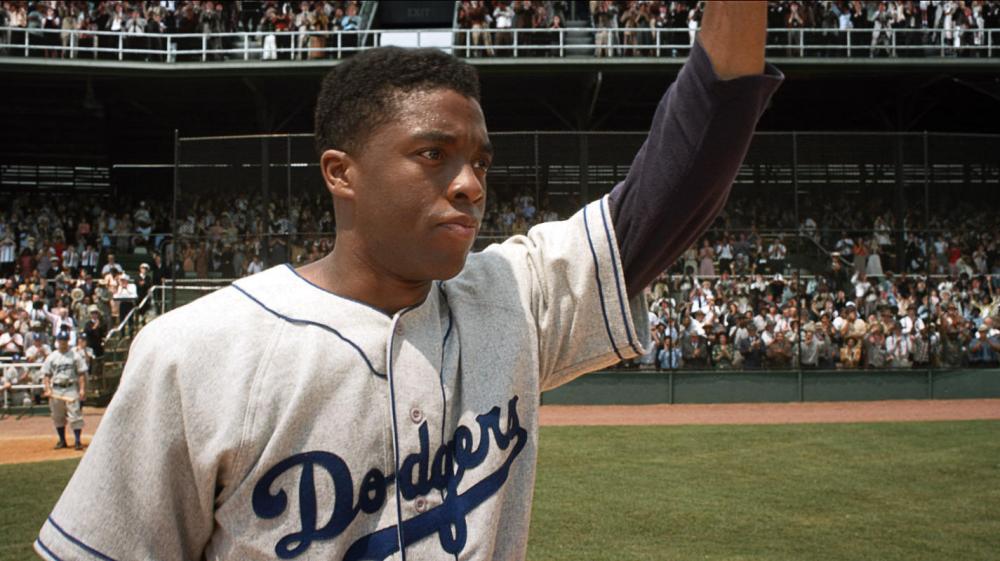
Chadwick Boseman on Playing Baseball Great Jackie Robinson in ’42’

42-fp-0292

Before he took on the title role in “Black Panther,” Chadwick Boseman had the honor of portraying baseball great Jackie Robinson in “42.” With Hollywood being the way it is, you would expect to see studio executives insisting on a getting a big time movie star to portray the famous baseball legend, but writer/director Brian Helgeland got away with casting Boseman back when he was relatively unknown to audiences at large. An actor and playwright by training, Boseman started to burn into our collective consciousness with this performance.

Filmmakers and actors over the years like Spike Lee and Denzel Washington have tried and tried to bring the story of Robinson to the big screen but with no success. It took Helgeland, who won an Oscar for co-writing the screenplay to “L.A. Confidential,” to finally succeed in making such a film a reality. The burning question is how did Boseman get the role of Robinson over so many others? There must have been thousands upon thousands of actors desperate to play the legendary ballplayer, and there is something very inspiring about a lesser known actor beating out a bunch of big-name stars for this opportunity. Boseman, during an interview with Julie Miller of Vanity Fair, explained how he got cast.

“I had left L.A. for a few months, and I was directing a play Off Broadway in the East Village,” Boseman told Miller. “I came back to Los Angeles for a visit and was supposed to go back to New York on a Friday, and my agent said, ‘No, they want to see you for 42. For the Jackie Robinson film.’ I met with 42 director Brian Helgeland, and I knew that I would love to work with him. He’s an Oscar winner and a great writer but also, the way that he works, you know sometimes that you can vibe with a person and that you will work well together.”

“The additional meeting was great. A lot of it was just talking about the role and project and why he wanted to do it,” Boseman continued. “I left thinking that it was a great audition but didn’t necessarily know if I would get it. The next week, they called me back in again, and I could tell that he was trying to show me to somebody else. They were taping it and saying stuff like ‘What else might they want to see?’ I realized at that point that I was Brian’s choice, so I was just trying to prove it.”

Before “42” came along, Boseman had been working a lot in television and appeared on shows like “ER,” “Law & Order” and “CSI: NY.” Eventually, he started starring in movies such as “The Express” among others. Surprisingly though, Boseman did not originally set out to be an actor. A graduate of Howard University and the British American Dramatic Academy at Oxford, he saw his career heading in a different direction.

“When I started in theater and film, I thought I would be a director,” Boseman said. “The only reason that I started acting was because I felt like I needed to understand what the actors were doing and their process so that I could better guide them. During the course of that, I caught the acting bug. But once I finished my acting training, I still was thinking I would be a writer/director. I don’t really think I focused on acting until I came to L.A. in 2008. That’s when it got serious for me.”

As a kid, Boseman played Little League baseball for a time, but he was more serious about playing basketball after a while. When it comes to sports movies, most directors prefer actors to have some sort of experience in baseball or whatever sport their film is about. It looks like Boseman had just about enough experience to show he could play Robinson, but he still had to go through a lot of baseball training in order to prepare for the role before the cameras started rolling. He related his training regimen to Eric Alt of Athlon Sports as well as the challenges he faced during pre-production.

“All the coaches I worked with concentrated on the way he did things,” Boseman told Alt. “They studied his swing, and I studied his swing on my own. We would tape batting practice and they would film me base running, and then every two or three weeks they would take his footage and split-screen it with mine and give it to me and let me compare. We did that for almost five months.”

“The fielding was much more difficult than the batting,” Boseman continued. “I’m a natural athlete, so I have the hand-eye coordination to hit the ball. But the fielding? The footwork? Understanding where to throw the ball from, depending on where you receive it? I just wish there was more of it in the movie because I worked so hard on it! (laughs) When I saw the movie I was like, ‘Man, that’s all? That’s it?'”

The cast and crew of “42” also had a great asset in having the participation of Jackie’s widow, Rachel Robinson. It turns out Rachel was very much involved in looking over different drafts of the screenplay, and it gave the film a genuine legitimacy it might otherwise not have had. Boseman told Miller he began his preparation for the role by talking to Rachel.

“When you’re trying to tackle a hurricane, or something larger than life, I knew that the first thing I had to do was talk to her,” Boseman said. “She gave me some books. She sat me down on the couch and told me about their relationship and the rules that they set for themselves to get through the experience. That was a great start, because you are meeting someone who is still connected to him and you get a sense of him when you meet her. You see what kind of a man could actually stand by her. Who is this guy that she would fall for?”

“In some sense, you got the sense of the edges of him, like the two of them were a puzzle. She is one piece and his piece is not here, but I can feel the edges from her,” Boseman continued. “She started the journey, definitely. She showed up on set. And she challenged me by asking me why I should play him. That’s a good place to start because you have to start with yourself.”

While Chadwick Boseman must have felt a great deal of pressure in bringing the legendary Jackie Robinson to life in “42,” he did deliver a terrific performance which had audiences applauding loudly when the credits come up. Acting may not have been Boseman’s first choice as a profession, but it is certainly working out for him in a great way.

SOURCES:

Julie Miller, “42 Star Chadwick Boseman on Playing Jackie Robinson, Copying His Baseball Moves, and Being Stood Up by the President,” Vanity Fair, April 12, 2013.

Eric Alt, “A Chat with Chadwick Boseman, Star of Jackie Robinson Biopic ’42,’” Athlon Sports, April 19, 2013.

One From Noah Baumbach: ‘Margot at the Wedding’

Margot at the Wedding poster

Noah Baumbach must have had one messed up childhood. His 2005 film “The Squid and the Whale” which chronicled a divorce filled with animosity and the of effect it ended up having on the kids. In 2007 he gave us “Margot at the Wedding,” which focuses on two sisters who do their best not to explode at one another. This is sibling rivalry at its most vicious and with sly attacks throughout until the inevitable showdown where the wounds and scars reveal themselves in all of their hurt and anger. Once in a while, you will get a movie which shows the loving power of a family and how they all come together as one. This is not that movie.

Nicole Kidman stars as Margot, who is heading into the country to attend her sister’s wedding. With her on this trip is her teenage son Claude (Zane Pais) who she dotes on with increased restlessness. 2007 was a tough year for Kidman as the films she starred in, be it “The Invasion” or “The Golden Compass,” were not at as successful as they were expected to be. She was at one point the most underrated actress in movies with unsung performances in movies like “To Die For” which she was unfairly robbed of an Oscar nomination for. Following her Oscar win for her role in “The Hours,” she looked to be stumbling in movies underserving of her talent. Her performance as Margot, however, reminds you of just how brilliant and fearless an actress she can when given the right role.

Margot is a bitch with a capital B, and she is one of the most unsympathetic and spiteful characters you would ever want to see in this or any other motion picture. She is cruel to those who love and hate her, and she even reacts coldly at times to her son by saying something about his appearance which could not be any less true. Kidman tears into the role with gusto, and she never tries to sweeten this character up and make her more likable than she ever could have appeared in the script. She is fearless in her portrayal of Margot, and she even lets us see beneath the character’s cruel mask to reveal the pain her character feels inside. You never completely sympathize with her, but you do come to pity her.

Margot’s sister Pauline is played by Jennifer Jason Leigh, the former Mrs. Noah Baumbach, and it is great to see her here. Her portrayal of Pauline makes the character pitiful in a whole other way. While Margot is cold to those around her, Pauline is much more vulnerable and is skillful in the way she throws her sister’s carefully placed insults right back at her. Pauline seems to be striving for a happiness which is just out of her reach. Leigh works at keeping her cool around Kidman’s character, but you can see through her eyes that the last time these two sisters met, it resulted in a brutal confrontation which kept them apart for years. It takes a great actor to make you see things about their characters without having to tell you what they are.

Pauline is about to get married to an unemployed musician/painter named Malcolm, and he is played by Jack Black. This is Black at his most unglamorous as he portrays Malcolm as a sad sack of a man who never looks all that happy about the fact he is about to get married. His character is utterly depressed and lost about what he wants out of life. There are times where Black falls back into those mannerisms we know him best for, and they do take away from his performance at times. But for the most part, he is really good here as he is cast against type in a more dramatic role.

In many ways, this movie is a prolonged attack leading to an explosion of emotion which we can tell has been repressed for far too long. How long you ask? Years, maybe even decades. You know the first time these two sisters meet each other that there is still bad blood between them which is eventually going to spill over. They say they are no longer mad at each other, but we know this is not true. Tension fills the air as these two test one another’s patience, and they continually betray each other in their own subtle ways.

“Margot At the Wedding” is not quite as effective as “The Squid and The Whale,” and it is easy to judge the two in comparison because they deal with the same thematic elements. They deal with broken families, divorce, parental neglect, underlying feelings of anger and resentment, etc. It has been said the best directors make the same movie over and over again, be it Hitchcock or Spielberg or anyone else. Baumbach’s specialty is in the dysfunctional relationships which he was exposed to when he was young.

Either way, you will most likely come out of this movie thanking god your family relationships are nowhere as bad as they are portrayed in this movie. You think you have it bad? Wait until you watch this.

* * * out of * * * *

If You Like ‘Ford v Ferrari,’ Check Out ‘Senna’

Senna movie poster

To call “Senna” a brilliant documentary is not enough. You will get sucked so deeply into the life of motor-racing champion Ayrton Senna to where you will not ever feel like you are watching his life from a distance. It also shows all sides of this man to where he is shown to be complex and unlike any other race car driver in Formula One. His death during a race in 1994 still saddens many after more than a decade, and after watching “Senna” you will clearly understand why.

Director Asif Kapadia really lucked out as he had access to so much footage from Senna’s life both in and out of cars. We have racing footage of course, but there is also home video footage showing him to be a sublime individual and a genuinely nice guy. Kapadia succeeds in making “Senna” feel like we are spending time with a friend and not just another racing superstar.

Compared to others in racing, Senna comes across as being surprisingly humble and shy. No matter how many championships he won, fame never seemed to go to his head, and this is saying a lot. His personality ends up getting contrasted sharply with his fellow racer Alain Prost, and their intense rivalry becomes a big focus here. Prost comes off at first as being very full of himself, particularly while he is being interviews by a female journalist, and we come to see how his biggest strength is also Senna’s chief weakness: mastering the politics of Formula One. It becomes hard not to be on Senna’s side as their rivalry becomes increasingly bitter. While Senna proves to be ruthless on the race track, he is deeply spiritual and not ignorant of the fact he is as mortal as anyone else.

The racing sequences are exhilarating as we watch Senna do things with a race car no one else could. His brilliance while driving in the rain made him especially unique in Formula One, and it is astonishing to learn he never got hurt while driving in this weather. His donations to improve the conditions in Brazil never feels like a publicity stunt, but instead proof of how fiercely loyal he was to his native country.

But the documentary’s most unnerving sequence occurs a day before Senna’s tragic death when fellow racer Roland Ratzenberger was killed on the exact same track at the 1994 San Marino Grand Prix. Senna becomes deeply upset at what has happened and vows to improve safety on all race courses, something he sadly never got to live to carry out. Watching it feels very eerie as we know the fate which awaits him, and even then, we find ourselves hoping and praying for a different outcome.

What makes “Senna” unlike your average documentary is while most are far removed from their main subject, Kapadia brings you up close and personal. Throughout its running time, Ayrton Senna is alive and not just another dead racer forever relegated to the past. It does not matter in the slightest if you are a fan of car racing or not. “Senna” is as enthralling as the best racing movies ever made as you experience it more than watch it, and it gives us a great respect for this racer even as it leaves us very sad that he left us at such a young age (he was only 34). But seeing him here alive once again gives us a great opportunity to know a man many of us never got the chance to in real life.

So, if you liked “Ford v Ferrari,” be sure to give this one a look. And if you did not like “Ford v Ferrari,” see “Senna” anyway.

* * * * out of * * * *

WRITER’S NOTE: Another great documentary by Asif Kapadia, and it is as great as this one, is “Amy” which serves as a much needed eulogy to the late singer Amy Winehouse.

‘Seven Psychopaths’ Lays Waste To Many Action Movie Cliches

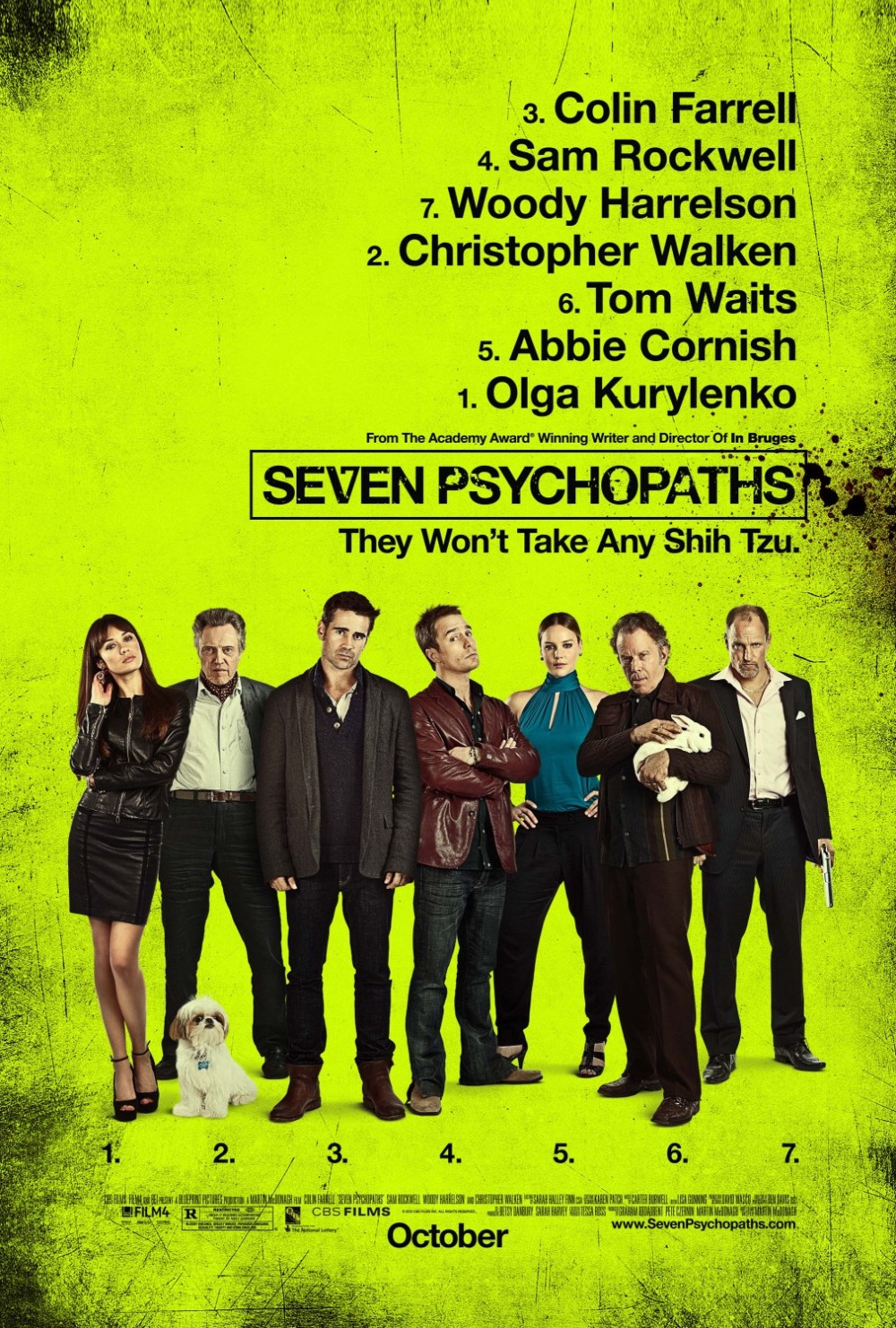
Seven Psychopaths movie poster

Leave it to playwright and filmmaker Martin McDonagh to find ways to skewer those endless clichés we keep seeing in action movies. Seriously, it feels like so many directors outside of Quentin Tarantino have tackled them to where we are completely burned out on films which try to show how clever they are in taking apart clichés which have long since been torn apart time and time again.

McDonagh’s film “Seven Psychopaths” appears to be another one of those satirical and incredibly violent action movies on the surface, but underneath it all is a surprisingly moving story about friendship. Now I can already hear a lot of people telling me how using violence to tell a story like this is utterly hypocritical, but they are clearly not aware of McDonagh’s plays like “The Pillowman,” “The Lieutenant of Inishmore” or “A Behanding in Spokane,” and they clearly have not seen his previous movie, the brilliant “In Bruges.” All those works do have a high level of blood and violence in them, but they are not simply designed to shock people. Instead, McDonagh uses those elements to get at a deeper truth about life and the people closest to us, and this is not always apparent to those who view his work from a distance.

The movie stars Colin Farrell as Marty Faranan, a struggling writer who is eager to finish his screenplay which is also titled “Seven Psychopaths.” The problem is he spends far more time getting drunk on wine and beer than he does in writing anything. So far, the only idea Marty has come up with is a Quaker psychopath who finds an interesting way to follow someone to the afterlife (I won’t dare give it away here). His actor friend Billy Bickle (Sam Rockwell) is eager to help him, but he is caught up in his part time business of dog kidnapping with his partner Hans (Christopher Walken). With this business, they cleverly managed to abduct dogs, and then they return them to their owners for a reward.

One of the dogs Billy kidnaps, however, turns out to be a Shih Tzu named Bonnie which belongs to Charlie Costello (Woody Harrelson), a vicious gangster who has far more love for animals than he does for humanity. This forces Marty, Billy and Hans to go on the run as Charlie and his henchmen will stop at nothing to get little Bonnie back. While making their getaway, they come to look at what has become of their lives and of how they need one another’s friendship to survive in such a competitive world.

Now combining comedy with violence (and we are talking very bloody violence here) is never an easy mix as it often feels uneven in most movies which attempt it. Bobcat Goldthwait tried it earlier this year with “God Bless America” which had its two main characters going on a crime spree in which they killed off various spoiled rotten celebrities with extreme prejudice. While Goldthwait mostly succeeded with that film, he was walking a thin line between success and failure as his subject matter proved to be very controversial.

McDonagh has it a little easier than Goldthwait though as, while the struggles of these Hollywood wannabe characters does feel a bit realistic, the story has him dealing with a number of seriously deranged characters, all of whom seem comfortably removed from reality. And as he did with “In Bruges,” McDonagh does a wonderful job of combining some laugh out loud moments with scenes of strong emotion. As a result, you never are sure what exactly will happen from one scene to the next.

In movies like these, Colin Farrell appears to be having the most fun as an actor. After appearing in the needless remake of “Total Recall,” he fares much better as a writer who is afflicted with self-doubt and is not always the nicest person to be around. But the joy of watching Farrell here is seeing his character grow as a person right up to the film’s conclusion, and he is much better at accomplishing this than many typically give him credit for.

Watching Sam Rockwell as Billy Bickle once again reminds us how he is a powder keg of creativity and is as unpredictable as most actors get these days. Rockwell is endlessly entertaining as his character takes some interesting twists and turns throughout the movie, and he almost steals the show as he performs for Farrell’s and Walken’s characters what he thinks is the best climax of an action flick ever. The audience I saw this with at Arclight Hollywood ended up applauding him when he was finished, and you do not always see this happening in a movie theater.

Then there is Christopher Walken who still appears to be going back and forth from being a brilliant actor to one who engages in self-parody a bit too much (“I gotta have more cowbell!”). But as Hans, Walken gives one of his very best performances in a long time as he perfectly captures the character’s giddiness at how he makes a living to unveiling a deep pain which he can no longer hide when tragedy overtakes his life. All the way up to his last moment onscreen, Walken is a marvel and a thrill to watch.

Woody Harrelson himself has been on a roll in movies for the past few years, and his performance as Charlie Costello is absolutely inspired. You come out of “Seven Psychopaths” feeling like Harrelson was born to play this role, and this is saying something when you consider Mickey Rourke was originally cast as Charlie before he had some sort of falling out with McDonagh. But this character brings out that wonderful comic touch Harrelson consistently gave off in “Cheers” and “White Men Can’t Jump,” and it also showcases the uninhibited darkness which he unforgettably portrayed in “Rampart” and “Natural Born Killers.” Harrelson can go from being funny to frightening in zero seconds flat, and you do not even have to be a pesky paparazzi photographer to see this.

There are also some terrific turns from Kevin Corrigan and Željko Ivanek as two of Costello’s hoods, and Tom Waits is wonderful in a supporting role as a remorseful psychopath. The movie is also aided by a great film score by Carter Burwell, an excellent production design from David Wasco, and some beautiful cinematography from Ben Davis.

The only place “Seven Psychopaths” falters is in its use of female characters. Abbie Cornish portrays Kaya, Marty’s girlfriend, and she gets very little to do here other than get insulted by Marty and Billy and look pretty pissed off about it. While Cornish does look beautiful when she is pissed, we all know she is capable of much more.

Olga Kurylenko also shows up as Costello’s girlfriend, Angela, and she is a wonderful presence as well but has also been given a role which is smaller than she deserves. Gabourey Sidibe of “Precious” fame fares a little better as Sharice, the girl who accidently loses Costello’s beloved Shih Tzu, but this role is meant as nothing more than a cameo. But considering Cornish and Kurylenko get top billing, you cannot help but expect them to have better characters to play here.

Still, “Seven Psychopaths” is a very entertaining movie and a must for any fan of McDonagh. Yes, it is violent and plays around with all those things which keep getting repeated ad nausea in action movies, but it also is about wanting something more in a story than just guys with guns. I will leave it up to you the viewer to see how McDonagh accomplishes this here.

Also, it will also leave you wondering about the following question: does a human head explode if you shoot it in the right spot? This same question was asked in Edgar Wright’s “Hot Fuzz,” and inquiring minds are still looking for an answer.

* * * ½ out of * * * *

‘Terminator: Dark Fate’ – Seriously Folks, The Thrill is Gone

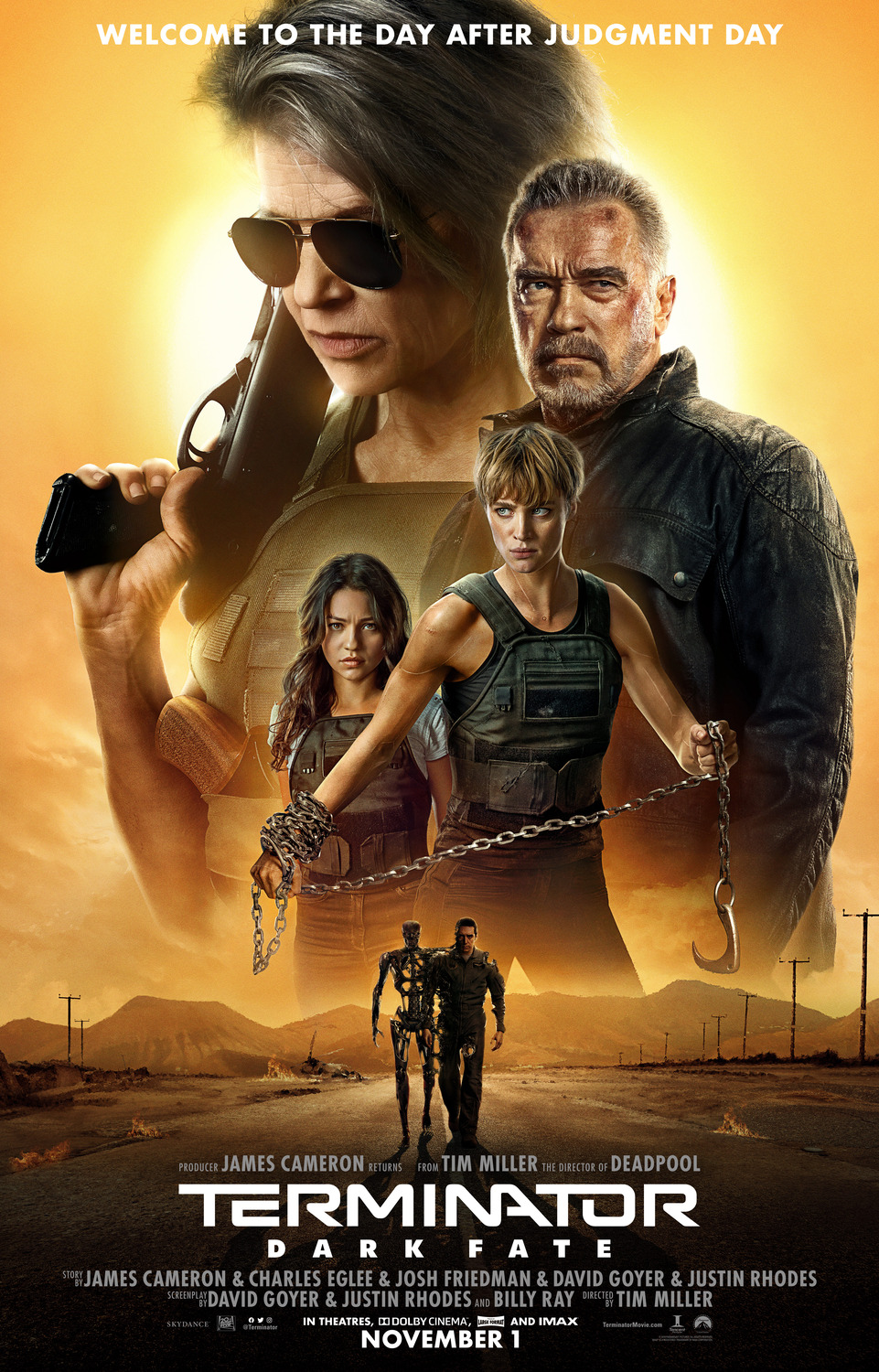
Terminator Dark Fate theatrical poster

Hollywood is one the few places on this planet where you can look at $29 million dollars and say, that’s it? This was the reaction many had when the opening weekend numbers of “Terminator: Dark Fate” were revealed to the world, and to say they were below expectations is putting it mildly. Many will pontificate over why this sixth installment bombed at the box office, but I think it comes down to the inescapable fact that the “Terminator” franchise has long since lost its capacity to wow and thrill us in the same way the first two movies did, and even series creator James Cameron, who returned to executive produce this sequel, cannot put it back together again. While you can retcon the hell out of “Halloween” to keep it going, “Terminator” is now way past the point of self-termination.

I finally got to check out “Terminator: Dark Fate” after finding some time to tear myself away from work as I was not going to let anything deter me from seeing it on the big screen. The truth is, it is not a bad movie and it has a good story and a game cast of actors who bring their all to the material. But it does not take long to see this sequel tread familiar ground as the story remains the same even if the major players have changed, and the feeling of déjà vu is more prevalent than ever before.

“Dark Fate,” as you all know by now, is a direct sequel to “Terminator 2: Judgment Day” and it ignores all the other movies which followed it. The movie begins with Sarah Connor suffering a tragedy much like the one Ellen Ripley suffered at the beginning of “Alien 3.” While she and her son were able to stop Judgment Day, they could never stop fate. The movie then jumps ahead 22 years when an advanced Terminator called the Rev-9 (Gabriel Luna) appears in Mexico City with a mission to kill Daniella “Dani” Ramos (Natalia Reyes), a young woman who works at an automobile industrial plant. But when Dani arrives at work, she finds her job is being taken over by (surprise, surprise) a machine.

Another person arrives from the future, and her name is Grace (Mackenzie Davis). At first she appears human, but then she is shown to have superhuman strength and fighting abilities much like the average Terminator, and seeing her kick human ass is quite the sight. We later learn she is indeed human but has been augmented to become more like a cyborg, and her mission is to protect Dani from Rev-9 as Dani is set to play an important role in the future.

Sound familiar? Of course it does because this was pretty much the plot of the first two “Terminator” movies. Part of me wants to forgive this as it sets up how Skynet was completely destroyed and has since morphed into another artificial superintelligence system called Legion, and this shows how history, more often than not, repeats itself. Heaven forbid we ever learn from our mistakes, you know? We are certainly reliving a past we have not learned from right now as certain impeachment hearings have a certain Nixon feel about them. Like Snake Plissken once said, “the more things change, the more they stay the same.”

But while the first few minutes tread very familiar ground, “Dark Fate” really comes to life when Linda Hamilton enters the picture as an older but still battle-ready Sarah Connor. It is the first time Hamilton has appeared in a “Terminator” movie in 28 years, and it is great to have her back as she makes this iconic character of hers as badass as ever, and she has some terrific dialogue to boot. With her face weathered from years of struggle and loss, Hamilton quickly reminds us how brilliantly she embodied this character all those years ago, and with the character evolving to another level here, she shows how one with such a hardened heart can rediscover their humanity even after suffering the worst life has to offer.

And yes, Arnold Schwarzenegger is back, and he gets to take his iconic character of the T-800 in yet another interesting direction. In “Terminator: Genisys,” he played the cyborg as one who has existed long enough to where he is no longer under warranty. In “Dark Fate,” this T-800 starts off as a cold-blooded assassin who, after a particularly shocking act, ends up developing a conscience and even becomes domesticated. Schwarzenegger gives another inspired portrayal here as he plays it straight and never for laughs, and this makes his performance all the more enjoyable. It is not the first time he has given a terminator this much heart, but his work here is particularly moving in a way it has not been for some time.

Mackenzie Davis, so luminous in “Tully,” is a powerful presence as Grace, and there is no doubt she gave her all in this role as watching her dominate the action scenes here is both physically and emotionally exhausting, just as it should be. Natalia Reyes does strong work in taking Dani from being an innocent person thrust into a situation no one could see coming to someone who accepts a role she is expected to fulfill. As for Gabriel Luna, he is good as Rev-9, but he is nowhere as menacing as Robert Patrick was as the T-1000.

Directing this installment is Tim Miller who helmed the first “Deadpool” movie, and he certainly has an interesting visual style which benefits this franchise to a point. At the same time, he is not able to bring the same visceral energy Cameron brought to the first two “Terminator” movies. Looking back, none of the other directors were able to either. Some came close, but Cameron is a rather unique filmmaker as he has given us some of the most exhilarating and adrenaline-pumping motion pictures we could ever hope to watch, and his vision of “The Terminator” is a personal one which no one can easily duplicate.

“Terminator: Dark Fate” simply feels like the same old thing with little in the way of anything new. It’s not a bad movie and it definitely has its strengths, but it serves as proof that this franchise has truly hit a dead end and really needs to be put to rest. The last few “Terminator” movies have come to us with the promise of a trilogy and of filmmakers more or less telling us that, this time, we are going to get it right. Well, this is the latest installment to see its hopes for a trilogy dashed yet again as Arnold’s dialogue of “I won’t be back” proves to be quite prophetic.

Still, we do learn of one advantage of being a terminator which the other movies never showed us: they can change diapers without complaining. If this does not impress you, what will?

* * ½ out of * * * *

Martin McDonagh on the Making of ‘Seven Psychopaths’

Martin McDonagh on the set of Seven Psychopaths

WRITER’S NOTE: This article was written back in 2012 when this screening took place.

Playwright and filmmaker Martin McDonagh dropped by Arclight Cinemas in Hollywood for a Q&A about his movie “Seven Psychopaths.” It features a terrific ensemble cast which includes Colin Farrell, Sam Rockwell, Christopher Walken, Woody Harrelson, Abbie Cornish, Tom Waits and Olga Kurylenko, and it follows the exploits of a writer who is desperate to finish his screenplay even as his friends inadvertently get him involved in the kidnapping of a gangster’s beloved dog.

“Seven Psychopaths” is McDonagh’s follow up to his brilliant movie “In Bruges,” but it turns out he wrote the script for it after he finished writing “In Bruges.” He explained he made “In Bruges” first because the script for “Seven Psychopaths” had a “canvas that was way too big for a first-time filmmaker.” This movie certainly has a lot of layers as it deals with multiple characters and storylines, and many of the characters have more to reveal about themselves than we realize at first glance.

The evening’s moderator said she once heard how McDonagh had admired Christopher Walken as a child, and McDonagh said he felt we all did as much as we respected Harry Dean Stanton (who has a cameo in the movie) or Tom Waits. It also turns out this was not the first time McDonagh had worked with Walken on a project.

Martin McDonagh: I did a play in New York with Christopher and Sam Rockwell about three years ago (“A Behanding in Spokane”), so I had that in. It was a dream come true to have Chris on set and doing his stuff.

McDonagh recalled the atmosphere on the set of “Seven Psychopaths” as being “strangely a lot of fun,” and the audience at Arclight Hollywood could certainly sense all the fun this cast of actors had. When asked if there was any improvisation, he said everyone pretty much stuck to the screenplay despite some exceptions.

MD: There were some little bits at the end of the shootout sequence in the graveyard, but everything else was on the page. The actors were so good that they made every line seem like they had come up with it on the spot. I think that’s the secret of truthful acting; to make it seem like it’s all improvised.

The dog playing Bonny was a Shih Tzu who is also named Bonny in real life, and McDonagh was great in describing how this one got cast.

MD: There were four or five Shih Tzus that came in to the casting couch. Bonny seemed more kind of edgy and the others were all ribbons and shampooed. Bonny felt like early De Niro.

McDonagh also made it clear if he knew the possibility of all those puns which made it into the movie’s advertisements like “they won’t take any Shih Tzu,” he would have gone with a German Shepherd instead. But it came down to deciding what would be the most incongruous dog for Harrelson’s gangster character to have, and Shih Tzus are so irresistibly cute. Bonny was apparently very sweet to work with, and the cast, especially Walken, spoiled the dog like crazy.

The main character played by Farrell is a writer named Marty Faranan, and Faranan is McDonagh’s middle name. However, aside from the middle name and the alcoholism, McDonagh claimed there are no connections between him and this character. McDonagh did however say what Marty wanted to accomplish with his script is the same thing he wanted to accomplish with this movie.

MD: The speech that Marty has at the start about wanting to make a film called “Seven Psychopaths” but still wanting it to be about love and peace is kind of where I was coming from. It’s really about friendship and for searching for something beyond movies about guys with guns. At the same time, it was a crazy guys with guns violent movie.

One of the best things about “Seven Psychopaths” is how it satirizes action movies and the clichés which continue to overrun them. The moderator talked of how there are certain conventions in them which seem to imply how you cannot kill a dog but that you can kill a woman, and McDonagh freely admitted he is constantly rankled by them as much he is from the notes he gets from studio executives.

MD: When you have a character putting a gun to a dog’s head you get a thousand notes about that, but not one about shooting someone in the stomach. Not one.

In terms of his cinematic influences, McDonagh cited the films of Sam Peckinpah and Terence Malick as being major ones on his cinematic work. When it comes to “Seven Psychopaths” however, he admitted Peckinpah was definitely the bigger influence. Other filmmakers whom he looks up to include Akira Kurosawa who made the classic “Seven Samurai,” Martin Scorsese whose film “Mean Streets” was a big influence on this film, Preston Sturges who made screwball comedies like “The Lady Eve,” and Billy Wilder whose darkly comic and satirical films he admires. Clearly, McDonagh is more influenced by old school filmmaking than he is by current mainstream entertainment

Martin McDonagh has more than earned his place among the greatest and most inspired playwrights working today, and his work as a filmmaker keeps getting better and better. “Seven Psychopaths” is a very clever movie which deserves a big audience, and it was great to see him take the time to come down to Arclight Hollywood to talk about its making.

Mary Elizabeth Winstead on Playing a Recovering Alcoholic in ‘Smashed’

Mary Elizabeth Winstead in Smashed

WRITER’S NOTE: This article was originally written back in 2012.

She charmed us in “Death Proof,” “Live Free or Die Hard” and “Scott Pilgrim vs. The World,” but now Mary Elizabeth Winstead gets the most complex role of her character to date in “Smashed.” In the movie she plays Kate Hannah, an elementary school teacher who is also a raging alcoholic. After one night where she even goes as far as to smoke crack, Kate finds she needs to turn her life around really quick. Her path to sobriety is not an easy one as it makes her question the relationships in her life, especially the one she has with her husband Charlie (“Breaking Bad’s” Aaron Paul) which appears to revolve around their mutual love of getting drunk.

Winstead did a lot to prepare for this role as she visited many Alcoholic Anonymous group meetings and talked to the people there. She was also aided by one of the movie’s writers and a co-producer who were in recovery themselves, and they made her feel like she was not coming into this project dishonestly. Hearing Winstead talk about her research ends up illustrating the diversity of one particular city in California.

“L.A. is a great place to do it, because it’s such a big city, and every neighborhood is very specific as far as the different types of people who live there,” Winstead said. “So, every meeting I went to was completely different. I went to one that was like six people, and they were all men in their 60’s, totally working class, totally not L.A. Then I went to one in West Hollywood that was a lot of industry people, and I went to a huge women’s meeting where everyone was hugging and laughing. And it was great just seeing people share and talk about themselves and talking about their darkest moments in front of bunch of people and having it be totally accepted. It was an honor for me to be a part of that and to see that and it was a big first step for me into realizing how much I related to their struggle, and how much of a universal struggle it is.”

Among the most challenging scenes for Winstead comes when her character is drunk. Now playing drunk may look easy for an actor to do, but it is actually quite the opposite. The trick is to make the act of drunkenness believable to the audience you are presenting it to, but it can be easily overdone to where you can look utterly foolish. Winstead admitted she had never played drunk onscreen before, and she was terrified that she would look terrible doing it. She and James Ponsoldt (the director of “Smashed”) ended up consulting an acting coach in order to get it down right.

“Together we found this coach named Ivana Chubbuck who has this book called ‘The Power of the Actor’ and she has a chapter specifically dedicated to playing drunk,” Winstead said. “We sat in a couple of classes, and we did one of the scenes in her class as well, so we used her method a lot for that. And that was really helpful because we just didn’t want it to feel like acting. How do you not act drunk, but not really be drunk? That’s a difficult thing to pull off.”

One thing which makes “Smashed” really unique in the annals of addiction movies is how Kate is not the usual face of onscreen addiction. Winstead described Kate as being a full character and one she could really relate to despite her ongoing problems.

“What was great about it was that this was one of the only roles that I have ever read in a script where the female lead character is such a full person. You get to see so many sides of her personality,” Winstead said. “For me, I can be all of those types of people. I have a lot of different traits to my personality, depending on who I’m around, and what the dynamic in the situation is. So, to get to play a character where you get to see every single shade of who she is, is very rare. That was really exciting to me. So, I always felt as though I was her, just different sides of her.”

What also aided Winstead in this role was how Ponsoldt made the actors feel very free on set to where it almost seems like they are not even working with a script. Winstead made clear how much of what we see in “Smashed” is in fact scripted, but there were some unscripted moments which did make it into the final cut.

“I think part of the reason it feels so real is that it felt like the camera was always rolling,” Winstead said. “We were always in character and we were always going off script and back on and off and back on. So, it never felt like: ‘Cut! We’re ourselves now.’ It didn’t have that break: ‘We’re going to go back to our trailer, see you later.’ It was never like that. We were always on set, we were always in character, and we were always working toward making it authentic.”

Mary Elizabeth Winstead admits she has struggled long and hard to find roles which are as good as the one she plays in “Smashed.” Coming out of it, she wonders if she will ever find a role like this ever again, and this is very understandable considering what a highly competitive arena show business is. Her performance as Kate Hannah, however, earned her serious Oscar buzz ever since the movie was shown at the Sundance Film Festival, and it is highly unlikely people will forget Winstead’s revelatory turn once they have left the theater.

SOURCES:

Kevin Jagernauth, “‘Smashed’ Star Mary Elizabeth Winstead On How She Learned To Play Drunk, The Emotional Rollercoaster Of The Role & More,” Indiewire, October 11, 2012.

Karen Benardello, “Interview with Mary Elizabeth Winstead on ‘Smashed,’” We Got This Covered, October 9, 2012.

Christopher Rosen, “Mary Elizabeth Winstead, ‘Smashed’ Star, On The Lack Of Female Roles In Hollywood & ‘Die Hard 5,’” Huffington Post, October 10, 2012.

The Grindhouse Film Festival Pays Tribute to Russ Meyer and Tura Satana

Faster Pussycat Kill Kill movie poster

Back in May of 2011, the Grindhouse Film Festival paid tribute to director Russ Meyer and the late actress Tura Satana, both of whom are best known for having worked together on the exploitation classic “Faster, Pussycat! Kill! Kill!.” This film screened at New Beverly Cinema along with “The Doll Squad” which Tura co-starred in, and in attendance were two actresses from the 1965 cult film: Haji and Susan Bernard. Both said if Satana were still with us, she would have been very pleased by the large turnout.

Satana starred as Varla, the leader of a trio of thrill-seeking go-go dancers. Her contribution to the 1965 movie was she added karate scenes and even choreographed them with the stunt director. Satana died in February of 2011 from heart failure, and Haji burst into tears confessing just how much she misses her and her pot roast. Bernard said Satana had a very big heart. She was 72 when she passed away, but we came out of this screening feeling like she left us way too soon.

In talking about Meyer, both ladies described him as a “good hearted man” who always visited his mother on Christmas Day. They described his editing and photography on his movies as being consistently top notch, and he always worked with the same five men crew which became a “tight knit” family. Bernard also remarked how he had a natural instinct about actors in what they could do without direction. It got to where he went up to the cast and said, “Here’s your scripts, do your thing.”

Bernard recalled her big driving scene where she got into the truck and of how she told Russ she had never drove a stick shift before. To this, Meyer replied, “You’ll figure it out.”

Both actresses made it very clear Meyer always took care of the girls and made sure they were well rested and that he ensured they did not have sex during filming as he always wanted them to look horny onscreen. Working with Meyer also made them both understand what he stood for: freedom of expression, anti-prejudice, equal rights for everyone and, along with the late Hugh Hefner anti-censorship.

Haji further remarked if you went into Meyer’s movies a complete wimp, you came out a toughened and changed person. He had the cast sleeping in tents out in the desert with scorpions, snakes and tarantulas threatening them when they least expected it. After doing one film with Meyer, Haji said she came out if it “rugged,” but they remained very good friends all the way up to his death.

“Faster, Pussycat! Kill! Kill!” is considered the cinematic origin of girl power and female empowerment. Unlike the endless number of films which came afterwards, it had no cursing and no nudity. Haji even said you could take your kids to see it. Whether or not taking kids to this movie is a good idea, there is no doubt of how much influence it has had on movies and popular culture. This cult classic still draws quite the crowd for good reason: women have the upper hand against those against them, and they are never ever weak. When you think about it, this was not always the case with movies back in the 1960’s.

‘The Blob’ 1988 Movie and Blu-ray Review

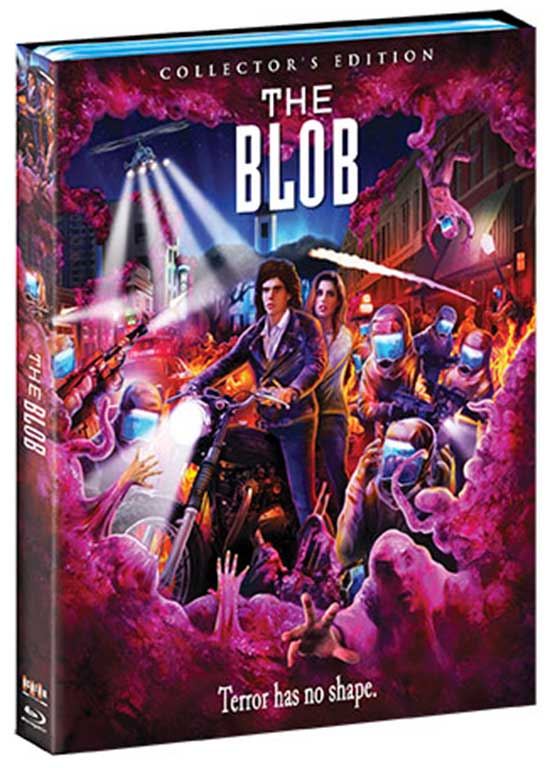
The-Blob-blu-ray-shout-factory-cover

The following article was written by Ultimate Rabbit correspondent Tony Farinella.

If you are a fan of 1980’s horror films, you know Shout Factory/Scream Factory gives them the proper treatment each and every single time as they are like the Criterion Collection for horror fans.  They go above and beyond the call of duty with their commitment to the audio and visual aspects of cult classic horror films, and they supply their Blu-rays with tons of special features.  They understand you want to know as much as possible about your favorite horror films, and they have done it once again with their collector’s edition of “The Blob,” a remake of the original film which starred Steve McQueen back in 1958.

With this version of “The Blob,” it shows the advancements made at the time in gore and special effects. I don’t think it is fair to necessarily compare the two films since they were released thirty-years apart.   One thing they both have in common is they are very enjoyable to watch.  I own both of them.  I have the Criterion Collection version of the 1958 film, and I am thrilled to add the remake to my collection from Scream Factory/Shout Factory.  The gore is also taken up a notch here, and it is sticky, gooey, bloody and completely over the top in the best possible way.

“The Blob” is, of course, a film about a disgusting life-form which comes to a town by the name of Arborville.  It is your normal town with a football team, local diner, police and cheerleaders, some of which you would just love to date.   Shawnee Smith plays Meg Penny, the local cheerleader who is your girl-next-door type.  Her father works at the pharmacy, and she is going on a date with football star Paul Taylor (Donovan Leitch Jr.) when they notice something terrible happening all around them. The character blamed for all of this is Brian Flagg who is played by Kevin Dillon, brother of Matt Dillon, and from “Entourage.”  He is the bad boy with a motorcycle, and he has a total kickass 80’s haircut. The police can’t wait to put the blame on him, but he is completely and totally innocent.

The blob will eat and destroy anything that gets in its way. You never know when it is going to appear or when it will strike.  It is part of a political experiment being overseen by shady scientists with their own agenda, and they are not concerned about the people.  The blob started by attaching itself to an old man’s arm, and from there the devastation only increased.  It is self-aware enough to have a running time of 95 minutes so the pace is right on point, the kills are interesting and disgusting, and it never feels boring.

Major props go out to Shawnee Smith as she gives a truly committed performance which should remind you of her work as Amanda from the “Saw” franchise.  Kevin Dillon is solid as well because he knows how to make this character likable but with an edge. He is someone you would want on your side when the blob hits the fan, if you catch my drift.  The effects are also terrific considering the time period this film was released in. The only time the green screen is very, very noticeable is near the end, but even then, it is campy fun.

This was my first time seeing the remake of “The Blob,” and I love both movies.  It is great when they get a second home on Blu-ray as well as the proper treatment courtesy of Shout/Scream Factory. There is also just the right amount of humor when the moment calls for it as well.  Fun fact: The screenplay was co-written by Frank Darabont of “The Green Mile,” “The Walking Dead,” and “The Shawshank Redemption.” This flick is able to gross you out while keeping you entertained and laughing as well, and this is not an easy accomplishment to pull off.  However, everyone stepped up their game on this film, and it shows in the final product.  I cannot recommend this movie enough if you have not seen it in the past, or if you have seen it and want to own it in this tremendous format.

* * * ½ out of * * * *

______________________________________________________________________________

Special Features:

Audio commentary with director Chuck Russell, special effects artist Tony Gardner and cinematographer Mark Irwin, moderated by filmmaker Joe Lynch

Audio commentary with actress Shawnee Smith

“It Fell From the Sky!” – an interview with director Chuck Russell

“We Have Work to Do” – an interview with actor Jeffrey DeMunn

“Minding the Dinner” – an interview with actress Candy Clark

“They Call Me Mellow Purple” – an interview with actor Donovan Leitch Jr.

“Try to Scream!” – an interview with actor Bill Moseley

“Shot Him!” – an interview with cinematographer Mark Irwin

“The Incredible Melting Man” – an interview with special effects artist Tony Gardner

“Monster Math” – an interview with special effects supervisor Christopher Gilman

“Haddonfield to Arborville” – an interview with production designer Craig Stearns

“The Secret of the Ooze” – an interview with mechanical designer Mark Setrakian

I Want that Organism Alive! – an interview with Blob mechanic Peter Abrahamson

“Gardner’s Grue Crew” – behind-the-scenes footage of Tony Gardner and his team

Audio Commentary with director Chuck Russell, moderated by film producer Ryan Turek

Theatrical Trailers

TV Spot

Still Gallery

Blu-Ray Info: “The Blob (1988)” is released on a Collector’s Edition Blu-Ray from Shout Factory/Scream Factory.  The film is rated R and has a running time of 95 minutes.

Audio Info: The audio is DTS-HD Master Audio 5.1.  For a film that is thirty-one years old, it sounds terrific.  All of the dialogue between the actors is easy to understand without any issues whatsoever.  When the gory scenes come up, they also have a real sizzle to them as well. Subtitles are in English.

Video Info: The 1080p High-Definition Widescreen (1.85:1) transfer is out of this world.  There are no signs of grain, dust, or dirt when watching this film.  It is incredibly clear and vibrant on screen.

Should You Buy It?

With so many special features on this wildly fun flick, it’s a no brainer when it comes to buying “The Blob (1988).”  I wish I had seen this movie sooner, but to be honest, I didn’t even know there was a remake of the original until recently.  I’m glad there is and that Shout/Scream Factory is there to make it available for purchase for hardcore horror fans such as myself and so many others out there.   The film is a gory ride which has a very satisfying and fun conclusion. You always get your money’s worth and then some with Shout Factory/Scream Factory titles, so you will not be disappointed when you pick this one up.  As a matter of fact, it would make a great double feature with the original flick.


In Defense of Rob Zombie’s ‘Halloween’ Movies

The two “Halloween” movies written and directed by Rob Zombie were eviscerated not just by critics but by the fans as well. Some critics, like James Berardinelli of Reel Views, said they did not even feel like “Halloween” movies. Fans were vocal in how characters like Laurie Strode and Dr. Loomis were unforgivably degraded compared to how they were portrayed in John Carpenter’s original. Others simply said Zombie’s take on Michael Myers just wasn’t that scary.

Well, I say phooey to all this nonsense! Zombie’s “Halloween” movies may not be as scary as the one which started off this never-ending franchise, but for me this was pretty much a given. There is no way you could recapture what Carpenter thrilled us with years ago. Zombie was aware of how Michael Myers, like other horror icons such as Freddy Krueger and Jason Voorhees, had pretty much worn out their usefulness. His respect for Carpenter’s slasher opus was strong, and after making a true grindhouse classic with “The Devil’s Rejects,” I knew he would take this story and these characters and make them his own.

What makes Zombie’s “Halloween” stand out from what came before it is how he treats the backstory of Michael Myers. Granted, this threatens to take away from what made him so scary in the first place. Carpenter’s original was an unrelentingly visceral experience mainly because we were not sure what to make of “The Shape” as he became less than human throughout. But here we get a strong idea of how young Michael went bad as he dealt with an uncaring sister, a busy mother, and an abusive lout of a stepfather. Seeing all he had to deal with made it understandable, if not forgivable, as to why he went psycho in the first place.

Now whereas Zombie’s “Halloween” was about Michael, his “Halloween II” was all about Laurie Strode, Dr. Loomis and of how the horrific events they went through forever destroyed them. It is here we come to realize what Zombie has accomplished with these movies: They are character studies instead of the average slasher movie we have come to expect. This is made even clearer on the “Halloween II” director’s cut which is available on DVD and Blu-ray as it proves to be infinitely superior to the theatrical version.

Fans hated how Laurie Strode and Dr. Loomis were so different from how they were portrayed in Carpenter’s original film, but they forgot how Zombie’s films were a meant to be a reimagining of the franchise and not business as usual. Strode’s extreme emotional reactions might make her unlikable, but they soon become understandable as no one involved in what she went through can ever walk away from it unscathed. Both Scout-Taylor Compton and Malcolm McDowell deserve credit for not being constrained by what Jaime Lee Curtis and Donald Pleasence created before them. In Zombie’s incarnation, these two actors inhabit their characters more than they play them.

In a time of remakes which are as endless as they are unnecessary, you have to give Zombie points for taking this long-running franchise in a different direction. It may not have been what diehard fans wanted or expected, but whereas most remakes repeat the formulas of movies they originated from with negative success, there is something to be said for a filmmaker who willfully goes against expectations. Seriously, this says a lot in a time when originality in cinema is largely frowned upon.