WRITER’S NOTE: As the opening paragraph indicates, this is about a screening which took place several years ago.
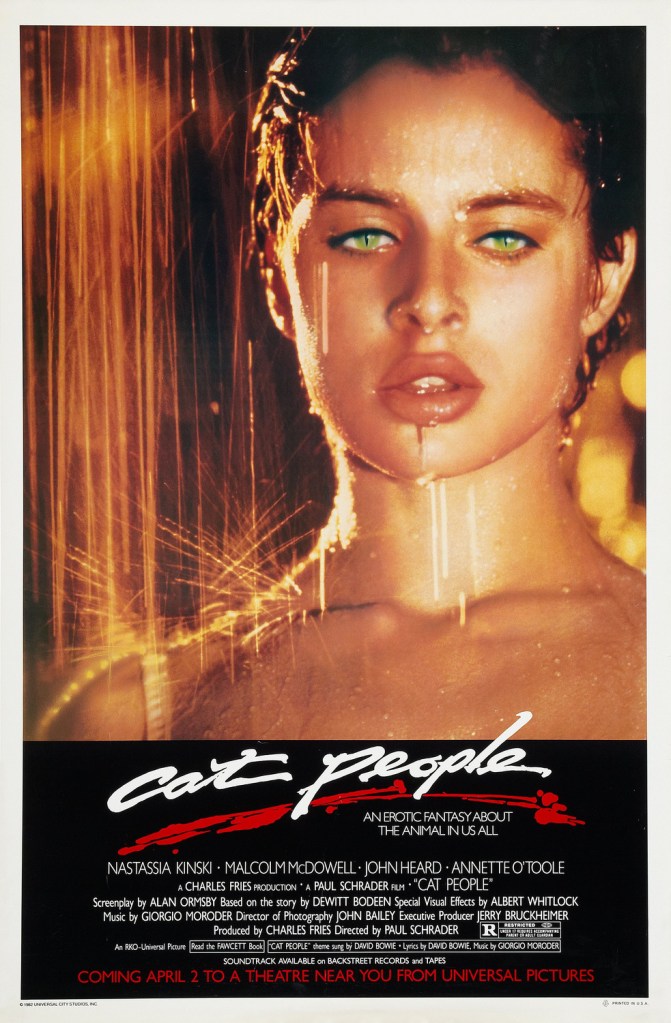
Actress Lynn Lowry, one of the famous horror queens of 1970’s movies, made a special appearance at New Beverly Cinema on Thursday, April 19, 2012 for a double feature of George Romero’s original version of “The Crazies” and Paul Schrader’s erotic remake of “Cat People.” Lowry took some time to talk about her brief appearance in Schrader’s take on the 1942 horror film, and her responses truly surprised the small but faithful audience attending this screening.
Filmmaker Ryan Stockstad, who was about to make a movie with Lowry called “Eggs,” asked the veteran actress what it was like working with Schrader, who may be best known for writing the screenplay to “Taxi Driver.” Lowry described Schrader as “insensitive,” and also said, “Is it okay if I say Paul Schrader is the least favorite director I’ve ever worked with?”
In auditioning for “Cat People,” Lowry said she asked the casting directors if they wanted her to do the scene “full out.” They said they had no problem with that, and she didn’t hold anything back as a result. Looking back, she said the secretaries who heard her from a distance loved what she did.
Lowry’s scene had her playing Ruthie, a prostitute who goes to a seedy motel to fulfill the pleasures of a particular customer. While there, she gets attacked by a black leopard hiding underneath the bed and screams in horror when she realizes how badly one of her feet has been slashed.
Lowry started the scene by walking to the hotel, and Schrader wanted the makeup people to spruce her up from head to toe. He wanted to light up the streets of New Orleans where “Cat People” was being filmed as she made her way to the location, but she ended up only being filmed from below her knees.
The actress described Schrader as working so fast to where he couldn’t quite get what he needed. For her scene, Lowry had to keep falling on her knees over and over again. As the day went on, she said the crew finally had to put a cat paw on the leopard to make this scene work.
The climax of had Lowry falling down a flight of stairs, a sequence she noted had to be shot multiple times. Part of the problem was her bra would not open up on cue, and she said Schrader wanted to see a lot of skin throughout the film. This ended up necessitating the use of Velcro on the undergarment to make it open more easily.
Lowry also remarked how there were nails on the stairs which the crew members did not bother removing. As a result, she ended up getting cuts on various parts of her body.
On the DVD commentary for “Cat People,” Schrader said he wanted to share credit with the movie’s visual consultant, Ferdinando Scarfiotti, and this was because he felt Scarfiotti was mostly responsible for the look of the film. Lowry, however, said she never ever saw anyone else on set directing.
It is a bummer to hear Lynn Lowry was not very happy with her time making “Cat People,” and she is certainly entitled to her opinion. But after all these years, this movie is a fascinating remake which truly stands on its own.
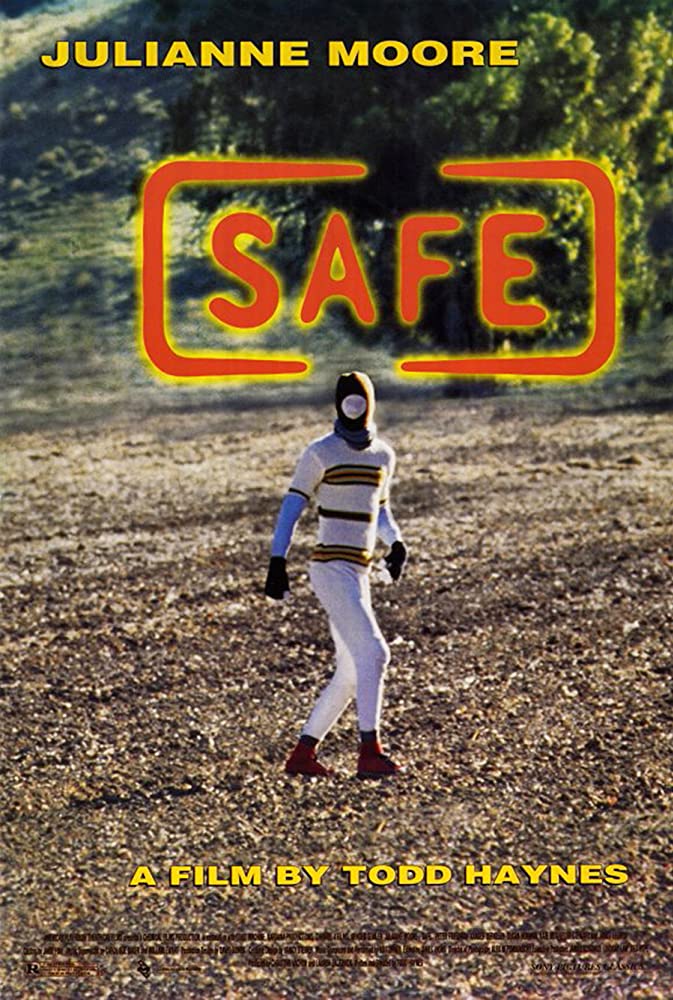
I am thankful I live near New Beverly Cinema as it has long since proven to be a great film school for movie buffs like me, and it has allowed me to watch movies I might otherwise not have bothered to watch when they were first released. Case in point is the 1995 movie “Safe” which marked a huge breakthrough for its director Todd Haynes and lead actress Julianne Moore. I do remember when it was first released and of film critics like Roger Ebert singing its praises, and it came out during a time when movies like these played in cities far from where I lived, and getting out to see them was impossible. Even with a driver’s license, certain cinematic events were too far away for me to attend.
Anyway, Moore plays Carol White, a suburban homemaker who is comfortably married to Greg (Xander Berkeley), and she spends her days either doing things around the house, going to her local aerobics class, or having lunch with friends. But one day after driving down Olympic Boulevard, she finds herself coughing uncontrollably after traveling behind a big rig truck whose exhaust seeps right into her air conditioning system. This marks the beginning of an acute sensitivity to just about every chemical known to the human race, and things just get worse and worse for her from there. In addition to coughing uncontrollably, she later finds herself suffering from nose bleeds, she develops asthma-like symptoms, and she ends up convulsing at the local dry cleaners.
Carol is said to have developed multiple chemical sensitivity, otherwise known as MCS or the “Twentieth-Century Disease.” This is still seen as a very controversial diagnosis which remains unrecognized by the American Medical Association. “Safe,” however, is not out to prove if MCS is a real threat to us all or not. Instead, it looks at how a disease can forever change the way we look at ourselves and of how we view the world around us.
“Safe” also gets deep into that anxiety-ridden place in our psyche which goes haywire when our safety zone gets violated by forces beyond our control. We feel Carol’s agony throughout because we all collectively fear getting a disease which has no clear diagnosis or an immediate cure. When you end up going through lord only knows how many doctor’s appointments where it feels like nothing’s working, it really wears you and your loved ones down to the point of sheer desperation.
Things get even more horrifying from there when Carol travels to a resort in the New Mexico desert called Wrenwood. Designed to help those afflicted with MCS, it really seems more like a cult. Instead of finding ways to deal with this condition to where people can function normally in their daily lives, its leader Peter Dunning (the excellent Peter Friedman) subtly enforces his fear of the chemical world on his dutiful followers. Peter comes in the guise of a very friendly person with the best of intentions, but we all know where good intentions lead.
Haynes, working with a minimal budget, makes “Safe” feel all the more real as he portrays suburban life in the San Fernando Valley in ways which never come across as corny or the least bit campy. All the characters are complex and the kind we recognize from our own lives, and the agitation they experience feels unnervingly vivid. Adding to this sense of dread is an excellent ambient score by Ed Tomney which deftly illustrates the growing anxiety of the film’s main character. Haynes brings out the best in each of the actors, and he lets them become their characters instead of just playing them.
Moore’s performance in “Safe” proved to be a revelation as she sucks us right into her character’s dilemma, and we can never take our eyes off her as Carol turns further inward and isolates herself from the world at large. The whole movie rests on her shoulders, and she shows no vanity in her portrayal of Carol. She literally becomes the character before our very eyes to where she looks frighteningly emaciated and close to being completely incapacitated. It’s a deeply affecting performance which made me want to reach out and hug her, and I say this even though it would probably not be enough to save her character.
“Safe” ends on an ambiguous note, leaving it up to the audience to guess what will become of Carol White. This will drive a lot of the mainstream audience members crazy as they demand to have things explained in full detail, but a movie like this cannot and should not offer easy solutions. How can it? I got so caught up in Carol’s ordeal to where I felt I was in her shoes. Personally, I hope she finds a way to overcome her circumstances, but that may just be wishful thinking.
I am really glad I finally got to see “Safe,” and I hope more people take the time to check it out. It stays with you in a way few movies do. It also leaves us with a haunting image of a certain character seen from a distance, completely covered with clothing to where they are hiding every part of their body from the world at large. Arcade Fire may sing about the body being a cage, but what happens when we put another cage over it? This all reminds me of a lyric from a song by Peter Gabriel:
“The more we are protected, the more we’re trapped within.”
* * * * out of * * * *
WRITER’S NOTE: When I first saw “Safe” at New Beverly Cinema, it had been out of print on DVD and VHS for several years. The Criterion Collection, however, has since released a special edition of it on DVD and Blu-ray, and I could not recommend it more highly. Click here to find out more about this special edition.
I always figured comedians were the best kind of people to hang out with as a kid. Hearing them tell funny stories, making joke after joke, happiness always seemed served up to them on a silver platter. But as time went on, I came to see while they were clowns on the outside, they were crying an endless river of tears inside. Comedy from these people comes from a deep pain and sadness in their lives, or out of a deep-seated anger they have at the world around them.
Look at Richard Pryor, need I say more? He had all the money, women, cars and drugs you could ever ask for. For “Superman III,” he ended up paid more than Christopher Reeve. Still, I remember reading an interview in which he said the last truly happy moment he remembers in his life was when he was jumping around in the dirt while pretending to be a cowboy at the age of 10, and he was in his 40’s when this interview was conducted. Comedy was his constant weapon against pain, and he never held anything back in his routines.
“Funny People” understands very well this gloomy realm many comedians live in, and is written and directed by a filmmaker who still performs from time to time as a standup comedian, Judd Apatow. But unlike “The 40-Year Old Virgin” and “Knocked Up,” this film has a darker edge to it and doesn’t hide away from the inherent viciousness of its characters. “Funny People” has been advertised as a comedy drama, but the balance often veers more to the dramatic. There are many laughs to be had here, but this movie clearly came from a rather dark place.
Adam Sandler stars as George Simmons, a comedian turned movie star whose career looks a lot like Sander’s own. George became famous with movies like “Merman” where he played a male mermaid, and “Re-do” in which he plays a character whose body has transformed into that of an infant. Seeing George’s head digitally inserted onto a baby’s body at once gives us a great sight gag, but it also seems like the kind of silly comedy Sandler himself has made once too often. Besides, I have more than my fill of talking babies.
George has it all: a beautiful mansion overlooking the sea, a swimming pool he does laps in on a regular basis, great cars, women who don’t hesitate to sleep with him even if they have boyfriends, and all the money one could hope to live off of to the end of time. But in his eyes, we see he is a sad man who has come to truly despise himself for what he has become. All the wealth he has amassed only serves to isolate him from the rest of the world, and it makes him defensive around total strangers who are unable to see him as ever resembling a regular person. But now, his doctor has diagnosed him with a terminal disease and has only months left to live. George reacts to this news as if someone drained his blood while he wasn’t looking, and it makes him realize how much self-hatred he has. From there, he becomes to make every last minute of his life count, but this may not alter his antagonistic personality from where it currently resides.
As George Simmons, Adam Sandler gives one of his best performances to date, and its right up there with his brilliant turn in Paul Thomas Anderson’s “Punch Drunk Love.” Not once does he back down from how George is a hard man to like. Throughout “Funny People,” George is dismissive to many around him, and he ends up being thoughtlessly mean to those who look up to him. Regardless, Sandler still manages to make you sympathize with this character and of the terminable diagnosis which he did not see coming. It’s the moments where Sandler lets it show through his eyes just how full of regret Simmons is, and it serves as proof of how this former “Saturday Night Live” performer is more talented than he thinks.
Along with this famous comedian on his cynical farewell tour is Ira Wright (Seth Rogen), an aspiring young comic who is not entirely confident with his stand-up act. George catches Ira’s act one night after he makes a surprise appearance at a comedy club, and while he is hurt when Ira discusses how he bombed onstage just moments before, George thinks this kid has got talent and offers to pay him some money to write up some jokes for an upcoming benefit show. From there, George hires Ira as his personal assistant, an employment opportunity which involves more work than the average 9 to 5 job which never pays enough.
Remember all those nasty horror stories from people who were assistants to the stars and certain sociopathic studio executives? Well, Ira may have gotten off easy compared to those people, but we fear his soul will be forever crushed the longer he stays with George.
In a lot of ways, Ira is they typical kind of character Rogen has played over and over again in movies, and not just the ones he does with Apatow. While I would love to see him take on riskier roles like the one he played in “Observe and Report,” he is the perfect match for Sandler’s endlessly cynical misanthrope of George. By the movie’s end, Rogen his performance proves to be the most underrated in the film, and he believably takes Ira from someone lacking in confidence to one who finds his voice with each standup routine he does to where he shows a strength he did not know he had. Rogen makes this transition feel seamless to where he had a stand out moment when he faces down Simmons and tries to make him see how his terminal disease has not come close to changing his outlook on life.
But the one person who almost steals “Funny People” is Apatow’s wife, Leslie Mann. Having already proved what a comedy dynamo she was in her husband’s previous films, there should be no more talk from those who believe she has only gotten this far as an actress because of nepotism.
Mann plays Laura, and George describes her to Ira as “the one that got away.” Laura was and still is George’s one true love, and he finds she still yearns for him even though their relationship came to a heartbreaking end when he cheated on her. This is a moment George appears to regret more than any other, and he becomes eager to make up for it as soon as he can. Laura never tries to hide her character’s undying affection for this man who is lonelier than most, and she is willing to end her marriage to an Australian soccer nut (Eric Bana, who is hilarious) who may be cheating on her as well. As Laura, Mann succeeds in making you fall for this character even while she selfishly tries to redirect her life without realizing the consequences of her actions.
There are a lot of strong elements working in favor for “Funny People,” but it doesn’t change the fact it is a deeply flawed movie. While it is good and worth watching, it will most likely be seen as one of Apatow’s weakest movies. I do like how he dared to go in a slightly different direction with this movie compared to what he has given us previously, but the balance between comedy and drama is off kilter most of the time. For many, I don’t think it will be entirely clear as to whether they are watching something comic or very serious.
Plus, at over two hours long, this movie really could have been shorter. I’m usually cool with long movies, but only if they can justify their length. It is way too easy to come off as self-indulgent when making a three-hour epic. “Funny People’s” length does cut deeply into its comic momentum, and there are spots where it things really dragged. It does pick up towards the end, but the story still could have used a bit more tightening.
Still, I really did like “Funny People” because it shows how Apatow still succeeds in giving us characters and situations which feel very real on an emotional level. With him taking his established formulas in a different direction, it is clear his work will continue to grow with each successive project he takes on.
I also love the brilliant cameos he manages to extract from big celebrities in his films. One scene in “Funny People” has George meeting up with a lot of famous comedians like Norm McDonald, Andy Dick (wow), Charles Fleischer, Collin Quinn and Sarah Silverman who has one of the movie’s funniest scenes. But the biggest surprise cameo to be found here is Eminem’s as I never expected to see him in any movie, let alone one directed by Apatow. Seeing him dissing Ray Romano provides us with an unforgettable moment where Ira ends up saying to Ray, “I thought everybody loved you.”
One perception about “Funny People” which needs to be cleared up is that it is not what many would call a “disease movie.” It is really to Apatow’s credit here that he never gets all mushy on us like many others would have when it comes to films about people who think they are facing certain death. George’s arc here is much like the character Michael Keaton played in “Clean and Sober.” In the process of trying to improve themselves and become better people, they end up fooling themselves to where they think they are changing for the better, but are instead acting more selfishly than they realize. Their attempts to help those in desperate situations reveal just how self-involved they are, and it just gets worse for them from there. It is not until the climax which has them at a place where they realize what they truly need to do to move on from a fractured past.
“Funny People” is definitely worth seeing. Just don’t go in with the normal set of expectations you have for the average Apatow production because things are a little different here. It definitely has some hilarious moments and dramatic ones, and Sandler makes it clear to us he can be a great actor when given the right material. It is also an intimate look at the fame and success one person experiences, and of how damaging and isolating it can be.
This project was really a long time coming for both Apatow and Sandler because they did share an apartment when they first moved out to Los Angeles. “Funny People” actually starts off with home video footage of them making prank phone calls which has them laughing in hysterics. It is meant to be a look of innocence which fame forever changes, but at least we can see how in real life these two funny men have their families to keep their egos in balance. George Simmons is simply the person each of them would have become if they weren’t careful.
Yes, this day was coming, but I did not think it would come this soon. Back in 2015, Amoeba Music sold its Hollywood location on the corner of Sunset and Cahuenga to developer GPI Companies for a reported $34 million, and it is set to be turned into yet another high-rise building in Los Angeles. I read the store would be open through the end of 2020. But then we were all hit by the global pandemic known as Coronavirus/COVID-19, and “non-essential” businesses like Amoeba were forced to close the doors temporarily. There was hope Amoeba’s Hollywood location would re-open again soon, but then co-owner Jim Henderson made the following statement:
“The massive impact from the COVID-19 pandemic has forced the closure of our iconic Hollywood location at 6400 Sunset Blvd. With no reasonably foreseeable opportunity to re-open in our current location, we are instead focusing on hopefully opening in the fall in our previously announced new home at 6200 Hollywood Blvd. This situation has been forced on all of us, and we feel this decision is the most responsible and practical one.
“This is heartbreaking for us. We never envisioned not being able to give the store the send-off it deserves, to give you all a chance to say goodbye. We had so many events planned to celebrate our history at 6400 Sunset, but we are facing too many mitigating circumstances that simply won’t allow for it.”
Having read this, I understand and respect Amoeba’s decision not to re-open its Hollywood location. All the same, this is a real heart breaker for me as I looked forward to visiting this store again at least a few times before it closed, but now this will not happen. Like the Second City theatre, Amoeba Music was like a second home to me in Los Angeles which I visited frequently. Walking out of there empty-handed could feel criminal, but I could always find a certain CD, DVD, Blu-ray, cassette tape or vinyl record worth adding to my terrifyingly enormous collection (my dad says I have more CDs and DVDs than God).
Having grown up in in Northern California, I often visited the Amoeba stores in Berkeley and San Francisco quite often, and this was back in a time where downloading music digitally was far from ever becoming a reality. Upon learning they were going to being opening a store in Hollywood, I became infinitely excited at what it would have to offer. Anyone familiar with the average Amoeba Music store knows they are far bigger than the normal record store. In fact, they are like warehouses which look to contain anything and everything you could ever hope to find. I was lucky enough to attend this store’s opening night back in November of 2001 and was in awe of just how big it was. If you were unable to find what you were looking for there, you had to wonder what was wrong with the world.
One of my biggest thrills in recent years was introducing my parents to this particular Amoeba Music store when they visited me in Los Angeles. They were flabbergasted at just how big this particular store was, and they were quick to grab their hands-on stuff like a Monterey Blues Festival t-shirt. This was also around the time of my birthday, and they got me Shout Factory’s special edition of “Creepshow” on Blu-ray, and that’s even though my dad was horrified at the price on it, and the soundtrack to “Once Upon a Time in Hollywood.” While I was unable to introduce my parents to New Beverly Cinema during their recent trip, I am ever so glad they got to check out this particular Amoeba store while it was still operating.
The following are some of my most memorable purchases I made at this particular Amoeba Music store.
Killing Zoe
I was lucky enough to visit this store on the day it opened back in 2001, and the DVD to “Killing Zoe” was the first thing I ever purchased there. Written and directed by Roger Avary, it stars Eric Stoltz as a safecracker named Zed who joins up with his longtime friend Eric (Jean-Hugues Anglade) in Paris to rob a bank on Bastille Day. I had just discovered this movie on IFC and was absolutely enthralled by it. The acting all around was terrific, and Anglade in particular was phenomenal as a man fully determined to go out with a bang. I also really dug the film score composed and performed by Tomandandy which proved to be as hypnotic as it was propulsive, and I have since become a big fan of their work.
But yes, “Killing Zoe” is especially worth watching for the gorgeous and beguiling Julie Delpy who wows us fright rom her first appearance as Zoe. Whether she is in bed with Stoltz or wielding a heavy-duty machine gun, you cannot take your eyes off of her for a second.
Because this was the first thing I ever bought at this particular store, I assure you I will never get rid of it.
The Best of Siouxsie and the Banshees
One time while I shopped here, this compilation album was playing on the store’s speaker system. I was already aware of Siouxsie and the Banshees thanks to their wonderfully bizarre song “Peek-a-Boo” which has an equally bizarre music video, and also “Face to Face” which proved to be a fantastic addition to the “Batman Returns” soundtrack. As this album played, I started to wonder why I didn’t give this British rock band more of my attention years ago as I suddenly became entranced by their songs “Cities in Dust,” “Dizzy” and “Kiss Them for Me.” to where I soon went over to the front counter to see what specific album was being played. I walked out with several items that day, but “The Best of Siouxsie and the Banshees” is the one I find myself still playing quite often.
“We Are Night Sky” by Deadboy & the Elephantmen
As with any other Amoeba Music store, the Sunset Boulevard location played host to many singers and bands who performed there in support of their latest releases. I was fortunate enough to be at the store when Deadboy & the Elephantmen performed in support of their second album, “We Are Night Sky.” Led by singer and guitarist Dax Riggs who was accompanied on bass and drums by Tess Brunet, the band was often compared to The White Stripes, but they really stood out on their own. As they played songs like “Stop, I’m Already Dead” and “Blood Music” with sheer abandon, I quickly became a fan and bought the CD. Other great tracks on this album are “How Long the Night Was” and “Misadventures of Dope.”
What a shame it was that this band came to a permanent end just one year later.
“Send Your Love to Me” – a P.J. Harvey live bootleg CD
The lady at the register warned me the sound quality on this disc was not great and that it sounded like someone recorded this show from the audience. I appreciated the warning as it prepared me for a recording which was clearly not done on a professional level. Still, I found it interesting to hear Harvey’s music from this vantage point, and at one point you can even hear one audience member tell another how she is going to be playing herself in the next “Batman” movie (I’m guessing he meant “Batman Forever”). Having seen Harvey perform live years ago at The Wiltern, listening to this bootleg made me feel like I was right back there again as songs like “Meet Ze Monsta” and “Down by the Water” are so invigorating to take in with an audience of fellow fans.
“Sorcerer” soundtrack by Tangerine Dream
At my previous day job, a friend of mine named Richard shared my love of film scores and movie soundtracks. One his big favorites was Tangerine Dream’s score to William Friedkin’s “Sorcerer,” and he complained about how he could never find it at any record store in Los Angeles or any other city. Sure enough, I did find a copy of it at Amoeba on Sunset. Surprisingly, it was not in the soundtrack section, but instead in the New Age section where all the other Tangerine Dream CDs could be found. You should have seen Richard’s face when I showed him the CD. Seriously, he looked like Donald Sutherland at the end of “Invasion of the Body Snatchers” as he was completely stunned to be holding any copy of this particular soundtrack. I also agree with him about how this is one of the most unique film scores ever composed, and it opened up doors for Tangerine Dream in Hollywood as they went on to create more unforgettable scores for films like “Risky Business,” “Firestarter,” “Near Dark” and “Thief.”
“Heartland” by Client
While searching in the electronic music section for the latest CD by Hybrid or Juno Reactor, I came across a sign which said, “If you like Goldfrapp, then check this band out!” The band this sign was referring to was called Client, an English electronic music group from London which had just released its latest CD, “Heartland.” Would I have bought this CD in any other store? Well, it seems a bit unlikely as other places may not have been as quick to promote a band or artist Americans were not the least bit familiar with. Thanks to this sign, I got to check out this album which contains such terrific songs like “Lights Go Out,” “Zerox Machine” and “Someone to Hurt,” and these are songs I still never get sick of listening to.
“Adventures in Babysitting” t-shirt
As soon as I saw this t-shirt which featured Elisabeth Shue’s famous line of dialogue from the 1987 teen comedy film, I knew I had to have it. However, there was one slight problem: where could I possibly where it? Any shirt which says “don’t fuck with the babysitter” is not exactly the kind you can wear it if you live near an elementary school. But with all the social distancing currently going on, perhaps I can get away with wearing it as it can be hard to make out certain words when others are six feet away from you. At the very least, it will give some a reason to laugh during a time where it feels like the world is bordering on Armageddon.
Goodbye Amoeba Music on Sunset Boulevard. While I look forward to the opening of its newest location, to see this one shut down sooner rather than later really breaks my heart. So much of my money was spent here, and I have long since lost track of all the CDs, DVDs and Blu-rays I managed to trade in there for store credit.
Hopefully the new store will have a bigger parking lot.
The founders of Amoeba Music, Dave Prinz and Marc Weinstein, have since created a fundraising page on Go Fund Me to help offset the costs associated with the COVID-19 shutdown. With all Amoeba’s locations currently closed, they are struggling to survive and are doing what they can to pay their bills and take care of their employees’ health insurance. Their fundraising goal is $400,000, and to date they have raised over $230,000.
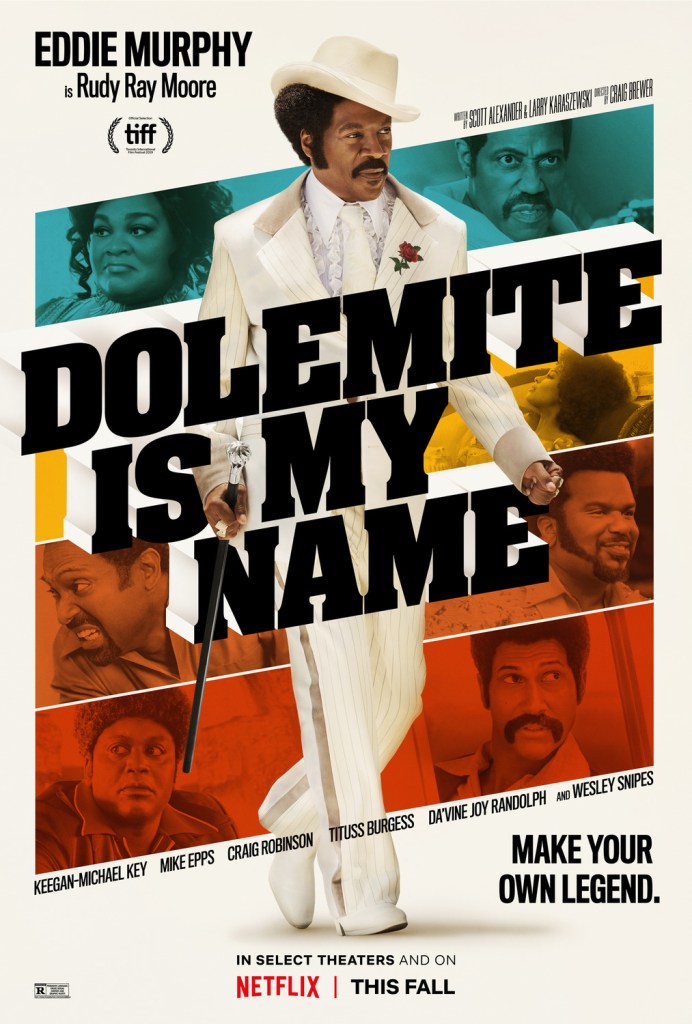
With the Coronavirus still wreaking havoc around the globe (deal with it you flat-Earthers), this mandatory quarantine has allowed me to catch up on movies which I was hoping to watch sooner. One I finally caught up with is “Dolemite is My Name,” the biographical comedy film about comedian and filmmaker Rudy Ray Moore who created the character of Dolemite, released several successful comedy albums, and then risked everything to bring his iconic character to the silver screen. What unfolds proved to be one of the best and most entertaining movies of 2020. Eddie Murphy gives us one of his greatest performances ever, Craig Brewer returns to make a film as entertaining as his best efforts, and screenwriters Scott Alexander and Larry Karaszewski have given us yet another offbeat biopic about an unlikely character who more than left their mark on the world.
When we first meet Rudy, he is a struggling artist living in 1970’s Los Angeles. We see from the start he is a natural born hustler, and his determination to become a star knows no bounds. At the same time, his life has long since fallen into a rut as he finds himself working at a record store whose manager, Roj (Snoop Dogg), refuses to play Rudy’s songs which comes with names like “Step it Up and Go” and “Below the Belt.” Despite Rudy’s eagerness, Roj freely admits none of his songs could ever compare to Marvin Gaye’s “Let’s Get it On.”
Furthermore, Rudy is past his prime, and he is starting to believe his dream of stardom has long since gone out of his reach. His stand-up bits at a local club fail to elicit a single laugh as his jokes are exquisitely lame to put it mildly. In addition, he has become quite, as someone later describes him, “portly.” Yes, even back in the 70’s, Hollywood seemed to have a problem with overweight people.
Then one day, Rudy gets accosted by a homeless man named Ricco (Ron Cephas Jones) who comes into the store making various loud proclamations which show off his superb rhyming skills, and one of them includes the name “Dolemite.” This ends up lighting a fire of inspiration in Rudy as he goes out into the streets to meet up with Ricco and his brethren to record their dialogue which prove to be poetic as it is profane. To be sure, Rudy pays these men to him their stories, but while some may be all about the Benjamins, he is more about the Washingtons.
From there, the character of “Dolemite” is born and Rudy dresses himself up for the occasion. It is an electrifying moment when we first see him take the stage even after the club owner begs him to just stick with his normal act. While he was at first ignored as an opening act, he now has the audience in stitches when he tells them, “Dolemite is my name, and fuckin’ up motherfuckers is my game!” From there, he finds the loving audience which had long eluded him, and he becomes increasingly intent on leaving his mark on the world.
Eddie Murphy certainly had a much different path to fame than Rudy Ray Moore ever did. He got cast on “Saturday Night Live” when he was 19, and film stardom came soon after when he starred in “48 Hrs.” Rudy, on the other hand, found success later in life and with a niche audience which was nowhere as big as Murphy’s. But watching Murphy here, I can see why he is a perfect fit to play Rudy as he inhabits this raunchy comedian and hustler with such an unbridled enthusiasm to where his spirit is so infectious throughout. Seeing Murphy land so many of Dolemite’s one-liners perfectly reminds us how brilliant his comedic timing is, and it is shocking to learn this is his first R-rated feature since 1999’s “Life.”
But moreover, Murphy really gives a great performance here which, in another year, might have earned him a deserved Oscar nomination. He really makes us root for Rudy even as his confidence begins to wane, and he also shows the insecurities and the past Rudy is constantly trying to stay several steps ahead of. There is one scene where we see Rudy on the phone with a prospective movie studio, and we do not even have to hear who is on the other line as Murphy shows us what rejection looks like as his face crumbles. Seriously, if this moment does not prove what a great actor can be, what will?
For Craig Brewer, “Dolemite is My Name” is his first feature film directorial effort since his 2011 remake of “Footloose.” To say this is a comeback for him is not really fair as he has spent the last few years producing several movies and directed TV episodes, so clearly he has been a busy body. However, watching this movie proves he has not missed a step as it contains the same boundless energy and enthusiasm he brought to “Hustle and Flow” and “Black Snake Moan.” Brewer clearly revels in the journey Rudy took from being a starving artist to becoming a known personality, and he makes this journey a thrilling and endlessly entertaining one for the audience.
For Scott Alexander and Larry Karaszewski, this stands proudly among their others which include “The People vs. Larry Flynt,” “Ed Wood,” “Big Eyes” and “Man on the Moon.” In some respects, Rudy’s career trajectory is a bit similar to Ed Wood’s as their talent, to put it mildly, can only go so far. But the screenwriters do make Rudy out to be an admirable go-getter who may not have gotten love from everybody, but who did get exactly what he needed. And in the end, Rudy certainly earned more success in his career than Ed ever did.
There are a couple more people I would like to single out including the mighty Da’Vine Joy Randolph who steals a number of scenes as Lady Reed, a single mother whom Rudy encourages to join him on his stand-up tour while in Mississippi. Randolph makes Lady Reed into a vulnerable individual who ends up finding the strength to make herself known to people who otherwise would might otherwise have paid her any notice. The scene she has with Murphy where Lady Reed thanks Rudy for paving the way to Hollywood for her is one of the most deeply felt as it rings so true emotionally, and there is not an ounce of sentimentality or emotional manipulation to be found.
And there is Wesley Snipes who comes close at times to stealing the show as the director of the “Dolemite” movie, D’Urville Martin. Watching Snipes here, it feels like the first time he has been this wildly energetic since “Major League.” After the cinematic debacle that was “Blade: Trinity” and his conviction for tax evasion, he seemed forever resigned to a career in direct-to-video movies where he played only deadly serious characters. But here, he gives one of his best performances in lord only knows how long as he turns D’Urville into a hilariously bewildered human being who keeps wondering how the hell he got mixed up with Rudy and his crew. It’s such a brilliantly off-the-wall performance, and just looking at his face during one of the most hilariously staged sex scenes in motion picture history is priceless.
Seriously, I get severe whiplash looking at Eddie Murphy’s career, and that’s even though its not as intense and jolting as what I get when looking at John Travolta’s. Murphy has been up and down so many times to where it hurt to wait and see him be great again. Heck, I almost gave up on him after “Beverly Hills Cop III.” But with “Dolemite is My Name” and his triumphant return to “Saturday Night Live,” he has more than earned his latest comeback, and I really hope this is one which will last for several more movies.
In this time of quarantine due to the global pandemic known as Coronavirus (COVID-19), I have not stayed in my apartment all day long as I have no choice but to work. Still, getting my ass out of bed continues to be a struggle, and while I keep saying I have no time to watch any new releases, I do find myself watching whatever is playing on one of the various Starz cable channels. And I have to be honest, there is always a certain movie which captures my attention regardless if I already have the movie on DVD or Blu-ray.
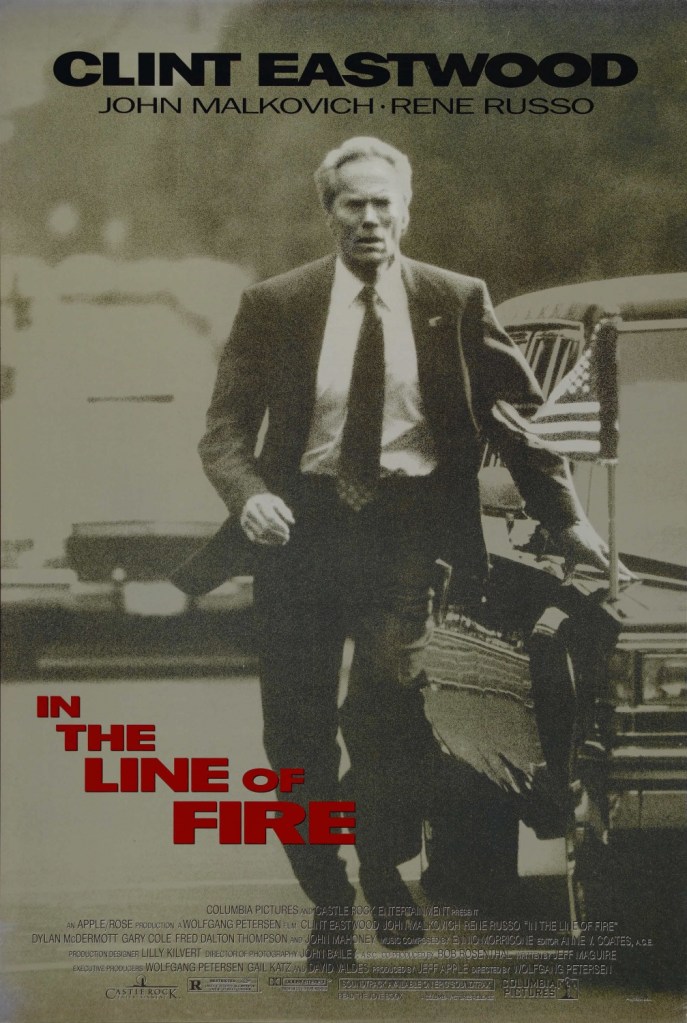
One movie which has been playing on Starz a lot recently is “In the Line of Fire,” the 1993 political action thriller which was directed by Wolfgang Petersen and stars Clint Eastwood as the grizzled and cantankerous veteran Secret Service Agent Frank Horrigan.
I worked at a movie theater in my hometown, Crow Canyon Cinemas, which played it, and during my lunch breaks I would go and watch it to take in the excellent direction, brilliant acting and terrific action sequences. It also provided me with one of my most frustrating moments while I worked there. While working a shift, an audience member came up to me and said the lights were still up inside the theater. I rushed in to see what was going on, and the lights were indeed still on as the movie opened up on Washington, D.C. and Ennio Morricone’s began playing. Another audience member yelled out, “ARE YOU GOING TO TURN THE LIGHTS OFF?!” This caused others in the audience to laugh, and I walked out of there inescapably pissed. Hey, if I was operating the film projector, I would have made certain the lights were turned off when the movie began. Please do not automatically assume it’s my fault! Do you even know who I am?! Do you know what us concession workers, ushers and box office personal are forced to deal with on a regular basis?!
Anyway, Frank Horrigan is a veteran Secret Service Agent who is busy breaking in a rookie named Al D’Andrea (Dylan McDermott) whom, as you will see, has a really bad first day at work. Upon arriving back at his apartment, Frank receives a call from a man who calls himself Booth, short for John Wilkes Booth, the man who assassinated President Abraham Lincoln. Booth is later revealed to be Mitch Leary (John Malkovich), a disillusioned and deeply obsessed CIA assassin who is determined to assassinate the current President of the United States. From there on out, Frank becomes determined to stop Mitch from ever reaching his murderous goal.
Of course, Mitch has a special reason for telling Frank about his plan as he is the sole active agent remaining from the detail guarding President John F. Kennedy back in 1963 when he was assassinated. Mitch prods Frank into thinking he could have done more to keep Kennedy alive, and we see in Frank’s eyes why this is still a gaping wound which has aversely affected his life for far too long
What really fascinated me about “In the Line of Fire” was the relationship between Frank and Mitch as it worked on different levels. At first, it felt like Mitch was viciously deriding Frank for his failure in Dallas on that fateful day, but perhaps Mitch was taunting Frank in an effort to see if there was any government worker who was still worth believing in. Either that, or perhaps Mitch was eager for some competition as he had long since become such a skilled assassin to where this particular job was easier for him than it should have been. The screenplay by Jeff Maguire is not clear on the answer to this, but this is part of this movie’s charm.
“In the Line of Fire” was the first movie Eastwood had acted in following his Oscar winning triumph, “Unforgiven.” When I saw “Unforgiven,” it forever changed the way I looked at Eastwood as I figured he was just coasting on the success of “Dirty Harry” for far too many years to where he could easily phone in a performance before we realized it But when it came to “Unforgiven,” this movie made me realize he was a consummate artist both in front of and behind the camera. Watching him in “In the Line of Fire” made me see this all the more as, behind that famous glint of his, he succeeds in giving a wonderfully complex performance as Frank Horrigan. From start to finish, Eastwood makes Frank into a difficult, thoughtful, charming, guilt-ridden and stubborn human being, and it is a real shame he didn’t get an Oscar nomination for his performance.
The key scene for Eastwood comes when Frank reminisces about the day of Kennedy’s assassination with Agent Lilly Raines (the always terrific Rene Russo), and he paints a very vivid picture for the audience to where no flashbacks are needed to illustrate what he is talking about. It was also one of the few times back then where we got see Eastwood cry, and an image like this seemed unthinkable for so long. Still, watching this iconic star lose it over an American tragedy which has long since been burned into our collective memory is a beautiful moment. Some are forever trapped in a time and place they can never escape from, and the assassination of J.F.K. is one which still holds many in its grasp.
One actor who did score an Oscar nomination for their performance was John Malkovich. With his character of Mitch Leary, Malkovich created one of the most malevolent psychopaths the world of cinema has ever seen. But as demented as Malkovich makes Mitch (the scene where he puts Eastwood’s gun in his mouth was his idea), he also allows us to see this character has some form of empathy. When Mitch talks about how he doesn’t remember who he was before the CIA “sunk their claws” into him speaks volumes as he has long since become a former shell of his former self to where he has nothing left to live for except revenge. When it comes to Malkovich, you can always count on him to take any character he plays and mold him into something undeniably unique.
I also have to single out Rene Russo who is an absolute joy to watch here as Special Agent Lilly Raines. She made her film debut in “Major League,” but she really caught my eye after co-starring in “Lethal Weapon 3” as Lorna Cole, an internal affairs detective who beat up the bad guys every bit as effectively as Martin Riggs did. When we first saw her in “In the Line of the Fire,” we knew her character was not an agent to be easily messed with as she could kick ass with the best. Still, Russo shows a wonderful vulnerability throughout as Lilly confesses to Frank how she broke off a relationship because she would not give up her job for anyone. Russo does not even have to spell out in words why Lilly is hesitant to become involved with Frank as any potential relationship comes with a lot of baggage, and yet the chemistry between these two proves to be so strong to where we have one of the more hilarious love-making scenes in cinema history. As we see the various objects drop off them as they climb into bed, we can understand Frank’s frustration about having to put all of it back on.
“In the Line of Fire” was directed by Wolfgang Petersen, the same man who gave us the greatest submarine movie ever made, “Das Boot.” Petersen directs this movie in a way which makes it clear to us how character means more to him than spectacle. Whether or not the stunts are the best you have ever seen, they are exciting as hell because we are rooting for the characters from start to finish. As the story heads to a most thrilling climax, I could not take my eyes off the screen for a second.
This movie also has one of my favorite film scores ever by the great Ennio Morricone as he nails every single moment for all its emotional worth. Whether it’s the main theme which is filled with a hard-fought for patriotism, the romantic themes which illustrate the growing relationship between Frank and Lilly, or the themes which add to the taut action sequences, there is not a single false note to be found here.
It is nice to revisit “In the Line of Fire” after all these years, and it still holds up in this day and age. It is a top-notch thriller and the kind of character driven motion picture we do not see enough of these days. It also makes you respect the secret service in a way we always should have. They have to defend the President of the United States regardless of how they feel about him or her as a person. I mean, heaven forbid we have another President serve as a martyr for this great country the way John F. Kennedy did. I bring this up because this is especially the case when we are forced to deal with an infinitely unpopular President, and I will just leave it at that.
WRITER’S NOTE: As the opening paragraph indicates, this article was written back in 2011.
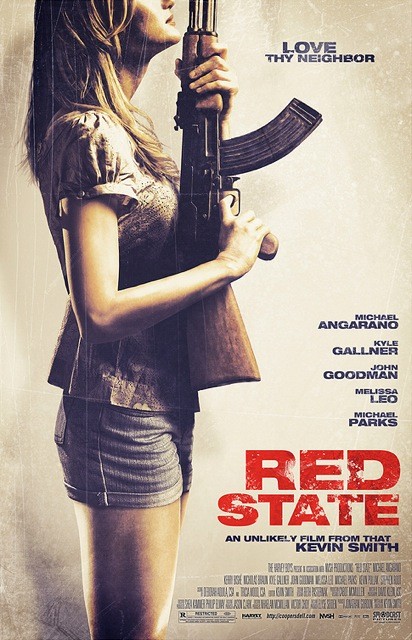
On August 19, 2011, Kevin Smith began a one-week run of “Red State” at New Beverly Cinema making it eligible for Academy Awards consideration. Smith also came to just about every showing there to do a Q&A afterwards as he came to love “sitting back and loudly appreciating the movie.” Of course, this led one audience member to confront him at a local Coffee Bean & Tea Leaf and say, “You were yelling ‘genius’ at your own movie?”
“Red State” is astonishingly different from any movie Smith has previously helmed including the Bruce Willis starring “Cop Out.” This is largely the result of him and his longtime director of photography Dave Klein, who also shot “Clerks,” making use of the Red One digital camera. Smith said he loved chasing around the set with it, and he remarked how the camera looked like something out of “The Bourne Identity.” Smith, however, was aiming for “Red State” to look more like “Half Nelson” and less like “NYPD Blue,” and he told Klein him he wanted it to look unlike any movie they had made before. To this, Klein said, “Thank God!”
Smith felt he improved as a filmmaker with the Red One, and he figured the company which made them would give him one for free. However, it turned out getting a free camera was as likely as getting anything for free from Apple.
When it came to the actors, Smith saw himself as more of a cheerleader than a director. He made this blunt in saying, “You don’t direct mother fuckers like these! Who am I to tell John Goodman or Melissa Leo about acting?!”
The actor he talked about most was Michael Parks who played Abin Cooper, Pastor of the Five Points Trinity Church, a highly fanatical and conservative church which makes the Westboro Baptist Church look tame by comparison. Smith, like many of us, first saw him as Texas Ranger Earl McGraw in “From Dusk Till Dawn,” and he declared that Parks “owned the first ten minutes” of it. Parks, however, told Smith he didn’t want impersonate Fred Phelps as he described him as being “boring.” Instead, Parks wanted Cooper to be “charismatic,” and his brilliant performance has Phelps only wishing he could be as such.
Speaking of the Phelps family, five of them came to a midnight screening of the movie. Or at least, five of them planned to until Megan Phelps contacted Smith and asked for 15 more tickets. Smith couldn’t resist having a laugh at the inescapable contradiction:
“God may hate fags, but the Lord loves a bargain!”
Megan described “Red State” as being “filthy” even though she kept watching it for ten minutes as a gift to Smith before walking out. She did, however, send him a couple of signs with the sayings “God Hates Fag Enablers” and “Red State Fags” on them. Smith’s wife, Jennifer Schwalbach, ordered him to throw them out, but he pointed out they were signed by all the WBC church members. Their daughter Harley ended up coming across the “Red State Fags” sign by accident. While he and his wife were looking at each other, Harley asked them, “Is this the sequel?”
Kevin Smith said “Red State” exists because of Quentin Tarantino. The Madonna speech at the beginning of “Reservoir Dogs” was such a big thing to him, and it made filmmaking seem all the more fun and possible to do. He sees “Red State” as the “true spiritual sequel” to “Clerks,” and he has had a joyous experience taking it out on the road. It’s very easy to believe to him when he said no one has had a bad experience with a premium ticket they bought for it.
WRITER’S NOTE: As the opening paragraph indicates, this screening took place back in 2011.
On September 28, 2011, New Beverly Cinema played host to the 25th anniversary screening of the 1986 buddy cop action comedy film “Running Scared.” It stars Billy Crystal and the late Gregory Hines as Chicago police detectives Danny Costanzo and Ray Hughes who, after almost getting killed, decide to retire in Key West, Florida. But before they can retire, they first need to bring down a vicious drug dealer (is there any other kind?) played by Jimmy Smits. Attending the screening were the film’s director, Peter Hyams, and actress Darlanne Fluegel who played Costanzo’s ex-wife, Anna.
Hyams had just finished making “2010” for MGM, and the studio wanted to keep him there. He got offered the script for “Running Scared” which he said was originally about two “elderly” cops who want to retire. However, he instead suggested that the cops be younger guys, and he made it clear how he wanted Billy Crystal and Gregory Hines for it.
At the mention of Crystal, Hyams said “you could hear the thump in the office.” Keep in mind, this was long before Crystal became the actor and Oscar host we know him as today. Back then, he was primarily known for being a cast member on “Saturday Night Live,” and he had only done one movie previously which he would rather people forget ever existed (“Rabbit Test”).
As for Hines, an unnamed studio executive told Hyams:
“But the part’s not written for a black guy.”
To this, Hyams replied:
“Hines isn’t playing a black guy, he’s playing a guy.”
One of “Running Scared’s” biggest action scenes involves Hines’ character climbing to the top of a Chicago building on a window washer’s rig. Many of Hyams’ films feature scenes shot from great heights, and he said this is because he is highly acrophobic. The director is so terrified of heights that he keeps shooting scenes from a high elevation in order to get people as scared as he is of them. It turns out the film crew was unable to get a stuntman for this sequence, so they got the actual window washer of the building to do it.
In talking about Fluegel, Hyams said he had such a crush on her after watching “To Live and Die in L.A.” and wanted her to play Crystal’s ex-wife. Her character was the “least eccentric” in “Running Scared,” Hyams noting if the character was not made interesting, the film was going to die. Fluegel said she felt very free when working with Hyams because she could see the kind of environment he had her working in. She found herself creating things for Anna as the production went on, and you could feel the relationship between her and Crystal without words. Fluegel replied much of it came from the fact that the two of them “were just buds.”
“Running Scared” did well at the box office, and MGM of course became interested in doing a sequel. The studio wanted the cops to go to England and fight crime there, but Crystal and Hines were not particularly interested in doing a follow-up. As for Hyams, he said he didn’t want to make the same movie again as he felt it would not be interesting.
Crystal, while at a screening for “City Slickers,” remarked at how “Running Scared” was “the first interracial cop buddy movie.” After 25 years, it’s important to note this as it was released before “Lethal Weapon.” It still holds up well today, and while the studio didn’t think it would work, Hyams stayed true to his instincts on how to make it. Not bad for a man who openly admitted he is “terrified of shooting movies” and never had a confident day in his life.
Back in 2010, I was trying to remember the last time I saw Sir Michael Caine play the lead in a motion picture. Looking back, I think it was “The Quiet American” in which he gave what he thought, and I agree with him, was one of his very best performances ever. Since then, he has been the supporting actor of choice in movies like “The Dark Knight” and “Inception.” The big joke around Hollywood was if you can’t get Morgan Freeman for your movie, get Caine. Those two guys are in just about every other movie being made. Still, we need a reminder every so often of how truly great an actor Caine is. There are a number of good reasons why his career has lasted several decades after having survived critical disasters like “Jaws: The Revenge.”
But in 2009, Caine did get indeed get the lead in a movie many still have not seen, “Harry Brown.” I saw it as a double feature at the New Beverly Cinema along with a classic movie Caine starred in called “Get Carter.” Both these films have him playing characters where violence plays or has played a big part in their lives. With “Get Carter,” he played a professional killer who was almost completely amoral, and yet you couldn’t help but like him. It’s almost tempting to look at “Harry Brown” as kind of a sequel to “Get Carter” as it makes you wonder what Jack Carter would have been like had he grown up long enough to become a senior citizen. Even if he managed to put his past behind him, it is always bound to catch up with him as only so many bad deeds go unpunished.
From its trailer, “Harry Brown” certainly does look like the British version of “Death Wish,” one of the most unforgettable movies about vigilante justice. But you could also look at it as being to Caine what “Gran Torino” was to Clint Eastwood. Each movie involves a character so uncomfortable with the changes going on around them, and they are resistant, as is everyone, to any kind of change. There’s even a good dose of Eastwood’s “Unforgiven” thrown in for good measure as you wonder how deeply Harry was shaped by his experiences as a military officer.
Either way you look at it, “Harry Brown” takes the overused concept of a regular person who loses someone close to them, forcing them to take matters into their own hands when the police fail to help, and turns it into a very effective thriller which is truly unrelenting in the intensity it generates. Seriously, this is a very bleak movie which puts you into the main character’s mindset and never lets you go. It also takes place in a an environment which is all too real to those who live in it, and the consequences hit you like a swift kick to the gut. You may look at Brown’s surroundings and say to yourself no one could pay me enough to live in this environment, but we are stuck there for 103 minutes, and there’s no easy way out.
Caine plays the title character, a widowed North Ireland military veteran who finds his training coming back to him as he comes to confront those who murdered his best friend, Leonard (David Bradley) in such a cold and callous way. Following this, it becomes clear to Harry his days of being indifferent to the horrible goings on now are at an end, and he threatens to become even more lethal than those gang members he stealthily pursues. In the process, his training as a soldier is reawakened, and he uses it to his advantage. The way Harry sees it, he and his men fought for something important, but these kids today are instead fighting for their own depressing amusement.
Caine continues to make screen acting look effortless for him, and even the moments where he doesn’t speak a single word speaks volumes of what is going through his mind. We feel Harry’s pain over becoming so lonely without a soul to rely on, and we experience his state of mind completely thanks to Caine’s incredible performance. We have seen this kind of character a lot in movies, but Caine imbues Harry with a wounded humanity which keeps him for becoming completely cold blooded. Even as he descends into violent acts of raw vengeance, we can’t help but sympathize with Harry as we come to wonder what we would do if we unlucky enough to be in this situation. We never catch Caine playing on the clichés other actors would likely fall into, and it makes you wonder if there is another actor who could have played this role as well as him.
“Harry Brown” marks the feature length directorial debut of Daniel Barber whose only other project was the Oscar nominated short film “The Tonto Woman.” Filming at a council estate in South London, he creates an unrelentingly bleak atmosphere which feels even darker than anything David Fincher came up with in “Alien 3” or “Seven.” Just taking in the atmosphere which surrounds Harry and his fellow neighbors drains the soul pretty quick. Instead of prettying anything up, Barber captures the hopelessness of a people stuck in a crime ridden area so far out of their control, and of the frustration which drives the main character into action.
It is clear from the start that this will not be your average Hollywood vigilante flick, and the violence featured here is very brutal. The movie’s opening sequence features a very realistically staged gang initiation sequence where a new recruit is made to do drugs and then gets beaten up to within an inch of his life. This is later followed up by a highly unnerving scene where two gang members are riding along on a motorbike while filming their escapades, and one of them ends up shooting a young mother while she is pushing her baby in a stroller. From that point on, you never feel safe while watching this movie. You feel the gunshots when they go off here, and it all becomes a race to see how much longer Harry can stay alive.
Barber also proves to be masterful in setting up highly suspenseful scenes which are brimming over with excruciating tension. The best example of this comes when Harry meets with two young men to buy a gun, and both are clearly high on their own supply to where they are hopelessly paranoid. You feel like things could explode at any second, and I have to give a lot of credit to the two actors, Sean Harris and Joseph Gilgun, here as they make their drugged-up characters all the more frightening than they already were in the screenplay. Seriously, the scene between them and Caine is one of the most unnerving I have seen in a long time, and I will never be able to shake it.
There is also a very nice supporting performance here from the lovely Emily Mortimer who previously stole my heart in “Lars and the Real Girl” opposite Ryan Gosling. She plays Detective Inspector Alice Frampton who is at times empathetic to the suffering around her, and at other times very serious about the work she does. It’s not your typical tough as nails cop on display here, and I found this to be quite interesting. Frampton almost looks out of her league, but she quickly shows us how she keeps an open mind and considers every possibility without singling out anything based on preconceptions or stereotypes. Of course, being the smartest cop in the movie, no one listens to or takes her seriously enough. Then again, if they had, the running length of this film would be equivalent to that of “The Tonto Woman.”
“Harry Brown” is truly one of the bleakest movies I have ever seen, and while the trailers make you think we are traveling into familiar “Death Wish” territory, this is not the case in the slightest. All these years later, I still can’t get it out of my head as it affected me more than I anticipated. I was expecting a solid B-movie at most, but there was much more to the story than what I saw at first glance. It marks a very impressive debut for Barber, and it allows Caine to give us yet another great character and unforgettable performance to a resume which is overflowing with them.
Anybody remember the 1986 sports movie “RAD?” If you were a BMX fan or a bicycle fan in general back in the 1980’s, you certainly do. Directed by the late Hal Needham, it stars Bill Allen as Cru Jones, a highly talented BMX racer who looks to compete in the Helltrack race. If he is victorious, he will become famous, win $100,000 dollars and get a new Chevrolet Corvette. The only thing is, his mother expects him to take his SATs to get into college, and it is on the same day as the race. Will he defy his mother and race, or will he take the test? Oh, come on, you already know the answer!
“RAD” got the kind reception many of Needham’s films did back in the 1980’s: the critics hated it, and it is one of those rare movies on Rotten Tomatoes to have a 0% rating. Nevertheless, it has long since gained a cult following which remains strong to this very day. And at the very least, it is a far better motion picture than Needham’s previous effort, “Cannonball Run II.”
While it was released on VHS and laserdisc and became a top-rental for two years after it was unleashed in theaters, “RAD” has long been out of print and never been made available on DVD. Who owned the rights to it? Hard to say. Some say Talia Shire, who plays Cru’s mother, had the rights, but this was never confirmed. The only way to find the movie was to look on websites like eBay where the VHS tape is being sold for quite a bit of money.
So, it was to my utter shock today when I discovered that “RAD” is now finally getting an official home video release nearly 35 years after it debuted. Vinegar Syndrome will be releasing the film exclusively on their website in the Blu-ray and 4K Ultra HD formats, and it comes with a plethora of special features which include the following:
• Newly scanned & restored in 4k from 35mm original camera negative
• Limited Edition 3D Lenticular (front) and Holographic (back) Slipcover
• Brand new commentary track with actress Talia Shire and Robert Schwartzman
• Brand new video interview with writer/co-producer Sam Bernard
• Multiple archival video interviews with the cast and crew
• Archival group commentary featuring multiple cast and crew
• Extensive behind-the-scenes stills and promo material
• Reversible cover artwork
• SDH English subtitles
Vinegar Syndrome has made it clear this special edition release is strictly limited, and they will not be repressing it in any format once it sells out. You can pre-order it now for $29.95 and it will be shipped out during the website’s Halfway to Black Friday Sale which takes place from May 22 to May 25. Trust me, this special edition release will sell out sooner than you think.
“RAD” may not be a major artistic achievement in cinematic history, but it still is a lot of fun to watch. The stunts are very impressive, and this film was made long before the advent of CGI, so nothing is faked here. Plus, you get to see Lori Loughlin, who plays Cru’s girlfriend Christian, at her most beautiful and long before she bribed the college admissions committee at USC to accept her two daughters. Ray Walston makes an appearance here, and there is even a great bicycle montage done to Real Life’s “Send Me an Angel.” What more could you ask for in an 80’s movie?