WRITER’S NOTE: This article was originally written in 2012 when this screening took place.
Among the guests at a recent reunion screening of “Major League” at the Aero Theatre was actor Tom Berenger who played veteran baseball catcher Jake Taylor. It is still one of Berenger’s best known roles as we watch his character go through another baseball season which may very well be his last while trying to win back his ex-girlfriend Lynn Wells (Renee Russo in her film debut). And like his fellow co-stars, Berenger proved to the filmmakers he could play baseball.
Berenger did have some experience playing little league when he was growing up, and he played some more ball after that but never professionally. “Major League’s” writer and director, David S. Ward, also said “you could watch Tom swing a bat and you could tell he could play baseball.” Berenger said he played on third base and left field, but “Major League” had him taking the catcher position for the first time ever. What made the difference in preparing for this role was who he had to work with.
Tom Berenger: I had a great teacher which was (Steve) Yeager who had been a catcher for the Dodgers. Besides being a great player, he was also a great teacher which is important, and he worked with Charlie (Sheen) and I and we started probably six weeks before the other guys came in.
Berenger even talked about how he got Yeager and some of the cast to come back to his hometown in South Carolina so they could practice there. His thought was that practicing at Pepperdine University near Malibu with the “dry air” and “breeze coming off of the ocean” was “a little deceiving” as real ballplayers deal with more humid conditions.
TB: We raised a little team so we could do infield practice and drills and things like that, and it was all these guys who were on softball leagues that had once played baseball. They loved it. It was great. I had a friend that was head of maintenance for the public schools, and he got us a field at one of the high schools that was totally blocked off. It was just screened by Palmetto trees, Live Oaks and stuff. He gave us the key to the gate to get in and he brought all his equipment out there and he recut the field, he redid the mound, he gave us a pitching machine so I could practice pop-ups and we could do batting practice.
Berenger said this worked out great for everyone there because they all were forced to deal with humidity, and it was this same humidity which the cast and crew faced in Milwaukee, Wisconsin where “Major League” was filmed. The movie was shot in 1988 during the hottest summer in Wisconsin since 1938, and he remembered it being brutal to work during the day as a result. While the training done in South Carolina certainly prepared many for day shooting, Berenger looked more forward to working nights when it was cooler.
Watching the movie again had Berenger getting nostalgic for the old Cleveland as it appears in the movie’s opening credits, and it is one of the few parts of the movie which was actually shot there.
TB: I’m looking at it and I’m going wow, look at that industrial town. That’s what we used to be. And that makes me a little sad, you know? Chicago and Cleveland and Pittsburgh and Bethlehem and Allentown; all those towns were like that and they’re not there anymore, and I find that really sad because I think they were the backbone of this country.
“Major League” still holds a place in all our hearts thanks to its humor and deeply felt moments which have stayed with us long after the end credits are done. Even Berenger admitted the movie still has a profound effect on him more than 20 years after its release.
TB: I have to say that I just love this film. I cry at the end every time I watch it. It’s a comedy but it’s got so much heart and great writing and direction.
WRITER’S NOTE: This article was originally back in 2012.
I was lucky enough to check out Quentin Tarantino’s latest movie “Django Unchained” at New Beverly Cinema, the same movie theater he bought and kept from going out of business. It was being shown in 35mm instead of a digital print at other theaters because Tarantino is still a big fan of film, and the New Beverly is known for showing movies in 35mm because that’s exactly what the owners and patrons like best.
One of the real treats of seeing “Django Unchained” at New Beverly Cinema is instead of getting coming attractions for 2013 movies, we instead get to watch movie trailers from the past. These ones were especially campy and represent the kind of movies Hollywood no longer makes, and I wondered if the trailers being shown before “Django Unchained” inspired this particular Tarantino film in some way. Many of the prints of movies and trailers shown at the New Beverly tend to come from Tarantino’s own personal collection, so even if they didn’t inspire this movie of his, then they must have been ones he loves watching over and over.
Let’s take a look.
“The Arena”
This exploitation film from 1974, one which clearly was inspired by “Spartacus,” stars Pam Grier and Margaret Markov as female gladiators who have been enslaved in Rome and are forced to fight for their freedom. The trailer proved to be hilarious as the acting is over the top, and the narrator embellishes the more explicit elements of this movie by saying how the Romans “enslaved the most sensuous women to titillate the perverted pleasures of the Roman public” and how the main characters are “beautiful unchained women” whose bodies are “shaped into superb fighting equipment.” There’s also a bit of nudity and blood on display, the kinds of things you almost never see in a movie trailer today unless it is a red band trailer being shown for restricted audiences only.
Still, it’s great to see Grier here whom Tarantino cast in his movie “Jackie Brown,” and it is said she and Markov did all their own fights and stunts in “The Arena.” We should all known by now that Grier is as tough as the characters she has played in dozens of movies, and seeing her take on the Romans makes this one worth a look.
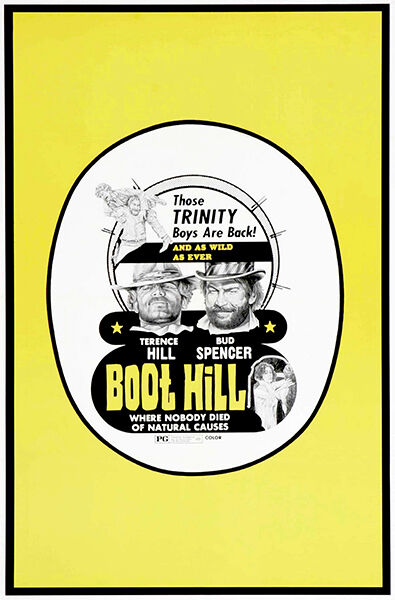
“Boot Hill”
The trailer for this 1969 Italian Spaghetti Western runs four minutes long, much longer than the average movie trailer we see in theaters today. It stars Terence Hill as Cat Stevens, but the trailer’s narrator refers to him as “the man with no name.” It also stars football great Woody Strode as Thomas, a man who is quick with a gun and out for revenge over the death of his son. Together, these two help the inhabitants of a gold mining community which is being oppressed by a criminal organization.
This is another trailer which has a male narrator emphasizing the movie’s violence, and it’s fun to hear him say how “Boot Hill” is a town “where death comes quick,” “where death comes hard,” and where “death comes in two colors.” Seeing Hill and Strode walk into town all serious and without a smile on their faces brings to mind how Jamie Foxx and Christoph Waltz roll into town in “Django Unchained.”
“Boot Hill” was actually the last film in a trilogy of movies directed by Giuseppe Colizzi, and it was preceded by “God Forgives… I Don’t!” and “Aces High.”
“Mandingo”
This 1975 film was based on the best-selling novel of the same name by Kyle Onstott, and it stars James Mason, Susan George, Perry King, Lillian Hayman, former boxer Ken Norton and pro-wrestler Earl Maynard. It takes place in the 1840’s where a plantation owner trains one of his slaves to be a bare-knuckle fighter, and there are some brutal scenes of bare-knuckle fighting to be found in “Django Unchained.” It makes me wonder if Tarantino based the character of Calvin Candie (played by Leonardo DiCaprio) on the ones played by Mason or King in “Mandingo.”
The narrator of this trailer describes “Mandingo” as being “the first true motion picture epic of the Old South,” but it’s a little hard to believe this as certain scenes appear to be very overwrought. The audience couldn’t help but laugh at the actress who told her lover “don’t kiss me yet, unless it’s just a cousin kiss” because the kiss which followed seems to be anything but a cousin kiss.
The movie version of “Mandingo” received a severe bashing from film critics like Roger Ebert, Leonard Maltin and Richard Schickel, all of whom gave it their lowest rating. Tarantino, however, said it represents one of only two instances in the last few decades where “a major studio made a full-on, gigantic, big-budget exploitation movie” (the other being Paul Verhoeven’s “Showgirls”).
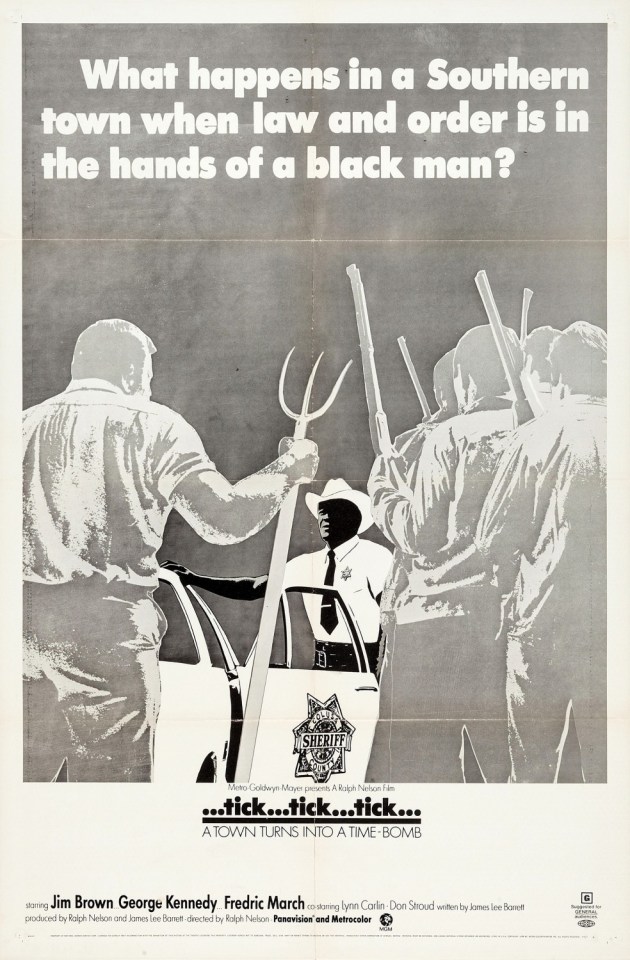
“…tick…tick…tick…”
Ralph Nelson’s 1970 movie stars another football great, Jim Brown, as Jimmy Price, a black police officer who has just been elected sheriff of a racially divided town in the American South. The fact he beat out the former Sheriff, a white man named John Little (George Kennedy), does not sit well with some of the townspeople. As the movie’s title and the endless ticking in the trailer indicates, the racial tensions will continue to rise until they boil over into a possibly fatal conflict.
“…tick…tick…tick…” has long since become a cult classic for its cutting-edge portrayal of racial tensions and its tense narrative, and of all the trailers shown before “Django Unchained” at New Beverly Cinema, this was the one the audience laughed at the least, if at all. It looks like it still holds up to this day regardless of the passing of time, and the way the white characters treat Jimmy doesn’t seem much different from the way Django is treated in “Django Unchained.” It’s especially cool to see Brown as a Sheriff because he has always had the appearance of someone who can clean up a town single-handedly.
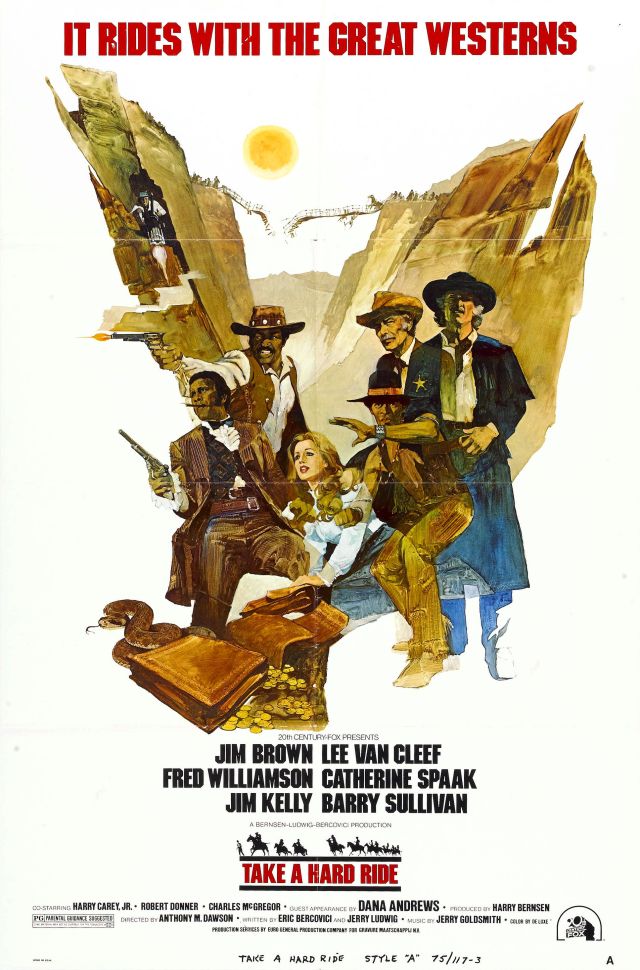
“Take a Hard Ride”
This Western from 1975 also stars Jim Brown as Pike, a rugged trail boss and former criminal who promises Bob Morgan (Dana Andrews) he will successfully transport $86,000 across the border to a ranch in Sonora, Mexico. Pike is forced to team up with a dishonest gambler named Tyree (Fred Williamson) for this mission, and they are soon being pursued by the ruthless bounty hunter Kiefer (Lee Van Cleef) and the corrupt sheriff Kane (Barry Sullivan).
The trailer for “Take a Hard Ride” made it look like a movie I really want to check out. Like “Django Unchained,” it is a mix up of the Blaxploitation and western genres and features one of the best casts a movie like this could ever hope to have. Brown and Williamson have always proven to be ultimate bad asses in whatever movies they appear in, and I love how the trailer’s narrator describes Cleef’s character as being “as sly as a rattlesnake and twice as deadly.” It was also great watching the scene where the cowboys and their horses crash down a hill because now I know where the filmmakers of “Young Guns II” got the idea for a similar scene.
After watching all these trailers and “Django Unchained,” it becomes clearer to see where Tarantino took his cues from as a writer and director. It also shows how brilliant he is at taking all the elements and turning them into a movie which is uniquely his own and not just an uninspired homage that pales in comparison to the films it inspired. “Django Unchained” proved to be a lot of fun, and the trailers which preceded it are for movies which look to be just as entertaining.
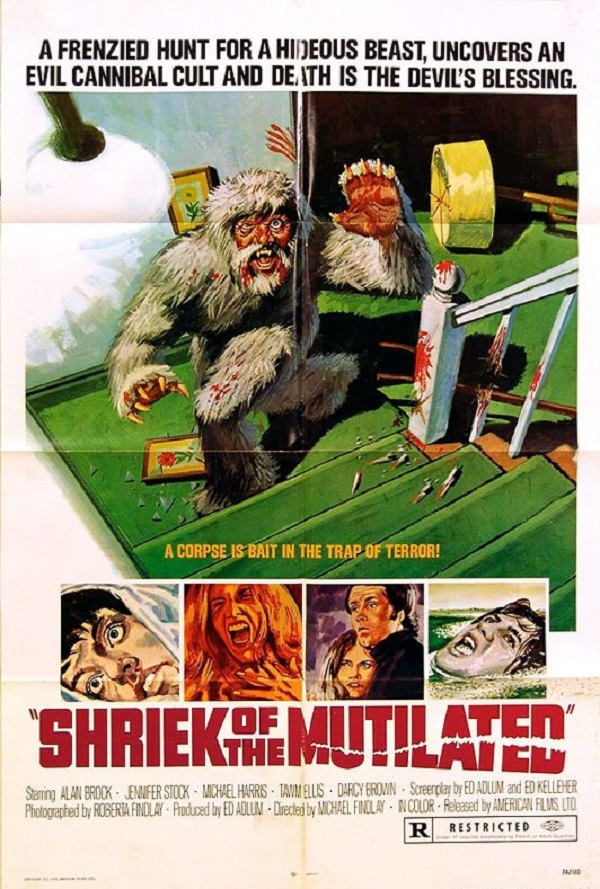
So said filmmaker Ed Adlum who introduced the screening of the 1974 cult horror movie he wrote and produced called “Shriek of the Mutilated.” This film played as part of a double feature along with another movie of his, “Invasion of the Blood Farmers,” for the Grindhouse Film Festival’s tribute to him at New Beverly Cinema back in September of 2012. Adlum also brought up a conversation his daughter Ingrid got involved in while she was a student at UC Irvine of what the worst movie ever made was. Ingrid said it was “Plan 9 from Outer Space,” but another student ended up saying:
“There’s one worse than that. It’s called ‘Shriek of the Mutilated.'”
“My father made that movie!” Ingrid said.
After Adlum’s introduction we watched “Shriek of the Mutilated,” and while it is far from brilliant to put it mildly, everyone in the audience had fun watching it. The movie even had the techno-pop song “Popcorn” by Hot Butter playing in a party scene, and listening to the song proved to be more exciting than the party. Brian J. Quinn, one of the programmers of the Grindhouse Film Festival, defended it by saying the worst movie ever made is a $100 million-dollar blockbuster which is a piece of crap, and “Shriek of the Mutilated” is certainly not that kind of movie.
“I don’t know about you but I had a ball,” Adlum told the audience after the movie had finished. “The thing isn’t as bad as I remember. The unintended laughs of which there were about 115 are really the best part of the picture. The things I can see that you can’t see like the guy wheeling Karen (Jennifer Stock’s character) into the room and banging into the door, I remember all of that stuff!”
There’s one moment where Lynn (played by Darcy Brown) is walking outside and picks up a broom and starts sweeping for no discernible reason before putting it back down. Adlum said it was “just a piece of business to do as she walked from here to there” and that “acting wasn’t essential” for anyone to be in this movie.
Adlum talked a bit about actor Alan Brock who played Dr. Ernst Prell, the professor who assembles a group of his students for a field trip to search for a dangerous creature known as a Yeti.
“Alan Brock was at one time a child star on film and hadn’t worked in years,” Adlum said. “He still lived with his mother and even though he was well into his 60s, he was so immature in that he had to be driven home every night instead of staying at the motel with all the other players and the crew. He had to be in his house and in his own bed, then I would pick him up in the morning and bring him back up to the woods (in Westchester County, New York) to do the film.”
The director of “Shriek of the Mutilated” was Michael Findlay, an exploitation filmmaker, and Adlum said the movie was his gift to Findlay for editing “Invasion of the Blood Farmers.” Adlum said he and Findlay were “fierce friends” as they “drank their brains out,” and he described him as knowing more about films than anybody else. For Findlay, “Shriek of the Mutilated” represented his chance to make a real movie as compared to the ones he was famous for like “Take Me Naked” or “The Touch of Her Flesh.”
Sadly, Adlum and Findlay had a big falling out at one point to where Findlay ended up calling Adlum a Nazi for some odd reason, and they didn’t speak again for years. Findlay died in 1977 on top of the Pam Am Building in New York City when a helicopter crashed and killed him and two other people. Upon hearing of his death, Adlum said he cried harder than when he found out his parents had died.
One audience member described “Shriek of the Mutilated” as starting off like a Bigfoot movie but then ends like a Manson cult movie, and he asked Adlum if this was always his plan.
“No, a lot of stuff was done on the fly and it kind of morphed into that,” Adlum said. “You think of stuff while you’re standing there. You may find a prop and work that into the film. Then when you’re all done with the picture and you’re editing it you say, these eight minutes is boring, let’s do something. So, you come up with what we call inserts, and sometimes inserts have nothing to do with the plot but they’ll make people go, oh!”
In talking about the music used in the movie, Adlum said it came from the Prague Philharmonic. This was back in the day of the Iron Curtain and the Eastern Bloc had no intellectual property rights with America, and America didn’t have any with them.
“I bought the record in the bargain bin, and I bought it for $2.98 with the express purpose of using it as background music in the movie” Adlum remembered. “The guy at the counter says to me, what are you doing with that? And I tell him and he says, well you better keep the receipt so that you can prove you have the rights!”
It also turns out Ivan Agar, the man who played the Indian Laughing Crow, was actually a chiropractor from Brooklyn, New York. Adlum said Agar had the funniest scene in the movie where a big line of drool comes out the side of his mouth, but this scene unfortunately didn’t make it into the final cut.
So yeah, “Shriek of the Mutilated” is not on the same level of filmmaking as Alfred Hitchcock’s “Vertigo,” but it was fun to watch even if we enjoyed for all the wrong reasons. It was a treat for us to hear Ed Adlum talk about its making, and you have to admire the sense of humor he has about the finished product. While he thought we would all head home after his Q&A, everyone stayed to watch “Invasion of the Blood Farmers” which showed just how much we appreciated him spending some time with us.
It was a role originally meant for Will Smith, but after watching “Django Unchained” it will be hard to think of any actor who could have played Django better than Jamie Foxx. The Oscar-winning actor came from the world of comedy where he has done hilarious work, but he continues to impress us with one terrific dramatic performance after another in films like “Collateral,” “Ali” and “Any Given Sunday.” The role of Django is one of the biggest and most challenging Foxx has taken on, and he convincingly takes this character from being a helpless slave to becoming a slick bounty hunter in splendid fashion.
When it comes to working with Quentin Tarantino, he’s always ready to show his actors movies they can base their characters on. Foxx was no exception to this, and Tarantino got him to watch Sergio Corbucci’s 1966 Spaghetti Western “Django,” a movie which serves as one of “Django Unchained’s” biggest inspirations. It starred Franco Nero as a coffin-dragging gunslinger who comes into town and gets caught up in a feud between the KKK and a bunch of Mexican bandits. While talking with Rebecca Murray of About.com, Foxx explained what impact watching “Django” had on him as well working with Nero who has a cameo in “Django Unchained.”
“I was like, wow, it was amazing. And then to actually have the original Django in the movie. I don’t know if you’ve ever met him but he was the biggest star on the set,” Foxx told Murray. “For him to give his blessing, and I think it really follows true to it and I think that’s what’s going to be the pleasant surprise to people, that it’s a Western and that it stays along the lines of a Western that happens to be in the backdrop of slavery. Slavery almost becomes secondary at a certain point because at the beginning it’s traditional, slave. Then once he becomes this bounty hunter, that’s the backdrop. Now it’s about revenge and about getting this girl, so he stayed true to that and that’s cinematic.”
While at the “Django Unchained” press conference, Foxx made it clear he was ever so eager to work with Tarantino on it. He had no qualms about playing a slave, and what attracted him to the role was Django’s uprising. Movies have always been an outlet for the artists who make them and the audiences that watch them, and Foxx explained what makes this one particularly cathartic.
“When you see movies about slavery…we never get a chance to see the slave actually fight back, actually do for himself, and in this movie there are a lot of firsts,” Foxx said.
Despite the fact it is a genre movie and a revenge fantasy of sorts, “Django Unchained” does deal with America’s dark history of slavery. Tarantino never sugar coats it for mass audience consumption, but then again, why should anyone? It’s an ugly part of the past we’d like to ignore, but it needs to be acknowledged so we can learn from it in the hopes of never repeating it again. As a result, the movie has been greeted with controversy over its subject matter and the frequent use of the n-word with many people (and not just Spike Lee) complaining loudly about it. But Foxx, in an interview with Keith Staskiewicz of Entertainment Weekly, said he is not surprised at the strong response “Django Unchained” has been getting and doesn’t think anyone else should be either.
“You know it’s going to be controversial!” Foxx told Staskiewicz. “That’s what’s been blowing my mind, people saying, did you know this was going to be controversial? It’s like, come on man! Did you read the script? Why would Quentin Tarantino do anything that wasn’t controversial? What movie of his have you seen where you went, oh, this is a Hallmark Movie and rated G? That’s not what you sign up for. You don’t sign up for that.”
Still, Foxx admitted it was a tough movie to make considering part of it was shot at the Evergreen Plantation in Louisiana. It was at this same plantation where slaves were made to work, and they suffered and toiled under brutal conditions. Being there must have been deeply unsettling for everyone involved in the movie’s making, and it certainly had a strong impact on Foxx which he wasn’t about to ignore.
“It’s tough shooting when you’re in plantation row and that’s where your ancestors were persecuted and killed, and we were respectful of that,” Foxx told Staskiewicz.
Regardless of the controversy, “Django Unchained” proved to be one of the most entertaining movies of 2012 thanks to Tarantino’s clever screenplay and direction, and also because of the sensational performances from the cast. Jamie Foxx can add Django to his roster of great screen roles in a career which still has many more to be revealed. Foxx also made a very good point about the film’s subject matter to Adam Edelman of the New York Daily News which people really need to think about.
“Every two, three years there is a movie about the Holocaust because they want you to remember and they want you to be reminded of what it was,” Foxx said. “When was the last time you seen a movie about slavery?”
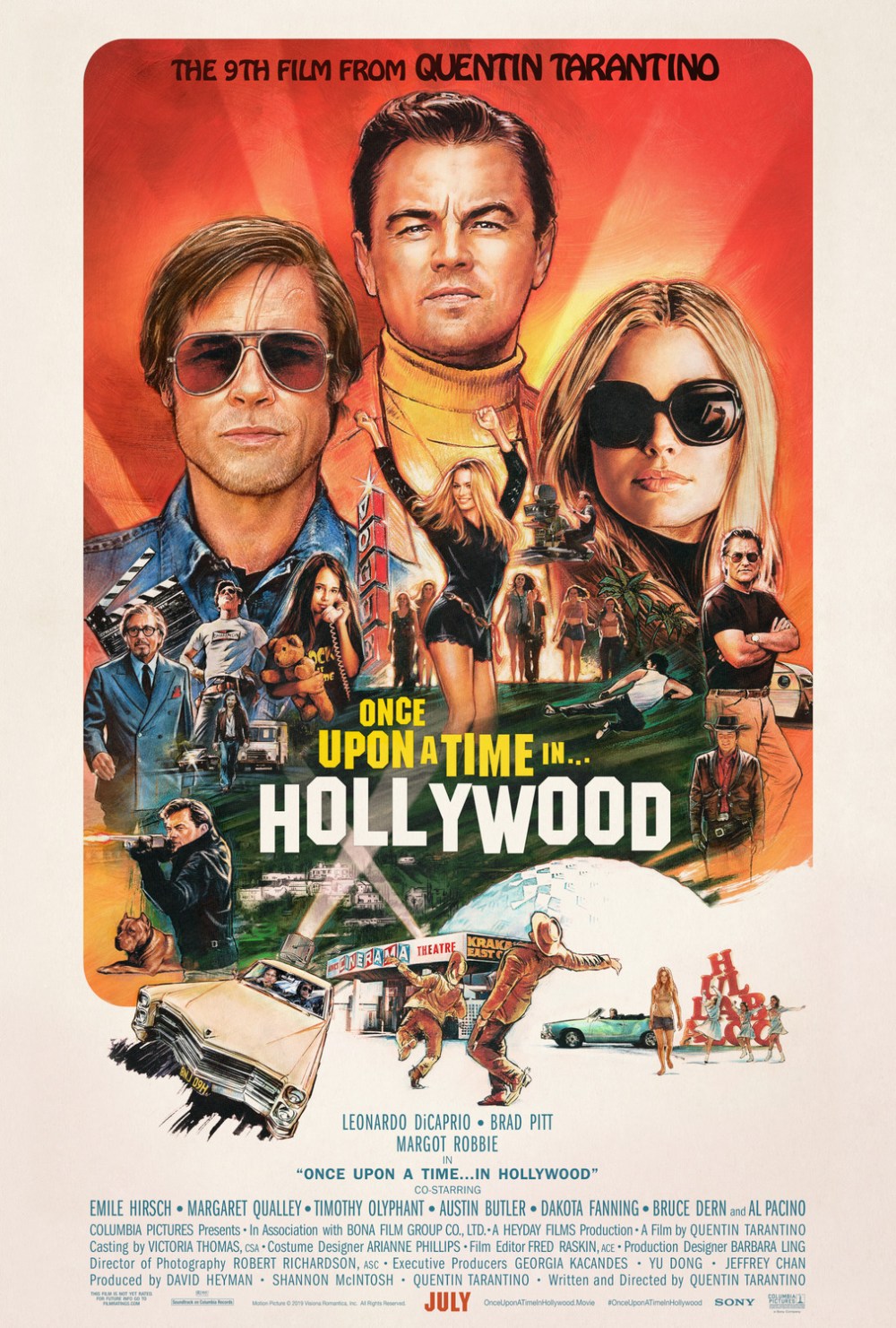
Quentin Tarantino once said he did not have an “Age of Innocence” in him like Martin Scorsese did, but after watching his 9th film “Once Upon a Time in… Hollywood,” I think he may be mistaken. Yes, it does have an R-rating like and features some truly brutal moments of violence where faces are literally pounded in, but this is largely a loving tribute to the Hollywood of the 1960’s and of the actors and filmmakers which inhabited it. Considering Tarantino’s attention to detail and his fetish for any kind of artifact from this era, I have no doubt he would have loved to have been a filmmaker back then if he could.
Tarantino and his longtime cinematographer Robert Richardson transport us back to the Hollywood of 1969 where we meet Rick Dalton (Leonardo DiCaprio), an actor and former star of a “Wanted Dead or Alive”-like television series called “Bounty Law.” After having a conversation with his agent Marvin Schwarzs (Al Pacino, more restrained than usual), he comes to see how washed up his career has become as he is reduced to doing guest spots as the villain on various television shows. The only person he can talk to about his troubles is his best friend and stunt double Cliff Booth (Brad Pitt) who is always around to have a drink with and drive him around town as Rick has had one DUI too many.
“Once Upon a Time in… Hollywood” is kind of like a Robert Altman film in that it doesn’t have a straightforward plot. Instead, it acts as a day in the life story as we watch Rick Dalton try to move on with his acting career as an important decision hangs over him, whether or not to move to Italy where he can star in low budget spaghetti westerns. When the story isn’t focused on him, it focuses on Cliff who seems content to live in a trailer out in Van Nuys with his dog who is a bit annoyed at him for serving him the kind of dog food which slides out of its steel can as if it were pure slime.
The only thing Rick seems fairly excited about these days is the fact Roman Polanski and Sharon Tate now live next door to him in the Hollywood Hills. But looming in the background is Charlie Manson and his cult of followers who look at first to be harmless hippies, but they later reveal themselves to be devoted to him in a most unhealthy way. Those of us who are familiar with history, and who have a deep respect for historical facts, know Sharon Tate and others were murdered by Manson’s followers, and that this shocking act all but ended the era of love and peace irreparably. But as I watched this film, I began to wonder if Tarantino would stay true to history, or if he would play around with it as he did in “Inglourious Basterds.” Whatever the case, the presence of Manson and his cult cast an ominous shadow over the proceedings, so we know the end of this story will not be the least bit pretty.
Watching “Once Upon a Time in Hollywood” reminded me of how much I love it when a filmmaker sucks us right into another time and place to where we don’t doubt the accuracy and attention to detail. Cameron Crowe did this with “Almost Famous,” Paul Thomas Anderson did wonders with the 70’s and 80’s in “Boogie Nights,” and Tarantino does the same as he brings us right back to 1969 with wonderful abandon. All the famous landmarks of Hollywood are here including the Cinerama Dome, Musso & Frank Grill, El Coyote Restaurant and the classic movie theaters located in Westwood. New Beverly Cinema can be seen from a distance as it is shown having a premiere for an adult film, and this was back when it was a porno theater.
This attention to detail also includes the kind of beer these characters drank, the type of books they read, television antennas and cars. This was back in a time when people smoked an endless number of cigarettes, drove and sat in cars without having to wear seatbelts, and when love and peace was in the air even as wars were being waged overseas.
It is great fun to see DiCaprio in this kind of role after seeing him be so serious in “The Revenant,” a movie which earned him the Oscar he should have received for “The Wolf of Wall Street.” He’s a gas here as he makes Rick Dalton into a study of desperation as he struggles to maintain what’s left of his image and berate himself while alone in his trailer. The scene he has with a child actress played by the wonderful Julia Butters is a special highlight as she shows him the kind of innocence and love of acting he once had before life, alcohol and a corrupted world view clouded his perception.
As I have said in the past, I love it when Pitt gets down and dirty in a role, and he does just this as Cliff Booth. In addition to being Rick’s stunt double, he is also a Vietnam veteran, and the violence he inflicts on others who wrong him can be described at the very least as punishing. Pitt also proves to be as funny as DiCaprio from scene to scene, and he has a classic scene opposite Mike Moh who is pitch perfect as Bruce Lee in which I saw something I never thought I would see or believe, someone getting the best of Bruce Lee.
But one performance I really need to single out here is Margot Robbie’s as Sharon Tate. While at the Cannes Film Festival, someone asked Tarantino why he didn’t give Robbie the same amount of dialogue he gave DiCaprio and Pitt. I don’t remember who asked this question, but whoever it was, they completely missed the point. It’s not always dialogue which aids a performance. Sometimes it’s just a look or an attitude, and Robbie gives off a look or two which is more than enough to capture the essence of Sharon Tate as well as her beguiling innocence.
Tate has long been relegated to history as one of the Manson family’s murder victims, but she deserves to be known for much more. As Robbie sits in a Westwood movie theater watching a movie Tate co-starred in, we are reminded of a talent which was taken away from this world far too soon, and it makes me want to check out everything Tate ever appeared in. Robie does a fantastic job of reminding us how fun it is to see ourselves, let alone our name, on the silver screen as others look on, unaware of who is sitting next to them in the audience, and she is as radiant as Tate was in her far too brief lifetime.
There are so many familiar actors worth singling out here, but some of them you may not see coming and I am not about to spoil any surprises this film has to offer. I will say it’s always a delight to see Kurt Russell in anything and everything, and he is great as a stunt coordinator who is not quick to warm up to Cliff. Margaret Qualley is a memorable presence as Pussycat, a member of the Manson family who does warm up to Cliff. Bruce Dern, in a role originally meant for the late Burt Reynolds, is fun to watch as George Spahn, a man whose ranch was used for many westerns and which later got used by Charlie Manson and his demented followers. And it is quite bittersweet to see the late Luke Perry as it is the last feature film he will ever appear in.
Seriously, as rough and tumble as “Once Upon a Time in Hollywood” gets, it really is a love letter to a Hollywood which time will never forget. As Tarantino nears the end of his long filmmaking career (or so he says), he continues to give us one enthralling motion picture experience after another. Even if his works threaten to be undone by self-indulgence, I am glad people are thoughtful enough to give him the freedom to make what he wants to make. If Tarantino ever had it in him to give us a fairy tale, this would be it. Even as its main characters threaten to be forever swallowed up by bitterness and cynicism, there is a light of innocence which helps lead them to the next stage in their lives. And if this film is any indication, this is time in Hollywood which Tarantino wishes lasted longer than it did.
Now, as with any Tarantino film, I have to go out and buy the soundtrack and then watch it again. And one other thing, I almost didn’t recognize Timothy Olyphant. Did you? Oh yeah, and sauerkraut will never be the same.
WRITER’S NOTE: This review was originally written in 2012.
Every time Quentin Tarantino releases a new movie, a celebration should be in order. The man loves movies like many filmmakers do, but he always succeeds in manipulating genre conventions to where he can freely make them his own, and this makes his works all the more thrilling. There’s also no beating his dialogue which exhilarates us in the same way a play by David Mamet can, and words in a Tarantino movie usually prove to be every bit as exciting as the action scenes. His latest movie “Django Unchained” is no exception, but it does suffer from some of his excesses which have taken away (if only slightly) from the films he has given us in the past. But if you can get past its flaws, you are still in for a very entertaining time.
Jamie Foxx stars as the Django of the movie’s title, and it takes place in the year 1858 which was just two years before the start of the Civil War. Django is being led through the freezing cold wilderness along with other slaves when he is freed by Dr. King Schultz (Christoph Waltz), a dentist who has since become a bounty hunter. King needs Django’s help in finding the Brittle brothers, ruthless killers who have a sizable price on their heads. In return for Django’s help, King promises him he will help rescue his wife Broomhilda (Kerry Washington) from slavery. She is currently in the hands of the charismatic but viciously brutal plantation owner Calvin Candie (Leonardo DiCaprio), and you know this will lead to a conclusion which will be anything but peaceful.
Tarantino always loves to mix genres, and he does this brilliantly with “Django Unchained.” On the surface it is clearly a western, but the “Pulp Fiction” auteur also combines it with the Blaxploitation genre which we all know is one of his favorites. Heck, we even get to meet the ancestors of John Shaft, the black private detective made famous by Richard Roundtree in the movie “Shaft.” Just as he did with “Inglourious Basterds,” Tarantino gleefully throws caution to the wind as he subverts both genres to create an exhilarating motion picture experience few other people can give us. He’s not out to make a historically accurate movie, but we’re having too much fun to really care.
Now many people including Spike Lee have complained about Tarantino’s overuse of the n- word in this movie as they have of other films he’s made in the past. In their eyes it’s like they’re saying Tarantino revels in the racist behavior of his characters, but I don’t think that’s even remotely true. All the insanely racist characters in “Django Unchained” end up getting their asses handed to them in the most painful way possible, and while Tarantino’s love of black culture might differ a little from others, the love is there all the same.
And again, Tarantino gives us a terrific soundtrack filled with many songs which are not from the time period this movie takes place in. I love how he complements scenes of Jamie Foxx and Christoph Waltz riding on their horses with songs by James Brown, John Legend and Brother Dege (AKA Dege Legg) among others. He also includes pieces of film scores by Ennio Morricone and Jerry Goldsmith for good measure, and there are even original songs to be found here as well, something exceedingly rare for a Tarantino movie.
Having said all this, the length of “Django Unchained” did drive me up the wall a bit. At a time where filmmakers push the limit and have their movies run longer than two hours, Tarantino proves to be one of 2012’s biggest sinners as this one clocks in at almost three hours and threatens to have as many endings as “The Lord of the Rings: The Return of the King.” Suffice to say, this movie could have been shorter. Perhaps it’s the absence of his longtime editor, the late Sally Menke, who was always good at reigning Tarantino in. Fred Raskin, who has edited the last three “Fast & Furious” movies, was the editor on this one.
Still, there is a lot to appreciate and enjoy about “Django Unchained,” especially the acting. Jamie Foxx has proven to be a terrific actor ever since he held his own opposite Al Pacino in Oliver Stone’s “Any Given Sunday,” and his talent doesn’t waiver in the slightest here. As Django, he gives us a western hero who has earned the right to seek vengeance for what has been done to him, and he is thrilling to watch as he makes this character a shockingly bad ass bounty hunter by the movie’s conclusion.
Christoph Waltz brings a wonderful mirth and a unique liveliness to the exceedingly violent characters he plays, and his role as dentist turned bounty hunter Dr. King Schultz is further proof. It’s fun to see him be so charming to others only to watch him blow them away when the occasion calls for him to do so. Waltz more than earned the Oscar he received for his brilliant performance in “Inglourious Basterds,” and his work in “Django Unchained” proves he is a gifted actor who is here to stay.
Leonardo DiCaprio clearly relishes the opportunity to shed his heartthrob persona to play the charming yet undeniably evil plantation owner Calvin Candie. In a year which has had a large number of unforgettable villains, Calvin is one of the most vicious as his power and wealth has turned him into a raving sociopath who has little hope of finding redemption in his lifetime. DiCaprio is enthralling to watch as he taunts everyone around him with a twisted glee, and he looks to be having loads of fun in playing a character few others would have chosen him to play.
One standout performance which really needs to be acknowledged, however, comes from Samuel L. Jackson, an actor who has played parts both big and small in Tarantino’s movies. Jackson plays Calvin’s head slave Stephen who is the Uncle Tom of “Django Unchained,” and he makes you want to hate his racist, backstabbing character with a passion. Jackson gives a spirited performance as a man who freely betrays the principles he should be standing up for in order to benefit his own desires and keep himself safe in a time where he is anything but.
Kudos also goes to Kerry Washington who plays Django’s kidnapped wife, Broomhilda. Her character suffers many indignities, and Washington makes her pain and fear so vivid to where she leaves you on edge every time she appears onscreen. The moments where she has no dialogue are among her most powerful as her eyes threaten to give away the secrets she is desperate to keep hidden.
Seriously, this movie is filled with actors we know very well, and they keep popping up here when you least expect them to. You have Don Johnson playing plantation owner Spencer ‘Big Daddy’ Bennett, you have Jonah Hill as Randy, a bone-headed KKK member who can’t seem to fix his hood properly, you have Walton Goggins playing an unapologetically vicious cowboy who enjoys the torture he inflicts upon others, and you have Dennis Christopher as the flamboyant Leonide Moguy. If you watch real closely you can also see Zoë Bell, Robert Carradine, Franco Nero, M. C. Gainey, Bruce Dern, Tom Savini, Michael Parks and John Jarratt pop up in roles which would seem small if they were played by anybody else. It’s all proof of how there are no small roles in a Tarantino movie, and all these people are clearly thrilled to be in his company.
Tarantino also has a small role as a mining company employee. While I have no problem defending him as an actor in some movies, his Australian accent could use a bit of work, and that’s being generous.
I’m not sure where I would rate “Django Unchained” in comparison to Tarantino’s other films, but I have to say I enjoyed “Inglourious Basterds” more. This movie’s nearly three-hour length took away from my overall experience, but I can only complain about it so much. When it comes to movies, Tarantino still provides audiences with the kind of enthralling entertainment which never plays it safe.
While it’s far from perfect, “Django Unchained” is a thrillingly alive movie filled with great acting, terrific dialogue and incredibly bloody gunfights Sam Peckinpah would have gotten a kick out of. If you can withstand its excesses and know what you are in for when it comes to a Tarantino movie, you are still bound to have a great time watching it.
WRITER’S NOTE: This review was originally written in 2009.
“Nazis, I hate these guys!”
-Harrison Ford from “Indiana Jones and the Last Crusade”
“You know somethin’, Utivich? I think this might just be my masterpiece.”
-Brad Pitt as Lt. Aldo Raine
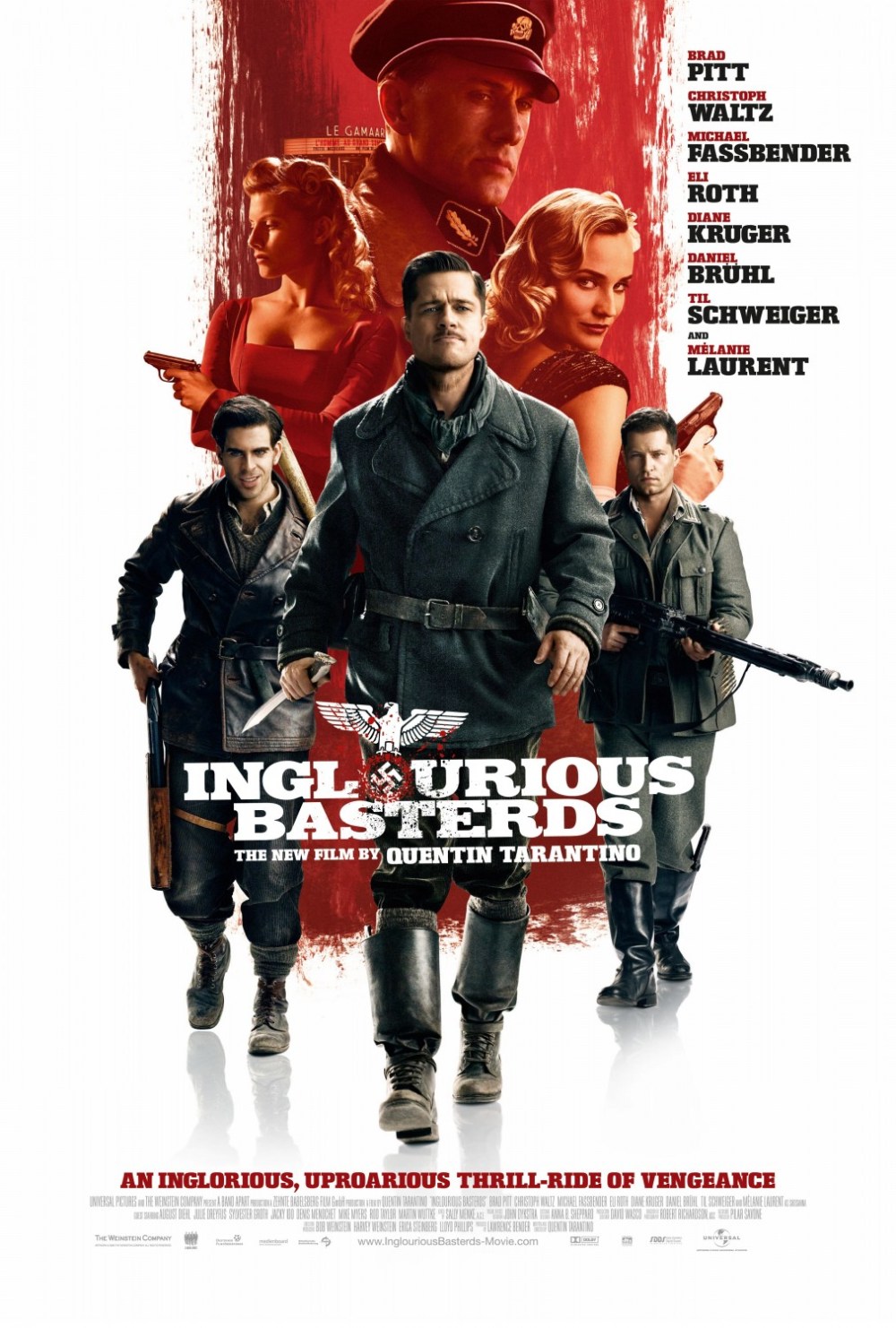
Could this truly be Tarantino’s masterpiece? Hard to say, but it is indeed his most ambitious movie to date. “Inglourious Basterds” is another brilliant love letter to all things cinema from Quentin Tarantino, and it ends the rather crappy 2009 summer movie season on a high note. With this film, Tarantino has created his own version of World War II and has given it an ending many of us would have preferred to have seen happen. It is also his tribute to movies like “The Dirty Dozen” and other war movies of its ilk. It is not a remake of the film of the same name, but it uses the same title out of respect.
“Inglourious Basterds” is told in a series of chapters, and it features several different threads of story which eventually intersect at the film’s fiery climax. We meet our chief Nazi villain, Col. Hans Landa (Christoph Waltz) as he questions a family as to whether or not they are hiding any Jews, but we soon realize he is asking questions he already knows the answers to. Then we are introduced to the Basterds themselves, and they are led by Lt. Aldo Raine (Brad Pitt) who announces that they are being dropped into Nazi occupied France to do one thing and one thing only, kill Nazis. Not only that, they plan to take souvenirs to show the Nazis they mean business. Then we meet Shosanna Dreyfus (Melanie Laurent), the only Jew to escape Col. Landa’s deadly grasp, and she has since found a safe hiding place as the owner of a German cinema which will soon host the most powerful members of the Nazi party for a film opening gala. Little do they know of the act of brutal vengeance which will eventually greet them…
At a running time of 153 minutes, “Inglourious Basterds” is one of those rare movies which really takes its time. There’s no big rush to get from one big action set piece to the next which is usually case with just about every summer movie released from one year to the next. Even while The Weinstein Company had to work with Universal Pictures to get this film made, Tarantino still gets full creative control which is a blessing for those of us who love his films. We also get the great dialogue we have come to expect from him, and there are moments where words speak louder than actions. There are many verbal duels between characters as each one tries to outdo the other, and what is implied by them ends up generating an amazing amount of tension.
Tarantino also retains a keen eye for casting, and he has said one of the actors he chose did in fact give him back his movie. That actor would be Christoph Waltz who plays the intelligent but deadly Col. Hans Landa. Waltz won the Best Actor award at this year’s Cannes Film Festival, and the way I see it, they should just hand him the Oscar come next March. Brilliant seems too subtle a description to describe his performance. His role is an extremely difficult one to pull off because he has to come off a certain way while allowing us to see in his eyes what he already knows. Waltz comes off with simple gestures which leave us deeply unnerved, and there is a key moment where he deals with a character that serves as a great cat and mouse moment as he tries to figure out the person he sees before him while she tries to remain calm and hide who she really is from him. Waltz’s opening scene with the French farmer is remarkable in how he psychologically tears him down to where he finally admits he has no choice and reveals what Landa already knows.
I’m not sure if I have seen Waltz in other movies before this one, but I look forward to seeing more of his work in the future. Seriously, his character is to “Inglourious Basterds” as Heath Ledger’s Joker was to “The Dark Knight.”
Then we have Brad Pitt who I am glad to see get down and dirty after being all cute and cuddly in “The Curious Case of Benjamin Button.” As Lt. Aldo Raine, he starts off by giving a speech to his men which makes him come off like George C. Scott in “Patton.” It is clear Pitt is having a ball playing this character and saying the dialogue Tarantino has written, and he looks to have saved some of the manic energy he had in “Burn After Reading” for this role. While performance at times comes close to caricature, he has us rooting for Aldo throughout.
Tarantino also continues to be great at writing strong roles for women. Mélanie Laurent does great work here as Shosanna Dreyfus, the Jewish woman who is the only survivor of Landa’s murderous rampage. Throughout the movie, she goes from playing it cool around the Nazis to being terrified as she comes under close examination from them. She has managed to maintain her cover as a German while running her own cinema, and she also has to fend off the advances of Pvt. Fredrick Zoller (Daniel Brühl) who is something of a pop star in the Nazi party when he meets her. She also has a strong relationship with her boyfriend projectionist, Marcel (Jacky Ido), which allows her to show compassion she would otherwise have to keep hidden from the prying eyes of those out to eliminate Jews. Laurent gets to portray many different facets of her character throughout the movie’s running time, and her performance is every bit as memorable to me as Waltz’s was.
I also got a big kick out of Diane Kruger’s highly entertaining performance as film star Bridget von Hammersmark, a Marlene Dietrich type. Kruger is a wonderful presence as she goes from being an outgoing actress who always seems to enjoy the company of others to a tough woman who shares in the Basterds passion of doing in the Nazis, most especially Hitler. Best known for her work in “National Treasure” and “Troy,” she really comes into her own here.
“Inglourious Basterds” has a great cast overall with other memorable turns from actors like Michael Fassbender as a British spy posing as a German officer, and Sylvester Groth who portrays the irrepressibly snooty Joseph Goebbels. It’s also a hoot to see Mike Meyers here in a “guest starring” role as a British general, and it almost fully makes up for the mess he inflicted on us with “The Love Guru.” Eli Roth, the so-called “torture porn” director, is also on board as Sgt. Donny Donowitz, aka “The Bear Jew.” Although this role was originally intended for Adam Sandler, it almost makes sense the “Hostel” director would play a soldier who beats Nazis to death with a baseball bat.
Many of Tarantino’s favorite movie devices are on display here including the “Mexican standoff” and endless talk about movies, but here they feel much fresher and exhilarating to watch. The scene in the German bar where a Nazi soldier is celebrating the birth of his son may seem a bit too long, but Tarantino builds the scene to a fever pitch of tension as everyone has their gun on the other, and you watch in terrifying anticipation as to who will shoot first. With the character of Shosanna, he takes the time to express his love of foreign cinema. In his other movies, especially the “Death Proof” portion of “Grindhouse,” he mostly speaks of his affection for American movies and pop culture, but his love of cinema never stops there.
Tarantino also gives us another great soundtrack which is a collection of film scores from other movies, and of songs capturing the essence of his characters to the letter. Interestingly enough, much of the music is not from the WWII period, and he even uses David Bowie’s theme song from Paul Schrader’s 1980’s “Cat People” remake to perfectly capture Shosanna in her final preparations for her much deserved revenge. As with the “Kill Bill” movies, he makes effective use of the film scores of Ennio Morricone who remains a big influence on his own work. It didn’t take me long after seeing the movie to buy the soundtrack, but I do wish it was on sale.
Many will complain of how inaccurate this film is to the historical facts of WWII, but they are just wasting their time. We should all know by the time we head into the theater that Tarantino is not out to be anymore as historically accurate as Michael Mann was with “Public Enemies.” Every once in a while, you need a movie which breaks the rules, and it is such infectious fun to see “Inglourious Basterds” break down the normal conventions of the typical WWII movie. So many of them over the past couple of years tend to be depressing affairs which deal with the humanity lost, but Tarantino is out to do the exact opposite. “Inglorious Basterds” is a fantastic genre movie which borrows from many movies, and he is still genius at taking elements from them all and making them his own.
2009 has been a bad year for movies thus far, but “Inglourious Basterds” is one of the best and is yet another cinematic triumph for Tarantino as it shows he is no one trick pony. I just hope we don’t have to wait another 6 years for his next film.
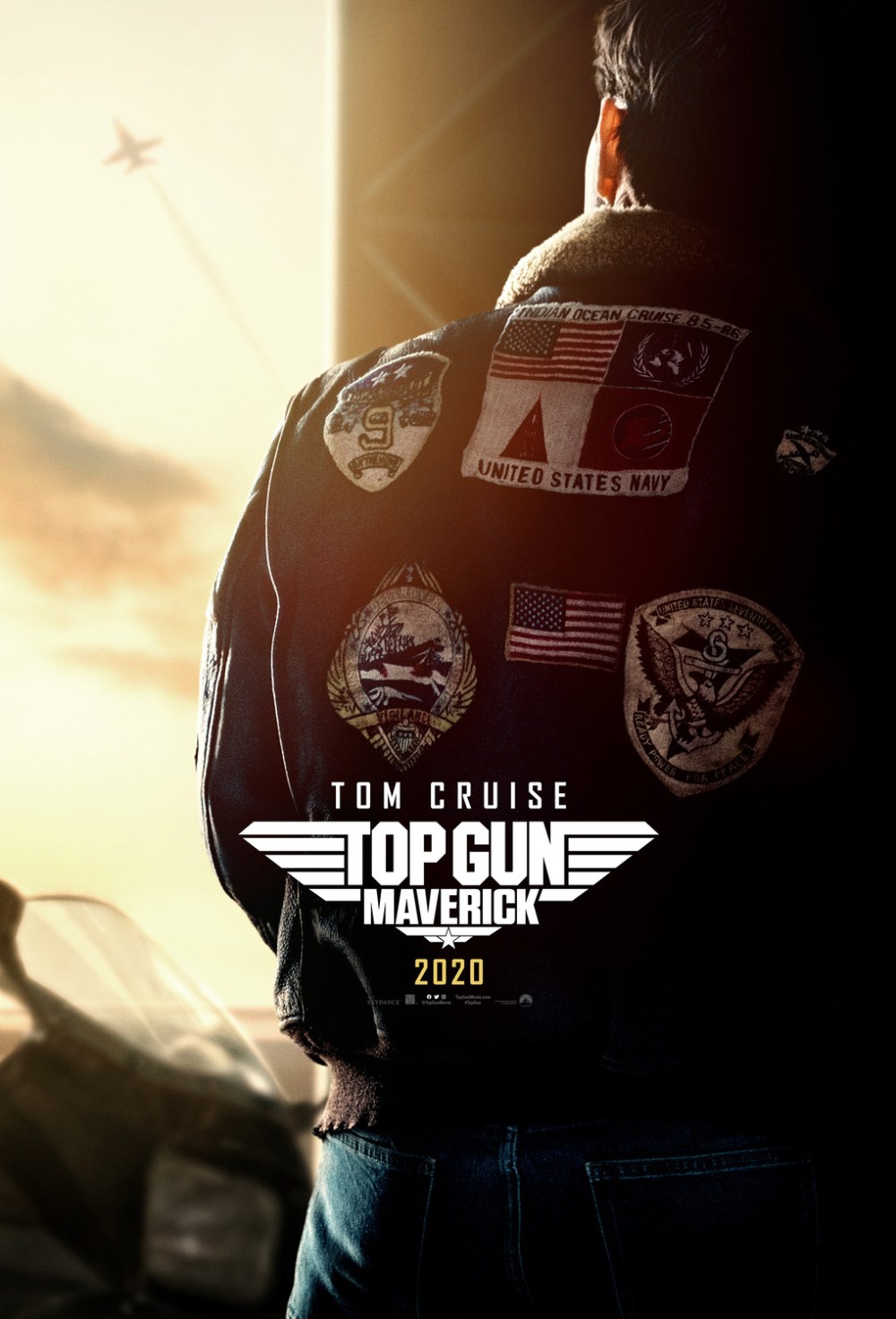
The thought of a “Top Gun” sequel was laughable years ago as Tom Cruise had little reason to do a sequel to any of his films. Seriously, it seemed as likely as him doing a sequel to “Cocktail” which, while a big hit at the box office, was not exactly a critical darling. But in recent years, any movie he stars in which doesn’t have “Mission: Impossible” in its title has failed to make much of a dent at the box office, and perhaps this is why he has chosen to finally revisit his superstar-making role of Pete “Maverick” Mitchell 34 years after the original was released. Whatever the case, its first trailer honestly has me very excited for it.
From this trailer, we learn Maverick is still a Captain instead of a military general, meaning he is still unsafe and quite dangerous in the cockpit of an airplane. Whereas James Tolkan chewed him out in the original, another bald military general played by Ed Harris (give this man an Oscar already!) berates him for not allowing himself to get promoted. When we finally get our first look at Cruise here, it looks as though he hasn’t aged much since 1986, and he still has that shit-eating grin which drives everyone crazy in ways both good and bad.
What struck me most about this “Top Gun: Maverick” trailer was its flight scenes as director Joseph Kosinski, who previously directed Cruise in “Oblivion,” makes us feel like we are in the cockpit with Maverick as he takes off from an aircraft carrier in the middle of an ocean. This reminded me of how exhilarating the flight sequences from the first “Top Gun” were, and this sequel looks to have even more of them.
From there, we get glimpses of characters such as Bradley Bradshaw (Miles Teller), son of the late Nick “Goose” Bradshaw (Anthony Edwards), and he looks to be as buff and as musical as Cruise, Edwards, Val Kilmer and Rick Rossovich were in the original. Yes, there looks to be another volleyball game in store for us in which we discover how the men look without their t-shirts on.
We also see glimpses of Jennifer Connelly as Maverick’s love interest who is said to be a single mother and the owner of a bar. My guess is Kelly McGillis does not appear in this sequel as she seems determined to remain retired from acting.
Val Kilmer is also set to return as Tom “Iceman” Kazansky, but we do not see him in this trailer. I read somewhere that his Iceman is now a Vice Admiral, and I’m guessing he will still be teasing Maverick about who is going to be whose wingman.
I am also gratified to know Harold Faltermeyer is back to score this sequel, and he will be doing so along with the great Hans Zimmer. You can hear Faltermeyer’s score throughout this trailer, and it is an immediate reminder of how much it drove the action and emotion of “Top Gun” back in 1986. I can already see myself buying the soundtrack to this sequel when it arrives in theaters in the summer of 2020. Heck, I might buy the soundtrack before this sequel is released.
That’s the other thing; “Top Gun: Maverick” is being released in 2020, exactly one year from now. I know Hollywood is always serious about securing release dates for movies way ahead of time, but showing us trailers for movies which will not be released for another 12 months seems unnecessarily torturous. Remember when we got the first trailer for “The Matrix Reloaded” and “The Matrix Revolutions?” It got audiences excited as hell and yelling out with joy as soon as those green digits started descending from the top of the silver screen. This was back in 2002 when the trailer was shown before “Star Wars Episode II: Attack of the Clones,” and it ended with “2003” on the screen. As thrilled as we were with the continuation of “The Matrix” franchise, seeing the date of when the first sequel was to be released had us groaning in frustration all too loudly.
At least here, Paramount Pictures tells us “Top Gun: Maverick” will be coming out in 2020 in the middle of the trailer instead of at the end of it. After all these years, Hollywood has remembered they can tease audiences only so much before foolishly risking our wrath.
“Top Gun” may have received mixed reviews upon its release as the aerial footage proved to be more exciting than when the characters were on the ground, but damn it was an entertaining flick. A nice wave of nostalgia passed over me as I watched this first trailer for “Top Gun: Maverick,” and I patiently await its release next summer. And who knows, maybe Quentin Tarantino will come up with another memorable examination of how this sequel depicts a man’s continuing struggle with his homosexuality just as he did previously in “Sleep with Me.”
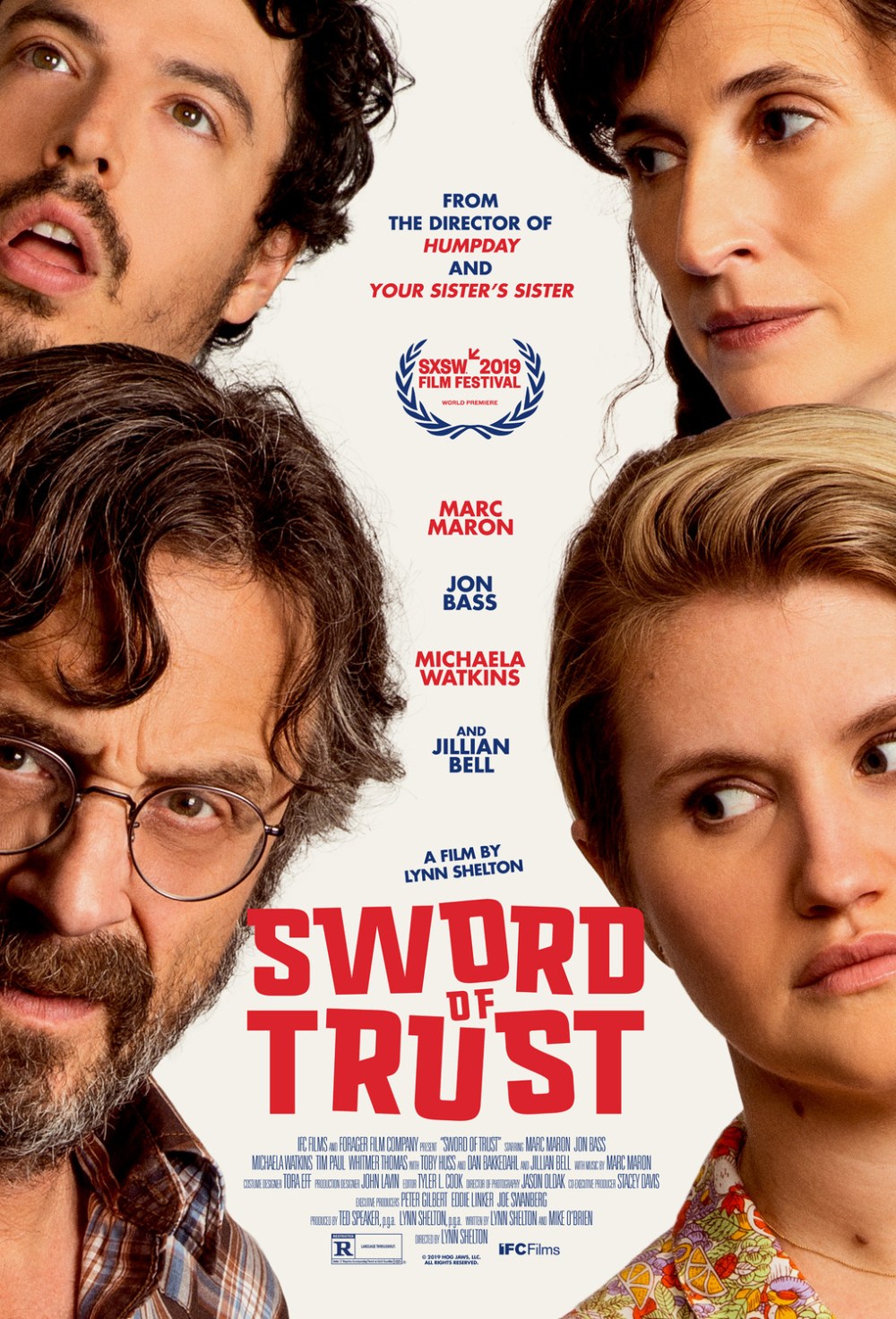
While driving over to a screening of “Sword of Trust.” I ended up in a fender bender which succeeded in ruining my mood for the rest of the day. As a result, I came into this movie wondering if I could look at it objectively as my mind kept going back to the unfortunate incident, and I was fuming at how I could not change what just happened. Well, it’s a good thing I waited a couple of days to write this review on it as my mind is clearer than it was previously. “Sword of Trust” at times feels like a half-realized film, but I did enjoy it and admired the intent of its filmmaker and cast to give us something character driven in a time when cinema is still infinitely dominated by superhero and comic book movies.
We meet Cynthia (Jillian Bell) and Mary (Michaela Watkins), a loving couple who arrive in Alabama to collect Cynthia’s inheritance from recently departed grandfather. They both think they will gain ownership of his home, but they discover it is wrapped up in reverse mortgages which means the bank owns it and is not about to give it up. Don’t you love that? Even if you read the fine print, you and your family members can ever so easily get screwed out of home ownership as greed remains king.
Anyway, Cynthia instead inherits a Civil War era sword, and it comes with a set of letters which prove that it was the South which actually won the Civil War. As a result, the two take the sword to the nearest pawn shop which is run by the cantankerous curmudgeon Mel (Marc Maron) who is quicker to cheat his customers out of the best deal possible for his own capitalistic gains. However, when his man-child employee Nathaniel (Jon Bass) stumbles across a You Tube video in which an overzealous conspiracy theorist appears more than willing to pay thousands of dollars for Civil War artifacts, these two men quickly become very interested in selling this sword to the highest bidder.
I enjoyed how the characters in “Sword of Trust” show themselves to be more capitalistic than they initially realize. Mel initially shuts down Cynthia’s and Mary’s attempt to sell him their sword, but when he shows a renewed interest in it, the two women are not about to be cheated out of any money. Unlike certain people, they refuse to believe Paramount Pictures has yet go profit on the Eddie Murphy comedy “Coming to America,” and they are not about to be swindled out of any substantial profit they are entitled to.
From there, the story moves in unpredictable directions as these four characters attempt to sell the sword to those conspiracy theorists, and I had no idea of where things were going to go which made this film especially entertaining. Considering the depressing rise in white supremacy in the United States of America, I started to believe “Sword of Trust” would descend into an abyss of racism, greed and selfishness. Does it? I refuse to say.
What I can tell you is “Sword of Trust” deals with characters who are more like us than we may initially realize. As they are driven to an undisclosed location in the back of a truck with no windows, they come to reveal things about themselves which no one is quick to another without some level of trust. This scene made me like this movie even more as these characters could have easily been passed off as types instead of individuals who slowly reveal share who they really are to complete strangers.
Directing this movie is Lynn Shelton who co-wrote the screenplay with Mike O’Brien, and she allowed her cast to improvise in a way which has us wondering how everything will turn out. “Sword of Trust” looks to be a cinematic experience we have seen far too many times beforehand, but it is filled with humanity and some strong laughs throughout. Even though it may very well get swept away by the latest summer blockbusters such as the live-action version of “The Lion King,” I think it is worth checking out for those who are looking for something a little different.
All the actors really commit to the material, and it is great fun to watch Watkins and Bell work off of one another throughout. It’s also fun to watch Bass fumble about as Nathaniel, a man-child who has made the mistake of believing in the wrong things to where his mind threatens to be permanently warped. Then again, his character does represent a growing portion of Americans who have somehow led themselves to believe the earth is flat (newsflash, it isn’t).
But the real star by far of “Sword of Trust” is Marc Maron. I have become a big fan of his after watching his IFC show “Maron” and listening weekly to his podcast “WTF.” Having seen and heard him in various formats, it is tempting to say he is simply playing a version of himself as Mel, but that isn’t really fair. Just watch as he tries to keep his guard up when his ex-girlfriend Deirdre (played by Shelton) visits his store; his inability to say something right away speaks volumes. Whether it is that scene or the one in the back of the truck, Maron has proven himself to be a strong actor as he is able to say many things without uttering a word, and it is an example of why he is having a career renaissance which has allowed him to star on the Netflix series “GLOW” and have a co-starring role in the upcoming film “The Joker.”
In addition, Maron also provides the music for this film, and his guitar helps to illustrate the complicated lives of each character and of the absurdity of their current predicament. Whether or not it will have you crying out “Boomer lives” while in the movie theater is another story.
“Sword of Trust” isn’t a great film, but it is an entertaining and absorbing one which I admired. Its resolution is a little pat, and some of the character twists feel a little too manipulative and fly in the face of easy logic, but I did admire what each cast member was able to bring to the material, and their performances alone make this worth a look.
It’s sad to see movies like this get such a short shelf life. Character driven motion pictures are not as prevalent in today’s cinematic landscape as they once were. I am always waiting for things to circle around back to where these kinds of movies will become more popular again, but it looks like we still have a long, long way to go to get there. Still, we have filmmakers like Lynn Shelton around who continue to buck the Hollywood trends, and this is better than nothing.
Now, back to my damaged car… Dammit.
* * * out of * * * *
“Sword of Trust” will be playing at the Nuart Theatre in Los Angeles, California thru July 25, 2019.
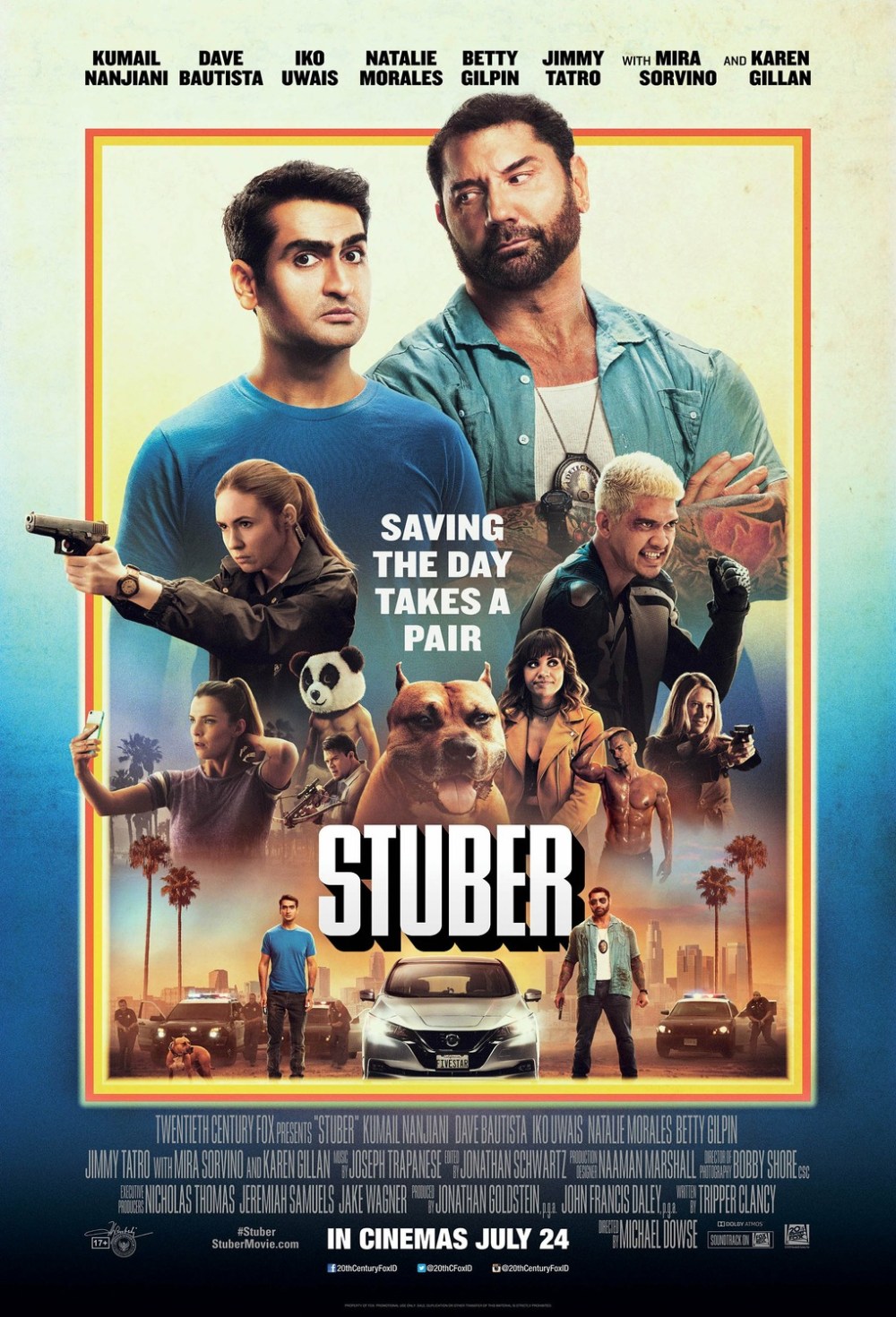
“Stuber” feels like an overdue return for me to action comedy genre. Seriously, it feels like I have been away from this particular genre for far too long. While there may have been many action comedies/buddy movies released in recent years, I cannot help but feel like the last one I bothered to watch was 2010’s “The Other Guys” with Mark Wahlberg and Will Ferrell. Watching “Stuber” brought to mind movies like that and also “Stakeout” in which Richard Dreyfuss and Emilio Estevez play Seattle detectives spying on Madeline Stowe, and it remains a classic I never get sick of watching. “Stuber,” however, doesn’t quite reach the greatness of “Stakeout” or “The Other Guys,” and watching it made me feel old as I begun to realize I have seen this type of movie so many times.
This movie starts off with a shockingly visceral action sequence as Los Angeles detective Victor Manning (Dave Bautista) relentlessly pursues ruthless drug trafficker Oka (“The Raid’s” Iko Uwais) inside a downtown hotel. This opening took me for a loop as the violence is not the least bit sugar coated as bullets inflect tremendous damage and the blood flows more freely than in the average comedy. Unfortunately, Oka escapes Victor’s grasp and mortally wounds his partner, Sarah (Karen Gillan), and this leads to a scene which has Victor more or less saying, “don’t you die on me!”
From there, the story moves to several months later where we meet Stu (Kumail Nanjiani) who, when he isn’t working his job at a corporate home improvement store, is out on the town as an Uber driver. Stu is also juggling his work life with his personal one as has deep feelings for his best friend Becca (Betty Gilpin) whom he is about to open a cycling exercise gym with. Then one day, while trying to maintain at least four-star rating on Uber so he can avoid deactivation, he gets a ride request from Victor who finds himself on the path of Oka yet again, and everyone’s life, career and Uber rating is on the line more than ever before.
The one thing which immediately stuck me about “Stuber” is how it reminded me of how the atmospheres of Uber and Lyft are completely different from one another. Whereas in “The Equalizer 2” where Denzel Washington got along with his passengers was only attacked by one but not because he was a Lyft driver, Stu invites trouble simply because Uber passengers are far too quick to give him a one-star rating for reasons which are not necessarily his fault. Seriously, Lyft has a better reputation than Uber, and this movie is a reminder of that.
“Stuber” is a movie aimed at entertaining its target audience and, as a result, employs an endless number of clichés which this genre is known for. Victor is a cop who is obsessed with bringing down the bad guy at any cost, and his endless pursuit has long since cost him the loving relationship he had with his daughter, Nicole (Natalie Morales). When these two men are forced into a situation brought about by circumstance, each wonders who is more manly than the other as they are forced to deal with issues which they have put off to the side for far too long.
On the upside, the pairing presented in “Stuber” is perfect as these two actors and their characters could not be further apart from one another if they tried. Bautista is a former wrestler who became an unforgettable presence in the Marvel Cinematic Universe when he played Drax in the “Guardians of the Galaxy” movies, and he has proven to be a memorable screen presence in “Blade Runner 2049,” “Spectre” and “The Man with the Iron Fists.” Nanjiani is a Pakistani-American stand-up comedian, actor, and podcast host who is best known for writing and staring in “The Big Sick,” a movie I should have already watched. This should be enough to inform you these two individuals are exact opposites from one another.
Bautista makes Vic Manning into the typically obsessed detective you are bound to find in a movie like this, and he makes this character an empathetic one as he tries to fix things with his daughter while bringing down an especially devious criminal. Nanjiani’s character is the more human of the two as he tries to survive a situation he has been unexpectedly thrust into while trying to be honest with Becca about his feelings for her. Together, these two actors make quite the pair as they race through Los Angeles in an electric car which is leased instead of owned.
Having said that, “Stuber” falls victim to playing far too often with clichés this genre has dealt with for far too long, and it gets to where we know the direction this story is heading in. Granted, I did not go into this movie expecting something original, but the filmmakers still had a chance to give us something both fresh and entertaining and they did not quite pull it off here.
The problem filmmakers have in making action comedies is balancing out the action with the comedy, and it is a balance which is harder to achieve than anyone initially thinks. “Stuber” was directed by Michael Dowse, a Canadian filmmaker who previously gave us the “FUBAR” movies which dealt with two lifelong friends and head bangers living out their lives, and also the sports comedy “Goon” which dealt with ice hockey. One of his movies I especially liked was “What If” which starred Daniel Radcliffe and Zoe Kazan in a romantic comedy that followed a well-established formula but still proved to be highly entertaining and absorbing nonetheless.
With “Stuber,” I couldn’t help but think Dowse would really freshen up the buddy comedy formula to great effect, but it only goes so far here. On one hand the action scenes are excellent and visceral, but on the other they seem too brutal for a movie which aims to keep us laughing hysterically. The shift from comedy to action is at times very jarring to where I wasn’t sure whether I should be laughing or clinging to the edge of my seat. And this movie doesn’t have the kind of action which could be seen as make believe. The bullets hit hard and leave a lot of damage, and the blood flows a lot more than it ever did in “Stakeout.”
When all is said and done, “Stuber” is not able to balance out the action and comedic elements with total success, and it is at times more violent than it needs to be. Also, I have seen this kind of movie so many times now to where it all feels routine, free of surprises and run of the mill despite a game cast that gives the material their all. Yes, it has its moments, and it is a reminder of why I would rather drive for Lyft instead of Uber, but for me this one is a near miss. I cannot say I didn’t enjoy it, but it is a movie which will not stay in the memory for very long after you depart the movie theater. Suffice to say, this is no “Stakeout” or “The Other Guys.”
Oh yeah, Mira Sorvino co-stars here as Vic’s boss, Captain Angie McHenry. It’s great to see her here. It’s great to see her in anything.





 The Ultimate Rabbit