Mapplethorpe: Look At The Pictures
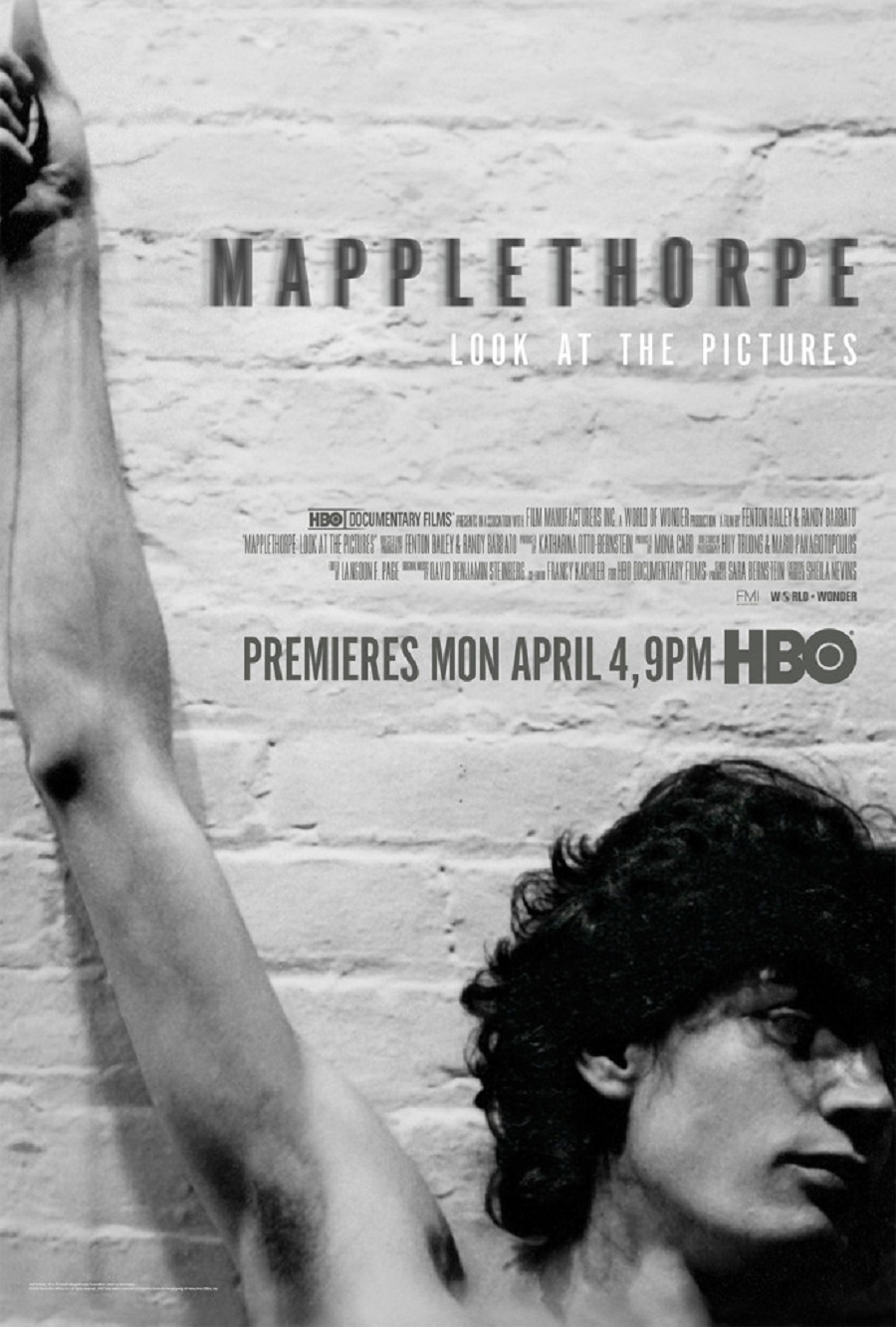
Mapplethorpe poster

This documentary starts off with former Senator Jesse Helms on the floor of congress back in 1989 where he denounced the controversial photography of Robert Mapplethorpe. Now Mapplethorpe’s work ended up pushing a lot of social boundaries with his frank depictions of sexuality, nudity and fetishism, and since he became known during the age of Ronald Reagan’s moral America, many saw him as nothing more than a shameless pornographer and refused to look at his photographs with any penetrating insight. What was on the surface bothered them, but like with any work of art it is about how the mind perceives it and of the effect it has on your perception of the world around you.

Helms told congress to look at the pictures as if they were done by someone possessed by the devil, but the HBO documentary “Mapplethorpe: Look at the Pictures” invites the viewer to look at them from a less biased perspective and see how this artist managed to turn contemporary art into fine art. What results is a fascinating look at an artist who in some ways is more prolific in death than in life, and it is probably the most in depth look at his life currently available.

We get scenes featuring curators at The J. Paul Getty Museum and The Los Angeles County Museum of Art as they prepare to open a landmark retrospective of Mapplethorpe’s work. Their intent is to look at him as a human being, and that intent is shared by the documentary’s directors Fenton Bailey and Randy Barbato whose previous work includes “Inside Deep Throat,” “The Eyes of Tammy Faye” and “Party Monster” (both the documentary and the feature film starring Macaulay Culkin). They dig deep into Robert’s past and never sugar coat his life for easy consumption.

It was very interesting to see Robert as a kid when he was considered the pogo stick champion of his neighborhood and somewhat unsurprising to learn he never really fit into any of the social circles in high schools (the great artists never seem to). Throughout the documentary we get to hear his voice from old recordings, and he says that he grew up in suburban America which he described as a good place to come from because it is also a good place to leave. He also admits he never set out to be a photographer as he took a course on it and hated it. And yet during his college years he found a creative spark which never left him.

“Mapplethorpe: Look at the Pictures” also features interviews with various friends, family members and celebrities who all seem to agree Robert was a largely mysterious person who was always looking to get a rise out of people.  At the same time, his brother Edward said he could be quieter than anyone else in the room. Writer Fran Lebowitz even described him as looking like a “broken Cupid,” so it’s safe to say that many people viewed him differently. As the documentary continues on, it shows us a man struggling to express himself during a time where voices which differed from the norm were quickly chastised and silenced.

One of the documentary’s most fascinating segments comes when Robert meets up with singer Patti Smith and observes the time they spent together at the famous Chelsea Hotel in New York. This segment also takes us back to a time when the Big Apple was bankrupt, corrupt and looked nothing like the insanely expensive city it is today. The two of them fed off each other creatively and created art no one else ever could have, and Mapplethorpe even shot the photograph which became the cover for her first album, “Horses.” The fact that their relationship is cut a little short in the documentary is disappointing as it would have been great to see more of them here, and it could very well make for a great documentary of its own.

Both Bailey and Barbato also might have fared a little bit better had they given equal time to the methods Robert used to create his art instead of his personal life. Many of his photographs, including his famous “Man in the Polyester Suit,” are on display here, and while we get an idea of how he messed around with his Polaroid photos to create something startlingly unique, it would have been nice to see more of his technique in how he pulled certain photographs off.

Instead, “Mapplethorpe: Look at the Pictures” spends more time than it needs to on Robert’s love life and his various lovers. Granted, hearing them talk about Robert does give us deeper insight into his psychology and how selfish he became as he got older. We even here Robert say at one point, “Life is about using people and being used by people,” so his self-centeredness is very understandable. But to hear people talk about him in this manner makes the documentary at times feel like a broken record.

However, “Mapplethorpe: Look at the Pictures” finishes on a strong note as we watch Robert putting up his last solo show entitled “The Perfect Moment.” By this time, he had been diagnosed with AIDS which back then was a death sentence, and some described this show as being a “memorial with a living corpse.” Robert was only 42 years old when he died on March 9, 1989, but he looked more like he was in his late 60’s. In his later years he sought fame like crazy, and he soon became more famous in death than in life. The effect this final show had on the general public was profound, and it served to secure his legacy after he passed away.

Despite some minor flaws, “Mapplethorpe: Look at the Pictures” is a compelling documentary which serves to look at the famous artist as more than just a controversial figure. Robert was a human being with problems like anybody else’s, but he always photographed what he loved and the people he loved to be with. He pushed all sorts of boundaries as he described art as being about “opening something up.” He certainly opened the world up to looking at things differently than ever before, and he remains a potent force in the art world today. Looking at his photographs now, one cannot help but wonder why certain parts of the human body are still considered more dangerous than a loaded gun.

Copyright Ben Kenber 2016

* * * ½ out of * * * *
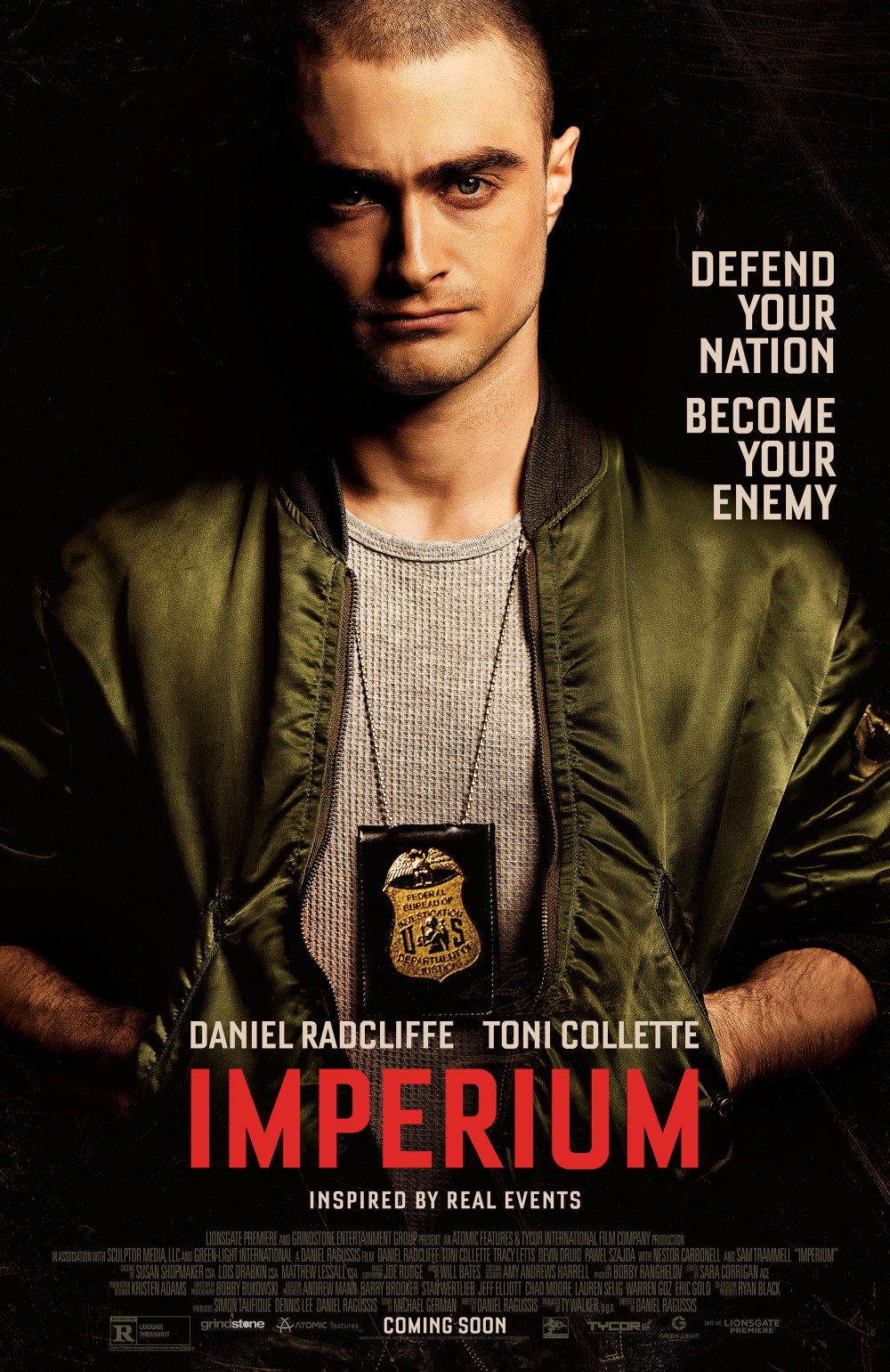
 

Imperium

IMPERIUMfinalposter

Imperium” is being released not along after “The Infiltrator,” another movie dealing with an FBI agent going undercover and entering a vicious criminal organization in order to stop the bad guys in their tracks. Like “The Infiltrator,” “Imperium” doesn’t break any new ground in the realm of undercover cop movies, but it is a taut thriller which holds our attention as it throws a barely prepared protagonist into a den of snakes who are quicker to kill than trust.

Front and center in “Imperium” is Harry Potter himself, Daniel Radcliffe. Ever since playing the lightning-scarred wizard, the actor has taken on many challenges to prove to the world there is more to him than J.K. Rowling’s infinitely popular literary character. At first he seems out of place as FBI agent Nate Foster, but that’s kind of the point. Nate comes across as a bespectacled and bookish nerd who is more comfortable doing research than going outside of the office. It also doesn’t help he’s the butt of jokes by his fellow agents who have yet to take him the least bit seriously.

But then along comes agent Angela Zamparo (Toni Collette) who sees a strong potential in Nate for undercover work. She is also sick of her superiors devoting all their resources to foreign terrorism instead of putting just as much focus on domestic enemies. Angela brings Nate into her office, tells him what he needs to know and gives him a copy of “How to Win Friends and Influence People” by Dale Carnegie, the only book needed for undercover work. From there, Nate transforms himself into a war veteran turned skinhead and navigates his way into the dangerous underworld white supremacy.

I have to give writer and director Daniel Ragussis a lot of credit as he focuses on something I desperately want America’s politicians to focus on: domestic terrorism. When it comes to the “War on Terror,” much of the focus has been focused on international groups like ISIS or The Taliban, but the threat inside America has proven to be far greater these days. Ragussis makes this very clear as he features video footage and photos of Neo-Nazis at work, be it going on marches or committing heinous crimes against those people who are not white.

Radcliffe may still have the shadow of Harry Potter hanging over him, but this doesn’t affect his performance as Nate Parker in the slightest. He makes Nate’s transformation into an undercover agent not just believable, but at times frightening. Movies like these show their protagonists sinking so deep into their assignments to where they lose contact with who they are and develop strong friendships with criminals they are supposed to bring down. Radcliffe shows, a lot of times without words, just how desperate Nate is to get to the truth. We already know just how great an actor he is, and his performance in “Imperium” goes to show the kind of acting challenges he is willing to step up to the plate to take on.

But there’s also Toni Collette who proves to be every bit as good as Radcliffe in her portrayal of, Angela Zamparo. Collette makes Angela cool as they come, and it’s loads of fun watching her reduce her male colleagues to rubble as they can’t even begin to match her job efficiency. Collette made her big breakthrough back in 1994 with “Muriel’s Wedding,” and ever since then she has immersed herself so deeply into each role she plays to where you completely forget the ones she played previously. The scenes she shares with Radcliffe here are great as we watch a rookie and a veteran slowly start to figure one another out, and nothing is never as it seems.

“Imperium” has the requisite scenes where Nate has to think fast on his feet so his cover doesn’t get blown, and some resonate with intensity more than others. One of the best comes when Nate is going to a potential site for a party along with Andrew Blackwell who is played by “The Knick’s” Chris Sullivan. Blackwell brings his best poker face to this scene as we watch Radcliffe tremble in fear as he is made to feel death is just around the corner. Both actors succeed in creating an almost unbearably intense scene here as if they are about to make the most pivotal move in a chess game.

Now “Imperium” will not go down as one of the best undercover cop movies ever made, but it does get the job done. It also shows Radcliffe taking on a new challenge and growing even more as an actor. Both he and Collette are more than enough of a reason to check this movie out sooner than later. Writer and director Daniel Ragussis also deserves a lot of credit for focusing on domestic terrorism as it feels like a realm in today’s day and age which doesn’t get enough attention. Sometimes the greatest threat to a nation isn’t from outside of it, but from within. Seriously, look at what Donald Trump’s bizarre run for President has brought out into the open.

* * * out of * * * *

Copyright Ben Kenber 2016.

Abortion: Stories Women Tell

Abortion Stories Women Tell poster

Was there ever a time when abortion didn’t seem like such a controversial issue? Well, if there was, that was certainly a long, long, long time ago. Even with the passage of Roe v. Wade in 1973, which gave every woman in the United States the right to an abortion, many have still been doing their best to get it overturned. Never mind that the Supreme Court has the final say on issues like this, never mind that Roe v. Wade was passed to stop women dying from abortions, and never mind that abortions make up a very tiny percentage of the work Planned Parenthood does; people are still swayed by their emotions more than they are by facts, and many have to be reminded of the importance of the separation between church and state.

The HBO documentary “Abortion: Stories Women Tell” is not out to take sides on this contentious debate. Instead, it gives women the opportunity to talk about their experiences with both pregnancy and abortion and to tell their own stories without any filters. Some men are heard on this too, but the focus is on women on both sides of the fence as they are the ones who have to deal not just with their decisions, but also the aftermath they are unwillingly exposed to.

The documentary starts off with a pro-life rally in Missouri where supporters chant “all in Christ,” and an elected representative tells them they are making progress in closing clinics in the state as they now “have the ability to look inside the womb.” But the focus then quickly shifts to a title card which states how since 2011, more than half of the United States have significantly restricted access to abortions, and those restrictions have increased from year to year. Abortion opponents may not be able to overturn Roe v. Wade, but they have managed to find ways around it.

Missouri at this time has only one abortion clinic which means the women who live there are more likely to drive many miles across the state border into Illinois to seek help. The documentary looks at the daily happenings at the Hope Clinic in Granite City, Illinois where employees do their best to help women in need of health care even while they are constantly harassed by protestors. None of them have any shame over the work they do, and that’s even if some consider themselves the black sheep of their family as a result.

The stories we hear cover different parts of the spectrum regarding the abortion debate. There’s Amie, a 30-year-old single mom who works 70 to 90 hours a week to make ends meet and cannot afford to have another baby right now. We get to meet Sarah who has discovered her baby will have lungs missing and won’t survive long after birth. Then there’s Kathy whose house is filled with various religious objects, and she is setting up a peaceful pro-life march to get what she sees as God’s message across to others. And there’s no forgetting Alexis who is 17 years old and pregnant, whose mother died when she was just 8 and who gets picked on at school because of her condition. It’s painful to see how isolated all these women are from the rest of society as the stigma of abortion is still all too harsh. Granted, Kathy might not seem as isolated, but there is a strong sense of loneliness about her as she pursues her quest to end abortions.

Director Tracy Droz Tragos, herself a Missouri resident, presents all these women’s stories without any judgment. She has given them a forum to speak their minds, and they all need to be heard regardless of how we feel about this infinitely taboo subject. There’s no narration to be found here as Tragos is not looking to steer the conversation one way or another, and this is even though the number of pro-lifers interview here pales in comparison to the pro-choice advocates. But for what it’s worth, the pro-life women interviewed here come across as very nice and full of much love, and this is in sharp contrast to those protestors (mostly men) who stand outside the clinic berating anybody and everybody who enters it.

But for me, the most important takeaway from “Abortion: Stories Women Tell” is that none of the women featured here take the issue of abortion lightly. Why would they? Many people who oppose abortion treat those who have had one with such disgusting disdain as if to say they never bothered to put much thought into what they were doing. But as Representative Jackie Speier said in a session of congress, the thought that anyone enters into such a decision with a cavalier attitude is just “preposterous.”

It’s impossible not to be emotionally affected by what these women go through. Plus, one cannot but be infuriated at those protestors who hold up signs featuring what looks like aborted fetuses which are disgusting and unforgivably cruel as they do nothing more than try to manipulate the actions of people they have no interest in knowing personally. Tragos briefly gets to interview one of the most outspoken pro-lifers who follows a clinic escort all the way to her car, begging her to repent. He talks about a law in California which punishes someone with not one, but two murders when they kill a pregnant woman. Whoever this person is, he may need to look at the California law book more closely.

With the United States currently entering the most contentious of Presidential elections, the future of Roe v. Wade is in more danger than ever. But watching “Abortion: Stories Women Tell” is a stark reminder of how women are still treated like a minority even though they make up more than fifty percent of the world’s population. This documentary will bring about a fury of emotions for everyone who watches it, but the one thing to keep in mind is all the women featured here are no different from one another. They believe in the same things and have more in common than they bother to realize.

I also have to quote Kenneth Turan of the Los Angeles Times here as he made an excellent point in his review I wish I had made myself:

“The key to understanding why ‘Abortion: Stories Women Tell’ is a quietly powerful documentary is not the first word in the title, but the final three.”

* * * * out of * * * *

Copyright Ben Kenber 2016.


Anthropoid

Anthropoid poster

Anthropoid” is kind of like a cousin to “Valkyrie,” another movie about soldiers looking to take out a high ranking Nazi. Like “Valkyrie,” it will not go down as one of the most memorable World War II movies ever made, but it is an entertaining film which engages us with noble characters, interesting questions about the price of war and a furious climax where resistance fighters make their last stand. More importantly, it deals with a true life event (yes, it is “based on a true story”) many probably don’t know about but should.

The movie starts in 1941 with two Czechoslovak exile soldiers, Jozef Gabčík (Cillian Murphy) and Jan Kubiš (Jamie Dornan), parachuting into their occupied homeland. Upon meeting the resistance fighters and their leader, “Uncle” Jan Zelenka-Hajský (Toby Jones), in Prague, they reveal that they are here to execute Operation Anthropoid which involves the assassination of Reinhard Heydrich, a high ranking Nazi who was one of the architects of the Holocaust and whom Adolf Hitler described as “the man with the iron heart.” Do they succeed in their mission? You’ll have to watch the movie to find out.

“Anthropoid” gets off to a bit of a slow start as Jozef and Jan try to settle in and not stand out among everyone else in town. They even recruit two lovely ladies, Marie Kovárníkovasá (Charlotte Le Bon) and Lenka Fafková (Anna Geislerová), to help them carry out their mission, and they are more than willing to help. Just watch as Lenka makes clear to the men how she can handle a gun.

There’s a subplot where Jan ends up getting engaged to Marie, and it just comes out of nowhere to where this section feels rather awkward. A number of characters are not developed fully enough to where “Anthropoid” threatens to feel like a missed opportunity. But what elevates the material are the performances which are very strong.

You can never go wrong with Cillian Murphy as he has yet to give a bad performance in any film he appears in. As Jozef, Murphy’s steely eyes stare into others with an intensity which wipes the smiles off their faces as he makes clear this is no ordinary mission. He also makes Jozef a most determined soldier who is infinitely determined to carry out this operation, but even he can only take so much before he falls apart emotionally.

Jamie Dornan shows more life here than he ever could have in the dreadful “Fifty Shades of Grey.” This is especially the case when his character suffers a brutal panic attack which has Jozef desperately trying to calm him down from. It’s way too easy to look like a fool when portraying such an emotional moment as the camera never lies, and it says a lot about Dornan that he was able to make this panic attack such a genuinely anxiety ridden moment.

There are also a number of other terrific performances to be found in “Anthropoid” like the one from Toby Jones. Then again, seeing him in a World War II movie these days instantly reminds us of his “Hail Hydra” character from the “Captain America” movies.

“Anthropoid” really kicks into high gear when an assassination attempt is taken and the Nazis come down hard on a particular group of people to where sympathy isn’t much of an option. It gets to where everyone wonders if killing one Nazi will have any effect on the war. With the world closing in on the main characters, the intensity keeps building and building all the way to the very end.

The last half of “Anthropoid” has the protagonists holing up in a church, and they are discovered by the Nazis to where a violent standoff ensues. Director Sean Ellis, who helmed the Oscar nominated short film “Cashback,” stages an impressive standoff which has us completely riveted. While the first half feels routine, the last half really does keep us on the edge of our seats. With “Valkyrie” we had a very good idea of things would turn out, but with “Anthropoid” we don’t. Bullets fly all over the place and emotions are shattered to where we can’t look away, and this is aided by a pounding music score composed by Guy Farley and Robin Foster.

Parts of “Anthropoid” may not stay in the conscious mind long after you have seen it, but the parts which do make it worth the price of admission. Many made tremendous sacrifices which can no longer be swept under the rug, and this movie gives those soldiers the respect they have deserved for the longest time. It also looks at the many costs of war and of how soldiers can only keep their cool for so long until they break under the pressure. It’s a bleak movie in many ways, but it also shows just how far the resistance fighters were determined to end Hitler’s genocidal reign.

* * * out of * * * *

Copyright Ben Kenber 2016.

Fury

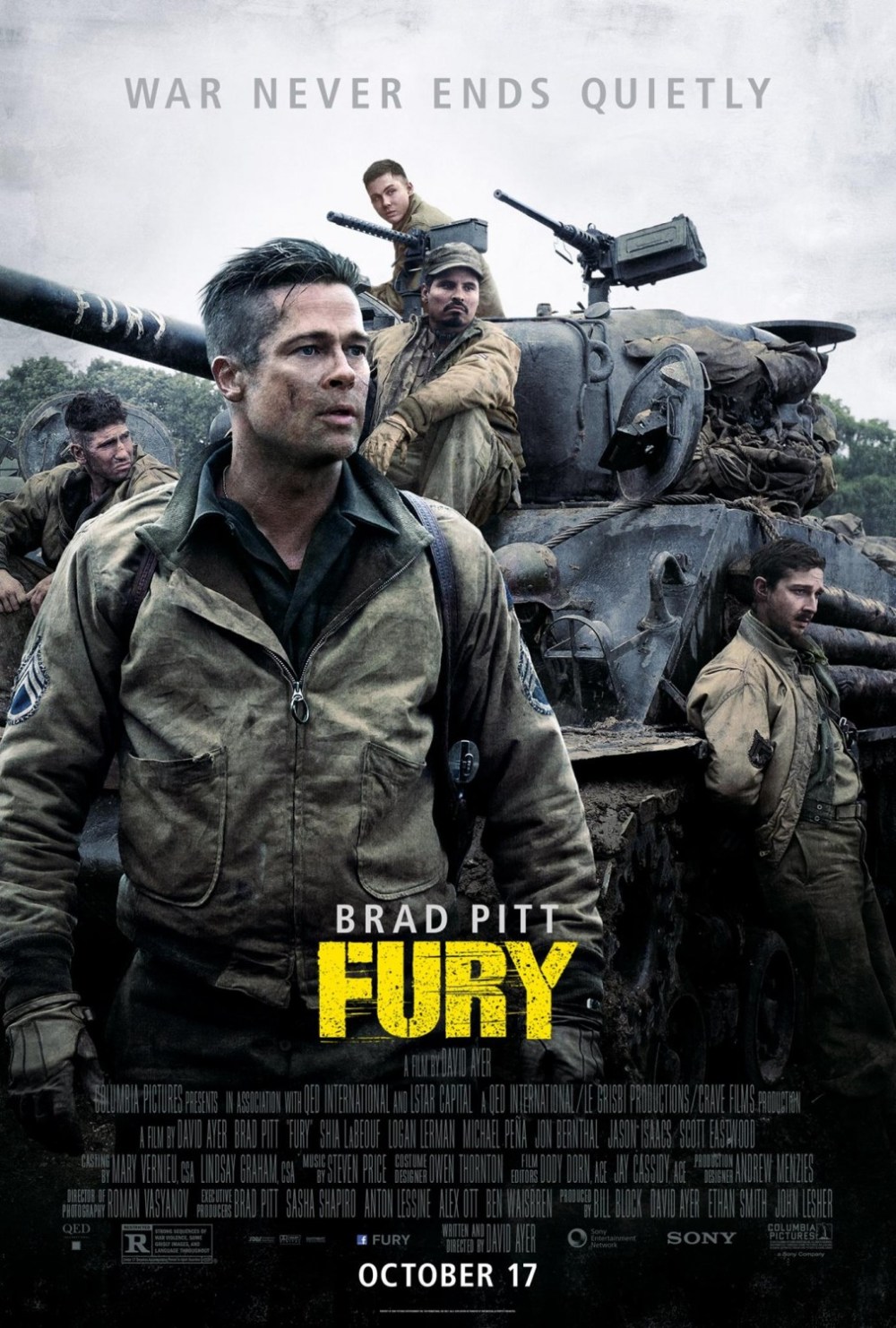
Fury movie poster

When it comes to David Ayer, you know he’s not going to slack off when it comes to researching his movie’s subject matter. His movies like the brilliant “End of Watch” and the underappreciated “Sabotage” had characters dealing with a vicious reality which they are forced to contend with on a regular basis, and Ayer makes us feel how frightening this reality is whether we want to be a part of it or not. That remains the case with “Fury,” a war film which takes us all the way back to the final days of World War II. It features all the usual characters we expect to see in a war film from the hardened Army sergeant to the innocent rookie, but you come out of it knowing what it feels like to be in a tank.

Brad Pitt stars as Don “Wardaddy” Collier, the commander of a five-man tank crew which is ordered to make a final push into Nazi Germany during World War II. Don is saddled with a battle ready crew which includes Boyd “Bible” Swan (Shia LaBeouf), Cpl. Trini “Gordo” Garcia (Michael Pena) and Grady “Coon-Ass” Travis (Jon Bernthal). After losing one of their members, they are suddenly saddled with the most baby-faced rookie imaginable in Army Private Norman Ellison (Logan Lerman). Don doesn’t like Norman’s presence one little bit as he feels it threatens everyone’s safety, but his superiors force him to take him on regardless of his objections. As a result, Don is forced to make Norman grow up a lot sooner than he wants, and it’s all in the name of survival.

For a time, I thought that Norman was going to be like Jeremy Davies’ character from “Saving Private Ryan” in that he would be the wimp who wouldn’t have the nerve to kill the enemy until the very end. Don, however, doesn’t have the patience to wait for Norman to grow a pair and forces him to kill a Nazi prisoner early on. Lerman gives a tremendous performance as Norman, and it’s fascinating to watch him go from being an anxiety ridden soldier to a hardened war veteran who doesn’t hesitate to take out as many Nazis as humanly possible.

There haven’t been many tank movies in the history of cinema. The only ones I can think of are Kevin Reynolds’ “The Beast” which came out in 1988 and the Israeli war film “Lebanon” which depicted warfare as witnessed from inside a tank. It’ll be interesting to see how they compare to Fury which puts you right into these characters’ mindsets as they lay waste to their target without the benefit of ear protection. You come to feel as battered and hardened as the crew does during their patrol through enemy territory where they find themselves outnumbered and outgunned.

It’s hard to watch “Fury” without thinking of Pitt’s performance as Aldo Raine in “Inglorious Basterds,” but he does succeed in making “Wardaddy” distinct from that character whether he is sporting facial hair or not. I always enjoy Pitt’s performances when he’s all dirtied up and free of his movie star looks, and this is one of them. You believe Pitt as a war veteran who has seen countless battles and has long since been worn down by them. But for Don, his main concern is keeping his crew alive, and Pitt is great at making you feel his character’s barely hidden vulnerability which is always on the verge of being exposed for all to see

Pena is an Ayer regular, having worked with him previously on “End of Watch,” and he has yet to disappoint in any role he takes on. As Trini, he gives us a character who was one of the many Latino military officers who fought for America back in the 1940’s. From start to finish, Pena makes Trini a war weary character who is not far from falling apart, and it makes for an intense performance.

I also give applause to Bernthal whose performance as Grady may not get all the recognition it deserves. On one hand Grady is a loathsome character we cannot stand to be around, but on the other he’s just a soldier trying to survive this war anyway he can. It’s rare to see an actor who makes you despise and sympathize with a character simultaneously, and Bernthal succeeds in pulling it off.

Another impressive performance in “Fury” comes from Shia LaBeouf as Boyd. Like Private Daniel Jackson in “Saving Private Ryan,” this guy is a trained killer but also quick to spout off passages from the Bible. Even after taking out a Nazi tank, he will still quote passages from that book with a great passion. LaBeouf got a lot of press for the method work he did on “Fury” which included pulling out a tooth, but seeing this movie is to be assured that all the work paid off for him.

Whether or not you consider “Fury” to be one of the best World War II movies ever made, it is one of the strongest to come out in the past few years. Ayer makes you feel the anxiety and exhaustion these soldiers go through while in battle, and you come out of this movie feeling as battered as they do. I very much liked what it had to offer, and I liked how Ayer didn’t try to sugarcoat reality for anyone in the slightest. That’s what makes his movies so unique and visceral.

* * * ½ out of * * * *

Copyright Ben Kenber 2014.

America: Imagine the World Without Her

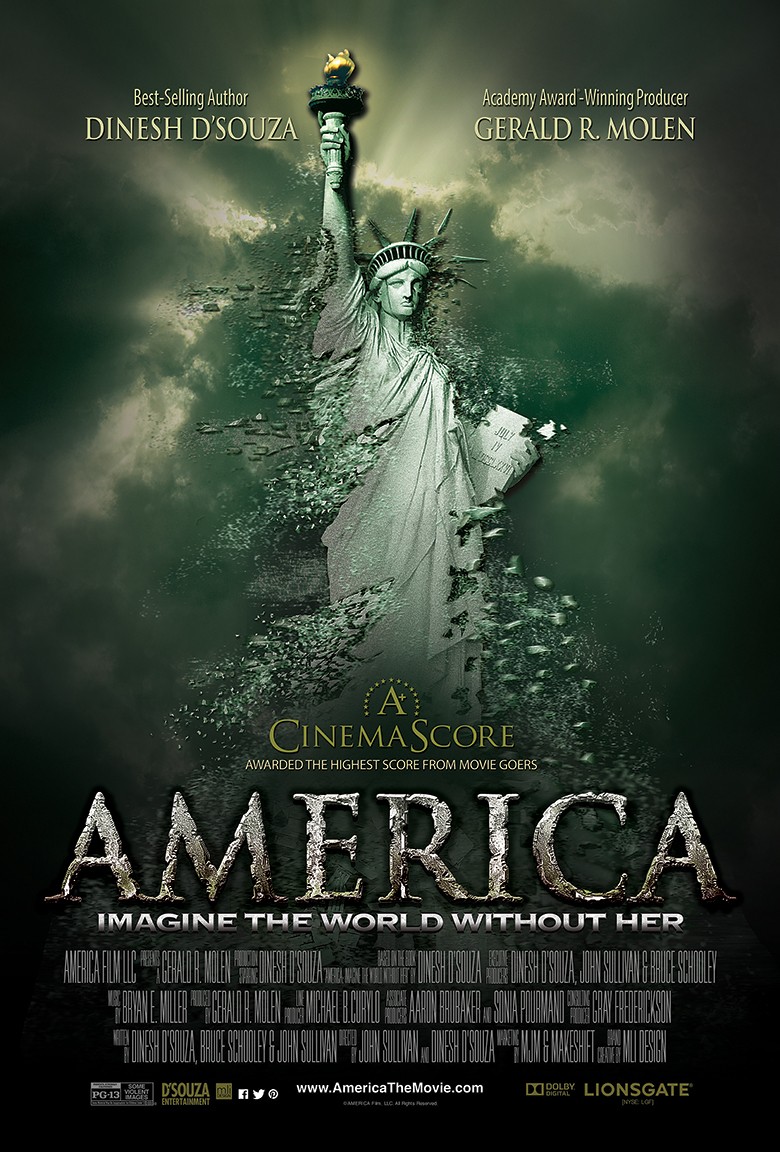
America Imagine the World Without Her poster

Is it even possible to write a review of Dinesh D’Souza’s documentary “America: Imagine the World Without Her” without seeming the least bit biased? Many who have slammed it have been greeted by comments accusing them of being blinded by President Obama’s “socialist” brainwashing, and those who praise it get accused of watching Fox News too much among other criticisms. Is there any way to view this documentary in an objective manner? Moreover, will anyone allow those who have seen it to review it in an objective manner? Well, I’ll give it a shot, but I can already see a number of comments coming my way which are both good and bad.

“America: Imagine the World Without Her” starts off with D’Souza meditating on what this country would have been like had George Washington been killed on the battlefield, and it is followed by images of institutions like Mount Rushmore, the Statue of Liberty and the Lincoln Memorial vanishing into dust. From there, he explores the dark history of America and a number of well-known individuals whom he believes have done nothing more than shame America rather than looking at what makes it one of the best countries on Earth.

“America” gets off to a shaky start because, from its trailers, the movie looked to present an alternate reality of what the country would look like if George Washington died early on, but he all but drops this concept and instead goes on a different path. If that was the case, then why did he bring up this scenario if he never intended to explore it? Maybe he came to the conclusion that a number of different things could have happened as a result, and to narrow it down to one would be difficult if not impossible.

Now D’Souza makes it perfectly clear he loves America, and I have no doubt of that. Furthermore, I would never dream of taking his love of America away from him as it has given him much success. Having said that, there is an overabundance of shots throughout of him staring at various monuments like the White House, the Marine Corps War Memorial (a.k.a. the Iwo Jima Memorial) and Mount Rushmore which we see him looking at as if he is desperate to make his love for the United States absolutely clear and without doubt. But after a while it becomes a self-indulgent nuisance to where we want to yell at the screen, “We get it! You love America! Enough already!”

D’Souza then takes an overview of America’s dark history and uses it to criticize a number of people (particularly on the left side of politics) whom he believes have used these historical events to shame the country and make it look like an evil place. From there, his intent is to refute much of what we have been taught about American history and to demonize those he believes have taken away from this country and empowered others who are a threat to it. He does this by using old news footage, historical reenactments with notable figures like Abraham Lincoln and Frederick Douglas and interviews with experts who tell D’Souza more or less what he wants to hear.

Regarding the historical reenactments, they come across as very bland and boring and are seriously lacking in any depth. The acting is pedestrian, the staging lacks much in the way of excitement, and the special effects are ridiculously cheap. There’s even a scene where we see Christopher Columbus’ three ships, the Nina, the Pinta and the Santa Maria, sailing towards America, and it looks like someone just put three toy boats in a river and filmed them. You’d figure a documentary produced by Gerald R. Molen, a man who produced many of Steven Spielberg’s movies including “Jurassic Park” and “Minority Report,” would have higher production values to work with, but that’s not the case here.

When it comes to the genocide of American Indians, D’Souza claims much of it was the result of different Indian tribes attacking one another over land. Granted, there is some truth to this as we have seen this conflict portrayed in movies like “Dances with Wolves” and “The Last of the Mohicans,” but this argument carries only so much weight and D’Souza only skims the surface. He gives the audience a lot of graphics you would find in a power point presentation, but it all comes off like a copy of Cliff Notes which might give you just enough information, but not everything you need to hear.

On top of this, D’Souza claims the majority of Indians lost their lives because of diseases. It was at this point I started to get confused as to what D’Souza was trying to get across. Was he saying the Indians were more susceptible to diseases than others? What life has taught me is that diseases do not discriminate like humans do. As a result, what D’Souza ends up implying with this assertion feels not only baseless but completely out of line.

As for how he deals with slavery, I have to give D’Souza some credit because even he admits it was not just a problem in America but in other countries as well. But then he goes into how certain blacks, before slavery was abolished, owned slaves as well, and he brings up the story of C.J. Walker who became known as the first female self-made millionaire in America and of how she made her fortune through a successful line of beauty products for black women. On one hand it’s interesting to learn about Ms. Walker, but I wondered what D’Souza was trying to prove here. Is he saying slavery was nowhere as bad in America as it was in other countries? Looking back, I got the impression he really glossed over the barbaric treatment many slaves received. He also describes the abolition of slavery as being “uniquely western,” but considering how it had its roots in European urban culture and that the Atlantic slave trade came to an end before American slavery did, this is not altogether accurate.

Things in “America” get worse as D’Souza defends capitalism by showing a scene where we see multiple versions of him running a fast food joint and cooking hamburgers. This is a moment where he could have had some fun with his own image, but he ends up taking himself too seriously and comes off as unintentionally goofy. Furthermore, he talks about how ordering a hamburger from his faux restaurant is cheaper than making one at home with the same ingredients. This is a weak argument as I have visited many fast food joints and none of the burgers came close to equaling the price D’Souza was offering for his.

D’Souza even says America’s wealth was created and not stolen and that colonial Manhattan was purchased from the Indians for $700. Considering there is much evidence available on how the Indians, a people never to be mistaken as immigrants, were driven from their lands and killed, I can’t help but wonder if they sold this land by choice or under duress. While I was watching this segment, I was reminded of what comedian Bobcat Goldthwait once said:

“America is one of the finest countries anyone ever stole.”

D’Souza then directs his ire at a number of “leftists” such as Saul Alinsky, Hilary Clinton, Matt Damon, Howard Zinn and President Barack Obama. The way he sees it, they are responsible for exploiting the dark moments of American history and for attempting to rewrite it for their own benefit. It is from there that “America” becomes nothing more than a propaganda piece designed to deliver a lot of fear-mongering to the masses.

Look, I have no problem with Americans criticizing President Obama when it’s within reason, but many of D’Souza’s criticisms feel like they are based on deep seated fears rather than actual facts. When “America” begins, he says the three things he feared would happen under an Obama administration did happen, but those things are still open to debate as President Obama did get elected to a second term.

But D’Souza’s sights are set mostly on Hilary Clinton as he sees her as being subverted in her early years by leftists and socialists who forever corrupted her worldview, and the way he presents Hilary in a series of reenactments reeks of shameless manipulation more than anything else.

Another public figure who gets dragged over hot coals is Saul Alinsky, the legendary community organizer and writer. D’Souza portrays him as the devil in disguise and attempts to use his own words against him. He even goes out of his way to say Alinsky learned many things from Lucifer like strategies for demonization and polarization. In retrospect, the way D’Souza portrays Alinsky makes the community organizer come across as a one-dimensional villain in your typical action flick. I imagine there is more to Alinsky than what we see here, but to tell us more might take away from D’Souza’s overall argument which was pretty weak to begin with.

But perhaps the most unintentionally hilarious moment comes when D’Souza brings up how he was indicted for making illegal political contributions to a 2012 United States Senate campaign. He ended up pleading guilty to this and doesn’t deny that he committed a crime, but it all leads to a staged shot of him sitting in a holding cell with handcuffs on. The way D’Souza sees it, he’s a victim of persecution by the government due to the success of his documentary “2016: Obama’s America.” Now whether or not D’Souza was a victim of selective prosecution was up for debate, but this staged moment proves to be so shameless that it comes across as completely self-serving. Considering he knowingly committed a crime which he plead guilty to, does he really have the right to play the victim card?

Looking back at “America: Imagine the World Without Her,” my reaction to it isn’t all that different from how I react to a Michael Moore documentary. Their movies make me want to do a lot of research into the subject matter they deal with to see how accurate they are to the facts and to see what else I could possibly learn about America in the process. Many accuse Moore of playing loose with the facts, but if that’s true then D’Souza isn’t any different.

D’Souza and his co-director John Sullivan came into “America” with a lot of passion which does come across onscreen, but it is still filled with illogical arguments which don’t carry much weight. While he accuses others of trying to rewrite history, he ends pretty much does the same thing here. The movie is also weighed down by poorly directed reenactments which don’t leave much to the imagination, and D’Souza spends his time onscreen implying things rather than proving them. Seriously, if he were to turn all this in as a term paper, he would have ended up with an F or a D- if he was lucky.

I always thought it was incredibly difficult to make a bad documentary, but D’Souza and Sullivan prove it is possible with “America: Imagine the World Without Her.” In the end, the criticisms this movie receives will matter very little as it has been embraced by the crowd it was made for. But none of this changes the fact this is a poorly made film which has little to show for its arguments, and it exists as nothing more than a boring propaganda piece. D’Souza is free to make the movies he wants to make, but next time he’s got to make arguments which stand up to scrutiny and get a better understanding of American history.

* out of * * * *

Copyright Ben Kenber 2014.

Save

Hillary’s America: The Secret History of the Democratic Party

Hillary's America poster

This movie has some of the funniest scenes of any I have seen in 2016, but there’s one slight problem; it was not intended to be a comedy. “Hillary’s America: The Secret History of the Democratic Party” is the latest political screed from Dinesh D’Souza which has him, along with co-director Bruce Schooley, trying to tie the Democrats’ racist past with Hillary Clinton’s campaign for President. In short, he attempts to show how the principles of the Democratic Party have never changed, and instead succeeds in making an even worse documentary (if you want to call this a documentary) than “America: Imagine the World Without Her.

Now while Hillary’s name and face are featured prominently in this film’s poster, D’Souza doesn’t really bother with her until the last half hour. Instead, he gives us a bunch of re-enactments (and this movie is overflowing with them) which chronicle his criminal conviction, the time he spent in a halfway house, the America of the 1800’s and the 1900’s, and of Hillary while she was in college. Perhaps a better name for this would have been “Dinesh’s America” as we are looking at history through his point of view, and his POV combines a selective sprinkling of facts with an overabundance of deluded paranoia.

D’Souza re-enacts his time in a halfway house as a way to continue his ridiculous claim of being made a political martyr. He also portrays himself as a white collar criminal surrounded by vicious street criminals whose actions make his crime pale in comparison. Was this really the kind of halfway house he was sentenced to? Maybe, but he presents the inmates in such a stereotypical way that it’s hard to take much of what he shows us seriously. Plus, there’s a sequence where he befriends a fellow inmate who tells him about an insurance scam he and his friends pulled off. The re-enactment of this scam is so ridiculously directed and poorly acted that I couldn’t help but laugh out loud to where I thought I might get kicked out of the theater.

We later see D’Souza visiting the Democratic Headquarters, and when no one is looking he sneaks into an off-limits room which contains the Democrats version of Pandora’s Box. This allows him to uncover the party’s racist past which had them defending slavery instead of trying to abolish it. Seeing D’Souza, a Republican, infiltrating this “secret” room in the Democratic Headquarters brings to mind another alternate name for this movie: “50 Shades of Watergate.”

It is no secret that the Democratic Party of the 1800’s was much more KKK friendly and were never quick to pass the Thirteenth Amendment which abolished slavery. This was even shown to be the case in Steven Spielberg’s “Lincoln” where Spielberg and screenwriter Tony Kushner never hid the fact that the Republicans were the real heroes when it came to ending this barbaric practice. This gives “Hillary’s America” some weight as this is a part of history worth paying attention to as the Democratic Party of today is much different than the one of the past. But it doesn’t take long for D’Souza to shoot himself in the foot as he bombards us with historical re-enactments so one-sided to where they quickly become boring and cruelly exploitive.

These historical re-enactments are further complicated by D’Souza treating Democrats like Andrew Jackson as one-dimensional villains in a bad 80’s action movie or a supervillain from a James Bond film, albeit ones completely lacking in charisma. It doesn’t matter which era is being re-enacted, he treats every Democrat as being drunk with power or as a vampire on a day pass. D’Souza even includes an especially ludicrous scene where Woodrow Wilson is watching D. W. Griffith’s “The Birth of a Nation” at the White House when a KKK member on a ghost horse comes galloping out of the movie screen. Wilson is made to look like he is transfixed by this sudden emergence, but it’s really just a bizarre fantasy.

In trying to show how the Democratic Party has not changed from its sordid past, D’Souza completely fails to prove this without a shadow of a doubt. He doesn’t so much cherry pick facts as whitewashes and manipulates them to form a thesis which defies all reasonable logic. Anyone with half a brain can see that the Democratic and Republican parties of today are so radically different from what they once were. D’Souza even tries to convince us the big switch between the two parties in terms of their views on civil rights was a flat out lie, and he presents his evidence of this in a way which requires the use of a microscope to fully discover what he is talking about.

When D’Souza finally gets around to dealing with Hillary Clinton, he portrays her as a self-centered and snobby bitch interested in her own ambitions more than anything else. In an article, Alex Shephard described D’Souza’s portrayal of a teenage Hillary as being like Reese Witherspoon’s character of Tracy Flick from “Election” if Tracy “liked to murder small animals,” and that is spot on. D’Souza shows her laughing at one of President Richard Nixon’s speeches on television as if it were a bad thing. But the most jaw-dropping moment comes when D’Souza flat out blames Hillary for her husband Bill’s numerous infidelities. This doesn’t really speak much of Hillary as it does of D’Souza’s criticisms of feminism.

D’Souza presents himself throughout “Hillary’s America” as a truth teller no one should dare question, but he rarely backs up his arguments with much in the way of convincing evidence. In fact, he even dredges up the Benghazi attack which has been beyond thoroughly investigated, Hillary’s emails which just about everyone is sick of hearing about, and he even includes a scene from those completely debunked videos from the Center for Medical Progress. Bringing these subjects up only weakens an already deeply flawed thesis to where it feels like D’Souza is just grasping for anything which might, and I strongly stress the word might, work in his favor. Oh yeah, he also throws in Saul Alinsky for good measure, but Alinsky comes across as a caricature more than anything else.

While there are many unintentionally hilarious scenes to be found here, there are others which are simply infuriating. D’Souza portrays Margaret Sanger, the mother of Planned Parenthood, as an emotionless sociopath. Granted, there is evidence she was a proponent of eugenics, but showing her as wanting to exterminate all black people is a flat out lie. His portrayal of President Lyndon Johnson as openly racist to where he only agrees to civil rights legislation just to quell his political opponents feels deeply insulting. And in portraying America of the past, D’Souza piles on scenes of slaves being whipped and tortured which soon feel cruelly exploitive of a national tragedy.

It’s tempting to call D’Souza stupid after watching “Hillary’s America,” but that may not be altogether fair. As a director, however, he makes one stupid mistake after another as he shamelessly manipulates the audience’s emotions while bashing their heads in with information based more on his distorted worldview than reality. He employs an overly dramatic music score by Stephen Limbaugh which becomes ridiculously bombastic in no time at all. And he concludes the movie with renditions of patriotic songs to show his undying love for America. I do not doubt his fervent patriotism of the United States, but it feels truly annoying that he needs to constantly remind us of this.

It doesn’t bother me that D’Souza has made an anti-Democrat movie as no political party is beyond reproach. What bothers me is how much he believes in what he is telling us as his view of history is more revisionist than it is accurate. Watching him in “Hillary’s America” reminded me of Bill Pullman’s dialogue in “Lost Highway:”

“I like to remember things my own way. How I remembered them. Not necessarily the way they happened.”

In D’Souza’s mind, Republicans have been and still are the heroes of justice and racial equality, but if Lincoln saw the state of the party today, there’s no doubt he would be crying a river over it and not just because Donald Trump (who is barely mentioned in this movie) is their presidential nominee.

Now, this review might be greeted by various internet trolls who claim I am deeply biased or a “libertard” among other things. I’m not going to go into who I am voting for this November here. Instead, I want to leave you with a couple of things to think about. Does it make more sense to base your views on a political party on what it was like when it began or how they treat the American people in the present day? If D’Souza loves being a citizen of America so much, why did he willfully break the law? Did he even realize before committing his crime that it would cost him a right which American citizens should cherish, the right to vote? Say what you will and believe what you want, but nothing will change the fact that “Hillary’s America: The Secret History of the Democratic Party” is one of the worst documentaries ever made.

½* out of * * * *

Copyright Ben Kenber 2016.

Save

Save

Krisha

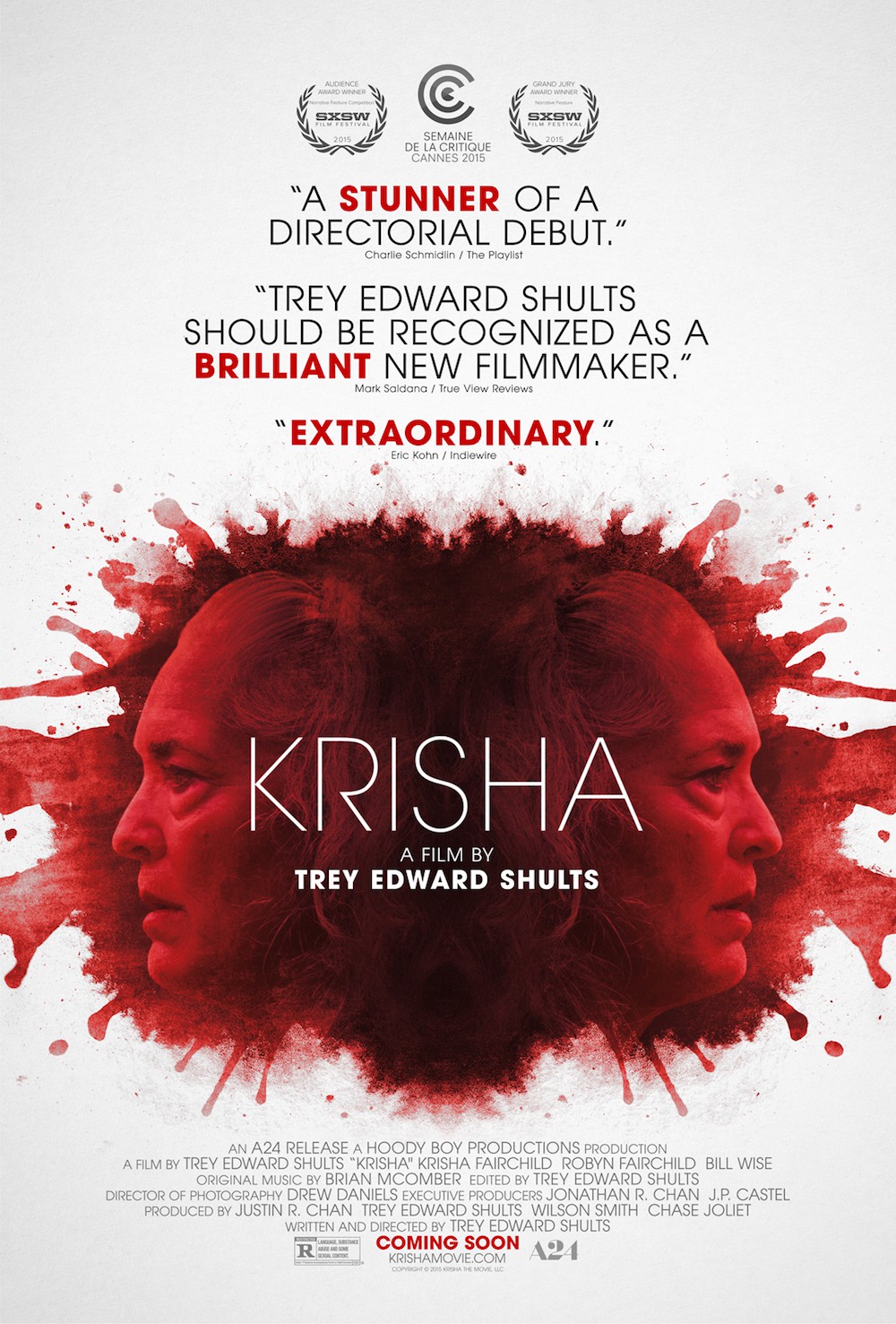
Krisha movie poster

Krisha” is one of those movies which can be best described as emotionally pulverizing. It starts off with a close up of the title character’s face as the sound builds to a feverish crescendo, and this is enough to tell everyone this movie is going to be a psychological endurance test for the audience watching it. It’s a powerful motion picture which is as emotionally cathartic as they come, and it’s one of the best movies of 2016.

Krisha Fairchild stars as the Krisha of the movie’s title, a deeply troubled woman returning home to the family she abandoned years ago for a life of drug addiction and self-destruction. It’s Thanksgiving and everyone welcomes her back with open arms, prepared to forgive her trespasses, but right from the start there is a palpable tension in the air as everything seems off. While her family is happy to see Krisha, they are still unsure of whether or not she can be trusted. As for Krisha herself, we find she is still struggling with her demons and may not make it through the night in one piece. She’s also cooking the Thanksgiving turkey, and the turkey is just a time bomb just waiting to go off.

It should be noted that the movie’s writer and director, Trey Edward Shults, based its story on a similar family situation he experienced when his cousin Nica came home for the holidays. She was in the throes of her own drug addiction which would end her life prematurely two months later. For Shults, making this movie was a way to confront this tragedy, and he cast many of his family members who had been through the same situation as well.

But the one family member who stands out here the most is Shults’ aunt, Krisha Fairchild.  Fairchild is not playing herself here even though she shares the same name of her character, but this makes her performance all the more extraordinary as she plumbs the depths of a drug addict struggling to prove to her son and family everything is okay with her now. As crazy as she gets in this movie, Fairchild still makes Krisha a sympathetic character who we cannot help but feel for. And when she puts on a red dress which looks a lot like the one Ellen Burstyn wore in “Requiem for a Dream,” she goes all out for an emotionally shattering climax.

The rest of the cast does terrific work, and this especially goes for Bill Wise who plays Doyle, the family member who proves to be its biggest personality and asshole. Doyle sees right through Krisha and tells her flat out, “You are an abandoner. You are heartbreak incarnate, lady.” And then there’s Robyn Fairchild who plays Krisha’s sister, the most stable of all the family members. When Robyn breaks down after a protracted argument with Krisha, it’s impossible not to feel her pain and emotional exhaustion as we all know strong family members who eventually reach their breaking point after holding it together for so long.

“Krisha” is Shults’ first feature film, and it is an incredible debut made all the more amazing by the fact he shot it all in just 8 days. He makes the film look like it was shot a lot longer and cost more than it did as he balances many different elements with a director’s masterful touch. Shults is also aided tremendously by the almost dreamlike cinematography by Drew Daniels and the abstract sounding music score by Brian McOmber which illustrates the increasing tension bubbling beneath the surface. This movie is an emotional powder keg just waiting to go off, and Shults never lets anyone off easy.

There have been countless movies made about drug addiction and the effect it has on the family members of the addict, and “Krisha” certainly feels like one of the most effective. It also rightly reminds the viewer that an addict will only seek help when they want to stop. We can’t make them stop. We can only hope for the best and pray for the addict to see the light and make a conscious decision to seek help. Watching this movie makes you want to see Krisha succeed and put her past behind her, but when things begin falling apart for her we can’t look away. Deep down we would like to, but her suffering is all too real to ignore.

“Krisha” shook me in a way very few movies do these days, and it marks the arrival of a gifted feature film director named Trey Edward Shults. Now that we have seen what he can do with the smallest of budgets, it will be interesting to see where he goes from here. As for Krisha Fairchild, she is an actress whose work has been under the radar for years, and here she gives one of the most unforgettable performances the world of movies has seen in some time. All good things to those who wait.

Copyright Ben Kenber 2016

* * * * out of * * * *


De Palma

De Palma poster

When it comes to interviews, filmmaker Brian De Palma always seems rather remote or looks like he would rather be somewhere else. In an interview about “Redacted,” he flat out told the interviewer he was simply there to sell his movie, and the interviewer replied perhaps De Palma was enjoying his company. To this De Palma replied, “I don’t think so.” So aside from him crushing the interviewer’s ego, his reply illustrates how uncomfortable he gets when talking about his movies. Perhaps this is why he has never done an audio commentary on any of them to date.

But this is the real joy of watching the documentary “De Palma” as he seems more than willing to spill the beans about his life and the inspirations behind his work. It also helps that it was directed by Noah Baumbach and Jake Paltrow, filmmakers De Palma has been friendly with for several years. Whether he’s talking about his greatest works like “Carrie” and “Scarface” or facing up to his critical and commercial disasters like “The Bonfire of the Vanities,” the revered filmmaker holds nothing back as he discusses each of them with a sense of humor which shows how he’s dealt with the movie industry and the way it has treated him over the years.

Now De Palma has often been accused of ripping off Alfred Hitchcock, and the documentary does start off with scenes from “Vertigo,” a movie now considered to be the greatest ever made. De Palma said he was so compelled by “Vertigo,” and we can see how this particular Hitchcock film influenced much of his work. However, the documentary gives us a deep overview of his films and how he drew inspiration from other filmmakers like Jean-Luc Goddard. He also explains the purpose of using split screen as it allows the audience to put everything together for themselves.

One of the real treats of “De Palma” is how it looks at the director’s upbringing, something we haven’t heard much about in the past. He never had much of a relationship with his dad, he says, who was an orthopedic surgeon which had him growing up around a lot of blood. This certainly explains why blood has played a big part in his movies whether it’s the prom scene in “Carrie” or the chainsaw scene in “Scarface.” We also get to see actor Robert De Niro, who appeared in De Palma’s movies “Greetings” and “Hi, Mom,” at the start of his career long before he played Al Capone in “The Untouchables.”

From there, we get to view his movies in chronological order and of how his work as a filmmaker evolved from one decade to the next. Now granted, this might make certain viewers a little impatient as they might want to skip ahead to his stories about “The Bonfire of the Vanities” or “The Untouchables,” but it’s sitting through the others before them that shows De Palma’s evolution as a filmmaker and how he managed to pull so much off despite intense pressure from studio executives and the MPAA.

Looking at these descriptions, “De Palma” may sound like just another talking head documentary. In a way it is, but to dismiss it as such would be unfair. De Palma is such an interesting guy on top of being a brilliant filmmaker, and I loved how he looks back at his triumphs and struggles with an almost gleeful sense of humor. He has been through a lot of heartbreak and struggles throughout his life, and it’s kind of a relief to see him laugh at some of the darker moments he was forced to endure.

What both Baumbach and Paltrow have pulled off is more than just the average documentary on a filmmaker you often see on cable. They present us with something which feels more like a friendly conversation with someone who is not always so open, and it’s a real pleasure to sit back and hear him talk. At the same time, “De Palma” also provides us with a look back at the great filmmaking period that was the 1970’s and how that period will never be repeated again. Then again, I have no issue with people proving me wrong there.

But perhaps most importantly, “De Palma” shows us a filmmaker who managed to stay true to his own voice despite working in a business which, as he puts it, makes you lose your own way. Even as he began working with bigger budgets and movie stars, he still tried to stay true to what he wanted to accomplish, and you come out of this documentary admiring him for that. And unlike other filmmakers who were stubbornly resistant to changes in technology, he was quick to utilize them whether it was high definition filmmaking in “Redacted” or the advent of music videos in “Body Double.”

There are many surprises and interesting bits of trivia to be found throughout “De Palma,” and I would rather you discover them for yourselves. What I can tell you is that this is one of the best movies, let alone documentaries, I have seen so far in 2016. It is infinitely interesting and a must for movie buffs and aspiring filmmakers. Whether he intended to or not, Brian De Palma has provided us with a master class in directing many would be smart to watch as the movie business is one which can tear an auteur’s vision apart out of fear or for the sake of profit. But here’s a man who, for better or worse, has done things his own way and continues to do so from one movie to the next.

And while it may be wishful thinking, here’s hoping it will give studio executives enough of a reason NOT to remake “Scarface.” We’ve already seen what others have done to “Carrie” for crying out loud.

Copyright Ben Kenber 2016.

* * * * out of * * * *

Suicide Squad

Suicide Squad poster

Oh lord, what happened here? This was supposed to be the movie of the summer where, for a change, we got to root for the bad guys. “Suicide Squad” was a movie I couldn’t help but have high expectations for as I was expecting something along the lines of John Carpenter’s “Escape From New York” which had us rooting for a sociopath more interested in his own survival than saving the world. Instead, we got a mess of a motion picture which is not the least bit exciting. While the previous DC comic book movie, “Batman vs Superman: Dawn of Justice,” proved to be a dour experience, “Suicide Squad” is just flat out boring.

I’m not going to bother going over the plot of “Suicide Squad” as there wasn’t much about it worth remembering. All you need to know is the worst of the worst have been recruited against their will to fight an antagonist bent on (what else?) world domination. We do, however, get a laborious introduction to the squad of the movie’s title which includes characters who are so seductively evil. There’s Floyd Walton/Deadshot (Will Smith) who never misses a target, Harley Quinn (Margot Robbie) who has gone from being a psychiatrist to an insane supervillain thanks to the Joker (Jared Leto), the assassin Digger Harkness/Captain Boomerang (Jai Courtney), former Los Angeles gang member Chato Santana/ El Diablo (Jay Hernandez) who puts all pyromaniacs to shame, Waylon Jones/Killer Croc (Adewale Akinnuoye-Agbaje) who looks more like a reptile than a human being, and Dr. June Moone/Enchantress (Cara Delevingne) who is an archaeologist possessed by an evil spirit (is there any other kind?).

These characters represent a path to the dark side which moviegoers like ourselves are eager to eat up onscreen. It’s no secret we revel in their exploits which go against all the laws we grew up believing in as the movies are a great way to explore humanity’s dark side. Instead, their adventures are unforgivably watered down to where we wonder what he was thinking or if Warner Brothers meddled with his vision too much. The PG-13 rating should have been a warning as this kind of material demands an R like “Deadpool” did.

“Suicide Squad” was written and directed by David Ayer who has given us some strong motion pictures like “End of Watch,” “Harsh Times,” “Street Kings” and “Sabotage.” His movies never sugarcoat reality which makes them all the more viscerally entertaining, but here exits his comfort zone and has made a movie which is not the least bit visceral. It would have been cool to see Ayer combine his real world aesthetic with the DC comic book universe, but what we get instead is something which is astonishingly banal. Not even the appearance of Batman (Ben Affleck, once again proving he was a terrific choice to play the Caped Crusader) does much to make the proceedings the least bit interesting.

Furthermore, the movie is poorly photographed to where everything feels so drab and lifeless. From the posters it looked like this would be an infinitely colorful motion picture as the villains leave their mark on a society which has long since abandoned them. Instead, every scene looks like it was illustrated from the same pastiche which makes it all the more depressing to sit through.

This is also not to mention the choppy editing which robs the action scenes of any excitement they hoped to have. Not even the clever music selections of songs by Eminem, Kanye West or Queen does much to raise our adrenaline levels as the characters show off their devilish talents. Ayer also introduces certain character driven scenes at the most inopportune moments in “Suicide Squad.” While they are meant to give more depth to the characters, they instead slow down an already tedious movie that pretty much lost me from the start.

In terms of the acting, some performances here are better than others. Will Smith and Margot Robbie pull off strong turns as Deadshot and fan-favorite Harley Quinn, but they are saddled with an endless stream of pathetic one-liners which fail to amuse in the slightest. Other are not as lucky such as Jai Courtney who looks more like Tom Hardy to where I thought Hardy was cast as Captain Boomerang. As for Adewale Akinnuoye-Agbaje, he suffers the same indignity Oscar Isaac and Idris Elba endured in “X-Men: Apocalypse” and “Star Trek Beyond;” getting covered up with way too much makeup which robs him of his natural charisma.

One of the best performances in “Suicide Squad” comes from Jay Hernandez who makes El Diablo into much more than just a one-dimensional schmuck. While the other actors have little room to move around, he manages to humanize his character to where we see much beyond the various tattoos covering his body to where his plight is ultimately heartbreaking. Hernandez manages to generate some genuine emotion here, and it’s in a movie which could have used more of it.

But the big surprise is Jared Leto’s turn as Joker in that Cesar Romero’s was far more threatening and memorable on the campy “Batman” television show. Leto does make the role uniquely his own and has a chilling laugh, but there’s nothing particularly special or invigorating about his portrayal. He doesn’t have the ghost of Heath Ledger haunting his every move, but he never comes across as much of a villain. Instead, Leto’s portrayal is nothing more than a cartoon, and his performance here is more of a cameo than a starring role.

Looking back, the most threatening character to come out of “Suicide Squad” is not a superhero or a supervillain, but instead a government official named Amanda Waller. From start to finish she is ruthless and single-minded in her approach to forming this squad and infinitely devious in keeping the team of supervillains under her complete control. It also helps that Amanda is played by the always fantastic Viola Davis who makes this character into a fascinating psychological case study as she proves to be an even bigger sociopath than those she has employed to save the world.

I came out of “Suicide Squad” depressed and wondered how so many talented people came together to make a comic book movie so lifeless and boring. Even if you come into it with low expectations as many are doing now, there’s not much of anything to like here. I was hoping to see an exhilarating motion picture with a devilish sense of humor, but instead we got what is so far the most disappointing movie of 2016. Warner Brothers may have started their own cinematic universe with some success, but now they need to start making better movies because they are way behind Marvel Studios.

To all the DC Comics fans out there who enjoyed “Suicide Squad,” please believe me when I say I’m happy for you. It’s good to know somebody got something out of this movie because I sure as hell didn’t. Here’s hoping and praying that “Wonder Woman” and “Justice League” are infinitely better.

* out of * * * *

Copyright Ben Kenber 2016.