The Choice

The Choice movie poster

Okay, I’ll admit I got choked up at some scenes in the latest Nicholas Sparks adaptation, “The Choice,” and the story took turns I didn’t expect it to. But saying “The Choice” is a better cinematic version of Sparks’ work than “Safe Haven” is the equivalent of saying “Cannonball Run” is better than “Cannonball Run II.” In the end that is faint praise of the very, very faint kind. While the Sparks faithful may find much to enjoy about “The Choice,” it is the usual romantic nonsense which will have you scratching your head more often than not.

The movie stars Benjamin Walker of “Abraham Lincoln: Vampire Slayer” fame as Travis Parker, a perennial ladies’ man who works at his dad’s veterinarian office and yet has all the time in the world to travel around the North Carolina shore on his boat. How this guy makes a living is beyond me as the 40-hour work week doesn’t seem to apply to him. While all his friends have a significant other in their lives, Travis believes having one will seriously cramp his lifestyle for no good reason. But even his sister is quick to inform him how he is in real trouble when a new girl arrives in town.

Next thing you know, we get introduced to medical student Gabby Holland (Teresa Palmer) who has just moved into a small house right next to Travis’, and she becomes incensed when he is sitting outside and blasting Ram Jam’s “Black Betty” on his stereo. These two do not get off to a great start, and Gabby finds herself repelled by Travis’ presence whenever she ends up in the same place as him. But in truth they are having a Han Solo/Princess Leia relationship in which they look like they can’t stand each other, but underneath they are fighting a strong attraction which cannot be denied. Plus, it reminds me of a great dialogue exchange between Iris and Gilbert in Alfred Hitchcock’s “The Lady Vanishes:”

“You’re the most contemptible person I’ve ever met in all my life!”

“Confidentially, I think you’re a bit of a stinker, too.”

Please note: those two characters ended up falling for each other.

While their eventual coming together is no surprise, it is a stunner to see just how quickly Gabby forgets about her long term boyfriend. He’s a doctor named Ryan McCarthy (played by former Superman Tom Welling) who’s a genuinely good man with a great future ahead of him, and Gabby knows he is someone she can depend on. But when Travis enters her life, she finds an excitement unlike any she has previously experienced. Still, it is astonishing how one person can easily forget their significant other in what seems like a heartbeat. Then again, anything’s possible.

From there, “The Choice” goes on a journey which is not as predictable as its poster might suggest, and it reaches a point where you realize why the movie has the title it does. It’s a look at some of the hardest choices one has to make in a relationship, but it ends up being assigned to one character in particular. Travis has to consider his options while Gabby doesn’t have much of a say, and the reasons for this will become clear to you if you decide to subject yourself to what is yet another emotionally manipulative romantic movie.

Somehow it seems ridiculous the choice this movie’s title refers to is up to one person and not others. If more characters were involved, then “The Choice” might have been more interesting than it ended up being, but this is a romantic movie done by the numbers and which serves to play with your emotions rather than be honest with you about the human condition.

The movie’s ending is one which undoubtedly please audiences, but it is also a largely unrealistic one and bound to have many rolling their eyes in severe disbelief. I won’t spoil it for you here, but I found it impossible to see this as anything other than an overblown fantasy. Romantic movies work best when they deal with real people in situations we can relate to, but this one does not.

If there is one thing “The Choice” has going for it, it’s how it makes North Carolina look like the most beautiful place to take a summer vacation at. North Carolina is to Nicholas Sparks as Maine is to Stephen King, and it’s hard to think of many other movies where this state looks as beautiful as it does here. Perhaps Sparks can write a novel about the history of North Carolina and someone can make a movie out of it worth watching. Like I said, anything is possible.

Walker and Palmer do have a palpable chemistry and Palmer, who is Australian, does pull off a very impressive American accent, but this is just another romantic movie which reminds me why I tend to avoid them on a regular basis. Some directors love to play their audiences like a piano, but they should be forbidden to do so when it comes to motion pictures like these.

You want a romantic movie worth watching? Try “When Harry Met Sally,” Say Anything,” “Obvious Child” or “What If” instead because those at least engage the viewer in an honest way. “The Choice” is just another one that plays by a rulebook which should have been obliterated a long time ago. Like many Sparks adaptations before it, this one can’t hold a candle to “The Notebook.”

Copyright Ben Kenber 2016

* * out of * * * *


The Other Side Of The Door

The Other Side of the Door movie poster

The Other Side of the Door” is a lot like last year’s “The Lazarus Effect,” another movie dealing with the resurrection of the dead. Both movies have up and coming directors at the helm and a cast of talented actors eager to dig deep into the material. But while each movie gets off to a solid start to where we are utterly enthralled, they get weighed down by clichés and an inescapable familiarity which turns them into utter disappointments. What starts off as promising eventually becomes something stale and unoriginal, and “The Other Side of the Door” quickly becomes the kind of movie we have seen one too many times.

We are introduced to Maria (Sarah Wayne Callies) and Michael (Jeremy Sisto), a loving American couple who decide to set up roots in India. But their joy of living in a foreign country is forever destroyed when their son Oliver (Logan Creran) is killed in a tragic car accident, and Maria cannot find a way to ease the pain of such a devastating loss. Their housekeeper Piki (Suchitra Pillai-Malik), however, tells Maria of a way she can say a last farewell to Oliver, and it involves spreading his ashes on the stairs of an ancient temple which is said to be close to the underworld, and she has to close the temple’s door and spend the night there. Eventually, Maria hears Oliver’s voice on the other side of the door and gets to talk to him one last time.

There’s a little catch to this plan though; Piki tells Maria that she cannot under any circumstances open the door during this conversation. You don’t even need to guess what happens next. Maria does indeed open the door, and in the process creates an unbalance between the worlds of the living and the dead. As a result, Oliver is brought back to the living as a ghost, and a horrific god gets unleashed who will soon wreak havoc on Maria and her family.

Like I said, this movie gets off to a promising start as it takes the themes of death and resurrection and applies mystical powers to them in a way I haven’t seen before. Usually in this genre the dead are buried in a sacred Indian ground or brought back to life with some amazing potion, but “The Other Side of the Door” takes a slightly different approach as it deals with mysticism. This helps to make it stand out from other movies of its type, but unfortunately it becomes bogged down by a familiarity which renders it average at best. In these movies the dead come back, and they are never the same as when they were alive. You know the drill.

It’s a shame because the actors cast here do terrific work in creating a believable couple trying to get through the worst thing any parent could ever live through. The real standout here is Sarah Wayne Callies who plays Maria as she makes her character’s pain and vulnerabilities all the more palpable. Best known for her work on “Prison Break” and “The Walking Dead,” she gives a really strong performance which is emotionally raw to where you cannot help but feel for her even as she makes big mistakes. Callies makes this movie worth watching as she almost makes you forget about what’s wrong with it.

“The Other Side of the Door” also benefits from the presence of Jeremy Sisto who plays Maria’s husband, Michael, as he makes him the kind of loving spouse anyone would be lucky to have. Like Callies, he brings a strong human presence to this movie as Michael does what he can to rescue Maria from her infinitely deep depression. Whereas most movies would have had this character acting like an ineffectual buffoon, Sisto makes Michael a believably decent human being who is trying to do the best he can.

But after the movie’s first act which has Oliver’s ghost begging for his mother to read him Rudyard Kipling’s “The Jungle Book,” it descends into “Pet Sematary” and “The Lazarus Effect” territory as the resurrected dead end up terrorizing those who loved them the most. Director Johannes Roberts, who previously directed the critically acclaimed thriller “F” and the sci-fi horror film “Storage 24,” does give us a number of undeniably creepy moments, but even he is unable to transcend this material which is all too familiar to horror movie fans.

When “The Other Side of the Door” reaches its conclusion, it ends on an ambiguous note like many horror movies do, but it just makes the whole movie feel more routine than it already is. All these movies about bringing the dead back to life always have the most innocent characters coming back as something purely evil, and they are filled with others who constantly stare at the protagonists as if to say, “You really screwed up and we’re not going to let you forget it.” It’s a shame because the movie had a lot of promise and some terrific performances, but in the end it just feels like the same old thing and becomes much less frightening as a result. Better luck next time.

Copyright Ben Kenber 2016

* * out of * * * *
Finding Dory

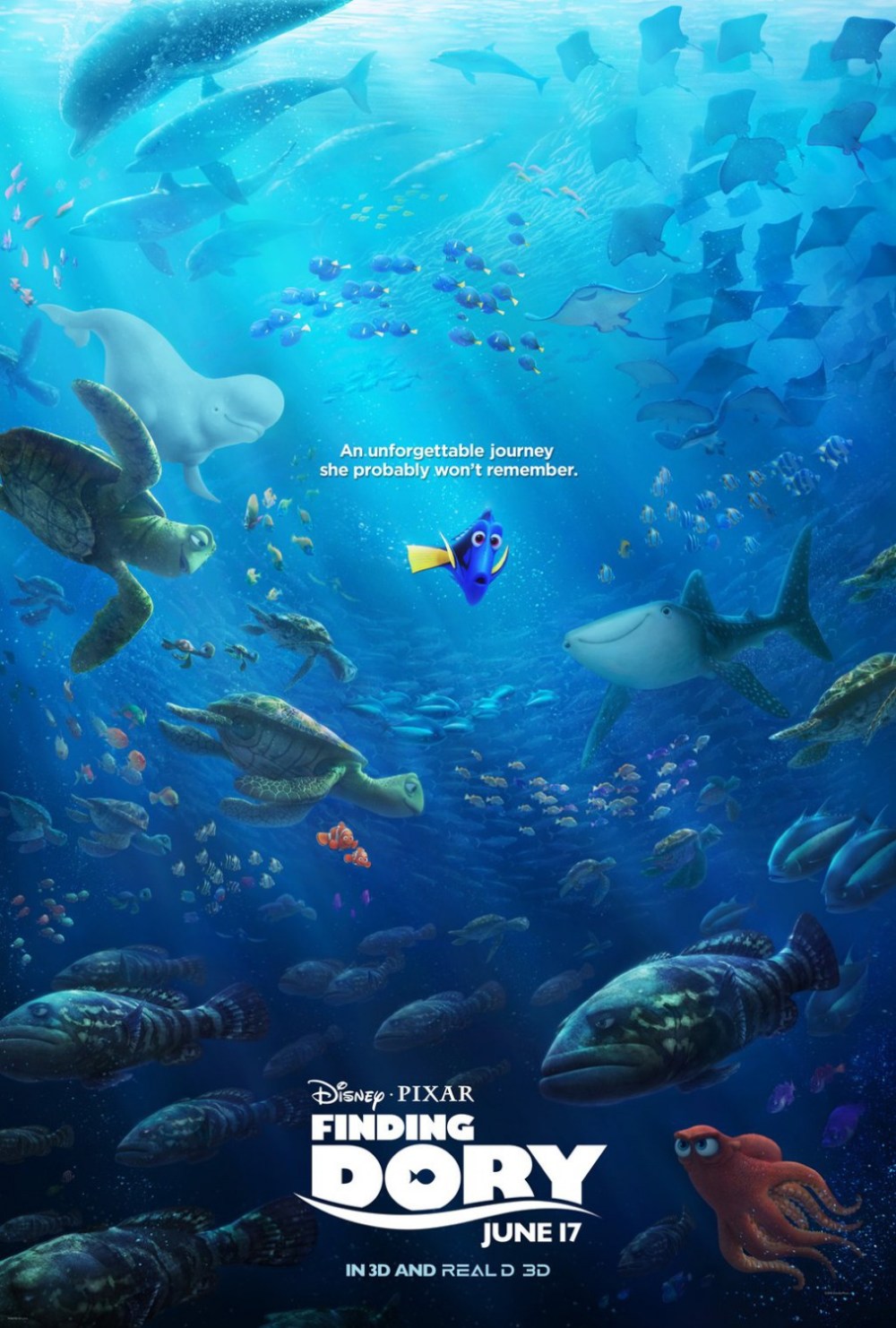
Finding Dory poster 6

Finding Dory” is a movie which put a big smile on my face as I watched it. In some ways this shouldn’t be a surprise as Pixar made it, and they continue to wow us time and time again, but this one really hits hard on an emotional level as well. This sequel to “Finding Nemo” allows a supporting character to take center stage this time around, and it is a character with a disability we find ourselves laughing and sympathizing with as she struggles to reconnect with a part of her past she tragically lost a long time ago.

A year has passed since clownfish Marlin (Albert Brooks) swam all the way to Australia to rescue his son Nemo (Alexander Gould in the original, Hayden Rolence here) and befriended Dory (Ellen DeGeneres), a Pacific regal blue tang with short-term memory loss, in the process. All three are back at the Great Barrier Reef leading a non-adventurous life, but Dory starts to remember things about her parents and how she was accidentally separated from them. When she suddenly remembers the place she came from, the Jewel of Morro Bay, California, she becomes infinitely determined to travel there and hopefully reunite with her parents.

While “Finding Nemo” was a long day’s journey into Australia, it doesn’t take long for Dory, Marlin and Nemo to arrive in California. However, Dory’s mission gets derailed when she is “rescued” by volunteers from the nearby Marine Life Institute. She is placed in the Quarantine section, and it is up to Marlin and Nemo to rescue her from the institute before it’s too late.

Now the story for “Finding Dory” isn’t much different from “Finding Nemo,” and as a result the freshness of the original is missing here. But this sequel is in many ways as good as the original as director Andrew Stanton, along with co-director Angus MacLane, gives as much focus to the story and characters as he does to the visual spectacle. And with Pixar, you can always count on them to outdo what they gave us before visually. The Marine Life Institute is displayed in such an amazing way to where you feel like you are looking at a real aquarium, and the main centerpiece is just incredibly rendered.

But seriously, what makes “Finding Dory” work so well above all else is the voice acting. This cast makes you root and care for these characters in a way the filmmakers could never have accomplished on their own. This is especially the case with Ellen DeGeneres who makes Dory such an endearingly lovable character, and she makes us feel for her to the point of tears. DeGeneres really deserved an Oscar for her work on the first movie, and the same goes with the sequel. Dory’s short-term memory loss was a joke of sorts, but now it’s a mental impairment she is desperate to overcome so she can find her parents. It’s a heartrending journey you can’t help but be sucked into, and one which feels genuine in its emotions and never manipulative.

And there’s no forgetting Albert Brooks who combines his comedic genius with a strong dose of vulnerability in his portrayal of Marlin. While this lovable clownfish looks like he hasn’t changed much from the last time we saw him, he is still full of heart and somehow rises to the challenges thrown at him when a dear friend is abducted. Brooks has always been a kick in every movie he appears in, and this one is no exception.

Many new characters are introduced in “Finding Dory” such as the near-sighted whale shark Destiny (Kaitlin Olson), California sea lions Fluke (Idris Elba) and Rudder (Dominic West) who are very territorial about the rock they hang out on, and the beluga whale Bailey (Ty Burrell). But the one who stands out most is Hank, an ill-tempered East Pacific red octopus voiced by Ed O’Neill. The “Married with Children” and “Modern Family” actor makes Hank a lovably gruff and infinitely clever character who would rather stay in the aquarium than go back into the ocean, and O’Neill leaves no trace of Al Bundy in his performance. There’s also a wonderful and genuinely emotional scene where Hank lets his guard down as he says goodbye to Dory, and O’Neill gives Hank a wonderful vulnerability which makes that moment stay with you long after the movie is over.

“Finding Dory” doesn’t reach the cinematic heights that “Inside Out” did, but it is still a wonderfully entertaining adventure you would be foolish to miss on the big screen. Pixar once again enthralls us with their mastery of animation, story and characters, and they are also blessed with another beautiful film score by Thomas Newman. While part of me wants to see Pixar do more original movies and less sequels, it was great fun to see these characters just keep swimming from one side of the ocean to the next. And in a time where blockbuster movies come at us from all directions, it’s nice to see one that really leaves a smile on your face.

As always, be sure to stay through the end credits.

Copyright Ben Kenber 2016.

* * * ½ out of * * * *

X-Men: Apocalypse

X Men Apocalypse poster

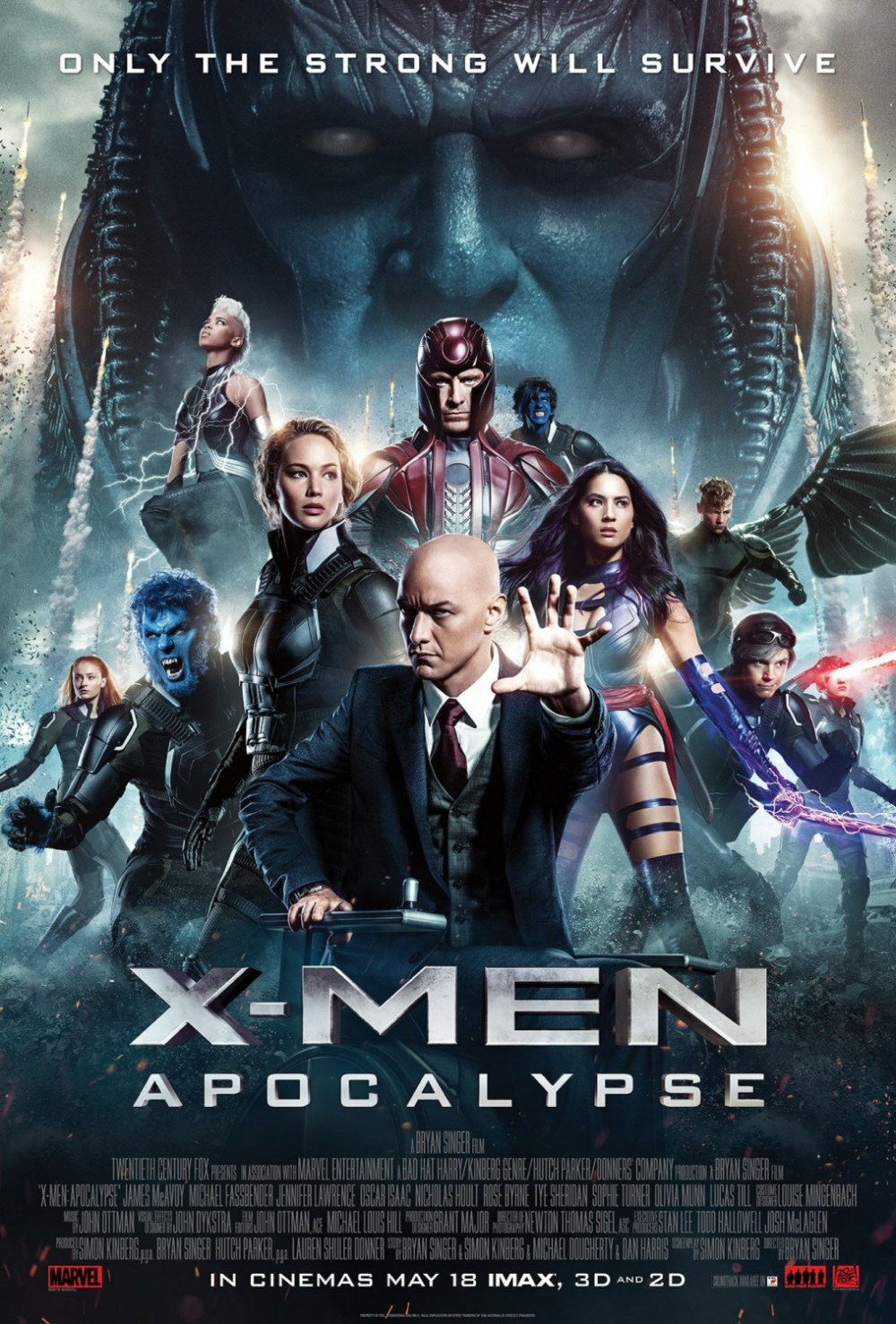
In the whirlwind of superhero movies which have come out in 2016, “X-Men: Apocalypse” ends up being sandwiched between “Captain America: Civil War” and “Batman vs. Superman: Dawn of Justice.” Like those two, “X-Men: Apocalypse” has far too many characters and plotlines to deal with, and its running time is much longer than it needs to be. But while this “X-Men” might not reach thrilling heights of “Captain America: Civil War,” it is far more enjoyable than the dour affair that was “Batman vs. Superman.” Still, after “X-Men: Days of Future Past,” this entry does feel like a comedown for the long running franchise.

The movie takes place in the 1980’s; a time of synth pop, “Knight Rider,” Ronald Reagan and “Return of the Jedi” among other things. The newest threat to both humans and mutants alike is En Sabah Nur, better known as Apocalypse, the world’s first and most powerful mutant. The movie starts off with him being entombed in a rocky grave after being betrayed by his followers, but he is awakened in 1983 and finds humanity has lost its way because, as he sees it, humanity was without his presence. As a result, he vows to destroy the world and remake it, and this time the X-Men may have a foe too powerful for them to defeat.

Playing Apocalypse is Oscar Isaac who enters yet another incredibly successful franchise after leaving his mark on another in “Star Wars: The Force Awakens.” In a way he is undone here by the large amount of makeup he is forced to wear as it threatens to rob him of his charisma. Seriously, the less makeup you put on Isaac the better as he can lock you in place with just a look from his eyes. Regardless, he is still very good here as he holds his own opposite actors who have been veterans of this franchise for quite some time.

Many of the “X-Men: First Class” cast return as well like James McAvoy, Jennifer Lawrence, Nicholas Hout, Michael Fassbender, Rose Byrne and Evan Peters. It’s great to see them all back as they are still deeply invested in these famous comic book characters as always. McAvoy, portraying Professor Charles Xavier/Professor X, shows just how mentally exhausting it is to fight an antagonist with only your mind. We also get to see how Charles lost his hair, and we leave the theater wondering how his eyebrows managed to remain intact.

Lawrence remains an enthralling presence in any movie she appears in, and she makes Raven/Mystique another in a long line of wounded warriors. The Oscar winning actress makes this comic book character into a hero as reluctant as Katniss Everdeen, and we feel for even as she feels she deserves no respect because of her regretful mistakes. While Raven/Mystique has been an antagonist for many of the “X-Men” movies, Lawrence makes her a complex character who comes to see what she must fight for most.

Erik Lehnsherr/Magneto has a setup like Logan/Wolverine had in “X-Men Origins: Wolverine” in which he’s found peace but eventually sees it completely destroyed to where the only thing on his mind is vengeance. It’s a familiar setup we have seen many times, but whether or not you know how Magneto will end up in this mutant tug of war, it’s worth just seeing Fassbender inhabit this role once again as he is riveting for every second he appears onscreen. Compare him all you want to Sir Ian McKellen, Fassbender imbues this iconic comic book character with a lot of raw emotion which will not leave you unmoved.

Evan Peters steals the show once again as Peter Maximoff/Quicksilver, the man who can move at supersonic speeds and yet still lives in his mother’s basement. Peters had one of “Days of Future Past’s” best scenes which was set to the tune of a classic 70’s song, and he does his thing here yet again to an 80’s song. It has been said that the next “X-Men” movie will take place in the 90’s, so we’ll have some time to guess what classic grunge song he will be saving the day to.

A number of other X-Men return as well, but this time played different actors. Kurt Wagner/Nightcrawler finally returns to the franchise for the first time since “X-Men 2: X-Men United,” and he is played by Kodi Smit-McPhee who gives the character a good dose of humor. Alexandra Shipp takes on Storm and sports a mohawk which is as fierce as her attitude, so watch out. The terrific Tye Sheridan portrays Scott Summers/Cyclops, and this character gets fleshed out in a way we have not seen previously. “Game of Thrones” star Sophie Turner appears here as Jean Grey, and it’s great to see the actress portray Jean’s dark side which is her gift and her possible undoing in the future.

With Bryan Singer returning to the director’s chair for his fourth “X-Men” movie, you can’t help but walk into “Apocalypse” with high expectations. Both he and screenwriter Simon Kinberg have too many characters to deal with to where several are not developed fully enough to be satisfying, and others are simply there for dramatic conflict. The mutant hating William Stryker returns, but the character barely registers this time around. We also get introduced to new mutants like Psylocke whose talents seem no different from others like her, and more could have been done to make her stand out. However, it should be noted that Olivia Munn fills out Psylocke’s uniform very well.

But even with its inescapable flaws, Singer still makes “X-Men: Apocalypse” a summer blockbuster packed with action, and the movie also hits you on a deep emotional level. We’ve been following these characters now for nearly a dozen movies, and we still care about their predicaments regardless of whatever timeline they are living through. Other directors in this franchise, with the exception of Matthew Vaughn, have not had the same success in engaging us as Singer has, and he continues to set the bar high for others looking to helm the next entry. And once again, Singer is served well here by his longtime editor and composer John Ottman who gives us yet another rousing music score.

So yeah, “X-Men: Apocalypse” could have been better, but it still works for what it is. It has a serious yet playful tone which has been the mark of many comic book movies in recent years, and it’s better than its score on Rotten Tomatoes would suggest. Regardless of how you feel about this movie, there’s still a lot of life left in this franchise and I am eager to see how the next “Wolverine” movie turns out.

Oh by the way, the filmmakers do pull off a none-too-subtle dig at “X-Men: The Last Stand.” Trust me, you will know it when you see it. Suffice to say, I don’t think Brett Ratner will be returning to this franchise anytime soon.

Copyright Ben Kenber 2016.

* * * out of * * * *

Pee-wee’s Big Holiday

Pee Wee Big Holiday poster

Pee-wee Herman was a big fixture in our young lives whether we liked it or not. Ever since the character’s first appearance at The Groundlings Theater, he amassed a large audience that grew infinitely beyond anyone’s wildest dreams. Both he and Tim Burton realized their big screen dreams with “Pee-wee’s Big Adventure,” and soon after he had his own Saturday morning show with “Pee-wee’s Playhouse.” Then he disappeared for a time and if we were sick of him, his absence made us realize how much we liked and got used to having him around.

Well in the past couple of years he has made a welcome comeback, and now it culminates in his first big screen adventure in decades, “Pee-wee’s Big Holiday.” Don’t let the fact it is debuting on Netflix turn you off (and why should it?). It’s an infinitely giddy movie which will have kids and adults alike laughing hysterically more often than not. While it seems to take place in an alternate universe where “Pee-wee’s Big Adventure” never took place, please rest assured that this man child has not changed and hasn’t aged a day.

When we meet up with Pee-wee, he lives in the picturesque town of Fairville where everyone seems more than willing to help him out with his Rube Goldberg-like devices and machines which get him up and out of his house in the morning. He is perfectly happy to work as a cook at Dan’s Diner and rehearse with his rock group to where the thought of going outside the city limits seems unthinkable. But this all changes when Joe Manganiello shows up as he plays… Well, you’ll have to see for yourself.

Anyway, Manganiello encourages Pee-wee to go beyond Fairville’s city limits and to find out more about life, and he even invites him to a birthday party taking place in New York City. Despite some hesitation, Pee-wee agrees and endures all sorts of adventures and mishaps as he makes his way from one side of America to the other.

What’s great about “Pee-wee’s Big Holiday” is how the humor succeeds in appealing to both kids and adults without condescending to either group. The kids will definitely enjoy Pee-wee’s antics as he braves a snake farm which is not all it appears to be and performs a balloon trick which has to be seen to be believed. Adults on the other hand will get a huge kick out of the subversive elements hidden throughout the screenplay which includes references to cult classics like Russ Meyers’ “Faster, Pussycat! Kill! Kill!” There’s even a great moment where “Magic Mike” is mentioned, and I wouldn’t dream of spoiling it for you here.

Tim Burton and Danny Elfman, whose movie careers exploded after the success of “Pee-wee’s Big Adventure,” weren’t around for this one. This particular adventure was directed by John Lee who became best known for his work on the MTV2 comedy series “Wonder Showzen” and episodes of “Inside Amy Schumer.” Lee keeps the pace of “Pee-wee’s Big Holiday” tight to where the movie never drags. Granted, the jokes are at times hit and miss, but the ones which do hit had me laughing harder than I had in some time.

Devo lead singer Mark Mothersbaugh composed the film score, and he seems like a natural choice to succeed Elfman. Both Mothersbaugh and Elfman have had long working relationships with unique film directors (Elfman with Burton, and Mothersbaugh with Wes Anderson), and their scores perfectly capture the playfulness and creativity we see unfolding onscreen, Whether or not you think Mothersbaugh’s work equals what Elfman pulled off years before, he is a terrific fit for this material and captures the infinite innocence of Pee-wee.

But what’s really nice is how Paul Reubens brings his man child alter-ego of Pee-wee Herman back to life after such a long hiatus. I figured Reubens had long since grown tired of this character to where it seemed like he had engineered a rather embarrassing escape from playing him. Reubens even went on to show his acting range with terrific performances in “Blow” and “Life During Wartime,” proving to the world there was way more to him than Pee-wee. But you can see on Reubens’ face throughout just how super enthusiastic he was about bringing this iconic character back to life, and he makes you realize just how much we have missed him lo these many years.

The only thing which could possibly take away from Reubens’ thunder here is Manganiello who steals every single scene he’s in. He could have easily screwed up here by playing his role like he was in on the joke, but he doesn’t and it help makes “Pee-wee’s Big Holiday” all the more fun to watch. Manganiello looks like he’s having a blast here, and his fun is very contagious.

There have been a lot of popular characters from the 1980’s resurrected over the past few years with varying degrees of success, and Reubens’ is more successful than others in doing so. His passion is sincere in bringing this character back from the land of syndication and reruns, and seeing him in action makes it seem like he never left us. Here’s hoping we see Pee-wee Herman taking on more big adventures in the near future.

Copyright Ben Kenber 2016

* * * out of * * * *

The Hollars

The Hollars poster

The Hollars” is a movie I really wanted to like. It is a very earnest story featuring a family meant to mirror our own, but the movie doesn’t take long to become painfully earnest as it veers from sitcom-like humor to somber drama with real uneasiness. John Krasinski not only stars in “The Hollars,” he also directed it, and while he is aiming for the heights of “Terms of Endearment,” he instead gives us a film which is very uneven and not as satisfying as he wants it to be.

It’s another day in the Hollar household as Jason (Sharlto Copley) finds the bathrooms occupied by his mother Sally (Margo Martindale) and his dad Don (Richard Jenkins) to where he literally has to find a pot to piss in. But Sally suddenly falls down and (yes, I’m going to say it) can’t get up, and both men realize she is not suffering from the common cold. When Sally is diagnosed with a brain tumor, her other son, John (John Krasinski), comes straight from New York City to be by her bedside. Of course, John has problems of his own as he struggles to get his career as a graphic artist off the ground while working a job he is not at all enthused about, and his longtime girlfriend, Rebecca (Anna Kendrick), is expecting their first child. Suffice to say, the Hollar family has a number of problems to deal with, and those problems are only going to get worse before they can possibly get better.

Now “The Hollars” gets off to a good start with a scene which is both comical and dramatic as Don and Jason discover Sally lying immobile on the bathroom floor, and what at first looks like a joke turns into something very serious. The look on Jenkins’ face is unforgettable as Don slowly realizes he may be on the verge of losing his beloved wife. Till death us do part is always part of those marriage vows, but we are never prepared to deal with death when it comes knocking at the door.

But when John arrives at the hospital and reunites with his family, everything suddenly descends into what feels like a sitcom, and the laughs feel as forced as Don’s crying. Jenkins has been and always been a great character actor, but seeing him essentially emote here feels criminal. No one should ever make Jenkins emote, ever!

From there, “The Hollars” introduces characters who appear to come from different universes, and when they collide everything feels off. Their acting styles don’t mesh well with one another, and it feels like they belong in different movies. Charlie Day co-stars as Jason, a hospital nurse married to John’s ex-girlfriend, Gwen (Mary Elizabeth Winstead, completely wasted in a frivolous role), and his performance is so broad to where I couldn’t wait for him to get off the screen. Even more disappointing is Sharlto Copley whose crazed energy which served him so well in “District 9,” “Elysium” and “The A-Team” movie is misplaced here as his character comes off as a stubborn jerk. His character should be empathetic, but Copley is unable to render him as such.

“The Hollars” works best when it grounds its characters in a reality we understand. As an actor, Krasinski has some nice moments, especially when he relives a childhood memory of swinging on a tire by the river. Singer Josh Groban is surprisingly good as a local preacher and succeeds in making him the most level-headed character to be found in this movie. And Anna Kendrick shows up in a few scenes and proves to be as delightful a presence as always.

But if there is anything which makes “The Hollars” worth the price of admission, it is Margo Martindale. She has long since proven herself to be one of the best actors working today as she can take the smallest moment in a play, television show or movie and make it completely unforgettable. Throughout this movie she works wonders as Sally faces an end no one is ever fully prepared for, and her performance is piercing in its emotional honesty. Just watch her as she talks about the time she visited the Fox Theater; she renders this moment so vividly that it’s as if she is painting with words instead of brushes.

Coming out of “The Hollars,” I couldn’t help but feel sorry for Krasinski. This is clearly a project he put his heart and soul into, but he is unable to balance out the comedic and dramatic elements in the story. Making a movie like this is very tricky because all the characters need to be on the same plain of existence, and he’s unable to accomplish that. More often than not, the movie veers over to the comedic side but the laughs don’t come when you want them to. When it veers to the dramatic, scenes end up feeling emotionally forced which just torpedoes the impact Krasinski hoped it would have.

Still, “The Hollars” is not a complete loss as there are things audiences will be drawn to, and those who have been in situations like this family are more than likely to be moved by what they see. And for all its flaws, this movie does have something in it which is truly great: Margo Martindale’s performance.

Seriously, better luck next time Krasinski. I’ll be rooting for you.

* * ½ out of * * * *

Copyright Ben Kenber 2016.


The Nice Guys

The Nice Guys poster 1

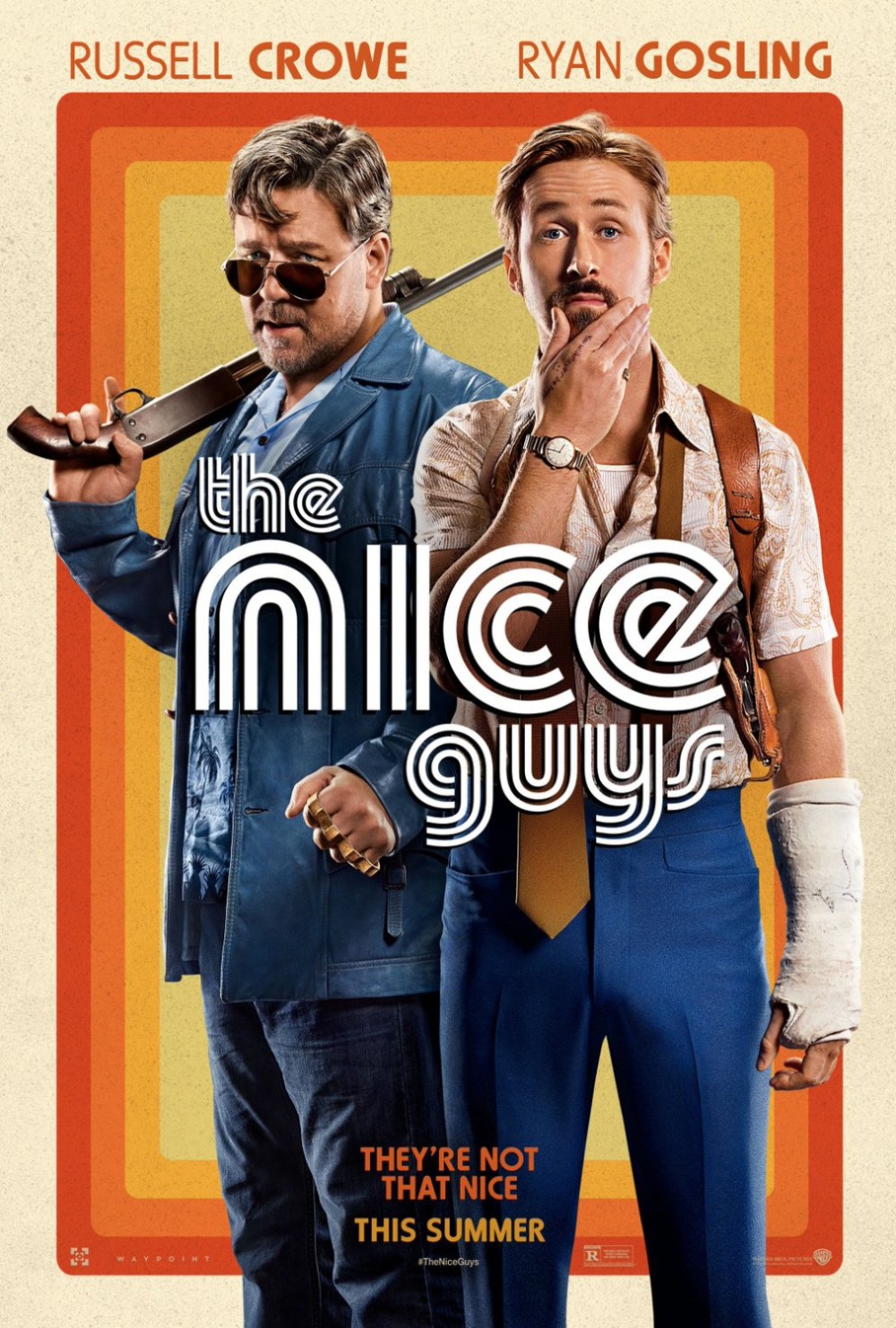
After exploring the superhero genre with “Iron Man 3,” writer and director Shane Black returns to the one he mastered years ago: the buddy cop movie. Black is the same man who wrote the screenplays for “Lethal Weapon,” “The Last Boy Scout,” “The Long Kiss Goodnight” and “Kiss Kiss Bang Bang” which he also directed. Now he gives us “The Nice Guys” which takes us back to the 1970’s and teams up Russell Crowe and Ryan Gosling as men involved in a murder mystery only they can solve.

“The Nice Guys” takes us back to 1977 and even features the “Big W” Warner Brothers logo Ben Affleck used to great effect in “Argo.” We even get some nice retro credits presented to the tune of “Papa Was a Rolling Stone,” so it doesn’t take Black long to transport us back to a time where laws against smoking were nowhere as strict as they are today. Black gives us some wonderful introductions to enforcer Jackson Healy (Russell Crowe) and down-on-his-luck private eye Holland March (Ryan Gosling), men who are not at their peak of their lives and are looking for reasons to justify their existence.

Like Bruce Willis and Damon Wayans in “The Last Boy Scout,” Jackson and Holland do not get off to the best start, and this is especially the case after Jackson breaks Holland’s arm with what seems like little ease. But the both of them come to see they need each other to discover the whereabouts of Amelia Kutner (Margaret Qualley), a missing girl who may be connected to the death of porn star Misty Mountains (Murielle Telio). Actually, describing the plot of this movie is a bit complicated as it is a little hard to follow, but perhaps a second viewing will help to answer questions viewers had the first time around.

Black, along with co-writer Anthony Bagarozzi, still knows how to create potent dialogue with a kick to it, and it makes the chemistry between Gosling and Crowe all the more palpable. After all these years, Black can still deliver a number of zingers few other screenwriters could pull off with as much success. As a director, he captures the mood of the 1970’s with a lot of flair and panache, and he makes the audience feel all the kicks and punches which come at them with fierce brutality.

Gosling nails the vulnerabilities and complications of Holland with a fearlessness, and he renders certain moments like when he suddenly discovers a dead body with an originality which makes them all the more memorable. As for Crowe, he has never had much success with comedy judging from his failed turn as a romantic comedy leading man in “A Good Year.” But here he fares much better as Jackson as this role plays on his strengths as a tough guy while at the same time playing around with this image of his. When he stares down a suspect he’s about to give a serious beating to, it makes you wonder why he even bothers wearing brass knuckles. His demeanor should be more than enough to intimidate anybody foolish enough to cross his path.

I also have to single out Angourie Rice’s performance as Holland’s daughter, Holly, as she more than holds her own opposite Gosling and Crowe. She also reminds us of how the younger generation is quick to call out their parents on the baloney they feed them on a regular basis. Rice makes Holy into a young girl wise beyond her years as a result of watching her dad fumble about much too often in life. She also reminds us of how we eventually become too benumbed by the unfairness of life as she holds a high moral standard that we have long since given up on out of hopelessness, and it makes for some powerful scenes in which she reminds the adults of why they are flat out wrong on certain issues.

“The Nice Guys” provides audiences with the opportunity to seek out a movie not populated with superheroes, and it is unafraid to brush political correctness aside without a second look. It’s giddy fun as it doesn’t conform to the cinematic norm which is overly influenced by corporations and needless test screenings. This one is its own beast, and taming it does it no justice. Either enjoy for what it is or see something else.

Copyright Ben Kenber 2016.

* * * ½ out of * * * *

The Wave

The Wave movie poster

The problem with most disaster movies these days is they present their horrific scenarios with nothing but stock characters who end up spouting annoying clichés aided by a weak screenplay. While they have amazing special effects at their disposal, they are saddled with a conventional story filled with people we can never truly relate to, and they bend the rules of science in a way that’s shameless as filmmakers believe we won’t question what we see. But we do question what we see, and what ends up on the screen ends up being far more laughable than thrilling.

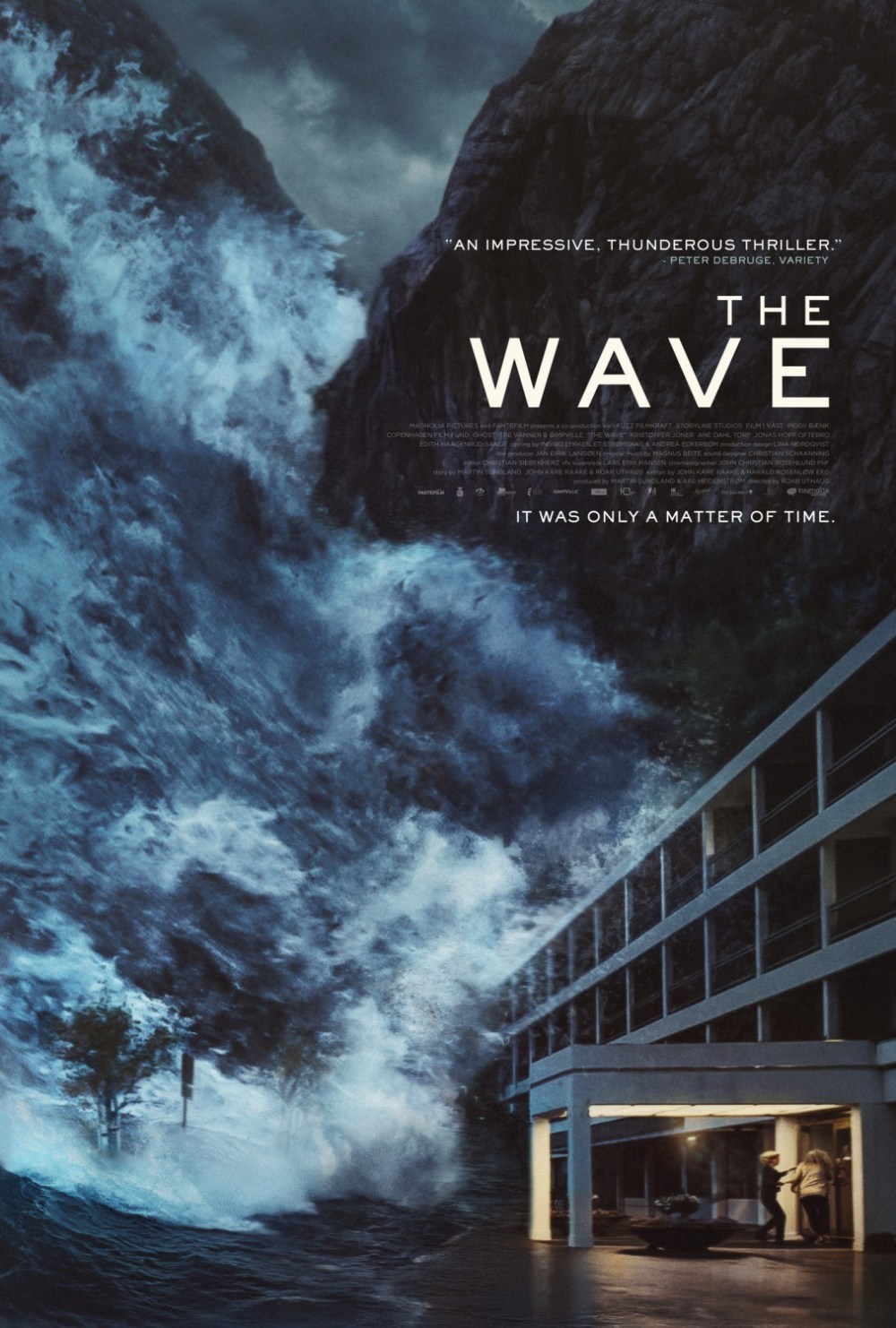
That’s what makes the Norwegian thriller “The Wave” so refreshingly effective as it has down to earth characters we can relate to, and it also deals with science in a way which is not insulting to the intelligence. The movie doesn’t break any new ground in the disaster genre, but the filmmakers still leave us on the edge of our seats throughout as they present us with a scenario which could very well happen before I finish writing this review.

The movie starts off with a documentary sequence which shows how parts of Norway, while stunning in their beauty, are always susceptible to collapse and utter catastrophe. This country saw one of its town decimated by a rock-slide tsunami back in 1934, and there was another massive tsunami in 1905 which killed 65 people. Scientists all agree this catastrophe will very likely happen again but they don’t know when, and this sequence hovers the rest of “The Wave” as we go into it knowing this beautiful Norwegian will soon be laid waste.

Kristoffer Joner stars as Kristian, a geologist who has worked in the small Norwegian village of Geiranger for the past few years and is about to start a new job at an oil company. His family is in the process of vacating their home to move to a new apartment in the big city, but on his last day at work he sees the substrata is shifting and things don’t feel right to him. But when he presents his concerns to his co-workers, they are not quick to alert the village’s inhabitants as they don’t see much of a threat based on the evidence at hand. Plus, the tourism season is at its peak and this town, just like Amity in “Jaws,” depends on this season to meet their financial obligations.

Watching “The Wave” reminded me of when I saw Roland Emmerich’s “The Day After Tomorrow.” While Emmerich’s movie was never boring, it’s take on science was hard to accept especially when the characters tried to outrun a weather freeze which immobilizes everything in its path. But the filmmakers of “The Wave” are not about to insult our intelligence and present us with scientifically sound facts, and that makes watching this movie all the more intense and anxiety-inducing as a result.

Going into this movie we all know that this town will be utterly destroyed, but the buildup to the inevitable catastrophe is worth it as, when it does hit, it leaves us as trapped as the characters as they desperately try to reach safety. Kristian is not out to be a hero as he warns others as he tries outrun the tsunami that will eventually wreak havoc on the defenseless village. Joner does an excellent job of giving us a protagonist who is an ordinary guy who recognizes the dangers this village will eventually fall victim to, and the reaction he has when a flock of birds flies away in anticipation of the massive rockslide tsunami is priceless.

Joner also has a family which includes his wife Idun (Ane Dahl Torp), his daughter Julia (Edith Haagenrud-Sande) who is fascinated by the world at large, and his son Sondre (Jonas Hoff Oftebro) who is NOT looking forward to being uprooted from his hometown even if his dad got a better job than the one he had. These are all people we understand and whose struggles we can easily relate to, and that makes this motion picture even more intense as we don’t feel like we’re watching characters; we’re watching real people.

As for the wave of the movie’s title, it is a CGI creation which is rendered very effectively. Seeing it demolish everything in its path feels more terrifying than anything shown in “San Andreas.” Seeing the townspeople flee to higher ground as it approaches is anxiety-inducing as we know not everyone will escape its wrath. Some disaster movies throw a barrage of visual effects at us to where we don’t feel like we’re watching a real disaster unfold, but that’s not the case here.

Sure, the story is predictable as Joner is determined to find his wife and son who get trapped in the post-tsunami devastation, and the movie’s ending is no surprise at all. But thanks to the attention on character as much as spectacle, this is a disaster movie Hollywood can really learn a lot from. Don’t let the subtitles turn you off because this is an especially intense disaster movie which will have your heart racing.

Copyright Ben Kenber 2016

* * * ½ out of * * * *

Pride and Prejudice and Zombies

pride_and_prejudice_and_zombies_ver3_xlg

I came into this movie expecting a parody along the lines of something directed by Jason Friedberg and Aaron Seltzer, the same filmmakers who inflicted such laugh free movies on us like “Meet the Spartans,” “The Starving Games” and “Vampires Suck.” The problem with most movie parodies today is everyone is constantly in on the joke to where watching them becomes excruciating. It’s no wonder this genre has been dying out lately as we can see the jokes coming from a mile away to where the punchlines are ruined before they’re even spoken.

So it is a nice surprise to see “Pride and Prejudice and Zombies,” a sly take on the classic Jane Austen novel, does not come even close to falling into this trap. It actually stays respectful of Austen’s work while adding a bit of the undead to the proceedings. The actors take their roles and the story more seriously than expected, and there’s never a kitsch feeling to be found throughout. This movie could have easily fallen apart in the wrong hands, but smarter minds prevailed and gave us something quite entertaining.

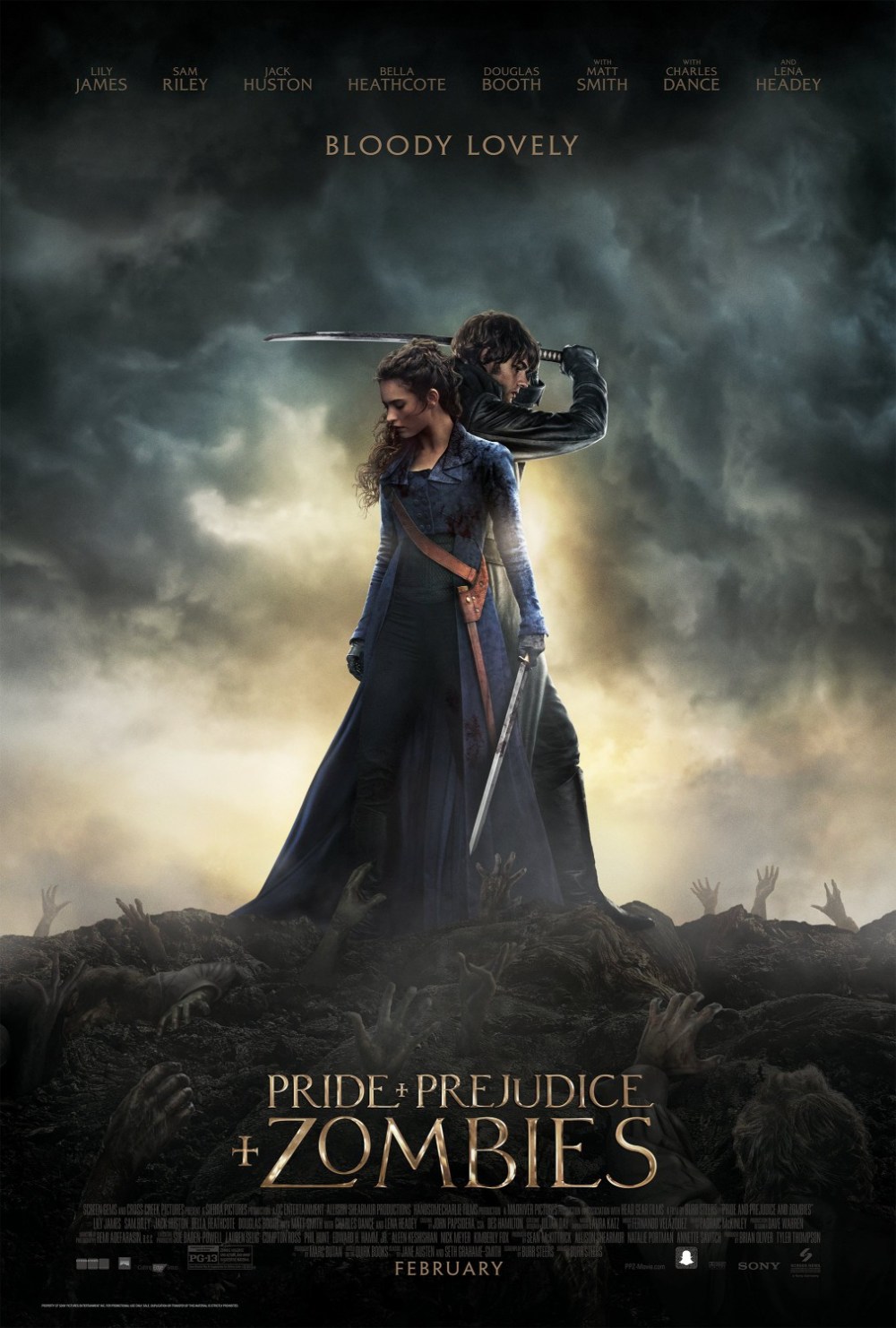
The movie is actually based on the novel of the same name by Seth Grahame-Smith which follows the plot of “Pride and Prejudice” while adding both zombie and ninja elements to it. The characters still exist in 19th century England, but it’s an alternative universe where the undead are a constant nuisance and Mr. Bennet (Charles Dance) has taken the time to train his daughters in martial arts and weaponry. Chief among his daughters is Elizabeth Bennet (Lily James) who is the best trained of them all as well as fiercely independent. While her sisters are eager to find a husband, she does not feel the need for one.

Into the picture comes Mr. Darcy (Sam Riley) who is an expert at identifying zombies and taking them out before they even have a chance to reveal themselves to the unsuspecting. Just as in Austen’s novel, Darcy and Elizabeth share an utter contempt for one another which will soon reveal the unmistakably strong attraction between them. But can they survive the zombie onslaught long enough for them to share their true feelings to each other? Well, anybody who has read Austen’s classic book knows the answer, but keep in mind how it never contained zombies like Grahame-Smith’s book does.

Lily James makes Elizabeth Bennet into a woman as lovely as she is lethal when it comes to taking out zombies with a sword. Seeing Elizabeth and her sisters stroll into a social event and armed to the teeth with weapons of all kinds makes clear that polite behavior has to be set aside when the undead drops by for a bite. Does she do one better than the other actresses who have played this classic character in the past? This doesn’t matter as she gets to take on a different version of this fiercely independent female who is more than capable of taking care of herself.

The same goes for Sam Riley who takes on the role of Mr. Darcy. Comparisons to Colin Firth’s interpretation of Darcy, which everyone seemed to fall in love with at first sight, might be inevitable, but I’m not going to bother. While Riley tends to keep Darcy’s stiff upper lip a little stiffer than it needs to be, he still makes Darcy into a formidable soldier and his scenes with James crackle with an attraction which cannot be denied.

The other actors in “Pride and Prejudice and Zombies” look to be having a great time as well. Among the standouts are Jack Huston as George Wickham who turns on the charm to where the easily duped are duped beyond repair, Lena Headey makes Lady Catherine de Bourgh, Darcy’s aunt, an especially fierce protector of her own family, and Matt Smith steals several scenes as the infinitely dubious Parson Collins. Once again, none of the cast acts like they are in on the joke, and the movie is so much the better for that.

Directing “Pride and Prejudice and Zombies” is Burr Steers who in the past few years has made one picture too many with Zac Efron (“Charlie St. Cloud” and “!7 Again”). However, this was the same man who helmed “Igby Goes Down,” a movie with a biting sense of humor which cut deep as it came with a lot of emotional honesty. “Pride and Prejudice and Zombies” doesn’t cut as deep as “Igby Goes Down” did, but it feels like Steers has more to play with this time around as he melds Austen’s world with the undead, and he is not as constrained by cinematic conventions as he was in the past.

Is Steers able to keep the momentum going from start to finish? Not quite. The movie does lose some steam towards the end as there is only so much he can do with the zombie thing. Also, it has a PG-13 rating which means the violence is going to seem neutered to an extent which is frustrating to accept. Imagine how insane the proceedings would have been had the violence and bloodshed went unrestrained. This would have been even more fun had Screen Gems let Steers turn this into a go-for-broke extravaganza.

All the same, “Pride and Prejudice and Zombies” proved to be far more fun than I expected it to be, and it brings to mind those crazy B-movies we all grew up on. Jane Austen could have been rolling over in her grave at the sight of this, but her fans can take comfort in that her works remain as popular today as they were years ago. Besides, it’s got zombies in it. How could it go wrong?

Copyright Ben Kenber 2016

* * * out of * * * *

‘Now You See Me 2’ Wants To Be Cleverer Than It Is

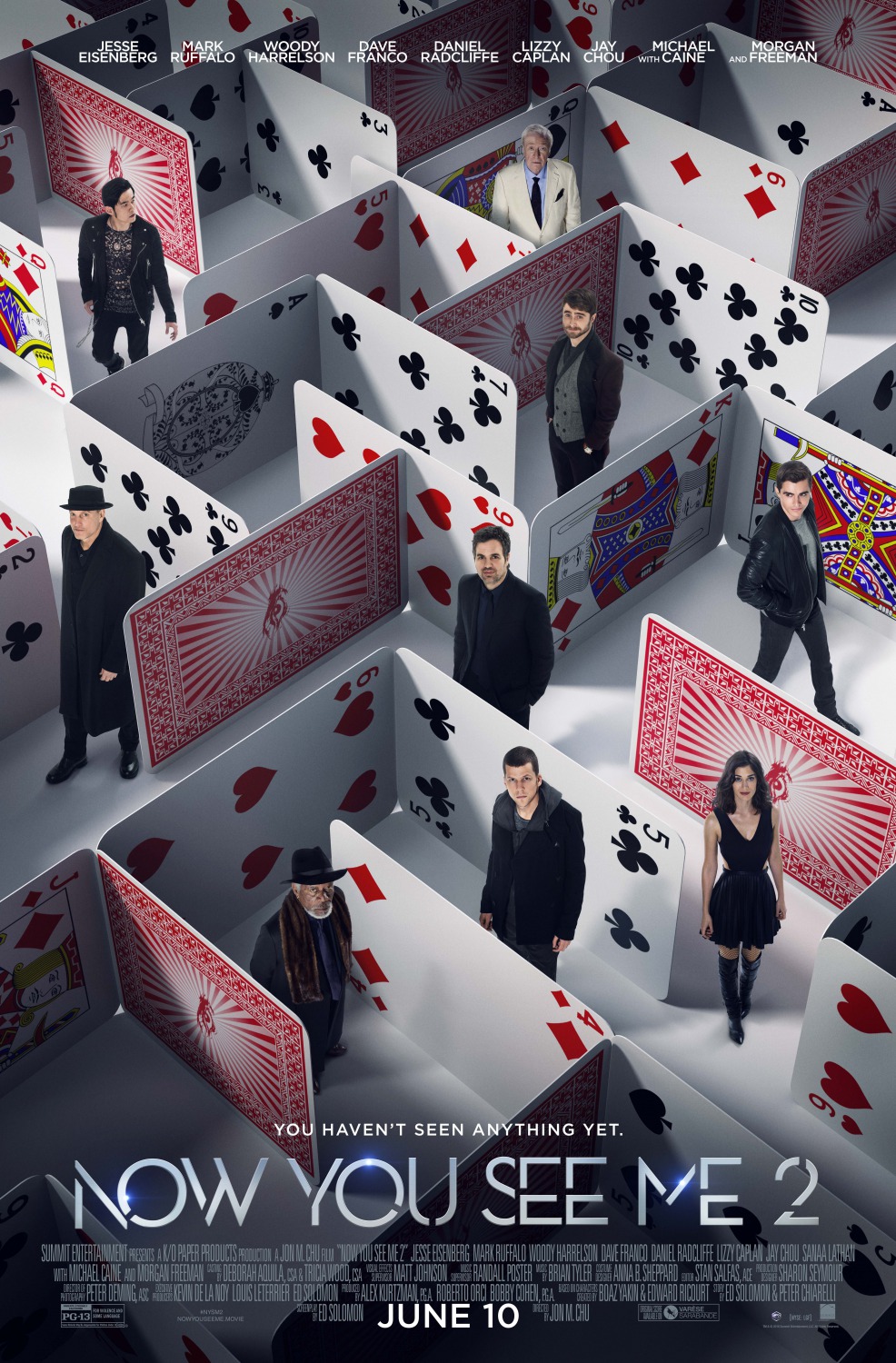
Now You See Me 2 poster

There’s a great moment, one of the very few, in the 007 adventure “Die Another Day” when James Bond is being presented with the latest nifty gadget from Q. Upon seeing what the gadget does, Bond tells Q, “You know, you’re cleverer than you look.” To this Q replies, “Still, better than looking cleverer than you are.” Those lines of dialogue kept repeating in my head as I watched “Now You See Me 2,” a movie which tries to be cleverer than its predecessor. But in the process, this follow up become so infinitely exhausting as it heedlessly defies logic more often than not.

We follow up with the Four Horsemen a few years after the events of the first movie, and they have managed to stay in hiding regardless of how impossible it is to stay off the grid these days. But Atlas (Jesse Eisenberg), Merritt (Woody Harrelson) and Jack Wilder (Dave Franco) are soon brought out of retirement to expose a Steve Jobs-like tech guru whose fraudulent practices have caused hardship for millions of people. Henley Reeves is out of the group, due to Isla Fisher’s pregnancy, and in her place is Lula (Lizzy Caplan) who quickly proves to be more than just a wannabe magician.

They work again in conjunction with FBI agent Dylan Rhodes (Mark Ruffalo), who was previously revealed to be the one who brought the Four Horsemen together, but their big comeback show goes awry when it is sabotaged by someone who shows that Jack never died and of Dylan’s role in the whole endeavor. That someone is revealed to be Walter Mabry (Daniel Radcliffe), a tech prodigy who invested a lot of money in companies run by Arthur Tressler (Michael Caine) and lost much of it after the Horsemen stole Tressler’s millions. Walter wants his money back and forces the group to pull off their greatest heist yet, and they run into additional trouble when the imprisoned Thaddeus Bradley (Morgan Freeman) finds a way to get his revenge from behind bars.

“Now You See Me” was a runaway hit back in 2013 and, while it had a number of plot holes, it proved to be a fun ride and had a terrific cast of actors whose charisma made it all the more watchable. But this same cast, even with new additions Caplan and Radcliffe, can’t save this sequel as we come to spend more time debunking their actions than we do in just going along for the ride. While I am prepared to suspend my disbelief through many films, it became impossible to do so with this one.

Watching “Now You See Me 2” becomes increasingly ingratiating as so many random characters try to stay one step ahead of each other. But while we go to a movie like this to see good defeat bad, the filmmakers have tried much too hard to keep the audience guessing from start to finish. Considering how this sequel takes place in a time long after movies like the “Ocean’s Eleven” trilogy have been released, you would think the bad guys would be better prepared. Then again, crime does make you stupid.

If it weren’t for the talented cast, this movie would be almost unwatchable. Ruffalo, Harrelson and Eisenberg have an effortless charisma about them, and they slip back into these roles as if a day hadn’t passed since the original. Both Caine and Freeman could play their roles in their sleep, and that’s what they do here. While it’s a bummer Fisher couldn’t return, Caplan proves to be an engaging presence and her enthusiasm is wonderful to take in. And it’s great to see Radcliffe join in with this ensemble as he reminds us of something which should be abundantly clear by now: there’s much to him than Harry Potter.

Behind the camera this time is Jon M. Chu who previously directed the “Step Up” sequels, “G.I. Joe: Retaliation” and “Jem and the Holograms,” a movie better known for its terrible box office opening weekend than anything else. While Louis Leterrier, who directed the original (he is an executive producer on this one), managed to keep things going at a steady pace, Chu stretches things out to where this sequel overstays its welcome by at least half an hour. He also ends this movie in a way which makes no logical sense considering where certain characters ended up in the original. Long before it ended, I found myself having a headache that had Excedrin written all over it, and I knew taking any would not make me feel any better.

You can only fool an audience for so long until they start analyzing the story very closely. When they start asking questions during the movie’s running time, you are in trouble. “Now You See Me 2” gets undone because the filmmakers didn’t care if it all made sense or not. Instead, they end up insulting our intelligence to where you wonder if it was worth it to even make this sequel.

In the future, I would love to see a prequel to this sequel in which we watch the characters get together and figure out how they will pull all their plans and magic tricks off. It will be worth watching just to see if the characters can convince themselves, let alone the audience, that their mischievous plans make any sense whatsoever regardless of the unpredictable variables which will come their way. If they can accomplish that, you will have one hell of a movie.

Copyright Ben Kenber 2016.

* * out of * * * *