‘Transformers: Revenge of the Fallen’ Belongs in the Cinematic Abyss

Transformers Revenge of the Fallen poster

To a certain extent, I have been happy to defend Michael Bay on some of his movies. “The Rock” was a kick ass action flick, and it brought Nicholas Cage to a whole new level of stardom which he has since pissed away. When he gave us “Transformers” two years ago, it seemed really good when you compared it to his other movies. It seemed like he might turn out to be better than we typically give him credit for. Heck, Steven Spielberg worked with him on it for crying out loud!

But now comes the inevitable sequel entitled “Transformers: Revenge of The Fallen,” which I thought could be the “Empire Strikes Back” of the franchise, but this not even close to being the case. If I didn’t have an intense hatred of Bay before, I sure as hell do now. I came out of this sequel cursing his name as if he had no reason to live. “Transformers: Revenge of The Fallen” may very well represent the biggest waste of money ever spent on any film I have seen since “Waterworld” or even “Norbit”. Yes, the movie has action all over the place and the effects are incredible and incredibly loud as you would expect them to be, but I came out of it wanting to spit at the screen. This is a movie with no heart or soul, and it renders all the hard work put into it as utterly meaningless. What a pathetic waste of celluloid this is! But what’s truly depressing is no matter how critically thrashed this movie gets, it will still make tons of money.

Shia LaBeouf returns as Sam Witwicky in a performance which threatens to be as utterly annoying as Ralph Macchio’s in “The Karate Kid Part III.” Despite being a hero and helping the Autobots defeat the evil Decepticons in the first movie, he still acts like a pussy whipped bitch here. I don’t think LaBeouf is a bad actor, but he needs to stop playing characters like this lest people start thinking he’s playing himself. The first “Transformers” gave his career a huge leg up, but this god-awful sequel can take him down just the same.

Megan Fox also returns as Sam’s voraciously attractive girlfriend Mikaela Banes, and she makes her entrance by leaning over a motorcycle showing off one of her best “assets.” This will probably piss people off as Bay makes good sport of objectifying women throughout, and it wouldn’t be the first time either. Still, I would be a bit of a hypocrite if I didn’t say I enjoyed this visual even if it was from a faraway distance. Hey Fox, I know you want to be taken seriously as an actress and, believe it or not, I would like to see that happen for you. All the same, if there is a third “Transformers” movie, I strongly advise you NOT to do it. I honestly think you deserve better than this.

The plot of “Transformers: Revenge of The Fallen” is… well, it’s somewhere in there. It involves… uh, some shard from that cube lodged in Sam’s clothing which…umm…well, ends up filling his head with symbols that… Jesus this is hard to describe! It makes Sam write all these symbols that…that…I don’t know, lead him to this big fight in Egypt… Oh yeah, he meets up again with Optimus Prime from the first one… Bumblebee is back too, and he threatens to be even more of a pussy than Sam is, but he kicks ass… Then they end up in Egypt and fight alongside those military dudes from the previous film…you know, Josh Duhamel and Tyrese Gibson? And then… uh, well… There’s a lot of action!

It’s clear from the start Bay is not concerned with developing a good story or giving us characters who are anything but shallow. It certainly would help to bring us into the action more on an emotional level. I have a pretty good idea what Bay is thinking: Fuck the critics! I make movies for the audience, not you snobs! But in the process of flipping the bird to film critics, he is also insulting the audience’s intelligence. And yes, this includes all those 12 and 13-year old’s who this movie was clearly made for. I can’t say I was a huge fan of the Transformers as a kid, but I bet the most die-hard fans will find much to hate about this horrid sequel, and the call for Bay’s blood will be as loud as the explosions are in this film.

All the hallmarks of a Bay movie can be found here; loud explosions every other millisecond, characters communicating by yelling at each other even when they are in earshot of each other, and inane dialogue which makes George Lucas’ sound like John Patrick Shanley’s. I’m sure there are many who will say this is a movie where you should “check your brain at the door,” but this sentiment only goes so far. There is a point where you take your audience for granted, and finding forgiveness for this transgression is a bitch. This isn’t the first time Bay has gone out of his way to intentionally piss off those critics who hate his films. “Bad Boys II,” another cinematic monstrosity, was Bay lighting a fire under the ass of many a film critic. But the maker of one god awful sequel has now succeeded in creating one which is far worse.

Bay flips the bird at us even more by introducing two Autobots which are nothing more than extremely offensive stereotypes of the blatantly racist kind. I’m talking about Mudflap and Skids, the Transformers’ answer to Jar Jar Binks. I figured by having an actor like Tyrese Gibson might balance out things here since he doesn’t descend into any stereotypical behavior, but this is a movie whose main audience will be kids for crying out loud! I usually think people look into the way certain people are portrayed in movies a little too much, but this time the criticism is more than justified as Mudflap and Skids are two infinitely misconceived characters.

Speaking of characters yelling at each other, this god forsaken sequel may very well contain the most yelling of multiple characters in any film. Do you have any idea of just how annoying it is when people TALK LIKE THIS AS IF YOU HAVE SOME HEARING DISABILITY AND THEY THINK YOU HAVE A PROBLEM WITH YOUR HEARING AID EVEN THOUGH YOU DON’T ACTUALLY HAVE ONE BUT THERE’S SO MUCH FIGHTING AND EXPLOSIONS GOING ON TO WHERE YOU DON’T HAVE THE TIME TO APOLOGIZE TO EACH OTHER BECAUSE YOU EITHER ARE RUNNING LIKE HELL FROM THOSE NASTY DECEPTICONS OR YOU HAVE TO FIGHT THEM ASSUMING YOU GOT ANY BALLS LIKE THE MILITARY DOES BUT HAVING ANY OLD GUN WON’T HELP BECAUSE YOU NEED THE EQUIVALENT OF A BAZOOKA?… I’m not sure I have seen another movie where I have been desperate to see so many tracheotomies performed in one sitting! It’s not enough to tell one person in this movie to shut the fuck up just once. You have to do it over and over, and they still will end up screaming their anxieties right out at you!

Not just that, but half the time I couldn’t even understand what the hell anyone was saying. Did Bay sneak crystal meth into everyone’s food? It’s bad enough he gave us a movie at two and a half hours long, but is this how he chooses to condense a lot of it? I wonder if Bay could actually explain to us what’s going on here. I bet the way he sees it, if he gave us all sorts of loud explosions and expensive special effects, then who are we to argue? You can get away with this in another movie, but not this one.

My reaction to this new “Transformers” movie reminds me of when I witnessed Roland Emmerich’s tragically horrific take on “Godzilla.” I went out of that movie feeling depressed and saying to myself if this is the way Hollywood is going to keep making movies, then I am not going to another one ever again. Over ten years later, it feels like we haven’t come any further. Does Bay really think this is something people will instantly embrace? In the end, it won’t really matter because “Transformers: Revenge of the Fallen” is bound to make a ton of money no matter how bad it is.

It’s not worth it wasting any more time on this movie than I already have. Seriously, I was all but ready to spit on the ground of the theater I saw it at. If you didn’t hate Bay before this movie, you will now. As I exited the theater, I quietly said to myself, “Fuck Michael Bay! Fuck him royally! Burn in hell!”

In regards to the audience I saw it with, the best piece of praise I heard from anybody about the movie was, “It’s okay.” Talk about being generous! Right now, I am sick of movies being just okay. So far, there has only been one truly great live action movie out this summer, and that’s “Star Trek.” Coincidentally, two of the screenwriters on this massive train wreck, Roberto Orci and Alex Kurtzman, also wrote the screenplay for that one. What the hell guys? Or maybe you’ll get off easy since Bay runs through your dialogue so fast to where we can’t possibly understand what anyone is saying. But don’t worry guys, Bay is taking all the heat on this one.

Michael Bay, you have just given us a great example of how NOT to make a summer blockbuster. Now if you’ll excuse me, I’m gonna go watch “No Country for Old Men” just so I won’t forget what great filmmaking looks and feels like.

ZERO out of * * * *

*This review should suffice for the “Transformers” sequel of your choice.  

‘Get Him to The Greek’ Allows Us to Forget about Sarah Marshall

Get Him to the Greek movie poster

We have sequels and franchise reboots or remakes up the wazoo this summer, but it feels like it has been forever since we had a movie spin-off. I know there are tons of them on television these days, but TV spinoffs seem to be a necessity, especially with shows like “Law & Order” and “CSI.” We’re gonna have “Law & Order: Los Angeles” in the fall, proving the cancellation of the original “Law & Order” never ended anything. Personally, I’m waiting for “Law & Order: Barstow” and “CSI: Chico.” Now those would be the ones to really shake things up!

In fact, the last time we had a movie spin-off was “US Marshalls” which took Tommy Lee Jones’ character of Sam Gerard from “The Fugitive” and gave him his own movie. Looking back, it was more of a remake of “The Fugitive” than anything else.

Now we have “Get Him To The Greek” which takes Russell Brand’s character of spaced-out rock star Aldous Snow from “Forgetting Sarah Marshall” and has him starring in his own movie movie. Give Hollywood some credit here for being a little more creative than usual. By making a movie based on a supporting character from another, they show an air of confidence they usually only pretend to have.

Whereas Aldous was drug free in “Forgetting Sarah Marshall,” he is shown to have fallen off the wagon big time in this one as we watch him suffering the aftereffects of a horrible song he wrote and recorded called “African Child.” The song was declared to be the worst song of the decade, and it places second to apartheid as the worst thing to happen to Africa. The love of his life, Jackie Q (Rose Byrne from “28 Weeks Later”), ends up leaving him along with their son Naples, and he proceeds to go on one drinking/drug binge after another as his life goes from worst to intolerable. Then he hits rock bottom, but this doesn’t stop his spiral any.

Several years later, a record company intern named Aaron Green (Jonah Hill) brings up at a meeting how it is coming up on the 10-year anniversary of when Aldous performed a concert at the Greek Theater, one which resulted in one of the best-selling live albums of all time. After Aldous confirmed with Aaron’s boss, Sergio (Sean Combs), that he will do a new show to celebrate this occasion, Sergio sends him out to England to fetch Aldous and to make sure he makes it to the concert on time.

Judd Apatow is of course behind this one as a producer, and the setup reminded me a lot of his movie “Funny People.” Big fan meets his celebrity idol, discovers being a celebrity can be the loneliest place of all, and they somehow connect at the end in a way they never thought possible. But this one is just a flat-out comedy and has none of the dramatic edge of “Funny People.” Its humor is vulgar and crude, but like all good Apatow productions, it also has a heart.

Like “Knocked Up,” “Get Him To The Greek” exists in the entertainment world. Hearing Aaron talk about how a new concert will spur large revenue for the record company, allowing them to re-release Snow’s back catalog in new remastered editions with bonus material struck a cord with me. I always fall for this stuff myself; remastered CD’s which make you actually feel like you’re in the room with the band as they jam together. I have been an addict of these remastered editions ever since I bought the one for Eric Clapton’s “Behind the Sun.”

This is not to mention all the cameos from artists like Pink and television personalities including Meredith Vieira from the “Today” show. You even have Mario Lopez and Kurt Loder poking fun at their public perception, something they probably would not have done ten years ago. “Get Him To The Greek” does not take place in some fairy tale world where everything ends up all nice and tidy. The laughs end up stinging much more here because they remind us of all those celebrity controversies the media thrusts at us every single day.

Russell Brand’s own drug addled past has been chronicled for some time now, so part of the fascination with watching him here is figuring out where he ends and Aldous Snow begins. Regardless of how out there he may seem in the media, there is something about his personality that makes us watch his every move. Not once does he do anything to hide his character’s hedonistic ways, and he scores one solid laugh after another. I’m not sure what to say about him as an actor because I haven’t really seen him in anything else but watching him again as this character was indeed worthwhile.

Jonah Hill also was in “Forgetting Sarah Marshall” as a waiter, but here he plays an entirely different character. From “Superbad” to “Funny People,” he’s been basically playing the same kind of role over and over again. Here, he plays his most grown-up character to date. As Aaron Green, he also gets to lose his trademark hairdo which makes him look like Little Orphan Annie. Clearly, his high school days are behind him, and he has us laughing at the most insane and compromising positions his character keeps stumbling into. Hill even has a great “Pulp Fiction” kind of moment, but I leave it to you to discover it for yourself.

But while Brand stole every other scene in “Forgetting Sarah Marshall,” he has this movie stolen from him by Sean Combs. That’s right, Puff Diddy is in this movie as record company executive Sergio Roma, and it allows him to parody his own image as a hip hop entrepreneur. What I loved about his performance is you never get the feeling he was trying to be funny. The more serious he gets, the more gut-bustlingly hilarious he becomes, and no one sells the term “mindfuck” the way he does here. It’s easy to fall into the trap of playing for laughs instead of playing the scene, but Combs never falls victim to it here.

You also have some nice supporting performances from actors like Colm Meaney, the “Star Trek” journeyman actor who plays Aldous’ father Jonathan, and he makes this man anything but a father figure. Having used his drug addicted son for his own gain, it is very surprising these two actually bother to be in the same room together. Rose Byrne also has some great moments as the love of Aldous’ life, Jackie Q, and her own music is ridiculously controversial in its own terms.

“Get Him to The Greek” was written and directed by Nicholas Stoller who also helmed “Forgetting Sarah Marshall.” Stoller does good work here, but he does let the pace drag towards the end to where there are lulls where you are waiting for the next big explosion of laughter. All the same, comedy is hard work, so you have to give him credit for the loud laughs he does get out of us.

Is this as good as “Forgetting Sarah Marshall”? Not quite. In fact, “MacGruber” was a funnier movie in retrospect, regardless of its audience not showing up when it was released. The plot itself is no different from a lot of road trip comedies, and you could compare this one a bit to John Hughes’ “Planes, Trains & Automobiles” when you think about it. Still, I had a lot of fun with it, and it is easily more fun than a “Geoffrey.” Trust me; just see the movie and then you will know what I am talking about. I’m sick of giving away the best parts of movies anyway.

* * * out of * * * *

‘It Comes at Night’ is Not Your Average Psychological Horror Movie

It Comes at Night movie poster

It Comes at Night” cannot and should not be mistaken for your average psychological horror movie. Whereas the average genre film aims to delineate who the good guys and the bad guys are, no such distinction is made here as writer and director Trey Edward Shults has rendered the characters to be all too human. We understand their wants, needs and motivations very well, and this makes the movie even more unsettling than it already is.

We are introduced to Paul (Joel Edgerton), his wife Sarah (Carmen Ejogo) and their teenage son Travis (Kelvin Harrison Jr.) as they lay Sarah’s father, Bud (David Pendleton), to rest in a most uncomfortable way. We soon learn the family has secluded themselves in their country home as some highly contagious disease has since laid waste to the world. Along with their dog, Stanley, the family keeps themselves out of danger by staying locked up at night when the danger which threatens humanity is at its most powerful point.

But their bubble is suddenly threatened when a stranger named Will (Christopher Abbott) breaks into their home, believing it to be unoccupied and in desperate need of supplies for himself and his family. After tying Will to a tree overnight to confirm he is not infected by the disease, Paul decides he is worth helping and succeeds in bringing Will’s wife, Kim (Riley Keough), and their son, Andrew (Griffin Robert Faulkner), to safety to where they are all leaving under the same roof. But even as they come to settle down comfortably with one another, the inevitable conflicts arise which will force them into a game of survival no one can back away from peacefully.

Shults made an unforgettable directorial debut with “Krisha” which was one of my favorite movies of 2016. While “Krisha” was an emotionally pulverizing motion picture, “It Comes at Night” is one which mercilessly plays with your head as it taps into your fears of the things you can’t see or understand. Paul, Sarah and Travis rarely stray far from their country home as just about everything outside of seems all too threatening to confront. Whether or not you think Shults gives the “it” of the movie’s title a clear definition, it won’t matter. The it could be anything. It could be a supernatural force, an incurable disease, or perhaps it is the realization of the violent deeds we are capable of committing when pushed to our breaking point.

“In order to appease the gods, the Druid priests held fire rituals. Prisoners of war, criminals, the insane, animals… were… burned alive in baskets. By observing the way they died, the Druids believed they could see omens of the future. Two thousand years later, we’ve come no further. Samhain isn’t evil spirits. It isn’t goblins, ghosts or witches. It’s the unconscious mind. We’re all afraid of the dark inside ourselves.”

                                                                                                                           -Donald Pleasance

                                                                                                                            “Halloween II

I put the above quote from “Halloween II” up above because those words were playing in my head while watching “It Comes at Night.” Looking at these characters, you can tell they were once decent people who wanted nothing more than to raise their families and live in peace, but the state of the world has forced them to defend what is theirs in a way they never thought they would resort to. This is especially the case with Paul who has long since become handy with a shotgun and disposing of corpses. But Edgerton, who is excellent as Paul, eventually shows the character at his most vulnerable state as he comes to see not just the person he has become, but the person he always was.

Shults shows the fears of all these characters reaching their peak at nighttime when fear and paranoia combine to create a more hostile environment than the one outside their front door. Speaking of the front door, it is painted a dark red as horror movies always feature a red door or two, and Paul makes it clear to everyone how the door must always stay locked at night, always. As Roger Corman once said, one of the scariest images in any movie is the closed door. So, when the door moves suddenly is ajar, Shults has us right in his grasp to where we are sitting straight up in our chairs.

In addition to Edgerton, Carmen Ejogo and Kelvin Harrison Jr. provide strong support as Paul’s wife, Sarah, and their son Travis. Together, they portray a family much like any other, struggling to survive in an increasingly insane world. Christopher Abbott, so good in “James White,” inhabits the character of Will with both a tense desperation and an easy-going attitude as he settles in with Paul and his family. This is an actor incapable of faking an emotion, and his performance in “It Comes at Night” is the latest example. Riley Keough is also excellent as Will’s wife, Kim, as she makes her an enigmatic presence to where you don’t know whether to hug her or keep your distance from her.

In making everything seem so down to earth, “It Comes at Night” does suffer as things become more underplayed than they should have been. There were times where I wished Shults had injected more energy into the story as things begin to feel way too subtle. Still, when the movie works, it really works as the tension builds to a fierce climax where I could not find myself rooting for one person over the other. Shults is also assisted by his “Krisha” collaborators Drew Daniels whose cinematography makes the darkness these characters live in all the more threatening and claustrophobic, and by composer Brian McOmber who provides another unsettling score which builds up an already intense motion picture into something feverishly intense.

The ending of “It Comes at Night” proves to be both infuriating and utterly haunting as we are left to wonder what will become of whoever is left. It feels like the movie ended sooner than it should have, but perhaps it would have been unfair to ask Shults to give us something more definitive. Still, it’s nice to see something like this occupying the local movie houses alongside the summer blockbusters as it gives us a lot to ponder once the lights come up.

As for myself, the post-apocalyptic setting of this movie is almost secondary to the one thing which should matter the most to these characters – trust. Whether we are living in the best of times or the worst of times, trust is the one thing we need more than anything else to survive one hard working day after another. Without trust, how can we survive in a crazy world? “It Comes at Night” confronts the issue of trust head-on, and it is devastating to see it break down amongst characters who might otherwise have no problem living under the same roof.

* * * ½ out of * * * *

‘Beginners’ is a Warm-Hearted Look at the Evolution of Relationships

Beginners movie poster

Mike Mills’ “Beginners” looked like the kind of movie I live to avoid. The son caring for his father who has a terminal disease, them making amends with each other before time runs out the relationship his son is currently involved in, etc. This has been the formula for an endless number of manipulative movies which bring out the cynical bastard in all of us. But there was something about this movie’s trailer that made it look like something more unique and heartfelt, and I’m not just talking about that Jack Russell terrier speaking in subtitles (thank god this is not another “Look Who’s Talking” sequel!).

Listening to Mike Mills’ interview on “Fresh Air” with Terry Gross informed me that “Beginners” is largely autobiographical; although I’m sure the names have been changed to protect the innocent. The story centers on Oliver (Ewan McGregor), a graphic artist with many failed relationships behind him. Upon the passing of his mother, his father Hal (Christopher Plummer) announces to him that he’s gay, and soon discovers that he is suffering from terminal cancer. In the meantime, Oliver gets involved with the very free-spirited Anna (Melanie Laurent) and finds himself exhilarated by her, but frightened at the things that could easily tear their relationship apart.

“Beginners” is told in a non-linear format with the story jumping back and forth between Oliver’s time with his dad, and the time he spends with Anna. Many people find this filmmaking technique annoying and too artsy-fartsy, but it serves this movie well and was never jarring. It moves from one part of the story to another effortlessly, and Mills never condescends to his audience in filming this way. Besides, when it comes to memories like these, we don’t remember everything that happened in the order it took place.

I was actually surprised at how emotional “Beginners” was. From the trailer, it kind of looks like a light comedy bordering on becoming a dramedy. But there is a deep sadness at its core as the revelations brought about mean different things for each character. For Oliver, it makes him look back at the time he spent with mom and wonder if she was always the unhappy wife to his father. For Hal, it is a bittersweet journey embracing his true sexuality while wishing he had more time on earth to enjoy it.

The reasons for Hal coming out now never feel contrived when he explains it to his son. He makes it clear he always loved his wife even when they both knew he was homosexual. Plus, he wanted the married life and the things which came with it: the house, the family, everything he couldn’t have had if people knew he was gay. Christopher Plummer delivers this speech simply and in a matter of fact way, never having to act it out for the benefit of the audience.

There’s no doubt this is a very personal film for Mills who previously made a movie I still need to see, “Thumbsucker.” While the end credits indicate the places and characters used are fictitious and any similarity to those living or dead is coincidental, it doesn’t change the fact Mills went through the same thing with his own dad. This is what makes “Beginners” such a good movie; it comes from an honest place and not one of simple manipulation. Its themes of love are universal and profound as relationships of all kinds need constant work to keep them strong.

This is one of the best roles Ewan McGregor has had in some time. As Oliver, he inhabits the character with a knowingness of what life has put him through, and the things he wants scare him the most. His eyes speak of a strong sadness he has trouble reconciling within himself, and you want to see him be a happier person. McGregor becomes the character right in front of us and gives a perfectly unforced performance which reminds us he’s still a terrific actor.

I really enjoyed watching Melanie Laurent here as Oliver’s girlfriend, Anna, and this is the first movie I’ve seen her in since “Inglourious Basterds.” She portrays the kind of free spirit us guys would all love to fall in love with. The chemistry she shares with McGregor is very strong, and their interactions make for some of the film’s most gleeful moments. Her demeanor, though, hides a dark spot in her life which is hinted at but never fully explained.

As for Plummer, he is simply magnificent as Hal. Seeing him embrace his sexuality is great fun as he makes new discoveries about life and “house music” among other things. Plummer is also heartbreaking as we find him experiencing joy just as his life is on the verge of expiring. For the last decade or so, he has been playing detestable villains in movies, and it’s a favorite role of his. But seeing him portray Hal reminds us of what we already should know, he’s one of the best actors working today.

But to be honest, all these great actors get completely upstaged by Cosmo who plays the Jack Russell terrier Arthur. Whether he’s with Plummer or McGregor, he’s such an adorable presence and even his eyes seem to speak words no other dog can easily speak. This may be the best performance I’ve seen by a dog since Mike the dog tossed away his dog food in “Down and Out in Beverly Hills.” Watching him makes you want to rush out to the nearest pet store and get your own Jack Russell terrier. Unfortunately, or perhaps fortunately, my apartment building doesn’t allow pets. Well, I’m better off with stuffed animals anyway.

“Beginners” shows us no matter how much experience we’ve had with relationships, we are always starting over again when it comes to a new one. It doesn’t matter what our age or sexual orientation is, relationships are an ongoing process we need to work at. We need to be open to risks and letting ourselves be vulnerable to the people we care the most about. And when all is said and done, we need to live through pain in order to experience pleasure.

* * * ½ out of * * * *

‘The Emerald Forest’ Makes the Term ‘Based on a True Story’ Mean Something

The Emerald Forest poster

The Emerald Forest” is kind of a spiritual sequel to “Deliverance” as both were directed by John Boorman. Each film deals with man’s tearing apart of nature for their own needs, and of how nature has its own set of rules which forces outsiders to survive by any means. They also take place in a wilderness where the rules of law and justice cease to exist as its inhabitants live defend what is theirs and are not exactly open to strangers. Also, they contain characters who have never been exposed to civilization as we know it. The subject of man versus nature makes for a fascinating subject, and it’s entertaining to see Boorman take it on again.

“The Emerald Forest” is “based on a true story” and was released back in 1985, back when that term actually meant something. Powers Boothe stars as Bill Markham, an engineer who has moved to Brazil with his family to complete the construction of a large hydro-electric dam. This of course necessitates large areas of the Amazon forest be cleared to make room for agriculture and living space. While on a picnic with his family, his son Tommy suddenly gets abducted by an indigenous Indian tribe. Bill ends up spending the next ten years looking for Tommy just as the dam he’s working on nears completion. He ends up finding Tommy alive, and Tommy has long since become fully integrated with the tribe known as the “Invisible People.” But will Tommy end up going home with his real dad, or will he stay with this tribe which he considers family?

I remember seeing commercials for this movie on television, and the fact it was “based on a true story” made it seem all the more frightening at the time. To be stolen from your family is a terrible fate and a horrible burden for any parent to endure, and it’s the last thing anyone should go through. The interesting aspect of “The Emerald Forest,” however, is how Tommy seems to enjoy being part of this tribe which has given his life a meaning it wouldn’t necessarily have in the real world. This makes the conflict between Bill and the tribe especially fascinating; he’s entitled to be angry at these people for kidnapping his son, but it’s not like his son has been treated badly by the tribe. Issues like this are usually black and white, but in this movie, they come to inhabit a morally gray area.

In the process of looking for his son, Bill comes across a rival tribe known as the “Fierce People” whose leader shows his admiration for the hunting skills he shows off with his machine gun, a weapon they are unfamiliar with. As a result, they give him a head start to run for his life before they hunt him down. He is fortunate enough to run into Tommy who has long since become a warrior like the Indian family which “adopted” him, and he takes his father to safety where the “Invisible People” can take care of his wounds.

The scenes showing the tribe and the rituals they perform are among the most fascinating scenes in “The Emerald Forest.” Boorman really makes us feel like we are observing something we would not be likely to see in person as we watch Tommy becoming a man. These are not just a bunch of actors trying to recreate what tribes of Indians did before and after white men stole their land, they look like the real deal. Plus, their description of Bill and those like him as “Termite People” as, like those pesky creatures, they destroy the land they come in contact with gets at the universal truth of life: Man’s attempt to create a new way of life ends up laying waste to our past.

Actually, the one actor who deserves the most credit here is the director’s son, Charley Boorman, who plays Tommy. Much of the movie’s success really hinged on his performance as a stranger to the world he has been abducted to. If you didn’t believe how sincere Tommy was to win the tribe’s respect, then “The Emerald Forest” would never have worked as a movie. But Charley is utterly believable and sucks you into his character’s reality without a second thought. It’s one of those performances where the actor becomes his character as opposed to just playing them.

Boothe was one of those actors who are impossible to cast as a wimp. I mean you could, but would you believe him in such a role? He’s always played tough guys who never go down without a fight, and here he plays a good guy who is no different. It’s hard to think of another actor who could have embodied Bill Markham better than him. Perhaps Sylvester Stallone or Arnold Schwarzenegger could have, but casting either of them would make this become a completely different movie.

Boothe not only has to show the intense dedication this father has in finding his son, but he also has to believably portray a man who is more of a match with the wilderness elements than any other stranger to this environment. He succeeds on both fronts as the tribe accepts him despite their differences with one another, something which isn’t easy. The actor also has to convincingly portray a man who has to go against what he does for a living to protect his son and his way of living. Looking at this makes you realize just how underrated, or perhaps largely underappreciated, an actor Boothe was while he was alive.

Boorman, along with cinematographer Philippe Rousselot, provides the viewer with beautiful scenery throughout. Much of it was filmed in Brazil, and we get to see sights which, all these years later, may not even exist anymore. Just as with “Deliverance,” Boorman wants to explore this part of life before it vanishes forever, and he was lucky to get any of it on film.

Like any movie “based on a true story,” much of “The Emerald Forest” has been fictionalized for dramatic considerations. This results in it having a shootout in which Boothe has to team up with the tribe which took his son so they can rescue their women who have been stolen into slavery. In some ways, it feels like a cop out for the movie to reach its conclusion, but it does have the added bonus of them dealing with another Indian tribe whose ignorance of guns has been exploited to their benefit. It seems to imply how any person who encounters the real world is more likely to corrupt themselves than advance their way of life. This ends up saving “The Emerald Forest” from turning into any other action movie.

John Boorman’s career as a director has taken him all over the critical map from classics like “Deliverance” and “Hope and Glory” to duds like “Zardoz” and “The Exorcist II: The Heretic.” “The Emerald Forest” stands in the middle of all his movies as it’s really good if not quite great. I’m glad I finally got the opportunity to see it even though it took me almost 30 years after its release to do so. It’s also nice to watch a movie “based on a true story” which actually feels like it is. These days, the term is meaningless as it has been used once too often, but back when this movie came out, it meant a lot.

* * * ½ out of * * * *


‘Cars 2’ Outpaces its Predecessor

Cars 2 movie poster

I’m a little befuddled at the critical notices being hurled at “Cars 2.” It’s the first Pixar movie to ever get a rotten score on Rotten Tomatoes. Granted, neither this sequel nor its predecessor represent Pixar at its best or most adventurous, but even the least of their movies are infinitely better than most of what Hollywood puts out. “Cars” was essentially an animated “Doc Hollywood,” but as predictable as the story was, it was still wonderfully entertaining and had many memorable characters. Its being made was also worth it just to hear my niece say “ka-chow!” on a regular basis.

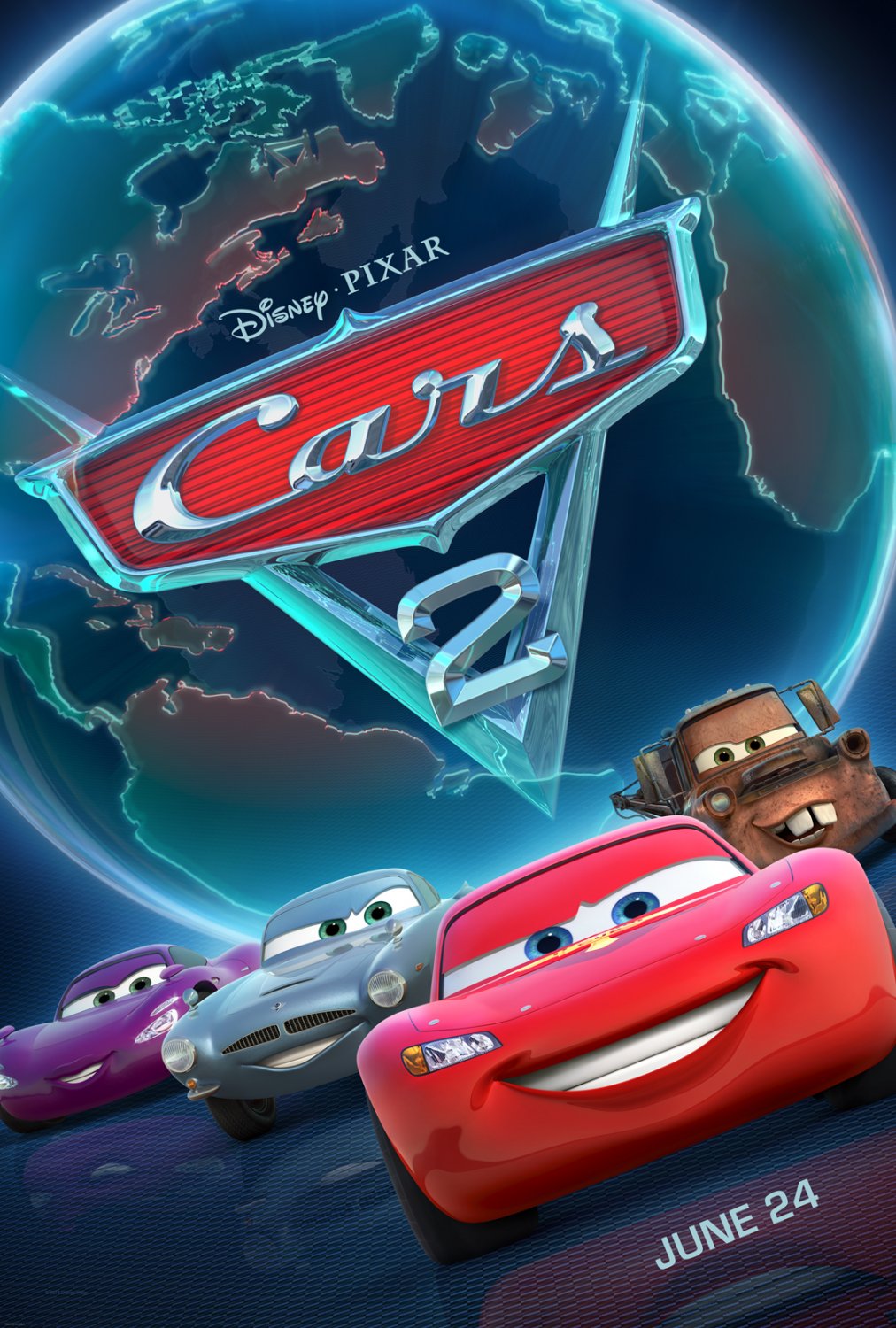
But “Cars 2” is easily more fun because the story is not as formulaic as its predecessor’s, and it takes the characters in a refreshingly different direction. This one has Lightning McQueen (Owen Wilson) going with his best friend Mater (Larry The Cable Guy) to the World Grand Prix to race against the arrogant Italian Formula One car named Francesco Bernoulli (John Turturro). During this time, Mater is suspected of being a spy by British Intelligence officers Finn McMissile (Michael Caine) and Holley Shiftwell (Emily Mortimer), the latter whom he takes a strong liking to. What starts off as another racing movie turns into an espionage adventure which circles the globe in an amazingly animated style.

Make no secret, “Cars 2” truly belongs to Mater more than anyone else. I’ve never been a huge fan of Larry The Cable Guy or his kind of humor, but he’s great fun here. Mater is not the brightest car in the world, but his heart shines through everything he does even as it continually gets the best of him. Most of the movie’s funniest scenes come from him dealing with customs unlike those in his home country, and his mistaking wasabi for ice cream is funnier than anything I saw in “Bad Teacher.”

Pixar continues to outdo itself in the field of animation, and the visuals they come up with are brilliant. I’ll go even further and say there were times I stared at the screen and wondered if certain things being shown were actually real instead of animated. Seriously, the resemblance between what’s real and what’s not disappeared for me at certain points,

Directing “Cars 2” is John Lassiter, and this marks the first full length Pixar film he’s directed since the original. His love of all things cars is as evident here as it was in the first film, and he also has race car drivers and announcers like Jeff Gordon, Lewis Hamilton, Darrell Waltrip, Brent Musburger, and David Hobbs voicing characters. You don’t even have to look at, or listen, hard to discover which characters they are voicing as character names are not particularly subtle. For example, we have Jeff Gorvette, Darrell Cartrip, Brent Mustangburger, David Hobbscap, and the subtlest of all, Lewis Hamilton.

I loved the addition of Michael Caine to this sequel as he makes Finn McMissile a cross between James Bond and the character he played in “Get Carter.” Years after playing Jack Carter in the 1971 classic, Caine remains as cool as ever, and not just because his car has an endless number of gadgets Bond could only wishes he had in the real world. His cockney accent is welcome in any movie he does, and this is certainly the case here.

Other additions in this automotive universe include Emily Mortimer who makes Holley Shiftwell tough and sensitive in believable fashion. Mortimer is such a sweet presence in movies like this and “Lars and the Real Girl,” and I always look forward to seeing and hearing her in any movie she does. It’s also great to have Cheech Marin, Jenifer Lewis, Tony Shalhoub, Joe Mantegna, and Bruce Campbell among others on board, and listening to them made me believe they had a blast working on “Cars 2.”

If I had any issues with “Cars 2,” it’s in regards to the character of Fillmore. This really has to do with the fact George Carlin voiced him in the original, and he has since passed on, and that Fillmore has little to do other than to say, “Wow man!” Out of respect for the late Carlin, who I still miss, I wished they had retired the character. This is nothing against Lloyd Sherr who has the unenviable task of replacing one of the great comedians ever as Fillmore, but this is one Pixar character which should have been put to rest. They retired Paul Newman’s character of Doc Hudson as he has also passed into the great beyond, and no one could have replaced him. I mean, I can understand why Pixar kept Slinky Dog on board for “Toy Story 3” even though Jim Varney died long before filming started, but Slinky had more to do in that sequel than Fillmore does here.

“Cars 2” does not equal Pixar’s artistic highs of “Up,” “Ratatouille,” or “Wall-E,” but so what? All that matters is it’s fun, and it easily outdoes the original. While its messages like the importance of being true to yourself may seem cheesy from a distance, they are handled here with a lot of heart and genuine emotion. Whatever you thought of the first one, you have to admit that you cared about the characters, and you will care for them even more in this sequel.

You can waste your money on “Green Lantern,” or you can take the family out to this one. The kids will be restless and noisy whether we like it or not, but I’m used to that by now. I saw “Cars” at the El Capitan Theatre in Hollywood, and parents were incapable of shutting their children up there. That I did not make the same mistake with this sequel is largely why it’s getting a particularly high rating.

* * * ½ out of * * * *

‘Batman Begins’ Revisited

Batman Begins poster

Before “The Dark Knight Rises” was released, I took the time to revisit director Christopher Nolan’s first stab at the Batman. I remember seeing “Batman Begins” at Grauman’s Chinese Theater when it first came out and thought it was very good, but I don’t remember thinking it was a masterpiece the way I thought “The Dark Knight” was. But now having watched it again, I have a better appreciation of “Batman Begins” and agree it has earned its place among the best comic book movies ever made.

The real difference here is, unlike the Tim Burton and Joel Schumacher “Batman” movies, Bruce Wayne and his alter ego are not upstaged by the villains. In fact, Bruce Wayne is a much bigger character this time around and also far more complex. This is a credit to both the screenwriters (Nolan co-wrote the screenplay with David S. Goyer) and actor Christian Bale who more than makes this iconic role his own.

We first see Bruce as an 8-year-old (played by Gus Lewis) running around his parents’ garden when he accidentally falls down into a well. It is there he is met by dozens of angry bats, giving him a serious phobia of the creatures. From there, the movie establishes its main theme of fear and how Bruce works to overcome it as well the fears he has about himself.

Now a lot of times when we get a backstory to a character, it ends up taking away their mystery by telling us more than we need to know. Burton’s “Batman” and “Batman Returns” never fully explored how Bruce became this crime fighter, and this proved to be a positive and a negative. While it made Michael Keaton’s portrayal more intriguing, it also made his Bruce Wayne/Batman a lot less complex. But a good portion of “Batman Begins” is dedicated to discovering how Bruce developed his fighting skills, and we get to see different sides of him throughout.

Tortured by the memory of his parents being shot to death in front of him, Bruce yearns for justice. His journey for it takes him from the criminal underworld in South Asia to the temple of the League of Shadows led by Ra’s al Ghul (Ken Watanabe). With the help of Henri Ducard (Liam Neeson), Bruce is trained as a ninja and vows to fight the crime and corruption which is engulfing his hometown of Gotham.

When it comes to origin stories, I get seriously impatient with them as they take too much time to set up a character, and they can simply feel like a commercial for the sequel we know will eventually follow. I have had that issue with many comic book movies like “Blade” to where I feel the movie is nothing more than a setup for a potential franchise. But I never felt this way with “Batman Begins” and was utterly enthralled by Bruce Wayne’s transformation from a man obsessed with vengeance to one determined to not become as bad as the criminals threatening Gotham. Seeing Bruce become this instrument of justice makes him a compelling character you want to keep on watching.

In the past, the “Batman” movies have been dominated by their villains. In “Batman Begins,” the villains come in different shapes and sizes. There’s mob boss Carmine Falcone (Tom Wilkinson), corrupt police detective Arnold Flass (Mark Boone Junior), the greedy CEO William Earle (Rutger Hauer), and the twisted psychopharmacologist Dr. Jonathan Crane (Cillian Murphy) who becomes better known by his alter ego of The Scarecrow. Of all these villains, The Scarecrow proves to be Batman’s most vicious threat here as his fear-inducing toxins devour the human mind into an almost permanent state of psychosis. Murphy, best known for his performance in “28 Days Later,” casts a spell on the viewer as he lets you look deep into his bright blue eyes to where you wonder how nasty the monster inside of him truly is.

Actually, the great thing about “Batman Begins” is how the good guys prove to be far more interesting than the villains. Until this movie came along, who would have ever thought this would be the case in a “Batman” movie?

Bale came to own the role of Bruce Wayne/Batman in a way only Keaton did before him. After Keaton left the franchise, the role basically became interchangeable to where it didn’t matter who played him. But Bale is lucky as he gets to play all the different parts of Bruce here; the vengeful son, the arrogant playboy, and the injustice-fighting warrior who likes to dress as a bat. Bale brilliantly captures each facet of Bruce to where you wish the character was this charismatic in the previous films.

Then there’s Gary Oldman, an actor who has given us some of the most intense and scariest villains in cinematic history, playing the role of Sgt. James Gordon. It would seem almost unthinkable for Oldman to play a good cop, but then again this may show how our respect for him as an actor may not have been as high as we thought. Some of the best actors can go from playing good guys/gals to bad ones with relative ease, and Oldman proves here he can do just this by making Gordon genuine in his intentions and a real cool dude overall.

As Henri Ducard, Neeson does kind of a variation of his Jedi master role from “Star Wars: The Phantom Menace,” and I think we all came out of “Batman Begins” wishing that Qui-Gon Jinn was as cool as Ducard. A man with fighting skills and the confidence to match them, Neeson is perfect in the role as his character trains Bruce without restraint and who ends up going in a different direction than we expect him to.

Katie Holmes plays Rachel Dawes, a character not in the original comic book series. When “Batman Begins” was first released, Holmes was in the midst of her whirlwind romance with Tom Cruise, and the way their relationship was perceived ending up spilling over to how people saw her in this movie. The general feeling at the time was that Holmes was miscast in the role, and many thought she was too young to be playing an assistant district attorney. Looking back though, Holmes was much better than we gave her credit for at the time. Either that, or her brilliantly staged divorce from Cruise gave me a new respect for her I didn’t have previously. Whatever the case, she gives her character a strong intelligence and a beautiful empathy that shines in various scenes, and that’s especially the case in her last scene with Bale.

As for Sir Michael Caine and Morgan Freeman, they are two veteran character actors you can never go wrong with. Caine gives Alfred a tremendous humanity in overseeing not just Bruce but the legacy his parents left behind. And Freeman makes Lucius a really fun character to be around as well as one who deserves the upper hand he eventually gets. Other great performances come from Tom Wilkinson, Linus Roache, and Rutger Hauer.

Watching “Batman Begins” again, I am amazed with what Nolan got away with. Each “Batman” movie he has done has him dealing with a large number of characters to where he should have too many to deal with. But here, each character plays a big part in the overall story, and none of them feel extraneous to it. There was a lot of thought put into this reimagining of the caped crusader, and it paid off big time.

Nolan’s other masterstroke in making “Batman Begins” stand out from its predecessors was in giving it a contemporary realism and humanity. Gone were the gothic qualities of Burton’s movies and the overly campy qualities which waylaid the Schumacher films, and in their place we got a Bruce Wayne we could actually relate to. No longer was this a character we watched from a distance, but one we could get up close and personal with. Bruce, after all, is not an alien from another planet, but a flesh and blood human being with a lot of wealth and emotional problems he needs to overcome. He was never designed to be your average superhero.

“Batman Begins,” when looked at on closer inspection, gave this DC Comics character the respect which eluded him on a cinematic level for far too long. Sure, the Burton movies were great in bringing the character back to the darker realm he originally inhabited, but Nolan was the first director to devote more attention to him as a character over the villains surrounding him. His achievement here has made him one of the best filmmakers working today, and this movie marked the start of one of the greatest movie trilogies ever.

Bring on the Bat!

* * * * out of * * * *

’47 Meters Down’ Thrills You Just When You Thought it was Safe to Go Back into the Water

47 Meters Down movie poster

From its poster, “47 Meters Down” looks like one of those Syfy flicks like “Sharknado” or “Lavalantula” which are enjoyable for being infinitely silly and having pathetic CGI effects. Or perhaps it would be like one of those knockoff movies from The Asylum, a production company shameless in capitalizing on blockbuster films by using titles and screenplays similar to them (“Snakes on a Train” or “Transmorphers” anyone?). Perhaps the filmmakers wanted to make something similar to the 2016 sleeper hit “The Shallows” which stared Blake Lively as a surfer who has to use her wits in order to keep from being eaten by a great white shark. Either way, I came into this movie figuring it would be one you should not take the least bit seriously and enjoy for all the wrong reasons.

But to my surprise, “47 Meters Down” is a very effective thriller which is lean in its execution, and its main intent is to take you on a pulse pounding ride. In many ways, it is like Renny Harlin’s “Deep Blue Sea” which, while by no means an artistic triumph, played around with the clichés we remember most from shark movies like “Jaws,” and it employs them to where we think we know what to expect, but our expectations are thrown for a loop. What results is a motion picture which knows exactly what it needs to do and how to do it.

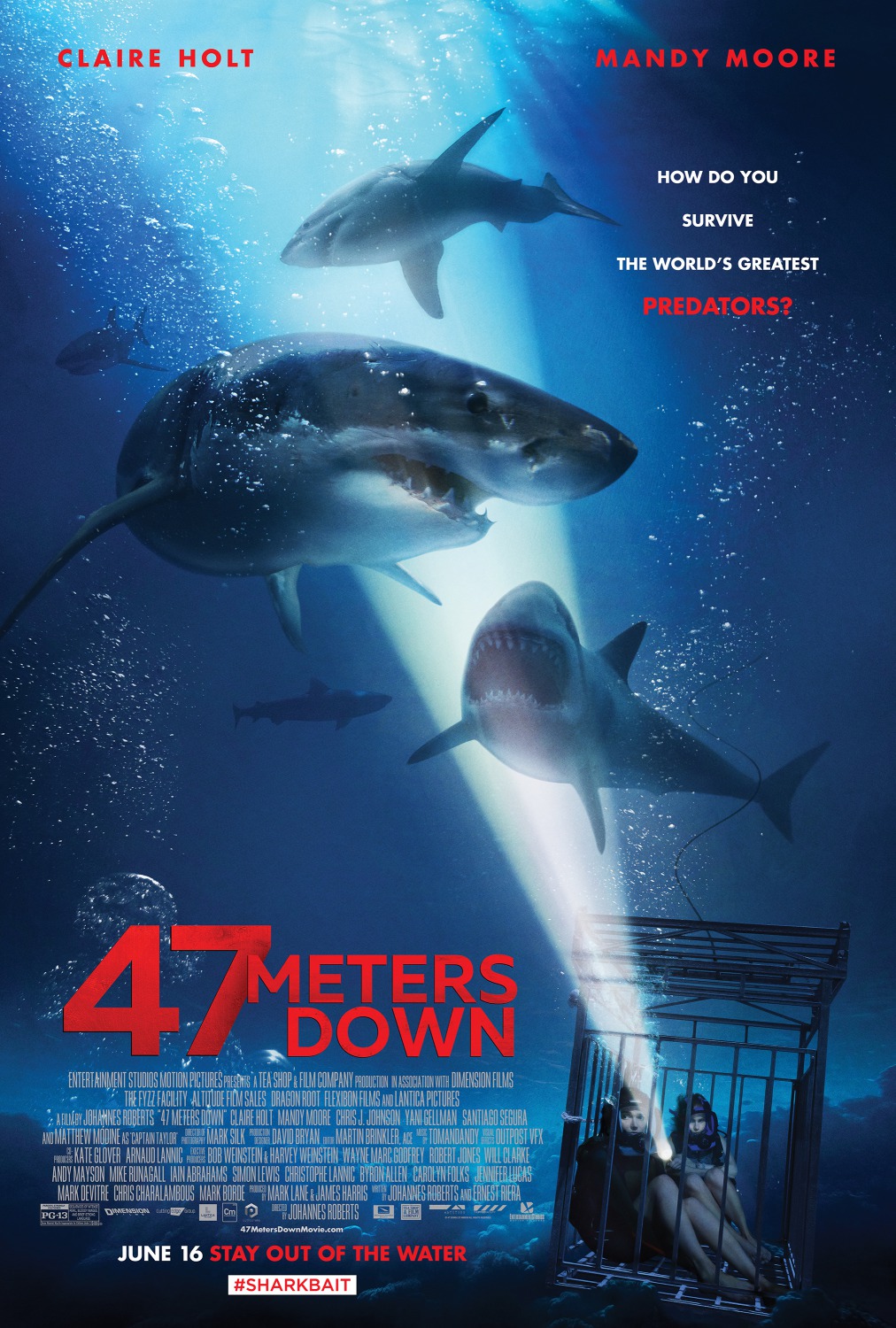
Mandy Moore and Clair Holt star as Lisa and Kate, sisters who, as the movie starts, are on vacation in Mexico. One night they run into some local guys who invite them to go cage diving for sharks. Just like Richard Dreyfuss in “Jaws,” these two women will be lowered into the ocean in a cage where they will get to see those sharp-toothed creatures up close without being eaten. But of course, we all know things will not go as planned as our two leads and the characters around them make one stupid mistake after another. Then again, if they didn’t make those mistakes, there would be no movie.

The clichés abound in “47 Meters Down” as the boat the ladies will be traveling on looks far too rusty to sail anywhere safely. You have Matthew Modine on board as the captain of the ship, Taylor, and I couldn’t help but be reminded of Quint from “Jaws.” There’s also the fact that these ladies have never scuba-dived before, and you know this is just asking to invite disaster. We have the air gauges which act as the plot’s ticking time bomb as the ladies threaten to run out of air sooner than they think, they cut themselves to where blood flows from their bodies, thus inviting any shark in the vicinity to drop by and feast on human flesh, and there’s always the one guy who is there to save everybody’s ass, but we all know how long he will last (or do we?).

Lisa also exhibits tremendous anxiety about doing this even as Kate assures her this will be the best time the two of them have ever had (it won’t). Hearing this conversation between them immediately reminded me of a number of “Star Wars” characters saying this infamous line from one movie to the next: “I’ve got a bad feeling about this.” Another unforgettable piece of dialogue which crossed my mind was Jon Voight’s line from “Deliverance” when he said to Burt Reynolds, “Let’s go back to town and play golf.” This was good advice which was left unheeded, and it makes perfect sense how Lisa’s common sense could be overturned by Kate’s need for adventure.

As you can imagine, everything goes terribly wrong as the boat winch breaks, and the women plummet down 47 meters to the seafloor. Director Johannes Roberts wisely keeps the majority of the action underwater as Lisa and Kate struggle to stay calm and not use up their dwindling supply of air. He puts us right in their shoes as, like them, we are left to wonder what the crew members in the boat are doing to bring them back to the surface or if they are doing anything at all. Roberts is also aided strongly by a pulse-pounding film score from Tomandandy whose work on “Killing Zoe” and “The Hills Have Eyes” remake rank among my favorites. Their music heightens an already intense motion picture to something which will fry your nerves and leave you on the edge of your seat even as we are forced to endure some unintentionally hilarious moments.

Granted, you can’t always expect David Mamet or Aaron Sorkin to be underwater with you when words fail you. When Moore cries out about how the shark almost got me, the audience I was with couldn’t help but laugh as it seems like such a silly thing to say. But then again, what would really say if we were stuck in the same predicament? I doubt we would be uttering a monologue out of Eugene O’Neill’s “A Long Day’s Journey into Night.” Of course, it always helps to have John Milius around when you need him.

Moore and Holt do strong work in creating a bond between and work hard to create characters who, while not having too much in the way of depth, quickly realize they need one another to survive this ordeal. Seeing one of them take off their mask and remove their oxygen tank just to get through the bars of the cage is enough to make one shiver, and this is accomplished without the use of special effects. The actresses are also aided by actor Matthew Modine who plays the Captain of the boat, Taylor. For the most part, we hear his voice more than we see him, but he gives strong support as he encourages his guests, people he never should have put in any danger, a reason to stay calm. In addition, he also reminds the ladies and the audience that the bends is not just the title of a Radiohead album.

Roberts previously directed “The Other Side of the Door,” a supernatural horror thriller which started off well, but later got bogged down in clichés it would have been smarter to avoid. “47 Meters Down,” however, is all about clichés, and just as Harlin did with “Deep Blue Sea,” he manages to manipulate those clichés to where we think we know what to expect, and then we are totally caught off guard. Just watch the scene where the actresses are playing around with an underwater camera, and you will understand what I mean.

Yes, the sharks are CGI, but they are still frightening antagonists in this movie. After a while, the terror comes from a combination of what we think is going on above the water as well as what we cannot see. The water is made to look especially murky to where we can’t see much of what is in front of us, and this leads to an especially scary moment when a character swims out to a certain point, and then suddenly can’t remember the direction in which she came.

Look, “47 Meters Down” is not Oscar material, but it never pretends to be either. While it may not reach the heights of “Jaws” or the unbearable intensity of “Open Water,” it is a taut thriller which will allow the audience a nice diversion for a couple of hours. Roberts and his cast understand exactly what this movie aims to be, and they deliver in a way which will get your adrenaline pumping. You can laugh all you want at the foolishness of the characters, but in this instance their foolishness is necessary for this movie to work at all.

* * * out of * * * *

‘Dawn of the Planet of the Apes’ is an Infinitely Worthy Sequel

Dawn of the Planet of the Apes movie poster

“So, what is it that separates you and me from the goldfish, the butterfly, the flat billed platypus? Our minds? Our souls? That fact that we can get HBO? Well maybe it’s that humans are the only species to put other animals in cages, put its own kind in cages.”

-Augustus Hill

“Oz”

This quote from one of my favorite, and most unsettling, television shows of the 1990’s kept reverberating through my mind as I watched “Dawn of the Planet of the Apes,” the sequel to the surprisingly well-received “Rise of the Planet of the Apes.” Animals do operate by their own set of rules and are not governed by the same ones we follow on a regular basis. But what if animals evolved to where they could cage us? Would they really be any different from us? Every creature on this planet yearns for independence from others, but what cost are we all willing to pay for it? This is one of the many questions this movie asks its viewers, and it’s particularly noteworthy to see in a summer movie with a very large budget.

“Dawn” takes place ten years after the events of “Rise,” and the world has changed in a highly dramatic fashion. Much of human civilization has been wiped out by the ALZ-113 virus which Gen-Sys created in the hopes of curing Alzheimer’s disease, and the apes are now the dominant species on Earth. Caesar (Andy Serkis) is still the leader of the apes, and we see them in their natural habitat working to survive in a hostile world and educating their young. It’s been a very long time since any of them have seen a human, but this changes when they run into Carver (Kirk Acevedo), an ape hating human who makes the mistake of shooting one of them.

From there, we come to see there are still many human beings who have not succumbed to the virus, and among them is Malcolm (Jason Clarke) who is determined to reach out to the apes in a peaceful manner. The humans are running low on power and need to gain access to a hydroelectric dam which is in the apes’ territory. Of course, this requires a lot of trust between the different species for this to happen, and neither one is prepared to make it easy for the other.

With Serkis returning as Caesar, all eyes are on him as he was brilliant in “Rise,” and he knocks it out of the park once again in “Dawn.” Time has hardened Caesar and his trust in humans has almost completely disappeared, and his days are spent protecting his fellow apes and keeping them in line. Yes, all the apes you see here are CGI-created, but the great thing about actors like Serkis is, after a while, they make you forget about how you’re looking at a visual effect. Serkis invests Caesar with such a raw emotional power to where you can’t help but feel for him when things go horribly wrong. Even when Caesar speaks, and it was a shock to hear him say “no” in the previous film, Serkis makes the character’s struggles all the more palpable to where you root for him to ease the divisions between humans and apes.

But what makes “Dawn” especially effective is, like the best science fiction stories, it reflects the struggles of the world today. The conflicts between the humans and apes could easily be compared to those between Israel and Palestine, blacks and whites, the rich and the poor and perhaps even between Star Wars and Star Trek fans (let’s not leave anyone out here). Director Matt Reeves (“Cloverfield” and “Let Me In”) mines this material for all the emotional depth it has, and none of the characters, human or otherwise, can be boiled down to a one-dimensional cliché. If they can just get past their perceived differences, the world can become a peaceful place for them to live in.

Also, “Dawn” gets at the unavoidable truth of how the greatest threat to a group doesn’t come from its enemy, but instead from within. Caesar’s second in command, Koba (Toby Kebbell), can’t get himself to make peace with all the cruel animal testing he was forced to endure before the virus laid waste to the planet. And on the human side, you have Dreyfus (Gary Oldman), the leader of the remaining human survivors who is determined to protect them no matter what. There will always be change and there will always be resistance to change, and Koba and Dreyfus represent the greatest threat to any change which can occur. If they could see that their differences are only skin deep, then maybe there would be a chance but, as Peter Gabriel said, fear is the mother of violence.

Now a lot of people have said the human element in “Dawn” is lacking, but I’m not sure about that. Granted, the CGI creation of the apes is amazing to look at and the actors who inhabit them deserve more recognition than they will probably get when awards season comes around, but “Dawn” has a good human cast as well. Jason Clarke, so good in “Zero Dark Thirty,” proves to be a human worth rooting for as Malcolm, a man who has shared about the same number of loses as Caesar has. Keri Russell, who is currently kicking ass on “The Americans,” reminds us of how lovely she can be playing such a tough woman devoted to her loves in her life as well as in science and facts. Oldman, who can be prone to overacting in movies like this, is fun to watch here as he gives us a character who is not quite a bad guy but not necessarily a good one either. It’s also great to see Kirk Acevedo, so great as Alvarez on the HBO series “Oz,” here as Carver, a former water worker who has trouble getting past his fear and misunderstanding of apes.

The rebooting of the “Planet of the Apes” franchise was not exactly met with open arms, and this was especially the case after we witnessed Tim Burton’s incredibly disappointing remake. But ever since “Rise of the Planet of the Apes,” this franchise has proven to be one to look forward to. Our expectations for it remain in check, and things get even better this time around with “Dawn of the Planet of the Apes.” Even if this movie ends on a note of despair over what could have been, there is still an inkling of hope as we look into Caesar’s eyes. For once, we get the feeling all of humanity might actually learn from its mistake, and maybe the apes can too.

* * * ½ out of * * * *

‘Wonder Woman’ is the Comic Book/Superhero Movie We Need and Deserve

Wonder Woman movie poster

Wonder Woman” is not just the comic-book/superhero movie we needed, it’s the one we deserve. Audiences have been long overdue for a female-led superhero movie, and this one proves to be well worth the wait. Director Patty Jenkins has taken this famous DC Comics character and given her the cinematic treatment she richly deserves, and it’s a relief she has gotten it considering the failure of “Batman vs Superman: Dawn of Justice” (the theatrical version anyway) and “Suicide Squad.” For once, the DC Comics Extended Universe has a win, and “Wonder Woman” proves to be the best of its kind since Christopher Nolan’s “Dark Knight” trilogy, and that’s saying a lot.

One the main reasons “Wonder Woman” is such a success comes down to the actress playing the title role, Gal Gadot. Many scoffed at her casting as they saw Gadot as nothing more than a Miss Universe contestant who was cast for her looks over everything else. Those same people did not take into account how Gadot served in the Israeli Defense Forces for two years as a combat instructor, or that she studied law for a time. All this experience made her the perfect choice to portray Diana, Princess of Themyscira, Daughter of Hippolyta, who would became better known by her civilian identity of Diana Prince.

Seriously, Gadot shows so much range here as she takes Diana from being an Amazonian princess infinitely eager to become a warrior like her Aunt, General Antiope (Robin Wright), to becoming a total fish out of water when she leaves the island of Themyscira and ventures into World War I-era London. She embodies this immortal Amazonian princess with vigor, strength, intelligence and a lot of heart, and it’s not just her beauty which kept my eyes glued to the screen whenever she graced it.

Also matching Gadot scene for scene is Chris Pine who plays United States Army Air Service Captain Steve Trevor. Pine has long since proven himself a terrific actor thanks to making the role of Captain Kirk his own in the past three “Star Trek” movies, but he really knocks it out of the park here as a man who discovers the meaning of true heroism thanks to both duty and love. Steve could have been portrayed as an overly cheeky character who easily stumbles over his unmistakable attraction for Diana, but Pine gives the character a lot of heart as well as a strong arc as Steve comes to discover he is not so different from the enemy he is pursuing.

In fact, this is what I love about “Wonder Woman;” it explores the dynamics of an immortal princess and the all too mortal human beings she encounters in her journeys. This could have been a simple good girl and guys versus bad guys adventure, but Jenkins and screenwriter Allan Heinberg have more on their minds than giving us the usual summer blockbuster. A good deal of thought went into this one, and while the best visual effects available were put to astonishing use, it is the story and characters which keep us riveted more than anything else. While stories of heroes trying to do good in the world have us scoffing at them with cynicism to where it feels like we cannot take them seriously, “Wonder Woman,” and the “Captain America” movies which proved to be better than we expected them to be, show how virtue can be such an immeasurable strength when portrayed in the right way.

Jenkins, who directed Charlize Theron to Oscar-winning glory in “Monster,” turns what could have been a cheesy spectacle into a thrilling motion picture from start to finish. Memories of the “Wonder Woman” TV show still echo in my brain to this day, and its theme song is one of my all-time favorites. As much as I would have loved to have heard that theme song in this iteration, it’s just as well it wasn’t included as this is a Wonder Woman for a new generation of fans as well as those from the past. There is no invisible jet on display here, nor are there any scenes of Diana Prince turning around in circles and bursting into a flash of light while changing into her Wonder Woman attire. But while Jenkins studiously works to avoid any cheese in her cinematic interpretation, she does not treat the material ever so seriously as she allows for a good sense of fun and spirit which makes this motion picture all the more entertaining. The hero at this movie’s center is not just a powerful one, but a sincere one as well, and this makes it all the more thrilling to sit through to where seeing it once is not enough.

In a summer season which has so far proven to be as underwhelming as it has promised to be, “Wonder Woman” is a much-needed breath of fresh air as superhero/comic book movies have threatened to become stale. But with this thrilling motion picture and “Logan,” we have been given a strong reason to rejoice as filmmakers are intent on providing us with something enthralling to witness.

I do, however, have to say that while not having the invisible jet in this movie was a smart move, having the lasso of truth was. Lord knows we could use this same lasso in today’s frightening world of politics as those in power show no hesitation in lying about what they know. At least with the lasso, we could get to the truth about all the issues which permeate our cynical yet concerned minds today.

Also, I love how Wonder Woman is not the kind of heroic character who shows any hesitation about being “the one.” Too many movies in recent years have featured people who spend the majority of their time complaining about how they are not sure they are “the one.” Princess Diana, however, doesn’t show any hesitation in going up against any nemesis who threatens to lay the world she lives in to waste. Perhaps this should serve as infinite proof of how women are not the weaker sex and never have been.

* * * * out of * * * *