No, I Haven’t Seen It Until Now: ‘Platoon’

Platoon movie poster

I think its use of “Adagio for Strings” by Samuel Barber is one of the reasons I stayed away from watching “Platoon” for the longest time. It still is one of the saddest pieces of music I have ever heard, although it would later be eclipsed by the even more emotionally devastating “Symphony No. 3” (subtitled “Symphony of Sorrowful Songs”) by Henryk Górecki which Peter Weir used to powerful effect in “Fearless.” Plus, the way the violence in “Platoon” was described to me by friends at school, like when a soldier gets his arms blown off by a bomb, filled my mind with horrible images which had no business infecting my mind at such a young age.

It took buying the 25th anniversary edition of “Platoon” on Blu-ray for me to finally sit down and watch it. I hadn’t even seen the movie yet, and here I am buying it at Costco for $11.99 By then, I had seen many Oliver Stone movies like “Born On the Fourth of July,” “JFK,” and “Natural Born Killers,” so I was long overdue to give this Best Picture winner a look.

Before “Platoon,” I had seen “Apocalypse Now,” “The Deer Hunter,” and “Full Metal Jacket” which viewed the Vietnam War from different perspectives. The one thing they had in common was they were directed by filmmakers who had never served in Vietnam. Stone, however, had served there, so “Platoon” is largely autobiographical for him. As a result, this is probably the first truly realistic depiction of the Vietnam War anyone could have ever hoped to see in a movie.

Charlie Sheen stars as Chris Taylor, and it’s interesting watching him here as this was long before his days on “Two and a Half Men.” Taylor serves as the narrator and most relatable character as, like him, we are coming into this war fresh-faced, naïve and innocent. The first scene where Taylor comes off a plane with a bunch of newbies is an omen of what is to come. Seeing body bags filled with fallen soldiers and crossing paths with those men who have seen the war up close quickly gives you a good idea of what Taylor will probably end up looking like at the movie’s end.

Sheen is perfectly cast as he makes Taylor go from being a newbie to an experienced combat veteran in little time. It’s a shame Sheen has since pissed away a good portion of his talent to where he’s pretty much playing a version of himself as some drunken womanizer, be it on a television show or a movie. His work here is a strong reminder of how good he can be as he is utterly believable in a role no one would cast him in today.

Seeing Taylor struggle on through the Vietnamese jungle after the opening scene is a quick indication of how unprepared he is for combat. Like many wars Americans have fought, it was on the soil of another country they were completely unfamiliar with. We see how this puts them at an immediate disadvantage as they look completely exhausted and depleted even at the start of the day.

When it comes to Vietnam, Taylor makes it clear he is a unique case as he tells everyone he dropped out of college to volunteer and serve in the war. This makes him seem like part of a generation raised to believe fighting in a war is both noble and infinitely patriotic, something to be proud of. Taylor also feels that not only poor kids should be sent to fight instead of the rich, but he soon learns the truths about war, one of which is given to him by King (Keith David) who tells him something which resonates strongly even today: “You got to be rich in the first place to think like that. Everybody know, the poor are always being fucked over by the rich. Always have, always will.”

The other two performances worth noting are given by Willem Dafoe as Sergeant Elias and Tom Berenger as Sergeant Barnes. Both figure prominently in Taylor’s tour of duty, and even he says these two were fighting for his soul. Dafoe is mesmerizing as the idealistic soldier who sees America’s involvement in Vietnam ending badly. The Christ-like pose he gets in, whether its holding a machine gun over his shoulders or as he runs from the Vietnamese soldiers, is no mistake. Elias ends up dying for the sins of his fellow soldiers while doing his best to protect them.

Berenger’s performance as Barnes ranks among his best ever. He succeeds in getting inside the head of someone who has been shot at so many times to where they are forever psychologically altered. Having seen death up close, Barnes acts as if he has surpassed it. In some ways, Berenger doesn’t need those makeup scars to show you how many firefights his character has been in as watching him walk through the jungle, completely unaffected by explosions going off around him as if he were Colonel Kilgore in “Apocalypse Now,” is more than enough proof of this.

Stone makes you feel the blood, sweat, tears and exhaustion these soldiers experience, and it’s all so vivid to where we come out of “Platoon” feeling like war veterans ourselves. It leaves all those other movies which make war seem like fun to utter shame. Coming from a filmmaker who has seen this particular war up close, we cannot deny the authenticity he puts on display.

“Platoon” also captures how quickly people can lose their moral bearings in the face of war. The scene in the village is by far the movie’s most unnerving moment as we watch Taylor and the other soldiers get overcome by their boiling anger and hatred. What’s so horrifying is that while you would like to believe you would have acted differently than they did, there’s no way you can be sure if you haven’t been in combat. The line between soldier and killer gets seriously blurred here, and it’s not hard to understand why.

Before filming began, the cast was treated to an intensive military training course under the tutelage of former Marine Captain Dale Dye who also served in Vietnam. They were made to dig foxholes and subjected to forced marches and nighttime ambushes which utilized explosions. This succeeded in breaking them down, and you can see and feel the weariness in them throughout. It more than adds to the sheer realism we see here.

There’s no victory to be found in “Platoon,” only death and destruction on both sides of the conflict. The movie gets at the truth of war which Danny DeVito talked about in “The War of the Roses” when he said, “There is no winning! There’s only degrees of losing!”

The violence and death portrayed may not seem quite as visceral as it did when the movie first came out. There have been many other war movies since like “Saving Private Ryan” which featured scenes of such brutal violence that no other filmmaker could possibly match. Plus, we all know about the Vietnam War in general and big a mistake it was for America for many years now. Still, “Platoon” is nothing less than powerful as its vision of the craziness and insanity of war is impossible to shake once you have seen it.

The Vietnam War may be a thing of the past, but the lessons we learned from it still need to be taught over and over again. America keeps fighting wars which, whether necessary or not, continually overstay their welcome and leave a lot of people feeling angry and betrayed. Oliver Stone certainly understands that, and he makes “Platoon” into a movie which shows the damage of war and why we can’t just let the past be the past.

* * * * out of * * * *

‘Encounters at the End of the World’ Takes Werner Herzog to Antarctica

Encounters at the End of the World poster

As a movie buff, I have to admit it is shameful on my part I have not seen more movies directed by Werner Herzog. I did see “Grizzly Man,” a brilliant documentary about Timothy Treadwell and his obsession with the grizzly bears, and like all brilliant documentaries made today, it did not get an Oscar nomination for Best Documentary. Thankfully, the Oscars did not ignore his documentary “Encounters at the End of the World” which is an endlessly fascinating look at his travels and discoveries in Antarctica. It is at times an incredibly beautiful look at an icy landscape, at others a bleak look at the inevitable end of the human race. At the same time, it also a rather humorous and interesting look at the people who risk their lives by living there to study the cutting-edge world of science.

Herzog narrates “Encounters at the End of the World,” and he allows us to go inside his head on how he views the icy wilderness of Antarctica, and of how he views the people and wildlife there. He makes it clear from the onset that when he was asked by Discovery Films to do this documentary, he agreed to it on the condition he would not be forced to do a “fuzzy” movie with penguins in it (a little jab at “March of the Penguins”). The first 10 or so minutes deal with the McMurdo Research Station which is full of buildings and tractors constantly moving all over the place. Herzog finds himself wanting to get away from McMurdo right away as he feels it is corrupting the Antarctic island with the inhabitants’ own self-interests as it is filled with horrors there like “yoga classes.”

Eventually, he ventures out of the encampment and into the far-off research facilities removed from the town. We see him and others there being put through safety drills and emergency preparations to deal with the worst of circumstances. The group leader speaks of how the wind can get so bad to where you can’t see even your hand in front of your face or hear yourself talk. This lends a chilling effect to an already chilled environment, and while it is exciting to be there, you feel the danger of it throughout.

The best part of this documentary, and the reason I wanted to see it, is the underwater footage where you follow divers underneath the glaciers of Antarctica. The visuals on display here are both beautiful and extraordinary to see, and there is a unique beauty to the underwater landscape you would be hard pressed to find anywhere else. This is all reminiscent of James Cameron’s documentary “Aliens from the Deep” in which he went with scientists in submersibles down to the bottom of the ocean to see what things live down there. But while Cameron’s documentary was fascinating, this one is not encumbered with 3D effects and of looks at where the future will take us. It deals with the world we exist in right now, and it doesn’t hide from how everything will disappear in the distant future.

I was also eager to find out how these scientists were able to dive down into waters which they would not be expected to stay alive in for more than 5 minutes. They wear special suits which are heavily insulated to protect them from the cold, and they wear gloves that threaten to make them look like aliens from another planet. Herzog says the water they are diving into is -2 degrees Celsius, and the divers go in with no ropes attached to their bodies as it will give them more room to move around. Still, this is very dangerous work they are doing, and if they get lost underneath the glacier, they will become a permanently frozen resident. You feel the danger of what they are doing, but you end up getting overwhelmed by the spectacular visuals they discover underneath it all.

Another fascinating moment comes when some scientists on the island play recordings of the sounds the local seals make underwater. The seals themselves steal some scenes from the human actors as they lie back lazily in the sun and look too tired to get up and acknowledge anybody. The underwater sounds of the seals seem so unreal, and I could not help but believe they were all computer generated. But they are indeed the real thing, and you experience the sounds along with Herzog and the scientists as they put their ears down to the ground and take it all in. It’s an amazing moment to witness.

The other thing I really loved was how it was just not another average science documentary filled with talking heads telling you all the things you need to know about the environments they are studying. There is science talk throughout the documentary which is fine, but Herzog also looks at the individual personalities he comes into contact with throughout his journey. Along with Herzog, you also wonder what could make all these people come to one of the most isolated places on the face of the earth and of how they stay there for so long.

Among the people Herzog meets throughout his travels are a philosopher who has a great quote at the end of the movie about how the universe is looking at itself through our eyes, and how we give life to everything in the way we view it. We meet one of the scuba divers who has a pensive moment where he takes in the fact he is about to making his very last dive into the icy depths. Then Herzog meets up with a Russian who had escaped the Soviet Union after the fall of the Iron Curtain, and the Russian almost loses it emotionally when he tries to describe to him how bad things were when he left. This Russian also has an escape plan at the ready with a big pack of supplies in case he needs to flee once again.

There are a couple of other people in the documentary who just talk and talk about themselves and the adventures they have been on. Herzog cuts them off in his narration by saying, “To make a long story short…”

“Encounters at the End of the World” does have a bleak view of humanity’s future, and the scientists are fully aware of this as temperatures continue to rise to where it is inevitable that ice will eventually melt completely in the future. This is also shown as we see a group of scientists watching “Them,” a 1950’s B-movie about radioactive ants which have grown to an enormous size. It turns out to be one of the many apocalyptic movies they show to each other from week to week. I wonder if they have ever gotten around to watching John Carpenter’s “The Thing.”

At the center of “Encounters at the End of the World” is not just Antarctica, but Herzog himself. His narration throughout could have been annoying, but it serves to illuminate what a funny and interesting person he is. Clearly, he is attracted to madness in various forms throughout the world as is shown here and also in “Grizzly Man.” I imagine this is a big theme in all of his movies. We discover all there is to see through his eyes, and of how he views the beauty of the ice and how it forms. As a result, it does make me want to see more of his movies.

Just remember what one of the men says in this documentary, and remember it always:

“Global warming is real.”

* * * * out of * * * *

‘Poltergeist III’ Shows Just How Unnecessary Certain Sequels Can Be

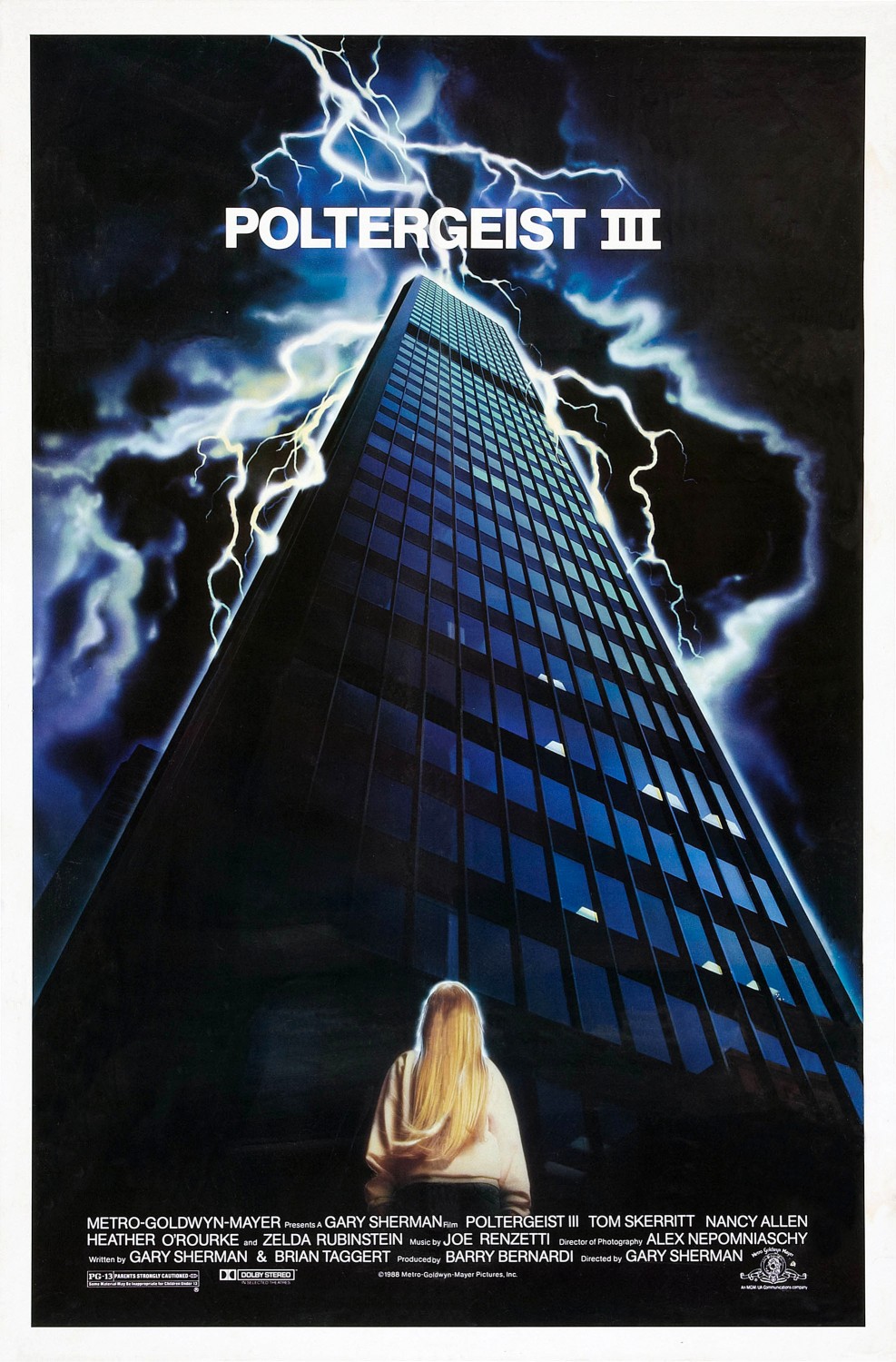
Poltergeist III poster

It’s only with an obscene amount of free time, combined with a morbid curiosity, which had me watching “Poltergeist III” on cable. My only real memories of it beforehand were a behind the scenes show detailing the special effects and Siskel & Ebert’s scathing review of it. By the time this sequel came out in 1988, the series had already worn out its welcome. I don’t remember anyone liking “Poltergeist II: The Other Side,” and it was said to have been one of 1986’s big losers at the box office. Nevertheless, the powers that be at MGM decided they could wring just a little more money out of this franchise with one more sequel.

Once again, Carol Anne (Heather O’Rourke) is at the center of the story which has her shipped off to Chicago to live with Aunt Pat (Nancy Allen) and her husband Bruce (Tom Skerritt) who manages the luxurious high rise building they reside in. However, it doesn’t take long before those evil spirits and Reverend Henry Kane find Carol Anne and start their nasty little tricks to get her to come to the other side.

Now I can’t help but wonder if Carol Anne’s parents just dumped her in Chicago so they could be rid of those evil spirits for good. What if this series continued on? Would Carol Anne have resided with a different family member in each successive sequel to where she would become the ultimate unwanted house guest? Just imagine what Aunt Pat’s conversations with the girl’s parents (played by Jo Beth Williams and Craig T. Nelson) were like. I mean, Pat at one point says all she heard was they were caught up in a land deal gone bad, but maybe it went more like this:

“Pat, we love our daughter, but this poltergeist problem is really just rubbing us the wrong way.”

“Oh come on, stop kidding around sis! Your daughter is being bothered by a poltergeist! You expect me to fall for that?”

“Oh yeah Pat? You think I’m joking?! C’mon! I dare you to let her stay with you! I double dare you!”

“Yeah right! So that the ghosts or spirits or whatever the hell they are can haunt me and my family?”

“What are you, chicken?”

“Pat, stop teasing me! You called me a chicken all the time when we were kids! I AM NO CHICKEN!!!”

“Alright, prove it!”

Now guess what happened after that…

Apparently, Carol Anne was told by her mommy and daddy she was to attend a school for “gifted children with emotional problems” in Chicago. Once there, she meets up with one of the dumbest psychiatrists in cinematic history, Dr. Seaton (Richard Fire). He’s the one who foolishly opens Pandora’s Box by getting Carol Anne to talk about her experiences from the first two movies. By doing so, a slimy hand bursts out of his desk and throws a coffee cup at him while an evil voice cackles away.

So, what’s Dr. Seaton’s explanation for this? He says Carol Anne is a manipulative child who has the power to create mass hysteria and perform mass hypnosis on people to make them think they see ghosts. What?! Are you serious?! People pay this guy money to say shit like that? Where’s this guy’s degree? Is he a legitimate psychiatrist, or is he like Leonardo DiCaprio’s character in “Catch Me If You Can,” faking his lifestyle while forging checks?

The character of Dr. Seaton basically exists for the audience to despise him whenever he opens his mouth. His disbelief in all the strange and bizarre things happening in the building is excruciating to sit through, and you just want these evil spirits to strangle him to death so he’ll shut up. Seriously, it says a lot about a movie when you start siding with evil spirits against the humans.

In fact, this is the big problem with “Poltergeist III;” you don’t care much for the majority of these characters. They exist merely as clichés instead of living breathing human beings, and seeing them suffer becomes more fun than fearing for their safety which all but kills the suspense. You have the teenage guy Scott (Kipley Wentz) who’s slobbering over his girlfriend Donna (Lara Flynn Boyle of all people), and they look like they’ve come out of a thousand movies from this genre. Then there are Pat and Bruce’s hopelessly self-absorbed and shallow friends who are too interested in their own needs to notice signs of evil spirits invading the building. And where exactly are the cops in all of this?

Looking back at the Siskel & Ebert review, the one major complaint they had about this sequel, which I am in total agreement with, was all the characters kept incessantly crying out for one another:

“CAROL ANNE!!! CAROL ANNE!!!”

“SCOTT!!! SCOOOOOOOOOT!!!”

“BRUCE!!! BRUCE!!!”

“CAROL ANNE!!! CAROL ANNE!!! CAROL ANNNNNNNE!”

I swear, Carol Anne’s name is mentioned as many times as Al Pacino used the F-word in “Scarface.” It didn’t take long for me to figure out what Kane was saying to his fellow evil spirits as well as their quick reply:

“We must bring her to the other side!”

“Yes Reverend, but we also got to get this screaming bitch to shut the hell up!”

Remember the bottomless pit that opens up in the garage? Those slimy hands reaching out to grab the main characters look like those rubber gloves you buy at the supermarket but with extra makeup applied to them. The overall budget for “Poltergeist III” was just under $10 million, but it looks like it cost a lot less. While the other “Poltergeist” movies have state of the art special effects, the filmmakers here get short served and have to work with whatever’s available. Yes, some of those mirror scenes are cool as characters pass by without their reflections showing up on them, but that’s just an old trick.

Directing “Poltergeist III” is Gary Sherman who made “Dead & Buried” which has since become a cult classic. He also made the superb exploitation feature “Vice Squad” which featured one of the scariest and most vicious pimps ever played by Wings Hauser. A lot of Sherman’s skill isn’t evident here, and even he admits this is his least favorite film of the ones he made. Perhaps the studio played around with the sequel more than he liked, and with a franchise like this you know he’s never going to get complete control over the final product.

My hat is off, however, to Skerritt and Allen who came out of this movie relatively unscathed. They overcome the ridiculous material and manage to keep a straight face as the movie becomes increasingly laughable and confusing as it heads towards its unnecessarily reshot climax which leaves the fate of certain characters up in the air.

Aside from O’Rourke, the only other cast member to appear here from the previous “Poltergeist” movies is Zelda Rubinstein as Tangina. I find it funny how she received both Saturn and Razzie Nominations for her work here. I for one can’t figure out if she’s good or bad in this movie, but her mystical dialogue gets a bit ponderous with her overzealous delivery of it.

Of course, the lasting significance of “Poltergeist III” is the fact it was O’Rourke’s last movie before her tragic death at far too young an age. Her loss is inadvertently emphasized in the film’s final scene in which she is substituted with a body double. Since she passed away during post-production, you know it’s not her being held by Allen. For what it’s worth, she is very good here despite the cruddy material, and the film was dedicated to her memory.

Who knows what would have happened if O’Rourke lived to see another “Poltergeist” sequel. With Carol Anne quickly growing up, it would have been a kick to see her turn into an Ellen Ripley type of character who is prepared to go to war with these evil spirits. While others will be horribly terrified by them, she’ll see it as just another day at the office. I can just see her talking with girls her age:

“You think you have it rough? I got sucked into another dimension by evil spirits when I was five! Going through puberty was a piece of cake compared to that! Stop. complaining about the run in your nylons!!!”

I wonder what the tagline was for “Poltergeist III.” The tagline for the first one was:

“They’re here.”

With “Poltergeist II,” it was:

“They’re back.”

I guess the tagline for the third film was:

“I’m screwed!”

* ½ out of * * * *

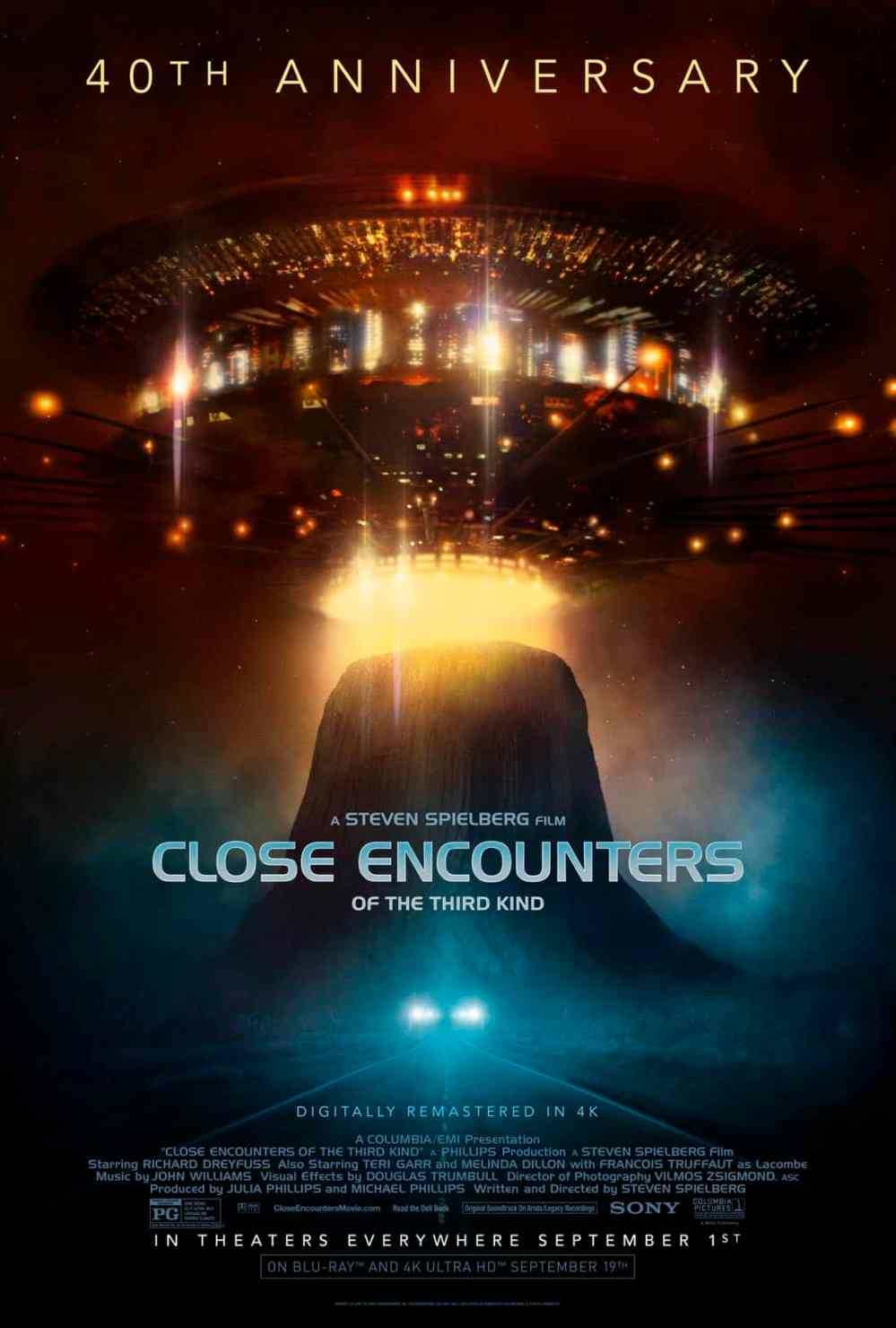
‘Close Encounters of the Third Kind’ Still Leaves Us in Awe 40 Years Later

Close Encounters of the Third Kind 40th poster

On this week’s edition of yes, this movie really is that old, we have Steven Spielberg’s “Close Encounters of the Third Kind.” Released back in 1977, it is now being re-released in a new 4K remastered version in honor of its 40th anniversary. I first watched it on laserdisc at a friend’s house back in the 80’s, and I remember being somewhat traumatized by it as there were scenes which proved to be quite scary. I have since watched the film several times, but this 40th anniversary re-release allowed me to see it on the big screen for the first time. Suffice to say, this is the way you should view this particular Spielberg classic.

The film begins with strange discoveries being made in various parts of the world which include the appearance of Army airplanes reported to have gone missing back in the 1940’s, a lost cargo ship which has reappeared in the Gobi Desert for no discernable reason, and witnesses living in India are found singing a five-tone musical phrase which is revealed to be the distinctive sounds of UFO’s. Meanwhile, out in Indiana, Ray Neary a blue-collar worker, husband and father to three very loud kids, is working late at night after a large-scale power outage takes place, and he finds himself having a very close encounter with a UFO, one which lightly burns his face with its bright lights. From there, he becomes obsessed with finding out more about these alien visitors to where he gets left with subliminal messages he is desperate to find answers for.

Throughout the decades, there have been countless movies dealing with human beings and their first contact with extra-terrestrials, many of which feature the last remnants of humanity fighting off an alien invasion determined to wipe them out with extreme prejudice. As I got older, I came to realize how rare it is to have a science fiction movie which deals with aliens in a highly intelligent way. Among them are Stanley Kubrick’s “2001: A Space Odyssey,” Robert Zemeckis’ “Contact,” Spielberg’s “E.T.,” and Denis Villeneuve’s “Arrival” which was one of the very best movies of 2016. Even rarer these days is the motion picture which leaves you in an extended state of wonder and awe from start to finish and even after you leave the theater.

Even 40 years after its release, “Close Encounters of the Third Kind” still has an immense power to enthrall us as its characters come into contact with something they have longed to see. There is nothing about it which comes across as unintentionally laughable, and while technology has evolved to a whole other level since the 1970’s, this movie feels timeless in its exploration of possibilities and discoveries. It also works on many different levels in that it is funny, scary, thrilling, and deeply emotional.

This film is especially unique on Spielberg’s resume as it is one he directed and also wrote the screenplay for. It would also mark the last time he would direct his own screenplay until he made “A.I. Artificial Intelligence” in 2001. As a result, there should be no doubt of just how personal this film is to him. It turns out he wanted to make this one before “Jaws,” but he didn’t have the commercial clout at the time to get the budget he wanted. Of course, when “Jaws” came out, this changed forever.

Spielberg has said “Close Encounters of the Third Kind” is not actually a science fiction film, and watching it again has me agreeing with him completely. Yes, it does feature aliens and UFO’s, but they are not really the point. Also, this film takes place in a reality we all know and relate to. “Close Encounters” does not take place in some future dystopian world, but instead one we all inhabit as the main characters are regular people working regular jobs and supporting their families. They don’t want to see UFO’s, but they did, and now they cannot and will not deny their existence. Throughout this movie, we remain in the human universe and we never enter an alien one, and this is very important to point out here.

“Close Encounters” also deals with stories which would become a hallmark of future Spielberg films and productions such as “E.T. The Extra Terrestrial” and “Poltergeist” among others. Seeing the government conspire to keep this alien visitation a secret is presented in a way which feels not only realistic, but also very possible to pull off back in the 1970’s. But he also shows how the truth of things cannot be kept a secret forever, and, like Ray Neary, we want to see this all the way to the end because we won’t stop and until we get answers to fulfill our curiosities.

When it comes to the actors, Spielberg really just lets them loose here. He doesn’t direct them as much as he lets them run wild, and I don’t just mean the kids who are a noisy bunch as presented here. Richard Dreyfuss is perfectly cast as Ray Neary as he brings a crazed and enthusiastic energy to the role of a man who has seen things he wasn’t supposed to see, and he is not in a position to unlearn what he has learned. Even as Ray’s actions increasingly alienate him from his wife and kids, Dreyfuss makes us empathize with his plight as he is caught up in something he cannot turn his back on.

Melinda Dillon is equally wonderful as Jillian Guiler, another character who, along with her fearless son Barry (Cary Guffey), experiences a close encounter of her own. She also suffers the indignity of her son being kidnapped by aliens, but she is eventually reunited with him in the movie’s last half. It may sound like I’m giving plot points away here, but I’m not because Dillon’s performance is such an emotionally fulfilling one to witness as she takes Jillian through the stages of fright, grief, desolation, and eventually joy and happiness. She makes you experience these emotions with her, and seeing her smile when Barry reappears is a moment of pure elation.

Spielberg’s casting of filmmaker Francois Truffaut as Claude Lacombe, a French government scientist, was truly inspired. Along with Bob Balaban who plays David Laughlin, Lacombe’s assistant and interpreter, he portrays a government official who brings sanity to a situation which has other government officials responding to in a panic to where the quick answer is cover everything up and keep the number of witnesses to a bare minimum. Truffaut brings a strong level of thoughtfulness and wonderment to his character as Lacombe shows an openness to first contact others would not be quick to embrace. While military officers are eager to keep Ray and Jillian out of the area, Lacombe tries to make them see they were invited to be here.

Many images from “Close Encounters” will forever remain burned into my consciousness. The most prominent image of all is when young Barry opens the front door where an alien ship hovers outside, waiting to make contact with someone, anyone. This is still the defining image of who he not just as a filmmaker, but as a human being. Spielberg’s eagerness to make contact with aliens from another galaxy is no secret, and here’s hoping a UFO does make contact with him in his lifetime. Better they meet him than a certain person who is currently occupying the White House.

I think people these days who are seeing “Close Encounters” for the first time might say it takes too long to get to the last half where humans finally get to communicate with aliens. But like Francis Ford Coppola’s “Apocalypse Now,” this film is more about the journey than the final destination. Spielberg wants us to question what we believe and how far we will go to get answers to questions which have plagued us for an infinite amount of time, and we share the awe of the characters once those answers are delivered to us here. And it’s not just that the characters get answers here, they truly earn them as well.

This is also one of those films its director couldn’t stop tinkering with over the years. Ridley Scott couldn’t leave “Blade Runner” alone years after its release, and Oliver Stone continued to tinker with his dream project “Alexander” to where the final cut he gave us still doesn’t feel final. As Spielberg was finishing up “Close Encounters,” Columbia Pictures was in dire straits financially and begged the filmmaker to release his pet project sooner rather than later. What came out in 1977 wasn’t his complete vision, and he eventually got to make a special edition of the film which was released in 1980. The 4K restoration of “Close Encounters” is essentially a combination of both versions, but the scenes with Ray Neary exploring the inside of the mothership have been cut out. Spielberg has said over and over he never should have taken us inside the ship, and I completely agree. While Spielberg provides the characters with many answers, there are still some things better left to the imagination.

Seeing “Close Encounters of the Third Kind” at the Cinerama Dome afforded me the opportunity to see the movie in its most desirable format. The audience I saw it with was left spellbound at what unfolded, and this says so much about this movie’s staying power. Just when I think I have become so jaded and embittered a filmgoer as studios continue in their desperate search for the next big franchise, a motion picture like this comes along to remind us filmmakers still have the power to leave us in a state of sheer wonderment. It feels like we have had an overabundance of movie anniversaries lately to where these celebrations feel more like a ploy to get more money out of our pockets. But this particular anniversary is one worth acknowledging as it continually reaffirms the power of cinema to truly transport to another time and place and, in the process, rescue us from the real world even if it’s only for a temporary time.

The only thing which bugs me about “Close Encounters” these days is Ray’s decision to leave his family behind and travel with the aliens. Essentially, he is presented with the same question Captain Decker is faced with in “Star Trek: The Motion Picture;” Would you leave everything and everyone you have ever known behind just to explore another world and dimension? Seeing Ray getting on board the ship made me wonder how his family would have reacted to this decision, and it plagues my mind long after the end credits have finished. Then again, Spielberg did make this film before he had any kids of his own. Had he made it after he became a father, there’s no doubt Ray would have made a different decision. Still, one could not blame Spielberg or Ray for being tempted to go. I certainly would be tempted.

* * * * out of * * * *

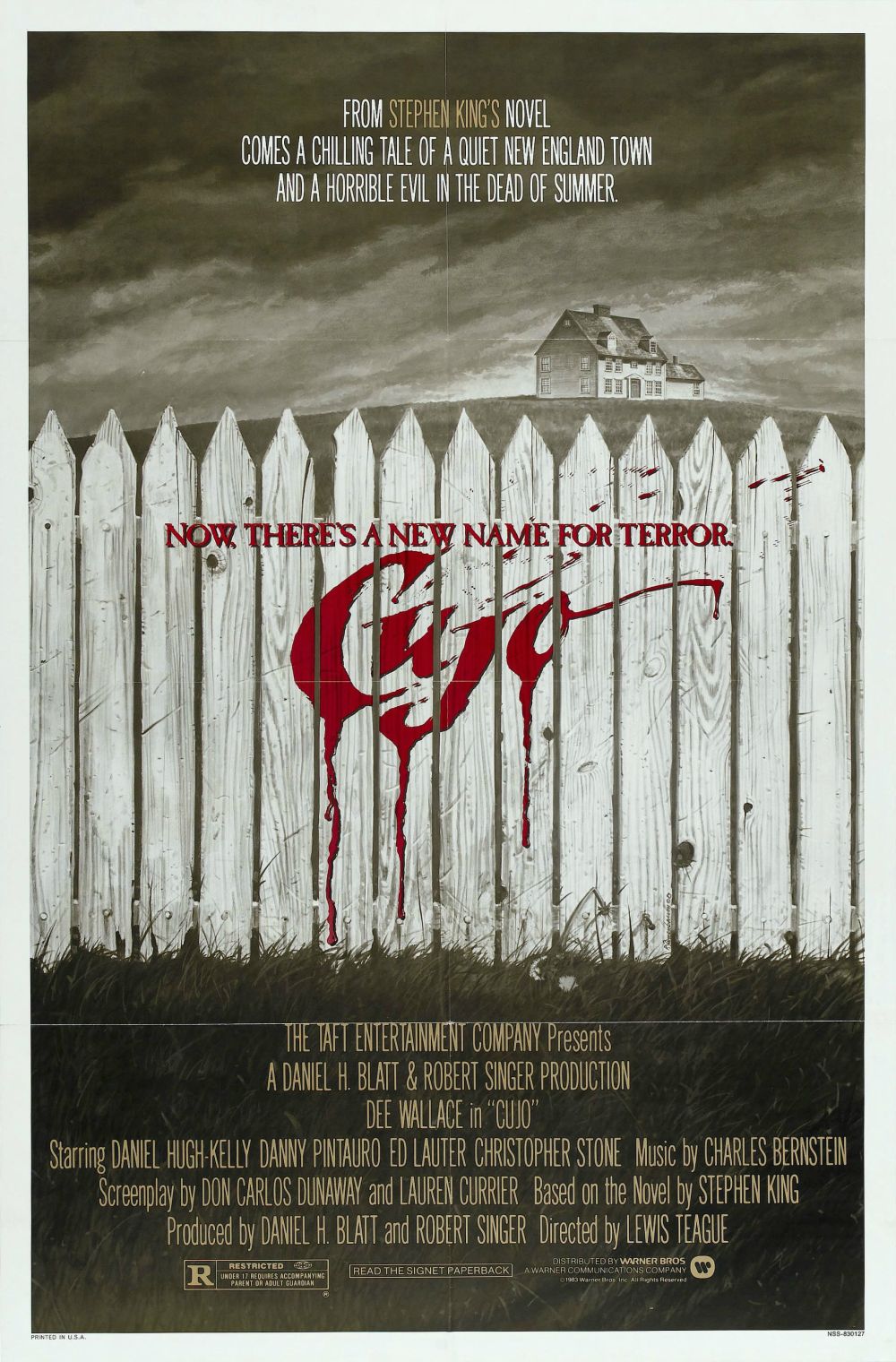
No, I Haven’t Seen It Until Now: ‘Cujo’

Cujo movie poster

It took Cinematic Void putting together a Stephen King film festival at the Egyptian Theatre in Hollywood to give me a reason to finally check out the cinematic adaptation of “Cujo.” It was a movie I have heard a lot about, and I remember the book’s original artwork with those growling teeth which indicated this particular dog was looking for more than puppy chow and snausages. Moreover, the word Cujo has long since been burned into my consciousness, and it seems to exist as a description of a dog who has gone mad and cannot be mistaken for man’s best friend. In “Fletch,” it made perfect sense when Chevy Chase said “Cujo” as he wandered through a seemingly abandoned house in Utah. Considering he was attacked by a Doberman Pinscher earlier in the film, his fear of being attacked again was completely understandable.

“Cujo” was released in 1983 during a decade when adaptations of King’s work were plentiful and varied in quality. While some were exceptional (“Stand by Me,” “The Shining,” and “The Dead Zone”), others like “Maximum Overdrive” just didn’t work. “Cujo,” however, proves to be an above average adaptation of his work as well as one of the more unusual. While many of his books deal with the supernatural, this one deals more with the horrors of real life instead of just monsters.

I’m sure you all know the story to “Cujo” by now. In case you don’t, it involves a beautiful St. Bernard who, at the movie’s start, chases a rabbit through the woods. In the process, he gets his head stuck in a cave filled with bats, one of which bites him on the nose. From there, he goes from being a lovable household pet to an infinitely vicious one as he attacks any and every human being in his sight.

From the outside, “Cujo” seems to have a very straightforward plot which indicates to the viewer it will be one of those animal attack movies we have seen time and time again. But what really surprised me most is how it focused more on the human element to where I realized the dog was really a supporting character more than anything else.

You have Vic and Donna Trenton (Daniel Hugh Kelly and Dee Wallace), a married couple and the proud parents of a highly imaginative boy named Tad (Danny Pintauro). But while they appear to be leading the perfect life in Castle Rock, Maine, there are cracks beneath the surface which will inevitably become visible to everyone. Vic is increasingly concerned with economic security, something even more understandable these days. Donna is having an affair with Steve Kemp (Christopher Stone), her ex-boyfriend from high school, as she is terrified of being trapped in a small town for the rest of her life. And Tad, he is still at an age where it’s far too easy to believe monsters are hiding in the closet and waiting to jump out at him. Seriously, seeing Tad race to his bed after turning off the light and hiding under the covers brings back a lot of memories.

Taking the fears of each character into account, it serves as a reminder of how brilliant King is at examining not just horrors of the unknown, but also the ones we are forced to experience in the real world. This makes “Cujo” especially effective as the obstacles these characters are forced to deal with feel almost as scary as the thought of this dog tearing their flesh apart.

“Cujo” was directed by Lewis Teague who also helmed the Stephen King anthology film “Cat’s Eye” as well as the cult classic “Alligator” and “The Jewel of the Nile.” Teague was lucky he got to make “Cujo” back in the 80’s, a decade where filmmakers had the opportunity to build up to a furious climax instead of being forced to rush straight to one. These days, studio executives would have begged, if not ordered, him to rush right into the sequences where the dog attacks the hapless humans and increase the blood and gore horror fans are expecting. Instead, Teague got to take his precious time introducing us to characters who are not mere stereotypes and whose struggles will soon pale in comparison to the dog whose appearance becomes increasingly dirty and slimy.

This movie’s major set piece comes when Donna and Tad become trapped in a Ford Pinto as Cujo thrashes away at it, trying to get inside. From there, “Cujo” becomes a major exercise in sheer intensity as we watch Donna do what she can to save herself and her son before the dog makes chop suey out of them both. But if the dog doesn’t get to them, the sweltering summer heat may do them in instead. Suffice to say, they cannot stay in the car forever.

It’s interesting King chose a St. Bernard as the type of dog instead of another like a Doberman Pinscher. Of course, casting a Doberman might have seemed like typecasting as they have always been the villains of dogs. St. Bernard dogs seem more like comic relief, and this was made clear back in the 1990’s with those “Beethoven” movies starring Charles Grodin. Therefore, choosing a St. Bernard as a dog is an inspired choice as it shows how easily a dog, any dog, can turn deadly after being bitten by a bat. When we first see Cujo, he is a beautifully groomed dog you just want to hug. But he soon becomes a dog in desperate need of a shower as he looks disgustingly slimy and has what looks like an abundance of snot sliding off his face. Eventually he becomes an evil force to be reckoned with, and it’s easy to understand how no one could have prepared for him.

But while this dog looks to be the main star of “Cujo,” he is not. The real star is instead Dee Wallace who, just as she did in “E.T. The Extra Terrestrial,” gives us a mother who cannot be mistaken for the average movie mother. I love talking about when actors inhabit roles more than play them, and it is certainly the case with Wallace here as she gives a performance best described as emotionally blistering. She makes us feel Donna Trenton’s frantic struggles as well as her mental and physical exhaustion in dealing with a crumbling marriage, an affair, her son and, of course, the dog. Also, she makes us feel every single bead of sweat coming off of her body as she and Tad are trapped not just in the car, but in the sweltering summer heat as well.

There also moments where Donna loses her patience with Tad, and this makes Wallace’s performance feel all the more real. Just as “Cujo” was being released, some associated with its production were keen to cut a scene where Donna snaps at her son as she grows tired of his crying out for daddy. This, however, would have been mistake as all parents lose their patience with their children. Seriously, just as my mom. I’m sure she has tons of stories she would love to share with you.

While I’m at it, let’s not leave out Danny Pintauro whose performance as Tad feels unbearably real at times. Seeing him weep and panic when the dog tries to get at him and his mother makes an already intense motion picture even more intense.

Teague and his collaborators which include composer Charles Bernstein, director of photography Jan De Bont, and editor Neil Travis clearly had more on their mind than giving us the average horror film with “Cujo.” While there is a conventional feel to much of what we see here, the filmmakers were more invested in the human element than the animal one. Lord only knows how this movie would look if it were made today, and I’m stunned it has not been remade yet. As this cinematic adaptation shows, horror movies can’t thrive unless we are emotionally invested in the characters to where they are not just stock or filler. This film may not be a masterpiece, but it proved to be far more effective than I ever could have expected it to be.

* * * ½ out of * * * *

No, I Haven’t Seen It Until Now: ‘Creepshow 2’

Creepshow 2 movie poster

Creepshow” proved to be a great deal of ghoulish fun, and it’s a film which had me begging for a sequel. There are many other short horror stories worthy of a cinematic adaptation regardless of whether or not they are written by Stephen King. Plus, at the time, it seemed to be a given George Romero would have had easier luck in securing financing for this than for a sequel to “Day of the Dead.” And with the same gothic-looking title, what could possibly go wrong? Even if it’s not one of the greatest horror movies ever, we can still enjoy this sequel for what it is, right?

Well, perhaps you can, but for me, “Creepshow 2” is a serious disappointment. Sure, the three stories contained in it are based on the works of King, and Romero did write the screenplay, but this sequel suffers right from the get go. It falters due to a budget much lower than a horror film deserves, a cast of actors who emote more than act, a weak music score, and animation which just reeks of cheapness.

The movie’s prologue has a young blonde boy named Billy (Domenick John) peddling fast on his bike as he chases a delivery truck into town to deliver the latest edition of Creepshow magazine. The back of the truck opens up to reveal The Creep played by Tom Savini, but voiced by Joe Silver. The makeup on this devilish character is less than convincing, and he is nothing compared to the ghostly apparition from the first movie. Even worse, he is made to crack jokey one-liners which will have you groaning more than laughing. Clearly, this character is “Creepshow 2’s” answer to the Crypt Keeper from “Tales from The Crypt,” or perhaps even John Carpenter’s Coroner from “Body Bags,” but it would have been to this sequel’s benefit had it not featured a wisecracking character as this kind had already started to wear out its welcome back in 1987.

One other thing, if you are going to have Savini playing a ghoulish character, do you really have to put makeup all over him? The infamous makeup artist and actor has a wonderfully devilish look about him, and the mask he wears just takes away from him.

“Creepshow 2’s” first story, “Old Chief Wood’nhead,” is its weakest by far. George Kennedy and Dorothy Lamour play Ray and Martha Spruce, an elderly couple who run a general store in Dead River, a town which, as we can tell from its first appearance, is finally living up to its name. One day they are visited by a Native American elder named Benjamin Whitemoon (Frank Salsedo) who gives the Spruces turquoise jewelry, his tribe’s sacred treasures, to look after. Unfortunately, not long after Benjamin leaves, a group of thugs arrive at the store, killing the Spruces and making off with the jewelry. Oh yeah, the Spruces also have an Indian statute standing prominently outside of their store named Old Chief Wood’nhead, and it doesn’t take long for us to see he will avenge the Spruces as you don’t mess with Indian spirits, ever.

Directing “Creepshow 2” is Michael Gornick who served as Director of Photography on its predecessor. As this first story demonstrates, he doesn’t quite have Romero’s panache or wicked sense of humor as he can’t balance out the horrific aspects with the comedic ones, and everything feels off balance as a result. Also, he shows far too much of Old Chief Wood’nhead coming to life which was a mistake. Gornick starts off by giving us glimpses of this character, played by Dan Kamin, to where we can tell the Chief is more than just another statute. But as the Chief goes on a mission of bloody justice, the character becomes cartoonish to where his bloody revenge isn’t the least bit fulfilling.

For what it’s worth, Holt McCallany, who plays Sam, the leader of the thug gang, does have beautiful hair here, and seeing him show it off as he sees it as his ticket for making it in Hollywood makes him all the more drolly hilarious. Still, MCCallany has nothing on Melissa Leo as her hair was infinitely beautiful from one episode of “Homicide: Life on the Street” to the next.

The second story, “The Raft,” is a bit of an improvement. Based on one of King’s scariest short stories from “Skeleton Crew,” it features our college kids who drive out to a predictably isolated lake, located a good 50 miles away from their school, for a swim. The lake’s only real notable feature, at first anyway, is a wooden raft in the middle of it. This raft, however, is soon upstaged by what looks like a slimy oil slick which begins to make its way over to the kids once they get in the water, and they soon find themselves stranded on the raft as the slick surrounds them.

“The Raft” has a lot of cinematic possibilities, and seeing these kids getting consumed by the oil slick provides “Creepshow 2” with some of its most horrifying moments. But in the end, it is undone as Gornick isn’t able to generate enough of a claustrophobic terror this story demands. Plus, the performances of Paul Satterfield, Jeremy Green, Daniel Beer and Page Hannah are weak as they are forced to emote more than act, and this just takes away from the situation and terror their characters are trapped in. Granted, this is not a movie which demands Oscar worthy performances, but it does need good acting to help bring you fully into such a terrifying story.

I do have to give the actors some credit though as they don’t have to do any acting when they first get in the water as it does appear to be very cold. Beer even said he almost died from hypothermia while filming “The Raft,” and keeping this in mind while watching this segment makes it even more unnerving. But despite a bravura conclusion, I came out of “The Raft” feeling like it could have been much better than it was. Perhaps this is partly due to having read King’s short story beforehand, and what he came up with couldn’t possibly be matched here.

The final story, “The Hitchhiker,” proved to be my favorite as it featured Lois Chiles, the Bond woman Dr. Holly Goodhead from “Moonraker,” in a strong performance as businesswoman Annie Lansing. The story begins with Annie leaving a hotel after having an adulterous fling with a gigolo, and she begins thinking of ways to explain to her husband why she is arriving home so late. But as she fumbles around with a lit cigarette while driving her expensive Mercedes down a lonely highway, she accidentally hits a hitchhiker played by Tom Wright. Did Annie kill him? She isn’t sure, and with oncoming headlights heading in her direction, she isn’t keen to wait around. From there, she goes from wondering how to cover up her affair to finding ways to justify leaving the scene of an accident, and then the hitchhiker reappears…

This story reminded me of the “Creepshow” segment entitled “They’re Creeping Up on You!” which starred E.G. Marshall as Upson Pratt, a ruthless businessman whose fear of bugs comes to haunt him big time. Like that segment, “The Hitchhiker” plays with your mind as you ponder if what you saw actually happened, or if it was all in the mind of the main character instead. On first glance, the story doesn’t make much sense as Annie keeps coming across this man she accidentally ran over for no real reason, but, in retrospect, perhaps the hitchhiker represents Annie’s conscience torturing her for hitting a pedestrian and failing to take responsibility for her actions.

This final segment for me reminds me of why I liked the first “Creepshow” so much; it’s a wickedly gleeful mix of horror and black comedy as Annie tries to kill off a hitchhiker who won’t stay ahead. In the process, she also lays waste to her precious Mercedes as her priorities shift from protecting her most valuable possession, a car, to defending herself from a crime which becomes something even worse. It is so over the top to where I was infinitely eager to see where the story would end up, and had the rest of “Creepshow 2” been like this, it would have been so much better. Chiles gets to show more life here than she got to in “Moonraker,” and she steals this sequel easily thanks to her unrestrained turn.

Horror movies in general tend to be made on low budgets, and this was certainly the case with “Creepshow” as Romero only had $8 million to work with. Gornick, however, had a budget half the size of that on “Creepshow 2” ($3.5 million to be exact), and he is unable to stretch it out the way Romero did. I’m always fascinated with what filmmakers are able to pull off creatively with little money, but this sequel shows that sometimes a low budget can be too low to work with. This has the appearance of a motion picture where the filmmakers were forced to cut corners at every turn due to limited funds, and it makes me feel sorry for Gornick as I’m sure he could have accomplished more if the budget allowed him to. While Warner Brothers distributed the first movie, the sequel was instead released by New World Pictures, a small independent production company which inched closer and closer to bankrupt around the time “Creepshow 2” came out.

I also didn’t care for the film score by Les Reed and Rick Wakeman as their themes came across as unbearably generic. Both are very talented musicians, but their music here just made me pine for John Harrison’s music from “Creepshow” as well as “Day of the Dead.” Back in the 1980’s, Harrison came up with some wonderfully creepy cues, but Reed and Wakeman have no such luck here.

“Creepshow 2” does have its inspired moments, but I came of it feeling like it could have been so much better. Instead of enjoying what I saw, I spent more time analyzing things which could have been easily improved. I do, however, have to applaud the filmmakers for including the following quote from Colliers Magazine in the end credits:

“Juvenile delinquency is the product of pent up frustrations, stored-up resentments and bottled-up fears. It is not the product of cartoons and captions. But the comics are a handy, obvious, uncomplicated scapegoat. If the adults who crusade against them would only get as steamed up over such basic causes of delinquency as parental ignorance, indifference, and cruelty, they might discover that comic books are no more a menace than Treasure Island or Jack the Giant Killer.”

This quote was from the year 1949, and yet all these years later many still seek scapegoats, be it comic books or Marilyn Manson, instead of dealing with things in a more rational manner. I loved that the filmmakers included this quote, but I would have loved it even more if they had opened the movie with it.

* * out of * * * *


‘The Girlfriend Experience’ has Sasha Grey Teaming up with Steven Soderbergh

The Girlfriend Experience movie poster

The Girlfriend Experience” represents one of Steven Soderbergh’s more experimental films as well as the occasional escape he gets from mainstream filmmaking. Like “Bubble,” he shot it with a very low budget and a relatively inexpensive camera, and he cast actors in it with no previous experience. There is, however, one exception to this, and that is Sasha Grey. Known to people, though they probably wouldn’t openly admit it, as one of the biggest stars in pornography films, she gives the term “Grey’s Anatomy” a whole new meaning. Her being cast in the lead role should show just how big of a breakthrough the world of pornography has made into the mainstream media, something which can no longer be denied.

This movie takes place a month or so before the 2008 Presidential election between Obama and McCain. Sasha plays Christine, a high-priced escort who goes by the alias of Chelsea, as she services the rich commodities brokers of New York. Sex does play a part in her job, but this is not the only thing she provides. Chelsea gives herself over to you as your girlfriend for the evening; one who will listen to your problems over a dinner at a nice restaurant, and she is there for you when the reality of life hits you too hard, or if your wife and kids are giving you too much to deal with. Basically, she is selling companionship as a commodity, and she has become independently wealthy because of it. Throughout the movie, she seems to have a disconnect between what she does, and the life she has outside of it. But as the story goes on, you will see this façade take quite a beating.

Sasha’s life outside of being an escort includes having a boyfriend who works as personal trainer at gyms. He is played by Chris Santos, and his relationship with Sasha is a stable one. While their chosen professions differ from one another, they are essentially the same; they sell their services for a price and try to remain independent while running their individual businesses their own way. Chris and Sasha are, to put it bluntly, pimping themselves for a price, except Sasha is getting a better price for her services. Unlike others, Chris is comfortable with what Sasha does for a living, assuming it remains in certain parameters the two of them have set for one another.

“The Girlfriend Experience” is really not about sex, and there is no simulated or non-simulated sex to be found here. Those looking for the typical Sasha Grey experience need to be made fully aware of this before they sit down to watch this film. She does have one nice full-frontal scene near the beginning of the film, but it is hardly titillating in the way you would expect. What this movie is really about is the practice of buying and selling certain commodities, and of how even the feel of loving companionship has become an ever-growing business. The question presented to us is, are we so drained of feeling and morality that we feel more comfortable buying companionship than we are in obtaining it naturally? Furthermore, what if the line between what you do for a living and what you do outside of it becomes blurred? Can you remain objective in such a situation?

Soderbergh gives the movie a non-linear approach as the movie shifts back and forth in time, and we see the characters in different emotional states. This will undoubtedly annoy many who are so used to watching movies where everything is shown in chronological order. I, on the other hand, welcome this approach because it is always refreshing to see any filmmaker challenge the medium especially when movies these are mostly about tried and true formulas. This method makes this movie seem more unpredictable in regards to what will happen next, and it also gives the audience a somewhat alienating feeling which forces us to view these characters from a clinical distance. “The Girlfriend Experience” doesn’t want us to feel like we are in the same room with these characters. Instead, it wants to observe them and think about what they are going through. The movie also wants us to question if there really can be an unbreakable line between work and play. If we lose sight of this, is it even possible to bring ourselves back to where we once were?

As an actress, Sasha Grey is no Meryl Streep, but she does do good work here. Soderbergh made it clear he chose her in part because of her name value in porn films, and that is understandable. It will certainly bring a bigger audience to this film than it would have gotten if another actress played her part. Soderbergh also said he chose Grey because she is a lot like the character in that she runs her own business and is her own agent; she runs herself and has no one managing her. Indeed, looking at Grey’s career overall, it’s hard to think of another actress, let alone a more accomplished one, who could have been more believable here. In many ways, Grey is Chelsea, and she may even be the first to admit this.

Shooting this movie with a digital camera, Soderbergh makes it clear “The Girlfriend Experience” takes place in the real world and not some fictional one. The Elliott Spitzer scandal which came about because of his dealings with escorts like Chelsea could make this film seem like a documentary. In casting people with no previous acting experience, Soderbergh succeeds in giving us characters we recognize from our daily lives. Still, he doesn’t let you get too close to them. Just as you’re about to get closer, he moves the story in another direction to where you are just as starved for feeling as the characters are.

The film’s final image, of two characters locked in an embrace, seems to define it completely. We want this closeness to another person just as much as we are frightened of it. It makes us wonder if it is possible to achieve it without having to pay a price for it. The movie does not lay judgment on escort services or other forms of prostitution, but simply acknowledges how one of the oldest professions in the world still plays a significant part in our world whether we admit it or not. It has since evolved to another level where it is being offered for more than just a quickie in a motel.

“The Girlfriend Experience” is one of Soderbergh’s more interesting films of the past few years. It runs at a scant 77 minutes, but it feels longer as there is much to take in. Many will say he owes us a movie this short after splitting his previous movie, “Che,” into two. It’s not quite a great movie, but it is very good and willing to take chances other movies in 2009 have not. It will be interesting to see where Grey’s career will go from here. Porn actors and actresses rarely, if ever, make a break into mainstream films because of the stigma attached to their profession. But even those who consider themselves “morally superior” to pornography are probably bigger fans of it than they will ever admit. It all plays a big part in our lives, probably on more of an unconscious level more than anything else.

Of course, it will become a very lonely world if the only way we can get intimacy is to pay a high price for it.

* * * ½ out of * * * *

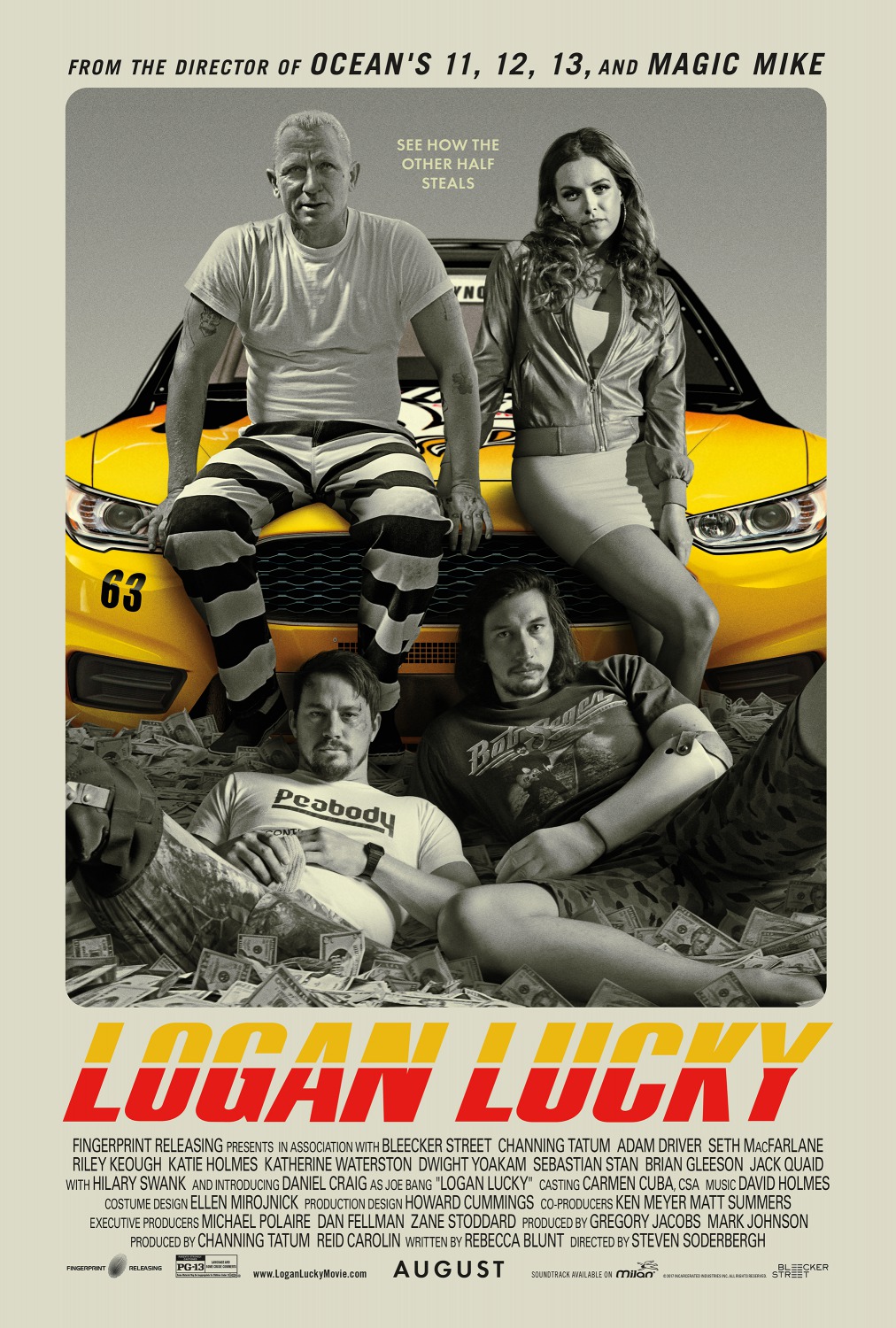
‘Logan Lucky’ Rescues Steven Soderbergh From His Unintended Retirement

Logan Lucky movie poster

I never really believed Steven Soderbergh was all that serious about retiring from filmmaking. Since calling it quits after “Behind the Candelabra,” he directed the Cinemax television series “The Knick,” helped Spike Jonze edit his Oscar-winning film “Her,” executive produced the television series version of “The Girlfriend Experience,” and he has even gone out of his way to recut famous movies like “Raiders of the Ark” and “Heaven’s Gate” (the latter which has been referred to as “The Butcher’s Cut”). This man has had filmmaking in his blood probably since birth, and you can’t keep a good filmmaker like him down.

Soderbergh is finally back in the world of motion pictures with “Logan Lucky,” and it’s another heist movie but one with a cast of characters nowhere as smart or as gloriously debonair as those from the “Ocean’s Eleven” movies. In fact, during a newscast we hear someone describe this gang of thieves as “Ocean’s 7-Eleven,” and this description feels more than appropriate given what we have seen.

Jimmy Logan (Channing Tatum) is a hard-working construction worker at Charlotte Motor Speedway, but this soon doesn’t matter as his boss is forced to terminate his employment after he is seen limping around the workplace due to an injury which ended his ever so promising football career. Jimmy is told his limp represents a “pre-existing condition,” a term which these days should be seen as the equivalent of a four-letter word. On top of this, his ex-wife Bobbie Jo (Katie Holmes) informs him she and her husband will soon be moving to Lynchburg, Tennessee which will make visiting his daughter, Sadie (Farrah Mackenzie), all the more difficult.

So, what’s an unemployed father with few prospects to do? Well, rob the race track of course. For this, he turns to his brother, the one-armed war veteran and bartender Clyde (Adam Driver), to pull off this challenging heist (is there any other kind?) without a hitch. Together they assemble a team which includes convicted safecracker and explosives expert Joe Bang (Daniel Craig), their sister Mellie (Riley Keough) who figures prominently in Sadie’s beauty pageant contest and can drive a Ford Mustang better than Bobbie Jo’s car salesman husband Moody (David Denman), and a pair of brothers, Sam (Brian Gleeson) and Fish (Jack Quaid) who are willing to participate in criminal activities as long as it doesn’t interfere with their religious beliefs.

Is “Logan Lucky” among Soderbergh’s best movies? No, but it does provide the audience with a fun time, and you can sense the director’s giddiness as he tackles the screenplay written by Rebecca Blunt with an unrestrained relish. This is familiar territory for the Oscar-winning director, but we can easily sense how inspired he felt while making this feature. There have been many heist movies and there will be many more after this one, but Soderbergh makes this one breathe as it has a lively setting and characters who could have been mere southern clichés but who are instead brought to wonderful life thanks to the actors portraying them. Soderbergh is also well-served by his frequent collaborators which include composer David Holmes, cinematographer Peter Andrews and editor Mary Ann Bernard (pay special attention to those last two names) as they help realize his vision in a way few others could.

This is one of those movies which features a big-name cast, and watching it reveals even more big names than what you may have noticed when looking at the poster. One actor I got a huge kick out of seeing here was Daniel Craig as Joe Bang represents a much-needed change of pace for the actor best known as James Bond (by the way, I’m thrilled to hear he will be playing 007 for a fifth time). Adapting an Appalachian accent which could not have been easy to pull off, Craig is an utter delight playing someone who is not the least big refined or tasteful in the clothes he chooses, or is forced, to wear. Also, seeing him deal with an explosive device he made out of household substances is especially hilarious as he has us in suspense until he doesn’t.

Adam Driver, who is quickly proving to be one of the most talented actors of his generation, is a deadpan delight as Clyde Logan as his face remains an impenetrable one incapable of showing emotions. In fact, I think he is as deadpan here as Steven Wright is in his comedy routines, and that’s saying a lot. Despite the seeming lack of emotions, Driver makes Clyde a fascinating character whose loss of an arms says more about him than he could ever say about himself.

There are many other actors worth mentioning here, but I would rather not as it might spoil the surprises you will find in this movie. I do, however, have to mention Dwight Yoakam who plays Warden Burns as this role represents something of a departure from the typical bad guys he has been known to play. Yoakam is hilarious in scenes where he tries to control a prison riot by explaining to the inmates how “Games of Thrones” show no longer follows the books it is based on. It also took me far too long to recognize Seth MacFarlane as the pretentious British businessman Max Chilblain or Sebastian Stan as NASCAR race driver Dayton White. Then again, this should testify as to what they both can get away with as actors.

“Logan Lucky” goes on a little longer than it should as various loose ends take an extensive amount of time to tie up for us to have a satisfying conclusion, but it is still a wonderfully inventive movie which represents a welcome return for a filmmaker we never wanted to see retire. While it doesn’t match up to Soderbergh’s greatest masterpieces, it does show how his enthusiasm for filmmaking is still strong even after it appeared to be burned out forever. This movie also gives me an increased appreciation for the word cauliflower as well as the music of John Denver. You may ask why, but to discover why, you have to watch this movie.

* * * out of * * * *

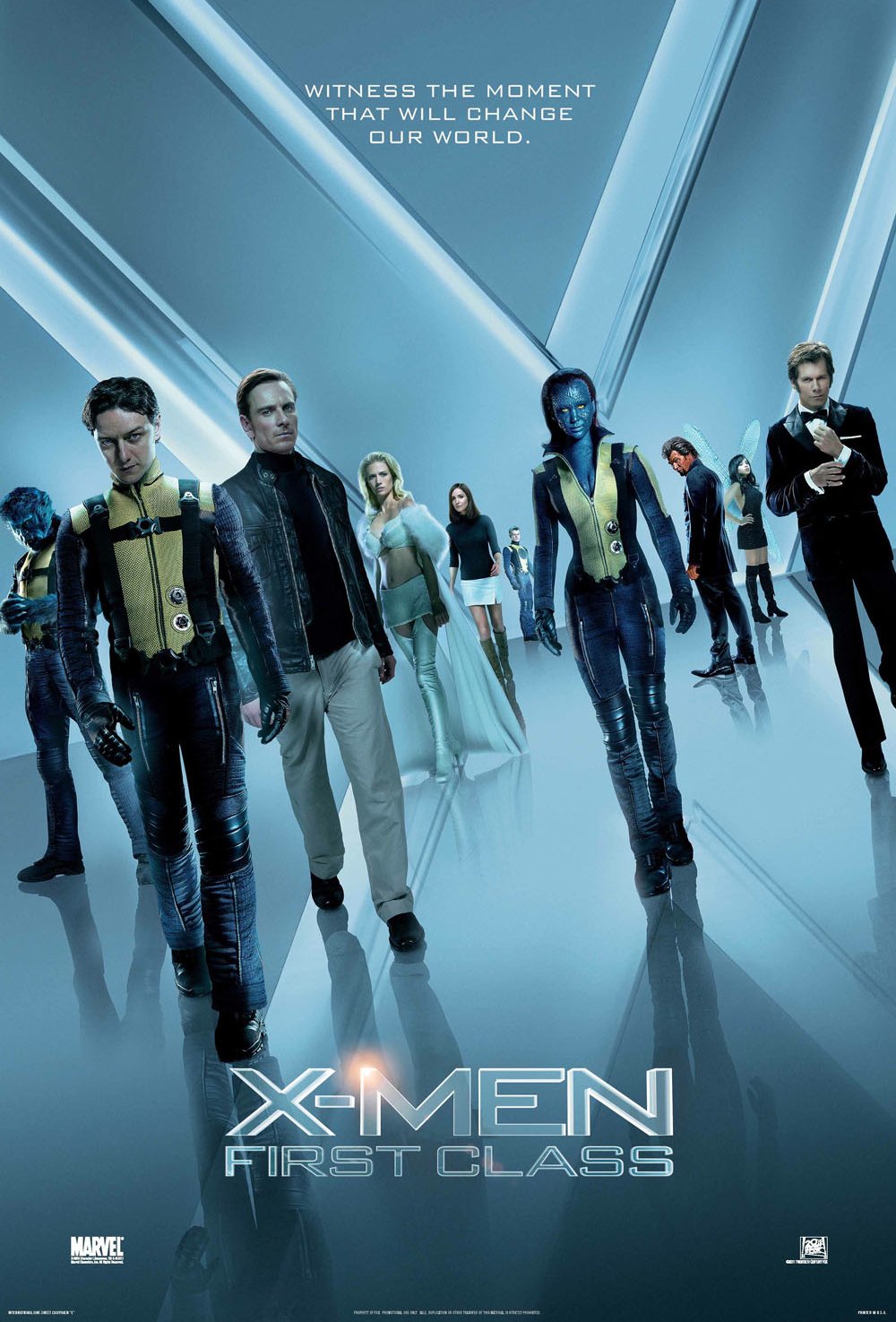
‘X-Men: First Class’ Represents What a Prequel Should Be Like

X Men First Class poster

X-Men: First Class” is a huge improvement over the previous entry, “X-Men Origins: Wolverine,” and it’s also the best film in the series since “X-Men 2.” It’s breezy fun, the special effects are terrific, and the emphasis on character this time around makes for a more involving prequel. With Wolverine shoved to the side, this fifth movie and the second prequel in the long running franchise, many other characters get their chance to shine.

The primary focus of “First Class” is on Charles Xavier/Professor X (James McAvoy) and Erik Lehnsherr / Magneto (Michael Fassbender) as we see the significant events which shaped and brought them together. But while Charles’ upbringing was a privileged one, Erik’s was unbearably tragic as he and his parents were imprisoned in a World War II concentration camp. Erik’s ability to control magnetism becomes evident early on, and this talent soon gets exploited by scientist Sebastian Shaw (Kevin Bacon) who commits an atrocious act in front of him. From there on, the driving force in Erik’s life is one of bloody revenge.

Prequels are tricky because we are naturally inclined to be against other actors taking over roles previously portrayed by Sir Patrick Stewart and Sir Ian McKellen. Then there’s that cynical feeling of studios taking this route just to save money. It was deemed after “X-Men: The Last Stand” that a fourth movie with the same cast would have been far too expensive to make. Of course, with a reported budget of $160 million, “X-Men: First Class” doesn’t sound like much of a bargain. Moreover, does anyone remember “Dumb and Dumberer: When Harry Met Lloyd?” Did you think audiences were going to be fooled by a Jim Carrey-less prequel? Anyone remember “The Flintstones in Viva Rock Vegas?” Heck, does anyone remember the first “Flintstones” movie? I remember seeing it, but the plot details escaped me once I walked out of the theater.

But what’s great about “X-Men: First Class” is the cast doesn’t need to worry about living up to the actors who inhabited the same roles before them. They get to approach these classic characters in a different light, and this frees them up from any restrictions which could have been imposed on them. Characters like Mystique and Dr. Hank McCoy are given more depth and complexity than ever before, and many surprises are in store for the audience as the script invests a lot of emotion in these characters including those bad mutants we rooted against in the past.

James McAvoy is excellent as the young Charles Xavier, and he looks like he had lots of fun making this prequel. Whereas Patrick Stewart’s Professor X was wise and mature, McAvoy’s is just getting started in his career and comes across as quite the ladies’ man. I also admired that while Charles is incredibly intelligent, we find his ego getting the best of him. So sure of all the things he is knowledgeable of, McAvoy does great work in making Xavier well-intentioned but not as open to mutants being themselves in the real world.

Erik Lehnsherr/Magneto remains one of the most fascinating characters in the “X-Men” universe. While he’s been the series’ chief villain and a megalomaniac, Magneto is simultaneously an anti-hero and has even been seen as a hero in the comic books. It’s hard not to feel sympathy for him considering the horrors he was exposed to in his youth, and it makes his future actions understandable, if not excusable. No wonder actors have so much fun in this role; you never know for sure the direction Magneto will end up taking. All you can say is, whatever he ends up doing, it will be to his benefit more than anyone else’s.

With movies like “Fish Tank” and “Inglourious Basterds” under his belt, Michael Fassbender is the perfect choice to play the young Erik Lehnsherr before and after he becomes Magneto. Fassbender has given performances deep with complexity and feeling; looking like the good guy at one point and then later turning into one seriously twisted individual. As Erik, he is great at showing the different layers to this character who is forever caught in a horrific moment he can’t get out of.

But one character who really gets expanded in “X-Men: First Class” is Raven whose shape-shifting abilities earn her the nickname of Mystique. Rebecca Romijn played Raven in the first three movies as a villain, and her character never got much in the way of psychological depth. Jennifer Lawrence, however, gets more to work with as we come to meet Raven at the time her allegiance to her “brother” Xavier begins to wane.

In Lawrence’s hands, she makes Raven/Mystique a strong female role model, one who is determined to be open about who she is and not be ashamed of it. While hiding herself in human form, as she is encouraged to do so by Charles Xavier, Raven’s frustration at appearing in public as someone other than herself is beginning to take its toll. Lawrence is riding high on some incredibly strong performances, and she continues to show how far her acting chops can stretch.

With Bryan Singer returning to this franchise as a producer, I’m sure he had a good hand in getting this particular entry focused more on character development. Each character is shown to be suffering through conflicted emotions as to what path the mutant race should follow, making them no different from the humans who deal with many of the same issues. Mutants are seen as the next stage in human evolution, but the haunting question of whether this will be to humanity’s best interests or detriment always hangs in the air.

But the person who deserves the most credit for “First Class” is its director, Matthew Vaughn. Coming off of the gleefully rebellious “Kick Ass,” one of 2010’s best movies, he manages to bring a lot of inventive energy to a franchise in desperate need of it. Vaughn also makes the special effects benefit the actors instead of just overwhelming them. What made the first few “X-Men” movies so special was the amount of emotion they generated, and the same thing is definitely the case here. It’s our connection with these characters which makes the action set pieces all the more exciting.

If there are any problems with “X-Men: First Class,” they come in the last half as the filmmakers become overly concerned about bringing the characters in line to where they are at in the first “X-Men” film. This was also a big problem with “X-Men Origins: Wolverine” even though that prequel was much more convoluted. It would have been nicer to see the friendship between Charles and Erik get expanded instead of just ending this one with them taking opposite sides. Then again, perhaps it still could be expanded on in future installments.

Kevin Bacon, always a terrific actor, is perfectly detestable as the movie’s most irredeemable villain. At the same time, I wished the writers had expanded on his character more. Compared to the others, Sebastian Shaw threatens to be a little too one-dimensional in his actions. If Sebastian had more complexity to him, it would have made the transition of power between him and Erik all the more believable and compelling.

Other strong performances come from Rose Byrne as Dr. Moira MacTaggert and Nicholas Hout as the highly intelligent yet shy Dr. Hank McCoy. On the other hand, while January Jones is amazingly beautiful as Emma Frost/White Queen, her one-note delivery of dialogue is one of this film’s major detriments.

“X-Men: First Class” is a prequel done in the same spirit of J.J. Abrams’ “Star Trek,” and it’s proof you don’t need Wolverine present to make a good “X-Men” movie. This is a reboot which works to everyone’s advantage, and I am eager to see what comes next.

By the way, don’t bother staying through the end credits. There’s no post-credits sequence, so take care of that urine ache ASAP.

* * * ½ out of * * * *

‘Fruitvale Station’ Puts a Human Face on a Tragic Shooting

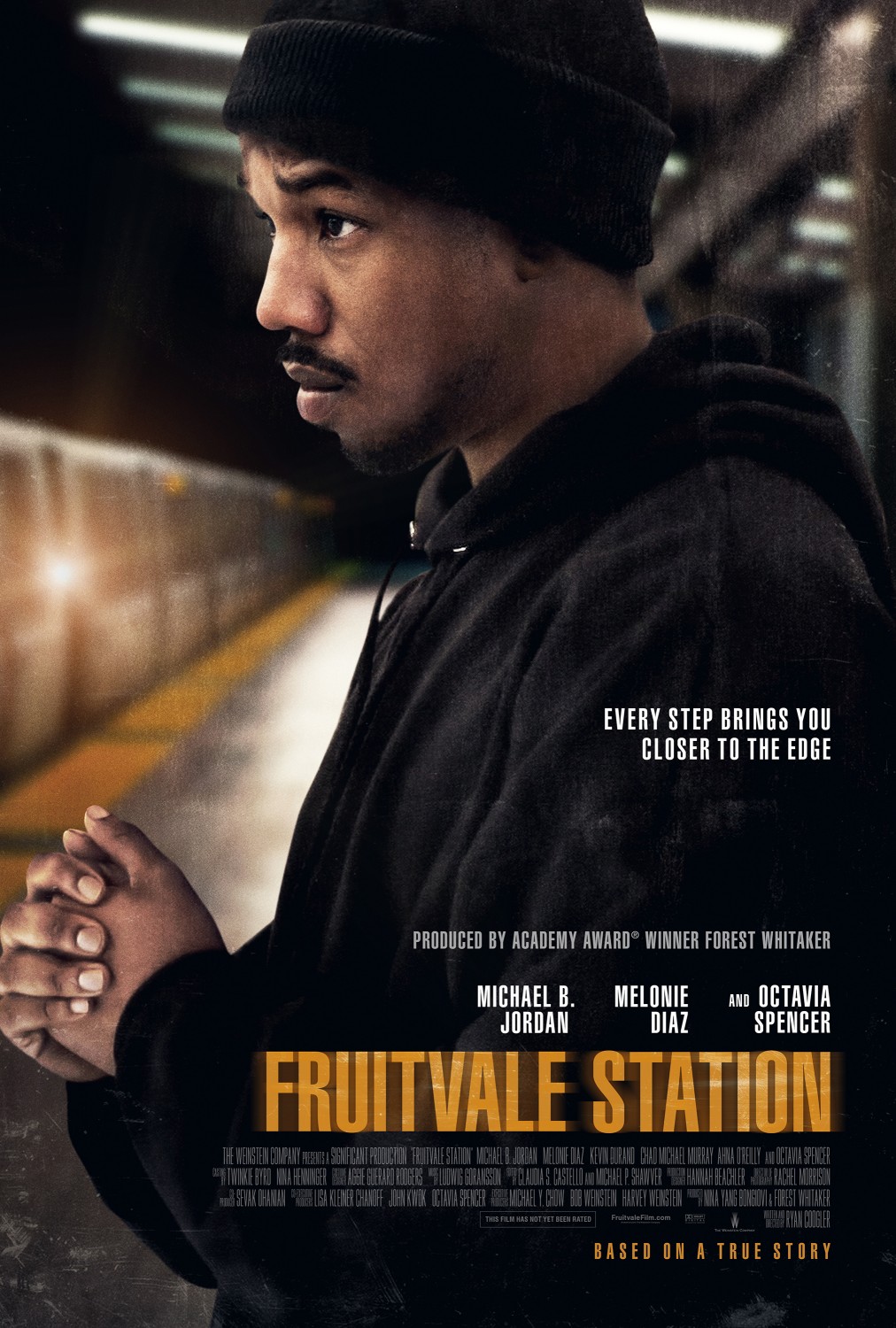
Fruitvale Station movie poster

It’s a strange and cruel irony “Fruitvale Station” opened in theaters the same week George Zimmerman was found not guilty of shooting Trayvon Martin. Like Martin, Oscar Grant was a young African American male whose life was cut short under needlessly tragic circumstances. On the night of January 31, 2008, Oscar was traveling home with his girlfriend and their friends on BART (Bay Area Rapid Transit) when a fight broke out on the train which he gets caught up in. When the train arrives at the station of the movie’s title, Oscar was pulled off it by BART police officers, and one of them, either accidentally or intentionally (depending on who you ask) shot him. He died the following day, and his death brought about protests and a call for justice.

The cases of Martin and Grant appear to illustrate that, despite strides we have made in race relations, it’s still not safe to be a young black man in America. Now “Fruitvale Station” is not a movie out to offer a solution to this continuing problem, but it does put a human face on it. After watching it, Grant will no longer seem like a mere statistic to anyone.

The movie follows Oscar (Michael B. Jordan) on the last day of his life as he goes about his business while trying to survive in an unforgiving world. He still lives with his girlfriend Sophina (Melonie Diaz) and their daughter Tatiana (Ariana Neal) in a rundown part of the Bay Area, and this is despite the fact Sophina knows he cheated on her. But regardless his wayward ways, Oscar is clearly dedicated to taking care of them both and in doing what he can to give them a better life.

“Fruitvale Station” is the first feature film for director Ryan Coogler, and he made it because he wanted people to get to know Oscar as a human being instead of just another name in a newspaper. Having seen the film, I can honestly say he succeeded in doing so. Not once does Coogler try to sanctify Oscar or water him down for an easier movie going experience. Coogler presents Oscar warts and all, and while he is far from perfect, we come to respect him for what he’s trying to do with his life on this fateful day.

We see Oscar trying to get his supermarket job back even though his boss isn’t about to rehire him, and it’s the first time we see Oscar’s hair trigger temper come to life. His mission now and throughout this fateful day is to provide for his family. Of course, this may lead to him selling drugs to help pay the rent and put food on the table, the same thing which landed him in prison. While his desire to lead a good life is strong, the lure of the criminal life and the money it can generate for him keeps percolating below the surface.

Michael B. Jordan made a name for himself on television shows like “The Wire” and “Friday Night Lights,” and he also appeared in the surprise hit movie “Chronicle.” His performance in “Fruitvale Station” is nothing short of sensational, and it made him one of the great breakout stars of 2013. It’s exhilarating to watch him as he takes Oscar from the joys of being a father to his frightening lows when he begs his mother not to leave him all alone. It’s a shame Jordan didn’t get an Academy Award nomination for his performance, but then again 2013 was a year overflowing with great performances, many of which were bound to be left out.

Octavia Spencer gives another one of her great performances in this movie as well. As Wanda, she gives us a mother who tries to be strong for her wayward son, but who struggles with the reality she may need to keep her distance from him for his own good. This is not the typical clichéd mother character who goes through the usual motions of the parental ups and downs, but one who has stood up against the tides life has thrown at her and whose love for her son you never doubt for a second.

“Fruitvale Station” starts off with footage of the actual incident where Oscar was shot, but it cuts to black before we can see if the shooting was intentional or accidental. This gives the movie a certain tension as we know how things will end, but even as we get to that moment, there’s a still a part of us which wants this situation to have a different outcome. Even though the end of the movie is never in doubt, we desperately want him to survive the night and get home safe.

The other thing I really liked about this movie is how it showed us a part of the Bay Area many of us don’t get to see. I grew up in Northern California, and while much of it is not crime ridden, there are parts of it I dare not venture into. Like the brilliant documentary “Hoop Dreams,” it sheds a light on how African-Americans live and subsequently breaks a lot of the preconceptions many of us have about them.

There have been several other tragic incidents following what happened to Oscar Grant such as the death of Michael Brown in Ferguson, Missouri. It’s always depressing to see how history keeps repeating itself despite our best attempts to learn from it. What makes “Fruitvale Station” so remarkable is it’s not out to give us glib answers on how to end the violence, but it instead puts a human face on a man who didn’t deserve to die. We hear about these stories in the news far too often, and they are usually shown to us with an unnecessary amount of bias. Both Coogler and Jordan have done a great service as they force us to see Oscar Grant as a person with strengths and flaws, and this makes “Fruitvale Station” one of the very best movies of 2013.

* * * * out of * * * *