‘Sorcerer’ May Very Well Be William Friedkin’s Masterpiece
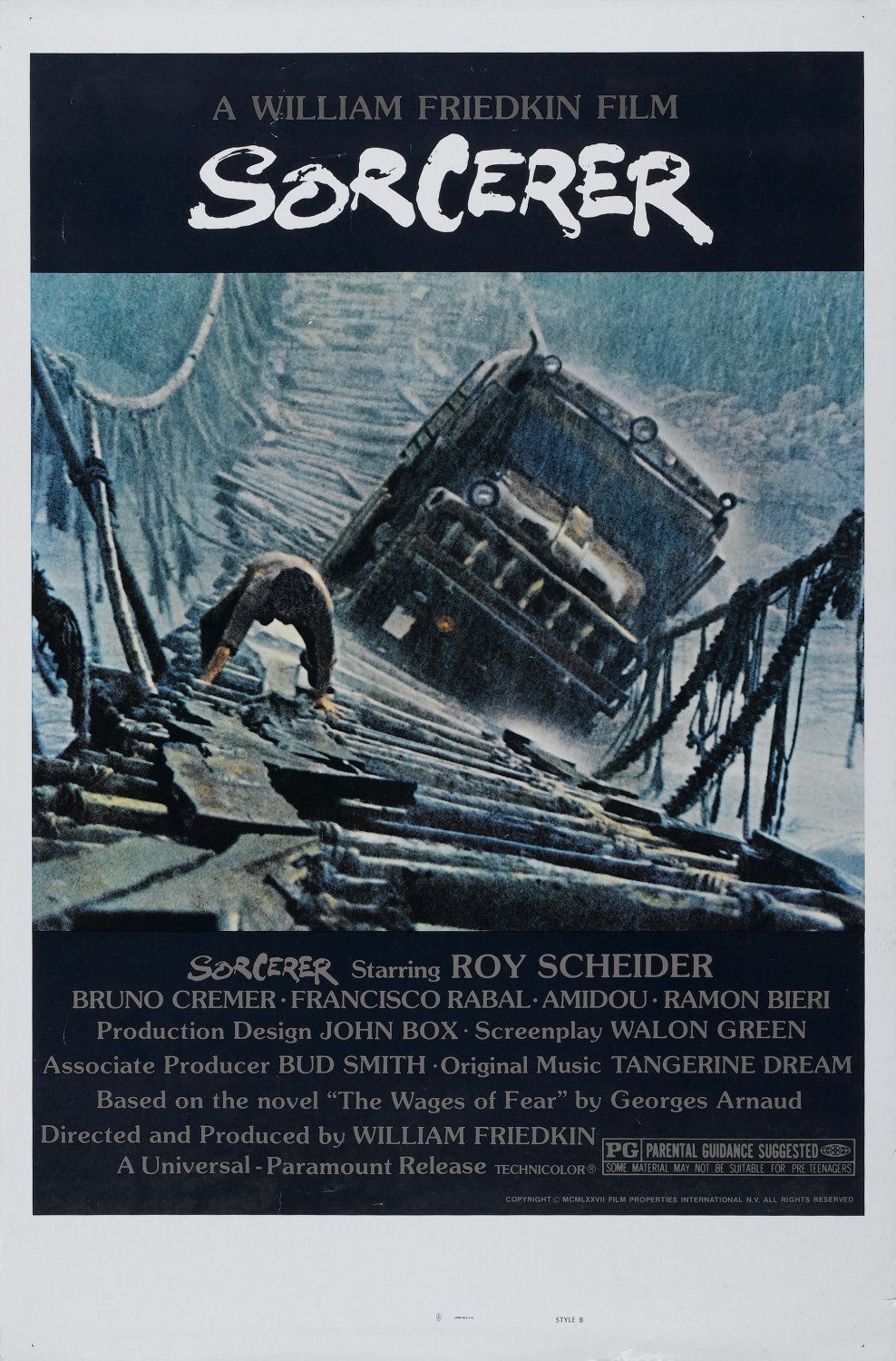
Sorcerer movie poster

This is the movie that almost completely destroyed filmmaker William Friedkin. “Sorcerer” came into theaters with a high level of anticipation, which was understandable as it was made by the same man who gave us “The Exorcist” and “The French Connection.” Lines were wrapped around the block when it opened at Mann’s Chinese back in 1977, but by the second week the theater was practically empty. “Sorcerer” was considered to be a critical and commercial failure, and Friedkin’s career has never been the same since. Of course, it opened around the same time as a small independent feature which blew away the competition. You may have heard of it, “Star Wars?”

Well, they say time heals all wounds, and “Sorcerer” has been critically re-evaluated to where it has received the critical acclaim it long deserved. The film is quite an accomplishment and a fascinating study in madness and redemption, and you will never look at truck driving the same way again after watching it. Depending on who you ask, it t is a remake of Henri-Georges Clouzot’s “The Wages of Fear” (Friedkin denies it is). The Oscar-winning director put his heart and soul into “Sorcerer,” and it pins you back into your seat and thoroughly exhausts you long before it ends. Like many great movies, it is one you experience more than watch.

“Sorcerer” takes its time getting started as we watch the back stories for its four main characters and of how they ended up at where they are. We meet hitman Nilo (Francisco Rabal) who takes down a target with a simple bullet, Kassem (Amidou) as he bombs a local church with the help of his friends, investment banker Victor Manzon (Bruno Cremer) who is about to be jailed for fraud, and then there’s Jackie Scanlon (Roy Scheider) who is marked for execution after his gang robs a church and accidentally kills a priest.

After this protracted prologue, the action moves to an unnamed location in a Latin American country which these four people have escaped to and seek refuge in. The utter squalor these men are forced to live in is so vivid to where it feels like the flies and stench of the environment doesn’t stop at the silver screen. You know how some people look at a movie and say it really made them want to take a cold shower? One shower is not enough to get past the filth these characters are forced to live in from day to endless day. This place is hell on earth for anyone, but these men obviously prefer it to death. They managed to avoid prison, but they came to a different kind of prison they are now ever so desperate to escape.

The chance for escape comes when an oil refinery suddenly explodes into a fireball, and the firefighters are unable to put the fire out without the help of explosives. Company executives manage to find a surplus of nitroglycerin sticks which can do the job, but the only catch is these sticks have not been turned and, as a result, have become highly sensitive and to where the slightest vibration could make them explode. So when an offer comes to drive this unstable set of explosives to the burning oil field for a high reward, these four jump at the chance to do the job. The rest of the movie follows their treacherous journey in trucks to deliver the explosives and hopefully not lose their lives in the process.

One thing I really admired about “Sorcerer” is how Friedkin dared to give us characters who were not altogether sympathetic. They are criminals of one kind or another, and yet we follow them every step of the way through their treacherous trip. Friedkin saw their incredibly dangerous journey as their chance not to just escape the filthy poverty they were stuck in, but also as an opportunity to redeem themselves for whatever bad deeds they committed. But their entire journey is a lot like sailing down the river Styx as they have to travel to through hell in order to escape it.

Friedkin does a great job of sustaining the tension as these men drive the trucks over terrain which looks like it’s on the verge of collapsing, and who encounter unwanted guests that have no idea of the cargo they are carrying. But the movie’s big action centerpiece is when they are force to drive the trucks over a suspended bridge which looks more than ready to completely fall apart. Add to that some furious rainstorms, and you have yourself one hell of a sequence which leaves you wrung out by the end.

Of all the actors in the cast, the most recognizable is Scheider. As a man on the run from the mob, he gives a performance which is never less than compelling, and you can only imagine the hell Friedkin put him through to play this role. The journey these men go on is not just dangerous physically, but also psychologically. Scheider does great work here as he is constantly on the verge of losing his mind, and this is especially in the movie’s second half.

Francisco Rabal, Amidou and Bruno Cremer are equally as good as they show the exhaustion and determination their characters have to complete this mission, and they too are put through the wringer to where they never seem to be acting their roles, but instead living them. You feel every bead of sweat which drips from their faces, and it makes “Sorcerer” even more of a visceral cinematic experience.

The imagery Friedkin captures is incredible as he shows us the squalor and unhealthy environment these characters live in so well, you can’t help but feel as trapped in it as they are. Friedkin has gone on record to say this film was the toughest for him to make, and I don’t doubt that for a second.

One of the other big pluses of “Sorcerer” is the brilliant score composed and performed by Tangerine Dream. Interestingly enough, they never saw a frame of the movie’s footage while working on the music, and yet they capture the events and psychology of the characters ever so perfectly. Like many of Tangerine Dream’s movie scores from “Thief” to “Risky Business,” this one is highly original and hard to compare to others. The soundtrack is still available on compact disc if you look hard enough for it.

After all these years, “Sorcerer” can no longer be mistaken as one of Friedkin’s misfires as it is now seen as one of his greatest cinematic achievements. It has since gained a strong cult following and is truly one of the most underrated movies of the 1970’s. It is unlikely we will ever get to see a movie made the way this one was ever again, and this makes it a must see for every and any film buff out there.

* * * * out of * * * *

‘Chappaquiddick’ Revisits a Tragedy No Kennedy Can Escape

Chappaquiddick movie poster

“They eat their wounded upstairs.”

Lieutenant Al Giardello tells Detective Frank Pembleton this on an episode of “Homicide: Life on the Street” to describe the politicians who have invited Pembleton to help them out on a delicate matter involving a congressman. So eager he is to impress his bosses, Pembleton suggests letting a police report get buried, covered up, and the Deputy Commissioner orders him to do so. But when this matter is made public to where a scandal erupts in the news, the Commissioner denies his own involvement and lets Pembleton take the fall. Pembleton has become one of the wounded as the higher ups in the department hang him out to dry, and we see what politicians will do to keep their political currency protected at all costs.

I kept thinking about this exchange while watching “Chappaquiddick” which takes us back to the year 1969 when Senator Ted Kennedy was involved in a car accident. While attempting to cross the Dike Bridge on Chappaquiddick Island in Massachusetts, his car went off the side and plunged into the water. Ted was able to free himself, but his passenger, Mary Jo Kopechne, remained trapped inside and eventually drowned. Ted failed to report this incident to the police until 10 hours after it happened, and we watch as his closest advisers look for ways to spin the story to their advantage as the scandal threatens to derail Ted’s political career and forever tarnish the image of the Kennedy family.

The car accident is presented in bits and pieces throughout because, as anyone who has been in an accident can tell you, no one remembers everything in a linear fashion. After the initial accident, the story jumps ahead to a soggy Ted Kennedy walking slowly back to the house where he, his advisers and secretaries were having a party. When his close friend Joe Gargan sees him shivering in the back of a car, Ted simply says, “I’m not going to be President.” From there, everyone goes into damage control mode as they try to get a hold of the narrative and manipulate it to where Ted will come out of this accident in one piece. But there is still a dead body in the center of this tragedy, and some in the inner circle are not about to let this fact go away.

It’s fascinating to watch the political spin machine at work in “Chappaquiddick” as this kind of press manipulation is a regular thing these days, but even back in 1969 the truth was not so easy to bend as the truth still found a way to the surface. Still, we feel the pressure of the press as Ted and company scramble to come up with an answer which will exonerate the Senator in the eyes of his constituents and America at large. There are scenes where his advisers come up with ridiculous scenarios to explain Ted’s actions, like getting a physician to explain how Ted suffered a concussion in the accident even though he isn’t given a chance to examine the senator. Then there’s the story about how Ted was put on sedatives because of his concussion, but a reporter points out how taking sedatives in this condition could easily kill him. And let’s not forget the neck brace fiasco which Ted didn’t even bother rehearsing. There was no Facebook or social media back then, but there was still enough attention paid to where Ted could not walk away from this tragedy unscathed.

At the center of “Chappaquiddick” is Jason Clarke who portrays Ted Kennedy. Many actors could have easily fallen victim to simply playing the late senator as the icon we all see him as and saddle themselves with an accent which makes them sound like Mayor Quimby from “The Simpsons.” Clarke never falls into any of those traps and instead makes Ted as human as anybody else, full of flaws and passions which at times get the best of him. It’s a wonderfully complex performance as Clarke shows how Ted worked to control how the news of this tragedy coming out while wrestling with a conscience that will not let him escape the guilt he feels. Just watch Clarke as he phones Mary’s parents to inform them of her death. It’s a heartbreaking moment, and not an easy one to pull off.

Special mention goes to Kate Mara who plays Mary Jo Kopechne. It’s a small role, but Mara makes the most of her time onscreen as she forces us to see Mary as much more than a mere historical footnote. We learn Mary was a devoted supporter of Bobby Kennedy and his values, and she desperately wants to believe Ted can deliver on the same promises Bobby made before he was killed. This makes her final onscreen moments where Kate is desperately keeping her head above water as she hopes for a miracle which never comes. Whether or not you knew of Mary Jo’s existence before this movie, Mara’s performance ensures we never forget her once we leave the theater.

Indeed, the entire cast of “Chappaquiddick” is well chosen as each actor inhabits their role with a lot of passion and energy which makes this more than the average biopic. Ed Helms and Jim Gaffigan get to break free of their comic roles here as Joe Gargan and Paul Markham, two of Ted Kennedy’s closest advisers who are desperate for him to get his story straight before he does even more damage to his image. Helms is especially worth singling out here as he makes Joe the conscience Ted desperately needs to pay attention to, and whether or not Ted does is not worth revealing here as you have to look into Helms’ eyes to see what the answer is.

One truly brilliant performance worth singling out here comes from Bruce Dern who gives an almost wordless performance as Joe Kennedy, the patriarch of this famous family. When we meet Joe, he has long since become hobbled by a stroke and aphasia, and this makes Dern’s work all the more challenging as he has to express things to the audience without the use of words. The final scene he has with Clarke is brutal as the frustrations and disappointments these two have with one another come to their breaking point.

It’s great to see Clancy Brown here as the no-nonsense Secretary of Defense Robert McNamara as he cuts through the bull to make sure the narrative runs as smoothly as possible for the incumbent senator. From the first moment he appears onscreen, the “Highlander” actor shows the audience he means business as McNamara moves quickly into damage control mode and freaks when the most thoughtless of mistakes are made by subordinates.

Olivia Thirlby also shows up here as Rachel Schiff, another loyal Kennedy secretary and close friend to Mary. It’s fascinating to watch Thirlby here as she takes Rachel from being totally devastated upon learning of her friend’s death to racing into damage control mode. Whatever you may think of her actions, Thirlby shows how devoted she is to the Kennedy family as she feels the country cannot suffer over one person’s mistake.

Also worth mentioning is Vince Tycer, a noted theater director in Connecticut, who plays David Burke, an individual known as a aide to powerful men. It’s fascinating to watch Tycer in “Chappaquiddick” as he hovers in the shadows next to Ted Kennedy and looks ready to defend the senator’s honor in any possible way. This is another character who could have been played in too broad a fashion, but Tycer plays David in a thoughtfully subtle way as this is a character who is more than willing to set aside his own thoughts and desires for something he considers to be the greater good.

“Chappaquiddick” was directed by John Curran who previously helmed such movies as “The Painted Veil” and “Tracks,” and he wrote the screenplay for Michael Winterbottom’s highly controversial “The Killer Inside Me.” Curran gives this film an underplayed feel as he wants us to see these characters not as historical figures forever defined by their public images, but as people like you and me. The more we see ourselves in these characters’ shoes, the more we get sucked into the story to where this becomes more than your average biopic or just another movie which is (sigh) “based on a true story.”

The only real problem I had with this movie was it felt a little too underdone to where an infusion of energy could have come in handy. I kind of wish Curran had livened up the proceedings at times, especially when it came to watching the walls close in on Ted. There is passion on display here, but that passion could have been stronger in retrospect.

Regardless, “Chappaquiddick” proves to be a fascinating look into the broad scope of political power and at the life of a man born into privilege who uses it to escape a harsh punishment with his career mostly intact. Ted did go on to become the “Lion of the Senate” as he fought long and hard for social justice and universal health care, but I left this movie wondering if his actions were taken to atone for his part in Mary Jo’s death. In the eyes of many Americans, he earned his forgiveness, but a closeup of Clarke’s eyes in this movie’s final moments suggests Ted never fully forgave himself. Did he truly earn a redemption in the years following this accident? We may never truly know, and this makes “Chappaquiddick” especially haunting.

* * * ½ out of * * * *

‘Take Me to the River’ Dives Right Into the Deep End

Take Me to the River poster

I came into “Take Me to the River” with little knowledge as to what the movie was about, and perhaps this is the best way to approach it. At first it looks to be a tale of a gay teenager dealing with his conservative relatives who have yet to understand how human nature really works, but then it takes a sharp left turn to reveal it is really about deep dark family secrets which are revealed in a wordless way, and the psychological impact it ends up having on its audience is far more profound than we could have ever seen coming.

We are introduced to Ryder (Logan Miller), a gay California teenager who is going with his mom Cindy (Robin Weigert) and dad Don (Richard Schiff) to a family reunion in Nebraska. Ryder is intent on revealing his sexuality to everyone there, but his parents encourage him not to. Shortly after he arrives, he is treated with suspicion from others as his red shorts look like a pair of swimming trunks and his glasses resemble something which came out of the 1980’s. His cousins, however, are crushing on him as he makes them special drawings, and they find him wonderfully rebellious. But then things go awry during a moment between him and 9-year-old Molly when she comes out of a barn with a bloodstain on her dress. Ryder is immediately suspected of abuse by his uncle Keith (Josh Hamilton), but he makes clear he didn’t do anything to her.

Now revealing more about “Take Me to the River” from there is a bit tricky because it is better not to know too much about the movie beforehand. For a time, I thought I knew where the movie was going to go, but then it becomes more like a thriller. This is especially the case when Ryder is invited to a supper with Keith and his family where Keith looks to make amends with him, but his laser-like stare indicates he has something quite devious planned for his nephew, and we are just as in the dark as Ryder is.

This movie marks the feature film directorial debut of Matt Soebel who also wrote its screenplay, and he does an excellent job of putting us right in Ryder’s shoes. Like Ryder, we have little idea of what’s going on and it leaves us with an inescapable feeling of dread.  And like “The China Syndrome,” it doesn’t have, or even need, a music score to underscore the tension which continually builds up. We don’t really hear any music until the very end, and when that final song comes on, I felt like breathing a sigh of relief as the tension finally lifted.

This is also a motion picture which derives its power from what is not said more than what is. Soebel is not interested in spelling everything out to us as our imaginations are capable of generating things far more frightening, and when the story comes to hint at a deep dark family secret, we cannot help but be unsettled at what that secret could be.

But as much as “Take Me to the River” sounds like a thriller, it is also a coming of age story as Ryder comes to better understand the people around him and develops a stronger compassion than he ever had before. The fact he is gay eventually becomes a tiny issue as their bigger things to undercover which has left his family members with very nasty emotional scars. This is saying a lot because many coming of age movies don’t come constructed like this, and it makes this one all the more unique.

I was very impressed with Miller who left a strong impression on audiences in “The Stanford Prison Experiment.” We never catch him portraying a typical teenager, let alone a gay teenager, but instead a regular kid who is caught up in a situation he can’t stay one step ahead of. I also liked Hamilton’s performance as Keith because it shows him to be quite the poker player. But the most impressive performance in “Take Me to the River” comes from Robin Weigert as Cindy. At first, she makes Cindy an overprotective mother, but her actions come to reveal someone who has suffered a serious trauma she can never fully make peace with. Weigert, just with a look, shows us how deep her emotional scars go, and it’s always impressive to see any actor pull this off without having to spell it out for the audience.

There’s always something to be said for a movie which catches you by surprise, and “Take Me to the River” is certainly one. I went into it not knowing much about it, and it took me on a ride unlike few others I have been on in recent years. In a time where movies are bound by formulaic standards and studio executives who are hell bent on starting the next big franchise, it’s nice to know there are still filmmakers out there making movies which go against the grain. Not everything can be the same, and in the end, everyone needs some variety as they can get easily bored.

If you love movies which break the mold, then “Take Me to the River” is one you need to check out. When it comes to humanity, there’s always something more to a person than meets the eye. While you might think individuals can be easily divided into groups of people you feel you can easily identify, this movie comes around to remind you this it is not as easy as you think. Family secrets are never easy to unveil, and this movie serves as a reminder as to why. I look forward to what Sobel has in store for us next.

* * * ½ out of * * * *


‘We Need to Talk About Kevin’ Features Tilda Swinton at Her Most Devastating

We Need to Talk Kevin poster 4

I think “We Need to Talk About Kevin” would make an interesting double feature with “Rosemary’s Baby” as both prove to be cautionary tales for prospective parents. But unlike Polanski’s classic film which dealt with the occult and supernatural, the horrors of “We Need to Talk About Kevin” are rooted in real life. Stories of kids going on murderous rampages at their schools have gotten far more media coverage than they deserve, but Lynne Ramsay’s film is not out to exploit this subject but to explore what could have triggered such a massacre.

Acting goddess Tilda Swinton plays Eva Khatchadourian (good luck trying to pronounce that last name), a successful travel writer who is picking up the pieces of her life after a tragic event people have come to blame her for. The movie shifts back and forth in time as we see Eva finding happiness with her husband Franklin (the always great John C. Reilly) to becoming pregnant with her first child, and then back to present day where she tries to make sense of the crimes her son committed. We see her as a pariah of the community, and everyone constantly stares at her as if to say, “How do you live with yourself?”

I’m not sure I’ve ever seen a character look less forward to motherhood in a movie before this one. Eva’s face of happiness is wiped away almost permanently by her new role in life, and while her husband is thrilled at being a parent, she just looks on despondently as if her life just came to a shocking end. Without words, you immediately get the impression she has no interest in being a parent, and she never really forms an affectionate bond with Kevin. Eventually, Eva sees the parts of herself she doesn’t like in Kevin’s cold, dark eyes as he glares at her as if to say she resembles everything wrong in the world.

Swinton has never been an actress content to fall victim to overly emotive acting or chewing the scenery for an Oscar moment. She inhabits her characters more than plays them, and her performance as Eva ranks among the very best of her career. She creates such an unforgettably human portrait of a mother whose superficial behavior towards her son isn’t fooling anyone, especially him. But at the same time, Swinton makes you feel deeply for Eva as she forces you to confront what you would do if you were in this unimaginable situation.

While we see Eva losing her temper at Kevin when he does bad things, we also see she’s the only person who realizes something is seriously wrong with him. Franklin, on the other hand, is either completely oblivious to his son’s nastiness or just doesn’t want to see the truth of how troubled he is. To everyone else, Kevin is just a boy doing boyish things, and this leaves Eva feeling even more isolated as she feels completely helpless in her attempts to repair the fractured relationship she has with him.

Kevin is played by three actors at different parts of his life: Rocky Duer, Jasper Newell and Ezra Miller. All do great work in making Kevin the kind of child none of us ever hope to have, and each manages to perfect the wicked glare Kevin gives off to where you would think they were auditioning for a Stanley Kubrick movie, hoping to outdo Vincent D’Onofrio’s piercing glare in “Full Metal Jacket.” But of those three actors, the one who deserves the most praise is Miller as he makes Kevin into one of the scariest sociopaths I have ever seen in a movie. Damien from “The Omen” has got nothing on this guy, and it’s tempting to think he could give Alex from “A Clockwork Orange” a run for his money. Miller never portrays Kevin as a simple one-dimensional villain, but as one whose meaning in life has been corrupted to where he doesn’t see much good in anything.

Director Ramsay previously made “Ratcatcher” and “Morvern Callar,” and her work behind the camera has been justly acclaimed. With “We Need to Talk About Kevin,” she shares in Swinton’s fearlessness in delving into subject matter many would choose to avoid if they could. Not once does she judge the characters here, and she leaves their actions up for us to judge. She is not out to provide answers to a situation like this because none are ever easy to come by.

The movie’s opening shot has Eva participating with dozens of people in some Italian tomato festival to where it looks like they are all bathing in blood, and it symbolizes what will eventually become of her life. Ramsay makes great use of the color red throughout as it acts as a stain on Eva’s conscience which cannot be washed away. The movie is beautifully shot to where the sterile setting Eva and her family lives in is just asking to be forever dirtied, and the film score by Jonny Greenwood, who composed the score for “There Will Be Blood,” illustrates the violence just underneath the surface that will eventually explode for all to see.

“We Need to Talk About Kevin” could easily have been an exploitive feature, but it never falls victim to that. There’s actually very little violence shown as Ramsay is far more interested in the aftermath of what has happened, and the movie ends on a surprising note of possible redemption for some of the main characters. Having seen it, I can now safely say Tilda Swinton was most definitely robbed of an Oscar nomination for her performance here. What she does is truly astounding as well as completely brave. Not many actors would easily venture into a topic which hits too close to home, but Swinton is never one to back down from a challenge.

Coming out of this bruising film experience, I kept thinking about this line of dialogue said by Augustus Hill on the HBO series “OZ:”

“One of the last things Jesus did on Earth was to invite a prisoner to join him in heaven. He loved that criminal. I say he loved that criminal as much as he loved anyone. Jesus knew in his heart it takes a lot to love a sinner. But the sinner, he needs it all the more…”

* * * * out of * * * *

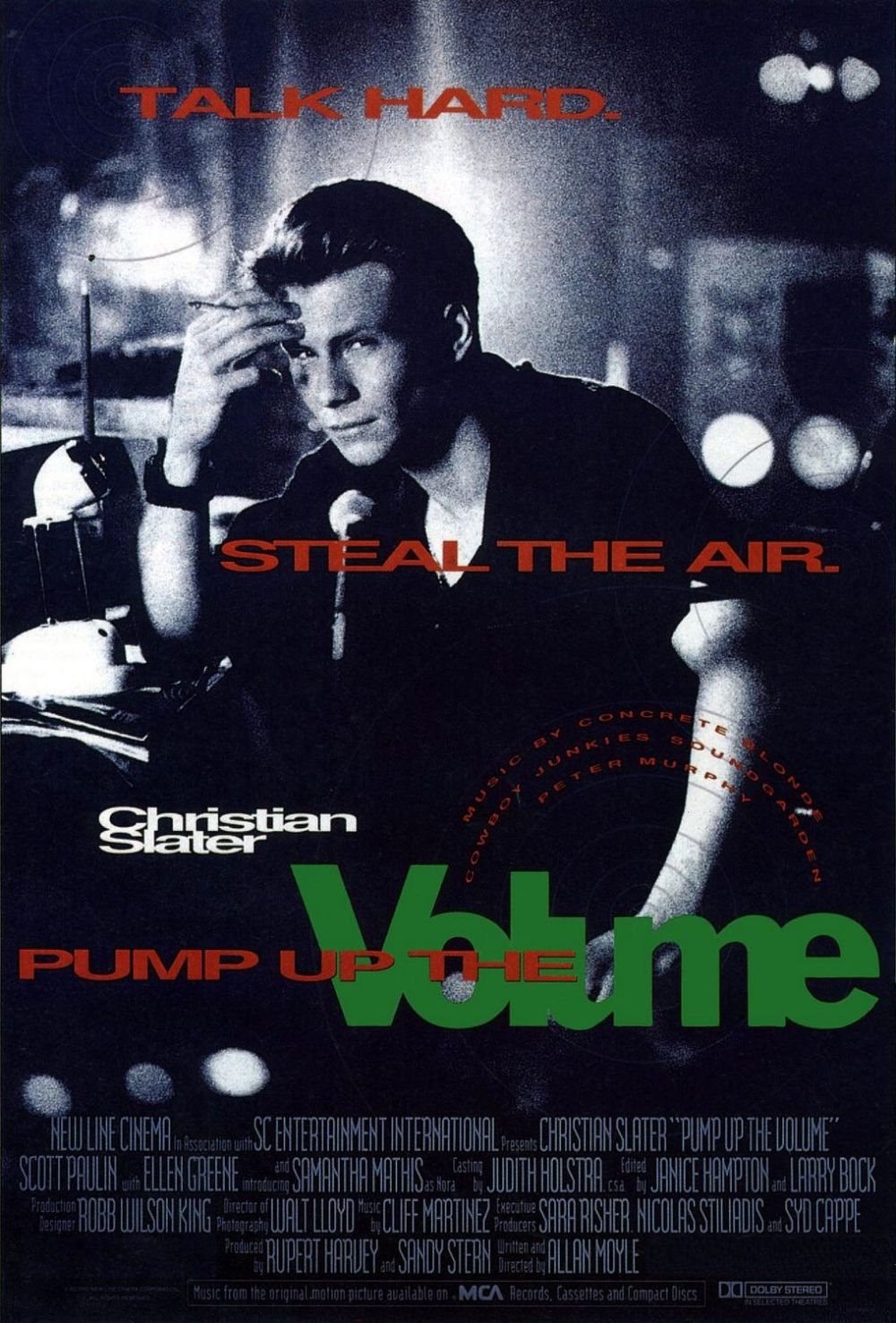
Why ‘Pump Up the Volume’ Remains My Favorite Teen Movie

Pump Up The Volume movie poster

Of all the movies I have seen about being a teenager, “Pump Up the Volume” is still far and away my favorite. It is also the one which hit me the hardest emotionally as, after seeing all these movies about nerds and jocks fighting each other on school grounds, this one had characters I could actually relate to. I grew up during the years of “Beverly Hills 90210” which infected us with a fantasy version of the high school experience where you could have your troubles as a teenager but would still come out of it with a smile, a cute boyfriend or girlfriend and some fancy, fancy clothes which made you look oh so incredibly cool. This movie does not exist in that fantasy world, thank goodness, and I would love to see Hollywood produce more movies like it.

Allow me to give you some background information about myself as it will inform how strongly I feel about this movie. My family had moved around quite a bit when I was a kid, but it actually didn’t bother me much until we moved from Southern California to Northern California. I lived in Thousand Oaks for five years, and at that point it was the longest I had ever lived in one place. For once I felt settled, and then my dad quit his job and got a new one up north in the Bay Area, and my whole life went into major upheaval as I had no choice but to move with my parents and away from a place which truly felt like home.

I had to start all over again making new friends, and even after all these years it still feels so unfair to have been put through this moving thing one time too many. I became very antisocial and withdrawn as I was so frustrated and depressed at this situation I was thrown into. For a while, it felt like I could not talk to anybody as I didn’t know what to say. In retrospect, the fact I got through adolescence in one piece seems like a miracle.

“Pump Up the Volume” features a character who went through something very similar. Christian Slater gives one of his all-time best performances as Mark Humphreys, a high school senior who has just moved with his family from New York to a suburb in Arizona which appears to be located in the middle of nowhere. He is a shy and withdrawn kid, clearly not happy about his situation. He can’t talk to anybody, not even to his parents who he feels completely alienated from. But by night he is Happy Hard On, a pirate radio DJ who operates an underground station in the basement of his parents’ new home. While Mark is very quiet in the classroom, he comes to life on the radio and rants about his new neighborhood and the world he is growing up in with complete abandon.

As time goes on, his radio program starts drawing in more and more listeners who relate to what he is going through. Chaos begins to reign at his high school and the adults work to control the situation, having no idea of what the kids are really going through. This scares Mark to the point where he wants to stop doing his show, but since this is one of his biggest outlets for the frustration and aggression he constantly feels, he can’t bring himself to stop. It’s through his venting that he suddenly becomes the voice everyone needs to hear, especially the kids.

“Pump Up the Volume” covers a lot of ground that other teenage movies don’t bother to, and it’s much more down to earth than others in the genre which, for myself, was a huge relief. I got so used to seeing movies about the classroom dork winning the girl of his dreams or beating out the jocks that made him believe he was so uncool. Watching movies like those when I was a teenager just made me feel more ostracized than I already did, so “Pump Up the Volume” was a godsend in how it had a main character I could actually relate to. Adolescents need movies like this to make them realize they are not the only ones going through rough times, and to make them see how being a teenager is not always what we expect it to be.

In one scene, Mark takes a call from a kid who admits he likes guys and ends up describing a truly humiliating situation he got trapped in. In another, he takes a call from a listener who has written him a letter saying he wants to kill himself, and when Harry asks him why, the listener says with tears coming out of his eyes, “I’m all alone.” But as Mark quickly admits, maybe it is okay to be alone sometimes, and that in the end we are all alone. It sucks, but there seems to be no real escaping this fact. Then again, I have no problem with anyone proving me wrong there. I can’t think of another teen movie before this one that dealt with such down-to-earth characters.

A lot of people have complained the adult characters are largely one-dimensional. While I can definitely see some validity in this argument, I also remember seeing these seem people at my high school. Believe me, these people do exist. Annie Ross plays Loretta Creswood, the principal of Hubert Humphrey High, and she is a true bitch in every sense. Loretta lives to see her students get the highest SAT scores in the state, and she has no time for troublemakers whom she sees as having no interest in education. I have friends of mine who are teachers, and they do not hesitate in telling me just how much they hate the principals they work with. The way they are described to me, they are just as bad as the one Ross plays in this movie.

Then you have Mark’s dad, Brian (played by Scott Paulin), who at first seems oblivious about how to deal with his son’s problems, but then he turns out to be the students’ savior when upon realizing they need to be heard, not talked down to. At the same time, Loretta doesn’t show the least bit of regret in expelling those students she feels are undeserving of an education. Paulin is terrific in making Brian seem like much more than the average parent, and he makes the character a heroic educator as we how much he values the fact everyone has the right to an education.

Another great performance comes from Samantha Mathis who plays Nora Diniro, a total rebel and a free spirit who never apologizes for who she is. Nora ends up befriending the terribly shy Mark, and she later comes to discover his secret identity. Nora eventually becomes Mark’s conscience as she makes him realize the powerful effect he has on the kids in the town and on her as well. When he wants to back out when things get too dangerous for him, she angrily reminds him he has a responsibility to the people who believe in him.

There’s a great scene where the two of them are outside in Mark’s backyard when he desperately wants to communicate to Nora, and she tries to make him as comfortable as possible. Nora even ends up taking off her sweater and stands in front of Mark with her breasts bared; forcing Mark to look into her eyes as they quickly make a connection not easily broken. Both Slater and Mathis have fantastic chemistry together, and Mathis creates the kind of free spirited character we all would have loved to have been like in high school.

“Pump Up the Volume” climaxes with the walls closing in on Mark as the adults try to figure out his real identity and shut him down for good. The fact he continues to be defiant even as the authorities get closer and closer to catching him was really inspiring to me. You want to see him, in the words of Jack Black from “School of Rock,” stick it to the man. Then Slater delivers this piece of dialogue which still stays with me:

“High school is the bottom. Being a teenager sucks, but that’s the point! Surviving it is the whole point! Quitting is not going to make you strong, living will. So just hang on and hang in there.”

“Pump Up the Volume” still resonates very deeply for me all these years later. It came out in the summer of 1990 which was, ironically the summer before I started high school. This movie became one of the things which kept me going through adolescence even when I got very, very depressed. Unfortunately, it was a box office flop on its initial release, but it has since gained a strong following on home video and DVD. It’s a following I hope will continue to grow, and maybe if we’re lucky, there will eventually be a special edition DVD and Blu-ray containing documentaries, trailers, audio commentaries and even music videos. Hey, Criterion Collection, are you listening?

“Pump Up the Volume” also contains one of my all-time favorite soundtracks. My only problem with it is it doesn’t have Leonard Cohen’s version of “Everybody Knows” which serves as the perfect song to open the movie with. Instead, we have the version by Concrete Blonde which comes on towards the end when Mark makes his last stand against the powers that be. I certainly don’t want to take away from their cover of the song as they did a great job on it, but Cohen’s version is perfect fit for Mark’s state of mind. It also would have been cool to get some of Cliff Martinez’s film score on the soundtrack as well as I really loved how it sounded. Still the soundtrack does have a lot terrific tracks from The Pixies, Soundgarden, Cowboy Junkies and Sonic Youth.

For me, “Pump Up the Volume” was a godsend. It gave me a character who was dealing with the same problems I dealt with when I was a teenager, and there were few, if any other, movies which contained individuals like him. Most teen movies back then just left me with a never-ending feeling of utter resentment as they featured kids who got to experience things I never did and felt robbed of. All the misfits, social rejects and those who felt dejected and rejected need and deserve a movie like “Pump Up the Volume.” After all these years, it remains very close to my heart, and I would not hesitate to recommend it to anyone.

* * * * out of * * * *

‘Ready Player One’ Revels More in the Virtual World Than in Reality

Ready Pkayer One movie poster

Ernest Cline’s “Ready Player One” is a novel I could see a lot of directors being ever so eager to turn into a motion picture. Edgar Wright, Guillermo Del Toro, Robert Zemeckis and even (gasp) Michael Bay would have had a blast bringing to life the virtual world Cline wrote about to where the possibilities of what they could bring to the silver screen seem infinite. In the end, it makes perfect sense Steven Spielberg was the one to adapt it as no other filmmaker has captured our collective imaginations as much as he has.

The year is 2045, and Earth has long since become consumed by pollution, corruption and climate change (which is real folks, don’t let anyone tell you different), and its inhabitants, those situated in the middle or lower classes, are consigned to mobile trailers which are stacked on top of one another. While this cannot be mistaken for a glamorous lifestyle, many clueless politicians and wives of U.S. Presidents would be quick to describe them as FEMA luxury suites. Looking at how barren their existence has become, it’s no wonder these characters prefer a virtual reality as opposed to the one they are forced to live in and endure on a daily basis.

Everyone, and I mean everyone, manages to escape their depressing reality in the OASIS (Ontologically Anthropocentric Sensory Immersive Simulation), a VR world which allows its users to engage in activities of either an educational, entertaining, or a profitable kind. You can be any avatar you want to be whether it’s Freddy Krueger or Godzilla, and you go into it believing it will allow you to be a somebody instead of a nobody. But eventually, even its most devoted users need to find a way to better deal with the real world as a line between the two needs to be drawn.

One of the OASIS’ most devoted users is Wade Watts (Tye Sheridan), an 18-year-old who lives in the slums of Columbus, Ohio with his aunt. It’s no surprise how quick he is to dive into this virtual world, but his reasons for doing so run much deeper than we initially realize. We learn the OASIS was created by James Halliday (Mark Rylance), an eccentric computer genius with an incredible love for 80’s pop culture. Halliday has since passed away, but he has left behind a trail of bread crumbs in the form of Easter eggs for his fans to discover. The first to find all these eggs is promised full ownership of the OASIS among other desirable gifts. Of course, there is a corporation, or a video game conglomerate if you will, named Innovative Online Industries (IOI) which is determined to gain ownership of the OASIS before anyone else. Will the rebellious users beat the greedy corporation to the finish line? Well, the answer might have seen obvious in the past, but these days it looks like the bad guys get away with far too much in the real world.

“Ready Player One” is essentially a combination of “Willy Wonka and the Chocolate Factory” and “Tron” as our protagonists are on the search for something which will fulfill their wildest dreams, but they have to find it in a world where the laws of nature do not necessarily apply. And when it comes down to it, the winner will not be someone who is the best at gaming, but someone with a good heart who wants to do the right thing, and who has a strong spirit. Finding someone like that in this day and age, let alone in the future, is an ambitious task as everyone appears susceptible to greed and corruption, but the filmmakers went into this project with the full belief such a person still exists, and a world without hope is not one we should be quick to live in.

The challenge Spielberg has with “Ready Player One” is balancing out the real world with the wondrous virtual world the characters are ever so eager to inhabit. But with all the tools he and his fellow filmmakers had at their disposal, it is easy to see how lopsided the balance is here. Spielberg clearly revels in amazing visual effects he can put onscreen. Watching this movie just once is not enough as there are an infinite number of Easter eggs to discover and acknowledge. While you may easily recognize such pop culture artifacts like Freddy Kruger and the DeLorean time machine from “Back to the Future,” there are so many others to acknowledge here to where you will be very surprised at what Spielberg and company were able to fit into a PG-13 movie.

When it comes to the real world, I feel Spielberg could have done more to distinguish it from the OASIS. This man did give us “Jaws,” “Close Encounters of the Third Kind,” “Raiders of the Lost Ark” and “E.T.,” movies which exceeded anything our imaginations could conjure up. Years later, however, he gave us “Schindler’s List,” “Saving Private Ryan” and “Munich,” films which did not shy away from the horrifying reality people are forced to endure. Surely Spielberg would be able to balance out the real world from the imaginary one to where we can see the difference between them or at least determine which one is more important to live in, right?

Well, “Ready Player One” functions a lot like the original “Jurassic Park” in that the spectacle gets the majority of attention while the human element suffers in comparison. But like “Jurassic Park,” Spielberg still has us captivated with incredible visual effects which leave us in complete awe. As the movie goes on, the avatars of the main characters start to look and feel more real than I expected, and this makes up for the limited character development they receive throughout. Cline co-wrote the screenplay with Zak Penn, but it feels like everyone could have gone a bit deeper with the material.

On a personal note, I loved how Spielberg digs deep into 1980’s nostalgia. Being a child of this decade, I still very much enjoy the music and movies which came out of it. To his credit, Spielberg doesn’t reference his own movies here, regardless of the fact they play a big part in Cline’s book. It’s also great to hear the music of Alan Silvestri here as his themes from the 80’s, particularly those from “Back to the Future,” never grow old. Silvestri’s score here references a number of pop culture classics, and I’m sure you will recognize many of them.

Tye Sheridan has turned in terrific performances in “The Tree of Life,” “Mud” and “Joe,” and he fits comfortably into the role of the typical young Spielberg hero who is wise beyond his years and smarter than the average adult. Olivia Cooke is a wonderful and strong presence as Samantha Cook, a fellow OASIS player whose avatar goes by the name of Art3mis. Ben Mendelsohn also shows up as Nolan Sorrento, the infinitely greedy CEO of IOI who is determined to gain full control over the OASIS. It’s a lot like the character Mendelsohn played in “The Dark Knight Rises,” but this time he is playing someone who believes they are in charge and actually is.

But if there is one performance worth singling out here, it is Mark Rylance’s as James Halliday, the main creator of the OASIS. Rylance makes Halliday into a wonderfully eccentric character whose social skills could use a bit of work, but whose heart shines through in everything he has created and accomplished. Not once does this Oscar-winning actor make Halliday into a caricature of Steve Jobs and instead presents us with a human being desperate to find someone in this world who has not been completely corrupted by the powers that be.

“Ready Player One” will not go down as one of Spielberg’s best movies, but it is far from being one of his worst. The visuals alone are worth the price of admission and watching it once will not be enough as there are so many Easter eggs to identify. Heck, if you close enough, you can even spot a poster with Wil Wheaton on it. While its message of how important it is to spend more time in the real world than the virtual one might seem a bit hypocritical, this movie was directed by a man who knows the difference between the two to where he doesn’t have to prove to us that he knows this. Still, on a story and character level, this could have dug deeper beneath the surface.

* * * out of * * * *


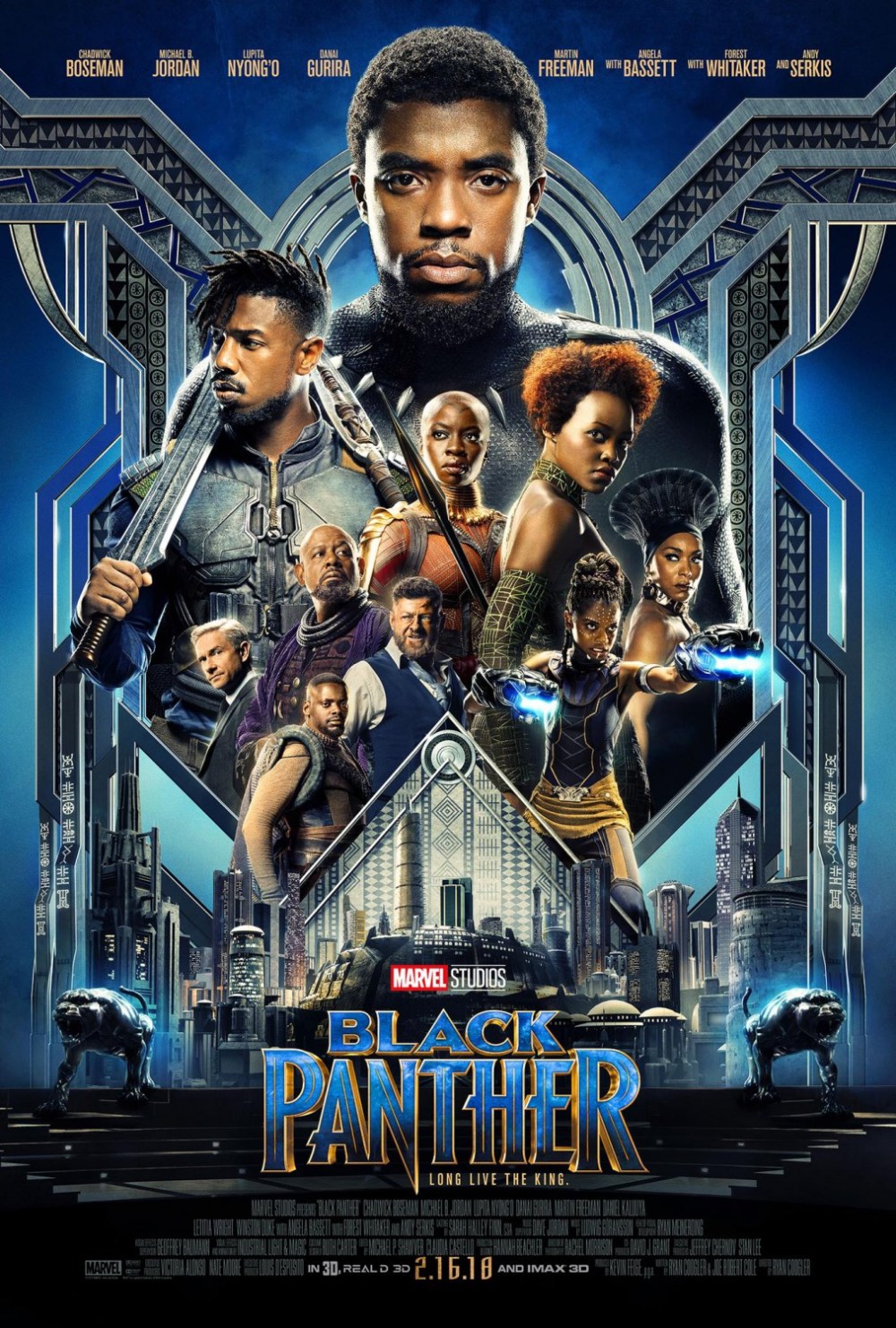
‘Black Panther’ Gives Us One of the Best Superheroes Yet

Black Panther poster

Complain all you want about the proliferation of superhero/comic book movies, the last year or so has given us some of the best. In 2017 we got “Logan” which saw Wolverine freed from his PG-13 shackles to where Hugh Jackman and James Mangold gave the “X-Men” character the sendoff he truly deserved. Then came “Wonder Woman” which not only filled our need for a female-led superhero movie, but also succeeded in putting the DC Extended Universe on the right track (of course, then “Justice League” arrived). And with “Thor: Ragnarok,” Marvel Studios allowed themselves to turn this particular franchise upside down and inside out, and what resulted was the most entertaining “Thor” movie yet.

Now it’s 2018 and we have “Black Panther.” You could say it provides audiences with the long overdue African-American-led superhero movie, but having watched it, this description is not entirely appropriate. T’Challa, the Black Panther of this movie, is a hero for everyone. Like Steve Rogers/Captain America, this is a character whose desire to do good in the world comes across with a powerful sincerity which no amount of cynicism can possibly take away. Along with confident direction, terrific performances and slam-bang action, “Black Panther” proves to be one of the best superhero/comic book movies ever made, a true high point in the Marvel Cinematic Universe, and one of the best movies of 2018.

As I write this review, “Black Panther” has been in general release for several weeks and has held the number one spot at the box office for as many times as James Cameron’s “Avatar” did. Clearly you have all seen it at least two or three times by now, so let’s not even bother with a plot description. Let’s just talk about what makes this particular Marvel Studios release so awesome.

Kudos to Ryan Coogler who has now graduated from low and medium-budgeted movies to full on Hollywood blockbusters with tremendous confidence. With “Fruitvale Station” he made us look at the life and tragic death of Oscar Grant in such a powerful way to where he can never be dismissed as a mere statistic. With “Creed” he brought a freshness and energy to the long running “Rocky” franchise which I never could have expected. Now with “Black Panther,” he has given us a movie which supersedes others of its genre to an outstanding degree as he combines the typical spectacle that comes with $200 million budget, and he combines it with a strong story filled with complex characters to where you cannot walk out of this one and say this was just an average motion picture.

Kudos to Chadwick Boseman for inhabiting T’Challa/Black Panther in a way to where there is no doubt he has the world’s best interests at heart, not just Wakanda’s. Through ferocity and feeling, Boseman makes T’Challa into a true hero for everyone and anyone. While this character has doubts about whether or not he is truly ready to be Wakanda’s king, something I have truly come to loathe about origin movies, Boseman never imbues him with the kind of hesitation which would easily destroy another. When the time comes to defend his people, he is most definitely up front and center.

Kudos to Michael B. Jordan for his performance as N’Jadaka / Erik “Killmonger” Stevens. N’Jadaka serves as the chief antagonist in “Black Panther,” but the character is not so much a villain as he is a victim. Jordan makes you see how N’Jadaka was wronged and of why his need for revenge is understandable if not condonable. This character was wronged and abandoned, so his bitterness at what was denied to him ends up feeling justified even when it poisons his soul. We root for N’Jadaka to fail, but we cannot help but feel empathy for him, and Jordan ends up creating a complex villain who can never be mistaken for some one-dimensional schmuck.

Kudos to every single actress in “Black Panther” as they give us badass Wakandans who refuse to run away from impending danger. Whether it’s Angela Bassett as Ramonda or Lupita Nyong’o as Nakia, they fill their characters with a strength and pride which can be wounded, but never easily broken. Special mention goes out to Danai Gurira who steals every scene she has as Okoye, a proud Wakandan who wears her pride on her face for all to see. If you threaten Okoye and she pulls a saber out on you, Gurira makes it clear you best start running in the other direction.

Kudos to Martin Freeman for making his character of CIA officer Everett K. Ross more than just mere comic relief. Even when we see him stumbling about in the midst of warriors who are prepared for conflict, Freeman allows Everett to evolve into a far more capable agent than he was at the movie’s beginning.

Kudos to Andy Serkis for his go for broke performance as gangster Ulysses Klaue. It’s a blast watching the “Planet of the Apes” actor smash through everything in his path. But even though he is not doing a motion capture performance here like he has done unforgettably in the past, he probably won’t snag an Oscar nomination for his work here anyway.

Kudos to Forest Whitaker for not just making Zuri a powerful religious and spiritual figure, but for also letting us see the cracks in the character’s façade when he reveals a burden he can never forgive himself for. Whether you see Zuri as “Black Panther’s” Yoda or Obi-Wan Kenobi, Whitaker lets us know right from the start no one could play Zuri better than he could.

Kudos to Daniel Kaluuya, currently riding high off of the tremendous success of “Get Out,” for making W’Kabi, T’Challa’s best friend, a vivid study of internal conflicts which are constantly pushed in different directions to where common sense can be thoughtlessly tossed aside.

Kudos to Winston Duke for making M’Baku into a ruthless warrior, but also one with a deep conscience. This character could have existed simply as a plot device for “Black Panther” to take advantage of when the going gets tough, but when T’Challa and his closest friends plead with M’Baku to join them in their battle of resistance, Duke makes the character’s eventual decision believable without ever seeming predictable or convoluted.

And kudos to all those filmmakers and artists behind the scenes who made Wakanda look so beautiful in “Black Panther.” Of all the places the Marvel Cinematic Universe has taken us to, this is the one I would like to visit the most. Wakanda forever? Damn straight!

Seriously, I cannot say enough great things about “Black Panther” as Coogler and company have made a film which was so well-thought out and put together. All the characters are complex and interesting, and what could have been just another superhero/comic book movie was elevated into something far more thrilling than I ever could have expected. But more importantly, “Black Panther” gives us a true superhero who everyone, and I mean everyone, can and should look up to. This, among other reasons, should explain why this movie has been such a box office behemoth since its release.

Even better, we won’t have to wait long to see this superhero again as he will appear in “Avengers: Infinity War” whose release is just around the corner.

* * * * out of * * * *

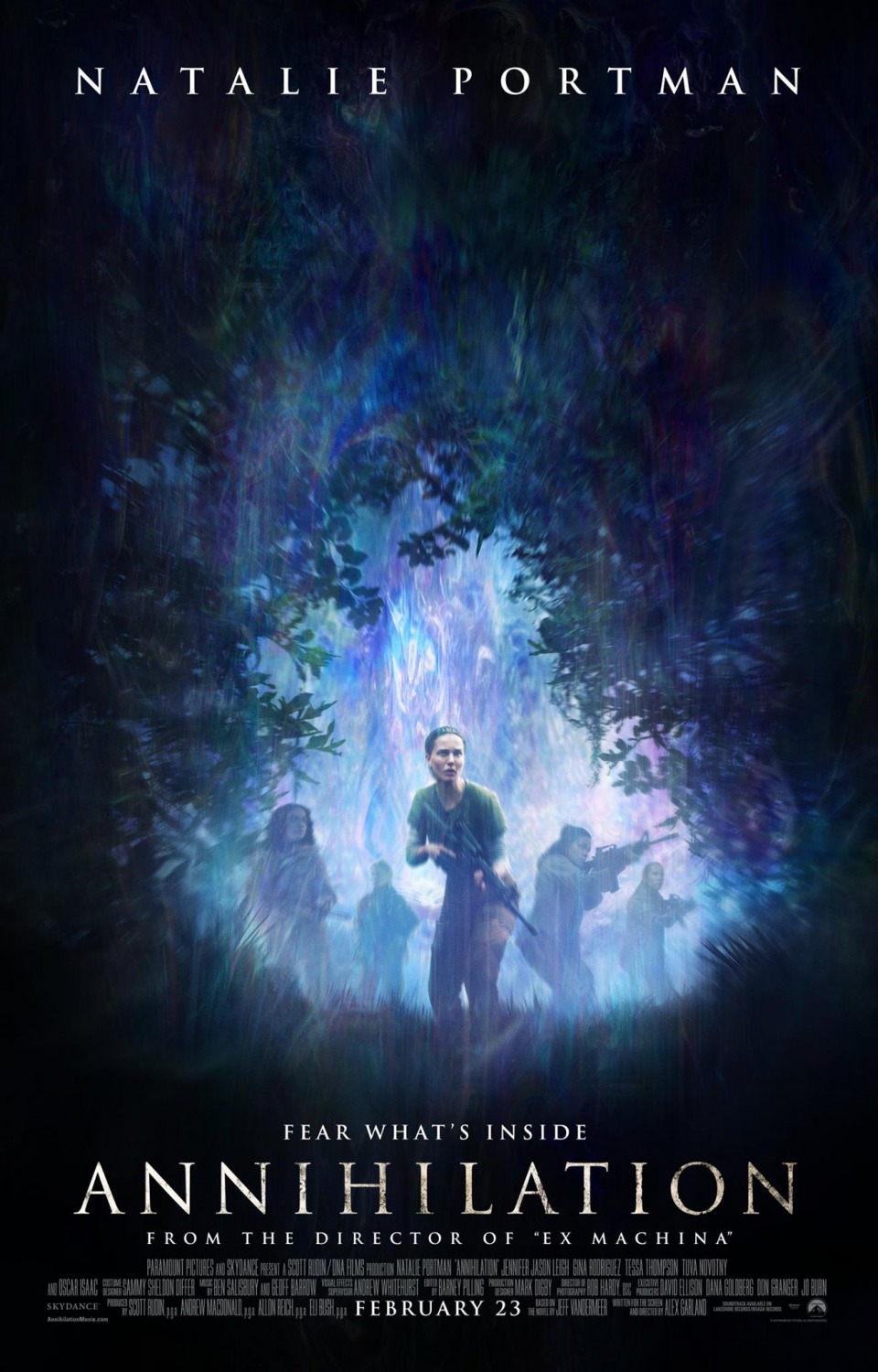
‘Annihilation’ is a Unique Sci-Fi Cinematic Experience

Annihilation movie poster

I have to give Paramount Pictures credit for taking risks in the past year or so on movies which defy what is considered these days to be mainstream entertainment. Last year, they released Darren Aronofsky’s “mother!,” a film which could in no way be mistaken for a comic book movie. Despite it earning a rare Cinemascore grade of an F, Paramount stood behind Aronofsky and his film defiantly, saying they were proud of the work he did. Keep in mind, the studio made this clear even after “mother!” suffered a weak opening at the box office, especially when compared to other movies starring Jennifer Lawrence.

Now in 2018, Paramount has released “Annihilation,” a science-fiction horror film which not only defies what many expect from Hollywood at the moment, but also proves impossibly hard to fit into any specific genre. This has led many to accuse Paramount of not giving the movie the proper promotion it deserved, but we will address this issue at another time. Whatever expectations you have for this cinematic experience, it would be best to leave them at the door as “Annihilation” deals with themes and situations other filmmakers have explored in the past, but this time they are handled in a way which feels truly fresh and not the least bit routine.

Natalie Portman stars as Lena, a biologist and former U.S. Army soldier who, as the movie starts, is in a depressed state as her husband, Army soldier Kane (Oscar Isaac), has been missing for a year, and many presume he has been killed in action. But suddenly, Kane reappears to Lena’s delight, but he resembles one of the pod people from Phillip Kaufman’s remake of “Invasion of the Body Snatchers” as he seems devoid of any emotion and cannot remember where he was. Before Lena can get a satisfactory answer regarding his whereabouts, Kane becomes very sick and is transported via ambulance to the hospital. As you can expect, military officials stop the ambulance, and it becomes clear Lena and Kane have stumbled across something those in power would prefer to keep under a heavy veil of secrecy.

“Annihilation” puts us right into Lena’s shoes as she desperately tries to understand the situation she has been thrust into. Finding herself at the United States’ government facility known as Area X, a name which implies a location always closed off to the general public, Lena is greeted by Dr. Ventress (Jennifer Jason Leigh), a psychologist who finally gives her some answers and introduces her to an area known as “the shimmer.” We see a meteor hit a lighthouse, and from there an electromagnetic field has developed and continues to spread at a rate to where it will eventually absorb everything in its path. Soldiers have been sent into “the shimmer” to better understand this phenomenon, but Kane is the only one who has come back from it alive.

Dr. Ventress ends up recruiting Lena and two other women to join her on the latest mission to enter “the shimmer,” a mission they have every reason to believe is a suicidal one. This is where “Annihilation” becomes particularly unique as these characters are not trying to be heroic but are instead dealing with their own self-destructive tendencies. Indeed, self-destruction is a big theme as these four women are revealed to be individuals deeply wounded by life in one way or another to where they feel as though there’s nothing much left to care about or live for. But as they get deeper into “the shimmer,” their survival instincts become awakened almost immediately.

“Annihilation” was written for the screen and directed by Alex Garland who started out as a novelist with his book “The Beach” which was made into a movie by Danny Boyle and starring Leonardo DiCaprio. Since then, he has graduated to writing screenplays for “28 Days Later,” “Sunshine,” “Never Let Me Go” and “Dredd.” In 2015, he made his directorial debut with “Ex Machina,” a brilliant science fiction thriller which dealt with the subject of artificial intelligence in a way which felt familiar and yet very fresh. Even if the story reminded me of “Frankenstein” in a way, the approach Garland took with the material and the characters felt invigorating and wonderfully unique.

Garland has brought this same kind of energy and enthusiasm to “Annihilation” as it follows a group of people caught in a situation much like the one in John Carpenter’s “The Thing” to where they are dealing with an antagonist who is not quite visible, and this leads them to become increasingly paranoid about one another. Garland does an excellent job of keeping the audience off-balance as he takes us through the story in a non-linear fashion. When Lena awakes in a tent inside “the shimmer,” she admits she has no idea how she got there or of what she experienced in the past few hours. Indeed, we end up feeling as lost as her as we are desperate to better understand the situation everyone has been sucked into, and Garland holds our attention throughout as a result.

Throughout, Garland gives us much to think about such as the differences between suicide and self-destruction as well as the importance and inherent danger of discovery. While watching “Annihilation,” I was reminded of a scene in “Jurassic Park” between John Hammond and Ian Malcolm. Hammond doesn’t understand why anyone would stand in the way of discovery, but Malcolm leaves him with this to chew on:

“What’s so great about discovery? It’s a violent, penetrative act that scars what it explores. What you call discovery, I call the rape of the natural world.”

But while Garland has crafted “Annihilation” as the thinking person’s sci-fi movie, it is not at all lacking in the thrill department. Certain scenes have a visceral feel to where I jumped out of my seat for the first time in ages. On a visual level, it has a look which is as beautiful as it is haunting, and I am having a hard time comparing it to other movies I have seen recently. On top of this, “Annihilation” features a very unique sonic landscape courtesy of composers Ben Salisbury and Geoff Barrow, both of whom combine an earthly sound with an electronic one as they work to separate the real world these characters have left behind and the alien realm they have dared themselves to enter.

Natalie Portman has a tricky role to play here. As Lena, she has to be vulnerable but also exhibit a reserve of strength deeply embedded in a character who has served her time in the military. That Portman manages to pull this off is not the least bit surprising, and she gives us a fully formed character whose experience and pain aid her in the movie’s spellbinding climax. Many still can’t shake the squeaky-clean image they have of Portman, but she has been around long enough to remind audiences of the amazing depth and range she has as an actress.

It’s great to see Jennifer Jason Leigh here as well, let alone in any movie she appears in. As Dr. Ventress, she creates a truly enigmatic character who keeps her emotion in check to where you constantly wonder what is going on in her head. Clearly, this doctor has more interests than in just exploring “the shimmer,” and Leigh keeps you guessing what they are all the way to the end.

I also have to give credit to Gina Rodriguez, Tessa Thompson and Tuva Novotny for creating such memorable characters out of those which, in any other movie, could have been of the easily disposable variety. Some characters exist solely to further the actions of the lead protagonist or serve as mere fodder for an ever so lethal antagonist, but these actresses make theirs stand out in a way they would not have otherwise, and their final onscreen moments are hard to shake once you have witnessed them.

And when it comes to Oscar Isaac, you can always count on him to give an infinitely charismatic performance even in a role where the character looks to have been drained of all emotion. Telling you more about his character of Kane would be detrimental to your viewing experience, but once you watch him here, you will agree he has created a fascinating portrait of a man who once knew his place in the world, but who now is forever lost in it.

It has now been a few days since I have watched “Annihilation,” and I still find myself thinking about the movie quite intensely. Even if its pace lags a little more than it should, the questions it left me with remain endlessly fascinating. When we see Lena reading “The Immortal Life of Henrietta Lacks,” is that a hint of some kind? What led Garland to include the Crosby, Stills & Nash song “Hopelessly Hoping” here? And more importantly, is the movie’s ending a hopeful one, or is it meant to be relentlessly bleak? Garland is not out to give us easy answers, but my hope is you will be open to the unusual experience this movie has to offer. Cinemascore may have given it an average grade of a C, but please remember this is the same research group which gave “America: Imagine the World Without Her” an A+.

Trust me, check this one out, and be sure to come into it with an open mind.

* * * ½ out of * * * *


‘The Imitation Game’ Presents Alan Turing to a New Generation

The Imitation Game poster

Movies “based on a true story” keep coming at us like Election Day fliers in the mail, but “The Imitation Game” is one of the few that actually deserves our full attention. It portrays the life and work of Alan Turing, one of Britain’s most extraordinary heroes, whose efforts and accomplishments remained unsung for far too long. At the same time, it is a movie about secrets; how we keep them, the importance of keeping them and of the damage they can do when uncovered by others. What starts off as a typical biopic becomes something much more as we watch how Turing and his crew of code breakers helped bring an end to World War II, and of how his life came to a tragic end through needless and unwarranted intolerance.

When it came to finding the right actor to portray Alan Turing, the filmmakers could not have found one better than Benedict Cumberbatch. While other actors would have made the mistake of portraying Turing as some kind of Dr. House clone, Cumberbatch turns him into a fascinatingly complex human being who is brilliant, socially awkward, and very vulnerable in a time where being vulnerable could be a huge liability.

For those who don’t know, Turing was a brilliant mathematician and cryptanalyst who worked at Bletchley Park, the top-secret Government Code and Cypher School during World War II, where he created a machine which succeeded in breaking Germany’s seemingly unbreakable Enigma machine. Cumberbatch makes it clear just how incredibly smart Turing is during his first meeting with naval commander Alastair Denniston (Charles Dance) as he turns a hopelessly bad job interview into an unforgettable demonstration of his deduction skills.

What I loved about Cumberbatch’s performance is how he makes Turing curt with people in a way which is arrogant but not necessarily mean. It’s no surprise his fellow co-workers have a tough time warming up to him as he is determined to do things his way and has little time for anybody who doesn’t think as fast as he does. But part of the fun is watching Cumberbatch take Turing from being an anti-social human being to one who is genuinely eager to involve the rest of his crew in breaking Enigma.

One of the colleagues who came to be a big help to Turing is Joan Clarke, a Cambridge mathematics graduate played by Keira Knightley. Her entrance in the movie is great as the other men consider her to be in town only to apply for secretarial work, but Knightley makes Clarke into a very confident character who is more than ready to prove her worth in a male dominated environment. She also becomes one of Turing’s best friends through thick and thin as she helps ease him into social gatherings and become one of the guys instead of such an isolated individual. Even as Turing’s life heads down the tubes, Clarke is still there for him as she understands him in a way few others do.

I figured “The Imitation Game” would climax with Turing’s machine breaking Enigma, and the sequence where Turing and the others succeed in doing so is intensely exciting. But in a sense, it marks the beginning of the end for this group as they come to discover how the secrets they have uncovered lead to other secrets being made and kept for the good of the people. There’s even a scene where Turing’s crew discovers when a cargo ship is going to be attacked, and they debate on whether or not they will stop it as doing so risks undoing all the work they have accomplished. I love it when dramatic movies provide characters with such difficult dilemmas to solve, and this film comes with some of the most agonizing.

Again, this is a movie about secrets, and it becomes fascinating to see how the keeping of these secrets comes to deeply affect each character. True identities are revealed and compromised, and while certain secrets are kept in the dark to give England an advantage in the war, others secrets come to destroy those who had the misfortune of living in a time where certain behaviors and orientations were criminalized. Turing is the one who suffers the most as his private life is revealed to the world which forces him to face an utterly cruel and unnecessary punishment.

“The Imitation Game” was directed by Norwegian filmmaker Morten Tyldum whose previous works include “Headhunters,” “Fallen Angels” and “Buddy,” and he also directed “Passengers” starring Jennifer Lawrence and Chris Pratt. Tyldum has done an excellent job in transporting us back to the days of World War II in a way which feels unique and not overly familiar. His emphasis is on the characters just as it should be, and he succeeds in making this not just another traditional biopic. He pays great respect to Turing throughout as this is a man who made a huge difference not just in World War II but also in the development of future technologies we have become far too dependent on these days.

Cumberbatch has long since proved how great an actor he is with his work on the London Stage and on “Sherlock,” and he was prominently featured in “The Hobbit: The Desolation of Smaug” and “Star Trek into Darkness.” In “The Imitation Game,” he takes us on quite the emotional ride as we see him triumph in what he does best and suffer horribly in a time where he doesn’t quite belong. He makes you feel Turing’s pain as it is reduced to a shell of what he once was, and the scene where he is unable to even start a crossword puzzle is devastating to witness.

But Cumberbatch isn’t the whole show here as he is surrounded by a wonderful group of actors who are every bit as good. Keira Knightley does some of her best work yet as Joan Clarke, the woman who comes to understand Turing the best. Matthew Goode, so unnerving a presence in “Stoker,” is the epitome of perfect casting as Hugh Alexander; the chess champion and man about town we would all like to be in our everyday lives. Mark Strong makes Major General Stewart Menzies a deeply enigmatic (no pun intended) character who knows far more than he ever lets on. And then there’s Rory Kinnear who portrays Detective Robert Nock, the man who investigates Turing and becomes very eager to keep his life from being ruined. Kinnear is very strong as he shows us the detective’s inner conflict in convicting a man who is truly responsible for saving many lives.

Turing ended up taking his own life at the young age of 43, and it is only in recent years that he has people have acknowledged the terrible treatment he received. In August 2009, John Graham-Cumming started a petition urging the British Government to apologize for Turing’s prosecution, and then Prime Minister Gordon Brown acknowledged and described Turing’s treatment as “appalling.” A few years later, Turing received a pardon from the Queen under the Royal Prerogative of Mercy, but many are still waiting for an apology over the way he was treated chemically. This man was responsible for helping to end the Second World War, and while he was alive he was treated with derision more than respect by many. Thanks to “The Imitation Game,” people will now see the kind of person Turing really was and why he deserves to be seen and celebrated as a hero. Believe it or not, his creation of his machine became the prototype for what we today call computers.

This is a terrific film.

* * * * out of * * * *

‘Inverse’ is an Infinitely Thoughtful and Riveting Sci-Fi Movie

Inverse movie poster

When it comes to mind-bending science fiction movies, I have gotten into the habit of trying to stay ahead of the filmmakers to see if I can guess where the story is heading and how it’s going to end. “The Sixth Sense” among other movies got me good, but now I want to beat directors at their own game. I don’t know, maybe I’m just sick of people playing with my head. But with Matt Duggan’s “Inverse,” it really helps not to second guess the filmmaker or attempt to stay ahead of him. Just when you think you know where this movie is heading, it becomes something else and goes out of its way to defy your expectations. What I thought was going to be something along the lines of “Starman” or maybe even “The Terminator” proved to be quite different, and it was in my best interest to just watch it and take everything in.

“Inverse” opens on a small picturesque house in a suburban neighborhood where we see a naked man (played by Josh Wingate) emerging from a swimming pool with no idea of who he is. Once he steps inside the house, he finds pictures of himself and discovers his name is Max, a man who actually died some time ago. His appearance causes quite a shock for his wife and other relatives who come into contact with him, but he can’t seem to remember who they are. Then Max is met by a man named Batter (Morlan Higgins) who informs him he is actually from a parallel universe and has been travelling back and forth between universes to where his brain has been almost completely fried. As Max begins to realize who he really is, he comes face to face with people who want to learn all they can about the universe he is from, and this ends up putting him in grave danger.

Like I said, “Inverse” is not a movie you want to try to get ahead of. Duggan unveils the different layers of the movie’s story to where it truly helps to pay close attention. It invites repeat viewings so you can get deeper into the story and discover new things. The first time you watch it will give you a visceral feeling as Duggan puts you right into Max’s shoes as he desperately tries to discover why he’s here, and you feel his insatiable need to get to the truth before he reaches an unfortunate end.

The other thing which intrigued me about “Inverse” is it’s not your typical good guy/bad guy story. There are no heroes to be found here as everyone has a price to pay for the actions they end up committing. Not even Max is safe as he comes to discover the damage he has incurred during his various travels, and there is really only one person here who hasn’t done anything wrong, and yet this person still gets harmed inadvertently. I leave it to you, the viewer, to figure out who this character is.

“Inverse” meditates on what it might be like to live in a universe where the level of intelligence is much higher than our own. It would certainly be nice to use more than 20% of our brains, so the appeal of certain characters wanting to discover the secrets of this other universe is very understandable. The movie also shows how the quest for higher intelligence can be an obsessive one, and it gets to where we realize there is only so much we should be allowed to discover as it may lead to our undoing.

The cast is all around excellent, and hopefully we will get to see more from them in the future. Wingate carries the weight of this movie on his shoulders as we stay with him from the first scene to the last. It’s almost exhausting to watch him here as he is forced to exhibit a wide range of emotions, and he succeeds in making you feel all of them.

There’s also a great supporting performance from Morlan Higgins as Batter, a character who serves as Max’s conscience throughout the film. We watch as Batter explains to Max how he got to where he is now, and in the process of trying to do the right thing, Batter ends up imprisoning himself into a mental cage which offers no easy escape. Higgins is actually one of the most well-known actors on the Los Angeles theatre scene, and he proves to be the kind who inhabits a character more than he plays one. You never catch him acting, and this is one of the joys of watching his performance here.

In addition, you have strong turns from John Burish as Tommy, Max’s brother, who is put in a difficult situation of putting a close family member in harm’s way in order to get at the truth of what’s going on. There’s also Alanna Priere and Michele Lawrence who play the women in Max’s life who are not all they appear to be. To say more about their characters would be giving too much away, so I’ll leave you to see how they fit into this story.

But the best performance in “Inverse” belongs to Chris Pauley who ends up playing two roles here. The most notable role of the two is Bert, a man who knows who Max really is and where he’s from. Pauley is utterly riveting every moment he appears onscreen as he interrogates Max through various methods, one of which includes him rocking out to some techno music for no easily discernable reason. You never know what Pauley is going to do next, and you can’t take your eyes off him for a single second.

“Inverse” was made on a very low budget, and Duggan makes the most of it. In the end, this is a sci-fi movie which thrives more on ideas than on spectacle. Even if the pace drags a little, Duggan holds your attention throughout as the effects of Max’s actions become all the clearer toward the movie’s conclusion. Credit should also be given to the movie’s producers, Stephanie Bell and Trevor Boelter, for seeing it all the way to its completion. Like a lot of low budget movies, this one had a very long journey to the silver screen, and it proves to be worth the wait.

Rumor has it Duggan wants to make a trilogy of movies starting with “Inverse,” and it would be very interesting to see where Max’s adventures will go from here. This is a movie which is coming way, way, way beneath the radar, and it deserves a big audience. Here’s hoping we eventually see a sequel to it.

* * * ½ out of * * * *

“Inverse” is now available to stream on Amazon Prime. If you are already a member, you can stream it for free.