‘Vicky Cristina Barcelona’ Challenges Our Views on Love and Romance

Vicky Cristina Barcelona movie poster

WRITER’S NOTE: This review was written back in 2008.

Vicky Cristina Barcelona” is easily the best Woody Allen movie I have seen in a long time. There is no shaky camera work to induce nausea here, and the story is never boring for one second. There is also none of those Woody Allen-isms we are all so tired of, probably because Allen himself chose not to act in this movie. Instead, he gives us a great cast of actors to bring his material to life, and he sets his story in the beautiful country of Spain. With cinematographer Javier Aguirresarobe, he makes the different areas of Spain so inviting to where you just want to jump on a plane and fly over there right now. If only plane tickets weren’t so damn expensive. Oh yeah, I have a job too. Damn!

The movie starts off by introducing us to Vicky (Rebecca Hall), a graduate student who is engaged to be married, and Cristina (Scarlett Johansson), a woman who just filmed a short feature and recently broke up with her boyfriend. They are best friends who take a vacation to Spain, and they agree on just about everything except when it comes to love. Whereas Vicky is reserved in the ways of love, Cristina is impulsive and spontaneous. While Vicky seems sure of what she wants, Cristina is unsure of what she wants from a lover or from life. The ways of these two women are put to test when they meet Spanish artist Juan Antonio (Javier Bardem). Juan casually comes up to them while at a restaurant and offers to take the two to Oviedo in the next hour where he says they will have great fun, drink fine wine and eventually make love. Cristina is all for going, but Vicky wants nothing of it due to her impending marriage. But of course, she goes to keep Cristina company. What happens from there will or will not change the way they feel about love in general.

Into this mix comes Juan Antonio’s ex-wife, Maria Elena (Penelope Cruz), who wishes she knew how to quit her ex-husband. Maria comes back into Juan’s life after Cristina has moved in with him, and she is unstable to say the least. From there, who knows what will happen. This is what I really liked about the “Vicky Cristina Barcelona;” It was very absorbing, and I had no idea what was going to happen next. I can’t say this about most movies I see these days.

Like I said, the cast is superb. I wish I had the power over women Bardem has over the female characters here. This is quite a switch from his Academy Award winning role as Anton Chigurh in “No Country for Old Men,” and this movie affords him a better haircut as well. Bardem succeeds in showing you how passionate his character is, and how unfulfilled his passion is.

Scarlett Johansson, Allen’s muse at the moment judging from the number of movies they have done together so far, is excellent as usual. Johansson plays an adventurous person who throws caution to the wind, but the actress also allows us to see the vulnerable side of Cristina which reveals her to be insecure as she has no idea of what she really wants out of life.

The most underrated performance of this movie, however, belongs to Rebecca Hall, whose dalliance with Juan Antonio creates conflicted feelings within her character which come across so clearly without her saying a word. Hall’s face does a lot of the acting for her while her words betray what Vicky thinks about what her heart truly desires. She has a loving fiancée, but he is nowhere as romantic as Juan. Of course, who would be? One important lesson for prospective husbands to be; make sure your fiancés don’t meet up with any Spanish men because you will never be able to compete with them. This will especially be the case if you are a banker.

But leave it to the Spanish actors to steal this movie away from everyone else. We already talked about how great Bardem is, but let’s talk about the passionate fireball that is Penelope Cruz. For years, she was stuck in American movies which dealt more with her looks more than her talent. Plus, she was constantly being accused of messing up relationships with married movie stars which was unfair to say the least. Ever since abandoning those movies, her talent has shined brightly in acclaimed films like “Volver.” Cruz is an uncontainable force in this movie, and she takes her characters from highs and lows which feel very believable and never overdone. The relationship between her and Bardem in this movie is easily the most complicated and most infuriating for them both. As Juan correctly points out, “We are meant for each other, and we are not meant for each other.”

The theme of the movie is love and what it does to us when we go after it, and of what it does to us after we think we have it. The one thing these characters have in common is the search for true love feels like a never-ending journey for them, and that’s even if you are with the person you love. It’s a beast which seems far more likely to hurt people instead of making them happy. There are a lot of thoughts here on love which makes “Vicky Cristina Barcelona” one of the more thought-provoking movies I have seen so far in 2008. There is a lot of comedy to be found here, but the movie is mostly a sad story of how love seems to be just out of our grasp. Even if you have the love you need in life, there is always something missing.

What I really loved about the comedy here is how none of the actors ever try to play the joke or attempt to be funny. The humor comes out of the absurd way the characters interact with each other. There is a brilliant moment where Maria tells Cristina how she had to go through her suitcase because she didn’t trust Cristina and that she wanted to know more about who is making out with her ex-husband. The scene is played in all seriousness, even when Cruz talks about how she has thoughts of killing Johansson, and it is hysterical.

“Vicky Cristina Barcelona” is a very unusual Woody Allen movie. While it deals with themes which are very familiar to ones he has dealt with in the past, it does not feel like your typical Woody Allen movie. That is a major plus because most of his movies have an overwhelming feeling of familiarity which threatens to take away from the proceedings. But by putting his thematic material in another country with a terrific cast, this is one of those movies which reminds you Allen can still pull off a great movie worth seeing. For once, I am eager to see what he will do next. He’ll probably go through the regular ups and downs, but he has clearly learned some hard lessons from the movies he did back in the 1990’s.
* * * * out of * * * *

‘The Reader’ Features a Brilliant and Galvanizing Performance from Kate Winslet

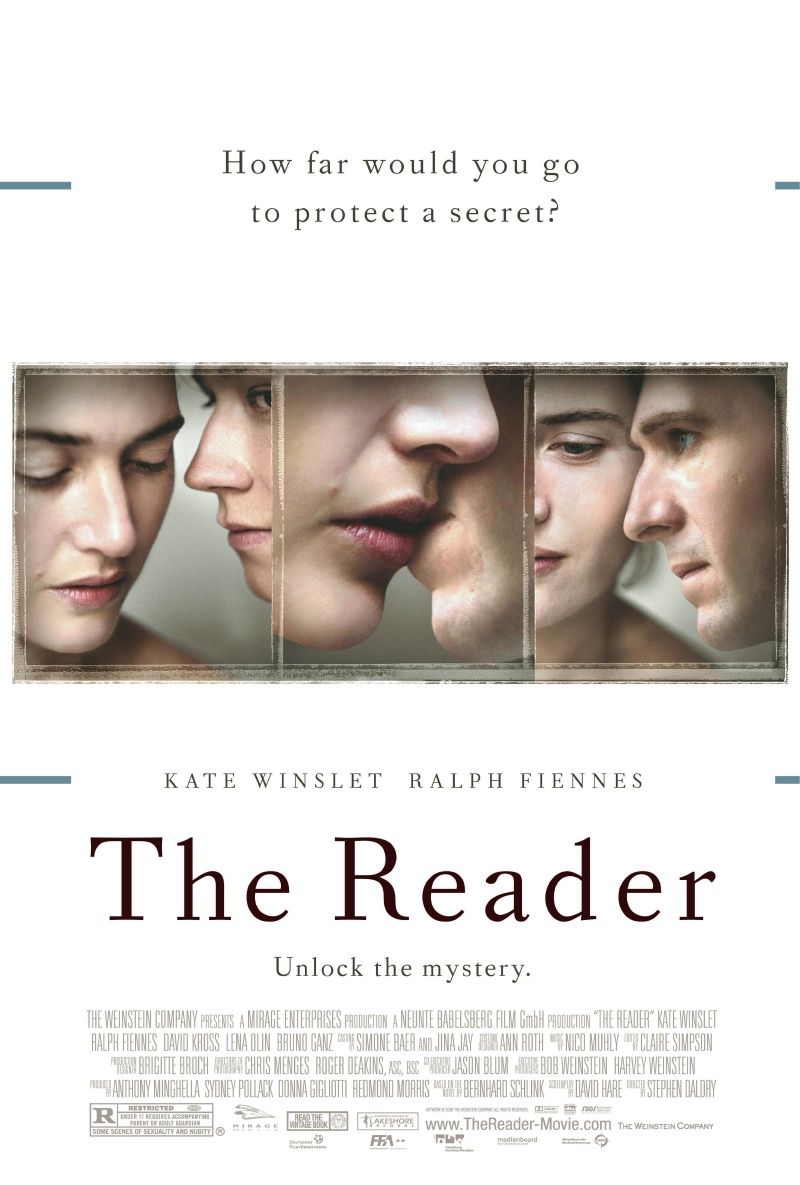
The Reader movie poster

WRITER’S NOTE: This review was written back in 2008.

The Reader” has been getting mixed reviews, and I can’t understand why. I was expecting a good movie with great performances when I went in to see it, but I ended up getting a lot more than that. My father was with me when I saw the movie, and he confirmed it was astonishingly faithful to the book it was based on. Indeed, “The Reader” is an emotionally devastating journey through the beginning of an affair between a young student and an older woman, and of the aftermath it lays on both of them. Every single performance here is extraordinary, particularly the one given by Kate Winslet. If she does indeed get nominated for this movie or “Revolutionary Road,” she will certainly deserve the Oscar this time around.

Winslet plays Hanna Schmitz who works as a ticket taker for the local trains going in and out of the town, and she encounters young Michael Berg (David Kross) who is sick and depressed. She takes care of him and even walks him home. Michael later returns to where she lives to thank her for what she did, and from there the two have a secret affair which involves both sex and reading. Hanna asks Michael to read to her before they make love, and he does so with tremendous enthusiasm to say the least. This deepens their relationship even while it remains a secret between the two of them, and it lasts for several months.

Part of the movie’s success in affecting you may depend on how much of yourself you see in the character of Michael Berg. Many of us would not like to remember ourselves as ever being weak, but something deep in our subconscious would certainly have entertained the idea of having an affair with an older woman, let alone Kate Winslet. As a teenager, your hormones are jumping up and down on an ever-expanding trampoline in the realm of puberty, so thinking about something other than girls will be a bit challenging. All the same, common sense might kick in somewhere which can, and should, stop us from being involved in such a relationship.

In many ways, “The Reader” is an argument against this kind of a relationship as this one elicits even more heartache, confusion, and emotional scars which can last a lifetime. They say the first love is always the hardest because of the eventual break up which hurts like a son of a bitch. Clearly, there are not many break ups or separations which can hurt as much as the one experienced by Michael and Hanna.

2008 may be remembered as the year of Batman, the late Heath Ledger, Robert Downey Jr. and many other things. I do hope it is also known as the year of Winslet. On top of “The Reader,” she also has “Revolutionary Road” coming up which is directed by her husband Sam Mendes. She needn’t have been nominated for an Oscar five times already to convince us of what a superb actress she is. Winslet manages to do many things I cannot see another actress doing as effectively, and she superbly handles the aging of her character without overdoing it or falling into some caricature of an elderly person we may have preconceptions of. Winslet immerses herself into this role ever so fearlessly, and she gives us one of the most compelling and emotionally devastating performances of the year.

Winslet also does something which at first would seem unthinkable and horrifying; she gives a human face to the SS officers who were later prosecuted for their role in the murder of millions of Jews during the Holocaust. From a distance, we would simply shout down at these people because of the horrible things they have done. Winslet wisely does not make us sympathize with what her character has been through, but she makes us see Hanna’s pain throughout the trial as she is caught up in a situation she does not entirely understand. This later leads to a revelation about her which I will not reveal as it will destroy the mystery of her character for the audience this movie deserves. But this secret is something Hanna feels much more ashamed of than her role as an SS officer.

It also brings up an interesting point worth dwelling on. These officers are being prosecuted for their role in the worst kind of atrocity, and probably rightly so. I say probably because in the end, these are just soldiers who were ordered to do their jobs by a genocidal maniac named Adolf Hitler. As history shows, the hierarchy of an evil or highly immoral regime seems to get off somewhat easier than the soldiers whom, whether we agree with their actions or not, were simply doing the job they were commanded to do. For them to simply not do their duties would have led to their deaths by a simple bullet in the head. Obviously, the atrocity of the Holocaust brought on a strong need for revenge in its aftermath, and prosecutors went after perhaps the only ones who could be easily prosecuted as Hitler killed himself before he could ever be captured. While I watched the movie, my dad leaned over to me and said, “Just remember this when they prosecute those soldiers from Abu Ghraib and not Donald Rumsfeld.”

As much as “The Reader” may seem like the Kate Winslet show, there are many other performances to admire other than hers. The one performance which might come across as the most underrated is the one given by David Kross as the young Michael Berg. Throughout all the scenes he has with Kate, he more than holds his own with her as he conveys the hell of an emotional turmoil he goes through both as a teenager, and later as an adult. In retrospect, Kross has the hardest role in the movie as he has to convey many things about his character without saying a word. We know why Michael is going through so many conflicting emotions, but the characters around him don’t know this. Furthermore, they cannot know as this would implicate Michael in a situation he will not ever be able to escape from. I have not heard of Kross before this movie, and I am interested to see how he got the role as his performance is nothing short of astonishing.

And of course, we have the great Ralph Fiennes as the adult Michael Berg, and he conveys how the character never moved on fully from the affair he had so many years ago. Fiennes portrays him as a man who knows he is more emotionally distant from people than anyone should be, and he is aided by Kross’ performance as we see why this is the case.

Director Stephen Daldry previously directed the film adaptation of “The Hours” with Nicole Kidman, Meryl Streep and Julianne Moore. Along with “The Reader,” he seems to be working with a recurring theme of women caught up in a world they are desperate to escape from. Even if such an escape lasts only a brief moment, they are caught up in a world not necessarily of their own making, and it threatens to kill their soul completely. Daldry certainly isn’t afraid to venture into emotionally charged material, or of material many will simply view as depressing.

“The Reader” is pretty certain at this point to have a place on my list of the best movies of 2008, and not just for the brilliant performance given by Kate Winslet.

* * * * out of * * * *

‘The Darkest Minds’ is the Same Old Young Adult Song and Dance

DarkestMinds_VerB_Poster_rgb

I went into “The Darkest Minds” thinking it was a “X-Men” spinoff. It deals with kids who have been ostracized from society once they are revealed to have obtained superpowers under mysterious circumstances, and it is being distributed by 20th Century Fox which also distributes the “X-Men” movies. With this in mind, I kept waiting for the main characters to yell out “mutant freedom” as loudly as those teenagers from “Red Dawn” cried out “Wolverines!” at any given opportunity. Lord knows the “X-Men” franchise shows no signs of slowing down even after the dramatic conclusion of “Logan.”

Well, it turns out “The Darkest Minds” is not an “X-Men” movie, but instead another adaptation of a best-selling young adult novel which takes place in an apocalyptic future. Written by Alexandra Bracken, this novel led to a series of others, so clearly Hollywood has set its sights on another potential franchise. But while “The Darkest Minds” might have seemed enthralling on the page, it comes off as just another young adult adventure on the silver screen. After the burnout of the “Divergent” franchise, I figured Hollywood would have finally tired of taping into the young adult book market, but these movies do still represent an a strong opportunity for studios to reach out to most desirable of demographics.

Once again, we are thrust into a dystopian future where the pandemic I.A.A.N. (Idiopathic Adolescent Acute Neurodegeneration) has killed 98% of humans under the age of 20. The rest who have survived develop amazing psychic powers under mysterious circumstances, and we all know how quick the world is to react to those people who are different. These children are quickly rounded up and sent to internment camps where they are separated from their families and identified by colors. And yes, there is a President of the United States (played by Bradley Whitford) determined to find a cure for this epidemic, but it is no surprise to see him flaunting a phony child reform program which those brainwashed my certain news channels are quick to believe in. Sound familiar? I mean, heaven forbid “The Darkest Minds” reflect today’s reality in any way, shape or form, you know?

Among these children is Ruby Daly (Amandla Stenberg), a young girl who accidentally erased her existence from the minds of her parents. On a scale, which looks a lot like the Homeland Security Advisory System, she is listed as an orange which classifies her as the most dangerous of the kids afflicted with psychic powers. But thanks to her mental powers which help her perform a mind trick much like the kind Obi-Wan Kenobi performed in “Star Wars,” she is able to escape the mandatory execution her kind gets. But even she knows it is only a matter of time before she is found out.

For a time, I thought “The Darkest Minds” would become the most politically subversive movie since “They Live,” but it eventually devolves into just another young adult adventure which is like so many we have seen previously. It features a strong and demographically desirable female character who looks to be the one to save humanity and/or dominate society in a way those in power are eager to take advantage of, and the story ends on a cliffhanger as the studio is unsurprisingly eager to make a sequel. But watching this movie reminded me of a little tidbit I read in Premiere Magazine back when it was in print as it summed up another potential franchise in a short sentence:

“’Remo Williams: The Adventure Begins…’ and ends.”

Ruby manages to escape the camp with the help of the kindly Doctor Cate Connor (Mandy Moore), but when she feels Cate may have other plans in mind for her, she flees and meets up with a group of kids who have also been afflicted with psychic powers and are just as demographically desirable. This group includes the rugged Liam Stewart (Harris Dickinson), the highly intelligent Chubs (Skylan Brooks), and the electrifying Zu (Miya Cech) who has since been rendered mute. As you can expect, Ruby and Liam get the hots for one another, and its hard not to laugh at the romantic scenes they have as their dialogue threatens to be as awkward as what Hayden Christensen and Natalie Portman were forced to utter in “Star Wars: Episode II – Attack of the Clones.”

Everything in “The Darkest Minds” feels like it was borrowed from some other movie. The kids discover a radio signal alerting them to a haven for I.A.A.N. kids, and it seems stolen from a similar scene in “28 Days Later.” The dance scene where Ruby and Liam get a little more intimate kept reminding me of the giant rave scene from “The Matrix Reloaded,” and not in a good way. Ruby’s ability to erase memories from the minds of others feels like a direct steal from “Superman II” as Clark Kent found a way to cure Lois Lane of her heartbreak. I know Hollywood movies are seriously lacking in originality these days, so this one ends up looking extremely desperate for ideas as a result.

When the kids get to use their mysteriously acquired powers, their eyes light up a certain color, and I kept waiting for Eric Carmen’s “Hungry Eyes” to start playing on the soundtrack. As for the powers they possess, I was not particularly impressed with them as they are much like the kind in every “X-Men” movie. I do have to say, however, that Zu doe a more impressive job of channeling electricity than Jamie Foxx ever did in “The Amazing Spider-Man 2.

But perhaps the most damaging aspect of “The Darkest Minds” is the endless number of plot holes which the dinosaurs from “Jurassic World: Fallen Kingdom” could have been quick to escape through. In a time where kids are being hunted by the government, how did Ruby and her friends manage to acquire a hotel room? When the kids invade a mall which has been abandoned for some time, how could they possibly find a new and unexpired bottle of Vitamin Water in it? And when the main characters arrive at a haven for kids of their kind and discover the person who leads it, shouldn’t this have raised their suspicions almost immediately? It is questions like these which make this young adult adventure unbearable at times to sit through.

For what it’s worth, “The Darkest Minds” fares better than some of the other young adult adventures I have seen in recent years. It proved to be more entertaining and memorable than “The 5th Wave,” and I was more interested in checking this one out than I was in watching any of “The Maze Runner” movies. Amandla Stenberg does give a very strong performance as Ruby, and she makes us invest fully in her character’s endless conflicts and dilemmas. It was also great to see Gwendoline Christie show up as Lady Jane, a bounty hunter of superpowered teens. Her character is essentially Captain Phasma from “Star Wars: The Force Awakens” and “The Last Jedi,” but without the helmet. Christie is a thrilling presence here, and that’s even though she disappears from the movie far too soon.

“The Darkest Minds” ends up traveling down a cinematic path which has been trodden on more often than not, and what results is a motion picture which is coming out five years later than it should. Even its target audience must be worn out from these different variations of the same story as nothing new is brought to the table. Despite the efforts of the filmmakers, this young adult adventure is inescapably ordinary, and I don’t think we will be seeing a follow up to it in the near future.

However, I do have to take the time to award Wade Williams with the John P. Ryan award for overacting in a motion picture. As the brutal military leader called The Captain, he chews the scenery with his endless snarling at others, and I could not help but laugh hysterically. Clearly this is not going to go down as his best work, but here he was never less than entertaining.

* * out of * * * *

‘Winnie the Pooh’ Has Eeyore Stealing the Show

Winnie the Pooh 2011 movie poster

WRITER’S NOTE: This review was back in 2011 when the movie was released.

You know what? I was looking forward to this one more than “Harry Potter and the Deathly Hallows, Part 2.” Granted, I saw the latter first, but anyone who knows me best will more than understand why I was in a hurry to watch this Disney animated film: I am a die-hard Eeyore fan! I got my first Eeyore plush toy before the start of the 5th grade, and I’ve lost track of how many I have collected since. My extraordinary niece told her friends I have over 3,000, but I beg to differ. To see him play such a pivotal part in “Winnie the Pooh” was a huge delight for me after seeing him get reduced to a mere supporting role in “Pooh’s Heffalump Movie.”

Oh yeah, I should talk about the rest of the film as well. That “silly old bear” once again headlines the proceedings as his grumbling tummy develops a mind of its own due to his endless addiction to honey. Sure enough, there are beehives nearby with a wealth of honey, but the bees are understandably protective of their export. Then there’s the case of Eeyore’s missing tail that has everyone giving him another which, to put it mildly, doesn’t exactly compare to the original. To cap it all off, this classic gang mistakenly believes Christopher Robin has been kidnapped by an evil monster known as the Backson (see the movie and you’ll understand).

For some reason, watching Pooh hurriedly pursuing the delicious and sticky substance known as honey kept reminding me of Darren Aronofsky’s “Requiem for a Dream” with its characters becoming increasingly desperate for whatever their minds craved more than their bodies, but that’s just me. I somehow doubt the animators at Walt Disney had any intention of making a G-rated movie to remind you of one of the most seriously disturbing films ever made.

“Winnie the Pooh” brings the 100 Acre Wood back to the traditional realm of hand drawn animation which is something of a rarity these days. While the characters might have looked fantastic with computer animation a la Pixar, doing things the old-fashioned way was the right choice. The “Winnie the Pooh” films and shorts have been long since relegated to the Disney channel and direct to DVD realm, and this brought about a drop in quality its most devoted films could not ignore. But seeing Pooh and company on the big screen is a terrific reminder of why we grew up loving these characters in the first place.

Jim Cummings once again provides the voice for Pooh and Tigger, and he captures the distinctive voices of each character perfectly. Travis Oates gets the innocent stuttering of Piglet down to perfection, and Craig Ferguson makes Owl as jolly as he is oblivious to his own pomposity. Rabbit, on the other hand, has always been the most anal of A.A. Milne’s characters, so I thank Tom Kenny for making him more likable and bearable than he typically is. As for Christopher Robin, Jack Boulter gives him a strong British accent even if he still sounds like a girl at times, much like the actor who voiced him in “Winnie the Pooh and a Day for Eeyore.”

Now back to the good part! Eeyore has been a great source of dry humor, and his brand of it is fully on display here. Watching him try on the tails others have given him should at the very least put a smile on your face even if it doesn’t on Eeyore’s. One of the movie’s most hilarious moments comes when Tigger trains him to be the second Tigger, leading to a montage I would love to say, but can’t quite get myself to believe, would put the one in “Rocky” to shame. Bud Luckey, who delighted us all with his great animated shorts on ” Sesame Street,” memorably voices Eeyore with all his gloominess and reduced expectations in life.

One great addition to this particular version of “Winnie the Pooh” is Zooey Deschanel. While she doesn’t appear in this movie, she does sing many of its songs including the classic opening track which introduces Christopher Robin’s friends. Her voice is lovely and it also has a whimsical quality which makes her contributions to this soundtrack all the more wonderful. While the songs by Robert and Kristin Anderson-Lopez aren’t as memorable as anything we have heard in “Beauty and the Beast” or “South Park: Bigger, Longer, and Uncut,” they fit the material nicely without indulging in any cringe-inducing cheesiness.

By bringing Pooh and his friends back to basics, “Winnie the Pooh” really proves to be a wonderfully innocent and nostalgic stroll back to the stories our parents read to us at one time or another. It’s the perfect family movie to see this summer even over the more popular, and unfairly maligned, “Cars 2.” Not once does it boil things down to the lowest common denominator for any audience prepared to pay tickets to see it, and it is a rare piece of cinematic innocence in a world filled with loud explosions and seriously crappy 3D effects. While it is a mere 69 minutes long, there is more story to this than its running time suggests. For proof of this, be sure to sit through the end credits.

Now let’s get Eeyore’s name in the title of the next A.A. Milne cinematic extravaganza! Tigger and Piglet both had enough charisma to get a headliner’s status above Winnie the Pooh, so you can’t convince me Eeyore does not deserve the same respect. It’s not like Owl, Kanga or Roo could upstage him anyway. And regardless of what Tina Fey and Seth Meyers said on “Saturday Night Live,” Eeyore did not commit suicide. As to whether auto-erotic asphyxiation was involved, I have no comment.

* * * ½ out of * * * *

‘Mission: Impossible – Fallout’ is a Thrilling Spectacle From Start to Finish

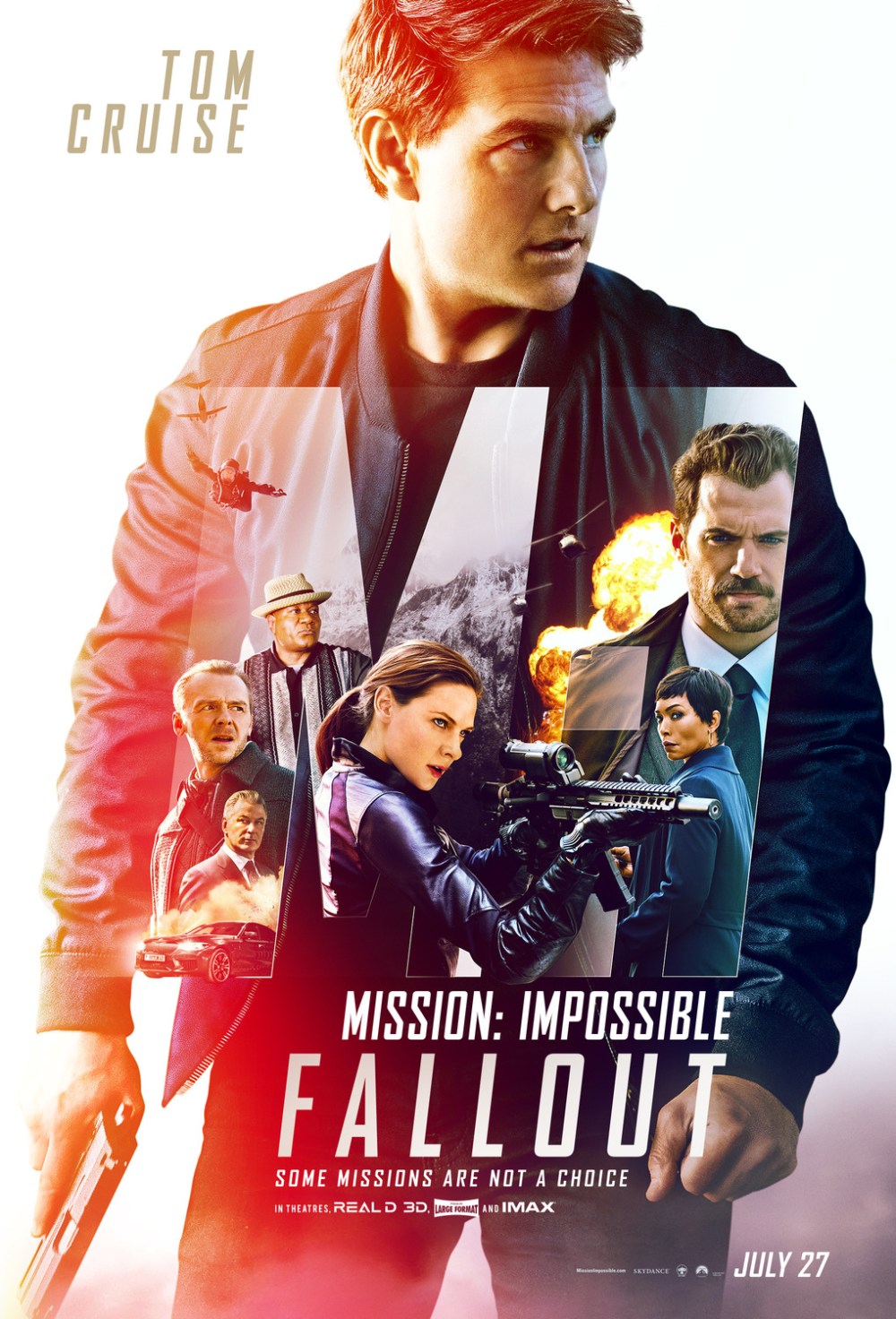
Mission Impossible Fallout poster

This is never supposed to be the case. Movie franchises are not supposed to improve with each sequel. We all expect them to get worse and worse to where you wonder why the filmmakers even bother making them anymore. But with the “Mission: Impossible” movie franchise, actor and producer Tom Cruise continues to work closely with gifted filmmakers to create motion pictures which defy expectations as he is intent on topping what came before. “Mission: Impossible – Fallout” is the sixth film in a series which began back in 1996, and it proves to be the most thrilling installment yet. I cannot wait to see it again, and I am determined to see it in a IMAX theater as this sequel demands to be seen on the biggest screen in town.

The plot of “Mission: Impossible – Fallout” is a bit convoluted, but I will give you the gist of it. The terrorist group from “Rogue Nation” known as The Syndicate has since reformed into The Apostles, and Ethan Hunt (Cruise) is tasked with intercepting the sale of three plutonium cores to them. But despite the presence of team members Luther Stickell (Ving Rhames) and Benjamin “Benji” Dunn (Simon Pegg), the mission is thwarted and the plutonium is stolen right out from under them. From there, they are determined to get the cores back, and their latest impossible mission has them meeting up with characters old and new to where alliances and methods are questioned endlessly. It all reminded me of what Mary Elizabeth Mastrantonio told Willem Dafoe in “White Sands:”

“You’re honest, even when you’re lying.”

Does everything we see here make perfect sense? No, but I really didn’t care. Even at 147 minutes, “Mission: Impossible – Fallout” never drags, and it is a movie I am happy to describe as exhaustively thrilling as it kept me on the edge of my seat throughout. Just when you think it’s over, we are pulled back into another astonishing action set piece which leaves us out of breath.

Let’s talk about the stunts, shall we? Among the first is the HALO (high altitude, low opening) jump which is a skydive from a seriously insane height. We all know how Cruise is a stickler for doing his own stunts, and while the average skydive is done from 7,000 to 9,000 feet, a HALO jump is often done from 15,000 feet and with the aid of oxygen. Taking this all into account makes this particular sequence all the more thrilling as it is done in what seems like an unbroken shot which would make even Alejandro Inarritu stare at the screen in awe.

There’s also a motorcycle chase through the streets of Paris, and I kept waiting for the characters to get seriously injured or killed as no one can navigate traffic like that in real life. And yes, it is indeed Cruise jumping from one building to another. Everything culminates in a thrilling helicopter chase which outdoes the ones I loved watching in “Blue Thunder,” and it is in this sequence where Cruise and company attempt to complete the most impossible mission of all as what they are tasked with doing has a higher probability of failure than success.

Cruise is now 56 years old, and he shows no signs of slowing down. While many be telling him to act his age, a term which has now lost all its meaning to me, he continues to defy the odds and show just how far he is willing to go to make an action movie which is anything but average. The scenes of him “grinning like an idiot every 15 minutes” are few and far between this time around as we instead see him playing mind games with actors who are playing characters not entirely trustworhty. And yes, there is the obligatory scene of him sprinting at warp speed, and I hope I am able to run like he does when I reach his age.

“Fallout” almost marks the return of writer and director Christopher McQuarrie, making him the first filmmaker to direct more than one “Mission: Impossible” movie. “Rogue Nation” was terrific entertainment, but he really outdoes himself this time out. His screenplay is full of endless plot twists and enigmatic characters to where I was quickly reminded of he was the same man who wrote the screenplay for “The Usual Suspects.” Seeing him balance various plot threads makes me admire him as a director even more as he brings everything together for a furious climax which is just staggering.

Simon Pegg has been great fun in the “Mission: Impossible” movies, but in “Fallout” we see his character of Benji Dunn evolve a bit. Granted, Benji has always served as the comic relief, but we see him become a better field agent to where, even when he whines about the things he doesn’t want to do, he can hold his own with Ethan to where he doesn’t have to perform a HALO jump to make this clear. Pegg has always been a great comedic talent, but he’s also a better actor than people give him credit for.

Ving Rhames continues to make Luther Stickell the uber cool IMF agent, and Luther has evolved to where he is not as concerned about his expensive taste in clothes anymore. Rebecca Ferguson, who all but stole “Rogue Nation” as Ilsa Faust, once again makes her character wonderfully enigmatic to where I was desperate to get at the secrets inside Ilsa’s brain. Alec Baldwin has more fun this time around as Alan Hunley, Sean Harris makes “Rogue Nation” baddie Solomon Lake even more sadistic than ever before, and Michelle Monaghan once again provides this franchise with a warm human presence as Ethan’s ex-wife, Julia.

We also get introduced to some new characters including Erica Sloane, the new CIA director played by Angela Bassett. Although we don’t get to see much of Bassett here, she reminds us of how badass she remains after all these years. It has been 25 years since she broke through as Tina Turner in “What’s Love Got to Do with It,” and she hasn’t let us down since.

Acclaimed stage actress Vanessa Kirby makes her American film debut as White Widow, a black-market arms dealer. Kirby makes this character such an alluring presence as she keeps her cool even as her life is constantly being threatened and as she dangles a plutonium core right in front of Ethan’s eyes, knowing full well just how much he wants it.

And, of course, we have Henry Cavill who gets to take some time off from his day job playing Superman to portray CIA assassin August Walker. Cavill is a bit stiff in some early scenes to where he threatens to get upstaged by his mustache, the same one he was unable to shave off for “Justice League” reshoots. For a time, I kept waiting for him to say, “It’s just you, me, and my mustache” as such a big deal was made about it having to be digitally removed. But as “Fallout” goes on, Cavill makes August into an especially dangerous character who is never to be trifled with. And while he may not be playing the Man of Steel here, he throws punches which had me thinking his arms were made of steel.

Seriously, “Mission: Impossible – Fallout” is the best movie yet in this franchise, and it may very well be the best action movie of summer 2018. Just when I thought nothing could top the sight of Cruise climbing the Burj Khalifa tower in “Ghost Protocol,” we are given some of the most amazing stunts, and they are coupled with characters busy playing mental chess games with one another as what the eyes reveal can be even more threatening than a bullet to the head. “Fallout” is a thrilling spectacle, and it makes me wonder if Cruise and company can possibly top what they have accomplished here.

Cruise had a tough time in 2017 as “The Mummy” reboot proved to be a critical and commercial bomb, and the biographical crime film “American Made” underperformed at the box office. It’s a good thing he still has “Mission: Impossible” to fall back on as he always pushes himself to outdo what he did previously as an actor and producer. Just when I thought his career would self-destruct in 5 seconds, he manages to come back with a vengeance.

* * * * out of * * * *

‘Eighth Grade’ Never Shies From the Terrors of Being a Teenager

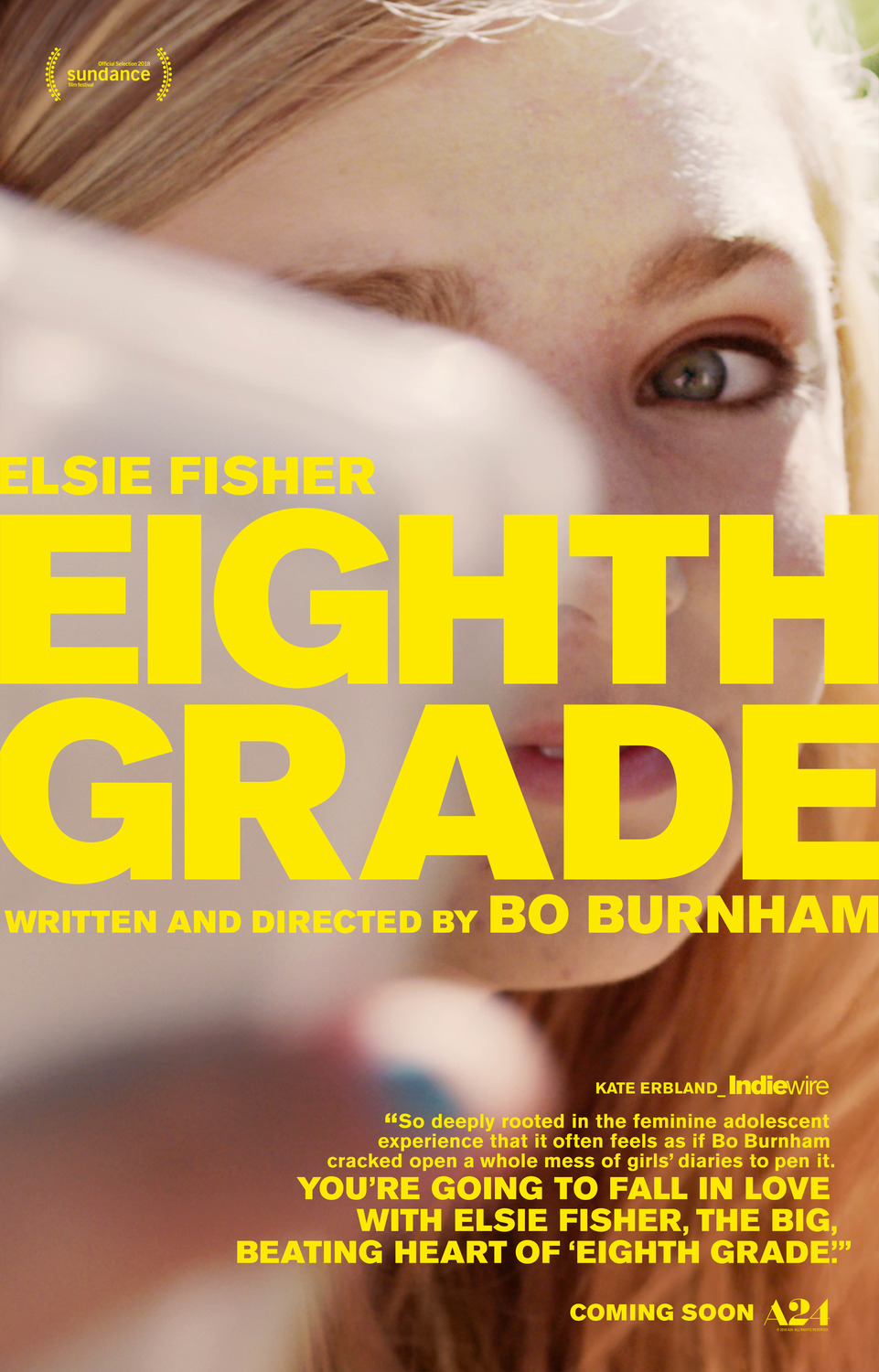
Eighth Grade movie poster

I remember eighth grade very well. It started with me running cross country and being elected Treasurer to the student council. I stole a line from Chevy Chase as I told my fellow students, “Hi, I am Ben, and you’re not.” They laughed hysterically and cheered me loudly, and I lived for this kind of reaction back then. I felt like I was on top of the world, but then things changed to where I felt completely out of place and unsure of how to talk or act around people my age. I became socially awkward and felt very isolated from everyone around me, and the year ended on what seemed like a disastrous note as I became the center of attention in a negative way, something I hoped and prayed would never happen.

Those memories were brought right back to the surface as I watched “Eighth Grade” which stars Elsie Fisher as Kayla Day, a teenage girl on the verge of graduating from junior high school. When we first meet her, she is making her latest YouTube video in which she is telling her audience about the importance of being yourself, and she comes off looking very confident. But then we see her in the real world and discover she is a deeply introverted young woman who is socially awkward and introverted. Her class ends up voting her “Most Quiet,” and the look on her face when she is told this says so much as even she cannot deny this being true.

Granted, Kayla is growing in a time where social media is everywhere, and she is addicted to her cell phone as much as the next person. But while I did not grow up in a time of cell phone addiction, social media oversaturation, Facebook, Instagram or Twitter among other things, the feelings she experiences as she navigates the cruel realm of middle school feel very real, and I relate to them more than I ever could have expected to after all these years.

Eighth Grade” has many moments which speaks volumes. The scene where the mother of Kennedy, the most popular girl at school, invites Kayla to her daughter’s birthday party is one of the most emotionally piercing. As the mother speaks, the camera has her face out of focus and instead offers a closeup on Kennedy who refuses to even look at Kayla, her face full of disgust to where she looks like she wants to say to her mom “do we have to invite her?” Being on the receiving end of a face like this when you were a teenager always felt really brutal, as our emotions at that age always felt epic to where dejection felt more common than happiness.

This is followed up by the movie’s most horrifying scene: a pool party. Just seeing Kayla stare out a window at the kids laughing and having fun in the pool as if she were a prisoner behind bars proves to be as unsettling as watching Dawn Weiner look for place to sit in the school cafeteria in “Welcome to the Dollhouse.” Kayla suffers a panic attack as she puts on her swimsuit, and when she does go into the pool, I kept waiting for her to have a Dustin Hoffman “Graduate” moment when she finds solace underwater. Kayla, however, can only stay underwater for so long as the noise in her head proves to be louder than everything going on outside of her.

Kayla does get a reprieve when she attends a high school shadow program and meets a really nice young woman named Olivia (Emily Robinson) who is very eager to introduce Kayla to the new school she will soon attend. Watching Kayla interact with Olivia reminded me of how I got along better with kids older than me than I did with those my own age. Her newfound friendship, however, hits a major snag when one of Olivia’s friends invites Kayla to play a game of truth or dare. I kept praying Kayla would not say the word “dare,” and when she does…

While watching “Eighth Grade,” I was reminded of the following exchange of dialogue from Sofia Coppola’s “The Virgin Suicides:”

“What are you doing here, honey? You’re not even old enough to know how bad life gets.”

“Obviously, Doctor, you’ve never been a 13-year-old girl.”

Writer and director Bo Burnham, one of the first performers to become a star on YouTube, has brilliantly captured all the angst, horror and awkwardness of these crazy years we would rather put behind us. Clearly, he was never a teenage girl himself, but this quickly becomes irrelevant as anyone who has ever felt left out or at the bottom of the social ladder can easily relate to what Kayla experiences from start to finish. His screenplay feels very true to life, and not once does this movie feel like an average episode of “Saved by the Bell” or “Beverly Hills 90210.”

As Kayla, Elsie Fisher has such a winning presence to where you root for her right from the start. Her face, which has evidence of pimples, is not the kind we see in Clearasil commercials, and I applaud her for not trying to cover this up. In moments where she has no dialogue, Fisher shows us exactly what is going through Kayla’s mind as she is unable to hide the confusion and uncertainty of how to act around others. It’s a wonderful performance which feels true to life, and Fisher makes her final moments in “Eighth Grade” count for so much as she prepares to start the next stage of her life with newfound confidence.

The other performance I loved was from Josh Hamilton who plays Kayla’s father, Mark Day. At first, it looked like he is portraying a hapless dad who is simply here for comedic effect, but Hamilton gives this character dimensions which truly surprised me. Mark could have been like any other father we often in see in movies, but Hamilton digs deep to find the bruised heart of one who is just trying to do the best he can. It all leads to a wonderfully acted scene where Mark tells Kayla how she can never make him sad, and it is one of the more original moments I have seen between a parent and their child in recent years, and I am certain I will never forget it.

It gives me great pleasure to add “Eighth Grade” to my list of the best and most realistic motion pictures ever made about teenagers. Movies like “Pump Up the Volume” proved to be a godsend for me as they dealt with real teenagers going through problems I could actually relate to, and kids today need these movies as a healthy alternative to the more flaccid and shallow portrayals of their age set which do not reflect their reality. While much of what I saw was unnerving to where I was instantly reminded of far too many embarrassing moments from my junior high school days, it is always refreshing to get a movie from a filmmaker who takes the time to listen to teenagers instead of talking down to them. John Hughes may be gone, but there are other filmmakers more than willing to carry his torch for another generation.

Regardless of its R rating, I hope those who are in the eighth grade or have just graduated from junior high school get to check this movie out as I believe they will benefit greatly from watching it. I also have to say if adults are intent on saying the word “lit” in videos aimed at teenagers, they need to understand how kids use this word. Trust me, kids see through your façade, and your attempts to look cool to them will make you appear far too desperate for their approval.

* * * * out of * * * *

‘Let the Right One In’ is Not Your Average Vampire Movie

Let The Right One In movie poster

This is one of those movies which made me want to be a film critic. I love to tell you what movies I really like and flat out hate, and this is even though I never expect to change your mind over what you want to see. But there are certain movies which I really want to see get the audience they deserve, preferably in a movie theater. “Let the Right One In” is a Swedish movie which absolutely deserves a loyal following as it is one of the most beautifully atmospheric movies to be released in 2008.

“Let the Right One In” follows young Oskar (Kare Hedebrant) who is an overlooked kid bullied by kids at school that have somehow managed to recite lines of dialogue from “Deliverance.” This is a kid who clearly doesn’t have a lot of friends and, like many, is a child of divorce. One night, while he is in the snowy courtyard outside his home, he is met suddenly by a girl named Eli (Lina Leandersson) who has just moved in to the same apartment complex he lives in. Eli quickly tells Oskar she cannot be his friend, but soon enough, they bond over a Rubik’s Cube. Their friendship builds throughout the film and serves to strengthen them as people to where they deal more effectively with the struggles they are forced to endure.

There is one catch though, and it is clear to the audience from the start: Eli is a vampire. An older man believed to be her father ends up blocking the windows with cardboard and other forms of paper to keep their apartment dark. We see this same man going out in the freezing dead of night to kill total strangers and drain them of their blood. Why? He’s got another mouth to feed. When he screws up and doesn’t come through, she shows just how vicious she can be in her displeasure. But despite who she is, you can see why she is cozy with Oskar. They are both outcasts in a world which does not appear to have much use for them.

What I really loved about “Let the Right One In” is how it takes the vampire genre and makes it fresh by combining it with the things we remember from our childhoods: bullies, sucking at sports, parents not understanding what we are going through, etc. We always hope for that one person who understands us and can relate to what we are going through. Some of us are lucky enough to have such a person in our lives, but others are not so fortunate. You could say Oskar becoming friends with a vampire would not be in his best interest, but these are two people who need each other at this fragile point in their lives.

We see Oskar getting whipped at school by the bullies who pick on those they feel are beneath them, and they call him piggy among other things. We later see Oskar fantasizing about getting revenge on those bullies as if he is Robert De Niro in “Taxi Driver.” With Eli, he finally gains the confidence to get back at them. In turn, Eli’s growing friendship with Oskar provides her with an escape from her eternally lonely existence. The real question between them is, can Eli trust herself enough to keep herself from making Oskar another victim? And if she reveals herself to him as who she really is, will he still accept her as his friend? Despite the bloody acts we see Eli committing, deep down we don’t want to see these two separated.

“Let the Right One In” was directed by Tomas Alfredson, and he does a brilliant job of opening the movie in silence as he slowly introduces us to the snowy suburb these characters inhabit. The frozen landscape mirrors the dreary and repressed nature of everyone who lives there, and it feels as cold as upstate New York felt in “Frozen River.” Of course, were the movie to be sunnier, it would require certain characters to die a fiery death. The vampires here perish the way vampires do in other movies, and if you are a vampire, it should go without saying how you appreciate the nighttime more than others.

But the wonderfully surprising thing about “Let the Right One In” is how tender it is. While it looks to be marketed as a horror movie, it is really a love story. While it is at times a violent and bloody movie, what really wins out is the bond these Oskar and Eli share throughout. It is a chaste relationship (they are both 12 after all) built on need and loneliness. There is a moment where they both lie together in bed which is really lovely, and it reminds one of how lonely it can be to sleep by yourself.

There is not a weak performance to be found here, but the real credit goes to the two young kids who have to carry this movie almost entirely on their shoulders. Kare Hedebrant is exceptional as the young Oskar, and there is never a moment in his performance which feels fake or forced. Hedebrant is a natural in front of the camera, and he acts from the heart. This is not your typical nerdy school outcast we see in so many movies made in America, but instead an intelligent boy who never quite fits in the way we all wanted to when we were his age.

Lina Leandersson, who plays the vampire Eli, has the toughest role in as she has to portray different emotions without actually showing them. Throughout the movie, her face is a mask of coldness and detachment, but in her eyes, she shows how much she likes being in this unexpected relationship with Oskar. Leandersson’s performance is truly remarkable as she makes you care about this person even after she commits abhorrent acts against others. This is not your typical vampire drunk on power like Lestat in “Interview with The Vampire,” but one who was born into this life without any choice. Eli does not drink the blood of others because she wants to, but because she needs to in order to survive. Lina’s drive is one of survival, not dominance.

Looking back at 2008, there were a lot of really good movies released, but not many great ones. Maybe I hold things to a higher level than I should, but “Let the Right One In” is a true masterpiece in this or any other year. It is both frightening and tender at the same time, and I don’t know of many other movies which have managed this balance ever so effortlessly.

* * * * out of * * * *

‘Mission: Impossible – Ghost Protocol’ Leaves You Hanging From Dizzying Heights

Mission Impossible Ghost Protocol poster

Writer’s note: This review was written back in 2011.

The “Mission: Impossible” movie franchise keeps getting better and better which each successive sequel, something few other franchises can ever lay claim to. The first one directed by Brian De Palma had a confusing storyline but spectacular action set pieces. The second one had a plot which was easier to follow and the signature ballet action sequences we’ve come to love and expect from John Woo. Part three gave us the directorial debut of J.J. Abrams, had a stronger plot, a very effective villain in Phillip Seymour Hoffman and ended up remembering what made the original television series work so well. Each movie in this series has its own unique identity which allowed this franchise to have a longevity we didn’t expect it to have. Of course, with Tom Cruise’s antics upstaging “Mission: Impossible III,” it started to seem his time as Ethan Hunt had run its course.

But Cruise is back for more, and “Mission: Impossible – Ghost Protocol” turns out to be the best of one yet as it features some of the most ingenious action scenes I’ve seen in a movie for quite some time. It also has the added benefit of having been filmed in part with IMAX cameras which gives certain scenes a highly realistic look and feel to where you are right in the center of the action. Just when I thought this franchise had ran out of steam, Cruise and director Brad Bird (making his live action debut) thrill us in a highly unexpected way.

It appears Hunt’s retirement from the IMF after “Mission: Impossible III” didn’t last long, and we find him at this movie’s beginning in a Moscow prison throwing a rock at the wall like he’s Steve McQueen in “The Great Escape.” But he is soon sprung from his cell with the help of Benji Dunn (Simon Pegg) and agent Jane Carter (Paula Patton), and we find out he was imprisoned for a mission gone wrong, and he has since become estranged from his wife Julia (Michelle Monaghan) for mysterious reasons. Just like Jack Bauer in “24,” Hunt can’t stay away from what he does best when danger rears its ugly head.

After their great escape, Hunt and Dunn infiltrate the Kremlin in an effort to locate files of a nemesis with the code name of Cobalt. This mission, however, goes horribly wrong when the Kremlin is blown to smithereens, and the entire IMF is disavowed as a result. Hunt and his team are forced to take blame for the attack, but they are allowed to escape in order to locate Cobalt and stop a nuclear war. This time, Hunt and company have no support to rely on as they forced to work on their own.

As with the previous entry, Cruise lets the other actors shine as he has realized Hunt doesn’t need to do everything himself. Seeing Benji get upgraded from techno nerd to field agent is great fun, and Pegg is a real treat to watch here as he becomes much more than just comic relief. Paula Patton embodies her agent character of Jane Carter convincingly and gets to kick some serious ass in various scenes, one of which has her taking on a female assassin in something more than just your average catfight.

The best addition, however, to this “Mission: Impossible” movie is Jeremy Renner who plays William Brandt, a chief analyst for the IMF. Renner, whose career has been on a major upswing thanks to his performances in “The Hurt Locker” and “The Town,” is a great addition to this franchise, and he even gets a big action set piece as William proves to know far more than he lets on. His secrets threaten to be devastating if revealed, and Renner does excellent work in showing the turmoil Brandt endures as he is faced with a whole other kind of impossible mission.

The main antagonist this time out is Kurt Hendricks (Michael Nyqvist from the original “Girl with the Dragon Tattoo”) who is bent on starting a nuclear war so he can bring about the next evolution of the human race. Nyqvist brings a strong villainy to this role which makes you sneer at his presence whenever he’s onscreen. However, he’s upstaged by Léa Seydoux who portrays French assassin Sabine Moreau. Her cold glare penetrates your inner defenses with little difficulty, and you have to put on your best poker face in her presence to stay alive (and that may not even be enough).

But the real star of “Mission: Impossible – Ghost Protocol” is director Brad Bird himself. You’d think stepping outside the world of animation where he made “The Incredibles,” “Ratatouille” and “The Iron Giant” would leave him at a spectacular disadvantage as what you can get away with in that realm of filmmaking does not necessarily translate as well to live action. But it’s clear Bird allows nothing to stand in his way in terms of what can be accomplished, and he comes up with one amazing action sequence after another.

The one sequence which needs to be acknowledged above others is when Cruise scales the outside of the Burj Khalifa tower, the tallest building in the world. The IMAX cameras give this moment a reality like no other, and that feeling of intense vertigo is hard to ignore. Seriously, I felt like I was outside of that building with Cruise as he climbed up it with nothing but suction gloves. If there is a more intense action sequence with a character hanging on for dear life from one of the world’s tallest buildings, it certainly didn’t come to mind while I watched this movie. I had trouble getting to sleep afterwards because that crazy stunt was still on my mind and would not let me be.

There’s about a half hour or so of footage shot in IMAX, and Bird makes use of this format to great effect. Aside from Cruise scaling the world’s tallest building, there’s a scene of the Kremlin exploding which literally takes your breath away. While many still complain of IMAX feeling like a rip off with its high ticket prices, it’s worth the extra money in a way 3D could only dream of being at this point.

“Mission: Impossible – Ghost Protocol” is a big surprise as this franchise looked like it had already hit its peak to where another sequel seemed needless. But Cruise and company successfully revive it by giving us characters to care about and root for, and they outdo themselves with stunts even more amazing than what we saw previously. Regardless of what you may think of Cruise as a person these days (many of my friends can’t stand him), he still puts on a good show even as he grows visibly older. Just when you thought he was out, he pulls himself back in!

* * * ½ out of * * * *

‘Generation Wealth’ Finds Hope Outside of the Corrupted American Dream

Generation Wealth poster

In 1988, John Carpenter made “They Live,” a science fiction horror film about a drifter who discovers the ruling class are actually aliens who have managed to conceal their existence and manipulate the human race into spending money and to “obey” them through subliminal messages in mass media. Years later, when Carpenter was attending a screening at the Egyptian Theatre, he described “They Live” as being his response to his horror at the Ronald Reagan years and his distaste at the increased commercialization of politics and popular culture in the 1980’s. When I was at a screening of “Big Trouble in Little China,” and I got to ask Carpenter the following question:

“You have said ‘They Live’ was your response to your horror at the Reagan years. With George W. Bush currently wreaking havoc around the globe, don’t you think this is the perfect time for a sequel?”

Carpenter’s response stays with me to this day:

“The 80’s never left us.”

Looking back, he was absolutely right. While I am a child of the 80’s and have a great love for that decade, it marked the start of America becoming an infinitely greedy nation as we strove to become very rich, deficits began to explode, and politicians began selling us on trickle down economics which promised that tax cuts on the rich would benefit the middle and lower classes. This proved to be a big lie, and yet politicians still try to sell Americans on it.

All of this went through my head as I watched Lauren Greenfield’s “Generation Wealth.” This documentary comes to us in 2018, and it proves once again how the 80’s still live on as we watch individuals try to become wealthy or at least gain the appearance of being rich. What results is a look at how the American Dream has been corrupted, the cost of greed, and the chance for redemption.

Greenfield is an acclaimed photographer and filmmaker, and “Generation Wealth” starts off with her narrating how through her 25 years of work, she discovers her work has pointed to one uniting phenomenon: wealth culture. From there, she investigates the various pathologies which created the richest society in the world, and she interviews several people who look to increase their bank accounts or change the way they look to where society will view them as sexy.

We meet Florian Homm, a former hedge-fund manager who at one time had a net worth of $800 million and ended up fleeing the United States to avoid getting arrested by the FBI. Watching him sit back on a couch while smoking a cigar with glee makes him look the modern-day version of Tony Montana from “Scarface.” Homm is never shy about just how much he loves money, and he laughingly admits how Harvard Business School didn’t train him to be an ethical businessman but instead to be “fine-tuned to rule the world.”

We also get introduced to Cathy, a bus driver from Virginia who travels to Brazil to get extensive plastic surgery which she charges to a credit card, the successful porn star Kacey who gained notoriety after Charlie Sheen paid her $30,000 for a days long party and drug binge, a young beauty queen who looks like a combination of Honey Boo Boo and JonBenet Ramsey, and former rapper Cliff (G-Mo) who we first celebrating the hip-hop version of the American Dream. They all want the best-looking bodies as well as all the money in the world, but as Greenfield says at one point, those who have everything never feel like they have enough.

I found myself getting sickened by the subjects Greenfield photographed and interviewed as it felt they were doing more damage to themselves than good to where they appeared, if not soulless, very empty on the inside. It proved to be a relief when someone like Chris Hedges shows up to put some much-needed perspective on what we are seeing as he compares America’s obsession with wealth to the end of Rome. At one point he even says, “Societies accrue the most wealth as they face death.” Can America be close to suffering the same fate? It certainly feels like it.

Greenfield doesn’t break new ground with “Generation Wealth” as Michael Moore already compared Rome’s fall with America in “Capitalism: A Love Story,” and “The Big Short” was an entertaining and sobering look at the 2007-2008 financial crisis. Do we need to go through how greed has wrecked America in yet another movie? Oh yes, we do! This country threatens to make the same mistakes yet again as politicians still insist on selling its citizens on trickle-down economics.

One key character from the 1980’s whom Greenfield highlights is Gordon Gekko, the fictional and unscrupulous corporate raider Michael Douglas played in Oliver Stone’s “Wall Street.” But while Stone intended for “Wall Street” to be a cautionary tale about the downside of unchecked greed, Gekko proved to be such a charismatic character to where he became a huge inspiration for those desperate to make it big on Wall Street. It didn’t matter how Gekko set a terrible example for them, these wannabes still looked up to him, and there is a good deal of him in many of the people Greenfield interviews here.

Greenfield to her credit she never judges any of the people featured here. She presents their stories objectively and never tries to manipulate us into thinking about them in one way or another. Whether you are intrigued or repulsed by the things they do, there is a sense of empathy I had for them as they become more and more human as the documentary reaches its final act.

When it comes to “Generation Wealth’s” final act, we see the results and repercussions of the actions everyone has made as they reach a plateau in their quest for money. Greenfield aligns their journey with the catastrophic financial crash of 2008 which left much damage in its wake. Seeing these people on the other side of it has them finding something absolutely priceless while others find tragedy and financial ruin. This proves to be both inspiring and devastating all at the same time.

“Generation Wealth” does lose some of its focus as Greenfield awkwardly inserts herself into her documentary. Is she also interested in being rich and wealthy? Is she well off thanks to her photography? It’s hard to say what she is saying about herself, but it does lead to some very amusing moments as one of her sons admits he knows the name of each Kardashian but not those of his neighbors, and her other little boy ends up inserting a sign in front of her camera as she films everything and anything. I don’t want to spoil the moment for you as it had me laughing endlessly.

Watching “Generation Wealth” kind of reminded of when I first saw “Doc Hollywood” which starred Michael J. Fox as a doctor intent on making tons of money as a plastic surgeon in Beverly Hills, and who later finds a more meaningful life for himself in Grady, South Carolina. But that was a fictional movie, and this one deals with real life, and I came out of it with more hope for the human race than when I went in. This documentary also shows how life is about the journey rather than the final destination. While I wanted to sit some of these characters down and force them to pay close attention to the lyrics of Digital Underground’s “No Nose Job,” it is worth watching their journey as, like them, we come to see what matters most in life.

With that, I leave you with the words Harold Perrineau uttered as Augustus Hill on the HBO series “Oz:”

“We think we know what we need. We spend our time figuring out how to get what we want, who can help us, who’s in the way. We make our moves and sometimes we get lucky. We get exactly what we want. And life gets worse. Simple truth #22, be careful what you wish for, brother. Be very, very careful.”

* * * ½ out of * * * *

‘Mamma Mia!’ – Maybe You’ll Like It, Maybe You Won’t

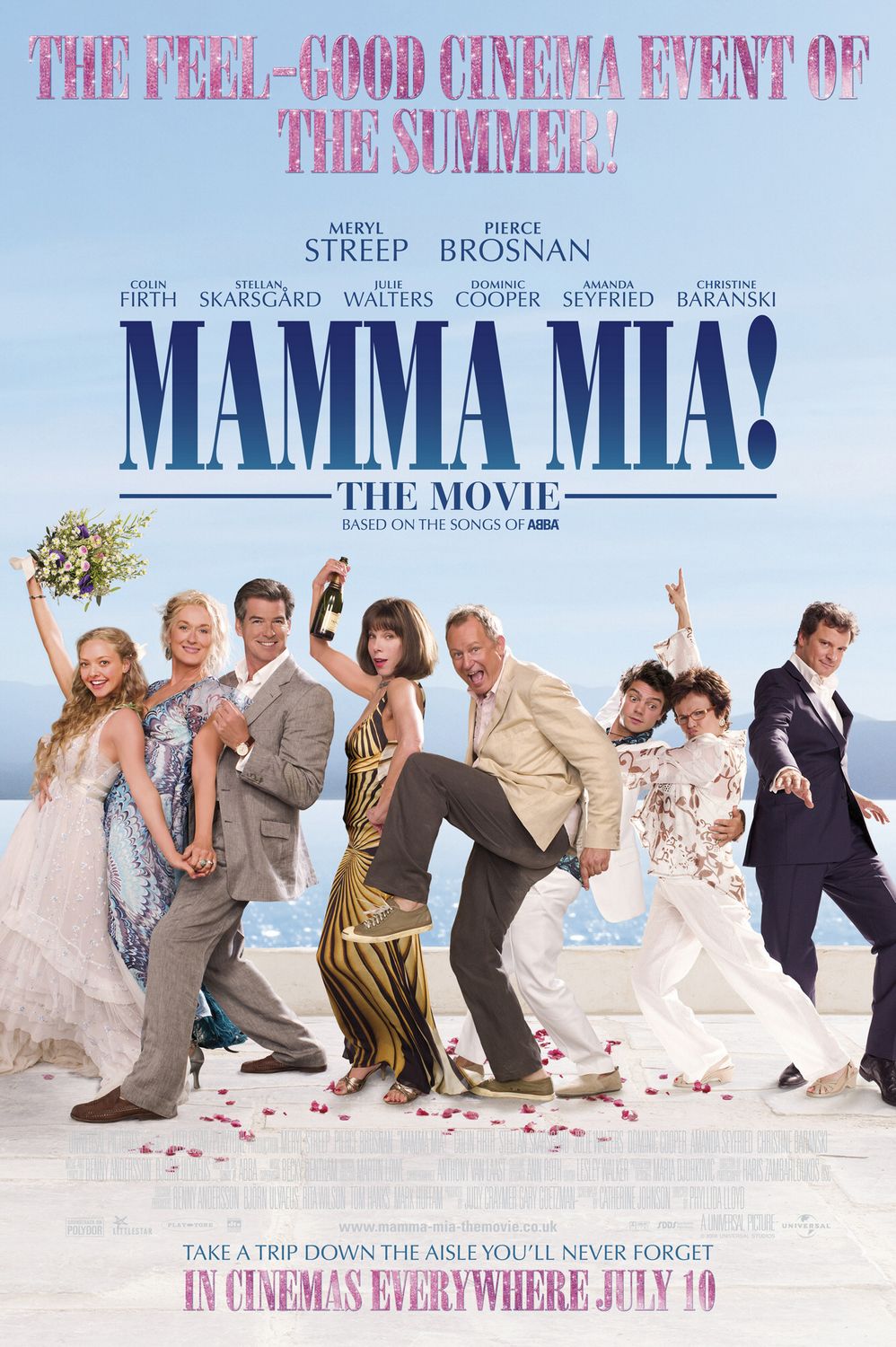
Mamma Mia movie poster

I never got to see the musical of “Mamma Mia” when it was onstage, but I’m not really surprised it became a big hit. The musical tells the story of a young girl on the verge of getting married and of how she ends up secretly inviting three of her mom’s previous boyfriends to her wedding. The catch is one of these men may actually be her father, and she would like whoever it is to give her away at her wedding. But when her mother realizes these three men have arrived, it makes her weep for the past she thought she had forever lost, and all of this is done to the tune of ABBA’s greatest hits which include “Dancing Queen,” “Take A Chance on Me,” and “S.O.S.” among others.

I’m not sure I am the right person to be reviewing this movie because I don’t fit into its demographic, and I have never been a big fan of musicals. I don’t despise them, they just never really appealed to me as much as they do to my friends. There are a few musicals like “Evita” and “West Side Story” which appeal greatly to me, and the film adaptation of the “Hairspray” musical provided me with one of the most entertaining times I had at the movies in 2007. But “Mamma Mia” is not in the same league as “Hairspray” or even “Moulin Rouge.” Maybe it’s because those movies brought us into their musical world so deeply while we watched them and did things others in this genre dare not do.

“Mamma Mia” on the other hand, didn’t draw me in as much, and this is regardless of the boundless energy that all the actors had when onscreen. You come out of it thinking that they must have had the time of their lives while making it. I certainly don’t want to take away from the effort put into the movie by everyone involved, but instead of feeling excited by all that was going on, I instead felt alienated from the whole venture. There was this cloying feeling I kept feeling throughout which made me believe this movie was less than genuine in its emotions.

The other big issue I had with “Mamma Mia” is the fact it is basically a musical founded upon a gimmick: centering an old-fashioned love story around a number of ABBA songs which people all over the world have listened to over and over again. Plus, seeing other actors sing ABBA songs feels a bit off putting as it reminds me of how infectiously good the original versions are. The actors certainly do their best, and Meryl Streep belts out a tremendous version of “The Winner Takes It All” which reminds us again of the great singing voice she has. We should have never forgotten this fact, but it has been a long time since we saw Streep go country in “Postcards from The Edge.”

The one thing that I really did admire about “Mamma Mia” is it shows without a doubt how actresses over 40 do have a place in today’s Hollywood, and that their experience is invaluable to movies like these. Hollywood is ruthlessly notorious for going after the youngest of actresses to star in movies, but many of these actresses have no real-life experience to draw on as of yet. The actresses in “Mamma Mia,” however, end up stealing every single scene they are in. Whatever you think about the movie as a whole, the elder actresses (if you really want to call them that) are the best reason to check it out.

Streep continues to make us all aware of the fact she is one of the best actresses, period. She brings a strong life force to her role of a woman working alone on an island with her daughter, feeling she is past her prime in life while her two sisters convince her nothing could be further from the truth.

Two of my favorite performances in come from Christine Baranski and Julie Walters, and they are a gas to watch throughout. Baranski has basically been a professional scene stealer ever since she co-starred as Cybil Sheppard’s best friend on “Cybil.” Since then, she has stolen scene after scene in movies like “Bulworth” and “Bowfinger” among others. Her performance as Tanya, the often-divorced sister of Streep’s character is a hoot, and there is no doubt she had a blast playing this role.

Julie Walters is probably best known to today’s audiences as Ron Weasley’s mother in the “Harry Potter” movies, but never forget she can be a hell of an actress when you give her the right part. Watching her shamelessly trying to seduce Stellan Skarsgard’s character to the tune of “Take A Chance on Me” is a highlight, and she plays her role with no inhibitions whatsoever. I hope we see her in movies which use her for more than just a supporting role.

The role of the bride to be, Sophie Sheridan, is played by Amanda Seyfried. She is very fetching here and she has a wonderful voice to boot. She also has the wonderful privilege of working with Meryl Streep, and they play off of each other wonderfully.

The three potential fathers of Sophie are played by Colin Firth, Stellan Skarsgard, and Pierce Brosnan. Colin’s effortless charm has never faded in the slightest ever since he played Mr. Darcy on the BBC miniseries “Pride & Prejudice.” As for Skarsgard, it is great to see him in a role where he is acting ever so serious like he did in “Insomnia” (the original) or “The Hunt for Red October.” This brings me to Pierce Brosnan, and while he is always a good actor, I need to be honest and say the man cannot sing. He just can’t! After watching him sing “S.O.S.,” I got that cringe inducing feeling as did the rest of my family while we were all watching this movie. As a result, we watched the rest of the movie in fear of him singing yet again. Did he sing again? Oh yes! Brosnan has had a long and celebrated career which included playing James Bond, but please, please, please don’t let him sing in the future! PLEASE!

In spite of all the strong elements “Mamma Mia” has, I still felt indifferent to it. In the end, I don’t think I fit its target audience. If you like musicals, then I would not stand in your way of watching it, but I can see why I didn’t bother with the film while it was in theaters. I certainly don’t hate “Mamma Mia” as there is a lot about it to admire, but it didn’t affect me in the same way as “Hairspray” or “Moulin Rouge” did. I enjoy the music of ABBA as much as the next person but listening to it here does not leave me with the same musical exhilaration. Perhaps you will feel differently.

* * ½ out of * * * *