‘Silver Bullet’ Movie and Blu-ray Review

The following review was written by Ultimate Rabbit correspondent Tony Farinella.

The work of Stephen King has usually produced highly entertaining and enjoyable films.  Not everything has been great or even good, but for the most part, there is usually something to take away from them which is unique and falls right in line within the realm of King’s wonderful and twisted brain.  That is definitely the case with “Silver Bullet,” which is based on his novella “Cycle of the Werewolf.” King also wrote the screenplay as well, so he was very hands-on with his approach to this film and in making sure his vision was seen clearly on screen.  The fine folks over at Scream Factory have brought it back into the public eye with this special collector’s edition on Blu-ray.

The film was released in 1985, the year I was born, and it stars Corey Haim as Marty, a 13-year-old boy who is stuck in a wheelchair.  Because of this, he tends to get special treatment from his family.  This does not endear him to his sister Jane, played by Megan Follows.   She feels as though her parents are always taking his side and that he can get away with anything and everything.   He is also very popular with his Uncle Red, played by Gary Busey.  Red is coming off his third divorce, and he is not shy about hitting the sauce as often as possible.

Deep down, however, Uncle Red has a lot of love and affection for Marty, and this leads him to build Marty a special wheelchair he names Silver Bullet which allows him to get around and have a little more fun.  But suddenly, this quiet and quant town where they live gets turned upside down when they start to notice people are being killed off left and right.  First, there was the local town drunk. And then a young child, an angry father and a pregnant woman also end up dead in a matter of days. The people of this small-town start to get restless and they want answers right away, but the local sheriff Joe Haller (Terry O’Quinn) is not able to provide them.  Because of this, they decide to go out looking for some private justice of their own.  Even the local Reverend Lowe (Everett McGill) doesn’t know what to say to the people anymore about the deaths which are occurring, and it is about to get worse before it can possibly get better.
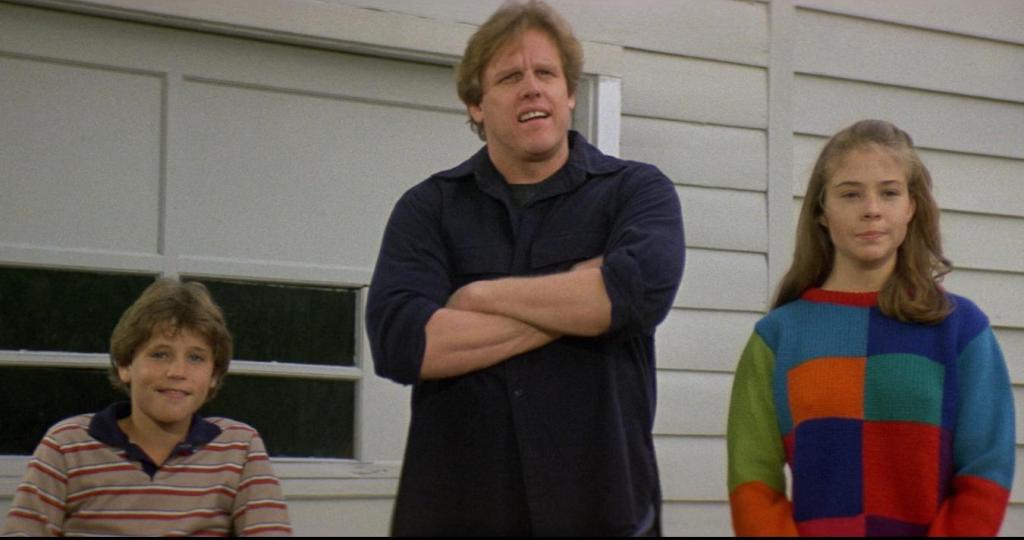
Corey Haim, Gary Busey and Megan Follows.

“Silver Bullet” is only 94 minutes, but a lot happens in those 94 minutes.  There is never really a dull moment or a scene which doesn’t make sense to the overall film.  At times, the category it falls under can be a little confusing.  Is it a straight up werewolf movie?  Is it a horror movie about a werewolf for young children to watch? At times, the film goes full throttle with the gore which set up some gruesome and enjoyable death scenes.  During other scenes, it cuts away from the gorier aspects of the killings.  It seems to want to have its cake and eat it too.

What I mean by that is it wants to be accessible for young children as a horror movie they can watch, but it doesn’t want to go too far.  Tonally, it seems to be trying to please young children and horror fans, and this is not an easy task to pull off.  There is a brother/sister relationship which is something a lot of kids can relate to, and the kids are trying to get the adults to see there is a werewolf out there.  On the other hand, they deal with topics such as divorce, suicide, and alcoholism. While the film worked for me, I could see it having a tough time finding an audience back when it was released.

According to IMDB, the budget was seven million dollars, and it grossed 12 million worldwide.  It was not a total bust, but it didn’t set the world on fire either.  That is why Scream Factory is perfect for films like “Silver Bullet.”  I had never seen it in the past, but I enjoyed it quite a bit.  The film has a good sense of humor, great performances from Haim, Follows and Busey, and it contains some pretty cool kills.  I think it will find a whole new audience on with this collector’s edition Blu-ray.

* * * out of * * * *

______________________________________________________________________________

Blu-Ray Info: “Silver Bullet” is released on Collector’s Edition Blu-Ray from Shout Factory/Scream Factory. It has a running time of 94 minutes and is rated R.

Video Info: “Silver Bullet” is presented in 1080p High-Definition Widescreen (2.35:1), and it looks out of this world on Blu-ray for being thirty-four years old.  At this point, we should expect no less from Scream Factory.  They do not disappoint with their transfers, and there is not a single shot in the film which is grainy or dirty.  It is clear, bright and filled with life.

Audio Info:  The English DTS-HD Master Audio Mono is also top-notch.  It must be mentioned that the music was composed by Jay Chattaway who will forever hold a place in my heart for his work on the “Maniac Cop” Rap.  He does a great job with the music in knowing when to keep it calm and mellow and when to take it up a notch.

Special Features:

NEW Audio Commentary with Producer Martha De Laurentiis

NEW Cutting to The Bone – An Interview with Editor Daniel Loewenthal

NEW A Little Private Justice – An Interview with Actor Kent Broadhurst

The Wolf Within – An Interview with Actor Everett McGill

Full Moon Fever – The Effects of Silver Bullet – An Interview with Special Effects Artists Matthew Mungle And Michael McCracken

Audio Commentary with Director Daniel Attias

Isolated Score Selections and Audio Interview with Composer Jay Chattaway

Theatrical Trailer

TV Spot

Radio Spot

Still Gallery

Should You Buy It?

I love what Scream Factory is doing for the horror genre and how they are bringing new life to films which have long been forgotten unless you are a super hardcore horror fan.  I like to consider myself very knowledgeable when it comes to the genre, but they always find a movie here and there which I haven’t heard of before, or have heard of but never seen in the past.  With “Silver Bullet,” they add plenty of special features that are worth watching and which add a lot to the film.  Scream Factory has become like the Criterion Collection for horror fans.  As far as the film itself, it is a nice 94-minute ride that is paced perfectly.  It is one of those films where you sit back, relax, laugh, scream and just enjoy yourself from start to finish.  I recommend you pick this one up if you get any Amazon gift cards over the holiday season.  You will be pleasantly surprised by it, despite some of the flaws I mentioned in my review.  Still, those flaws do add to the charm of the film.

‘Star Wars: The Rise of Skywalker’ – Imperfect But Still Satisfying

My journey with “Star Wars” began back in 1980 when my parents took me to see “The Empire Strikes Back.” I had no idea what to expect, and what I saw scared the crap out of me. When that wampa monster attacked Luke Skywalker, I recoiled in shock as that thing came out of nowhere. For the rest of the film, I kept my hands close to my ears as things like those Tie Fighters became unbearably loud. But despite my initial reaction, it was safe to say this particular motion picture did have a profound effect on me. And after watching “A New Hope” a year or two later, I found myself completely hooked on this universe George Lucas created and have never lost my excitement for it.

Now comes “Star Wars: The Rise of Skywalker,” the last film in this latest trilogy which has J.J. Abrams returning to the director’s chair. This is said to be the end of the Skywalker saga, and this may indeed be the last “Star Wars” trilogy ever as Lucasfilm looks to create more stand-alone movies in the future. As a result, Abrams must have had a motherload of stress making this one as has so many people to satisfy and over 40 years of characters and situations to wrap up in a nice bow.

Well, “The Rise of Skywalker” is far from perfect. The screenplay by Abrams and Chris Terrio (“Argo”) has too much going on, and the story is hard to follow at times. Even with a running time of 142 minutes, things feel a bit rushed as the filmmakers looked to be working furiously to get from one storyline to the next as there are many characters to deal with in one way or another. And while it has many visual splendors, this episode feels like it is lacking somewhat in the imagination department.

And yet, as “The Rise of Skywalker” went on, I found myself completely caught up in the many adventures these characters come to have. As with any epic space opera, there are challenges to be faced, sacrifices to be made, and perhaps even a chance at redemption. By the end of this ninth episode, I honestly found myself choked up as I reveled in the victories and the sorrows everyone faces here. Even with all its weaknesses, this is indeed a “Star Wars” movie. For those who say it is not a true “Star Wars” movie, please shut up. You all gave Rian Johnson way too much flack for thwarting your expectations with “The Last Jedi,” and that episode deserves more respect than we initially gave it.

Obviously, giving you a spoiler-ridden review is not in the cards here as, like everyone else, I HATE IT WHEN PEOPLE SPOIL MOVIES. What I can tell you is the opening crawl practically shouts the following phrase at us: “The dead speak!” It should be no surprise by now that Emperor Palpatine/Darth Sidious (Ian McDiarmid) shows up alive though physically impaired to the astonishment of many including Kylo Ren (Adam Driver) who still looks to continue the legacy of Darth Vader. Meanwhile, Rey (Daisy Ridley) is taking Jedi lessons from General Leia Organa (the late Carrie Fisher), eager to become one like Luke Skywalker before her. As for Finn (John Boyega), Poe (Oscar Isaac) and Chewbacca, they fly off into the galaxy to seek out… Well, you’ll figure it out.

As a whole, the “Star Wars” movies have rarely, if ever, been perfect. The only one which can be said to be so is “The Empire Strikes Back” which remains the best of the bunch to this day. But even the least of these movies, their strengths more than make up for their weaknesses. One of the biggest strengths of “The Rise of Skywalker” is the investment it has in the characters. We have followed them through their intergalactic highs and lows, and seeing them take part in one last battle proves to be highly involving even when the story threatens to be a bit too convoluted.

I adore Daisy Ridley’s work as Rey, a scavenger who struggles to find an identity in the midst of intergalactic chaos. Her intensity remains strong and never wanes here, and it is almost exhausting watching her here. She is again equally matched by Adam Driver who is a pretty intense actor himself, and their scenes together prove to be among the highlights here as their characters come to admire and despise one another in equal measure.

I also love seeing Oscar Isaac and John Boyega back as Poe and Finn as they both prove to be pair of dudes with plenty of natural charisma to spare. Even if they spend a bit too much time bickering with one another, they still prove to be quite a pair.

Seeing Carrie Fisher here proves to be bittersweet as her character of Princess/General Leia was supposed to be a big part of this installment. Alas, she died before “The Last Jedi” was released, but Abrams ends up making ingenious use of cut footage from the previous films to make her a significant part of the story here. She certainly deserved a better exit than what she got previously, and it is great to see her this one last time.

And yes, it is a blast to have Billy Dee Williams back as Lando Calrissian. Even after all these years, he remains as cool as ever, with or without a Colt 45 in his hand.

As “The Rise of Skywalker” reaches its thunderous conclusion, I found myself of two minds. Yes, this story does feature a number of familiar beats which makes things seem a bit predictable. At the same time, however, I was still very wrapped in the fates of these characters to where I found myself deeply caught up in their predicaments. By the end, I found myself on the verge of tears as I found myself joyously reveling in their triumphs and reunions, and few movie cane make me feel these emotions nowadays.

The other thing which occurred to me is how the “Star Wars” movies always seem to come out when we need them the most. The odds are always against our heroes as evil never dies and always seems to exist in larger numbers, and maintaining a sense of hope can be quite a struggle. In the world we live in right now, hope feels in very short supply as the corrupt seem to have far too much control over everything, and the rich keep getting richer at the expense of everyone else. History repeats itself, and this has certainly been the case in these three recent “Star Wars” movies as the First Order is simply another version of the Empire. And yet these characters continue to persevere despite everything in their way, and seeing this filled my soul up in a way not easily filled. We need to keep the fight going in our lives because giving up is not an option, and we are reminded of this here.

It will be interesting to see how people will view these movies in ten years from now. Perhaps they will receive a much-needed critical evaluation. Regardless of how you feel about “The Force Awakens, “The Last Jedi” and “The Rise of Skywalker,” they are indeed “Star Wars” movies which demand your attention, and it has been a lot of fun revisiting this galaxy once again. I will miss these characters very much. This last chapter may be imperfect, but I still found it to be very satisfying.

* * * ½ out of * * * *

‘It Chapter Two’ Movie and Blu-ray Review

It-chapter-Two-2-600x765

The following review was written by Ultimate Rabbit correspondent Tony Farinella.

It Chapter 2” was a film that I really thought was going to add to what the previous film had done back in 2017. I was very impressed with the chemistry of the children and especially with Bill Skarsgård as Pennywise.  He brought a whole new element of creepiness to the mix.  When you have a clown scaring children, it is the perfect combination for an entertaining yet disturbing horror flick.  Sadly, when they are adults, it does not have quite the same impact. The film is also held back by its nearly three-hour running time.  With some films, the running time is not always noticeable because of how it is edited. In this case, however, they could have cut close to a half-hour from the film, and it would have made a major difference.

Mike Hanlon (Isaiah Mustafa) has stayed in Derry, Maine for the past twenty-seven years in what appears to be a dungeon of sorts.  He has been waiting for Pennywise to return. Now, Pennywise has returned, and Mike decides to get the Losers Club back together because of the pact they made when they were children to end him once and for all, if he ever came back.  Sadly, there is little in the way of backstory when it comes to the adults in this flick.

Richie Tozier is played by Bill Hader, which on paper sounds like a perfect casting decision.  I don’t know if this was Hader doing improv during shooting or if this was in the script, but you can tell when he is about to make a joke, and the jokes are not funny and feel forced. Jessica Chastain is the star of the show as Beverly Marsh, and she brings the right amount of humanity, vulnerability, and strength to this role. James McAvoy also delivers a strong performance as Bill Denbrough. As for Ben Hanscom (Jay Ryan), he is no longer the overweight kid from the previous film.  He has lost a lot of weight and is still pining over Beverly all these years later, even having her signature from his yearbook in his wallet.

From a visual perspective, James Ransone as Eddie Kaspbrak is a great casting choice, as he looks almost exactly like the child actor he is portraying as an adult. Andy Bean rounds out the Losers Club as Stanley Uris.  The magic word in an ensemble movie is chemistry and, I am sad to say, they do not have much of it together, and this really puts a damper on the proceedings.  I remember watching the original film and its special features, and the kids really clicked on and off set. It is what made the film so powerful and enjoyable.  Here, it feels like a bunch of actors are thrown together just for the sake of ending the story.

49128719388_f374a66eed_c

Another major issue with the film is how infrequently they use Pennywise.  In the first film, he is shown here and there, but the power of his presence is undeniable.  In this second chapter, he almost seems like an afterthought.  He is shown only a handful of times in the first two hours before showing up for the finale.  While some might say this was done to build things up and leave the audience wanting more, it instead focuses too much on the individual characters and their lackluster backstories.   They have not changed much in twenty-seven years, and this is not a good thing.

What is most maddening about “It Chapter 2” is how individual scenes are so powerful and impactful. This is frustrating because it makes you wish more of the film had that type of feeling to it.  Instead, the film is bogged down in going from the past to the present, and it does not have a flow to it.  There is no rhythm or consistency, and it is overstuffed.  There are things to like in “It Chapter 2,” but you have to suffer through a lot of tedious and unnecessary scenes to get to them and enjoy them.  This is one of the most frustrating films I have seen in 2019 because of how good it could have been if they had a clear vision on what they wanted to do from start to finish.

* * out of * * * *

______________________________________________________________________________

Blu-Ray Info: “It Chapter 2” is released on a three-disc Blu-ray combo pack from Warner Brothers Home Entertainment. It has a running time of 169 minutes. It is rated R for disturbing violent and bloody images throughout, pervasive language, and some crude sexual material.  One disc is the DVD, one is the Blu-Ray, and the final disc is the bonus disc with all of the special features.

Audio Info:  The audio for the film is presented in Dolby Atmos-TrueHD: English, English Descriptive Audio, and Dolby Digital: English, French, and Spanish.  The audio is tremendous, and it is really effective during the more anxious scenes in the movie. Subtitles are also in English, French, and Spanish.

Video Info: The 1080p high definition transfer of the film looks outstanding.  It is dark in the right moments when the tension calls for it. When scenes are in broad daylight it is really bright and vibrant.

Special Features:

The Summer of It: Chapter One, You’ll Float Too and The Summer of It: Chapter Two, It Ends

Pennywise Lives Again

The Meeting of the Losers Club Has Officially Begun

Finding the Deadlights

Commentary by Director Andy Muschietti


Should You Buy It?

I am not mad at “It Chapter 2.”  I am just disappointed.  It is clear everyone involved here wanted to make a great film, but maybe they should have waited a little bit longer in terms of its release date.  I know we live in a world where people want things right now, but if they were going to finish this up properly, they should have really taken their time to get it done properly.  There is too much movie here.

There are a ton of great special features, however.  There are so many special features that they had to add an extra disc to the set which is a nice touch. I appreciate the effort they put into this Blu-ray from that aspect as well as the audio and visuals.  There are hints of greatness here, but the final product of the film left me feeling underwhelmed. There is a really good movie somewhere in here, but it gets lost in a sea of mediocrity. If you want to own both films, I would buy this one when it goes on sale.


Martin Scorsese’s ‘Hugo’ is a Splendid Love Letter to the Power of Movies

Hugo movie poster

Maybe it was Martin Scorsese’s desire to utilize the 3D format which kept me from seeing “Hugo” on the first day of its release. 2011 saw 3D movies get a serious public beating as audiences became convinced it existed solely for Hollywood studios to jack up ticket prices. But to watch “Hugo” is to be reminded of how amazing 3D can be when using the right tools and not just throwing cheap gimmicks at the audience. But moreover, it is backed up by a great story and remarkable performances as Scorsese shares with us his love of all things cinema.

Seriously, the first five minutes of “Hugo” will blow you away as you will feel like you are traveling over the Paris of the 1930’s. It truly looks as though the snow it is literally blowing in your eyes, and it reminded me of when kids were grasping at the snowflakes coming off of the silver screen during “The Polar Express.” Scorsese was lucky enough to use the same Fusion Camera System which James Cameron used to superb effect in “Avatar.” The images stretch out from the screen, and the extra dimension gives these visuals a depth which at times feels remarkably real.

Based on the novel “The Invention of Hugo Cabret” by Brian Selznick, Asa Butterfield stars as Hugo, a young boy living alone in a Paris railway station while maintaining the clocks and stealing whatever supplies he needs in order to survive. One major obstacle he has to deal with is Inspector Gustav (Sacha Baron Cohen) who patrols the station with his vicious looking dog. Gustav shows no hesitation in picking up orphans and sending them straight to the orphanage which, in the kids’ eyes, seems like an unforgiving house of horrors.

Two people come to play an important role in Hugo’s life: the toy shop owner Georges Méliès (Ben Kingsley) and his spirited goddaughter Isabelle (Chloë Grace Moretz). They enter Hugo’s life as he continues to work on fixing an automaton he and his father, Mr. Cabret (Jude Law), were putting it back together in working order when Mr. Cabret was tragically killed in a museum fire. It is this same automaton which will draw these three together in ways none of them could ever have imagined.

By taking us back to a time when motion pictures were in their infancy, effects we now see as cheesy and simple to create come to feel as magical as they once did. Scorsese is brilliant in putting us into these characters’ shoes as we watch audiences react strongly to a film with a train which looks like it is coming straight at them, or at Buster Keaton hanging on for dear life from a clock outside a tall building. Looking at the awe which is so vivid in the faces of these children reminds us of how movies can magically draw us into another world, and this is a feeling many movies do not give us these days. In this day and age, we take the power of motion pictures for granted.

Butterfield’s performance is remarkable. Showing the pain and resourcefulness of a young boy who has lost his parents and is forced to fend for himself is no easy task, and he ended up giving one of 2011’s most underrated performances. Butterfield inhabits the character of Hugo so deeply to where, after a while, it does not feel like we are watching a performance at all.

Kudos also goes to Moretz, the star of “Kick Ass” and “Let Me In,” for adding yet another superb role to her already splendid resume. As the adventurous Isabelle, she pulls off a flawless English accent which is worth noting as we have gotten so used to actors screwing them up. The warmth of her smile onscreen is utterly genuine, and she lights up “Hugo” whenever it feels like it is getting a bit too dark.

There are other great performances to be found in “Hugo” as well. Ben Kingsley is fantastic as usual as Georges Méliès, and the late Christopher Lee has some wonderful moments as bookshop owner Monsieur Labisse. One of the big standouts in the supporting cast though is Sacha Baron Cohen who takes a break here from his “Borat” and “Bruno” mockumentaries as Inspector Gustav. He’s a hoot throughout, and his interactions with the infinitely lovely Emily Mortimer (“Lars and the Real Girl”) who plays Lisette are hilariously sweet.

Scorsese has put together a truly beautiful motion picture which deserves a bigger audience than it received while it was in theaters. The fact that more people went to see “Alvin and the Chipmunks: Chipwrecked” than this is deeply depressing. A lot of moviegoers really hated 3D movies back in 2011, so this did not do “Hugo” any favors. But after watching it, you will find yourself believing this extra dimension is worth your money when it is put together by the best masters of filmmaking.

* * * * out of * * * *

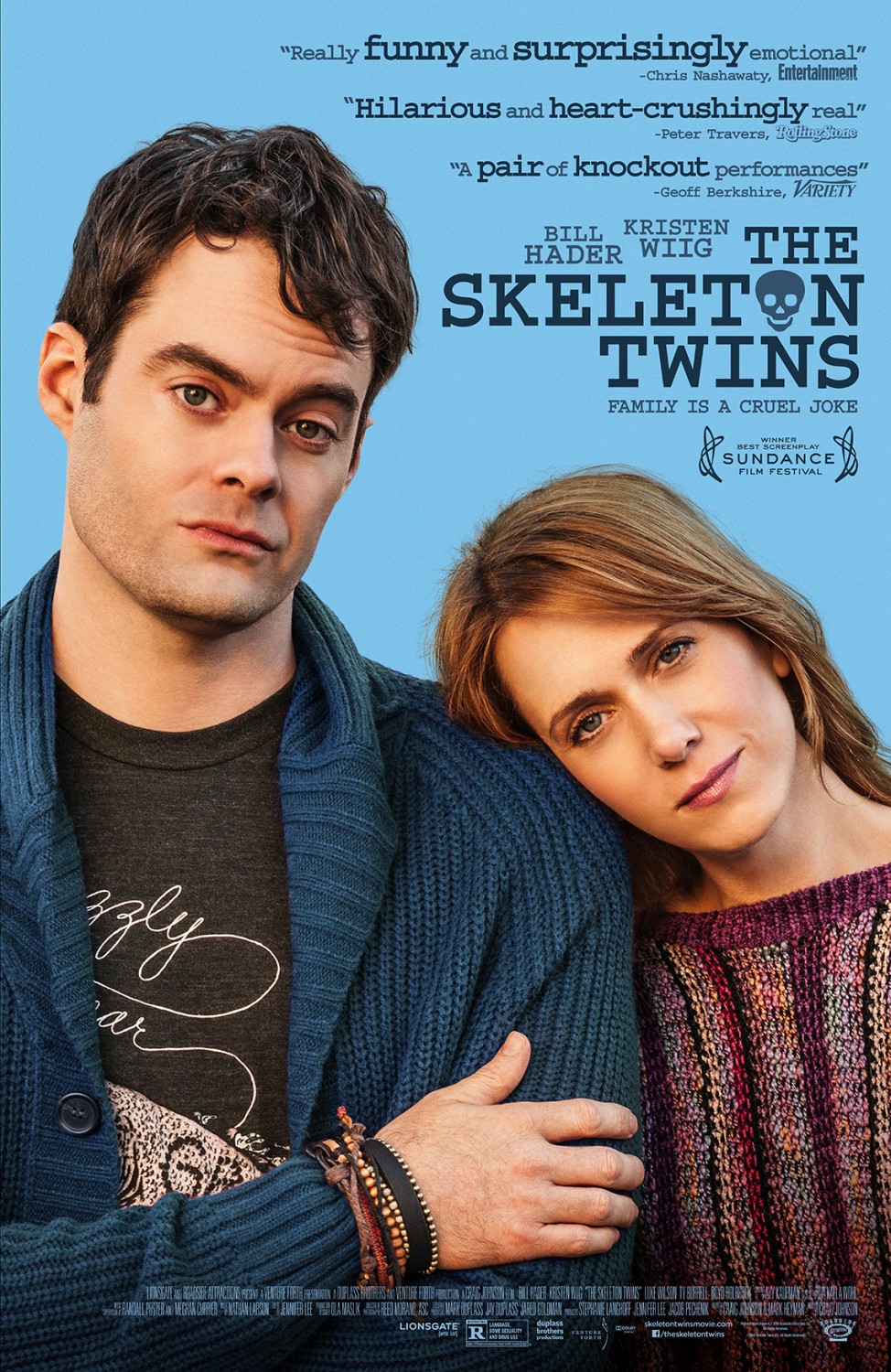
‘The Skeleton Twins’ Has ‘SNL’ Stars Doing Drama as Well as They Do Comedy

The Skeleton Twins movie poster

Okay, I think we are way past the point where we should not be the least bit surprised when comedic actors succeed in giving strong dramatic performances. Many are stunned when funny people like Jim Carrey and Adam Sandler give strong and deeply felt performances in “The Truman Show” and “Punch Drunk Love,” and it feels like these same people are saying they were fully prepared for them to really suck because they were working outside of the genre they have gained the most recognition for. After all these years, the majority of audiences still believe drama is far more challenging to pull off than comedy, but it has always been the other way around. Making people cry is easy, but making them laugh is much harder. Frankly I am far more stunned when serious dramatic actors give terrific comedic performances because lord knows they take themselves way too seriously.

I bring this up because I just saw “The Skeleton Twins” which stars two of “Saturday Night Live’s” best alumni, Kristin Wiig and Bill Hader. It won the Waldo Salt Screenwriting Award at the 2014 Sundance Film Festival, and it is not hard to see why. They play twins who were as close as a brother and sister could be until events like the unexpected death of their father tore them apart. The two bring their comedic talents to this sad tale, but they also dig deep into their roles to show us sides of themselves we have not seen, or never took the time to see previously.

When the movie starts, these characters have reached an emotional bottom they cannot seem to dig themselves out of. Milo (Hader) lives in Los Angeles where he is just another out of work actor, and he is inconsolable after his latest relationship falls apart. As a result, he sinks into his bathtub and tries to commit suicide. Meanwhile in New York, Maggie (Wiig) is about to take her own life when she is interrupted by a phone call informing her Milo has beat her to it, except of course for the fact he was saved from death just in the nick of time.

Maggie visits Milo in the hospital, and it marks the first time they have talked to one another face to face in a decade. It is an awkward reunion as neither is sure what to say to the other, and one of them has to spoil the ending of “Marley & Me” in the process. The wounds from childhood are still fresh in their minds, and their mother (played by Joanna Gleason) is no help as she has since become a new-age practitioner who refuses to recognize or even consider the pain her children have been enduring. But soon Milo and Maggie realize in order to fix their lives and let go of the past, they need to repair their relationship with one another first.

Now regardless of the above description, “The Skeleton Twins” is indeed a comedy, or perhaps a dramedy is a better way to describe it. In a lot of ways, it has to be a comedy because Milo and Maggie need to laugh about something or else everything will become far too painful to bear. But even though they look to be on the road to recovery, Milo and Maggie still have some severe road bumps to travel over which will test them and their broken faith in one another.

We learn Milo’s first love was his high school English teacher Rich (Ty Burrell), and it should go without saying it was a forbidden love which should never have taken place. Nevertheless, Milo still has deep feelings for Rich and has never gotten past what they shared. He tries to reconnect with Rich by pretending to be a successful actor, but Rich initially resents Milo’s reappearance in his life as he now lives with his girlfriend and son. But this does not deter Milo as he continues to pursue Rich for a relationship which is not the least bit realistic for either of them.

As for Maggie, she at first appears to be happily married to a Lance (Luke Wilson), and they tell everyone they are more than ready to start a family. Maggie, however, is secretly taking birth control pills behind Lance’s back and has developed a crush on her flirtatious scuba diving instructor, Billy (Boyd Holbrook), who is quite the Australian hunk (is there any other kind?). As well intentioned as she and Milo are, both are indulging in self-destructive behavior and do not fully realize the consequences of what they are doing until the damage has already been done.

Like other movies I really admire, the characters in “The Skeleton Twins” are refreshingly down to earth and relatable to where they are not much different from those we know in our own lives. Regardless of whether or not we ever had an affair with our high school English teacher or our scuba diving instructor, we have all been at that point where we feel infinitely lost to where we are unsure of how to make our lives better. Furthermore, none of these characters are painted in broad strokes. They all have various layers to their personalities, and there are no clear cut good or bad guys to be found here.

Wiig has long since proven to be a wonderful actress in “Bridesmaids” and “All Good Things,” and her work in “The Skeleton Twins” is the latest example. As Maggie, she uses her brilliant comedic skills to great effect, but she also inhabits her character more than she plays her to where we get caught up in the infinite sadness Maggie is trying to outrun on a daily basis. This is especially the case when Maggie is forced to face up to what she has done wrong, and this not easy for anyone.

But the most revelatory performance in “The Skeleton Twins” comes from Hader as Milo. Honestly, I am not surprised he is as good as he is here, but it feels like this is the first time we have seen him in this kind of role. Milo is gay, and this may lead some to believe Hader is simply resurrecting his Stefon character from “SNL” to where we will watch him go to Trash, the meatpacking hot spot where you can meet the Muslim Elvis impersonator Pierre, but he is a lot smarter than that. Hader gives a very nuanced performance throughout, and his story about peaking in high school really choked me up. No one wants to believe high school is the best time in their lives, but it may be the place where you end up doing your most memorable work.

And just as they proved over the years on “SNL,” Wiig and Hader are quite the team when you put them together. They play off each other brilliantly during the scene in the dentist’s office where they discover the benefits of nitrous oxide which allows their characters to open up in a way they haven’t in years. But that almost doesn’t compare to the movie’s penultimate scene where they lip sync “Nothing’s Gonna Stop Us Now” by Starship (or Jefferson Starship or Jefferson Airplane or whatever the hell you want to call that band) which proves to be hilariously moving. It’s never been one of my favorite songs, but this movie has me seeing it in a whole new light.

While I am at it, I do have to give credit to the supporting actors who take roles which could have been stock characters and render them as truly memorable. Luke Wilson is a delight throughout as Lance, the endlessly cheerful husband. Lance could have been completely indifferent to what his wife is going through or just a flat-out jerk, but Wilson humanizes this character to where we see he is truly a good-hearted man who wants to be there for his wife even when he does not know how to help her. Special mention also goes out to Ty Burrell who plays a character who, in real life, we would despise with an intense passion, and he makes Rich an empathetic character who is in his own way just as lost and self-destructive as Milo and Maggie are.

“The Skeleton Twins” does end on a rather abrupt note and leaves a couple of plot threads dangling in an unsatisfying manner. Regardless, it is one of those movies which had quite the emotional impact on me. It always feels like a gift when you watch a movie with characters you can relate to, and director Craig Johnson has given us just that.

Seriously, there can be no more talk of how amazing it is when comedy actors can do drama. Of course they can, and this should go without saying. Do not tell Hader and Wiig to stick with comedy because this movie shows they can do anything and everything at this point. No pun intended, but nothing is going to stop them now.

* * * ½ out of * * * *

Errol Morris’ ‘Tabloid’ is More a Love Story Than a Documentary

Tabloid movie poster

“What is a lie when every man has his own truth?”

-Clark Johnson from “Homicide: Life on The Street”

 “I like to remember things my own way. How I remembered them. Not necessarily the way they happened.”

-Bill Pullman from “Lost Highway”

 “Facts are simple and facts are straight

Facts are lazy and facts are late

Facts all come with points of view

Facts don’t do what I want them to

Facts just twist the truth around

Facts are living turned inside out

Facts are getting the best of them.”

-from “Crosseyed and Painless” by Talking Heads

The story at the center of “Tabloid” is further proof of how truth can be much stranger than fiction. It is an endlessly entertaining documentary on an utterly bizarre incident from 1977 involving former Miss Wyoming Joyce McKinney. She talks about falling head over heels in love with a Mormon missionary named Kirk Anderson, and of how he disappeared without a trace after they became engaged.

Joyce spent the next couple of years searching for Kirk, eventually finding him in Ewell, Surrey where he was working at The Church of Jesus Christ of Latter-day Saints. Desperate to be reunited with him, she flew to England determined to rescue and marry him as she sees her destiny as being with him until death separates them forever. But from there the story splinters into two heavily contrasting versions. Joyce claims the Mormon religion is a cult which brainwashed and robbed Kirk of his free will, and that he went with her willingly upon finding him at the church. However, Kirk later told police he was abducted by Joyce and chained to a bed in a cottage where she seduced and raped him.

Whatever the case, this story exploded in the press and became, as one interviewee called it, “the perfect tabloid story.” With its mix of sex and religion, this case came to be known as “The Mormon Sex in Chains Case” and “The Case of the Manacled Mormon.”

You may come out of “Tabloid” frustrated as it is not made entirely clear who is honest and who is lying, but getting to the truth is not the intention of this documentary. Morris constructed it in a way which tests who and what we believe in and how our perceptions have been molded over time by the media culture more than we ever bother to realize. It almost doesn’t matter what actually happened because the story is so weirdly captivating, and viewers find themselves wanting it to go in a particular direction regardless of whether the facts match up with that direction or not.

John Patrick Shanley was dead on correct when he wrote how doubt is a bond as powerful and sustaining as certainty. Everyone in “Tabloid” has an inescapable shadow of doubt hovering over everything they say and what they believe to be true. It’s like those “Choose Your Own Adventure” books we all read as kids. You know, the ones which tell you to turn to this page or another to where the outcome of your journey remains truly unpredictable.

Seeing the media at work on this “Mormon in Chains” case makes one realize not much has changed in their coverage of events. Back then, the public ate all the lurid details of this absurd story as it touched on those guilty pleasures we are never quick to admit we have. People like to believe they are above “trash” like this, but unconscious minds are always quick to wander to the magazine aisle in the supermarket to peek through the latest issue of the National Enquirer among other magazines which take the truth and manipulate into something wonderfully lurid. We know it is bad for us, but we cannot always keep our morbid fascination in check.

As an interview subject, Joyce McKinney is never boring for one second. At the start of “Tabloid,” she has an endearing quality which makes you want to spend all this time in her company. You will find yourself feeling for her when the world more or less threw her under a bus, and you will not be able to stop empathizing with her even after much of what she says comes into question. You can hear Morris interviewing her in the background, and every other question he asks sounds like, “Oh my god are you kidding me?!”

Still, it does at times feel like Joyce is putting on a performance for us, one which she has rehearsed for decades. Morris said she was the star of her own movie long before he started making this one, and it is easy to see how this is the case. Regardless, you will find yourself wanting to buy her story even as others come up with proof of how she lied.

With all the various facets of her life put up onscreen, you are eager to see where Joyce will take us next as it is unpredictable for those who are not the least bit familiar with this case. Even if she is lying about everything, it’s never less than interesting.

The truth these days is such a malleable thing as everyone shapes it to fit their own needs and beliefs. Others will say we are wrong or lying, but we are quick to defend what we know to be the truth. Many will convince themselves of what is true to where we can no longer be objective about the experience they had. We replay certain moments in our lives over and over again until they seem correct to us. Even Joyce says at one point, “You know you can tell a lie long enough until you believe it.”

What is great about “Tabloid” is how on top it is a love story of the most unusual kind. There is never any doubt that Joyce still loves Kirk after all these years. Even if you feel miles away from truth after watching this documentary, it is safe to say this much is certain.

* * * ½ out of * * * *


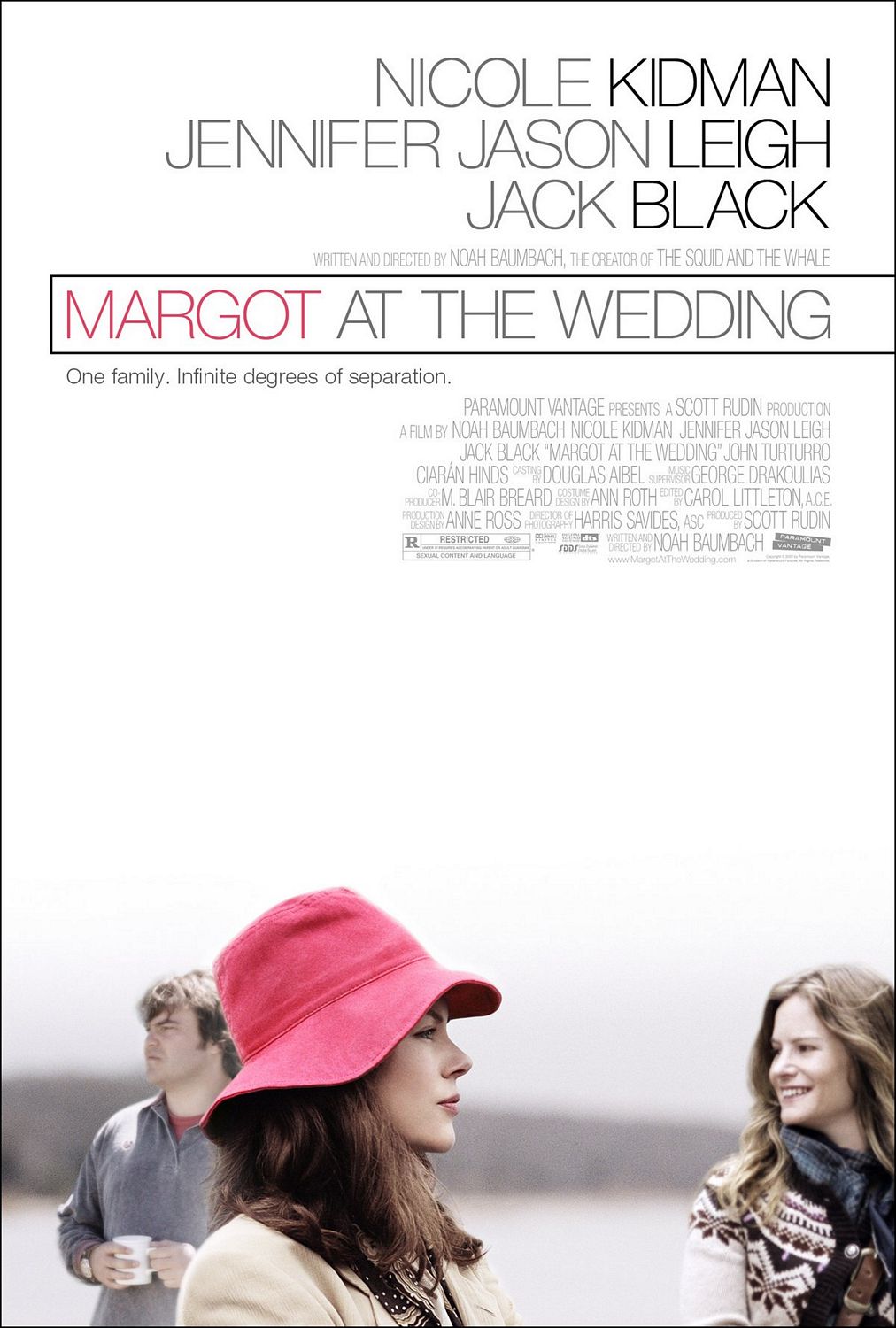
One From Noah Baumbach: ‘Margot at the Wedding’

Margot at the Wedding poster

Noah Baumbach must have had one messed up childhood. His 2005 film “The Squid and the Whale” which chronicled a divorce filled with animosity and the of effect it ended up having on the kids. In 2007 he gave us “Margot at the Wedding,” which focuses on two sisters who do their best not to explode at one another. This is sibling rivalry at its most vicious and with sly attacks throughout until the inevitable showdown where the wounds and scars reveal themselves in all of their hurt and anger. Once in a while, you will get a movie which shows the loving power of a family and how they all come together as one. This is not that movie.

Nicole Kidman stars as Margot, who is heading into the country to attend her sister’s wedding. With her on this trip is her teenage son Claude (Zane Pais) who she dotes on with increased restlessness. 2007 was a tough year for Kidman as the films she starred in, be it “The Invasion” or “The Golden Compass,” were not at as successful as they were expected to be. She was at one point the most underrated actress in movies with unsung performances in movies like “To Die For” which she was unfairly robbed of an Oscar nomination for. Following her Oscar win for her role in “The Hours,” she looked to be stumbling in movies underserving of her talent. Her performance as Margot, however, reminds you of just how brilliant and fearless an actress she can when given the right role.

Margot is a bitch with a capital B, and she is one of the most unsympathetic and spiteful characters you would ever want to see in this or any other motion picture. She is cruel to those who love and hate her, and she even reacts coldly at times to her son by saying something about his appearance which could not be any less true. Kidman tears into the role with gusto, and she never tries to sweeten this character up and make her more likable than she ever could have appeared in the script. She is fearless in her portrayal of Margot, and she even lets us see beneath the character’s cruel mask to reveal the pain her character feels inside. You never completely sympathize with her, but you do come to pity her.

Margot’s sister Pauline is played by Jennifer Jason Leigh, the former Mrs. Noah Baumbach, and it is great to see her here. Her portrayal of Pauline makes the character pitiful in a whole other way. While Margot is cold to those around her, Pauline is much more vulnerable and is skillful in the way she throws her sister’s carefully placed insults right back at her. Pauline seems to be striving for a happiness which is just out of her reach. Leigh works at keeping her cool around Kidman’s character, but you can see through her eyes that the last time these two sisters met, it resulted in a brutal confrontation which kept them apart for years. It takes a great actor to make you see things about their characters without having to tell you what they are.

Pauline is about to get married to an unemployed musician/painter named Malcolm, and he is played by Jack Black. This is Black at his most unglamorous as he portrays Malcolm as a sad sack of a man who never looks all that happy about the fact he is about to get married. His character is utterly depressed and lost about what he wants out of life. There are times where Black falls back into those mannerisms we know him best for, and they do take away from his performance at times. But for the most part, he is really good here as he is cast against type in a more dramatic role.

In many ways, this movie is a prolonged attack leading to an explosion of emotion which we can tell has been repressed for far too long. How long you ask? Years, maybe even decades. You know the first time these two sisters meet each other that there is still bad blood between them which is eventually going to spill over. They say they are no longer mad at each other, but we know this is not true. Tension fills the air as these two test one another’s patience, and they continually betray each other in their own subtle ways.

“Margot At the Wedding” is not quite as effective as “The Squid and The Whale,” and it is easy to judge the two in comparison because they deal with the same thematic elements. They deal with broken families, divorce, parental neglect, underlying feelings of anger and resentment, etc. It has been said the best directors make the same movie over and over again, be it Hitchcock or Spielberg or anyone else. Baumbach’s specialty is in the dysfunctional relationships which he was exposed to when he was young.

Either way, you will most likely come out of this movie thanking god your family relationships are nowhere as bad as they are portrayed in this movie. You think you have it bad? Wait until you watch this.

* * * out of * * * *

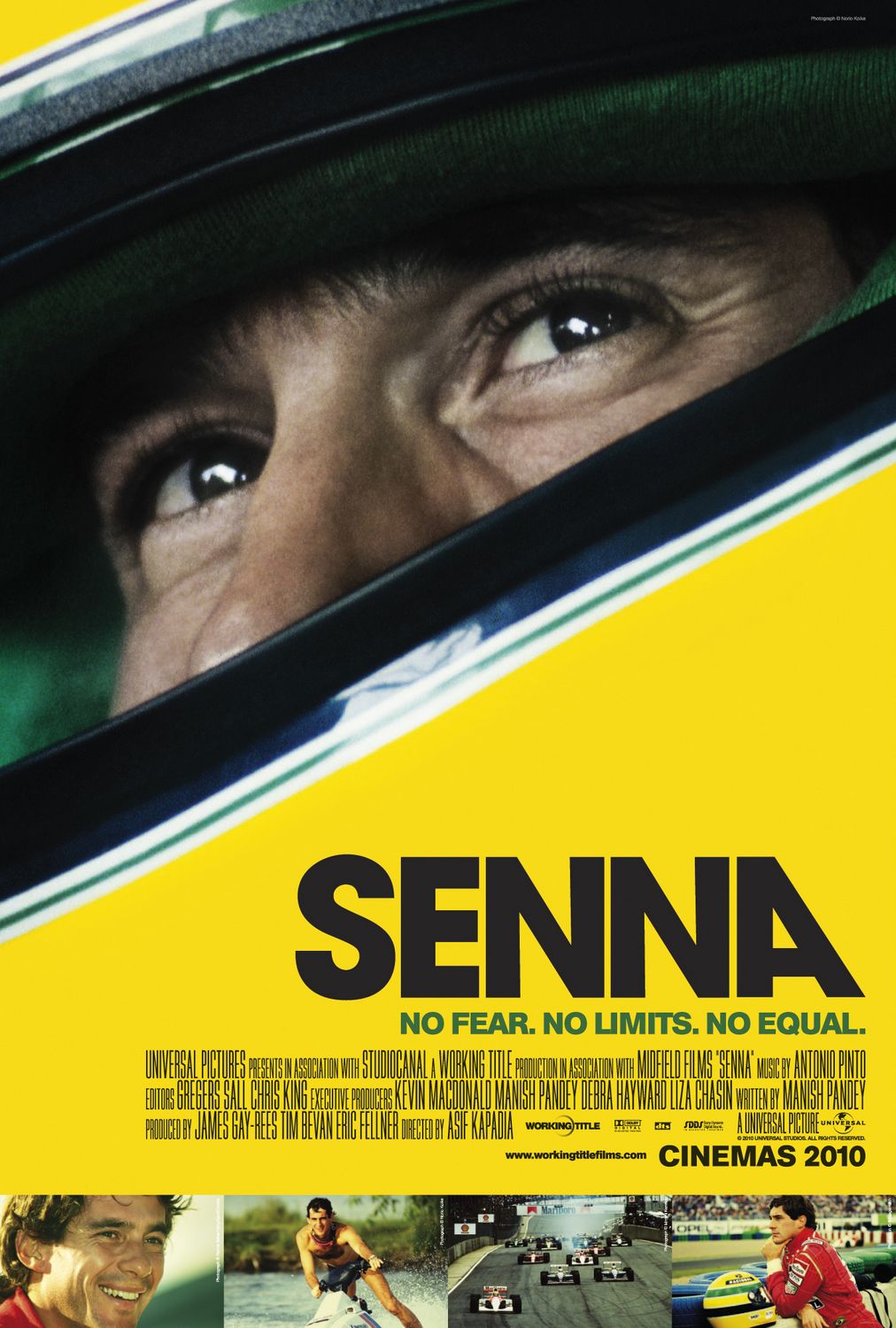
If You Like ‘Ford v Ferrari,’ Check Out ‘Senna’

Senna movie poster

To call “Senna” a brilliant documentary is not enough. You will get sucked so deeply into the life of motor-racing champion Ayrton Senna to where you will not ever feel like you are watching his life from a distance. It also shows all sides of this man to where he is shown to be complex and unlike any other race car driver in Formula One. His death during a race in 1994 still saddens many after more than a decade, and after watching “Senna” you will clearly understand why.

Director Asif Kapadia really lucked out as he had access to so much footage from Senna’s life both in and out of cars. We have racing footage of course, but there is also home video footage showing him to be a sublime individual and a genuinely nice guy. Kapadia succeeds in making “Senna” feel like we are spending time with a friend and not just another racing superstar.

Compared to others in racing, Senna comes across as being surprisingly humble and shy. No matter how many championships he won, fame never seemed to go to his head, and this is saying a lot. His personality ends up getting contrasted sharply with his fellow racer Alain Prost, and their intense rivalry becomes a big focus here. Prost comes off at first as being very full of himself, particularly while he is being interviews by a female journalist, and we come to see how his biggest strength is also Senna’s chief weakness: mastering the politics of Formula One. It becomes hard not to be on Senna’s side as their rivalry becomes increasingly bitter. While Senna proves to be ruthless on the race track, he is deeply spiritual and not ignorant of the fact he is as mortal as anyone else.

The racing sequences are exhilarating as we watch Senna do things with a race car no one else could. His brilliance while driving in the rain made him especially unique in Formula One, and it is astonishing to learn he never got hurt while driving in this weather. His donations to improve the conditions in Brazil never feels like a publicity stunt, but instead proof of how fiercely loyal he was to his native country.

But the documentary’s most unnerving sequence occurs a day before Senna’s tragic death when fellow racer Roland Ratzenberger was killed on the exact same track at the 1994 San Marino Grand Prix. Senna becomes deeply upset at what has happened and vows to improve safety on all race courses, something he sadly never got to live to carry out. Watching it feels very eerie as we know the fate which awaits him, and even then, we find ourselves hoping and praying for a different outcome.

What makes “Senna” unlike your average documentary is while most are far removed from their main subject, Kapadia brings you up close and personal. Throughout its running time, Ayrton Senna is alive and not just another dead racer forever relegated to the past. It does not matter in the slightest if you are a fan of car racing or not. “Senna” is as enthralling as the best racing movies ever made as you experience it more than watch it, and it gives us a great respect for this racer even as it leaves us very sad that he left us at such a young age (he was only 34). But seeing him here alive once again gives us a great opportunity to know a man many of us never got the chance to in real life.

So, if you liked “Ford v Ferrari,” be sure to give this one a look. And if you did not like “Ford v Ferrari,” see “Senna” anyway.

* * * * out of * * * *

WRITER’S NOTE: Another great documentary by Asif Kapadia, and it is as great as this one, is “Amy” which serves as a much needed eulogy to the late singer Amy Winehouse.

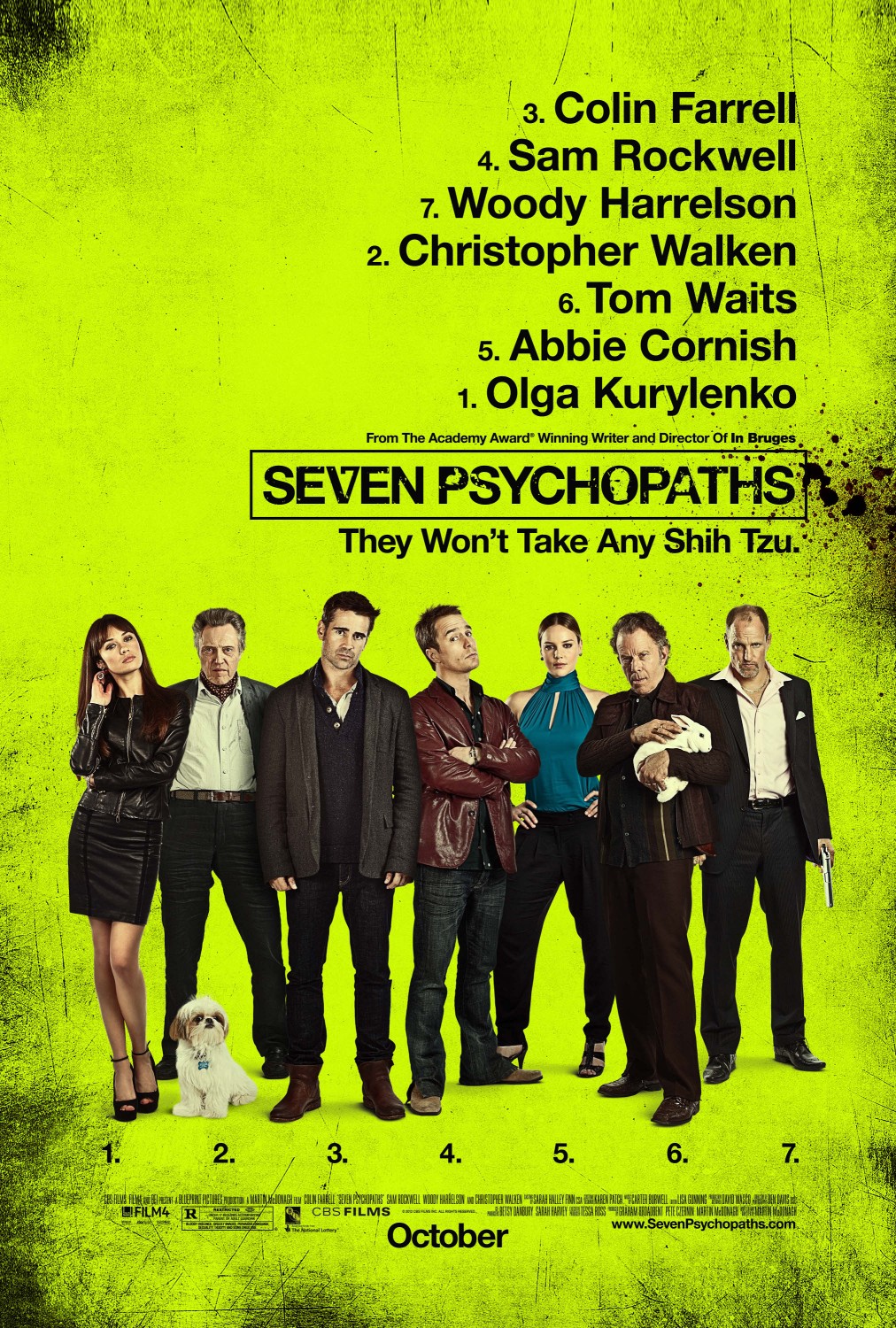
‘Seven Psychopaths’ Lays Waste To Many Action Movie Cliches

Seven Psychopaths movie poster

Leave it to playwright and filmmaker Martin McDonagh to find ways to skewer those endless clichés we keep seeing in action movies. Seriously, it feels like so many directors outside of Quentin Tarantino have tackled them to where we are completely burned out on films which try to show how clever they are in taking apart clichés which have long since been torn apart time and time again.

McDonagh’s film “Seven Psychopaths” appears to be another one of those satirical and incredibly violent action movies on the surface, but underneath it all is a surprisingly moving story about friendship. Now I can already hear a lot of people telling me how using violence to tell a story like this is utterly hypocritical, but they are clearly not aware of McDonagh’s plays like “The Pillowman,” “The Lieutenant of Inishmore” or “A Behanding in Spokane,” and they clearly have not seen his previous movie, the brilliant “In Bruges.” All those works do have a high level of blood and violence in them, but they are not simply designed to shock people. Instead, McDonagh uses those elements to get at a deeper truth about life and the people closest to us, and this is not always apparent to those who view his work from a distance.

The movie stars Colin Farrell as Marty Faranan, a struggling writer who is eager to finish his screenplay which is also titled “Seven Psychopaths.” The problem is he spends far more time getting drunk on wine and beer than he does in writing anything. So far, the only idea Marty has come up with is a Quaker psychopath who finds an interesting way to follow someone to the afterlife (I won’t dare give it away here). His actor friend Billy Bickle (Sam Rockwell) is eager to help him, but he is caught up in his part time business of dog kidnapping with his partner Hans (Christopher Walken). With this business, they cleverly managed to abduct dogs, and then they return them to their owners for a reward.

One of the dogs Billy kidnaps, however, turns out to be a Shih Tzu named Bonnie which belongs to Charlie Costello (Woody Harrelson), a vicious gangster who has far more love for animals than he does for humanity. This forces Marty, Billy and Hans to go on the run as Charlie and his henchmen will stop at nothing to get little Bonnie back. While making their getaway, they come to look at what has become of their lives and of how they need one another’s friendship to survive in such a competitive world.

Now combining comedy with violence (and we are talking very bloody violence here) is never an easy mix as it often feels uneven in most movies which attempt it. Bobcat Goldthwait tried it earlier this year with “God Bless America” which had its two main characters going on a crime spree in which they killed off various spoiled rotten celebrities with extreme prejudice. While Goldthwait mostly succeeded with that film, he was walking a thin line between success and failure as his subject matter proved to be very controversial.

McDonagh has it a little easier than Goldthwait though as, while the struggles of these Hollywood wannabe characters does feel a bit realistic, the story has him dealing with a number of seriously deranged characters, all of whom seem comfortably removed from reality. And as he did with “In Bruges,” McDonagh does a wonderful job of combining some laugh out loud moments with scenes of strong emotion. As a result, you never are sure what exactly will happen from one scene to the next.

In movies like these, Colin Farrell appears to be having the most fun as an actor. After appearing in the needless remake of “Total Recall,” he fares much better as a writer who is afflicted with self-doubt and is not always the nicest person to be around. But the joy of watching Farrell here is seeing his character grow as a person right up to the film’s conclusion, and he is much better at accomplishing this than many typically give him credit for.

Watching Sam Rockwell as Billy Bickle once again reminds us how he is a powder keg of creativity and is as unpredictable as most actors get these days. Rockwell is endlessly entertaining as his character takes some interesting twists and turns throughout the movie, and he almost steals the show as he performs for Farrell’s and Walken’s characters what he thinks is the best climax of an action flick ever. The audience I saw this with at Arclight Hollywood ended up applauding him when he was finished, and you do not always see this happening in a movie theater.

Then there is Christopher Walken who still appears to be going back and forth from being a brilliant actor to one who engages in self-parody a bit too much (“I gotta have more cowbell!”). But as Hans, Walken gives one of his very best performances in a long time as he perfectly captures the character’s giddiness at how he makes a living to unveiling a deep pain which he can no longer hide when tragedy overtakes his life. All the way up to his last moment onscreen, Walken is a marvel and a thrill to watch.

Woody Harrelson himself has been on a roll in movies for the past few years, and his performance as Charlie Costello is absolutely inspired. You come out of “Seven Psychopaths” feeling like Harrelson was born to play this role, and this is saying something when you consider Mickey Rourke was originally cast as Charlie before he had some sort of falling out with McDonagh. But this character brings out that wonderful comic touch Harrelson consistently gave off in “Cheers” and “White Men Can’t Jump,” and it also showcases the uninhibited darkness which he unforgettably portrayed in “Rampart” and “Natural Born Killers.” Harrelson can go from being funny to frightening in zero seconds flat, and you do not even have to be a pesky paparazzi photographer to see this.

There are also some terrific turns from Kevin Corrigan and Željko Ivanek as two of Costello’s hoods, and Tom Waits is wonderful in a supporting role as a remorseful psychopath. The movie is also aided by a great film score by Carter Burwell, an excellent production design from David Wasco, and some beautiful cinematography from Ben Davis.

The only place “Seven Psychopaths” falters is in its use of female characters. Abbie Cornish portrays Kaya, Marty’s girlfriend, and she gets very little to do here other than get insulted by Marty and Billy and look pretty pissed off about it. While Cornish does look beautiful when she is pissed, we all know she is capable of much more.

Olga Kurylenko also shows up as Costello’s girlfriend, Angela, and she is a wonderful presence as well but has also been given a role which is smaller than she deserves. Gabourey Sidibe of “Precious” fame fares a little better as Sharice, the girl who accidently loses Costello’s beloved Shih Tzu, but this role is meant as nothing more than a cameo. But considering Cornish and Kurylenko get top billing, you cannot help but expect them to have better characters to play here.

Still, “Seven Psychopaths” is a very entertaining movie and a must for any fan of McDonagh. Yes, it is violent and plays around with all those things which keep getting repeated ad nausea in action movies, but it also is about wanting something more in a story than just guys with guns. I will leave it up to you the viewer to see how McDonagh accomplishes this here.

Also, it will also leave you wondering about the following question: does a human head explode if you shoot it in the right spot? This same question was asked in Edgar Wright’s “Hot Fuzz,” and inquiring minds are still looking for an answer.

* * * ½ out of * * * *

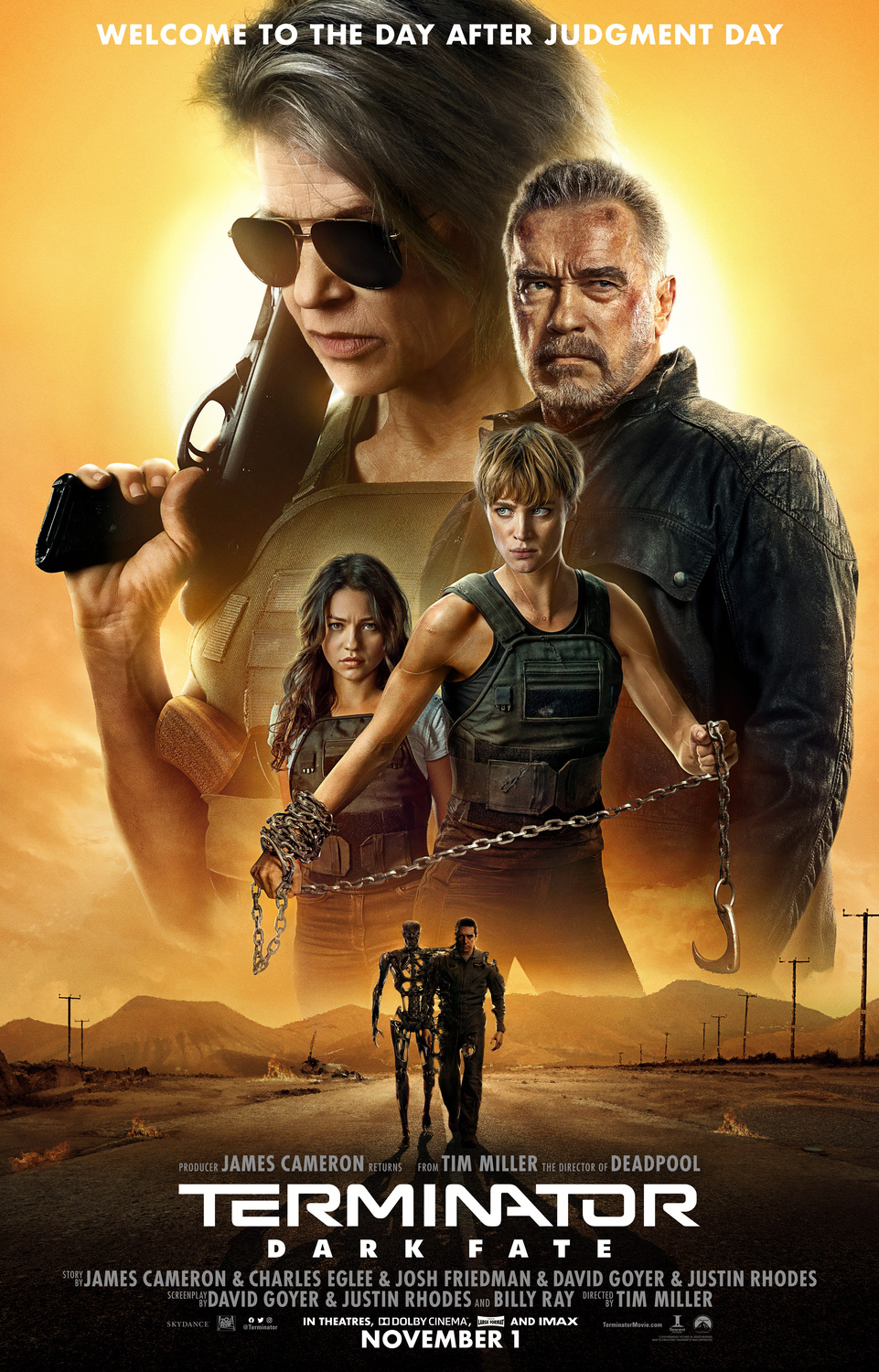
‘Terminator: Dark Fate’ – Seriously Folks, The Thrill is Gone

Terminator Dark Fate theatrical poster

Hollywood is one the few places on this planet where you can look at $29 million dollars and say, that’s it? This was the reaction many had when the opening weekend numbers of “Terminator: Dark Fate” were revealed to the world, and to say they were below expectations is putting it mildly. Many will pontificate over why this sixth installment bombed at the box office, but I think it comes down to the inescapable fact that the “Terminator” franchise has long since lost its capacity to wow and thrill us in the same way the first two movies did, and even series creator James Cameron, who returned to executive produce this sequel, cannot put it back together again. While you can retcon the hell out of “Halloween” to keep it going, “Terminator” is now way past the point of self-termination.

I finally got to check out “Terminator: Dark Fate” after finding some time to tear myself away from work as I was not going to let anything deter me from seeing it on the big screen. The truth is, it is not a bad movie and it has a good story and a game cast of actors who bring their all to the material. But it does not take long to see this sequel tread familiar ground as the story remains the same even if the major players have changed, and the feeling of déjà vu is more prevalent than ever before.

“Dark Fate,” as you all know by now, is a direct sequel to “Terminator 2: Judgment Day” and it ignores all the other movies which followed it. The movie begins with Sarah Connor suffering a tragedy much like the one Ellen Ripley suffered at the beginning of “Alien 3.” While she and her son were able to stop Judgment Day, they could never stop fate. The movie then jumps ahead 22 years when an advanced Terminator called the Rev-9 (Gabriel Luna) appears in Mexico City with a mission to kill Daniella “Dani” Ramos (Natalia Reyes), a young woman who works at an automobile industrial plant. But when Dani arrives at work, she finds her job is being taken over by (surprise, surprise) a machine.

Another person arrives from the future, and her name is Grace (Mackenzie Davis). At first she appears human, but then she is shown to have superhuman strength and fighting abilities much like the average Terminator, and seeing her kick human ass is quite the sight. We later learn she is indeed human but has been augmented to become more like a cyborg, and her mission is to protect Dani from Rev-9 as Dani is set to play an important role in the future.

Sound familiar? Of course it does because this was pretty much the plot of the first two “Terminator” movies. Part of me wants to forgive this as it sets up how Skynet was completely destroyed and has since morphed into another artificial superintelligence system called Legion, and this shows how history, more often than not, repeats itself. Heaven forbid we ever learn from our mistakes, you know? We are certainly reliving a past we have not learned from right now as certain impeachment hearings have a certain Nixon feel about them. Like Snake Plissken once said, “the more things change, the more they stay the same.”

But while the first few minutes tread very familiar ground, “Dark Fate” really comes to life when Linda Hamilton enters the picture as an older but still battle-ready Sarah Connor. It is the first time Hamilton has appeared in a “Terminator” movie in 28 years, and it is great to have her back as she makes this iconic character of hers as badass as ever, and she has some terrific dialogue to boot. With her face weathered from years of struggle and loss, Hamilton quickly reminds us how brilliantly she embodied this character all those years ago, and with the character evolving to another level here, she shows how one with such a hardened heart can rediscover their humanity even after suffering the worst life has to offer.

And yes, Arnold Schwarzenegger is back, and he gets to take his iconic character of the T-800 in yet another interesting direction. In “Terminator: Genisys,” he played the cyborg as one who has existed long enough to where he is no longer under warranty. In “Dark Fate,” this T-800 starts off as a cold-blooded assassin who, after a particularly shocking act, ends up developing a conscience and even becomes domesticated. Schwarzenegger gives another inspired portrayal here as he plays it straight and never for laughs, and this makes his performance all the more enjoyable. It is not the first time he has given a terminator this much heart, but his work here is particularly moving in a way it has not been for some time.

Mackenzie Davis, so luminous in “Tully,” is a powerful presence as Grace, and there is no doubt she gave her all in this role as watching her dominate the action scenes here is both physically and emotionally exhausting, just as it should be. Natalia Reyes does strong work in taking Dani from being an innocent person thrust into a situation no one could see coming to someone who accepts a role she is expected to fulfill. As for Gabriel Luna, he is good as Rev-9, but he is nowhere as menacing as Robert Patrick was as the T-1000.

Directing this installment is Tim Miller who helmed the first “Deadpool” movie, and he certainly has an interesting visual style which benefits this franchise to a point. At the same time, he is not able to bring the same visceral energy Cameron brought to the first two “Terminator” movies. Looking back, none of the other directors were able to either. Some came close, but Cameron is a rather unique filmmaker as he has given us some of the most exhilarating and adrenaline-pumping motion pictures we could ever hope to watch, and his vision of “The Terminator” is a personal one which no one can easily duplicate.

“Terminator: Dark Fate” simply feels like the same old thing with little in the way of anything new. It’s not a bad movie and it definitely has its strengths, but it serves as proof that this franchise has truly hit a dead end and really needs to be put to rest. The last few “Terminator” movies have come to us with the promise of a trilogy and of filmmakers more or less telling us that, this time, we are going to get it right. Well, this is the latest installment to see its hopes for a trilogy dashed yet again as Arnold’s dialogue of “I won’t be back” proves to be quite prophetic.

Still, we do learn of one advantage of being a terminator which the other movies never showed us: they can change diapers without complaining. If this does not impress you, what will?

* * ½ out of * * * *