The late Roger Ebert proclaimed Ramin Bahrani director of the decade on the basis of his movies “Chop Shop” and “Goodbye Solo,” both of which came out in the 2000’s. His films have received tremendous critical acclaim and numerous awards from one film festival to the next, and this streak does not look to stop with his latest movie. “99 Homes” stars Andrew Garfield as an unemployed contractor who is unjustly evicted from his home and Michael Shannon as the real estate magnate who kicked him out of it and who eventually becomes his mentor in the art of home foreclosures. It’s a thriller which is unsettling as it is heartbreaking as it calls attention to the housing crisis which swept the nation and those cold-hearted and greedy men who profited greatly from it.
Bahrani gives us a story which hits close to home as it contains agonizing scenes of Garfield and his family being given only a few minutes to pack up all their belongings and leave their house. He makes you feel the searing discord between the haves and have-nots as it’s open season on homeowners who have no chance of defending what is rightfully theirs. But when Garfield comes on board with Shannon, he finds a way to dig himself out of his financial black hole so he can get back his house. But as Garfield gets deeper and deeper into Shannon’s world, he starts losing his ethical and moral bearings as he starts to others what was done to him.
Bahrani was at the Four Seasons Hotel in Los Angeles, California to do a press conference on “99 Homes.” I was one of the reporters there and told him the movie seemed to be as much about survival in an economically shaky world as it is about greed and home foreclosures. When I asked him what he felt “99 Homes” had to say about surviving in this crazy world the characters inhabit, he said the following:
Ramin Bahrani: “One of the scenes I really like, for me it was like something from Dostoyevsky in my mind, was when the two men sit at the dock at night. And I remember Michael (Shannon) came up to me and said, ‘Ramin, is this the important line in the scene?” I told him, ‘Michael, this is the important line in the whole movie.’ And that’s after Michael tells Andrew (Garfield) that he carries a gun even at two o’clock in the morning because he was almost run off the road one time when he goes to dinner with his family and all this stuff, and Andrew says, ‘Is it worth it?’ And Michael looks at him and says, ‘As opposed to what?’”
It’s a haunting question which left the reporters at the press conference speechless, and it’s one of the many reasons why you must see “99 Homes” which is now available to rent and own on DVD, Blu-ray, and Digital.
Having escaped “The Amazing Spider-Man” universe intact, Andrew Garfield gives one of his best performances to date in the tense and timely thriller “99 Homes.” In it, he plays Daniel Nash, an unemployed contractor and construction worker who gets evicted from his home along with his mother Lynn (Laura Dern) and son Connor (newcomer Noah Lomax). In an effort to get his home back, Daniel ends up working for real estate magnate Rick Carver (Michael Shannon), the same man who evicted him and his family, and in the process, he becomes Rick’s protégé and learns how to work the housing market to make a lot of cash. This leads to Daniel making more money than he ever dreamed of, but considering what he’s doing to others what Rick did to him, this newfound wealth is coming at a high moral price.
“99 Homes” is an urgent thriller which demands your attention as it deals seriously with the housing crisis which erupted in America in 2010 and the insatiable greed that followed. Garfield makes Daniel into a very empathetic character, and it’s hard not to feel bad for him even as he makes a Faustian bargain to get his house back. You share in Daniel’s fury at being evicted so unjustly, and you root for him even as he becomes more and more ethically bankrupt. Some will call Daniel a traitor while others will see him as just another guy trying to survive in an increasingly insane world. In the end, we have to ask ourselves what we would have done if we were in his situation.
Garfield was one of several cast members who appeared at the press day for “99 Homes” which was held in Los Angeles, California at the Four Seasons Hotel. I pointed out that while this movie is about money, greed, and ethics, it is also about survival and what we are willing to do to keep a roof over our head and food on the table. I asked Garfield what he felt “99 Homes” said about survival, and he answered my question in a very personal way.
Andrew Garfield: I betray myself every day. I betray myself in small ways, in big ways in order to fit in, in order to be accepted and in order to stay on the path I think I’m supposed to be on. I feel afraid a lot as well in the modern world. I feel a lot of fear about instability to be honest. I don’t feel a great foundation in our culture as of now. I think there are great things happening, there are soulful things happening usually on the outskirts, but it takes a great deal of treasure hunting to find those things or find something that’s deep and meaningful. I’m so grateful and lucky. Thank God for storytelling and thank God for this medium of storytelling because without this I would be lost, I know I would be. This is a big part of survival for me that I get to give myself to something that feels meaningful. And that’s why, when a story like this comes along, it’s really impossible to say no because it’s very rare, the essence of what this story is. That’s my very shallow answer to a very difficult question.
To be honest, it didn’t sound like a shallow answer at all, and it’s not hard to see how Garfield put all his heart and soul into this project. It should go without saying there’s much more to this actor than him playing Spider-Man, and we should expect to see more great performances from him in the future.
“99 Homes” is now available to own and rent on DVD, Blu-ray, and Digital.
“The Unbelievably Sweet Alpacas” is one of 20 short films which make up “We the Economy,” a series that uses innovative story techniques to give us a better understanding of the U.S. economy. This particular short film was directed by Adam McKay, best known for directing the “Anchorman” movies, “The Big Short” and for co-founding the comedy website “Funny or Die,” and it’s an animated short film and a thinly veiled parody of all those “My Little Pony” cartoons children are still crazy about watching. It takes place in a magical land filled with long-lashed, multi-colored Alpacas who love lollipops, rainbows, and friendship, and they have just graduated from school and are looking to get well-paying jobs in the business world. But once they are made aware of the sharp divide in wealth distribution which mirrors America’s, the growing evidence of inequality gap makes them turn against one another with hilarious results.
A press day for “We the Economy” was held at the London Hotel in West Hollywood, California, and McKay was one of the directors who attended it. “The Unbelievably Sweet Alpacas” is not only the funniest short film in this series but also one the most informative. McKay said the inspiration for it came in part from his kids watching “My Little Pony” cartoons all the time, but another one came from an unexpected source.
“There was actually a documentary about the richest building in New York City on Park Avenue, and it was made by Alex Gibney and it was called ‘Park Avenue (Money, Power and the American Dream),’” McKay said. “He describes how the children of the super billionaires would always come through the lobby and be so friendly with the doorman, and the doorman would go, ‘How was your soccer game?’ And then the doorman described how one day when they were like 11 or 12, the light just went off. It was like someone had told them you were different and they no longer connected with the doorman. The guy was talking how sad that is, and so I think just vaguely that was in my mind that when you’re a kid, these differences don’t mean anything. And then when they become real, all of a sudden you’ll notice all the alpacas start fighting with each other and they’re no longer friends. So yeah, I think we’ll give Alex Gibney credit for that.”
Making this short film also proved to be very educational for McKay as it made him fully aware of just how bad income equality is in the United States.
“I was shocked,” McKay said. “I came in knowing that the U.S. had a problem with income inequality, but I didn’t know just how bad it was and that our upward mobility was so stagnant and that it’s actually not that great in the U.S. I was shocked about the numbers about the middle class. Our middle class has almost completely evaporated. I knew we were bad, but then when I worked with Adam Davidson and looked at the actual numbers… Damon actually contacted us and was like, ‘I think there was a mistake made when you said 50% of the wealth went to the top .1%.’ We’re like, ‘No, that’s not a mistake.’ And I had the same reaction he did which was like, that’s gotta be a typo.”
“I didn’t know that we are by every definition of the word in the U.S. an oligarchy. I had no idea that that was the case,” McKay continued. “A strict definition of oligarchy, that is the U.S. more so than Russia or China than any country you can think of. It’s a little depressing but at the same time a good opportunity to let people know about these numbers.”
One of the images which really stood out in my mind was when the Alpacas are shown a portrait of a company CEO who is shown holding a copy of Ayn Rand’s “The Fountainhead.” For the record, I have not read any of Rand’s books, but her name has been coming up a lot even though she died back in 1982. There were three movies based on her book “Atlas Shrugged,” the first which was a critical and commercial flop, and yet the filmmakers still made a pair of sequels to it. John Oliver even did a segment about her on “Last Week Tonight” as he wondered why she was still considered relevant. I had to ask McKay why this book was so prominently featured in the portrait, and he helped school me in what Rand was really about.
“She was a refugee of Communist Russia, so she had been given the hard boots,” McKay said. “I think she was a fun partier supposedly so she hung out with the billionaires and was like fuck everyone else, let’s have a good time. She had seen the overreaction of the Communist Revolution so she was an extremist in the other way, and then you have these guys with dynastic wealth who have inherited millions of dollars who kind of feel shitty about it. And then here’s a woman telling you, let’s go have a big sex party and you shouldn’t feel shitty about having your money. She’s perfect for the Koch Brothers and it’s like she’s their bible because, otherwise, they’re going to have to give away a lot of their money, and they don’t want to do that.”
“Ever since I’ve been in college, I’ve always been having arguments with the Ayn Rand devotees,” McKay continued. “My point on Ayn Rand is she’s always been a bad writer. John Milius is a big right-winger, but the guy can write (remember Robert Shaw’s famous U.S.S. Indianapolis speech from “Jaws?”). You can be a right winger or whatever you want to be, just don’t be a shitty writer.”
“It’s funny because she becomes more important the more you get income inequality in our country, and the more billionaires you get the more her name comes back into the public,” McKay said. “In the 50’s and 60’s, she was fringe. The interview with Mike Wallace with her was like she was a cuckoo bird, and it is only now that our country’s kind of a little bit broken that suddenly she’s back in the mainstream.”
“We the Economy” is now up and running, and it has proven to be a clever and innovative way to teach us more about the U.S. economy. Be sure to check the website, and you can view “The Unbelievably Sweet Alpacas” below.
Jeff Nichols’ “Loving” is a beautiful movie from top to bottom as everyone involved in its making did an expert job of transporting us back to the 1950’s and 60’s. Based on a, yes, true story, it introduces us to Richard Loving (Joel Edgerton) and Mildred Jeter (Ruth Negga) who are deeply in love with one another. They eventually get married, but with Richard being white and Ruth being black, they are arrested and put in jail as their interracial marriage violated Virginia’s anti-miscegenation laws. As punishment, they are banned from returning to Virginia for 25 years and forced to live in Washington D.C., but they soon sue the state and their case eventually made it all the way to the Supreme Court where it was ruled banning interracial marriage is unconstitutional.
I recently got to speak with two artists who worked on “Loving” behind the scenes: Kenneth Walker and Julie Lallas. Walker was the head of the hair department, and his previous credits include “Jimi: All is By My Side,” “Munich” and Ridley Scott’s “American Gangster” which he described as the hardest film he ever worked on. Lallas headed up the makeup department and worked with Nichols previously on “Take Shelter,” and she has also worked on the set of “Enchanted,” “Nick & Norah’s Infinite Playlist” and “We Need to Talk About Kevin.” Talking with them both was very illuminating in terms of how they went about their jobs, and it also allowed me to ask them if they want their work to be showy or to instead just disappear into the framework of the movie.
Check out the interview above, and also included below is a trailer for “Loving.” Nichols’ movie is now playing in Los Angeles and New York, and it is definitely worth checking out.
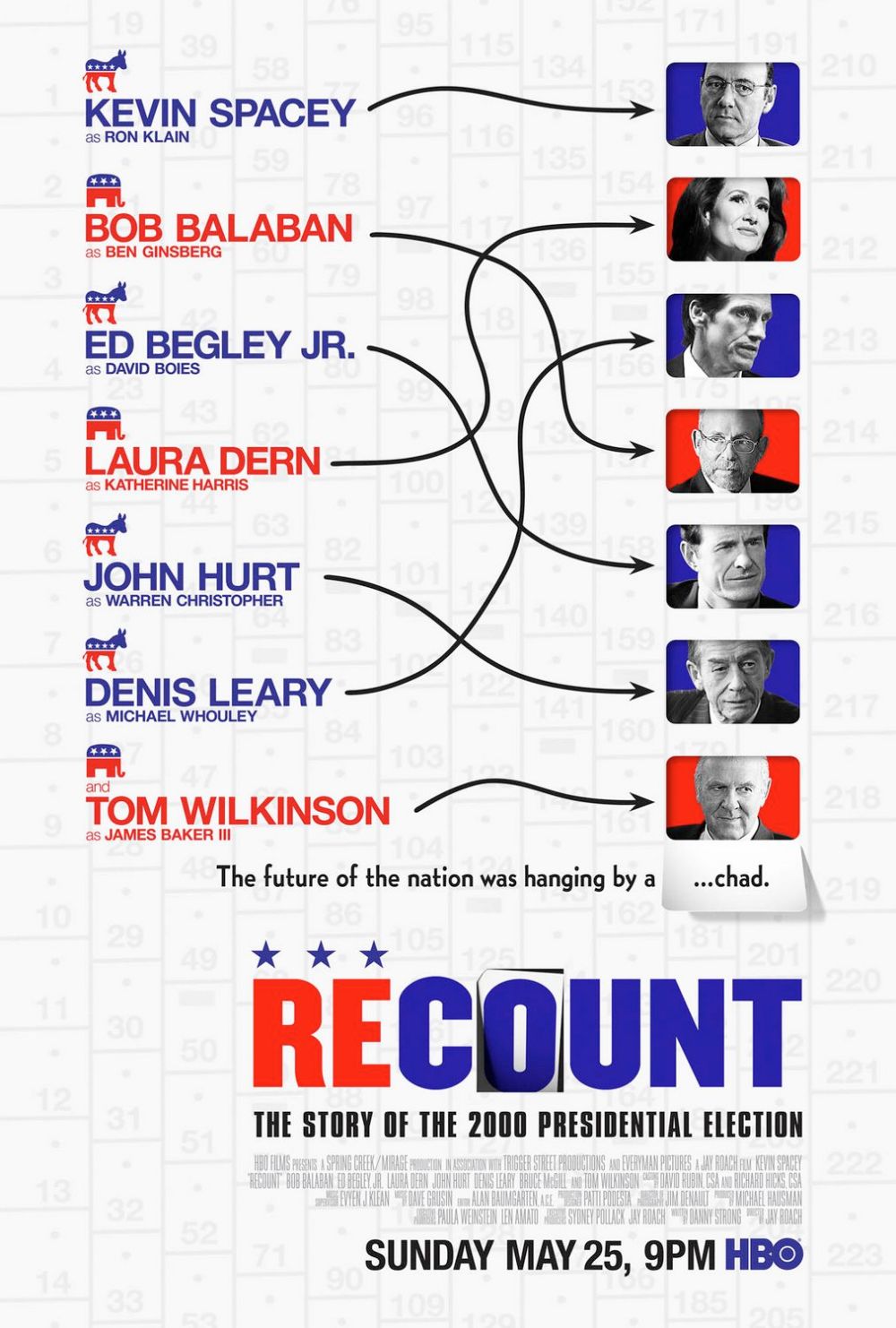
Memories of hanging chads and confusing ballots permeate our consciousness years after the heavily contested 2000 presidential election between Al Gore and George W. Bush. We saw this played out on the networks with all their furious coverage, but with “Recount” we get a look at what went on in the campaign offices while this election fight went on to get a picture of what they each felt was fair and just.
How you view “Recount” may depend on what side of the political spectrum you have placed yourself on. I’m not sure how accurate this movie is to the real events, but I imagine it is pretty close. Coming out of it, you may feel it values one candidate over the other. But in the end, “Recount” is not so much a movie about the fight to get candidates elected as it is about the fight for democracy. It is a fight for all the voters to be heard, and also a scary tale of how the fate of the Presidency can end up in the hands of a powerful few instead of America as a whole. Hopefully, this is something that we all collectively hope we never have to live through again.
“Recount” was directed by Jay Roach, best known as the director of the “Austin Powers” movies. Here, he directs a large cast of superlative actors who take the roles of many people we know well from the 2000 election and gives us a strong case of why many still thank Al Gore was robbed of the Presidency. Both Gore and Bush are basically supporting players here, and we only see them from the backs of their heads or in news footage of them during the campaign. The movie is more interested in what went on behind the scenes of the election and of the different fights made to get to the truth of who won the Florida electoral votes.
Even though we all know how this ended up and who got elected, the movie is still riveting in the same way “Apollo 13” was. The filmmakers are not so much interested in the general way things happened as they are in the specifics of the election. We see brilliantly shot examples of how chads in ballots could not be broken off as they were designed to. The opening shot of the movie shows how easily confused some Florida residents are when they are trying to vote, and yet it is not altogether clear how to vote for Gore so that you don’t accidentally vote for Pat Buchannan. The moment where one of Gore’s campaign workers rushes up to him before he is about to make his concession speech on the night of the election is scary as we all feel like we are running alongside him. Even after all these years, we have a strong emotional reaction to the thought of Gore conceding the election.
At the head of this star-studded cast is Kevin Spacey who gives one of his best performances as Ron Klain, Gore’s legal advisor on the campaign trail. The day before the election, it is presumed Gore is going to win, and Klain is offered a job in Gore’s new administration. Klain ends up turning it down as he feels it is not the way he wants to spend the next eight years of his life. But when it becomes clear there are clear inconsistencies in the voting in certain Florida counties, Klain goes right into action to make sure all the votes are recounted, as the margin of victory is only off by just over a thousand votes. Klain is aided by a large team of political strategists from Michael Whouley (Denis Leary) to Warren Christopher (John Hurt).
Spacey makes it clear from the start that Klain is an idealist more than anything else about the way the political system works. What he does throughout the movie is not motivated by his desire to see Gore become President, as he even admits he is not even sure he likes Gore, as it is by the desire to see all the votes counted and to not have any of them thrown out for different reasons like those rejected ones which contain the similar names of convicted felons. Because the election was so close, we can see in Spacey’s eyes how this election is much too important for anyone’s vote to be cast aside.
We also get great performances from actors like Ed Begley Jr. who plays David Boes who passionately fought for the recount to continue when testifying at the Supreme Court. Another great one comes from the always reliable Tom Wilkinson (“Michael Clayton”) who plays James Baker who fights on behalf of George W. Bush to turn the election his way. Wilkinson plays Baker as being idealistic in his own way, and he is almost as idealistic as Klain is for the democrats. Bruce McGill is also great here as Republican lobbyist Mac Stipanovich who is brought in to persuade Florida Secretary of State Katherine Harris to stop the recount.
Speaking of Katherine Harris, who by the way wanted nothing to do with “Recount,” she is played here in a brilliant performance by Laura Dern. With makeup, which brings up harsh memories of Faye Dunaway in “Mommie Dearest,” Dern gives us a Katherine Harris who is not dumb, but who is oblivious to what is going on around her. Harris says she is following the law, but never really questions those around her as to what their true motives are. Dern is one of the best actresses working today, and this movie is a good reminder of this fact.
The other thing to note about “Recount” is how the actors do a great job of inhabiting their roles as opposed to impersonating people we have become all too familiar with. The trap of playing real life people is many actors end up playing them from the outside in instead of the inside out. It takes a group of well-trained actors to play these roles, and who are not mere impressionists or mimics. Mimicry is a cool art, but it doesn’t work in a movie like this one.
Roach does a great job of putting us back in the year 2000, and he makes you a witness to all the events to where even though you know how this race ended, you still hope and pray for a different outcome. He also shows how each candidate has to be grateful for the dozens of people and hundreds of supporters who helped them get to where they ended up. The truth is we haven’t had many movies recently which have looked at the people who work so hard for the politicians they support, and these people need to be thanked for all they do. They can’t stay behind the scenes forever. They need to be seen for who they are.
In the end, “Recount” is not so much a movie about how Gore got screwed out of an election he won the popular vote on. It’s not even about if Gore lost the election. It is about how democracy was lost in the 2000 election, and of how many voices were rendered irrelevant for reasons which were not altogether justified. The final scene of the warehouse where all those uncounted votes is haunting, and it feels like an outtake of the scene from “Raiders of The Lost Ark” where the Ark of the Covenant got stored in a factory holding hundreds of boxes which all look alike. The real victim of this election was all the voters were not heard, and this left a shadow over George W. Bush’s presidency which will never be erased.
It also serves as an important document of this moment in history which we can never forget. We need to remember what happened so it never happens again.
This movie’s title refers to the day Julius Caesar was assassinated by a group of senators who feared his role as a dictator would forever destroy their constitutional government. Some of these senators were close friends of his which make their actions all the more shocking. In the political arena, then and now, you would think those running for office would have their friends and loyal advisors to instill their trust in. But as history shows, the quest for power can tear friendships apart and corrupt the seemingly incorruptible. In William Shakespeare’s play of “Julius Caesar,” a soothsayer warns him before he is stabbed to death:
“Beware the Ides of March.”
George Clooney’s film is based on the play “Farragut North” by Beau Willimon, and it looks at how dangerous a political campaign can be for all those involved. They may not get stabbed in the back literally, but there is a lot of backstabbing to go around figuratively speaking. It all makes for an intense political thriller which never lets up.
Ryan Gosling stars as Stephen Meyers, a Junior Campaign Manager for Governor Mike Norris (Clooney) who is seeking the Democratic nomination for President of the United States. As the movie opens, Norris is campaigning in Ohio where a win there will all but guarantee him the nomination. Meyers is a strong believer in Norris and what he stands for, but his belief in him and the world of politics is in for a rude awakening. After a secret meeting with rival campaign manager Tom Duffy (Paul Giamatti), trust becomes a precious commodity in very short supply. Meyers also stumbles on an even bigger situation which could destroy the campaign to where it can never recover.
This is Clooney’s fourth movie as a director, and the abilities he shows behind the camera are never in doubt. “The Ides of March” doesn’t necessarily break any new ground in the political movie genre, but Clooney does great work in generating tension throughout as characters suddenly find themselves on a precipice which threatens to fall out beneath them with little warning. He also gets great performances from the entire cast as they face off against each other as if they are playing a game of chess. Everyone is holding their cards close to their chest, and only the eyes can give them away in showing where they are most vulnerable.
Gosling had a heck of a year in 2011 with this, “Crazy Stupid Love,” and “Drive.” As with the latter, he brings a smoldering intensity to his performance as he takes Meyers from a political idealist to one who sells out his values when things get rough. With one look, he can let us inside his thoughts without saying a single word.
Two of my favorite performances in “The Ides of March” come from two of the best character actors ever: Phillip Seymour Hoffman and Paul Giamatti. Playing campaign managers for their individual candidates, they brilliantly bring out the moral complexities of each person as their agendas become clear as the story continues to unfold. Both of them also make what could have been seen as convoluted actions or maneuvers completely believable as they try to get the upper hand in a fragile political environment. They essentially represent the cynical side of politics where idealism vanished a long time ago and the path Meyers may be forced to go down if he wants to continue working in this realm.
The fabulous Evan Rachel Wood is great as always as Molly Stearns, a campaign intern whose confidence collapses when her secret is realized. Seeing her go from a sexy seducer to the campaign’s most vulnerable employee is handled by her like a pro, and she makes us see Molly as a person while others view as a crippling concern which needed to be quickly and quietly removed. The cruelty of politics comes to hit her character the hardest.
And then there’s the equally fabulous Marisa Tomei who portrays New York Times reporter Ida Horowicz. She enjoys a friendly banter with Gosling from the start which draws us in on a more personal level. It’s there where Tomei traps not just Gosling, but the audience as well. She provides us with a friendly face, but she is later revealed to be a manipulative journalist who wields more power than you might expect a journalist to have. I have yet to see Tomei give a bad performance in anything she does.
What I really like about the screenplay of “The Ides of March” is it’s not about good guys and bad guys. It’s all about shades of gray and how the hope in politics can be easily and quickly worn down to a cinder of what it once was. Some of the actions in the movie almost feel like something out of the “Saw” movies as they almost seem illogical and impossible to put together, but it makes sense in regards to the political realm it takes place in. This would make a great double feature with Mike Nichols’ “Primary Colors” as both movies deal with the moral compromises made in getting your candidate elected. But while “Primary Colors” sees a light at the end of the tunnel, “The Ides of March” doesn’t let the viewer off as easy.
Jason Reitman, director of “Juno” and “Up in The Air,” started the first night of his movie program at New Beverly Cinema with a double feature of “Ferris Bueller’s Day Off” and “Election.” “Election” was released in 1999 and directed by Alexander Payne who would later go on to give us “About Schmidt” and “Sideways.” Reitman said he considers this film to be the unofficial sequel to “Ferris Bueller’s Day Off” as it answers the question; what ever happened to Ferris after high school? Reflecting on what Edward R. Rooney, Dean of Students, said of how Bueller’s life would be in a ruinous state 20 years from now, “Election” shows this wasn’t far from the truth. Here we see Matthew Broderick, still stuck in high school, as Civics teacher Jim McAllister. There is no escaping the hell that is high school for him this time, and he is confronted with a go-getter named Tracy Flick (Reese Witherspoon) who is running for Student Body President.
Reitman started off talking about how Volkswagen was willing to pay a lot of money for Broderick to drive a VW Bug in “Election,” but Payne was adamantly against it. This was proof, Reitman said, of how this was a director who stuck to his guns and never strayed from his cinematic vision.
Whereas “Ferris Bueller’s Day Off” was John Hughes’ love letter to Chicago, “Election” was Payne’s love letter to Omaha. This city in Nebraska has been the setting for just about every movie Payne has made, and Payne told Jason he loves to shoot in the Midwest of America because of “the wind.”
Before “Election” started, Reitman brought out a special guest to talk about the making of Payne’s movie: Chris Klein. Klein played the well-meaning but hopelessly dim high school football star Paul Metzler. After “Election,” Chris went on to star in “American Pie” and later went against type in John McTiernan’s remake of “Rollerball.” That movie was never mentioned during the Q&A, and probably for a good reason.
“This may sound hokey, but this is what dreams are made of.”
That’s how Klein described being cast in this film, and he ended up being plucked from obscurity as a result. At the time, he was living in Omaha and going to high school. People would never take him seriously when he said his dream was to be a professional actor. You have to wonder what those same people must think of him today.
During pre-production for “Election,” Klein said Payne was scouting out high schools and other locations in Omaha when his high school principal, who was essentially acting as his agent at that point, brought Klein to the director’s attention. While Paul Metzler was a football star, Klein had become the star of the plays and musicals at his school. One day, his teacher was instructed to tell Klein to get some papers which he forgot to bring with him. As he was walking down the hallway, Payne passed by him as he headed in the opposite direction. The next day, Payne called Klein up and asked him to audition and do a cold reading for him. Klein said he actually didn’t know what he was reading for and had he known it was for “Election,” he’s sure he would have blown the entire thing.
Klein said he had not seen any of Payne’s previous films, so the director gave him a copy of “Citizen Ruth” which he ended up watching with his mother. For those not familiar with this particular film, it starred Laura Dern as a glue-sniffing drug addict who ends up becoming pregnant, and she spends the movie deciding whether or not to get an abortion. Keep in mind that Omaha, Nebraska is a very conservative area, so neither Klein nor his mother were adequately prepared for this motion picture. His mother ended up saying, “WHAT IS THIS MOVIE??!! IS THIS REALLY THE GUY YOU ARE ABOUT TO WORK WITH???!!”
“Election” marked the first time Klein had ever been on a film set, and he remarked how he never realized they played music during a scene. Also, when he read the screenplay, he told Payne he didn’t know it was supposed to be funny. Payne responded by saying this was exactly what he wanted. He told Klein his character Paul Metzler was nervous and never comfortable in front of people, and this characterization worked out perfectly for this movie.
For Reitman, Klein’s experience making “Election” reminded him of various panels he has been on with actors from his own movies. Many of them said they had no idea what Reitman was doing until the whole thing was over. Klein described what Reitman pointed out as being very similar to his experience making “Election.” It never occurred to him what kind of film they had made until he went to the premiere and saw it with an audience. Afterward, he exclaimed, “HEY! WE ACTUALLY DID SOMETHING FUNNY!”
Admittedly, having grown up in conservative Omaha for most of his life, Klein said there were several scenes which concerned him. But none concerned him more than when Paul gets a blow job. Reitman, however, pointed out how the blow job is a huge moment for Paul in that it is the first one he has ever gotten. But this is the way Klein saw the whole scene:
“Believe me; I have gotten A LOT of blow jobs! The thing though is none of them were ever put up on the big screen before!”
Reitman remarked how directing an actor, not an actress mind you, to do an orgasm in a film is “really hard.” This was a challenge Reitman faced when he directed Michael Cera in “Juno” in a scene where he was very intimate with the title character. Reitman said Cera is a wonderful guy and a great actor, but getting that expression on his face of the thing we want to experience multiple times throughout our lives proved impossible, so the scene ended up on the cutting room floor. All this talk about blow jobs led Reitman to remark, “This has turned into an amazing Q&A!”
Klein learned many lessons about being on a movie set when making “Election.” Throughout it all, he spent just about every hour on location to where Payne ended up telling him, “Don’t worry, you can go home. We’ll call you when we’re ready for you.”
Another thing which really altered his perception of moviemaking was when the actress originally cast Paul’s sister, Thora Birch, got replaced. As Klein saw it, she was basically fired, and he became very fearful he would be next to go. Payne may have been watching a young actor growing right before his eyes, but Klein described the whole process as him taking it all so seriously so he wouldn’t get fired.
Klein finished by saying working on “Election” was an amazing experience as well as a lucky one, and watching professionals like Matthew Broderick and Reese Witherspoon, both of whom he described as being “very generous” to him and others, made this one of the very best experiences he has ever had. To all this, Reitman remarked, “I’m so glad you two (Klein and Payne) ran into each other at your high school!”
Before the Q&A concluded, Reitman he has since become friendly with Payne as they constantly meet up at film festivals. Payne has been very complimentary on Reitman’s work, and Reitman said this has meant so much to him. Now they text each other on a regular basis, so he had asked Payne if there was one shot in “Election” which best describes the whole movie. Jason read the entire text he received from Payne to the audience:
“The entire movie rests on the one shot of the protagonist washing his genitalia in the shower of that motel room.”
After a week away from Los Angeles Marathon training due to my covering the press day for “Bleed for This,” which had me occupying the same room with Miles Teller, Aaron Eckhart, Katey Sagal and director Ben Younger, I arrived back at Griffith Park in Burbank to join up with my fellow Team to End AIDS runners for an 8-mile run. There was a big running event going on in the Hollywood area this morning, but I managed to avoid the road closures placed in everyone’s path and got to Griffith Park right on schedule.
Having been away for a week, it kind of feels like I have been away for a month. On one hand, I got to meet up with my friend Marta who has returned to train with T2EA. On the other, I found myself meeting a new bunch of runners whose names I hope to memorize by next week. Being in the 15-minute pace group, we were expected to run at a 3:1 pace. Some of the other runners, however, were a bit iffy about as they weren’t sure they would do well at this pace. In retrospect, I wonder if I might need to adjust my pace as I was struggling the last few miles.
This run took us outside of Griffith Park and into familiar areas of Burbank. We went as far as Magnolia Street where we reached the turnaround point, and then we headed back to our starting point and prayed we would reach it in one piece. The zipper on one of my pouches broke before I boarded the LA Metro train for the AIDS Walk a couple of weeks ago, so I was left with just with this little camera bag to hold all my energy goodies. I prided myself on how I didn’t need to consume any energy blocks or gels on this run, but I would have benefited from taking at least one of them.
I was determined to watch my speed this time around, and I did take it easy at the start even though my fellow pace group members were not in sync when it came to starting our watches and phone apps at the same time. Having said that, I used it as an excuse to reach my walking break sooner than my watch would allow me.
When I am running, it is ever so easy for me to get lost in my own thoughts. This form of exercise has always been great for me in terms of relieving myself of endless anxiety and depression, but it also keeps me from staying in the moment when I need to. I’m always trying to remain conscious of my form as I always feel I am slouching forward too much. This shit always catches me by surprise, and I keep kicking myself as a result.
On my way to Griffith Park, I tried to get into the mood by playing music off of my soundtrack/movie score iPod which had on shuffle. I guess I was trying to find a piece of music which really got my mojo going, and I kept pressing the next track button in an effort to get to it. The best I could come up with on my route was “Insensatez” by Antônio Carlos Jobim which is featured on the soundtrack to David Lynch’s “Lost Highway.” The word insensatez means “how insensitive” in English, but in Portuguese it means “absurdity” or “folly.” Being that this is my seventh year in a row where I have trained for the Los Angeles Marathon, I can’t help but wonder if my decision to do it yet again is an absurdity or a folly of sorts. Well, one thing’s for sure, I’m being very insensitive to my knees which have long since given up trying to argue with me.
For some odd reason, the theme song to “George of the Jungle” kept playing in my head as I ran through the streets of Burbank. Maybe the rhythm of the song is what kept me energized as my energy began to run low. Either that or it was someone’s way of reminding me of how easy it can be to get into an accident when you don’t pay attention to immovable objects around you. George was certainly a muscular dude who knew the jungle and the animals which inhabited it very well, but his confidence typically got the best of him when it came to swinging on those vines. There’s nothing wrong with having an ego, but never let your ego get overinflated. You’ll end up running into something hard which will remind you of something you should damn well know already: you’re not indestructible.
Once back at Griffith Park, we were all witness to a terrifying sight: JC eating dill pickle soup. Now anybody who knows JC knows the man despises pickles with a passion, but he offered to consume it for the sake of raising money for APLA. Like him, we will do anything to complete our fundraising goals, and this was his ultimate sacrifice to appease all the donors out there. With all due respect to the Bolivers, who made the soup, it really did look like puke. I had to turn away from JC after he took his first taste and his face got all scrunched up. I’ve already vomited enough this year, and 2016 has been the year to vomit all over.
Looking back, I did a good job on this 8-mile run, but now I need to step up my game in terms of training. In addition to my two maintenance runs, I need to get in some cardio workouts whether it’s at the gym or by using Wii Fit. Laugh all you want; those Nintendo games really give me a heart-racing workout.
This marks the last run before Daylight Savings Time ends, a time of year I never look forward to, and that’s regardless of the fact it gives us an extra hour of sleep. When it gets darker early in the evening, it makes me feel like the day has already ended and that I am up way past my bedtime. I hate that. It’s also the last run before this clusterfuck of a Presidential election FINALLY concludes. We could be looking at a very different America depending on who gets elected to the Oval Office. Let’s hope justice wins out in the end.
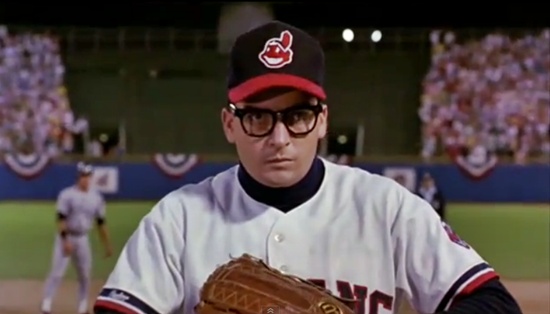
Charlie Sheen is better known these days for his bad reputation than his talents as an actor. His ouster from the CBS show “Two and a Half Men” looked to be the end of him, but he soon bounced back and filmed a plethora of episodes for the FX series “Anger Management.” Still, his bad boy image is impossible for him to shake, and it makes one wonder just how much he is like his character of Ricky Vaughn in “Major League.”
The question of what it was like working with Sheen was brought up when American Cinematheque did a special screening of “Major League” and “Major League II” at the Aero Theatre. Sheen’s role as the Cleveland Indians star pitcher Ricky “Wild Thing” Vaughn remains one of his best and most memorable roles, and his current troubles in the press can’t take away from our pleasure in watching him. Among the guests at this screening were writer/director David S. Ward, Tom Berenger, and Corbin Bernsen, and each described their memories of working with Sheen.
Ward, who wrote and directed the first two “Major League” movies, described Sheen as being the consummate pro on set and said he showed up every day on time.
“He knows his lines, he gives everything, he very seldom goes up on a line, he’s very generous with the actors and they all love to work with him,” Ward said about Sheen. “I can’t say enough about him.”
Ward even remembered a time while making “Major League II” when Sheen had a scene with David Keith who played the overly cocky Jack Parkman. It was a scene where Sheen was pitching to Keith, and it turns out that Keith had lost his contact lenses and was seeing two baseballs instead of the one being thrown to him.
“I was trying to get a shot of him (Keith) hitting a ball that looked like it got in the air enough to get out of the stadium,” Ward said. “Well he (Keith) was seeing two baseballs coming at him, and Charlie threw him 128 pitches. And I said ‘Charlie let’s stop, we can do this tomorrow, we can do this some other day’ and he said ‘no, no, no let’s do this. I’m warmed up, let’s do this.’ 128 pitches, never complained, and it took us that many for Keith to hit one in the air! That’s the way Charlie was. He gave everything, he loves baseball, he loves to play baseball, he’s a terrific baseball player, and he’s got a great arm and throws hard.”
Berenger, who had previously worked with Sheen in Oliver Stone’s “Platoon,” recalled playing ball with him at Santa Monica High School before “Major League” began filming.
“He threw ten pitches, and out of the ten one was a little outside and nine were right on the corners of the strike zone,” Berenger said. “That’s how much control he had, and he was fast too. We went down and did batting practice with the Savannah Cardinals which was a minor league team at the time, and I warmed up one of the pitchers and he threw 94 miles an hour. And I’m guessing Charlie was about 88-89 miles an hour.”
Bernsen ended up telling this story of when Sheen was working on “Major League II.” One day Sheen found out his hotel room had been robbed, and among the items stolen were his wallet, his Walkman (remember those?) which he always had on him, and his gun.
“Charlie had just flown in one of 15 women who had come in during the shoot. Charlie is Charlie, he’s still professional but Charlie is Charlie,” Bernsen said. “I got pretty close with him and I remember him saying, ‘Fuck! I don’t care about my wallet, I don’t care about my Walkman, they took my fucking gun! Whatever happens, I just don’t want that to get out!’”
“So he and his girlfriend and I walked from the hotel across this walkway because he’s got to find another Walkman to do tomorrow’s shoot with because he likes to have his music,” Bernsen continued. “And he’s gonna go into the appliance store to buy a Walkman and always going, ‘I don’t care about the money and I don’t care about the Walkman. Don’t mention the fucking gun!’ And we walk into this department store into the appliance section back in the old days where they had a hundred TVs on the same station. The news was on and as we entered the department, ‘Breaking news: Charlie Sheen was robbed while in town making ‘Major League.’ Among the things stolen was his gun…’ And I just saw him freeze.”
Whether this adds or takes away from all those crazy stories we’ve heard about Charlie Sheen over the years, it also shows him to be far more professional than we give him credit for in general. Sheen’s performance in the “Major League” movies was no fluke, and if Ward and company are serious about making another movie in the future with these characters, they would be incredibly foolish to not include Sheen in it.
The 1989 sports comedy “Major League” got a special screening at the Aero Theatre in Santa Monica, and joining moderator and American Cinematheque program director Grant Moninger for a Q&A was the movie’s writer and director David S. Ward and producer Chris Chesser. This screening brought out many excited fans who consider “Major League” to be the best baseball movie ever made.
Moninger started off by saying that after watching “Major League,” it seemed like the most fun film to make as everyone got to film and play baseball. When he asked Ward what the making of the movie was like, we were surprised by his answer.
“It was one of the most difficult movies to make that I ever had been associated with,” said Ward. “When we started we had one of the hottest summers in 75 years in Milwaukee where we shot the movie. We started out with six weeks of night shooting because we had to work around the (Milwaukee) Brewers schedule at the time, and staying up all night for six weeks just kills you. It was an independent movie at the time, and we didn’t have a lot of money and we didn’t have a lot of anything.”
Regardless of the production difficulties, however, Ward said he did have a great time making “Major League” because of the guys, and he even said that Rene Russo, who played Berenger’s ex-girlfriend Lynn Wells, was one of the guys as well. Ward described the cast as being magnificent and said everybody pulled together to make this movie work. It was just the physical difficulty of making it was hard, and it was something the cast and crew hadn’t planned on dealing with.
Ward went on to describe the “red tag” scene in the locker room in which the players discover whether or not they have been cut from the team. This scene ended up being shot in the basement of a high school which had no windows, and it was already 95 degrees when they began shooting there at four in the morning.
“We had two jerseys for each player, and I remember Tom (Berenger) doing a take and he would sweat through his jersey because it was so hot,” Ward said. “We would take his jersey and give him the other one, and we’d blow dry the one that was sweated through with a hair dryer. Well, it dried it, but it also made it hot. When he sweated through the other one, he had to put on the dry one which was hot!”
When it came to casting “Major League,” Ward said he would only cast people who could play baseball:
“I had actors come in and tell me they played Triple-A ball for the Cardinals, and Chris (Chesser) and I would take them outside and we’d play catch with them, and the Triple-A guy couldn’t throw the ball 15 feet; he never played baseball in his life! People will say anything to get the part, so we just took them outside and we tested them out.”
The cast ended up having two weeks of training before filming began with Steve Yeager who was a former Major League baseball player himself. This was about getting everybody in shape not only to play baseball but also to do basic physical conditioning.
“If you’re not used to playing baseball every day, you don’t realize how many quick starts and stops there are and you can pull muscles and hamstrings,” Ward said. “If an actor gets injured, you can’t shoot with them for a while and your schedule gets screwed up. So, everybody got in shape both physically and baseball-wise and that was a big help.”
Players from other baseball teams were also cast such as Peter Vuckovich who was an All-Star pitcher for the Milwaukee Brewers and Cy Young award winner. Vuckovich played the New York Yankees’ first baseman Haywood, and Chesser remarked he was actually asked to read for the part of the Yankee reliever nicknamed “The Duke.” However, he and Davis found Vuckovich to be “so ugly and so menacing” to where it made more sense to cast him as the player who insults Berenger and hits home runs off of Charlie Sheen. But Chesser also said although Vuckovich looked like he could hit a baseball out of the field, he actually “never hit the ball out of the infield” and never hit a single home run in his entire career.
When it came time to film the climatic game where the Cleveland Indians play against the New York Yankees for the division title, Ward said he and Chesser promoted a night at the stadium to get extras, and 27,000 people showed up. Looking back, the evening was an amazing experience for him and the cast as they had so many cheering people to work with.
“We taught them how to sing ‘Wild Thing,’” said Ward. “We had cameras roaming around all night just picking up people. The girls who came out and danced on the dugout, they just did it! We didn’t ask them to do it, they just got out and did it! I just looked at that and said, thank God!”
Ward added there was a group of about 350 people who came out every night, and he even remembered a couple who had tickets to the Summer Olympics in Seoul that same year. The couple debated whether to travel to Seoul like they planned or stay for the last two days of the movie’s shooting. Ward encouraged them to go to the Olympics, but they ended up staying.
Moninger also asked about the late James Gammon who played head coach Lou Brown, and the mention of the actor’s name got a big applause from the audience. Ward got a bit choked up when talking about Gammon and said he never had any other actor in mind for Lou other than him.
“I was just thrilled to get him, “ Ward said. “He was everything I thought he would be. He’s a great gentleman and a wonderful man. Nothing bothered him. He was a rock of Gibraltar in every way. I remember going to his memorial service and one of the things that was really moving to me is they had his jersey from ‘Major League’ hanging up. He gave so many great performances, and yet the one everyone identifies him with is this one.”
When it came to writing “Major League,” Ward said he was inspired to write about Cleveland as he grew up there. The year this screening took place, every major sports team in Cleveland was pathetic, and Ward remembered it being pretty much the same way when he was deciding on what movie he was going to write next.
“I was thinking that probably the only way the Cleveland Indians would win anything in my lifetime is if I wrote a movie with them winning,” Ward said. “So what kept me going was I just didn’t want to be another Cleveland failure.”
One big question the audience had was why “Major League,” which takes place in Cleveland, wasn’t actually shot there. Ward responded he knew he was going to get into trouble for that.
“The reason we shot it in Milwaukee was that Cleveland is a big union town, and we couldn’t do it independently there,” Ward said. “The other thing was that they hadn’t built the Jacobs Field (which is now the Progressive Field) ballpark yet, so the team was still playing at Cleveland Municipal Stadium. Also, the Browns were playing pre-season games there, and the field had football lines on it. That wouldn’t have looked very good, so it wasn’t feasible to shoot there.”
Another audience member brought up Bob Uecker who played Indians sportscaster Harry Doyle in “Major League” and asked how much of his dialogue was written and improvised. Ward replied he wrote the character of Harry and his lines, but when Uecker was cast he discovered just how incredibly funny he was. What also helped Ward was that Uecker knew a lot of things about baseball players he didn’t, and he felt he would have been an idiot not to let Uecker improvise if he wanted to. When it came to Uecker’s famous line of “just a bit outside,” Ward said he wrote it, but it didn’t sound anywhere as funny in his head as when Uecker said it.
Everyone at the Aero Theatre had a wonderful time hearing all these stories about how “Major League” came to be. After so many years, this movie really holds up as it is hilarious and has a lot of heart. While many of the actors other than Berenger and Bernsen were not able to make it to this screening, we did get a surprise guest with Jo-bu, Pedro Cerrano’s voodoo god doll. Ward and company celebrated the appearance with Jo-bu with some rum, the same kind Eddie Harris (played by Chelcie Ross) stole and took a drink from when nobody was watching. You all remember what happened to him, right?