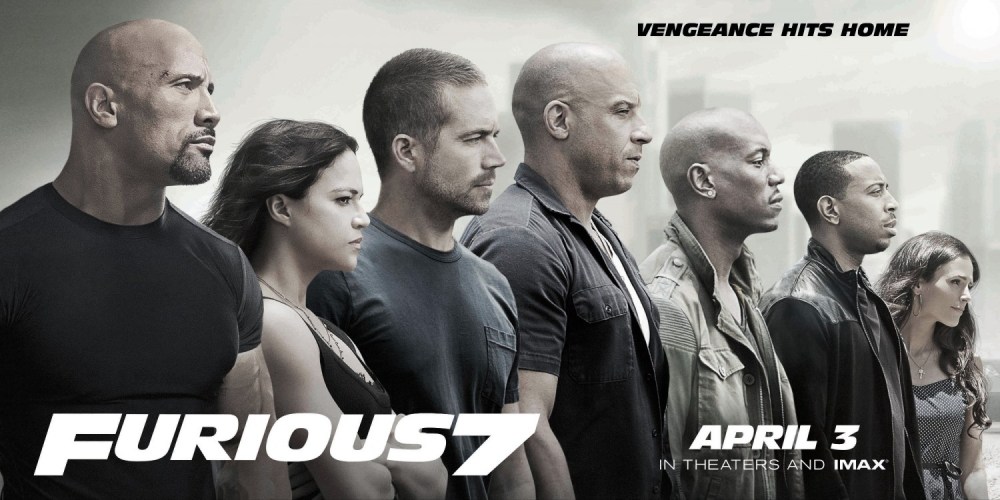
Some franchises really overstay their welcome, but that’s never been the case with “The Fast and The Furious.” While it looked like this series was running on fumes by the time “Tokyo Drift” came around, the main characters from the original came back for the fourth entry which re-energized everything to a major extent. Now we arrive at “Furious 7” where the action remains top notch even as the filmmakers defy logic more than ever before, but there’s also a lot of emotion and poignancy as we are reminded of what brings us back to these films more than anything else: the characters. Deep down, we care a lot about Dom Toretto and his family and of what happens to them.
After vanquishing Owen Shaw in “Fast & Furious 6,” Toretto and company now have a new nemesis to deal with in Owen’s older brother, Deckard Shaw. Played with villainous relish by Jason Statham, Deckard vows vengeance against Dom and his crew for what they did to his brother, and he starts off by eliminating Han Seoul-oh (Sung Kang) and then obliterating the Toretto family home. This disrupts their lives as Brian O’Connor (the late Paul Walker) tries to settle down into a regular suburban life with Mia (Jordana Brewster), bur the death of one of their gang forces them to take matters into their own hands.
There’s actually something quite nice about calling “Furious 7” a sequel instead of a prequel or intra-sequel. The three previous entries took place before “Tokyo Drift,” but now we have a “Fast & Furious” film which actually takes place after “Tokyo Drift.” As a result, the fates of these characters are now up in the air more than ever, and we can’t be sure of what will happen next.
The presence of the late Paul Walker casts a heavy shadow over “Furious 7” as there is no way we can watch this film without being reminded of the fiery car crash which claimed his and Roger Rodas’ life in November 2013. It’s nice to see Walker play his star-making role one last time, and his entrance into it is very inspired. Walker died halfway through filming this movie, so the filmmakers had to use stunt doubles and CGI effects to fill in the missing blanks. Honestly, the results look seamless, and I couldn’t tell how exactly they pulled it off. Just like Brandon Lee in “The Crow,” Walker gets one last ride which is more than worth the trip.
It’s also fun to see Vin Diesel back in action even as his dialogue becomes rather cringe-inducing at times. There’s certainly no replacing him as Dom Toretto, and he has a number of nice moments with Michelle Rodriguez whose character of Letty is still struggling to remember who she once was. It’s also nice to see Jordana Brewster and Dwayne Johnson back as well, and this is even though we don’t see enough of them this time around. As for Johnson, he looks more massive than ever and has a nice little Incredible Hulk moment which will have the audiences cheering. And yes, he sure can wield an enormous machine gun just like the one Jesse Ventura wielded in “Predator.”
Among the new additions to the franchise in “Furious 7” include Kurt Russell, and it’s always great to see him in anything. Russell plays Frank Petty, a.k.a. Mr. Nobody, who heads an ultra-secret covert ops group which comes to help Dom and his crew take down Deckard. After all the law-breaking Toretto and his gang did, it only makes sense they team up with a group which bends the law as well. The “Escape from New York” star remains as cool as ever, and if they do decide to make another film in this franchise, I hope they bring him back for more.
Djimon Honsou also shows up as a bad guy named Mose Jakande, a character whose last name reminded my friend Courtney of some lyrics from the song “Iko Iko.” The “Gladiator” actor lends another strong villainous presence to a movie which already has one with Statham. Ronda Rousey, one of the few bright spots in “The Expendables 3,” makes a cameo as a character who tries to beat the crap out of Letty. And of course, you can always count on Tyrese Gibson and Chris Bridges (a.k.a. Ludacris) to keep chewing each other out with infinite glee as Roman and Tej.
“Furious 7” employs a number of stunts which defy the laws of gravity and logic among other things, but it’s our love of the characters which keep us from being bothered about that too much. This is especially the case when Dom and Brian drive an incredibly fast car from one high-rise building to another in Abu Dhabi. This moment almost tops Tom Cruise climbing up another building in the same country in “Mission: Impossible – Ghost Protocol.”
Also, as I’m sure you’ve seen in the trailer, the gang parachutes out of a plane in their cars, and they manage to land on the ground below with relative ease (their shock absorbers may need some work though). Lord knows how you can steer a car while it is skydiving to the ground, but these drivers are all about the impossible, and they make us want to buy into their craziness.
I do have to give Diesel some extra credit here. His character of Dom Toretto ends up surviving so many car crashes and head-on collisions in this sequel, not to mention driving out of a parking garage as it collapses around him, to where I’m not sure how many other actors could pull this off and make you believe they would come out with only a few cuts and scratches (at least, until the movie’s last half). Only an actor like Diesel can sell this kind of survival to an audience these days, so it should be no surprise we are willing to accept all he endures here no matter how improbable it all gets.
With Justin Lin out of the director’s chair for this installment, James Wan of “Saw” and “Insidious” fame steps behind the camera to direct this, his first mega-budget blockbuster. This is kind of a hard franchise to bring anything new to at this point, but Wan does bring an unexpected amount of emotion to the material. Granted, a lot of this emotion comes from Walker’s tragic demise, but even Wan understands the need for the audience to be emotionally invested in these characters for a movie like this to work at all. Jumping from small budget films to a studio tent pole franchise is no easy feat, but Wan makes “Furious 7” work as a go for broke action extravaganza which never ever lets up. He is also backed up by another kick ass music score by Brian Tyler who returns to the franchise after sitting out “Fast & Furious 6.”
I have to believe there’s an eighth “Fast & Furious” movie coming our way, but if this is to be the last one, then the franchise is certainly going out on as high a note as any franchise could ever hope to. Still, I’ve got to believe there’s still some life left in this series as I am very much impressed at how long it has lasted.
At the very least, Walker gets a better and more heartfelt sendoff here than he did in “Brick Mansions.” Even the toughest guy in the audience is likely to shed a few tears at the dedication made to the actor’s memory at the movie’s conclusion. He’ll tell you he didn’t get choked up, but you will be able to tell if he’s lying to you.
After watching “Fast Five,” I kept wondering what the filmmakers would end up calling the sixth film in the franchise. One guy told me they should call it “Sexy Six” which I thought would be pretty cool, but the filmmakers decided not to be all that creative with the title this time and they just called it “Fast & Furious 6.” Then again, you will notice during the opening credits (yes, this one actually has opening credits) that the movie is called “Furious 6.” Why they decided not to put this title on the trailers, posters and TV commercials is beyond me because it sounds perfect.
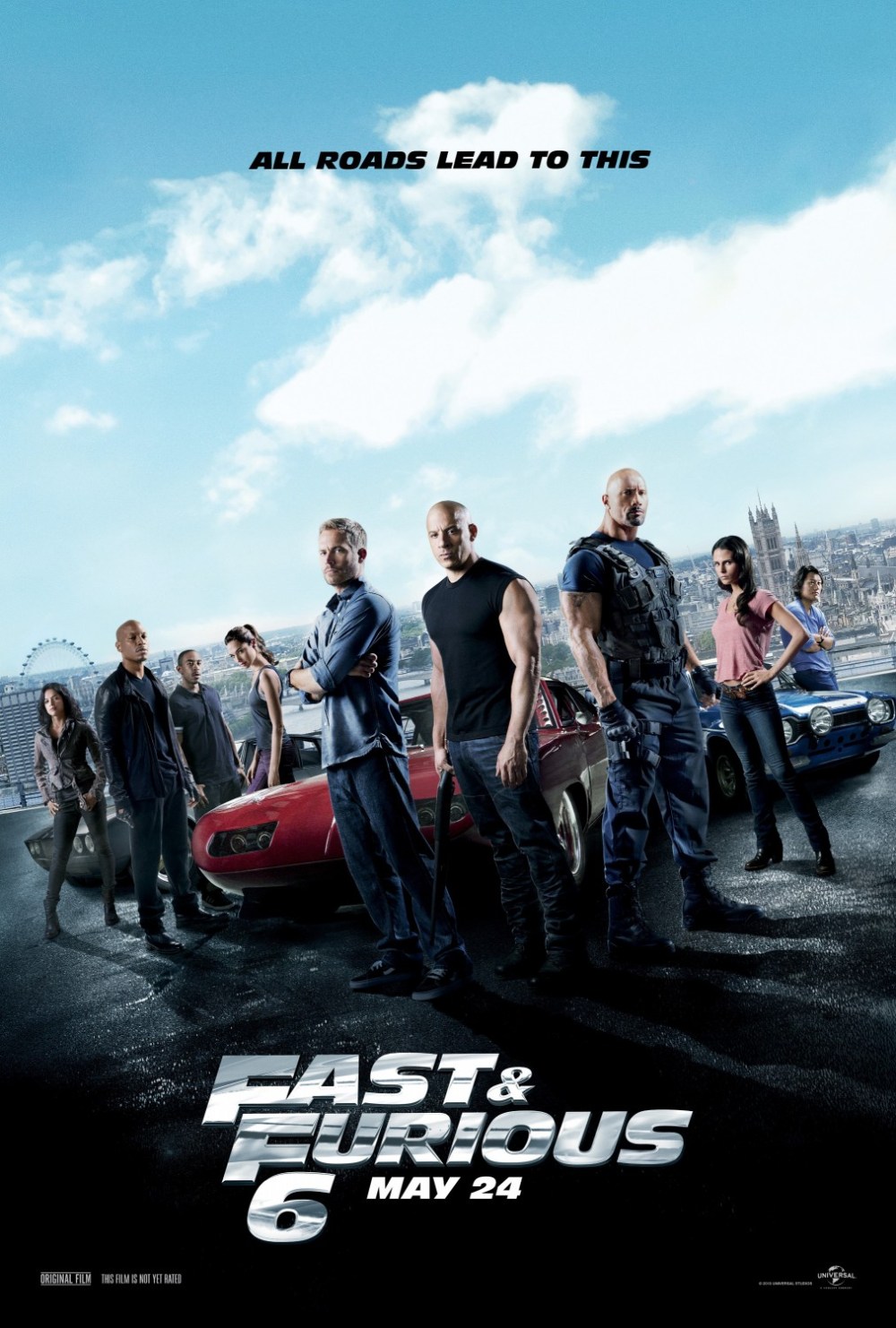
Anyway, it doesn’t matter because “Fast & Furious 6” proves to be just as much fun as its predecessor, and it delivers the kind of crazy and illogical entertainment we have come to expect from these movies. You can bitch and moan about the plot holes and the absurdity of certain stunts, but this franchise is now over a decade old and we have long since given up trying to make sense of everything which goes on. I’m just astonished director Justin Lin and company still managed to make an incredibly entertaining movie while not introducing much of anything new to this series.
After pulling off the mother of all bank heists in “Fast Five,” the merry band of car racers have retired rich and are enjoying life. Brian O’Connor (Paul Walker) and Mia Toretto (Jordana Brewster) are now the parents of a baby boy, Dominic Toretto (Vin Diesel) has a ridiculously beautiful estate in which he lives with Elena (Elsa Pataky), Gisele (Gal Godot) and Han (Sung Kang) have moved to Hong Kong, and Roman (Tyrese Gibson) and Tej (Chris “Ludacris” Bridges) flaunt their wealth in ways both loud and generous.
But with this being a “Fast & Furious” movie, there’s no way any of these people will stay retired. Into the picture comes Luke Hobbs (Dwayne Johnson) who meets up with Dom not to arrest him, but to ask for his help in bringing down a former British Special Forces soldier named Owen Shaw (Luke Evans) who has taken down various military convoys. Dom, of course, has no interest in working with Hobbs, that is until Hobbs shows Dom a picture of one of Shaw’s crew members: his ex-girlfriend Letty (Michele Rodriguez). From there, the whole crew reassembles to take Shaw down, rescue Letty, get full pardons, and drive some super-fast cars in the process.
It should be of no surprise to anyone that Letty is alive as this was confirmed during a post-credit sequence in “Fast Five,” and it’s good to see Rodriguez return to this franchise. While the explanation of how she survived doesn’t make much sense (these movies have never been high on logic), I’m glad to see her back. Letty looks to have turned bad and is suffering from amnesia, but you’ll have to see the movie for yourself to see how far from grace she has fallen.
It’s a shame this will be Justin Lin’s last film in this long running franchise (James Wan will be taking over for the next installment) as he continues to outdo himself in terms of the stunts he gets onscreen. Even when certain stunts stretch the boundaries of what’s even remotely possible, Lin still leaves us on the edge of our seats and begging for more. He also understands that while we love the action, it’s the characters which bring us back as well as we have come to deeply care about what they go through.
We could get into a long discussion about whether or not Vin Diesel and Paul Walker are really acting in these movies, but this issue has long since been rendered moot. They are these characters, and they are key part of this franchise’s success as we root for them to get away with everything and anything. This also goes for Jordana Brewster who, while a bit underused in this one, is still a kick to watch as Mia. Recent additions like Dwayne Johnson have also given the “Fast & Furious” movies a swift kick in the butt, and we leave this movie wondering if his muscles can get any bigger than they already are. It’s like what Danny DeVito said about Arnold Schwarzenegger in “Twins:”
“You’re all swelled up and you look like you’re ready to explode!”
Actually, the best thing about “Fast & Furious 6” is watching Tyrese Gibson and Ludacris play off of each other. These two are so damn funny as they try to one-up each other as to who’s the cooler dude, and I wonder if the filmmakers would ever consider doing a spin-off series with their characters.
As for the newest additions to the “Fast & Furious” family, Luke Evans gives us the strongest villain this series has seen in a long time with Owen Shaw. This is not to say the villains in the previous installments were weak (the actors playing them were quite good), but they proved to be generic in the large scheme of things. With Shaw, we get a character bound by a philosophy as strong as it is twisted, and Evans sees to it we do not forget about this particular nemesis once we leave the theater.
Gina Carano, whom Steven Soderbergh directed in “Haywire,” is another newbie here as Hobbs’ partner Riley, and you can sure bet she puts her mixed martial arts fighting skills to good use in this movie. Her fight scenes with Rodriguez are exhilarating to witness, and those looking for a good catfight will get more than what they expected here.
Some of the craziest stunts in “Fast & Furious 6” include a tank which mows down every car in its path, regardless if the cars are imports or American made, and a cargo plane which our heroes use everything in their power to bring down. One automobile which stands out in particular is “The Flipper” which Shaw drives, and it’s a car designed to flip over any car foolish enough to get close to it. Whether you’re driving head on at this thing or trying to ram it from behind, you’re in a no-win situation as you will find yourself unexpectedly flying through the air and crashing painfully. Just look at Walker’s face as he finds this out the hard way.
“Fast & Furious 6” does have its share of plot holes which are becoming harder to forgive, and the airplane runway featured in the movie’s climax is even longer than the one in “Die Hard 2,” but it’s still a slam-bang piece of entertainment to where you can only complain about its problems so much. It’s not better than “Fast Five” which was a wicked blast, but it’s still delivers the kind of fun we have come to expect from films like this. As always, be sure to stick around for a post-credit sequence which introduces us to the main villain of the next sequel. While the identity of the actor playing this villain has long since been spoiled, you’ll still get a kick out of seeing this guy appear on the big screen.
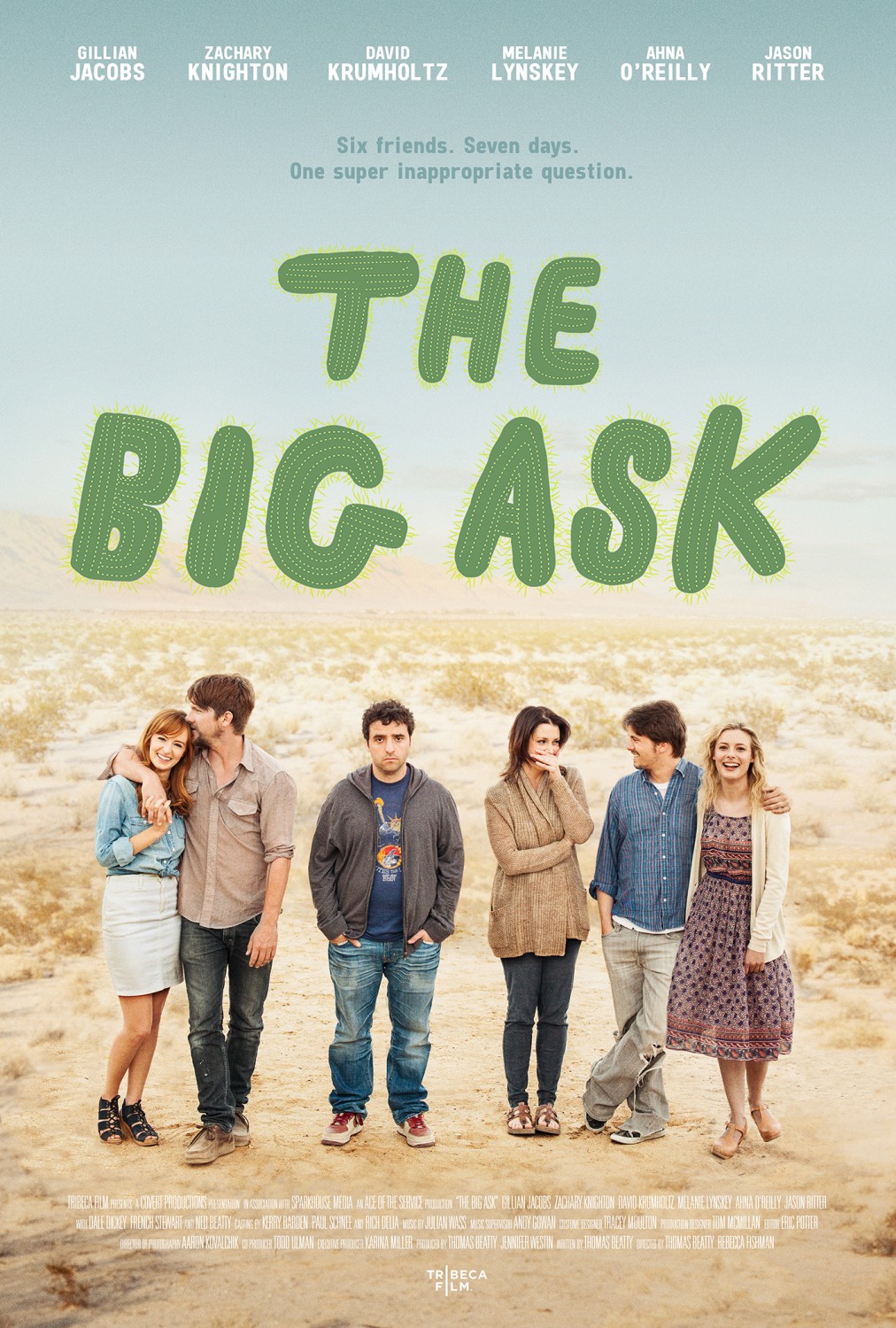
“The Big Ask” is a very well made black comedy which stands out among other indie movies being released at the moment. Its story revolves around three couples who go on a vacation in the desert to help their friend Andrew (David Krumholtz) who has just lost his mother to cancer. But once everyone is there, Andrew tells everyone there’s only one thing which can heal him in his time of sorrow; he needs to sleep with his friends’ girlfriends. It’s an absurd offer which makes everyone eager to jump in their cars and go home, but they stay as they see Andrew is very depressed and needs attention. But the movie has you wondering if they will actually go through with his plan if it means saving him from himself.
I got to speak with David Krumholtz over the phone, and he proved to be a lot of fun to talk to. Krumholtz has appeared in “Harold & Kumar Go to White Castle,” “Serenity,” “The Santa Clause” and “10 Things I Hate About You,” but these days he is best known for playing Charlie Eppes on the CBS show “Numbers.” During my interview with him, he talked about why he didn’t feel the need to do research on his character, what it was like making a movie with two directors instead of one, and he described the town of Twentynine Palms where the movie was shot. Also, he took the time to talk about a new website he is part of called Weather From which allows him to play one of his favorite characters.
Ben Kenber: The original title for “The Big Ask” was “Teddy Bears” which one character uses as a nickname for the cactus trees near the home everyone is staying in. Why did the title of the movie change?
David Krumholtz: I really don’t know why. I think Tribeca Films felt the title “Teddy Bears” didn’t really tell you what the film was. I like the title of “The Big Ask,” don’t get me wrong, but the problem is everywhere I go people ask me what I have coming out and I say “The Big Ask,” and they think I’m saying “The Big Ass.” So I keep getting, “You’re in a movie called ‘The Big Ass?’” And I have to explain that now it’s “Ask.” What’s even more awkward is that I show my ass in the movie.
BK: Well “The Big Ask” makes more sense in terms of what the movie is about.
DK: Yeah, I guess so.
BK: When it came to playing this character, did you do any research for this role or did you just work off the script as it was written?
DK: The script was very self-explanatory, and I really didn’t need to do much research because I’ve had an experience somewhat similar to this, obviously not asking my best friends’ girlfriends to have sex with me, but I had had kind of a painful experience in my life that I needed saving from. I needed my best friends to gather around me and to lift me up on their shoulders. I think a lot of people go through that, and it’s very hard to ask for help when you’re feeling helpless because it’s desperate. It’s interesting how people react to other people’s desperation. I had an experience like that, and this script in the way the characters react really rang true for me to what I experienced in my own situation. I didn’t have to do much research because I think I felt like I had been there, done that, so it was an opportunity for me to exercise that demon on film. I think people go through that kind of stuff all the time. Some people keep it quiet, some people handle it in certain ways, other people just scream for help. That’s ultimately what my character is doing in the film because he’s saying help me. But the matter in which he asks for help is ludicrous, and of course the fact that he thinks that there’s nothing wrong with it and that it’s totally normal is also crazy. I love how the film handles the awkwardness of it. These characters are real people, and so the idea is how real people react in this situation. The script was just so grounded in reality and in sort of the silent awkwardness and I thought Thomas Beatty did such a great job at making it feel real, and it’s because he had had an experience like that as well. I think it’s a great crowd movie in the sense of your sitting there kind of sympathizing with this guy who on paper reads like an asshole but you get where he’s coming from, and the big question is will they have sex with him or won’t they. I think it’s a fun movie in that regard.
BK: Yes, definitely. It’s like on the surface they are saying no but there’s a part of them that’s unconsciously considering it, so you can’t help but be riveted by the movie from start to finish for that reason.
DK: Yeah, the movie ends up becoming a reaffirmation of all the characters’ values. The one character of Dave (played by Zachary Knighton) wants to get married and he will stop at nothing to make it happen, and then the circumstance puts a stamp on his conviction to make it happen, to get his girlfriend to say yes. And the opposite is true for Jason Ritter’s character of Owen and Gillian (Jacobs) in that this brings to light the problems they have in their relationship, the communication issues. Their lives sort of unravel as a result of this question that this guy asks and it’s definitely not handled in a collegiate humor way. It’s definitely an adult movie for people who were not sure how to be adults. It’s certainly true of every adult.
BK: This movie is credited to two directors, Thomas Beatty and Rebecca Fishman. What was it like being directed by two directors instead of just one, and did that make things easier or harder?
DK: Well Thomas and Rebecca are husband and wife, and in this circumstance Thomas wrote the script so I think Thomas appreciated what Rebecca brought to it which was a filmic sense: the cinematography element and being in communication with the cameraman. So Thomas didn’t have to concentrate on anything but working with the actors and working on the script, so that in regard it was great. I found that I got more out of Thomas than I would have if he was worried about performance and camerawork the whole time. Rebecca had her own ideas as to what the film was tonally, and there were times when their ideas contradicted one another and there were times where we all agreed on the same thing. It’s tricky especially because they are husband and wife. You definitely don’t want to be the reason they start fighting, and it was a hard movie to make. But their spirit and their earnestness and their enthusiasm for the material really just carried us all through, so it was lovely to have the two of them there together.
BK: What was the most challenging aspect of playing this role for you?
DK: I mean for me, to be honest with you, I think beyond just doing some soul searching with the role, I think the most challenging thing is probably that there wasn’t very much that can be played broad or on the nose about this character. As actors we have an instinct to perform and to push and to show, and the hardest thing for me was I felt like the movie and Andrew only worked if I pulled him back and held back a lot because I’m playing a character that the audience is wondering what’s going on in his head. And more importantly, he’s wondering what’s going on in his head. He’s not even sure what he’s thinking, so it’s really important to pull back my performance and do something really small, and that was the biggest challenge for me. I need to establish a good level of trust with Thomas Beatty about that because I told him, “Look if I’m ever going too big or broad or if I’m too on the nose with my interpretation, pull me back. Let’s go smaller.” This is a movie where the awkward silences are the funniest beats, and so in this case less was more.
BK: The group dynamic between you and the rest of the actors is truly fantastic. Did you all have a lot of time to work things out and rehearse before you started shooting?
DK: No, this is a super low-budget indie so there are no frills and there’s not a lot of rehearsal time… Yeah, we did a couple of read-throughs and we kind of worked out some kinks. The great thing was from the first moment as a cast we all got along beautifully. We all enjoyed each other’s company, we all sort of came from similar places in our lives which we applied to this experience and to this project. So, what helped a lot and what made up for the lack of rehearsal time was that we all just had amazing chemistry as people, and then that did a lot of the work for us onscreen.
BK: The movie was shot in Twentynine Palms. Can you tell us more about this city?
DK: It’s about a half-hour outside of the heart of the Mojave Desert and about an hour past Joshua Tree National Park, so it’s basically the middle of nowhere. There’s a big, big giant army base out there and that’s about it. They were dropping bombs constantly and our little house that we all stayed in would rattle when they would drop a bomb, and sometimes they’d drop a bomb closer to us and it would be like, “Do we need to get the heck out of here?” We were basically in the middle of the desert with bombs being dropped near us and it was really quite a different experience, but for us it was kind of like paradise because it was so immersive. We really didn’t have a choice. We were all trapped in the desert and we really didn’t have a choice but to focus on what we were doing and focus on each other.
BK: Wow, I didn’t see anything resembling an Army base out there so you must have done a great job of hiding it from view in this movie.
DK: It’s actually the biggest army base in America; it’s that big. If you go out on this one road the road ends and if you go off-roading for about 20 minutes, you’ll end up at a giant re-creation of the central market of Baghdad, and it’s in the middle of nowhere dude. There’s no easy access to it, and there’s literally props and fake soap and fake market items. They do drills within that city and it’s meant to mock Baghdad or any major Middle Eastern city, and it’s about a square mile, that’s how huge it is, and you can see it from above from the mountain range. You really can’t get down to it. I’m not even sure how the military has access to it. I guess they have a certain road that leads there that people can’t get to from the other side. But I know Ahna O’Reilly and Jason Ritter went out there one day with a couple of friends and actually got out of the car and walked into it and walked around it while there were no drills happening. Then all of a sudden an alarm went off and the drill was happening and they had to run out of there because the Army started shooting up the place. I actually went out there once but I didn’t get too close because it was just super scary to me and super intimidating. It’s a very trippy place man, Twentynine Palms. If you ended up in Twentynine Palms, there’s a very specific reason.
BK: You also have a website that’s starting up now called “Weather From.” Could you tell us a little more about it?
DK: I’m really, really jazzed about it. Basically my friends came up with the idea to create a weather website that would make you laugh. People get their most up to the moment weather on the Internet and they thought that since it’s become this essential part of everyone’s lives, to check the weather for their town or where they are traveling to or where they are traveling from, why don’t we make them laugh while we are doing it. The idea was to create a bunch of characters and film a bunch of vignettes where the characters told you the weather for your small town, and it kind of went off on tangents. They pushed me to do an old lady character because my friend Ricky, who was involved in it, knew that I had done this character that I based on my grandmother. I said, “Well yeah I’ll do it, but I don’t want to do it in drag. Can we get some prosthetic makeup going?” We actually ended up getting Stephen Prouty’s company which just got nominated for an Academy Award for doing “Bad Grandpa,” so all of a sudden they transformed me into an old Jewish lady that no one, even my family members, were fooled by. Basically, how the site works is you go and you type in your zip code or the name of any city around the world, it hooks up to the National Weather Service so it works like any other weather website except instead of specific forecasts coming up, a video comes up and it’s accurate to your hometown. We did 35 videos for 35 different types of weather, and the videos range from 30 seconds to two minutes long. They are basically just vignettes and it’s me as this old, nasty Jewish woman who has a filthy mouth and is very opinionated and is also a little sexually promiscuous telling you the weather for your hometown and then also going off on tangents of what the weather reminds her of or whatever; everything from her wanting to have sex with Jeff Goldblum to claiming that she was the only survivor of the space shuttle Challenger disaster. She’s a really funny, funny character. We didn’t hold back. She’s very filthy and she’s very real, and it’s hard to imagine that’s me which is really cool. People have been really surprised by it. I think it’s a brilliant concept, and the idea going forward would be that there would be more characters to choose from to give you your weather and there will be more specific types of weather. We only did 35 types of weather as a start, but the weather can get very, very specific with high fronts and low fronts and hurricanes and tornadoes. So hopefully as we go forward we will get the chance to do hundreds of videos potentially.
BK: Yeah, it will be interesting to see how the website evolves as you have started off with a couple things, but I imagine at some point it will have to get a little more specific. That should give you a lot to work with as an actor which is cool.
DK: Yeah, I think so. I think it has endless potential and I’m just happy that they asked me to be a part of it. I’ve been working really hard on promoting it and getting the word out there about it because I love playing that character. It’s so much fun (laughs). She’s such a nasty old woman. I guess she’s a side of me that I didn’t know existed, or maybe I did know and I didn’t want to tell anybody or didn’t want to admit to. But it’s so much fun getting to let her out and I just really want people to see it and enjoy it as much as I enjoyed making it.
BK: What do you hope that people get the most out of watching “The Big Ask?”
DK: Well, I really hope they have a good time laughing at my character’s misfortune, but I hope it makes them reflect a little bit on their own frailty and their own willingness or lack of willingness to ask for help. It’s the kind of movie that I love when I can walk out of the theater and feel like I know what that’s like. I can feel those feelings in my life, and maybe it’s time I ask for what I need regardless of whether or not it hurts people’s feelings because I need it. And if their friends, they’ll understand it’s something that I need. So hopefully someone will walk out of there having popped the question or whatever it is just because they felt inspired to do so.
I want to thank David Krumholtz for taking the time to talk with me. “The Big Ask” is now available to own and rent on DVD, Blu-ray, and Digital.
With “Fast Five,” the fifth movie in “The Fast & The Furious” franchise, the filmmakers have seemingly run out of ways to include both “fast” and “furious” together in the same movie title. Does this mean this sequel is less furious than others? Granted, this franchise started a decade ago, but you’d think they would still find a way to put those two words together in such a clever fashion. What, “2 Fast 2 Furious” wasn’t clever enough? How about these?
“Fast & Furious Times 5”
“Faster & Even More Furious”
“Fast & Furious to The Fifth Power”
“Infinitely Fast & Furious”
“Ocean’s Fourteen”
Well, while only “fast” made it onto the marquee this time, this movie is most definitely not lacking in any fury. “Fast Five” is gloriously mindless entertainment, filled with one preposterous action sequence after another. It won’t be mistaken for any cinematic classic and much of what’s on display is very improbable, but it’s so much fun so who cares? This was to the Summer 2011 movie season what “The A-Team” was to the Summer 2010 movie season; an over the top blockbuster unapologetic in its quest to entertain action movie fans. You can complain about its flaws, but that would just be taking all the fun out of the proceedings.
Now I did put “Ocean’s Fourteen” on the list for a good reason. Whereas the previous movies dealt with car racing, “Fast Five” is more of a heist film as Vin Diesel, Paul Walker and company work out a plan to steal $100 million from a corrupt businessman. If they succeed with their destructive cleverness, they will be able to buy the freedom they can no longer afford.
This one starts where “Fast & Furious” ended as Dominic Toretto (Vin Diesel) is being hauled off to prison in a bus to serve a 20 plus year sentence, but his sister Mia (Jordana Brewster) and Brian O’Conner (Paul Walker) end up breaking him out after making the bus he’s on crash in such spectacular fashion. Seriously, the bus crash here puts the one from “Another 48 Hours” to shame, and it’s designed to let audiences know just how bad the car crashes are gonna hurt this time around.
From there, the story moves to Rio de Janeiro, Brazil where Dom and company choose to hide out from the law. But since being on the run sucks your wallet dry, they take a job to steal three very valuable cars from a moving train. This heist, however, goes awry when it turns out the cars are the seized property of the DEA, one of which has important information regarding this sequel’s main bad guy, businessman Hernan Reyes (Joaquim de Almeida) and all the cash he has saved and probably doesn’t pay taxes on. From there, the heist is on even as a relentless DSS agent, Luke Hobbs (Dwayne Johnson), arrives to take Dom and his elusive team down for good.
Justin Lin returns for his third movie as director in this series. I still haven’t gotten around to checking out “The Fast & The Furious: Tokyo Drift,” but I felt he did good work with the previous entry. But this time he really outdoes himself with stunts which, while highly improbable, have us feeling their dramatically LOUD impact to where we’re saying to ourselves:
“WHOA!”
“DAMN!”
“OUCH!”
“MAN!”
If Lin made any mistakes in the last two sequels, he has certainly learned his lessons from them. Even if its characters are stealing cars from a train which is moving as fast a bullet, he’s got the audience enthralled as he moves the story along at a rapid pace, preventing us from examining the logistics of what we’re seeing. Many will look at “Fast Five” as your basic guilty pleasure, but something this entertaining should not make you feel guilty about enjoying it at all. “Troll 2” on the other hand…
I’m also glad to see Brian Tyler back as “Fast Five’s” music composer. His combination of symphonic music and electronic elements matches the maximum propulsion of what’s speeding past us onscreen. However fast the cars are traveling, Tyler’s film score matches their velocity and gives those OUCH moments some extra oomph.
It’s great to see the gang back once again, especially Vin Diesel who made a welcome and much-needed return to this franchise in “Fast & Furious.” While his style of acting hasn’t changed much, he owns his role as Dom like no other can. Trying to substitute another actor in his place has already proven to be a mistake, and his presence alone infuses Dom with a “don’t mess with me” attitude which is irreplaceable.
Even Paul Walker is a welcome presence here, long after many called him bland and unconvincing as undercover cop Brian O’Conner. I don’t know, maybe it’s all the stubble on his chiseled face, but he has long since grown into the role whether critics like him or not. If his presence ever bothered me in previous installments, it didn’t this time around.
I was also glad to see Jordana Brewster get more to do this time around as Mia Toretto. While her character was underused the last time, she has a much more central part to this movie in ways I’d rather not get into, but which will become obvious to the audience in no time. She gets to drive a little more in this one, and she looks out for everyone whether or not they are behind the wheel.
“Fast Five” acts as a greatest hits collection as it brings together characters from the other films. Joining this crazy heist film are Roman Pearce (Tyrese Gibson) from “2 Fast 2 Furious,” Vince (Matt Schulze) from “The Fast & The Furious,” Han Lue (Sung Kang) from “Tokyo Drift,” Gisele Harabo (Gal Gadot) from “Fast & Furious,” and Tej Parker (Ludacris) from “2 Fast 2 Furious.” Seeing them interact with each other is a kick, especially when Gibson and Ludacris keep busting each other’s’ balls over who is better at what. With these two, it’s like they’re in one rap battle after another without the mics in their hands while the audience cheers them on.
But the big addition this time around is Dwayne Johnson as DSS agent Luke Hobbs. With his bulging muscles and pronounced tattoos, Johnson hasn’t looked this badass since “The Rundown.” Watching him drowning in all those dopey family movies like “The Tooth Fairy” got increasingly depressing over time. While he still ain’t no Laurence Olivier, his relentless presence in “Fast Five” gives Dom and company one of their toughest adversaries yet.
The series overall (specifically Parts 1, 4 and 5) has kept a solid longevity not just because of the spectacular action, but also with strong characters who, despite their law-breaking ways, make you want to root for them even after they pass the finish line. Even while we may not buy two muscle cars driving at high speed while towing an enormous metallic bank safe through the busy streets of Brazil, we care about them enough to see them get away with it.
Having watched “Fast Five,” it feels like it’s been forever since I have seen so many cars get gleefully destroyed. Is this the end of this franchise? Well, all I can tell you is to make sure you stay through the end credits as it should easily answer your question. Of course, they need to come up with yet another clever title. Somehow “6 Fast & 6 Furious” doesn’t make much sense, but how about these?
“Fast & Furious to the 6”
“6 Times as Fast, 6 Times as Furious”
“Still So Damn Fast & Furious”
“Beyond Fast & Furious”
“The Furious Six”
“Faster Than 6”
“Faster and More Furious Than 60”
“Sexy Six” (a guy sitting next to me in the movie theater suggested this one).
Or how about “The Toretto Brothers?” Jake and Elwood Blues may outdo these guys in the music business, but not in racing a quarter mile at a time!
This review was written in 2009 when this movie was released.
I never bothered watching either of the sequels that came out after “The Fast & The Furious.” What was the point? You have Paul Walker headlining “2 Fast 2 Furious” (clever title) which did not inspire much confidence in me at the time. Then came “The Fast & The Furious: Tokyo Drift” which had none of the original characters in it (excluding cameos). For many, including myself, this second sequel seemed to be the last gasp of a franchise trying to get by on its name only. But now we have “Fast & Furious,” a movie every bit as tight as its title. With this one, we finally have the original cast back with the clever tagline of “new model, original parts.” With this in mind, I actually found myself excited at what looked to be the first true sequel to the 2001 original.
Okay, the original was by no means a great movie. Even Rob Cohen, who directed it, didn’t try to hide the fact the story was ripped off from “Point Break.” In essence, “The Fast & The Furious” was basically “Point Break” on wheels. At the same time, it was never less than entertaining and offered us a surprisingly authentic look into the world of street racing. What astonished me most was how it brought all kinds of ethnicities together who were all in pursuit of being the ultimate racing champion. In a way, it made you look at street racing as an equal opportunity killer. Car crashes of all kinds know no prejudice.
With “Fast & Furious,” the series comes back to what Cohen originally hoped it would be; the continuing soap opera of what’s happening with Dominic Toretto, his sister Mia, his girlfriend Letty, and his friend turned nemesis Brian O’Conner. Of course, this particular sequel would never have happened without the participant of one individual: Vin Diesel. Having opted out of the other sequels, Diesel returns to his star-making role as Dom, the character all the fans desperately wanted to catch up with.
“Fast & Furious” has been described as an intersequel, as opposed to just a prequel, in that it takes place between the events of “2 Fast 2 Furious” and “Tokyo Drift.” We catch up with Dom and Letty (Michelle Rodriguez, as luscious as ever) in the Dominican Republic as they are up to their usual game of hijacking trucks, in this case oil tankers. The movie gets off to a fast start indeed as the hijacking quickly develops some rather dangerous complications. From there, Dom comes back to Los Angeles to avenge the death of a very close friend.
When the movie heads to Los Angeles, we then catch up with Brian O’Conner (Paul Walker), who is now an FBI agent. Brian starts the movie on a chase which is indeed furious as he runs after a fugitive who has information on a major drug dealer he is pursuing. It is a wonderfully executed chase scene which gets us primed for what will happen next. Of course, the real man Brian is after is the same man Dom wants revenge on, so these are forced to work together again even though they couldn’t trust one another any less.
“Fast & Furious” allows us to also catch up with Dom’s sister, Mia (Jordana Brewster), who fell hard for O’Conner before realizing who he really was. She now looks at him with disdain as she feels completely betrayed by his lies. But come on, you know these two are still hot and heavy for each other. Of course, it takes them some more time to realize this.
Is it even worth it to be critical of a movie like this? The plot threatens to be paper thin throughout, and it is there of course to hang a lot of car chases and other action sequences on. There are clichéd characters aplenty, such as Brian’s superior officer who wants results or his ass is grass. There’s also that rival agent who doesn’t trust Brian one bit, and that’s even before Brian drives the guy’s head into the marble wall at the FBI office (ouch!). Then there is dialogue which sounds like it comes out of every other action movie you have seen, and some of it will have you rolling your eyes. But seriously, it’s not like the filmmakers are trying to make “Lawrence of Arabia” here. I mean, you could compare the two to determine which is the better movie, but this is more likely to make you look like a snob rather than an objective film critic.
Truth be told, I just went into “Fast & Furious” to have a fun time, and that’s exactly what I got. This is a well-maintained action picture which has much to appreciate. I especially liked the chase scenes which, while not necessarily the best ever, are heads above a lot of the recent action movies Hollywood has churned out. I especially dug the street racing scene where Dom and Brian race two other guys for the chance to become drivers for hire. The only catch is the streets are not closed off for this one. They are being led by GPS monitors showing them the direction they need to go, but they also have to keep their eyes open for oncoming traffic which is oblivious to the reckless endangerment about to be unleashed.
There is another cool sequence where cars race across the desert to get across the Mexican border. While the chase itself succeeds in defying the laws of logic in several ways, and it does have those CGI moments which takes away from it, it was still fun as Dom and company barrel through these secret caverns with their twists and turns. This leads to an all-out furious climax as the tunnel is utilized again for more deadly results.
There is also a high volume of scantily dressed women to be found just like in other movies in this endless franchise. Very appealing to the eye, I found it to be. Still, it continues to astound me just how lax the MPAA is with movies like these. There is a lot of skin left uncovered for a PG-13 movie and then some. Very stimulating it was! Sorry to sound like Yoda, but I am not going to lie about the eye candy on display.
As for the movie’s faults, the female characters keep getting short shrift compared to the men in this franchise. Seeing Michelle Rodriguez here made me forget about all her troubles which she got into during her time on “Lost” and of how the media paid way too much attention to. She is a hottie to put it mildly, and you totally believe she would actually go out of her way to do some of the dangerous shit herself. It doesn’t matter if a stunt double did most of her work because you come out of this movie believing she would have done some of this on her own. The fact she is underused here is painful.
The same goes for Jordana Brewster whose character of Mia is left around just hoping and worrying about Dom and Brian. She’s great to watch, and she doesn’t even try to hide her character’s anger and bitterness at Brian. Still, to have her just sit around worrying about the guys instead of doing more threatens to make this a waste of her talents. She gives the movie the heart it needs though, and she strengthens the connection between Dom and Brian. The end of the movie seems to imply that if there is another sequel, she will have a bigger part in it. It would have been great if this were the case here though.
It’s great to see Vin Diesel back in this franchise. Lord knows it wouldn’t be worth doing another one if he were not participating in it. Over the last few years, Diesel had become envisioned by the media as an actor with a very over inflated ego, and many of his movies released after “The Fast & The Furious” tanked at the box office. In retrospect, this seems largely unfair as studios were quick to blame him for trying to be the next big action star way too quickly. While Diesel is not a great actor (not yet anyway), there is no denying he has a charismatic presence onscreen. Some of his strongest moments come when he doesn’t say a word. After all these years, he still has the physical confidence which spells out to the audience, “Let’s not mess with me today.”
Paul Walker is, well, Paul Walker. Every performance I have seen him give is basically the same, so his rep in Hollywood as a nothing more than a pretty face feels pretty much justified. To be fair though, he is more believable as Brian O’Connor this time around than he was in the original. That rough facial hair he has helps illustrate the years he has been on the job and of a history he still has to absolve himself of.
John Ortiz is also on board as the nefarious Campos. It’s a role very similar to the one he played in Michael Mann’s movie version of “Miami Vice,” except he has a lot less hair this time around.
The director behind the wheel of “Fast & Furious” is Justin Lin who also helmed “Tokyo Drift.” Lin is best known, however, for his brilliant 2003 debut feature “Better Luck Tomorrow” which brilliantly transcended the stereotypes many people have of Asian Americans. Ever since then, however, he appears to have gone all Hollywood with wussy studio movies like “Annapolis” with James Franco. Many still want him to come back and make another movie like his first feature, but Lin does a good job here in delivering a good old fashioned B-movie which delivers the goods. His skills as a filmmaker are not in doubt, and I expect great things from him in the future.
Lin also brings along his “Tokyo Drift” composer Brian Tyler for the ride, and Tyler gives the movie the kick ass score it deserves. A combination of thunderous guitar riffs and orchestral movements, the propulsive score he comes up with more than matches the horsepower the cars have here.
“Fast & Furious” was a lot of fun and that’s all a movie like this needs to be. Whether or not it stands the test of time, it is great to see these characters back on the silver screen. It was worth it to see these characters live a quarter mile at a time once again.
I also want to add that the movie does have that disclaimer which says, “The car and motorcycle sequences depicted in this film are dangerous.” To this, I say, duh!
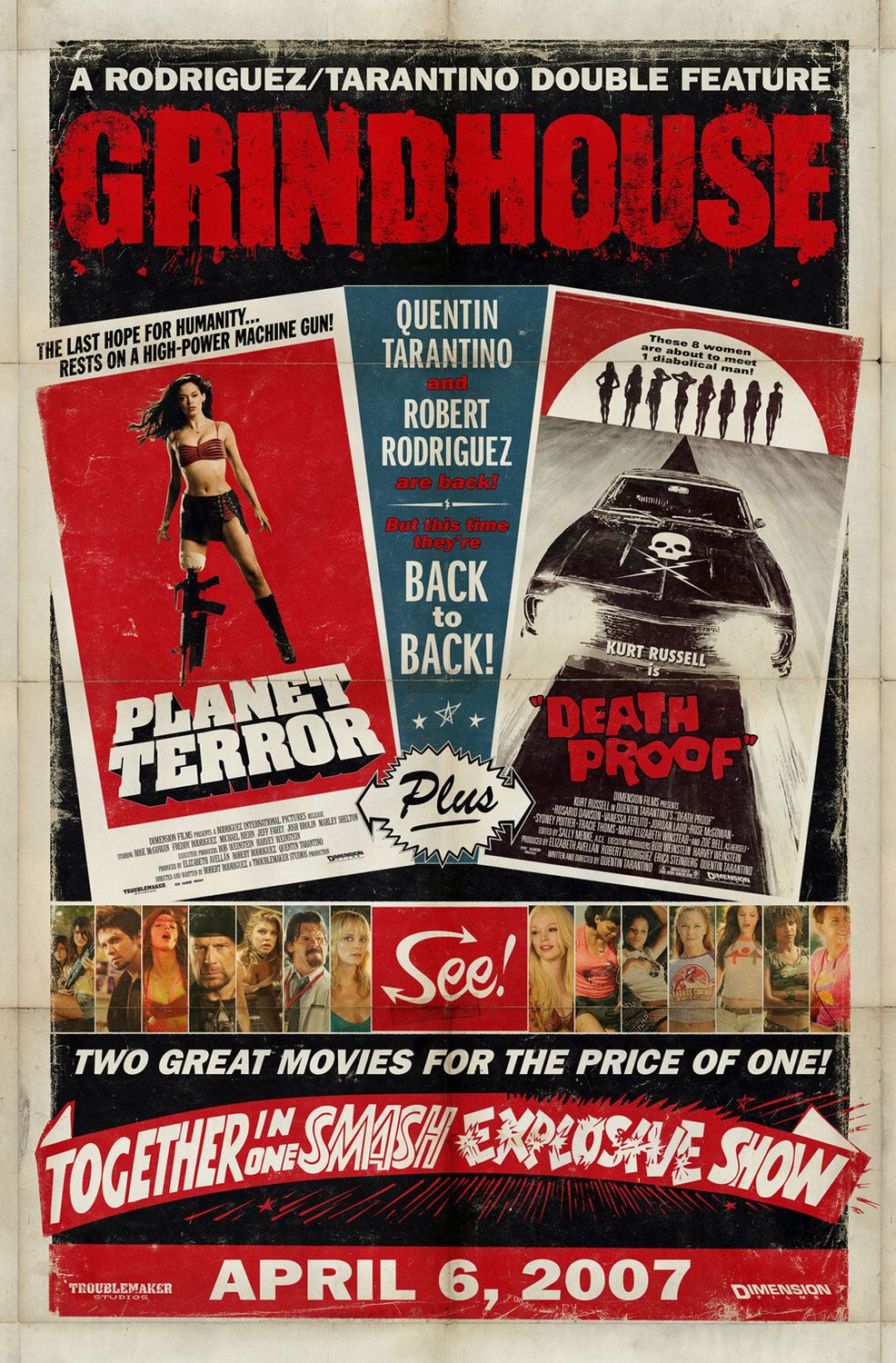
“Grindhouse” is a double feature of movies written and directed by Robert Rodriguez and Quentin Tarantino, and it is their ode to the exploitation movies of the 70’s and 80’s which used to play in all those seedy movie theaters in New York and Los Angeles. Now a lot of those movies were poorly made and had bad acting, writing and directing, but this is not the case here as this crazy love letter to all things exploitation gets brilliant treatment from two renegade minds of Hollywood cinema. To put it mildly, “Grindhouse” was an awesome experience. How great it is to see some kick ass movies made by two guys who have such a love for movies and who love making them.
“Grindhouse” starts off with the first of four fake movie trailers. This is part of Rodriguez’s and Tarantino’s plan to immerse you in the experience of watching grindhouse movies like they did as kids; the scratched-up prints, those missing reels, the restricted ratings, the film breaking apart, and of course those insane coming attractions trailers which at times were more memorable than the movies they were promoting.
Anyway, the first trailer was for “Machete” which was done by Rodriguez and stars Danny Trejo as a Mexican framed for a crime he didn’t commit, and he ends up going after the bad guys with a bloody vengeance. This was a blast to watch and the best of all the fake trailers in “Grindhouse” as it captures the ridiculous one-liners we gleefully remember from all those over the top action movies from the 80’s. I especially liked how they had Cheech Marin playing a priest who Machete gets to kill the bad guys with him. He almost succeeds in stealing the trailer right out from under Trejo’s feet.
Then things get underway with “Planet Terror,” Robert Rodriguez’s addition to the “Grindhouse” movie. It is basically his ode to all those zombie movies which came out before we met the fast-paced zombies of “28 Days Later,” and it’s a cross between a George Romero movie and a John Carpenter movie. “Planet Terror” even features a score composed by Rodriguez himself, and he wrote and shot a lot it while listening to Carpenter’s music from “Escape From New York.” In fact, you can even hear a small part of Carpenter’s score in “Planet Terror” if you listen very closely.
“Planet Terror” was a total blast, a flashback to those go for broke action and horror movies that didn’t even try to hold anything back. It reminded me of the “Evil Dead” movies among others where everything and everybody were going nuts. Then again, with the characters running for their lives away from zombies chasing them, can you blame them?
Rodriguez has put a great cast together for “Planet Terror.” The one person who will be remembered forever from it is the ever so luscious Rose McGowan who plays Cherry, a dancer at a strip club who can’t keep from crying as she dances in front of customers. As you know from the movie’s trailer, one of her legs ends up getting chopped off and it eventually gets replaced by a machine gun which she uses to gleefully sadistic effect. It makes for some hilarious moments as Cherry doesn’t even hesitate in blowing away as many zombies as she can.
Also great in “Planet Terror” is Freddy Rodriguez who brings a total rebel quality to his role as El Wray who is a very cool customer indeed. You also have Michael Biehn playing the sheriff, Josh Brolin who plays Dr. Block whose wife, Dakota (played by Marley Shelton), has been cheating on him with another woman, and even Bruce Willis shows up as a military commander who knows more than he is willing to let on.
One of the people I was especially impressed with was Jeff Fahey who I have not always been a big fan of as he always seemed to me to be playing himself in every role he takes on. But here he is loads of fun as J.T., a gas station and restaurant owner who continually claims to have the best barbecued meat in all of Texas. It ended up making me look at Fahey in a whole new light, and as a character actor, he proves to be invaluable.
“Planet Terror” is one gory ride, to put it mildly, but then again what do you expect when you have Tom Savini playing one of the sheriff’s deputies? Have you even seen the movies he has worked on in the past? Rodriguez gets all the gross details down like body parts getting blown or ripped off in an ever so disgustingly precious fashion. Those same body parts are, as a man, the last things I ever want to lose! Ever!
After “Planet Terror” ended, we were treated to the other three fake movie trailers that “Grindhouse” had to offer. Edgar Wright, who directed “Shaun of the Dead,” did the trailer for “Don’t,” and it was endlessly hilarious as it showed us all the things we shouldn’t be doing when we’re in a horror movie. Then there was Rob Zombie’s “Werewolf Women of The S.S.” which was as funny as it was bizarre. Don’t worry, I won’t spoil this one for you as there are cameos here that are too inspired to just give away. And finally, there was “Thanksgiving” which was directed by Eli Roth, the same man who gave us “Hostel.” Thanksgiving does seem to be one of the few holidays left which have yet to be turned into a horror franchise where horny teens get slaughtered in a creatively bloody fashion.
Then we get to Tarantino’s addition to the “Grindhouse” movie: “Death Proof.” It stars Kurt Russell as Stuntman Mike, a serial killer who uses a car instead of a knife to murder young women. No reason is really given as to why he does this, but in a movie like this does it even matter?
“Death Proof” has its share of gruesome moments including a car crash that is shown from different angles as you see how each person gets horribly injured in a head-on collision. Suffice to say, if you have been in a nasty car accident, you probably won’t want to see this. It also features one of the more exhilarating car chases in recent memory where Russell tries to run a Dodge Charger which is occupied by a trio of women off the road. One of these women, Zoe Bell (Uma Thurman’s stunt double in “Kill Bill”) is riding on the hood of the Charger like the insane stunt woman she is. Seeing her struggle to stay on the car makes the scene all the more frightening and exciting as a result. Tarantino clearly has no interest in throwing all sorts of CGI effects at us. He wants to give us the real thing, and that he does.
Of the two movies in “Grindhouse,” I have to say that “Death Proof” was my favorite. Although it takes a while to get to the action, the dialogue is fabulous in a way only Tarantino can come up with. He continues to come up with great lines which make the characters much more distinct than those in your average action movie filled with stock characters. One of the actresses involved with “Death Proof” said Tarantino really knows how to write for women and knows how they think. Now, this might be open to debate for a lot of people, but I think that is absolutely true as it is shown here and in other movies like “Pulp Fiction” and “Jackie Brown.”
Russell remains one of the most underrated actors working in movies today as he can go from genre to genre and from playing a good guy to a bad guy pretty easily. He is great in this role where he plays a pure psychopath who is clearly schizoid as he goes after his next trio of soon to be victims, and it resembles the kind of work he did in movies like “Escape From New York.” Russell is perfect as Stuntman Mike that it got to where I just could not see Mickey Rourke playing this same role even though he was originally cast in it. Rourke wouldn’t have been bad, but this role feels like it was tailor-made for Russell.
So overall, “Grindhouse” was a kick-ass experience that I am ever so eager to see again. I already have the soundtracks to both “Planet Terror” and “Death Proof” which are fantastic to listen to. Then again, I did actually get them before I even saw “Grindhouse” because I was pretty confident that I would not be disappointed, and I wasn’t. Although it drags a little in spots, it is never boring. It’s not going to appeal to everyone, and it is as politically incorrect as any movie in recent years, but it will definitely appeal to those who have been eagerly and patiently awaiting the resurrection of grindhouse cinema they grew up watching in the past. Many had no choice but to watch those exploitation classics on video and DVD, but with Rodriguez’s and Tarantino’s “Grindhouse,” we finally get to see movies like them again on the big screen where they belong.
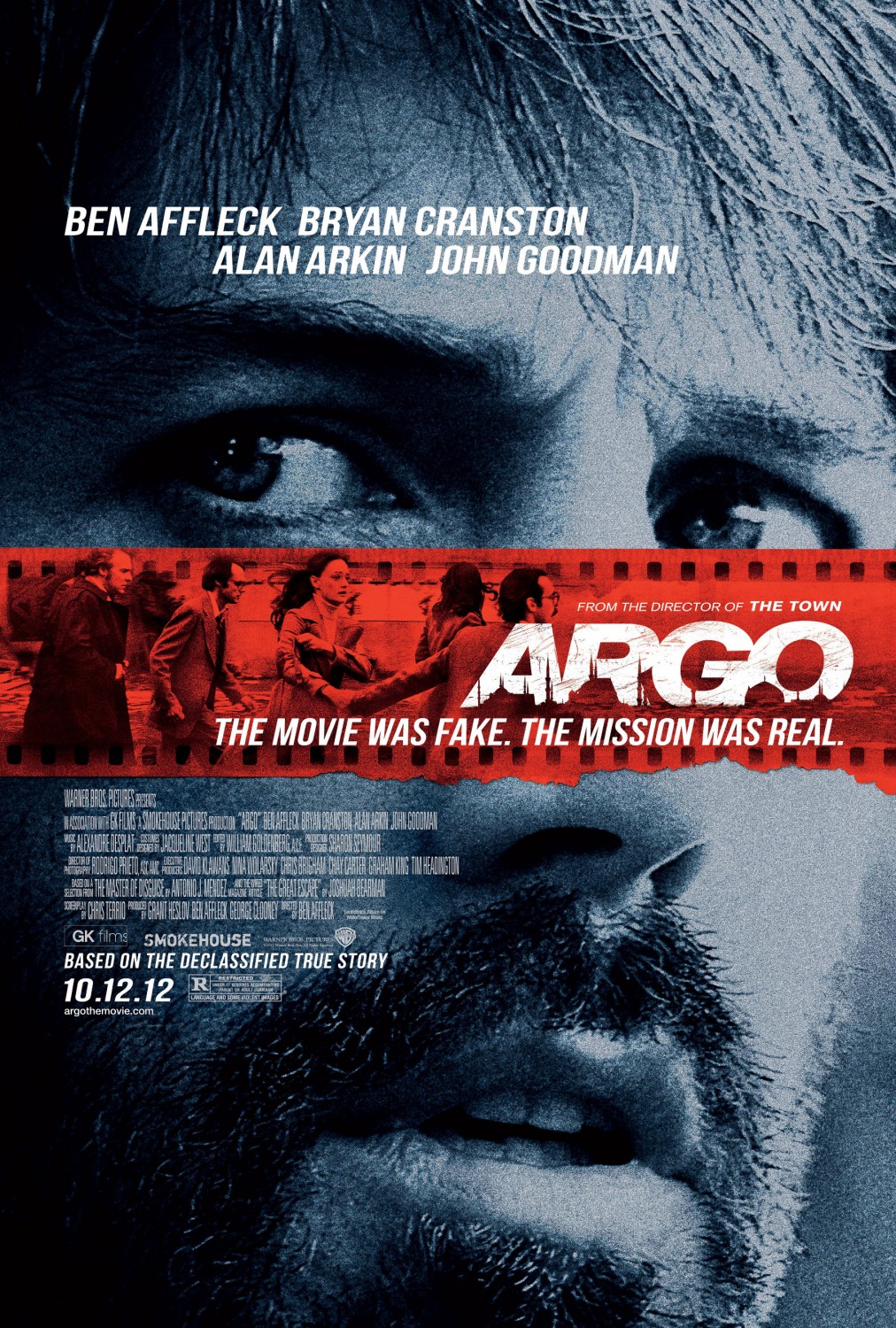
After the one-two punch of “Gone Baby Gone” and “The Town,” Ben Affleck should not have to prove what a great movie director he is. But for those who, for some utterly bizarre reason, still believe they need further evidence to support this conclusion, I give you “Argo.” His third movie as a director tells the story of how CIA specialist Tony Mendez went about trying to extract six U.S. diplomats out of Iran during the 1979 hostage crisis. It proves to be a very intense experience watching this movie, and I also got a huge kick over how it skewers Hollywood and the business of making movies as well.
I loved how Affleck really went out of his way to make “Argo” look like a 70’s movie. He even included the old Warner Brothers logo (referred to as the “Big W” logo) which preceded the studio’s movies from 1972 to 1984. I’ve really missed this logo for the longest time.
Anyway, when Iranian revolutionaries ended up storming the U.S. embassy in Tehran, six diplomats manage to evade capture and find refuge in the home of Canadian ambassador Ken Taylor (Victor Garber). Meanwhile, back in the United States, the State Department has learned of the escapees and their predicament, and they start looking for ways to get them out of Iran. It is Mendez who comes up with the idea, after watching “Battle for the Planet of the Apes” on television, to create a cover story of how the six are actually filmmakers from Canada who are scouting locations for a fake sci-fi movie called Argo. This looks to be one of those “so bad it’s good” kind of movies, and it would have been fun to watch for all the wrong reasons had it ever been made.
The scenes where Mendez goes to Hollywood are among my favorites in “Argo” as he works with movie business veterans who are keenly aware that lying to others is part of their job description. John Goodman and Alan Arkin are priceless as make-up artist John Chambers and film producer Lester Siegel, and they are given great pieces of dialogue to speak throughout. The lines Arkin is given are especially biting:
“You’re worried about the Ayatollah? Try the WGA!”
The tension is then ratcheted up tremendously when Mendez heads over to Iran to prep those six diplomats on how to get out of the country alive. You feel their collective anxiety as they become fully aware of how one little slip up will get them quickly executed in public view, and you are with them every step of the way as the walls continue to close in on them. Emotionally speaking, “Argo” is the first movie I have found myself crying after in a long time, and the tears I cried were from sheer relief.
“Argo” is based on a true story and, while this remains a serious pet peeve of mine, this is one which needed to be told. It wasn’t until 1997 that this rescue operation was declassified for all the world to know about, and it speaks a lot about how two countries can come together in a tough situation (in this case, the U.S. and Canada). Yes, portions of the story were fictionalized for dramatic purposes, but that’s always the case so just get over it.
Affleck casts a lot of great acting veterans in “Argo,” and kudos to him for doing so. I’ve already mentioned Goodman and Arkin, but you will also find Bryan Cranston, Kyle Chandler and Philip Baker Hall doing terrific work here as well. As for the diplomats, they are played by such actors as Clea DuVall and Tate Donovan among others, and they all are uniformly excellent.
In addition to directing this movie, Affleck also stars as Mendez and gives a particularly understated performance. I know we all love to pick on him as an actor, but he’s a better one than we give him credit for. Not once does Affleck try to steal the show from the actors around him, and his work is commendable as acting and directing a movie at the same time can be a real pain in the ass.
“Argo” has more than earned its place among the best movies of 2012, and it makes clear that Affleck’s success as a director is no fluke. This is a guy who has seen the heights of success and the utter embarrassment of failure, and he has come out the other side of it all proving he is a great talent whether he’s in front of or behind the camera.
Be sure to stay through the end credits as well as there is information you will need to hear about this true story.
Leave it to “Saturday Night Live” alum Bill Murray to play the ultimate sad sack loser whom you manage to find some empathy for. Other great actors have played this kind of role to great effect like Al Pacino, Gene Hackman, and Billy Bob Thornton, but I am convinced after watching the movie “St. Vincent” that no one does it better than Murray. Even if the character he plays appears to be an irredeemable jerk, Murray still makes you see there is at least one redemptive quality in this infinitely cynical soul.
Murray plays the Vincent of the movie’s title, but he doesn’t look anything like a saint when we first meet him. We see him getting liquored up frequently and betting on the horses, and he clearly he has more luck getting drunk than he does at gambling. Then he comes to discover he is beyond flat broke (there is such a thing) as he borrowed money against his house to an alarming degree, and a local bookie named Zucko (Terrence Howard) informs him he has a serious debt to pay.
We watch Vincent dance all by himself to Jefferson Airplane’s “Somebody to Love,” and we can’t help but wonder if he cares if anyone loves him in the slightest. In case you haven’t noticed, Vincent is not the nicest person to be around.
As his troubled times ramble on, Vincent suddenly discovers he has some new neighbors which include the recently divorced Maggie (Melissa McCarthy) and her 12-year-old son Oliver (Jaeden Lieberher). They don’t get off to a good start as their moving van accidentally hits a tree and damages Vincent’s fence and his “antique” car. Vincent doesn’t seem the slightest bit interested in giving them a warm welcome as he is in getting reimbursed for the damage done, but when Maggie finds herself forced to work long hours, she has no choice but to let Vincent babysit Oliver while she’s away.
Vincent’s idea of taking care of Oliver includes going to the racetrack where his luck with the horses changes dramatically, and he teaches Oliver to defend himself which comes in handy when he has to get back at the school bully. Now these are not the kind of things you teach a child, but it helps break the ice between them to where they come to enjoy each other’s company.
Murray does not need to win an Oscar to show us all what a great actor he is because we have known this for years now. His performances in “Rushmore,” “Lost in Translation” and “Groundhog Day” show just how far his range stretches, and he does wonders with a character we would be quick to hate in real life. Even when “St. Vincent” becomes a little too sentimental for its own good, Murray never fakes an emotion and we feel for him regardless of how he treats others. The sad look in his eyes speaks volumes and tells us what we need to know about Vincent without him having to spell it out for everyone.
It’s also nice to see Melissa McCarthy in a good movie for a change. Ever since her brilliant supporting turn in “Bridesmaids,” she has been stuck doing solid work in bad movies like “Identity Thief” and “Tammy,” but here she is served by a good script and a role which allows her to take a more serious turn. She’s wonderful here as Maggie, a single mom who’s doing the best she can under difficult circumstances, and she scores some funny moments as well, especially when it comes to a certain plant.
Seeing Chris O’Dowd play Catholic school teacher Brother Geraghty is amusingly ironic as we last saw him as a very anti-Catholic character in “Calvary,” and he is wonderful to watch here. As for Terrence Howard, he has this brilliant ability to take stock characters like the angry bookie and make them seem not the least bit cliché, and his performance as Zucko is yet another example of that. And then there’s Naomi Watts who knocks it out of the park as pregnant Russian stripper Daka, and she gets the accent down perfectly.
But seriously, the performance I was most impressed with in “St. Vincent” was Jaeden Lieberher’s as Oliver as he gives us the perfect example of a child who can see right through adult hypocrisy. It’s such a genuine and unforced performance to where Lieberher inhabits Oliver more than plays him, and he makes this young man come across as smarter and far more mature than the adults around him.
“St. Vincent” was written and directed by Theodore Melfi, and he travels through the familiar “Scent of a Woman” territory to where you have a good idea of where this movie is heading. As I said earlier, it does get a little too sentimental at times, but Melfi throws some interesting twists into the mix I didn’t see coming. I also like how Oliver fights off the school bully and then becomes really good friends with him. It’s not often in movies that you see something like that happen.
When it comes down to it, “St. Vincent” doesn’t reinvent the wheel, but it is very well made and features some truly memorable performances. Will Murray get an Oscar nomination for his work here? Probably not, but that’s because he gives a subtle performance the Academy never appreciates enough. Regardless, he continues to turn in one great performance after another, and his work in this movie is just the latest example.
Sure, everybody deals with anxiety, but for others it can be a very serious disorder. Anxiety is not the same thing as fear because fear is more of a feeling about something which is realistically dangerous, and it is an appropriate response to a perceived threat. But anxiety is more about anticipating disaster and excessively worrying about everyday things like health, money, relationships with friends and family or troubles at your job. The problem is many of these worries are irrational, and much of what you fear never becomes a reality. Still, it’s not something you can just flip off like a light switch as those who are saddled with this disorder end up suffering from many physical symptoms like fatigue, insomnia, fidgeting, difficulty concentrating, trouble breathing and nausea among other things. They find themselves unable to control their anxiety, and it can seriously affect how they deal with daily life.
I bring this up because I suffer from anxiety, but I typically don’t talk about it much outside of a doctor’s office. There is a stigma attached to mental disorders in general, and many who suffer from them don’t want to admit they have a problem. Explaining this to others is frustrating because not many have a full understanding of what you’re going through, and the advice you are likely to get is “get over it.”
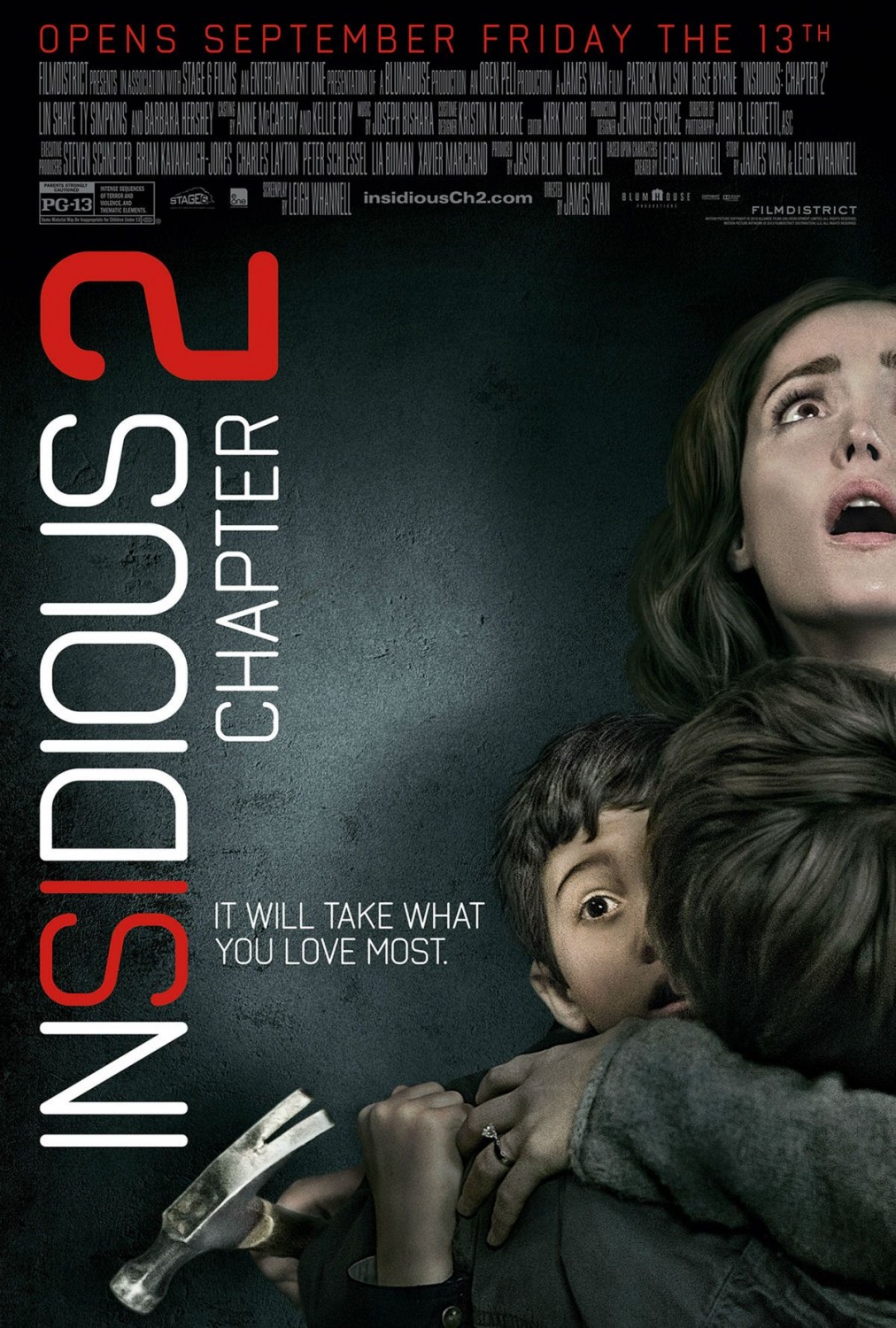
So, I had the opportunity to speak with Leigh Whannell, an actor and writer who wrote the screenplays for “Saw,” “Dead Silence” and “Insidious,” all of which were directed by James Wan. Whannell was in Los Angeles for the “Insidious: Chapter 2” press junket, and I was lucky enough to have a 1-on-1 interview with him at the Four Seasons Hotel thanks to the website We Got This Covered. Whannell himself suffers from anxiety as well, and I asked him how he dealt with it and if it influenced his writing in any way. Part of me was worried this might seem like too personal a question, but he was actually very open to talking about it.
Leigh Whannell: When I was in my mid-20’s, I was having these physical symptoms. To me I didn’t think it was anxiety, I thought it was a health problem. I was getting these headaches and heart palpitations, and at that age I was too young to understand psychological problems. Especially in Australia, we don’t really have a big therapy culture in the sense that I don’t know if people really address their problems as much as they do here. So, I was very confused, and when a doctor told me that all these things that are happening are because of anxiety, that was hard. I think the way I dealt with it in the end was to chisel away at the elements of my life that were adding to the stress. I was working in a job I didn’t like very much, and I got out of the job. It was hard because no one wants to be unsure where their next paycheck is coming from, but I knew that if I got out of that job that would help so I did that. In terms of influence, it was very influential in the writing of ‘Saw.’ I look at ‘Saw’ now and I realize that it’s not exactly a critically acclaimed film, but a lot of people would maybe see it as a B-movie. But for me, at the time, I didn’t see it that way. It was so meaningful to me because, even though it’s this thriller, I was looking at this character that was dying, and all these anxieties about death really were an influence. I think it can end up being good therapy in a lot of ways. When you get out your subconscious on paper, it’s like a mental sauna. You sweat out all the dark stuff and I think that ‘Saw’ is very much a product of who I was in my early to mid-20s. I think I had a pretty dark nihilistic worldview, hence the movie ‘Saw’ (laughs).
I told Whannell it was great he was able to channel his anxiety into his work as it proved to be beneficial for his health and career overall. As I walked out of the hotel room, he wished me the best of luck in dealing with it as he deeply understood what anxiety was all about, and he also gave me some good advice to follow:
Leigh Whannell: I think it’s similar to a physical health problem in that you need to take steps like meditation or long walks or days where you don’t have to focus on it. You need to carve out time for yourself.
Since the interview, I have started taking a mindfulness class which is a form of meditation that focuses your mind to be more attentive and aware of what your body is going through. Essentially, it gives your brain a much-needed rest and to not judge the thoughts which keep running through your head on a regular basis. I have also sought treatment through therapy and other methods, and all of it has been largely beneficial. I still have a way to go in dealing with my anxiety, but I can honestly say I have made a lot of progress.
I really want to thank Leigh Whannell for his time and for being so open about what he went through while dealing with overwhelming anxiety. Honestly, it looks like he’s feeling great and doing much better than when he was younger. Hearing him talk about this issue and seeing him looking very healthy certainly gives me a lot of hope.
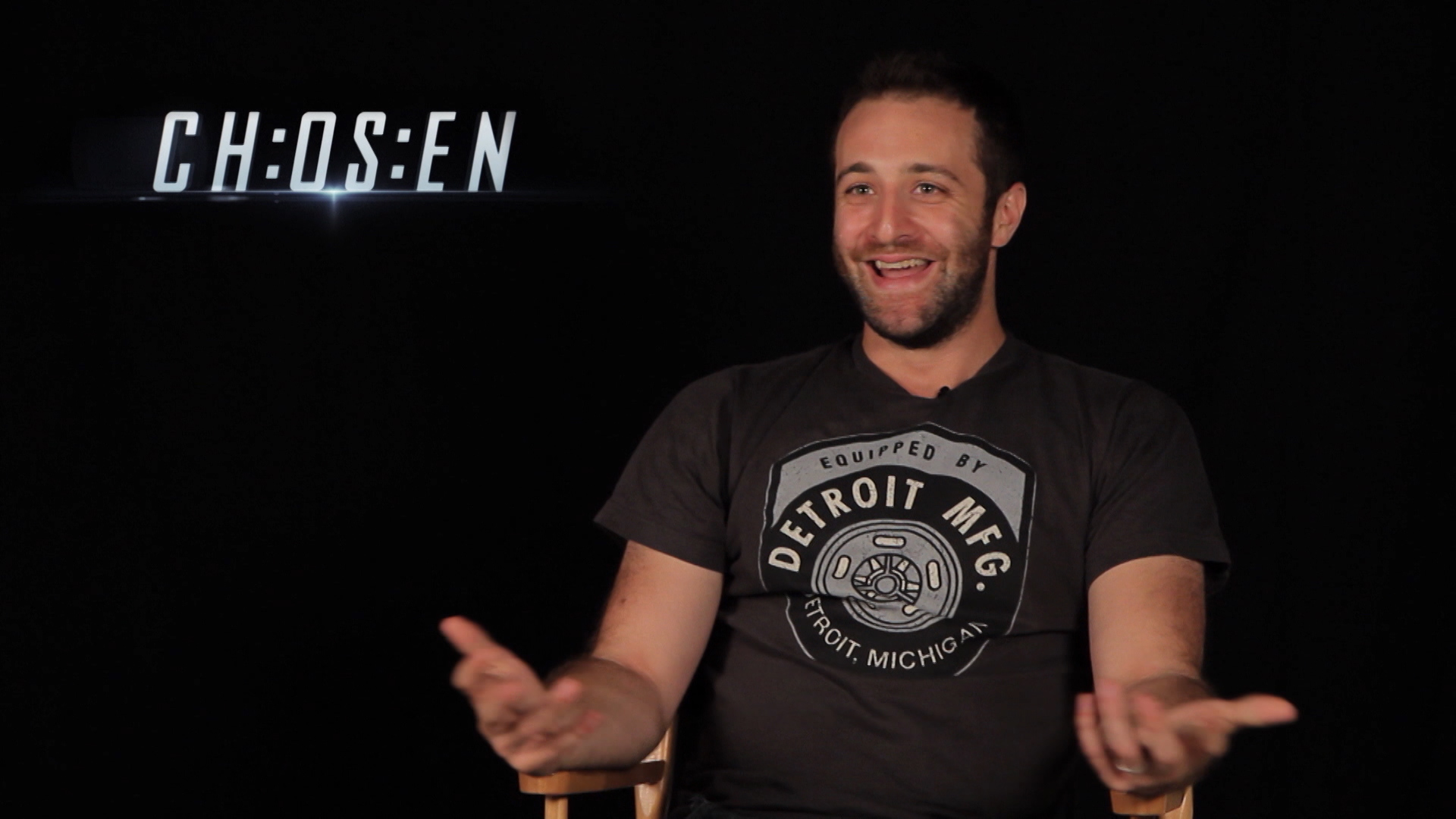
He has made a place for himself in the horror genre with the “30 Days of Night: Dust to Dust” miniseries and the web series “Chosen.” Now with “Beneath,” Ben Ketai breaks into the feature film realm with a story about a bunch of coal miners who get trapped several hundred feet underground after a catastrophic accident. The movie stars Jeff Fahey as veteran coal miner who spends the last day on the job with his co-workers and his daughter Samantha (Kelly Noonan) when the accident happens, and they have to work together to escape the mine before madness and toxic gasses kill them.
I got to speak with Ketai over the phone, and it was great fun talking with him as he explained what it was like working with Fahey, the challenges of maintaining a strong level of suspense for ninety minutes, and the research he did on coal miners for this movie. “Beneath” might look like your typical horror movie, but in many ways, it isn’t.
Ben Kenber: I thought this movie was very riveting and I like how you managed to keep the suspense up until the very end. How much of a challenge was it to maintain that suspense from start to finish? It could not have been easy.
Ben Ketai: One of the challenges when doing a horror movie like this where you are stuck in one space for the entire film, and I give all the credit to Chris (Valenziano) and Patrick (Doody), the writers, is figuring out how to build a proper level of escalation that keeps the story moving without breaking the suspense until the very, very end. It definitely makes my job much easier when you have a creative group of people like that.
Ben Kenber: This is definitely an interesting story for a horror movie. There have been a lot of stories in the news over the past years of mines collapsing and miners being trapped for an agonizing period of time. Was there a specific event that inspired the story for this film?
Ben Ketai: It was really, for Patrick and Chris, the Chilean coal miners and what they went through was the first seedlings of the idea. And then while they were working on it, I think there were a couple more incidents that came along and so we had a lot of different unfortunate happenings that allowed us to draw inspiration from. A lot the inspiration for the film also comes from just coal miners who haven’t been in collapses, and Chris and Patrick did extensive research while writing the script talking to coal miners and visiting coal mines in West Virginia. We had a recently retired coal miner talk to our cast before production. It was like a little seminar on what it’s like to be a coal miner. There were lots of wonderful sources of inspiration.
Ben Kenber: Where exactly was this movie shot? It looks like a real coal mine, but I came out of it not knowing if it was actually a movie set or not.
Ben Ketai: We actually shot it on a soundstage in Culver City, and pretty much everything you see inside the mine was constructed by our brilliant and very resourceful production designer Michael Barton.
Ben Kenber: At times, I thought it looked so real.
Ben Ketai: I had to remind myself sometimes when we were actually on set. I would start to get claustrophobic, and I had to remind myself that we were on a soundstage and that there was sunlight outside.
Ben Kenber: While watching “Beneath,” I was reminded of a number of other movies like “The Descent” where a group of women went cave dwelling and encountered a bunch of vicious monsters. Was there any movie which inspired you or played through your mind while you were making “Beneath?”
Ben Ketai: We actively tried to avoid “The Descent” and other movies like it because we knew it would draw such strong comparisons just because of the subject matter. But of course we watched “The Descent” and we looked at what works best in that movie, and then also what signifies what that movie is and what that movie looks like it feels like. It sounds too derivative, but while making the movie and immersed in the experience I tried to pull from movies that aren’t actually entirely of the genre. I wanted to try to put something more human to the horror experience. Honestly, one of the movies that my crew and I watched the night before we shot was “Friday Night Lights” simply because it’s a film to me that just does a great job of capturing real camaraderie, and also it has a very piece of life feel to it. That was something that we wanted to bring to a movie like this and to try to make the characters feel like real people that we love and care about, and if we can do that then the horror is going to take care of itself. “The Wrestler” was another movie we watched, and it did such a great job of getting the camera to capture the world of wrestling in such a personal way. I wanted to do that same thing with coal miners and have that same sensation.
Ben Kenber: I’m assuming that you did a lot of research on coal miners and mining accidents, and I imagine that when you have a lack of oxygen down there beneath the earth that you start seeing things that may or may not actually be there. What kind of research did you do in preparation for directing this film?
Ben Ketai: All sorts really. The writers had a great head start obviously and they worked on the script for about a year and a half. When I came onto the project just a couple months out from production, they kind of dumped all the research into my lap and I had to do a crash course and catch up fast with them. We were developing the script through craft and with the actors. We just gathered as much information as we could about what happens to your brain during oxygen deprivation, and not only that but what happens when you were trapped in a coal mine. It’s not just that you are running out of oxygen, but the air itself is becoming toxic. There are always toxic gasses that are leaking into the coal mine, and usually if the mine hasn’t collapsed there is stuff that extracts that from the working environment. When the collapse happens, it basically cuts off their flow of fresh air, and things like methane and poisonous gasses continue to build up. All the crazy things that can happen to you like hallucinations to total personality changes, that was really the most exciting thing to me. We had this great device that creates a real-life thing that could explain away all those supernatural things. We really wanted to make it all ambiguous, and we did.
Ben Kenber: The cast for this movie is really spot on. All the actors look like they have worked in a mine for a long, long time. What was it like casting this film?
Ben Ketai: The casting process on this movie was awesome. It was probably the most enjoyable process that I ever had working on movies because we didn’t have a studio looking over our shoulder and we didn’t have foreign sales companies to answer to. So we really just got to do it the old school way and we just had auditions. We really took our time to figure out who were the best people to embody these characters, and we managed to assemble what I felt was a cast of just all incredibly talented and incredibly realistic people/actors.
Ben Kenber: What was it like working with Jeff Fahey?
Ben Ketai: It was a really, really incredible experience. I’ve always been a fan of his. I was probably 12 years old when I first saw “Lawnmower Man.” I grew up with Jeff Fahey. It’s kind of a dream to get to work with a guy like this, and not only that but he’s got so many years of experience under his belt and so much passion for his craft that working with him is sort of like… You turn him loose in a scene and his energy and his expertise kind of permeates to the rest of the cast. I think it really helped pull everything together. I feel like, as a director, I’m just lucky to be able to put that in front of the camera.
Ben Kenber: Robert Rodriguez once said having less money to work with forces you to be more creative. Was that the case for you on this movie, and did you have to cut any corners to get the shots that you wanted?
Ben Ketai: It definitely forces you to be more creative, and I really actually think in many ways it’s what gives the movie its voice and personality. We had to spend so much money building the set itself because we couldn’t film in a coal mine. There really wasn’t much left for anything else. When I came onto the film as director, my first role was to try to make everything feel as real as possible. Myself and Tim Burton, my cinematographer, we wanted to make it feel like we were down in the coal mine with flashlights and headlamps. So what you actually see onscreen is lit with practical lights. Instead of spending our time and our electric budget on a huge lighting truck like you would get on a big studio movie, we were at Home Depot looking at different kinds of flashlights.
I want to thank Ben Ketai for taking the time to talk with me. “Beneath” is now available to own and rent on DVD, Blu-ray, and Digital.