‘Avatar: The Way of Water’ – James Cameron Wows Us Yet Again

It is surreal that “Avatar: The Way of Water” has finally arrived in movie theaters after having its release delayed so many times. The original “Avatar” came out in 2009, and since then we have been promised a number of sequels which never quite made it to the silver screen regardless of what James Cameron promised us. This got to be aggravating for everyone including myself as I kept rolling my eyes whenever Cameron said the sequels would be coming out soon. Like many, I wanted to just yell out, “release them already!” But while so much has happened between 2009 and 2022, it suddenly feels like it was just yesterday when we first visited Pandora and all those blue people, and I was reminded about how wowed I was by everything Cameron put on display.

Well, I can certainly see why Cameron kept us waiting for years and years as he wanted to break new cinematic ground, and he has done so with again with this long awaited sequel. While “Avatar: The Way of Water” may not have the most complex of stories or characters, and his films rarely do, he succeeds in giving us one hell of a cinematic experience as he spends a lot of the 192 minutes wowing us in ways I thought he was no longer capable of. Like “Top Gun: Maverick,” I cannot wait to see it again.

Over a decade has passed since the Na’vi repelled the human invasion of Pandora, and Jake Sully is now the leader of the Omaticaya tribe. He and Neytiri (Zoe Saldana) are now parents to four children; two adventurous sons and two girls who are so fascinated by the world and creatures constantly surrounding them. But like all happily ever after endings, this fairy tale eventually comes crashing down in a nightmarish fashion.

The Resources Development Administration (RDA) has now returned to Pandora, but instead of obtaining that brilliantly named mineral called unobtanium, they are this time intent on inhabiting the planet as Earth is now in its death throes because there were never enough people there who realized climate change was real. And in this futuristic time Cameron has thrust us into, manifest destiny has taken humanity from conquering planets to taking over galaxies because, you know, heaven forbid adults get given the same kind of boundaries children are and eventually benefit from. Once again, humans are out to, as George Carlin once said, free the people and whip a little industry on them.

Fearing the worst, Jake and Neytiri flee the Omaticaya tribe along with their children and take refuge with the Metkayina reef people in hopes they will never be found by the RDA. The family, however, has trouble fitting in as they are tree people while Metkayinas are water people. This leads to a lot of awkward situations between everyone as the kids hate being uprooted and are not sure how to act around those who know the water more than what is above it.

It is when “Avatar: The Way of Water” goes into the waters of Pandora that it really takes off. The underwater footage is nothing short of amazing as we are taken through the many depths of the planet and are introduced to various aquatic creatures who must be seen to be believed. A good portion of the footage was shot in a higher frame rate (HFR) which gives the visuals a clarity which makes them look even more astonishing than they already are. I have not always been a big fan of HFR as it can make things look a little too crystal clear, and Cameron knew not shoot the whole movie in this format as the audience could have been easily alienated, but he makes HFR work to not just his advantage, but the audience’s as well.

Now much has been said about this sequel’s making and of how the actors spent many minutes underwater. As the Na’vi children are made to experience the underwater realm, “The Way of Water” could almost be seen as an advertisement for free-diving. Spend just a minute or two in the shallows or the depths is not enough to take in the last frontier left to explore on Earth or any other planet, but we are also reminded of the dangers of staying underwater for too long, and Cameron knows we know this, so he squeezes ever last ounce of tension to make this clear.

Cameron also gets to deal with themes which have been prevalent throughout his movies and documentaries to where I am quickly reminded of a line from “Aliens” uttered by Sigourney Weaver where she pointed out the difference between humans and certain extraterrestrials:

“You know, I don’t know which species is worse. You don’t see them fucking each other for a goddamn percentage.”

 Indeed, we are given plenty of proof here of how marine life can be far more intelligent than humanity, and it makes the humans decimation of such sea creatures in scenes which reminded me of similar ones in “Jaws” even more painful. Clearly, these fish hunters never took the time to watch “Star Trek IV: The Voyage Home” at least once, and the fluid they remove from these creatures is treated as being even more profitable than unobtanium. All I can say about this fluid is that it’s the kind which would just fly off the shelves in Beverly Hills. I mean, heaven forbid anyone allows themselves to age gracefully, you know?

The inhabitants of Pandora also get to talk to whales in this movie, something which I am sure would make Doctor Doolittle infinitely envious. Now on paper this may have looked incredibly silly, but I never found myself laughing at those scenes where the characters could talk to the animals. That, and maybe I just want to believe deep down that we can do this for real someday if we haven’t already.

As complex as the visual effects are, the same cannot be said about the movie’s story or screenplay. Even with several other credited writers, nothing here sounds like it could have come out of a David Mamet play. Then again, Cameron has not always been known for giving such complexities when it comes to his screenplays. What you see is what you get, and it is up to the actors to bring to life even if the dialogue is not particularly great.

Speaking of the actors, their performances are mostly excellent, and the best ones come from those who will not simply let the effects teams do all the work for them. This is especially the case with Zoe Saldana who puts every single ounce of her energy into Neytiri to where the motion capture, visual effects and her performance all combine to create one big passionate fireball of energy. The same goes for Kate Winslet, reuniting with Cameron for the first time since “Titanic,” who portrays the pregnant Metkayina free diver Ronal with a passion to where it took me forever to realize it was the Oscar winning actress of “The Reader” who was playing this character.

I also have to say how envious I was of Sigourney Weaver here. Not only does she reprise her role of Dr. Grace Augustine, but she also portrays the daughter of her Na’vi avatar, Kiri. Weaver portrays Kiri with all the innocence a child could have as she comes into contact with things she is ever so quick to learn from and use to her advantage.

But my favorite performance of all comes from Stephen Lang who returns as the nefarious Colonel Miles Quaritch, albeit in Na’vi form as he died in the last movie. With his mind implanted in this avatar with memories of his past life, Miles has not changed one bit as he seeks bloody revenge on Jake Sully for what he sees as betraying his own kind. But thanks to Lang, he gives us an antagonist who is never one-dimensional as his goals are led by a patriotic duty which, while misguided, fuels his heart in ways nothing else can. Still, he lets us see another dimension hiding within Miles as he comes to meet the son he left behind on Pandora, Spider (Jack Champion), who has long since become accustomed to the environment he has been living in.

Everything in “Avatar: The Way of Water” leads to an adrenaline-fueled climax which echoes the most intense moments from one of Cameron’s more underrated works, “The Abyss,” as Jake and company are forced to literally keep their heads above water as they fight off those who exploit their planet for their own greedy purposes. When it comes to Cameron, he never lets us down when it comes to infinitely exciting third acts.

No, this is not a perfect movie, and it does not surprise how many detractors out there are quick to point this out. But still, Cameron still knows how to create a cinematic spectacle which is best experienced at a theater near you. Furthermore, no other filmmaker out there can make 3D seem like much more than a mere gimmick than he can. Regardless of how annoying it was to wait this long for an “Avatar” sequel, I think it was worth the wait. But more importantly, I am relieved we will not have to wait all that long for the next installment, and I cannot wait to see where these characters will go next.

Just remember this quote when you come out of “Avatar; The Way of Water:”

“They say the sea is cold, but the sea contains the hottest blood of all.”

That quote is from “Whales Weep Not” by D.H. Lawrence. And yes, I got that quote from a pivotal scene in “Star Trek IV: The Voyage Home.”

* * * * out of * * * *

Revisiting ‘Avatar’ in its IMAX Special Edition

Avatar-rerelease-movie-poster-limited

WRITER’S NOTE: This review was written in 2010.

I really did mean to see “Avatar” in IMAX while it was still playing in theaters, but I never got around to it, unfortunately. After a bit, all the hoopla surrounding the movie was met with people deriding it and calling it a remake of “Fern Gully: The Last Rainforest” or “Dances with Wolves,” and I got worn out from hearing all the complaints. I knew “Avatar” was not going to have an original storyline, so there was no way I could have been disappointed. But after watching it on a regular screen in 3D, I was really eager to see how it played on in IMAX. With Cameron, you can always count on seeing his movies being made with the utmost technical precision. If there is a technological glitch anywhere, it’s someone else’s fault, not his.

At the end of August 2010, “Avatar” got re-released specifically in IMAX theaters around the country, and it had been extended to include scenes that were not in the original theatrical version. There is a total of 9 minutes of extra footage here, and Cameron succeeded in blending these new scenes into the film seamlessly. The new footage includes the following additions:

  • There are more of the Stingbat and Sturmbeat creatures which had their own standout scenes in the first version. The Stingbats look even more wonderful than they did previously, and that’s saying quite a bit.
  • You get more hunting sequences including one in which Jake and Neytiri fly up in the sky and shoot at the animals down below with arrows. This adds more to how Jake interacts and learns from the Na’vi, and how he becomes more open to being taken in by them.
  • There’s an additional sequence where Jake, Grace, and Norm visit a school where Grace taught which has since been turned into a storage space (and not a carefully looked after one). The moment when Jake spots bullet holes in the chalkboard says a lot about how the military infrastructure on the planet is causing more harm than doing any good for the people. It’s a haunting image that filled me with things I did not want to think about as school violence appears to be rising.
  • We get to see a Na’vi counterattack after the bulldozers have laid waste to some of the most sacred parts of Pandora. It is a foreshadowing of the devastating battle the humans will soon bring to the planet’s inhabitants, and of how fighting fire with fire does not always work to one’s advantage. This is especially the case when the other side has more firepower.
  • The sex scene between Jake and Neytiri is longer, but don’t get too excited about it. There’s no insertion of anything or any penetration on display (this is a PG-13 movie after all!), just more hugging and cuddling. We still have yet to see how the Na’vi makes out with one another. I guess we’ll have to wait for the “unrated” edition to see that (lol).
  • There’s a strong emotional scene towards the end between Jake and the Na’vi which reminded me of the final moment between Tom Cruise and Ken Watanabe in “The Last Samurai.” However familiar or similar this scene may seem, it still adds much to the story as it makes Jake’s destiny on Pandora all the more important.

Basically, all the scenes don’t ever feel extraneous, and each adds much to what we had previously seen in theaters back in 2009. Say whatever you want about Cameron’s dialogue or lack of original storylines, but he remains one hell of a storyteller. Clearly, this whole movie was in his head for years and years, and he got every last detail down perfectly. Considering how long he worked on “Avatar,” it’s safe to say he waited extremely patiently until technology finally met up with him so he could tell this tale properly.

Now I’m not going into another long-winded review of “Avatar” as many of my thoughts on the movie have not changed. I do have to say, however, that it was worth the $20 bucks (yes, it was that much) to see it in IMAX. The movie didn’t fill the entire screen, more like three-quarters of it actually, but that was fine. Witnessing Cameron’s film in this format made the experience of watching it all the more immersive. I got serious vertigo watching this special edition at times as it felt like I was moving along with the characters at certain points. I had this same experience when I watched “The Dark Knight” in IMAX, and there were a number of scenes that were shot in the actual IMAX format in that one. I felt like I was floating along with the camera and wherever it went, and it is a feeling I never get enough of at the movies.

I noticed even more that the 3D really brings you into the movie more without calling too much attention to itself with scenes featuring ash falling through the air after the humans wipe out certain parts of Pandora, it started to feel like the debris was coming right off the screen.

Also, it should be clearer than ever that “Avatar” is a powerful anti-imperialist movie, and that it is not a fan of Americans invading other countries. There’s no respect for the rights of the indigenous population on Pandora, and we keep seeing this going on right here on Earth. It makes me wonder if history will ever stop repeating itself.

Seeing “Avatar” on the average-sized movie screen at your local theater is quite something, but watching it in IMAX is a whole other thing. No wonder this has been such an enormous hit around the world. Cameron sucks you visually and emotionally in ways most filmmakers only think they can. Most people I know of these days would prefer to wait until a movie comes out on DVD so they can watch it at home, but this is the kind of motion picture which was made to be seen in a cinema, let alone in IMAX.

* * * * out of * * * *

James Cameron’s ‘Avatar’ – A Cinematic Spectacle Like Few Others

WRITER’S NOTE: This review was written back in 2009.

“That is our (USA) job around the world; run in, free some people, and whip a little industry on them. So they can enjoy the benefits of industry that we have come to enjoy (cough).”

-George Carlin from “Class Clown”

“Some of the darkest chapters in the history of my world involve the forced relocation of a small group of people to satisfy the demands of a large one. I’d hoped that we had learned from our mistakes but it seems that some of us haven’t.”

“Jean-Luc, we’re only moving 600 people.”

“How many people does it take, Admiral before it becomes wrong? A thousand? Fifty thousand? A million? HOW MANY PEOPLE DOES IT TAKE, ADMIRAL?!”

-Patrick Stewart and Anthony Zerbe from “Star Trek: Insurrection”

We waited for this one almost as long as we waited for the release of Guns ‘n’ Roses’ “Chinese Democracy,” and now it is here. James Cameron has been at it again, making the most expensive movie ever, but this is nothing new and I am so burned out from hearing all the gossip about his movie budgets. The naysayers were out in full force proclaiming this would be a disaster as its release was delayed a number of times. But “Avatar” once again shows there is no one more equipped than Cameron to change the way we look at movies. With his latest epic, he has achieved the impossible and completely blurred the line between what is real and what is a special effect, and I could never tell the difference from start to finish.

You have to give a lot of credit to this ambitious director for being ever so patient. Cameron waited years for the technology to catch up to where he could tell this story most effectively, and he even invented a new camera with his brother to make the most convincing 3D movie we could ever hope to see. So many others would be in a hurry to get a movie up on the screen to where nothing but shortcuts are taken, but “Avatar” had a two year post production period (the longest ever) to get every little detail covered. This movie needs to be seen on the big screen as it was made for it. Waiting for a physical or digital release to watch it on would be tragic.

“Avatar” stars Sam Worthington as Jake Sully. Jake is a former marine who is now paralyzed from the waist down, and he does not ask for sympathy or pity. He ends up being recruited for a mission on Pandora, a moon on the far reaches of space. This mission was originally meant for his brother, but he passed away before he could take it on. Pandora is inhabited by very tall blue creatures called the Na’vi, and avatars of them have been created so that humans can walk among them undetected so they can be studied more closely.

Of course, these avatars are also being closely observed by the military as they plan to infiltrate the Na’vi and force them off their sacred land. For what reason? So that the greedy corporation (is there any other kind these days?) can get at the mineral called unobtanium (nice play on words). This mineral represents an enormous cash cow for soulless investors back on Earth, and it also serves as a much-needed source of energy it desperately needs. In the future, it appears humanity has extended the manifest destiny policy from other countries to the far reaches of space. I mean, heaven forbid we allow other cultures to handle their precious resources without our unsolicited advice! Do we ever learn?

Anyway, the story of “Avatar” has been told many times before; a disillusioned military officer comes face to face with people he has been fighting, and soon he becomes enamored with their lifestyle and code of honor to where he is integrated into their society. This has been the basis for “Dances with Wolves” and “The Last Samurai” and even “The Emerald Forest.”. We know the setup and how it’s all going to go, but Cameron still makes it work by having us invest emotionally in these characters. By doing so, all the action and the visuals presented to us become all the more enthralling.

Seriously, Cameron has been one of the very best storytellers in movies for decades now. This at times gets lost on people because his dialogue can be quite cringe inducing. You want to go up to him and make him realize people don’t talk to each other the way he thinks they do. It constantly reminds me of what Harrison Ford told George Lucas about his script for “Star Wars”:

“You can type this shit, but you sure as hell can’t say it!”

For what’s it worth, however, Lucas makes Cameron sound like David Mamet.

Regardless, the strength of the story he has concocted makes the visuals on display all the more exhilarating. My big issue with most effects driven movies is you can tell when you are watching a CGI effect. All this does is completely take me out of the movie to where I roll my eyes and wonder why Hollywood regularly underestimates audiences.

Now at the start of “Avatar,” when Jake is looking at the creature he will be, you can definitely tell what is real and what is computer generated. But as the movie goes on, I honestly couldn’t figure out which was which. I tried, believe me I tried to see the difference, but there was just no way. Plus, the motion capture they used on the actors is astonishing. The avatars are made to look like the actors playing them, and the movements are so amazingly lifelike to where it makes every other 2009 movie see, like it was made back in 1987. That description may be stretching it a bit, but I couldn’t resist.

The art direction in this movie is incredible, and the color blue (my favorite) is used quite a lot. There are other astonishingly breathtaking visuals like the floating mountains which looked quite real…. Damn it! I am running out of words to describe what I saw. You have to see it for yourself.

As Jake Sully, Worthington keeps him from being a complete cliché and infuses him with a nobility which has served him well in life. But one of the most welcome actors here is Sigourney Weaver who is appearing in her first Cameron movie since “Aliens.” Weaver plays Dr. Grace Augustine, the head of the Avatar program. While the military wants to use her work for their own manipulative methods, she uses them to help gain the trust of the Na’vi and study their world for peaceful and scientific purposes. She is the classic Cameron female character; tough as nails, controlling, and never ever a pushover Apparently, Weaver based her character on Cameron to an extent. To steal a line from “Up in The Air,” Dr. Grace Augustine may very well be James Cameron with a vagina.

Another classic Cameron female is played by Michelle Rodriguez, still looking as hot as she did in “Fast & Furious.” Her character of helicopter pilot Trudy Chacon is somewhat similar to Jeanette Goldstein’s character of Vasquez from “Aliens”; a badass soldier who is as tough as the men, maybe even tougher. She’s certainly a lot more morally conscious than the majority of the marines in the film, and Rodriguez makes sure you never forget that.

You also have Giovanni Ribisi playing Parker Selfridge (yes, his last name rhymes with selfish), the corporate manager in charge of the mining operation on Pandora. Like Paul Reiser’s character from “Aliens,” he is only interested in making a gigantic profit which will set him up for life. I love how Ribisi plays Parker as a pragmatic ass with absolutely no moral scruples whatsoever as this character is ever so gleeful about what is in store for him once this mineral is sufficiently mined. The way he sees it, what’s the big deal?

But one of the best performances comes from Stephen Lang who plays the brutal Colonel Miles Quaritch. Despite some of the ridiculous dialogue which comes out of his mouth, Lang completely makes Miles into a soldier you would be incredibly foolish to mess with. Like Tom Berenger in “Platoon,” his face is deeply scarred, and he does nothing to hide that. Miles simply sees it as an illustration of how nasty the moon of Pandora is. His flaw, however, is that he cannot see who the Na’vi really as his anger against them has long since powered by an everlasting fear which he cannot overcome.

Now let’s talk about the Na’vi, those big blue creatures who are tall enough to play for the Los Angeles Lakers or the San Antonio Spurs. They could have made or have broken “Avatar.” Cameron has said he thought about the story long before he began working on “Titanic,” and that he even thought about these characters when he was a kid. Now having an original race of people who speak their own language may work well on “Star Trek,” but in other shows and movies, it looks more comical and ridiculous than was originally intended. This is not the case here.

This brings me to the performance of Zoë Saldaña, who you may remember as Uhura in J.J. Abrams’ “Star Trek.” She plays Neytiri, Princess of the Na’vi tribe Omaticaya. Neytiri is the first real Na’vi to come in contact with Jake Sully, and she later falls in love with him. In essence, a lot of “Avatar” rests on her performance, and she succeeds in making you believe in this race of beings to where you see them as more than just an amazing series of special effects. This ends up making it easier for other actors like Wes Studi and CCH Pounder to portray their characters without having to expend too much effort in helping you buy into these extra-terrestrials. Saldana sets up the groundwork, and everyone follows her from there.

“Avatar” deals with many of the same themes Cameron has dealt with throughout his career: military intervention into a foreign land, machines versus nature, love found between beings from different worlds or societies, how scientists and those with curious minds seek to understand the aliens and make peace with them, and how corporations will do anything for a profit. The parallels between what the military forces are doing in Pandora and our wars in Vietnam and Iraq, not to mention our current escalation in Afghanistan, are clear as day, and it does make the movie feel timely.

But one of the especially interesting things here is how Cameron utilizes a lot of the technology which was on display in his previous films. Those armed walkers Colonel Quaritch uses look to be an upgrade of the driver Weaver used in the climax of “Aliens” (which the Wachowski brothers all but ripped off for “The Matrix” sequels). The mind devices used to control the avatars looks a lot like the head pieces used in “Strange Days.” The scenes of humans interacting with otherworldly creatures bring to mind similar scenes from “The Abyss.” And you have characters who go from being antagonists to becoming the good guys (“Terminator 2” was a classic example of this). With all this in mind, I thought Cameron was running out of new ideas, but I love how he combines them all up to good use in “Avatar.”

But enough of me babbling about “Avatar.” Whatever weaknesses this movie may have are undone by its well-earned achievements. Once again, see this movie in a theater! I don’t care if you hate going to the movies. “Avatar” is a great and reinvigorating reminder of how sitting in a darkened movie theater can be so thrilling.

Now, if you’ll excuse me, I have to find an IMAX theater playing this movie that is not sold out for weeks in advance. Seeing something like this on the silver screen once is never enough, ever.

* * * * out of * * * *

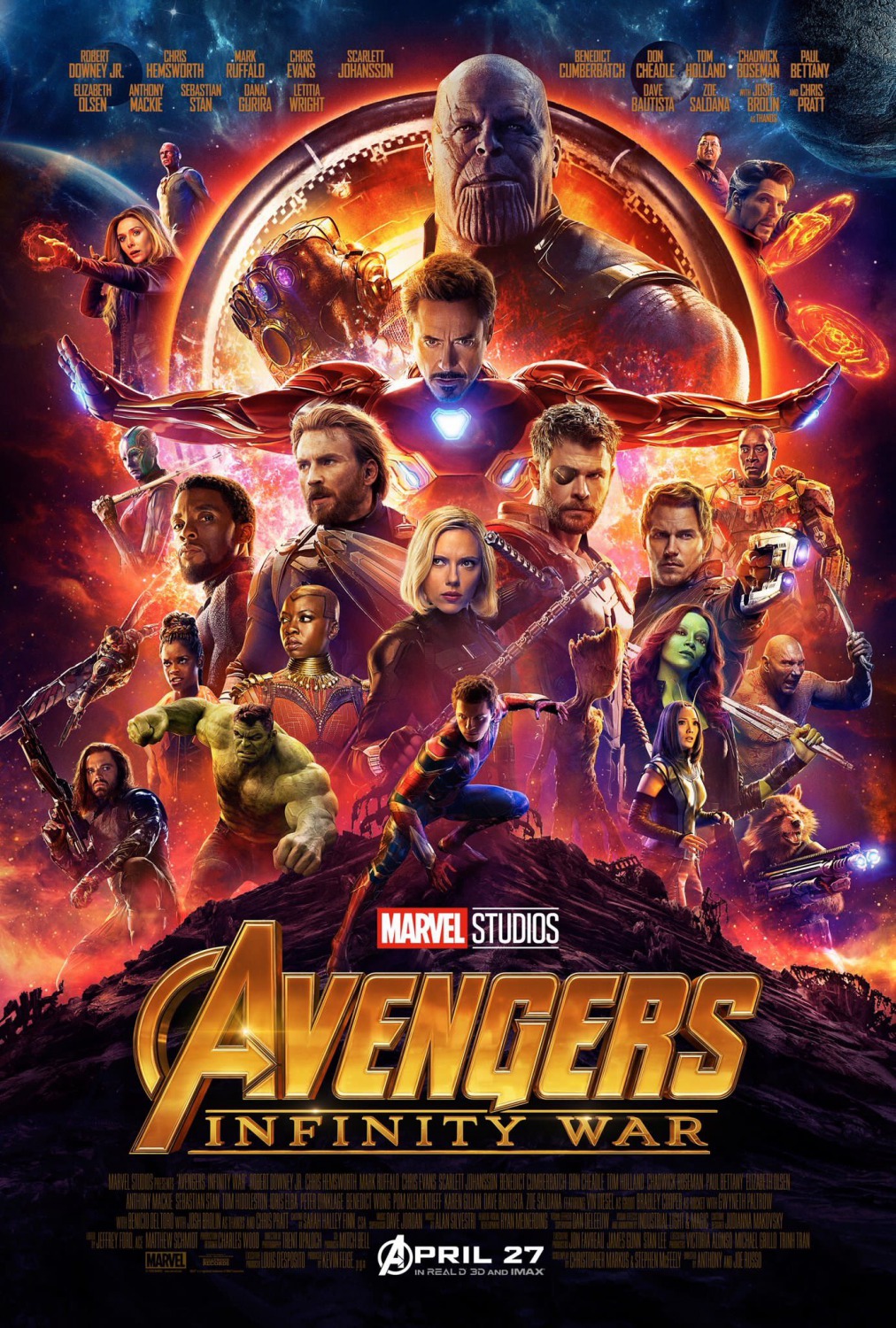
‘Avengers: Infinity War’

Avengers Infinity War poster

You know how many advertisements for movies say how “everything has led to this” from time to time? Well, for once, this statement makes perfect sense with “Avengers: Infinity War” which is, thus far, the biggest Marvel Cinematic Universe movie yet as it gives us their most threatening foe yet in Thanos. This particular Marvel character, an intergalactic despot from the planet Titan, has been hinted at in post-credit sequences from Marvel movies past, and now he is here to take center stage in a never-ending franchise which typically sees its greatest heroes get the majority of attention.

Thanos longs to get his hands on the Infinity Stones, six incredibly powerful, not to mention beautiful, gems which will allow him to impose his will on all of reality. Clearly, this is a character determined to gain unlimited power at any cost, and he is determined to re-balance the universe in the process. Thanos is looking to create his own version of Year Zero, and this means many characters will die whether we want them to or not.

Not only does “Avengers: Infinity War” arrive with a wealth of anticipation and expectations, but we also come into it with a sense of dread as we know some of our favorite characters may not survive this particular adventure. Then again, these Marvel movies do exist within the science fiction genre, and you can never be sure if anyone can ever truly stay dead. Spock died in “Star Trek II,” but he did come back to life in “Star Trek III.” Knowing “Avengers: Infinity War” will get a sequel, I can’t help but believe we will see some of these superheroes again. Besides, many of them have sequels in pre-production, so their fate is not exactly sealed. Who will live and die for certain? Well, we will find this out in the summer of 2019.

Directors Anthony and Joe Russo, both responsible for the “Captain America” sequels which rank among the best of the MCU, have a near impossible task with this “Avengers” movie as it features dozens upon dozens of main characters we have been introduced to in the past. The fact these characters are not all equally represented here is not a surprise, but what surprised me was how well the Russos were able to balance things out to where it felt like everyone had a good dose of representation throughout. Perhaps certain characters get more screen time than others, but I was too wrapped up with what was going on to really analyze this movie all too closely.

It is also worth noting how while these characters all inhabit the same cinematic universe, they do exist on different tonal levels. Some Marvel movies like “Iron Man” and “Thor” have their moments of levity, but they are generally serious adventures as their heroes are faced with obstacles both physical and psychological. Then again, there is “Guardians of the Galaxy” which came out at a time where Marvel movies in general were threatening to become as deadly serious as anything coming out of the DC Comics Extended Universe. James Gunn’s film of Peter Quill and his merry band of Han Solo-like bandits proved to be a comedic blast from start to finish, and it proved to be much lighter than the average superhero/comic book movie.

I bring this up because “Avengers: Infinity War” could have ended up being a very uneven motion picture in terms of tone as John Krasinski’s “The Hollars” was (granted, Krasinski did score a rebound with “A Quiet Place,” but still). The Russos, however, make everything blend together in a satisfying way to where nothing felt completely off-balance, and this is very commendable.

The way I see it “Avengers: Infinity War” gets off to a good start, but things feel just a little bit off to where this movie threatens to be more episodic than its filmmakers intended. But as it goes on, things improve to where the Avengers are given a real depth which reminds us they are as vulnerable as anyone else. Sure, they may be endowed with tremendous powers, but when faced with their greatest foe, they become as mortal as anyone else, and this makes their latest adventure all the more perilous.

There are many performances worth noting here, and this Marvel movie is overflowing with strong ones which would take forever to point out. Robert Downey Jr. continues to revel in the evolution Tony Stark/Iron Man as he gives his most soulful performance yet as this iconic comic character which got the MCU off to such a strong start. Zoe Saldana gets to take Gamora to an even more epic level as her character has a much closer relationship to Thanos than she would like to admit. The same goes for Chris Pratt who, as Peter Quill/Star Lord, finds even more depth than in the previous “Guardians of the Galaxy” movies to where it makes me look forward to the third movie in that franchise more than ever before.

But the one performance worth singling out above all others is Josh Brolin’s as Thanos. This could have been the typical one-dimensional antagonist bent on obtaining the most power any individual could ever obtain, but the “No Country for Old Men” actor makes him into an almost tragic figure who has yet to discover what price he has to pay for his quest for power, and it is a heavier one than he could ever expected. As a result, Brolin forces this character into the center stage in a way audiences could not have easily expected, and the final scene he has is a frightening reminder of the prominence Thanos has in the realm of Marvel Comics. Seeing this makes me believe no other actor could have portrayed Thanos as effectively as Brolin does here.

“Avengers: Infinity War” ends on a cliffhanger, and it feels like a bold move on the part of the Russo brothers and Marvel Studios to do so as it concludes on a note which truly left me breathless. We do get the typical post-credits sequence and the message of how so-and-so will return, but both these things take on a different meaning to where you almost wish this Marvel movie ended without them. In a year from now we will see the follow up to “Infinity War,” but until then we will be reminded of how our heroes will not always be there for us. Can they return for another round? We have yet to find out.

* * * ½ out of * * * *

Star Trek Beyond

Star Trek Beyond poster

With “Star Trek Beyond,” the rebooted franchise now follows the Enterprise crew on its five-year mission to explore strange new worlds, to seek out new life and new civilizations and to boldly go where no one has gone before. What results is a mixed bag of a movie that gets a little too bombastic for its own good at times, but which still entertains better than many of the other summer blockbusters released in 2016. More importantly, this movie remembers what makes “Star Trek” so memorable: the relationships these characters have with one another.

We meet up with James T. Kirk (Chris Pine) and his crew in the third of their five-year mission. Kirk finds his duties as captain growing monotonous and becomes increasingly interested in accepting a promotion to Vice Admiral. Spock (Zachary Quinto) is reeling from his breakup with Uhura (Zoe Saldana) and the death of Spock Prime (the late Leonard Nimoy) to where he is considering leaving Starfleet to help New Vulcan. Scotty (Simon Pegg) still loves his warp engines, Sulu (John Cho) and Chekov (the late Anton Yelchin) are still at the helm, and McCoy (Karl Urban) is still eager to remind everyone that he is a doctor and nothing other than that.

The Enterprise’s latest assignment has them traveling through an unstable nebula on a rescue mission, but it turns out to be a trap that destroys the Enterprise and leaves its crew stranded on an alien planet whose inhabitants are quick to enslave them. An alien commander named Krall (Idris Elba) seeks to destroy the Federation of Planets for reasons which eventually become clear as the movie goes on.

As the trailers for “Star Trek Beyond” have long since revealed, the Enterprise is destroyed early on. This isn’t the first time we have seen this famous starship destroyed. We watched helplessly as it self-destructed in “Star Trek III: The Search for Spock” and we its lower half explode and its saucer section make a spectacular crash landing in “Star Trek: Generations.” But what’s significant about this movie’s Enterprise is that it is destroyed very early on as opposed to the halfway point. This is a bold move as these films thrive on the presence of the Enterprise for the most part, but here we see it destroyed from the get go to where you wonder how the crew can do their jobs without it. As a result, things in “Star Trek Beyond” feel more unpredictable than usual as everyone is separated from one another and trying to figure out what to do without easy access to the Federation of Planets.

J.J. Abrams stepped away from the director’s chair as he was busy directing “Star Wars: The Force Awakens.” In his place is Justin Lin who is best known for his numerous contributions to “The Fast & The Furious” franchise, but I also like to remind people of his 2002 film “Better Luck Tomorrow” which I felt made him a good choice to helm this “Star Trek” movie. Thanks to a script by Simon Pegg and Doug Jung, he takes the time to focus on the characters and their evolving relationships with one another. I especially loved the scenes between Spock and McCoy as these two can’t stand one another but still need to rely on each other when danger looms over them. Spock may find the fear of death of illogical, but McCoy rightly points out that it is what keeps us alive. This is reminds me of a pivotal moment from the original “Star Trek” television series when McCoy said, “Do you know why you’re not afraid to die Spock? You’re more afraid of living.”

Having said that, Lin does make the action scenes in “Star Trek Beyond” feel, and I have to say it, a little too fast and furious. It gets to where we threaten to lose sight of the movie’s plot and what its main antagonist is aiming for. I imagine that when I see this “Star Trek” movie again, and seeing any “Star Trek” movie just once is not enough, I will better understand all that is going on, but the fact that I wasn’t able to follow every little detail here did take away from my enjoyment. I liked “Star Trek Beyond,” but I came out of it feeling like I could have liked it a lot more.

Speaking of the main antagonist, he is Krall and is portrayed by Idris Elba, an excellent choice as he is the kind of actor who can elicit fear with just a look of his eyes. Like Oscar Isaac in “X-Men: Apocalypse,” he is covered up with way too much makeup which threatens to take away from his natural charisma, but he still gives us a villain that is in no way, shape or form a one-dimensional character. As “Star Trek Beyond” goes on, we learn that he is a victim of circumstances beyond his control, but while that doesn’t justify his actions, it certainly explains why he does what he does. Elba is one of the best actors out there today, and his performance here is further proof of that.

It’s great to see how these actors have grown into the roles they were first cast in seven years ago. Pine shows how the years of space travel have worn down Kirk’s soul but not his spirit. Quinto continues to do excellent work as Spock, having made this character his own a long time ago. Urban remains a pitch perfect McCoy, and his delivery of that character’s classic catchphrases is worth the price of admission. Saldana continues to give us a kick-ass Uhura who isn’t about to take shit from anyone, and I mean anyone. With this “Star Trek” movie, Pegg gets to make Scott more than a comic foil as he works to get the support of a particular alien who can help him and the crew defeat Krall. And there’s Yelchin who finally gets to do much more as Chekov here than in the previous films. He’s terrific here, and it makes his recent death all the more tragic as he was a major talent whose life was cut much too short.

Special mention also goes to Sofia Boutella who gives a genuinely strong alien warrior character in Jaylah. This is the same actress who made an undeniably memorable impression as the henchwomen whose prosthetic legs were designed to leave some serious damage. Boutella steals every scene she has here as Jaylah looks to defend herself against those who destroyed her family, and I can’t wait to see what role she will take on next.

While part of me wishes “Star Trek Beyond” was a better movie than it is, it still proves to be better than many of the other summer blockbusters released so far in 2016. Many believe that this franchise is still be converted into one resembling “Star Wars,” but I don’t believe that as the filmmakers involved are fully aware that the characters are far more important in this one than the special effects. It also makes me smile that this franchise continues to live on to further generations no matter what. While some look at Gene Roddenberry’s vision of a hopeful future as nothing but hooey, others see it as one that nobody should stop believing in, and I am one of those people. Here’s to this franchise continuing to live long and prosper no matter what.

* * * out of * * * *

Copyright Ben Kenber 2016.

Star Trek Into Darkness

Star Trek Into Darkness movie poster

J.J. Abrams has done it again; he’s made another incredibly entertaining “Star Trek” movie. “Star Trek Into Darkness” proves to be just as much fun as the reboot he helmed in 2009, and I found myself with a big grin on my face as the end credits came up on the silver screen. In a summer season that has gotten off to a somewhat tepid start, Abrams manages to thrill us with a combination of spectacular action pieces and characters we come to care deeply about. He also takes this movie to where no “Star Trek” movie has ever gone before: a place where roman numerals and colons are not needed in the title.

One year has passed since the events of the last movie, and this one starts off with the crew of the U.S.S. Enterprise accidentally catching the attention of a primitive civilization that is not yet ready to discover the existence of things like starships. This leads the crew, and James T. Kirk in particular, to violate the Prime Directive which dictates that there will be no interference in the development of an alien civilization, to attempt to save one of their fellow crew members from certain death. Back on Earth, none of this sits well with Admiral Christopher Pike (Bruce Greenwood) who berates Kirk (Chris Pine) for acting as if the rules don’t apply to him.

But things change quickly when a vicious domestic terrorist named John Harrison (Benedict Cumberbatch) lays waste to certain parts of Earth, and Kirk becomes consumed with vengeance and determined to bring him down at any cost. But in their pursuit of Harrison, the crew of the Enterprise find themselves in conflict as to what course of action is the best one to pursue. While Kirk feels justified in killing Harrison, this action could lead to an all-out war that the Federation of Planets cannot afford.

Now some complain that ever since Abrams became part of the “Star Trek” franchise that the movies have become more about action than ideas, but that’s pretty much been the case since “Star Trek II: The Wrath of Khan.” What Abrams gets right though is his attention to the characters, and in the end this franchise is really more about the characters than special effects. While we love the action with all those starships firing their torpedoes at one another, it’s the characters and what they go through which keeps us endlessly riveted.

I love the complicated relationships these people have with one another. Admiral Pike continues to be the father figure Kirk needs in his life, and Greenwood is perfect in the role as he dishes out some hard love to the strong but arrogant captain of the Enterprise. You never really catch Greenwood acting in the role, and his moments opposite Pine are filled with a lot of genuine emotion that never feels faked.

But the key relationship in this particular “Star Trek” movie is the one between Kirk and Spock which remains as complicated as ever. While Kirk is willing to fudge the facts in order to justify his course of action, Spock has no choice to be 100% honest about everything because he’s a Vulcan, and Vulcans don’t lie (but they do exaggerate). You wonder how these two can stand to be on a starship together for even a brief period of time, but the fact is that these two need one another in order to survive from one galaxy to the next. This becomes all the more apparent as “Star Trek Into Darkness” reaches its relentless conclusion.

Pine gives another excellent performance here as the iconic character James T. Kirk, and it’s fun to watch him take Kirk from being a cocky individual to one who ends up making selfless decisions in order to save the only family he has left: his crew. Quinto remains riveting as ever as Spock as we watch his half-human and half-Vulcan sides battling with one another for supremacy. Spock has always been a very complex character, and there are many reasons why he was the only one to survive the pilot episode of the original “Star Trek” television series.

Zoe Saldana really gets to kick ass as Uhura, and there’s something thrilling about her not just being relegated to her communications station on the bridge. Simon Pegg remains a delight as Scotty who finds out more about starships than he’s supposed to in this one. John Cho really does get his moment in the sun as Sulu when he is required to take the Captain’s chair and makes it clear he is not to be messed with. And then there’s Karl Urban who remain as pitch perfect as ever as Dr. McCoy, and he delivers some of the character’s most iconic lines with a freshness which reminds us how much we loved this character in the first place.

As for Anton Yelchin, his character of Pavel Chekov is kind of underused in this “Star Trek” movie. Yelchin gives a good performance, but Chekov is relegated to engineering a little too much this time around, and he comes off looking like he’s not a necessary part of the Enterprise crew.

There are also some new additions to “Star Trek” family in this sequel that prove to be very welcome. Peter Weller, the original “Robocop,” co-stars as Starfleet Admiral Marcus, and he brings to his role the same relentless hard ass intensity he brought to the fifth season of “24.” Alice Eve portrays the very alluring Science Officer Carol Wallace who knows more about weapons than anyone is comfortable with, and she hides secrets which may jeopardize her relationship with the crew.

But the one actor everyone will be paying the most attention to is Benedict Cumberbatch. Long before this sequel was released, it was believed that he would give us one of the most unforgettable villains of the summer 2013 movie season, and he doesn’t disappoint. John Harrison is not your typical one-dimensional bad guy, and that makes Cumberbatch’s portrayal of him all the more mesmerizing to watch. He also gives the role a strong depth you don’t expect it to have as we discover his true nature and why he is wreaking all this havoc.

To say anything more would risk spoiling the movie for you, and I am not about to do that. Abrams makes a very welcome return to the director’s chair for this “Star Trek” adventure, and his success here bodes well for that “Star Wars” movie we are waiting for him to make. While some directors get caught up in visuals, battles and explosions, Abrams is one of the few who gives an equal amount of attention to the actors and the characters they play. That makes his films all the more thrilling and emotionally involving to witness.


It’s hard to say where “Star Trek Into Darkness” ranks among the other movies in this franchise that continues to live long and prosper, but it’s safe to say that it won’t be sharing company with “Star Trek V: The Final Frontier” anytime soon. This film entertained me from beginning to end and it never sacrificed character for the sake of action. It has me looking forward to the next film which should have the Enterprise crew finally starting their five-year mission to explore strange new worlds. Whether or not Abrams will be in the director’s chair, it’s bound to be a very entertaining journey.

* * * ½ out of * * * *

Copyright Ben Kenber 2013.

Star Trek (2009)

Star Trek 2009 movie poster

I have been into “Star Trek” since I started watching the original series when I was five years old. I reveled in Kirk, Spock and the rest of the Enterprise crew hurtling through space and exploring new worlds. I still remember watching the episode “The Return of the Archons” where the Enterprise crew was being held prisoner, and there was this overwhelmingly loud noise which rendered them unconscious. As they fell to the floor, I mimicked what I saw on that ancient Zenith television my parents bought, pretending I was part of this great crew. Back then, I envisioned myself as a character on that show and “Star Trek: The Next Generation” as its adventures made up for the dullness of reality.

As “Star Trek” expanded from its original incarnation later became a never ending movie franchise, I stayed with it as much as I could. My dad had to carry me out of “Star Trek II: The Wrath of Khan” after I burst into tears at the end. The fact that I kept saying he would come back to life was truly an utter coincidence when “Star Trek III: The Search for Spock” came out, and I was in tears after that one as well. I later became determined to be the first person in Thousand Oaks, California to own a copy of “Star Trek IV: The Voyage Home” on VHS. When my family moved from Thousand Oaks to the Bay Area, I found myself wanting those transporters to be real so that I could beam down south to hang out with the friends I was forced to leave behind.

But somewhere along the line, I found myself losing interest in all things Trek as I started to miss out on the last couple of seasons of “Star Trek: TNG.” Then there were other spinoffs like “Deep Space Nine” and “Voyager” among others, and I became increasingly less excited about the franchise as it came to resemble “Law & Order” and its various other incarnations. You knew what you were going to get, so the level of excitement I had for the franchise kept fading away year after year. Still, I believed that the franchise could be resurrected because, as Spock would say, there are always possibilities.

That resurrection has now arrived, seven years after “Star Trek: Nemesis,” thanks to J.J. Abrams. His “Star Trek” movie is the most exciting film this series has seen since “First Contact,” and I fucking loved it! This origin story of the Starship Enterprise and its cast gives the franchise a much needed kick in the ass. By taking the series in new directions, Abrams has succeeded in opening up the world of Trek to an audience that never fully embraced it before.

We get to see a young James Tiberius Kirk driving a hot rod while blasting the Beastie Boys’ “Sabotage” on the car’s stereo, and this is the first sign that this “Star Trek” is not going to be the same old shit. We see a young Spock getting taunted by his classmates which makes him use methods other than that famous Vulcan nerve pinch to subdue his enemies. Seeing Spock beat the crap out of others might have been hilarious in any other movie, but Abrams takes the character in fresh new directions we have not seen him go to before. This plays much more intensely on the fact that Spock has always been half-human and half-Vulcan.

The plot of “Star Trek” revolves around the device of time travel which has played a part in the most entertaining and successful films in the series (“The Voyage Home” and “First Contact”). It involves a large mining ship of Romulans commanded by Nero (Eric Bana) who is as thirsty for revenge as Khan was in “Star Trek II.” It doesn’t matter how much you know about Gene Roddenberry’s sci-fi universe because anything and everything you remembered about it previously will seem very different, and that makes this movie all the more entertaining and unpredictable.

One of the key successes Abrams has with “Star Trek” is the actors he has chosen as none of them try to do imitate what the actors who originated these roles did before them. Among the most impressive is Chris Pine who plays Kirk as a hotshot who gets himself in trouble constantly and lacks a father figure in his life. Pine really succeeds in capturing the same cockiness and over confidence that William Shatner brought to the role before him.

But even better is Zachary Quinto who plays Spock at his most emotionally unhinged. Of all the actors here, he has the biggest obstacle to overcome since the original Spock (Leonard Nimoy) is in this film as well. I admired how Quinto strongly displayed Spock’s inner turmoil and of the fact that he is a child of two worlds. One of his best moments comes when he essentially flips off the Vulcan High Command after he is accepted into their prestigious science academy. By describing Spock as having done well despite the “disadvantage” of having a human mother (played by Winona Ryder of all people), we get a huge thrill out Quinto making “live long and prosper” sound like he’s saying fuck you to the.

Another inspired casting choice in “Star Trek” is Simon Pegg as Engineer Montgomery Scott. As the movie heads to its exciting climax, it is frightening to see just how much Pegg resembles Scotty from the original series, and that’s even more so when we hear him say, “I’m giving her all she’s got Captain!” Pegg gives us a Scotty that is a perfect comic foil, and it will be great fun to see where he will take Scotty in future installments.

As Nero, Eric Bana gives us the strongest and most lethal villain this series has had since Khan. Whereas the previous antagonists seemed more refined in how they acted among their prey, Nero’s fury is so personal and uncontainable, and the fact that he is named after the Roman Emperor whose rule was marked by tyranny, and that he ordered the execution of his mother and adopted brother, should give you an idea of how screwed up he is.

The rest of the cast includes Bruce Greenwood who is perfectly cast as Christopher Pike, and it reminded me a lot of his underrated portrayal of John F. Kennedy in “Thirteen Days.” John Cho of “Harold & Kumar” fame plays Sulu, and he has a great moment where he gets to put his fencing skills to the test. Zoe Saldana plays Uhura with a calm sexiness and an intelligence that is foolishly underestimated by others until she makes you see the big picture. Karl Urban gives us a pitch perfect Dr. Leonard ‘Bones’ McCoy and captures the character’s infinite crankiness we all know him to have. Anton Yelchin plays Pavel Chekov, and while the character feels underused here, he is still well cast and has a flawless Russian accent. And of course, we have Winona Ryder playing Spock’s mother, and her performance is all the more impressive when you take into account that she is only two years older than Quinto.

What impressed me even more about this particular “Star Trek” is that it was given a budget of over $100 million. There is no doubt that the money is there on the screen, and the effects are remarkable. This is an especially good point to make as special effects have never really been the strong point of the “Star Trek” series, but here they are the best they have ever been. The Enterprise bridge looks so much different than it ever before, and it has a sleek style to it that makes being there all the more inviting.

I’ll be very interested to hear what die hard Trekkers think of this latest adventure of the Enterprise crew. This one does not dwell on big ideas the way “Star Trek” has done for the most part throughout its various incarnations. The main power of Roddenberry’s series was how it dealt with social issues of the day in the realm of science fiction. This one is meant to be more like “Star Wars,” and it allows Abrams to give this aging franchise an invigorated feeling that it desperately needed. While it may not be a “Trek” rooted in philosophy, I think this one leaves the door open for writers to explore present day themes in a future installment.

But I cannot go on without mentioning the welcome return of Leonard Nimoy as Spock (. This could have been a gimmicky cameo that lasted just a few seconds, but Nimoy’s Spock does play a very pivotal role in this movie. Furthermore, he also helps give it a sense of legitimacy that it would not have had without his appearance. Keep in mind, his character was the only one who survived the rejected first pilot of the original series.

Seeing this “Star Trek” brought a lot of happiness to me. My mood seems to get inadvertently sidetracked depending on the health of the franchise. I can honestly say that I am not all surprised at its longevity or constant rebirth. Roddenberry’s message of hope always finds a way to win out, and it is fitting that the movie is getting released around the beginning of the President Barrack Obama’s first term. Granted, this is really a coincidence since the movie was being developed before he made his decision to run for President, but it’s a wonderful coincidence all the same.

All those kids who gave me crap about liking this great series can suck it now, because “Star Trek” is here to stay. Even those who picked on me for being a Trekker, and ironically did much better in science classes than me, won’t be able to pass this one up. “Star Trek” can be seen as the first truly great odd-numbered movie in the long running series, and it is proof that this series will never die.

Live long and prosper? OH HELL YES!!!

* * * * out of * * * *

Copyright Ben Kenber 2009.