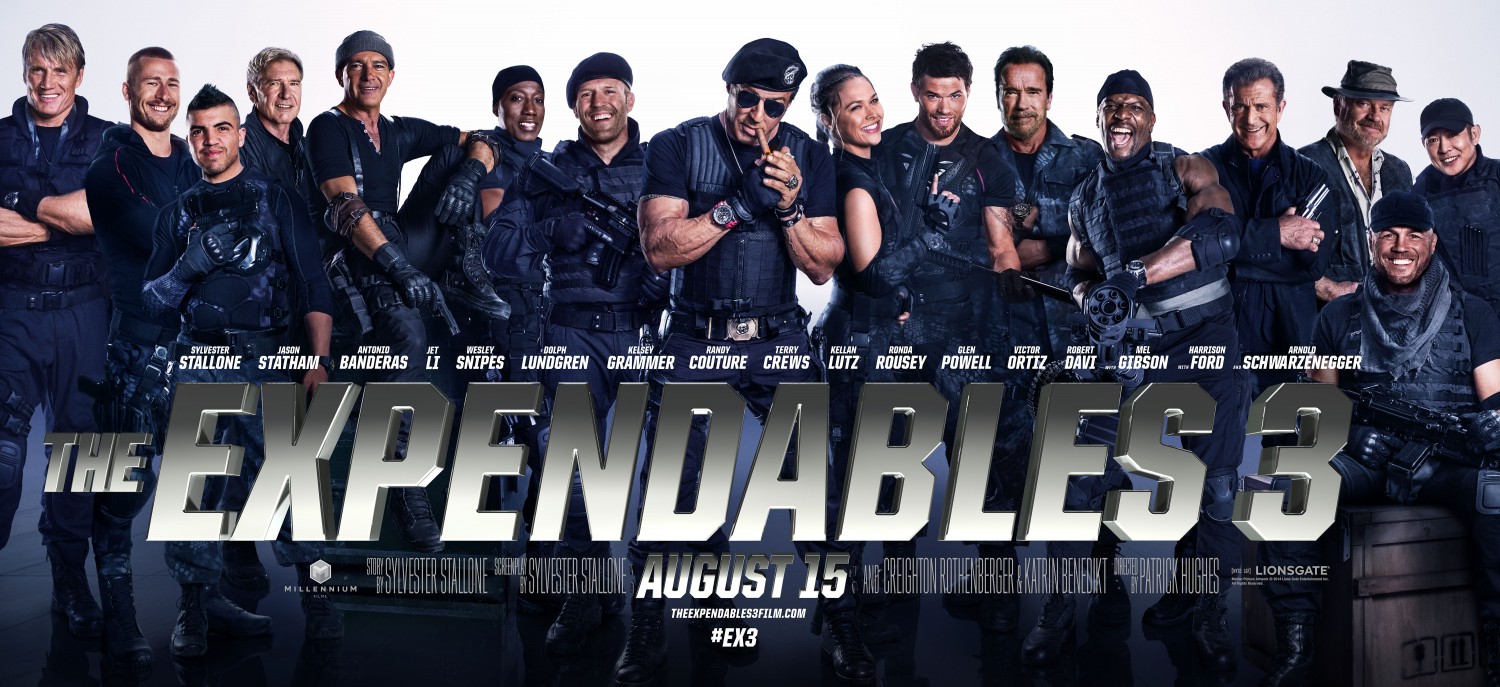
With “The Expendables 4,” or “Expend4bles” as the studio cleverly calls it, about to be released, I wanted to reflect on its predecessor which came out nearly a decade ago. As disappointed as I was with “The Expendables 3” to where my opinion would be no different if it were rated R instead of PG-13, I still adore its teaser trailer which I still find myself watching quite often. It is short and sweet as we are introduced to the cast of the sequel to the tune of Malcolm Arnold’s theme to “The Bridge on the River Kwai.” There is something thrilling about seeing all these actors and movie stars coming together on the silver screen to this famous piece of film music, the same one the actors of “The Breakfast Club” whistled at one point while losing an entire Saturday for whatever it was they did wrong.
Like the teaser trailer for “Transformers: Revenge of the Fallen,” this is a great one for a movie I really cannot stand. While I am happy to revisit “The Expendables” and “The Expendables 2,” “The Expendables 3” is one I would prefer to believe never existed in the first place. But yes, we always have this delightful teaser trailer to it.
I was really looking forward to the third “Expendables” movie ever since I saw the teaser trailer which was scored to the theme for “Bridge on the River Kwai.” None of the films in this franchise will ever be mistaken for high art, but they bring about a much-needed nostalgia workout which many of us have for the action movies from the 1980’s. Watching “The Expendables 3,” however, reminded me of how the third movie in a franchise is where everything falls apart due to a reliance on formula and clichés which don’t work the way they used to. While I have a hard time saying how the actors look tired here (and that’s because they don’t), the story gets boring quickly, the dialogue is cruddy and not even the action sequences could lift me out of my utter frustration with something that is not nostalgic enough nor exhilarating or adrenaline-pumping in the slightest.
“The Expendables 3” starts off with the team rescuing one of its long-lost members, Doctor Death (Wesley Snipes), from being sent to a military prison. The scene where he’s being rescued is cool, but the thrill we get from watching it feels a bit muted, and this becomes a sign that everything else following the movie’s opening will be equally exhilarating, which is to say not at all. Either that, or “The Raid 2” truly spoiled me to where no other action film being released these days can come even remotely close to that sequel’s brilliance.
After rescuing Doctor Death, the team heads off to Somalia to intercept a shipment of bombs being sent to a warlord, of course. In the process, they come face to face with former member and Expendables co-founder Conrad Stonebanks (Mel Gibson) who had betrayed the team by profiting off of illegal weapons dealings. When he shoots Hale Caesar (Terry Crews) to where he is left in a precarious medical state, Barney Ross (Sylvester Stallone) gets all shaken up and decides to disband the veteran members of the Expendables as he feels they have all run their course, and they should all get out while they still have a pulse.
When Barney does this, I knew this sequel was going to be in serious trouble. Barney ends up recruiting a whole bunch of younger Expendables with the help of retired mercenary Bonaparte (Kelsey Grammer), but I knew from there that those “old guys” will eventually return to help save the day. Stallone, who has always been the major creative force behind the “Expendables” movies, always writes screenplays where the main character suffers a personal tragedy and seeks redemption in order to right what he did wrong, and he’s basically been writing the same damn screenplay since the original “Rocky.” Frankly, I think it’s time Stallone opens his eyes to see how this storyline is now as old as the Declaration of Independence.
Look, I don’t care how old Jason Statham, Wesley Snipes, Randy Couture and Dolph Lundgren are because they can all still kick ass after all these years, but putting them all on the back burner for this entry proves to be very foolish. You know that Barney will eventually realize he needs their help, and the movie takes way too long for him to reach this conclusion. Instead, it wastes a lot of time introducing us to a new generation of Expendables, and most of them are inescapably tame to where it’s easy to understand why this sequel got a PG-13 rating instead of an R.
Kellan Lutz ends up showing the same range as an actor that he showed earlier in the horrifically bad “The Legend of Hercules,” and that is not a compliment. As for Glen Powell and Victor Ortiz, they don’t leave much of an impression here. Things fare much better though for Ronda Rousey who plays the highly athletic nightclub bouncer, Luna. Don’t even ask if she holds her own with the male action stars because you can quickly tell she can even before she starts kicking ass. While her co-stars won’t linger in the mind long after you’ve endured “The Expendables 3,” Rousey makes you eager to see a female version of this franchise sooner rather than later.
Antonio Banderas shows up as Galgo, the soldier who won’t shut up. It’s like he’s doing a version of his “Puss in Boots” character on acid, and it’s a kick to see how much energy the Spanish actor still has at his age. Harrison Ford is also on board as Max Drummer, the CIA dude who manages the Expendables. It’s fun seeing Ford join the party, but it doesn’t take long to see that he is playing the same character Bruce Willis played in the last two films. All the writers have done here is change the name to protect the greedy “Die Hard” movie star.
Granted, there are some nice in-jokes throughout “The Expendables 3” which show the cast having a good sense of humor about themselves. I have to give Snipes credit as even he pokes fun at his felonious past, and there’s a nice line of dialogue regarding Willis’ disappearance from the franchise. But while the cast is clearly having fun, that fun never translates over to the audience. On top of being saddled with a weak story and crappy dialogue, this sequel makes you feel like you are a guest at a party where you’re not really party to the party.
Looking back, this movie could have used a lot more of Schwarzenegger in it as he proves to be the one who gives us all the 1980’s action nostalgia we could ever possibly want. Seeing him spout off classic one-liners from “Predator” provided me with the most enjoyable moments this misbegotten sequel had to offer. Indeed, he’s always had a good sense of humor about himself and is always determined to give audiences what they want. To see him reduced to a series of cameos here does “The Expendables 3” a major disservice.
Actually, the best and most enjoyable performance here is, in my humble opinion, Mel Gibson’s who plays the ruthless arms dealer Conrad Stonebanks. Playing a crazed villain has become the kind of role Gibson typically plays these days, and this is one of the most gleefully psychotic bad guys he has played thus far. That crazy energy he displayed in the “Mad Max” and “Lethal Weapon” movies is put to great use here, and he makes Conrad the kind of bad guy we seriously love to hate.
“The Expendables” movies have been about reviving the old days of 1980’s action flicks, but this third entry misses the whole point about what made them so much fun; even with the thinnest of plots, they were about something. “The Expendables 3” feels like it barely exists, and I came out of the theater feeling empty and depressed. Those 1980’s action classics always got my adrenaline pumping, but this one almost put me to sleep despite an especially loud climax. After two fun action movies which made me nostalgic for what I grew up on cinematically, here we have with a sequel which reminded us of why so many in this genre suck nowadays.
“The Expendables 3” was directed by Patrick Hughes, an Australian filmmaker who is said to be helming the American remake of “The Raid: Redemption.” Now it is bad enough anyone is remaking that infinitely awesome flick, but I hope he has better luck with that one than he did with this lousy sequel.
There was a time long ago, before he decided against paying taxes, when Wesley Snipes was one of the biggest action stars working in movies. When you see an actor like that suddenly sink into the almost inescapable realm of direct-to-video films, you cannot help but feel a little sad. Seriously, Snipes is a better actor than many give him credit for these days. He wowed us in “New Jack City” and the “Blade” movies among others. But in between all that, he starred in crappy movies he usually proved to be the most watchable thing in. “Passenger 57” is one of those crappy movies but, for what it is worth, it is never boring for a second.
Snipes stars as John Cutter, a security specialist for an airline corporation who is taking a flight to Los Angeles to take a new job. He is the kind of character you might see in Sylvester Stallone movies like “Cliffhanger;” a man who has suffered a terrible tragedy and is now heading on to the road to redemption. Cutter watched his wife get shot to death in front of him during a convenience store robbery, so you can understand why he doesn’t smile a lot. Along with him on the plane is flight attendant, don’t dare call her a stewardess, Marti Slayton, played by Alex Datcher. Cutter just got through a training session with her where he chewed Slayton out for improvising a move where she succeeded in disarming a terrorist. Now he is trying to make it up to her, but she is not making it easy for him. Ironically, the thing Cutter chewed Slayton out about becomes their only option for survival.
Unbeknownst to Cutter, aboard the plane is terrorist Charles Rane (Bruce Payne) who is being shipped under the guard of FBI agents to await trial where he will most certainly be found guilty. Payne plays the villain of the piece with a seething glare you can find in any Stanley Kubrick film. It is a one-note performance, even if his character has the excuse of feeling no pain. At the same time, Payne does create a threatening presence as a villain to where he has us desperately wanting him to experience the most intense pain humanly possible. Seriously, karma has got to visit this asshole at some point.
Now this brings me to one of the key idiotic moves in this film. Charles Rane is responsible for all of these terrorist acts of destruction, many of them involving airplane explosions. So of course, the FBI has the bright idea of transporting him to trial via airplane. Not by car, train, or even in a cage or some contraption that they would use for Hannibal Lecter. Of course, if they didn’t take him on a plane, there would be no movie. I doubt it would have been anywhere as exciting to see Mr. Rane hijack a 1970’s Pinto. Then again, that might have made for some interesting fight scenes between him and Cutter.
Some movies have gaping holes in plot logic which don’t bother me because I don’t always realize they are happening while I am watching a movie. But when you have plot holes as big as the ones those dinosaurs could have walked through, it’s kind of hard to not notice them. “Passenger 57” is full of plot holes, and they left me scratching my head constantly. We have already gone over transporting an airline hijacker by airplane, but how does this terrorist manage to get on board after being taken off by the police? He has some guy shooting the officers taking him back on board, but how did he get all the way out there? Did the FBI even bother checking the backgrounds of the flight crew and passengers? Really, you can see it in the eyes of Rane’s henchmen. Then again, looks can be deceiving. And is it really possible for Cutter to get inside an airplane by sneaking up through the landing gear while the plane is taking off and not get crushed or blown away in the process?
To a certain extent, it almost shouldn’t matter as “Passenger 57” is entertaining enough. But if these logic loopholes give you a big enough headache, like being in the front row and staring right up at a movie like “JFK,” then it does. You can only be allowed to insult the intelligence of the audience so much before they get right back up in your face.
The other really big problem is that the majority of the acting here is God awful. Granted, Snipes is always fun to watch, and I even have good things to say about Elizabeth Hurley as well. The other actors, however, all speak as if their feet are nailed to the floor, and they emote more than anything else. This is especially evident on the ground when Snipes is confronted by a bunch of hillbilly cops that are clichéd and racist in inescapable ways. How rare it is that you see this much bad acting in a motion picture which was released theatrically.
Then again, you do have Tom Sizemore on board as Cutter’s friend of sorts, Sly Delvecchio. Even if he was on drugs while acting in this movie, he is never ever boring and raises the acting level ever so slightly for the rest of the cast. Then again, that helped only so much.
The movie was directed by Kevin Hooks who has done a lot more work these days in television than he has in feature films. But considering that he has worked on such shows as “24,” “Alias,” and “Homicide – Life on The Street” among others, it is clear he has a good hand for action and character than this particular motion picture would quickly suggest. Maybe the movie was so low budget that they didn’t have time to work on things more. If they did have more time, it would have ended up being far more entertaining and enthralling than what ended up onscreen here.
As I write this, Snipes has since gone through a career renaissance thanks to the combined efforts of Craig Brewer and Eddie Murphy who allowed him to let loose and go crazy in “Coming 2 America” and “Dolemite is My Name.” Seeing him in “Passenger 57” serves as a reminder of the kind of action movie star he was once upon a time, and he does make this one more watchable than it might be otherwise. Thanks to Snipes, he keeps me from giving this particular movie a more brutal review.
In the end, I can’t say I hated “Passenger 57,” but I never got bored by it either. This was made back when we had dozens of “Die Hard” knock-offs, and this one can safely be described as “Die Hard on A Plane.” If you want a better version of this movie, check out “Executive Decision” with Kurt Russell and Steven Segal which has better acting and characters. Better yet, check out “Air Force One” which stars Harrison Ford and was directed by Wolfgang Peterson.
After all this time, I can’t believe Roger Ebert liked this movie more than “Air Force One.”
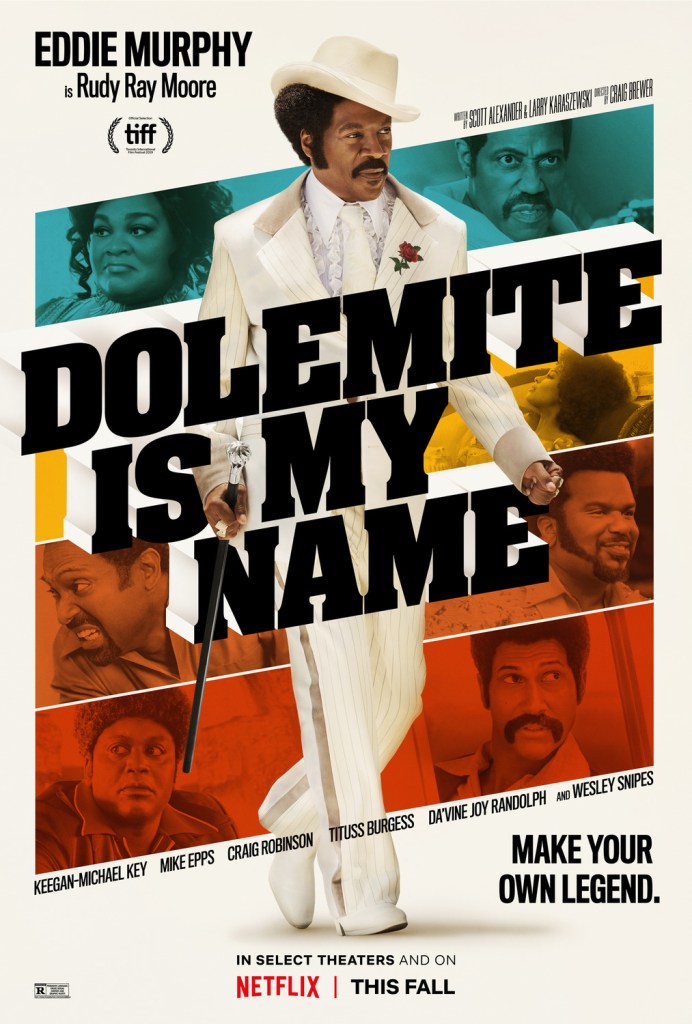
With the Coronavirus still wreaking havoc around the globe (deal with it you flat-Earthers), this mandatory quarantine has allowed me to catch up on movies which I was hoping to watch sooner. One I finally caught up with is “Dolemite is My Name,” the biographical comedy film about comedian and filmmaker Rudy Ray Moore who created the character of Dolemite, released several successful comedy albums, and then risked everything to bring his iconic character to the silver screen. What unfolds proved to be one of the best and most entertaining movies of 2020. Eddie Murphy gives us one of his greatest performances ever, Craig Brewer returns to make a film as entertaining as his best efforts, and screenwriters Scott Alexander and Larry Karaszewski have given us yet another offbeat biopic about an unlikely character who more than left their mark on the world.
When we first meet Rudy, he is a struggling artist living in 1970’s Los Angeles. We see from the start he is a natural born hustler, and his determination to become a star knows no bounds. At the same time, his life has long since fallen into a rut as he finds himself working at a record store whose manager, Roj (Snoop Dogg), refuses to play Rudy’s songs which comes with names like “Step it Up and Go” and “Below the Belt.” Despite Rudy’s eagerness, Roj freely admits none of his songs could ever compare to Marvin Gaye’s “Let’s Get it On.”
Furthermore, Rudy is past his prime, and he is starting to believe his dream of stardom has long since gone out of his reach. His stand-up bits at a local club fail to elicit a single laugh as his jokes are exquisitely lame to put it mildly. In addition, he has become quite, as someone later describes him, “portly.” Yes, even back in the 70’s, Hollywood seemed to have a problem with overweight people.
Then one day, Rudy gets accosted by a homeless man named Ricco (Ron Cephas Jones) who comes into the store making various loud proclamations which show off his superb rhyming skills, and one of them includes the name “Dolemite.” This ends up lighting a fire of inspiration in Rudy as he goes out into the streets to meet up with Ricco and his brethren to record their dialogue which prove to be poetic as it is profane. To be sure, Rudy pays these men to him their stories, but while some may be all about the Benjamins, he is more about the Washingtons.
From there, the character of “Dolemite” is born and Rudy dresses himself up for the occasion. It is an electrifying moment when we first see him take the stage even after the club owner begs him to just stick with his normal act. While he was at first ignored as an opening act, he now has the audience in stitches when he tells them, “Dolemite is my name, and fuckin’ up motherfuckers is my game!” From there, he finds the loving audience which had long eluded him, and he becomes increasingly intent on leaving his mark on the world.
Eddie Murphy certainly had a much different path to fame than Rudy Ray Moore ever did. He got cast on “Saturday Night Live” when he was 19, and film stardom came soon after when he starred in “48 Hrs.” Rudy, on the other hand, found success later in life and with a niche audience which was nowhere as big as Murphy’s. But watching Murphy here, I can see why he is a perfect fit to play Rudy as he inhabits this raunchy comedian and hustler with such an unbridled enthusiasm to where his spirit is so infectious throughout. Seeing Murphy land so many of Dolemite’s one-liners perfectly reminds us how brilliant his comedic timing is, and it is shocking to learn this is his first R-rated feature since 1999’s “Life.”
But moreover, Murphy really gives a great performance here which, in another year, might have earned him a deserved Oscar nomination. He really makes us root for Rudy even as his confidence begins to wane, and he also shows the insecurities and the past Rudy is constantly trying to stay several steps ahead of. There is one scene where we see Rudy on the phone with a prospective movie studio, and we do not even have to hear who is on the other line as Murphy shows us what rejection looks like as his face crumbles. Seriously, if this moment does not prove what a great actor can be, what will?
For Craig Brewer, “Dolemite is My Name” is his first feature film directorial effort since his 2011 remake of “Footloose.” To say this is a comeback for him is not really fair as he has spent the last few years producing several movies and directed TV episodes, so clearly he has been a busy body. However, watching this movie proves he has not missed a step as it contains the same boundless energy and enthusiasm he brought to “Hustle and Flow” and “Black Snake Moan.” Brewer clearly revels in the journey Rudy took from being a starving artist to becoming a known personality, and he makes this journey a thrilling and endlessly entertaining one for the audience.
For Scott Alexander and Larry Karaszewski, this stands proudly among their others which include “The People vs. Larry Flynt,” “Ed Wood,” “Big Eyes” and “Man on the Moon.” In some respects, Rudy’s career trajectory is a bit similar to Ed Wood’s as their talent, to put it mildly, can only go so far. But the screenwriters do make Rudy out to be an admirable go-getter who may not have gotten love from everybody, but who did get exactly what he needed. And in the end, Rudy certainly earned more success in his career than Ed ever did.
There are a couple more people I would like to single out including the mighty Da’Vine Joy Randolph who steals a number of scenes as Lady Reed, a single mother whom Rudy encourages to join him on his stand-up tour while in Mississippi. Randolph makes Lady Reed into a vulnerable individual who ends up finding the strength to make herself known to people who otherwise would might otherwise have paid her any notice. The scene she has with Murphy where Lady Reed thanks Rudy for paving the way to Hollywood for her is one of the most deeply felt as it rings so true emotionally, and there is not an ounce of sentimentality or emotional manipulation to be found.
And there is Wesley Snipes who comes close at times to stealing the show as the director of the “Dolemite” movie, D’Urville Martin. Watching Snipes here, it feels like the first time he has been this wildly energetic since “Major League.” After the cinematic debacle that was “Blade: Trinity” and his conviction for tax evasion, he seemed forever resigned to a career in direct-to-video movies where he played only deadly serious characters. But here, he gives one of his best performances in lord only knows how long as he turns D’Urville into a hilariously bewildered human being who keeps wondering how the hell he got mixed up with Rudy and his crew. It’s such a brilliantly off-the-wall performance, and just looking at his face during one of the most hilariously staged sex scenes in motion picture history is priceless.
Seriously, I get severe whiplash looking at Eddie Murphy’s career, and that’s even though its not as intense and jolting as what I get when looking at John Travolta’s. Murphy has been up and down so many times to where it hurt to wait and see him be great again. Heck, I almost gave up on him after “Beverly Hills Cop III.” But with “Dolemite is My Name” and his triumphant return to “Saturday Night Live,” he has more than earned his latest comeback, and I really hope this is one which will last for several more movies.
Why do filmmakers constantly insist on doing a retcon of the “Halloween” franchise? Every once in a while, the continuity of the series is tossed to the wayside, usually for profit and greed, but perhaps deep down there are those out there who remain infinitely eager for another and more fulfilling showdown between Laurie Strode and Michael Myers. We thought we got it in 1981’s “Halloween II,” but even Michael couldn’t stay down after being burned beyond recognition. Then there was “Halloween H2O: 20 Years Later,” but that was really a “Scream” movie disguised as a “Halloween” movie, and what resulted did not feel particularly compelling.
But just when you thought it was time to lay this long-running franchise to rest, along comes the simply titled “Halloween” which wipes the slate clean to give us the true sequel fans of the series have been waiting 40 years for. Once again, Michael Myers breaks free and heads back to Haddonfield, Illinois for a bloody homecoming. But this time, Laurie Strode is ready and waiting, and she is not about to take any prisoners. As this “Halloween” unfolds, you will see what Sylvester Stallone meant when he said, while in pursuit of Wesley Snipes in “Demotion Man:”
“Send a maniac to catch a maniac.”
In this alternate timeline, Michael did not escape at the end of John Carpenter’s “Halloween,” but was instead captured and sent back to Smith’s Grove Sanitarium and has remained there for the last 40 years. His latest psychiatrist, Dr. Ranbir Sartain (Haluk Bilginer), insists Michael can talk but chooses not to, but this doesn’t stop a pair of true-crime podcasters, Aaron Korey (Jefferson Hall) and Dana Haines (Rhian Rees), from trying to make him say something, anything. But once Aaron pulls Michael’s old mask out of his bag, we know it won’t be long before they are reminded of what curiosity did to the cat.
This particular “Halloween” was directed by David Gordon Green and co-written by him, Jeff Fradley and actor Danny McBride, and the respect they have for Carpenter’s 1978 horror classic is on display throughout. They even bring back the serif font from the original’s credits as they are determined to make us accept this is a direct sequel to the one which started it all. I admired how the credits started off with a pumpkin which looks to have been stomped on one too many times and which reforms slowly but surely. It’s almost like a metaphor for this franchise as many continue to resurrect Michael, or “The Shape” as he is often referred to, with varying results.
Green is one of those filmmakers who can go from making independent films like “All the Real Girls” and “Joe” to more mainstream fare such as “Pineapple Express” and “Stronger” with relative ease. With his “Halloween,” he gives a slow-burn thriller which thankfully doesn’t peak too soon. Many horror movies give us their best moments far too early these days, so it’s nice to see Green not making this same mistake here as he gives us a deeply suspenseful thriller which builds up and up to its much-anticipated climax.
I also have to give Green and his collaborators credit for giving us characters we care about. It is impossible not to relate to them in one way or another as we remember having their same needs and desires when we were their age. Many of the “Friday the 13th” sequels kept giving us characters we couldn’t wait to see get killed off as we were made to hate them, but when the residents of Haddonfield are killed off, you cannot help but feel for them, and not just because they never got the chance to lose their virginity.
The real big news, however, about this “Halloween” is John Carpenter is back. It marks his return to the franchise he created for the first time since “Halloween III: Season of the Witch.” I imagine money was a big motivating factor, but I do believe Carpenter when he said how enthusiastic he was about Green and McBride’s pitch for this movie. In addition to acting as executive producer, Carpenter also scored the movie along with his son Cody Carpenter and Daniel Davies, and they give the brutal proceedings here an extra hard kick in the ass (click here to check out my review of the soundtrack).
But let’s face facts, the real star of this “Halloween” movie is Laurie Strode. Jamie Lee Curtis returns to her iconic role with a real vengeance, and she plays Laurie to the hilt in this installment. When Curtis first played Laurie, she was a kind, shy and innocent young woman. 40 years later, Laurie is a shell of her former self as her life has been severely undone by PTSD, alcoholism and agoraphobia. She has spent the past few decades training to be a survivalist as her life is now dedicated to removing Michael from the face of the earth, and it has all come at the expense of caring for her own family.
Curtis has always put in a great performance in each movie she appears in, be it a good or a bad one, but she really hits it out of the park here. She succeeds in turning Laurie Strode into a bad ass warrior who is never determined to suffer in the same way she did before, and at times she threatens to be more frightening than Michael herself. Just check out the scene when Laurie breaks into her daughter Karen’s (Judy Greer) house and reminds her bluntly of how unprepared she is for the oncoming slaughter.
Moreover, Curtis really makes us sympathize with Laurie Strode throughout. We know all what she has been through, and to see the effect it has on those closest to her is heartbreaking. We learn she has been divorced twice, and her daughter Karen wants little to do with her and constantly begs her to get help. Even when Laurie absent-mindedly takes a drink from a glass of wine like as it it were was an automatic impulse, we feel for her as no one can see Michael Myers as being the embodiment of pure evil the way she can.
Watching Curtis as Laurie here quickly reminded me of a line the late Natasha Richardson said in “Patty Hearst:”
“I finally realized what my crime was, I lived. Big mistake. Very messy.”
The cast overall does really good work, and they are made of very likable and dependable actors which include Judy Greer and Will Patton who make their characters seem very down to earth in a way you want them to be. One real standout here is Andi Matichak who plays Allyson, Laurie’s granddaughter and the only one capable of having a meaningful relationship with her. Matichak proves to be a very appealing presence here, and she makes Allyson into a strong and defiant young woman who is not about to suffer fools in the slightest.
As “Halloween” builds up to its inevitable climax, Green keeps increasing the tension throughout. He smartly leaves Michael in the shadows, and you can’t help but wondering when he is going to jump out next. Green also leaves you wondering if we might actually see Michael’s face or even hear him speak. Does he? Wouldn’t you like to know?
This “Halloween” is not at all groundbreaking, but then again neither was Carpenter’s film. The 1978 “Halloween” owed a lot to the works of Alfred Hitchcock among others, but it also managed to give a freshness to the horror genre in the same way “Psycho” did years before. With any “Halloween” follow-up, we can only hope for it to be as good, if not better, than the original. There’s no way you can top what Carpenter pulled off 40 years ago as none of us saw Michael Myers coming. But with this “Halloween,” we get the true sequel the original never quite received, and it proves to be well worth the wait.
There is also something very cathartic about watching this one in the midst of the #MeToo movement. Essentially, we are watching a woman take revenge on a man who thoughtlessly ruined her life years before, and seeing her do battle with him makes this “Halloween” especially thrilling. Lord knows women have been forced to be silent for far too long, so seeing one get her revenge feels much, much overdue.
By the way, I think I’m going to start calling this one “Halloween: 40 is the New 20.” It seems appropriate, don’t you think?
* * * ½ out of * * * *
WRITER’S NOTE: A lot of people have been getting mad at Jamie Lee Curtis recently. We see her wielding many different weapons and firearms in this movie as Laurie Strode, but some have been quick to call her a hypocrite for doing so as her stance on gun control and the need for it has been well-documented. Why is she appearing in this movie armed to the hilt and yet complaining about gun violence in real life? Ladies and gentlemen, what Curtis is doing in this movie is called ACTING. SHE IS PLAYING A CHARACTER. Whatever happened to make believe anyway? Not all actors are out to put their political issues into each movie they do. Do yourself and everyone else a favor and stop blurring the line between fiction and non-fiction. That is all.



 The Ultimate Rabbit