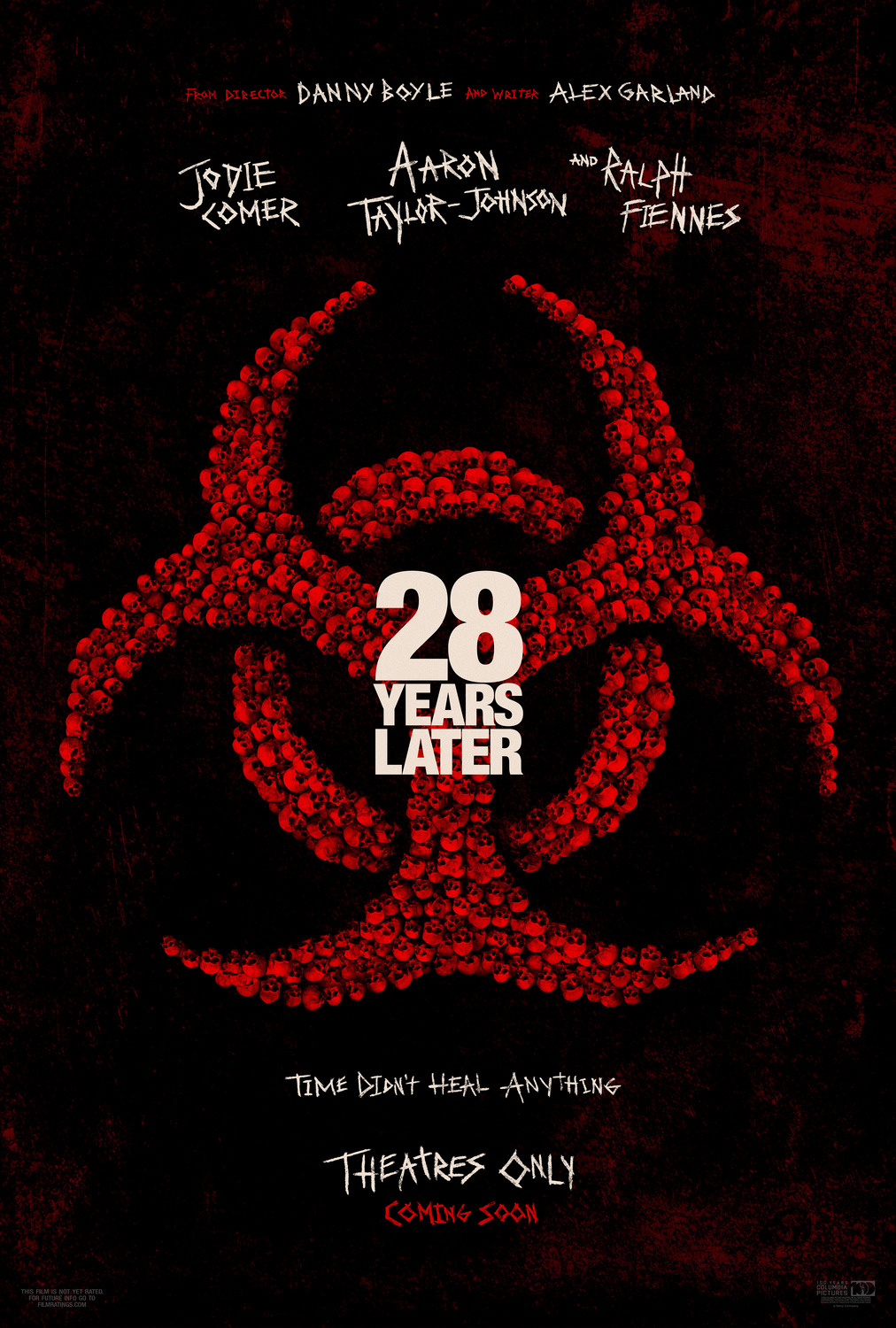
And so, it has finally arrived: the first trailer for the long-awaited sequel, “28 Years Later.” Like another sequel, “Beetlejuice Beetlejuice,” it was stuck in the deep, dark and despairing pit known as development hell. But like said sequel, this one finally emerged from its depressing depths and looks to promise us another round of infected zombies running way too fast and devouring everything in their path, and it looks to be a creative reinvigoration for Danny Boyle, the Oscar winning director of “Slumdog Millionaire.”
The story so far indicates that almost thirty years have passed since the Rage Virus was unleashed upon the world after a group of animal rights activists naively released an infected chimpanzee from its cage (the road to hell is always paved with good intentions). After what looks like a prologue in which a harried parent locks a group of children into a room where they watch the Teletubbies before blood starts flying everywhere, we are taken to an island where humans can find peace as they are surrounded by water which acts as a much-needed border between them and the infected. Like those characters from the “Dawn of the Dead” remake, they think this island will offer them a safe haven, but we all know this will not last very long.
This first “28 Years Later” trailer promises an especially visceral and bleak time at the movies as humanity still struggles in a post-Rage Virus world. But then again, remembering how “28 Weeks Later” ended with dozens of infected running towards the Eiffel Tower, we could not have expected things to get much better. And keep in mind, the tagline for this sequel states, “Time didn’t change anything.” With Boyle returning to this franchise as a director for the first time since “28 Days Later,” and Alex Garland returning as screenwriter, it will be interesting to see how life has evolved (or perhaps devolved) for the characters we see here and the virus.
Movie trailers for the longest time have been using special remixes of popular songs to get the audience’s adrenaline pumping as excitement is always promised for eager film buffs, and the hopes of a huge first weekend opening at the box office is always in the air. With “28 Years Later,” we instead get an old recording of Rudyard Kipling’s war poem “Boots” read by Taylor Holmes. Holmes’ increasing the intensity of Kipling’s words makes the images thrust at us here all the more horrifying, and it makes this one of the best and most memorable movie trailers I have seen in some time.
The big question I have, however, is this; where is Cillian Murphy? After winning the Best Actor Oscar for his role in “Oppenheimer,” it was said he would be reprising his role of Jim and also be serving as an executive producer on this sequel. While actors such as James Bond front-runner Aaron Taylor Johnson, Jodie Comer and an especially beat up Ralph Fiennes dominate this trailer to where no infected person could easily upstage them, I kept waiting to see Murphy somewhere in here. Rumor is, there is a corpse which rises up from the grass that looks a lot like him, and it makes me wonder what will become of Jim this time around.
“28 Years Later” is said to be the first of a trilogy, and the next film, “28 Years Later II: The Bone Temple” is currently being shot with “Candyman” director Nia DaCosta at the helm. Boyle’s sequel, which said to have been shot mostly on an iPhone 15 Pro Max, will be released on June 20, 2025.
WRITER’S NOTE: This interview took place back in 2013.
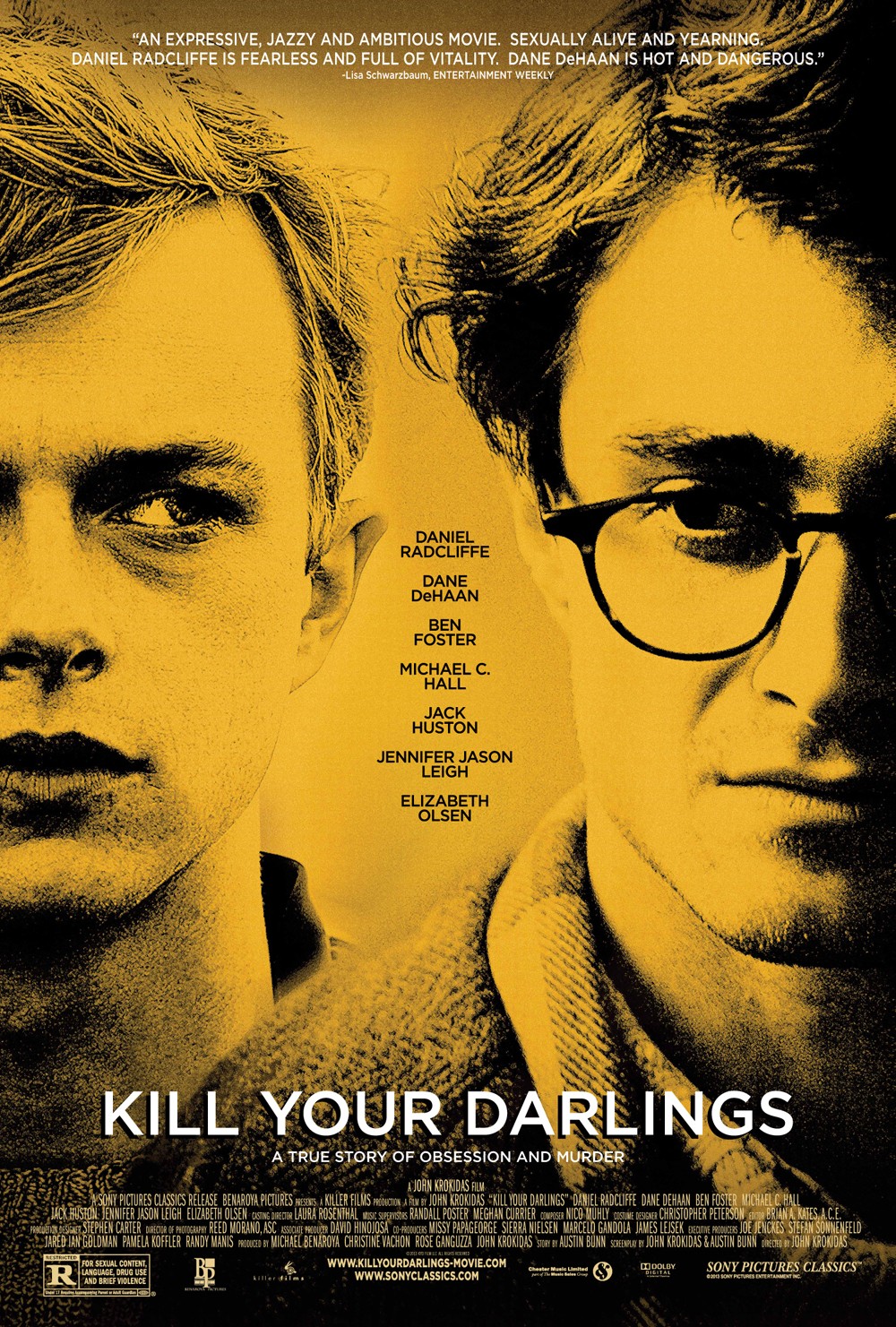
John Krokidas makes his feature film directorial debut with “Kill Your Darlings” which stars Daniel Radcliffe, Dane DeHaan and Michael C. Hall. The movie is about a murder that occurred in 1944 which brought three poets of the beat generation (Allen Ginsberg, Jack Kerouac and William Burroughs) together for the first time. Radcliffe portrays Ginsberg as a 17-year-old who is about to start college at Columbia University, and he ends up falling under the extroverted spell of fellow classmate Lucien Carr (DeHaan) who introduces him to the poets who would later bring a new vision to writers everywhere. It is when Carr murders his love David Kammerer (Hall) that their relationship starts to become unglued.
Krokidas co-wrote the script for “Kill Your Darlings” with his Yale University roommate Austin Bunn. A former magazine journalist, fiction writer and reporter, Bunn graduated from Yale and went on to get his master’s degree at the University of Iowa Writers’ Workshop. As for Krokidas, he later attended New York University’s Graduate Film Program where he made the short films “Shame No More” and “Slo-Mo.”
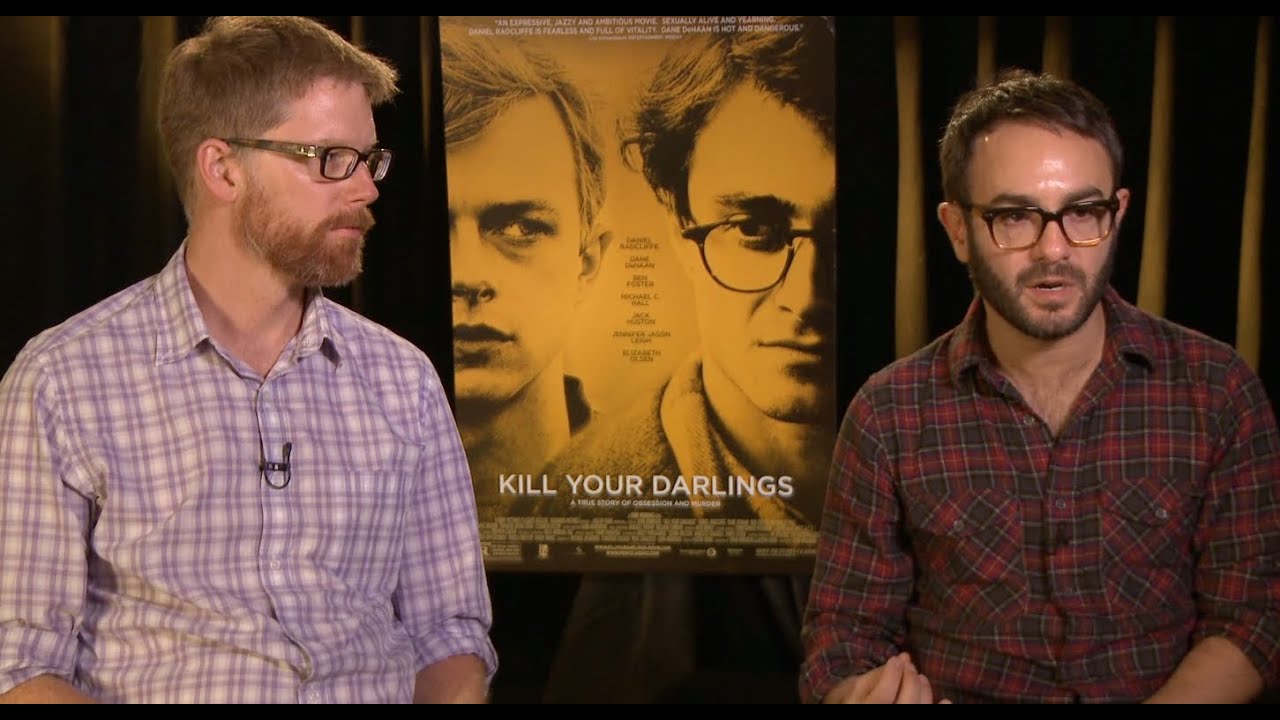
I got to hear how Krokidas and Bunn made the film under challenging circumstances when they appeared at the “Kill Your Darlings” press conference held at the Four Seasons Hotel in Los Angeles, California.
Question: What was the division of creative responsibility between you two like?
Austin Bunn: Probably like a lot of people in this room, I discovered the beats in college. I used to go to the campus bookstore and just track down the poetry collection, find Allen’s books and read them like they were some secret transmissions from the future version of myself. I was a closeted, young creative writer from New Jersey so Allen Ginsberg’s work meant the world to me. So, I had this really strong connection with Allen and of beat biographies and the history. I read a lot of the back catalog and I had come to John with the idea. So, in terms of the division of responsibility, I would write the first draft and then John would come in. The thing about John, as you will soon learn, he wanted to raise the emotional decibel level in every scene. John is one of the most riveting and vital and least hagiographic version of this story. We didn’t want to take the beats’ greatness as a given, so John sort of demanded that we write a really emotional roller coaster. Then we just went back and forth. John talks about it as the Postal Service, like the band version of producing a script. We were living in different cities at the time; I was at the University of Iowa Writers’ Workshop as a graduate student and John was in New York finishing film school.
John Krokidas: Austin wanted to do this as a play first. He was a playwright and a short story writer of some renown, and we were college roommates and we shared ideas with each other as college roommates and good friends do. But I, of course, started seeing the movie version in the back of my head and I had just gotten out of NYU film school and started convincing him that the play would be really flat and undramatic, but as a movie…
Austin Bunn: The Jedi mind trick!
John Krokidas: This would be amazing. But I would say I’m the structure guy I think, coming from NYU’s film program. I’m very traditionalist in terms of Sidney Lumet’s “find your spine,” and Austin is really wonderful with character and dialogue. If anything, he’s on a religious crusade against expository dialogue, and I would write these three paragraph monologues for each character expressing their emotion like that scene where Jennifer Jason Leigh finally turns to Allen to give him advice. I had a two-page monologue version and Austin crossed it all out (Austin laughs) and wrote the one line that’s in the movie, “The most important thing your father ever did was fail me,” which said everything.
Question: The movie is also very visual too because of the beats’ energy and such. How did you go about creating the look with cinematographer Reed Morano?
John Krokidas: I’m so proud of what we brought to this film. The movie is set in 1944 and it’s a murder story. Even in the writing process, I looked up and saw that “Double Indemnity” won Best Picture that year, and it was the year of “Laura” and “Gilda” and all these great American Film noirs. So, I said, “Why don’t we incorporate this even in just the fabric of the movie and start with the jail scene in a place of heightened tension flashback to more innocent times, and then build again to see whether or not these characters can escape or not escape their fate?” So, I started looking at noir style at first, but I thought an academic recreation of Film noir, who wants to see that? Going back to spine and theme, I thought what this piece was really about was young people finding their voice. So, what about going from conformity, the row houses of New Jersey and the pillars of Columbia, to nonconformity? And of course, where film noir went in the hands of the French was the New Wave. So I thought, “Okay well let’s start off with these controlled, composed, expressionistic-lit shots, and then as the boys go down the rabbit hole together, let’s take the camera off the tripod. Let’s get some jazzier free-form style.” So, I made this book of the 1940s. I had learned that Ang Lee, for “The Ice Storm,” did a 50 page book on the 1970s with colors, fonts and important historical events, you name it. So, I did that with the 1940s and then gave it to Reed. The great thing that I have learned on this is you can do all the academic treatises you want, but then you hire great people. She saw the goal post of what I wanted and then she showed me Jean-Pierre Melville’s films. She showed me films that meant a lot to her and then let kind of what I wanted filter through her own imagination. What I am amazed by specifically in her work is we did this movie in 24 days. Each scene was done in two hours or less, and she has the instincts to be like a documentary camera person and is able to light like that at the same time. We wanted to make sure this film felt relevant and contemporary as opposed to just being a traditional biopic.
Austin Bunn: (We didn’t want it to be) the greatest hits version of their lives.
John Krokidas: It was looking at Ryan McGinley photographs and contemporary, counterculture, young images of today and then finding what connected them to the 1940s. What was resonant in counterculture then and today at the same time.
Question: What was the direction that you were giving your actors? We were told that sometimes you would pull them aside for a more dramatic scene, but was there a consciousness you went into to direct the film and the actors? Were they any kind of specific kind of notes you gave them?
John Krokidas: Here’s the embarrassing story; Austin and I actually met freshman year because we were both acting in a production at Yale of “The Lion in Winter.”
Austin Bunn: Yes.
John Krokidas: Neither of us were the greatest actors in the world which is, I think, why we went into writing and directing. But I trained as an actor as an undergraduate and what you learn is that each actor has their own method and way. It’s whatever it takes for them to get the emotions to the surface. So, when I met with each actor that I cast, I would just simply ask them, “Have you trained? How do you like to work and what don’t you like?” Michael C. Hall gave me one of the greatest lessons in directing in which he said, “If what I am doing is not making you happy, don’t tell me that because that will make me self-conscious and it will make me think about what I’m doing. Just tell me to add whatever you want to what I’m doing.” That’s just a great lesson for life. Dan and I, when we were working together, we spent time before production (he was so generous and hard working on this) and he wanted to approach this like it was his first film which was very poignant to me. I said, “Would you like to try learning a new method and approach acting in a different style?” He said, “Absolutely!” So, with Dan, he’s so bright and in his head, and for the intellectuals Meisner works really well in focusing your action on what you are trying to do in the scene. Dane had trained extensively, and what he does is create a Bible for the character and does tons of research before production. Then he burns it and starts really becoming the character on set. Ben Foster (who plays William Burroughs) has something I’ve never seen another actor do which is, once we’ve basically got the scene up on its feet, he goes and he does the blocking of the scene by himself in the location several times. He calls it “the dance” because once he’s memorized the dance and knows the physicality (“I need to pick up the fork here, I need to put it down there”), he doesn’t have to think about it anymore and that’s completely freeing to him. So it’s like cooking this huge seven course meal where you have to get everything done at exactly the right time, but every plate needs a little bit of love in a different way. To me the greatest thing was being able to get this dream cast and then just to work with them to find how they like to work and what got the best out of them.
Austin Bunn: John had a really intuitive idea which was to keep the actors from reading past this point in the biographies, so none of the actors came in burdened by the mythology of who these guys would become. They were just 19-year-old kids. So, I think that was really smart and it released the actors from having to play the later decisions in their lives and the kinds of writers they would become. They just got to be young people, and that was a great relief I think for them.
John Krokidas: Yeah, and for us too as writers. I had a talk with Jack Huston once when he and I shared the same room and I’m saying, “Oh my god, I’m directing you as Jack Kerouac.” But we were like, “No. You are Jack who is a college student on a football scholarship who hates the other jocks, who just wrote a book which he thinks might be completely trite and he just wants to get out of college and have some real-life experience and join the war so he could begin to have real material to write his next book. That’s who you are.” That just liberated all of us.
Question: When writing the script, how much are you tied to the truth and how much are you allowed to take creative license?
John Krokidas: We did so much research for this. We felt we had to, and I think part of it’s our academic background because there’s so much in the biographies. There are so many biographies of them out there, but then also we would find different accounts online for example from David Kammerer’s friends. They said that that relationship between him and Lucien was never portrayed accurately and that Lucien actually kept coming back to David and David was asking him to end the relationship. And then we may have broken into Jack Kerouac’s college apartment together. We did the trick of pressing all the buzzers and then somebody let us in. But what’s interesting is Columbia students were living there and they had no idea that they were in Jack Kerouac’s apartment. So, we physically went to all of the locations in which this movie took place, and that just helped inform our writing process as well; getting to be able to visualize the actual spaces. Add to that, we went to Stanford University to the Allen Ginsberg archives. It wasn’t about the lack of material out there. If anything, it was about making sure that we really just focused on who they were up until the point which the movie takes place.
Austin Bunn: Just to add to that, the people that I know that have seen the film have been really surprised at how much is actually totally accurate. The day after the murder, Allen Ginsberg went to the West End Bar, “You Always Hurt the One You Love” was playing on the jukebox and he wrote the poem that ends the film. It ends with “I am a poet;” that is a line from August 20, 1944 so we worked really hard to weave it in. But like John was saying before, we didn’t want to do the dutiful, stuffy, every box checked kind of biopic that has been around for a while. We wanted to do something that felt more in line with the spirit of the beats that was more specific and honest and transgressive, and I hope we got there.
Question: Did you two have a specific goal of what you wanted to portray and what you wanted the audience to leave with either of the time or of the characters themselves?
John Krokidas: What I want the audience to leave with is that feeling of when we were 18 and 19 years old just like these guys were in the movie; when everything seemed possible and you knew that you had something important to say about with your life. That you wanted to do something different and unique and not just what your parents taught you, not just what school taught you, but you wanted to really leave your mark on the world. The fact that after the movie these guys actually did it and created the greatest counterculture movement of the twentieth century is amazing. I have had plenty of people come up to me after seeing the movie and said, “This movie made me want to be a better writer” or “this movie made me want to go back and start playing music again.” That to me means everything. That’s ultimately, deep in my heart, why I wanted to make this movie.
Austin Bunn: The pivot point was this murder. I loved Allen Ginsberg for his openness and his honesty, and to think that at one point in his life he was called upon to defend his best friend in an honor slaying of a known homosexual, the very thing that Ginsberg went on in his life to defy and radically create change about the idea of being in the closet and the shame around that issue, that contradiction was really exciting to us dramatically.
John Krokidas: You know this movie took, from the time that we started talking about this until the time that we are getting the chance to be with you all today, over 10 years to make. When I really think about it, the thing that kept me going and kept me wanting to tell this story is that there needs to be something that pisses me off at night. The fact that in 1944 you could literally get away with murder by portraying your victim as a homosexual, that pissed me off to no end. This isn’t a political movie and it’s one scene and it’s obviously what informed how Lucien Carr got away with murder, but for me that was the thing that kept me up all night that said, “No, I have to tell the story.”
Question: The movie has different kinds of music playing throughout it like jazz and contemporary music. Did you envision using different musical styles when it came to making this movie?
John Krokidas: I originally wanted a bebop jazz score similar to Miles Davis’ score for Louis Malle’s “Elevator to the Gallows” because the transition from swing to bebop at this time was exactly what these guys wanted to do with words; to go from rhythms to exploding them into something beautiful. My music supervisor, Randal Poster, said to me, “John put down your academic treatise, put down your paper. Go make your movie. Your child’s going to start becoming the person that he or she wants to be.” So I went and I made my movie, and then I put jazz music on the film and it didn’t work at all. And then I went and did only period accurate music and it felt like Woody Allen’s “Radio Days” which is a great movie but it’s not the young rebellious movie about being 19 and wanting to change the world that we wanted to make. So, I actually went back to the playlists that Austin and I used a while writing this movie and I used Sigur Rós and stuff that was timeless but contemporary, and it brought the movie to life. Then I realized that the composer Nico Muhly had arranged all of those albums and worked with Grizzly Bear and Björk and other people that we were using as temp track. So, we got the movie to Nico and just thankfully he loved it. Now that I knew that I had contemporary music in a period film, then we get to that heist sequence. I had heist period music on it, it was so corny. The sequence didn’t work, it didn’t have any stakes to it, and I can academically tell you when the beats come on, they led to the hippies which led to the punks, and the punks led to Kurt Cobain and the 90s, etc. But the truth is that while I can intellectualize it, you go with what’s visceral and what feels honest and true to you. For me, the biggest lesson in making my first film is to do all of your homework, do all your research, know what you’re doing, but then don’t be afraid to get out of the way if your movie starts to tell you what you should be doing.
Question: How did you decide on what literary quotes to put in, and how did you work with the actors in establishing the cadence and the elocution on those?
Austin Bunn: What a great question! If you know any of the beat history, this new vision was real for them and they have written volumes about it, none of which makes any sense. We couldn’t make heads or tails of it.
John Krokidas: Do you all remember your journals when you were 20 years old or those conversations you had at three in the morning with other college students? We got to read their version of it, and there’s a reason that we hide all of our journals and don’t let them see the light of day.
Austin Bunn: It was challenging. With the uninhibited, uncensored expression of the soul, that’s actually a credible quote directly from the Ginsberg new vision manifesto. So in some ways we knew we had to distill some of that material from the Ginsberg journals to help make the argument for how valuable this manifesto was and the irony honestly of what transpires in the plot which is the very thing that Allen’s called to do which is to create this censored version of history. But in terms of the poetry itself, it was really challenging because as we all know there are movies about poets and writers where recitations happen and they are really flat and they can be corny and there’s a time where you tune out of the movie when you’re waiting for the poetry to end. Specifically, I think of Allen’s first poem that happens on the boat. We were really challenged to find a poem that would speak to audiences but was genuinely an Allen Ginsberg poem written in his voice. So what we had to do was really channel Allen. His early work is quite rough and burdened by trying to impress his dad and his professors. John had the concept of this isn’t a poem that he’s just reading to impress people, it’s a poem he’s reading to Lucien Carr. The audience knows that, you know that and Lucien finds it out on the boat at that moment. That really gave me permission to kind of rethink what the poem was going to do and how we would make it, so we came upon Allen’s method which was kind of magpie; stealing from the American vernacular and going out and finding common speech and repurposing it, creating this Whitman-esque inclusion. So you hear in the poem things that you’ve already heard in the film just like Ginsberg did himself. Things like Allen in wonderland is reworked in the poem, unbloomed stalwart is the very thing that David said to him at the party. So we’re kind of hopefully paying off not just a poem that is emotionally powerful, but also something of the method that Ginsberg would use for the rest of his life.
John Krokidas: Radcliffe was such a hard worker. While he was on Broadway doing a musical, we would meet once a week for two months before even preproduction and rehearsals began to work on the accent and to work together. I have him on my iPhone reading “Howl.” We didn’t look at the later recordings, we looked at the earliest vocal recordings possible of Allen Ginsberg to make sure that we weren’t capturing the voice of who he became, but his voice at that time and what his reading voice was like. To be honest, it’s just really telling the actor, “You’re not performing a poem. You are letting Lucien know that he is loved with this poem and that you love him and that you can see inside him.” It’s playing the emotion underneath the poem which was the direction.
Question: What does it do for you when all the main characters are gay? Normally you got the female characters who can be a love interest but they are not going to be a rival. Usually, even now in films and in life, there is a separate role where as if you are all the same gender, you can all be anything to each other.
John Krokidas: I think this is a movie with every character is discovering what their sexuality is (gay, straight, bi or all over the place), and more importantly whether or not they are worthy of being loved. I personally don’t know if Lucien Carr was straight or gay, and to me it’s irrelevant because I have seen this relationship play out amongst gay people I have known so many times where an older man who is gay and a younger man of questionable sexuality develops such a close bond. The stereotype I think would be is that the young man had an absent father figure or finds the older man’s confidence and just the care and nurturing qualities of them very attractive. What happens though is that those two get so intimate that ultimately there’s nowhere else to take the relationship but sexual, and when that happens then the power position in that relationship twists and the younger man suddenly realizes that he holds the power because he’s the sexually desired one. That’s where a lot of conflict ensues. Whatever you read about that relationship between Lucien and David, everyone knew that they were codependent. Everyone knew it was toxic and going to end badly. Nobody knew it was going to end in murder.
Austin Bunn: I think a lot of the biopics we see are kind of denatured of their sexual qualities and the edginess of the relationships in them. So, I think we were trying to do something that restored some of that ambiguity, lust, desire and confusion that is genuinely in the beats’ history. We were not making that up.
“Kill Your Darlings” is available to own and rent on DVD, Blu-ray and Digital.
For some reason, I have found myself thinking about “The Muppets Take Manhattan” over the past few days. I’m not sure why as, while it is very good, it does not rank as highly for me as “The Muppet Movie” or “The Great Muppet Caper” do. Perhaps it came to mind because it was one of the last Muppet movies to appeal to both kids and adults at the same time. The equivalent to that these days are Pixar movies, and yet many of them end up streaming on Disney Plus instead of being shown on the silver screen where they belong.
When it comes to family movies these days, I always hope and pray they will appeal to both kids and adults, but that is often not the case. The latest example of this is “Lyle, Lyle, Crocodile” which is based on the children’s story of the same name by Bernard Waber as well as its prequel, “The House on East 88th Street.” Apart from featuring quite the cast of actors, it also contains songs from those who wrote the music for “The Greatest Showman,” and I still remember that cinematic musical as being quite invigorating. When it comes to this movie musical, however, the kids are bound to have a fun time, but adults will find the proceedings watchable at best.
“Lyle, Lyle, Crocodile” introduces us to Hector P. Valenti (Javier Bardem), an aspiring actor and musician who looks to make it big in show business and on a show which is the equivalent of “America’s Got Talent.” We quicky learn, however, that Hector has been around this show’s tryouts quite a bit, and those involved are quick to eject him from the premises before he embarrasses himself any further.
Regardless of his circumstances, Hector is still determined to become a big star no matter what, and he finds his key to success while visiting a pet store in downtown New York. While there, he comes across a young saltwater crocodile named Lyle (Shawn Mendes) who has the kind of singing voice which would wow the judges on “American Idol.” They quickly form a singing and dancing act which Hector believes will lead them to a life of infinite fame and fortune, Lyle, like Michigan J. Frog from the Merrie Melodies short “One Froggy Evening,” finds he is not up to performing in front of an audience. Due to financial necessity, Hector is forced to leave Lyle behind as he goes solo in an attempt to make the money he so desperately needs to pay off those he is in debt to.
Cut to 18 months later (Enya was right when she sang about how time flies), and Hector’s residence is now being inhabited by the Primm family which is made up of Joseph (Scoot McNairy), Katie (Constance Wu) and their son Josh (Winslow Fegley). These three have just moved from the suburbs to downtown because what better way to uproot themselves and their son. As you can expect, Josh ends up befriending Lyle in an unexpected way, and the two quickly bond as two strangers in a strange world can.
Like “Don’t Worry Darling,” “Lyle, Lyle, Crocodile” deals with a storyline which is as old as they come. Whether we are talking “E.T.” or “Mac and Me,” one of Paul Rudd’s favorite motion pictures ever, a young child alienated in their environment and befriending a creature who quickly becomes their best friend has been done to death. Judging from the reception I witnessed at the press screening I went to; young kids will very much enjoy this. As for the adults, they will get much enjoyment over how their children react to what is on the silver screen, but they may find themselves tunning out more often than not.
When it comes to Lyle, this is a crocodile you want to hug and keep Michael J. “Crocodile” Dundee away from as Lyle is not about to take anyone on a death roll. Directors Will Speck and Josh Gordon have gone out of their way to make this creature a lovable one to where kids will be begging their parents for a crocodile of their own come Christmastime. To this, parents will be wondering if they actually want a real one or if a stuffed animal will do.
The best things about this movie is, of course, Javier Bardem who makes the wannabe actor and magician Hector P. Valenti all the more charismatic. What seems like a simple two-dimensional character on the page is made all the more complex as Bardem makes you love, despise and pity Hector all at the same time. I figured a role in a movie like this would seem like a walk in the park for him, but clearly this is not the case.
As for the other human actors, Winslow Fegley makes Josh Primm into an appealingly alienated young dude whose earnestness is well earned. Constance Wu gives her a scenes a wonderfully physical and comedic flair while Brett Gelman wastes no time in making us see why his character of Mr. Grumps has the name he has. As for Scoot McNairy, I get the feeling he would rather be in another picture than this one.
When it comes to the songs by Pasek and Paul, the same duo who penned the music for “La La Land” and “The Greatest Showman,” for me they went in one ear and right out the other. Sure, they have a boisterous quality to them and get the adrenaline going for a minute, but they also don’t leave much of an aftertaste. Some musicals you come out of humming a tune or two, but this one had me struggling to remember any lyrics.
Shawn Mendes does have quite the voice as Lyle sings to communicate with the Primm family and others, but it eventually got to where I wanted this crocodile to speak as well as sing. I wanted Lyle to discuss how he felt about movies like “Crocodile Dundee,” or if he found the 1980 cult classic “Alligator” in any way offensive to his species. Or perhaps this is just my way of saying that my wandered from time to time as the events unfolded, and that is never a good sign.
You know what? “Lyle, Lyle, Crocodile” is not a bad movie. It is watchable and at times a lot of fun, but it seems rather generic as compared to so many others from this genre. I have no doubt kids will enjoy this, especially the very young ones. As for the adults, hopefully they will enjoy how their children react to what they see on the silver screen.
For me, it’s not enough for a movie to be passable at best, and this is especially the case with family or children’s’ movies.
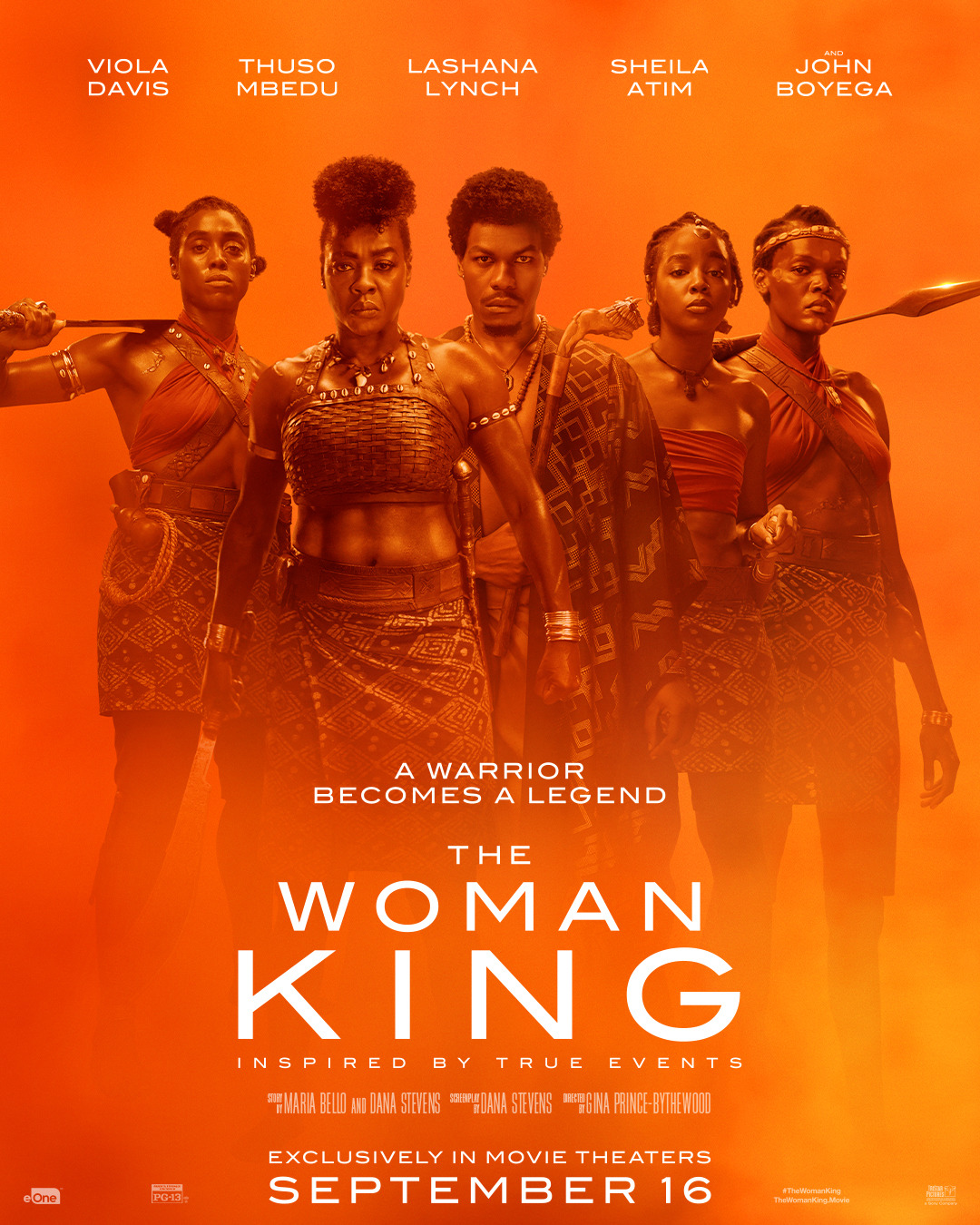
As soon as Viola Davis rises from the bushes as General Nanisca in “The Woman King,” I knew this film was going to kick ass. Throughout her career, whether she was in “Doubt,” “Out of Sight” or “The Help,” this Oscar-winning actress has proven to be a force of nature and one to be reckoned with. When it came to the film version of “Fences,” the question was not if Davis could her own with Denzel Washington, but if Denzel could hold his own with her. As for her work as Amanda Waller in those “Suicide Squad” movies, she made the crew of delinquents and outright criminals working under her command look like a bunch of pussies. She does the same here as she dominates the screen to where no one with a half a brain should even dare to question how lethal she can be as she lays waste to her oppressors with little in the way of remorse.
“The Woman King” takes us back to the 1800s to the kingdom of Dahomey in West Africa. There is an opening prologue which tells us of the peril this kingdom is under that is a little hard to follow, but the main thing to know is that the kingdom is protected by an all-female unit of warriors known as the Agojie. As the opening sequence makes clear, they are far and away the most feared warriors on the continent as we watch them crush their opponents ever so confidently. Of course, you don’t see a lot of blood here as this is a PG-13 rated motion picture, but all the bones breaking and shattering are here on display, reminding us once again that the MPAA remains far more comfortable with violence than love-making.
Yes, this group of warriors did exist in reality. Actress Maria Bello became aware of this piece of history while visiting Africa, and she serves as “The Woman King’s” co-producer and co-writer for good reason. Granted, the movie’s story does deal with inescapable cliches and familiar storylines to where the term “inspired by true events” this movie is being promoted with makes a lot more sense than “based on a true story,” and you all know how I feel about that term which has long since become useless to me.
The story follows certain conventions and employs familiar cliches in an effort to make us follow and understand these characters on a general level. While General Nanisca (Davis) is well-regarded as a warrior, others such as the many wives of King Ghezo (John Boyega) see her as a mere commoner, unworthy of such admiration. Of course, one of those wives gets her comments thrown back in her face upon being reminded of how she hid behind locked doors while the kingdom was being attacked. Be careful when you talk shit about others!
Into the plot comes the young Nawi (Thuso Mbedu) who is about to sold to a man who is to be her husband. This prospective husband, however, is quick to smack Nawi in the face when she does not respond to him, and her response is to shove him back several feet to where he lands flat on his back. Instead of fighting back, he cowers away, blaming Nawi’s father for raising such crazy children.
From there, Nawi’s father drags her to the area where the Agojie train and presents her as a gift to the king. It’s punishment for her not accepting a husband, but even she knows this is her only destiny. Like the Jedi, the Agojie cannot marry or have children, and this is a destiny she is prepared to take on. Of course, it will come with many bumps and bruises throughout time.
Okay, let me get to the performances. Like I said, Davis is a force of nature, and it is so thrilling to watch her use every fiber of being and body to portray such a hardened warrior. Just from looking at her eyes, she makes you believe this is a warrior who has survived many battles and endured much pain and suffering others would never be able to handle. It’s tempting to compare General Nanisca to Tom Berenger’s character of Sgt. Barnes from “Platoon,” but Nanisca still has a lot of heart under that hardened gaze of hers.
Upon her entrance into training, Nawi is met by another Agojie warrior, Izogie, and she is played by “No Time to Die’s” Lashana Lynch who is wickedly good here. Izogie is also a hardened warrior, but she still has a wide smile and an undeniably sharp sense of humor even after all she has been through. It’s a blast watching her as she steals the show in the same way she did opposite Daniel Craig when she portrayed another 007.
Special attention should be also given to Mbedu who takes her character of Nawi from an innocent soul to a true warrior. She runs the gamut of emotions throughout and embodies this soldier-in-training with tremendous enthusiasm to where you believe every part of her rough and tumble journey on an emotional and physical level. You have to respect the actor/actress who can make a transition like this in a motion picture because it is never easy.
Director Gina Prince-Bythewood (“Love & Basketball,” “Beyond the Lights” and “The Old Guard”) keeps things moving at a steady pace throughout, and the film never lags for a second. She has created one of the more engrossing and action-packed films of 2022 and has brought us a piece of history which will never be easily forgotten once you have watched the action in front of you.
As I write this, “The Woman King” has since earned an A+ rating on CinemaScore and debuted at the top of the U.S. box office. It’s a thrill to see it doing so well in this day and age. Still, part of me wished the filmmakers had given the action more of the “Braveheart” brutality as there were plenty of bones and bodies being crushed, but not much blood. I mean, come on, this is war and battle we are talking about. Seeing it getting the PG-13 treatment feels like a bit of a cheat, but perhaps there is a director’s cut just waiting around the corner.
Regardless, “The Woman King” is both thrilling and endlessly enthralling throughout, and it would be a shame if you missed it on the silver screen. And when you walk out of the theater, the only words you should say, particularly about Viola Davis, is “not bad for a human.”
WRITER’S NOTE: This review was written back in 2012.
David Koepp’s “Premium Rush” is the best cycling movie in some time. Come to think of it, when was the last time a cycling movie was made and released? I keep thinking it was Hal Needham’s “Rad,” but that came out in 1986. There’s also no topping the classic “Breaking Away,” the cycling movie many aspire to be like. There was also “American Flyers” which was released in 1985 and was written by Steve Tesich, the same one who wrote the screenplay for “Breaking Away.” But when it comes to “American Flyers,” I think its fantastic music score easily upstaged the film itself.
Anyway, none of that matters because “Premium Rush” delivers the goods like any cycling film should, and it does so with terrific acting, sharp writing and what looks like the real thing with a wonderfully severe lack of CGI as we watch these daredevil bike messengers throttle their way through the insanely busy streets of New York City.
Joseph Gordon-Levitt stars as Wilee, one of the very best bicycle messengers in New York who gets things to where they need to be and on schedule. Of course, this requires him to travel at breakneck speeds through busy traffic where a car can break down at the most inconvenient time, and he also has to deal with various members of the NYPD who have it in for him and others in his line of work. One other thing, Wilee’s bike of choice has only one gear, and he’s taken the brakes off of so that nothing will slow him down. Seriously, that is how he rolls.
Taking this into account, I wonder if Wilee has a death wish or if he’s just an adrenaline junkie. What we do learn about him is that he came close to becoming a lawyer, but the idea of sitting behind a desk in some office did not appeal to him in the slightest. Of course, it probably wouldn’t appeal to anyone who has seen “Office Space.”
His ex-girlfriend, Vanessa (Dania Ramirez), however, entertains thoughts of working in an office as she doesn’t want to be a bike messenger forever, and that’s even though she says it beats waiting tables. There’s also Tito (Anthony Chisholm) who doesn’t let his advanced age make him any less useful in this line of work (nor should it by the way), and Manny (Wolé Parks) who competes with Wilee not just on a bike but for Vanessa as well.
On this one particular day in which this movie takes place, Wilee is delivering a package that has caught the attention of NYPD cop Bobby Monday (Michael Shannon). Now Bobby wants what Wilee has, but while Wilee is not always one to obey the rules of the road, he does follow the strict guidelines of his job which states messengers will not hand over the package they are delivering to anyone other than who it is meant for. As a result, Bobby begins chasing Wilee down as we find out that this NYPD cop, like any other stupid gambling addict, has a ridiculously high debt to pay off.
The film’s director, David Koepp, is best known as a screenwriter, having written such exciting movies like “Jurassic Park,” “Spider-Man” and “Panic Room.” Along with co-writer John Kamps, Koepp has great fun telling the story of “Premium Rush” in a non-linear fashion. The story goes back and forth in time as the characters’ actions are made very understandable and given more depth throughout. This way of storytelling may alienate certain audience members, but I liked it as it plays around with our perceptions of what we believe to be true. Just when you think you know what’s going on to happen, something comes along which obliterates your predictions.
As a director, Koepp has had varying degrees of success with movies like “The Trigger Effect,” “Stir of Echoes” and “Secret Window,” but here he manages to keep the action exciting and never lets it drag for a second. It also helps that the cycling we see here is done for real, and it makes me wonder how it was choreographed and who these stunt people are. Clearly, they dared to pedal fast while cars come at them in various directions, and even the best cyclists have to be scared in these situations.
Now people may debate about whether or not “Premium Rush” might serve as a recruitment gig for bike messengers, but it also shows how painful it can be when you crash into something, and odds are you will. There’s also a scene during the end credits which shows Levitt’s arm all bloody after he hit the back window of a taxi cab, and that makes up for the lack of a disclaimer.
Levitt has had great success in the last few years with “(500) Days of Summer,” “Inception” and “The Dark Knight Rises,” and he is fantastic here as a character named after that coyote who chased the Road Runner endlessly. This role could have been given to some actor who would have annoyed us with their overwhelming ego, but Levitt makes this character likable despite his insane bike-riding habits.
You also have ace character actor Michael Shannon on board as an undeniably dirty cop. It doesn’t matter what movie he’s in because Shannon never disappoints in giving us a great performance. As Bobby Monday, he makes what could have been a mere one-dimensional villain all the more colorful and threatening. We have seen corrupt cops like this one in so many different movies, but Shannon makes him seem more intriguing than what must have originally appeared on the written page.
The rest of the cast includes Dania Ramirez (whom you may remember as AJ’s girlfriend on “The Sopranos”) to the always entertaining Aasif Mandvi, and they succeed in making this movie all the more entertaining to watch. The action is also given an exciting and propulsive score by David Sardy and a beautifully sunny look by cinematographer Mitchell Amundsen. Heck, watching this movie makes you very sweaty even if you are viewing it in a theater or in the comfort of your air-conditioned home.
“Premium Rush” is nothing spectacular, but it is fun to watch. It’s a shame it did not do better business at the box office, but Columbia Pictures did kind of screw up its release. Watching it reminds those of us who do not ride bikes anymore how much fun and very dangerous cycling can be. If nothing else, it does make wearing a helmet while riding a bike far more appealing than it ever has been in the past.
After watching “Where the Crawdads Sing,” I immediately went out and purchased a copy of Delia Owens’ novel upon which it is based. Judging from the opening narration in which the main character of Catherine “Kya” Clark tells the audience how “marsh is not swamp” but instead is “a space of light where grass grows in water, and water flows into the sky,” this cinematic adaptation looked to defy all the perceptions we typically have of such places on Earth. This is further emphasized by her describing how swamp exists within the marsh and is “quiet because decomposition is cellular work,” and how it “knows all about death, and doesn’t necessarily define it as tragedy, certainly not a sin.” This dialogue comes straight from Owens’ prose, and it stayed with me throughout the film’s 126-minute running time.
This cinematic adaptation of “Where the Crawdads Sing” comes to us from Reese Witherspoon who has gushed endlessly about how much she loves the novel, and she produced this film alongside Lauren Neustadter. The screenplay was written by Lucy Alibar who co-wrote “Beasts of the Southern Wild,” and it was directed by Olivia Newman who is best known for her Netflix film “First Match.” Clearly, there is a lot of talent in front of and behind the camera here, and the appreciation everyone has for the source material cannot be doubted. Still, while this film held my attention throughout, I Pate’s came out of it thinking, couldn’t the filmmakers have dug into the material even deeper?
We first meet Kya as a young girl who lives with her family in the North Carolina marsh, and it is fun to watch her being embraced by her loving mother. But then we see her dad (played by Garret Dillahunt) is an abusive bastard who treats every member of his family like crap. From there, Kya’s mother and siblings leave their home one by one to where it is just her and dad, and she learns to survive his drunken wrath in more ways than one. But soon he disappears, and Kya is forced to fend for herself and survive on her own to where she copes with loneliness in a way few others do.
Indeed, seeing Kya grow up in the marsh to where we can believe she can more than survive on her own provides this film with its most interesting moments, but it is all surrounded by a courtroom drama which makes the proceedings feel utterly routine and ordinary. As the story begins, the police come upon the body of Chase Andrews (played by Harris Dickinson), a high school quarterback who had been in a relationship with Kya which ended on a bitter and violent note. People in town are quick to label Kya as the key suspect as they have always viewed her as an outsider to where they fear her for all the wrong reasons. It is not long before Kya is arrested and charged with his murder.
Part of my problem with this film is that it treats many of the characters as caricatures instead of fleshed out human beings. More often than not, the filmmakers only touch on the surface of these individuals instead of transcending their nature to present something more unique. While certain characters are given special attention, others are painted in broad strokes to where they could have come out of so many other motion pictures. The period detail is spot on as the film immerses us in the times and tribulations of the 1960’s, but it still feels like we are just watching events unfold instead of living them through Kya and everyone else.
One actor who elevates his material here is the great David Strathairn who co-stars as Kya’s defense attorney, Tom Milton. While the prosecuting attorney looks and acts like a Jake Brigance wannabe, Strathairn transcends his character’s mannerisms and background to give us a performance which feels alive and lived in. Not once does he ever give us a moment which feels false as his character comes out of retirement to defend Kya in her murder trial. At the start, he asks Kya to her that he cannot help her until het gets to know her better. His character becomes key from there to the story as, like him, we want everyone to see Kya as an individual instead of some odd human being who exists in the shadows where few others dare to travel to.
Speaking of Kya, the actress who plays her is Daisy Edgar-Jones, and her performance for me was worth the price of admission. She more than inhabits Kya to where the character never comes across as some female version of Tarzan, but instead one who merely exists in the marsh as it is the only home she has ever known and feels comfortable in. Jones also renders many scenes she appears in with heartbreaking honesty as we watch her discover love for the first time, and later heartbreak which is always devastating, especially for the young.
It is also worth singling out Jojo Regina who plays the younger Kya as she embodies the character at a fragile point in her life. She shows us how lost the young Kya is when she first goes to school and discovers how cruel children can be to someone different from them. More importantly, Regina sets the stage for Kya becoming wholly independent as she digs in the marsh for mussels to sell to the local general store. Watching her, I believe Regina gave Jones so much great stuff to work with.
I also enjoyed the performances of both Sterling Macer Jr. and Michael Hyatt as Jumpin and Mabel, the kindly African-American couple who own and run the local general store where boats get their gas. They respect and care they have for Kya is strong and shows through their eyes and actions. Plus, Mabel has one of the movie’s best lines as she rightly points out that the Bible says nothing about being careful.
But as for the rest of “Where the Crawdads Sing,” it all feels inescapably routine. Sure, the cinematography by Polly Morgan is gorgeous, the music score by Mychael Danna fits the material perfectly, and it is clear everyone here has great love for the source material. But in the process of being slavish to the novel, they don’t do enough bring everything it to life. I cannot help but believe this adaptation could have been given much more depth as this movie could have stood out in the same way Michael Apted’s “Nell,” which starred Jodie Foster as a similar individual raised away from civilization. While the novel may have given many a unique experience, this movie fails to do the same as it becomes like many we have seen time and time again.
I think it would have been best to focus much more on the trifecta of Kya, her first boyfriend Tate (Taylor John Smith), and her second boyfriend Chase. Where Kya is a child of the wilderness and the marsh, Tate has one foot in the civilized world and another in the wilderness, and Chase himself is a product of the civilized world which has given him a lot of bad ideas about social status and women. These relationships are dealt with, but in a rather shallow way with some acting which is too theatrical for motion pictures.
Heck, I would have liked to have seen more of Dillahunt as Pa as, from what I have read of the novel thus far, there is more to him than being just a drunken bully. Perhaps we could have been given more depth into this character as a result to where we could understand why he acts the way he does even as we rightly despise his actions. Still, the movie decides to keep him at arms’ length. Granted, the main focus is, and absolutely should be, on Kya, but perhaps knowing more about the key people in her life would have made her coming of age adventures all the more enthralling.
If you are a fan of the novel, I think you will have to see how the movie “Where the Crawdads Sings” compares to it. There is a lot to like about it, and again, Jones is simply wonderful in the lead role. But considering how beloved this novel is, I imagine many will come out of it feeling like more could have been done with the material.
For what it’s worth, both the movie and the novel serve as a reminder of how the civilized and uncivilized worlds don’t go by the same laws as survival takes on different forms in each. And remember, unlike animals, human beings are the only species to put their own in cages, behind bars.
The tagline for “Dead Man Down” is “revenge is coming.” But while revenge is a big theme, it’s really about forgiveness. These characters have been forever wounded by a past which will not let them be, and they spend their time trying to avenge it in order to find some form of peace in their lives. What results is a movie which doesn’t break any new ground (few movies these days do anyway), but it is still a compelling one filled with complex characters and twists I didn’t see coming.
We meet Victor (Colin Farrell), the right-hand man to ruthless New York crime lord Alphonse Hoyt (Terrence Howard), and he defends his boss in a nasty firefight at the movie’s start. Quickly, we assume Victor is as loyal to Alphonse as any gangland player could ever be and that he will soon get a meteoric rise to the top of the criminal food chain. However, it turns out Victor is actually seeking revenge against Alphonse for killing his wife and child, and he is getting closer and closer to exacting his revenge.
But then Beatrice (Noomi Rapace), a woman who lives in an apartment across from Victor’s, enters the picture. Beatrice is still recovering emotionally from a nasty car accident which has left her face permanently scarred. While the scar hasn’t taken away all her beauty, it has destroyed her self-image and left her with a deep-seated rage she is desperate to be rid of.
After a dinner where the two of them make small talk and discover things they have in common, Beatrice makes her real intentions clear to Victor; she wants him to kill the drunk driver who plowed into her car and ruined her face. Moreover, she is willing to blackmail Victor into doing this as she has evidence of him killing another man. Knowing Victor is capable of taking a life, she gives him no choice but to take another. Both have strong motivations for vengeance, but can they tear themselves away from their rage long enough to see the damage they are doing to one another?
Right from the start, “Dead Man Down” is filled with twists and turns which makes this average revenge thriller all the more entertaining to sit through. Even if the twists aren’t entirely plausible, they keep us on the edge of our seats as we can only guess what will happen next. Just when you think you know where things are going, you don’t.
But what I really liked about this movie was how wonderfully complex the characters were. There is nothing black and white about them as everyone exists in a morally grey area. While Victor and Beatrice are clearly justified in having their revenge, we know the ways they are seeking it will do not make them good people. Even Alphonse comes across as much more than an average one-dimensional bad guy as he is someone who certainly wasn’t born evil. While certain characters may deserve some form of punishment over others, no one comes out of this story the least bit innocent.
“Dead Man Down” marks the first English language film from writer and director Niels Arden Oplev, the same man who gave us the original version of “The Girl with the Dragon Tattoo” as well as the recent remake of “Flatliners.” Now when filmmakers from a foreign country come over to America, their talents usually get compromised in the process. But Oplev doesn’t appear to have lost any of his skill here as he gives us a strong motion picture filled with fascinating characters. He also gets terrific performances from each of his actors as well as some strong visual moments such as a descent down the middle of a stairwell.
Colin Farrell has gone from doing needless remakes like “Fright Night” and “Total Recall” to terrific movies such as “In Bruges” and “Seven Psychopaths.” He has become an actor who can go from playing a good guy to a bad guy with relative ease, and this makes him perfect for a character like Victor who could be seen as either. Farrell does excellent work in conveying Victor’s conflicted emotions as he goes about exacting his revenge. As he gets closer to achieving his goal, Victor begins to see how he is becoming just like those who destroyed his life. Seeing the pain in Farrell’s eyes as he makes this clear to the audience without words shows us how great of an actor he can be when given the right material.
Noomi Rapace, the original Lisbeth Salander, is a powerhouse as Beatrice. Watching Rapace deal with her rage as well as the bad luck life has dealt her is enthralling to take in, and the scenes where she is attacked by a group of children who see her as a monster are devastating to witness. Like Salander, Beatrice is stuck in a moment which forever changed the course of her life, but Rapace gets to showcase more of a vulnerability here she wasn’t able to express as much in her star making performance. She remains a compelling actress to keep an eye on, and it’s great to see her reunited here with Oplev.
But I the performance which most impressed me was Terrence Howard’s as Alphonse Hoyt. Now when you see an actor take on the role of an evil crime lord, you expect them to chew the scenery and give an over the top performance. But Howard doesn’t do this here, and it is clear he has given this role a lot of thought. There is no doubt that Alphonse is an evil dude, but Howard is excellent in giving a method to this man’s madness. Howard left such a powerful impression on us with his Oscar nominated performance in “Hustle & Flow,” and his performance in “Dead Man Down” is a reminder of how he never lets us down as an actor.
In addition, there is a really good supporting performance by Dominic Cooper as Victor’s friend Darcy, and he has a wonderful scene at the start where he is holding his baby and talking about how he hopes being a father will lead him to a better future. The great Isabelle Huppert also shows up as Beatrice’s mom, Valentine, and she remains a remarkable actress even in the smallest of roles. There’s also strong cinematography from Paul Cameron and a wonderfully atmospheric film score from composer Jacob Groth to take in as well.
“Dead Man Down” is not the equal of “The Girl with the Dragon Tattoo,” and its climax is a bit over the top for a movie like this, but I liked how character driven it was and you don’t see many movies like that these days. It is also a compelling story about how the power of forgiveness is more important than the need for revenge. In this day and age, it is important to remember that.



 The Ultimate Rabbit