I came into “Fly Me To The Moon” with a bit of trepidation. On the surface, it looks like a fluffy and light hearted romantic comedy, the kind of film I typically avoid like the plague. Also, a portion of its story seemed determined to prove that the Apollo 11 mission and landing on the moon could have been faked, and I take major exception at anyone attempting trying to prove how that “one small step for man” was all a farce. Seriously, if you think Neil Armstrong and company making it to the moon was all a big fat lie, I invite you to watch the 2019 documentary “Apollo 11” which makes clear the mission did in fact happen, and to believe otherwise would be blasphemous.
Well, I was pleasantly surprised by “Fly Me To The Moon” as it proves to be a warm-hearted any very involving film which has laughs, genuine emotions, and some truly wonderful performances throughout. It also serves as a reminder of how, even back in the 1960’s, people were more interested in getting control of the narrative than they were about facts or what was seen as truth. This is even more the case today for reasons I’m sure I do not need to point out.
Based on a story by Bill Kirstein and Keenan Flynn, we are introduced to Kelly Jones (Scarlett Johansson), an advertising and publicity genius who is, shall we say, recruited by a shady government agent named Moe Berkus (Woody Harrelson) to fix up NASA’s image in preparation for the big Apollo 11 mission to the moon. Upon arriving in Florida along with her assistant (played by Anna Garcia), she comes into direct conflict with NASA director Cole Davis (Channing Tatum) who is determined to see this mission through to completion without any complications. But with these two characters being played by Johansson and Tatum, you know sparks will be eventually fly between them because, you know, why not?
First off, I have to point out what a dynamo Scarlett Johansson is here as Kelly. In her first scene in which she confidently manipulates a trio of automobile executives to include seatbelts in their upcoming models, Johansson is ever so sublime as she commands the screen to an infinitely enjoyable extent. Watching her make her way into places no civilian is allowed and getting the participations of companies willing to hawk their products (Tang, in particular, is an unforgettable standout) is infinitely enjoyable to witness. And when the time is right, she shows a vulnerable side to Kelly which hits right at our hearts.
As for Channing Tatum, I’m a little torn on his performance as Cole Davis. Part of me wishes he didn’t appear so stiff at times, but maybe this was by design. Cole is a NASA official who is as strait-laced as they come, and Tatum plays this to perfection even as I wanted him loosen up a bit. But as the movie goes on, his performance improves as he comes to like Kelly more than he thought he would, and he does have a bit of chemistry with Johansson which certainly helps. And in the end, like him, we want to see this particular Apollo mission succeed.
“Fly Me To The Moon” reaches an especially interesting point when Moe orders Kelly to set up a fake moon landing on a nearby stage in the NASA compound. It is meant to serve as a backup in case the Apollo 11 mission fails, but Moe eventually admits that this fake setup will be the only moon landing anyone will ever see on television as America is determined to win the Space Race no matter what. It is an interesting conundrum as government forces ensuring that there will be footage of astronauts landing on the moon makes sense, and makes even more sense that there would be a serious need for a backup plan to be utilized to ensure some kind of moon landing would take place for the public to see. Still, some things in this world can’t be even better than the real thing regardless of what U2 says.
Director Greg Berlanti (“Love, Simon”) and screenwriter Rose Gilroy do not reinvent the romantic comedy drama, let alone the period romantic comedy drama, but they do give us a lot of inspired dialogue and situations as Kelly and company work to deceive government officials into believing they are watching a staged landing when they are actually, and desperately, trying to broadcast the real deal. With the inclusion of the average black cat, things become more exciting than you might expect them to be.
In addition to Johansson and Tatum, a number of other actors give memorable performances here. Woody Harrelson is a hoot as he made me believe without much doubt how Moe Berkus can hear and see everything from a mile away. His work here is a reminder of how he can play any role given to him, and this has been the case for many years now.
Watching Ray Romano as Cole’s NASA friend, Henry Smalls, is a reminder of what a truly terrific actor he can be. Granted, this was made clear to me years ago with his work in “Rob the Mob” and “The Irishman,” but I’m not sure people know him enough outside of his “Everybody Loves Raymond” and stand-up comedy success. Romano gives Henry a lot of genuine emotion, and he fully humanizes this character in ways any great actor could and should. He is that good here.
If there’s a scene stealer to be found in this film, it is Jim Rash who portrays the obsessive director of the fake moon landing, Lance Vespertine. There’s no forgetting him after this as he makes us understand why Lance is such an exacting filmmaker to where he treats government agents and actual astronauts as if they are the worst actors ever. He is such a flamboyant presence throughout, and yet he also manages to avoid turning Lance into a mere caricature. Others may disagree with this assessment, but there you go.
I really wasn’t sure what to expect from “Fly Me To The Moon” when I walked into the theater as it was not a summer movie I was eagerly waiting for, but I came out of it pleasantly surprised as I enjoyed it much more than I thought I would. It takes familiar elements from the average romantic movie and makes them feel fresh in my eyes, and it once again reminds me of what a tremendous talent Johansson can be. Also, it is further indisputable proof of how Apollo 11 did in fact land on the moon. For some stupid ass reason, there are still many committed to believing the whole thing was faked and that Stanley Kubrick was somehow involved. Seriously, get a life already!
WRITER’S NOTE: THIS REVIEW WILL CONTAIN SPOILERS AS IT HAS BECOME IMPOSSIBLE TO TALK ABOUT THIS FILM WITHOUT GIVING CERTAIN THINGS AWAY. IF YOU DO NOT WANT IT RUINED FOR YOU, SEE IT BEFORE READING THIS REVIEW.
I must confess, I have not read any of Nicholas Sparks’ books nor have I seen any other cinematic adaptations of them before I sat down to watch “Safe Haven.” As a result, I am not sure whether to blame him or the screenwriters for ripping off the plot of “Sleeping with the Enemy” for this misbegotten effort. Those expecting this to equal the greatest of Sparks’ cinematic adaptations, “The Notebook,” will be severely disappointed as even those who have not seen that Julia Roberts starring vehicle will be confident in admitting this one falls way short. “Safe Haven” lacks any sense of originality, and it is completely undone by a couple of ludicrous plot twists which sink any legitimate reason for this film to exist at all. Furthermore, watching it reminded me of why I typically avoid romance movies in general.
Julianne Hough from the “Footloose” remake and “Dancing with the Stars” stars as Katie Feldman, and at the start we see Katie running for her life for reasons which are later made clear. Katie is ever so desperate to avoid police detective Kevin Tierney (David Lyons) to where she even makes herself look pregnant in the hopes it will throw him off. She ends up escaping his clutches and takes a bus out to the small town of Southport, North Carolina where she hopes to start a new life.
Look, I love how people want to escape a dark past by moving to a new town, but for some immensely stupid reason they move to one which is not all that far away from the place they used to live. Word to the wise: if you want to move away to where no one can find you, try moving to another state or country. Even with the advances in today’s technology which typically render anonymity a joke, you have a better chance of not being found out if you go to a place you cannot drive to in one day’s time.
Anyway, Katie gets a job as a waitress at a local restaurant and ends up leasing a beautiful apartment out in the woods. Of course, where she found the money for such a place is beyond me and every other audience member. We know she is looking to avoid any personal connections as the last one she was involved in caused her a lot of psychological damage, but someone as adorably cute as her is bound to find a suitor whether she wants one or not. That suitor comes in the form of Alex Wheatley (Josh Duhamel from the god awful “Transformers” movies), a widow with two kids. Alex lost his wife to cancer a few years ago, and he is having trouble relating to his kids, especially his son. Guess who fills the missing part of his life…
Okay, as much as I despised “Safe Haven,” I do have to admit that Hough and Duhamel have good chemistry together and make a cute couple here. Hough herself has a wonderful earthiness which makes her seem more down to earth than other actresses I could quickly think of while watching this film. Even if her range as an actress goes only so far, she has a very appealing presence here even if it might seem a bit too vanilla for some.
As for Duhamel, he does himself good by not giving an emotive performance as Alex. I expected him to be overdoing it for the whole film, but he doesn’t make his character a whiny little bitch or the typical self-pitying widow who often inhabits the romance genre. Alex has suffered a terrible tragedy in his life by losing his wife far too soon, but we see him moving on as well as he can, and he does not waste much time bemoaning what is missing in his life.
Now I mentioned at the start of this review how this film is essentially a rip off of “Sleeping with the Enemy,” and this proves to be the case even before the first big twist is revealed. We watch as the Kevin becomes increasingly obsessive in discovering where Katie is hiding out as it becomes implied that she is wanted for first degree murder. But it eventually becomes to light that Katie is actually Kevin’s husband, and from there I knew exactly where the story was heading which had me rolling my eyes endlessly as a result.
There is a flashback sequence in which we see what drove Katie and Kevin apart, and watching it made me wonder what Katie ever saw in this creep in the first place. In a lot of ways, I feel sorry for Lyons, best known for his work on the television series “ER” and “Revolution,” because I am sure he came into this project believing he was not just playing any ordinary villain, but this is essentially what Kevin Tierney is. The character is here to give us someone to despise, and he really serves no other purpose to this film beyond that.
I was also amazed at how Katie stabbed Kevin pretty hard with a kitchen knife. We do not see where he has been stabbed exactly as this is a PG-13 movie, and yet he somehow recovers from this knife wound in record time. Maybe the American health care system is slightly more effective than we think, but even the smallest of stab wounds still require an extended period of time to recover from. No one just jumps out of bed a day after a sharp object is inserted into their body as the word “ouch” takes on a very significant meaning when this happens.
Furthermore, Kevin spends a good portion of “Safe Haven” being drunk as a skunk. Now maybe this explains how he copes with the pain he is forced to endure from that knife wound, but seeing Kevin trying to outdrink Denzel Washington’s character in “Flight” renders him unintentionally hilarious as a result. While this character is meant to be a frightening presence in “Safe Haven,” all he really ends up being is an abysmal idiot who is lucky to have survived as long as he has. The fact he still has a pulse by this film’s midpoint is quite astonishing to say the least.
But then comes “Safe Haven’s” second big plot twist, and this one is ripped off from “The Sixth Sense.” At the end, we come to discover one of Katie’s friends whom she has confided in throughout is actually not alive and died some time ago. As a result, I kept waiting for Katie to say “I see dead people.” This ludicrous revelation calls into question everything we have seen up to this point. Are certain characters here meant to be delusional, or is it just circumstance that they are talking to a walking corpse? If the filmmakers wanted to make “Safe Haven” the romantic movie answer to “The Usual Suspects” or any of what my friends would call “mind fuck” motion pictures, they failed miserably.
Speaking of which, the director of “Safe Haven” is Lasse Hallström, and his career as a director has always fascinated me. He has gone from directing such great movies like “My Life as a Dog,” “The Cider House Rules” and “What’s Eating Gilbert Grape” to pure drivel like this and “Dear John.” You are never sure if his next film is going to be way too sentimental or not sentimental enough, but this time he outdoes him by being cloyingly manipulative. While he still does an admirable job of getting good performances from his cast, I came out of this film hating him for playing with the audience’s emotions so shamelessly.
I don’t know, maybe I should read Sparks’ novels to see if what did not work in a movie actually works better on the written page. I am sure there are a lot of reasons why he remains a best-selling author after so many years, but watching “Safe Haven” makes me wonder what those reasons are. This film is far too silly to be taken seriously, and the absurdity of its plot twists makes the whole endeavor feel like a pointless cinematic adventure.
Following this misbegotten motion picture, I did my best to avoid any kind of romantic movies. Granted, there have been some like “What If?” which surprised me, but there have been others such as “The Choice” which was also based on one of Sparks’ novels. If you do not see many reviews of romantic movies or romantic comedies on this website, I am sure you will understand why.
The following review was written by Ultimate Rabbit correspondent, Tony Farinella.
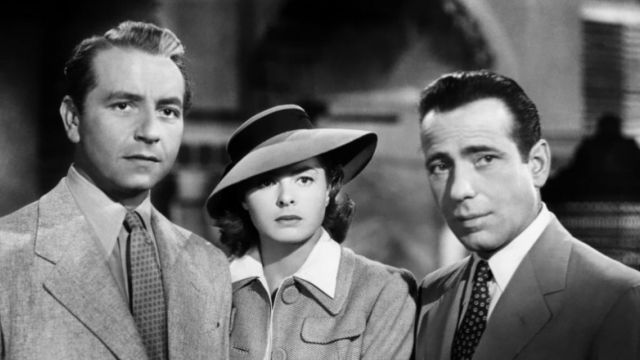
“Casablanca” is a film which conjures up an immediate reaction from film fans whenever they hear the title. It’s right up there with “Citizen Kane” as one of those films which film buffs and historians consider one of the greatest movies ever made. There are many reasons for this, but the biggest reason is the love story between Humphrey Bogart and Ingrid Bergman. There is also the dialogue and the many quotable lines which come to mind when thinking of this film. I won’t be repetitive here and list all of them for you, but if you have seen “Casablanca,” you know the lines by heart. It’s one of those films which means a lot to a great deal of people and for good reason.
Set in 1941, the film introduces the audience to Rick Blaine (Humphrey Bogart), the owner of the nightclub Rick’s Café Américain. He refuses to have drinks with any of the customers and mostly keeps to himself. The audience can tell he’s cynical, unhappy, and something has happened to him to cause him to lose a big part of himself. He tends to stay neutral on almost every topic. Even though he’s cynical, he’s still a good guy with a good heart. His world gets turned upside down when his old flame, Ilsa Lund (Ingrid Bergman), shows up with her husband, Victor Laszlo (Paul Henreid), as he’s seeking protection from German Major Strasser (Conrad Veidt) who intends to arrest him.
Victor Laszlo is a fugitive Czech Resistance leader. Rick’s Café serves as a place for all sorts of types, good and bad, because of World War II. A lot of people there are looking to keep a low profile while others are looking to find someone to arrest. Rick has some war experience himself, but now he’s focused on his nightclub. He starts to become very focused on Ilsa when he catches up with her again, and it’s clear there are still strong feelings between the two. They were in love back in Paris, but when it was time to leave, she just left him hanging with a note that left him with more questions than answers.
Rick has letters of transit, which allow two individuals to get out of Casablanca safe and sound and start over without any consequences. Rick can give the letters to Ilsa, but that also means he will be giving her up as well. Again, even though he stays neutral on most topics, he can tell the good guys from the bad guys. He’s not afraid to lend a helping hand to someone in need. However, if he helps her and Victor out, he knows he will never see the love of his life ever again. That was the beauty of some of the old Hollywood films: the romance felt urgent and very important. It never felt frivolous or silly. You can tell that two people really loved each other, and it made a huge impact on their lives.
“Casablanca” is an old-fashioned Hollywood classic in every sense of the word. You have the black and white picture, the classic romance, and the big stars. You also have great supporting work from actors like Claude Rains, Sydney Greenstreet, and Paul Henreid. It all feels vital and like it serves a purpose. It’s old-fashioned Hollywood craftsmanship at its finest. The story with the war can sometimes bog the film down a little bit, but it’s there to push the love story between the two leads. They are the heart and soul of this beautiful picture. Like fine wine, this is the kind of film which gets better with age. Even if you have seen it multiple times and know how it’s going to end, you still can’t help but get swept up in the story. “Casablanca” is the kind of movie Hollywood doesn’t make anymore, but I wish they did.
This is Bogart’s best performance in his storied career. He has a certain vulnerability to him we don’t often get to see on film. He’s also an everyman in this film, and it’s great to see him connecting with his black piano player, Sam (Dooley Wilson). He respects people and does the right thing, but it doesn’t feel forced. It’s a completely natural performance. It’s not a big or showy performance, and it doesn’t need to be as we see everything in his face: all of the pain and the agony. Bergman is sweet, tough and very, very smart. She’s the perfect actress to go toe-to-toe with Bogart in this film. She looks absolutely stunning and gorgeous on screen.
I was sucked into “Casablanca” from start-to-finish, like I am every single time I watch it. Even though I know how it’s going to end, I’m still on the edge of my seat when they get to the final scene. The last line of dialogue is iconic and the perfect note to end this film on as well. I’m a huge fan of old Hollywood when stars were stars, and they could light up the screen with their presence. It should also be noted that “Casablanca” won Best Picture in 1942 along with Best Director (Michael Curtiz) and Best Screenplay. This is Classic Hollywood at its finest!
* * * * out of * * * *
4K/Blu-ray Info: “Casablanca” is released on a two-disc 4K/Blu-ray combo pack from Warner Brothers Home Entertainment. It also comes with a digital copy of the film as well. It has a running time of 102 minutes and is rated PG for mild violence.
4K Video Info: “Casablanca” looks pretty good on 4K. The black and white and older films in particular play pretty well with light and darkness on HDR. It’s not a fantastic upgrade, but I don’t know how much more they could have done to really upgrade a film from the 40’s. It’s better than the Blu-ray, but it’s not a huge improvement.
Audio Info: The audio for the film comes on DTS-HD MA: English 1.0, and Dolby Digital: French and Spanish. It also comes with subtitles in English, French, and Spanish. There isn’t a huge upgrade on the audio here, but it still sounds pretty solid. I don’t really think this is the kind of film which needed a huge audio upgrade.
Special Features:
Commentary by Roger Ebert
Commentary by Rudy Behlmer
Introduction by Lauren Bacall
Warner Night at the Movies
Now, Voyager trailer
Newsreel
“Vaudeville Days” (1942 WB short)
“The Bird Came C.O.D.” (1942 WB cartoon)
“The Squawkin’ Hawk” (1942 WB cartoon)
“The Dover Boys at Pimento University” (1942 WB cartoon)
“Great Performances: Bacall on Bogart” (1988 PBS special)
Michael Curtiz: The Greatest Director You’ve Never Heard Of
Casablanca: An Unlikely Classic
You Must Remember This: A Tribute to “Casablanca” (1992 TEC documentary)
As Time Goes By: The Children Remember
Deleted Scenes
Outtakes
“Who Holds Tomorrow?” (1955 “Casablanca” TV episode)
“Carrotblanca” (1955 WB Cartoon)
Scoring Stage Sessions (audio only)
Lady Esther Screen Guild Theater Radio Broadcast – 4/26/43 (audio only)
Vox Pop Radio Broadcast – 11/19/47 (audio only)
Trailers
I can’t get too upset over the lack of updated special features, as they transported a ton of special features from previous releases. The fact you get two commentary tracks, especially one with Roger Ebert, is quite a treat. There are A LOT of special features here. This one is pretty simple for film buffs and physical media collectors out there—if you love classic Hollywood, you owe it to yourself to pick up this film on 4K and watch it in the best possible format. As mentioned previously, it’s an upgrade over the Blu-Ray, even if it’s not a massive upgrade. Nonetheless, this is a film you should add to your collection on day one with the slipcover. Personally speaking, I love a good slipcover on my favorite films, and if you want the slipcover, it’s always better to buy it sooner rather than later. This will make the film lover in your life very happy this holiday season!
**Disclaimer** I received a copy of this film from Warner Brothers to review for free. The opinions and statements in the review are mine and mine alone.
WRITER’S NOTE: This is from a press day which took place in 2013.
With “About Time,” writer/director Richard Curtis once again proves that he is the master of making romantic movies. While romantic films are currently a dying breed in America, Curtis gives the genre a much-needed re-invigoration. This is the same man who wrote the screenplays for “Four Weddings and a Funeral,” “Notting Hill” and “Bridget Jones’s Diary,” and he also wrote and directed “Love Actually” which has become everyone’s favorite movie to watch at Christmastime. Curtis populates his films with characters we can all relate to, and he shows us how the simplest things in life can be so wonderful.
I got to meet up with Curtis when he appeared for the “About Time” press conference at the Four Seasons Hotel in Los Angeles, California, and he proved to be as charming and funny as many of the characters who inhabit his films. During the roundtable interview he talked about “About Time” differs from other romantic films, how he came to cast Domhnall Gleeson and Rachel McAdams, and why this will be his last movie as a director.
While these questions came from several reporters, I did take the time to put my name to the questions I asked Richard. You will find them eventually.
Question: Why did you not tear Tim (Domhnall Gleeson) and Mary (Rachel McAdams) apart in the middle of the movie only to bring them back together?
Richard Curtis: Well, I quite liked the idea in the film. There is a kind of habit in romantic films of getting people who hate each other when they meet; he’s a Nazi and she’s a member of the Socialist Worker’s Party (laughs), however will they fall in love? But most of us, when we bump into the people we are going to spend the rest of our life with, quite like them when we first meet them. I quite liked the idea that you could do something where people like each other, and then there was the time travel and then they liked each other again. I’m interested in if you can do it. I was writing about sort of a happiness in a funny way and writing about the interesting business of how things work rather than being really interested in the way things don’t work.
Q: Speaking of the time travel aspect, it’s something that people keep watching these movies for. They’re always keeping an eye out for the loophole or plot holes. Did that make it harder writing the script?
Richard Curtis: Look, you know you’re gonna fail, that’s the thing. I know where I failed in this so you just do your best and the people and the production keep you up to it, and anybody who spots anything that’s wrong will always say it to you because it’s a fun thing to spot when they’re reading the script. So, you know you’re getting closer to true without actually getting there, and it was fun to play with it. It’s also a thing where when you decide you’re going to do a time travel movie, it is something that is in your head as you’re walking around. The thing about not being able to go past the birth of your child was definitely the result of another conversation I was having with someone about how weird it is that you commit your entire life to people who you have no ability to choose, and then I thought that’s so true. And not only that, if I had sex four seconds later, I’d have a different child and then immediately I thought that would become a key plot point.
Q: This movie has two love stories in it. It has the father and son and it has the man and the woman. How were you able to find the balance so that one didn’t overshadow the other?
Richard Curtis: On the whole you try and rig films to make sure they turn out as you want them to turn out, but I think it seems as though perhaps the strength of the Bill Nighy story is more than I expected. It’s turned out to be more emotional than I expected, and I think that’s all down to the way Bill chose to play it. He chose to play it in such a sort of gentle way that I think, when you see the film, you can insert your own father into the space that Bill creates. Oddly enough, this film is in some ways less manipulative. If you’re doing a movie that ends in a big kiss and a romance, your kind of playing the cards all the way through to try and get the maximum emotion at the end. In this one I always knew that I was always aiming for this bizarrely simple final moment which was just gonna be a guy doing the most banal things in the course of an ordinary day. So, I didn’t think so much about the dynamics of the film, perhaps I have in others. But one of the ways of doing it was by getting them to get married halfway through, so that film’s done and there’s another film to rely on.
Q: Has it affected sort of the carpe diem qualities, or is that something you practiced before you started writing the script?
Richard Curtis: No. Oddly enough I think, and Bill and I talk about, because I’ve done the movie, I am thinking about that a lot more, I really am. My girlfriend, who never makes any concessions to me, says I always work far too hard and I always think that I’m not working as hard as I used to and always am. But even she is saying that she’s noticed that I seem to be creating more space and enjoying things a little bit more and making more time for normal things. So that’s why I have said I am not going to direct another film because I think that directing a movie is not a good way to have a happy life.
Q: Is that a Steven Soderbergh promise or are you just gonna keep coming back?
Richard Curtis: Anyone who says that, Steven is their hero because it means you can change your mind. It is becoming a great tradition; the great heroes like Jay-Z, doesn’t he resign? If I come back, I’m part of a noble tradition, but that is my intention at the moment.
Q: Can you talk about Comic Relief and how that came to you at a young age?
Richard Curtis: Wow, do other people know about that side of my life? Well, it started off by an almost comical mistake in that a girl I know asked if I would like to go with her to Africa, and I just said I would go to keep her company and then the charities decided to send us to different countries. They said we would cover more ground, so that was a mistake. So, I was in Ethiopia at a very bad time and that could not but change my life. That’s something I have to carry. We did a stage show and then we did a TV show, and the TV show made so much more money than was expected that I couldn’t not do it again, and I have just gone on doing it. Every time we do it, we make more money than I will earn in my entire career. I think of it as my difficult child, it takes exactly half my time, it changes its nature so I now, and after doing it now for 25 years I got a feeling that the money we’ve raised might be less important than the education or part of it. Kids in England have always grown up knowing a lot about poverty in Africa and problems at home, and that educational thing may have actually turned out to be the function of it. The next thing I’m doing is doing a year and a half trying to be part of making the new declaration by the United Nations in 2015 to end poverty, so it’s a never-ending big subject. I think the way it’s bounced off on my career is that I haven’t written my seven bad films. I do think a lot of times when people, when they finish the thing, say have I got any other ideas whereas I’m always a year behind. I thought of this film in 2005, and then I chose to do the pirate movie (“Pirate Radio”) because I wanted to be a bit older by the time I made it. It’s actually given me breathing time and let things stew longer, so I always believe quite a lot in the projects I do by the time I get to them.
Q: Fighting poverty seems like an even bigger challenge now with the gap between the rich and poor growing bigger and bigger. Do you feel sometimes like it’s a never-ending battle and how we are going to do this?
Richard Curtis: Well, you have to be realistic about that. Actually, statistically speaking, the lives of the very poorest people on the planet have never gotten better quicker than in the last 15 years. It’s been extraordinary so I’m paying more attention to that. But the rich and poor inside countries, I’d just think it increases your responsibility to try and make sure that people like me who do live in the bubble of comfort are really aware of how peoples’ lives are at the other end of the scale. I made all my children watch a documentary called “Poor Kids” the other day. It’s just a really brilliant, very sweet-natured documentary about four really poor kids in the UK, and they literally could not believe what they saw and that increases the desire to communicate this.
Q: You also focus a lot on the joy of real people like with the Heathrow Airport scenes in “Love Actually,” and then there are scenes in “About Time” that look like they had regular people in them. Where did you find those people?
Richard Curtis: Well with “Love Actually” we put up a little black box with curtains in Heathrow and just filmed and then sent assistants rushing around and saying do you mind signing this release. It’s very weird, you haven’t seen your mom for 17 years and somebody’s saying we’ve just filmed you crying embarrassingly. The strange thing is when we edited that, over half of what I wanted in that sequence I couldn’t use because it turned out we hadn’t got the permissions. The bit at the end of this one was sort of the same thing. Quite a lot of it was sort of staged. There are some things that weren’t. Most of that was directed by my girlfriend. That was the weird thing. It was the final day of the shoot. I woke up and I was in the most astonishing pain. I thought I had kidney stones or whatever, and she leapt out of bed in the highest of spirits and said she would ring a doctor on the way to the set (laughs). Some of the loveliest images there were got by her which I think sort of shows because she is full of an energy and joy about her. It was interesting how ordinary those images had to be. I didn’t shoot them at the beginning, so I didn’t quite know how it was going to end. When I thought that I would end with a series of just normal images, I took a film by a friend of mine called Kevin McDonald called “Life in a Day” which is a movie he made about YouTube, and I cut like ten favorite images from that in and showed that to friends and it was a disaster because they were good. They were so definitive, so beautiful, so picturesque, and everyone said the movie’s all been about ordinariness and you can’t then say that every day is a beautiful sunset and every day is an astonishing child framed perfectly in a window in Milan. So, I did try and keep those end bits as sort of banal as they could be, but still joyful.
Ben Kenber: “Love Actually” is my family’s favorite movie to watch every Christmas Eve. I love it too but I’m always hoping we can add “Bad Santa” as a double feature though.
Richard Curtis: Lauren Graham’s in “Bad Santa!” I love her!
Ben Kenber: I’m not usually a big fan of romantic movies, but what I love about your movies is that the people and what they go through feels so real and relatable. A lot of American romantic films are manipulative but your films never feel like they are. Your movies touch on issues that most other filmmakers don’t really take seriously.
Richard Curtis: Well, thank you very much. I don’t have an answer for that, but don’t down American filmmakers because I think there’s a kind of feeling that romantic films may not be in a good place at the moment. “(500) Days of Summer” I thought was an incredible movie, “Like Crazy” is an amazing movie about love, and “Lost in Translation” is the greatest ever romantic comedy even though it’s not a romantic comedy. I’ve been looking back because I’m thinking about finishing and thinking why did I write all these films on this subject and then suddenly realizing it is because it is the context of my life and what matters to me. How your family treats you, who you love, how you get on with your kids and your friends are what fills most of your emotional time, and I’m just trying to hang on to that and write about normal things because I never, never bump into serial killers.
Q: A lot of people don’t seem to realize that “Love Actually” is a Christmas movie because the holiday gets so pushed into the background.
Richard Curtis: I think the funny thing about “Love Actually” is the casting is now out of whack. Originally it was 50% well known and 50% not, and now the naked guy is in “The Hobbit,” January Jones is Betty Draper on “Mad Men,” and even the boy is now in “Game of Thrones.” Liam Neeson is the greatest action hero in the world and Andrew Lincoln is on “The Walking Dead,” so it’s a hell of a cast now.
Q: You are obviously a believer in love. Do you have thoughts on marriage?
Richard Curtis: Well in a way “Four Weddings and a Funeral” was a long way of explaining to my mum why I wasn’t married. She always found it hard to accept. I haven’t gotten married for particular, peculiar reasons, but I’m sure that marriage is a wonderful thing.
Q: You make great use of music and songs in your movies. Can you give us an insight into what your playlists are?
Richard Curtis: Well, the insight I would say is that I really do have to use music in order to get through the process of writing. It really is part of me learning what I’m trying to do, and sometimes that takes very specific forms. When I handed this movie in, it said on the front cover “About Time” or “The Luckiest” or “Golden Lapels.” I thought about those two so much and was so sure I was going to use them, and I thought I might even name the movie after them. So, in this movie, all the cues were there as I was writing and helped me write the right scenes and work out what I wanted to say. There’s a version of “Downtown Train,” a Tom Waits song, by Everything But The Girl, an English group which was all I listened to while I was writing “Notting Hill.” That was all I was trying to do in the whole of that movie was reproduce the emotional temperature of that song which I knew could not be in the movie, but it was my sort of guide. And then I just use pop music to cheer me up, so I got different playlists on my computer. I’m trying to make my tastes more modern. My sons are pushing me hard in that direction. My 16-year-old says he can’t listen to traditional pop music anymore because the lyrics of the songs he listens to by people like Jay-Z are so much better than normal pop songs. Normal pop songs are so thin and so repetitive, he says, that he can’t listen to them anymore.
Q: The scene in the underground subway station is one of the best in this movie. Your use of music in all your movies is great.
Richard Curtis: Well, thank you. That was a really interesting day because sometimes you hope something works but you don’t know how. I couldn’t work out as I was shooting it how it was going to be possible to edit it because he’s always going to be singing the wrong words of the song. It was never going to be correctly timed so I just shot all night and hoped the editor could work it out, and the editor said there was no problem when we got to it.
Q: Can you talk about casting the two main parts? How did that come about?
Richard Curtis: There are completely different ways that casting works. My friend, Mike Newell, said to me, “When the movie is cast, the movie is made.” He was extraordinary when we were casting Vicar #3 in “Four Weddings and a Funeral.” The guy came in and Mike said, “So tell him about Vicar #3,” and I said, “Well the leading character is trying to decide whether to get married and the vicar comes in and…” And Mike said, “No, no, tell me why did he join the church” (laughs). That level of detail and three dimensionality, I think that casting is hugely important. Rachel, having always loved her work and having picked up a sort of vibe about her as a human being and being very interested in this part about sort of contentment and in the idea of going from someone you meet on the first date and, by the end of the film, she is the mother of three, was based on trust and faith and things that she had seen and things I had also heard about her from the people who had worked with her. Domhnall on the other hand was seen as one of the top 25 young actors in the country, and I saw lots of them as often happens when I audition. Unless it’s the right actor, there doesn’t seem to be anything there at all. That was very much the case with the sister’s part until we found Lydia Wilson. It seemed as though there wasn’t anything there, and then we got Lydia with all her complicated emotions and Domhnall instantly made it funny which is absolutely key because he’s actually interested in comedy. So many young actors, you know, aren’t. They’re actually trying not to be funny and they’re trying to make people take them more seriously and think them cool or attractive, and he was really happy to be stupid and loving. He’s a lovely actor and a very sweet man. It was complicated because he was wearing his “Anna Karenina” beard so he looked like he’d stumbled out of the woods in “Deliverance” (laughs). The beard looked great if you’re wearing a military uniform, but if you’re wearing a t-shirt and jeans you look like you’re too fond of farmyard animals. It was a real act of faith, and then I made him do a whole day on camera, still with the beard, actually acting out the part and stuff. So, he worked very hard for it and was then sort of perfect.
Q: There’s a lot of Hugh Grant in Domhnall’s role, sort of like the younger version of him in “Notting Hill.” Was there any kind of connection made there?
Richard Curtis: I wasn’t aiming for Hugh at all. It’s obviously a voice that comes out when I write that part. I actually voted against Hugh in “Four Weddings and a Funeral” when it came down to it and I was, thank God, defeated 2 to 1 because Hugh was brilliant. But I think there’s something about Domhnall that’s much closer to my original inspiration when I started writing films. I was really inspired by “Gregory’s Girl,” “Breaking Away,” “Diner” and the guys in that except Mickey Rourke, and Woody Allen really. I was always looking for awkward, normal people, and I think when you first sit down with him at the party you don’t think that he’s the guy. You think he’ll be lucky to ever get a girlfriend. I like that side of him whereas with Hugh, girls would like him.
“About Time” is available to own and rent on DVD, Blu-ray and Digital. Please feel free to check out some other “About Time” interviews I covered for the website We Got This Covered by clicking on the names below:
Okay, this is getting scary. I’m starting to enjoy romantic comedies again, and that is so not like me. Recent years have given us a few actually worth watching like “Obvious Child” and “Trainwreck,” both which went far beyond my expectations. This all started to happen as the genre began finding itself suffering from burnout thanks to a lot of banal movies which have made me roll my eyes on a regular basis, many of them adaptations to Nicholas Sparks novels. Then there was “What If” (or “The F Word” as it is known in certain circles) which is by no means an original romantic comedy. It owes quite a bit to “When Harry Met Sally” among other classics, and it does follow a lot of the same conventions I have come to expect from this genre. But what keeps it from feeling ordinary is a terrific screenplay, smart direction and wonderful performances from its two undeniably adorable leads: Daniel Radcliffe and Zoe Kazan.
Radcliffe plays Wallace, a medical school dropout who has been in one failed relationship too many, and this makes him take a long break from the game of love. But while at a friend’s party, he ends up bumping into Chantry (Kazan), an animator with a sparkly personality which more or less matches his own. After walking her home, Chantry informs Wallace she has a boyfriend named Ben (Rafe Spall) whom she has been with for a few years, and that she would love for her and Wallace to just be friends. Wallace agrees, but as time goes on, he wonders if they can be more than just friends. Lord, I have had many friendships with women where I wondered the same damn thing.
The questions of whether or not men and women can be friends still seems to come up from time to time, and that’s even though the answer should be a resounding yes. But there is always that one friend who belongs to someone else whom you endlessly pine for. “What If” really digs into this state of mind to where I could not help but feel Wallace’s passionate longings which he tries to cover up with a seemingly cynical take on love. We all have had crushes on others, and we are constantly aware of how painful crushes can be when they turn into shattering examples of unrequited love. It all reminds me of some dialogue from John Hughes’ “Sixteen Candles:”
“It just hurts.”
“That’s why they call them crushes. If they were easy, they’d call ’em something else.”
I was reminded of this while watching “What If” because, unlike other romantic comedies, I really found myself desperately rooting for Wallace and Chantry to become a couple. A lot of it is thanks to the fantastic chemistry between Radcliffe and Kazan as they bring this movie to such vivid life. Both play off one another wonderfully, and once you see the two discussing the ingredients of a Fool’s Gold sandwich (Elvis Presley’s favorite sandwich of all), you can tell they were made for each other.
Radcliffe may always have the shadow of Harry Potter hanging over him, but it’s really past the point where we have to recognize what a truly talented an actor he is. As he heads from one genre to the next, the young actor shows all the on-the-job training he got from playing J.K. Rowling’s unforgettable wizard has really paid off. While Wallace tries to put a solid front in an attempt to show how love has not gotten him down, Radcliffe shows what’s going on beneath the surface without ever having to spell it out for the audience.
Kazan has a uniquely adorable beauty about her, and she continues to do great work in every project she’s in. As Chantry, she gets the opportunity to take a character who appears to be comfortable with where she’s at in life, and we follow her through a journey of self-discovery which is honestly long overdue. She has a nice boyfriend and doing the work she loves to do, but throughout “What If” we watch her as she begins to discover what she really wants out of life. As she makes these subtle changes in her character, Kazan shows us just how wonderful an actress she can be.
There’s also a great scene-stealing performance from Adam Driver as Wallace’s best friend, Allan. Always giving bad advice on women and yet having a lot more success with them than Wallace, Driver has a wonderfully dry sense of humor here which is irresistible, and it’s a blast watching him stumble over his words on a regular basis.
I also have to give credit to Rafe Spall who plays Chantry’s boyfriend, Ben. This could have been the usual douchebag boyfriend who deserves to be dropped flat, but Spall makes him a good hearted man who just doesn’t have his priorities straight.
“What If” was directed by Michael Dowse whose other films include the two “FUBAR” movies, “Goon” and “Stuber.” While he doesn’t go out of his way to reinvent the romantic comedy wheel here, he does freshen up the formula and gives us something which does not feel like something you have seen a hundred times before. Along with screenwriter Elan Mastai, who based this screenplay on the play “Cigars and Toothpaste” by T. J. Dawe and Michael Rinaldi, he does a good job of keeping us emotionally involved in the plight of these should-be lovers all the way up to its end.
I still have issues with romantic comedies from time to time, but “What If” shows what good filmmakers can do with a formula that has been done to death. Even though I have seen this kind of film so many times before, this one proved to be a lot more emotionally involving than I ever could have expected it to be.
* * * out of * * * *
CHECK OUT THE VIDEO BELOW TO VIEW THE EXCLUSIVE INTERVIEW I DID WITH DANIEL RADCLIFFE ON “WHAT IF.”
I walked into “Beyond the Lights” expecting it to be some sort of manipulative soap opera which aimed to be “The Bodyguard” for a new generation. What I got instead was a showbiz story which felt surprisingly genuine in its emotions and intentions. It does have that familiar ring of two people from opposite walks of life coming together, but the way their relationship evolves throughout proves to be very entertaining to watch.
When we first meet Noni Jean, she’s a little girl performing in a talent competition and singing Nina Simone’s “Blackbird” which leaves the audience in a state of awe. However, when the judges award her a runner up prize, her mother Macy (Minnie Driver) angrily takes her out of the auditorium and orders her to “chuck” her trophy in defiance. The way Macy sees it, being second best counts for nothing in a world where you need to be number one.
We then move to years later when Noni, now played by Gugu Mbatha-Raw, is on the verge of stardom after having won a Billboard Award even though she hasn’t released an album yet. But after retreating to her hotel room, we come to see how much the pressures of fame are bearing down on Noni as she sits on a balcony ready to jump. Coming to her rescue is police officer Kaz Nicols (Nate Parker) who pulls her back from the edge, literally and figuratively speaking, and two quickly get lost in each other’s eyes. What happens from there is easy to guess.
Initially, Kaz feels somewhat betrayed when Macy pays him off to publicly say Noni did not try to commit suicide, but Noni warms up to him quickly as she can tell he sees something in her others do not.
While they may come from different worlds, Kaz and Noni are going through similar issues. Her mother Macy has been grooming her for stardom ever since she was little, and she has helped turn Noni into the kind of woman every man wants or at least fantasizes about. As for Kaz, his police captain father David (Danny Glover) is grooming him for public office, something he does in fact have ambitions for. However, when you look into Kaz’s eyes, you wonder just how serious he is about politics or if he really wants a different path in life.
Basically, Kaz and Noni are trying to fulfill the desires of their parents, and we have caught up with them as they have long since played a role they feel society wants them to play. In the process, they have lost touch with what they really want out of life, and we follow them as they go through a much-needed period of self-discovery. Watching these two evolve and change from start to finish is deeply involving and, even if the conclusion is never in doubt, we revel in their personal triumphs.
I am not at all familiar with Mbatha-Raw or her work as an actress, and she gives an extraordinary performance here. She is mesmerizing to watch as Noni begins to shed the public persona which has been foisted upon her, and it allows the frightened child inside of her to come out into the open. Also, she has a show stopping moment where she sings “Blackbird” by herself onstage, and you cannot take your eyes off of her for a single second.
Parker also puts in a strong performance as a well-meaning man who respects the law, wants to help people and who has, as his shirtless scenes will attest, spent a lot of time in the gym like any cop should. Looking at the actor’s past which had him involved in political activism, charitable work and working as a wrestling coach, you get the sense he was born to play Kaz. As he wades deeper into Noni’s world of fame, Parker shows Kaz to be someone who keeps his head above water and is not easily seduced by the closed-off world of show business. But there’s also no doubt that the chemistry between him and Mbatha-Raw is very palpable.
Kudos also goes out to Minnie Driver who takes what could have been a one-dimensional stage mother from hell and turns her into a complex character who is far more vulnerable than she lets on. We come to see how Macy has never had it easy, and she is eager for Noni to have everything she never had. But as much as she cares for her daughter, Macy also comes to realize her determination to make Noni a star speaks more about her ambitions than anyone else’s. Driver is a powerhouse as she lets us see how Macy has been wounded by others who had no faith in her when she was young, and it becomes understandable why Macy wants to beat everyone at their own game.
“Beyond the Lights” was written and directed by Gina Prince-Bythewood whose previous films include “Love & Basketball,” “Disappearing Acts” and “The Secret Life of Bees.” I regret to say I haven’t seen those films, but I am certainly willing to see them now based on the work she has done here. Prince-Bythewood succeeds in giving us a showbiz tale which actually feels grounded in reality. The atmosphere at the award shows and parties Noni attends feel authentic, and they never seem like a spectacle to be easily laughed at. She also gives us a number of complex characters who struggle to survive the high pressure world of fame and fortune where people have everything and nothing at the same time.
I also have to applaud Prince-Bythewood for sticking by Mbatha-Raw when studios were insistent on getting a bigger name cast in the role of Noni. Perhaps a music star would have done a good job here, but they also would have brought an enormous amount of baggage with them which would have had an unintentionally negative effect on this movie. Mbatha-Raw has the advantage right now of not having this baggage, and that makes her performance all the more enthralling as a result.
Sure, there are some soap opera dramatics here and there and certain moments do not ring true, but “Beyond the Lights” really did prove to be one of the big cinematic surprises of 2014. It is also another film to add to the list of worthwhile romantic movies. Just as this particular genre looked to be burning out, the movies coming from it are getting so much better. I’m starting to like these kinds of movies again. What’s wrong with me anyway?
“The One I Love” is one of the harder movies to review because it really helps to go into it with an open mind. The less you know about what happens in it, the better the experience will be. Ever since its debut at the 2014 Sundance Film Festival, its most fervent admirers have been praising it and guarding its secrets as if they have the secret formula for Coca-Cola. What I can tell you is that it is an insanely clever romantic comedy, and it belongs to a genre I typically live to avoid.
Things start off with the married couple of Ethan (Mark Duplass) and Sophie (Elisabeth Moss) going through troubles which usually tear a couple apart permanently. They try to recreate their romantic spark by revisiting the house they snuck into when they first met and jump in the pool, but the magic isn’t there. In the process of visiting their therapist (played by Ted Danson), he suggests they spend the weekend in this cottage he knows about so they can work on their marriage. When they get there, they find the cottage is in a beautiful location I would personally love to visit sometime, and it proves to be a very relaxing place for a vacation. But when they start to explore the other parts of the house, things quickly get very trippy.
So that’s it. This is all I am going to tell you about the plot of “The One I Love.” It is very nice we have a movie like this one where film buffs are not investigating every little detail like they do with “Star Wars” or “The Matrix.” With big blockbusters, everyone is analyzing every single moment of the movie trailers, following news updates of who is being cast, and it gets to where they have a vision of what it is going to be like inside their heads. The problem is, going into anything with such lofty expectations will usually have you living very disappointed, and perhaps for the wrong reasons. It helps that “The One I Love” is a low budget feature which is coming in under the radar because people aren’t busy overanalyzing like this one.
It should also be noted how director Charlie McDowell and writer Justin Lader created this movie out of a 50-page document which contained the scene beats and the locations of the entire movie. The only thing this document did not contain was the dialogue, and the actors ended up improvising it themselves. Even though the actors were given ideas to work with, they pretty much drive this movie more than anyone else, and I applaud the challenges they face here and the risks they took with what they were given.
“The One I Love” serves as a terrific acting showcase for its stars Mark Duplass and Elisabeth Moss, both of whom get to explore different levels of their characters throughout the movie’s running time. Mark is, of course, well known for making and producing many offbeat films with his brother Jay Duplass like “Cyrus,” “Baghead” and “The Puffy Chair” among others. As an actor, he is perfectly cast in the role of an everyman husband who finds himself threatened with the various events he is forced to endure while staying at the cottage. As Ethan, we sense his desperation to save his marriage, and we also sense his desperation to not be second best at anything.
Moss has had quite the ride in recent years with her work on “Mad Men,” “Top of the Lake” and “The Handmaid’s Tale,” and she is currently experiencing great success on the silver screen in “The Invisible Man.” She once again proves just how wide her acting range is as Sophie. Like the movie, she is full of surprises and such a lovely presence to watch, and she renders every emotion you see Sophie going through as being totally genuine. Considering what the role has her doing, it is really quite a feat when you realize what Moss has accomplished here.
“The One I Love” is one of the few movies I have seen in recent years which takes turns I did not see coming, and I honestly have not been this riveted by a romantic comedy since “Four Weddings and a Funeral.” Seriously, you really need to check your expectations at the door when you go and see it because there will be no easy way to prepare you for what will unfold. I am always waiting to see a movie which constantly surprises me throughout, and this is one of them.
If there were any expectations I had with “The One I Lovie,” it was that I was to hear Stephen Still’s song “Love the One You’re With” play over the end credits. Once you watch this movie, you will understand why this would have been the perfect piece of music to end things on. After all, “The Simpsons” made great use of it on one of their “Treehouse of Horror” episodes.
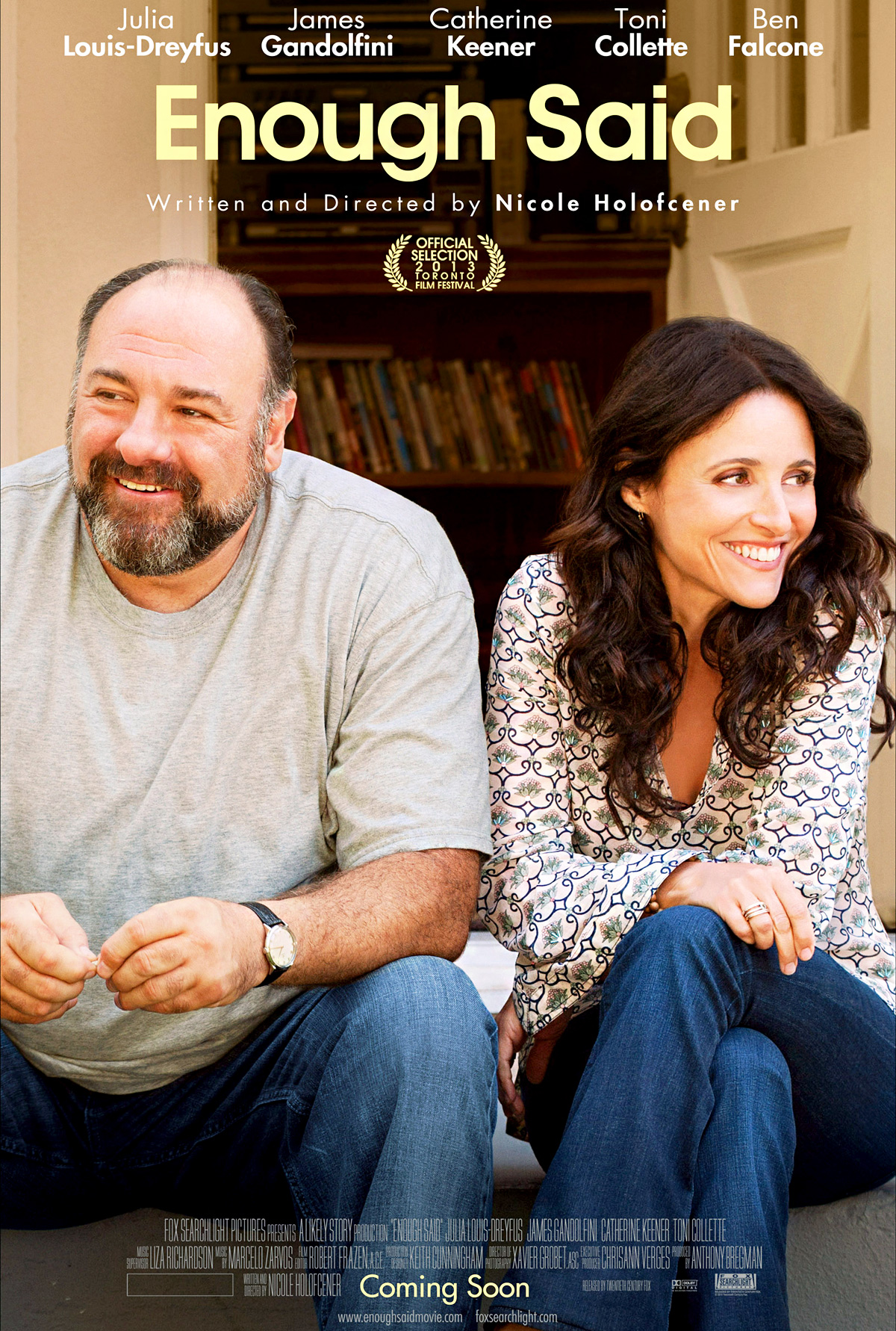
With movies like “Lovely & Amazing,” “Friends with Money” and “Please Give,” Nicole Holofcener has firmly established herself as a filmmaker with a unique voice. In a time where romance and relationship movies are being critically and commercially crucified, her films are wonderfully refreshing as they feature characters who feel real, are remarkably down to earth and have flaws we can all understand and relate to. Even if you think her films deal with familiar subjects and situations, the attention Holofcener gives to her characters and the actors who play them make you feel like you are experiencing a story you have never watched before.
Her film “Enough Said” is no exception to this, and it stars Julia Louis-Dreyfus as Eva, a professional masseuse and single mother who is slowly getting back into the dating game. While at a party, she meets Albert (James Gandolfini, in one of his last performances), and the two find themselves forming a deep connection very quickly. Things, however, get complicated when (SPOILER ALERT) Eva discovers that one of her patients, Marianne (Catherine Keener), is actually Albert’s ex-wife. Throughout their sessions together, Marianne has been giving Eva many different examples about what a lousy husband Albert was, and this makes Eva wonder if her first impressions of Albert were the right ones to have.
I talked with Holofcener while she was doing press for the “Enough Said” digital release, and the movie itself has since received various nominations from the Golden Globes, the Independent Spirit Awards and the Screen Actors Guild Awards. During our interview, I got to find out how she comes up with such wonderfully unique characters, what it was like for her to work with the late James Gandolfini, and we also talked about Catherine Keener who has appeared in most of her films and how their creative relationship has evolved from their first film together.
Ben Kenber: “Enough Said” is fantastic and one of the best films of 2013. With this and “Please Give,” I really love how your movies deal with characters that are down to earth and have flaws like everybody else. Most romantic movies usually don’t have that, but your films are among the exceptions.
Nicole Holofcener: That’s very nice. Thank you. That’s what I’m going for.
Ben Kenber: With “Enough Said” and the other movies you have made so far, how do you come up with such unique characters?
Nicole Holofcener: I have no idea (laughs). I mean they’re kind of an amalgamation of people I know and people in my imagination. I guess, by going very specific, sometimes I’ll focus on a character’s habit or a quirk or a mannerism or something irritating or something specific. I started with the Sarah character (played by Toni Collette) in this movie with the fact that she has made problems that started with a friend of mine who said she left bracelets on the kitchen counter, and she finds them in the kitchen and how much that annoys her and why she won’t simply ask her housekeeper not to do that. Then I have Sarah, and it’s like everything kind of falls into place after that, not easily. I’m not saying it’s easy, but it informs who that person is and what her issues might be. And then all of a sudden, she had this whole story with her housekeeper and it ended up being a good scene, but it started with the bracelet on the kitchen counter. So very specific, I guess. By going very specific and individual. When I read a script, I hate it when they say things like, “Sarah, 35, driven, type A, but inside falling apart.” It’s like, well then, you don’t even have to read what happens because you’ve already been told who she is.
Ben Kenber: This looks like a movie which sticks very closely to the script you wrote, but was there any improvisation used by the actors?
Nicole Holofcener: Yeah, absolutely. The story is very much the script as written, but they (the actors) ad-libbed all over the place, and I got rid of some and I kept some. But they had the freedom to do that especially because they were so funny and smart. They changed things but not the story.
Ben Kenber: The characters are so down to earth, and everybody seemed so relaxed onscreen. How did you manage to get such naturalistic performances from your cast?
Nicole Holofcener: They were sedated. I just gave everyone a Xanax every day. If only it could be like that (laughs). Some days were more relaxed than others but, as they say, the director sets the tone. I’m pretty relaxed, and while I take directing seriously, we’re not in a war zone. I try to have a good time and help people feel safe and relaxed so that they can give vulnerable performances and trust me. I try to earn their trust, and then I try to help them feel comfortable.
Ben Kenber: Well it definitely looks like he succeeded in doing so.
Nicole Holofcener: Well that’s good.
Ben Kenber: I do have to ask you about the late James Gandolfini because this is a great role to see him in. It shows audiences there was more to him than Tony Soprano. People should’ve known this before “Enough Said” came out, but the movie makes it clear to those who couldn’t get “The Sopranos” out of their heads. What was it like to work with him?
Nicole Holofcener: It was great to work with him. It was often challenging. He asked a lot of questions. I think we were sometimes mutual pains in the asses, but in a very affectionate way. He’d look at me like, “C’mon!” I’d look at him like, “C’mon!” He was playful and very hard-working, very self-effacing and sweet, shy. The crew loved him. He was very friendly and warm toward the crew which was very nice and so was Julia (Louis-Dreyfuss). So, I had a very relaxed family kind of feeling.
Ben Kenber: Yeah, you definitely get that from watching the movie. Catherine Keener also stars in this movie as Marianne, and you’ve worked with her several times in the past. How has your working relationship with her evolved from the first time you worked with her to this one?
Nicole Holofcener: Well, the first time I worked with her I was kind of scared. She had more experience than me. It (“Walking and Talking”) was my first feature, and I was pretty intimidated by her. But she was very giving and warm, and that’s why we continue to work together. We’ve gotten to know each other so well, and discovering how wonderful she is, every part, just made me want to work with her again and again. And now that it has been so many years, it’s a short hand. Even though she’s still great, I’m not intimidated by her anymore (laughs). She can still be a little scary.
Ben Kenber: Keener is a terrific actress, and the rapport between you and her really shows with each movie you work together on.
Nicole Holofcener: Good, yeah. It’s a pretty special relationship, definitely.
Ben Kenber: Well, I really, really liked this movie a lot. I really gravitate towards movies with very down-to-earth characters. I usually avoid romantic movies like the plague, but with movies like yours where you can really relate to the characters and the problems they experience in life, they really stand out in a wonderful way. “Enough Said” is one of those movies.
Nicole Holofcener: I’m so glad. I hope that people who avoid romantic movies will watch this one for the same reason (laughs). Thanks, that’s good.
I want to thank Nicole Holofcener for taking the time to talk with me. “Enough Said” is available to own and rent on DVD, Blu-ray and Digital.
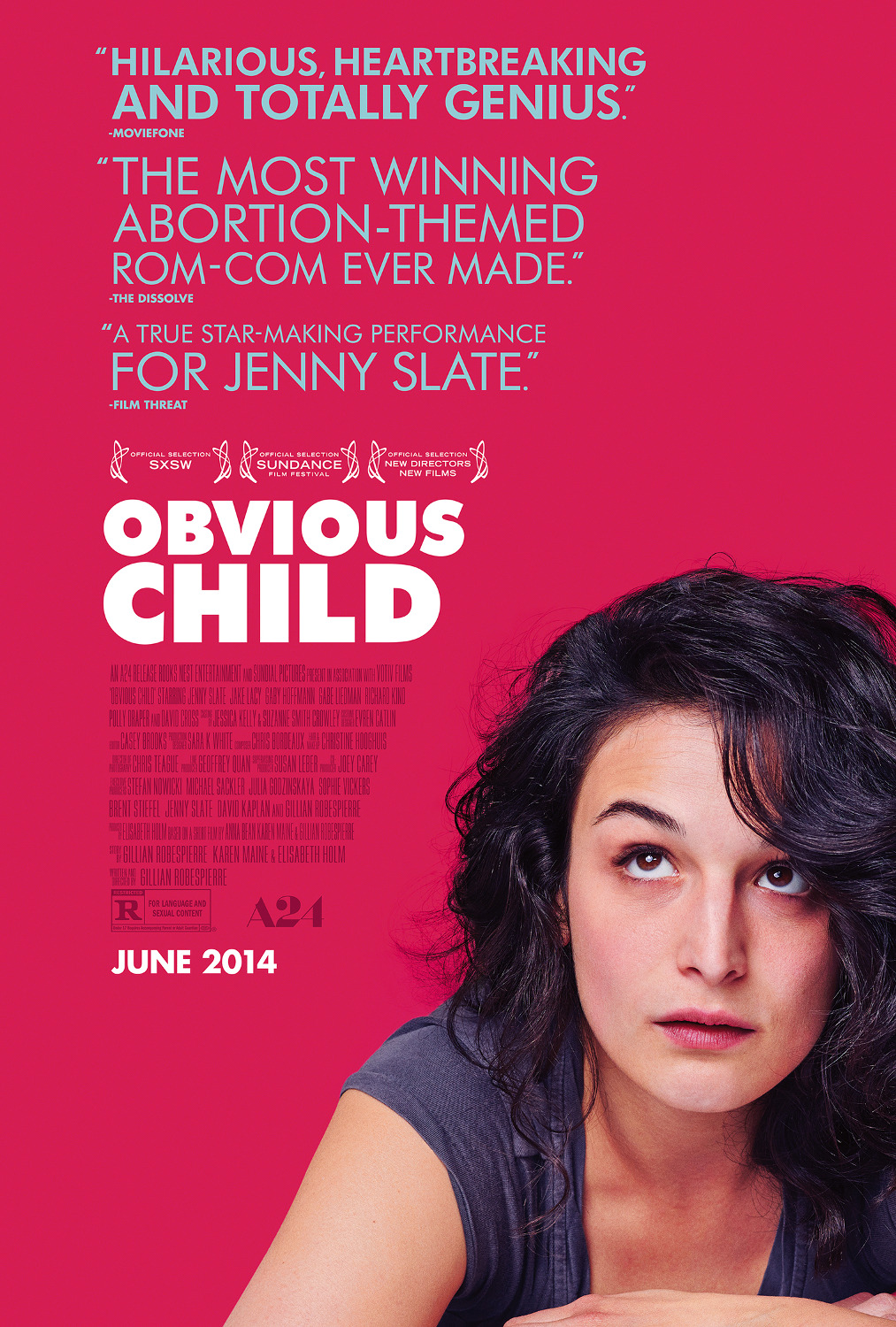
“Obvious Child” marks the feature film directorial debut of Gillian Robespierre, and it is one of the most assured directorial debuts I have seen in some time. It tells the story of aspiring stand-up comedian Donna Stern (Jenny Slate in a star making performance) whose life has just hit rock bottom. As the movie starts, she gets dumped by her boyfriend, fired from her job, and then finds herself pregnant after a one-night stand. Suffice to say, this is not the best of times for her. But at the same time, what happens from there results in one of the best romantic comedies you could ever hope to see.
Now since Donna decides to get an abortion, “Obvious Child” has been labeled by many as the first ever “abortion comedy.” But while Robespierre is glad this has given her movie far more attention than she ever expected, she does not share this point of view. During an interview at the Four Seasons Hotel in Los Angeles, she made this very clear.
Gillian Robespierre: That’s not why we made this movie, to be called an abortion comedy, because we don’t think it is. I don’t think abortions are funny or hilarious, and I think that shorthand leads to believe we’ve been flippant or glib with the topic. We wanted to accomplish a couple of things with making this movie, and one was making a romantic comedy that was very entertaining, had a lot of romance, had a really funny leading lady, and had somebody who was recognizable onscreen who felt like she could be you or your sister or your best friend. And her parents were recognizable and her best friends were recognizable in a genre that sometimes doesn’t seem relatable. That’s what we wanted to do and really wanted to show. And we wanted to take some stigma away from abortion at the same time and show a procedure that was not full of regret and shame. Donna doesn’t put it on herself and her friends and the characters around her don’t put it on her either. That’s simply all we wanted to accomplish.
Indeed, the movie is really about how Donna picks herself up from her depressed state, comes to empower herself, and eventually learns to trust other people again after getting her heart shattered. This allows Robespierre to find humor in the more serious moments, and at the same time she succeeds in keeping things both human and intimate. These days it seems incredibly difficult to make a movie with such down to earth characters, but she pulls this off with what seems like relative ease.
GR: I think when we talk sometimes even in one sentence, offstage or on stage in a movie or in real life, sometimes we write comedy and tragedy in one beat. I think we’re just trying to take that sort of natural tone that we have and put it on the screen and cut out all the fat that movies and romantic comedies have and have the tone just be very realistic. Donna is a naturally funny character so in one beat she’ll be saying something very self-deprecating, and in the next second she’ll be saying something very sweet and heartfelt. I think that’s just how we interact with each other. To me, it’s just a realistic portrayal of how modern people speak to each other.
When it came to the movie’s title, Robespierre admitted it came from the song of the same name by Paul Simon. She explained why she chose it.
GR: I don’t think Donna is a child or an obvious child. I think Donna is somebody who’s not ready for what the late 20’s is giving her, and she thought she would be someplace else,” Robespierre said. “She didn’t know that the late 20’s is just as hard as her early 20’s, and she’s just trying to figure out how to be confident in where her voice is on and offstage. She’s just trying to figure out how to take over this passivity that seems to be a running narrative in her life, and I think she’s mature and thoughtful, and I think she’s doing something that needs to be done.
The fact Robespierre chose the title of a Paul Simon song for her movie made me wonder if the lyrics played a big part in her decision.
GR: I’m a rhythm girl. I do know the lyrics to the song, I’ve read the liner notes, and I think that determines the feel of the song. It’s not just like drum and bass, it’s obviously Paul Simon’s beautiful poetry that he’s written. But I just liked it for nostalgic reasons and I’m a sucker for nostalgia. I listened to that song a lot when I was little in my car looking out the window, making up my little movie ideas; ‘Oh look at that tree, I feel like I’m in a movie.’
Of course, with this movie being a comedy, you come out of it wondering how many of its scenes were improvised instead of scripted. When you have a strong comedic talent heading your cast, we are quick to believe the director had no choice but to let their main star rewrite the screenplay themselves. But to hear Robespierre say it, the job of a director is to work with people instead of for them.
GR: I think filmmaking makes me really excited about being a filmmaker, and wanting to do this in the first place is that you get the chance to collaborate with a lot of smart, creative, intelligent actors, cinematographers, and editors. Every step of the way is collaboration, and what Jenny and I found in each other was a tone of how we like to speak with one another, and a comfortability of where our parameters are. I was very comfortable with letting Jenny go because she knows Donna just as well as I do, and we were really on the same page. So if a word didn’t feel true and if a sentence would have been funnier this way, I was very malleable. I have an ego, but it’s a different kind of ego.
“Obvious Child” started off as a short film Robespierre made, and it made me wonder about the differences between making a short as opposed to a feature length movie. Her immediate response was time and money as she never had enough of either, but she did go into more detail about what she had to deal with this time around.
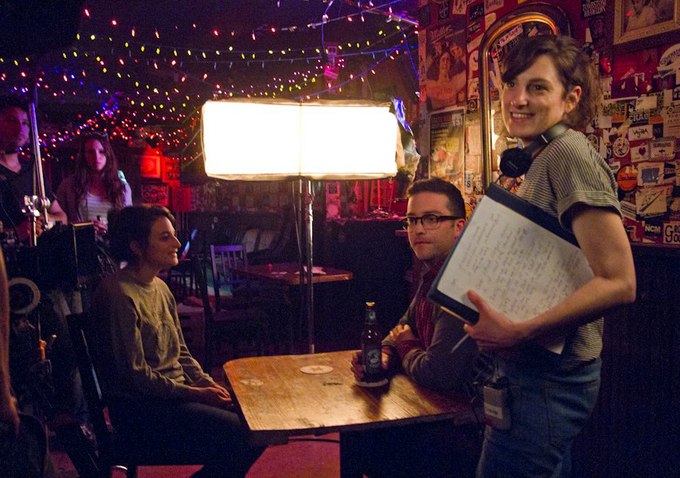
GR: We had a crew of 30 people which was very new for me. The short was just four or five people all from film school. This was a real movie set where my producer Elizabeth (Holm) and I worked really hard to hire a crew. We were a boss and paid thirty people, and there’s something really exciting about that and really scary about that. To be somebody’s employer comes with, I think, a lot of heaviness and respect for the people who work for you and who were coming in every day and bringing in so much of themselves to their roles whether it’s Jenny coming in every day focused, but also the crafty person and the DP and the gaffer. Everybody was full-fucking focused.
Still, with “Obvious Child” dealing with the divisive issue of abortion, people can’t help but think pro-life supporters have been giving the filmmakers and actors a lot of grief. Robespierre responded she hasn’t personally received any feedback from any pro-life groups, and she again reiterated her movie is not an abortion comedy. In my opinion, I liked how it dealt with abortion in an intelligent and refreshing manner. Movies like “Juno” and “Knocked Up,” both which I loved, sidestep abortion in favor of dealing with unplanned pregnancies in another way. But in this post Roe vs. Wade world, it’s surprising we haven’t had more movies like “Obvious Child.” But while it may seem like a revolutionary movie, Robespierre made it clear she wasn’t out to reinvent the wheel.
GR: There’s room for other storytellers out there. I think just because one movie is tackling unplanned pregnancy that ends in childbirth, that’s a real narrative and that’s a story that happens. We’re tackling it in a different way but also making it a comedy using a genre that we love which is the romantic comedy. I was just watching “Knocked Up” last night, it was on TBS, and I laughed my head off.
“Obvious Child” was, in my opinion, one of the ten best movies of 2014. While Jenny Slate is getting the praise she deserves for her performance, the movie’s success is really thanks to Gillian Robespierre whose work here bodes well for the great future she has ahead of her. In a sea of independent films which constantly get lost in the shuffle of all the superhero blockbusters being unleashed on us, it’s great to see a movie like this get the attention it deserves.
Uh-oh, I think I’m becoming a fan of romantic comedies. For the longest time, I have been avoiding them like the plague as they feature characters whose problems don’t even compare to what I go through, dialogue which makes me cringe in such an incredibly painful way, and acting that is embarrassing and flat. But just as the genre looks to be finally dying out, 2014 brought us movies like “What If” and “The One I Love” which succeed in reinvigorating it to where I got surprised in a way I didn’t expect. But moreover, these movies have provided us with down to earth characters we can actually relate to instead of sneer at in bitterness.
Of all the romantic comedies released in 2014, I doubt I will see one better than “Obvious Child.” It marks the feature film directorial debut of Gillian Robespierre, and it’s a very confident and assured debut as she follows the trials and tribulations of a twenty-something woman whose life hits a low point which leaves her in a depressed funk. It also deals with a very touchy subject in a way both intelligent and very refreshing, and that makes this rom com a brilliantly subversive one.
Former “Saturday Night Live” star Jenny Slate stars as Donna Stern, a comedian and bookstore employee who is about to go through one of the worst periods of her life. “Obvious Child” starts with Donna’s boyfriend dumping her which leaves her utterly devastated, and then she is informed the bookstore she works at will be closing which will leave her out of a job. This leads her sinking into a depressed state which results in one of her worst stand up gigs ever, but on that same night she meets a really nice guy named Max (Jake Lacy) with whom she strikes up an easy-going conversation. From there, the two of them have a night of fun where Max accidentally farts in Donna’s face, and they end up having sex after an exuberant dancing session to Paul Simon’s “The Obvious Child,” a song from which this movie gets its name.
Not long afterwards, Donna discovers this one-night stand has gotten her pregnant, something she is not the least bit prepared for. As a result, she decides to get an abortion but finds she has to wait a few days before the doctors can perform the procedure. During this time, she wonders about whether or not to tell Max about her decision, and the movie chronicles her journey towards the best/worst Valentine’s Day she has ever had.
Many have been describing “Obvious Child” as the first ever abortion comedy, but that description doesn’t do it justice. Yes, abortion is a theme here, but it’s not what this movie is about. The main focus is on how Donna’s unplanned pregnancy forces her to confront the realities of independent womanhood for the first time in her life, and it proves to be a journey both rough and, at times, truly hilarious.
Many of us remember Slate from her brief stint on “SNL” where she accidentally let the F-word slip out of her mouth. She left after only season, but she has since made a name for herself on “Parks & Recreations” and “Marcel the Shell with Shoes On.” Slate’s performance in “Obvious Child” proves to be a huge breakthrough for her, and you just want to hug her after watching this movie. She infuses Donna with a lot of heart and makes you relate to her struggles as life constantly throws an endless number of curveballs in her direction, and we get so emotionally absorbed in Donna’s journey as she faces up to her responsibilities and rises above her misery which threatens to consume her completely. Slate is both warm and funny at the same time, and that’s not always an easy combination to pull off. It’s one of the best performances from an actress I have seen this year.
Slate is also backed up by a terrific supporting cast which features characters who come to reveal things about themselves we wouldn’t otherwise have known. Gaby Hoffmann is wonderful as Donna’s friend and roommate Nellie, Richard Kind is drolly amusing as Donna’s father Jacob, Polly Draper has some very moving moments as Donna’s mother Nancy, Gabe Liedman is a hoot as everyone’s gay best friend Joey, and David Cross has some hilarious scenes as Sam, a comedian and a guy who just doesn’t get what’s going on around him.
I also have to give Jake Lacy a lot of credit as he makes Max a truly nice guy we never find ourselves snickering at. Roles like these are often very bland and don’t give actors a lot to work with, but Lacy makes you believe Max is the real deal and the kind of significant other we all hope to find in our own lives. Max could have been the most boring and thankless character in “Obvious Child,” but Lacy keeps him from becoming this with a lot of humor and charm.
When it comes to the abortion issue, which has already split people on “Obvious Child” (particularly those who haven’t even bothered to see it), Robespierre handles it in a manner which is actually very refreshing. She’s not out to demonize abortion, but she also doesn’t make light of it either. In this Roe vs. Wade world we have been living in for the past few decades, I’m surprised we haven’t had more movies like this one.
Robespierre has created a truly wonderful film I am very eager to see again soon, and it’s one of the most intelligent rom-coms to come out in some time. “Obvious Child” really left a smile on my face as I walked out of the theater. Regardless of whether or not you have gone through what Donna has, or whether you’re a man or a woman for that matter, you can sympathize with what she goes through as we have all hit a rocky point in our lives. What’s great is how she rises above her problems and becomes a stronger person as a result. Robespierre and company confront the painful moments in these characters lives with a lot of intelligence and warmth, and it’s also really funny. It’s deep, but it also had me laughing a lot.




 The Ultimate Rabbit