‘Take Me to the River’ Dives Right Into the Deep End

Take Me to the River poster

I came into “Take Me to the River” with little knowledge as to what the movie was about, and perhaps this is the best way to approach it. At first it looks to be a tale of a gay teenager dealing with his conservative relatives who have yet to understand how human nature really works, but then it takes a sharp left turn to reveal it is really about deep dark family secrets which are revealed in a wordless way, and the psychological impact it ends up having on its audience is far more profound than we could have ever seen coming.

We are introduced to Ryder (Logan Miller), a gay California teenager who is going with his mom Cindy (Robin Weigert) and dad Don (Richard Schiff) to a family reunion in Nebraska. Ryder is intent on revealing his sexuality to everyone there, but his parents encourage him not to. Shortly after he arrives, he is treated with suspicion from others as his red shorts look like a pair of swimming trunks and his glasses resemble something which came out of the 1980’s. His cousins, however, are crushing on him as he makes them special drawings, and they find him wonderfully rebellious. But then things go awry during a moment between him and 9-year-old Molly when she comes out of a barn with a bloodstain on her dress. Ryder is immediately suspected of abuse by his uncle Keith (Josh Hamilton), but he makes clear he didn’t do anything to her.

Now revealing more about “Take Me to the River” from there is a bit tricky because it is better not to know too much about the movie beforehand. For a time, I thought I knew where the movie was going to go, but then it becomes more like a thriller. This is especially the case when Ryder is invited to a supper with Keith and his family where Keith looks to make amends with him, but his laser-like stare indicates he has something quite devious planned for his nephew, and we are just as in the dark as Ryder is.

This movie marks the feature film directorial debut of Matt Soebel who also wrote its screenplay, and he does an excellent job of putting us right in Ryder’s shoes. Like Ryder, we have little idea of what’s going on and it leaves us with an inescapable feeling of dread.  And like “The China Syndrome,” it doesn’t have, or even need, a music score to underscore the tension which continually builds up. We don’t really hear any music until the very end, and when that final song comes on, I felt like breathing a sigh of relief as the tension finally lifted.

This is also a motion picture which derives its power from what is not said more than what is. Soebel is not interested in spelling everything out to us as our imaginations are capable of generating things far more frightening, and when the story comes to hint at a deep dark family secret, we cannot help but be unsettled at what that secret could be.

But as much as “Take Me to the River” sounds like a thriller, it is also a coming of age story as Ryder comes to better understand the people around him and develops a stronger compassion than he ever had before. The fact he is gay eventually becomes a tiny issue as their bigger things to undercover which has left his family members with very nasty emotional scars. This is saying a lot because many coming of age movies don’t come constructed like this, and it makes this one all the more unique.

I was very impressed with Miller who left a strong impression on audiences in “The Stanford Prison Experiment.” We never catch him portraying a typical teenager, let alone a gay teenager, but instead a regular kid who is caught up in a situation he can’t stay one step ahead of. I also liked Hamilton’s performance as Keith because it shows him to be quite the poker player. But the most impressive performance in “Take Me to the River” comes from Robin Weigert as Cindy. At first, she makes Cindy an overprotective mother, but her actions come to reveal someone who has suffered a serious trauma she can never fully make peace with. Weigert, just with a look, shows us how deep her emotional scars go, and it’s always impressive to see any actor pull this off without having to spell it out for the audience.

There’s always something to be said for a movie which catches you by surprise, and “Take Me to the River” is certainly one. I went into it not knowing much about it, and it took me on a ride unlike few others I have been on in recent years. In a time where movies are bound by formulaic standards and studio executives who are hell bent on starting the next big franchise, it’s nice to know there are still filmmakers out there making movies which go against the grain. Not everything can be the same, and in the end, everyone needs some variety as they can get easily bored.

If you love movies which break the mold, then “Take Me to the River” is one you need to check out. When it comes to humanity, there’s always something more to a person than meets the eye. While you might think individuals can be easily divided into groups of people you feel you can easily identify, this movie comes around to remind you this it is not as easy as you think. Family secrets are never easy to unveil, and this movie serves as a reminder as to why. I look forward to what Sobel has in store for us next.

* * * ½ out of * * * *


‘We Need to Talk About Kevin’ Features Tilda Swinton at Her Most Devastating

We Need to Talk Kevin poster 4

I think “We Need to Talk About Kevin” would make an interesting double feature with “Rosemary’s Baby” as both prove to be cautionary tales for prospective parents. But unlike Polanski’s classic film which dealt with the occult and supernatural, the horrors of “We Need to Talk About Kevin” are rooted in real life. Stories of kids going on murderous rampages at their schools have gotten far more media coverage than they deserve, but Lynne Ramsay’s film is not out to exploit this subject but to explore what could have triggered such a massacre.

Acting goddess Tilda Swinton plays Eva Khatchadourian (good luck trying to pronounce that last name), a successful travel writer who is picking up the pieces of her life after a tragic event people have come to blame her for. The movie shifts back and forth in time as we see Eva finding happiness with her husband Franklin (the always great John C. Reilly) to becoming pregnant with her first child, and then back to present day where she tries to make sense of the crimes her son committed. We see her as a pariah of the community, and everyone constantly stares at her as if to say, “How do you live with yourself?”

I’m not sure I’ve ever seen a character look less forward to motherhood in a movie before this one. Eva’s face of happiness is wiped away almost permanently by her new role in life, and while her husband is thrilled at being a parent, she just looks on despondently as if her life just came to a shocking end. Without words, you immediately get the impression she has no interest in being a parent, and she never really forms an affectionate bond with Kevin. Eventually, Eva sees the parts of herself she doesn’t like in Kevin’s cold, dark eyes as he glares at her as if to say she resembles everything wrong in the world.

Swinton has never been an actress content to fall victim to overly emotive acting or chewing the scenery for an Oscar moment. She inhabits her characters more than plays them, and her performance as Eva ranks among the very best of her career. She creates such an unforgettably human portrait of a mother whose superficial behavior towards her son isn’t fooling anyone, especially him. But at the same time, Swinton makes you feel deeply for Eva as she forces you to confront what you would do if you were in this unimaginable situation.

While we see Eva losing her temper at Kevin when he does bad things, we also see she’s the only person who realizes something is seriously wrong with him. Franklin, on the other hand, is either completely oblivious to his son’s nastiness or just doesn’t want to see the truth of how troubled he is. To everyone else, Kevin is just a boy doing boyish things, and this leaves Eva feeling even more isolated as she feels completely helpless in her attempts to repair the fractured relationship she has with him.

Kevin is played by three actors at different parts of his life: Rocky Duer, Jasper Newell and Ezra Miller. All do great work in making Kevin the kind of child none of us ever hope to have, and each manages to perfect the wicked glare Kevin gives off to where you would think they were auditioning for a Stanley Kubrick movie, hoping to outdo Vincent D’Onofrio’s piercing glare in “Full Metal Jacket.” But of those three actors, the one who deserves the most praise is Miller as he makes Kevin into one of the scariest sociopaths I have ever seen in a movie. Damien from “The Omen” has got nothing on this guy, and it’s tempting to think he could give Alex from “A Clockwork Orange” a run for his money. Miller never portrays Kevin as a simple one-dimensional villain, but as one whose meaning in life has been corrupted to where he doesn’t see much good in anything.

Director Ramsay previously made “Ratcatcher” and “Morvern Callar,” and her work behind the camera has been justly acclaimed. With “We Need to Talk About Kevin,” she shares in Swinton’s fearlessness in delving into subject matter many would choose to avoid if they could. Not once does she judge the characters here, and she leaves their actions up for us to judge. She is not out to provide answers to a situation like this because none are ever easy to come by.

The movie’s opening shot has Eva participating with dozens of people in some Italian tomato festival to where it looks like they are all bathing in blood, and it symbolizes what will eventually become of her life. Ramsay makes great use of the color red throughout as it acts as a stain on Eva’s conscience which cannot be washed away. The movie is beautifully shot to where the sterile setting Eva and her family lives in is just asking to be forever dirtied, and the film score by Jonny Greenwood, who composed the score for “There Will Be Blood,” illustrates the violence just underneath the surface that will eventually explode for all to see.

“We Need to Talk About Kevin” could easily have been an exploitive feature, but it never falls victim to that. There’s actually very little violence shown as Ramsay is far more interested in the aftermath of what has happened, and the movie ends on a surprising note of possible redemption for some of the main characters. Having seen it, I can now safely say Tilda Swinton was most definitely robbed of an Oscar nomination for her performance here. What she does is truly astounding as well as completely brave. Not many actors would easily venture into a topic which hits too close to home, but Swinton is never one to back down from a challenge.

Coming out of this bruising film experience, I kept thinking about this line of dialogue said by Augustus Hill on the HBO series “OZ:”

“One of the last things Jesus did on Earth was to invite a prisoner to join him in heaven. He loved that criminal. I say he loved that criminal as much as he loved anyone. Jesus knew in his heart it takes a lot to love a sinner. But the sinner, he needs it all the more…”

* * * * out of * * * *

Exclusive Interview with Toby Regbo about ‘U Want Me 2 Kill Him?’

Toby Regbo in U Want Me 2 Kill Him

In “U Want Me 2 Kill Him?,” Toby Regbo gets one of his biggest and most memorable roles yet. The movie is based on a true story which was chronicled in Vanity Fair about a 16-year old schoolboy who gets arrested for attempted murder. His explanation was he was working under orders from an MI5 agent, but the truth of the matter ends up revealing something far more shocking.

Regbo plays John, a lonely boy who gets picked on at school and is later befriended by one of the most popular students there, Mark (Jamie Blackley). The friendship comes about because John’s sister Rachel (Jaime Winstone), whom Mark has developed an online relationship with, asked him to look out for John. But when Rachel is found murdered, both John and Mark in their devastation vow revenge against the person who took her life. What happens from there is not worth giving away, but it resulted in one of England’s most shocking crimes and showed us all how much of a threat the internet can be.

I got to speak with Regbo over the phone about his role back in 2013. During our conversation we talked about how his role reminded him of his years as a teenager, how much time he spends on the internet, the challenges of playing a character based on a real life person, and he even gave me an update on “Maleficent” which he was cast in.

U Want Me 2 Kill Him poster

Ben Kenber: Were you aware of the Vanity Fair article or the true-life story this film was based on before you got the script for it?

Toby Regbo: Not before I got the script. I read originally for Mark, the other character that Jamie Blackley ended up playing which is a good thing the roles ended up that way. But no, I didn’t know anything about it until I auditioned for it, and then once I got close to getting the part then I started looking further into it. I read the article and I also had some information that wasn’t in the article. I met the journalist who wrote the Vanity Fair Article (Judy Bachrach). In fact, she came to the set. But once you know the story, you want to know as much as possible about the case. It’s so mental that this happened.

BK: What appealed to you most about the role you ended up playing in the film?

TR: It’s hard to talk about the film without giving too much away.

BK: Yes, that’s true.

TR: I guess the interesting thing for me was trying to play the scenes in the movie without giving any tells to the ending. That was the key for me, trying to create something that was believable enough that you don’t see it coming I guess, at least for not a long way away.

BK: Yes, that must have been tricky because you read the script and wonder how you can keep from revealing everything. That must have been a challenge for everybody involved.

TR: We did a lot of rehearsals which is great. It’s the most rehearsal I’ve ever done before starting a film. Andrew Douglas, the director, and his wife Lenore sort of coached us (me and Jamie) through the movie. We did three or four weeks of rehearsals beforehand and working everything out. It was about just trying to keep them real, trying to find out exactly what motivated them. We did a whole bunch of work with sort of character objectives. We used this book called Ivana Chubbuck’s “The Power of the Actor” and we worked out what motivated our characters.

BK: Do you prefer to do a lot of rehearsal before you shoot a movie or does it depend on what movie you’re working on?

TR: It just depends on the whole vibe. I do like rehearsals, but at the same time the best stuff that ever happens is stuff that you don’t plan for. You can do things to death, but you just got to get out and do it for real. I’m doing this TV show and we’ve been shooting for like ten months now, and I’ve never shot that long before. It’s like a different process. You shoot like 8 pages a day, you get scripts like a couple of days beforehand, there’s not much preparation time and you just got to sort of go with it. It’s great training as an actor.

BK: I agree. The chemistry you have with Jamie Blackley onscreen is terrific and you two come across as very down to earth and really good friends. This makes the eventual unraveling of their friendship all the more painful to witness. How did you two develop that chemistry?

TR: It came to us naturally. Jamie is one of the easiest people to get along with that I ever met in my life. And also at the same time, when we started filming we both had fallen in love with girls at the same time, so we had that camaraderie on set. We were always talking about how long we should wait until we say I love you to a girl, so we both had that commonality. It worked out for Jamie, it worked out for me.

BK: Before you made this movie, did you spend a lot of time on the internet and in chat rooms?

TR: I’ve never been in a chat room before. There was a time where we used to go on MSN Hotmail a lot when I was like 14 which was a fucking nightmare. More than anything else, the social media revolution has helped kids talk shit about each other at an exponential rate. It’s been a lot of fun on there talking about who kissed who and what boy did what, and that was a great fucking waste of time for a couple of years. I’ve sort of grown away from it now. I thought I go and do a lot of other things than just waste all this time online.

BK: Were you able to do a lot of research on the person your character was based on? We find out at the end of the movie that a lot of information can’t be revealed due to certain laws in England.

TR: Yes, and I think that’s for the best. The character that I play, I based it on the script which was based on the Vanity Fair article. But I felt very distant from whoever this unknown boy, now a man, is. I don’t know the name, I don’t know who he is, I have no connection with him at all and I think that’s the way that it should be. On Demand on my TV earlier today I saw the trailer for the “Diana” movie. The story is about Diana and how the press ruined her life and how they like ended it. However you want to look at it, it was this terrible event that happened and now she’s dead, but they’ve made a fucking movie about it. I mean the hypocrisy of like saying oh look how terrible it is that the media ruined her life, and then they’ve made a movie about it. That doesn’t seem to make any sense. But I did feel a responsibility playing someone who is real. Although they did a very terrible thing, they shouldn’t have to have this film on their shoulders for the rest of their lives. It based on a true story, but there is this creative license in it.

BK: It’s interesting because with certain movies that are based on true stories, many actors feel the need to learn as much as they can about the real person they are playing to the point where they fall into the trap of impersonating them. I guess knowing less about the person your character was based on was probably more freeing for you because you weren’t shackled to that.

TR: Yeah, I mean I think for some actors they love that. They really want to get inside the heads of the real person, but I find it very, very strange to try sort of mesh this other person over the top of you especially when it comes to your voice and like doing an accent and that sort of thing. I think its dangerous territory where it can become an impersonation. I would always approach playing a real person with extreme trepidation, but in this case I felt like I was playing the character that was written on the page rather than this actual boy who is out there in the real world.

BK: I imagine you’re not far from the age of the character you play in this film. Did playing this role bring back any memories of being a teenager for you?

TR: I was 19 when we filmed it and I’m 22 now. Bringing back memories of a teenager would’ve only been one year. To be honest, being a teenager is fucking shit most of the time. Kids are really, really horrible, and I totally understand escapism that both of these boys are sort of trying to pursue through the power of the mundane inanity being a teenager growing up in the suburbs trying to have the “mad life” as Mark would put it.

BK: I see that you were cast in Disney’s “Maleficent” as the young Stefan. Can you tell us anything about that movie?

TR: Well I can tell you that I’m not in it (laughs). I worked two weeks on that and there was some studio nonsense. Basically they wanted the character that I was playing to be younger, much younger. We were doing this prologue to the film and they wanted 10 rather than 16, but they waited two weeks into filming before making that decision. I’m still glad that I got to be on that set. I’ve never done anything like that before, and I hope that it turns out well. It’s amazing what they are doing there, and I never been in something with such a big budget. Just the level of detail… There were these chests on the set, these like fairy chests or whatever, and you open them and they are like filled with all these intricate gilded swords and beautiful linens and stuff. The level of detail was amazing. I’m sad I’m not a part of it.

I want to thank Toby Regbo for taking the time to talk with me. “U Want Me 2 Kill Him?” is now available to own and rent on DVD, Blu-ray and Digital.

‘Inverse’ is an Infinitely Thoughtful and Riveting Sci-Fi Movie

Inverse movie poster

When it comes to mind-bending science fiction movies, I have gotten into the habit of trying to stay ahead of the filmmakers to see if I can guess where the story is heading and how it’s going to end. “The Sixth Sense” among other movies got me good, but now I want to beat directors at their own game. I don’t know, maybe I’m just sick of people playing with my head. But with Matt Duggan’s “Inverse,” it really helps not to second guess the filmmaker or attempt to stay ahead of him. Just when you think you know where this movie is heading, it becomes something else and goes out of its way to defy your expectations. What I thought was going to be something along the lines of “Starman” or maybe even “The Terminator” proved to be quite different, and it was in my best interest to just watch it and take everything in.

“Inverse” opens on a small picturesque house in a suburban neighborhood where we see a naked man (played by Josh Wingate) emerging from a swimming pool with no idea of who he is. Once he steps inside the house, he finds pictures of himself and discovers his name is Max, a man who actually died some time ago. His appearance causes quite a shock for his wife and other relatives who come into contact with him, but he can’t seem to remember who they are. Then Max is met by a man named Batter (Morlan Higgins) who informs him he is actually from a parallel universe and has been travelling back and forth between universes to where his brain has been almost completely fried. As Max begins to realize who he really is, he comes face to face with people who want to learn all they can about the universe he is from, and this ends up putting him in grave danger.

Like I said, “Inverse” is not a movie you want to try to get ahead of. Duggan unveils the different layers of the movie’s story to where it truly helps to pay close attention. It invites repeat viewings so you can get deeper into the story and discover new things. The first time you watch it will give you a visceral feeling as Duggan puts you right into Max’s shoes as he desperately tries to discover why he’s here, and you feel his insatiable need to get to the truth before he reaches an unfortunate end.

The other thing which intrigued me about “Inverse” is it’s not your typical good guy/bad guy story. There are no heroes to be found here as everyone has a price to pay for the actions they end up committing. Not even Max is safe as he comes to discover the damage he has incurred during his various travels, and there is really only one person here who hasn’t done anything wrong, and yet this person still gets harmed inadvertently. I leave it to you, the viewer, to figure out who this character is.

“Inverse” meditates on what it might be like to live in a universe where the level of intelligence is much higher than our own. It would certainly be nice to use more than 20% of our brains, so the appeal of certain characters wanting to discover the secrets of this other universe is very understandable. The movie also shows how the quest for higher intelligence can be an obsessive one, and it gets to where we realize there is only so much we should be allowed to discover as it may lead to our undoing.

The cast is all around excellent, and hopefully we will get to see more from them in the future. Wingate carries the weight of this movie on his shoulders as we stay with him from the first scene to the last. It’s almost exhausting to watch him here as he is forced to exhibit a wide range of emotions, and he succeeds in making you feel all of them.

There’s also a great supporting performance from Morlan Higgins as Batter, a character who serves as Max’s conscience throughout the film. We watch as Batter explains to Max how he got to where he is now, and in the process of trying to do the right thing, Batter ends up imprisoning himself into a mental cage which offers no easy escape. Higgins is actually one of the most well-known actors on the Los Angeles theatre scene, and he proves to be the kind who inhabits a character more than he plays one. You never catch him acting, and this is one of the joys of watching his performance here.

In addition, you have strong turns from John Burish as Tommy, Max’s brother, who is put in a difficult situation of putting a close family member in harm’s way in order to get at the truth of what’s going on. There’s also Alanna Priere and Michele Lawrence who play the women in Max’s life who are not all they appear to be. To say more about their characters would be giving too much away, so I’ll leave you to see how they fit into this story.

But the best performance in “Inverse” belongs to Chris Pauley who ends up playing two roles here. The most notable role of the two is Bert, a man who knows who Max really is and where he’s from. Pauley is utterly riveting every moment he appears onscreen as he interrogates Max through various methods, one of which includes him rocking out to some techno music for no easily discernable reason. You never know what Pauley is going to do next, and you can’t take your eyes off him for a single second.

“Inverse” was made on a very low budget, and Duggan makes the most of it. In the end, this is a sci-fi movie which thrives more on ideas than on spectacle. Even if the pace drags a little, Duggan holds your attention throughout as the effects of Max’s actions become all the clearer toward the movie’s conclusion. Credit should also be given to the movie’s producers, Stephanie Bell and Trevor Boelter, for seeing it all the way to its completion. Like a lot of low budget movies, this one had a very long journey to the silver screen, and it proves to be worth the wait.

Rumor has it Duggan wants to make a trilogy of movies starting with “Inverse,” and it would be very interesting to see where Max’s adventures will go from here. This is a movie which is coming way, way, way beneath the radar, and it deserves a big audience. Here’s hoping we eventually see a sequel to it.

* * * ½ out of * * * *

“Inverse” is now available to stream on Amazon Prime. If you are already a member, you can stream it for free.

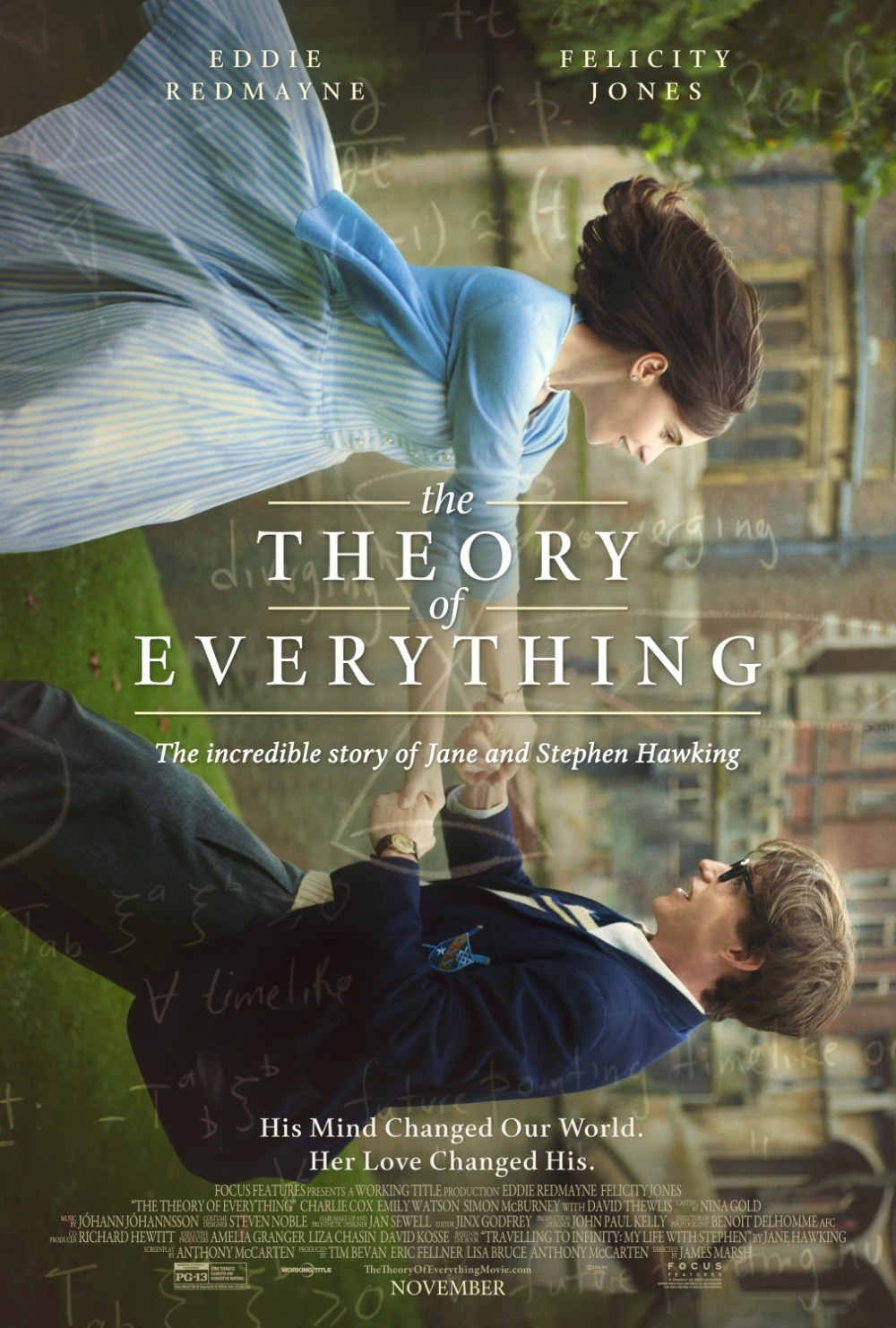
‘The Theory of Everything’ Gives Us the Stephen Hawking We Never Got to Know Until Now

The Theory of Everything movie poster

WRITER’S NOTE: This review was written back in 2014. I am posting it here out of respect for Stephen Hawking who just passed away in March 2018 at the age of 76. Once diagnosed with ALS, he was expected to live only a few years more, but he succeeded in living on despite what the disease did to his body, and he lived one hell of a life. RIP Stephen.

It is shocking to see Stephen Hawking, as played by Eddie Redmayne, riding around recklessly on his bicycle at the beginning of “The Theory of Everything.” We have long since gotten used to seeing him in his motorized wheelchair as ALS robbed him years ago of the ability to move around on his own, and we all know the sound of his computerized voice which has provided us with an insight to his brilliant mind and allowed him to provide lyrics to Pink Floyd songs. But this movie reminds us he was not always like this, and that there was someone in particular who saved his life in more ways than one.

“The Theory of Everything” is based on the memoir “Travelling to Infinity: My Life with Stephen” which was written by his first wife, Jane Wilde Hawking, and it focuses on their courtship which took place during their time as students at Cambridge University. Stephen looks like a perfectly dressed nerd who has the appearance of someone destined never to have any luck with women, and yet he still manages to catch the eye of the beautiful Jane (may we all be this lucky). At first it looks like an ill-suited coupling as Stephen is a student of physics while Jane’s main studies are in romantic languages. She believes in God, but Stephen’s love of science appears to imply he does not. We watch as they come to love and understand how the other thinks, and the way it is presented to us is both lovely and very believable.

But of course, we all know what will happen to Stephen eventually, and it is shown here in excruciating detail as he suddenly trips and falls down right on his head (ouch). Upon discovering he has ALS and told he has only a couple of years to live, Stephen finds himself shying away from everyone around him including fellow students, professors and even Jane as he desperately doesn’t want to be a pity case for anyone. But Jane has fallen deeply in love with Stephen, and she is not about to give up on him because there is too much to lose.

It’s hard not to think of movies like “A Beautiful Mind” while watching “The Theory of Everything” as both feature strong female characters determined to save their afflicted husbands from the diseases which appear all but fatal. For a time, it looks like this film will be no different in the way it portrays the strained relationship Stephen and Jane as they sacrifice so much to make things work between them. But as the movie goes on, it defies conventions and shows us a relationship which does suffer, but any impediments thrown into their path do nothing to tear apart the infinite respect they have for one another.

The eyes of the world are on Eddie Redmayne right now who as his performance here is utterly astonishing. I would love to ask about how he went about portraying Stephen’s bodily deterioration because he achieves doing so in a way which feels painfully real, and it’s amazing what he’s able to convey when Stephen is no longer able to communicate vocally (at least, until he gets that computerized voice). We always talk about how certain performances are more about imitation when it comes to playing characters based on real people, but Redmayne inhabits Stephen to such an amazing effect to where I found it impossible to label his performance as being one of mere imitation. Even as ALS continues to ravage his body, Redmayne makes the case for why Stephen remains such a respected individual to this very day as well as one who continues to fight the odds.

And let’s not forget the fantastic performance by Felicity Jones who portrays Jane Hawking as the lovely and strong-willed woman she is. While it may look like she has the easier role to play, Jones has an equally challenging role as she shows the unending struggles and sacrifices Jane went through to keep Stephen alive. It’s painful to watch Jane as she uses an alphabet sign to communicate with Stephen after his tracheotomy, and Jones makes you feel her pain as she wonders if she has suddenly taken too much away from him.

“The Theory of Everything” was directed by James Marsh who previously made “Man on Wire,” the Oscar-winning documentary about Philippe Petit’s tightrope walk between the two World Trade Center buildings in New York. Marsh does excellent work in keeping all his actors in check to where they never go for scene-hogging moments of an embarrassingly dramatic nature. Truthfully, it is the ordinary moments of these characters lives which are the most fascinating to watch, and Marsh succeeds in taking us back in time to a most romantic period in these couple’s lives.

The other great thing is how Marsh and screenwriter Anthony McCarten, who spent ten years trying to get this movie made, refused to let the audience look at Stephen Hawking as if he’s a complete invalid. Despite the damage ALS has done to his body, Stephen still managed to live a full life which has included two wives and three children, and it didn’t stop him from doing his work which eventually led to the publication of his novel “A Brief History of Time.” Heck, he even got to guest star opposite Data on “Star Trek: The Next Generation.” What more could someone ask for?

“The Theory of Everything,” is by no means a movie which falls victim to conventions or clichés. It presents us with a marvelous story about two people who come to love one another for their thoughts and minds, and of how their love helped them through various struggles which would have worn anyone else out in less than a year. It also contains some of the best performances of 2014 from Redmayne and Jones who are as brave as they are daring. Portraying real-life people onscreen is always a challenge, but they both took roles based on very well-known individuals and succeeded in making them their own.

Seriously, “The Theory of Everything” is one of the best movies of 2014 that I have seen and it is deserving of many of the accolades it has received.

* * * * out of * * * *

Eli Roth Talks with Rie Rasmussen about ‘Human Zoo’

Human Zoo movie poster

Director Eli Roth came to New Beverly Cinema on November 15, 2011 to do a Q&A with Rie Rasmussen about her film “Human Zoo.” He credited Rasmussen for giving a “ballsy performance” in her directorial debut and thanked the audience for “taking a chance on a new film and a new director.” It is only now making its American debut thanks to Quentin Tarantino, and Roth made it clear he is among this movie’s biggest fans.

Roth described “Human Zoo” as having a European sensibility in that you don’t know where it’s going, and he really liked how it gives you time to figure things out. When he asked Rasmussen where the story came from, she said it started with life and how it is a human zoo which puts us behind bars. The movie was also inspired by her stepsister Lin and the American citizenship she finally attained. Lin managed to escape the sex slave trade in Moscow which her mother was tragically sold into, and she was dropped off in Copenhagen. Rasmussen talked about how those born in America won the “ovarian lottery” and of how Lin won the second one by making it to Copenhagen.

Rasmussen also described “Human Zoo” as being a prison of the mind. Her character of Adria Shala puts herself into a mental prison when she is taken in by a sociopath named Srdjan Vasiljevic (Nikola Djuricko). Rasmussen based this on when she moved to New York where she was “let loose on a pack of wild animals.” Having run into the “alpha male attitude” in America, Rasmussen came to see the “violent aspect of males” which made her learn how to defend herself. She also added how the sociopath Srdjan was based on a real guy, and that the moment when Shawn (Nick Corey) takes off all his clothes during a fight happened in real life.

In terms of resources, Rasmussen said she was given a budget of $4 million. However, after all the union payouts for hotel accommodations and travel among other things were taken care of, she only had a million dollars left to work with. She managed to shoot for eight weeks in France while the interiors were shot in Serbia. Whereas most directors have 10 to 16 weeks to edit their movie, Rasmussen only had five as “Transporter 3” was coming in right afterwards. This is extraordinary as those who’ve seen “Human Zoo” can confirm how the movie looks like it cost much more to make.

When it came to directing the violence, Rasmussen said she was allowed to shoot it by those who survived the atrocities in Bosnia. “Human Zoo” opens with a rape sequence, but she succeeded in making it the least sexual it could ever be. She said when it comes to real life rape, no one ever gets an arousing response. Looking back, the audiences she saw the film with reacted very strongly to what they saw.

Rasmussen has had the opportunity to work with filmmakers like Brian De Palma and Luc Besson, and their influence can be seen throughout “Human Zoo.” While it has yet to receive a full blown theatrical release in America due to it being considered an NC-17 rated movie by the MPAA, those who saw it at New Beverly Cinema can attest to its astonishing brilliance. Here’s hoping that it reaches a wider audience sooner rather than later.

‘Salt’ Has Angelina Jolie Doing More Than Tomb Raiding

Salt movie poster

Looking back, the summer 2010 movie season was truly the summer of the preposterous action movie. We got the big screen version of “The A-Team” which had four guys trying to steer a parachuting tank with its turret by firing rounds out of it, then there was Tom Cruise who could do just about anything except take the time to go to the bathroom in “Knight and Day” (Jack Bauer had that problem too), and even the brilliant “Inception” employed a concept which is not at all possible (unless the military is trying to keep it a secret). And then there was “Salt” starring Angelina Jolie which runs very rapidly through a river of plot holes and leaps in logic, and it’s just as much fun as the films I just mentioned. Thanks to director Phillip Noyce (“Clear and Present Danger” and “Rabbit Proof Fence”) who keeps things moving at such a fast pace, there’s not much time to sit back and count all the inconsistencies. All we can do is hang on to the edge of our seats and revel in the slam bang action brought to us without an overuse of CGI effects.

Jolie plays CIA agent Evelyn Salt who is just about to head on home to her loving husband Mike (August Diehl) who loves to study spiders when she and her partner Ted Winter (Liev Schreiber) suddenly get the opportunity to interrogate a Russian defector. During this interrogation, the defector reveals that a highly trained Russian agent will assassinate the Russian President when he visits the United States. He the name of this agent is Evelyn Salt, and the chase is on from there. Immediately thrown under a veil of heavy suspicion, Evelyn desperately rushes out of the office to find her husband before he disappears from her life forever. Never mind abiding the law or taking the time to explain herself, she wants her husband now! When a woman gets pissed, it is in your best interest not to argue with her, especially if she is a CIA agent!

Evelyn Salt is a mixture of both Jason Bourne and Jack Bauer, and this is especially the case in how she manages to evade capture or break free from highly trained agents and officers on more than one occasion. The movie really plays on Jolie’s strengths throughout, and of the kind of person the media has perceived her to be. I say this because over the years she has been treated like some seriously deranged human being who would have sex with her bother instead of a regular person which she is if anyone actually bothered to notice. Jolie plays on these perceptions throughout “Salt” as we watch her relentlessly pursue those who wish to capture and question her, and also when she changes her appearance to get closer to her objective.

I also liked how by the time she comes to meet the man who will soon become her husband, you can believe she has been fully trained to all she can do. A lot of movies would have you believe these characters were born with these skills and have perfected them since they were toddlers. With Jolie, you never doubt her even as the movie becomes more ridiculous by the minute.

There are so many twists and turns throughout “Salt” to where it shamelessly flaunts its illogic plot developments throughout to where we give up trying to figure it all out. Compared to many of Noyce’s other movies, this is easily the most kinetic action movie he has made to date even when compared to “Dead Calm” which introduced Nicole Kidman to the world. You could complain about how things don’t add up, but Noyce never lets the pace of the movie lag for a second, and we never find the time to sort through the plot and characters while we are watching. For other movies this would be a major hindrance, but for “Salt” it works to its advantage. You’re too thoroughly entertained to even care if this film is messing with our head one time too many.

In addition to the talents of Ms. Jolie, you also have Liev Schreiber as her partner and friend Ted Winter. Many consider Schreiber to be this stone-faced actor who wears the same expression in each and every movie he does, but this is probably because they have never seen him act onstage where he gives one brilliantly inspired performance after another. Schreiber holds his own opposite the formidable Jolie as he desperately works to protect his friend from those who would make her disappear, and you root for him as he gets closer and closer to getting a full idea of who she really is.

You also have Chiwetel Ejiofor as Peabody, an agent above Winter who pursues Salt relentlessly. He’s the character you want to shake around and slap in the face so he can see how wrong he is about her (or how wrong we think he is). Chiwetel has done great work over the years, most notably in Stephen Frears’ “Dirty Pretty Things,” and he makes Peabody more than your average one-dimensional government official who would foolishly believe a Russian defector over a loyal agent from the CIA.

We also have to give Noyce a lot of credit for not relying on a plethora of CGI effects in “Salt.” When you see Jolie clinging for dear life on her apartment building 12 stories up from the ground, that was really her (get ready for some serious vertigo). It all reminded me of how good “Live Free or Die Hard” was as it tried to make the effects as real as possible as the filmmakers came to realize the typical film going audience would no longer be easily fooled by CGI effects. Sometimes they are not even better than the real thing.

If there is one seriously massive complaint I have against “Salt,” it’s in regards to Andre Braugher’s role as the Secretary of Defense. Those of you who know me are fully aware of what a die-hard fan I am of the NBC cop show from the 1990’s, “Homicide: Life on the Street.” Braugher’s work on the show was beyond brilliant, and not many other actors can manipulate people through such theatrically volcanic explosions of anger. Furthermore, let us not forget his work in movies like “Glory” where he made the first of many memorable impressions. But in “Salt,” he is relegated to a role where he barely has any lines and is given far too little to do. What gives?! You want to cast Braugher in a movie, then you give him a role which is in tune with his well-known talents. Stop giving him roles which could be played by anyone.

Maybe “Salt” is more fun than it deserves credit for. But along with a pulsating music score by James Newton Howard and some tight film editing by John Gilroy and the well-regarded Stuart Baird, the movie gives you a good dose of adrenalin pumping fun which we don’t always get on the silver screen. Nitpick all you want about the events in “Salt,” it’ll still keep you on the edge of your seat throughout.

* * * out of * * * *

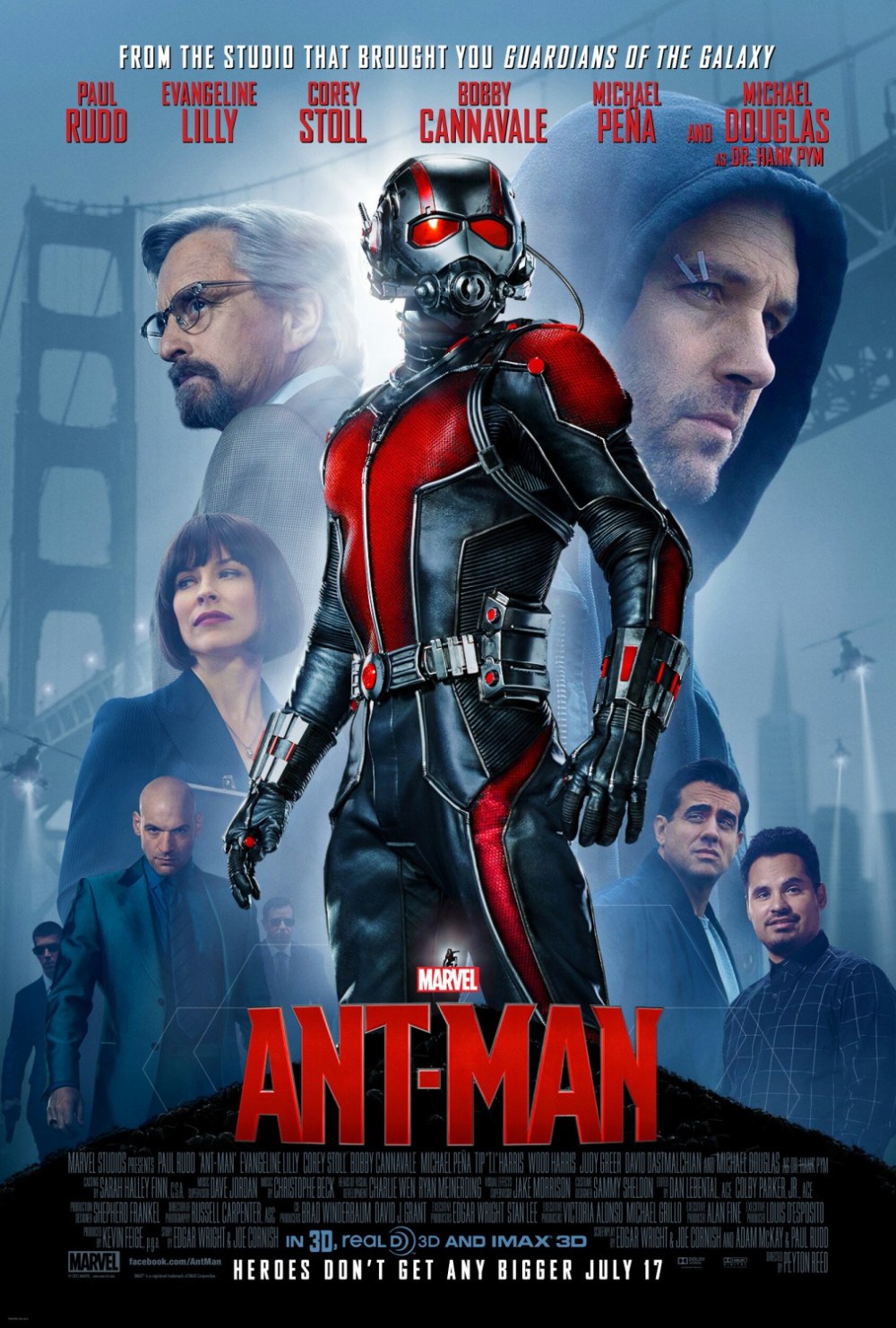
‘Ant-Man’ Proves to be More than the Average Origin Movie

Ant Man movie poster

Part of me will always wonder what “Ant-Man” would have looked like had Edgar Wright not left the project. Wright has long since proven to be a wonderful talent behind the camera with “Shaun of the Dead,” “Hot Fuzz,” “Scott Pilgrim vs. the World” (my favorite movie of 2010) and “The World’s End,” all of which succeeded in giving audiences an awesomely entertaining time at the movies. He left this film after having been involved with its development for several years as Marvel had different plans for it than he did, and this usually spells trouble for any cinematic endeavor. But we can only wonder so much about what could have been until we realize we will never truly know since Wright’s version was never made. When all is said and done, “Ant-Man” proves to be a very entertaining time at the movies. It is yet another superhero origin story, but one which feels fresh and unlike others that just go through the motions.

We come to meet Scott Lang (Paul Rudd) just before he leaves prison after serving a sentence for robbery (but not armed robbery). Scott was once married and has a daughter who thinks the world of him, and he is desperate to make an honest living despite his law breaking past. After a job at Baskin Robbins goes bust for him, he is contacted by Hank Pym (Michael Douglas), a brilliant physicist who invites him to take his place as Ant-Man, a superhero who can take on the bad guys no matter how big or small he is.

When it comes to superhero movies, I have long since tired of the origin story as it feels like a setup for a franchise Hollywood studios are infinitely desperate for in this day and age. “Ant-Man,” however felt like a fresh and subversive take on the origin story to where I couldn’t remember the last of its kind I had seen. The only thing it did remind me of was the Monty Python sketch about ants which showed how strong they are when it comes to lifting things far greater than their weight. Watching it also had me excited at the possibilities of what one person could do if they are shrunk down to such a miniscule size, and this is even though we would like certain body parts to be larger than they already are.

Paul Rudd is a perfect choice to play Scott Lang as his effortless charisma makes you believe Scott is an ex-con who is ever so eager to turn his life around for the sake of his daughter. This is a role which could have been played either too seriously or broadly, but Rudd manages to find a balance to where this character is not the usual brooding super hero who has occupied many comic book movies to an annoying abandon.

Of course, every superhero movie needs a strong female character, and we get one here with Hope Van Dyne. The daughter of Hank Pym, she is played by Evangeline Lilly whom we all know from the “Lost” and for playing the elf Tauriel in Peter Jackson’s “Hobbit” trilogy. Lilly’s character has to deal with many conflicting emotions when it comes to her father and Scott, and it’s endlessly fascinating to see how she handles those emotions from start to finish. What could have been an easily disposable role is made all the more unforgettable thanks to Lilly’s committed performance as someone who is still stuck in the past and trying to make a better future for herself and everyone else.

Many of us, including myself, grew up watching Michael Douglas in movies like “Romancing the Stone,” “The War of the Roses” and “Fatal Attraction,” and he has since graduated to playing the role of elder statesman in. His performance as Hank Pym is one of the best I have seen Douglas give in some time as he imbues this character with a lot knowledge and wisdom as well as a lot of heart. Hank is a deeply flawed man who does what he can to protect his family, but he ends up unintentionally wounding those closest to him in the process. Douglas is perfectly cast here as he is great at making us root for someone we almost don’t want to root for, but we end up doing so all the same.

Then there’s Michael Pena who gives a terrific performance in each and every film he is in, and he steals one scene after another as Scott Lang’s best friend, Luis. Pena infuses an infectious energy in his performance which makes you want to be a part of Ant-Man’s plan to get back at the bad guys, and his performance as Luis is another memorable role he can add to his wide variety of roles he has performed to a great extent thus far.

And let’s not forget Corey Stoll who makes for a wonderfully detestable villain as Darren Cross, an ever so bitter student of Hank Pym who looks to go into the Ant-Man business for himself. Stoll has left quite the impression on audiences ever since his role as Ernest (“who wants to fight”) Hemingway in Woody Allen’s “Midnight in Paris.” It’s nice to see he doesn’t give us the usual one-dimensional bad guy we typically expect in a summer movie, and this makes his character of Darren all the more threatening.

“Ant-Man” was directed by Peyton Reed whose previous credits include “Yes Man,” “The Break-Up” and “Bring it On,” movies I should have seen already, but anyway. Reed does fine work in balancing out the characters here with the terrific special effects on display to where “Ant-Man” never comes across as the usual comic book movie fare. It makes me excited for what will come next.

We can be sure this will not be the last time we will see Ant-Man on the big screen. After all, what’s a Marvel movie without a franchise? You can expect the usual batch of post-credit sequences that will require you to sit through the end credits and appreciate the fact hundreds of people worked hard to make this movie a reality. But for a change, I don’t find myself looking to a Marvel sequel with sarcasm. I look forward to it as a promising continuation of a story which features one of the more unusual Avengers to inhabit this ever-growing cinematic universe.

* * * out of * * * *

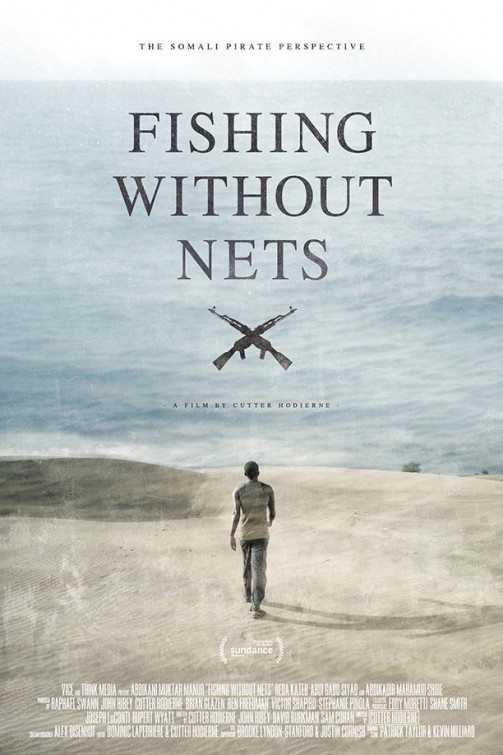
If You Liked ‘Captain Phillips,’ Then Check Out ‘Fishing Without Nets’

Fishing Without Nets movie poster

Fishing Without Nets” is the third movie in recent years to deal with Somali Pirates hijacking a ship at sea, and it comes on the heels of “Captain Phillips” and “A Hijacking.” The scenario may be the same, but the perspective is different this time around. While “Captain Phillips” and “A Hijacking” observed the pirates from a certain distance, “Fishing Without Nets” is told from their point of view. While no one is in a position to condone their actions, director Cutter Hodierne gives us an empathetic view of their struggles which have led them to take such drastic actions to ensure their own survival.

The movie opens on Abdi (Abdikani Muktar), a Somali fisherman, loving husband and father, walking through the village he lives in. The place is an utter mess and you get the sense it has been a mess for quite some time to where it doesn’t appear to offer much in the way of opportunities. Abdi has no interest in joining the pirates on their hijacking missions as he prefers to make an honest living through fishing, but he becomes increasingly desperate as his last few times out at sea resulted in no fish being caught. In the process of trying to get his wife and son out of Somalia to a better place, he discovers he needs a whole lot more money to make that happen, so he relents and joins the pirates on their latest hijacking mission with the promise of a huge reward. But once the pirates take over an oil tanker, Abdi finds himself wanting to escape the situation even before it descends into paranoia and chaos.

Watching “Fishing Without Nets” reminded me of movies like “Frozen River,” “Maria Full of Grace” and “Alive” which feature characters resorting to life-threatening methods as the bottom constantly threatens to fall out from beneath them. “Frozen River” in particular was about a mother (played by Melissa Leo) whose husband ran out on her with their life savings, and she is barely making ends meet at a minimum wage job. As a result, she resorts to smuggling illegal immigrants across the Canadian border into the United States which nets her enough money to keep her big screen TV from getting repossessed as well as for the down payment on her family’s new home. In any other instance she would not resort to this law-breaking activity, but when a mother’s livelihood and her family’s are at stake, you know she will do anything to keep them safe.

This is certainly the case for Abdi when he resorts to piracy to keep his family safe, and he even says at one point, “a man is not a man until he can feed his family.” When it comes down to it, “Fishing Without Nets” is about the will to survive, and this remains a universal story all around the world. When pushed to extremes, you can bet no one is going to just lie down, give up and die. No, they are going to fight for their loved ones even if it means breaking the law, so you cannot help but be empathetic to Abdi’s choices even as they put his life in serious danger.

Hodierne went out of his way to cast non-actors for this movie instead of putting known names in it, and this helps to give “Fishing Without Nets” a truly authentic feel which puts you right into the action. While some of the situations are familiar from “Captain Phillips” and “A Hijacking,” he makes this film stand out with its unique point of view, and he generates some serious tension when infighting breaks out among the pirates. Scenes where a gun is pointed at a character’s head are a dime a dozen in movies, but here those same scenes have an intensity which really shakes you up.

Also, Hodierne and his director of photography, Alex Disenhof, capture some amazingly beautiful shots on the ocean which help illustrate just how isolated all these characters are out there. The last shot pulls away from a boat drifting in the ocean, and it’s truly one of the most memorable moments of any film I saw in 2014. Considering how small of a budget Hodierne had to work with, this makes what he accomplished all the more impressive.

“Fishing Without Nets” may not be on the same level as “Captain Phillips” or “A Hijacking,” but it is an action packed and intense movie which would make for a perfect triple feature with those two. After it was over, I could see why the Sundance Film Festival decided to give Hodierne a directing award because it is a truly impressive debut which invites you into a world that is not the least bit safe to be in. Furthermore, it also allows us to understand why Somalis have been resorting to such methods in order to survive, but then again, anyone else might be forced to do the same when it comes to surviving in an endlessly harsh and cruel world. It doesn’t make it right, but it’s a truth which hopefully none of us will ever have to face like these men do.

* * * ½ out of * * * *

This ‘Peter Rabbit’ is Far From Ultimate

Peter Rabbit 2018 poster

After watching the trailer for Sony Pictures Animation’s “Peter Rabbit,” I kept thinking of the times when brands like KFC and Planter’s Peanuts among others changed their image in commercials to something more hip which made them look ever so desperate to appeal to a youthful demographic. It was both hilarious and cringe-inducing to see these popular brands reduce themselves to current trends they were never created for, and more often than not, it just revealed to us how tone deaf corporate executives can be in their quest for a profit. Those of you who have seen the “Peter Rabbit” trailer can agree this is not quite the same character we grew up reading about in those wonderfully imaginative books by Beatrix Potter. Now that I have seen the movie all the way through, I can confirm Ms. Potter is rolling over in her grave.

This “Peter Rabbit” is nothing more than a bastardization of those innocent tales as the filmmakers go out of their way to modernize this material to such an infinitely nauseating extent, and it hurt to see everyone trying way too hard to be clever. The harder everyone tries to be hip here, the more depressing this movie becomes as its story becomes increasingly convoluted and eventually turns in a poor man’s version of “Home Alone” as Peter tortures his nemesis in the same way Macauley Culkin tortured Joe Pesci and Daniel Stern.

Directed by Will Gluck who previously gave us the ill-advised remake of “Annie,” this movie isn’t so much an adaptation of “The Tale of Peter Rabbit” as it is a story which exists outside of it. Even though Peter Rabbit (voiced by James Corden) came close to meeting his maker the last time he invaded Mr. McGregor’s vegetable garden, we see he has not learned his lesson as he continues to steal every single vegetable he gets his paws on. But when a new McGregor moves into town, things will become even more challenging for him and his furry friends.

The opening minutes of “Peter Rabbit” serve to introduce not only Peter, but also a number of Potter’s other creations like Benjamin Bunny (Matt Lucas), Mrs. Tiggy-Winkle (Sia), Tommy Brock, Mr. Tod and Mr. Jeremy Fisher. Seeing this, I couldn’t help but think Sony Pictures was aiming to create a cinematic universe to rival the one Marvel Studios continues to add to. If this movie succeeds at the box office, we may very well see these characters get their own solo adventures to where they might have their own “Avengers” or “Justice League” movie. Still, I don’t think we should expect “Peter vs. Benjamin: Dawn of Radishes” anytime soon. After all, neither has a mother named Margret.

Peter runs afoul again of Mr. McGregor (a completely unrecognizable Sam Neill), but a heart attack suddenly does the old man in, freeing up the rabbit and his friends to have the equivalent to an endless rave party in his home. But then into the picture comes family relative Thomas McGregor (Domhnall Gleeson) who moves in after being fired from his job at Harrods in London, and no time is wasted before he and Peter wage war against one another which involves, among other things, repeated electrocution.

Perhaps it was too much to expect the filmmakers to remain true to “The Tale of Peter Rabbit” with had its main character being portrayed as being very naughty and later paying a price for being recklessly disobedient to his elders. This particular Potter tale was a great one for kids as it taught them the value of being good, something which Peter did not value in the slightest. “Peter Rabbit,” however, defies the tale’s morality and shows how this rabbit’s rebellious ways are something to cheer on instead of lay caution to. Also, Peter’s sisters Flopsy, Mopsy and Cottontail are shown to be willing participants in his rebellious escapades, something they were not previously.

I was also shocked to see how Neill’s Mr. McGregor was portrayed as a bloodthirsty meat eater who showed no hesitation in making a rabbit pie out of those who failed to escape his clutches. This leads “Peter Rabbit” to have a “Watership Down” scene where we learn how one of his parents became a tasty meal for Mr. McGregor, and this reeks of shameless manipulation on the part of the filmmakers. At the very least, this movie is bound to appeal to vegans as much as it will to children.

Then there is Thomas McGregor, and Gleeson portrays him in a way very similar to his role as General Hux in the recent “Star Wars” movies. Thomas is such an obsessive neat freak to where he wants the toilets at Harrods to be so clean he could drink out of them, and he almost does so with a straw. I expect sick humor like this in “The Human Centipede,” not in a family movie. If you want to see Gleeson in something good, check out “About Time” or the underrated “Goodbye Christopher Robin” instead.

James Corden is a wonderful talent, and I always enjoy watching his late-night sketches which include many unforgettable carpool karaoke episodes. But when it comes to roles like voicing Peter Rabbit, he tries way too hard to be funny and hip. This was the same problem with his work in “The Emoji Movie” which, in retrospect, I gave him too much leeway on. His performance in “Peter Rabbit” is definitely spirited, but seeing him trying to be infinitely clever to where he is desperate to stay one step ahead of the audience becomes painful and exhausting as the movie drags on.

Indeed, the filmmakers try way too hard to make “Peter Rabbit” seem so hip and cool to where they include songs like Len’s “Steal My Sunshine,” a great pop song which has now been officially used once too often in movies. Gluck also includes Big Country’s “In a Big Country,” Rancid’s “Time Bomb,” Vampire Weekend’s “The Kids Don’t Stand a Chance,” and The Proclaimers’ “I’m Gonna Be (500 Miles).” You know, the kind of music Potter listened to endlessly while she wrote. Seeing the animals dancing the latest dance moves here was very dispiriting to me, but at least we never see Flopsy, Mopsy or Cottontail do any twerking.

If there is one real saving grace in “Peter Rabbit,” it is Rose Byrne. As Bea, the McGregor’s next-door neighbor, painter and animal lover, she is so infinitely appealing to where she truly lights up the screen whenever she appears. Byrne gives these proceedings a heart and soul which doesn’t deserve them, and I became infinitely jealous of Peter whenever she picked him up and cuddled him. It’s moments like those which had me wanting to be Peter, but anyway.

The children I saw “Peter Rabbit” with really enjoyed the shenanigans portrayed onscreen, and I am sure many of them will get a kick out of this movie. I, on the other hand, stared at the silver screen feeling dejected as the plot went down a road which filmmakers have traveled thousands of times before. Things get even more ridiculous when Thomas and Peter go from being bitter enemies to much needed allies. Seeing one character attempting to blow up another with dynamite is enough to bring about a restraining order. These two coming together near the end is as ridiculous as the thing which kept a pair of superheroes from beating one another to death in “Batman v. Superman: Dawn of Justice.”

“Peter Rabbit” is the first 2018 movie I have watched, and I’m positive many others which have yet to be released will be far better. Parents right now have a chance to take their children to movies which are far more imaginative and thoughtful like “Paddington 2,” but it looks like they will be quicker to get in line for this one instead. Call me a purist, but this is not how a Beatrix Potter tale should be translated to cinema. Of the many rabbits out there, this one is far from being ultimate.

* out of * * * *