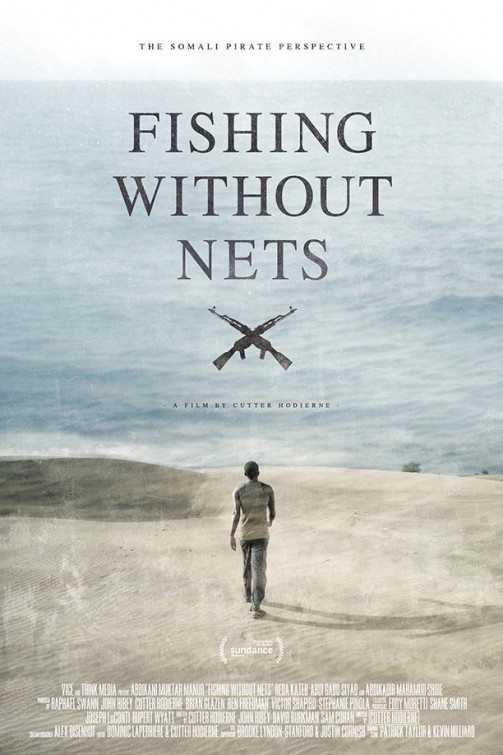
“Fishing Without Nets” is the third movie in recent years to deal with Somali Pirates hijacking a ship at sea, and it comes on the heels of “Captain Phillips” and “A Hijacking.” The scenario may be the same, but the perspective is different this time around. While “Captain Phillips” and “A Hijacking” observed the pirates from a certain distance, “Fishing Without Nets” is told from their point of view. While no one is in a position to condone their actions, director Cutter Hodierne gives us an empathetic view of their struggles which have led them to take such drastic actions to ensure their own survival.
The movie opens on Abdi (Abdikani Muktar), a Somali fisherman, loving husband and father, walking through the village he lives in. The place is an utter mess and you get the sense it has been a mess for quite some time to where it doesn’t appear to offer much in the way of opportunities. Abdi has no interest in joining the pirates on their hijacking missions as he prefers to make an honest living through fishing, but he becomes increasingly desperate as his last few times out at sea resulted in no fish being caught. In the process of trying to get his wife and son out of Somalia to a better place, he discovers he needs a whole lot more money to make that happen, so he relents and joins the pirates on their latest hijacking mission with the promise of a huge reward. But once the pirates take over an oil tanker, Abdi finds himself wanting to escape the situation even before it descends into paranoia and chaos.
Watching “Fishing Without Nets” reminded me of movies like “Frozen River,” “Maria Full of Grace” and “Alive” which feature characters resorting to life-threatening methods as the bottom constantly threatens to fall out from beneath them. “Frozen River” in particular was about a mother (played by Melissa Leo) whose husband ran out on her with their life savings, and she is barely making ends meet at a minimum wage job. As a result, she resorts to smuggling illegal immigrants across the Canadian border into the United States which nets her enough money to keep her big screen TV from getting repossessed as well as for the down payment on her family’s new home. In any other instance she would not resort to this law-breaking activity, but when a mother’s livelihood and her family’s are at stake, you know she will do anything to keep them safe.
This is certainly the case for Abdi when he resorts to piracy to keep his family safe, and he even says at one point, “a man is not a man until he can feed his family.” When it comes down to it, “Fishing Without Nets” is about the will to survive, and this remains a universal story all around the world. When pushed to extremes, you can bet no one is going to just lie down, give up and die. No, they are going to fight for their loved ones even if it means breaking the law, so you cannot help but be empathetic to Abdi’s choices even as they put his life in serious danger.
Hodierne went out of his way to cast non-actors for this movie instead of putting known names in it, and this helps to give “Fishing Without Nets” a truly authentic feel which puts you right into the action. While some of the situations are familiar from “Captain Phillips” and “A Hijacking,” he makes this film stand out with its unique point of view, and he generates some serious tension when infighting breaks out among the pirates. Scenes where a gun is pointed at a character’s head are a dime a dozen in movies, but here those same scenes have an intensity which really shakes you up.
Also, Hodierne and his director of photography, Alex Disenhof, capture some amazingly beautiful shots on the ocean which help illustrate just how isolated all these characters are out there. The last shot pulls away from a boat drifting in the ocean, and it’s truly one of the most memorable moments of any film I saw in 2014. Considering how small of a budget Hodierne had to work with, this makes what he accomplished all the more impressive.
“Fishing Without Nets” may not be on the same level as “Captain Phillips” or “A Hijacking,” but it is an action packed and intense movie which would make for a perfect triple feature with those two. After it was over, I could see why the Sundance Film Festival decided to give Hodierne a directing award because it is a truly impressive debut which invites you into a world that is not the least bit safe to be in. Furthermore, it also allows us to understand why Somalis have been resorting to such methods in order to survive, but then again, anyone else might be forced to do the same when it comes to surviving in an endlessly harsh and cruel world. It doesn’t make it right, but it’s a truth which hopefully none of us will ever have to face like these men do.
After watching the trailer for Sony Pictures Animation’s “Peter Rabbit,” I kept thinking of the times when brands like KFC and Planter’s Peanuts among others changed their image in commercials to something more hip which made them look ever so desperate to appeal to a youthful demographic. It was both hilarious and cringe-inducing to see these popular brands reduce themselves to current trends they were never created for, and more often than not, it just revealed to us how tone deaf corporate executives can be in their quest for a profit. Those of you who have seen the “Peter Rabbit” trailer can agree this is not quite the same character we grew up reading about in those wonderfully imaginative books by Beatrix Potter. Now that I have seen the movie all the way through, I can confirm Ms. Potter is rolling over in her grave.
This “Peter Rabbit” is nothing more than a bastardization of those innocent tales as the filmmakers go out of their way to modernize this material to such an infinitely nauseating extent, and it hurt to see everyone trying way too hard to be clever. The harder everyone tries to be hip here, the more depressing this movie becomes as its story becomes increasingly convoluted and eventually turns in a poor man’s version of “Home Alone” as Peter tortures his nemesis in the same way Macauley Culkin tortured Joe Pesci and Daniel Stern.
Directed by Will Gluck who previously gave us the ill-advised remake of “Annie,” this movie isn’t so much an adaptation of “The Tale of Peter Rabbit” as it is a story which exists outside of it. Even though Peter Rabbit (voiced by James Corden) came close to meeting his maker the last time he invaded Mr. McGregor’s vegetable garden, we see he has not learned his lesson as he continues to steal every single vegetable he gets his paws on. But when a new McGregor moves into town, things will become even more challenging for him and his furry friends.
The opening minutes of “Peter Rabbit” serve to introduce not only Peter, but also a number of Potter’s other creations like Benjamin Bunny (Matt Lucas), Mrs. Tiggy-Winkle (Sia), Tommy Brock, Mr. Tod and Mr. Jeremy Fisher. Seeing this, I couldn’t help but think Sony Pictures was aiming to create a cinematic universe to rival the one Marvel Studios continues to add to. If this movie succeeds at the box office, we may very well see these characters get their own solo adventures to where they might have their own “Avengers” or “Justice League” movie. Still, I don’t think we should expect “Peter vs. Benjamin: Dawn of Radishes” anytime soon. After all, neither has a mother named Margret.
Peter runs afoul again of Mr. McGregor (a completely unrecognizable Sam Neill), but a heart attack suddenly does the old man in, freeing up the rabbit and his friends to have the equivalent to an endless rave party in his home. But then into the picture comes family relative Thomas McGregor (Domhnall Gleeson) who moves in after being fired from his job at Harrods in London, and no time is wasted before he and Peter wage war against one another which involves, among other things, repeated electrocution.
Perhaps it was too much to expect the filmmakers to remain true to “The Tale of Peter Rabbit” with had its main character being portrayed as being very naughty and later paying a price for being recklessly disobedient to his elders. This particular Potter tale was a great one for kids as it taught them the value of being good, something which Peter did not value in the slightest. “Peter Rabbit,” however, defies the tale’s morality and shows how this rabbit’s rebellious ways are something to cheer on instead of lay caution to. Also, Peter’s sisters Flopsy, Mopsy and Cottontail are shown to be willing participants in his rebellious escapades, something they were not previously.
I was also shocked to see how Neill’s Mr. McGregor was portrayed as a bloodthirsty meat eater who showed no hesitation in making a rabbit pie out of those who failed to escape his clutches. This leads “Peter Rabbit” to have a “Watership Down” scene where we learn how one of his parents became a tasty meal for Mr. McGregor, and this reeks of shameless manipulation on the part of the filmmakers. At the very least, this movie is bound to appeal to vegans as much as it will to children.
Then there is Thomas McGregor, and Gleeson portrays him in a way very similar to his role as General Hux in the recent “Star Wars” movies. Thomas is such an obsessive neat freak to where he wants the toilets at Harrods to be so clean he could drink out of them, and he almost does so with a straw. I expect sick humor like this in “The Human Centipede,” not in a family movie. If you want to see Gleeson in something good, check out “About Time” or the underrated “Goodbye Christopher Robin” instead.
James Corden is a wonderful talent, and I always enjoy watching his late-night sketches which include many unforgettable carpool karaoke episodes. But when it comes to roles like voicing Peter Rabbit, he tries way too hard to be funny and hip. This was the same problem with his work in “The Emoji Movie” which, in retrospect, I gave him too much leeway on. His performance in “Peter Rabbit” is definitely spirited, but seeing him trying to be infinitely clever to where he is desperate to stay one step ahead of the audience becomes painful and exhausting as the movie drags on.
Indeed, the filmmakers try way too hard to make “Peter Rabbit” seem so hip and cool to where they include songs like Len’s “Steal My Sunshine,” a great pop song which has now been officially used once too often in movies. Gluck also includes Big Country’s “In a Big Country,” Rancid’s “Time Bomb,” Vampire Weekend’s “The Kids Don’t Stand a Chance,” and The Proclaimers’ “I’m Gonna Be (500 Miles).” You know, the kind of music Potter listened to endlessly while she wrote. Seeing the animals dancing the latest dance moves here was very dispiriting to me, but at least we never see Flopsy, Mopsy or Cottontail do any twerking.
If there is one real saving grace in “Peter Rabbit,” it is Rose Byrne. As Bea, the McGregor’s next-door neighbor, painter and animal lover, she is so infinitely appealing to where she truly lights up the screen whenever she appears. Byrne gives these proceedings a heart and soul which doesn’t deserve them, and I became infinitely jealous of Peter whenever she picked him up and cuddled him. It’s moments like those which had me wanting to be Peter, but anyway.
The children I saw “Peter Rabbit” with really enjoyed the shenanigans portrayed onscreen, and I am sure many of them will get a kick out of this movie. I, on the other hand, stared at the silver screen feeling dejected as the plot went down a road which filmmakers have traveled thousands of times before. Things get even more ridiculous when Thomas and Peter go from being bitter enemies to much needed allies. Seeing one character attempting to blow up another with dynamite is enough to bring about a restraining order. These two coming together near the end is as ridiculous as the thing which kept a pair of superheroes from beating one another to death in “Batman v. Superman: Dawn of Justice.”
“Peter Rabbit” is the first 2018 movie I have watched, and I’m positive many others which have yet to be released will be far better. Parents right now have a chance to take their children to movies which are far more imaginative and thoughtful like “Paddington 2,” but it looks like they will be quicker to get in line for this one instead. Call me a purist, but this is not how a Beatrix Potter tale should be translated to cinema. Of the many rabbits out there, this one is far from being ultimate.
“A Ciambra” was Italy’s official submission in the Foreign Language Film category for the 90th Academy Awards, and it was made in the heart of the country’s Romani community. A gritty coming of age story, it follows Pio Amato, a 14-year-old boy who is eager to grow up real fast. Pio spends his days smoking and drinking as well as following his older brother Cosimo (Damiano Amato) around town while learning the skills needed for survival in their hometown. While tensions between the different factions, the Italians, the African immigrants and his fellow Romani, remain high, Pio is able to slide through each in a way few others can. When Cosimo is arrested one night, Pio is quick to convince everyone he is more than ready to fill his older brother’s shoes and take care of things. But as the movie goes on, he wonders if he is truly ready to become a man.
“A Ciambra” was written and directed by Jonas Carpignano whose previous film, “Mediterranea” won various awards including Best Directorial Debut from the National Board of Review and the Gotham Award for Breakthrough Directing. What he has succeeded in doing here is giving us a motion picture which makes you feel like you are hanging out with these characters instead of just watching them from a distance. Carpignano combines biographical elements with documentary style filmmaking to give us something we experience more than anything else. There are not many movies like this one these days, and I will take them wherever I can get them.
Carpignano spent his childhood between Rome and New York City, and he currently lives in Italy where he continues his filmmaking endeavors. He was in Los Angeles to talk about “A Ciambra,” and it was a pleasure taking with him about how he went about making the film with non-professional actors. In addition, he spoke of what it was like to work alongside Martin Scorsese who is the film’s executive producer and of the most valuable piece of advice the “Goodfellas” director gave him.
“A Ciambra” opens in Los Angeles at Laemmle’s Royal Theater on February 2, 2018. Be sure to check out the interview above as well as the movie’s trailer below.
“Pan’s Labyrinth,” “Blade II” and “The Devil’s Backbone” should be more than enough proof of how Guillermo Del Toro is a cinematic god among directors. If you need further proof of this, then I suggest you watch “The Shape of Water,” his romantic fantasy which is truly one of the best films of 2017. While I tend to scoff at romantic movies as I consider them cringe-inducing exercises in endurance which prove to be even more painful than running the Los Angeles Marathon. Please keep in mind, I have run this marathon seven years in a row, and soon I will be running it yet again.
“The Shape of Water” transports us back to Baltimore, Maryland in the year 1962 when America was stuck in the middle of the Cold War. We meet Elisa Esposito (Sally Hawkins), a janitor at a secret laboratory who was rendered mute at a young age due to a neck injury. She follows a daily routine of pleasuring herself in the bathtub while boiling eggs on her kitchen stove, and then she goes to work where she performs her duties without complaint. Luckily, she has a pair of friends to converse with, in a matter of non-speaking, like artist and closeted homosexual Giles (Richard Jenkins) and her ever so talkative co-worker Zelda Fuller (Octavia Spencer) who also takes the time to interpret Elisa’s sign language. But even with friends like these, let alone the luck she has living above a movie theater, there is clearly something missing from her life.
Things, however, quickly change for Elisa when the laboratory she works at receives a creature in a tank. This creature was captured in South America by the cold-hearted Richard Strickland (Michael Shannon), and the government officials he answers to want to dissect the creature in an effort to gain a foothold on the space race. Elisa, however, has different ideas as she develops a strong connection with the creature which will not be easily broken.
I guess this might seem like a strange love story for many to take seriously, but considering the seismic shifts in how the world views, and should view, marriage and the rights of others, “The Shape of Water” could not have been timelier. As improbable as a relationship like this one may sound, Del Toro and his cast make it one we quickly become engaged in to where we are swept up emotionally in a way few movies can.
Along with cinematographer Dan Laustsen, Del Toro gives this film a look which is at once suffocating and yet wondrous. We clearly in the world of movies while watching this one, but the while this might seem like a genre picture designed to take us out of reality, it is filled with genuine emotion which is never easily earned. We can always count on Del Toro to give us a beautifully realized motion picture, but this one deserves special recognition as it had a budget of around $20 million, and yet he made it look like cost so much more. I would love to ask him how he accomplished what he did on a limited budget. In any other case, $20 million is a lot of money. But for a film like this, it seems almost too low to work with.
Sally Hawkins has wowed us as an actress in “Happy-Go-Lucky,” “Made in Dagenham” and “Blue Jasmine,” but she really outdoes herself here as Elisa Esposito as this role takes her into Holly “The Piano” Hunter territory. With her character being a mute, Hawkins not only has to communicate without the use of words (vocally anyway), she has to keep her heart open in a way which we make a habit of avoiding. This actress shows little hesitation in making herself so open and vulnerable to a creature everyone else would be quick to be infinitely fearful of.
Speaking of the creature, he is played by Doug Jones, an actor who is masterful at portraying non-human characters. Whether it’s as Abe Sapien in the “Hellboy” movies, the Faun and the Pale Man in “Pan’s Labyrinth” or even as Lieutenant Commander Saru on “Star Trek: Discovery,” Jones always succeeds in finding a humanity in these characters others would never be quick to discover or find. His performance here as the Amphibian Man is every bit as good as Andy Serkis’ in “War for the Planet of the Apes,” and I put these two actors together because many believe it is the makeup or special effects which do all the acting for them, but it’s their acting which makes their characters so memorable. Jones, like Hawkins, has to communicate without the use of words, but he has an even bigger challenge as his character cannot even use sign language. His work deserves more credit than it will likely get at awards time.
“The Shape of Water” also has a terrific cast of character actors, and they are the kind who never ever let us down. Richard Jenkins is right at home as Giles, a closeted gay man who, when he tries to reach out to someone he cares about, is quickly rebuffed not just by that someone, but also by a society which thoughtlessly excluded many for all the wrong reasons. Jenkins never resorts to giving us a cliched version of a homosexual, but instead makes us see Giles as a man who is kind and considerate but still ostracized to where he is willing to break the rules to help a friend who doesn’t judge him in the slightest.
When it comes to Octavia Spencer, you can never go wrong with her, and she is a wonderful presence here as Zelda Fuller, Elisa’s co-worker who is never at a loss for words. She also makes it clear how Zelda is a force to be reckoned with, and this is something the character’s husband really should have taken into account a long time ago.
There is also Michael Stuhlbarg who portrays Dr. Robert Hoffstetler, the scientist who sees far more value in the Amphibian Man being alive as opposed to becoming a glorified science experiment worthy of dissection. This is a typical role you find in genre films, but Stuhlbarg inhabits the role to where Robert can never be dismissed as a simple stock character. Even as we learn there is more to Robert than what we initially see on the surface, Stuhlbarg makes us see this is a man who values understanding and compassion over greed. You know, the kind of person we would love to see in the White House at this moment.
But one actor I want to point out in particular is Michael Shannon who portrays Colonel Richard Strickland, a man hellbent on putting his country before everything else, including his wife and kids. Shannon succeeds in rendering Strickland into a more complex character than you might expect. As we watch Strickland get berated by his superiors for not doing his job like they want him to, Shannon shows us a patriotic American who wants to serve his country well, but we watch as his spirit becomes as corrupted and diseased as those two fingers of his which were torn off his hand by the creature and reattached with limited success. As the movie goes on, those fingers of his become a disgusting color as they come to represent the corruption of his soul. Other actors would be intent on making you despise such a villainous character, but Shannon makes you see a man whose desperation has forever blindsided his worldview.
Whether or not you think “The Shape of Water” breaks any new ground in the world of motion pictures is irrelevant. All that matter is how it is a beautifully realized film which takes you on an incredible voyage only the best of its kind can. It also reminds you of how valuable a filmmaker Del Toro is in this day and age when distinct voices in the world of cinema are continually minimized and rendered silent for the sake of profit. Here’s hoping you get to see it on the big screen where it belongs before Donald Trump leads us into a war no one in America is prepared to be drafted into.
When I first looked at the poster for “Just Getting Started,” I was very happy to see the following phrase on it: written and direct by Ron Shelton. Shelton is responsible for creating some of the best sports movies such as “Bull Durham,” Tin Cup” and “White Men Can’t Jump,” and he has a true gift for creating fantastic dialogue and getting wonderful performances out of his actors. Somewhere along the line, he stopped making movies to where I wondered where he was and what he was up to. Now we know.
“Just Getting Started” takes place at a luxury resort in Palm Springs, California called the Villa Capri. This resort is managed by Duke Diver (Morgan Freeman), a man with a mysterious past who is determined to make sure his residents will never ever stop partying or having fun. But while Duke is the life of the party, his ego becomes threatened by the arrival of Leo (Tommy Lee Jones), an ex-military man who wastes no time in battling Duke for the top spot of Alpha male at the Villa Capri. Things get even more complicated when a new resident, the beautiful Suzie (Rene Russo), arrives at the resort, and the two become determined to gain her affections in an effort to prove who is the better man. But once Duke’s past comes back to haunt him, he and Leo are forced to work together in an effort to stay alive.
It was a real pleasure talking with Shelton, and he spoke about what brought him back to the director’s chair for the first time in over a decade, how he goes about directing a comedy, and of what it was like to have Freeman and Jones go against type and play characters who are not so serious and eager to have fun. Shelton also talked about Glenne Headly who passed away recently, as this was the last movie she appeared in before her death.
Ben Kenber: I was very excited to learn you were directing another movie. This is your first feature film since “Hollywood Homicide.” What was it about this story which inspired you to get back in the director’s chair?
Ron Shelton: Well I had three or four movies which fell through at the last second, so it’s not like I suddenly decided to get off the couch and direct. I have been writing steadily and developing TV things and trying to finance features. In the independent world, there are so many moving parts to the financing that if one piece falls out, the whole thing falls apart. So it hasn’t been for lack of effort, and now I have a couple more I think that are gonna go. It won’t be such a dearth of time between them, and I got some other projects I’m working on. This one came together financially, that’s why this one got made.
BK: What inspired you to write this particular screenplay?
RS: Southern California where I grew up, and maybe you grew up, in the winters and Christmas, to me, I’m used to it. You go to the beach and play golf. But people from cold climates come out here and they are just like appalled; this doesn’t count as Christmas. And I started saying to half the world, this is Christmas, this kind of weather. What’s wrong with it? When the Nativity happened, it was probably more like Palm Springs (laughs). Then I remembered driving to Palm Springs at Christmas and there were dust storms and Christmas trees were blowing off lots down the street and Johnny Mathis was being piped in, and I thought, yeah, this was a good backdrop for a movie, so that’s where the backdrop came from. And then basically, the Duke Diver character is based on a hustler a producer and I knew who was a good hustler. He wasn’t a criminal hustler, but he was a guy everybody loved, and nobody ever knew what he did for a living or how he survived. So, I kind of turned that into this character, and the whole thing fell together.
BK: The characters played by Morgan Freeman, Tommy Lee Jones and Rene Russo, they are not all they appear to be at the start.
RS: Right, exactly.
BK: Your movies take place in the real world which we all understand and complain about more often than not, and they also contain fantastical elements which you can only find in the realm of fiction. How much of a challenge is it for you to balance those two elements out?
RS: It’s what I prefer to do. What I couldn’t imagine is a movie set in outer space or in the future or time travel or Death Stars blowing up or toys that turn into monsters or Transformers. That doesn’t interest me. I’m interested in human behavior whether it’s tragic or comic, and all of my movies, however disparate they are, are about how people behave. I just think that’s the most exciting thing to observe, and I tend to like movies about human behavior and not special effects. That’s just me. I’m in the minority obviously when you look at the box office results out there. I like to take the audience into a world they never would go into except for a movie whether it’s playground basketball (“White Men Can’t Jump”), minor league baseball (“Bull Durham”), or the political world of Louisiana politics in the 1950’s (“Blaze”). That’s just what interests me. It’s as simple as that.
BK: I fear many people will consider “Just Getting Started” as a movie about old people, but it really isn’t. It’s more about how no one ever really acts their age and how we roll with the punches.
RS: Well you don’t go to a retirement home to die. You go there to party. Everybody onscreen is not looking back and reliving their loses which everyone has, looking at their high school yearbooks, or thinking about what might have been. Everybody there probably is divorced or widowed, and all they are doing is looking for what’s next in their life. I’m 70. When you get to 70, that’s all you’re doing. I don’t think of myself as old. I can’t hit a golf ball as far, but I’m a better golfer. Morgan’s 80 and Tommy’s my age. We’re all about moving forward, working more, discovering things about ourselves, and that’s really what I think interests me. Most people I know who are my age, whether they are in the movie business or not, are not looking back. They are looking forward and looking forward to tomorrow. That’s all it’s about.
BK: I love how you cast Morgan Freeman and Tommy Lee Jones in these roles. Both are known for playing dramatic roles with a lot of gravitas, so seeing them let loose here is a joy because we don’t see them often in comedic roles. When it comes to directing actors to be funny, do you let them play the joke or play the scene?
RS: Play the scene always. Never play the joke. I’m not a very good joke writer anyway. I try to write behavior and interchange and exchange that’s humorous or that’s real and based on behavior, and I just say play it. You’re the actors, play it. Don’t ever look for a laugh. Don’t ever worry about where the punchline is because there’s probably not a punchline, and that’s the way we do it.
BK: That’s great because a lot of movies today, filmmakers just like to play the joke and that doesn’t work.
RS: Right.
BK: I think the trick with comedy, especially with your movies, is to play the scene and never play it like you are in on the joke.
RS: Exactly. A lot of times an actor, not these two because they are so good, but in another movie I’d be directing, they would say this line is so funny on the page and I don’t think I’m getting the laugh out of it. I said you shouldn’t be trying to get the laugh, just play it real. Play every line real, and the laughs come or they don’t come. Sometimes you think there’s going to be a laugh in the script, and it’s a smile. Sometimes a laugh comes when you least expect it, but it’s not going to come on the punchline because there aren’t any, or they rarely are.
BK: You worked with Rene Russo in “Tin Cup,” and she looks and is fabulous in this role. It looks like a serious role for her at first, but then she pulls out the stops.
RS: Rene plays the strong woman who’s really a mess better than anybody I know (laughs).
BK: How did you direct the actors? Did you just let them loose?
RS: When a director says “action,” his work is done. It’s like you’re a basketball coach; at the first tip, you’re done. Plus, with these people, you don’t have to direct them as much as you give them a note and then get out of the way. Just help stage it and shoot it. Tommy’s note was look you’re not competing with Duke, he’s competing with you. You’re not threatened by Duke, he’s terribly threatened by you. So that’s where some of the chemistry comes from. Tommy’s toying with Duke, and Duke is fighting for his existence with Tommy. So that just needs a slightly different motivation.
BK: When you write a screenplay, you usually have a vision of it in your head of how the dialogue should sound like. What is it like when actors speak the dialogue you have written?
RS: Well then, it’s the third thing: You write one movie, you shoot another movie, and then you edit a third movie as the old saying goes. Once they have it, it takes on a new life of its own. That’s the truth. Once you’ve hired the actor and I hand them the script, I always say look, until this moment, I know more about this character than you because I have been living with this character and writing him and figuring him out. Now, it’s yours. Now you’re going to discover things about this character I didn’t even think about. So in a certain way, I’m handing this character to you.
BK: I also liked the three ladies (played by Sheryl Lee Ralph, Elizabeth Ashley and the late Glenne Headly) whom Duke flirts with, and I loved their dialogue because you expect them to not know what’s going on, but they know more than they let on. What was it like writing those characters?
RS: They were great. I wish I had more time. It was a fast shoot. We had 28 days if you can believe that. If we had more time, we could have done more with those wonderful actresses. And yes indeed, it was a shocking loss when Glenne passed. Nobody anticipated it at all, and it happened suddenly too. It wasn’t like a disease. But they were all great to work with. They were so happy to be working in a nourishing environment where everybody was having fun, and there was mutual trust and we could play. But everybody was very respectful of the script. There was virtually no improvising in the whole movie, and they were just pros. I love working with pros.
BK: I really thought the dedication you gave Glenne at the conclusion of the end credits was really lovely.
RS: Thank you.
BK: In regards to the shooting schedule you had for this movie, how did shooting it in less than 30 days affect you as a director?
RS: It’s not a shooting schedule when a movie is shot in three different cities with 80 and 70-year-old actors with about 80 locations. It’s a schedule when you’ve got sets, and we didn’t have any sets, and you’re moving the company all the time. When you’re moving the company all the time, that’s what takes time. The second unit I shot in Palm Springs because we also shot in Albuquerque and Santa Fe, and I picked up a day in Valencia. So that’s a lot of movie for 28 days.
BK: Another actor I was happy to see in this movie was Jane Seymour, and she is almost completely unrecognizable here. Was this by design or was it her idea to look completely different from any role she has played previously?
RS: When she said she would love to do this, she was a late add. She said, what’s my hair look like? I said I don’t know, I hadn’t thought about that. And she said, I have two different wigs. And I said, why don’t you wear them both? We’ll just alternate them in scenes. She thought that was a great idea, and she said one is blonde and one is brunette. I said perfect, every time we cut to you, you’ll look different.
BK: How did this movie evolve for you while you were in the editing room?
RS: Well you keep finding the movie. The big question in editing was, how much should the audience know that you keep a secret? You don’t want to make it too much, and you also don’t want to say he doesn’t have a secret because when the golf cart blows up, it can’t be like, what the hell’s happening? It has to be oh, now we’re going to get to the bottom of the secret. So we were always playing with how much to share with the audience and how much not to share. That’s just a difficult kind of problem you address in post-production.
I really want to thank Ron Shelton for taking the time to talk with me. It was a real pleasure. “Just Getting Started” will open on December 8, 2017. Be sure to check it out!
Poster, photo and trailer courtesy of Broad Green Pictures.
While in Chicago where he shared the stage at the UIC Pavillion with Cardinal Blase Cupich, actor Mark Wahlberg said he prayed to God for forgiveness over starring in “Boogie Nights.” The 1997 film, which marked writer/director Paul Thomas Anderson’s cinematic breakthrough, starred Wahlberg as Eddie Adams, a high school dropout who later gained fame as porn star Dirk Diggler. Furthermore, he even apologized to the Pope for the crude humor in “Ted.” Wahlberg was quoted as saying, “I just always hope that God is a movie fan and also forgiving, because I’ve made some poor choices in my past.”
Sure Mark, you have made some poor choices, but most of them are relegated to your criminal youth. Your are a devout Roman Catholic and attend Mass on a regular basis, but I refuse to believe God would punish you for your work in a movie as brilliant as “Boogie Nights.” Besides, you succeeded in pulling off the ever so difficult transition from being a rap star (Marky Mark and the Funky Bunch) to becoming a legitimate actor thanks to your astonishing performance opposite Leonardo DiCaprio in “The Basketball Diaries.” Since then, you have brought those “good vibrations” to a variety of roles in “The Departed,” “Three Kings,” “We Own the Night,” “The Yards,” and “Lone Survivor.”
Still, while your resume is filled with great movies, it is also littered with bad ones, and I’m stunned you haven’t asked God to forgive you for the following stinkers.
Planet of the Apes
Okay, Tim Burton really should be apologizing for this one more than you. The “Beetlejuice” director is a wonderfully unique filmmaker, but I kept having to remind myself he directed this surprisingly bland and forgettable remake of the 1968 classic starring Charlton Heston. Mark, you played astronaut Leo Davidson, and even your boundless energy couldn’t save this one as very little of what I saw remains in my consciousness. It is the equivalent of a McDonald’s Happy Meal in that, whether you enjoyed it or not, it leaves no lingering aftertaste. Even the movie’s twist ending is unremarkable, and I walked out of it wondering why Burton made something so average instead of wonderfully weird.
The Truth about Charlie
Hollywood may still be a remake-happy place with many classics being plundered for a new generation of filmgoers, but there are some this town needs to leave well enough alone. Among them is “Charade,” Stanley Donen’s classic 1963 film starring Cary Grant and Audrey Hepburn, but this didn’t stop the late Jonathan Demme from remaking it as “The Truth about Charlie.” Mark, you had as much luck playing the Cary Grant role here as Russell Crowe did in playing a romantic comedy lead in “A Good Year” which is to say, not at all. Please Mark, don’t try to be the next Cary Grant or even the next Robert De Niro. Just be yourself.
The Happening
Oh lord, where do I start with this one? Following his box office flop “Lady in the Water,” M. Night Shyamalan continued his descent into cinematic oblivion with this thriller which failed in spectacular fashion. For you Mark, “The Happening” allowed you to play a schoolteacher, something different from what we usually see you as. Shyamalan, however, directs you to some of the worst acting of your career, and your performance became hilarious for all the wrong reasons. Heck, even you were quoted as saying, “It was a really bad movie… Fuck it. It is what it is. Fucking trees, man. The plants. Fuck it. You can’t blame me for not wanting to try to play a science teacher. At least I wasn’t playing a cop or a crook.” God must have been scratching his head while and thinking there couldn’t be a more laughable environmental thriller than “The Day After Tomorrow” until this one came along.
Max Payne
Even by 2008, everyone had come to the conclusion adapting video games into movies was a bad idea and almost always doomed to failure. But this didn’t stop “A Good Day to Die Hard” director John Moore from turning one of Rockstar Games’ most popular titles into a neo-noir action thriller. Mark, you may have described the script for “Max Payne” as being awesome and the character as being one of the edgier roles you have ever played, but Jim Vejvoda was correct when he described your performance as “drab.” This came out the same year as “The Happening,” and you earned a Razzie nomination as Worst Actor for both. Couldn’t you see this adaptation would look like nothing more than a “Death Wish” knock-off?
Pain & Gain
You may still want to get God’s forgiveness for playing a porn star, but I’m surprised you won’t do the same for playing Daniel Lugo, a man convicted of extortion, kidnapping, torture, murder, and who is now serving a life sentence in prison. Just as with Dirk Diggler in “Boogie Nights,” you were just playing a character, but if you think God has a problem with porn actors, wouldn’t he have an even bigger problem with criminals like Lugo? Furthermore, this marked your first collaboration with the cinematic devil known as Michael Bay, someone who has laid waste to our innocent memories of Transformers toys. With “Pain & Gain,” Bay wanted to do something smaller, a character piece, but this director has never been good at doing things subtly. This black comedy was based on a true story, something Bay keeps reminding us of throughout, but things never gel here despite good performances from you, Dwayne Johnson and Anthony Mackie.
Transformers: Age of Extinction
After “Transformers: Dark of the Moon,” we thought Michael Bay was forever done with this franchise to where we breathed an enormous sigh of relief. But noooooo! He just had to start a new “Transformers” trilogy and drag you along, kicking and screaming I hope. All of our hopes and prayers for a good Michael Bay “Transformers” movie were not answered as “Age of Extinction” proved to be almost as bad as “Revenge of the Fallen” to where it didn’t take long for audiences to get completely numbed to all the endless explosions Bay couldn’t stop setting off. Your line of “I think we just found a Transformer” is the only thing I can bother to remember from this misfire, and this isn’t saying much.
Ted 2
I loved “Ted” as I always dreamed of having a living and breathing stuffed animal in my life. And Mark, seeing you and the teddy bear getting into a nasty fight remains one of the funniest scenes I have ever seen in a motion picture. But with “Ted 2,” it really seemed like you and Seth MacFarlane were just phoning it in. The “Flash Gordon” jokes fall flat here, and this sequel is desperately missing Mila Kunis. As for you getting covered in sperm samples at a lab, you are so much better than that.
Transformers: The Last Knight
Mark, you said this “Transformers” sequel will mark your last appearance in the franchise, and I pray to the heavens above that you keep this promise. No amount of energy you brought to the role of Cade Yeager is enough to divert us from the fact “The Last Knight” is astonishingly incomprehensible. Did the studio executives even question Michael Bay about this film? Even now, I laugh hysterically over how incoherent the storyline is. Thanks to its disappointing box office, this may mark Bay’s end with the franchise, an end which should have come after the first film.
Mark, you probably are not reading this article, but I do admire your work as an actor, and you have given terrific performances recently in “Deepwater Horizon” and “Patriots Day.” You shouldn’t have to apologize for your work in a truly great film. Instead, you should beg God’s forgiveness for all the bad ones you got stuck in. Even the one you pray to cannot understand the plot of “Transformers: The Last Knight,” so seek your penance for that one and all the others on this list. Thanks, and God be with you.
Lake Bell made a name for herself as an actress in television on “Boston Legal” as well as in movies like “It’s Complicated” and “No Strings Attached.” In 2013, she made her feature film directorial debut with “In a World…” and it showed her to be as talented behind the camera as she is in front on it. She now returns to the director’s chair with the comedy “I Do… Until I Don’t” which she also wrote and stars in as Alice. The story revolves around three couples who are at various points in their relationships, and they end up becoming subjects for a documentary directed by the highly regarded, yet hopelessly pretentious, filmmaker Vivian (played by Dolly Wells). What follows is a well-acted, written and directed movie which looks at marriage and asks if it is an institution worth preserving or instead worthy of a reboot.
Bell was joined by actor Ed Helms at the “I Do… Until I Don’t” press day held at the London Hotel in West Hollywood, California. Helms plays Alice’s husband, Noah. As the movie opens, the two of them have been married for 10 years, and they begin to wonder if boredom has become an overriding factor in their relationship as they discuss the possibility of having children. Just when you think you know where their relationship is heading, things end up taking an unpredictable turn.
I spoke with Bell about how the screenplay seemed to come together organically and how it evolved from when she started writing it to where she finished it. With Helms, we discussed how wonderfully he and the other actors worked with one another as their chemistry onscreen is never in doubt.
Check out the interview below, and be sure to check out “I Do… Until I Don’t” when it arrives in theaters on September 1, 2017.
On this week’s edition of yes, this movie really is that old, we have Steven Spielberg’s “Close Encounters of the Third Kind.” Released back in 1977, it is now being re-released in a new 4K remastered version in honor of its 40th anniversary. I first watched it on laserdisc at a friend’s house back in the 80’s, and I remember being somewhat traumatized by it as there were scenes which proved to be quite scary. I have since watched the film several times, but this 40th anniversary re-release allowed me to see it on the big screen for the first time. Suffice to say, this is the way you should view this particular Spielberg classic.
The film begins with strange discoveries being made in various parts of the world which include the appearance of Army airplanes reported to have gone missing back in the 1940’s, a lost cargo ship which has reappeared in the Gobi Desert for no discernable reason, and witnesses living in India are found singing a five-tone musical phrase which is revealed to be the distinctive sounds of UFO’s. Meanwhile, out in Indiana, Ray Neary a blue-collar worker, husband and father to three very loud kids, is working late at night after a large-scale power outage takes place, and he finds himself having a very close encounter with a UFO, one which lightly burns his face with its bright lights. From there, he becomes obsessed with finding out more about these alien visitors to where he gets left with subliminal messages he is desperate to find answers for.
Throughout the decades, there have been countless movies dealing with human beings and their first contact with extra-terrestrials, many of which feature the last remnants of humanity fighting off an alien invasion determined to wipe them out with extreme prejudice. As I got older, I came to realize how rare it is to have a science fiction movie which deals with aliens in a highly intelligent way. Among them are Stanley Kubrick’s “2001: A Space Odyssey,” Robert Zemeckis’ “Contact,” Spielberg’s “E.T.,” and Denis Villeneuve’s “Arrival” which was one of the very best movies of 2016. Even rarer these days is the motion picture which leaves you in an extended state of wonder and awe from start to finish and even after you leave the theater.
Even 40 years after its release, “Close Encounters of the Third Kind” still has an immense power to enthrall us as its characters come into contact with something they have longed to see. There is nothing about it which comes across as unintentionally laughable, and while technology has evolved to a whole other level since the 1970’s, this movie feels timeless in its exploration of possibilities and discoveries. It also works on many different levels in that it is funny, scary, thrilling, and deeply emotional.
This film is especially unique on Spielberg’s resume as it is one he directed and also wrote the screenplay for. It would also mark the last time he would direct his own screenplay until he made “A.I. Artificial Intelligence” in 2001. As a result, there should be no doubt of just how personal this film is to him. It turns out he wanted to make this one before “Jaws,” but he didn’t have the commercial clout at the time to get the budget he wanted. Of course, when “Jaws” came out, this changed forever.
Spielberg has said “Close Encounters of the Third Kind” is not actually a science fiction film, and watching it again has me agreeing with him completely. Yes, it does feature aliens and UFO’s, but they are not really the point. Also, this film takes place in a reality we all know and relate to. “Close Encounters” does not take place in some future dystopian world, but instead one we all inhabit as the main characters are regular people working regular jobs and supporting their families. They don’t want to see UFO’s, but they did, and now they cannot and will not deny their existence. Throughout this movie, we remain in the human universe and we never enter an alien one, and this is very important to point out here.
“Close Encounters” also deals with stories which would become a hallmark of future Spielberg films and productions such as “E.T. The Extra Terrestrial” and “Poltergeist” among others. Seeing the government conspire to keep this alien visitation a secret is presented in a way which feels not only realistic, but also very possible to pull off back in the 1970’s. But he also shows how the truth of things cannot be kept a secret forever, and, like Ray Neary, we want to see this all the way to the end because we won’t stop and until we get answers to fulfill our curiosities.
When it comes to the actors, Spielberg really just lets them loose here. He doesn’t direct them as much as he lets them run wild, and I don’t just mean the kids who are a noisy bunch as presented here. Richard Dreyfuss is perfectly cast as Ray Neary as he brings a crazed and enthusiastic energy to the role of a man who has seen things he wasn’t supposed to see, and he is not in a position to unlearn what he has learned. Even as Ray’s actions increasingly alienate him from his wife and kids, Dreyfuss makes us empathize with his plight as he is caught up in something he cannot turn his back on.
Melinda Dillon is equally wonderful as Jillian Guiler, another character who, along with her fearless son Barry (Cary Guffey), experiences a close encounter of her own. She also suffers the indignity of her son being kidnapped by aliens, but she is eventually reunited with him in the movie’s last half. It may sound like I’m giving plot points away here, but I’m not because Dillon’s performance is such an emotionally fulfilling one to witness as she takes Jillian through the stages of fright, grief, desolation, and eventually joy and happiness. She makes you experience these emotions with her, and seeing her smile when Barry reappears is a moment of pure elation.
Spielberg’s casting of filmmaker Francois Truffaut as Claude Lacombe, a French government scientist, was truly inspired. Along with Bob Balaban who plays David Laughlin, Lacombe’s assistant and interpreter, he portrays a government official who brings sanity to a situation which has other government officials responding to in a panic to where the quick answer is cover everything up and keep the number of witnesses to a bare minimum. Truffaut brings a strong level of thoughtfulness and wonderment to his character as Lacombe shows an openness to first contact others would not be quick to embrace. While military officers are eager to keep Ray and Jillian out of the area, Lacombe tries to make them see they were invited to be here.
Many images from “Close Encounters” will forever remain burned into my consciousness. The most prominent image of all is when young Barry opens the front door where an alien ship hovers outside, waiting to make contact with someone, anyone. This is still the defining image of who he not just as a filmmaker, but as a human being. Spielberg’s eagerness to make contact with aliens from another galaxy is no secret, and here’s hoping a UFO does make contact with him in his lifetime. Better they meet him than a certain person who is currently occupying the White House.
I think people these days who are seeing “Close Encounters” for the first time might say it takes too long to get to the last half where humans finally get to communicate with aliens. But like Francis Ford Coppola’s “Apocalypse Now,” this film is more about the journey than the final destination. Spielberg wants us to question what we believe and how far we will go to get answers to questions which have plagued us for an infinite amount of time, and we share the awe of the characters once those answers are delivered to us here. And it’s not just that the characters get answers here, they truly earn them as well.
This is also one of those films its director couldn’t stop tinkering with over the years. Ridley Scott couldn’t leave “Blade Runner” alone years after its release, and Oliver Stone continued to tinker with his dream project “Alexander” to where the final cut he gave us still doesn’t feel final. As Spielberg was finishing up “Close Encounters,” Columbia Pictures was in dire straits financially and begged the filmmaker to release his pet project sooner rather than later. What came out in 1977 wasn’t his complete vision, and he eventually got to make a special edition of the film which was released in 1980. The 4K restoration of “Close Encounters” is essentially a combination of both versions, but the scenes with Ray Neary exploring the inside of the mothership have been cut out. Spielberg has said over and over he never should have taken us inside the ship, and I completely agree. While Spielberg provides the characters with many answers, there are still some things better left to the imagination.
Seeing “Close Encounters of the Third Kind” at the Cinerama Dome afforded me the opportunity to see the movie in its most desirable format. The audience I saw it with was left spellbound at what unfolded, and this says so much about this movie’s staying power. Just when I think I have become so jaded and embittered a filmgoer as studios continue in their desperate search for the next big franchise, a motion picture like this comes along to remind us filmmakers still have the power to leave us in a state of sheer wonderment. It feels like we have had an overabundance of movie anniversaries lately to where these celebrations feel more like a ploy to get more money out of our pockets. But this particular anniversary is one worth acknowledging as it continually reaffirms the power of cinema to truly transport to another time and place and, in the process, rescue us from the real world even if it’s only for a temporary time.
The only thing which bugs me about “Close Encounters” these days is Ray’s decision to leave his family behind and travel with the aliens. Essentially, he is presented with the same question Captain Decker is faced with in “Star Trek: The Motion Picture;” Would you leave everything and everyone you have ever known behind just to explore another world and dimension? Seeing Ray getting on board the ship made me wonder how his family would have reacted to this decision, and it plagues my mind long after the end credits have finished. Then again, Spielberg did make this film before he had any kids of his own. Had he made it after he became a father, there’s no doubt Ray would have made a different decision. Still, one could not blame Spielberg or Ray for being tempted to go. I certainly would be tempted.
“Heaven Knows What” is a movie which takes us into a landscape alien to many of us: the world of a drug addict. Arielle Holmes stars in a riveting performance as Harley, a homeless addict on the streets of New York who has two passionate yet volatile loves in her life: her boyfriend Ilya and heroin. We watch as they struggle to survive one day after another on the mean streets of New York, struggling with addiction and each other as Harley attempts to prove her love to Ilya in the most passionate and dangerous way possible.
The movie was directed by brother filmmakers Josh and Ben Safdie whose previous credits include the comedy drama “Daddy Longlegs,” the documentary “Lenny Cooke,” and the crime-drama “Good Time” starring Robert Pattinson. I got to speak with them while they were in Los Angeles, and they described the various elements behind this movie’s making in great detail.
“Heaven Knows What” is based on the memoir “Mad Love in New York City” written by Holmes. I was eager to read it after watching the movie, but it hasn’t been published yet. Josh explained why.
Josh Safdie: She has a few publishers who want to do it, but she’s like rethinking about how she wants to release it now that she’s done these two other movies and is now in the responsible world.
Ben Safdie: There’s a beautiful rawness to it. If you were to read the pages, it really feels like you were right there sitting next to her all the time and it’s beautiful. That kind of immediacy is also what really attracted me to it because first you hear about, oh, homeless person addicted to drugs. We’ve heard that story a million times. How do you tell that story in a new and different way? Her voice was that new way.
I came into this movie not knowing anything about its backstory, and I honestly thought Holmes was a highly trained actress as her performance is brilliant and mesmerizing. This, however, is not the case as she is not all that far removed from the addict we see on screen. She was a homeless addict for years but has managed to get herself cleaned up, and her performance in “Heaven Knows What” has earned her attention from many who want to make her a star. Both Josh and Ben described what it was like working with her.
JS: Her performance is incredible. You have to remember when you live on the street you’re performing on an everyday level. Whether you’re hustling this person or trying to get this thing out of that person, it’s a performance and a performative life. She was also moonlighting as a dominatrix where she literally was performing as a different character.
BS: One of the most difficult performances you can give is as yourself because you need to be able to understand what makes you tick and then be able to put that out there without any inhibition. And then that’s how you build other performances because if you can get at your core in its ugliest form, or whatever its form, you can build from there.
JS: Acting is just painting your personality a different color. I really was amazed. When I watch the movie now, as I get more and more distance from it just in terms of just having filmed it with a sense of making it, I watch Ari’s performance and I’m really in shock about it. It would take like six or seven takes to get the performative level because it would often start out with her enthusiasm level and how enthused she was to do the scene. Sometimes she was really in it and she would give us this incredible performance. Other times it would take 12 takes to get it out of her. It’s really a beautiful performance from her. And the guy, Caleb (Landry Jones, who plays Ilya), is an actor in Hollywood movies. That’s like the craziest performance because people don’t even realize that it’s a performance and they learn his real story that he is a Texan and that he was in “X-Men: First Class,” he was in “Contraband,” he was in “Antiviral,” he lives in Los Angeles. This is not him at all. Maybe there are traces of him in Ilia, but no, that’s not him.
What’s fascinating about “Heaven Knows What” is how it combines fiction with a raw cinema verite. It’s essentially a fictionalized version of true events, and yet it feels like we’re watching real life unfold right before our eyes. I asked the directors what it was like balancing out the fictional elements with the real-life ones while making this movie.
BS: I think it was about putting them in a blender and not knowing where that line was because that was the only way to make it successful. We made a documentary before this, and that was a documentary. That was a real person and we were trying to tell his real story, but in order to tell his story most effectively we had to use techniques from fiction filmmaking, reenactment and changing the timeline. We were fictionalizing reality there to get the point across. So here we are making a fiction film with a kind of documentary base, and again we had to employ the same kind of tools. You have to make things up to really get at the true emotional core of things. (Werner) Herzog says it’s like the ecstatic truth once you get there.
The movie also features a brilliant electronic score which serves to illustrate just how alien the world drug addicts inhabit is to the rest of us. Along with movies like “The Guest,” “It Follows” and “Ex Machina,” electronic film scores are making a big comeback. Josh and Ben talked about the movie’s composers and why they chose that kind of music.
JS: There’s a bunch of things that are happening in music in the movie. For the most part, we feature the work of Isao Tomita and his renditions of Debussy. We really wanted to have a romantic score, but this movie is like a time squared, nighttime vibe. It’s like electrified and it’s kind of seedy, and it’s an alien landscape almost. We like to say the movie takes place on Mars which is where an addict’s brain goes in a weird way. Debussy music is some of the most romantic music ever composed, but when it’s done through this Japanese mind from the 70’s it’s different. It’s reinterpreted. It’s no longer really romantic but it has its core in romanticism.
BS: There’s other music that we use throughout the movie. There’s some original music by Paul Grimstad in the hospital sequence, and then there’s Ariel Pink who’s a Los Angeles guy who wrote a song for the movie called “I Need a Minute.” It’s electrified as well, and he wanted it to be a love song to the locked bathroom, being able to lock your own bathroom and needing another minute while people are banging on the door.
Watching “Heaven Knows What” brings to mind movies like “Kids” and “Requiem for a Dream” which dealt with lifestyles which were unnerving and at times horrifying to witness. We want to look away and these films dare us to, but in the end we can’t avoid the reality of what people do to each other and themselves.
“Heaven Knows What” is now available to own and rent on DVD, Blu-ray and Digital.
I got to speak with Costume Designer Erin Benach about her work on Jeff Nichols’ historical drama “Loving.” The movie takes us back to the late 1950’s and early 1960’s where we are introduced to Richard and Mildred Loving, an interracial couple whose marriage quickly had them banished from Virginia as it violated the state’s anti-miscegenation laws. They later sued Virginia, and their civil rights case, “Loving vs. Virginia,” eventually made it all the way to the Supreme Court which affirmed the very foundation of marriage ways and ended state laws that prohibited interracial marriage.
Benach also worked with Nichols on his other 2016 movie, “Midnight Special.” She earned a 2012 Costume Designers Guild Award nomination for her work on Nicolas Winding Refn’s “Drive,” and she reteamed with him on “The Neon Demon.” She has also worked with filmmaker Derek Cianfrance on his movies “Blue Valentine,” “The Place Beyond the Pines,” and “The Light Between Oceans.” Her other credits include Brad Furman’s “The Lincoln Lawyer,” Andrew Niccol’s “The Host,” Anna Boden and Ryan Fleck’s “Sugar,” and Ryan Gosling’s directorial debut “Lost River.” You can visit her website at www.erinbenach.com.
In my conversation with Benach, she talked about having the costumes fit into the story without overwhelming it, why the costumes could not stand out too much, and of the challenges she faced in capturing the look and feel of the years “Loving” takes place in. She also talked about the differences of working with Nichols and Refn whose films are so very different from one another.
Please check out the interview above. “Loving” is now playing in Los Angeles and New York.