The Choice

The Choice movie poster

Okay, I’ll admit I got choked up at some scenes in the latest Nicholas Sparks adaptation, “The Choice,” and the story took turns I didn’t expect it to. But saying “The Choice” is a better cinematic version of Sparks’ work than “Safe Haven” is the equivalent of saying “Cannonball Run” is better than “Cannonball Run II.” In the end that is faint praise of the very, very faint kind. While the Sparks faithful may find much to enjoy about “The Choice,” it is the usual romantic nonsense which will have you scratching your head more often than not.

The movie stars Benjamin Walker of “Abraham Lincoln: Vampire Slayer” fame as Travis Parker, a perennial ladies’ man who works at his dad’s veterinarian office and yet has all the time in the world to travel around the North Carolina shore on his boat. How this guy makes a living is beyond me as the 40-hour work week doesn’t seem to apply to him. While all his friends have a significant other in their lives, Travis believes having one will seriously cramp his lifestyle for no good reason. But even his sister is quick to inform him how he is in real trouble when a new girl arrives in town.

Next thing you know, we get introduced to medical student Gabby Holland (Teresa Palmer) who has just moved into a small house right next to Travis’, and she becomes incensed when he is sitting outside and blasting Ram Jam’s “Black Betty” on his stereo. These two do not get off to a great start, and Gabby finds herself repelled by Travis’ presence whenever she ends up in the same place as him. But in truth they are having a Han Solo/Princess Leia relationship in which they look like they can’t stand each other, but underneath they are fighting a strong attraction which cannot be denied. Plus, it reminds me of a great dialogue exchange between Iris and Gilbert in Alfred Hitchcock’s “The Lady Vanishes:”

“You’re the most contemptible person I’ve ever met in all my life!”

“Confidentially, I think you’re a bit of a stinker, too.”

Please note: those two characters ended up falling for each other.

While their eventual coming together is no surprise, it is a stunner to see just how quickly Gabby forgets about her long term boyfriend. He’s a doctor named Ryan McCarthy (played by former Superman Tom Welling) who’s a genuinely good man with a great future ahead of him, and Gabby knows he is someone she can depend on. But when Travis enters her life, she finds an excitement unlike any she has previously experienced. Still, it is astonishing how one person can easily forget their significant other in what seems like a heartbeat. Then again, anything’s possible.

From there, “The Choice” goes on a journey which is not as predictable as its poster might suggest, and it reaches a point where you realize why the movie has the title it does. It’s a look at some of the hardest choices one has to make in a relationship, but it ends up being assigned to one character in particular. Travis has to consider his options while Gabby doesn’t have much of a say, and the reasons for this will become clear to you if you decide to subject yourself to what is yet another emotionally manipulative romantic movie.

Somehow it seems ridiculous the choice this movie’s title refers to is up to one person and not others. If more characters were involved, then “The Choice” might have been more interesting than it ended up being, but this is a romantic movie done by the numbers and which serves to play with your emotions rather than be honest with you about the human condition.

The movie’s ending is one which undoubtedly please audiences, but it is also a largely unrealistic one and bound to have many rolling their eyes in severe disbelief. I won’t spoil it for you here, but I found it impossible to see this as anything other than an overblown fantasy. Romantic movies work best when they deal with real people in situations we can relate to, but this one does not.

If there is one thing “The Choice” has going for it, it’s how it makes North Carolina look like the most beautiful place to take a summer vacation at. North Carolina is to Nicholas Sparks as Maine is to Stephen King, and it’s hard to think of many other movies where this state looks as beautiful as it does here. Perhaps Sparks can write a novel about the history of North Carolina and someone can make a movie out of it worth watching. Like I said, anything is possible.

Walker and Palmer do have a palpable chemistry and Palmer, who is Australian, does pull off a very impressive American accent, but this is just another romantic movie which reminds me why I tend to avoid them on a regular basis. Some directors love to play their audiences like a piano, but they should be forbidden to do so when it comes to motion pictures like these.

You want a romantic movie worth watching? Try “When Harry Met Sally,” Say Anything,” “Obvious Child” or “What If” instead because those at least engage the viewer in an honest way. “The Choice” is just another one that plays by a rulebook which should have been obliterated a long time ago. Like many Sparks adaptations before it, this one can’t hold a candle to “The Notebook.”

Copyright Ben Kenber 2016

* * out of * * * *


The Other Side Of The Door

The Other Side of the Door movie poster

The Other Side of the Door” is a lot like last year’s “The Lazarus Effect,” another movie dealing with the resurrection of the dead. Both movies have up and coming directors at the helm and a cast of talented actors eager to dig deep into the material. But while each movie gets off to a solid start to where we are utterly enthralled, they get weighed down by clichés and an inescapable familiarity which turns them into utter disappointments. What starts off as promising eventually becomes something stale and unoriginal, and “The Other Side of the Door” quickly becomes the kind of movie we have seen one too many times.

We are introduced to Maria (Sarah Wayne Callies) and Michael (Jeremy Sisto), a loving American couple who decide to set up roots in India. But their joy of living in a foreign country is forever destroyed when their son Oliver (Logan Creran) is killed in a tragic car accident, and Maria cannot find a way to ease the pain of such a devastating loss. Their housekeeper Piki (Suchitra Pillai-Malik), however, tells Maria of a way she can say a last farewell to Oliver, and it involves spreading his ashes on the stairs of an ancient temple which is said to be close to the underworld, and she has to close the temple’s door and spend the night there. Eventually, Maria hears Oliver’s voice on the other side of the door and gets to talk to him one last time.

There’s a little catch to this plan though; Piki tells Maria that she cannot under any circumstances open the door during this conversation. You don’t even need to guess what happens next. Maria does indeed open the door, and in the process creates an unbalance between the worlds of the living and the dead. As a result, Oliver is brought back to the living as a ghost, and a horrific god gets unleashed who will soon wreak havoc on Maria and her family.

Like I said, this movie gets off to a promising start as it takes the themes of death and resurrection and applies mystical powers to them in a way I haven’t seen before. Usually in this genre the dead are buried in a sacred Indian ground or brought back to life with some amazing potion, but “The Other Side of the Door” takes a slightly different approach as it deals with mysticism. This helps to make it stand out from other movies of its type, but unfortunately it becomes bogged down by a familiarity which renders it average at best. In these movies the dead come back, and they are never the same as when they were alive. You know the drill.

It’s a shame because the actors cast here do terrific work in creating a believable couple trying to get through the worst thing any parent could ever live through. The real standout here is Sarah Wayne Callies who plays Maria as she makes her character’s pain and vulnerabilities all the more palpable. Best known for her work on “Prison Break” and “The Walking Dead,” she gives a really strong performance which is emotionally raw to where you cannot help but feel for her even as she makes big mistakes. Callies makes this movie worth watching as she almost makes you forget about what’s wrong with it.

“The Other Side of the Door” also benefits from the presence of Jeremy Sisto who plays Maria’s husband, Michael, as he makes him the kind of loving spouse anyone would be lucky to have. Like Callies, he brings a strong human presence to this movie as Michael does what he can to rescue Maria from her infinitely deep depression. Whereas most movies would have had this character acting like an ineffectual buffoon, Sisto makes Michael a believably decent human being who is trying to do the best he can.

But after the movie’s first act which has Oliver’s ghost begging for his mother to read him Rudyard Kipling’s “The Jungle Book,” it descends into “Pet Sematary” and “The Lazarus Effect” territory as the resurrected dead end up terrorizing those who loved them the most. Director Johannes Roberts, who previously directed the critically acclaimed thriller “F” and the sci-fi horror film “Storage 24,” does give us a number of undeniably creepy moments, but even he is unable to transcend this material which is all too familiar to horror movie fans.

When “The Other Side of the Door” reaches its conclusion, it ends on an ambiguous note like many horror movies do, but it just makes the whole movie feel more routine than it already is. All these movies about bringing the dead back to life always have the most innocent characters coming back as something purely evil, and they are filled with others who constantly stare at the protagonists as if to say, “You really screwed up and we’re not going to let you forget it.” It’s a shame because the movie had a lot of promise and some terrific performances, but in the end it just feels like the same old thing and becomes much less frightening as a result. Better luck next time.

Copyright Ben Kenber 2016

* * out of * * * *

Finding Dory

Finding Dory poster 6

Finding Dory” is a movie which put a big smile on my face as I watched it. In some ways this shouldn’t be a surprise as Pixar made it, and they continue to wow us time and time again, but this one really hits hard on an emotional level as well. This sequel to “Finding Nemo” allows a supporting character to take center stage this time around, and it is a character with a disability we find ourselves laughing and sympathizing with as she struggles to reconnect with a part of her past she tragically lost a long time ago.

A year has passed since clownfish Marlin (Albert Brooks) swam all the way to Australia to rescue his son Nemo (Alexander Gould in the original, Hayden Rolence here) and befriended Dory (Ellen DeGeneres), a Pacific regal blue tang with short-term memory loss, in the process. All three are back at the Great Barrier Reef leading a non-adventurous life, but Dory starts to remember things about her parents and how she was accidentally separated from them. When she suddenly remembers the place she came from, the Jewel of Morro Bay, California, she becomes infinitely determined to travel there and hopefully reunite with her parents.

While “Finding Nemo” was a long day’s journey into Australia, it doesn’t take long for Dory, Marlin and Nemo to arrive in California. However, Dory’s mission gets derailed when she is “rescued” by volunteers from the nearby Marine Life Institute. She is placed in the Quarantine section, and it is up to Marlin and Nemo to rescue her from the institute before it’s too late.

Now the story for “Finding Dory” isn’t much different from “Finding Nemo,” and as a result the freshness of the original is missing here. But this sequel is in many ways as good as the original as director Andrew Stanton, along with co-director Angus MacLane, gives as much focus to the story and characters as he does to the visual spectacle. And with Pixar, you can always count on them to outdo what they gave us before visually. The Marine Life Institute is displayed in such an amazing way to where you feel like you are looking at a real aquarium, and the main centerpiece is just incredibly rendered.

But seriously, what makes “Finding Dory” work so well above all else is the voice acting. This cast makes you root and care for these characters in a way the filmmakers could never have accomplished on their own. This is especially the case with Ellen DeGeneres who makes Dory such an endearingly lovable character, and she makes us feel for her to the point of tears. DeGeneres really deserved an Oscar for her work on the first movie, and the same goes with the sequel. Dory’s short-term memory loss was a joke of sorts, but now it’s a mental impairment she is desperate to overcome so she can find her parents. It’s a heartrending journey you can’t help but be sucked into, and one which feels genuine in its emotions and never manipulative.

And there’s no forgetting Albert Brooks who combines his comedic genius with a strong dose of vulnerability in his portrayal of Marlin. While this lovable clownfish looks like he hasn’t changed much from the last time we saw him, he is still full of heart and somehow rises to the challenges thrown at him when a dear friend is abducted. Brooks has always been a kick in every movie he appears in, and this one is no exception.

Many new characters are introduced in “Finding Dory” such as the near-sighted whale shark Destiny (Kaitlin Olson), California sea lions Fluke (Idris Elba) and Rudder (Dominic West) who are very territorial about the rock they hang out on, and the beluga whale Bailey (Ty Burrell). But the one who stands out most is Hank, an ill-tempered East Pacific red octopus voiced by Ed O’Neill. The “Married with Children” and “Modern Family” actor makes Hank a lovably gruff and infinitely clever character who would rather stay in the aquarium than go back into the ocean, and O’Neill leaves no trace of Al Bundy in his performance. There’s also a wonderful and genuinely emotional scene where Hank lets his guard down as he says goodbye to Dory, and O’Neill gives Hank a wonderful vulnerability which makes that moment stay with you long after the movie is over.

“Finding Dory” doesn’t reach the cinematic heights that “Inside Out” did, but it is still a wonderfully entertaining adventure you would be foolish to miss on the big screen. Pixar once again enthralls us with their mastery of animation, story and characters, and they are also blessed with another beautiful film score by Thomas Newman. While part of me wants to see Pixar do more original movies and less sequels, it was great fun to see these characters just keep swimming from one side of the ocean to the next. And in a time where blockbuster movies come at us from all directions, it’s nice to see one that really leaves a smile on your face.

As always, be sure to stay through the end credits.

Copyright Ben Kenber 2016.

* * * ½ out of * * * *

The Hollars

The Hollars poster

The Hollars” is a movie I really wanted to like. It is a very earnest story featuring a family meant to mirror our own, but the movie doesn’t take long to become painfully earnest as it veers from sitcom-like humor to somber drama with real uneasiness. John Krasinski not only stars in “The Hollars,” he also directed it, and while he is aiming for the heights of “Terms of Endearment,” he instead gives us a film which is very uneven and not as satisfying as he wants it to be.

It’s another day in the Hollar household as Jason (Sharlto Copley) finds the bathrooms occupied by his mother Sally (Margo Martindale) and his dad Don (Richard Jenkins) to where he literally has to find a pot to piss in. But Sally suddenly falls down and (yes, I’m going to say it) can’t get up, and both men realize she is not suffering from the common cold. When Sally is diagnosed with a brain tumor, her other son, John (John Krasinski), comes straight from New York City to be by her bedside. Of course, John has problems of his own as he struggles to get his career as a graphic artist off the ground while working a job he is not at all enthused about, and his longtime girlfriend, Rebecca (Anna Kendrick), is expecting their first child. Suffice to say, the Hollar family has a number of problems to deal with, and those problems are only going to get worse before they can possibly get better.

Now “The Hollars” gets off to a good start with a scene which is both comical and dramatic as Don and Jason discover Sally lying immobile on the bathroom floor, and what at first looks like a joke turns into something very serious. The look on Jenkins’ face is unforgettable as Don slowly realizes he may be on the verge of losing his beloved wife. Till death us do part is always part of those marriage vows, but we are never prepared to deal with death when it comes knocking at the door.

But when John arrives at the hospital and reunites with his family, everything suddenly descends into what feels like a sitcom, and the laughs feel as forced as Don’s crying. Jenkins has been and always been a great character actor, but seeing him essentially emote here feels criminal. No one should ever make Jenkins emote, ever!

From there, “The Hollars” introduces characters who appear to come from different universes, and when they collide everything feels off. Their acting styles don’t mesh well with one another, and it feels like they belong in different movies. Charlie Day co-stars as Jason, a hospital nurse married to John’s ex-girlfriend, Gwen (Mary Elizabeth Winstead, completely wasted in a frivolous role), and his performance is so broad to where I couldn’t wait for him to get off the screen. Even more disappointing is Sharlto Copley whose crazed energy which served him so well in “District 9,” “Elysium” and “The A-Team” movie is misplaced here as his character comes off as a stubborn jerk. His character should be empathetic, but Copley is unable to render him as such.

“The Hollars” works best when it grounds its characters in a reality we understand. As an actor, Krasinski has some nice moments, especially when he relives a childhood memory of swinging on a tire by the river. Singer Josh Groban is surprisingly good as a local preacher and succeeds in making him the most level-headed character to be found in this movie. And Anna Kendrick shows up in a few scenes and proves to be as delightful a presence as always.

But if there is anything which makes “The Hollars” worth the price of admission, it is Margo Martindale. She has long since proven herself to be one of the best actors working today as she can take the smallest moment in a play, television show or movie and make it completely unforgettable. Throughout this movie she works wonders as Sally faces an end no one is ever fully prepared for, and her performance is piercing in its emotional honesty. Just watch her as she talks about the time she visited the Fox Theater; she renders this moment so vividly that it’s as if she is painting with words instead of brushes.

Coming out of “The Hollars,” I couldn’t help but feel sorry for Krasinski. This is clearly a project he put his heart and soul into, but he is unable to balance out the comedic and dramatic elements in the story. Making a movie like this is very tricky because all the characters need to be on the same plain of existence, and he’s unable to accomplish that. More often than not, the movie veers over to the comedic side but the laughs don’t come when you want them to. When it veers to the dramatic, scenes end up feeling emotionally forced which just torpedoes the impact Krasinski hoped it would have.

Still, “The Hollars” is not a complete loss as there are things audiences will be drawn to, and those who have been in situations like this family are more than likely to be moved by what they see. And for all its flaws, this movie does have something in it which is truly great: Margo Martindale’s performance.

Seriously, better luck next time Krasinski. I’ll be rooting for you.

* * ½ out of * * * *

Copyright Ben Kenber 2016.


Sarah Hyland and Graham Phillips Discuss EDM and ‘XOXO’

XOXO Sarah Hyland and Graham Phillips

The Netflix drama and music film “XOXO” follows six strangers whose lives collide at a most vibrant EDM festival. Among those strangers are Krystal (Sarah Hyland) who is hoping to find true romance in a place she expects to find it, and Ethan (Graham Phillips) who is about to make his DJ-ing debut at the biggest EDM festival of them all, XOXO. During their time there, Krystal and Ethan come to find now what they wanted, but what they need most as will the other characters around them.

“XOXO” offers a cinematic glimpse into the world of EDM which has gone from being played in illegal underground rave parties to becoming a major part of musical festivals around the country. We see all the characters get dressed up in exotic costumes as if they are headed to another planet, and drugs of all kinds are in heavy supply to where some innocent fans don’t realize right away when they have just been given some. Either way, they are all there to experience the glorious emotions EDM gives off, and none of them can wait for the bass to drop.

Both Graham Phillips and Sarah Hyland recently dropped by the London Hotel in West Hollywood, California to talk about their experience making “XOXO.” Courtney Fairhurst Howard from Sassy Mama in LA asked them both if they had knowledge of EDM music and if they had attended any EDM festivals before shooting began. This would soon lead into my question about the preparation Graham underwent to become a truly talented DJ.

Sarah Hyland: I have been a fan of EDM music for a while. I had never been to a rave so to speak, but I have been to places like Coachella where there’s always rave tents. So I kind of experienced something like that before, but it was really cool to just indulge myself in this culture. It was great. I learned a lot from it, and it was a lot of fun.

Graham Phillips: I too have enjoyed EDM for a really long time. I’ve sort of been drawn to more of the sweeping symphonic vibe of EDM like Above & Beyond or Madeon. Whenever they can integrate some organic sounds as well into all the electric sounds, I tend to really like that. I came from a musical theatre background as did Sarah, so maybe that’s why. I actually started DJ-ing my freshman year in college just to meet the social chairs of the eating clubs at Princeton and just because as a freshman male you’re the bottom of the social ladder and you can’t really get access to any of these clubs until you’re in a fraternity. And so I learned to DJ and they needed DJ’s so I was like okay, I will learn to DJ. I like the music anyways. I did start liking it more and more, and I started to throw some parties in Orange County with some of my friends who actually liked the music even more than I did. They were the people who were finding these new tunes as they were coming out. I loved hosting parties and still do, and that’s sort of what it grew from. I guess sophomore year it kind of petered out, but when I got this script at the end of my sophomore year I found it so funny because this was just what I experienced but on a much smaller level. Actually Chris, the director, didn’t even know that I had any DJ-ing experience when he cast me, so that was kind of a fun surprise for him. He didn’t have to teach me everything.

Ben Kenber: Was there any specific research you had to do in terms of understanding the equipment your character uses?

GP: I actually used almost all my own equipment for this. I just brought it to the set and asked if I could please use this instead of something completely foreign (to me), and they were like yeah, sure. It didn’t require a lot of research for me which was really nice because a lot of the shots we grabbed at real festivals where we had a five-minute slot onstage in front of 80,000 people. So when you have just a small amount of time to get the shot, the last thing you want to be doing is fumbling around with the knobs. It was nice that I had some background in it.

It was great to learn how Phillips had plenty of experience in DJ-ing before filming “XOXO,” and his expertise with it certainly shows when you watch the movie. “XOXO” is set to debut on Netflix on Friday, August 26. Please be sure to check out the poster and the trailer below.

XOXO movie poster


Exclusive Interview with Eva Husson about ‘Bang Gang (A Modern Love Story)’

Bang Gang (A Modern Love Story),” just by looking at its trailer, seems like the French version of “Kids,” but that’s not even remotely true. Based on a true story, a fact we don’t discover until the end credits, it follows a group of ordinary teenagers who live in the suburban neighborhoods of France and participate in sex parties they refer to as “bang gangs.” In the center of the sexual shenanigans is the beautiful George (Marilyn Lima), one of the main organizers of these parties and who experiences some intense inner turmoil. After being spurned by her would-be boyfriend Alex (Finnegan Oldfield) who goes after her best friend Laetitia (Daisy Broom), George begins feel increasingly isolated from everyone around her even as the parties become increasingly reckless. In short, this story will not end well. Or will it?

This movie marks the feature film directorial debut of Eva Husson whose previous credits include the short films “Hope to Die” and “Those for Whom It’s Always Complicated.” Many consider her one of many directors to emerge from the world of music videos, but she will be quick to silence you on that. Born in France, Husson earned an M.A. in English literature from the Sorbonne, and she would later move to America to pursue an M.F.A. at the American Film Institute. She did make some music videos along the way, but her focus has always been on writing and directing feature films.

With “Bang Gang,” Husson has pulled off an impressive debut filled with strong performances by a mostly non-professional cast, and she is aided by the lush cinematography of Mattias Troelstrup as well as the atmospheric music score by White Sea.

I got to talk with Husson while she was in Los Angeles to promote “Bang Gang (A Modern Love Story” which she described as “a movie about teenagers falling in love in the midst of a sexual apocalypse.” She explained how she pulled off the long tracking shot at the movie’s beginning which lasts for several minutes, why she put the term “based on a true story” at the movie’s end instead of the beginning, and she pointed out how the project was inspired by stories involving American teenagers and not French ones. She also spoke of why she had her cast watch Paul Thomas Anderson’s “Boogie Nights” and Lars Von Trier’s “Melancholia” before the film shoot began.

Please check out the interview above. 

AN ULTIMATE RABBIT NOTE: This video interview was recently updated to eliminate any copyright issues which were never intended, and to make it available to the widest audience possible.

Bang Gang poster

The Wave

The Wave movie poster

The problem with most disaster movies these days is they present their horrific scenarios with nothing but stock characters who end up spouting annoying clichés aided by a weak screenplay. While they have amazing special effects at their disposal, they are saddled with a conventional story filled with people we can never truly relate to, and they bend the rules of science in a way that’s shameless as filmmakers believe we won’t question what we see. But we do question what we see, and what ends up on the screen ends up being far more laughable than thrilling.

That’s what makes the Norwegian thriller “The Wave” so refreshingly effective as it has down to earth characters we can relate to, and it also deals with science in a way which is not insulting to the intelligence. The movie doesn’t break any new ground in the disaster genre, but the filmmakers still leave us on the edge of our seats throughout as they present us with a scenario which could very well happen before I finish writing this review.

The movie starts off with a documentary sequence which shows how parts of Norway, while stunning in their beauty, are always susceptible to collapse and utter catastrophe. This country saw one of its town decimated by a rock-slide tsunami back in 1934, and there was another massive tsunami in 1905 which killed 65 people. Scientists all agree this catastrophe will very likely happen again but they don’t know when, and this sequence hovers the rest of “The Wave” as we go into it knowing this beautiful Norwegian will soon be laid waste.

Kristoffer Joner stars as Kristian, a geologist who has worked in the small Norwegian village of Geiranger for the past few years and is about to start a new job at an oil company. His family is in the process of vacating their home to move to a new apartment in the big city, but on his last day at work he sees the substrata is shifting and things don’t feel right to him. But when he presents his concerns to his co-workers, they are not quick to alert the village’s inhabitants as they don’t see much of a threat based on the evidence at hand. Plus, the tourism season is at its peak and this town, just like Amity in “Jaws,” depends on this season to meet their financial obligations.

Watching “The Wave” reminded me of when I saw Roland Emmerich’s “The Day After Tomorrow.” While Emmerich’s movie was never boring, it’s take on science was hard to accept especially when the characters tried to outrun a weather freeze which immobilizes everything in its path. But the filmmakers of “The Wave” are not about to insult our intelligence and present us with scientifically sound facts, and that makes watching this movie all the more intense and anxiety-inducing as a result.

Going into this movie we all know that this town will be utterly destroyed, but the buildup to the inevitable catastrophe is worth it as, when it does hit, it leaves us as trapped as the characters as they desperately try to reach safety. Kristian is not out to be a hero as he warns others as he tries outrun the tsunami that will eventually wreak havoc on the defenseless village. Joner does an excellent job of giving us a protagonist who is an ordinary guy who recognizes the dangers this village will eventually fall victim to, and the reaction he has when a flock of birds flies away in anticipation of the massive rockslide tsunami is priceless.

Joner also has a family which includes his wife Idun (Ane Dahl Torp), his daughter Julia (Edith Haagenrud-Sande) who is fascinated by the world at large, and his son Sondre (Jonas Hoff Oftebro) who is NOT looking forward to being uprooted from his hometown even if his dad got a better job than the one he had. These are all people we understand and whose struggles we can easily relate to, and that makes this motion picture even more intense as we don’t feel like we’re watching characters; we’re watching real people.

As for the wave of the movie’s title, it is a CGI creation which is rendered very effectively. Seeing it demolish everything in its path feels more terrifying than anything shown in “San Andreas.” Seeing the townspeople flee to higher ground as it approaches is anxiety-inducing as we know not everyone will escape its wrath. Some disaster movies throw a barrage of visual effects at us to where we don’t feel like we’re watching a real disaster unfold, but that’s not the case here.

Sure, the story is predictable as Joner is determined to find his wife and son who get trapped in the post-tsunami devastation, and the movie’s ending is no surprise at all. But thanks to the attention on character as much as spectacle, this is a disaster movie Hollywood can really learn a lot from. Don’t let the subtitles turn you off because this is an especially intense disaster movie which will have your heart racing.

Copyright Ben Kenber 2016

* * * ½ out of * * * *

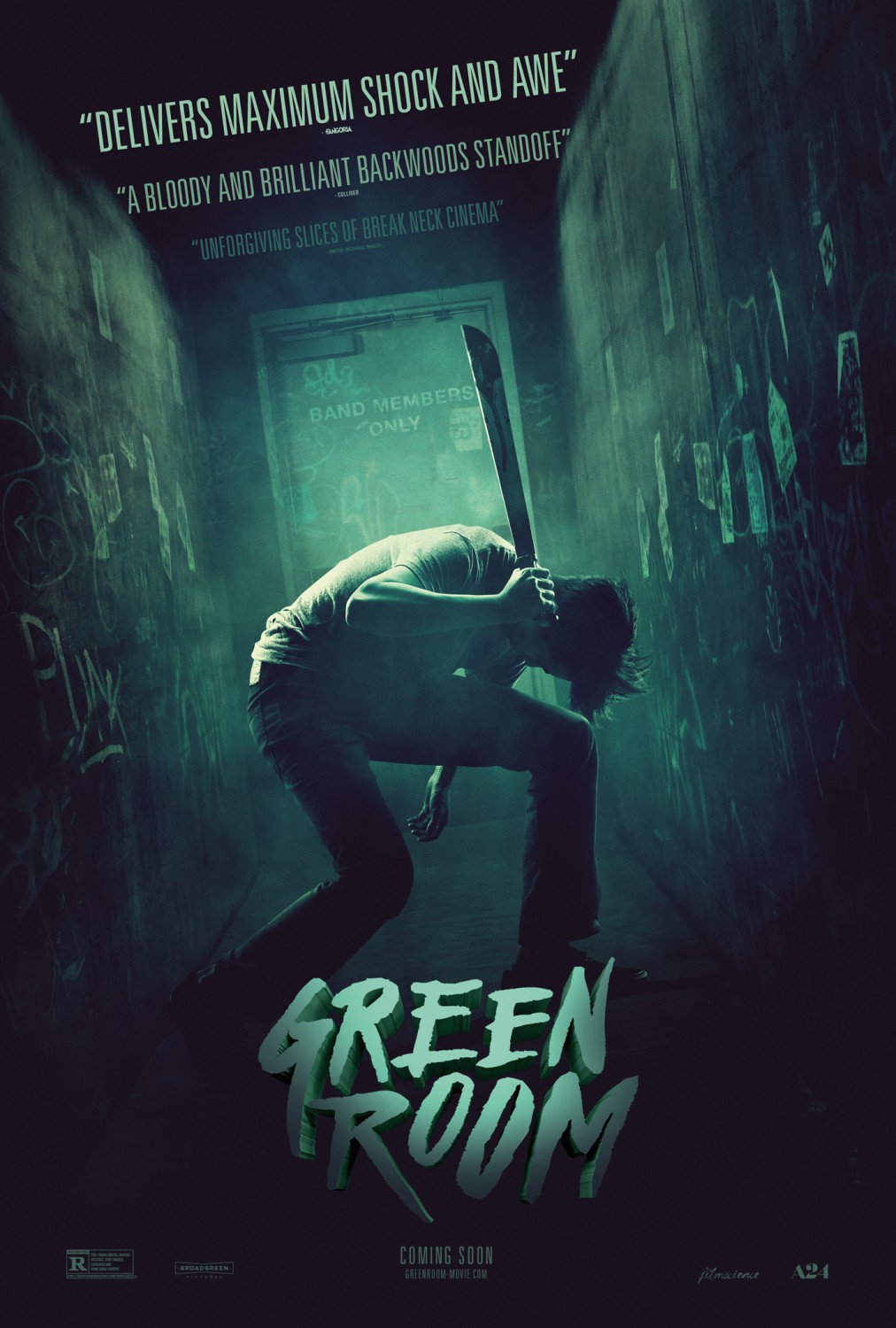
Green Room

Green Room movie poster

Green Room” is a nasty piece of work which sticks the knife into the viewer and sticks it real deep. Like “Assault on Precinct 13” (the original, not the remake), it is a siege movie but not the one you are necessarily used to seeing. The characters are really fleshed out to where the actors are inhabiting them more than acting, and the violence is not the usual PG-13 bloodless action. For those of you who like your movies seriously intense, ultra-violent and filled with characters who look and feel real, “Green Room” is one you want to check out. For those who do not care for violent movies in the slightest, you would do your best to avoid this one. If you thought “Harry Brown” was dark and bleak, wait till you get a load of this.

The movie opens on The Ain’t Rights, a punk band about to complete their long and largely unsuccessful tour, and their last show has them going to a rural place outside of Portland, Oregon. But upon arriving there, they discover it is a neo-Nazi skinhead bar located deep in the woods, far from the prying eyes of the police among others. Their show goes fine even though things get off to a rough start as they do a cover of Dead Kennedys’ “Nazi Punks Fuck Off” which has some audience members hurling beer bottles at them, but they still manage to get off the stage in one piece. But then they stumble upon a crime never meant for their eyes, and they soon find themselves trapped in the bar and at the mercy of the skinheads who, desperate to cover up their extra-curricular activities, have no plans to let them leave while they are still breathing.

There’s something endlessly fascinating about human beings being driven to the limit of survival. We start having what seems like an ordinary day which we often sleepwalk through, and then something happens which threatens our livelihood and activates our survival instincts to where they cannot be turned off. These punk band members are trapped in a horrific situation not of their own making, and they will soon find themselves acting in their most primal state as death constantly looms around the corner.

What surprised me most about “Green Room” was how real and complex all the characters were. These are not just a bunch of character types simply designed to infuriate moviegoers or immediately gain their sympathy. They all feel like real people caught up in a situation we hope never to be in, and they cannot escape the possibility of a grisly fate. Heck, even a simple negotiation between one character and another takes on a more sinister edge here as the intensity is ratcheted up to a level to where this movie feels like a blood relative of Sam Peckinpah’s “Straw Dogs.”

Plus, you cannot help but be deeply affected by the violence displayed here. Not once is it ever glorified as it is presented in an ugly and visceral form you will react very strongly to. One character gets their arm slashed in a way that reminded me of Naomi Watts’ gaping leg wound from “The Impossible,” and I could not help but gasp in response. Regardless of how many ultra-violent movies you have seen, you cannot leave “Green Room” feeling unaffected by what you have witnessed.

“Green Room” was written and directed by Jeremy Saulnier whose previous film, “Blue Ruin,” received a lot of critical acclaim. I have not seen that one yet, but you can sure bet I will be checking it out soon. He takes what is essentially a genre picture and upgrades it to one that feels far more potent than most. He also gives the punk band which occupies it an authentic feel as nothing they do onstage ever comes across as generic. Clearly this director has been around bands like these for a good portion of his life, and he knows how they operate as they work hard to keep their music from being easily corrupted.

Saulnier also benefits greatly from having a top notch cast which grounds their characters in a reality that feels all too real. Chief among them is Anton Yelchin who plays Pat and who is forced to get to his most primal state in a way he never expected to when he got up in the morning. Also effective is Alia Shawkat as Sam, the band’s sole female member who manages to control her fear enough to keep one step ahead of the skinheads looking to eliminate those in their path. Joe Cole and Callum Turner give memorable turns as the other band members Reece and Tiger, and Macon Blair leaves a strong impression as Gabe, a skinhead who actually grows a conscience in the midst of all the chaos.

One real stand out performance in “Green Room” comes from Imogen Poots who plays Amber. When we first meet Amber, she comes across as a helpless victim who is in over her head and becomes trapped with the rest of the band. But quickly, she becomes a very enigmatic character capable of violence the others are not. We only learn so much about Amber throughout, but Poots imbues her with what seems like a dark history filled with violence that she has somehow managed to survive in spite of her circumstances. Amber knows what’s at stake, and she’s willing to do anything she can to stay alive, anything.

But, of course, the biggest star in “Green Room” is Sir Patrick Stewart who plays a man who is the polar opposite of Jean-Luc Picard or Professor Charles Xavier. Stewart portrays Darcy Banker, the leader of this skinhead gang. What’s especially chilling about Stewart’s performance is how he makes Darcy into an ordinary guy capable of such insidious evil. Not once does he try to chew the scenery or turn Darcy into your typical skinhead villain drunk with power and hatred, but someone who has dealt with unfortunate situations like this before and has long since handled them in a calm fashion. Stewart never has to overplay the part as he conveys just how comfortable Darcy is in his belief structure and psychosis to where taking a human life is not all that different from swatting a fly.

“Green Room” is not high on originality and features situations we have seen in countless movies before, but arguing about this is a waste of time. It’s a heavy duty thriller that takes no prisoners and is unafraid in dragging us into an ultra-violent realm of society we would never want to see in person. If you like your movies claustrophobic and filled with an intensity which really jacks up your adrenaline, this one is for you. For those who do not like these kind of movies, don’t bother. Some movies are meant to be infinitely disturbing and effectively so, and this is one of them.

Copyright Ben Kenber 2016.

* * * ½ out of * * * *

Money Monster

Money Monster poster 1

2016 has been a good year for pulse-pounding thrillers, and “Money Monster” is the latest example. While not as intense as “10 Cloverfield Lane” or as viciously gruesome as “Green Room,” it certainly gets the adrenaline running thanks to taut direction and terrific acting from a star studded cast. While the handling of the material is at times scattershot and you come out feeling like it could have been better, what ended up on screen makes for solid entertainment.

“Money Monster” opens up on the set of a cable show with the same name which is hosted by wall street financial guru Lee Gates (George Clooney), a man whose ego is bigger than his knowledge of stocks. During what seems like a normal day of filming an episode filled with tips for investors as well as dancing and graphics to keep viewers entertained, Kyle Budwell (Jack O’Connell) somehow makes it onto the set, fires a gun in the air and takes Lee hostage. It turns out Kyle invested in a company Lee was especially enthusiastic about, but he ended up losing his entire savings in the process. After making Lee put on a vest filled with plastic explosives which could level a skyscraper, Kyle becomes intent on making him apologize not just to him but millions of investors who lost all their money thanks to the “advice” they received on his show.

Watching this movie reminded me of others which dealt with morally duplicitous human beings who, whether they intended to or not, ran into monsters they created out of their own greed and lack of understanding. Costa-Gavras’ “Mad City” quickly come to mind, but “Money Monster” stands above it because the filmmakers don’t deal with the subject manner in such an obvious way. There’s more going on here than what we see on the surface, and this makes what seems like an average movie one of the more intelligent ones I have seen in a while.

Clooney is perfectly cast as a man whose over confidence has long since gotten the best of him, and he shows a lot of vulnerability as his character of Lee Gates is exposed for all his falsehoods. We watch as his regularly scheduled program is interrupted in one of the worst ways possible, and it forces him to think fast on his feet in order to stay alive. Clooney excels in this kind of role as he is not afraid to show the deep cracks in this man’s façade, and this is even after he is revealed to be a three-time divorcee, the kind we see a lot of in movies.

As Kyle, Jack O’Connell brings the same fierce intensity to this role as he did in “Eden Lake,” “Starred Up” and “Harry Brown” among others. It’s almost exhausting to watch him here as his he starts at such a high pitch of energy to where he can’t allow himself to go slack for very long. This is definitely an actor to keep an eye on.

After suffering through the hideous debacle of “Mother’s Day,” Julia Roberts rebounds here as Lee’s long-suffering director, Patty Fenn. Now Patty may not be the star of the show, but she’s the one who makes it a reality on a daily basis. Roberts doesn’t need to do much to show how much of a veteran Patty is at her job as it involves dealing with dozens of people in a high pressure environment, and she truly shows grace under pressure when Kyle turns everyone’s world upside down. Patty quickly becomes the voice that keeps Lee sane as she continues directing the show which threatens to be more unpredictable than it already it is. Roberts is riveting to watch throughout as she does her best to keep her cool while everyone else loses their own much too easily.

In fact, what’s notable about “Money Monster” is how the female characters are much stronger than their male counterparts. This is the case not just with Patty, but also with Diane Lester (the excellent Caitriona Balfe), a high ranking executive who shows little hesitation in digging through her boss’ dealings in order to get to the truth. Just watch as one of her male bosses attempts to fire her; she doesn’t even break a sweat. Or how about Kyle’s pregnant girlfriend Molly (scene stealer Emily Meade) who has a show-stopping scene where she brutally berates Kyle without any hesitation.

Many of the male characters on the other hand are quick to crumble as their egos cannot handle defeat easily. Some might look at this as a bit sexist, or maybe the movie and its screenplay just exposes the reality that women are stronger because they have more to overcome both in society and in the workplace.

“Money Monster” marks Jodie Foster’s fourth film as a director, and she does a very good job of keeping the tension ratcheted up high throughout. Along with screenwriters Alan Di Fiore, Jamie Linden and “Stakeout’s” Jim Kouf, she takes what looks like a predictable story and messes around with the elements to where second guessing what’s about to happen becomes pointless. At the same time, she does have some trouble balancing out both the dramatic and comedic aspects here, and the more comedic the movie becomes, the more it loses its dramatic power. It’s a strong movie for sure, but you do come out of it thinking it could have been even better.

Still, “Money Monster” is an entertaining thriller that benefits from strong direction and terrific performances from its talented cast. It’s no “Network,” but it does have a lot to say about how money rules our lives and has us making rash decisions for the purpose of staying one step ahead of losing everything. While its ending is a bit too pat, it’s not just another mindless thriller. And in the end, it’s always nice to see wall street take a beating in any movie.

Copyright Ben Kenber 2016.

* * * ½ out of * * * *


Imperium

IMPERIUMfinalposter

Imperium” is being released not along after “The Infiltrator,” another movie dealing with an FBI agent going undercover and entering a vicious criminal organization in order to stop the bad guys in their tracks. Like “The Infiltrator,” “Imperium” doesn’t break any new ground in the realm of undercover cop movies, but it is a taut thriller which holds our attention as it throws a barely prepared protagonist into a den of snakes who are quicker to kill than trust.

Front and center in “Imperium” is Harry Potter himself, Daniel Radcliffe. Ever since playing the lightning-scarred wizard, the actor has taken on many challenges to prove to the world there is more to him than J.K. Rowling’s infinitely popular literary character. At first he seems out of place as FBI agent Nate Foster, but that’s kind of the point. Nate comes across as a bespectacled and bookish nerd who is more comfortable doing research than going outside of the office. It also doesn’t help he’s the butt of jokes by his fellow agents who have yet to take him the least bit seriously.

But then along comes agent Angela Zamparo (Toni Collette) who sees a strong potential in Nate for undercover work. She is also sick of her superiors devoting all their resources to foreign terrorism instead of putting just as much focus on domestic enemies. Angela brings Nate into her office, tells him what he needs to know and gives him a copy of “How to Win Friends and Influence People” by Dale Carnegie, the only book needed for undercover work. From there, Nate transforms himself into a war veteran turned skinhead and navigates his way into the dangerous underworld white supremacy.

I have to give writer and director Daniel Ragussis a lot of credit as he focuses on something I desperately want America’s politicians to focus on: domestic terrorism. When it comes to the “War on Terror,” much of the focus has been focused on international groups like ISIS or The Taliban, but the threat inside America has proven to be far greater these days. Ragussis makes this very clear as he features video footage and photos of Neo-Nazis at work, be it going on marches or committing heinous crimes against those people who are not white.

Radcliffe may still have the shadow of Harry Potter hanging over him, but this doesn’t affect his performance as Nate Parker in the slightest. He makes Nate’s transformation into an undercover agent not just believable, but at times frightening. Movies like these show their protagonists sinking so deep into their assignments to where they lose contact with who they are and develop strong friendships with criminals they are supposed to bring down. Radcliffe shows, a lot of times without words, just how desperate Nate is to get to the truth. We already know just how great an actor he is, and his performance in “Imperium” goes to show the kind of acting challenges he is willing to step up to the plate to take on.

But there’s also Toni Collette who proves to be every bit as good as Radcliffe in her portrayal of, Angela Zamparo. Collette makes Angela cool as they come, and it’s loads of fun watching her reduce her male colleagues to rubble as they can’t even begin to match her job efficiency. Collette made her big breakthrough back in 1994 with “Muriel’s Wedding,” and ever since then she has immersed herself so deeply into each role she plays to where you completely forget the ones she played previously. The scenes she shares with Radcliffe here are great as we watch a rookie and a veteran slowly start to figure one another out, and nothing is never as it seems.

“Imperium” has the requisite scenes where Nate has to think fast on his feet so his cover doesn’t get blown, and some resonate with intensity more than others. One of the best comes when Nate is going to a potential site for a party along with Andrew Blackwell who is played by “The Knick’s” Chris Sullivan. Blackwell brings his best poker face to this scene as we watch Radcliffe tremble in fear as he is made to feel death is just around the corner. Both actors succeed in creating an almost unbearably intense scene here as if they are about to make the most pivotal move in a chess game.

Now “Imperium” will not go down as one of the best undercover cop movies ever made, but it does get the job done. It also shows Radcliffe taking on a new challenge and growing even more as an actor. Both he and Collette are more than enough of a reason to check this movie out sooner than later. Writer and director Daniel Ragussis also deserves a lot of credit for focusing on domestic terrorism as it feels like a realm in today’s day and age which doesn’t get enough attention. Sometimes the greatest threat to a nation isn’t from outside of it, but from within. Seriously, look at what Donald Trump’s bizarre run for President has brought out into the open.

* * * out of * * * *

Copyright Ben Kenber 2016.